The Weekly Orbit [9/01/25]

The Weekly Orbit is a (sometimes) weekly column collecting and refining my more casual anime- and manga-related thoughts from the previous week. Mostly, these are taken from my tumblr blog, and assume at least some familiarity with the works covered. Be wary of spoilers!


Hey there, friends! Another pretty light week this week, but one in which I’ve got some interesting stuff outside of the usual Seasonal Anime bracket to share as well. Enjoy.


Anime – Seasonal

Call of the Night – Episode 9

Bear with me here. I’ve always found the co-opting of the “arcs” system that shonen anime fans tend to use a little frustrating. Admittedly, I don’t know if this is actually true, but my impression at least has always been that things are sliced up into arcs as a fan-led convention. So when an anime’s English marketing actually refers to something as an “arc,” I roll my eyes a little. All storylines are arcs when you get down to it, so what are we saying here, right?

Well, Call of the Night makes the argument that this part of its story should be called The Halloween Arc because it takes place entirely on Halloween. You know what? Fair enough. I’ll let them have this one.

This is all tangential of course to the fact that this is probably the best Call of the Night has been since its return. (If it’s not, its main competition is episode four. Throughout its second season, Call of The Night has proven to be surprisingly adept at tragic yuri. I would love Kotoyama to attempt a full series in the genre at some point.) Anko springs her plan into motion on the night of a Halloween festival, but we’re still in the dark about what that plan actually is. Thus, most of Anko’s actions throughout this episode—and we see enough of them that she’s basically the second protagonist here—seem engineered to make you, the viewer, wonder what in the utter fuck she’s trying to accomplish. This is more entertaining than it may sound on paper.

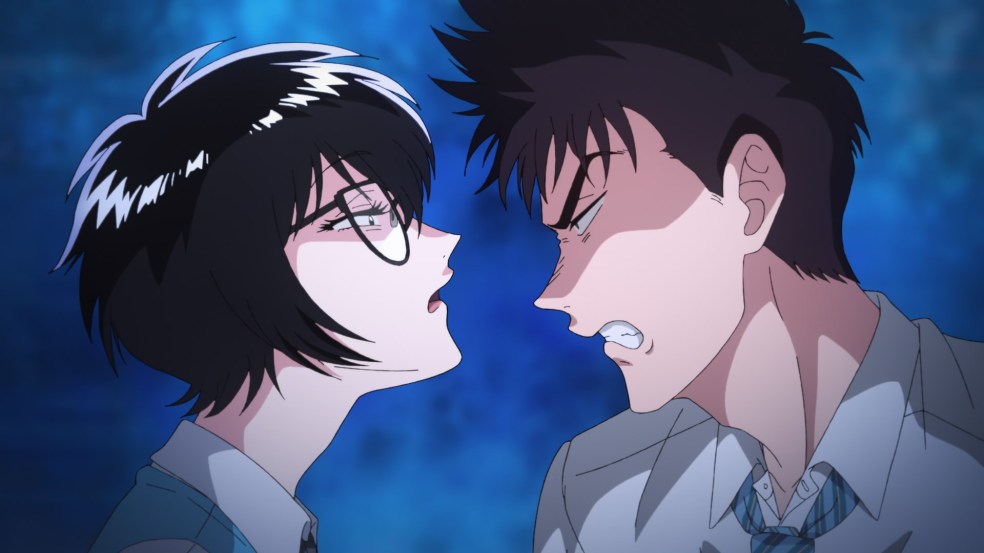
It’s been established that a vampire’s main weakness is memorabilia from their human days. With most of the vampiric side of the cast having gone out of their way to dispose of those, Anko begins enacting a strange plan where she actually shoots two of the vampires—Niko and Seri—in full public view. (The public in question, being about as smart as any fictional audience, assume a movie is being filmed Or Something.) They recover, of course. You can’t kill a vampire with something as simple as a revolver. But the provocation has had its intended effect, and by episode’s end Anko is running from Seri’s boyfriend (Takkun, also a vampire) and the rest of the vampires. We end on a confrontation in her and Nazuna’s old classroom, where the two reunite and stare each other down.

It’s a hell of a cliffhanger, and it promises even better things ahead, but what I really need to emphasize here is just how wildly entertaining Anko is during all this? I was a bit slower to warm to the character than a lot of people in my age bracket, but she’s an utter riot here. Sure, she’s the antagonist, but that doesn’t mean she can’t be silly with it. Particular highlights include threatening to shoot some random guy after he hits on a girl half is age only to reveal that that gun is actually just a gun-shaped cigarette lighter, and a sequence near the end of the episode where she just runs like hell after tossing Takkun into a trashcan.

CITY THE ANIMATION – Episode 8

I think I should mention that I’ve been watching the dub of CITY. That’s very relevant in this episode because it ends with a musical number! And to my (pleasant) surprise they actually dubbed it! That’s not always a given in anime dubs.

Now, the number itself was some kind of bizarre Hamilton-meets-Japanese folk tales-meets The Barenaked Ladies’ “One Week” kind of thing, but it’s the thought that counts.

Oh yeah and the rest of the episode was pretty funny, too. The “Bon Jovi” joke in the band names segment got me so hard that I had to pause the video to collect myself. Episode nine is pretty great, too, for the record! I’m hitting my limit for how much writing I can do about anime in a given week here, I think (this is the last bit of writing I’m doing other than the closer before this article goes up), but episode nine is a giant, wacky race. In the vein of something like….well, Wacky Races. The episode sprinkles in some backstory for the characters we’ve gotten to know over CITY’s run and is pretty sweet in addition to the usual humor as a result. This is especially true of our goofball schoolgirl lesbians Matsuri and Eri, who, soon to be parted, enter the race to make some final memories together and end up winning the whole thing. It’s cute!

Dandadan – Episode 9

Despite an absolutely fireworks fight scene at the start of it, episode nine is mostly a slower and more comedic break between the previous and upcoming arcs of Dandadan. This makes sense, and a decision to slow down a little and focus on the series’ character strengths is a good one on the heels of so much fighting.

That’s not to say this episode is devoid of important developments, though. Having finally become strong enough to take him on, Okarun manages to convince Evil Eye to not constantly attempt to slaughter all humans in his vicinity. Instead, the two of them will fight once a week. Like gentlemen. (More or less.) This paves the way for Jiji to return to school, which sets up the often hilarious second half of the episode, wherein Evil Eye emerges at school and Jiji’s classmates have to wonder why he’s suddenly talking about butchering all who stand before him, and why he suddenly looks so goth. It’s basically just one joke iterated upon for several minutes, but it’s a pretty good joke.

in between these things, Mantisian and some of his friends—including the Minecraft Steve-esque Mr. Ludris—rebuild the Ayase household’s home, with the help of an alien wonder-material called nanoskin. While this seems like just a cute way to wave away the whole “no longer having a house” situation that Momo and her grandmother would otherwise be in, it’s actually about to be rather important as a plot device. In the interest of not spoiling the rest of this season, I’ll say no more on that, but overall, yeah, this was a very fun episode. I’m excited to see where we head next.

Necronomico and The Cosmic Horror Show – Episode 9

As I assumed would be the case last week, Episode eight of Necronomico sets us up with what seems to be the structure we’ll be working with for the remainder of the series.

Our four remaining heroes have to tackle the four Old Ones, and they end up splitting up and doing each trial alone. This means that the first half of this episode is actually a focus story about Hastur on the villains’ side, and, on the heroes’ side, Sano Seishirou. Given that the latter’s characterization so far has amounted to a pedophile joke about 5 episodes ago, which even the show itself seems to have forgotten about, this is a good chance to give him some actual characterization.

And you know what? He acquits himself pretty nicely here. Hastur’s game is in of itself not terribly interesting, being essentially the card game War with a smaller deck and some extra steps, but it’s nice to see Seishirou actually fit into the “heroic teacher that goes down fighting” archetype, even as Hastur taunts him all the while. (The drawling, low growl that Okitsu Kazuyuki delivers for how Hastur mockingly calls Seishirou “senseeiii” is one of the best pieces of voice acting in this whole show so far.)

The card game does manage to have some legitimate emotional stakes, especially when Hastur conjures up mental recreations of Seishirou’s family for the final hand. Pretty impressive considering that it just boils down to a coin flip, essentially, but Seishirou ekes out a win by psychoanalyzing his opponent and is free to be reunited with his family.

Except he isn’t, because SURPRISE! HE DOESN’T ACTUALLY HAVE A FAMILY!

In the sort of beautifully brick-stupid twist you only get in this kind of show, it is revealed that Seishirou’s family, who we only met a few minutes prior, are in fact completely imaginary! Surprise! It’s the most hilariously awful system rep of all time!

Suffice to say, I think this is so dumb that it kind of comes back out the other side and becomes funny. How can you hate dialogue like this?

Others will feel differently I’m sure, and Seishirou’s victory over Hastur is pyrrhic anyway: he collapses and dies shortly after Hastur’s disposed of, leaving the remining three Old Ones (and possibly also Tick Tock Man? I wouldn’t put that past this show) for the anime’s final few episodes.

Ruri Rocks / Introduction to Mineralogy – Episode 9

Another complete delight from the slice-of-substrate anime this week. This marks a return to what we might call Ruri Rocks’ usual formula, but the expressiveness of the animation is at an all-time high here, and there are a lot of gorgeous moments throughout the episode. I’m particularly fond of Ruri’s dream of infinite fields of opal and how it eventually reflects itself in reality toward the end of the episode. This is also another episode that deals with a manmade object—this time a massive dam—and its impact on mineralogy, which is a theme the show seems to want to return to again and again. I admit I find it pretty compelling stuff, so I can’t complain. Also, Nagi tries on a bunch of different outfits in this episode and looks gorgeous in all of them, god bless.

There’s No Freaking Way I’ll Be Your Lover! Unless…. – Episode 8

I really enjoy that Satsuki’s evil plan to break Mai’s spirit consists of….telling an embarrassingly sweet story, so she’ll be distracted, so she can headshot her in a video game. Truly, a woman after my own heart (and of course the evil chiptune music makes a return to compliment it).

I find myself short on actual commentary for Watanare, which is a little frustrating because it’s honestly an absolutely fascinating show. In this episode we have a series of amusingly janky Red vs. Blue-ass 3DCGI segments, of our characters playing this video game they’ve agreed to compete at, juxtaposed against sincere emotional stakes, which are themselves complicated by the series’ overall messiness. (A term I normally hate and try to avoid, but I really can’t think of a better adjective to describe the relationships on display here.) If someone handed you just the script for this episode, you might think it was some kind of very bizarre sports anime, given how well the game and the emotional development are woven together.

Turkey! – Episode 8

Turkey has juggled an impressive amount of moods and tones over the course of its run thus far. Episode eight largely sits on the “quiet melancholy” end of the spectrum, before a sudden swerve—a fakeout, I am guessing—into horror at the episode’s end.

This isn’t my favorite episode of the series, and what we learn here is not anything we couldn’t have guessed from context. Still, the reveal of Mai’s backstory is well done, and I like the way everyone is connecting with their feudal counterparts. Also, I’m not sure what it was, but Nanase’s line about liking (or at least acclimating to) living in the past because she “feels useful” there really hit me. There is something immensely sad about that.

Anime – Non-Seasonal

Key The Metal Idol – Episodes 3 & 4

The main thing that has interested me about this show so far is its sheer, overwhelming atmosphere. That’s still true; there’s a real hypnagogic feeling to much of the plot. Key—who may not really be a robot after all? It’s still unclear—suddenly develops psychic powers, which she seems to unintentionally use to kill an idol singer (herself a remote-controlled PPOR android) mid-concert. The sleazy gravure idol manager from episode one hangs on to the lip of a rooftop for dear life. A tech CEO protests that robots don’t need self-awareness, damn it! All the while picking apart the gears of his own robotic “son.” These strange and haunting images, combined with the forceful sheets of pulsing, heavy synthesizer, give the entire thing the energy of a jumbled-up nightmare. I know people compare these two all the time, but it really does feel quite similar to Serial Experiments Lain. The emotional beats are arranged very differently, though, and in general Key the Metal Idol, at least so far, feels in some sense more raw and primitive. Time will tell if that impression holds.

22/7 – Ano Hi no Kanojotachi: day09: Miu Takigawa – Short

It has been five years since early lockdown-era idol anime 22/7 tried, and failed, to reinvent its genre.

22/7 the idol group, though, have ticked on. They still exist, and have persisted through a variety of lineup changes, a notably rocky history that has resulted in a lot of changes in direction for their sound and, admittedly, given them more of a fanbase than you might assume if you don’t follow idol stuff very closely. Takigawa Miu, the group’s center, was one of two remaining original members. She has now left. “Graduated,” as it is somewhat-euphemistically referred to among idol fans.

This short is ostensibly a sendoff. It’s not even narratively related to the 22/7 TV series (it has more in common with, and is presented as, an episode of the 2018 slice of life shorts that were created in the early lifespan of the projects), but it marks the end of something, so it’s still significant, as both a point to reflect on what 22/7 was and is and what its existence can tell us in general about the circles of art and media it is a part of.

Miu’s vocal performances—both voice acting and singing—were provided by Saijou Nagomi. (She technically reprises the role here, but doesn’t speak, contributing only a few soft sobs at one point. These could easily have been provided by a fill-in or pulled from archive audio, but I’m choosing to assume some amount of professionalism here.) Five years is a long time in the entertainment industry, and watching this short, and its quiet melancholy, I cannot help but wonder how she must’ve felt to have it playing behind her during her farewell concert, as that is the context for which it was originally produced.

It is worth noting that Miu is Ms. Saijou’s only voice acting credit of any note, and if she’s ever released any other music, I was not able to find it by doing a cursory search. Still, a glance at her Twitter page indicates she was keeping it professional up until her very last day in the group. There is lots of talk over there of cherishing every moment she spent with her fans and so on. As of the time of this writing, the most recent post is a handful of images from the farewell concert.

The short itself, portrays Miu in transit; first coming home on a bus, and then, after quietly crying to herself in bed, going somewhere that looks an awful lot like a college or new school of some other sort, in what is either a dream sequence or a flash-forward. It’s definitely playing into these sorts of thoughts; where is she going from here? Is she happy? Does she have regrets? On some level, all of that is as much an emotional manipulation as any of the more obvious work done by any number of more traditional idol anime—before or since—that 22/7 sought to surpass. (And we have to give credit to Wonder Egg Priority director Wakabayashi Shin that this is imbued with such emotion in the first place. The short has no dialogue, as mentioned.) Still, it’s overall a surprisingly moving piece of work, and one that feels ever so slightly out of step with where the medium’s sensibilities currently are, with its vibrant and shiny lighting that feels so tied to the visual aesthetics of the last decade as opposed to this one. I said it’s a long time in the entertainment industry, but honestly, five years is a long time for anyone. The short is a potent, if brief, reminder of this.

The last scene of the short shows us Miu, on a bus, looking back at the camera. We don’t know where she’s going, but she is going. It’s hard not to feel happy for her. And as strange as it may be to say, that shot, as it fades out for the final time, is probably the most 22/7 has ever affected me. Perhaps tellingly, it did it without subverting, reinventing, or deconstructing anything.

Manga

Dear Flowers That Bloom in Days of Yore – Chapters 1-10

I think, in a world where there are already a lot of yuri manga doing this, there is a danger that the whole “subversively playing with Class S tropes” setup would start to feel hoary and cliched in its own right. This has not happened broadly, and it certainly hasn’t happened with Dear Flowers That Bloom in Days of Yore. Protagonist Kasumi begins a letter writing relationship with an anonymous “onee-sama” after discovering a note from her in a copy of foundational Class S text Hana Monogatari. In doing so Kasumi and her “onee-sama”, who she eventually meets in person, discovering her to actually be an older middle-schooler named Haruyo. The two wrap themselves in these roles, roles that are heavier, bigger, and older than either of them. Heavier, bigger, and older, but not necessarily more real. And that tension is threatening to tear Kasumi apart.

Were the manga merely playing with Class S tropes, I would think it was clever but not terribly ambitious. Where it clearly excels is in its ability to use this framework to subtly but definitively expose Kasumi’s own internalized homophobia. Something happened to her. We don’t yet know what, but we know it involved a now deceased friend. In the most recent chapters, Kasumi has met another girl who also met her own “special one” through a letter slipped into the copy of Hana Monogatari. I won’t spoil the specifics, but the most recent chapter seems to certainly imply that the girls who meet via this method are doomed to tragedy. The book, in other words, is cursed. Literally or metaphorically? Who knows? The distinction isn’t relevant except for fiddly questions of what genres this manga technically belongs to.

I have gone this whole writeup without mentioning that mangaka Igarashi Jun is….honestly a very rare talent in terms of presentation. Aside from being an absolute master of chiaroscuro—simple but striking contrasts of solid lights and darks recur throughout the manga. You would think this would be very common in a medium that’s solidly black and white, but it really isn’t.—they also employ, admittedly sparsely, a number of paneling techniques I just really don’t see in manga very often. They’re also an expert at conveying mood through visual metaphor; before meeting Haruyo, Kasumi imagines her as a thorned rose bush in the shape of a woman. When the two sink their most firmly into their roles, the scene is wintry and amberlike; beautiful but remote. I think one could recommend this manga alone on the strength of the fact that it’s clearly written by a master of their form, but the subtle and resonant details of the storytelling shouldn’t go unappreciated either.


That’ll be all for today’s column. Have a pleasant week, friends.


Like what you’re reading? Consider following Magic Planet Anime to get notified when new articles go live. If you’d like to talk to other Magic Planet Anime readers, consider joining my Discord server! Also consider following me on AnilistBlueSky, or Tumblr and supporting me on Ko-Fi. If you want to read more of my work, consider heading over to the Directory to browse by category.

All views expressed on Magic Planet Anime are solely my own opinions and conclusions and should not be taken to reflect the opinions of any other persons, groups, or organizations. All text is manually typed and edited, and no machine learning or other automatic tools are used in the creation of Magic Planet Anime articles, with the exception of a basic spellchecker. However, some articles may have additional tags placed by WordPress. All text, excepting direct quotations, is owned by Magic Planet Anime. Do not duplicate without permission. All images are owned by their original copyright holders.
Seasonal First Impressions: This City Knows Your Name – Remembering and Forgetting in KOWLOON GENERIC ROMANCE

Seasonal First Impressions is a column where I detail my thoughts, however brief or long, about a currently-airing anime’s first episode or so.


Look at them individually, and no part of Kowloon Generic Romance seems all that strange. Its setting, the historical Kowloon Walled City, is probably the most individually unusual factor, but still, oddball places to set a romance series are hardly a new idea. The romance itself? An ice queen and a guy who’s too pushy by half, maybe more. Nothing strange going on there, even if it really is leaning into the self-deprecating part of its title. The atmosphere? Wistful. Thoughtful. Slow. But still, nothing too out of the ordinary.

Tying these things together, and making it clear that we have something strange on our hands, is the final element. Kowloon doesn’t actually take place in the historical Walled City, you see. It takes place in an alternate past-future present of it. The year is nineteen-exty-something, and a bizarre 3D-rendered floating octahedron hovers above the city, looking for all viewers like a nepo baby whose mom played Ramiel in Neon Genesis Evangelion. A mysterious pharmaceutical company has a hand in everything. Everything too, true to life, is old, used, and hand-me-down. Reiko [Shiraishi Haruka] our protagonist, points out that new shops rarely last in Kowloon, as though the city itself rejects the march of time. That may well be true of Reiko herself, too, although if it is, she doesn’t seem to be aware of it.

Reiko has a hot-cold relationship with her coworker Kudou [Sugita Tomokazu], she knows that this is a crush, but hasn’t acted on it. I can’t personally sympathize with that because, honestly, Kudou, easily the weak link here, is an unlikable dipshit, but people who aren’t me have crushes on unlikable dipshits all the time, so, fair enough. (Sidebar: He is clearly hiding something and I’m sure the narrative will take great steps to paint him as pained and with a heart of gold. This is whatever to me, I am passingly interested at best in the Generic part of Kowloon‘s Romance.) Their rapport works as well as it needs to, which is to say, I buy that Reiko genuinely likes this guy even if I wouldn’t. More interesting is where they go, after a day of work, Kudou takes Reiko out on the town, to a variety of small bars and eateries, before eventually showing her the Goldfish Tea House, a place with an eerie, unstuck-in-time atmosphere that feels very intentional.

The bartender—an odd term for a guy in charge of a teahouse, but I can think of no other—makes a comment that Kudou, evidently an old friend of his, has brought his girlfriend along again. This flusters Reiko, who is further perplexed by Kudou’s lack of a reaction. This sticks with her even more after an incident at their workplace, where Kudou, half-asleep, pulls Reiko into an impassioned kiss. (He seems half-asleep anyway. I don’t really buy, and I don’t think we’re supposed to buy, that this was entirely accidental. While forced kisses like this are an unlikable and common element of much romance fiction, the context makes me think we’re supposed to find this strange. If not, well, there’s no accounting for taste I suppose.) All of this then comes to a head when Reiko uncovers a mysterious photo among Kudou’s belongings, which seems to depict him with….her. But the woman in the photograph is smiling and cheerful, and it’s clear that even though the two look almost identical, physically speaking, Reiko doesn’t feel a direct connection to this other woman. The episode ends there, leaving us to ponder the mystery of what, precisely, is going on here.

The mystery, and the various visual bits and pieces that float through the episode, that is. Goldfish, watermelons, cigarettes, the moon juxtaposed with Generic Terra, the aforementioned octahedron, cramped city alleys marked with numbers, including 8s, which Kudou makes a habit of brushing against, defining it as a personal quirk. Plus noisy neighbors, traditional music. The episode’s slow pace and emphasis on the visual and aural, despite not having what we might traditionally call a “strong production”, makes it clear that it intends to plant them in the minds of its viewers, this array of symbolic objects contains, somewhere within it, the key to understanding just what exactly is going on with the woman in the photograph. A drifting mix of signifiers meant to rouse our interest without answering too many questions upfront.

Kowloon Generic Romance is based on a manga, so if one wanted to, it would be trivial to spoil themselves silly. Even the anime’s Anilist recommendations tab tells a story, being populated more by the likes of Sonny Boy and Summertime Rendering than any romance anime. This all but spoils that there’s something weird going on here, something weirder than simple coincidence. The involvement of a pharmaceutical company makes my educated guess induced amnesia, but honestly, who can say?

Something I’ve learned over the past few years of doing these previews is that there are two kinds of anime whose premieres strike me less as good or bad and more as puzzling. Those where the mystery is clearly an intended hook to rope in the audience, and those where I—and sometimes others as well—are reading in a subversiveness or intrigue that’s not actually there. Shoshimin Series (despite its mundane subject matter) and Summertime Rendering are the former, Reign of the Seven Spellblades is the latter. These categories are only obvious in hindsight, so while I think Kowloon is the former, only time will tell. Still, its mystery is enough for me to stick with it for now.


Like what you’re reading? Consider following Magic Planet Anime to get notified when new articles go live. If you’d like to talk to other Magic Planet Anime readers, consider joining my Discord server! Also consider following me on AnilistBlueSky, or Tumblr and supporting me on Ko-Fi. If you want to read more of my work, consider heading over to the Directory to browse by category.

All views expressed on Magic Planet Anime are solely my own opinions and conclusions and should not be taken to reflect the opinions of any other persons, groups, or organizations. All text is manually typed and edited, and no machine learning or other automatic tools are used in the creation of Magic Planet Anime articles, with the exception of a basic spellchecker. However, some articles may have additional tags placed by WordPress. All text, excepting direct quotations, is owned by Magic Planet Anime. Do not duplicate without permission. All images are owned by their original copyright holders.

Seasonal First Impressions: Maid in Abyss – Is YOU ARE MS. SERVANT Strange Enough To Stand Out?

Seasonal First Impressions is a column where I detail my thoughts, however brief or long, about a currently-airing anime’s first episode or so.


I’ve been trying to be slightly less longwinded in my writing as of late, so let me just lay the cards on the table here. You Are Ms. Servant, an odd little sort-of romcom from Felix Film, is primarily concerned with two equally-important questions. Question 1: Isn’t the anime pop cultural archetype of the maid-as-assassin, who exists only to kill on behalf of her master, as typified by examples as diverse as Izayoi Sakuya from Touhou and Roberta Cisneros from Black Lagoon, kind of fucked up? Question 2: Do you want a soft dommy mommy gf? Because whoever wrote this certainly does.

It’s probably best to think of You Are Ms. Servant as a pretty typical anime of this present moment for the medium. Visually, it’s all over the place, some shots are absolutely gorgeous, others are just barely passable. Overall, one gets the sense that, even accounting for the fact that this first episode looks pretty good on the whole, the production could fall to pieces at any moment and one wouldn’t be that surprised. There’s also a mashup of visual signifiers here that feels less original than it would have even a few years ago. Frequent cuts in the chibi style emphasize comedic moments, as does the technique of simply rattling a character back and forth very rapidly when they express surprise. At the same time, there’s a pretty heavy use of what we might call denpa imagery throughout this debut episode; shots of railroad tracks as trains breeze by, static-tinged memories, etc. It’s a weird mix, one that leaves the show feeling fairly incoherent tonally. A fact that is, in of itself, hardly notable at this point in this genre’s history.

The setup here is, as it often is in these shows, very simple. Yokoya Hitoyoshi [Kumagai Toshiki] is an ordinary high school boy who struggles with keeping his home clean and whose parents are presently conveniently out of town. Yuki [Ueda Reina], whose name we don’t actually learn in this first episode but which I am plucking from Anilist’s character sheet for convenience, is a “maid” seeking work, who has for reasons only vaguely explained in passing, decided to come to Hitoyoshi for her prospective employment. Obviously, this makes no sense and is the realm of pure fantasy. This is fine on its own, of course, and I’d even argue that the fact that Yuki goes to Hitoyoshi shaves some of the inherent ickiness off of the basic concept here. More the problem is that Yuki is cast firmly in the Yor Forger mold, she’s preternaturally talented at murder, but absolutely hopeless at anything else, in a way that is clearly supposed to be humorous but mostly hits a somewhat sour note. It’s hard to get the thought “we’re doing this again?” out of one’s head throughout a lot of the comedic material. This is a trope that’s been quickly run into the ground over the past few years, and Ms. Servant is not going to be the one to make it funny again.

If You Are Ms. Servant can claim any great innovation, it’s in attempting to return the character archetype to its roots. Yuki is a goofball a lot of the time, baffled by the idea that anyone would enjoy food instead of just thinking of it as pure sustenance and flummoxed by even the simplest of household chores, but there are moments that reveal some real darkness within her. Memories of being raised as a child assassin, Noir-style, intrude on the otherwise simple world of the series. One gets the sense that Yuki’s past is something she’s actively running from, and that her turning up on Hitoyoshi’s doorstep is no coincidence.

Hitoyoshi has his own demons, too. His parents’ absence would be unremarkable in most anime with this setup, but we learn toward the conclusion of this episode that he’s prone to having nightmares wherein he cries out for his mother. The implication here seems to be that Hitoyoshi is a child of divorce. So, it is perhaps inevitable that the varying needs of this narrative, in this format, conspire to give the final moments of this episode a, we’ll say, very particular feeling. This is where Question 2 starts coming up.

Technically, at least in this first episode, it is never outright said that these two are attracted to each other, but come on.

So that, it seems, is You Are Ms. Servant, an age gap romance informed by its characters respective troubled upbringings, standing on an unsteady foundation of hacky comedy, reaching for denpa signifiers in search of meaning. Will the series ever actually do anything with the obvious wellspring of disquiet here? It’s hard to predict these things ahead of time, but the example of some past similar anime doesn’t incline me to get my hopes up. Still, its blend of disparate elements is at least distinct. I want the series to dig into the pasts of its main characters more, and I want that direct namedrop of the term “found family” in the closing narration to actually mean something. Time will tell if it does.


Like what you’re reading? Consider following Magic Planet Anime to get notified when new articles go live. If you’d like to talk to other Magic Planet Anime readers, consider joining my Discord server! Also consider following me on AnilistBlueSkyTumblr, or Twitter and supporting me on Ko-Fi. If you want to read more of my work, consider heading over to the Directory to browse by category.

All views expressed on Magic Planet Anime are solely my own opinions and conclusions and should not be taken to reflect the opinions of any other persons, groups, or organizations. All text is manually typed and edited, and no machine learning or other automatic tools are used in the creation of Magic Planet Anime articles, with the exception of a basic spellchecker. However, some articles may have additional tags placed by WordPress. All text, excepting direct quotations, is owned by Magic Planet Anime. Do not duplicate without permission. All images are owned by their original copyright holders.

New Manga First Impressions: Shot Through The Heart – Love, Loss, and the Ephemeral Beauty of a Grassroots Fandom: The Story of LOVE BULLET

A Disclaimer: I don’t usually do this sort of thing, but even moreso than usual, if you’re just looking for a simple “is this good or bad? Thumbs up or thumbs down?” kind of thing, I would actually urge you to go read this manga as it currently exists before reading this article. It’s quite short so far (only a single volume), and well worth it. I get into a lot of minutiae about the plot below, and I’d hate to spoil the experience for anybody.

New Manga First Impressions is a column where I detail my thoughts, however brief or long, about the first chapter volume or so of a new manga.


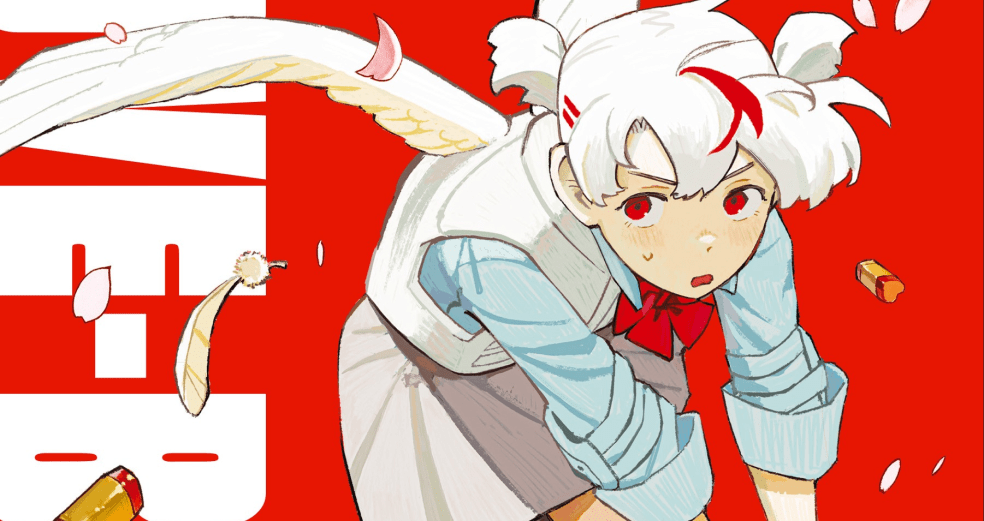
Love, to hear it told, is war. It’s a battlefield. It stinks, It hurts. It bites and bleeds. It’s rough going, in other words. It’s a little surprising, considering all that, that it’s taken this long for someone to have the idea of giving Cupid a handgun. But that is the basic concept of Love Bullet, the manga from newcomer inee that’s recently blown up in certain circles, depending on where you are on the internet. This is a case where the story outside the story is almost as interesting as the work itself, but we’ll save getting into all that for the end of this article. Here’s the, if you’ll forgive the pun, bullet points: Love Bullet follows a group of supernatural beings called cupids. Their task, armed as they are with a variety of firearms and explosives decorated with heart motifs, is to observe their targets in the human world and, with careful observation, decide who the best partner for them would be before pulling the trigger, as doing so makes the targets fall in love. There’s an additional twist to this, however. The cupids themselves are former humans, those who died before their time with some unresolved love of their own still in their hearts.

Becoming a cupid thus offers those who suffer this fate a second chance. And the pilot “0th” chapter goes some further way to laying out our premise and cast. Koharu, our main girl, is the rookie on the job. Kanna, her mentor, is laid back and does her best to help Koharu through the twists and turns of her new profession, there’s also the conscientious Ena, as well as Chiyo, who is, we’ll say, rambunctious.

Chapter 0 sees these four disagree over how precisely to resolve a love triangle of teenagers at a local not-McDonald’s. Three of the four cupids are in favor of pairing Hina, their target, with one of her childhood two childhood friends, Aoi or Daito. (The casual bisexuality of almost every ‘target’ character is worth mentioning, here, as an aside. It feels like an unshowy but powerful acknowledgement that the whims of the heart are often too complex to be so easily pinned down.)

Setting Hina up with either of these two would break the heart of the other, so this isn’t a decision to be made lightly. When the cupids are unable to come to an agreement, Chiyo, the one of the three who most likes to talk with her fists, starts a fight.

Fights between cupids aren’t lethal or anything—cupids can’t fall in love, so being shot or blown up or whatever with their equipment instead renders them temporarily indisposed by making them ridiculously jealous—so some trickery on the part of her mentor eventually gives Koharu, who is determined to somehow solve this problem in a way that doesn’t compromise Hina’s friendships, the deciding shot. Thinking outside of the box, she pulls the trigger between Hina and one of the younger employees at the McDonald’s, saving her friendships and setting her up with a sudden-onset crush instead. The takeaway here is this; Koharu has a good eye for unconventional solutions, something that will serve her well as a cupid in the stories of romance-to-be to come.

However, those stories don’t actually exist yet. The first main arc of the series—which comprises the first and currently only volume of the manga—is actually an origin story for our inventive matchmaker, and this is where Love Bullet goes from merely interesting to positively arresting.

Things begin simply enough. Koharu reminisces on her days as human high school girl Sakurada Koharu. She had a reputation as a matchmaker even then, and her talent for noticing these things put her in enough demand that we see her best friend, one Tamaki Aki, having to occasionally step in.

Koharu in fact seems so wrapped up in this little role she’s made for herself that she doesn’t really consider her own feelings very often. Aki directly says as much to her, only for Koharu to self-deprecatingly reply that beyond this talent of hers, there’s not much to her as a person. This is pretty blatantly untrue, but it gives us a good first look at someone who clearly struggles with her own self-worth. For her part, Aki also has ulterior motives behind trying to get Koharu to put herself first a bit more. Those motives? The obvious, Aki wants Koharu to like herself because Aki likes Koharu.

Unfortunately for both Koharu and Aki, however, this is where the series really earns that “doomed yuri” descriptor. Not a full minute after Aki admits her feelings, Koharu, frozen with indecision, promptly has a head-first meeting with the consequences of choosing to have long talks with your friend next to a construction site, and she promptly dies.

This is perhaps the one writing decision in this arc that I could, writing this a few days after having first read it, think of someone perhaps finding cheesy or even contrived. Honestly it kind of is! But that’s not really a criticism, at least it’s not coming from me, because Love Bullet uses this moment to explode into a bomb-burst of grief. A demonstration of how the world absolutely stops when someone you love leaves it. Love Bullet can afford to be a little loose with the actual literalities of how we get to that point, because, setting aside any fundamentally silly complaints about a lack of realism—people die in freak accidents every day—the actual point of all this stuff is to explore the feelings themselves.

This also marks a notable shift in style for the manga. As Koharu passes away, Love Bullet reveals one of its best visual tricks. The four-page sequence where Koharu dies is a pair of mirrored halves, and is just an absolutely excellent execution of this technique, to such a degree that I am surprised to see it from someone who’s relatively new to the medium1. On the first of these pages, three vertically stacked panels depict Aki’s grief-stricken face as she sees the life fade from her best friend. On the second, Koharu lies at the center of the page’s sole panel, in the midst of a heart-shaped pool of blood, finally realizing that she wanted to fall in love too. On the third, cherry blossom petals fall around her as she awakes, again in the center of a monopanel, newly sporting angel wings. Lastly, on the fourth page, three vertically stacked panels again herald the arrival of Kanna, Koharu’s new mentor, here to induct her into the cupids and thus begin our proper story. In the final signal that Sakurada Koharu the human is dead, Kanna addresses her as just “Koharu.” The scanlators helpfully point out that this change is even more drastic than it seems in English. “Sakurada Koharu” is of course a person’s name and is thus written with Kanji in its native Japanese, but “Koharu”, the cupid she’s just become, is addressed with her name written only in katakana, thus reducing it to pure phonics and making it clear that in some profound metaphysical sense, Koharu the human and Koharu the cupid aren’t precisely identical.

We don’t simply leave Aki behind as the story progresses, though. Koharu’s first assignment as a cupid is, in fact, to help Aki herself find a new love. What’s worse—or better, perhaps, depending on your perspective—is that time has not stood still for the human world between Koharu’s death and resurrection. In fact, it’s been half a decade. There’s again a brilliant use of mirroring here. Aki, now a college student at a prestigious art school who looks drastically different than she did just five years prior, is visually contrasted with Koharu, now an eternally-young angelic being, who looks more or less the same aside from her hair, eyes, and, of course, wings. Even their color schemes are stark opposites!

What’s more, successfully matchmaking as a cupid earns that cupid “karma.” Get enough, and history is casually rewritten such that you’re brought back to your human life. Of course, that doesn’t reverse the time that’s passed since then. Even when the prospect of becoming human again is dangled in front of Koharu, it’s very clear that for the most part, these changes that have happened are permanent. Kanna, who seems to style herself an upright mentor type, reveals that she’s actually the one who chose Aki as Koharu’s first target. From both a practical and personal point of view it makes sense; Koharu knew Aki very well, and there are few people more qualified to pick out a partner for her. On an emotional level, Koharu has to deal with the loss eventually, so she might as well take it head on. Still, it does all feel a little cruel, too. Of course, that too is almost certainly the exact reaction we’re supposed to have, and it’s one that gives this whole scenario some extra resonance. The feelings involved in romance, present or past, are rarely straightforward.

Eventually, by peeking at a “data record” that the cupids are given about their targets, Koharu learns that Aki has held a flame for her this entire time. This only makes sense, a person never really “gets over” something like that, but enough time has finally passed that, presumably with no small amount of effort from Aki herself, she’s able to move on to a new person to at least some extent. Kanna is able to gently coax Koharu into accepting her role as a cupid, and she resolves to find the best partner for Aki that she possibly can.

This is where we meet Chiyo.

You give love a bad name.

Chiyo serves as, more or less, the antagonist of this first arc, and is established as “battle-crazy” bad news who doesn’t really care about the people she’s ostensibly trying to partner up. In fact, when initially targeting Koharu here, she taunts that she thinks it would be “more fun” to just pair her up with somebody at random. According to Kanna, this kind of situation isn’t terribly uncommon. Cupids might technically all have the same job, but fights break out over who gets the karma payout off of claiming a particular heart.

All of this, of course, makes Chiyo a perfect counterpart to Koharu. The wild, battle-hungry fighter who’s here for a good time but not a long one vs. the shy newbie who has some actual investment in the fate of Aki’s love life. It’s actually Kanna who does most of the fighting with Chiyo, though, which would seem like a missed opportunity if they didn’t clearly have some sort of shared history of their own. (Chiyo calls Kanna out on trying to act like “a goodie two-shoes.”) Kanna is able to get Chiyo mostly off of Koharu’s trail by challenging her to a straight-up fistfight, which the heavily armed angel finds interesting enough to agree to.

Koharu, meanwhile, is sent to infiltrate the school with some angel magic. She can actually use this “cupid’s charm” to disguise herself as a human and interact with the college students, including Aki herself. (Who, in another melancholy development, can’t recognize her under the glamour.) Koharu is able to get a general sense of Aki’s current state in life by doing this, and while tons of Aki’s classmates are head over heels for her straightforward, honest nature and deep knowledge of art, most of them are pretty forward about trying to earn her affection, something she doesn’t really seem to care for. Koharu gets the sense that Aki needs someone more reserved and on the quieter side. In another brilliant little page-to-page compositional trick, the thought balloon that begins with “It’s like they need to be someone more reserved. Someone like–” is interrupted by another student calling Koharu’s name on the next page.

It’s perhaps unsurprising that Sakura there, a reserved and shy girl not terribly unlike Koharu herself, is who Koharu eventually picks as Aki’s love interest. I worry that reducing the setup to who “wins” though might make it sound like Koharu is being selfish or even living vicariously through Sakura. In actuality, the manga goes some length to demonstrate that Koharu’s decision is one she comes to after careful consideration. (And after Kanna wins her little bout with Chiyo in a very fun sequence I’ll leave unspoiled.) What gives her the conviction to finally pull the trigger is a conversation between Sakura and Aki herself. By this point, she’s shed her human guise, and the two thus can’t see her. As such, she’s given the surreal experience of hearing Aki recount her own death, and how she’s been dealing with the aftermath since then. It’s a beautiful scene, Aki quietly lays out how she managed to come to terms with Koharu’s passing, and Koharu, improbably, is there to hear all of it.

What really makes this work is how it helps Koharu come to terms with her own loss. In the final moments before she shoots, Aki’s feelings of loss seem to overlap with her own. Aki’s loss of Koharu reflects Koharu’s loss of Aki, the time that’s now forever lost between them, and both of their respective needs to continue onward in spite of all that. To put it bluntly, this all really, really got to me. I don’t cry over fiction easily, but that last page, where Koharu finally pulls the love pistol’s trigger and destines Aki and Sakura to fall for each other, made me start sobbing.

If you love something, set it free.

This, all of it, is fantasy in the purest sense. We don’t know, by the very nature of these things, whether our departed loved ones would want us to move on from them, but the idea that they would seems to be common across cultures, and these ideas that hit so close to the root of the human experience that they’re nearly universal are much of what I come to anime and manga for in the first place. Love Bullet is written by someone who is in all ways quite a different person from me, but the pain at the back of our minds, when we remember those who aren’t with us anymore, connects me to a girl in this story. That means something, and shouldn’t be dismissed.

Case in point: over a decade ago, an internet friend of mine vanished after being grievously harassed in the way that was all too common back then. Shortly before leaving, she told me she’d been crushing on me since we met. That was a very long time ago, and I don’t really have any way of knowing what happened to her, as this was before having all of your alternate social media accounts listed in some convenient place was common. Suffice it to say, my situation and Aki’s are quite different. But the fact that her story stirred this memory in me at all is a testament to the power of the narrative being put together here.

It is, I hope I’ve made clear, excellent stuff. These feelings are what art is for. What’s most impressive about Love Bullet is how it’s clearly the product of a unique and mature artistic voice, from someone who is clearly incredibly talented despite being relatively early on in her career. But what makes it worth reading are those moments of connection, the ones that hit you in the heart.

Obviously, I love this thing to death and want it to continue very, very badly. Inee has mentioned that she has a whole saga for Koharu planned out. (Plus there are so many opportunities for other interesting stories here as well. I am sure Chiyo, for example, has some heart-stompingly sad backstory that I simply need to see.) Unfortunately, though, this is where we get to the part of the article that’s not about the manga itself. Love Bullet, you see, is serialized in a magazine, and thus like any manga bound to that format, is subject to the whims of various people working on the business side of that endeavor. Those people are, often, absolutely ruthless about axing any manga that threatens to underperform. (A counterproductive approach that tends to part ongoing manga from their audiences right as they’re getting to know each other, it must be pointed out.) Love Bullet has, apparently, been underperforming in its volume 1 sales, and its future is therefore rather uncertain.

This is upsetting not just because it’s a fantastic story but also because, god damn it, I’m an author too. One of a very different kind, of course, but it’s impossible for me to see this person writing this story, pouring their entire heart into it, only for it to be threatened by the scythe of capitalism, and just sit here and do nothing. Rarely if ever are my articles capable of affecting tangible, direct change on the world. But this might be an uncommon exception. Sancho Step, the group responsible for scanlating the manga and thus bringing it to international attention (and whose scans I’ve been showing off here), have a very handy guide to purchasing the first volume either physically or digitally. Sancho Step have already done a lot for Love Bullet, and I’m under no delusion that my site has a massive reach, especially not compared to the #ReadLoveBullet campaign they’ve already had well under way for some time now. Still, if I can help move even one copy of the manga and possibly forestall its demise, that’s worth it. Good, impactful, resonant art is worth it, and Love Bullet is absolutely every single one of those things.


1: As is the case with most mangaka who get a debut serial, there is ample evidence that inee published some amount of independent oneshots and such before writing Love Bullet, so it’s not like she’d never picked up a pen before drawing it. Still, the command of panel composition displayed here is exceptional.


Like what you’re reading? Consider following Magic Planet Anime to get notified when new articles go live. If you’d like to talk to other Magic Planet Anime readers, consider joining my Discord server! Also consider following me on AnilistBlueSkyTumblr, or Twitter and supporting me on Ko-Fi. If you do the latter soon enough after this article goes up, I will probably use the donation to buy a copy of Love Bullet, so thanks 🙂 If you want to read more of my work, consider heading over to the Directory to browse by category.

All views expressed on Magic Planet Anime are solely my own opinions and conclusions and should not be taken to reflect the opinions of any other persons, groups, or organizations. All text is manually typed and edited, and no machine learning or other automatic tools are used in the creation of Magic Planet Anime articles, with the exception of a basic spellchecker. However, some articles may have additional tags placed by WordPress. All text, excepting direct quotations, is owned by Magic Planet Anime. Do not duplicate without permission. All images are owned by their original copyright holders.

Seasonal First Impressions: Out of Luck, Out of Love in MAKEINE: TOO MANY LOSING HEROINES!

Seasonal First Impressions is a column where I detail my thoughts, however brief or long, about a currently-airing anime’s first episode or so.


Like so many of this season’s premieres—the good, the bad, and the strange—the real meat of Makeine‘s first episode is in its closing few minutes. Unlike with some of those shows, though, we’re going to start from the beginning. Makeine: Too Many Losing Heroines, deserves to be taken on its own terms.

Nukumizu Kazuhiko [Umeda Shuichirou] is a cynical sort. Not in a bad way—this is not the sort of show that tries to pass off an asshole male protagonist as having depth by making him a snarky jerk—but he’s pretty sure he’s got some things figured out. Nukumizu is a big light novel reader, fitting considering that that’s his own home medium, and he loves romance LNs. These are stories he clearly deeply appreciates, despite or maybe even because of their generally cliché- and trope-ridden nature, and as we’re introduced to him, he’s sitting in a café finishing one up by himself. Now, Nukumizu isn’t delusional, he’s aware that romance novels aren’t reality, and in fact, he has a little opening monologue here about how most high school couples break up. “Nearly all,” in fact, if you count people who break up after graduation, according to him. ([citation needed] But it’s the kind of thing you can’t blame a single teenager for believing.) Still, he wonders, and maybe even wishes—and who hasn’t wished for things, every now and again?—that he could know what it’s like. He’s never had a girlfriend, and he doesn’t know how it feels to have your life upended by fleeting and sudden feelings. You can’t really blame him for being curious.

Some of that feeling might vanish though, by his meeting (or really, getting to know) our other main character, Yanami Anna [Toono Hikaru]. Anna and her friend Sousuke [Oosaka Ryouta] are having what at first seems to be some kind of lovers’ quarrel, but as Nukumizu eavesdrops, it becomes clear that Anna is actually encouraging Sousuke to make his feelings for someone else known. Somewhere in the conversation, it slips out that Anna, a friend of his since childhood, loves him too.

This is all quite awkward. Moreso when Sousuke has little hesitation in making his choice, despite Anna’s own hurt feelings, she encourages Sousuke to tell his crush how he feels before she transfers to England in the coming months. Thus encouraged, Sousuke runs off, his own romance story beginning off-screen and somewhere else. Meanwhile, left behind, Anna pathetically nips at the bitten-down straw of the soda he’s left behind, an act that Nukumizu happens to catch her in. Unfortunately for him, Anna notices and pulls up to his table.

Thus begins a full-on unwelcome venting session. A torrent of TMI traumadumping that makes Nukumizu feel equally awkward and unable to really wriggle out of the situation. Worse, Anna orders a bunch of food and stress-eats all of it (relatable) while getting over what she charitably describes as her “breakup.” Anna, as you may notice, is not the most considerate person in the world, but as a noted fan of anime girls with bad personalities, I enjoy her antics. Especially when she complains further about how they’re too lovey-dovey later in the episode when they invite her to karaoke and she has to hear them sing duets.

This is, in fact, the central comedic conceit of this series. Nukumizu acts relatively normal, everyone around him is a font of romcom light novel clichés and bad coping strategies post-getting rejected. This applies to Anna throughout the episode, who runs Nukumizu’s charge up at the cafe ordering first a big plate of fries and then, we later learn, several other things as well. (This sprouts a whole side-plot where the reason that Anna and Nukumizu keep interacting after this point at all is because Nukumizu wants Anna to pay him back. When she eventually reveals that she can’t, she starts making lunches for him, giving them further reason to talk to each other.) It also seems like it’s going to be true of the other main girls. Lemon [Wakayama Shion], for example, laments that her boycrush only likes smart girls. I am interested to see what bad decisions she ends up making as a result of this.

Mind you, I’d also be fine with it if Lemon just got to be uncomplicatedly happy. She’s like a sad puppy here, it really got to me.

The joke is thus Nukumizu’s constant pinballing off of everyone’s antics and drama, essentially making this a harem comedy where the girls more want the main guy as a shoulder to cry on than a love interest. However, if this were to just be a harem series where the protagonist is also secondarily the girls’ therapist, it might get a little formulaic. Thankfully, more than that, there’s a slightly deeper world being built here. Since Anna and, eventually, all of the main girls, seem to have unrequited crushes on other people, there is an entire cast of minor supporting characters who are off living happy romcom stories of their own. Our main characters are, thus, “the losers,” hence the title of the show. Admittedly, it is also true that the “winning and losing” nature of romcom media discussion can feel tedious and childish, but that is perhaps more a consequence of their being read largely by teens and teens-at-heart than anything else. Even so, this seems like something that Makeine wants to seriously engage with rather than simply inverting.

This creates an interesting effect whereby Makeine feels like the B-Side of a “normal” romcom anime that doesn’t actually exist. Our characters are the weirdos, the outcasts, or simply the awkward. People too shy or too strange to properly make their feelings known to others. Makeine‘s protagonist being somewhat genre-aware of all the clichés the other characters speak and do is not terribly original in of itself. Indeed, you could argue that “protagonist somewhat aware of the clichés of the genre he’s in” has become a cliché itself over the years. But this broader, wide-net arrangement of characters where the entire cast feel like the background characters of another anime certainly is. This is Makeine‘s subtle innovation, and it’s why, of the 3 (to 4, it depends on how you count) romcom premieres I’ve covered on the site this season, this is easily the best. It extends to the character designs to a certain extent, even. While our own hero and heroines have nice designs of their own, the supporting characters meant to come off as the “real protagonists” of their own stories often have similarly striking ones. This is particularly true for Karen [Waki Azumi], Sousuke’s love interest, a pink-haired sweetheart who seems for all the world like a born romcom lead and is even the rare contemporary anime girl with hair vents1, but who is nonetheless a minor character in the actual story of Makeine.

She even talks like the lead in a “normal” romcom.

This might even explain the otherwise-puzzling decision to give the girls’ uniform a vertical array of four bowties for each character, as it draws some attention to the lightly heightened nature of the setting. That it looks funny (and provides an opportunity to color-code each character’s ties to their general appearance) is a nice bonus.

I want to pause there, because these claims of subversion are the kind of proclamations that get anime saddled with heavy, meaningless terms like “genre deconstruction” or its equally-meaningless cousin “reconstruction.”2 Makeine is neither of these things. By all indications, it is not going to sit you down and lecture you about why Romcom Light Novels Are Bad, nor is it going to gently reassure you that Romcom Light Novels Are Good. Makeine is taking it as a given that you understand the value of its own genre. The B-Side feeling is a structural trick—a very impressive one, no doubt, but a structural trick nonetheless—a way of delivering this story in an intriguing and engaging way.

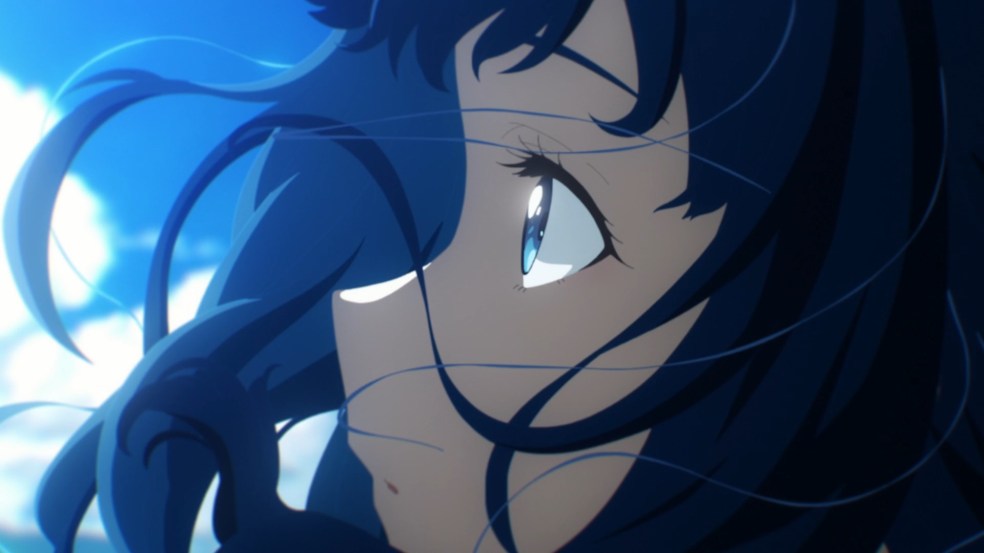
As Nukumizu finds out, a romantic comedy that takes place on the B-Side, underneath some other story, is still a romance story. Despite his own cynicism, his own awareness of how these things usually play out both in reality and in fiction, the final scene of the episode sees him shot through the heart. He sees Anna on the school’s rooftop—a shamelessly stereotypical occurrence, completely unrealistic, lifted from a hundred other anime, other manga, other light novels—her sky-azure hair against the backdrop of a billowing white cumulus cloud, and the wind catches it just so. Just like that, it is completely fucking over for our boy.

Anna doesn’t clock his smitten stare. The two talk for a while, and after spotting Lemon running track in the field below, she suddenly begins crying. This, she says, is her heart catching up to her head that she won’t ever be with Sousuke, which threatens to leave the episode on a bitter and sad note.

Instead, after she lets it out, she and Nukumizu talk for a bit about how “getting dumped” feels. There’s something very subtle and sweet about the complexity of feeling captured here. How the utter hole left by a love lost can hijack your thoughts in strange, unintuitive ways. Anna says it herself; thinking about Lemon running track down below her suddenly crashes into the feeling of rejection. Makeine is very observant here; rejection is not a “logical” feeling. Anna describing this whole thing as “getting dumped” in the first place is frankly a little generous, as she admits in an earlier scene she and Sousuke were never dating in the first place. But the human heart is not driven by what does and doesn’t make sense, and so here she is, crying on a rooftop, she and Nukumizu looking absolutely miniscule beneath the massive sky.

They talk, eventually Anna stops crying, and after collecting herself—admitting in the process that it doesn’t even “feel like a fresh start”—she takes a massive, hearty chomp out of a chikuwa. All the while, Nukumizu is thinking. Thinking about himself, about Anna, about boys and girls, and about the romance novels he loves.

He repeats the episode’s opening monologue to himself. Perhaps in denial, perhaps in realization that he is not immune to a good yarn, even if he’s the one living it. The episode ends here, on a soaring, hopeful note. It’s an open question as to how long it will take Nukumizu to realize what’s happened to him here, but I’m sure he eventually will. Because this, after all, is a love story.


1: A kind of hair style that was popular in anime character designs in the ’00s. Sadly, it seems to have fallen out of favor somewhere near the turn of the last decade. Perhaps it’s starting to come back? We can only hope.

2: I am here referring to both of these terms in their latter day TVTropes-y usage. I would actually argue that both are wholly artificial concepts and neither really applies to almost any piece of media, but even if we take the framework that these terms create to be a real thing, Makeine doesn’t fall into it.


Like what you’re reading? Consider following Magic Planet Anime to get notified when new articles go live. If you’d like to talk to other Magic Planet Anime readers, consider joining my Discord server! Also consider following me on AnilistBlueSkyTumblr, or Twitter and supporting me on Ko-Fi or Patreon. If you want to read more of my work, consider heading over to the Directory to browse by category.

All views expressed on Magic Planet Anime are solely my own opinions and conclusions and should not be taken to reflect the opinions of any other persons, groups, or organizations. All text is manually typed and edited, and no machine learning or other automatic tools are used in the creation of Magic Planet Anime articles, with the exception of a basic spellchecker. However, some articles may have additional tags placed by WordPress. All text, excepting direct quotations, is owned by Magic Planet Anime. Do not duplicate without permission. All images are owned by their original copyright holders.

Seasonal First Impressions: Otaku Hot Girl Summer in 2.5 DIMENSIONAL SEDUCTION

Seasonal First Impressions is a column where I detail my thoughts, however brief or long, about a currently-airing anime’s first episode or so.


Something’s in the air. Maybe Dress-Up Darling was the warning shot, but to hear Megan Thee Stallion tell it, the era of the Otaku Hot Girl is upon us. If we are not prepared, that’s probably on us.

Look upon your god and despair.

2.5 Dimensional Seduction, another entry in the “girl with a gimmick” subgenre of romcom, opens with insert narration. Here, our female lead, in voiceover, waxes rhapsodic about cosplay as the ultimate form of transformation and devotion. I don’t know about all that, but it’s certainly a very involved hobby. I don’t have the figure for it, myself, but I can imagine someone caring this much about it pretty easily. When we meet this person a few minutes later, we will find that she cares this much about basically every aspect of otakudom, so it’s certainly in character.

The first character we meet after the OP plays isn’t her, though. It’s Okumura Masamune [Enoki Junya], the president and sole member of his high school’s ‘Manga Research Club.’ Which is to say; he spends his free periods holed up in a club room watching OVAs by himself. In introducing himself to us, he tells us, charmingly, that he doesn’t like real women and only cares about anime girls. In telling us this, he recounts a remarkably quick series of mini-vignettes of romantic rejection and ostracization from his peers. This is as good a place as any to pause.

I already talked at length about the girl-with-a-gimmick setup on the 4th when I wrote about Roshidere, so I won’t repeat myself too much. But it’s worth briefly contrasting these shows to bring up a main difference between them. In Roshidere, the male lead seems to have a reasonable amount of self-esteem, despite being a huge nerd. In 2.5D, this is clearly not the case, or is only the case in that sort of weird sideways way that nerdy people tend to do where we convince ourselves we’re somehow better than everyone else for having slightly unusual interests. The geekboy persecution complex is a whole thing I don’t have the space or desire to get into here1, but there are two key things we should take away here. A. Given everything else we see in this episode, Masamune talking about how he only likes 2D chicks is clearly a coping method for managing rejection. B. Related to that, he is not a reliable narrator of his own feelings. This makes him a bit interesting, because it means, despite his misogynistic sentiments which they are clearly meant to be able to relate to, that he is not just a cipher for the audience to project onto. You’re not as much supposed to think that you are this guy, and more that you’re at least kind of like him. (Even if you’d handle the situation better. Maybe especially if so.) We’re led to both empathize with and look down on him, a perspective that bears some distant relation to the strange, schadenfreude-driven ethos of manga like Rent-a-Girlfriend. Thankfully, despite that, there’s nothing so heavy here. Our main boy is mostly just kind of a twit, and I’m pretty confident that we’re supposed to be laughing at him at least a little, even if the show does assume you’ll also root for him as a sympathetic (and presumably also nerdy, teenage, male) audience.

This becomes more obvious when our female lead, and in many senses our actual main character, Amano Ririsa [Maeda Kaori], barges into the clubroom and into Masamune’s life. They quickly bond, to Masamune’s own frustration, over a shared love of the character Lilliel, a magical girl from a series called Ashword Wars. From Masamune’s own point of view, this is a perfectly Shakespearean tragedy. Here he is, having proudly sworn off real women, only for one that he can’t ignore to crash into his life. Even without that other element that I’m deliberately dancing around this far up the page, this would already be a perfectly serviceable romantic fantasy for this show’s target demo. The two talk about minutiae in the Ashword Wars OVAs. Ririsa compliments Masamune’s frighteningly extensive collection of Lilliel figures, including the one with an exploding outfit. They play a fighting game together. What’s not to love?

In fact, if Masamune were more confident and well-adjusted there almost wouldn’t be a story here at all. There’s a real “Man vs. The Self” element to his inner monologue, which runs throughout much of the episode, in which he denies any attraction to this girl. He acknowledges that she’s attractive, and can even bring himself to say that “despite her gender” (goodness), she’s a true otaku. Were it not, he thinks, for the fact that she just has one too many dimensions, she’d be perfect.

Thus enters the cosplay angle.

I might describe the overall plot of the first episode as “guy gets incredibly freaked out upon learning a girl is way, way more of an otaku than he is.” Ririsa, you see, loves the same sexy heroines that Masamune does, claiming she projects herself onto them. This is—I hope I’m not shocking anyone by saying this—a real thing. Tons and tons and tons of girls, the world over, love and adore female characters who are, in some sense, made to cater to some kind of male fantasy. The world we live in is, unfortunately, patriarchal, and thus dominated by male fantasy. One plays the hand they’re dealt, and active reappropriation of these characters is a thing that any woman engaging with a male-led fandom2 learns to do. It’s second nature at a certain point. I found myself vibing pretty hard with Ririsa here, essentially proving the show’s own point! We’re not otherwise particularly similar people, but I love magical girls a lot, too! If I looked good doing it, I would probably cosplay at least occasionally. All of this is taking the long way around of saying; it is not actually surprising or unrealistic that Ririsa is who she is and loves to cosplay. Her sheer boldness in undressing in front of a male classmate is surprising and unrealistic—as is her taking him at his word when he says he’s not attracted to actual girls—but we can excuse that, as you please, as either naivete on her part or just a necessary narrative greasing of the wheels to make this setup work at all.

Ririsa explains that she truly fell in love with cosplay when a nascent fascination with the idea led her to attend an in-person event. Seeing all the other beautiful girls there dressed up in sexy outfits awakened something in her (I have rarely so quickly decided a character is bisexual), even after she was gently shooed off for being too young to attend. (To give you an idea, one of the cosplayers describes it as a “softcore” event. These girls are selling photoCDs filled with suggestive pictures of themselves, and that’s not something the show avoids talking about.)

Driven by the, ahem, beauty and passion on display she saw that day, she’s determined to eventually sell a photo CD of her own. Honestly, despite the ostensibly saucy subject matter, her attitude toward the whole thing is mostly just cute, but her passion for the hobby is clearly genuine. She ropes Masamune into taking pics of her in not one but several Lilliel outfits, and predictably he gets really into it. Enough so that he conks out from Ririsa calling him “Ashford-sama” (another character in the manga, you understand). Some further developments aside, the episode ends with Ririsa wondering why her heart is pounding so fast when remembering the photoshoot later that day, thus setting us up for future romantic adventures that will presumably involve a lot more photos of Ririsa in kinky outfits.

The fairly straightforward resolution may make one wonder. All of this subtext, the stuff about reappropriation and whatnot, that I’m reading onto the show, is any of it actually intentional? Without a direct line to the mangaka, it’s hard to say, but it also only half matters. A funny side effect of the show’s focus Ririsa is that, despite everything I said earlier about Masamune not being a simple audience stand-in, and despite not being the one with a running inner monologue, she actually comes off as having more interiority than he does, especially given that the interiority he does have is not particularly flattering! Ririsa is certainly the more sympathetic of the two, and I would not be at all shocked if this series picks up a decent-sized periphery of female fans who relate to Ririsa in some loose sense, even as the show, going by various promotional materials, gears up to get racier. This wouldn’t even be the first time such a thing has happened in recent memory.

My Dress-Up Darling, the other hot 2020s property about a guy and his hot cosplayer gf, is the obvious point of comparison here. But what’s striking to me is how different the shows feel. Dress-Up Darling has a lot of delicate character work, but it’s also actually more salacious than 2.5D has been so far. (In terms of the respective anime at least. I’ve read neither manga.) The two halves of that show can, in fact, feel like they fit together uncomfortably, when it’s doing closeups of lovingly-animated boob sweat in one episode and melancholic-romantic train rides home in the next. I can only speak for myself, but when watching that anime I often wished it would settle down a little. It really sings in its more character-driven moments, so the ecchi elements can feel like a distraction except in the rare occasion that they gel just so with everything else that show is doing. Even so, Dress-Up Darling is pretty straightforwardly the better series, and not just because Gojou is a much more likable male lead. I would be very surprised to see 2.5D even attempt to access some of the more complex emotional currents that MDUD consistently manages to, even in its weaker episodes.

2.5D is a series of much more limited ambitions, in general. The goals here, as of now, are to gently push Masamune and Ririsa together and have them engage in Convoluted Horny Situations, goofy antics, or both—in alteration or combination—the entire long way. There’s still a character arc visible from the start here, but Masamune is a much simpler character than Gojou from MDUD, and because he is also an otaku, he and Ririsa are instantly much more on the same page than Gojou and Marin are. Masamune denying his attraction to Ririsa, and then justifying it by claiming she’s a “2.5D girl”, is a bit. Something to make You, The Horny Teenage Boy Watching This Show, think he’s a lucky bastard but laugh at the same time.

A less cut-and-dry way it’s less ambitious lay in its visuals. 2.5D’s first episode has essentially one standout moment—the “headshot” when Masamune sees Ririsa in costume for the first time—against a general temperature of looking pretty good. But it’s not quite as striking as Dress-Up Darling or even Roshidere, so that does count against it a little. Even then, it’s hard to care too much when even “not as good as those other two shows” still looks pretty good. It also doesn’t seem nearly as interested in the finer details of cosplay and costuming as MDUD is, so I could see that being a negative for folks who want an authentic depiction of the experience. Certainly, I found myself missing it.

Overall, though, while I don’t know if I’d call 2.5D a particularly great show, I’m forced to respect its craftsmanship, as an honest critic. I can appreciate that, on some level, it is doing everything in its power to get these two dating. I will also admit to just having a weak spot for shameless audacity, and because 2.5D’s audacity isn’t tying a romance narrative I like a lot more down (so far, anyway), I am more charitable toward it than I might be if it were trying to do more things at once. Is that unfair? Yes! But that’s just how these things go sometimes. I think this show is alright; long may the Otaku Hot Girls reign.


1: For one thing, it’s not unique to otaku, at least not in the loanword sense of that term. When I was in high school, people were just as willing to get this kind of defensive over liking comic books, D&D, fantasy literature, alternative music, even video games well past the point where those had gone firmly mainstream. I imagine the boys at the younger end of Gen Z are fighting this particular fight even still, as we speak.

2: Which is most fandoms. Because the patriarchy privileges men in any given hierarchical system, you see.


Like what you’re reading? Consider following Magic Planet Anime to get notified when new articles go live. If you’d like to talk to other Magic Planet Anime readers, consider joining my Discord server! Also consider following me on AnilistBlueSky, or Tumblr and supporting me on Ko-Fi or Patreon. If you want to read more of my work, consider heading over to the Directory to browse by category.

All views expressed on Magic Planet Anime are solely my own opinions and conclusions and should not be taken to reflect the opinions of any other persons, groups, or organizations. All text is manually typed and edited, and no machine learning or other automatic tools are used in the creation of Magic Planet Anime articles, with the exception of a basic spellchecker. However, some articles may have additional tags placed by WordPress. All text, excepting direct quotations, is owned by Magic Planet Anime. Do not duplicate without permission. All images are owned by their original copyright holders.

Seasonal First Impressions: The Plastic Love of MY WIFE HAS NO EMOTION

Seasonal First Impressions is a column where I detail my thoughts, however brief or long, about a currently-airing anime’s first episode or so.

Certain typographical features of the below post are intentional.


The uneasy thickness of a nightmare permeates the scene, and a synthesized voice pushes a dinner tray into view. Singed metal and corrosion lay on a plate, served like a tidy meal. It’s a head; a human head, or at least something in the shape of one, smoldering and smoking, a revolting bon appetit for an unwilling customer. This is the kind of thing that would send anyone screaming awake, so when Takuma [Toyonaga Toshiyuki] does, it’s no surprise. For him, jolting awake is a moment of relief. Proof that he was just dreaming, that this jarring and disquieting interlude wasn’t real. That’s the problem though; with Takuma’s thoughts and with My Wife Has No Emotion in general. I’m not sure he’s right about that. (edited) [4:02 AM]

This moment, a surreal and genuinely disturbing dream sequence, is hidden in the middle of My Wife Has No Emotion‘s first episode like a knife between book pages. It colors everything that follows, and makes us see what came before in a different light, its influence spilling out from both chronological sides of the event. Look carefully, though, and it’s clear that the seeds for it were planted before the footage even began rolling. Go look at that key visual; note how Takuma’s eyes are closed and his hands squeeze his robot-wife in an apparent expression of domestic bliss that is nonetheless decidedly paternalistic and controlling. She, meanwhile, stares out at us. It’s a cold, creepy stare, but not necessarily a judgmental one. It almost seems like she just really wants to know. “Do you like this? Is this what you’re here for?”

In a sense, all of this is subtextual. Run the tape back and revisit our basic setup and you’ll see the familiar ingredients of a friendly rom-com with a sci-fi twist. Even then, though, simply describing the premise raises alarm bells. Lonely salaryman buys—has bought, this happens before the start of the show—an “appliance” as he calls her, a human-shaped robot to cook and clean for him. He is an overworked, pitiable mess of a man inhabiting a desolately empty apartment, and Mina [Inagaki Konomi], the robot maid in question, responds to him with, accordingly, pity, but also a towering amount of passive aggression. Assuming that’s not just me doing what Takuma may very well be doing: projecting our own thoughts onto a being that is, at the end of the day, not actually sapient. Akin to trying to “date” ChatGTP. In a show presented even slightly differently, I would have no trouble at all thinking this was supposed to be straightforward wish fulfillment despite all of these complications. Maybe it is, for a certain kind of person, but the second the show raises the possibility that this entire domestic setup is cover for something sinister, it’s impossible to stow the notion away, even if the anime itself might like to.

My Wife Has No Emotion should not, by all rights, be causing me to have these thoughts. Questions of meant—is this what the author meant to do here, is this how the author meant to make me feel—can be a trap. Without speaking to the original mangaka directly, we cannot know for sure what is meant by any single thing in this show’s first episode. Previously, I’ve treated questions of whether or not a show is Doing Something as a puzzle to be solved. We can do that here, too. We can observe how, despite the ostensibly simple setup of boy-meets-robo-chef, there is a strong air of the denpa all over this thing. A pronounced unease, a sadness that is at one point said aloud but is obvious from the outset. We can look at Takuma’s mostly-empty apartment. We can nod thoughtfully at his drinking problem and Mina’s attempts to curb it later in the episode. (Out of genuine concern, or is she just obeying her programming?) We can consider this setup in the context of the oft-slandered “rehabilitation” genre (I’m hardly a fan myself). We can compare it to past works in the medium to tackle the sapience of artificial, robotic humanoids; Chobits, Mahoromatic, Time of Eve. All of this, ultimately, might be like trying to search for sharks in a swimming pool. [4:13 AM] Speculation is speculation. We’re not going to know for sure if My Wife Has No Emotion will go there unless it does.

The nightmare in the middle of this first episode is strange, but to even go so far as to say it’s intentionally disturbing is to speculate. This is ultimately a work with an ambiguous, or more charitably, a very multilayered tone. Takuma lives alone and openly laments being lonely, so he projects this loneliness onto Mina. (Since the entire show is wholly from Takuma’s perspective we don’t know, and maybe can’t know, if she reciprocates.) He mentions having once had a girl over, but that this did not work out. We can make the reasonable assumption that being shot down made him not want to even try anymore. He’s clearly also at least a little scared of Mina, though. Is that a fear of the unknown—of not knowing how much agency truly lies behind those big, cameralike robotic eyes—or is it a much more basic fear of women? Is it both? Conflating the two wouldn’t be out of character, given what we learn of him here. [4:16 AM]

There’s also the presentation to consider. Mina’s character design is decidedly in the uncanny valley, even by the bug-eyed standards of moe designs, a feeling only reinforced by the moody staging, lighting, and backgrounds, and ramped up even further by the in-spots minimal, all-Casio-presets soundtrack. It switches to a fuller, more traditional romcom OST late in the episode, and that somehow feels even more artificial. Likewise, that scene sees the show gets “raunchy” in its final few minutes, and in doing so, it feels even more awkward. Like an intentional bit of self-sabotage. Message #anime-notes

My Wife Has No Emotion is a weird series that may or may not at some point bring that weirdness to the forefront for an extended time. But ultimately, that’s a gamble, and it’s going to be difficult to not feel suckered if this uneasy tone is a fakeout, bar an extreme strengthening of the series’ writing chops. Usually, I end these articles by offering a pithy summary and a blunt “should you watch this” yes/no recommendation. I’m not going to do that here, I think you already know if this bet is one you’ll take.


Like what you’re reading? Consider following Magic Planet Anime to get notified when new articles go live. If you’d like to talk to other Magic Planet Anime readers, consider joining my Discord server! Also consider following me on AnilistBlueSky, or Tumblr and supporting me on Ko-Fi or Patreon. If you want to read more of my work, consider heading over to the Directory to browse by category.

All views expressed on Magic Planet Anime are solely my own opinions and conclusions and should not be taken to reflect the opinions of any other persons, groups, or organizations. All text is manually typed and edited, and no machine learning or other automatic tools are used in the creation of Magic Planet Anime articles, with the exception of a basic spellchecker. However, some articles may have additional tags placed by WordPress. All text, excepting direct quotations, is owned by Magic Planet Anime. Do not duplicate without permission. All images are owned by their original copyright holders.