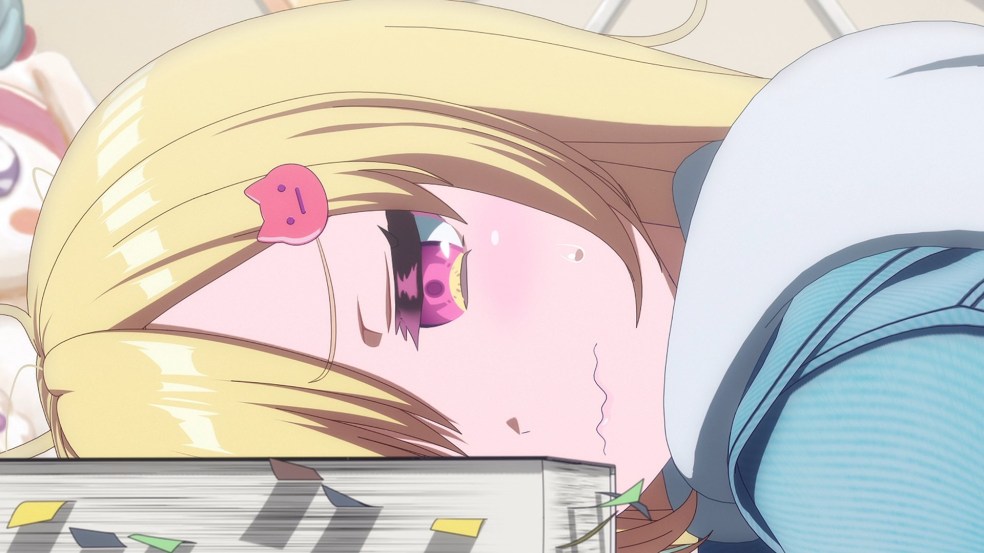
Seasonal First Impressions is a column where I detail my thoughts, however brief or long, about a currently-airing anime’s first episode or so.
Yeah, take a second to really take in that title up there. I feel like Todd in The Shadows talking about Mike Posner.
The Detective is Already Dead. La detective ésta muerta. This series, gratuitous Spanish subtitle and all, has, improbably, returned to us, from the great anime graveyard. Rescued from Limbo by…honestly I have no idea. I guess the light novels were selling well, that’s the only explanation I can think of.
How did we get here? I’m supposed to be on hiatus, you know. A combination of burnout a month or so back and the fact that I’m currently working on a project wholly unrelated to this blog means that I completely planned to take this season off. If I did any First Impressions articles at all, it would be for the handful of things I’m really looking forward to, surely, like Fools’ Night or something, right?
Well, I have a bit of a score to settle here, I guess.
The Detective is Already Dead, for those of you who have forgotten or just didn’t know in the first place, is a truly bonkers light novel adaptation originally from all the way back in 2021. It has a quite good first episode and a remainder of the series that varies wildly in quality. I wrote a review of that first season after it ended, very, very confident that it would simply never get a followup. It was a sometimes-good, sometimes-bad, but always-weird series that just seemed too odd to survive on television long-term. Let me quote myself, in fact, while also recommending you just read that article if you want the full rundown on the first season’s plot.
This is another of this year’s anime that will absolutely not survive the march of history, mentioned as it will be only as a curio or a “hey, do you remember that show with….?” answer. At best, perhaps some of the staff will go on to bigger and better things. In which case it will be an amusing trivial footnote. Call it a victim of the production bubble, call it just poorly-conceived. It is impossible to imagine Detective outside of this present time and place; mid-to-late 2021 specifically. It’s a born relic.
This is not the outright wrongest I’ve ever been on this site. (That’s probably still the article where I talked about how much I was looking forward to the future of idol anime, published right before that genre basically stopped existing.) But…well, it is a bit embarrassing, I suppose. It is important to admit that I was wrong, though, because I think what I failed to understand at the time is that Detective actually isn’t unique at all. To understand why, it’s helpful to quickly break down the whole “light novel anime” idea in general, as the implication of that term has changed greatly over time. At first, it meant dialogue-heavy, highly-conceptual pieces, stuff like Boogiepop Phantom. Then, at some point, the meaning shifted to refer to science-mystery-urban fantasy-battle every-genre-in-a-blender works, the most prominent example of which is probably the “Raildex” (A Certain Magical Index / A Certain Scientific Railgun et. al.) franchise. Nowadays, if you say that an anime is adapted from a light novel, most people will assume you’re talking about a narou-kei series, usually some isekai thing where a guy gets reincarnated into a fantasy world with some number of busted “cheat skill” superpowers.
These are all very different things, and I think the main mistake I made in classifying Detective back in the day is that it’s actually more akin the second definition than anything else. (Although its dialogue-heavy nature puts it in conversation with the first as well, in the same way that Monogatari‘s does even if this series is certainly not that one. It wasn’t the only one of these from around then, either. See In/Spectre from the year before.) In this way, Detective is—I know how this sounds—actually a bit ahead of its time in this regard, because this stuff is starting to make something of a minor comeback. (In fact, a new Raildex anime—the spinoff A Certain Dark Item—premieres in just two days.) So where Detective really sits in the greater context of 2020s TV anime is in the “throwback” sector, intentionally or not.
So, its due credit given, and it contextualized, I hope, at least a little better in the grand scheme of things, what does a return of this series five whole years after its first season really look like? Well, I admit I was curious to find out, so here we are.

We open on a brief, sorely-appreciated recap of the first season; Siesta [Miyashita Saki. I don’t normally do these little asides anymore, but it’s worth noting that this is actually probably Miyashita’s most prominent role. It’s either this or as the main girl from Harukana Receive. I say this with some surprise, as I always thought she was very good as Siesta.] and Kimihiko’s [Nagai Shin, who is similarly seemingly known almost entirely for this.] first meeting on a plane, mid-hijack, their battles with the secret organization SPES, their brief adoption of the little girl Alice [Naganawa Maria] who turned out to be a system, one of whom was the evil Hel [Hanamori Yumiri] who ultimately killed Siesta. In fact, Nagisa [Taketatsu Ayana] the girl who has essentially replaced the late Siesta as Kimihiko’s partner, is also part of this system, and I admit I don’t remember if we learned that in season one or if it’s new information to us here.
(Siesta was also somehow present in there. The series returns to its baffling heart transplant motif here and, ah, of course, I can’t believe I was ever confused about this! Nagisa developed the alter after receiving Siesta’s heart in a transplant, she literally stole her heart. It’s yuri! How silly of me for ever finding it odd. In any case, the Siesta alter seems to be gone now, so this isn’t really relevant. If you’re reading this and don’t understand system terminology, I am deeply sorry.)
Present for this recap are Kimihiko and Nagisa themselves, as well as Charlotte, nickname Char [Shirasu Saho], a blonde who was one of Siesta’s prodigies, and the be-eyepatched idol Yui [Takao Kanon. Yeah, Togawa Sakiko is in this show.] who I seem to vaguely remember threatened to shoot someone back in the first season. All of these characters—basically season one’s whole cast—were kidnapped by Siesta herself, and the recap is delivered by her, posthumously, via a recorded video. I must get in here the mention that the video recapping these events begins with, quite possibly, the best title drop of all time.

Absolute goddamn cinema.
Ah, but you may ask, how did she kidnap all of these people if she’s dead?
Well, obviously, Siesta, at some point, made a “bio-robot” maid modeled on her own likeness who could continue to carry out her plans after death.
Meet Noches [Miyashita Saki again. Obviously.]

Noches’ main role is to spoon out even more exposition, and this one is a doozy. It is revealed here, you see, that the “Great Detective” role that Siesta occupied in life is one of the twelve “Tuners”, key people of extraordinary powers throughout the world who combat the dangers to humanity that rise periodically throughout the ages. They’re basically the League of Extraordinary Gentlemen as translated to a light novel concept. You get it. (Someone should tell Alan Moore about this series, I bet his reaction would be extremely positive.) She explains that the people in charge of choosing the Tuners—whoever they are—are likely to accept Nagisa as a candidate.


She isn’t actually sure if she wants that, though, and she and Kimihiko spend some time discussing the subject at school later on, after Noches has let them go. The conversational rhythm they get into here is honestly actually pretty good. I don’t recall particularly caring for Nagisa back when I watched the first season, but she makes a shockingly good showing in this episode (the strongest in general, I’d say). In addition to the more lighthearted banter, they discuss Nagisa’s trauma. Recall that Hel is her alter, so when she remembers Siesta’s death, it is from Hel’s (and thus her own) physical perspective. There’s a genuine sense of guilt conveyed pretty well here, which Kimihiko, who also failed to save Siesta, shares in. This particular bit of bonding is easily the best-written segment of the premiere, and it made me genuinely invested in what happened next.

You see, if Nagisa does want to be the next Great Detective, Noches challenges her to find a “mistake” hidden in the video that Siesta recorded. Kimihiko and Nagisa eventually come to the conclusion that there is no such mistake in the video itself, such that the “mistake” must instead be something Siesta actually did wrong herself during the events in question. They mentally run down a list of people they could ask about it; Siesta herself is out of the question obviously. Charlotte and Yui, they conclude, would not know anything they didn’t already share. And then it hits them, the one person who was there that they could ask that they haven’t already: Hel.

Full credit, this is a pretty cool twist. The way it’s executed is neat, too, as Noches (who comes up with a procedure to ‘safely’—I’m sure that’ll hold true—resurface Hel) frames it more like summoning a demon than anything else, with the compelling imagery of Nagisa standing in front of a full-length mirror while holding a smaller one. It works, too, and Hel’s red-tinted return is where the episode ends. Obviously the way Hel is played—she’s literally described as an “evil personality”—is quite far from sensitive, but it’s at least an interesting thing plot-wise, and I have to admit! The cliffhanger made me want to tune back in next week.


I did not expect to find myself popping for Hel, of all possible characters, making a return. But, here we are.
What to make of all this in the broad sense? Well, aside from the fact that I’ve just come to appreciate this genre a lot more over the years (I will take a second wave light novel anime over a third just about any day of the week), it does fall into a pattern that a lot of premieres have fallen into this season, in that it’s a good enough premiere to make me want to come back for episode two, but not one that’s so great that I’m fully confident the rest of the anime will be as well.
2026 has been an insane year for anime, but that claim seems to really stop at the end of the last season, as the Fall season so far has been very dry, one of the seasons with the fewest “must-watch” new anime in at least a couple years. (Sequels and spinoffs are a different conversation, of course, and I do acknowledge that several acclaimed shows are making a return—not including this one, necessarily—but it’s still pretty thin on the ground out there.) In this landscape, something like this is about as good as most premieres can hope to get, and I’d put it in the same quality tier as, I don’t know, fellow light novel anime Nia Liston (a third-wave LN anime with many elements of the second by my reckoning, if its premiere is any indication). Ultimately, I think my reaction does betray some nostalgia for these characters (which I was perhaps not even aware I held), but the boring truth is that this is the kind of show where I will keep tuning in for exactly as long as each episode is about this good and no longer. If it slips below that, the likelihood of me finishing the season goes way down. That’s just how it is! It’s not an interesting thing to say, but it’s the truth.
Still, as I said, there is just some serious novelty—at least to me—in seeing this, of all anime, finally back. I can only…thank? blame? the light novel readers who I am sure are the only reason this got greenlit at all. It is a very surreal feeling to be reunited with one of the first anime I wrote about on this site that I just had no idea what to make of. Even now, having a better understanding of it and its influences, it’s still pretty damn weird. (You may have noticed very little actually happens in this episode. Starting a season with an episode that’s this dialogue-driven is ballsy in its own way.) So if my feelings seem a bit shuffled around but, as they did in my original review, still a bit mixed, I must apologize for not being able to provide some better answer to the question of: why this show, and why now?
I can think of at least one person, though, who probably would be able to give you a better answer. Unfortunately, she’s…well, you know the rest.
Like what you’re reading? Consider following Magic Planet Anime to get notified when new articles go live. If you’d like to talk to other Magic Planet Anime readers, consider joining my Discord server! Also consider following me on Anilist, BlueSky, or Tumblr and supporting me on Ko-Fi. If you want to read more of my work, consider heading over to the Directory to browse by category.
All views expressed on Magic Planet Anime are solely my own opinions and conclusions and should not be taken to reflect the opinions of any other persons, groups, or organizations. All text is manually typed and edited, and no machine learning or other automatic tools are used in the creation of Magic Planet Anime articles, with the exception of a basic spellchecker. However, some articles may have additional tags placed by WordPress. All text, excepting direct quotations, is owned by Magic Planet Anime. Do not duplicate without permission. All images are owned by their original copyright holders.