Seasonal First Impressions: Breaking Down the Madness of BRAVE BANG BRAVERN!

Seasonal First Impressions is a column where I detail my thoughts, however brief or long, about a currently-airing anime’s first episode or so.


Anime with protagonists in the military are a bit of a tough sell for me, for a variety of reasons, with only a couple of exceptions. Thus, when I went into Brave Bang Bravern!, the latest from CygamesPictures (and a rare original from them), it was mostly off the strength of its staff. That studio, Masami Ōbari involved as the director, etc. I had no idea what to expect, since all promotional materials suggested that this was going to be on the “fairly realistic war drama” end of the spectrum, as far as mecha anime go. You know, your Gundams and such.

In hindsight, there were several tells that this wasn’t exactly the case. For one thing, there’s that title; “Bravern” does not sound really sound like the name of a robot in that sort of thing. But I admit that’s a dubious imperfect metric (“Gundam” doesn’t necessarily sound like that either). And secondly, Obari is not really known for being involved in anime that are, in basically any way, down to Earth. So this show, with its JSDF mecha brigade protagonist Isami [Ryouta Suzuki], seemed like an outlier.

All this in my head, I went into Bravern a bit skeptical and very unsure of what to actually expect. To the show’s credit, that uncertainty turned out to be intentional. On the other hand, I’m still not entirely sure to what end precisely it’s doing all this, but there’s something to be said for going for broke, and I think there’s some good evidence that Bravern‘s heart is in the right place, as we’ll get to.

As for what it’s actually about, well, we open in the middle of a joint US / Japan / a couple other countries it’s not totally clear mecha training exercise, as one does, where Isami wins the day in-simulation by storming an enemy position by himself, backed up only by US Titanostrider pilot Lewis Smith [Youhei Azakami]. This opening scene portrays Isami as a classic wild gun, loose cannon sort. He goes against orders to do this, and is duly reprimanded, but the narrative seems to paint him in the opening half of the first episode here as a guy Willing To Do What Must Be Done. You know the sort if you’re familiar with any even vaguely macho military fiction.

As it turns out, this is the first of several fakeouts. The characterization of Lewis as a stock cool guy, on the other hand, seems pretty accurate. The show’s opening minutes do a lot to build up a tense but ultimately still friendly rivalry between the two. At one point, Lewis challenges Isami to a mecha showdown, asking if he’s not “brave enough” to accept, in a bit of fun foreshadowing.

The second fakeout dispels any idea that this is going to be a grounded, politically-driven mecha series. Somewhere in a control room, an alarm suddenly blares and a mysterious object appears on-screen. You know the deal here, too, most likely; an invasion from space, they show no mercy. The same bullet points that indie game ZeroRanger memorably pared down to their barest, most elemental form in its opening cutscene. They’re treated with a similar, perfunctory but punchy approach here. The invasion is swift and brutal, some real War of the Worlds shit as the aliens stride in, coldly levelling anything and anyone in sight with their pinkish UFO-mecha. This is about where most people might assume they’ve got Bravern figured out, if they’re entering sight-unseen. Those people would be wrong.

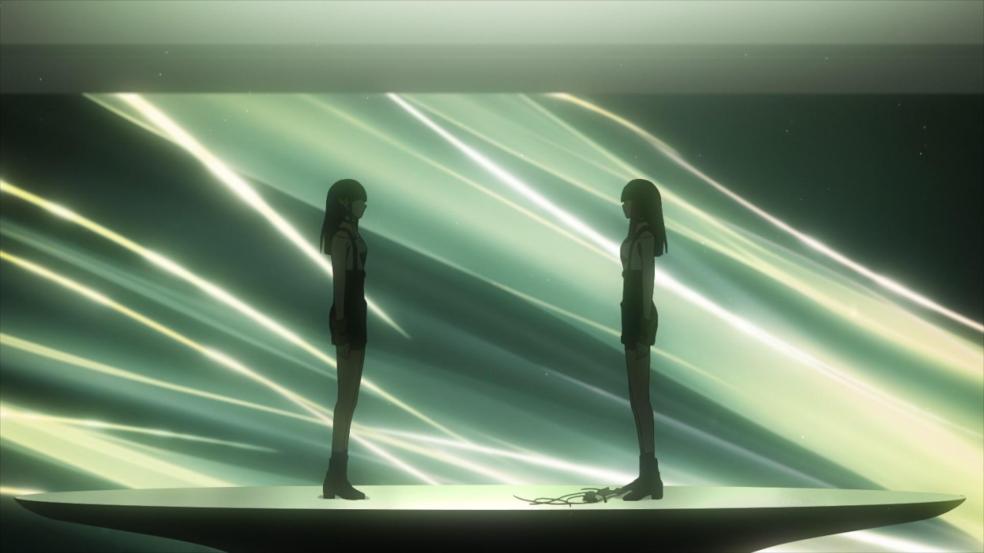
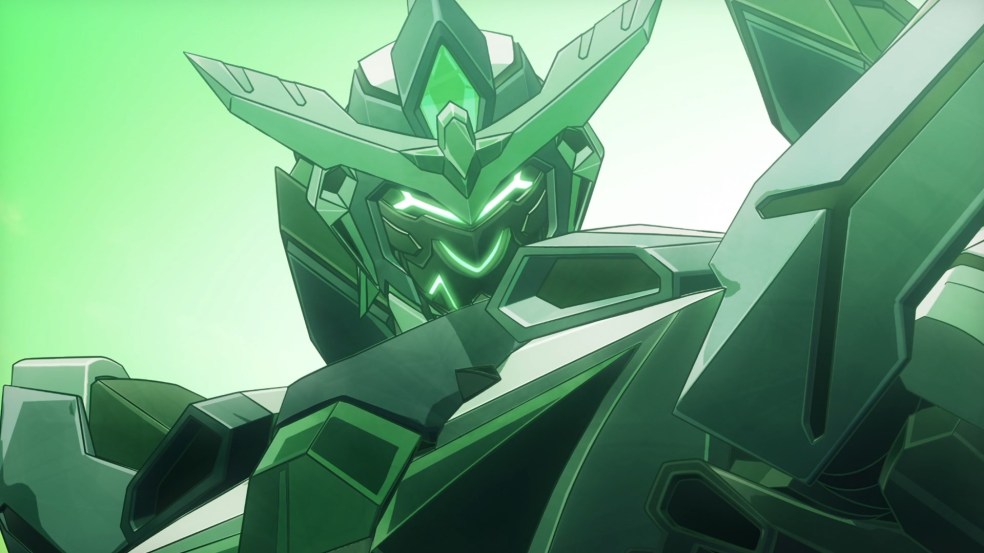
The situation falls to pieces quickly enough that the group who engaged in training exercises early on are left to fend for themselves. Isami tries and fails to save some of his comrades, including his blue-haired girl buddy Hibiki [Yume Miyamoto]. He does not do well, and it really seems like this is the end for Isami right up until the exact moment that one of the enemy’s blazing lasers is intercepted by an equally-bright green flash from the heavens above. Enter the show’s title character, Bravern [Kenichi Suzumura], a giant robot of a very different sort than we’ve seen up to this point.

Regardless of anything else I have or will ever say about this show, the turn-on-a-dime “what the actual fuck” spectacle of what happens here is absolutely immaculate. It’s the best capital A-M Anime Moment of the year so far. It is some absolutely cool as fuck nonsense. Isami goes from a foot soldier to plunged into the cockpit of Bravern, a dyed-in-the-wool super robot in the classic mold and a character in his own right. He has a flaming sword, he fires blasts of green energy, he arrived on a beam of green energy. He has diegetic in-cockpit theme music. It is a few absolutely wonderful, absurd, totally ridiculous minutes, and even if everything else this show does ends up absolutely paling in comparison, it will always have this.

It’ll also always have its actual, real opening credits, which seem designed with that same classic, old-school mentality in mind; a steel aircraft carrier beneath an azure sky, glowing, neon outlines around a cast of menacing, gargantuan robot silhouettes aglow with neon lines that we have yet to meet. It’s awesome. It promises a lot. Delivering on that is going to be the hard part, but it’s a promising sign that, as he sits in Bravern, Isami realizes that when he was a kid with dreams of justice, he didn’t really want to be a spec. ops. guy, a fighter pilot, a tank driver, or even a Titanostrider operator. He wanted to be a hero.

All of that is to the show’s benefit, because from here on out, starting in episode two which I’m also covering here, figuring out what this series even is becomes a lot more complicated. Because, you see, in addition to being a willful juxtaposition of super robot science-fantasy against a fairly gritty invasion story sort of thing, Bravern is also….a BL-inflected comedy.

No, really. Buckle in, because this is where things get weird weird.

When we see Isami at the start of the second episode, he’s being detained by some shadowy group or another and very literally tortured. This is a pretty sharp tonal departure from the end of the last episode, but what’s intercut with it is even stranger; Bravern, attempting to explain the situation to the group of military officials still gathered on the aircraft carrier and them largely not understanding. To be fair to them, his explanations include a lot of shouting his own name, Isami’s name, and doing things like relating his life story like a literal book complete with chapter titles. Also, his fixation on Isami is very clearly meant to resemble a gay crush, and his description of their first time “piloting” together very quickly becomes laden with so much innuendo that the term ‘subtext’ no longer feels sufficient. The show playing this for comedy is….a little blue, to say the least. (As is the show’s apparent intentional juxtaposition here. Isami is literally being tortured, the military officials are being ‘tortured’ by Bravern’s mannerisms. Eh.) Much of this seems designed to raise the question “what if the super robot you were piloting had a thing for you, and he was kind of annoying about it?”

By contrast, the actual situation Bravern’s explaining is pretty dire. The peril invading their world is an alien invasion of bio-machines, spearheaded by eight ships called Deathdrives, each containing a swarm of mecha and a single more powerful unit. One of which, the blue anti-Bravern called Superbia, we meet here. Superbia and Bravern fight, of course. Since Isami is still being detained by some aloha-shirted torturer guy, Bravern comes very close to losing that fight, as he’s noticeably weaker without someone in the driver’s seat.

Isami has to be convinced to get back in Bravern, in true mecha anime fashion, as his, ahem, “first time,” was not had under the best circumstances and he’s still processing all this stuff. (That’s all text, by the way, I am doing very little interpreting here.) At one point, Lewis tries to pilot Bravern instead, sweet-talking to the big red boyscout with talk of how he, too, wants to save the world and everyone on it. This almost works, and we are treated to a delightfully goofy scene where the whole conversation is rendered like something out of an old shoujo series, but Bravern seems to be monogamous. No one gets in him but Isami, and that’s final.

When he finally does get in Bravern, the dynamic duo kick Superbia’s tailpipe, of course. Including a charming, doofy scene where Bravern goes in for the super move kill and then stops himself because he insists that he do a different one this time. It’s charming, it’s very silly, and I think all this taken together maps out Bravern as being focused on, in roughly this order; being awesome, being gay, and being funny. That’s not a bad thing to be, even if the finer details of its themes remain ambiguous. Isami still has military command to deal with, after all.

My bet, if I can try to manifest something into existence here, is that Isami’s emotional journey will be attached to his learning to grow out of this role he’s built for himself as a soldier—one he’s already very much leaving behind as of episode 2—and into the role of a real hero, and there’s one final piece of evidence that might support that reading.

Just when it seems like the second episode could not possibly get sillier, Isami’s clothes explode in the final minutes of its main closing scene, and he is stuck inside Bravern as the episode ends, in an apparent parody of that one Evangelion episode. A ridiculous gag with no further meaning? A symbol of him being forced to shed his “soldier’s uniform” and confront reality as it truly is? Both of these things, somehow? Bravern’s sheer absurdity practically demands this kind of overanalysis, even as it can absolutely just be enjoyed as pure entertainment.

All told, the operative adjective here is definitely “campy.” And there’s a lot that I haven’t mentioned, including our main mechanic character, Miyu [Ai Kakuma], whose interest in Bravern quickly gets into robotfucker territory. (She thinks he’s handsome. Can you blame her?) There’s a pretty great scene where a German official speculates in her native language with one of her cohorts that this whole thing might be some kind of ploy by the Americans, only for her to be loudly reprimanded with Bravern’s absolutely awful German. There’s the show’s bizarre, maybe intentionally funny? art style dimorphism between the men and the women, where the former look like they’re from a relatively grounded military series and the latter look like they’re from a KyoAni production. (Quite possibly also just reflective of the interests of main character designer Jae-Uk No.) There’s a gag where Bravern cuts off a government official by loudly yelling his transformation phrase (obviously, he can turn into a futuristic jet fighter) and flying away. The fact that this thing is clearly heavily inspired by—and might be part of? I’m not clear on this—the Brave series. The fact that Isami and Bravern’s shouts are out of sync the first time they do their finishing attacks. And on, and on, and on. There’s a lot to like here, a lot to be puzzled over, and a few things to take issue with. It adds up to one of the season’s best premieres, and certainly one of its most ambitious.

It’s totally possible that all of this completely flames out, of course. This has happened before. Giving a story tons of slack because it’s weird or absurd can lead to Magical Destroyers situations, or even, in a worst-case-scenario, a Darling in the FranXX. Still, what’s the point of flying close to the Sun if there’s no risk you’ll be burned? Icarus was a chump.

After a supremely homoerotic ED sequence, Bravern‘s second episode features a brief post-credits scene, where Lewis quite literally stumbles over a girl in a crashed UFO-like ship, by implication, this was the pilot of Superbia, and is our local Rei Ayanami. This fairly standard sci-fi twist after such a weird premiere made me absolutely redouble my commitment. More than anything else that’s premiered this season, for Bravern, I will be there no matter what. I have got to see where this goes. Join me if you’re brave enough.


Like what you’re reading? Consider following Magic Planet Anime to get notified when new articles go live. If you’d like to talk to other Magic Planet Anime readers, consider joining my Discord server! Also consider following me on AnilistBlueSky, or Tumblr and supporting me on Ko-Fi or Patreon. If you want to read more of my work, consider heading over to the Directory to browse by category.

All views expressed on Magic Planet Anime are solely my own opinions and conclusions and should not be taken to reflect the opinions of any other persons, groups, or organizations. All text is manually typed and edited, and no machine learning or other automatic tools are used in the creation of Magic Planet Anime articles, with the exception of a basic spellchecker. However, some articles may have additional tags placed by WordPress. All text, excepting direct quotations, is owned by Magic Planet Anime. Do not duplicate without permission. All images are owned by their original copyright holders.
(REVIEW) Feminism, Football, and FAREWELL, MY DEAR CRAMER: FIRST TOUCH

This review was commissioned. That means I was paid to watch and review the series in question and give my honest thoughts on it. Thank you for your support.


There’s a long, and pretty embarrassing, story behind this particular column.

A solid sixteen months ago, I was commissioned to watch this film by a Twitter follower. I added it to my queue and intended to get to it pretty promptly. After all, movies are pretty short time commitments compared to, say, a whole cour or two of TV anime. Somehow, over the next several months, I’d managed to incorrectly get it in my head that I’d gotten through the entire batch of commissions that I took around that time, instead of just most of them. A fair bit later into 2023, shortly before I had my massive burnout episode in August, I realized I’d never actually finished this, and another commission. (Which will hopefully be up on this site, soon, but is a bit more of a time commitment, being for a whole series instead of just a movie.) Yesterday, in the middle of January, a year and half later, I finally had both the time and motivation to watch and do a writeup on the film.

So that’s why this column exists. At this point, I have no method of contacting the original commissioner (I, a brilliant mind as always, forgot to write their name down, and I don’t have that Twitter account anymore), and thus have no way of letting them know the work has finally been completed. Hopefully, they somehow see this. If not, this is an endeavor I embarked on purely to make myself feel less bad about essentially scamming someone by accident. Genuinely, I feel pretty terrible about this whole thing, and this entire explanation is only that and not an excuse, of which I have none. But I figure the least I can do is give the film an honest go.

And if there’s a silver lining to this entire rigamarole, at least on my end, it’s that I got to watch a pretty decent sports movie. I’ll go farther actually; Farewell, My Dear Cramer: First Touch, is a good sports movie. It’s a fairly typical underdog’s journey kind of thing, with the additional slant that there’s a bit of tackling of sexism in sports here as well.

Our main character, Nozomi [Miyuri Shimabukuro], is forever frustrated that, following an injury in her first year of middle school, she’s not usually allowed to play in official matches with her school’s soccer team with all the boys, despite the fact that she really wants to.

Nozomi’s the one with her arm in a cast.

People tell her, explicitly, many times throughout the movie, that girls are just weaker than boys and that she will never be able to compete on even terms. This is a bit silly, even in-universe, because generally speaking, throughout the film, Nozomi is shown to be very good at soccer. The source of much of the film’s conflict is actually just that her soccer team’s coach [Kouji Yusa] won’t let her play in any serious context. He’s too worried that she’ll get seriously injured and ruin any chances of a future career, apparently ignorant of the psychological damage he’s doing in the present in the process. In his limited defense; Nozomi does get hurt during a game near the start of the film, but it’s hard to read his attitude as anything but condescending when this same incident is still being cited as a reason not to field her months later. It’s only toward the end of the movie that he changes his tune, and how that happens dovetails nicely with First Touch‘s other big thematic point; soccer as an expressive medium.

There’s an old cliché you’re probably familiar with: “it’s not about winning or losing, it’s how you play the game.” In First Touch‘s world, they’re instead about equally important, which is still more consideration of that old chestnut than a lot of sports anime give. Much of this, in the context of the film, is devoted to showing how truly dedicated Nozomi is to playing the game. It’s not just that she’s good at soccer, it’s that she’s passionate about it, and her friend Sawa [Shion Wakayama] describes her play as “inspiring.” A decent stretch of the film is devoted to showcasing her determination; she’ll practice ’til she drops, and if more formal equipment isn’t available she’ll practice kicking against concrete struts beneath a highway bridge under a grey, drizzly sky. It’s a common sort of visual language for this kind of movie, but it’s effective, and it does a lot to drive home that Nozomi cares a lot about soccer. It makes you care, too, even if you’ve never played the game in your entire life.

This isn’t necessarily as effective with some of the film’s other main characters. Take Yasuaki “Namek” Tani [Shinba Tsuchiya] for example, who we could probably call the film’s antagonist of sorts. Namek starts the film, in a before-the-main-story scene that takes place several years prior, as the curly-haired baby of a young Nozomi’s soccer-playing friend group, who nicknames her “Boss.”

When they meet again in the film’s present, he at first tries to be friendly, but when Nozomi, frustrated by the goings-on in her life, is hostile, he very quickly turns nasty and sexist, and some of what he says is downright gross.

Now, let’s be fair here; these characters are middle schoolers, and middle schoolers will absolutely just Say Some Shit to get under each others’ skin. But this whole exchange is definitely deliberately uncomfortable, and sets Namek up as the closest thing we have to an outright bad guy here. The thing is, Namek is also the other main character of this story, and he and Nozomi get about equal screentime. There’s something to be said here about how Namek doesn’t really seem happy with his own attitude, and tellingly, he abandons it at the end of the film. Misogyny does have an emotional impact on the men who propagate it, too, especially when they’re this young. The film’s attempt to address that is blunt, and doesn’t entirely connect, but trying at all is worth something, and it’s usually a decent sign when the worst thing you can say about a film’s thematics is that it’s probably trying a little too hard. This is all perhaps best encapsulated by a flashback to Nozomi rescuing a young Namek from a bunch of bullies by soccerballing them in the face, which is hilarious. Taking all of these things together, it’s clear that he actually idolizes her, which makes his macho disrespect of her just a few years later in life, evidently a cover for his own insecurity, kind of sad.

All of this is fine, on its own. However, as Nozomi and Namek’s rivalry escalates, it quickly gains a romantic overtone that it really probably didn’t really need. I can’t help but wonder if the movie wouldn’t feel more coherent if Nozomi’s rivalry with him lacked this inflection, since it can make the film’s portrayal of Namek a bit muddled and notably less sympathetic, since it feels like it’s trying to build an excuse for him. (The whole “boys pick on girls that they like” trope.) Middle school kids hate each others’ guts for much less good reason than Nozomi has here, there’s no reason to turn it into a romantic thing beyond lacking the imagination to do something else with the plot here, and it’s just a little disappointing to see the movie fall back on cliché in that way. That said, in the final stretch of the film, we do get a very nice scene of Nozomi reminiscing about how far he’s come as a player, actively cut in with the ongoing final game, and it’s very visually striking, so that’s something.

Let’s talk visuals in general, in fact. There’s something notable in how First Touch feels like the starting point for LIDENFILMS’ ongoing flirtation with nighttime settings; enough of the movie takes place at night, including a couple pivotal scenes, that it’s noteworthy, and this seems like foreshadowing of the powers they’d later put to fuller practice with Call of The Night and Afterschool Insomniacs. I know the Farewell, Cramer TV series is not liked specifically because of its production woes, but the movie doesn’t really struggle with that at all, perhaps indicative of shakeups of some sort at LIDEN around that time, although without having any primary sources on hand it’s hard to say for sure.

Sonically, there’s not much to say, other than that First Touch has a heavy reliance on insert music that veers between endearing and cloying. Not exactly a rare phenomenon in this genre, but at its best it does make the soccer feel more impactful.

All told, First Touch is very much at its best when reinforcing the point that competition isn’t all there is to these things. Its highest points highlight soccer’s ability to serve an expressive medium, and its value as, purely, a fun activity. (Again, remember that all of these characters are middle schoolers, we’re talking 14 year olds or so at oldest here. Nobody in these games is actually playing for world championships or anything, despite Nozomi’s Coach’s high hopes for her as the film comes to a close.)

The final game, where Nozomi is able to play in an official school-to-school match by pulling off the brilliantly silly maneuver of stealing her brother’s jersey and sneakily substituting herself in in the second half of the game. Films like this need to have A Sports Moment of this type, where the actual rules of the game are, if not flouted, definitely at least stretched to their limit, in the service of an elevated hyperreality. This moment is basically the only thing First Touch does that’s like this, but it makes it count. In the end, Nozomi’s team loses the game but she wins a far more important emotional victory over Namek. (Honestly I might’ve preferred a clean victory, but whatever.) In First Touch‘s closing minutes, the two reconcile, and Namek sobbingly confesses his love to her in a pretty hysterical cry of “SUKI DA, BOSSU.” This doesn’t change the fact that Nozomi honestly has more chemistry with her gal pal Sawa than she does with Namek—it is after all, Sawa’s cheering that encourages Nozomi to make the inspiring, climactic play that eventually earns her the respect of the rest of her team—but it’s a cute and funny note to end on, enough that it can make some of the film’s writing flaws easy to forgive.

If there’s a downside to this whole ending bit, it’s that the movie is probably a little longer than it needs to be. (Remember what Pompo said about the 90-minute rule.) Personally, I count no less than three points where the movie could’ve ended but felt the need to try stretching its last emotional beats one more time. That’s a reductive and overly mathematical way to qualify these things, of course. The film drags, but it doesn’t overstay its welcome badly enough to undo its stronger points. The film understands the expressive power of sport, and that pulls it through any issues it might have. If not necessarily a great film, it’s firmly a pretty good one.


Like what you’re reading? Consider following Magic Planet Anime to get notified when new articles go live. If you’d like to talk to other Magic Planet Anime readers, consider joining my Discord server! Also consider following me on AnilistBlueSky, or Tumblr and supporting me on Ko-Fi or Patreon. If you want to read more of my work, consider heading over to the Directory to browse by category.

All views expressed on Magic Planet Anime are solely my own opinions and conclusions and should not be taken to reflect the opinions of any other persons, groups, or organizations. All text is manually typed and edited, and no machine learning or other automatic tools are used in the creation of Magic Planet Anime articles, with the exception of a basic spellchecker. However, some articles may have additional tags placed by WordPress. All text, excepting direct quotations, is owned by Magic Planet Anime. Do not duplicate without permission. All images are owned by their original copyright holders.

Seasonal First Impressions: SENGOKU YOUKO is Good, Thank God

Seasonal First Impressions is a column where I detail my thoughts, however brief or long, about a currently-airing anime’s first episode or so.


You who lament this barbarous age; rejoice! Sengoku Youko is pretty good, the work of cult mangaka Satoshi Mizukami will not all be turned into anime sludge in the vein of the previous project to bear his name, the absolutely tragic anime adaptation of The Lucifer & Biscuit Hammer.

To be realistic for a moment, after that debacle, the bar is basically on the floor. Sengoku Youko is playing with a stacked deck, with both the greatly hedged expectations coming off of the last Mizukami adaptation and the fact that Sengoku Youko the manga is probably the least-read of Mizukami’s major works. (It’s the only one that I haven’t read, in fact.) As with Biscuit Hammer, it’s also on the old side to be getting an anime adaptation now, having started back in 2007 and wrapped up almost a decade later, but historical fantasy is a timeless genre on this medium, so this is not really any kind of issue. Given all this, it has a much better chance at making a favorable first impression than its ill-fated sibling. Still, even that in mind, Sengoku Youko’s premiere is just a solid slice of historical fantasy, featuring a great dynamic between its three leads, a couple funky monster designs, and some really nice action animation.

As for what it’s actually about, our setup here is pretty simple. Set in the mid-1500s, during the massively unstable sengoku period (hence the name), Sengoku Youko follows a pair of spirits, the short fox girl Tama Youko [Yuuki Takada] and her ‘little brother’ Jinka Yamato [Souma Saitou], as they fight evil.

Tama is the one with the adorable fox ears.

No, literally, that’s their whole thing, per Tama’s instruction. (Jinka, who is bigoted against the humans they often end up saving, only seems to go along with it with great reluctance.) They’re also joined by a cowardly ronin, Shinsuke Hyoudou [Ryouhei Kimura], who is transfixed by the vast strength that Tama and Jinka display, and hopes to somehow get stronger by going along with them.

The first episode sees Tama break up a bandit ring that turns out to be led by….ah, this.

This leads to some of the episode’s best visuals, in particular a very striking sequence where Tama and Jinka combine their powers, turning Jinka into a white-haired fox warrior that trounces his opposition fairly easily.

A later confrontation with a strange monster menacing some Buddhist monks ends on a cliffhanger, providing a nice hook to get folks coming back next week. That said, I have a suspicion that all is not as it appears in Sengoku Youko. Even if it stays episodic like this, it will probably be a fun time. However, given Mizukami’s usual M.O.—a desire to take genres apart and then stitch them back together in a different shape, exhibited with battle shonen in the Biscuit Hammer manga, reincarnation fantasy in Spirit Circle, and mecha anime in Planet With—I really doubt that it’ll be content to stick to any kind of formula. Time will tell, but I’m interested in finding out, and I can give this first episode no better endorsement than that.


Like what you’re reading? Consider following Magic Planet Anime to get notified when new articles go live. If you’d like to talk to other Magic Planet Anime readers, consider joining my Discord server! Also consider following me on AnilistBlueSky, or Tumblr and supporting me on Ko-Fi or Patreon. If you want to read more of my work, consider heading over to the Directory to browse by category.

All views expressed on Magic Planet Anime are solely my own opinions and conclusions and should not be taken to reflect the opinions of any other persons, groups, or organizations. All text is manually typed and edited, and no machine learning or other automatic tools are used in the creation of Magic Planet Anime articles, with the exception of a basic spellchecker. However, some articles may have additional tags placed by WordPress. All text, excepting direct quotations, is owned by Magic Planet Anime. Do not duplicate without permission. All images are owned by their original copyright holders.
Seasonal First Impressions: The Puzzle of PON NO MICHI

Seasonal First Impressions is a column where I detail my thoughts, however brief or long, about a currently-airing anime’s first episode or so.


The seasonal anime churn is pretty accessible nowadays compared to where it was even 15 years ago. Most shows get officially brought over in some capacity and are available on some streaming site. Because of that, in the rare case where that’s not true, it’s worth seeking out the odd show with no official North American release just to see what it is that could be holding it back from an official pickup.

With Pon no Michi, there’s an obvious answer; the subject matter, a parody-heavy slice of life comedy about riichi mahjong, is very Japanese. But that said, this has never really stopped the importation of mahjong-themed anime and manga before, so it’s a bit of a mystery as to why this one specifically didn’t get picked up for the ol’ US of A, especially given that mahjong is probably having the closest thing to a Moment in recent years over here as it’ll ever have, given the recent popularity of games like Mahjong Soul. (You can try to watch it on BilliBilli’s English site, but doing so, at least in the US, gets you a “video unavailable due to the request of the copyright holder” notice. So who knows what’s going on there.)

It’s also a bit of a shame, because while Pon no Michi is probably not going to be anyone’s anime of the season, its premiere is a delightful and quirky little thing. This is the kind of low-stakes comedic fun that tends to get shows slapped with the “cute girls doing cute things” pseudo-genre label. I’ve never been fond of that term myself, but, if you wanted to apply it to Pon no Michi, it’d be hard to argue against. There are girls. They are cute. They do things (play mahjong poorly and also just generally dick around). The shoe fits. This is all also lightly inflected with Gay, as such anime tend to be. Not enough to earn it a yuri label, but enough that fans of yuri will probably have fun shipping this cast of wonderfully silly idiots. It’s a nice watch.

It’s also surprisingly odd. Elements like a magic, talking bird that claims to be a “mahjong spirit”, frequent style cuts that parody a plethora of other mahjong manga and anime, and a character who appears late in the episode to call our lead “ojou-sama” would seem incongruous in an even slightly more grounded show. But here, where the actual mahjong play is secondary to the gags, they fit just fine.

The actual plot is so barely-there that it only just counts as one. The gist is that Nashiko Jippensha [Kaori Maeda] is being too loud when hanging out at home with her friend, Pai Kawahigashi [Iori Saeki]. Nashiko’s mom kicks them out of the house and they’re forced to go be noisy elsewhere. Nashiko and Pai chill in a park for a while until Nashiko gets a convenient phone call from her conveniently off-screen father. He then tells her that he just so happens to have recently bought an old, unused mahjong parlor nearby. With her dad’s blessing, Nashiko and friends make their way there, call in a third friend—the sprightly redhead Izumi Tokutomi [Shion Wakayama]—and get to work straightening the place up so they can claim it as their own personal hangout spot.

While doing so, they stumble upon its mahjong-enabling accoutrements, including an electric shuffling table. In the process, Nashiko meets the aforementioned magic bird, who the girls name Chonbo [Akio Ootsuka], and the remainder of the episode is spent on silly nonsense.

The girls don’t actually know much about mahjong, is an important point. Nashiko knows by far the least, having apparently never even heard of it. As such, the girls’ first “mahjong game” quickly deteriorates into the lot of them being goofy, such as Nashiko declaring she’s using her “Red Dragon Beam” when slapping down a Red Dragon tile. This is also where most of the aforementioned parodies of other anime come into play (I’ll admit to most of them flying over my head, but even I know about Akagi, since it’s by the Kaiji mangaka.)

Did I mention that the rich-girl character who calls Nashiko “ojou-sama” in the episode’s closing minutes is named Riiche [Yui Kondou], after the mahjong term? Again, the show’s a bit silly.

All told, this seems like a solid pickup that one will unfortunately have to go a bit out of their way to experience. Still, for those among us who appreciate a nice slice of lighthearted comedy with a wildly catchy theme song, it might just be worth doing.


Like what you’re reading? Consider following Magic Planet Anime to get notified when new articles go live. If you’d like to talk to other Magic Planet Anime readers, consider joining my Discord server! Also consider following me on AnilistBlueSky, or Tumblr and supporting me on Ko-Fi or Patreon. If you want to read more of my work, consider heading over to the Directory to browse by category.

All views expressed on Magic Planet Anime are solely my own opinions and conclusions and should not be taken to reflect the opinions of any other persons, groups, or organizations. All text is manually typed and edited, and no machine learning or similar technology is used in the creation of Magic Planet Anime articles, with the exception of a basic spellchecker. All text, excepting direct quotations, is owned by Magic Planet Anime. Do not duplicate without permission. All images are owned by their original copyright holders.

Seasonal First Impressions: Munch Squad for Monsters in DELICIOUS IN DUNGEON

Seasonal First Impressions is a column where I detail my thoughts, however brief or long, about a currently-airing anime’s first episode or so.


There are two ways you can look at Delicious in Dungeon.

The first is as an adaptation of a very well-liked manga; a classic fantasy series with a notable twist and some strong worldbuilding that sets it apart from many of its peers, and a strong sense of characterization as well.

The second is as Studio TRIGGER’s first plain ol’ TV anime since SSSS.DYNAZENON three years ago.1 If we discount sequels, it’s their first since Brand New Animal back in 2020. It’s also the first full directorial turn for Yoshihiro Miyajima, who’s been part of the studio for years but has mostly done storyboarding and direction of single episodes.

Combined, these facets put Delicious in Dungeon‘s anime in an interesting (if not necessarily enviable) spot. Fans of the manga are largely going to demand fidelity to the source material. Long-time TRIGGER heads will be disappointed if the series doesn’t go all-out with explosive action animation. (This has never been all that TRIGGER is good at, but it remains the studio’s defining characteristic in the minds of its western fanbase at the very least.) So far, it seems like those who want a fairly straightforward adaptation of the manga are winning out.2 This first episode is, true to the opening chapters of the manga, fairly slow and expository, neatly setting up and then demonstrating our premise.

Speaking of, that premise is thus; some years ago, an ordinary village was disrupted by a fissure from the ground. From the fissure came the undead form of an ancient king, who promised riches to those who would liberate his kingdom from a wicked magician. The only problem? The kingdom, and the magician, are buried beneath what were once crypts and graves, but have through magical influence grown and warped into a massive, labyrinthine dungeon. Delicious thus marks itself out as one of the relatively few pieces of fantasy media that kind of cops Wizardry‘s Whole Thing but actually tries to explain how any of this—including such gamey staples as partying up, an entire ‘dungeon town’ economy, complete with in-universe resurrection in town upon dying, etc.—actually works, and integrate those mechanics into the story. From what I’ve read of the manga, it’s not always successful at this and I’ll admit to being a bit less enamored with Delicious in Dungeon than some, but it’s still a solid idea, and I give the series a fair amount of credit for trying.

As for whose story specifically we’re following, the anime opens as the manga does, with a party deep in the dungeon encountering a mighty red dragon—our second of the anime season, if you’ll remember the last article I wrote—which they cannot defeat. Of these adventurers; two quit, one, Falin [Saori Hayami], is eaten by the dragon, and the other three; Laios [Kentarou Kumagai], Marcille [Sayaka Senbongi], and Chilchuk [Asuna Tomari], are resurrected in town without a penny to their names, stuck in a pretty awful spot in that if they don’t hurry back to the bottom of the dungeon, Falin will be digested, and at that point there’s certainly no hope of resurrecting her at all. (Thankfully, we learn that dragons digest things very slowly. Still, our heroes are definitely on a clock here.)

So, with a little prodding from Laios, who seems awfully eager to try this in the first place, the party adopts an unorthodox approach which forms the crux of the whole series; they’ll live off of whatever they can procure in the dungeon, which means a whole lot of meals prepared from JRPG enemy staples like giant scorpions, slimes, ambulatory mushrooms, and so on.

The final piece of the puzzle here is the dwarf Senshi [Hiroshi Naka], who the party meets while trying (and failing) to prep scorpion meat. Senshi claims to have been researching monsters and the food that can be made from them down in the dungeon for over a decade. A fact Marcille openly questions, but nobody can fault his cooking prowess. Using the aforementioned Floor 1 mobs, Senshi is able to whip up a pretty tasty-looking stew, and goes into a fair amount of detail about how he’s doing so while he does it. This is the show’s essential appeal; the fun thought experiment of using a D&D Monster Manual as a cookbook.

All told, the premiere promises a fun if straightforward adaptation of the source material. What’s carried over particularly well is the character dynamics, which are enhanced by the obvious benefits of an anime adaptation (voice acting, character animation, and so on). Laios and Marcille have the best of it, here. The former is largely a lovable dumbass, whose fixation on eating monsters (considered strange even in-universe) contrasts with how Marcille is only going along with this very begrudgingly. Marcille’s delightfully bitchy, nervy personality in turn pings ineffectually off of Senshi, who is too busy imparting Cooking Wisdom to care. All three are rounded off by Chilchuck, who serves as a snarky sounding board in this early stage of the story.

Some specific scenes are worth highlighting; there’s a particularly great bit of comedic editing where Laios asks Marcille, just freed from the clutches of a predatory plant, how it felt. In his mind, since the plant has to secure prey (mostly animals) without making them uncomfortable enough to struggle, he thinks it probably feels pretty nice. Marcille’s reaction is this;

I didn’t edit that. (Although I will ask you to forgive my subpar screen-recording software.)

Elsewhere, the actual cooking scenes are the star of the show. This only makes sense, given that they’re the main draw of the series, and the pseudo-tart3 that Senshi prepares in the second half of the episode looks good enough that you’ll be a bit annoyed it’s not a real thing.

All told, this looks like a solid adaptation of an all-around good source manga. I fell off of said manga a while back (not for any reason to do with the story, to be clear, sometimes I just lose track of things), so it’s nice to be reminded of why I liked these characters in the first place. I think, despite the differing desires of the two main groups that are going to check this show out, everyone will walk away satisfied. There’s nothing to complain about here, and with a slated 24 episodes, the series looks to be a delicious two-cour-se meal of fun fantasy anime.


1: Cyberpunk: Edgerunners was a weird net animation thing. This series is being released by Netflix in the west as well, but as a simulcast rather than as something they directly funded, at least going by who’s listed as being on the production committee.

2: I know some folks were worried that TRIGGER might insert a bunch of extra fanservice that wasn’t in the original manga a la the Mieruko-chan anime or something. I’m not sure why people were worried about that, given that TRIGGER’s few other adaptations have been very faithful and straightforward, but if you’re in that crowd do rest assured that there’s nothing like that, here. Even in the one scene where there’d be an easy opportunity to add a bunch of extraneous ecchi material, they simply do not. Also, anyone who has read the manga knows that the character it’s horniest about is Senshi.

3: Pseudo because the crust isn’t edible. Which I guess makes it more like some kind of weird pudding?


Like what you’re reading? Consider following Magic Planet Anime to get notified when new articles go live. If you’d like to talk to other Magic Planet Anime readers, consider joining my Discord server! Also consider following me on AnilistBlueSky, or Tumblr and supporting me on Ko-Fi or Patreon. If you want to read more of my work, consider heading over to the Directory to browse by category.

All views expressed on Magic Planet Anime are solely my own opinions and conclusions and should not be taken to reflect the opinions of any other persons, groups, or organizations. All text, excepting direct quotations, is owned by Magic Planet Anime. Do not duplicate without permission. All images are owned by their original copyright holders.

Seasonal First Impressions: Dragons, Tigers, and Isekai in FLUFFY PARADISE

Seasonal First Impressions is a column where I detail my thoughts, however brief or long, about a currently-airing anime’s first episode or so.


A new year means a new anime season; a fresh turn of the calendar page for a medium that, at least as far as TV anime goes, often feels defined by a chase for the next big cultural touchstone. 2024 does, in fact, have plenty of upcoming anime that look pretty promising, from the battle girl android action-yuri of Metallic Rouge to highly anticipated manga adaptations like Delicious in Dungeon, to whatever Jellyfish Don’t Swim in the Night is going to be. But today, January 1st, the very first anime to make its TV debut in 2024 is this; Fluffy Paradise. It’s an isekai, of course.

It’s hard to even feign shock at the sheer deluge of isekai series anymore, and to be honest talking about the genre’s saturation has started to feel pat. (Plus, there actually aren’t that many this season, compared to some seasons still fresh in memory where we’ve had up to ten airing at once.) So let’s just skip all that and get to the actual meat of this thing, or what meat of it there is anyway. For one thing, yes, this anime starts with the obligate scene of the protagonist dying in the ‘real world.’ I have to admit I’ve always found the fact that they seem to feel the need to show this directly kind of morbid and I’ve never totally gotten over that. For another, the protagonist, in her previous mundane life, kind of looks like Kobeni from Chainsaw Man, so hey, that’s something. (And this seems like something that would happen to Beni, given her rotten luck.)

The fact that she’s a woman in the first place shouldn’t go unnoticed, either. Isekai anime remains very lopsided in terms of protagonist gender, and it is nice to see one that’s not vaguely otome game-themed have a female lead.

Our girl is of course given the obligate talking-to by a deity who offers to compensate her for her short life by fixing things in her favor in the next. He does ask for her help with something rather specific in return, though. We’re told that in this world, humans are persecuting “non-human creatures,” complete with some silhouettes of what sure look like catgirls and doggirls and such. The show doesn’t really circle back around to this until the very end of this first episode, but it is the one point that sticks out.

I say this because much of Fluffy Paradise is frankly dull. It leaves no real impression for most of the length of its runtime. We could get into specifics about its plot and characters, but they feel so cursory in of themselves that there doesn’t seem like much a point. Our girl ends up in a very plain isekai setting, born (of course) to noble parents. There, she’s given the name Nefertima—Neema [Ai Kakuma] for short—and the show begins in earnest. The main focus here is that she wished to be able to “pet lots of fluffy things” as part of her reincarnation, so animals love her, and it’s from this that the series gets most of what flavor it does have.

Anywhere she goes, Neema is surrounded by a Disney Princess-esque parade of adorable animals. This extends even to befriending the divine “sky tiger” that she meets upon a visit to the royal palace. All of this is pretty cute, but it’s not really ever more than that, and even the few moments that seem like they’re trying to be vaguely transgressive (eg. a few mildly charged interactions between the three-year-old Neema and the teenage prince) don’t accomplish even that much. They’re too tame to even be tasteless.

Meh.

Arguably, the entire point of “cozy isekai” like this is that they never do too much. But by introducing that whole Man vs. Nature element at the start, the show inherently asks to be taken more seriously than as just another lazy Monday series. I’ll also admit, I tend to be a bit harsh on this subgenre in general. I’m a longtime iyashikei apologist, and even I tend to find that most of these “slow life” shows are boring rather than actually relaxing, usually owing to their iffy visuals and general lack of atmosphere.

The production values are decent, on that note, but come with their own set of caveats. The animation is just expressive and bouncy enough that Fluffy Paradise escapes the fate of its often-stiff isekai brethren. Even then, there are still a few spots that are disappointingly under-animated, such as a magical board game played in the episode’s middle portion. You could also be forgiven for not really noticing, because the actual art direction is very drab and generic. Pity any RinBot player with this and even just a few other isekai in their back catalogue, because they’d largely be indistinguishable. This is true of the setting as well; an ISO Standard vaguely European isekai setting with basically no characteristics to set it apart from its genre-fellows whatsoever. You can get away with this if your show is funny enough or has strong enough characterization (eg. in the case of In My Next Life as a Villainness! or such), but that’s not really the case here, and the nondescript visuals contribute to an overall feeling of interchangeability. This show could’ve aired at any point in the last decade and it wouldn’t seem out of place. That can be a good thing, but in Fluffy Paradise‘s case, it really isn’t.

But, there is a silver lining here, the one spot where the show seems willing to take a risk, and that’d be the dragon.

Bro thinks he’s Smaug.

In the episode’s closing minutes, Neema’s sister summons a dragon during a magic demonstration. We’re not told anything explicitly here but she sure seems intent on killing it, until Neema rushes out to get between her sister and the dragon. The episode ends on that note, providing a cliffhanger and a (theoretically at least) solid hook to bring people back next week. If Fluffy Paradise ever breaks out of the middling isekai box—and hey, it’s happened before—it’ll be there, with Neema as a defender of the world’s wild things against her fellow humans. Still, given everything else about the first episode, I don’t have a ton of faith it’ll actually follow through on this idea.

I could sit here and wax further about how there are just so many isekai and how it’s such an over-saturated genre and so on, but at some point you just have to let things be what they are. Fluffy Paradise seems basically fine as far as such things go, but it also seems solidly “safe.” There’s nothing in here that a hundred other anime haven’t done, and if I want to put on my Nostradamus hat and make big predictions, I kind of wonder if the lower amount of isekai this season means people aren’t maybe finally getting tired of this whole setup.* Who knows.

I won’t keep watching Fluffy Paradise, personally. But for the people who do, I legitimately hope it turns out to be better and more ambitious than I’m predicting here. In cases like this, I like to be proven wrong.

(Also, the ED is a cute thing with a lovely felt stop motion visual style. That counts for something, too.)


* A very rare after the fact edit from me, here. What was I talking about when I wrote this? This season is absolutely swamped with isekai.


Like what you’re reading? Consider following Magic Planet Anime to get notified when new articles go live. If you’d like to talk to other Magic Planet Anime readers, consider joining my Discord server! Also consider following me on AnilistBlueSky, or Tumblr and supporting me on Ko-Fi or Patreon. If you want to read more of my work, consider heading over to the Directory to browse by category.

All views expressed on Magic Planet Anime are solely my own opinions and conclusions and should not be taken to reflect the opinions of any other persons, groups, or organizations. All text, excepting direct quotations, is owned by Magic Planet Anime. Do not duplicate without permission. All images are owned by their original copyright holders.
(REVIEW) The Miracle of Being: EARTH MAIDEN ARJUNA, Saving The Planet, and You

This review contains spoilers for the reviewed material. This is your only warning.


We aren’t meant to live like this.

At least, that is part of the driving thesis of Earth Maiden Arjuna. The mood is spiritual, and the tools used to explore that spirituality are myriad. It is here where we find maybe the fullest-ever realization of the magical girl as shaman; moonless, stormy nights in the wilderness, a return to the Earth that shakes you to your bones and shocks every single neuron in your brain, a bolt of lightning illuminating what every single aspect of the phrase “save the world” truly means. Pure hippie shit, in a good way. Gaia Theory‘s strongest soldier in this medium; the big wheel keeps on turning, and Arjuna‘s greatest strength is its ability to illuminate the spokes thereof; the fight for our planet rendered as a profound spiritual struggle. It’s brilliant, absurd, and more than a little frustrating.

Because at its worst, Arjuna instead gives off the familiar, stale whiff of thumbing through the more dubious sections of a New Age book store; screeds against genetic engineering, half-true claims about the value of growing your own food, needling jabs about everything from selectively-bred microbes to video games to aspirin, and, perhaps most damningly, the stink of the anti-abortion movement. Pure hippie shit, in a bad way. The kind of “ecological consciousness” that can be co-opted by the self-impressed, the hucksters, and much worse alarmingly easily. The kind you have to be pretty careful with.

Arjuna is largely not careful. And for that reason, it’s a tangled thing; as twisting, knotty, and gnarled as the roots and tree branches it so dearly loves. A lot of it will feel familiar, for good and bad, to anyone who’s ever had an older relative that went through a spiritual phase. This is essential oils and nights on a magic mountain, the dim glow of fireflies and the stale paper of inflammatory pamphlets. This is Earth Maiden Arjuna; for better or worse, it’s a lot. But while I’m going to say a lot about Arjuna and its various strengths and weaknesses here, two things are absolutely true; Arjuna knows something is wrong, and it has at least one pretty solid idea of how to fix that wrongness. In evaluating it as a piece of art, rather than as some kind of instructional text, those points count for a lot.

Arjuna is the story of Juna [Mami Higashiyama ,in what is, incredibly, apparently her only major anime role], an ordinary high school girl whose life is thrown into disarray in the aftermath of a motorcycle crash along with her boyfriend Tokio [Tomokazu Seki], who enters the series as the driver of said motorcycle. Juna, in a coma, is saved from the brink of death by the mysterious Chris [Yuuji Ueda]. The price for her resurrection? She must fulfill her role as the chosen defender of Earth itself, primarily in the form of dealing with ethereal, worm-like monsters called the Raaja.

In a sense, none of this would be that out of place in any other magical girl series. The term is an uneasy fit for Earth Maiden Arjuna for reasons we’ll get into shortly, but it does apply. If you take an extremely reductive approach, you can boil most of the rest of the series down to the essentials as mapped out by, say, Sailor Moon. A magical warrior is granted incredible powers that rely on her sense of empathy and compassion does battle against monsters that manifest from humanity’s evils, along the way her own sense of responsibility develops with the help of both her own experiences and a mysterious mentor. The thing is, while it’d be a mistake to try to force too much distance between Arjuna and its genre-fellows, the presentation of all of this makes it feel very different from most of its peers. Juna’s role is intricately connected to her understanding of the Earth as a singular, living organism. It takes her most of the series to truly understand the full implications of that, and she really only has her final revelation in the very last episode.

Thus, most of the show is about how she deepens that understanding. Early on, she’s abandoned on a mountain with no equipment or supplies of any kind, and must learn how to survive on her own. And if you’re expecting the series to hammer this into some kind of tourist ad for the beauty of nature, you’re not watching the right series. Juna very nearly dies, and the only way she’s able to survive is by a quite literal miracle. Stripped of the trappings of modern life, Juna is forced to treat the Earth itself as her only means of survival, and through this lesson—and many others like it over the course of the series—she deepens her bond with the planet, little by little. Surviving the mountain gives her the ability to see the auras of living things. Which, sure, it’s the instrument that propels several of the series’ subsequent plotlines, but more important to what Arjuna is trying to actually do is that it lets her literally see how much of the planet is alive. Everything from the swarm of ants that picks her over in an early, frightening portent of what the series later has in store, to the glimmer of a nutritious leaf, to the very blood flowing through her own veins is laid bare to her.

In a lesser series, Juna’s character development would stop here. Possessed of the sacred knowledge of how life and planet are intertwined, she would spend the remaining 10 episodes of the show being insufferable about everything and the remainder of the series would be about other characters—and consequently, we the audience—learning from Juna in a direct and very talking-down kind of way. There is, admittedly, some of this, and one particularly bad example, as we’ll get to, but for the most part Juna comes out of this ordeal and many others like it with only incremental experience. Life is hard, giving up the life you’ve lived up until this point is significantly harder, and Juna subsequently spends most of the series as the student, not the master, and there are a number of times throughout where she fails to learn an important lesson, all the way up through to the end of the series.

The whole mountain storyline is one of the show’s most successful. Conversely, it feels pertinent to here mention that not every one of these necessarily lands, and some of the show’s weaker material does, as mentioned, drift into pure New Age book shop hokum. On the other hand, it’d be a mistake to say that Arjuna, if it has a problem, suffers from the fact that it’s about the environment in the first place. The show would not work on a very fundamental level if it wasn’t about these things, and if it misses about as often as it hits, maybe that’s just the inevitable consequence of being such a pure emotional trip of thoughts and feelings. Art of a certain caliber is due a certain amount of grace, and if one takes Arjuna as the scrambled thoughts of someone trying to work out their place in the world rather than as someone necessarily telling you how to live your life, it makes significantly more sense.

….But admittedly, the series itself sometimes makes that hard. It’s true that art should not be judged solely through the lens of how applicable it is as advice to one’s own life, and Arjuna is mostly good enough that I’d be inclined to dismiss such readings out of hand. But it’s not entirely good enough, and it’s probably here that we should talk about the show’s flaws, which are few in number but significant in impact.

So, the food thing. Arjuna really, really loves the idea of all-natural, organic food. “Organic” here meaning “devoid of those nasty chemicals and GMOs.” This is one of a couple places where the show’s point of view becomes all too easy to wave off. Because the sorts of people who complain about GMOs and non-specific “chemicals” in things are, rightly, often thought of as kooks. For the most part, Arjuna‘s treatment of this subject matter skews too goofy to really be read as harmful. The recurring problem of Juna being unable to eat processed food once she returns to civilization, for example, is definitely framed as though it’s a serious thing, but it’s hard to imagine anyone taking it on those terms. Especially when the show’s alternative is portrayed in such a trippy, Healthy Eating PSA-on-acid manner.

Juna decides to take “you are what you eat” more literally than most.

And, frankly, for all its haranguing on about chemicals in foods (seriously, some of the episodes of the show that are worse about this made me feel like I was in the car with my health nut aunt), Arjuna does at least know that spiffy capitalistic solutions won’t actually work. At one point, Tokio tries to compromise with Juna by offering her a ‘vitamin drink’ (think V8 or some such), and Juna has to explain to him that it’s not really much better than the cola that he’s drinking. Also, in a rare show of self-deprecation, Arjuna stages a fake commercial for this drink in episode 7’s halfway break that really must be seen to be believed. (It’s the first of several of these, in fact, including an extra-long one that was apparently a DVD bonus. Arjuna‘s skewering of commercials is probably its easiest point to relate to.)

This is the case for most of the show’s flaws, at any rate. These are sticking points that can be either laughed off as absurd or safely chalked up to the passage of time between the series’ original release and now. It’s not the case for all of them, though. We do have to talk about the show’s one big sticking point, the anti-abortion episode. Folks, it’s a rough one.

Juna spends most of this episode, the show’s ninth, learning to hear the voices of the unborn with the help of Cindy [Mayumi Shintani], Chris’s sort-of assistant. Cindy is a great character, possibly my second favorite after Juna herself, she’s funny, has a deep affection for Chris since he saved her as a child, and is responsible for both some of the show’s best one-liners and some of its most emotional moments. This episode, though, largely doesn’t do her justice. For the most part, the episode is a parade of nonsense to a much greater extent than even the others that present dubious ideas. It reads like a checklist of weird anti-abortion stuff; the notion that babies can “choose” when they’re born, the stereotype of all women who get (or even consider) abortions as abnormally sexually promiscuous, etc. The target for the latter in this case being Juna’s otherwise-unseen sister Kaine.

The whole thing climaxes with this, the dumbest single line in the whole show.

Married with that visual—of Juna just standing there all po-faced and pissed off—it basically becomes the world’s worst reaction image, something that is both riotously funny and deeply uncomfortable. A T-shirt reading “magical girls don’t do drugs” would be less on the nose.

That the series has to tie itself into knots to get there just makes it worse. With most of the other points Arjuna makes you can at least understand where it’s coming from, but most of what’s brought up here is just flat-out wrong, and worse still is that in doing this it squanders a powerful symbol it could’ve used to explore the issue with much more sympathy.

That’d be the fact that Cindy can physically feel everything that will ever happen to her—including, as she makes very clear in a very uncomfortable scene, sex—a disturbing and deft metaphor for the way that society hammers women into shape from the literal moment they are born; how it is demanded that a girl be aware of and take steps to address how she might appear to men, and how if anything happens to her because she fails to consider this, that she will be blamed. That this metaphor is then squandered on making her a mouthpiece for some really ugly bio-essentialism and the most tone-deaf anti-abortion plot this side of a Christian direct-to-streaming movie just sucks. Easily the worst part coming when we’re informed that Chris was water birthed from two loving parents, and that this is the reason he’s so gentle, because he “knows what real love is.” The unspoken other side of that claim, presented as fact, is pretty fucked up, and you would have to be a real piece of work to seriously think that the circumstances of a baby’s birth are solely dictated by how much their parents love them. The whole thing is just bad. Easily the worst idea the series has, and just wildly unpleasant to boot.

Ultimately, pockmarks like this are why I can’t give Arjuna the outright glowing review I’d love to. And we get into a fiddly and subjective realm, here, of just how much this is going to bother an individual viewer. Admittedly, while I am a woman, I am a trans woman, and thus am somewhat distanced from the issue of childbirth in particular. That might be why I find this episode, easily the show’s nadir, to mostly just be deeply unfortunate rather than an out-and-out show-wrecker. Nonetheless, if someone, especially someone who has more closely been impacted by this subject said that this just fully ruined the show for them, I don’t think I could really blame them.

Ultimately, Arjuna is holistic enough that not taking to it to ask for this would actually be the bigger insult than doing so is. It is better to acknowledge what the show is doing than try to pretend it isn’t doing it. (This is to say nothing of the viewer who would actually agree with the points being made here. But many are objectively untrue, and several are based on old debunked myths about childbirth. So I would advise anyone in that position to reconsider.)

A more briefly touched-on idea regarding an intersex character also hits a strange note. I will cop to not knowing if what she offers as an explanation for her condition (something about side effects from medicine her mother was taking) is true, but even if it is, the way it’s brought up doesn’t gel with the rest of the scene very well. It’s a strange mark on an otherwise pretty good bit of character writing, where we learn that she had a loving boyfriend and was part of the climate activism movement when she was younger, and it’s worth noting that the character is very well-handled otherwise, especially given that this show came out in 2001.

What makes flaws like this all the more noticeable is how well it gets it at other times. Arjuna excels at both very small-scale person to person drama and extreme big-picture thinking, and it’s pretty good at tying the two together, too. (This technique, which is not at all unique to this show, was the basis for the “world story” term back in the early days of Anglophone anime blogging, and if the term’s ever applied to anything, Arjuna must surely be it.) It only really hits a sour spot in discussing certain kinds of systemic problems, which it inevitably simplifies and tries to suggest easy fixes for. This makes it frustrating that the show spends as much time talking about all that as it does, but it makes the areas it excels at stand out all the more.

Take episode 8, for example. Juna, having just come off of a period of being depressed and doubting if Tokio truly loves her, finds she can literally astral project to spend some time with him, flitting around his room as an intangible half-ghost while Tokio, put-upon everyman that he is, remains unaware of her semi-physical presence, but loves talking to her nonetheless. Elsewhere, parental bonds are reforged after enduring immense stress with the help of Juna’s ability to literally see emotions, and a down on his luck math teacher expounds about the beauty of Fermat’s Last Theorem.

There’s even a pretty great moment in what is otherwise the show’s worst episode. Juna re-commits to her relationship with Tokio after the whole abortion plotline mercifully ends, and while they spend time together under the stars on a beach, they realize that their feelings for each other are more important than anything physical. The love is what counts.

Sequences like these contrast the depressing mundanity of modern life with the inner strength and character of the people who endure it, and it is this compassionate interpretation of a majority of its characters that inclines me to read Arjuna favorably. In a lesser series, characters like Tokio’s father, a biochemist whose work ends up indirectly causing the apocalypse (more on that in a second) or the aforementioned math teacher would be written as flat caricatures. That they have such interiority makes the show breathe and feel alive, which is really important in a series whose core thesis is that we’re all part of a greater being.

And, indeed, that’s how it ties that small-scale drama to the big-picture stuff. More or less the entirety of the show’s finale, which fields an impressive amount of spectacle to truly take the kids’ gloves off, sees Arjuna kick into overdrive as petroleum-eating bacteria merge with the Raaja to create a new type of Raaja that destroys plastic and, it seems, most artificial products in general, on a massive scale, leaving Japan completely devastated and the entire world threatened. An American official with ties to an oil company advocates for just letting the whole country die, probably the closest Arjuna ever gets to an out-and-out evil villain.

Arjuna has some pretty harsh things to say about civilization in general, and for a while, it does genuinely look like the series might torch the whole planet and walk away, which would be a disappointing ending that lets all involved off the hook and burns the series to the ground for a false sense of catharsis. Pointedly, it is only Juna’s near last-minute realization that the world is intricately interconnected that saves Earth, and everyone she cares about, from destruction at the hands of the Raaja. The final scene, where she fully comprehends the realization that she’s been given, and loses her voice in the process, is absolutely stunning.

It all clicks into place; when you harm the planet you harm yourself. When you harm yourself, you harm your neighbor. When you harm your neighbor, the whole world suffers. You get it. In the show’s opening shots, we learn that Juna is an archer, and recites a mantra to herself to help her shoot straight. Most of that mantra, in this final episode, turns out to be literally true; “the body permeates throughout the universe.” “It’s not to shoot the target, but to become one with the target.” Juna realizes that the Raaja and her mentor Chris—and thus, all beings everywhere—are one in the same. It is a humble, joyous, and life-affirming ending to an astounding series. This is why I like Arjuna, and why I can forgive it for most of its missteps. For the faults it does definitely have, it understands its own core extremely well, and its ability to articulate those central ideas is admirable.

Earth Maiden Arjuna‘s legacy is….difficult to pin down. In contemporary English-language anime discourse, it might actually be most famous as Kevin Penkin’s favorite anime. Which is fair enough; the series’ music, by the legendary and inimitable Youko Kanno, plays a huge role in establishing Arjuna‘s atmosphere of mysticism. The show’s production is absolutely wonderful in general, actually. It looks positively great; decidedly of its era in the best way possible. And well, doesn’t this tell you something about the state of anime discourse in English? All that time spent talking about what the show means and one whole paragraph about its sound and visuals. I haven’t even mentioned that this thing was the brainchild of Shouji Kawamori! (Probably best known as “the Macross guy” but honestly of such prolific work that pinning any particular thing to him and having it be definitive is impossible.) I also haven’t mentioned how absolutely cool Juna’s “Arjuna” form is. Dig the glowy hair!

There are, I’ll concede, also elements I’m not qualified to comment on. The fact that Juna can summon a massive mecha-like creature that’s called Ashura and seems to symbolize the more wrathful and headstrong aspect of her personality certainly means something, but beyond basics like this I’m over my head in discussing the series’ use of Hindu symbolism, and a few other things besides.

But I don’t think Arjuna, of all anime, would be mad to have itself reduced to its themes. The series’ ending demonstrates a deep appreciation of the fact that the universe is a web of connected nodes. The show’s display of this fact is on the simple side, but it is true that there are no discrete actors. In a very real way, we are each other, and we are the world itself. Left implicit by Arjuna is the fact that this is also true of ideas, thoughts, feelings, and yes, stories. So, if Arjuna fails the spot test on any particular issue, at the end of the day it understands compassion. It’s a lot like Juna itself, in fact; ever the student, forever learning, right up until the very end.


Like what you’re reading? Consider following Magic Planet Anime to get notified when new articles go live. If you’d like to talk to other Magic Planet Anime readers, consider joining my Discord server! Also consider following me on AnilistBlueSky, or Tumblr and supporting me on Ko-Fi or Patreon. If you want to read more of my work, consider heading over to the Directory to browse by category.

All views expressed on Magic Planet Anime are solely my own opinions and conclusions and should not be taken to reflect the opinions of any other persons, groups, or organizations. All text, excepting direct quotations, is owned by Magic Planet Anime. Do not duplicate without permission. All images are owned by their original copyright holders.

(REVIEW) What Actually is The LOVE LIVE! SUNSHINE!! LIVE-ACTION FILM SPECIAL MOVIE?

This review was commissioned. That means I was paid to watch and review the series in question and give my honest thoughts on it. You can learn about my commission policies and how to buy commissions of your own here. This review was commissioned by @Yousorojisan. Thank you for your support.


“I guess if you have the full power of an anime studio behind you, you can shitpost as hard as you want.”

-Julian M., KeyFrames Forgotten cohost and personal friend.

What is it with short-form idol fiction, man? Last year, I briefly reviewed Idolmaster Spin-Off, which, like the subject of today’s review, is a completely incomprehensible piece of brain-zapping surrealism. Just yesterday I happened to read the deeply fucked up weird sci-fi high concept shock fiction body horror idol novella The Last & First Idol. Given the competition, the Love Live! Sunshine!! Special Movie is only the third or so craziest idol thing I’ve ever mentioned on this site, but it’s still pretty goddamn weird in a way that’s only really explicable by its origin as an April Fools’ prank.

What little premise there is goes like this; our sort-of protagonist Riko (Rikako Aida) falls asleep, and there, she dreams of herself and the rest of Love Live! Sunshine!! group Aquors as cute little puppets. They mime through a sequence of fairytales, beginning with The Three Little Pigs, the one among these that will be most recognizable to Anglophone audiences. The plot, such as it is, progresses in an economical but chaotic fashion. But of course, the actual narrative (itself fairly scant) is not the point here, this whole ordeal has more in common with [adult swim] shorts than it does anything else related to the Love Live! franchise, which is why we get things like a recurring antagonist in the form of a coelacanth puppet.

Things like this are, essentially, novelties. As such, it’s hard to grade them on a scale as is usually expected when writing some sort of review. I can tell you that the visuals are charmingly lo-fi even if the puppetry itself is rather amateurish, but that doesn’t really tell you much about the Special Movie itself, does it? Instead, I’d argue there are two angles to approach this short from.

The obvious tack is the aforementioned, where we view Special Movie as a piece of nonsense comedy. As far as such things go, it’s a solid execution of the idea, and you can find fellows for Special Movie among a particular strain of absurd, mostly half-length anime that have been a recurring fixture in TV anime for the better part of two decades (if you ever want to truly question your life I highly recommend the cranium-destroyingly insane Ai Mai Mi). It’s pretty fun in its own way, so full marks there.

The second and arguably more interesting angle, however, is to view this not as a primarily comedic endeavor but as one that performs a crucial function for an idol group. It conveys the personalities of its involved members extremely well; enough so that, despite not having seen the original Love Live! Sunshine!! (it wasn’t part of this commission, and as is often the case, I was assured I did not need to see it to understand this), I immediately clocked the personalities of all of this short’s major players. Granted, idol anime characters tend to be written in archetype, but this kind of thing, where characters get one or at most two short scenes to establish their personality before the plot moves on, are harder to pull off than one might think. With almost no prior knowledge of this particular part of the Love Live franchise, I nonetheless gleaned right away that Riko is the self-conscious straightman of the group, that Chika (Anju Inami) is the lovable goofball protagonist, and so on, and so forth. If we pretend for a moment that the Love Live characters are real people—and there is little reason not to when engaging in this sort of thought exercise—the short makes a lot of sense as an act of brand extension. You, if you’re reading this, presumably love these characters already. Why not watch them do something stupid for 15 minutes? What do you have to lose?


Like what you’re reading? Consider following Magic Planet Anime to get notified when new articles go live. If you’d like to talk to other Magic Planet Anime readers, consider joining my Discord server! Also consider following me on TwitterMastodonAnilist, or Tumblr and supporting me on Ko-Fi or Patreon. If you want to read more of my work, consider heading over to the Directory to browse by category.

All views expressed on Magic Planet Anime are solely my own opinions and conclusions and should not be taken to reflect the opinions of any other persons, groups, or organizations. All text, excepting direct quotations, is owned by Magic Planet Anime. Do not duplicate without permission. All images are owned by their original copyright holders.

(REVIEW) To Die Amidst the Azalea Bloom – VAMPIRE IN THE GARDEN and the Modern Queer Tragedy

This review contains spoilers for the reviewed material. This is your only warning.

This review was commissioned. That means I was paid to watch and review the series in question and give my honest thoughts on it. You can learn about my commission policies and how to buy commissions of your own here. This review was commissioned by Wynne. Thank you for your support.


“There must be a paradise waiting for us somewhere.”

The image of a vampire in a garden is a pleasant one. Consider it for a moment; the bloodsucking creature of folklore allowed to sit in peace, the Sun gently lighting her face in the way it does for the rest of us. Throughout Vampire in The Garden, we examine this visual metaphor, jewel-like as it is, from several angles. Some of these are surprisingly literal, others symbolic, but it’s clear from the outset, and throughout the miniseries, that the primary meaning is not that of a greenhouse or anything of the sort. It is of a garden of Eden. An imagined, perfect paradise beyond this world, in which there is no strife, violence, or hatred. In which two people who love each other can be together, even if they are from vastly different circumstances.

Even if the whole world is arrayed against them; arrows aimed at the throat.

I’m getting ahead of myself. Vampire in The Garden is yet another anime this year to focus on vampires and romance, following after the second part of The Case Study of Vanitas, but presaging summer seasonal hit Call of The Night. It has a bit in common with both of those, but its real roots lie much deeper; back in the era of 90-120 minute OVAs. Vampire is a little longer, the five-episode mini-series clocks in at about 2 hours, but it is very much a single, self-contained story. And what a story; this is easily one of the year’s best anime, no mean feat in 2022, which has been absolutely swamped with great shows. As for the production-side of things; it’s a Wit Studio project, helmed by director and series compositor Ryoutarou Makihara, his first time at the helm since the obscure Empire of Corpses.

There are two main things one must understand about Vampire in The Garden in order to properly appreciate it. 1: it is an intensely queer story. While it is true that the themes found within it could be generalized out to apply to other situations, there is a reason that both of its leads are women, and the story simply makes far less sense if you try to rationalize your way into believing that our protagonists, Fine (Yuu Kobayashi), and Momo (Megumi Han), aren’t in love. 2: it is a tragedy. Gay romances that end in heartbreak get a bad rep these days for understandable reasons, but such a thing should only truly be objectionable if it doesn’t have something to say, and Vampire in The Garden has plenty to say. Throughout, it demonstrates a keen eye for imagery and paints a very emotionally honest portrait of life as a queer person in a society that is not very accepting of those.

Consider our protagonists. On the one hand, we have

Momo; a hardworking factory girl with a talent for tinkering, who lives in a massive compound called the Tower, run by her authoritarian, abusive mother. She longs for an escape, and a flight of fancy—fixing a broken music box, forbidden, as all music and art are, in the Tower—spirals into a tragic adventure. Her close “friend” Milana is shot during a raid on the Tower by vampires, the eternal enemy of mankind in the bleak, frozen, post-apocalyptic world that Vampire takes place in. But, of course, if things were as simple as “humans vs. vampires”, we wouldn’t be here. In a combination of panic, confusion, and the urge to seize the chance to escape, she meets–

Fine; queen of the vampires. Flighty, constantly neglecting her duties by choice. She too longs for escape, and it’s a chance encounter with Momo that sets them off, together, on an adventure far from the Tower and far from Fine’s own ostensible demesne, ruled as it really is by her consort/vizier Allegro (Chiaki Kobayashi). Together, Momo and Fine are star-crossed lovers in the most classic mold possible; a Romeo & Juliet of the modern age. You already know how this story ends; amid a field of moon azaleas, somewhere deep within a cradle of earth, all graves, shed petals, and teardrops. But that doesn’t make it a journey not worth going on.

That journey sees Fine and Momo searching for that mythical paradise. Initially, they seek such a thing solely to escape the shackles of the human/vampire war itself, but before long, they’ve grown close enough that it’s clear that the promise of somewhere where humans and vampires can live together in peace, and thus where Fine and Momo can live together in peace, becomes their primary motivator. At the start of this story, Momo loses Milana, who she is clearly quite close to. We learn much later on that Fine lost someone she was quite close to, Aria, a long time ago. Momo and Fine’s relationship, as deeply upsetting as the circumstances it was born in are, is one that springs from mutual loss. They find comfort in each other in a way that feels truly human.

Their first stop is the catacomb-esque opulence of Fine’s manor, where Fine helps a wounded Momo recover. It’s here where they first start to trust each other and their relationship goes from something uncertain and tenuous to something very real and immediate. The good times are fleeting, of course, but they have meaning.

At one point, Momo stumbles into a cinema, and is so rattled by the film idly left playing—probably the first she’s ever seen, mind you—that Vampire itself dissolves into a nightmarish patchwork of loss and traumatic imagery, and it is Fine who must calm her down. For not the last time in the series, Vampire is astoundingly lyrical, a tapestry of images both in the forefront and background that imbue the world with tactility and meaning;

a bath,
a record player,
an opera singer
whose voice, spilling
out of the player
laments the loss of those
she loved

There’s a garden – a beautiful, green, lush, literal garden – where Fine grows all manner of plants, in defiance of the Sun itself. She teaches Momo to sing, to appreciate art and music. For this, she is rewarded by the pursuing humans of the Tower, and then, separately, the vampires, raiding her mansion. Both of our protagonists are pursued–

Momo by her mother’s forces.

Fine by her own subjects.

–and the mansion ends up in flames as they flee, starting a pattern that will repeat several times over the course of Vampire‘s five episodes. Momo and Fine arrive somewhere, settle there for a short time, and then are driven away by these twin forces independently pursuing them. It is worth noting that they never directly do anything we’d understand as wrong, it is simply that the very act of a human and a vampire living together is unconscionable to the people of this world.

Throughout, as these entwined swathes of fire pursue its protagonists, Vampire is able to capture a gripping, rare feeling. On the one hand, you can appreciate much of these more action-oriented scenes for what they are on a technical level, and say that Vampire, especially its first half, is a kickass action-post apoc-sci-fi-fantasy adventure. This is true, but on the other hand, it is also a near-hallucinatory torrent of love and loss; trauma, laughter, music, snow, iron, blood – mixed together, and adjoined end to uncomfortable end, a feeling evocative of memory itself. Much like the music box that serves as a leitmotif throughout the series.

Everywhere Fine and Momo go is a false promise, in a way. The manor, of stability. The segregated two-island vampire / human town they visit in episode three, of unity. The too-good-to-be-true village in the far north in episode four, of community. And finally, the blasted-out ruin of some long-forgotten metropolis in the final episode, an already-broken promise of civilization itself.

This extends somewhat to the supporting cast as well. Momo’s mother is portrayed as disturbingly, realistically abusive, swinging wildly from backhanding and berating her daughter and pleading for her forgiveness and asking for a hug. When Momo finally turns her away near the very end of the show, it’s hugely cathartic. Later in the story, we meet Elisha, the representative of the idyllic / winter horror village in episode four.

In addition to enabling the false promise of community and hospitality that the village itself represents, she’s also quick to attack Momo as a hypocrite when things go south. This is, of course, nonsense. There is a vast gulf between harming people accidentally, or in self-defense, and doing so as part of a convoluted scheme to live a life of privilege, which is what Elisha’s village is doing.

There’s also Momo’s uncle, who leads the human forces that seek to recapture her, and in the final episode it’s revealed that he too once fled from home with a vampire he loved in tow, only for that story to end on a harsh, bitter note. This recontextualizes his earlier actions; like Momo, he longed for an escape from the drudgery of a world defined by petty, pointless conflict. Unlike Momo, when that escape was ultimately denied to him, he turned his anger outward.

Which leads us to Vampire’s conclusion.

Just based on what kind of story this is, it will not surprise you that only one of our protagonists is fortunate enough to live through the ending. Fine’s death is a long, torturously slow process. At first, she seems to die rampaging amidst muzzle flash and rubble, but the truth of things isn’t that simple. A serum that turns vampires into berserk beasts—a plot point back from back in the first episode, and one which I should point out, basically causes them to transform into what humans think they are—can’t be countered so easily. She does save Momo, and her final confrontation with Momo’s uncle actually ends when she stops attacking him. What truly rattles the man is not the notion of vampires attacking him, it’s of them not doing so, because it means that there isn’t anything inherently stopping vampires and humans from living in harmony, it really is just all circumstance; grudges, old wounds, and unsolved problems.

Momo’s own last confrontation is the aforementioned rebuke of her mother, as she carries the still-dying Fine to her final resting place; a warm cave below the cold surface, where the queen of vampires finally dies, amidst a bed of porcelain-white flowers. The very last shot of the main body of the series is –

Momo,
kneeling in front of Fine’s body,
taking a sharp, deep breath;
preparing to sing.

She herself lives on, and Fine is gone, but not forgotten.

The main reason that Fine and Momo don’t both survive is that, unfortunately, that is rarely the case for real queer couples in these kinds of situations either. But we shouldn’t take this to mean that Fine and Momo’s entire journey was pointless. Instead, it is the very fact that Fine and Momo did journey, and journeyed together, that is, itself, the true paradise they sought, however fleeting it may have been. There is a real, resonant beauty in that notion, even if it is a very sad and tragic sort. Something like;

“If we don’t have each other forever, at least we had each other today.”

The series offers a single post-credits scene; a sunlit garden, where Momo cradles a young vampire child in her arms. This scene’s nature—real or metaphysical, future or afterlife—is left ambiguous. A ray of uncertain hope that pierces the gray skies of an even less certain present.

I have to confess, Vampire in The Garden has proven very challenging to “review”, in as much as this even is a “review” of anything. This is a work of uncommon grace and elegance, as even its ideas which sound, on paper, inadequate, or like they’re trying too hard, are executed absolutely perfectly in the miniseries itself. There are several other axes I’ve barely even touched on; the visual beauty of most of the show’s backgrounds, for example. Part of me does feel that I haven’t entirely done Vampire justice, but perhaps that is simply a limitation of my medium. Some things must be seen to be felt.

And of course, all criticism is, in the end, but a reflective prism of the original. Here, for the first time in a long time, I have felt honored to be that reflection; I am but a mirror to moonlight.


Like what you’re reading? Consider following Magic Planet Anime to get notified when new articles go live. If you’d like to talk to other Magic Planet Anime readers, consider joining my Discord server! Also consider following me on Twitter and supporting me on Ko-Fi or Patreon. If you want to read more of my work, consider heading over to the Directory to browse by category.

All views expressed on Magic Planet Anime are solely my own opinions and conclusions and should not be taken to reflect the opinions of any other persons, groups, or organizations. All text, excepting direct quotations, is owned by Magic Planet Anime. Do not duplicate without permission. All images are owned by their original copyright holders.

(REVIEW) Giving the Cold Shoulder to RWBY: ICE QUEENDOM

This review contains spoilers for the reviewed material. This is your only warning.

Magic Planet Anime posts will be extremely irregular for the foreseeable future. See this post for details.


For a while, it looked like things might improve.

I’ve covered RWBY: Ice Queendom on and off here on Magic Planet Anime since it premiered, and I was not shy about the fact that I did not really care for its opening arc. Then, unexpectedly, episode four happened and for a while, it seemed like things were picking up. I had hoped it would stay that way, but suffice it to say, this didn’t happen. I just haven’t felt very motivated to cover Ice Queendom here on MPA in a long while. And because of that, this is, in a sense, less of a proper review and more of a conclusion of my coverage of the series. It’s been a long and rough road, and I am mostly unhappy with how the show has turned out, but I do feel obligated to write something.

But to back up a bit, there isn’t anything inherently wrong with what Ice Queendom is trying to do. As a reboot / side story / whatever of the larger RWBY series, it succeeds in that it doesn’t actually require you to have seen any prior material to get an idea of what the series’ whole deal is. (A good thing, too, since, as I mention in the First Impressions writeup linked up there, I am a neophyte to the franchise.) As a Studio SHAFT anime made during what is at this point undeniably their twilight years, it succeeds in looking intermittently cool when it’s not busy being extremely janky. In that sense, it’s not terribly different from, say, Assault Lily Bouquet, another “girls with cool weapons” anime from SHAFT from just a few years back. And indeed, Ice Queendom‘s greatest strength is the visual oomph brought by that SHAFT pedigree. The Studio SHAFT of 2022 are not the Studio SHAFT of 2011, but they can still deliver some real knockouts when things come together. For the most part, even from this angle, Ice Queendom really does feel like there’s no one “at the wheel” so to speak. These flashes of excellence; mostly in the form of fight scenes or other visual setpieces, seem to be largely the work of individual animators or occasionally episode directors, rather than there being any sort of unifying hand throughout the production. Still, it’s something.

In practice, you’re more likely to notice the show’s flaws, which stem from its one major difference from the bulk of mainstream TV anime. Any number of other battle girl anime are, generally, either original IPs or they’re based on existing Japanese series. Ice Queendom is, of course, based on the extremely weeb-y, but very much American, original RWBY. This matters, because, I am told, the original series is the original sin for what ends up being this show’s most glaring, central writing problem. The root of all evil; The Over-wrought Furry Racism Allegory.

Very briefly, RWBY takes place in a fairly standard urban fantasy world. There are monsters, there are people who hunt the monsters with cool weapons, and an academy where they learn how to properly engage in monster hunting. Very well-trod stuff, but not necessarily bad. Here is the problem; in addition to the humans and the monsters (called Grimms), we also have kemonomimi called the Faunus. For reasons I can only guess at, Ice Queendom is very fixated on the Faunus, specifically as a vehicle for the aforementioned Over-wrought Furry Racism Allegory. This is a somewhat infamous stock plot, and it’s pretty much impossible to do well unless you’re the guy who wrote Maus. Personally, I’ve been over it since about when the first surly Skyrim guard threatened to turn my Khajit into a rug. And I cannot even imagine how utterly sick actual POC must be of the continued prevalence of this particular trope.

Ice Queendom‘s take, unfortunately, is particularly bad. A majority of the show takes place not in the series’ own real world, but inside the mind of one of its main characters, the snooty heiress Weiss Schnee (Youko Hikasa), who, along with her friends Ruby (the cheerful red one, Saori Hayami), Yang (the big sister-ish yellow one, Ami Koshimizu), and Blake (the cool and aloof Faunus, Yuu Shimamura), is one of the four members of the titular Team RWBY. Early in the series, she’s possessed by something called a Nightmare Grimm which locks her in a dream world inside of her own head. With the help of extremely cool original-to-Ice Queendom character Shion Zaiden (Hiroki Nanami), the remaining Team RWBY girls dive into this nightmare prison and attempt to rescue Weiss. This takes up the remainder of the show, and along the way they fight a fairly wide variety of dream baddies and, at least ostensibly, help Weiss grapple with the trauma that comes from being raised by a bunch of rich assholes who probably don’t care very much about her.

You may ask, what does all of this have to do with kemonomimi? Well, you see, one of the things that the show repeatedly hammers home over the course of its run is that Weiss does not like or trust Blake. Specifically, she doesn’t like or trust Blake because she’s a Faunus. Because, you see, some Faunus are part of a, ahem, “terrorist organization” called the White Fang, which attacks trains and such owned by Weiss’ family’s company. Blake actually was part of the White Fang at one point, having left some time ago for only vaguely specified reasons. Thus begins Ice Queendom‘s utter fixation on both this dumb-as-bricks plot and, on top of that, trying to falsely equate Weiss and Blake’s struggles.

Let us be very clear here, based on the information that Ice Queendom itself gives us, Weiss is a troubled but still very privileged heiress from a wealthy background. Blake is from a, by all appearances, widely discriminated-against ethnic minority, enough so that she feels the need to wear a ribbon to hide her wolf ears, and may have done some arguably-bad things in the past. I am not embellishing here; those are the facts laid out by the series itself. Somehow, Ice Queendom insists that both of these characters are equally sympathetic, utterly emptying the pantry of basic dream symbolism in service to the idea that somehow, Weiss Schnee, deeply unlikable rich girl who spends much of the series as her subconscious “nightmare self” trotting around in a militaristic overcoat, and Blake Belladonna, a girl who has by all accounts had a very rough life, are equally at fault for the rift that emerges between them.

If I ended up inside someone’s mind, and I found out that they thought things like this, I would probably have a hard time trusting them, too. Just saying.

Make no mistake; what actually happens, repeatedly, throughout Ice Queendom, is that Blake will say something that the show frames as her being hurt, but which is actually, obviously, completely correct. Weiss will then say something racist. We are supposed to believe that both of these people are doing something wrong here, despite the fact that it its trumpetingly obvious that only one is.

I’ve said this before, but I feel like a total idiot for complaining about this kind of thing. Not because I’m wrong—I know I’m not—but because it just seems obvious. I have said a fair few positive things about Ice Queendom in my earlier columns on the show, and I stand by most of those. I do genuinely think it’s pretty visually interesting, and, even if the dream symbolism leans toward the obvious, it is the closest we ever get to actually seeing a full inner picture of Weiss that doesn’t just make her seem like an entitled snot. But none of that really fixes the fact that overall Ice Queendom fails at some very basic things.

The whole Blake / Weiss feud plotline would, itself, be just the source of a complaint—a major one, but not necessarily one that would wreck the whole series—were Ice Queendom not so obsessed with circling back to it. The show’s entire final stretch, from episode 8 to episode 12, is almost entirely about it. Other narrative threads like Ruby’s personal development as a leader of her team are reduced to perfunctory side stories; this is clearly what Ice Queendom wants to be about, and for the life of me I cannot figure out why, because it is both its worst and its least interesting plot by an order of magnitude, and it rots the show at the root right up until the very end.

Naturally, the series ends with wishy-washy handwaving bullshit about how the power of friendship has helped Team RWBY overcome their differences. Except, of course, that a huge chunk of the very last episode—what is supposed to be the triumphant postscript, mind you—is spent by people still casting aspersions on Blake for her being a Faunus. One of those people is still Weiss, who really does not seem to have grown as a person at all over the course of the story. Another one is the school’s headmaster, who both assures her that the academy is totally egalitarian and then also grills her about her possible connections to the White Fang within the space of a single conversation. It is a truly breathtaking display of double standard, and if it were at all intentional it’d be almost brilliant, but I’m not convinced it is. Instead, it’s just the last of a very long series of nails in Ice Queendom‘s coffin. And then the proverbial spit on the grave is Weiss using the threat of calling the police as a bit of bargaining leverage against a different Faunus character not ten minutes later.

There is one further bright spot, and it also comes in at the show’s end. And I do mean the very end; as in, the last scene of the whole series. Inexplicably, we end on a scene of Ice Queendom‘s cast getting into a massive foodfight. It’s lavishly animated and a pretty slick little tune pumps in the background as it happens. It’s also completely baffling. I’m told it’s an homage to the opening of the second season of the original RWBY.

On its own, this is great. In a meta sort of way, it even loops back around to what RWBY as a series was originally about; flashy fight scenes, with any greater narrative context a secondary concern at most. (Even I know about the famous color trailers. I’m not totally out of the loop.) But taken in the greater context of Ice Queendom on the whole, it really raises the question; why could they have not just done this the entire time? There is no real reason that all of the writing problems that so badly hamstring the show should be present, and I really doubt anyone would’ve blamed the scriptwriters for sidelining or even outright ignoring some of the original’s more questionable plot lines. No one likes RWBY for its writing. Again, even I know that much.

At the end of the day, what we have with Ice Queendom is a deeply frustrating piece of media. Intermittently good, occasionally brilliant, but willing and ready to repeat the mistakes of not just its source material but an entire generation of pop media, usually in the most basic fashion imaginable. Often enough that doing so completely ruins it. This is a case where a show’s positive aspects don’t balance out the negative ones so much as they make them seem even worse by comparison.

If we are to remember Ice Queendom in any kind of positive light, it should be for those rare few moments of visual brilliance. But, of course, when it’s possible to experience all of a show’s highlights just by scrolling through sakugabooru, there’s already been a greater failure of imagination.


Like what you’re reading? Consider following Magic Planet Anime to get notified when new articles go live. If you’d like to talk to other Magic Planet Anime readers, consider joining my Discord server! Also consider following me on Twitter and supporting me on Ko-Fi or Patreon. If you want to read more of my work, consider heading over to the Directory to browse by category.

All views expressed on Magic Planet Anime are solely my own opinions and conclusions and should not be taken to reflect the opinions of any other persons, groups, or organizations. All text, excepting direct quotations, is owned by Magic Planet Anime. Do not duplicate without permission. All images are owned by their original copyright holders.