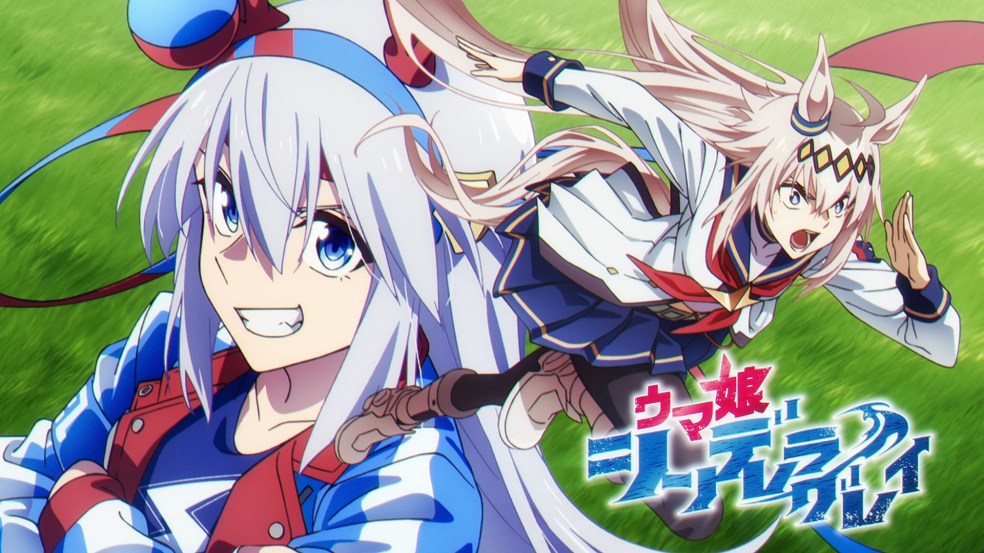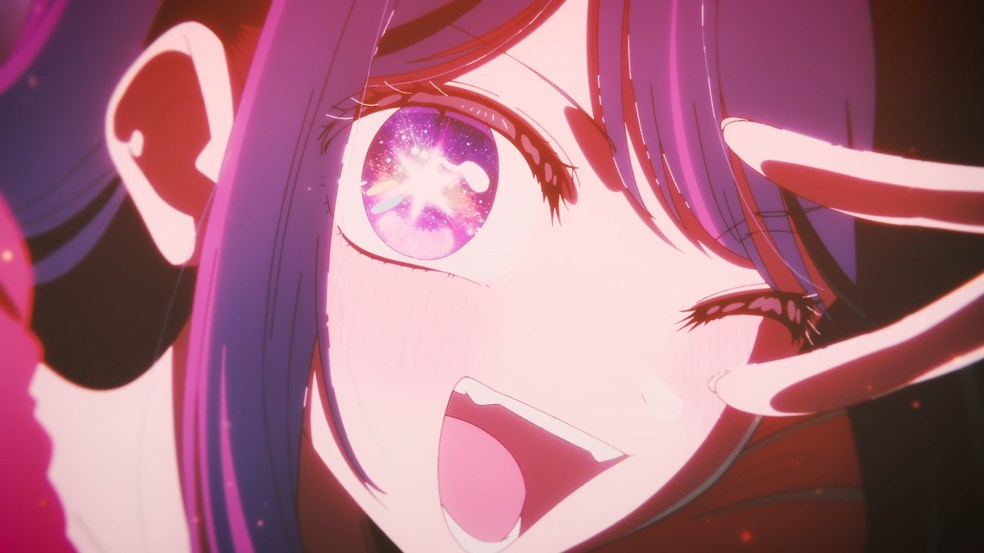
Let’s Watch UMAMUSUME: CINDERELLA GRAY – Episode 20 – “The Answer”

Let’s Watch is a weekly recap column where I follow an anime for the course of its entire runtime.

For the Cinderella Gray column, new installments will be posted either on the Sunday each episode airs, or as soon as possible over the succeeding week. Expect spoilers!

Cinderella Gray can be watched, legally and for free, on It’s Anime By REMOW on Youtube. A link is provided below for your convenience. The descriptive blurbs for these articles are taken from those of REMOW’s Youtube uploads.


A recurring tension in the Umamusume series is the fact that all racing careers eventually end. This only makes sense, most athletes retire eventually. You can’t push your body like that forever, and even the best will have to pack it in someday, as the alternative is usually much worse.

In the context of Umamusume, retirement is a peculiar thing. It’s almost never addressed directly. When it is, it’s sometimes accompanied by mention of the Dream Trophy League, a wholly fictional second racing league that we know little about, which existed as a background detail in some of the earlier, no-subtitle Umamusume anime seasons. Whether the Dream Trophy League even exists at this point in Umamusume‘s vague, shifting, and sometimes self-contradictory timeline isn’t clear—if it’s ever mentioned in Cinderella Gray at all, I must’ve missed it, and honestly even asserting that Cinderella Gray and those other seasons take place in the same continuity at all requires some squinting—but I bring this odd relic of the earlier Umamusume anime seasons up here to point out one thing in particular. It doesn’t actually come up in this episode even once, which feels notable.

Why? Because this is the episode where we finally learn what, exactly, has been hanging over Tamamo Cross’s head for the last while. You may recall that she seemed oddly hesitant to commit to racing in the Japan Cup again next year back when Obey Your Master asked. Here, we learn why. The Arima Kinen is going to be her last race.

This episode actually opens on a bit of backstory for Tamtam, showing us how she met her trainer Komiyama Masami. That “old man” whose sake she’s run some of her races was in fact her landlord, implicitly a former umamusume trainer himself, and introducing Tama to Komi was an act of kindness where it’s easy to understand why she’d hold him in such high regard. We aren’t directly told precisely why Tama is retiring, but with the juxtaposition here, we can infer any number of reasons.

Regardless of the “why,” when the two of them meet at a press conference, Tamamo breaks the news privately to Oguri Cap, who does not take it well. Whatever reason Tamamo might have, this means that she and Oguri will only have one more race together, the Arima Kinen itself. Oguri is actually in a fairly good mood up until this point in the episode, and her sharp downturn in demeanor here is quite startling. Moreso when she realizes, as she tries to argue with Tama, that she is now essentially in the same position Fujimasa March was way back in episode six. Tamamo Cross’s ultimatum to Oguri is the same as Oguri’s was to March; if she really wants to settle things, she has to beat her here. There will be no do-overs.

When the actual press conference starts and Tamamo Cross breaks the news to the press that the Arima Kinen will be her final race. We actually get a rare bit of narration from Oguri here, where she admits to not even remembering what she tells the press when they turn their mics to her. We don’t hear it, either, all of her thoughts have been blotted out by the specter of Tamamo Cross’s retirement.

Between the prospect of her greatest rival retiring and her own failure to reach the Zone, Oguri’s in a pretty tough position here, mentally. Some time after the conference, we see Oguri training at night to blow off some steam, and it feels like an open question as to whether the self-doubt, anger, and disappointment might actually snuff out her competitive fire forever. This is a real danger to someone like Oguri Cap, and she’d hardly be the first Umamusume protagonist to let her own hangups psyche her out of a victory.

Enter Dicta Striker, the Chestnut Bullet.

Dicta, based on one of the real Oguri Cap’s contemporaries, the horse Soccer Boy, has been a background presence in the anime since Oguri relocated to Tracen, but this episode is the first time we really get a good handle on her as a character. We get some of her backstory, including how her early career as a young prodigy gave way to a streak of losses that broke her confidence. She rebounded, though, at one point partly inspired by Oguri herself. By the time she calls out to Oguri for a late-night practice race, she’s long since reached the elusive Zone herself.

The training race, then, is as much a direct conversation between these two as it is actual practice. Dicta lightly needles Oguri as they run, saying that as she is now, she’ll never reach it. Privately though, Dicta thinks that Oguri is actually on the verge of breaking through this mental barrier. Dicta pushes her further; what compels her to race? Who does she want to beat? What, at the end of the day, is driving her?

This seesawing tension, between the joy and the fire Oguri Cap feels from running itself, from surpassing her rivals—once Fujimasa March, now Tamamo Cross, perhaps someone else in the not-too-distant future—from surpassing her own limits, and the persistent fear that she won’t be able to, will remain an underlying current for the remainder of the series. Cinderella Gray really leans into the Beast part of Oguri’s nickname in scenes like these, illustrating an underlying, boiling primality at the heart of her character, something fiercer and deeper than just competitiveness.

In a way, it’s unsurprising to see the anime render her in these terms—at the end of the day, this is a sports anime, after all—but the elemental distillation of it here is still a pretty rare thing, and it’s one Umamusume has made an art of over the years. Perhaps because of this, the nighttime practice race between Oguri and Dicta is the episode’s best scene, with most of its best shots being moody, windy cuts of Oguri’s running figure against the night sky.

Oguri comes close to making the breakthrough she needs to—very close, we get that visual effect of gray smoke leaking out of her eyes again, and a shot of a wall of glass cracking but not yet breaking—before Dicta abruptly calls the race off just as Oguri is about to pull ahead of her. Whether her explanation that she doesn’t want to push either herself or Oguri so much before the real race that they hurt themselves is what she really believes or a small bit of saving face is hard to say for sure. Either way, it’s clear that this run helps Oguri a lot.

Directly helping her rival out, even in such an oblique way, may seem contradictory with the goal of actually winning the Arima Kinen for Dicta. But, afterward, when her trainer, a hulking oak tree of a man, lightly chastises her for it, Dicta just wryly replies that she doesn’t want anyone to say that Oguri wasn’t at her best when she beats her.

Dicta isn’t the only one helping her, either. As all of this is going on, Belno Light, who by this point is essentially Oguri’s co-trainer, has been handling the more technical and strategic aspects of planning the race. An early scene at the press conference sees her inspired by how well Komi takes care of Tamamo Cross, and she gets a particularly great showcase here where, as an umamusume herself, she’s actually able to imitate Oguri’s running gait and analyze the specific ways in which the Arima Kinen’s track will affect her.

As with the Tenno Sho, the Arima Kinen features an inclined section, something that can’t be overcome with brute force alone and requires actual strategy to handle. Belno’s scenes in the episode, devoted to tackling this problem, are less dramatic than those with Tamamo Cross or Dicta Striker, but they’re no less important, and I think the story does a great job of making her seem just as important to Oguri’s growth as Oguri’s rivals are. By the time she’s finally come up with a good solution, she’s effectively run a version of the race herself. She may not be a preternatural talent like some of her contemporaries, but Belno’s tenacity here can stand up against that of any other umamusume in the series.

Of course, whether that growth equals success is another question. The episode ends on Christmas Day, at the Arima Kinen, a bright and sunny winter day as the runners take the field….


Like what you’re reading? Consider following Magic Planet Anime to get notified when new articles go live. If you’d like to talk to other Magic Planet Anime readers, consider joining my Discord server! Also consider following me on AnilistBlueSky, or Tumblr and supporting me on Ko-Fi. If you want to read more of my work, consider heading over to the Directory to browse by category.

All views expressed on Magic Planet Anime are solely my own opinions and conclusions and should not be taken to reflect the opinions of any other persons, groups, or organizations. All text is manually typed and edited, and no machine learning or other automatic tools are used in the creation of Magic Planet Anime articles, with the exception of a basic spellchecker. However, some articles may have additional tags placed by WordPress. All text, excepting direct quotations, is owned by Magic Planet Anime. Do not duplicate without permission. All images are owned by their original copyright holders.
The Weekly Orbit [7/26/25]

The Weekly Orbit is a (sometimes) weekly column collecting and refining my more casual anime- and manga-related thoughts from the previous week. Mostly, these are taken from my tumblr blog, and assume familiarity with the works covered. Be wary of spoilers!


Hi folks! It’s probably late at night for most of you as I post this, but I wanted to get one out this week, so I was willing to put it up outside my usual posting hours. Weirdly, the late hour sorta works, here. We’ve got a buffet of somewhat darker episodes this week, with only a few exceptions. Do enjoy.


Takopi’s Original Sin – Episodes 4 & 5

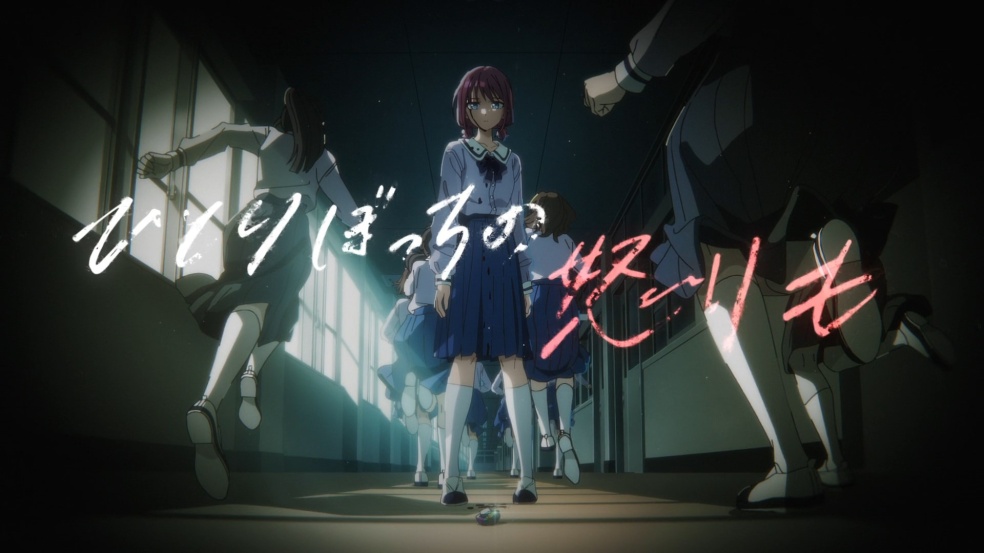
I haven’t written about Takopi’s Original Sin basically at all since it started airing, and I think part of that is a desire to not pass any judgment on something like this until I fully understand where it’s going. But it’s worth breaking that silence to say; this might be the best-animated episode of any show this year. There is some steep competition in that regard, but the way the visuals wobble out to convey Naoki’s dissociative state throughout much of episode four is really something else.

Narratively, I’m slightly less sure of what we’re doing, but the series has been good enough so far that everything I’m about to say should be taken as, at absolute most, a minor qualm. I think you can put the three kids that star in this story on a scale as to how obvious it is that the show wants you to sympathize with them: Marina was the least sympathetic, an incredibly vicious bully whose outbursts were explained by the revelation that she was physically abused at home. Her being perhaps the “worst” (I use the term very loosely) of these kids made her death all the more shocking. It’s not punishment vested on a bad person, it’s an absolutely tragic end to a very unhappy child whose life was defined by abuse, which she was the victim of but also the further perpetrator of. Naoki is the most overtly sympathetic, being subject to harsh psychological abuse by his own mother for much of his life and having few of the more “unpleasant” qualities of the other two. Shizuka, our protagonist, is somewhere between these two poles, and that’s where I’m scratching my head slightly because the specific way she’s between those extremes feels like something I’m not entirely clicking with. (Saying all this, I must again clarify that I am referring to ‘sympathetic’ as in the way that the narrative presents these characters to us. Personally speaking, I sympathize with all of them, because they’re young kids trapped in absolutely awful situations. But I digress….)

Naoki is talked into being an accomplice to covering up Marina’s murder because Shizuka basically charms him. Now, in of itself I think the beat of Naoki falling for Shizuka and this informing his actions is fine. But the degree to which Shizuka leans into it and actively leads him on just strikes me as kind of odd. To be clear, I don’t think this is “problematic” or whatever, I think what the series is trying to do is make a point about how people tend to take after their parents (in particular, bad mothers, respectively neglectful, psychologically abusive, and physically abusive, are a shared commonality between Shizuka, Naoki, and Marina respectively. Naoki’s brother even compares him to his mom explicitly). The framing is what feels a little odd to me, which I imagine is a problem unique to the anime, with the cartoon gunshot sounds accompanying Naoki’s gaga heart eyes probably being the most over the top example. (Although to be honest, now that I’ve laid it out here, I think I’ve actually talked myself out of having a problem with it. But it does still feel like the anime is trying a little too hard to shock us with how “bad” Shizuka is, maybe that’s just in my own imagination.)

On another note, Naoki’s brother is handled in a really interesting way throughout this episode. The bit where he comfortingly pats Naoki’s head and it’s portrayed as this bright, cheerful bit of magic is another example of the show’s visuals being over the top, but in a way I really appreciate.

Episode five, meanwhile, is another swerve and once again takes things in a somewhat different direction. I’m using this space to both jot down some thoughts on episode five itself—which, this is the rare thing that’s exclusive to this column, I’m not pulling from my tumblr here—but also to bounce off of this reblog addition to what I wrote above on the previous episode by tumblr user angyo. Angyo puts forward that the reason behind the way the show treats Shizuka is that we are to understand Shizuka and Marina as being two sides of the same coin. People in what are, at the end of the day, actually quite similar situations, being driven to life-or-death extremes by respectively Shizuka’s need to see Chappy again (even though he is probably dead) and Marina’s need for approval from her mother. (“Cornered raccoon rules”, as angyo put it, a turn of phrase good enough that I’m stealing it.) And I do think this is directly relevant to episode five, because what the gradual darkening of Shizuka’s character—what I took for an attempt to shock the audience just two paragraphs back—is actually an attempt to underscore how easily these characters could switch places. It is very easy to imagine, for example, a situation where Takopi encountered Naoki or Marina first upon arriving to Earth and this entire narrative is framed differently, with Marina as the most overtly sympathetic of the cast and Shizuka as the “bad guy.”

In fact, you don’t have to imagine this at all, because that’s exactly what episode five is. Shizuka and Takopi make it to Tokyo only to find that Shizuka’s father has since started a new life with some other woman and now has two other kids. Any hope that her father might entertain the idea of helping Shizuka is dashed when one of his other children asks him who this strange girl is, and he shuts the door on her. Backed into a corner yet again, she takes it out on Takopi, bashing him with a rock hard enough to induce forgotten memories to rise to the surface. He remembers something—wait a second, he actually has been to Earth before.

In a previous timeline, Takopi met Marina first. Thus, the anime’s fifth episode is a rough perspective flip of its first. Takopi—not yet known by that name—befriends Marina, more or less, and helps her navigate life from ages ten to sixteen or so. Shizuka is actually barely present in this version of events. Instead, we focus on how here as in the timelines we’ve already seen, Marina’s youth is defined by the abuse of her mother, and there’s a heartbreaking bit where Takopi, again totally innocent, observes that Marina must smack him around so often because her mother does the same to her. It’s these moments where Takopi’s Original Sin is most devestated, not where things reach an elevated fever pitch, but when Takopi makes a simple observation that any child could.

As things seem like they might finally be getting a bit better for Marina, Shizuka reenters the picture at a crucial moment. She (inadvertently? I’d like to think so) steals Naoki, here Marina’s boyfriend, from her. This leads to a terribly sad series of events that culminates in Marina finally snapping under her mother’s abuse, killing her and, it seems clear, eventually herself. Takopi knows what he must do to prevent this; he has to kill Shizuka, and he’ll use the time machine on his home planet to do it.

Forcing his way to the machine, he is reverted to mental childhood himself by the mysterious mother figure of his home planet, and by the time he returns to Earth we’re back at the start of episode one, and he’s forgotten about Shizuka and Marina entirely.

The strongest parallel here is thus that despite Takopi’s best intentions, he has demonstrably led both of this show’s protagonists to bad places, and eventually their deaths. The show’s present timeline, which we return to at the end of the episode, gives him a chance to potentially fix all of that, but it’s difficult to imagine him succeeding for the same reason that Takopi is, despite everything, still ultimately sympathetic. He’s basically a child himself in his current state, he has a simplistic understanding of the world, which is why his most sophisticated attempts at problem solving in the entire show so far boiled down to “kill Shizuka” and “try to help Shizuka cover up that she killed Marina.” Episode five ends with the unexpected return of Naoki to the main timeline, and between him coming back and Takopi’s memories resurfacing it’s hard to say where all of this will eventually end, but any show that makes its viewership turn over character dynamics this thoroughly is doing something right. Just one week out from its finale, it remains one of the season’s most compelling.

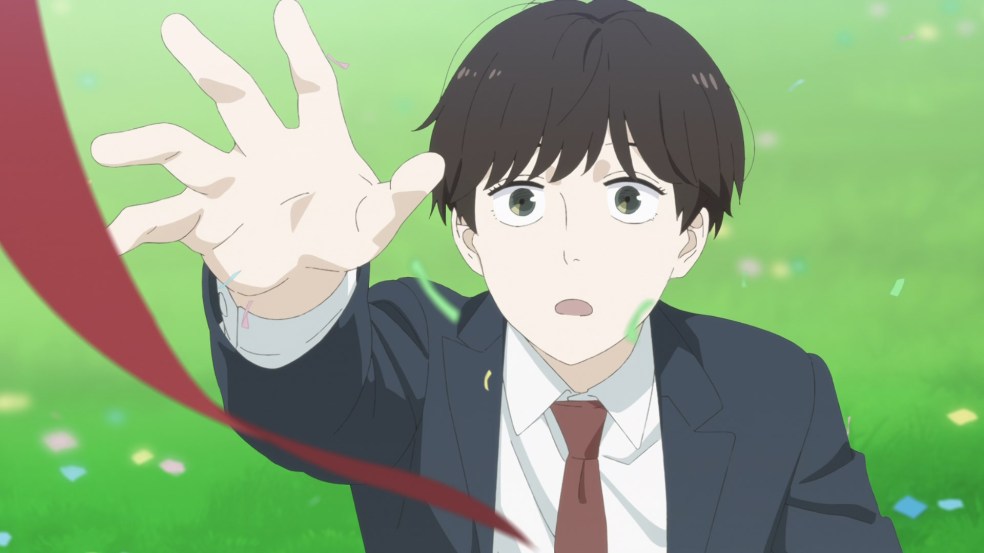
There’s No Freaking Way I’ll Be Your Lover! Unless…. – Episode 3

I like to give a show credit when it manages to completely throw me off. I do see how we got here Watanare‘s first episode, but it’s definitely still not a direction I expected the show to take when I watched its premiere.

There’s a lot of things I could talk about here but I’m a little uninterested in attempting to make some grand proclamation about what this narrative development “means.” Because I’m sure tons of people are already doing that and, to be honest, I do not really need my fiction to be a morality fable, so I don’t have strong opinions on where they’re going to take this. I’m fine with anything as long as it’s interesting.

I actually wanna talk about the backgrounds, mostly.

I’m hitting the limits of my artistic vocabulary here, because I don’t know what about them makes them look this way, but a good amount of the backgrounds in this series have a very flat and fake look to them. These are spaces meant to emphasize their own artificiality, and it hits a height in this episode that I was worried we wouldn’t see again after the premiere.

This isn’t a bad thing, It’s clearly deliberate and is meant to convey a sense of alienation. It’s also a very subtle inflection, and it’s one of my favorite things about the show. It’s most obvious with Mai’s room in Paris-

-and the suburb Renako lives in.

But notably, Renako’s room itself takes on this quality during the night after the incident at the end of this episode, which I think is a great way of quickly and subtly conveying her anxiety and confusion.

I’m unwilling to contribute to the discourse (in both the literal and euphemistic sense of that term) around the show beyond this, at least so far, but it’s definitely established itself as quietly being one of the season’s more interesting anime. I salute that.

Necronomico & The Cosmic Horror Show – Episode 4

I need an anti-favorite characters list on Anilist so I can put Eita on it. I get characters like this are supposed to be annoying and hateable so they can die late in the show for catharsis, but the dude is seriously just aggravating as shit. Also, I feel like there’s a version of this same character in every show like this so he’s not even particularly interesting or novel. Maybe my perception is skewed since I haven’t actually seen that many of these, but yeah.

Anyway, other than his being generally grating as fuck and the weird “on-screen chat commentary” gimmick, this is actually probably the best episode of the show so far. It’s also the best-looking since the premiere, a good sign for a show that would be lost without some visual oomph. I was a little worried we were already running out of ideas for death game setups with the second one, but the escape-room-with-the-directions premise the Old Gods field here is pretty solid. More importantly, the actual environment of Hotel Reversal, as it’s called, is really good, I love all the oranges and greens and the generally very zany vibe of the hotel itself. It makes it feel like a real escape room game despite the high stakes. We lose a few people this episode too, and it’s no big loss because they’re among the less interesting characters. My bet is that the teacher is the next person to die, but we’ll see.

Ruri Rocks / Introduction to Mineralogy – Episode 3

I’m really delighted by the decision to expand the show’s world a bit here. The anime’s first two episodes were nearly devoid of anything but Ruri and Nagi’s mineral expeditions. Here we meet one of Ruri’s colleagues, Imari Youko [Miyamoto Yume], and since we’ve roped a third person into this setup, the scope of the show expands too.

The entire iron mine trip is lovely, but obviously the bit at the end with the Flourite vein is the episode’s apex. We have an actual cliffhanger of sorts at the end and I really cannot wait to see what else this show has in store. The next episode of this show will likely have aired already by the time you read this, I’m sure that one will be lovely too.

It is also worth restating that Nagi remains just devastatingly hot. Anime woman of the year, I won’t apologize.

Call of the Night – Season 2, Episode 4

Well, this episode hit me like a ton of bricks.

Overall, Call of the Night has been improving steadily since it came back. (In fact, I’m starting to think the premiere was the weak link.) As such, there’s a lot to like in this episode; visually it’s an array of achingly lonesome liminal spaces, hospital rooms so dreary you can practically smell them, and dramatic, frightful closeups. The same borrowed horror language that the show used in its first episodes.

There’s all the show’s usual strengths writing-wise, including some great banter between Ko and Nazuna. But what really takes this episode to another level is its second half, where we learn the backstory of the character Honda Kabura [Itou Shizuka], a long-time supporting member of the cast and one of Nazuna’s fellow vampires. I don’t want to relitigate all the specifics, but the gist is that Kabura was, as a human, sickly, frequently in and out of hospitals. What we see of her friend group paints them as pretty unsupportive and shitty people, and in fact, her nurse tells her this outright.

Her nurse is, or at least appears to have been, Nazuna. But she’s not called Nazuna, as this person refers to herself as Haru. So either Nazuna went by a different name back then—it would track, given her almost total amnesia as to her earlier life established in last week’s episode—or there’s something else going on here and this is a relative or somesuch. Either way, Haru seems to be just about the only person Kabura really had in her life, so when things reach a breaking point, Haru is the person there for her. This all has an extremely strong gay overtone—more than that, really, since when Haru is running down a list of things that she hates and which have been imposed upon her, she includes men—and when it inevitably comes time for Haru to turn Kabura into a vampire, Call of the Night actually brings back its season one opening theme, drawing a direct line from what happened to Kabura in her own past and what happened to Ko at the beginning of this story.

Their specific situations are different. Ko’s problems seem to be mostly mental and social. Kabura’s to at least some extent are physical. But the effect is the same; these two are societal outcasts. When one of Kabura’s shitty friends visits her in the hospital, she ends up snapping at her. She hits the nail on the head though—these people really do look down on the sick and the unwell, those of us who walk slow or don’t socialize. When Haru offers to turn Kabura, she phrases it not as inviting her to vampirism but as inviting her to the opportunity to live a full life with actual meaning. “Do you want to be able to run?” asks the vampire. The girl who can only walk slow does not need to even speak her answer, for the vampire already knows it.

Anime – Non-Seasonal

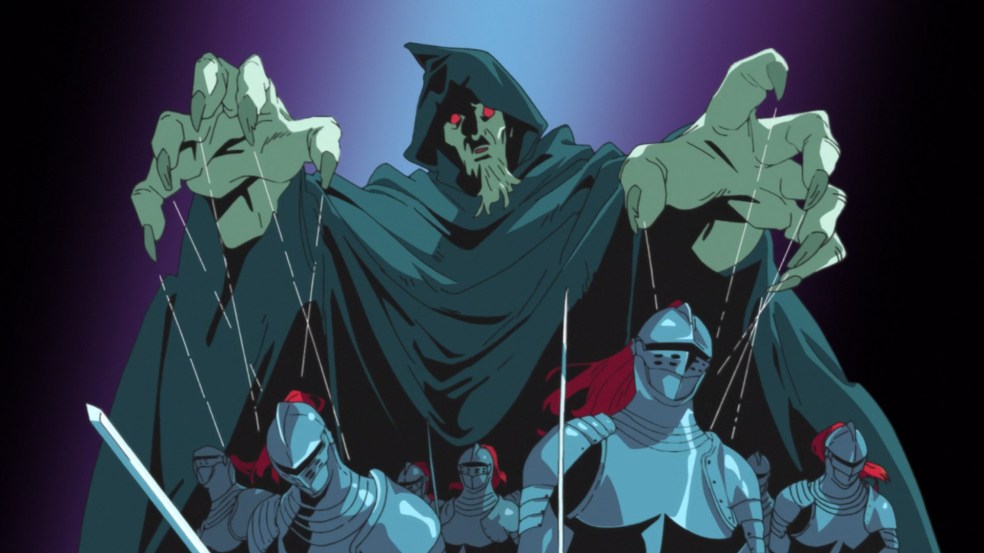
The Epic of Zektbach

Well, this was quite a goofy thing.

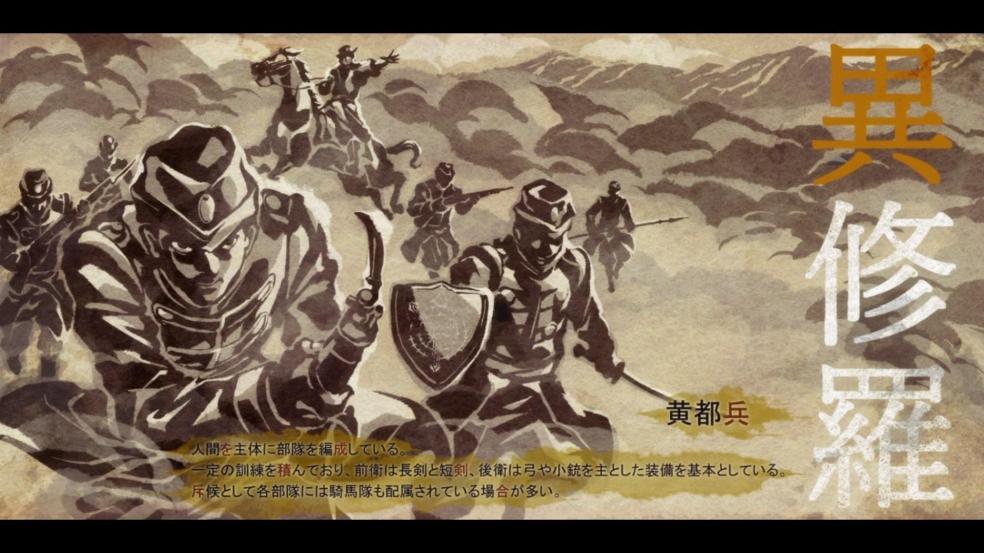
Essentially, what we have here is a highly compressed attempt at a heroic epic about a character named Shamshir. Shamshir saves her country from an invasion, but her fellow soldiers are entranced by her “dance”—her fighting style—and eventually start committing murders, which Shamshir herself is blamed for.

This doesn’t really go anywhere despite a small handful of interesting ideas—we see things from Shamshir’s and also the murderers’ perspective a few times and they seem to see their targets as masses of binary code and chemical formulas—and the OVA unceremoniously peters out after Shamshir gives in to her bloodlust and murders her entire city, seemingly including her childhood friends.

Apparently, this is one facet of a larger franchise connected to a bunch of concept music, some small booklets, and a now-defunct website, so maybe this makes more sense in context (the series’ somehow still online Fandom wiki boldly claims the series has “gnostic themes”) but as an OVA it’s pretty bad. Not helping is the fact that it looks like absolute mud; almost everything is a shade of brown or red with occasional grays. The resulting visual effect is a bit like if a show had a sub-Attack on Titan color palette on Arifureta‘s visual budget. Still, there’s a charm to the specific kind of bad on display here, not so much so that this is worth seeking out, but I at least had a good time poking fun at it with my friend Josh, who I have now promoted to main-body-of-the-article status, I suppose. (Hi Josh.)

Josh and I started watching old OVAs together recently after having the brilliant decision to knock out famously bad anticlassic Garzey’s Wing together—if you see more OVAs here in the future you can thank them—and they in fact found one of the music videos that comprises the bulk of the remainder of the Zektbach franchise. It is way, way better than the OVA, and also has a much nicer art style. It lacks much of a narrative given that it’s, you know, a 2-minute music video, but it’s much more worth watching than the OVA, I think. I’ve embedded it below.

Puppet Princess

This, on the other hand, was just an absolute slap from start to finish.

These OVA centered around some kind of odd conceit from back in the day aren’t always as great as the general concept makes them sound. But this one and its puppet fighting gimmick really are just as much fun as the idea promises. Obviously, there are a lot of really excellent action sequences here, mostly revolving around our protagonist Rangiku’s [Uechi Aki] array of fighting puppets and the large box she keeps them in. But it really can’t be overstated how absolutely great this thing looks in general, the direction is razor-sharp and in particular the more horror-leaning scenes really pop. (As a side note, basically everyone suddenly gains individually-drawn teeth and bulging eyeballs when they’re going through terrible things. The former in particular means this probably has the most teeth-per-minute of any anime I’ve ever seen. Just something to think about!)

Also present is a master ninja / illusionist named Manajiri [Wakamoto Norio. Yes, really!] who serves as a sort of secondary dynamic. They have a solid dynamic. Although sullying it somewhat is that there’s a decidedly uncomfortable and unfortunately very of its time bit where he tries to grope Rangiku while she’s cleaning herself in a waterfall, although he does at least back off, which is more than can be said about many characters who’ve been placed in similar situations. It’s a little unfortunate since Manajiri is otherwise a pretty great character in his own right.

Rangiku’s puppets are easily my favorite thing about the OVA overall, though, she cycles through a couple of them over its 40-odd minute runtime and while the best is probably the large red samurai she uses for the first and last battle, they’re all great. Naturally, they become the tools of vengeance used to kill the man who murdered her father. Between the beats of the vengeance plot, there’s also some interesting (and harrowing!) stuff in here about how badly her father treated her in favor of the puppets. You can thus extract an interesting thematic line about a man in power favoring literal dolls over the human women in his life, but the OVA only has so much time to explore this. My only real complaint, in fact, other than the waterfall scene, is that I actually wouldn’t have minded watching a lot more of this. I think you could pretty easily extend this to a full series.

And interestingly, it almost sort of did? Puppet Princess itself never got a TV anime, but one of the mangaka’s other projects, Karakuri Circus, did, nearly twenty years later. It features a similar overall premise, which may be enough to finally get me to check Karakuri Circus out after having had it on my plan to watch….since it was new, I believe. There’s a lot of interesting anime out there! For better or worse.


That’s all for this week!

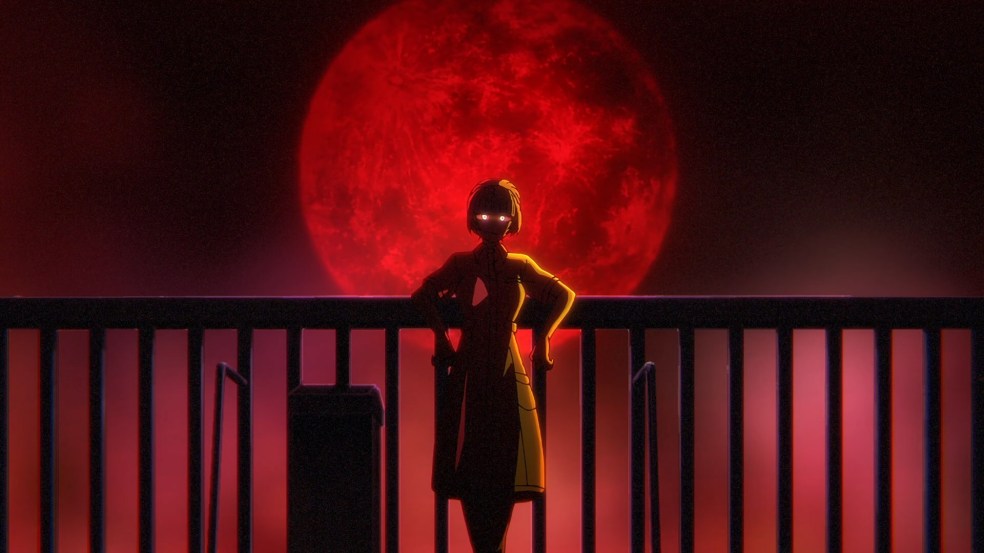
It’s been a long time since I did one of these, but on your way out the door why don’t you take a Bonus Screencap along with you? This time of Nazuna in her nurse getup from the Call of the Night midcard for this week.


Like what you’re reading? Consider following Magic Planet Anime to get notified when new articles go live. If you’d like to talk to other Magic Planet Anime readers, consider joining my Discord server! Also consider following me on AnilistBlueSky, or Tumblr and supporting me on Ko-Fi. If you want to read more of my work, consider heading over to the Directory to browse by category.

All views expressed on Magic Planet Anime are solely my own opinions and conclusions and should not be taken to reflect the opinions of any other persons, groups, or organizations. All text is manually typed and edited, and no machine learning or other automatic tools are used in the creation of Magic Planet Anime articles, with the exception of a basic spellchecker. However, some articles may have additional tags placed by WordPress. All text, excepting direct quotations, is owned by Magic Planet Anime. Do not duplicate without permission. All images are owned by their original copyright holders.

Let’s Watch UMA MUSUME – CINDERELLA GRAY Episode 13 – “Japan’s Best”

Let’s Watch is a weekly recap column where I follow an anime for the course of its entire runtime.

For the Cinderella Gray column, new installments will be posted either on the Sunday each episode airs, or as soon as possible over the succeeding week. Expect spoilers!


Back at the very beginning of this series, when we had only just met her, Oguri Cap was presented to us as “someone we could root for from the bottom of [our] hearts.” Those were the words of Kitahara Jou, her original trainer, who saw something in her. A spark, a fire. That rare, ineffable, and hard-to-qualify thing known as star power. There is just something about Oguri that makes people like her. This isn’t even restricted to Oguri Cap the anime character. Even the real, historical horse was so popular that cheering crowds chanting his name were known to pop up when he made an appearance. Regardless of the time, place, or even the medium, people love Oguri Cap. We want to see them succeed.

Essentially, this is us. (I’m Norn Ace.)

And succeed she has! When the only major defeat you’ve suffered so far was not at the hands of a fellow racer but bureaucracy, you know your career’s in a good place. Cinderella Gray has spent this entire season building that goodwill, contrasting her thunderous victories with her good-natured and straightforward personality, making us cheer for Oguri no matter where she runs or whom she runs against. That is still true here, in the final episode of what is already becoming retroactively known as Cinderella Gray Part 1. Make no mistake, her main rival in this race, Tamamo Cross, is also a great character. Enough so that she basically carried last week’s episode on her own, as Oguri was largely kept out of the spotlight there. But this is Oguri’s show. Oguri is who we’re here for. And this finale boils the series down to its barest essentials; a stable of powerful rivals, a race, a mountain to be conquered. There is nothing remotely complicated about the narrative here, all Oguri has to do is run.

And yet, even running is not really a simple thing. The episode opens with some recapping of last week, this time from Oguri’s perspective—the way she waxes poetic about how Tamamo is so obviously different from the rest is really something, the girl has it bad—before getting into the real meat of the race, the final stretch of the course. This, both the show and Oguri herself make note of, is basically where the real race begins. The Tokyo racecourse that hosts the Tenno Sho ends with an absolutely brutal incline, making all of the “climbing the peak” metaphors deployed throughout this season stunningly literal as it speeds to a close. (I would not be surprised if the incline was, from a writing perspective, where all those metaphors came from.) As Tamamo passes front-runner Lord Royal, the race boils down to Tamamo herself and Oguri, two ash-haired racetrack demons who are, by all evidence, equally matched.

And then Tamamo gets a leg cramp. For a minute, it seems like Oguri’s last race of the season will play out as a victory with an asterisk; outside conditions throwing her dominance into question. What actually happens is much more stark, a much cleaner break, than something that cheap.

Tamamo Cross grits her teeth. She remembers her childhood; an old man with a strong accent teaching her the fundamentals of running as the sun sets next to a river. That old man, the same we met a few episodes ago as he lay in a hospital bed, clearly doing very badly, is who she thinks of as she steels herself. Suddenly, she is somewhere else. All sound fades away, and she is a streak of lightning across the racecourse.

Rarified, transformative states of this nature are a rare thing. Depicting them in fiction is really, really hard. Symboli Rudolf, who’d know a thing or two about this subject, just refers to it as “the Zone.” I can think of no better term myself, so I’ll defer to her, here. This is not the first time such a thing has been depicted in Uma Musume—a good chunk of the visual spectacle of the New Era movie, for example, comes from scenes like this—but it’s the first time Oguri Cap has stared down its barrel. For the first time in the series, she is on the receiving end of the same kind of buzzer-beater blowout performance she’s dealt to so many other racers. Tamamo Cross takes the gold in Part 1’s final race. Oguri Cap has lost.

Musaka, who can spot Oguri hitting her limit the second it happens, remarks that no matter how many times one endures it, defeat never feels less bitter. Norn Ace, watching back in Kasamatsu and probably Oguri Cap’s biggest fan, tries to talk herself out of feeling disappointed but is clearly crushed. Belno echoes many fan sentiments with saying that Oguri’s victory seemed predetermined. Nonetheless, the fact of the matter is that no one truly knows how a race like this—any competition like this—is going to go until it happens. (And remember, while Oguri Cap is who we’ve been following, for Tamamo Cross this is a major victory. Not only does she become the first racer to ever win both Tenno Sho races consecutively, the victory clearly means a lot to her trainer, who’s shown weeping with joy from his hospital bed.)

Perhaps the person with the most perspective on the whole issue, though, is Oguri Cap herself. Is she disappointed? Absolutely. We see her tear up after Tamamo crosses the finish line, and she attempts to reckon just why she lost. But she recovers almost instantly, brimming with motivation now that she’s found someone who can actually match her. Tamamo and Oguri talk after the race, swearing to run against each other again, officially declaring each other as their rivals with a whole lot of blushing that gives the scene as much gay subtext as anything from this franchise has ever had. It’s a wonderful bow on the episode.

So Oguri’s defeat here is not really a sad thing. For the first time, she has a rival who is not just at but above her level, and the episode ends with her as her same old cheerful self getting ready to train. There’s a new mountain to climb, and while we’ll have to wait ’til Fall to see just how Oguri plans to summit that particular peak, it seems inconceivable that she won’t. Cry if you must, but don’t dig a grave. To paraphrase Uma Musume‘s resident trickster Gold Ship, a loss is not the same as dying. Oguri Cap will be back.


Like what you’re reading? Consider following Magic Planet Anime to get notified when new articles go live. If you’d like to talk to other Magic Planet Anime readers, consider joining my Discord server! Also consider following me on AnilistBlueSky, or Tumblr and supporting me on Ko-Fi. If you want to read more of my work, consider heading over to the Directory to browse by category.

All views expressed on Magic Planet Anime are solely my own opinions and conclusions and should not be taken to reflect the opinions of any other persons, groups, or organizations. All text is manually typed and edited, and no machine learning or other automatic tools are used in the creation of Magic Planet Anime articles, with the exception of a basic spellchecker. However, some articles may have additional tags placed by WordPress. All text, excepting direct quotations, is owned by Magic Planet Anime. Do not duplicate without permission. All images are owned by their original copyright holders.

Let’s Watch UMA MUSUME – CINDERELLA GRAY Episode 10 – “The Peak”

Let’s Watch is a weekly recap column where I follow an anime for the course of its entire runtime.

For the Cinderella Gray column, new installments will be posted either on the Sunday each episode airs, or as soon as possible over the succeeding week. Expect spoilers!


Following last week’s big fakeout, we have a more transitional and low-key turn for Cinderella Gray this week. Honestly, this is a good thing. If we were to have another big important race here, it would risk making the show repetitive (a trap its predecessor, the third season of no-subtitle Uma Musume, sometimes fell into). When we open, we find Oguri Cap in a funk, saddened that she was disqualified from what she was directly told were the “best” and most important races, she feels aimless and demotivated despite sticking religiously to her training.

There are a few factors that get her out of that malaise. One is the relatively brief race that is in this episode, and Oguri’s not actually in this one, not even in anyone’s mind. Instead, Roppei takes her to watch the Takarazuka Kinen. A plot point in some prior seasons, the Takarazuka’s lineup is determined by fan vote. The favorite is a one-off character, one Akitsu Teio. But the one who actually wins is Tamamo Cross.

Cross, the streak of blue lightning first introduced to us way, way back near the start of the season, has nonetheless been largely a background presence up until this point. She and Oguri still have not directly spoken, and seeing Cross win in person is the first time Oguri Cap seems truly aware of just what she’s up against. Despite its brevity, her from-behind win here is truly spectacular, and very much reminiscent of Oguri’s own victories.

This isn’t the only thing that puts some zip back in Oguri’s step. She also gets a phone call from her former rival Fujimasa March, making her first appearance of any real length in the series since her departure from it in episode six. Unsurprisingly, March has kept racing. What’s maybe a little moreso is that March is actually the one calling Oguri for reassurance. March is lost and without motivation too. We learn here that her dream of winning the Tokai Derby didn’t come true; she failed to even make the podium, coming in fourth, and as she calls Cap she’s on the verge of quitting entirely.

Of course, our protagonist, with her head of silver and heart of gold, is not having that from her first rival, someone who clearly still means a lot to her. In convincing March to continue racing, Oguri does the same to herself. The specific situations are fairly different of course—Oguri, if anything, is having too much success, whereas March’s anxiety is caused by her finally hitting a wall—but the emotional connection between the two makes it all make sense. Both will continue racing, even with their first dreams out of reach, March whips up a cute metaphor about moving on to the next mountain, and for a show—a whole series, really—that’s in part about staying determined in the face of whatever life throws at you, it absolutely works. (There’s also a cute sequence of cameos by Norn Ace and friends, and it’s good to know that they’re all still getting on well.)

We also get a rare sequence from Tamamo Cross’s camp. Her trainer thinks Tamamo will probably be competing with Oguri for the first time in the coming Fall Tenno Sho, a G1 race (reinforced when, later in the episode, we learn Oguri is going to be running an important qualifying race for the fall G1s). Just as important to the scene, though, arguably, is that somebody clearly really wanted to draw Tamamo Cross working out. Live your truth, buddy.

My understanding is that this workout sequence is in the manga, but is not nearly as involved. I can only reiterate what I’ve already said.

The remainder of the episode is fairly lighthearted. Roppei puts Oguri and Belno on “summer vacation,” giving them a break after Oguri’s constant racing and training since arriving at Tracen. Oguri being Oguri, when given free reign to explore Tokyo, she mostly does so as a foodie, spending much of the episode’s second half on a date with Belno, in a blissful heaven of hamburgers, tornado fries, crepes, rolled ice cream, and so on. She’s in disguise during this whole outing, though her modest disguise of “a hat and some glasses” doesn’t really work, perhaps given the relative scarcity of silver-haired horse girls in Tokyo, and Oguri and Belno attract a decently-sized crowd regardless, to which Oguri Cap reacts this way.

I didn’t edit that. That’s really what she says, or at least it’s really how the subs translate it.

The crowd alerts Sensuke that Oguri is nearby, and the two have their first face to face conversation here, where he lets slip who all Oguri is going to be facing in her upcoming qualifying race. (It’s loosely implied by the framing that he shouldn’t really be sharing this information, but Sensuke is nothing if not unscrupulous.) The episode ends with that race just about to start, and as usual, we won’t know the results until next week. Still, with Oguri’s inner competitive fire newly set alight, it’s hard to imagine her losing. We’ll see how things go, won’t we?


Like what you’re reading? Consider following Magic Planet Anime to get notified when new articles go live. If you’d like to talk to other Magic Planet Anime readers, consider joining my Discord server! Also consider following me on AnilistBlueSky, or Tumblr and supporting me on Ko-Fi. If you want to read more of my work, consider heading over to the Directory to browse by category.

All views expressed on Magic Planet Anime are solely my own opinions and conclusions and should not be taken to reflect the opinions of any other persons, groups, or organizations. All text is manually typed and edited, and no machine learning or other automatic tools are used in the creation of Magic Planet Anime articles, with the exception of a basic spellchecker. However, some articles may have additional tags placed by WordPress. All text, excepting direct quotations, is owned by Magic Planet Anime. Do not duplicate without permission. All images are owned by their original copyright holders.

Let’s Watch: UMA MUSUME – CINDERELLA GRAY Episode 6 – “The Beast”

Let’s Watch is a weekly recap column where I follow an anime for the course of its entire runtime.

For the Cinderella Gray column, new installments will be posted either on the Sunday each episode airs, or as soon as possible over the succeeding week. Expect spoilers!


Oguri Cap enters this episode devastated and conflicted. She leaves it a hometown hero. That’s how legends are born.

The previous episode of Cinderella Gray was a masterfully-crafted, coiling mechanism of tension. This episode is where that tension is released, and in that process we get to see some sides to our favorite characters that we haven’t seen before. But the true crux of the episode is the Gold Junior, an epic, psychological struggle on the racetrack. It ends with a huge, overwhelming moment of pure catharsis, one of the best of its kind in recent years. Remember; “Cap” meaning “peak.”

Getting there is another story. The episode opens with Oguri Cap furious, angrier than we’ve ever seen her, at Kitahara’s decision to transfer her to the nationals and stay behind. (Not to once again devote space on this site to my own thirsting, but there is a frightful beauty to Oguri’s angry faces, they’re very well-drawn and the fact that they’re such a stark contrast to how she normally acts really enhances the effect.) Her fury is easy to understand; she and Kitahara promised to take on the Tokai Derby together, and from her point of view he’s now breaking that promise. This is a recurring theme across the episode, the letters and spirit of these promises, and what breaking them means.

For Oguri, it makes it difficult for her to concentrate on the race, both in the training leading up to it and, eventually, for the race itself. For Kitahara, it’s the apex of his plague of self-doubt. No less a figure than once again, Symboli Rudolf, calls him out for his foolishness. Making either choice would’ve been better than trying to make none of them, and hinging the transfer on Oguri’s race results puts the horse girl in a truly unenviable situation.

The morning of the race is filled with contrast. Merch stalls sell adorable plushies of the rising local hero, and excitement is in the air from the audience at least, who clearly understand that they’re about to see Oguri build her legend up with another victory. But the track itself is bogged-down with mud after thudding, pounding rain from the previous night. Kitahara is in low spirits, and Oguri, now conflicted that her running is making others sad and without the confident support of her trainer, is in even lower ones.

Complicating things even further is the presence of Oguri’s rival up to this point, Fujimasa March. March, of course, is also furious. Word has by now spread that Oguri is going to be transferring to the nationals if she wins. Fujimasa demands to know why. They promised to race in the Tokai Derby together, and that promise is now falling apart before March’s eyes. Again, it’s easy to see why she’s upset, and moreover, why she’s hurt.

But she gets no sympathy from Cap herself. Deadened by having lost her reason to run, Oguri reminds her that all March has to do to keep her from transferring is to win. The presentation is immaculate here, with sweeping, low, buried-in-the-floor camera angles and easily the meanest face we’ve ever gotten from Oguri. The tension is palpable, and it says a lot that the slap across the face that Fujimarch opens the conversation with is not the highlight of this scene.

Nonetheless, the race waits for no one.

And indeed, the race itself is a struggle less between Oguri Cap and Fujimasa March, and more between Oguri Cap and herself. She’s out of form for much of the race, and imagines her legs bound by heavy iron chains dragging her down. For a while, it really does seem like Cap might actually lose, and it’s to the show’s credit that it keeps anyone who doesn’t have the real Oguri Cap’s racing history memorized guessing.

She’s so out of sorts that she doesn’t even make use of her trademark burst of speed, something which Fujimasa March notes with some incredulity, offended that her rival isn’t even trying. As it often does in these sorts of situations, it takes an external force to jostle Oguri Cap back into proper form.

That force is Kitahara, who, like Oguri, spends most of the race struggling with himself. His own doubts are quieter and get less direct attention (since he isn’t the protagonist, naturally), but he spends most of the Gold Junior sulking and not even actually looking at the race track. It takes Roppei, also in attendance, to snap him out of it, physically forcing him to look at Oguri Cap’s performance. Seeing his trainee obviously out of form and distraught is enough to spur Kitahara back to action, and he begins running too, fumbling through the crowd, bloodying his nose—that seems to happen to him a lot—and finally reaching a spot where he can cheer loud enough for Oguri to hear him. Just as Roppei shook Kitahara out of his stupor, Kitahara shakes Oguri out of hers by doing this.

For Oguri, his cheers, and the cheers from the others watching—Belno, the bully trio who have remained an important part of the supporting cast up to this point—are a reminder of why she’s running; to make herself happy, to make others happy.1 Regaining her confidence is enough: Oguri Cap takes the day.

In a beautiful touch, her hair comes undone as she crosses the finish line, leaving her final mark on the locals a wave of flowing, cloudy gray as she streaks into first place. The victory is immensely cathartic. The series makes a point here that Oguri Cap inspires her supporters; it’s obviously talking about Kitahara, Belno, Norn Ace, and so on, but it’s also talking about the people in the crowd, and thus, implicitly, us as well. The swell of joy is very real with this one, it’s perhaps one of the best-orchestrated victories in the whole franchise.

In the aftermath, Oguri’s stage show—which she rocks, by the way, and just generally looks great doing—becomes a platform for Kitahara to tell the crowd that, yes, the rumors are true. She’s moving on and up. The crowd is initially disappointed, but he reminds them—and anyone watching at home who might be sad to see this part of the story end—that there are higher dreams to aim for. This story isn’t over yet, and there are more mountains to climb.

The reason all of this works so well is that big dreams and stories of triumph are why we’re here in the first place. As Kitahara notes, it’s a Cinderella story! It’s right in the title! It’s also a testament to how ungodly well Cinderella Gray has been written so far that I’m genuinely going to miss every single character Oguri has to leave behind now that she’s transferring to Tracen! Norn Ace’s idea to take a commemorative picture (somehow framed as a polaroid photo despite her taking it on a smartphone, just one more drop of that trademark Uma Musume time weirdness) had me full-on crying.

I am aware I keep comparing Uma Musume to some kind of long-running battle shonen anime, which is, of course, not actually what it is. But I do have to bring that comparison out again, because this episode really does feel like the end of a long, long first season where there’s a notable changing of the guard and it’s all very bittersweet. I can only really again credit the writing for evoking that feeling over a scant six episodes (of a confirmed thirteen and a rumored 23). Perhaps the toughest departure is that of Fujimasa March, who vows to continue running despite her initial plan to quit if she lost to Oguri again. It doesn’t seem like they’ll meet again, at least not as competitors, as Oguri is going somewhere that March can’t reach. Nonetheless, their mutual respect for each other is genuinely touching, an excellent last note to their rivalry.

But we can’t dwell on who’s leaving, because two very important characters actually aren’t. Firstly, Kitahara vows to get a national trainer license—we aren’t explicitly told why he didn’t try to do this in the first place, but given some of the allusions to Kitahara’s still-murky past, we can make some educated guesses—and Belno Light, who is not just Oguri’s close friend but also her personal outfitter at this point, has quietly gotten acceptance into Tracen via its sports science program. This all ends the episode on a warm glow, bittersweet but with emphasis on the sweet. The main trio are going to Tracen, and the real race has yet to be run.


1: In this way, she isn’t actually terribly dissimilar to the protagonist of Uma Musume‘s third season, Kitasan Black. For a plethora of reasons, I think the approach works much better here.


Like what you’re reading? Consider following Magic Planet Anime to get notified when new articles go live. If you’d like to talk to other Magic Planet Anime readers, consider joining my Discord server! Also consider following me on AnilistBlueSky, or Tumblr and supporting me on Ko-Fi. If you want to read more of my work, consider heading over to the Directory to browse by category.

All views expressed on Magic Planet Anime are solely my own opinions and conclusions and should not be taken to reflect the opinions of any other persons, groups, or organizations. All text is manually typed and edited, and no machine learning or other automatic tools are used in the creation of Magic Planet Anime articles, with the exception of a basic spellchecker. However, some articles may have additional tags placed by WordPress. All text, excepting direct quotations, is owned by Magic Planet Anime. Do not duplicate without permission. All images are owned by their original copyright holders.

The Weekly Orbit [6/17/24]

The Weekly Orbit is a weekly column collecting and refining my more casual anime- and manga-related thoughts from the previous week. Mostly, these are taken from my tumblr blog, and assume familiarity with the works covered. Be wary of spoilers!


Hello, anime fans!

I have a confession, there were supposed to be two articles today. This, and a longform comparison of Girls Band Cry and Jellyfish Can’t Swim in The Night called “The Girl Band Wars Are Almost Over – But Who’s Winning?” I couldn’t bring myself to do it! At this point, I like the former show more, and it just kind of felt rude beating on Jellyfish for “only” being very good as opposed to fantastic. (And I’m sure plenty of people would disagree with me there anyway.) Because of all that, you can guess what we’re starting with today.

Anime

Girls Band Cry – Episodes 10 & 11

Oh boy we have a lot to cover here. Suffice to say, I think Girls Band Cry has easily notched itself as my favorite anime of this season. Depending on how things go, it could take the annual crown, too.

First point of note; there’s a good old fashioned WcDonald’s in this episode, I was worried they’d gone extinct.

Second point of note; I like that the Rupa groupie scene is in 2D. Once again, flat animation is reserved for romanticized, idealized moments. Someone on tumblr pointed out that this seems to vaguely imply that Girls Band Cry‘s vision of what being a rocker girl “should be” includes being surrounded by other women. Who could argue with that?

Anyway! There are two main beats to this episode. Following the introduction of a barely-hiding-her-fangirlishness manager figure, our girls are semi-officially working with talent agency Golden Archer. Not long after, however, the episode takes a left turn into Nina’s family problems, where it stays for the rest of its duration. This starts with her mother and father showing up unannounced in the area. Given that the show is nearing its end, it makes sense that we’re finally bringing this all back.

We also get the barest outline of Rupa’s own backstory from her own mouth, a phone call that went unmade on the day of what she tersely refers to as ‘the accident’ has made her cognizant of how little time anyone really has in the world. She uses this to encourage Nina to try to reconcile with her family, although Momoka’s much blunter ‘encouragement’ of just flat-out banning her from the apartment is part of the equation too. Reluctantly, Nina ends up on a train back home.

This confrontation, primarily between Nina and her father, is not easy. An obvious reason for which is that both Nina and her father seem to be incredibly stubborn. Even when she’s literally back home, their conversation is had from opposite sides of a shoji door, with Nina herself radiating the same red rage particles that we’ve seen the show draw on her before as she struggles to hold back her anger (complete with a very loud heartbeat sound in the OST), and her father chain smoking the entire time.

Later, her father walks her to her old school, and Nina is clearly uncomfortable the entire time. (It may just be on my mind, since I’ve seen it recently, but the small city summer portrayed in the scenes where Nina’s father is taking her around remind me of AIR. There’s a similar tactility to the humid, baking concrete of the city.)

Perhaps surprisingly, Nina’s father seems to have gone through the effort of getting the school to issue an apology of some kind. This doesn’t sit right with Nina either, though, and the emphasis placed on her father labeling her a “victim” implies to me that the real issue here is that Nina’s father is unable to see her as a complete person. She can slot into one of several roles, perhaps; student, daughter, bullying victim, but he can’t handle it when she wants something he doesn’t have a good grasp on. This is in fact a recurring thing with Nina; Momoka gives her the same treatment in prior episodes with projecting her own past experiences onto Nina, and another character does the same in a flashback in episode 11. Nina seems to really not like being put in a box! Which is, honestly, completely fair!

Ironically, the inverse might be somewhat true as well, since Nina seems eager to put her father in a specific, adversarial role. Of course, Nina, being only a teenager, does not have nearly as much responsibility for her parent’s mental health as they do for hers.

Speaking of which, the climactic scene here where Nina is talking about how That One Song gave her the courage she needed to soldier on after dropping out of school is just genuinely really beautiful. Aside from its excellent visual presentation—how often do you get the “falling into the open blue sky” thing in the show itself?—the fact that she openly admits to have been contemplating suicide at one point, and how she contrasts with that how she feels now, as someone who loves herself and is ok with who she is…. It’s odd to put it this way, but I honestly feel, I suppose, proud of her?

If you’re cynical, you can object that Nina’s reconciliation with her father is too clean and too soon. I would counter that the two of them still obviously have a fairly complicated relationship by the end of this episode, and that it is rare for anyone to truly ever square everything away with their parents. I don’t think the show portrays Nina as having done that, and I think that remaining emotional debris will continue to be important as the series enters its final stretch.

Which brings us to episode 11. Easily the highlight of the show, and maybe the best single episode of any anime this year so far.

The scheduling of the concert is switched around, which gives TogeToge a leg up to hopefully make an even bigger first impression at their first festival. Things are going well for them for once! It’s really nice to see!

In the leadup to the festival, with Nina and Momoka actually doing pretty much fine for once, the show refocuses on its other three characters for a little while, spotlighting Subaru and how she’s still hiding her involvement with the band from her overbearing grandmother, and then moving over to Tomo and Rupa, whose relationship—played to a tasteful tee, neither over- or under-explained—provides a source of strength for the both of them in the face of the loss of their respective families. Physically in Rupa’s case, emotionally in Tomo’s. Subaru seemingly resolves things with her grandma later in the episode, but Tomo and Rupa’s issues aren’t so easily packed away. I wouldn’t be surprised if the show touches on them one more time before it ends.

Also, hey, Mine’s back! That’s cool as well. In general the atmosphere of the pre-show buildup reminds me a bit of the pre-concert scenes from Oshi no Ko, although in that show there’s a different and more cynical context at play to the upbeat, nervy anticipation on display here.

Also returning here? The punk girl from episode one. (Kyouko, apparently.) It feels telling that even she’s a fan of TogeToge now.

Momoka taking them all to the big main stage to see Diamond Dust play before their own show is gutsy. And at that, we get our rewind all the way back to Nina’s confrontation with DD’s current lead singer when they were both students. And, as has been previously implied a few times, friends! We still don’t precisely know what their falling out was about, as Pink’s remark to Nina where she tells her to stop “playing the tragic heroine” are awfully vague. Regardless, DD’s performance itself is pretty good, although one gets the sense they’re sort of being set up to fail here from a meta perspective. Their little show of rivalry here is admirable, but they aren’t the band we’ve been following this entire time. (And while they sound fine, if we’re being honest, they’d be rinsed not just by TogeToge but by most protagonist girl bands from these sorts of anime. Then again, maybe me thinking all this is the intended reaction, and we’re supposed to be feeling some amount of fannish partisanship.)

Rupa’s just here for the drama as usual, what a queen.

During the sound check Subaru plays a pretty nice little breakbeat, and Rupa gets to show off her bass licks.

TogeToge also unveil their new looks here and all of them look genuinely fucking fantastic. (I’d recommend this little Twitter thread on possible references and symbolism in the outfits.) Rupa’s weird military uniform thing with the goggles, Subaru’s pinstriped suit(!), Nina’s dyed hair and badass long shirt, Tomo’s almost pixelated-looking hair bow accessory, Momoka’s arm bands. Honestly just a killer visual presentation both in- and out-of-universe.

When the time comes to take the stage, they absolutely kill it. At the end of the day, this is an anime, so of course, Girls Band Cry deploys absolutely every single visual trick it can think of to really sell the performance that serves as the climax of this episode.

“Void & Catharsis”, the song they play, is a, if you’ll pardon the pun, rock solid alternative number with a surprisingly heavy low-end that serves as a bed for Nina’s incisive, comet-like vocals. (Also it has what I’m pretty sure is a breakdown? I’m not a heavy metal expert, but what the fuck.) The show spins out into full music video mode here, taking a page from the otherwise very different Love Live series, as the stage blends into a blurry stitching-together of crystalized memory and motive; defiance, lies, love, loss. It is perhaps the single most arresting moment in a music anime to air this year. I ended up replaying the entire thing from the start of the song onward, twice. I can’t help myself; TogeToge have serious charisma. Every single one of them sheds tears during their part of the music video, making this episode something of a sideways title-drop, as well.

The single most compelling visual element, though, has nothing to do with all the crazy camera tricks, overlays, flashbacks, or anything else like that. It’s Nina herself. In what I can only describe as an absolute triumph of CGI in anime as a form, this little seventeen year old pipsqueak comes off as a complete and total superstar, and, even more than that, an absolutely fatal frontman. She stomps angrily from one end of the stage to the other with her long shirt drooping and billowing dramatically, she grips her head in anger as she sings like the words are being physically ripped out of her throat, she headbangs, she pumps her fist and spins around to egg her own band on, she glares at the audience like she’s trying to kill them—maybe Diamond Dust specifically, who are also watching—with her mind, she does weird shit with her hands and gestures around like a rapper. It’s mesmerizing.

Clearly, all this is the result of a ton of love not just for animation as a form of art but for concerts as a form of performance. The entire thing is just end to end nuts, and this moment, regardless of what came before it or comes after it, completely validates Girls Band Cry as an artistic endeavor. If the entire rest of the show were to somehow go missing, removed from reality with a surgeon’s knife, this performance alone would make the undeniable case that it deserved to exist.

Nina isn’t even my favorite character in this show. But good god she’s great here. I’m just honestly stunned.

As for GBC itself, there is only one real problem; there are still two episodes of this anime left. It’s possible I’m just sitting in a sort of concertgoers’ afterglow at the moment, but I kind of can’t imagine what else the show could really do from here. How do you top that?

Nonetheless, Girls Band Cry wants to try, and that ambition is admirable.

Jellyfish Can’t Swim in The Night – Episode 10

Once again mostly rambling stream of consciousness, because talking about this show coherently is kind of hard. It seems like there’s maybe been another (brief) timeskip?

Kano’s put the group on ice after her fight with Mahiru, citing her reasons for singing as trivial and expressing a fear of singing in the meantime. The show here makes the odd decision to focus an episode primarily on Mei, although we’re drawing a link to the current Sunflower Dolls center, Mero, I think?

There is something to be said both about this show’s weird fixation on noses, and how Mei is somehow the gayest person in this show that includes a possible actual couple.

“The Influencer” is the idol from a few episodes back, now going by Nom-Nom Baba. Godspeed.

I must give the show credit for its horror-inflected visuals when Mei decides to activate her stalker powers. Also worth noting is how hard Mei seems to be infatuated with Mero despite her ulterior motives and despite claiming to not even be a fan of Mero’s in the first place.

The depiction of Mero has a fairly shallow person is interesting, someone who only sings because she wants to be famous and be adored. Mero makes the claim—probably not entirely wrong—that Kano herself mostly only sings nowadays to try and get her own mother to notice her. Of course, Mero herself doesn’t seem that happy with her own situation, so perhaps she’s not the best source.

Kano being once again subject to the gossip of classmates. Not great all around for her, I’d imagine. Although, the fans she overhears talking near the jellyfish mural does do something to improve her morale. (And honestly, the two who talk about wanting to respect JELEE’s privacy remind me of a hell of a lot of conversations I had on the ZUTOMAYO Discord back when they were first blowing up.)

Nonetheless, Kano draws a not entirely false but certainly not entirely true equivalence between her own behavior and her mother’s pattern of predatory behavior.

There is something genuinely, deeply sad about the scenario of exactly half of JELEE putting on a livestream to announce their hiatus. Mei’s absolutely heart-rent, ridiculously screechy and off-key singing is a very literal cry for help. It sounds TERRIBLE, and for a show centered on music to play something so deliberately unmusical as an important plot point is….bold, to say the least, to say nothing of her rambling rant immediately afterward.

By the end of the episode, it seems to tentatively be the case that JELEE will get back together. But is it really going to be that simple? Time will tell.

Also hey! This show deserves credit for managing to be visually inventive enough to meaningfully compete with Girls Band Cry, even at this relatively late point.

Jellyfish Can’t Swim in The Night – Episode 11

So we’re back in The Negging Office again as of the start of this episode. This happening while the rest of JELEE are having a big viral moment is an interesting juxtaposition. Of course, they’re not all doing great either given that Kiwi’s cover has been blown at the same time. So really it’s 50/50 on the main cast doing OK right now.

Once again a case of Yukine using her perceptiveness to just basically gut someone emotionally for her own ends. (Honestly, I think if I can pin a major difference between this show and Girls Band Cry it’s that this series has something akin to an actual villain.)

With Kano and Mei’s conversation we return to a theme of passion and intention over technical precision that I think this show is fairly good at elaborating upon. This takes the form of rewriting the lyrics for JELEE’s upcoming single here but the series has gone back to it several times.

Back on Mahiru’s end of the story, she’s handed an extensive correction sheet that essentially swaps all of the art she’s contributing to the Sundolls’ show out for different work entirely. Yukine frames this as a compromise but it seems fairly obvious to me that she never actually intended to use Mahiru’s art in the first place and this entire thing has just been a ploy to hurt Kano.

Kiwi is handling the public rejection that comes with knowing her superhero persona was fake very badly, we see her combing through her comment sections and deleting anything negative and the like. She doesn’t drop the bluster for Mahiru, either, and in fact compares herself to “some punk band” in how she intends to tell anyone who tries to bother her in person to go shove it. (Wrong show, darlin’.)

There’s a recurring thing here about the characters either not liking themselves or being so unsure of themselves that they don’t even know if they like themselves or not. This is mostly framed in reference to artistic pursuits, but it seems to be more general than that, which ties into the episode’s episode’s climactic scene.

Visiting an arcade that was an old haunt of theirs as kids, Mahiru and Kiwi run into some former friends, who proceed to badmouth Kiwi in front of Mahiru while Kiwi slumps toward them unsteadily. When they notice her, they rake her over the coals for lying about her past and for being immature. Some of their taunts are outright transphobic in a way that feels very real.

Kiwi, gathering an inner conviction that seems to surprise even themselves, rants at them, telling them off, screaming at the top of her lungs and making a huge scene. Kiwi seems to say outright that they’re some form of genderqueer if not precisely in those terms exactly. It’s a brave, raw moment from an anime that’s been full of those.

We don’t see their tormentors’ reaction, as the show just cuts to Mahiru and Kiwi riding a train back home.

Mahiru stands up to Yukine, too, when they have their next meeting. The episode again ends on a cliffhanger when Mahiru tries to negotiate JELEE performing at the concert as well.

It feels fair to say that Jellyfish is trying its absolute damnedest to sell all of this. I want it to work, especially in Kiwi’s case since I think the show is fairly unsubtle about portraying them as some sort of genderqueer. Unfortunately though, on a personal level, I still think that while Jellyfish has a lot of strong moments, and the show’s core thesis of being true to yourself is solid, I’ve found it kind of hard to reckon those moments together in my head. It’s still definitely quite a good show, but something is missing in a way it wouldn’t be in a story that had a slightly cleaner, more ironed-out plot.

Of course, a few weeks ago I said such a version of Jellyfish would arguably be less special, and part of me still thinks that, but I can’t help but shake the feeling that this is one of those anime that just doesn’t have enough time and space to do everything it wants to do, which is a shame. (I have seen speculation that the series was cut down from 20 to 12 episodes at some point during the writing process. If that’s actually true, it explains a lot.)

Still, we have the finale next week. Who knows, I want to be proven wrong.

The Grimm Variations – Episode 2

The second episode of CLAMP‘s loosely fairytale-inspired anthology is in fact a pretty straightforward karmic retribution story. Honestly, I’m a bit mixed on this one, although my opinion has improved a bit since I first watched it a few days ago. It’s pretty lurid and, even considering the end of the ‘tale’ told here, it’s not exactly a great feeling to be following a serial rapist and killer as our protagonist for most of the story. Still, his comeuppance is pretty satisfying even if his executor doesn’t necessarily seem like a much better person. (If she is, it’s only by degrees.) It also has astoundingly little to do with the story it’s ostensibly based on, which does not sway my opinion of it strongly one way or the other, but may put off some.

The visuals in this episode are pretty interesting too. This story takes place in a future that’s consistently half-submerged in a virtual reality, making determining what’s “real” or not something of a challenge, and giving the whole thing an airbrushed CGI finish. (And also some strong character designs, especially for Scarlet who looks a bit like if Lelouch Lamperouge had a twin sister who spent most of her time in a fire-red bunny ear hoodie.) This is in fact the ostensible motivator for our protagonist, as vile as he is. There may be some seed of commentary in here about the constant thirst for “grounded”, “realistic” stories is at times little more than an excuse to rubberneck at horrible tragedies, but even as I make this connection, I’m cognizant it’s a bit of a reach.

All told I think the main goal here was just to tell a straightforward tale of comeuppance, and it’s a decent one of those, if definitely not one for the squeamish.

Mysterious Disappearances – 10

Yorumun’s gone full Bonzi Boddy. What will our heroes do?

I love Nodoka’s voice actor just absolutely dying in the booth to portray the character having a breakdown. Pretty good!

Yorumun being a version of a garei rather than a tsukumogami is another example of the show switching from one apparent type of supernatural being to another.

I like Mysterious Disappearances‘ fascinating analogy between an idol and their audience and a divinity and their congregation. It’s hardly the first time anyone’s made the observation, but this is one of the more literal takes on it I’ve seen, and I think consequently this is one of the anime’s better episodes.

I like Yorumun’s departure, on the whole. It’s a pretty good sequence and gently nudges the episode into tragic yuri-esque territory. There is the obvious question of whether Yorumun’s death allowing her former host to walk again is ableist or not, I’m inclined to unfortunately kind of think so, but that’s a problem inherited from the manga. Then again, so are most of this episode’s strengths, so maybe it all comes out in the wash? I’m not sure.

Delicious in Dungeon – Episode 24

Fantastic end to a fantastic first season. I honestly don’t think you could ask for much more.

The first half of the episode sees us resolve the changeling plot from last week. More than anything, I want to highlight the really excellent animation here. They went all-out, knowing it would be the last episode for a while, and it really shows. Half-foot!Marcille in particular is given an absolutely cartoony treatment that is both adorable and very funny. Love it.

The more serious second half is what I think people will remember long-term, though, and I think that’s about right. What sticks out to me about the Dungeon Meshi anime as we await the gap between seasons is that it has a very good understanding of its source material, a very good command on what to emphasize, what it can and can’t do, and how to portray all of that in a way that feels complimentary to the manga as opposed to feeling as though it’s trying to replace it. All that to say; the trolley ride sequence is the exact right split of moody and comedic. The way the conversational ball drops when Laios reveals his biggest anxiety about Senshi’s plan is how just the five of them could possibly eat a whole dragon? Brilliant.

Also, Falin, despite only technically being in this episode for a small bit near the very end in person, is great throughout here. She remains my favorite character and I’m in absolute love with how much affection the animators and director clearly have for her.

All told, I cannot wait for season two.


And that’s all for this week! Normally I’d here include a fun little Bonus Thought, but I actually have something more serious to talk about, here. My housemates and I have been having some financial difficulties at home, and to make a long story short we need about $120 USD to fix things. If you enjoyed the previous article, or for that matter anything I’ve written that you’ve read recently, I would be deeply, earnestly thankful if you could consider contributing to my Ko-Fi. If you’ve been reading this site for a long time, you’re probably aware of how generally reluctant I am to ask for help in the main body of an article itself, so that should give you some idea of how serious things have gotten. Hopefully everything will be fine!

EDIT: We’ve actually already hit our goal! I’m so impressed that I’ve edited in a post-facto Bonus Tomo Screenshot below, because she’s my favorite and I think everyone should look at her. Look at how devilish she looks behind that keyboard! What a scamp.

And on that note, I’ll see you next week, anime fans. Please feel free to leave a comment to tell me what YOU thought of this week’s shows!


Like what you’re reading? Consider following Magic Planet Anime to get notified when new articles go live. If you’d like to talk to other Magic Planet Anime readers, consider joining my Discord server! Also consider following me on AnilistBlueSky, or Tumblr and supporting me on Ko-Fi or Patreon. If you want to read more of my work, consider heading over to the Directory to browse by category.

All views expressed on Magic Planet Anime are solely my own opinions and conclusions and should not be taken to reflect the opinions of any other persons, groups, or organizations. All text is manually typed and edited, and no machine learning or other automatic tools are used in the creation of Magic Planet Anime articles, with the exception of a basic spellchecker. However, some articles may have additional tags placed by WordPress. All text, excepting direct quotations, is owned by Magic Planet Anime. Do not duplicate without permission. All images are owned by their original copyright holders.

Anime Orbit Seasonal Check-in: No, Seriously, What The Hell is Going on in ISHURA?

Anime Orbit is an irregular column where I summarize a stop along my journey through anime, manga, and the related spheres of popular culture over the past week.

Expect spoilers for covered material, where relevant.


Bad anime are fascinating things.

I would argue that there are two pretty distinct types of bad anime. There are anime that are trashy—which have an open disregard for artistic aims beyond “be cool”, a mentality that can lead to shows that are the anime equivalent of empty calories—and there are anime that are boring, which may aim to be Serious Art but profoundly fail at it. ISHURA, an isekai battle royale political intrigue fantasy thing that aired its seventh episode this week, asks; need this be a dichotomy at all? What if, for example, it was possible to be both trashy and sometimes fun, but also tedious and dull? Not at the same time, obviously, but in alteration?

We’ll get into the specifics of that, but in a lot of ways, my main thought about ISHURA, a show I would say I have decidedly mixed feelings on, is just that it is an extremely ’20s anime. Ten years ago, it was not entirely clear how vast the endless appetite for isekai light novel adaptations truly was, so I can’t see it getting made then. Ten years from now, I imagine this market—maybe the entire industry—will have collapsed. Maybe I’m wrong, but that’s just my call on things. ISHURA‘s defenders, however, of which there are a surprising amount, will point to a few merits that make them hold the show in more regard than your run-of-the-mill narou-kei adaptation, and argue these are reasons that ISHURA not only got an adaptation, but deserved to get one. Let’s run those down.

1: the action scenes – ISHURA has, in the rare occasion it’s actually gone full-tilt with them, admittedly had some cool fights. These are, though, uniformly sloppy despite the surface-level wow factor. The direction is there, but it struggles against wonky CGI and inconsistent animation quality. In the most recent episode there was a moment where there was very visibly and obviously a cut missing. If I, a random viewer with no formal animation training whatsoever, can notice that kind of thing, there are issues with your pipeline. In spite of these imperfections, I’ll concede that these are easily the show’s best moments, because they’re fun in spite of all that.

2: the worldbuilding – Frankly, I understand this argument the least. ISHURA‘s plot is a confusing, dull tangle of lore dumps, proper nouns, fantasy geopolitics (complete with our old friend, Ye Olde Fantasy Racisme, although it’s not as major a factor here as it is in many competing isekai), and silly character names that I am not going to do the show the favor of trying to summarize here. The world they take place in is an obvious step up from the infinitely-xeroxed settings of many fantasy isekai, but there is a difference between worldbuilding being interesting and there simply being a lot of it, and I place ISHURA firmly in the latter category, despite a few cool details like the presence of a faction of talking wyverns. I will admit the magic system seems neat, but it’s not interesting enough to devote most of an episode to explaining it at length, which ISHURA of course, does. That particular expository scene takes place in a hot spring, which takes us to our third point.

3: the babes – Many people probably think of themselves as being above watching something because it has attractive women in it. I am not “many people,” and, from what I gather, neither are most ISHURA fans. That said, with one exception, I don’t find ISHURA‘s cast to be a standout in this regard. (Which is kind of weird, because the studio behind this series are longtime ecchi peddlers Studio Passione.) None of the men really do it for me either, sadly.

Let’s talk about that exception, though, because she’s indicative of both ISHURA‘s obvious weaknesses and, conversely, its strengths. I think by looking at her, we see the show itself in microcosm.

This is Nihilo [Rie Takahashi]. Full name Nihilo the Vertical Stampede (no relation to Vash). She has short purple hair, a smug streak a mile wide, and has wires that look like old iPod earbud cords coming out of her back. I think she’s basically the perfect woman and I love her more than every other character in this show put together.

I felt the need to include two screenshots because the first one is so dark that it’s honestly kind of hard to see her. I’m not sure why anime have started taking lighting cues from Game of Thrones, but I hate it.

I will not sit here and pretend that Nihilo is a terribly well-written character. She has an easy to understand motivation (she wants to be treated like a person instead of a living weapon, to very much boil it down), which is nice, but we’re not exactly breaking new ground there, and this is the case for most of the show’s characters. What’s more important than all that is that in the most recent episode, she climbs, naked, into a giant spider mecha that somewhat inexplicably has its own name and title. As she did this, and as she sped off cackling about how she felt free and had her “body” back, it occurred to me that maybe I was just watching ISHURA in the wrong way.

This isn’t a get-out-of-jail free card, to be clear. Episodes 3, 4, 5, and 6—a good chunk of the show—are mostly just unforgivably dull. But, there is a certain “smacking action figures together” appeal to the show’s stronger moments, particularly when any of the shuras (as its various Powered Individuals are called) fight each other. Perhaps that’s all you’re really supposed to get out of ISHURA. Pick a favorite character—or a couple favorite characters, I’m also partial to the in-way-over-his-head, wyvern hating general Harghent [Akio Ootsuka] and the skeletal Shalk [Kouichi Yamadera], who also has a nice turn in this episode as he fights the show’s alleged protagonist—cheer when they’re onscreen, and sit through the rest of the show while just barely paying attention.

That’s not really an endorsement on its own, and I would still describe ISHURA as easily the least essential of the anime I’m watching this season. Plus, if it ever slows down so much that we get back to episodes 3-6 levels of tedium, I will be very sad. But episode 7 is at least, you know, fun? Fun is worth something. The show’s massive ensemble cast also makes it so that you never really know quite what you’re getting with each subsequent episode, and I do get why that appeals to people in a landscape where every isekai feels interchangeable.

ISHURA‘s appeal is, in many ways, the appeal of seasonal anime in general; you really never do know for sure what you’re going to get! Sometimes you get excellent adaptations of great source material (Delicious in Dungeon, Sengoku Youko), solid genre work (The Wrong Way To Use Healing Magic), fun surprises (Brave Bang Bravern!, Bucchigiri?!), or things that are just totally inscrutable (Metallic Rouge). And, sometimes, you get one of these. If I had to compare ISHURA to anything, it would be Big Order, another light novel adaptation, and one that has found cult “so bad it’s good” status in the near decade since it aired. I’m not sure if ISHURA is committed to the bit enough that it could ever get there, but it seems to be making a run for it.

And yet, at the same time, I’m left wondering if that’s really enough to make up for its many obvious deficiencies.

From its instantly-polarizing opening episode, wherein ostensible female lead Yuno [Reina Ueda, in one of the weirdest miscasts in recent memory] sees her girlfriend brutally murdered in front of her by giant, hulking magitek robots, I knew I would have complicated feelings on ISHURA. I’ve wanted to like it in spite of that, because I think people are often too hard on stories that open on a down note. But it’s become clear that ISHURA is really just interested in shock value and spectacle. That first episode really is quite visually impressive, and the most recent follows suit.

Those are fine things to aim for, but is it really so much to ask that the series have decent pacing and just a little more thought put into it, in addition to that? I’m content to classify ISHURA as a guilty sometimes-pleasure, but it would really be nice if it could be more than that. That it’s not just makes me wonder about what could’ve been.


Like what you’re reading? Consider following Magic Planet Anime to get notified when new articles go live. If you’d like to talk to other Magic Planet Anime readers, consider joining my Discord server! Also consider following me on AnilistBlueSky, or Tumblr and supporting me on Ko-Fi or Patreon. If you want to read more of my work, consider heading over to the Directory to browse by category.

All views expressed on Magic Planet Anime are solely my own opinions and conclusions and should not be taken to reflect the opinions of any other persons, groups, or organizations. All text is manually typed and edited, and no machine learning or other automatic tools are used in the creation of Magic Planet Anime articles, with the exception of a basic spellchecker. However, some articles may have additional tags placed by WordPress. All text, excepting direct quotations, is owned by Magic Planet Anime. Do not duplicate without permission. All images are owned by their original copyright holders.

Let’s Watch DELICIOUS IN DUNGEON Episode 3 – “Living Armor”

Let’s Watch is a weekly recap column where I follow an anime over the course of its runtime. Expect spoilers!


Ah, damn it. I didn’t want to do these anymore.

Let’s Watch used to be my most consistent regular column; but it’s been nearly a year since I last wrote one, and the facts of the anime industry, and my own tendency to randomly burn out toward the end of an anime season, make doing them consistently a fraught prospect. But I couldn’t help myself today, this week’s Dungeon Meshi episode was just too freakin’ pretty. So even if this doesn’t mark the return of the column in general, I hope you’ll enjoy me puffing the series up a bit, here.

This week’s episode, its third, was just an absolute visual treat. It’s one of the best-looking episodes of the year so far in general, actually. TRIGGER continue to deliver absolutely great-looking stuff a decade into their existence as a contemporary studio of note. I suspect it has a different episode director than the prior two; the character animation is noticeably looser and the storyboards seem more willing to deviate from the manga. This was one of my few complaints about the anime so far, that it was sticking maybe a little too close to the source material, so I’m happy to see some extra expression this time around.

The obstacles / menu items for our heroes this time around are suits of living armor. As Senshi so wisely points out in the episode’s opening minutes—and to Laios’ immense disappointment—armor itself is, you know, metal. It’s not food. You literally cannot eat it.

Look at him, he’s so sad about this.

This does little to keep Laios from wondering, though, and since the party inevitably crosses paths with a swarm of suits of living armor guarding the path they’re trying to take further into the dungeon, it’s a somewhat relevant concern. (Actually, what is the term for a group of these things? An armory? A war chest? Who knows.) It’s especially so since they’re acting different from usual; rather than just springing to life when passed by, and returning to wherever they previously stood when the threat passes, these suits of armor seem to be deliberately trying to prevent our heroes from getting through the area. This is especially weird since, as Marcille points out, living armor aren’t alive, they’re magical constructs.

As our party struggles to deal with all this, we get some really nice fight scenes here. Action is not a main focus of Dungeon Meshi, but it is definitely a feature of the series, and it’s nice to see it fleshed out here with some of TRIGGER’s usual flash. There’s a lot of fluidity and style to the main fight scene here, with Marcille specifically often getting in a lot of goofy expressions (even moreso than the norm for this series) contrasted by some genuinely cool moments as she’s fighting the armors. The armors themselves are actually animated in a way that subtly hints as to what’s really going on here by having them move in a jerky, imperfect fashion. Needless to say, this is an absolutely lovely touch.

Particular attention is also paid to Laios’ imagination, which we get to see a little more of than usual here, and is expanded upon slightly from this part of the manga. Laios eventually finds and confronts the apparent ‘queen of the hive’ here, so to speak, which is wearing an ornate, rather Ornstein-ian design as opposed to the regular knights seen up to this point.

Laios happens to spot something on the inside of its tower shield, and we’re treated to a delightfully weird and loopy-looking segment where he flashes back to his childhood.

Doing so helps him put 2 and 2 together; the thing on its shield is an egg sac. A little more work, and he discerns the true identity of these creatures; they’re not the suits of armor themselves, they’re mollusks—things that look a bit like a cross between a sea slug and a scallop, specifically—hiding inside of them and mimicking muscle movements.

This, of course, leads Laios to an important revelation; he totally can eat them.

And so, the episode ends with the usual cooking portion. These creatures are new to Senshi, so only some of their dishes turn out well (an attempt to steam the creatures in the armor’s helmet ends poorly). This also makes Marcille’s usual food skepticism a little more understandable—honestly, as someone with an eating disorder who cannot eat a lot of foods, I always have wished the series was a little nicer to her about this. Maybe it is later on? I am still in the process of reading the manga—and even Chilchuck and Senshi make Laios eat the food first. But everything basically turns out alright, and Laios even picks up a passenger, which he keeps secret from the rest of his party, when he salvages a new sword from the defeated armor mollusks.

Surely, this is not a decision that will have no consequences whatsoever, right?

In any case, anime fans. I don’t necessarily want to sign off with ‘see you next week.’ My schedule remains very much in flux and 2024 promises to be a very busy year for me, but I do have some more articles in the pipeline (including one that should be out tomorrow or so), so I will definitely be seeing you in some capacity, somewhere soon. Ciao!


Like what you’re reading? Consider following Magic Planet Anime to get notified when new articles go live. If you’d like to talk to other Magic Planet Anime readers, consider joining my Discord server! Also consider following me on AnilistBlueSky, or Tumblr and supporting me on Ko-Fi or Patreon. If you want to read more of my work, consider heading over to the Directory to browse by category.

All views expressed on Magic Planet Anime are solely my own opinions and conclusions and should not be taken to reflect the opinions of any other persons, groups, or organizations. All text is manually typed and edited, and no machine learning or other automatic tools are used in the creation of Magic Planet Anime articles, with the exception of a basic spellchecker. However, some articles may have additional tags placed by WordPress. All text, excepting direct quotations, is owned by Magic Planet Anime. Do not duplicate without permission. All images are owned by their original copyright holders.

Let’s Watch OSHI NO KO Episode 7 – “Buzz”

Let’s Watch is a weekly recap column where I follow an anime for the course of its entire runtime. Expect spoilers!


Last week, Oshi no Ko dealt with some extremely heavy subject matter; how reality shows manipulate the images of those starring in them, online harassment, attempted suicide. All very stark and very real problems, depicted in a harrowing light that cuts close to the bone.

This week, the series continues addressing some of these issues, but takes a different, more pragmatic approach, one informed by the character of Aqua himself. If you have to play this awful game—and if you’re in the industry and want to stay in the industry, you really do—how can you win? Akane wants to keep acting in spite of everything, and won’t quit Love Now despite her own mental health being in the gutter. In that situation, what can be done to shift the public opinion? How do you take control of a narrative that’s spun out that far?

Well, if there’s one thing Oshi no Ko is good at, it’s getting us to understand (if not necessarily sympathize with, that’s going to be a person to person thing) Aqua’s big plans. He takes this entire thing exactly as seriously as it deserves to be taken, and considers Akane’s actions a cry for help. So, he’s going to help her, even if that means he and his Love Now co-stars have to get their hands dirty to basically rewrite their own show. His plan is simple; they’re going to use a combination of filming and editing to present a version of Love Now from their own point of view; the “real reality show,” as Aqua puts it, in the form of an online video. While the ethical mores of this particular plan might be questionable, its ability to get the public at large back on Akane’s side is less so. Even more because Aqua has Love Now’s whole cast on his side; the guy knows what he’s doing. When time comes to acquire a key piece of raw footage, he even guilt-trips the show’s director in expert fashion. It’s captivating stuff, a performance of a different kind. (It’s also honestly a little scary, but hey, he’s an antihero.)

Sleepless nights of editing follow, ended by a Monster energy-riddled Aqua needing MEM’s help to finally upload the video. But the ploy works, and things end in more or less a settled fashion, as the internet firestorm finally subsides. Even if, as Aqua himself points out, the incident will probably still trail Akane from time to time for the rest of her career.

Love Now’s cast openly suggest that Akane might feel a little safer if she puts on more of a performance during the show’s tapings. Somebody offhandedly asks Aqua what kind of girls he likes, to take a suggestion, and the predictable happens.

(Interestingly, he doesn’t actually name Ai directly. Instead, he describes someone in generalities, and MEM, in a true brain-to-brain moment, tosses her out as an example of the kind of person Aqua’s thinking of.)

Akane, thinking that this Aqua guy is really nice, and maybe playing the part of his ideal girl might get him to notice her, does some character study.

By which, it must be clarified, I mean she does a lot of character study. We learn something pretty interesting about Akane here; she is the sort who needs to really get into the head of any role she’s going to play. Since Ai is now just another one of those roles, she spends some amount of time (it’s not entirely clear how long, but it seems like at least a few days) learning literally everything about her that she possibly can. Not just her public persona, but pulling tiny social tells out of random photographs and videos, making notes and taping them to her wall. It’s genuinely a little freaky, and of Akane herself, it speaks to the kind of person who feels a deep need to get lost in a performance and to fully inhabit it. And, if I can turn her lens back on her a bit, seems to suggest that she’s not really happy with who she is.

Nonetheless, in an aside, we learn that Akane is famous in the theatrical world as a true force to be reckoned with, and in the episode’s closing scene, we see why. By the time Akane returns to the Love Now cast, she’s dived so deep into Ai as a character that, when the camera starts rolling and she has to start acting, a pair of hauntingly familiar star designs appear in her eyes. Her voice actress imitates Ai’s manner of speech, the animators draw her with Ai’s rhythm of motion. She basically becomes Hoshino Ai. Aqua definitely notices; his shocked reaction is the last thing we see in the episode. (Complete with a killer cut to the ED, which unlike last week’s, absolutely fits here.)

Despite everything she’s been through, Akane is an absolute monster talent, and it’s heartening to see her given a chance to shine here after the awful mess she went through last week.


Like what you’re reading? Consider following Magic Planet Anime to get notified when new articles go live. If you’d like to talk to other Magic Planet Anime readers, consider joining my Discord server! Also consider following me on TwitterMastodon, or Anilist, and supporting me on Ko-Fi or Patreon. If you want to read more of my work, consider heading over to the Directory to browse by category. If you have any questions about this or any article, feel free to leave a comment, or pop on over to my RetroSpring and ask me there. It’s up to you!

All views expressed on Magic Planet Anime are my own opinions and conclusions and should not be taken to reflect the opinions of any other persons, groups, or organizations. All text, excepting direct quotations, is owned by Magic Planet Anime. Do not duplicate without permission. All images are owned by their original copyright holders.

Let’s Watch OSHI NO KO Episode 6 – “Egosurfing”

Let’s Watch is a weekly recap column where I follow an anime for the course of its entire runtime. Expect spoilers!

Content Warning: The below article discusses self-harm and attempted suicide.


We didn’t cover last week’s episode of Oshi no Ko here on the site. (I’d like to pretend that’s for some grand reason, but to be honest it’s just a combination of the fact that I’ve been sick and also reading way, way, way too much Umineko: When They Cry.) So to give a quick recap; last week, Aqua was able to convince Kana to join Ruby’s fledgling idol group, the rebooted B Komachi. It was a fun, straightforward episode that has something in common with, say, last year’s Shine Post, even if Oshi no Ko on the whole is very different from that. Tragically skipping last week also means we won’t get to discuss Kana and Ruby’s “mentor” in the realm of online marketing, masked fitness Youtuber Pieyon, in detail. He’s a pretty great minor character, all told, even if Kana certainly doesn’t see it that way.

On the other side of the coin, we got Aqua finally joining the reality show, a dating / daily life program called Love Now, he promised to take part in a few weeks back. Love Now’s cast show is of decent size, but we’re mostly going to be focusing on three characters; the fashion model Sumi Yuki [Saori Oonishi], the livestreamer MEM-cho [Rumi Ookubo], and the actress Kurokawa Akane [Manaka Iwami]. Other than Yuki coyly flirting with Aqua, this part of the episode was mostly scene-setting. (It’s to OnK’s credit that it’s willing to walk around in the less obviously-glamorous parts of the entertainment industry. Few people dream of getting famous off of gimmick fitness videos or reality TV. It’s a stepping stone thing.)

The focus is again on Yuki as this week’s episode opens up; a theatrical outburst where she cries and talks about quitting the show is, of course, just her playing up her actual feelings for the camera. Aqua observes this—and seems to have observed a lot about his castmates—and places them into three distinct categories; Yuki and MEM-cho both get “skillful”, whereas Akane is relegated, in his view, to someone who doesn’t come across well and so gets little screentime. Indeed, Yuki remains the center of attention for the first part of this episode. Within Love Now itself, she sits at the center of a love triangle, and thus most of the show’s audience interest is funneled toward her. It’s easy to get the sense that while Yuki may or may not be manipulative, exactly, she definitely at least knows how to play to her own strengths. Through all this, Aqua and MEM mostly stay out of the way, and at one point MEM actually accuses Aqua of being rather unambitious.

One person that definitely isn’t true of, though, is Akane. Throughout the episode we see her taking notes on her fellow cast members, from the camera crew, and practicing various things; stretching, fencing, line-reading. Akane is a capital-A Actor, not unlike Kana. But that’s ill-suited to a reality TV series where the main draw is everyone acting more or less how they actually do, any playing up for the camera aside, and she happens to nearly walk in on her own manager being yelled at by one of the show’s producers. She needs to leave some kind of mark on the show, or she’ll be left behind.

Oshi no Ko does something interesting here; there’s a cut-aside to Ruby and Kana, where the former has to stop the latter from tweeting negatively about a lousy soft drink she bought. Kana’s point is solid, and she says it verbatim; in the social media era, the entertainers themselves are the product. This borderline-paranoiac attitude is normal in the industry, and it makes sense, in a way, too. The Internet is a big place, and the digital abyss loves nothing more than to gaze back.

For a while, it seems like Akane’s story might be one about what happens when you don’t keep that in mind. Determined to make some kind of strong impression on Love Now’s viewers after god knows how many sleepless nights of searching her own name on Twitter and finding very little at all, she tries playing the part of the bad girl, and makes a go at snatching Yuki’s not-quite-bfs away from her. This, to put it mildly, goes badly. In the middle of a (mostly-staged) argument, she makes a dramatic hand gesture and accidentally smacks Yuki across the face, scratching her cheek. What Akane and Yuki themselves think of this whole incident doesn’t really matter; the fact that it was caught on camera means that the audience is judge, jury, and executioner here. And if you’ve ever followed reality TV even a little bit, you know how nasty this kind of thing can get.

I don’t like to screenshot fake tweets, but it’s pretty necessary to discuss what happens here. There are a lot of them.

As we see this, the show dissolves into a swarm of voices; buzzing like flies around Akane’s head as she slowly withdraws from her own life, and encounters scathing rebukes of not just the inciting incident but everything she’s ever done and even her personality itself everywhere she goes, online and off. It’s pretty goddamn depressing, and it’s impressive that Oshi no Ko can manage to convey just how hard this stuff, which can seem trivial to an outsider, hammers on you.

It’s bad enough that in the episode’s final scene, Akane leaves her apartment in a half-awake daze. She tells herself (and the group chat that seemingly all the Love Now actors are in) that she’s just going to the store to pick up some food, this in spite of the fact that a typhoon is blowing through and wind and rain are pounding down outside. It eventually becomes heartbreakingly clear that no matter what she might’ve said, Akane left the house to die. It takes the absolutely miraculous intervention of Aqua—just passing through by chance, or did he have some idea of what was about to happen?—to literally pull her back from the ledge mid-jump. (The harrowing moment is spoiled only very slightly by the rather inappropriate choice to fade the show’s ED song in. I think total silence might’ve been a better call this time around.) The real visual jewel here is a match cut between how Akane feels—tragically free—and how she actually looks standing in the pouring rain.

There’s no such thing as a pretty suicide. Thankfully, good fortune saw Akane saved in the nick of time, but it’s worth thinking about the context that Oshi no Ko was originally written in. The entertainment industry is no stranger to performers being pushed to the brink by an uncaring public, and the arc happened to originally serialize not long after the tragic Terrace House incident. [Just as an additional content warning, that article discusses a real-world suicide in detail, please exercise caution before deciding to read it.] The parallels are not subtle.

To some, there will never be a sufficiently tactful way to depict this kind of thing, but the horrors gestured to here are very real, and turning away when a light is shined on them doesn’t make them vanish. Not for nothing, “Egosurfing” is the only anime episode I can recall ever seeing that ends with a card showing the National Suicide Hotline’s information. Oshi no Ko is a work of fiction, so Akane was always going to be okay here. Real people, obviously, do not have that luxury, so the hotline card seems like a good inclusion.

There is no real suitable way to transition from discussing that kind of subject to my usual outros for these articles. Nonetheless, I will see you all again next week.
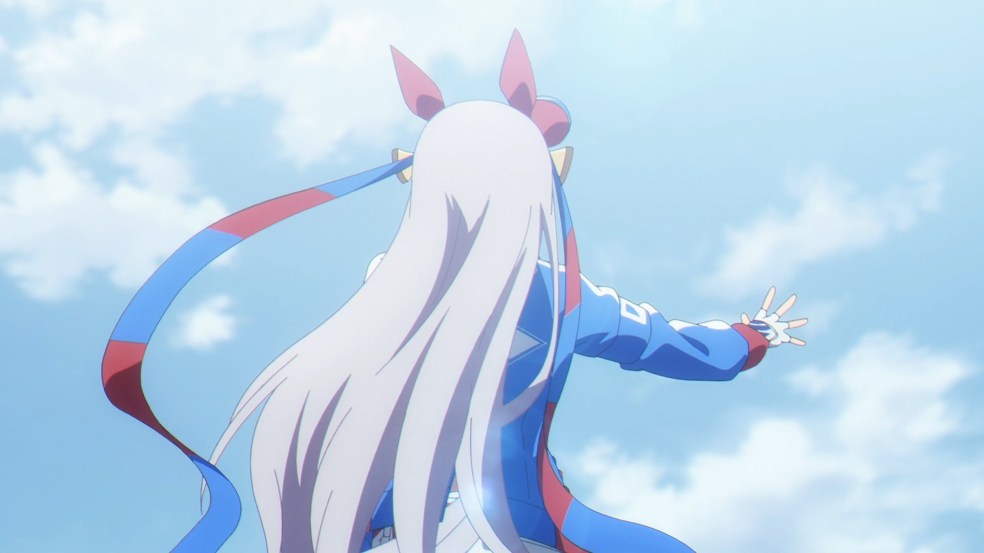

Like what you’re reading? Consider following Magic Planet Anime to get notified when new articles go live. If you’d like to talk to other Magic Planet Anime readers, consider joining my Discord server! Also consider following me on TwitterMastodon, or Anilist, and supporting me on Ko-Fi or Patreon. If you want to read more of my work, consider heading over to the Directory to browse by category. If you have any questions about this or any article, feel free to leave a comment, or pop on over to my RetroSpring and ask me there. It’s up to you!

All views expressed on Magic Planet Anime are my own opinions and conclusions and should not be taken to reflect the opinions of any other persons, groups, or organizations. All text, excepting direct quotations, is owned by Magic Planet Anime. Do not duplicate without permission. All images are owned by their original copyright holders.