Seasonal First Impressions: Blood in the Lilyfields in I WANT TO LOVE YOU TILL YOUR DYING DAY

Seasonal First Impressions is a column where I detail my thoughts, however brief or long, about a currently-airing anime’s first episode or so.


In the grand scheme of all of the anime that have premiered (or have yet to premiere) in the Summer 2026 anime season, my most anticipated show wasn’t the new Kyoto Animation series, ScienceSARU’s take on Ghost in the Shell, the new BanG Dream anime, or anything of the sort. No, I saw that title, and the little bit of atmospheric teasing built up by its first trailer, and—despite knowing nothing at all about the manga it’s based on other than that it’s generally well-liked—knew that it was going to be this. This was my called shot, I’ve been saying for months that this is going to be the premiere of the season; forget whatever hyped-up sequel you have in your mind, the A-O-T-S is I Want To Love You Till Your Dying Day.

Does the actual premiere live up to those predictions? Well, to be perfectly honest, no. Not really. But, I do still think it’s a good premiere. And before I get into why, let’s talk about what this thing actually is first.

Looked at through a certain lens, Dying Day is not terribly different from any of a vast number of ‘magic school’ anime that have existed over the past 15 years. Our protagonist attends an academy that teaches its students how to effectively wield the arcane talents they are born with. The most immediate difference is one of tone; the school of Dying Day is a misty, floodlight gray, and we open in medias res, one of the students having just been killed in a recent “operation.” This school, you see, trains its students not for careers or for their own enrichment, but as soldiers in a war. Young girls and boys learn to conjure magic primarily as a weapon, summoning small, dagger-like wooden wands to do so. The emotional timbre in this opening is more Madoka Magica than Harry Potter, in other words.

Our protagonist is the dead girl’s roommate. In a relatively straightforward move for this show, she’s behind everyone else in her class in terms of talent. Her name is Totsuki Sheena [Takahashi Rie], and she spends most of this episode’s opening minutes wondering why. Why is everyone so blasé about the death of her roommate? Is this how this is all really supposed to be? Flashing back to conversations with that late roommate, Sheena remembers being told she was lucky for being as weak as she was. That her weakness was a privilege that exempted her from thinking about the war. And that night, as she’s continuing to ponder all this, she runs quite unexpectedly into a girl a good bit younger than herself, who is absolutely drenched in blood. Not her own blood, either.

This is Kagari Mimi [Hidaka Rina]. Mimi, who eagerly gobbles up the riceballs that Sheena offers her, is the key to the other half of this show’s tonal space and, I suspect, will be central to whatever it decides to do long-term. (I use that vague phrasing because to be honest, this episode is slow and setup-heavy enough that I don’t really know what that is yet.) Mimi is a few years younger than Sheena and, when she enrolls in Sheena’s class the next day and is announced to be Sheena’s new roommate, the classroom is abuzz with gossip. The other girls (and the boys, too) whisper that Mimi might be that Mimi, a girl who the staff supposedly keep on retainer as some kind of invincible superweapon. In introducing all this, Dying Day does a peculiar little waltz where it tiptoes back into the foggy duskiness of its opening minutes and a goofier sensibility more willing to embrace light novel clichés. In the former camp you have Sheena and Mimi’s wanderings around the school at night, and the funeral for Sheena’s former roommate where Sheena chucks a rabbit into her empty coffin. (The school’s soldiers, we’re told, dissolve instantly upon death. If they were captured, their foes—who we know almost nothing about at this juncture—might “learn things” from their corpses.) In the latter camp, you have everyone’s gleeful fangirling over how cute Mimi is, and one particular detail of the setting; the school’s soldiers (or at least the girls) can kiss each other to use “healing magic.” Essentially, Fate/stay Night‘s “mana transfer” but in slightly less H-game terms. It’s an uneasy dance, but Dying Day largely makes it work.

One of those kisses ends the episode. After witnessing another pair of girls do it, Mimi unexpectedly kisses Sheena when the latter is unable to sleep that night due to stomach problems that, it seems a fair guess, are caused by stress. Sheena narrates that this little problematically age-gapped kiss tastes faintly of soap and, of course, blood…and that’s where the episode ends! Aside from a few minor details (such as a very chummy couple who seem like they’re going to be our main supporting cast) I have really left out very little. It’s a slow, buildup-heavy first episode that is big on atmosphere and raising questions in the mind of its audience. Honestly? Partly because of that uneasy yoyoing between moods, I suspect Dying Day will probably be relegated to cult favorite at best. And even on a technical level it isn’t a perfect premiere. (There are a few obvious visual shortcuts, in particular the use of CGI for some distance models, a general sign of a show that is trying its hardest but isn’t necessarily the most resource-rich production. They’re the only real ding to the otherwise excellent atmosphere.) Still, if you like sapphic overtones so heavy that “overtone” is honestly not the right word anymore and a curious, mysterious atmosphere, I really do think this is worth checking out. Anime of the year? No, not in a year with legitimate masterpieces in this space like Shiboyugi and Kamiina Botan. Of the season? Even then, probably not. But, it is worthwhile in its own right, in a time where everything is rushing to grab your attention as quickly as possible, something taking the slow path shouldn’t be underestimated.


Like what you’re reading? Consider following Magic Planet Anime to get notified when new articles go live. If you’d like to talk to other Magic Planet Anime readers, consider joining my Discord server! Also consider following me on AnilistBlueSky, or Tumblr and supporting me on Ko-Fi. If you want to read more of my work, consider heading over to the Directory to browse by category.

All views expressed on Magic Planet Anime are solely my own opinions and conclusions and should not be taken to reflect the opinions of any other persons, groups, or organizations. All text is manually typed and edited, and no machine learning or other automatic tools are used in the creation of Magic Planet Anime articles, with the exception of a basic spellchecker. However, some articles may have additional tags placed by WordPress. All text, excepting direct quotations, is owned by Magic Planet Anime. Do not duplicate without permission. All images are owned by their original copyright holders.

Seasonal First Impressions: BANG DREAM YUME∞MITA Is Out of This World

Seasonal First Impressions is a column where I detail my thoughts, however brief or long, about a currently-airing anime’s first episode or so.


2026 has been, to undersell it, a strong year for anime thus far. But if we’ve been missing anything, it might be the girl band renaissance that’s consistently been a highlight of the medium’s last few years. A year-ish since the last major show of this genre is not, by any means, a drought, but it felt like we were absolutely swimming in them for a little while, so it can feel like an absence regardless. If you’ve been feeling that way, fear not, the drought is over; Mugendai Mewtype are here. BanG Dream! Yume∞Mita (which I will be spelling without the infinity symbol interpunct, cool as it is, from this point onward) is the latest entry in that longrunning series. It dropped with a gargantuan three-part premiere earlier today, because, well, of course it did. BanG Dream season waits for no one.

Mugendai Mewtype are a bit of an oddity within BanG Dream on the whole, however. This anime is absolutely accessible to anyone who’s not been following them for years—they’ve been active in some form or another since 2022—but it is nonetheless notable that this thing was only made after a retooling of their overall concept. (My very limited understanding, as someone who is a casual BanG Dream fan at best, is that they were originally mostly a VTuber outfit and only became an actual live band later. This anime was, presumably, conceived somewhere after that point.) As such, Mewtype are underdogs of a sort, so it’s nice to see them getting their own story.

As for what that story is like, I’m going to actually flip my usual script here and talk about the style and tone of the series first, and save the actual plot for the bottom half of this article. Worth mentioning, more than anything, with this multipart premiere, is the show’s extremely expressive visual style. A far cry from the frozen and elegant gothica of Ave Mujica, its immediate predecessor, Yumemita is a cartoon-ass cartoon. Characters bend and stretch to express contentment or shock, other art styles or locations are beamed in for a few seconds for comedic effect, the works. I would go so far as saying that off these three episodes alone it really gives Girls Band Cry a run for its money in terms of being one of the most visually impressive 3DCGI anime to date, not just within its genre but outside it as well. The colors are, similarly and once again in contrast to Ave Mujica, brighter than a fresh lightbulb and more colorful than a pack of Skittles, extremely vibrant and practically radiating off of the screen. Ultimately this is the sort of thing you need to see to truly appreciate, but if my recommendation is worth anything I can safely say that the anime is worth watching for its visuals alone.

From this, you might surmise that Yumemita is on the lighter end of the tonal spectrum. You’d be correct to! Overall, this is a pointedly less heavy affair than the previous two BanG Dream anime have been. That’s not to say there are no stakes (there are, and there’s one delightfully glowering exception to everything I’m about to say that we’ll get to), but there is, for example, no long-simmering backstory involving—spoilers for those two shows, by the way—parental abuse or incestuous niece/aunt romantic pining. Yumemita is thus perhaps more in line with a “normal” BanG Dream anime, if what I’ve seen of the first season is representative. But this isn’t a show content to rest on its laurels. In its more straightforward moments, Yumemita experiments visually, as previously outlined. In its more serious ones, it turns that experimentation toward something more tense. It manages to pull this shift off with surprising ease, and the show’s few (few so far, at least) darker moments read more as deliberate contrast than lack of cohesion.

It’s worth taking a detour to discuss one further aspect of the presentation; the subtitles. Mostly, they’re fine, but seem to be strictly single-line, meaning there are a couple of cases where lines aren’t subbed because they’re spoken under another, usually longer, set of dialog. (There’s a particularly annoying instance of this in the third episode.) In a few cases, pretty important-looking text messages aren’t translated at all. This doesn’t majorly impact the show’s basic comprehensibility in the same way that Ave Mujica‘s truly busted official subs did, but it’s still annoying, and it feels like we’re missing a bit of nuance, and it’s aggravating to have to take time out of so many premiere writeups I do just to note that the subs are scuffed. This may be another one where the wait for fansubs is worthwhile, but I don’t think the officials are bad enough to wave anyone away from entirely. It will come down to personal preference, in the end.

Speaking of the show’s writing, Yumemita also has an exceptional command of comedy, and I’d in fact say that were it not for the aforementioned exceptions you could get away with just calling the series a comedy outright. (As-is it’s more of a dramedy.) Much of this revolves around Arale1, our main protagonist, vocalist of Mugendai Mewtype, and owner of a truly impressive mile-a-minute motormouth that she tries and often fails to keep a lid on. Bandmates Nonoka, a happy, bunny-coded airhead that serves as the group’s guitarist, and Miyako, a mangaka who also does illustrations for Mewtype and is their keyboardist, get their fair share of jokes in, too, however. Final group member Yuno, Mewtype’s DJ and general doodad manipulator, is essentially the group’s collective straight man and is more a subject of comedy than anything else.

(From left to right: Yuno, Arale, Miyako, and Nonoka, rocking out while singing the OP)

With all this said, the actual plot of the show is an interesting beast in its own right, and we shouldn’t discard it. In premise, Mugendai Mewtype’s actual formation is extremely straightforward. Our heroines were individually-successful creators in their own right—Nonoka livestreams, Miyako has her manga and illustrations, Yuno both contributes songwriting and composition to other artists’ projects and was in a previous band of her own, and Arale was also in a previous musical group (a different one, it should be stressed). As would be expected of people who meet as part of, essentially, a business arrangement, none of the Mewtype girls directly knew each other before the events of the first episode, and it feels safe to say that none of them are on the same page. (Although some of them were at least aware of each other. Arale in particular fangirls to hell and back over Miyako’s manga.) In fact, none of them really seemed to know that they were going to be in a band together as such at all. Especially not Miyako, who explicitly simply didn’t read the terms of her contract. (Get a lawyer to go over these things, kids!) Worth mentioning here is also the band’s manager, a horrible little voxel FunkoPop thing, because the band’s actual meetings, you see, occur entirely within something akin to VRChat.

The main point-of-view character for most of these three episodes is Arale herself. Arale’s past experiences with online fame lead to her to be, to put it nicely, a little neurotic about how she acts around other people. Constantly, over the course of the premiere, she wants to say something but doesn’t, or can’t stop herself from saying something that she doesn’t want to. In neither case do either of these cause much issue for Arale in the present at least, but they clearly embarrass her and she spends most of the premiere trying to worm her way out of having to sing as part of Mugendai Mewtype at all. (In fact, in a commonality with the MyGo/Ave Mujica trilogy-to-be, there’s pretty much no actual music in this first trio of episodes aside from the OP and ED themes.) Especially early on when speaking to her IRL schoolmates, she only says a few words out loud while an entire internal monologue plays over top and, indeed, is what’s actually subtitled.

Arale gets up to quite a few antics over the course of these first three episodes, but trying to avoid singing (especially in front of anyone) is her main thing at the moment.

Why? Well, as mentioned, Arale used to be part of a different group. The LaLa Girls, as they were known, were together for a while until they weren’t. We don’t know all the details, but one thing is quite clear: a video of Arale talking shit about both her bandmates and some other, unrelated people was leaked on their Youtube page, and our girl got very cancelled. We first learn of this when she runs into two of her former bandmates. Ritsu, who really seems to miss her and want to reconnect with her, and Viola2 [Kaede Hondo], who is, even in just her brief screentime here, a magnetic presence who seems very determined to make sure that doesn’t happen. Both are part of a new band with a flower theme, we don’t know a ton about them (or there other two members) yet, but it seems like they’ll be an important presence here.

(From left to right: Bell, Viola, Ritsu aka Clematis, and Popo)

Earlier, I mentioned that this series has a largely fairly light atmosphere compared to the last two BanG Dream anime. That’s mostly true, I mentioned an exception, that would be Viola and her general role in this story. Arale has a flashback / bad dream at the start of the second episode that really makes it seem like she’s in the wrong with the whole “leaked video” thing. But a good chunk of Viola’s dialog, and her weird, touchy-feely actions while speaking to Arale (including petting her hair and talking about how she looked better with twintails), definitely imply something weird going on. This comes to its head at the premiere’s conclusion, in a post-credits scene after the third episode. Here, she pretty heavily implies that she either somehow set Arale up, or kept the video in her pocket as a weapon the entire time. Ritsu, in particular, seems very uncomfortable with all of this, and Viola is clearly keeping her under her thumb by threatening to hurt Arale even further unless Ritsu cuts contact. She goes on a monologue here that is just pure cartoon supervillain shit; she strings together a speech about how human civilization rose because the first humans weren’t afraid of fire and how it only takes one spark to set something alight. If she didn’t draw attention to it herself, you could easily miss that this is pretty much entirely just wordplay riffing on the term “getting flamed online.” The performance from her voice actress, the permanent cat smile plastered across her face, and the deployment of the show’s SD squishiness to highlight just how much sadistic joy she’s taking in this all serve to make her almost outlandishly EEEEEEVIIIIIIILLLLL. The only thing she’s missing is an ojou laugh and a threat to kick someone’s dog. It’s quite a contrast from the rest of the show! Arale, in spite of her past mistakes, is trying to better herself and most of the interpersonal issues between Mugendai Mewtype themselves seem comparatively minor! So this is all a bit of a twist, for certain.

It’s not necessarily the only thing in this premiere to suggest some darker directions this series may take—Miyako has an entire subplot about pushing herself to the brink of exhaustion to juggle the band and her existing job as a mangaka, for example—but it’s by far the most obvious.

This is, of course, still nowhere near the kind of hair-raising stuff that happens in, especially, the later parts of Ave Mujica, but the tonal pivot is pulled off with such finesse that’s easy to forget that this is the same show where, an episode earlier, Arale and Nonoka lure Miyako into talking to them by scattering a bunch of candy on the ground in front of her. Or, indeed, earlier in this same episode that same pair of characters convince themselves that Yuno is secretly a highly-advanced AI and try to trick her into revealing herself by making her solve captchas and shit. (This gets a hell of a punchline a couple minutes later where it’s shown that, while Yuno herself is not a robot, she’s perfectly happy to use ChatGPT to reply to Nonoka’s incessant text messages. Ouch.)

Suffice to say, if Yumemita wants to make a more permanent pivot to darker material, it has the tools to do so even if the material in question is a bit different in presentation than that of other recent BanG Dream entries. Viola is being set up as an outright antagonist, and not a ton of band girl anime actually have those! Usually, a character in that position has sympathetic motives of their own, and while it’s very possible that something like that will eventually happen with Viola as well, nothing here telegraphs that at all. So far, she just really seems like a possessive, sadistic bitch! It’s honestly really compelling! If in part, admittedly, because it’s such a contrast to the goofball shit in the rest of the premiere.

Still, I’d hasten to say that I don’t think these two halves of the show contradict each other in any way, either. If the past few years of BanG Dream anime have proven anything, it’s that the wild risks these shows take tend to pay off. I am here for this, and you should be, too.


1: Normally, this is where I credit voice actors. However, to my understanding, all of the Mewtype girls are just credited as the characters themselves in all BanG Dream projects. This seems weird to me! but it’s how they do things with this particular part of the project, for whatever reason. If I had to take a random guess, it relates to their origins as a VTuber group.

2: Viola’s group all have stage names, and given the flower theming, we can guess “Viola” isn’t her real name. Whatever that real name might be, we don’t get it here.


Like what you’re reading? Consider following Magic Planet Anime to get notified when new articles go live. If you’d like to talk to other Magic Planet Anime readers, consider joining my Discord server! Also consider following me on AnilistBlueSky, or Tumblr and supporting me on Ko-Fi. If you want to read more of my work, consider heading over to the Directory to browse by category.

All views expressed on Magic Planet Anime are solely my own opinions and conclusions and should not be taken to reflect the opinions of any other persons, groups, or organizations. All text is manually typed and edited, and no machine learning or other automatic tools are used in the creation of Magic Planet Anime articles, with the exception of a basic spellchecker. However, some articles may have additional tags placed by WordPress. All text, excepting direct quotations, is owned by Magic Planet Anime. Do not duplicate without permission. All images are owned by their original copyright holders.

Brief Thoughts on: IKOKU NIKKI – Episode 10


Something I greatly appreciate about Ikoku Nikki is its intentionally screwy chronology. Asa walks home disappointed when one of her friends suggests they all try out for a lead vocalist position. We then get to see why she’s upset. All of those friends pledged at some point to write a song together, a promise treated as sacred in some genres here dissolves into nothing in the span of just a few months. As she walks, melancholy, a piano melody drifts her way, and it’s suddenly years and years ago, when she was much younger and singing in a choir competition, something her biological parents seem to have encouraged. Later, when she loses, her father stutteringly tells her that her singing “stood out.” In this way, there is a through-line. The immense weight of that reaction, likely not even intentional, is something that can utterly sledgehammer a child’s sense of self. This isn’t the thing that sets Asa a-wandering, but it is one such thing.

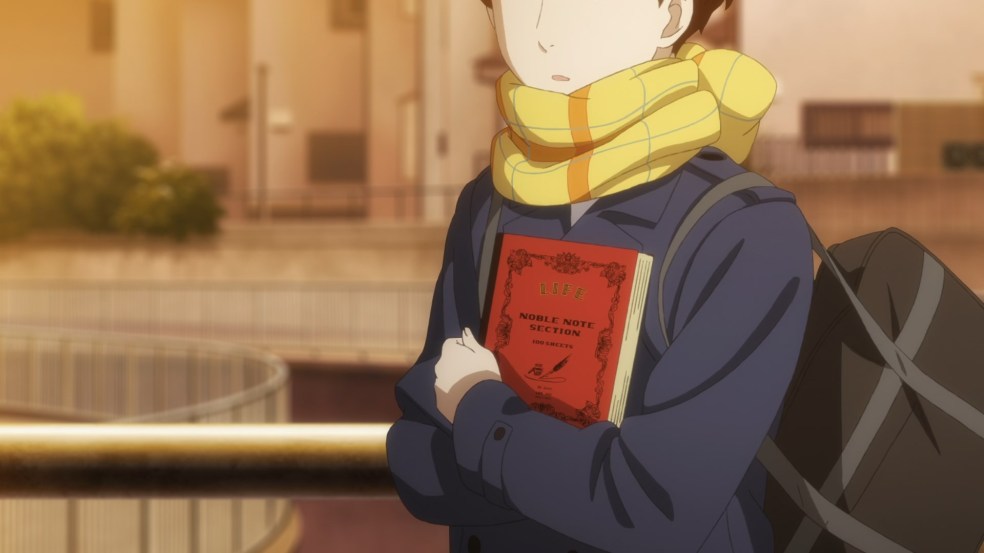
This methodology pairs well with the collage-like approach that Asa takes to her notebook itself, the central object of Ikoku Nikki on the whole. Her writing in it is, like her memories, patchwork, a scrawled quilt of quotations from the adults in her life, doodles of UFOs, short exclamations of feeling and so on. In this way, Ikoku Nikki is very good at marrying form to function; we are living inside of a notebook not unlike Asa’s as we watch it, because everyone’s life is like this.

And indeed, Asa’s not actually the only character to have this privilege. We follow Emiri for some time here, time spent waiting for her friends, fixed on a length of telescoping pencil lead, washes away into a daydream of the seaside.

When one of those friends arrives, she vents about feeling like she could never stop being friends with Asa even if she wanted to ever since the accident. That feeling, tense and heavy, melts away. The person Emiri is venting to is a gentle newcomer to the narrative, one Shouko [Hanazawa Kana], who wraps her pinky finger around hers, the implicitly romantic nature of the gesture made explicit when Emiri blushingly says that she likes this girl. Without this insight into Emiri’s own point of view, it would be easy for the viewer to condemn her at arm’s length. Walking alongside her, we can see that her feeling of burden isn’t borne of cruelty. It’s the shifting unease of someone who feels she is rapidly growing apart from her childhood friend, in ways she’s not sure how to confront. This sort of tempering is what drives Ikoku Nikki’s emotional logic, it’s what makes it feel “real.” The emotional verisimilitude holds up a mirror to every similar selfish decision we’ve ever made for ourselves. It doesn’t judge, but it does reflect.

These aren’t the only lives this show has explored, but all those it has are considered similarly. (Makio, most notably. Both here and elsewhere.) Notebooks, connected by only the whims of their writers, emotions and events blending together with no regard for time or space, are the perfect metaphor. We are, perpetually, searching for the unifying thread at the center of it all, the reason we write in the first place, no matter what form our stories take.


Like what you’re reading? Consider following Magic Planet Anime to get notified when new articles go live. If you’d like to talk to other Magic Planet Anime readers, consider joining my Discord server! Also consider following me on AnilistBlueSky, or Tumblr and supporting me on Ko-Fi. If you want to read more of my work, consider heading over to the Directory to browse by category.

All views expressed on Magic Planet Anime are solely my own opinions and conclusions and should not be taken to reflect the opinions of any other persons, groups, or organizations. All text is manually typed and edited, and no machine learning or other automatic tools are used in the creation of Magic Planet Anime articles, with the exception of a basic spellchecker. However, some articles may have additional tags placed by WordPress. All text, excepting direct quotations, is owned by Magic Planet Anime. Do not duplicate without permission. All images are owned by their original copyright holders.

Brief Thoughts on: IKOKU NIKKI – Episode 3

“Brief” articles are copied directly from my tumblr, with only minor changes, and are shorter and more off-the-cuff than their full length counterparts.


One of my favorite things about this anime, which is used in a couple of different ways over the course of this episode, is Makio’s very authorial and writerly narration. She describes Asa’s empty apartment, which they visit in this episode, this way, and it really adds an ineffable something to the characterization as opposed to if we heard fewer of her thoughts. It gives the work a very “literary” quality, which makes sense both on an obvious level because Makio is an author, but also on a less obvious once, in that she seems to use this formal discursive register to separate herself a little bit from the events she and Asa are going through. It’s an interesting tension, and one I hope the series continues to explore as it goes on.

One way this forms a tension is in her statements to Asa, that Asa’s feelings about her parents’ passing are her own business alone. She’s said this a lot over the course of these three episodes, and while she clearly does believe it to some degree, she also doesn’t believe it so much that she doesn’t ask questions when Asa comes home from her first day back at school—the graduation ceremony, ironically—in tears, having even gotten lost on her way back. Asa presses her for asking about it, and—again, I think this is an interesting bit of tension—Makio says she shouldn’t put so much stock in what other people say

The entire episode of Asa going to school, only to learn that her friend Emiri has inadvertently let the entire class and faculty know about the tragedy she went through, and acting out at both Emiri and that faculty is an interesting one. We don’t really see Asa acting this emotive very often and she’s clearly very angry that everyone will only think of her as “that girl with the dead parents”, she says as much. (All the while the visuals transpose the characters into a surreal Maypole Dance setting.) Emiri and Asa were friends before this, but she spends most of the rest of the episode ignoring her and, on her way out the door, says she hates her.

We return to Makio attempting to figure out what exactly happened here, and when Asa throws the whole “no one’s business but your own” thing back in her face, that is when she tells Asa that she shouldn’t put so much stock in what other people say. Even more interestingly, this is immediately before talking about her own schoolday friend (Daigo Nana, who we met last week), and how Nana wrote her a letter on their last day of school together that meant the world to her. These pieces of subtle hypocrisy aren’t drawn a ton of attention to, other than Asa calling them out the one time, but they’re very interesting and paint Makio as a very complex character.

Again, I’m just really interested to know where else we’re going here. You could easily make the case that this is an outside candidate for the best thing airing right now, and given how stacked this season is, that’s really saying something.


Like what you’re reading? Consider following Magic Planet Anime to get notified when new articles go live. If you’d like to talk to other Magic Planet Anime readers, consider joining my Discord server! Also consider following me on AnilistBlueSky, or Tumblr and supporting me on Ko-Fi. If you want to read more of my work, consider heading over to the Directory to browse by category.

All views expressed on Magic Planet Anime are solely my own opinions and conclusions and should not be taken to reflect the opinions of any other persons, groups, or organizations. All text is manually typed and edited, and no machine learning or other automatic tools are used in the creation of Magic Planet Anime articles, with the exception of a basic spellchecker. However, some articles may have additional tags placed by WordPress. All text, excepting direct quotations, is owned by Magic Planet Anime. Do not duplicate without permission. All images are owned by their original copyright holders.

Let’s Watch UMAMUSUME: CINDERELLA GRAY – Episode 20 – “The Answer”

Let’s Watch is a weekly recap column where I follow an anime for the course of its entire runtime.

For the Cinderella Gray column, new installments will be posted either on the Sunday each episode airs, or as soon as possible over the succeeding week. Expect spoilers!

Cinderella Gray can be watched, legally and for free, on It’s Anime By REMOW on Youtube. A link is provided below for your convenience. The descriptive blurbs for these articles are taken from those of REMOW’s Youtube uploads.


A recurring tension in the Umamusume series is the fact that all racing careers eventually end. This only makes sense, most athletes retire eventually. You can’t push your body like that forever, and even the best will have to pack it in someday, as the alternative is usually much worse.

In the context of Umamusume, retirement is a peculiar thing. It’s almost never addressed directly. When it is, it’s sometimes accompanied by mention of the Dream Trophy League, a wholly fictional second racing league that we know little about, which existed as a background detail in some of the earlier, no-subtitle Umamusume anime seasons. Whether the Dream Trophy League even exists at this point in Umamusume‘s vague, shifting, and sometimes self-contradictory timeline isn’t clear—if it’s ever mentioned in Cinderella Gray at all, I must’ve missed it, and honestly even asserting that Cinderella Gray and those other seasons take place in the same continuity at all requires some squinting—but I bring this odd relic of the earlier Umamusume anime seasons up here to point out one thing in particular. It doesn’t actually come up in this episode even once, which feels notable.

Why? Because this is the episode where we finally learn what, exactly, has been hanging over Tamamo Cross’s head for the last while. You may recall that she seemed oddly hesitant to commit to racing in the Japan Cup again next year back when Obey Your Master asked. Here, we learn why. The Arima Kinen is going to be her last race.

This episode actually opens on a bit of backstory for Tamtam, showing us how she met her trainer Komiyama Masami. That “old man” whose sake she’s run some of her races was in fact her landlord, implicitly a former umamusume trainer himself, and introducing Tama to Komi was an act of kindness where it’s easy to understand why she’d hold him in such high regard. We aren’t directly told precisely why Tama is retiring, but with the juxtaposition here, we can infer any number of reasons.

Regardless of the “why,” when the two of them meet at a press conference, Tamamo breaks the news privately to Oguri Cap, who does not take it well. Whatever reason Tamamo might have, this means that she and Oguri will only have one more race together, the Arima Kinen itself. Oguri is actually in a fairly good mood up until this point in the episode, and her sharp downturn in demeanor here is quite startling. Moreso when she realizes, as she tries to argue with Tama, that she is now essentially in the same position Fujimasa March was way back in episode six. Tamamo Cross’s ultimatum to Oguri is the same as Oguri’s was to March; if she really wants to settle things, she has to beat her here. There will be no do-overs.

When the actual press conference starts and Tamamo Cross breaks the news to the press that the Arima Kinen will be her final race. We actually get a rare bit of narration from Oguri here, where she admits to not even remembering what she tells the press when they turn their mics to her. We don’t hear it, either, all of her thoughts have been blotted out by the specter of Tamamo Cross’s retirement.

Between the prospect of her greatest rival retiring and her own failure to reach the Zone, Oguri’s in a pretty tough position here, mentally. Some time after the conference, we see Oguri training at night to blow off some steam, and it feels like an open question as to whether the self-doubt, anger, and disappointment might actually snuff out her competitive fire forever. This is a real danger to someone like Oguri Cap, and she’d hardly be the first Umamusume protagonist to let her own hangups psyche her out of a victory.

Enter Dicta Striker, the Chestnut Bullet.

Dicta, based on one of the real Oguri Cap’s contemporaries, the horse Soccer Boy, has been a background presence in the anime since Oguri relocated to Tracen, but this episode is the first time we really get a good handle on her as a character. We get some of her backstory, including how her early career as a young prodigy gave way to a streak of losses that broke her confidence. She rebounded, though, at one point partly inspired by Oguri herself. By the time she calls out to Oguri for a late-night practice race, she’s long since reached the elusive Zone herself.

The training race, then, is as much a direct conversation between these two as it is actual practice. Dicta lightly needles Oguri as they run, saying that as she is now, she’ll never reach it. Privately though, Dicta thinks that Oguri is actually on the verge of breaking through this mental barrier. Dicta pushes her further; what compels her to race? Who does she want to beat? What, at the end of the day, is driving her?

This seesawing tension, between the joy and the fire Oguri Cap feels from running itself, from surpassing her rivals—once Fujimasa March, now Tamamo Cross, perhaps someone else in the not-too-distant future—from surpassing her own limits, and the persistent fear that she won’t be able to, will remain an underlying current for the remainder of the series. Cinderella Gray really leans into the Beast part of Oguri’s nickname in scenes like these, illustrating an underlying, boiling primality at the heart of her character, something fiercer and deeper than just competitiveness.

In a way, it’s unsurprising to see the anime render her in these terms—at the end of the day, this is a sports anime, after all—but the elemental distillation of it here is still a pretty rare thing, and it’s one Umamusume has made an art of over the years. Perhaps because of this, the nighttime practice race between Oguri and Dicta is the episode’s best scene, with most of its best shots being moody, windy cuts of Oguri’s running figure against the night sky.

Oguri comes close to making the breakthrough she needs to—very close, we get that visual effect of gray smoke leaking out of her eyes again, and a shot of a wall of glass cracking but not yet breaking—before Dicta abruptly calls the race off just as Oguri is about to pull ahead of her. Whether her explanation that she doesn’t want to push either herself or Oguri so much before the real race that they hurt themselves is what she really believes or a small bit of saving face is hard to say for sure. Either way, it’s clear that this run helps Oguri a lot.

Directly helping her rival out, even in such an oblique way, may seem contradictory with the goal of actually winning the Arima Kinen for Dicta. But, afterward, when her trainer, a hulking oak tree of a man, lightly chastises her for it, Dicta just wryly replies that she doesn’t want anyone to say that Oguri wasn’t at her best when she beats her.

Dicta isn’t the only one helping her, either. As all of this is going on, Belno Light, who by this point is essentially Oguri’s co-trainer, has been handling the more technical and strategic aspects of planning the race. An early scene at the press conference sees her inspired by how well Komi takes care of Tamamo Cross, and she gets a particularly great showcase here where, as an umamusume herself, she’s actually able to imitate Oguri’s running gait and analyze the specific ways in which the Arima Kinen’s track will affect her.

As with the Tenno Sho, the Arima Kinen features an inclined section, something that can’t be overcome with brute force alone and requires actual strategy to handle. Belno’s scenes in the episode, devoted to tackling this problem, are less dramatic than those with Tamamo Cross or Dicta Striker, but they’re no less important, and I think the story does a great job of making her seem just as important to Oguri’s growth as Oguri’s rivals are. By the time she’s finally come up with a good solution, she’s effectively run a version of the race herself. She may not be a preternatural talent like some of her contemporaries, but Belno’s tenacity here can stand up against that of any other umamusume in the series.

Of course, whether that growth equals success is another question. The episode ends on Christmas Day, at the Arima Kinen, a bright and sunny winter day as the runners take the field….


Like what you’re reading? Consider following Magic Planet Anime to get notified when new articles go live. If you’d like to talk to other Magic Planet Anime readers, consider joining my Discord server! Also consider following me on AnilistBlueSky, or Tumblr and supporting me on Ko-Fi. If you want to read more of my work, consider heading over to the Directory to browse by category.

All views expressed on Magic Planet Anime are solely my own opinions and conclusions and should not be taken to reflect the opinions of any other persons, groups, or organizations. All text is manually typed and edited, and no machine learning or other automatic tools are used in the creation of Magic Planet Anime articles, with the exception of a basic spellchecker. However, some articles may have additional tags placed by WordPress. All text, excepting direct quotations, is owned by Magic Planet Anime. Do not duplicate without permission. All images are owned by their original copyright holders.

Let’s Watch UMAMUSUME: CINDERELLA GRAY – Episode 15 – “Our Story”

Let’s Watch is a weekly recap column where I follow an anime for the course of its entire runtime.

For the Cinderella Gray column, new installments will be posted either on the Sunday each episode airs, or as soon as possible over the succeeding week. Expect spoilers!

Cinderella Gray can be watched, legally and for free, on It’s Anime By REMOW on Youtube. A link is provided below for your convenience.


Let’s talk about Super Creek [Yuuki Kana].

Actually, before we talk about Super Creek, let’s talk about characters, and how Umamusume handles them. Full disclosure, I’m going to be pulling extensively here—both in this column specifically and, honestly, probably whenever I talk about Umamusume going forward—from IronicLark’s excellent Umadacchi Densetsu blog, a fantastic resource for all things Umamusume and, so far as I am aware, easily the most thorough exploration of the series and its various components available in English. I highly recommend diving into it yourself sometime if what I am doing in these columns interests you even a little bit. Frankly, Lark is significantly more knowledgeable on the subject than I am.

So, characters. Most things I cover on this blog are either standalone anime projects, or they’re anime adapted from some single specific source, a manga, a light novel, etc. Umamusume belongs to the other category of things I cover here, and has more in common structurally with, say, Love Live, than most other anime I write about. What I mean by this is that it’s a media mix1 franchise. Without getting too into it (because that distinction alone is worth having a long conversation about) what this essentially means is that rather than one component of the franchise being the “primary” unit that all other adaptations pull from, there are many distinct components given roughly equal weight. Now, this isn’t strictly the case with all or even most media mix properties, as in the case of Umamusume and many others, there is a “central” project—the game—but the distribution of influence is much more horizontal than it is in something like, say, the Yano-kun anime airing this season, which is a straight one-to-one adaptation of a single specific story.

This approach changes how a series handles many things, but most relevant here is how it handles characterization. Because, if you primarily know Super Creek from the Umamusume game—and I’m betting that describes at least some of you—you might wonder how that character and her doting, motherly personality fit in to the generally fairly serious ‘sports anime’ tone that Cinderella Gray has going on. The answer is that Umamusume, as with many media mix properties, tends to emphasize or scale back different character traits depending on the needs of the story. As such, different iterations of the same character can feel pretty distinct, even if the “core” remains the same. (As a complete tangent, the most extreme example of this approach I can think of is actually Transformers, a series in which this guy, this guy, and this guy all have the same name, at least some of the time, despite being nothing alike.) Nothing so extreme as that example is present in Umamusume, but I bring all this up just to say: when we see Creek here, she is somewhat different from the Super Creek you’ve seen people make all those googoo babies jokes about on the internet. (Although, elements of that doting characterization do remain, I don’t want to overstate the differences.)

Creek is formally introduced here after having kicked around in the background of Part 1, and—not to spoil anything—we are going to be following her, at least intermittently, for quite a while. Her introduction is actually relatively low-key at first, though. We see her training. We see her trainer, Fumino Nase [Yū Shimamura2] apparently a prodigy who’s brought her trainees pretty significant success even early on in her career, beset by reporters. Nase seems to find all the media attention annoying at best (and particularly bristles at an offhand mention of her father, evidently also a trainer), but she’s willing to throw them a bone by telling them that she intends to have Super Creek compete in the Kikuka Sho, one third of Japan’s Triple Crown and, importantly, the longest race of the three. This comes as a surprise to the reporter interviewing her as, to hear that reporter tell it, Creek’s race results haven’t been that impressive, and she’s actually not even a sure thing to so much as run in the race, as someone would have to drop out first. Nase is of course aware of all this, though, and explains that as a trainer, she considers it part of her job to believe in miracles, no matter how unlikely they might be.

Naturally, just then, word comes down the line that one of the other competitors has had to drop out. Super Creek has an in.

The actual Kikuka Sho race follows both Creek and one of her main competitors. Yaeno Muteki, whose name you probably remember. It’s hard not to feel a bit bad for Muteki, who keeps getting put in these situations where she’s trained so hard and has good prospects only to end up facing a rare, generational talent.

And make no mistake, Super Creek is one of those. For a race as long as the Kikuka Sho both physical stamina and clarity of mind are important, so while Muteki holds the most promising position for a majority of the race, Creek is eventually able to angle her way from the middle of the pack straight to the front, and she ends up not only winning but winning by a pretty large margin. (A quick reference check on the real race that this episode is based on shows that the real Super Creek overtook the second-place horse, Gakuten to Beat, by five lengths. I am choosing to assume a similar margin here, in the absence of any other evidence. I suppose he really did beat Gakuten.)

Creek’s strength, as emphasized here, lies in her incredible endurance. Something she and Nase have evidently been working on for some time. A brief flashback between the two invokes the Cinderella metaphor once again.

Apropos of nothing, it is worth pointing out that Creek and her trainer seem very close.

It’s worth going over again, the term “Cinderella story” refers to, in sports, a longshot victory by an underdog. Usually several such victories over the course of a tournament or the like. In the context of Cinderella Gray, well, the second part of the title spoils that this mostly refers to Oguri Cap. But it can, just as easily, be taken to refer to many of Oguri’s contemporaries, including Tamamo Cross and, yes, Super Creek as well. (Given her chestnut brown hair, she’s an almost-literal dark horse.) Her victory here is clearly hard-fought, and the fire in her eyes on the final spurt is really something to behold. I’m probably not going to surprise anyone by saying I absolutely love Creek, especially this incarnation of the character. I am hoping this episode might turn at least a few more people in the world into Super Creek fans. Fingers crossed.

(On the note of “beholding”, it’s worth addressing the elephant in the room at least briefly. There has been some amount of discourse about the show’s somewhat reduced animation prowess from the first part of the first season, the Kasamatsu arc. There’s some truth to this, probably related to staff being shuffled around, but the highlights of this race stack up to anything else in the series so far. We’ll see how the rest of the season plays out in this regard. I feel the need to give a good amount of credit to the show continually paying attention to how the racers run, though. Even in the weakest moments of the race, Creek is consistently drawn as taking long, comparatively slow strides. Right up until that final spurt, where she starts really putting the pedal to the metal.)

In any case, while Yaeno Muteki takes her loss hard, she and her master keep up their training. Muteki has an endurance of her own, in this regard, and as I’ve gone through this story she’s become one of my favorite supporting pieces of Cinderella Gray‘s cast, which is not exactly lacking for strong characters.

And as for the Ashen Beast? Well, this arc does mark the point at which Cinderella Gray goes from being largely about Oguri Cap to being something of an ensemble piece, and I suspect we’ll get a lot more of these focus episodes in the weeks (and hopefully, years) ahead. But, she is here. The entire time Super Creek is making history on the racetrack, a pair of distant eyes are on her, and they are those of none other than our very own Gray Monster. She, Belno, and Musaka make a number of comments during the race, in fact, but what sticks out to me most are the ice-blue bullets Oguri stares into the screen when she senses she has gained yet another rival. Truly, our girl is a monster.

Super Creek will not be the last girl to give Oguri a hard time this arc, by a long shot. A brief post credits scene introduces us to Toni Bianca [Kaida Yuuko], the Italian umamusume who stands as one of many international racers Oguri and all other Japanese racers competing in the Japan Cup will have to face. Toni is wildly dismissive of them, time will tell if she can back up that talk.

Oh, and there’s another umamusume from abroad who arrives as well. Some blonde girl with tacky stars-and-stripes leggings. Probably no one important, in any case.

Famously a thing us Americans say a lot.

But! We’ll get to find out together. See you next week, Umamusume fans.


1: While the Japanese term “media mix” is quite similar to the English phrase “mixed media”, I’m rendering it as-is here, because “mixed media” has a different connotation in English, whereas a “media mix” is something a fair bit more specific.

2: As with the Sirius Symboli case in Part 1 of the anime, my usual sources are not helping me here, but I found a few stray references indicating that she’s voiced by Yu Shimamura, and am taking those at their word.


Like what you’re reading? Consider following Magic Planet Anime to get notified when new articles go live. If you’d like to talk to other Magic Planet Anime readers, consider joining my Discord server! Also consider following me on AnilistBlueSky, or Tumblr and supporting me on Ko-Fi. If you want to read more of my work, consider heading over to the Directory to browse by category.

All views expressed on Magic Planet Anime are solely my own opinions and conclusions and should not be taken to reflect the opinions of any other persons, groups, or organizations. All text is manually typed and edited, and no machine learning or other automatic tools are used in the creation of Magic Planet Anime articles, with the exception of a basic spellchecker. However, some articles may have additional tags placed by WordPress. All text, excepting direct quotations, is owned by Magic Planet Anime. Do not duplicate without permission. All images are owned by their original copyright holders.