(REVIEW) Reckoning with MAGIA RECORD: DAWN OF A SHALLOW DREAM

This review contains spoilers for the reviewed material. This is your only warning.


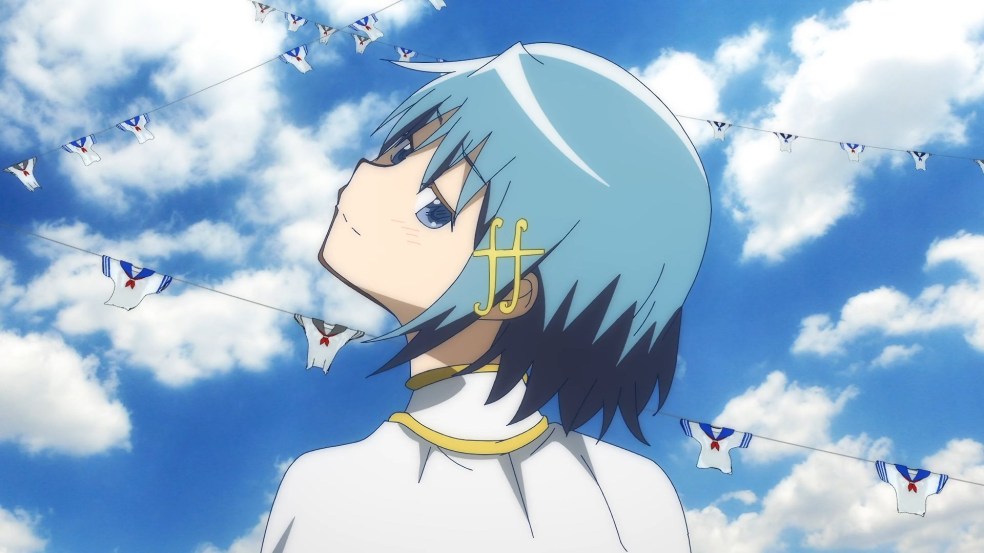
Here we are, again and at last. I have written about Magia Record; the anime adaption of a mobile game spinoff of the original Puella Magi Madoka Magica, again, and again, and again over the past two years. This will, barring something truly unexpected occurring, be the final time. Dawn of a Shallow Dream is the final “season”–really more of a movie with intermissions–of the series. Part of me will miss it.

Magia Record on the whole is, to use a term I consider neutral, but some would call a denigration, messy. Its pieces do not all fit neatly together. It overreaches, and from a purely technical point of view, it’s a serious mixed bag, marrying near-immaculate directing with consistently inconsistent quality of actual, y’know, drawings. Its three seasons are all very different and its cast of characters is too large for it develop them all equally-well. Its core theme–persistence in the face even of impossible odds and crushing despair–is arguably overdone within this genre, and is better-executed by its parent series, by Symphogear, and perhaps even by distant cousins like Day Break Illusion. Aren’t we all a bit tired of this by now?

Well, if you’re reading this, you probably know how I feel about these things (and if not, you will soon enough.) So, it will not surprise you that the answer from me, the woman who thought Blue Reflection Ray was really underrated, is “no, I’m not tired of it at all.” Bring them on a hundred strong, I say.

My thoughts on Magia Record have shifted a bit several times since the first season originally aired, but I remain resolute on a key point. As a “Precurification” of the original Puella Magi Madoka Magica‘s general idea–that is to say, a vehicle for delivering and iterating on “Madoka stories” within a fixed format–it absolutely kills. Shallow Dream is its swing at a grand finale. It doesn’t hit every target perfectly, and I will discuss what bones to pick I do have a bit farther down, but it makes a good show of things in its own way.

Magia Record‘s plot has always been a point of contention; the show is very cognizant of its own worldbuilding. Lucid, even. But that doesn’t translate to it always being clear to the viewers. This is probably the simplest it’s ever gotten, and thankfully things are conveyed fairly strongly here. Even so, to sum it up I can only offer something like; Iroha (Momo Asakura) and friends stop Embryo Eve by weaponizing the power of human connection. Not perfectly, of course, because this is Madoka, but, you know, pretty well. Along the way we get some long-overdue explanations for what was going on with Iroha’s sister and their two friends. Also because this is Madoka, about a quarter of the cast dies along the way. You can’t win ’em all.

I completely understand why MagiReco’s insistence on burrowing so heavily into its foretext is offputting to some (I would argue it’s still in service of a solid thematic goal, regardless), but it does mean that for the hardcore magical girl fan, Magia Record has been a treat of well-done henshin sequences, fight scenes, and just in general, deliciously weird imagery that nothing else in the genre quite touches. We don’t get as much of that in “season three” here as we did last year for season two (there’s really only one fight in the whole thing and it’s pretty brief), but it remains a pleasure to look at, even when the character art goes headlong into “why is SHAFT like this?” territory.

The background we get for Touka (Rie Kugimiya), Nemu (Sumire Mohoroshi), and Iroha’s long-missing sister Ui (Manaka Iwami) fill in a lot of the gaps from the first two seasons, which does have the nice benefit of making this all feel a little more like it’s one thing instead of three discrete shows under a broad umbrella. Their turn from good intentions to total villainy makes sense in hindsight. From just wanting to save Iroha, to trying to loophole their way out of the magical girl system entirely–which of course, horribly backfires and is why Ui goes missing in the first place–and finally to their full villainous, cult leader-esque incarnation from seasons one and two, it’s all compelling stuff, a story of how the best of intentions can go horribly awry when met with poorly understood circumstances.

Elsewhere, Momoko (Mikako Komatsu) and Mifuyu (Mai Nakahara) give their lives to free as many of the girls trapped by Magius’ “witch factory” as they possibly can. The sequence is heartwarming and tinged with a cosmic all-is-love energy. Nothing in the Madoka universe comes without sacrifice, of course, but we would all be lucky to go out, if we had to, while helping so many others.

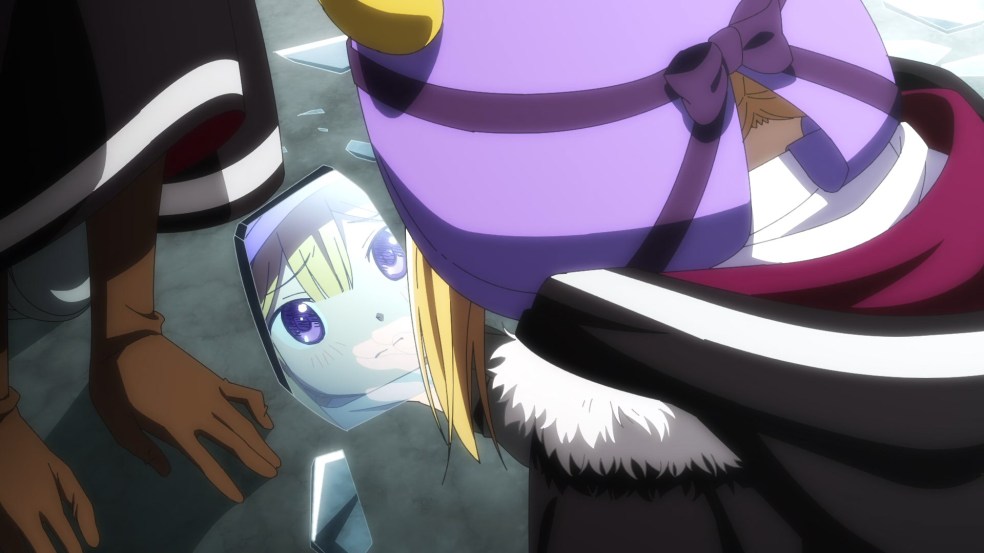
Not everything works quite so well. In particular, I can’t help but be a touch disappointed with the treatment of Kuroe (Kana Hanazawa), who becomes a witch here before being killed off, mostly to teach Iroha a lesson about how she can’t just impose her own worldview on other people. This feels like something that should’ve come up more strongly than this earlier in the series, and Kuroe being offed when we just got to really know her does leave something of a bad taste in my mouth. Even so, the sequence is undeniably pretty damn cool.

The last battle against Eve, in which it is only just barely prevented from merging with Walpurgisnacht, is suitably epic, even when it gets interrupted by the ranting, raving, honestly a little out-of-nowhere? Hijacking by Alina Gray (Ayana Taketatsu).

These scenes are all notable individually, and there are a number of others I’ve not discussed here. (Yachiyo (Sora Amamiya) makes up for her absence from much of the season by getting a lovely, touching reunion with her late partners, or rather, the magic they held that lives on inside her, for example.) But you may ask what this all adds up to. It’s a fair question.

The truth of the matter is that Magia Record is, again, messy. It is not an immaculate distillation of its core values down to a euphoric four-episode package. It does not “transcend” and become “more than the sum of its parts,” perhaps. But I challenge anyone with even the slightest shred of affection for this series–Madoka, not just Magia Record–to watch the closing shots; where the surviving magical girls band together and push forward, heads held high even in the face of their unenviable, tragic situation, and not feel something.

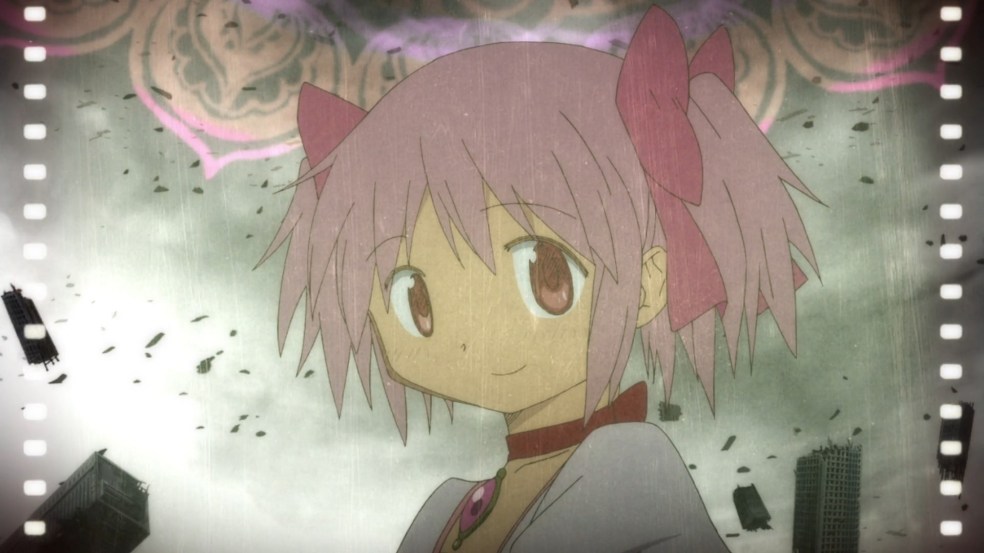
Magia Record ends with a literal closing of the book; the white-gloved hands of a Goddess (Aoi Yuuki) shutting it with an affectionate finality. The girls narrate that no one knows of the battles they fought and what they sacrificed. That no one knows of the dreams they held that were lost. Of their picking up the pieces and starting again. The existence of the series itself, and of this review, is proof otherwise, of course. And you could interpret this as a tragic ending, if you were so inclined. But what, really, is more positive than starting again? I have said this before in other columns and will say it again in many more. The true essence of hope–that nebulous thing–is to live on, and to help others do the same.


Like what you’re reading? Consider following Magic Planet Anime to get notified when new articles go live. If you’d like to talk to other Magic Planet Anime readers, consider joining my Discord server! Also consider following me on Twitter and supporting me on Ko-Fi or Patreon. If you want to read more of my work, consider heading over to the Directory to browse by category.

All views expressed on Magic Planet Anime are solely my own opinions and conclusions and should not be taken to reflect the opinions of any other persons, groups, or organizations. All text, excepting direct quotations, is owned by Magic Planet Anime. Do not duplicate without permission. All images are owned by their original copyright holders.
The Five Most Magical Anime of 2021

Special Notice: This should really go without saying, but since I’m going to be talking about all of these shows in general, overall terms, you can expect spoilers for all of them, up to and including their endings.


So here we are again, anime fans. Another year firmly in the past tense, not just within our specific sphere of interest but in general. Time is a funny thing, it’s already late November as I write this opening paragraph, which isn’t much less time than I gave myself last year, but despite the fact that I am demonstrably writing about fewer shows, I wanted to at least try and give each of them a bit more attention.

Yes, this marks a change in format. Last year I undertook the–in hindsight rather absurd–task of ranking every anime I’d finished that came out that year. The format required me to spend a fair amount of writing real estate on anime that I either didn’t like or simply had no strong thoughts on at all. This year, I wanted to simplify a bit. Only a bit, mind you. This is still me we’re talking about, after all.

So, this year the job is less complex, but simultaneously more difficult. 5 Anime I liked more than the rest; five that stuck with me and that I think will continue to stick with me. Plus, a handful of honorable mentions to get a positive word in for some anime that I enjoyed but couldn’t wholly self-justify putting in the main top five.

Just to fully disclose; as usual, these are indeed only my opinions, thoughts, and observations. My opinions that I consider reasonably informed and well thought out, but opinions, nonetheless. There is also the fact, of course, that anime I didn’t watch cannot make it onto this list by default, with apologies to the several anime I heard very good things about this year but did not find the time to watch myself. (Chiefly here I am thinking of ODD TAXI and Eighty-Six, but there are other examples too.) This list also consists exclusively of serial fiction, in the interest of keeping things fair, so the final Rebuild of Evangelion film isn’t here either. (Which is a shame, because it would’ve easily earned a spot on this list. My hope is that next year I’ll have seen enough anime films that actually came out in 2022 to make them their own list, but we’ll see.) And it’s only shows that are actually finished, so if Ousama Ranking ever shows up on one of these lists, just as an example, it’ll be the list for next year, when it concludes.

Ultimately then, what you have is a snapshot of what I consider particularly worthwhile in the medium of serial anime. A couple things went into picking shows for this list. The simple question of how much I enjoyed watching it week to week is obviously the biggest factor, and all else being equal is what I prioritized. But I did try to give at least some consideration to more nebulous things, such as general public reception, whether I think they will stand the test of time, etc. etc. (Factors that I am of course completely capable of being wrong about. But hey, I try my best.) Above all else was the simple fact of what they meant to me. It is, after all, my list, no one else’s.

Anyway, enough beating around the bush, let’s get to it.


#5. Magia Record: Puella Magi Madoka Magica Side Story Season 2

Madoka Magica was not the only franchise to make a welcome return this year, but of those that did, it’s probably the one closest to my heart. I will fully admit, there’s some circumstantial bias here. I missed out on the original Madoka Magica when it was airing now a good ten years ago. On some subconscious level it’s possible that my opinion of Magia Record is elevated by the simple fact that I get to see it unfold in real time. I’d be hard pressed to say that MagiReco’s second season was the most accessible anime of 2021–that’s part of why it rounds out the bottom of the list–but it was certainly among those I felt the most connection to. (Covering it week by week, on what would become my last bit of work for The Geek Girl Authority, probably helped.)

To a point, a show that looks like this speaks for itself. Public consensus has held for some time that Studio SHAFT‘s golden age is firmly in the past tense, but if there’s a case to be made for that whole “SHAFT Renaissance” idea that bounces around Anime Twitter from time to time, it’s somewhere in the frames of Magia Record. The season’s stronger episodes (which make up a good chunk of its brief eight) absolutely drip with style, and its premiere in particular is the sort of love letter to both the fans and the series itself that you just don’t get super often. Combine that with its wildly ambitious (some might say overly ambitious!) storyline that attempts to mythmake by tying together disparate parts of the wider Madoka ‘verse, it giving relatively minor characters like Kuroe a chance to shine, and just the frankly kinda insane fact that the Madoka Train is still chugging along at all a full decade later? Yeah, Magia Record earns its spot on the list, even if it is “only” at #5.

It’s totally possible that MagiReco’s third season–whenever it arrives–won’t be as good as this, or indeed that it’ll be much better, but this list is a ranking of what’s aired this year, and this year, the oddball middle segment of a three-part story happened to be the fifth-best anime of the whole damn thing. Go figure.


#4. SSSS.DYNAZENON

As a sequel to one of the best anime of the 2010s–2018’s SSSS.GRIDMANSSSS.DYNAZENON is odd. It takes place away from that anime’s setting and involves only two of its characters (and only in a supporting capacity.) But considered thematically, these deviations from its predecessor make perfect sense.

If, as is often held to be the case, we can map GRIDMAN‘s characters to the inner workings of a single mind, and thus make the case that that series is about self-acceptance, DYNAZENON is the logical progression. The exterior to GRIDMAN‘s interior. Like a lot of anime this year, DYNAZENON dealt in themes of alienation and misplacedness. Common emotions that we all struggle with in a world where things feel like they’re falling apart faster and faster all the time. Yet, at the same time, it re-lit the fire of that old truism; no man is an island.

How? Easy. Director Akira Amemiya proved yet again that, yeah, you can still make a show that’s at least 50% giant robots fighting giant monsters by volume actually say something and have it not come across as corny or just over-wrought. DYNAZENON manages the impressive task of welding those fight scenes together with interrogative character work all over again, in a way that feels distinct from, but very much related to, GRIDMAN‘s approach to that problem.

All five members of our core cast are disconnected from society in some way. Be it Yomogi’s parents’ separation, the death of Yume’s older sister, Koyomi and Chise’s mutually-enabling shut-in habits, or even how Gauma is lost from his own world entirely. Over the course of the series they heal, but the journey is not a smooth or easy one, and the kaiju represent allegorical threats to their wellbeing as much as physical ones.

This is to say nothing of the Kaiju Eugenicists, those alarmingly-named villains who serve as the main four’s opposites on the other end of the good guy / bad guy spectrum. They’re alienated too, but their alienation consumes them, and is the driving force behind their desire to subjugate and destroy. In the case of Sizumu, it quite literally turns him into a monster.

DYNAZENON‘s driving question is thus how to move on from that alienation, from those things that drive a wedge between us and others. To its credit, it offers no easy solution, although in showing what really happened to Yume’s sister when no one was there to support her, it offers a dire warning of the consequences of not at least trying. The Dyna Soldiers find solace in the pieces of the Dynazenon itself, which, perhaps tellingly, is formed from what appear to be mere toys in their dormant state. But more importantly, they find solace in each other. To quote my own writeup of the tenth episode from back in June:

The only reason she couldn’t be saved like Yume herself was just a single episode ago is that, in a very literal sense, no one was there to support her. I suspect that SSSS.DYNAZENON may lose some people off that fact alone, but the point here is that Yume is still affected by her death. There are no easy outs, not even here.

But there are words of advice. Before the two leave each other for the last time, Kano tells Yume that she needs to rely on others more. And that, right there, is the entire thesis of SSSS.DYNAZENON as a series. Where SSSS.GRIDMAN dealt with the internal, all of its characters mapping to different parts of a single psyche, SSSS.DYNAZENON is external.

SSSS.DYNAZENON Recap: (S02E10) Which Memories Do You Regret?

It’s known that a third part of the trilogy; a crossover, likely in film form, called GRIDMAN x DYNAZENON, will round out this particular series of stories from Amemiya and co., beyond that, details remain scarce. But SSSS or no, if they can keep making stuff like this, stuff that hits you right in the heart? His place as one of the new decade’s best directors is assured. Keep broadcasting, kaiju king.


#3. Sonny Boy

Another theme we’re going to be seeing a lot of here is transience. It’s rather been my “word of the year,” so I hope you’ll forgive my use of it again, here, but it’s true. All things pass, and for many people our whole lives involve, at least to some degree, reckoning with that fact. Sonny Boy was not the only show this year to grapple with that fact, but it was notably thorough about it.

It begins in the void, but soon crash-lands into an island on the far side of summer. There, surreal parables about life, death, and everything in-between unfold like the show’s own Matryoshka Doll worlds. Universes within universes, wheels within wheels. The purpose? An ode to our lost digital generation; the Millennial/Gen-Z continuum. Adults are imposters putting on a show or so distant that they’re divinity. No one is truly there to guide the cast, much like there’s no one truly there for us except ourselves. They, as we, need to make peace on their own.

Of the anime on this list, I will cop to “understanding” Sonny Boy the least. There is a lot of symbolism here; it’s a dense show. (Which, hey, means it’s good for a rewatch.) But the series’ core of melancholy-hopeful nihilism is easy enough to map out, and that’s what earns it a spot on this list. Well, that and its absolutely stunning visual style. Sonny Boy looks like very little else that aired in 2021, and its surrealist, painterly looks would earn it a spot in the honorable mentions even if the show genuinely was all talk and no walk. But thankfully, while it may occasionally lean inscrutable, its heart beats strong.

Of the various treatises on the passing of everything that 2021 produced (gee, I wonder why that was on everyone’s minds), Sonny Boy stands as one of the more accepting. But in a way, my typing this is pointless. One of the show’s own characters put it best.

Perhaps I should be giving Rajdhani a co-writing credit for how often I’ve used these screenshots when talking about Sonny Boy.

(As a side note; creator Shingo Natsume‘s next project is a sequel to The Tatami Galaxy. So, it seems like this is hardly the last time he’s going to direct something delightfully confounding. Perhaps it’ll show up on the list next year!)


#2. Heike Monogatari

If Sonny Boy explored transience via surreality and imagined worlds far from our own, Heike Monogatari grounded its own investigation of the concept firmly in the real-world concerns of history and myth. Based on a historical Japanese epic, The Heike Story has the benefit of hindsight. From the beginning of the first episode, each character’s steps fall with inevitability. From Lord Shigemori, who takes protagonist Biwa in after her father is callously murdered by members of his own clan, to Taira no Kiyomori’s heartless power-grabbing ploys, every man, woman, and child here has their fate sealed before the first episode of the series even begins.

There is one exception: Biwa herself. (She’s voiced by Aoi Yuuki, in what would be the strongest role in the career of almost any other voice actress but is just another casual triumph for her. She brings alternating innocence for the Biwa we see most of the time, and stately, religious gravitas for the white-haired “seer” Biwa.)

Her role? To be conscripted as fate’s chronicler and become representative both of the nature of the original epic itself and more generally as a symbol of all of us. Witnesses to history, as we are, who so often are powerless to change it despite our own strengths. It can feel grim and fatalistic; seasons change and an empire falls like a leaf from a tree in autumn. But Heike Monogatari never makes it feel that way. Things simply are, and then they aren’t. Dust becomes dust, time ticks on.

Heike Monogatari is observance and acceptance, and the stormy lining to its silver cloud is that it’s so obviously timeless that even writing about it feels sort of pointless. It’s like trying to review The Iliad. It could have been #1, easily, and in almost any other year it would’ve been. Yet, at least to me, it was still somehow “only” the second-best anime of 2021.

But, before we get to the top of the list, let’s go through some honorable mentions. Because you’re worth it, dear readers.


Honorable Mention: takt op.Destiny

Ribbons of highway and a great blue sky way. Ruins, cities, deserts, forests, monsters, and song. A world that’s lost its music. That was takt op.Destiny. Hardly the year’s most “together” production, takt op has the dubious distinction of sharing a bizarre ending twist with notable “would’ve probably made this list if quality wasn’t a factor at all” shortlister The Detective is Already Dead. But obviously, its spotty ending is not why it’s here. Of what I saw in 2021, takt op had some of the most purely joyous animation. Most of it took the form of fight scenes, and it’s easy to dismiss that sort of thing as lowbrow. But by tying it together with a thematic core about rescuing a world that thinks it no longer needs art with that art, it manages to make it all feel meaningful. For the bounty of good to great anime 2021 did have, it was rather short on anime that I felt compellingly made the case for art itself–something last year had in spades–boiling down to mostly just this, Love Live! Superstar!!, and Kageki Shoujo!! (Which itself only missed the list by dint of a dry run of episodes in its middle third.) So, for filling that niche, I am quite grateful to takt op, perhaps the year’s messiest pile of camp.

Honorable Mention: Zombie Land Saga Revenge

If someone asks me what I thought about the general quality of anime in 2021, I will tell them that I had to relegate the second season of Zombie Land Saga to the Honorable Mentions list.

Honestly it barely feels fair. Zombie Land Saga Revenge is everything you could want out of a sequel; it builds on the original in logical and interesting ways. Franchouchou start the season having blown their biggest concert, washed up and down and out. But the mountain waits for no one, so what can you do but try to climb it again? And we saw them climb again. Those ridiculous zombies fought claw and jaw to bigger and bigger concert placements, and along the way we saw them grow as people, with particular star turns for Junko and Yuugiri. Let’s not forget that in the latter case, Revenge decided to just become a historical drama for several episodes, an outfit it wore better than many actual historical dramas do. Zombie Land Saga truly can do it all. The best idol anime of 2021, and almost certainly its best comedy. And I had to put it on the HM list. What a year it’s been, eh?

Honorable Mention: BLUE REFLECTION RAY

More than any other anime on this list, and maybe more than any anime I’ve ever covered period, I really strongly think Blue Reflection Ray is underrated. It’s a victim of circumstance, really. Animated by a studio long past its prime in a year that had two other anime that did many of the same things as it but in a more flashy and accessible way, there is a real case to be made that BRR never had a chance. But this list is, ultimately, about anime that I love. And I truly do think BRR was something special.

And not just because it’s really gay, although that certainly helps.

As a love letter to the magical girl genre, as a scrappy example of what even the most “low budget” of anime can accomplish with enough sincerity and grit, and as a rumination on how society treats young girls–another theme that came up quite often in art this year–Blue Reflection Ray stands tall with the best of them. When, in its penultimate episode, the Reflectors transform back-to-back-to-back just like a “real” magical girl team for the first and only time, BRR felt just as important as any other magical girl series. Girls in a world of lies living their truth for the first time.

Speaking of other magical girl anime.

Honorable Mention: Tropical Rouge Precure

This was the hardest cut from the proper list. TroPre is relegated to the HMs by a technicality; it’s not actually over yet, a quirk of the show’s odd schedule. (Precure series generally run for a full four cours over the course of an entire year, which makes accounting for them in otherwise neat and orderly lists like this one difficult. And yes I’m aware I said that only finished shows would be on the list. Sue me.) But that’s okay, because while Tropical Rouge Precure is great, it’s on this list less for what it actually is and more for the experiences I had while watching it. Its placement here is not due to its excellent sense of humor, its wonderful characters, or its at-times gorgeous animation, even though those are all very much merits the series has.

Unlike most other anime on this list, I did not–and do not–watch TroPre by myself. I watch it with a group of friends, every weekend, at around the same time. In this way, I get to have an experience that I very much would’ve liked to have had as a little girl; getting to talk about one of my favorite magical girl anime with some other girls my own age. A sense of lost youth is a common side effect of being transgender, and while never having gotten to chat about Sailor Moon with schoolmates is pretty low on the list of things I’m sad I missed out on, it is still on that list. So, as a balm for that particular little hole in my soul, I value the series a lot. We plan to continue this practice next year, so unless something goes horribly wrong, you can expect to see Delicious Party Precure somewhere on the list next year, too.

There have already been three magical girl anime somewhere in this article, and that’s the end of the honorable mentions. So you may well wonder; what’s at #1?

Well, a different sort of magical girl anime.


.

.

.

.

.

.

.

.

.

.

.

Oh come on, you can’t actually be surprised.


#1: Wonder Egg Priority

I knew from the minute I started writing this list that Wonder Egg Priority would be my #1.

I tried to talk myself out of it more than once; to convince myself to put Heike Monogatari at the top of the list instead. I like that show and Wonder Egg almost as much as each other. It would’ve been a compromise, but it was one I could’ve lived with.

But that’s the thing, right? It still would’ve been a compromise. And it’s my list, so there is no room for compromise. Wonder Egg Priority is my favorite anime of the year. Is it the best anime of the year? That’s a level of definitiveness that I don’t normally strive for when writing, even if this sort of format implicitly demands it. But if I’m the one being asked the question? Then yes, it absolutely fucking is.

Quite unlike my #1 pick for last year, Keep Your Hands Off Eizouken!, Wonder Egg Priority ends the year not as a widely beloved (or at least liked) exemplar of its staff’s prowess. Its place in the popular discourse is, and probably always will be, that of a great folly. A production train-crash that physically hurt the people working on it and squandered its potential and left its audience profoundly disappointed.

Which, of course, is a massive oversimplification. I try to at least pay some attention to what The Public At Large think about the anime I cover, if anything. But the fact remains that while the consensus will probably always be against WEP, and not totally without reason, there are people who still like it. I am one of them. There are dozens of us. I just happen to like it more than anything else that aired this year.

But of course you want to know why, which is a fair question, given what this website is and what I write about on it.

It would be fairly easy to fall back on its many technical merits. Wonder Egg Priority is an incredible-looking show, constantly toeing a line between appearing pristine as jeweled glass and wild as paint-buckets tossed at canvasses. If CloverWorks never make anything that has quite this level of visual pop ever again, it would not be a mark against them in any way. We could talk also about its soundtrack, an underappreciated aspect of the series that colors every moment of it in a way rare both this year specifically and in general. (Sonny Boy is its only real competition from 2021 in this aspect.)

If we wanted to really stretch our critic-brains, we could turn toward its thematic merits. To try to break down the series’ elaborate use of symbolism. Or perhaps its understanding of how gender roles define and oppress us, and how the modern world will beat any young girl it can’t control into submission, co-opt her for its own ends and twist her into hurting others like her. (See: Frill.) We could cite its deeply compelling four main characters and their own specific twists on this notion; a recovering hikikomori (Ai), a former idol with past sins on her mind (Rika), a mysterious wunderkind with a vanished sister (Neiru), and the series’ own high-strung, gender-nonconformant take on the obligatory “boyish one” (Momoe).

We could talk about how they smash personifications of pedophilia, misogyny, and transphobia to paint-colored smithereens and are pursued by anonymous maniacs called Haters through their imaginary worlds. We could talk about how their mysterious “benefactors” who promise they can restore the dead to life turn out to be little more than hucksters past their prime. We could talk, at length, about all of this.

We could even talk about this!

But frankly, I think “all of this” is, incredibly, at least to me, somewhat secondary. It is true that Wonder Egg Priority has all these merits, and I think they alone could be used as an argument for why the show is very good. And if they were all that Wonder Egg Priority did right, it would have earned a comfortable spot somewhere a few ranks back. Maybe between Sonny Boy and Heike Monogatari, as “merely” a show from 2021 that I’m confident I’ll still be thinking about in 2031. In truth, what is often cited as its greatest “objective flaw” (and oh, how I hate that phrase), is what locked me into holding it close to my heart forever, and why, if asked, I will say it’s among my all-time favorites.

Wonder Egg Priority doesn’t really have an ending.

Its story comes to an abrupt halt. Little is resolved, one of the main characters is missing. It’s a question mark. There is no “to be continued.”

This is, I realize, a stance held by very few. But endings are rarely what truly move me about stories. (Heike Monogatari is one of a quite small number of exceptions.) So on its own, WEP’s lack of an ending is no serious fault to me. Indeed, Wonder Egg Priority could have ended in any number of ways, from the sappy to the depressing, that would’ve given it some measure of critical and fan acclaim. If it had really nailed it, it could’ve sat alongside modern born-classics like Revue Starlight, hailed as a truly great example of what TV anime as a medium could achieve.

Instead, it dissolved into a cloud of smoke, seeping into our collective memories forever. It became an unanswerable question and an unsolvable puzzle; quiet as God and twice as unknowable. In doing so, it embodied the boiling haze of steaming existential confusion that is the modern zeitgeist better than almost any work of fiction I have ever experienced. Wonder Egg Priority left an axe-wound in the popular imagination. For that, I love and respect it immensely. In a way, it is this aspect that most closely ties Wonder Egg‘s form to its message. The girls’ struggle, ultimately, is against suicide personified. The Temptation of Death. The fact that they don’t explicitly “win” is contentious. But that’s the whole point; we don’t see how this story ends. Some small glimpses of incremental progress aside, we know nothing. Only that Ai marches forward, in spite of it all, to try again.

I have seen it argued that this is a relentlessly bleak ending, but both the reality of the subjects Wonder Egg speaks on, and its own stylistic flourishes make it fairly obvious that this is, in fact, hopeful. To live in the modern age is to live in a world filled with poison. To live on in spite of that, to get up every day, to snap your gaze toward the horizon and walk–as Ai does–is optimism. This world wants us dead. We live anyway.

Quite unlike last year’s #1, I do not expect that Wonder Egg Priority will ever be hailed as timeless or classic. I think if it is remembered at all, it will be as a mistake. The avalanche of public consensus is hard to fight against, particularly in the age of social media. But, as I have learned many times this year, I can be wrong. If I have ever been wrong about anything relating to this medium I’ve devoted so much of my time to writing about, I would like it to be this.

Because whenever I so much as think about Wonder Egg Priority, it comes back to me in an instant. The hyper-technicolor magical girl psycho-drama that no one asked for, but that we–or perhaps just some of us–sorely needed. Wonder Egg Priority might never gain any coveted status as a must-watch, as a classic of its medium or genre, as “one of the good anime,” or anything of the sort, but if it does not gain some kind of following, there is something truly wrong with this world indeed. We endure precisely because we know we’re not alone. It would be a horribly cruel thing for one of the best articulations of that idea ever put to the silver screen to be lost to obscurity.

Yet, in spite of everything I just said, I hold no delusion that I am the Wonder Egg Guru. I have spent the better part of a year attempting to reckon with the WEP Project’s first, last, and only output. To explain it succinctly, to square how much I love it with how strongly I oppose the worst parts of the industry that let it exist. But the fate’s-honest truth is that I am not much closer to “closing the book” on Wonder Egg Priority, for myself or anyone else, than I was when the TV broadcast ended in late March. It’s an enigma. I think at least some part of it always will be. And maybe it seems unfair to give the gold medal to an enigma. Maybe the #1 spot should be saved for something I can explain better. But it is my view that the role of the critic and commentator is not that of an interpreter. It is that of an honest witness. I could have sat here and thought myself into circles. I could have tried to justify putting something–anything–else at #1, but that’s not honest. And if I don’t have honesty, what do I have?

So, there it is. The most magical anime of 2021. The best anime of the year, so says me, is a series that draws a line from the strained psyche of four teenage girls to our own place, lost in the fog that smothers this haunted planet. Then, in a grand confrontational hammer-smash, it reveals that there is no line at all; these things are one in the same.

Now that’s a magic trick.


And, yes, that’s the list.

What did you think? As I mentioned last year, I try not to pay too much mind as to whether my picks will be “controversial” or not, but, well, last year I didn’t top the list with what is probably the most divisive show of the entire year. So tell me your thoughts! Did you love my picks? Were they utterly baffling to you? Maybe 50/50? What were your top five, top six, top whatever anime of 2021? I’d love to hear from you, so please do leave a comment here or on Twitter. If you’re one of the folks who was disappointed by my #1 (and more than one person explicitly said they would be, whoops!) then…well, I hope this will spurn you to write your own lists, at the very least. (I maintain that basically everyone’s life could be improved by running a blog.)

Incidentally, I ran a very small little competition on my twitter account yesterday, and wanted to shout out @lilysokawaii, @pikestaff, and @theplatinumdove for correctly guessing my #1 pick. For the rest of y’all: better luck next year!

Tomorrow, an article will go up that briefly discusses my plans for 2022, as she fast approaches. I’ll see you then, anime fans.


Wanna talk to other Magic Planet Anime readers? Consider joining my Discord server! Also consider following me on Twitter and supporting me on Ko-Fi or Patreon. If you want to read more of my work, consider heading over to the Directory to browse by category.

All views expressed on Magic Planet Anime are solely my own opinions and conclusions and should not be taken to reflect the opinions of any other persons, groups, or organizations. All text, excepting direct quotations, is owned by Magic Planet Anime. Do not duplicate without permission. All images are owned by their original copyright holders.

The Frontline Report [9/26/21]

The Frontline Report is a weekly column where I briefly summarize the past week of my personal journey through anime, manga, and the related spheres of pop culture. Expect some degree of spoilers for the covered shows.


Hello, anime fans! You may have noticed the site looking a little different this past week. I got a new WordPress theme which comes with a somewhat spiffier look and more general readability. Sadly switching themes does seem to have made the archives a bit of a pain to browse and there’s not really anything I can do about it until I can eventually afford a WordPress Premium plan and implement some custom CSS. I’m going to try to work on a workaround at some point in the future, but in the meantime, I beg your patience.

All that in mind, I do strongly urge you to take a gander at this article’s footer and consider pledging some support. It really does help me continue writing in a very real and tangible way.

Administrative notes aside, we’ve got a bit of an interesting bit of zeitgeist in the air this week. Four of the five anime covered here are about an all-female cast pushing through some obstacle(s) or another. For the girls of Magia Record this triumph is shadowed with equal parts tragedy, but nonetheless, it remains compelling. For the most part at least, it seems the girls are alright.


Blue Reflection Ray

This is among the first anime to actually end since I started doing this column. I’ve already written about the series at length in my review of it and I’ve no desire to repeat myself too much. So let me just say, Blue Reflection Ray is that rare anime that just kind of clicks with you if you’re the right sort of person. It has its flaws, sure, but I wouldn’t trade the series for the world and I’m very happy with how it ended. I may simply be a straight-up sucker for magical girl anime. But my view that there is always room for these stories of girls triumphing over the evils of the world remains unchanged. Blue Reflection Ray was not the best to ever do it, it wasn’t the first, and it certainly won’t be the last. But it is a valid, meaningful part of that artistic lineage, and no one can take that away from it.

The Detective is Already Dead

Another recently-concluded show. Boy, Detective was….something, wasn’t it? I think after the dust settles and it recedes into memory, the few people who remember Detective at all will remember it more as a sometimes-compelling trainwreck more than anything genuinely awful. I don’t mean to come across as elitist about this, but I think anyone saying it’s truly terrible hasn’t seen any truly terrible anime. (Not that I blame them, of course.)

But it certainly wasn’t particularly good either, and I can’t picture it picking up even the ironic cult following of something like Big Order. Such is the curse of being rough going but not outright bad enough to watch “as a joke”.

That said, as I mentioned in my review of the series, I do think all of that gives it a kind of charm if you’re a pretty specific sort of person. But most people aren’t that sort of person, of course. So into the dustbin of history it will inevitably end up. What a tragic fate for our heroic detective! But so it goes. So it goes.

Kageki Shoujo!!

I stand by what I said last week, and what do you know, Kageki Shoujo!! stuck the landing. I’m still not sure I’d put it in my personal upper echelon of anime from 2021 (you’ll have to wait for my year-end rankings to find out for sure), but it did what it wanted to do and it did it well. That’s worth quite a lot all on its own.

The finale this week succeeds in my mind largely because of two things. One; it finally gives us, however briefly, a Sarasa performance that’s truly her own. Her take on Romeo & Juliet‘s Tybalt here is a wonderful thing to behold, and watching the audience (which, mind you, is just her own classmates) dance in the palm of her hand as she wrings the dark, moody character for all he’s worth is just excellent. Two; it ties up some other loose ends, in particular with respect to the hitherto slightly underdeveloped Sawa Sugimoto. Her own frustration at not getting that very same role comes through just as clear as Sarasa’s triumphs, and how she deals with that disappointment ends the show on a realistic, but still high, note.

Inevitably, some will be a bit cold on the choice of stopping point. (We don’t even get to actually see any of our girls act in a proper play, after all.) And the faint hope of a second season remains in the air. But I think that so many people care so much about Kageki Shoujo!! in the first place speaks a lot to its strengths. No one really expected much of this series, but it ended up captivating the crowd anyway. Isn’t that sort of surprise what following seasonal anime at all is all about?

It probably doesn’t make a whole lot of sense to feel “proud of” a show, but nonetheless that’s where I find myself at with Kageki Shoujo!! When the season started I was fairly sure it would be written off by most due to sharing some vaguely similar subject matter and a very similar name with Revue Starlight. That it’s managed to comfortably find and secure its own audience, even over here in “the West”, is a lovely thing. I’ve rarely been happier to be proven wrong.

Magia Record

Magia Record‘s second season is over, though not without some amount of tumult, coming as it does after a week of delays and with a number of technical issues.

As with before, most of my thoughts are over on Geek Girl Authority. Though with an asterisk, this time.

This is the last article I’m going to be writing for them. My current plan is to fully focus my efforts over here on Magic Planet Anime. So, if you could give it a look, that’d mean a lot to me. The people at GGA have been great to me in the, gosh, two years I’ve written for the site, and I’m happy to part with them on the best terms possible.

As for the episode itself? Honestly it’s a real treat to have Mami survive a season of anything Madoka-related alive and unhurt. Everything else, probably deliberately, remains up in the air right now. I’m definitely quite invested in the fate of Kuroe, in particular. Her disappearance here raises a lot more questions than it answers.

Tropical Rouge Precure

I don’t write about Tropical Rouge Precure, or really Precure in general, much in this column, both because its air-day, fairly late on a Saturday night here in the States, makes it hard to talk about the “current” episode and because, being a year-round show with four full cours, it doesn’t change that much from week to week. Most of the time, that is.

But every once in a while Precure will deliver an absolute knockout, and that’s episode 29 (“Reviving A Legend! The Pretty Cure’s Power-Up Makeover!“) for Tropical Rouge. Easily the best-looking episode of the show so far (and one of the best of the year period, up there with Magia Record season 2’s debut episode among others), it introduces some half dozen new plot points without making anything feel congested or convoluted and looks amazing while it does it. It’s the rare anime episode that feels twice its length in a decidedly positive way. Expect this one to come up in conversations even years from now. Episode 30 has since aired too, and it’s also good, but 29 has to remain the star here, an all-timer if there ever was one.


Elsewhere on MPA

I linked them already, but seriously, do check out my reviews of The Detective is Already Dead and Blue Reflection Ray if you have the time. I’m quite proud of how the both of them turned out.

Lastly, it’s yet to fully come to fruition, but I can say with relative confidence that a new episode of KeyFrames Forgotten is on the way. I’m not entirely sure when it will arrive, but the wheels are in motion, you have my word of that much.

Until next week, anime fans.


Wanna talk to other Magic Planet Anime readers? Consider joining my Discord server! Also consider following me on Twitter and supporting me on Ko-Fi or Patreon. If you want to read more of my work, consider heading over to the Directory to browse by category.

All views expressed on Magic Planet Anime are solely my own opinions and conclusions and should not be taken to reflect the opinions of any other persons, groups, or organizations. All text is owned by Magic Planet Anime. Do not duplicate without permission. All images are owned by their original copyright holders.

The Frontline Report [9/13/21]

The Frontline Report is a weekly column where I briefly summarize the past week of my personal journey through anime, manga, and the related spheres of pop culture. Expect some degree of spoilers for the covered shows.


Hey folks! I’ve been under the weather and generally low-energy this week so this writeup comes to you a day late. Hope y’all are doing well out there. Let’s jump right into things.


The Detective is Already Dead – Every time I try to talk about this series my breath is stolen from my mouth. Not because it’s Just That Bad and 𝕔𝕖𝕣𝕥𝕒𝕚𝕟𝕝𝕪 not because it’s Just That Good. I don’t know what I’d say about it if I could. Props for having the balls to go the obvious route? For daring to be so completely ridiculous in such a headstrong-stupid way? Here’s a question for you; how many anime feature heart transplants as a motif? I can only think of this one. The detective may be dead, but my faith in anime as a medium remains. God help us all.

Magia Record – As usual, you can read my thoughts over here. Short version? I really love this show. As a side note, it does bother me that so many people still seem to think that Madoka Magica‘s great contribution to its genre is realistic violence. Violence in art is a tool. In PMMM it is used to tell you that the systems the girls are trapped in are fucked up and horrible. The intent here, in this week’s MagiReco, is much the same.

Miss Kobayashi’s Dragon Maid S – I’ve somehow managed to go the whole season without so much as even acknowledging that I’m watching Dragon Maid. But now that it’s nearing its conclusion I’m confident in saying at least this much; it’s a lot of fun. Kyoto Animation remain an absolute powerhouse here, even in light of the tragic arson attack on their studio two years ago. The production, as such, is untouchable, and visually speaking it’s arguably the best anime airing right now. Its fun, adventurous animation is capable of flipping from hijinks to truly impressive battle sequences to more adventurous and bizarre comedic stylings at the drop of a hat. It’s damn great, and the series deserves high marks for that alone. Its writing remains a bit patchy, if only because it’s trying to be so many things at once.

It’s at its best when it locks into a single swathe of the emotional spectrum, as with this past week’s episode, which sees Kanna on a journey to New York and back again as she makes a friend in the Big Apple. And of course, rescues her from Bad Guys ™. Her flight over the US is wonderful, being positively Ghibli-esque.

Beyond that, and despite its supernatural setting, Dragon Maid shines brightest in scenes that articulate the small joys of everyday life. A cut illustrating something as simple as pouring cold tea into a glass is given an opulence that magnifies its emotional impact. In these key moments, Dragon Maid is a magic spell. More real than our own world.

Sonny Boy – Is Sonny Boy losing people? I wouldn’t be too surprised if it was. I’m still definitely on-board with the series as purely a machine that pumps out bizarre, vaguely parable-esque vignettes. The background plot involving the fake teacher Ms. Aki and her schoolbus of cultists may or may not eventually resolve in interesting fashion. In the meantime, this week’s episode spotlights Mizuho’s cats and hands us a curious story of a boy and his clone that ends in as much a punchline as it does a moral lesson. Where does Sonny Boy go from here? I have no idea, and that’s exactly why I like it so much.


Manga

Puella Magi Homura Tamura – This past week I’ve been taking another read (it’s my second time through) of this obscure little corner of the Madoka Magica expanded universe. I think people have forgotten that said EU is, in fact, surprisingly large. Many have been mostly left behind by the passing of the initial Madoka hype wave, but there were actually quite a few interquels, spinoffs, and otherwise divergent-from-the-norm Madoka Stories. Most were fairly serious affairs, and perhaps predictably given the large number of hands involved, they varied pretty widely in quality. Homura Tamura is quite distinct from all that, though. It’s decidedly on the humorous side, though its offbeat sense of humor is more likely to remind readers of other entries in the comedy yonkoma genre than it is to provide any insight into what the girls of Madoka Magica act like “off-camera”.

Still, it’s a solid and fun read. It got licensed by Yen Press years ago so I’m sure you can find hard copies somewhere if you care to snoop around. There’s a lot of great genre parodies in here, and some truly out-there takes on some of Madoka’s core premises. Have you ever wanted to read a manga in which Homura travels through time so much that she eventually ends up at a café staffed and visited entirely by versions of herself from alternate timelines? Then friend, I’ve got a manga for you. Fun fact: This is illustrated by AFRO, who would soon become known as the artist behind YuruCamp. Second fun fact: if you google the name of this manga, the little Google Book Preview thing will claim it was illustrated by Italian painter Afro Basaldella. Close but no cigar, Google!


Wanna talk to other Magic Planet Anime readers? Consider joining my Discord server! Also consider following me on Twitter, supporting me on Ko-Fi, or checking out my other anime-related work on Anilist or for The Geek Girl Authority.

All views expressed on Magic Planet Anime are solely my own opinions and conclusions and should not be taken to reflect the opinions of any other persons, groups, or organizations. All text is owned by Magic Planet Anime. Do not duplicate without permission. All images are owned by their original copyright holders.

The Frontline Report [9/5/21]

The Frontline Report is a weekly column where I briefly summarize the past week of my personal journey through anime, manga, and the related spheres of pop culture.


Hello folks, it’s been another breezy week here at Magic Planet Anime. I hope these three writeups will sate your curiosity for the next seven (ish) days.

Blue Reflection Ray – As it enters its final act, I am half-convinced that myself and a friend (hi Luna!) are the only two people on Earth still watching Blue Reflection Ray. Nonetheless, for anyone else still out there who’s on this strange journey with us, wasn’t this week’s episode just incredible? The reintroduction of Momo, one of the show’s best characters, signals the beginning of the end for BRR’s plot, and the dark, vine-covered city that bringing the Commons into reality has created is the embodiment of the emotional deadening the show stands against. But in spite of that, the episode is all fluff in the best way possible, hatchets are buried and relationships are rekindled. The shot of the Reflectors, now all on the same side sans Uta and Shino herself, is one of my favorite moments of the entire season. We’ve followed these girls a very long way from home, and I cannot wait to see where they finally end up.

Magia Record – As usual, my detailed thoughts are over on GGA. This week’s episode was visually jankier than usual, probably the result of SHAFT’s famous production troubles. It manages to be compelling, anyway. And honestly that shot up there of Iroha and Yachiyo hugging as they reunite would make almost any episode well worth it. As a side note, MagiReco also picks up a “one-liner of the year” award here, for Yachiyo’s just genuinely funny as hell comment here:

Whoever came up with that deserves a medal. All told, despite its issues it’s still a very strong episode from a very strong show.

Sonny Boy – The main problem with Sonny Boy is that it’s so obviously compelling that talking about why can feel routine, or worse, dogmatic. But there really is a soul under all the surreal imagery. This week’s episode, “Laughing Dog”, explored the past of Yamabiko, the boy turned canine. In it, Sonny Boy lays out a million and one different ways people can be trapped; by their relationships, by their past, and by failing to move on from either. The series has a reputation for being opaque, and this episode won’t change that, but it is one of the rare anime episodes where a single line of dialogue seems to leap out the screen and slap us, the audience, across the face.

There’s a bitter tinge of futility here, too. The idea that one can no more truly leave their regrets behind them than a dog can swear a pinkie promise. But maybe that’s just another layer to the metaphor. Worlds hang in the balance, and four weeks remain.


Wanna talk to other Magic Planet Anime readers? Consider joining my Discord server! Also consider following me on Twitter, supporting me on Ko-Fi, or checking out my other anime-related work on Anilist or for The Geek Girl Authority.

All views expressed on Magic Planet Anime are solely my own opinions and conclusions and should not be taken to reflect the opinions of any other persons, groups, or organizations. All text is owned by Magic Planet Anime. Do not duplicate without permission. All images are owned by their original copyright holders.

The Frontline Report [8/29/21]

The Frontline Report is a weekly column where I briefly summarize the past week of my personal journey through anime, manga, and the related spheres of pop culture.


Folks, I’ll keep it straight and simple with you. I’ve been showing my family around Chicago for much of the past week and I have been deeply tired. As such I’m not caught up on my seasonals, so the writing here is, for the most part, going to be a bit dated. But hey, you work with what you have.

I’m planning to do a catch-up marathon starting this very evening. So hopefully next week I’ll have some more relevant material for you. Until then, enjoy what I’ve got penned so far.

Kageki Shoujo – Sarasa’s story has begun tying into a larger dualistic theme of artistic tradition and innovation; how they conflict and otherwise interact. I’ve given Kageki Shoujo some guff in the past for focusing too much on male side characters. To some extent I still kind of think it does, but as the nature of the story has branched out to become as much about the systems that shape those who pour their hearts into their art as it is about any individual person, it feels more earned.

Episode eight, in particular, paints a quietly illuminating portrait of what, exactly, one has to give up in pursuit of dreams this grandiose. Centering around secondary character Kaoru and her brief, bygone romance with a bench-warmer from her high school’s baseball team, it both draws and explicitly denies parallels between the two. Kaoru wants nothing more than to become an actress and live up to her family’s legacy, her would-be boyfriend cannot stand the pressure that the constant comparisons to his literally professional-level older brother produces. The two bond over this half-commonality and are eventually driven apart by it. In the end, they pursue their dreams, but at the cost of each other. The episode ends, though, on a hopeful note, and a promise that this might all circle back around someday. It’s an optimistic, even romantic notion for a show that’s generally as grounded as Kageki Shoujo is.

Sonny Boy – New worlds, evil teachers who are students in disguise, movies that change reality, talking dogs, pariahs, and visions from the heavens. Halfway through its run, Sonny Boy is as wonderfully weird and cryptic as ever. Episode six was the end of a certain version of this drifting classroom’s story, but not the one we’re following. For this treasure box of puzzles and surreal imagery, we can only anticipate what’s to come.

Cut joke from my GGA writeup for this week: “I’m here to kick ass and eat peach cobbler, and I’m almost done with all this peach cobbler.”

Magia Record – As always, my more detailed thoughts are available over on GGA for this series. We must ask ourselves though; is Magia Record the best thing currently airing? This week’s episode and its feat of turning the previously ignorable Kuroe of all people into a character-of-the-week is a sign that points to “yes”. Honestly, what competition does it have? Sonny Boy? That show is great, certainly, but it lacks MagiReco’s series credentials and consequently the sense that we’re seeing something big happen. The real thinker is just whether the remainder of season 2, and the upcoming season 3, are enough to change the question we’re asking into “is Magia Record the best anime of 2021?”.

As a final note; you’ve probably already read it, but if not, do be sure to check out my review of the final Rebuild of Evangelion film. I really loved the movie and I think it may, in fact, be my favorite ending for the series.


Wanna talk to other Magic Planet Anime readers? Consider joining my Discord server! Also consider following me on Twitter, supporting me on Ko-Fi, or checking out my other anime-related work on Anilist or for The Geek Girl Authority.

All views expressed on Magic Planet Anime are solely my own opinions and conclusions and should not be taken to reflect the opinions of any other persons, groups, or organizations. All text is owned by Magic Planet Anime. Do not duplicate without permission. All images are owned by their original copyright holders.

The Frontline Report [8/1/21]

The Frontline Report is a weekly column where I briefly summarize the past week of my personal journey through anime, manga, and the related spheres of pop culture.


It probably says a lot about me that for this week’s Frontline Report the show I wrote the most about is the one I think is the least good. Oh well, you know what they say about tigers and changing stripes. As always, let me know what you think in the comments!

The aquatope on white sand – This week’s episode deals with Fuuka being recognized, first by a coworker who happens to be deep into idol culture and later by a trio of curious teens. The bizarre public afterlife of people who aren’t famous but used to be is a fascinating and very complicated topic, and I’m glad that aquatope is not just conveniently forgetting Fuuka’s recent past. Something that’s interesting to me is that it’s not totally clear whether Fuuka actually regrets leaving the industry or if she thinks putting it behind her was the right choice. At different points in this episode you can make the case for either stance.

Blue Reflection Ray – This show is draining, man. For as good as BRR is, the fact that its episodes contain so much exposition combined with how heavy the show gets can definitely lead to episodes like this one where watching them just kinda feels exhausting. That may sound negative but I actually think that’s a positive trait. Is that weird? It’s probably weird.

The Detective is Already Dead – With the constant torrent of new anime, there’s a pressure to only let yourself watch the best of the best. Things that are masterpieces or at least seem like they’ll get into that conversation. If you subscribe to that philosophy, you can go ahead and move Detective to your Dropped list now. Detective is not the best, it’s honestly not even very good. But, when I find myself auditing my own time once a week (as I always do, it’s a bad habit arguably), I ask myself, “am I still getting anything out of this show?” Inevitably, I walk away answering “yes.”

Detective is…just kind of flummoxing. It has middling production values, and consists almost entirely of dialogue. (A trait I imagine works a little better in the original light novels.) Nonetheless, once or twice per episode it will do something that reels me back in, and temporarily banishes my skepticism. This week it was Nagisa talking down badly-traumatized cyborg idol Yui as she threatened both her and her co-lead with a pistol. Yet, while I maintain that Detective‘s problems have never been rooted in its premise (which I believe absolutely can be put to compelling ends), the fact remains that when Siesta reappears in a flashback in the post-credits, she is a dynamic, charismatic, theatrical presence that the show has no access to without her. Thus, the question of what happened to Siesta and how it will be resolved, and consequently whether Detective will ever actually earn its premise, is still an open one. She remains a compelling character, even in absence. A true “subtracted woman” who exists outside of the very narrative she controls. What can you do? The detective is dead already.

Magia Record Puella Magi Madoka Magica Side Story Season 2 -The Eve of Awakening- – I made most of my thoughts on MagiReco’s second season premiere pretty clear in my writeup for GGA. But it bears repeating; this is probably the best premiere of the year. It is pure “fanservice” in the older sense of the word; it’s a love letter to Madoka Magica as a franchise, the fans who are still ride-or-die for it ten years later, and the magical girl genre itself. It’s an open question as to whether the rest of the season will live up to the admittedly very high standard set by this premiere, but even if it doesn’t, I remain confident the show’s going to continue to be worth watching.

Sonny Boy – Barely to its quarter mark, Sonny Boy is the season’s easy standout, the only thing in the same conversation as Sonny Boy is the aforementioned MagiReco, from which it is otherwise very distinct. If you’re only going to watch one show this season, make it this one.

A friend ventured that Sonny Boy, at present, is depicting its characters reinventing the worst facets of society from scratch, since it’s all they know. This week’s episode with its magic blackout curtains and supernatural NEET-ism solved only by empathy seems like it may gesture to a way out somewhere many weeks down the road. Honestly though, you don’t need me to say this, but as hard as it is to say where Sonny Boy is headed, the ride alone is worth the price of admission.


If you like my work, consider following me on Twitter, supporting me on Ko-Fi, or checking out my other anime-related work on Anilist or for The Geek Girl Authority.

All views expressed on Magic Planet Anime are solely my own opinions and conclusions and should not be taken to reflect the opinions of any other persons, groups, or organizations. All text is owned by Magic Planet Anime. Do not duplicate without permission. All images are owned by their original copyright holders.

(REVIEW) The Long Road Home and The WONDER EGG PRIORITY

This review contains spoilers for, and assumes familiarity with, the reviewed material. This is your only warning.


“Sometimes adults seem like a different species.”

Six months that now feel like a decade ago, the first episode of Wonder Egg Priority premiered on Nippon TV. No one, least of all myself, really knew what to expect. Most pre-release scuttlebutt came from the odd title and charming character designs. (Courtesy of Saki Takahashi, and still excellent.) Some smaller amount came from its intriguing staff list and its status as an original project from CloverWorks. I don’t think anyone, really, expected the bizarre technicolor magical girl psychodrama we were given.

Many people ran to the series with an outstretched hand, myself included. When I wrote about that first episode not long after its premiere, the horizon was endless before us. Wonder Egg Priority could have been anything, and as long as you had the patience for a little bit of overt artiness, you could join the ride. And many people did! I made quite a few friends and acquaintances over the course of watching this series, some of whom are quite possibly now reading this article. A sizable amount of them now dislike, or at least are no longer fond of the series. Asking “what happened?” is the easy, but in my view incorrect, thing to do.

And for this series, which meant–and still means–so much to me personally, I do not want to take the easy way out. I have been workshopping different versions of my notes since the original twelve-episode run of the series concluded. But I wanted to wait until its finale–unlucky number 13, delayed after a truly awful production fiasco–aired to make any last calls. As I’m writing this opening trio of paragraphs, I sit in a limbo, aware of the sharply divisive reactions the ending has brought on but not having seen it myself. What will I think of it? It almost doesn’t matter, self-defeating as that may sound. The fire is out and the wizard is dead. Wonder Egg Priority seems tragically destined to exist as a footnote in popcultural memory.

But enough of that. Let’s start with the very first note I wrote, when the series had just ended its original run, over a month ago.

The world is a vampire. Those in power prey on the marginalized, who often feel helpless to escape their situation. If they do, it is often by opting out of existence entirely, either directly via suicide or indirectly via other self-destructive behaviors.

That thought out in the world, it is natural to ask what can save us. Wonder Egg Priority does not answer that question, and indeed I think the great contributor to the finale’s negative reputation is that it doesn’t actually try to. A fact I think many are finding frustrating and alienating.

The natural human impulse to seek an end to a story finds no recourse here. Wonder Egg draws on a long lineage; from Perfect Blue to Revolutionary Girl Utena, from Puella Magi Madoka Magica to Flip Flappers. But the key distinction to be made is that Wonder Egg Priority does not draw a conclusion in the same way that these works do. Utena, most dramatically among these, famously advocates rejection of and escape from oppressive systems entirely.

What is Wonder Egg‘s contribution here? Well, from this point of view, nothing. Wonder Egg Priority ends where it began, the only major change made being who protagonist Ai Ohto is seeking to find again.

Instead, it captures a strange, extremely specific feeling. The series’ final minutes billow and dissolve in the air like a dream the night after a tragedy. Was anything in Wonder Egg Priority “real” to begin with? It’s a fair question to ask, and if the answer one comes up with is “no” they might well feel cheated.

But perhaps we should back up a bit. Let us remind ourselves of the actual facts of the series, its characters and narratives.

As you know, Wonder Egg Priority is the story of Ai, a heterochromiac hikikomori. Before the series begins, her only friend Koito Nagase throws herself from her school’s rooftop, adding Wonder Egg Priority to a long list of anime from the past twenty-five years that fixate on suicide. Ai is given a chance by a pair of mysterious, magical benefactors to bring her friend back to life. The only catch? She has to purge monsters from the strange mental elseworlds of the recently-suicided, in a bizarre funhouse mirror of a typical modern magical girl setup. It’s quite the premise, bearing a passing but notable resemblance to the aforementioned Madoka Magica, but otherwise escaping easy description.

Eventually, she is joined by three other young girls, who form what becomes her new friend group; the playful and blunt Rikka, a former idol, the stern and serious Neiru, the young nominal head of a corporation, and the androgynous Momoe, whose gender nonconformance forms a plot point all its own.

Thematically, the topic of suicide is made mystical and ascribed a sinister, sapient character, named The Temptation of Death here. All else leads back to this, and understanding that is key to understanding the bulk of Wonder Egg Priority. The truth the main run of the show wishes to shine a spotlight on is a very simple one; people, particularly young women, are cast into idealized shapes by the world we live in. If they do not conform to them, they are punished and ostracized. Their eventual death by their own hand is seen as a tragic inevitability, rather than a preventable, active action on the part of the ostracizers. Those who survive eventually become the oppressors themselves, and the cycle repeats. (This, roughly, is what happened to the character of Frill. She is an oppressed-turned-oppressor.)

So all this in mind, what do we make of the show’s ending?

Ai and her friends, in a literal sense, solve very little. Frill, implied to be responsible for the Temptation of Death phenomenon, is not stopped. Acca and Ur-Acca, the maintainers of the entire eggs-and-elseworlds system, are not openly rebelled against, and Ai ends up back on their doorstep at the end of the show. (One might even indeed read certain things as implying that this has happened many times, and the main run of Wonder Egg Priority is just a single one of these iterations.) Even the less supernatural driving questions, such as why Koito killed herself, and whether Sawaki, Ai and Koito’s teacher, is a sexual predator, are not directly answered. Everything remains obscure. One might, not unreasonably, demand to know what the point of all this was. After all, the middle of the show seems to criticize these systems so sharply. What is the point of offering no solution, or even any obvious catharsis?

Well, rarely do I reach for the author(s) in cases like this. But Director Shin Wakabayashi offers this thought, and I find it illuminating:

On the surface it’s a curious notion, given the actual events depicted. But if considered in the proper light, it makes sense.

When Ai finds the garden in which she meets Acca and Ur-Acca in the first episode, she is distraught and directionless. When she returns in the finale, it is after much time has passed, and despite surface appearances, it is on her own terms. Note, specifically, the lack of the Acca-possessed beetle in her second arrival to the garden.

Whether or not she will succeed “this time” is not terribly relevant. She has returned to the unconquered mountain to try again. In her life, it is all she can be asked to do. The same is true of all of us in ours.

Evaluating whether Wonder Egg Priority “works”. Whether or not it “earns” its right to hash through all this difficult material and provide no definitive answers, and so on, is difficult. The series, especially its ending, is challenging and highly unconventional. I do not mean to suggest anything as pedestrian as those disappointed by the ending simply “not understanding it”, but I do think it deserves time and patience that it is not necessarily being given.

To go back to my opening remarks, I have never more in my brief career as a critic wanted to be wrong about the afterlife of an anime. Nothing would make me happier than five, ten, twenty years from now learning of some director, writer, or animator citing Wonder Egg Priority as an influence. But even if that never comes to pass, those to whom this series would speak will find it, I am confident of that much.

Even if we take Wakabayashi’s tweet as the series’ sole artistic aim, it well succeeded. Ai, Rika, Neiru, and Momoe will live forever in a certain corner of my mind for the rest of my life. As is true of all truly impactful works of fiction. If that was all the team went for, well, mission accomplished.

In these ephemeral, fleeting lives of ours, all that we can truly ask of each other is understanding. More than maybe any anime I’ve ever seen, Wonder Egg Priority understands that, if nothing else, on a deep level. In the end, it asks of us just two things; do your best, and take care of each other.

And surely, I think, we can do that.


If you like my work, consider following me on Twitter, supporting me on Ko-Fi, or checking out my other anime-related work on Anilist or for The Geek Girl Authority.

All views expressed on Magic Planet Anime are solely my own opinions and conclusions and should not be taken to reflect the opinions of any other persons, groups, or organizations. All text is owned by Magic Planet Anime. Do not duplicate without permission. All images are owned by their original copyright holders.

The Door To The Common is Closed – The Ambiguity and Ambition of BLUE REFLECTION RAY

“Three days from now, we died.”

When I first wrote about the series just a month ago, I said I felt like Blue Reflection Ray had not entirely found its audience. Rather than doing so per se, several weeks later as it nears its halfway point, it almost seems to be growing more esoteric and hard to place by the episode. Blue Reflection Ray, in both its best and worst moments, feels like a show destined for cult fandom. It is still airing, and already has the aura of an anime forgotten by time.

How accurate that feeling will prove to be remains to be seen, we’re still in the first cour after all. But, BRR itself has taken no steps to make itself more accessible. It’s certainly not the best anime airing this season, but Blue Reflection Ray might be the anime airing right now that is the most its own thing. As it’s gone on, it’s drifted ever farther from the obvious touchpoints I and others previously named. Comparisons that may have done it more harm than good early on to begin with. But, that ambiguous approach may in fact be closer to familiar ground than many viewers (even myself) have realized.

At the time of this writing, the most recent episode of Blue Reflection Ray is its ninth. It’s a classic bombshell-style plot twist sort of episode. But even before then, there were signs that BRR was not content to just rotely copy anything, touchstone or no. Episode six gave us the emotionally scalding backstory of Nina Yamada, one of the “evil” red Reflectors. Most anime do not try to handle episodes juggling such topics as child abuse, the young girls of the world who are lost to sexual exploitation, and codependency. Blue Reflection Ray did. Was it entirely equipped to do so? Well, I suspect many would find the episode in question problematic, or at the very least in over its head. They may even be right to, but I myself cannot help but respect something with that level of self-confidence. A bat was swung, and it was for the fences.

And that self-belief is important, because no matter what else can be said about it, Blue Reflection Ray always scans as genuine, which allows it to succeed even when making surprisingly ambitious narrative plays like those, that well outstrip what something of its fairly limited production values “should” be able to accomplish.1 That brings us to episode nine.
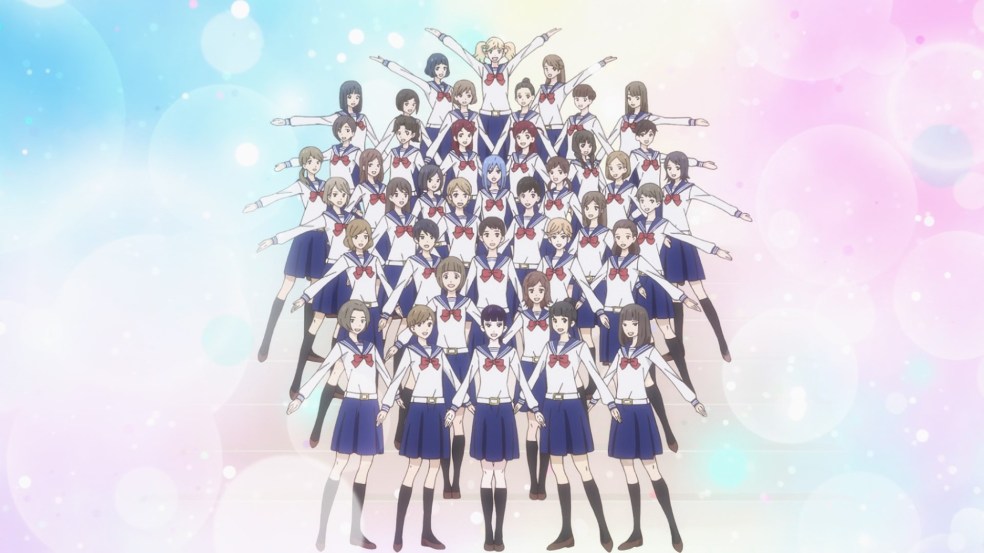
Fundamentally, “What She Said”, as the episode is called, is two characters challenging each others’ worldviews. On one side is Mio Hirahara, the leader of the red Reflectors and main character Hiori’s sister. On the other side is Momo Tanabe, ex-delinquent and most senior of the blue Reflectors.

The moral differences here are stark, and while Momo’s red Reflectors’ actions are not excused, the series does paint them in a more sympathetic light than one might expect, even if they are still ultimately “the bad guys” in a narrative sense. It does this mostly by way of what is essentially an expository monologue on Mio’s part. As a sidenote; it’s to the credit of the show’s director (Risako Yoshida) that this somehow feels gripping and compelling instead of dry.

These revelations are, themselves, plot points. There is a lot to process here; time loops, monsters called Sephira (briefly shown without explanation way back in episode one), the mysterious “Door to the Common” that Mio and her Reflectors are working to open, the confirmation that Mio and Momo were partners–as we now know, quite literally in another life, in the previous timeline–the ominous fact that three days in the future is when Mio and Momo originally lost to the Sephirot. It’s all quite much.

What remains true regardless of the literal plot developments, is that Blue Reflection Ray is a portrait of emotional dysfunction gone horribly wrong. In this specific way, it actually is similar to many of its contemporaries, and it’s here that we can most understand what it’s trying to do. Only what every magical girl series does; prove the worth of human connectedness in a world that has forgotten it. Its route is just more circuitous than most.

Of course, the obvious caveats apply. Sure, the series could crash and burn in its second cour. It’s possible there really isn’t a plan and I am simply reading too much onto a production with low ambitions. But, with all respect to this hypothetical negative reader, that is true of almost any anime with truly few exceptions. I would, a million times over, make the mistake of giving something too much credit than the inverse.

Blue Reflection Ray‘s first cour is approaching its end, and I suspect we may finally have at least some answers soon. Until then? The Door to the Common remains closed, and all we can do is wait for it to be unlocked.


1: I like Blue Reflection Ray‘s visuals. I think its watercolor palette, the general shoujo aesthetic of the character designs, and the gaudy computer art mish-mash of the Leap Ranges are all strengths. However, if an anime eventually comes along that will rehabilitate J.C. Staff’s reputation for odd, spacey, and sometimes just straight-up bad animation, it will not be this one.


If you like my work, consider following me on Twitter, supporting me on Ko-Fi, or checking out my other anime-related work on Anilist or for The Geek Girl Authority.

All views expressed on Magic Planet Anime are solely my own opinions and conclusions and should not be taken to reflect the opinions of any other persons, groups, or organizations. All text is owned by Magic Planet Anime. Do not duplicate without permission. All images are owned by their original copyright holders.