The Weekly Orbit [5/13/24]

Hello anime fans, it’s another light week here on Magic Planet Anime as I fight against the raging tide of getting sucked into playing Hades II all day every day. Anyhow, here’s what I do have to report on this week. Enjoy!

Anime

Delicious in Dungeon – Episode 19

We’ve got a split episode this time. Firstly dealing with Izutsumi joining the party.

I have to say, I think somebody on the staff is a bit thirsty for her. I can’t precisely explain why I think that but it has something to do with how her face is drawn compared to how it’s drawn in the manga, or even in scenes after this opening one.

The directing in the first half of this episode is otherwise actually a bit dry, but the second more than makes up for it.

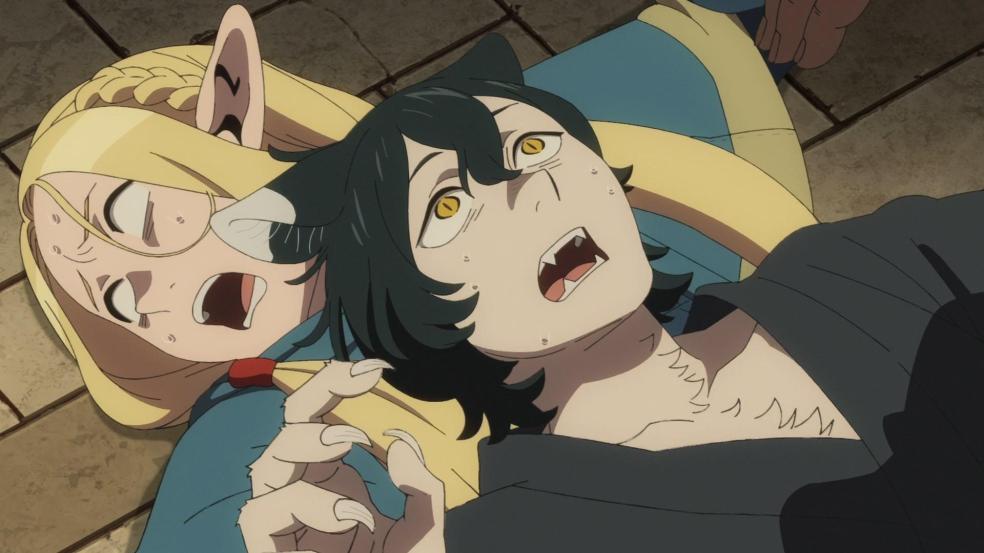
The decision to render Marcille’s nightmare in black and white is bold. I don’t think many other studios would’ve even tried it, but it pays dividends here. Not just because it enhances the alternating terror and, yes, comedy of the nightmare. (Do keep in mind that against the backdrop of Marcille running from a monster symbolic of her fear of death we also have Laios Being Laios. Poor guy.) The moment where she retrieves the book from the monster, and it’s a golden yellow in contrast to the black and white dream is just absolutely brilliant. I love it.

Also, the Falin doll is really, really cute.

GO! GO! Loser Ranger! – Episode 4

God Suzukiri is so good here. Anyway!

The transition to Red just laying into the guy mouthing off to him is very sudden and I think it’s effective in how out of nowhere it is. This is the first time we really see unambiguously that the Rangers are deeply corrupt.

Thus begins Loser Ranger‘s flirtation with political metaphor. It’s, uh, a lot. The Invaders are genuinely a threat here; we see so in Hibiki’s flashback as their general murders his whole family. Yet, he clearly bears individual invaders like Footsoldier D no ill will.

What is the show trying to say by this being the case? Hard to say. This is very slight manga spoilers, but the series’ worldview eventually develops into what I’d call nuanced (although not without problems), but it takes a while to get there.

In any case, the fights remain tricky and full of surprising little twists and turns, and by episode’s end we’ve got D and Hibiki set up as our Lelouch and Suzaku (so to speak) respectively. Fun times all around.

Girls Band Cry – Episode 4

The fact that Momoka’s high school band photo is 2D and is thus literally a window into a prior era of the girls band genre is pretty great. I wonder how intentional that is.

We here meet the stern aristocratic grandma. Who is also a minor himejoshi, if her choice for the improv scene that she makes the girls act out is any indication.

Said scene is genuinely so intense with the secondhand embarrassment that I had to mute the audio on the first bit. The second half where it turns into Nina just putting Subaru on blast is brilliant though. (Also, hm, comparing being in a band to dating. Interesting angle for a show airing in The Yuri Season to take.)

There’s something about the visual of an anime girl saying she doesn’t like acting “because it’s embarrassing” and calmly turning off the TV behind her. Interesting stuff.

I was repeatedly warned by people that this episode has a “weird resolution.” I don’t really agree, Subaru clearly is more conflicted on her split loyalties than she’s actually letting on, and the final scene is Nina realizing that. I will grant that it’s an unusual emotional expression to hitch an entire episode on, but it’s far from the strangest I’ve ever seen.

Also, Nina being a serial meddler is going to come back to bite her at some point. Sadly, it doesn’t seem like SobsPlease have gotten to episode 5 yet. If they still haven’t fairly soon I might try out the other group fansubbing this. It would be a shame though, I really like SobsPlease’s work thus far.

Mysterious Disappearances – Episode 5

This adaptation reminds absolutely confounding.

In what I assume is some attempt to get around broadcast standards, the bath scene that should chronologically have been in the last episode has been split up in two, and the longer half has been wedged in here. It takes up a good half of the episode, isn’t titillating, and is only “comedic” in a very technical sense.

What survives the transition are little character moments; Oto’s friend getting annoyed that she can’t peep on the girls undressing, Oto herself being wooed by snacks into visiting the teacher’s apartment and later leaving some of those snacks at the altar of her late grandmother, etc.

In the episode’s last third, Oto is scared awake by haunting knocking and disembodied footsteps in the rain, creating a tension that is completely shattered the second that a new character is introduced by rushing at Oto, sans context.

There’s some other stuff in here. But for the most part, Mysterious Disappearances is so far mostly an example of the truism that horror anime are never anywhere near as good as horror manga. The original manga is trashy but fun. The anime has been mostly a series of puzzling decisions that dull the manga’s strong points and create new weaknesses. There’s still time for it to recover, of course, but this weak opening half is going to make it a hard sell to anyone who’s not already a pretty big fan.

A Salad Bowl of Eccentrics – Episode 6

Is your favorite girl band anime this season Girls Band Cry or Jellyfish? If you’re undecided, can I interest you in a dark horse candidate?

Salad Bowl is thankfully back on track this week, and quite honestly this episode is a complete odyssey, more than making up for last week. I’m never going to claim that an obsessive lesbian cult leader like Noa is good rep, exactly, but in The Yuri Season it’s as on-tone as anything else. The sugar mama arrangement that Livia stumbles into with Noa is pretty fantastic, whether it’s in the realm of taking her clothes off so Noa can 3D scan her and make dolls of her or convincing Noa, who is also a bedroom musician, to join Puriketsu’s faltering band.

This episode is the best of Salad Bowl as a series and as a concept. Pure uncut zaniness, no chaser.

As a side note, this is really the first time I’ve bought into Livia being hot. Maybe it’s the sharper visuals here than in prior episodes, maybe she just looks good with a guitar. You decide!

Pokémon Horizons – Episode 49

Dot episodes are always fun, and I’m a sucker for anything that even remotely touches on the performer / performance dichotomy, as this episode does with the dichotomy between Dot and Nidothing. So this episode was just an all-around hit with me. Also it’s a 2-parter! Cool!


That’s it for this week. Please bask in the glory of this week’s bonus thought before you go.


Like what you’re reading? Consider following Magic Planet Anime to get notified when new articles go live. If you’d like to talk to other Magic Planet Anime readers, consider joining my Discord server! Also consider following me on AnilistBlueSky, or Tumblr and supporting me on Ko-Fi or Patreon. If you want to read more of my work, consider heading over to the Directory to browse by category.

All views expressed on Magic Planet Anime are solely my own opinions and conclusions and should not be taken to reflect the opinions of any other persons, groups, or organizations. All text is manually typed and edited, and no machine learning or other automatic tools are used in the creation of Magic Planet Anime articles, with the exception of a basic spellchecker. However, some articles may have additional tags placed by WordPress. All text, excepting direct quotations, is owned by Magic Planet Anime. Do not duplicate without permission. All images are owned by their original copyright holders.
(REVIEW) A Strange Dream About the Sky – The Weight of AIR

This review contains spoilers for the reviewed material. This is your only warning.


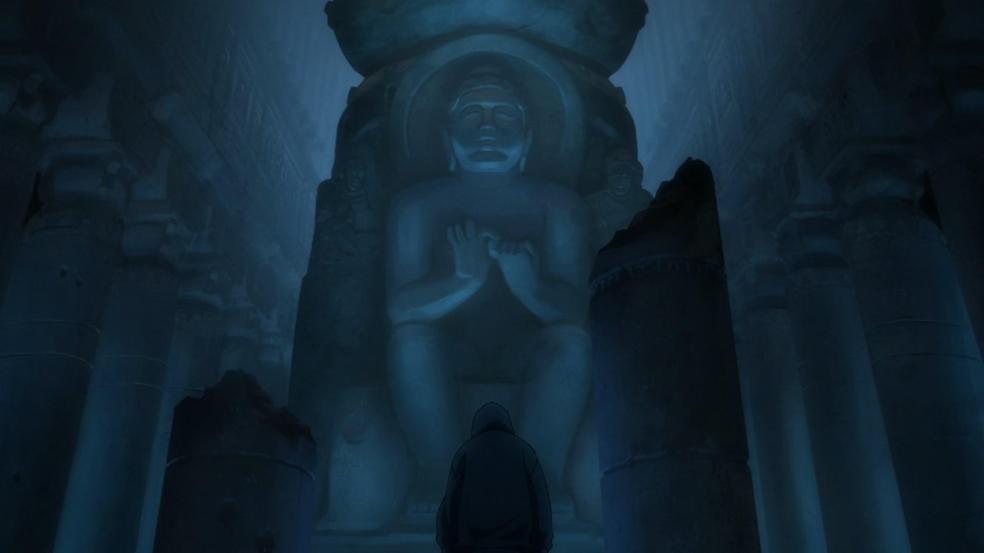
If you close your eyes, you can immerse yourself in it. The sweltering Sun, the sea breeze messing your hair and running the sharp scent of salt past your nostrils. The sound of the cicadas lighting up the trees with their songs, and the humid heat. During the day; the brilliant, sapphire-blue sky and the billowing white clouds across it. At night, it’s an inky black streaked by the starry Milky Way. This is a series of blurry photos from a blazing-hot July buried somewhere in your memories. This is Air.

If it seems strange to tie an adaptation of a member of the infamous nakige (“crying game”) genre to a specific season, it might help to think of it as Air‘s way of contextualizing its attempts to tug at your heartstrings; the joy and sadness of a human lifetime distilled down and squeezed into a single, eternal summer, bringing to mind similar works in different media, like Fennesz’ album of that same name. When the series began airing in 2005, I myself was a child, in Florida with my father, and the heat of the Sun feels as real in Air as it does in my own recollections. Air‘s vision of summer is mercifully devoid of crocodiles, geckos, and palmetto bugs, but the feeling is the same, and the tense dichotomy between “these days feel like they will never end” and “we don’t have many days left” is thick enough to break scissor blades. The summer lasts forever, until it doesn’t.

Air, you see, is not just a story, it’s a dream. A reference point, and a map for its structure and storytelling aims, that recurs many times over its twelve episodes. Its logic is dreamlike; characters are introduced suddenly and vanish out of sight when their stories conclude, the series is peppered with elements of magical realism, and the environment itself seems to bend around the characters’ emotions, especially in its last stretch when the cast winnows down to just two main characters. Its emotional impact is dreamlike, too; it can make you very sad without you necessarily understanding what’s happened or why. (If I seem to skimp on describing Air‘s actual plot throughout this article, that’ll be why. Some articles are very easy to write; this one was not.) Dreams are, too, a recurring story element. Our main heroine, Misuzu [Kawakami Tomoko], dreams of another version of herself, suspended in the sky and flying on wings of pure white feathers. Our main hero, Yukito [Ono Daisuke] is a crow who’s dreamt himself into the shape of a man, or perhaps the other way around. These dreams are just part of the larger dream of the series itself, one that only ends when Air concludes. It’s a vast dream, too, encompassing over a thousand years, from 994 AD to the summer of 2000. Millennium to millennium, era to era, life to life.

Fittingly, Air‘s depiction of the human condition is impressionistic and emotional. Its core concerns are faith, family, and the preciousness and brevity of life. At its best, it feels as light and ethereal as its namesake or as heavy as torrential rain; lifting you up and pummeling you back down. This isn’t to say it’s always at its best—this is now the third Maeda Jun project I’ve seen, and I’m starting to get a good sense of his strengths and weaknesses as a creative, and there are some questionable decisions in the show’s final stretch in particular—but the highs are very high, and they’re plentiful enough to make the series worth watching.

In terms of literal narrative, Yukito arrives to a nameless town (modeled on the real-world city of Kami, Hyogo Prefecture), searching for a place to stay and a way to earn money, yes, but also a half-remembered vision inherited from his mother; something about a woman in the sky. In an early indication of the series’ magical-realist bent, Yukito is a puppeteer whose magical control of his doll is treated as nothing more than a mildly amusing parlor trick. He meets Misuzu, an odd, clumsy girl who trips a lot and says “gao!” when frustrated, and is eventually roped into being Misuzu’s live-in caretaker by Misuzu’s surrogate mother, a drunkard aunt named Haruko [Hisakawa Aya].

From this setup, Yukito becomes entangled in the lives of a number of women around the city, possibly a consequence of the series’ origins as an eroge. (This adult VN -> clean rerelease -> anime pipeline used to be quite common, back in the day.) Stripped of their original context, Yukito meeting these characters and witnessing their stories takes on an anthology-esque quality. Among those we meet are the self-styled ‘alien’ Kano [Okamoto Asami], Kano’s older sister, the town doctor Hijiri [Touma Yumi], the rambunctious redhead Michiru [Tamura Yukari], and her older sister, the deliberately-spoken, astronomy-fixated Tohno [Yuzuki Ryouka]. Each of these girls has some issue that Yukito aids in, if not resolving, at least providing closure for. In the earlier episodes, anything explicitly supernatural is pushed to the margins and the tone is fairly ambiguous. However, in episode four, the series stops playing coy, and from the moment that a magic feather in a temple induces a shared hallucination of a bygone era, the show’s magical realism is fully realized.

The show’s main theme of family comes into focus over the course of these stories. Each one centers around a frayed familial connection of some kind—Kano’s strained relationship with Hijiri, Michiru being the disembodied spirit of Tohno’s miscarried sister, Tohno’s mother completely forgetting she exists, et cetera—all of which is just windup to the two main stories of the series, the one between Misuzu herself and Haruko, and a very different, but intimately connected tale that takes place a thousand years prior.

Because, you see, the recurring image of the flying maiden is what ties all of these disparate stories together. Sometimes mentioned directly, sometimes only alluded to. Air reflects its own structure here, as this unknowable woman in the sky means something different to everyone. Air’s big halfway point twist, then, is when we learn the story of that woman. This is the other half of Air, a story taking place in the Heian Era, first at a secluded temple-palace and then all up and down medieval Japan. Kannabi-no-Mikoto, alias Kanna [Nishimura Chinami], an enshrined woman who is among the last of a mystical race of angel-winged people. Her attendants Ryuuya [Kanna Nobutoshi] and Uraha [Inoue Kikuko] serve to care for and comfort her at the shrine, drawing a parallel between these characters and those taking care of Misuzu. In an act of grim foreshadowing, Kanna’s life at the palace is disrupted when forces unknown infiltrate it, seeking certainly to capture, and possibly to kill her, leading Kanna and her entourage to flee and seek her also-imprisoned mother. Here, Air‘s visual presentation completely flips upside-down; these portions of the story are clouded over with heavy monsoons of rain, and when the Sun does poke out, it looks noticeably different than it does in the modern day portions of the story; less omnipresent and less oppressive.

Really, this part of Air is a different anime entirely, a feeling further enhanced by the two-part Air in Summer OVA which further fleshes it out (you could give yourself a “streamlined experience” by weaving both halves of Air in Summer into the main anime’s episode count). Kanna’s status as a winged person marks her as both something divine and an outcast. We don’t get many details; when we eventually meet Kanna’s mother, she only mentions that she herself is ‘tainted,’ and Kanna eventually comes to realize that her life, at least, what of it we see, may be the dream of someone else. (There’s a real Butterfly Dream thing going on here.) When she and her attendants can no longer escape their would-be captors, she unveils her wings. And thus, in one of the story’s two climactic points, Kanna is shot to death. Riddled with arrows against the backdrop of the white, caustic moon.

Death marks the final boundary for Air‘s narrative. Kanna’s story ends—at least for us—when she dies, and so too does Misuzu’s when the series returns to her side of the story for its final stretch. Back in the (relative) present, Misuzu’s illness, now fully revealed to be a curse, worsens. She loses the use of her legs, and eventually her memory starts to go, too, leaving her unsure of who Haruko, the woman who has been her surrogate mother for many years, even is. (This is another unifying thread between Misuzu, Kanna, and the rest of the show’s heroines. None of them have a normal relationship with their mother figure.) The final arc sees Haruko attempting to prove that she’s worthy of being Misuzu’s real mother, to herself, implicitly to us the audience, and to Misuzu’s actual biological father, a man named Keisuke [Tsuda Kenjirou].

In Air‘s last episode, we see Haruko’s desperate attempts to connect with her daughter finally begin to bear fruit, only for Misuzu to realize that she is, in a sense, still sleeping. Air ends with her death, as she and Haruko both accept that their time together is over. It hits in the heart, unifying the series’ themes of faith and family as Haruko reflects on her mistakes in treating Misuzu poorly1. If you’re the type who can be hit by that kind of thing (and I definitely am), it’ll get you, but there are questions to be asked, here, and this is where we have to put on our rational hat a little bit.

For one, Maeda certainly has a thing for young, disabled girls, doesn’t he? I don’t necessarily mean that in an outright condemnatory way—although some would, and I wouldn’t even say they’re wholly wrong to—but it is a noticeable recurring character type throughout his work; a girl whose emotional fragility is reflected by physical frailty. It feels rooted in ableism and misogyny. Plus, on top of that, this ending is just sort of basic. Yes Jun, to paraphrase Young Thug, we all hate when girls die, but is that really all?

To be fair, in the case of Misuzu’s death, and the closing chapter of this story, it quite literally isn’t all. Misuzu’s soul reunites with Kanna, and it is implied (albeit only indirectly), that this frees both of them—since they are ultimately, metaphysically one in the same—from their shared curse. Still, there’s a very fine line being walked here. “Life is incredibly frail, and there is a certain tragic, inevitable beauty to death” is a perfectly fine notion. Adding just a couple of words in there to make it specifically about the disabled very quickly turns it ugly, and I am not sure Air manages to say the first thing entirely without saying the second even if it doesn’t ‘mean’ to, which is a shame, to say the least.

On the other hand, you can try to ignore any themes built into Air entirely. That seems to be what much of the Japanese game-buying public did with the visual novel. Maeda has recounted2 how many players’ main takeaway was that the game was “soothing,” and how frustrating this was to him. From a certain point of view, this is definitely true of the anime as well, and you’re free to strip it for parts if all you really need is a sumptuous bath of wonderfully retro visuals and sound. Indeed, in addition to its very deliberate sense of place, Air lives and breathes its era; it is Early 2000s as hell, and all of the signifiers that have become so inseparable from this era are present. This is especially obvious with the highly sexually dimorphic character designs, where the men are all tall, lanky, and comparatively realistic, and the women are all short, soft, and have huge headlight bug-eyes. There’s some really strong animation, too, especially in terms of the near-constant sea breeze that blows throughout the show. Every hair on many of the girls’ heads will happily billow in the wind throughout the series, it’s quite something. Reducing the series to its aesthetic components in this way, however, requires actively disregarding what Air is about. I can’t speak for the game, but I don’t think the series is helped by trying to flatten it into a Pure Moods CD, even given its flaws.

If you wanted to, though, you had an option there, too. The series’ companion album Ornithopter, a sprightly thing where trance and instrumental city pop meld and melt together into a hazy heat blur, is an interesting counterpoint to the sadder parts of the anime. Like a pleasant dream the night after a bad day, it seems to gently nudge us into remembering that life will go on.

Life did, in fact, go on for all involved with Air. This series was director Ishihara Tatsuya‘s debut in that capacity, and he shortly thereafter went on to helm the world-conquering anime adaptation of The Melancholy of Haruhi Suzumiya, and a number of excellent Kyoto Animation titles thereafter including Nichijou, arguably the best comedy anime ever made and certainly one of the best of its era. He’s still at it now, directing the currently-airing third season of Hibike! Euphonium. Main series compositionist Shimo Fumihiko is also still working, currently fulfilling that same role on the fifth season of cult series Date A Live. A good chunk of the voice cast is still active, not always a given for an anime that’s nearly 20 years old, although sadly Misuzu’s voice actress Kawakami Tomoko, perhaps best known as the title character in Revolutionary Girl Utena, passed away in 2011 after a battle with cancer. She was an incredible talent, and was taken from us too soon.

And then, there’s the case of Maeda Jun himself, certainly worth discussing given that he seems to have been the main creative brain behind Air. Maeda, of course, had a pretty successful career for quite a while after Air, working in a similar capacity as the main force behind Clannad and Angel Beats! (the latter of which became an anime that I deeply love), among other things. Then, in 2020, came The Day I Became A God, and, well, if you’re a longtime reader of this site, you know how that went. I more or less stand by what I said in that article, and Air‘s lowest moments foreshadow some of The Day I Became A God‘s core problems, but it’s worth noting that I was hardly alone, there. The Day I Became A God was so widely disliked that the backlash prompted Maeda to retire from writing for anime and the like entirely, and he claims he felt so disheartened by the reception that he apparently considered killing himself.

It never feels great to be a part—even a very small part—of that kind of reception. I would like to think Maeda has good work in him still, and overall, I’d say I quite liked Air, despite its flaws. (Certainly my feelings on Angel Beats! remain unchanged, as well.) But you can’t change what’s already been done, and if Maeda has decided to stick to composing, he’s at least certainly very good at that as well.

As for Air itself, the series, there’s a lot I haven’t touched on, here. The series’ first half has a lot of great storytelling moments that I have both skipped recounting for the sake of not making this article even longer and to leave some of the magic intact for anyone who reads this and wants to check the show out. I’ve also not really gone into the various highs and lows of the show’s comedic moments, of which it has a surprising amount. (The very short version; most of the humor is actually surprisingly great, but a few things have not aged well. Sexual harassment-as-joke is something we should be glad we’ve largely left behind.) There are lots of bizarre little details, like Misuzu’s constant referring to chicks as “dinosaurs’ children” (she knows her cladistics!), a dog that makes “piko-piko” noises instead of barking, and so on. Despite all I’ve written, I feel like I’ve only really scratched the surface, and the years of surrounding context that have built up around Air have only amplified that feeling.

In the end though, Air has given me a wider appreciation not just for Maeda’s work but for work in general. Art reflects life, and life doesn’t stop for anyone. There’s no point in not trying to enjoy every day you have, and the fact that Air could make me reflect on the value of my own life and the time I have left in it is, in a way, the greatest argument in favor of it being a worthy piece of art. Dreams can be beautiful, yes. But, we all wake up eventually.


1: In general, as I’ve pointed out in my previous writing on this series, their dynamic reminds me a lot of Rosa and Maria’s from Umineko. I do wonder if it was a direct inspiration or just a coincidence.

2: In the initial version of this article, I said I couldn’t find this interview. However, since then, someone has backed it up on the Internet Archive’s Wayback Machine, and if Google Translate is to be judged good enough to get the gist of the interview, that does in fact seem to be what he said, in essence if not literally.


Like what you’re reading? Consider following Magic Planet Anime to get notified when new articles go live. If you’d like to talk to other Magic Planet Anime readers, consider joining my Discord server! Also consider following me on AnilistBlueSky, or Tumblr and supporting me on Ko-Fi or Patreon. If you want to read more of my work, consider heading over to the Directory to browse by category.

All views expressed on Magic Planet Anime are solely my own opinions and conclusions and should not be taken to reflect the opinions of any other persons, groups, or organizations. All text is manually typed and edited, and no machine learning or other automatic tools are used in the creation of Magic Planet Anime articles, with the exception of a basic spellchecker. However, some articles may have additional tags placed by WordPress. All text, excepting direct quotations, is owned by Magic Planet Anime. Do not duplicate without permission. All images are owned by their original copyright holders.

The Manga Shelf: Your Planet is Doomed – The End of Romance and the Alienation of Humanity in UCHUUJIN NO KAKUSHIGOTO

The Manga Shelf is a column where I go over whatever I’ve been reading recently in the world of manga. Ongoing or complete, good or bad. These articles contain spoilers.


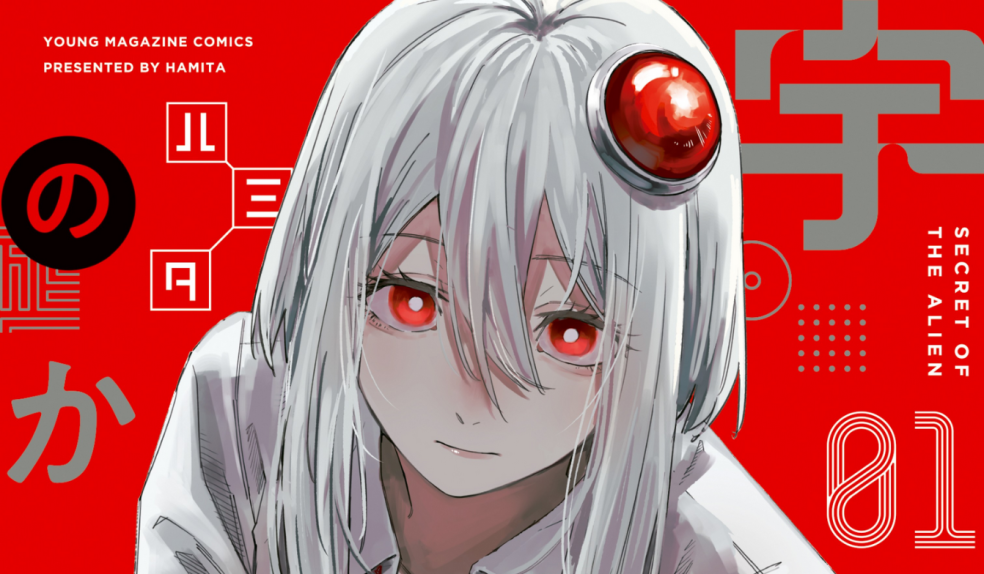
Knowing yourself is hard, knowing others is harder. Mangaka Hamita, in the second work by him that I’ve read since learning about him last week, seems to suggest that it might, in fact, be completely impossible. This is a core concern of Uchuujin no Kakushigoto (also Secret of the Alien, semi-officially), one of just a few manga of his that aren’t self-published. Other concerns of the work include honesty, difficulty in understanding one’s own feelings and the feelings of others, and of understanding how people think in general. Our main characters are our male lead—called “Class Rep” so often that that might as well be his name1—and Tamachi Haru, his girlfriend, an alien from another planet, who he confesses his love for shortly after she comforts him in the wake of his parents’ unexpected death.

In many other manga, the alien angle would be a gimmick. Something to give a bit of color to an otherwise typical romcom and to highlight how other people can be “alien” to us, while reinforcing that love and kindness can form real, meaningful connections regardless. Uchuujin no Kakushigoto turns that on its head. The inherent unknowability of others is the entire point, and the manga seems extremely skeptical that it’s possible for people to truly know each other at all.

But I’m getting a bit ahead of myself. The manga’s actual narrative concerns Haru, her mysterious “mission” to Earth, and the ways she and the Class Rep impact the lives of those around them. Being from another planet, Haru has no concept of why killing is wrong. This leads to the first central conflict of the manga, wherein she murders the class delinquent Karagaki for hitting on the Class Rep in front of her, because she assumes humans can just rebuild themselves from nothing like her own species can. The Class Rep is, of course, brought to a panic by having his classmate blown to smithereens in front of him, but Haru reassures him that everything will be fine. In two weeks’ time, when she can travel back home, she can regenerate Karagaki just like a member of her own species. So as long as Karagaki’s sudden disappearance stays covered up, it’s no harm no foul.

It does not stay covered up, of course. And in fact, events quickly spiral out of control from this initial flashpoint as twist piles on twist and revelation piles upon revelation. (Not a knock, this style of storytelling gets a bad rep, but it makes for a real page-turner when properly deployed.) A few things quickly become clear. For one, Haru is a truly alien alien. She has no real concept of human morality or common sense, and the Class Rep’s attempts to impart these values to her largely fail. For two, these efforts fail because the Class Rep doesn’t really understand Haru. In fact, as the manga goes on, it becomes clear that, for three, he doesn’t really understand anybody. He tries to help people almost compulsively—the result, we later learn, of a neglectful upbringing—but because he can’t truly relate to people, his “help” tends to cause more problems than it solves. (He is in fact at one point depicted as being unable to distinguish any person who needs his help from any other. This isn’t literal, but it’s telling.) You could, if you were so inclined, read this as loosely ableist, but as someone who is neurodivergent myself, I found it profoundly and painfully relatable. You, or at least I, will really feel for this guy over the course of the story, to say nothing else of the other people caught in this whole mess.

Take the character of Teru for example. Ostensibly, he’s Karagaki’s boyfriend. But after she disappears, it’s slowly revealed that not only was she majorly two-timing him, he’s also the only person actually searching for her, because everyone else assumes she’s just run off somewhere. Teru, we learn, is also deeply alienated from his own feelings, and has spent a lot of time and effort trying to be like Karagaki so she’ll like him back. (She’s the reason he has blonde hair, for example, and it’s implied he generally attempts to act the part of a punk even though he’s really not one.) His persistence in trying to find her, even after the Class Rep manages to talk him out of it once or twice, is in a way admirable, but when the mounting stress of realizing she didn’t truly love him collides with the fallout from another incident wherein his mother suddenly abandons him, he can’t take it, and kills himself.

The ripple effect here, of Haru and the Class Rep’s actions indirectly leading to such a drastic outcome, is characteristic of Uchuujin no Kakushigoto. But more than just a storytelling style (one that foreshadows the manga’s final big twist), it’s representative of its tone. This is, at its core, a deeply bitter story about love that isn’t really love, people who don’t and can’t comprehend each other’s feelings, and how, if extrapolated to the whole of humanity, these intersecting facets say something very bleak about the human race.

Things that are tonally bitter have a bad reputation, and certainly, handled poorly, it can come off as the author simply ranting at an uncaring world. (Though given the state of the world, I’m inclined to forgive a bit of even that much nowadays.) So I do understand why the kneejerk reaction may be, as it was for me, that this manga thinks it has more to say than it actually does. (Honestly, that might even be true, as we’ll get into.) But that overtone of bitterness shouldn’t discount the story on its own. Bitterness is a part of the human condition just like any other emotion, and it can be worthwhile to see it explored. The specific kind of cynicism here feels so total that finding a “constructive” read can feel difficult, but art is not moral instruction. Even read as uncharitably as possible, Uchuujin no Kakushigoto is still emotionally affecting. It’s true that the nature of some of the characters means they resonate less than they might otherwise, but for the most part, and despite its many twists and turns, I actually found it fairly strong in this regard. It feels a bit silly to actually put it this way, but the mere fact that I felt sad when characters died, and that their later “revivals” via Haru’s space techno-magic actually made it hurt more, is a huge point in the manga’s favor. Being able to punch you in the gut is a skill like any other, and it’s worth praising when it’s well-developed.

Now, we do need (or at least, I feel the need) to take somewhere to note the flaws this thing does have. One of Haru’s gee-whiz sci-fi gadgets, which the manga mostly portrays as rightly horrifying uber-technology, is a memory-erasing gun. It seems to give those it affects permanent brain damage, a state Haru herself tellingly terms “honest.” As an example, a major supporting character is a girl named Maseki, the vice class president, and in love with the Class Rep. As introduced, she’s a thoughtful and sweet girl. But eventually, she falls afoul of Haru’s mission, and the damage from the gun turns her into an “honest” being of pure id, devoid of any inhibition. The second this new incarnation of her is introduced, she tries to strangle Haru with her bare hands, since she sees Haru as a romantic rival for the Class Rep’s affections. Later, she throws herself at him, sans clothes, in the manga’s only real instance of fanservice.

This is representative of the series having something of a madonna/whore thing going on with its female characters. The girls are uniformly either purehearted and sweet like pre-memory gun Maseki, or they’re beings of pure desire that use sex appeal to get what they want, like post-memory gun Maseki, minor character Natori whose main trait is stringing Teru along for her own kicks, or, indeed, Karagaki, who probably has a number of issues of her own that would lead to her sleeping around to the extent that we’re eventually told she does (up to and including prostituting herself), but whose inner life goes largely unexplored. It’s not that these women are written with no sympathy, but the discrepancy between them and the Class Rep and Teru, the two characters whose lives are explored in detail, is fairly stark. One could argue that Haru herself rises above this dichotomy, but given that this arises from her disconnection from humanity, I’m not sure that’s a good thing. And even if we ignore that, she’s still only one character against the example of several others.

This flaw doesn’t sink the manga, but it does dull its otherwise sharp emotional impact. The reveal that Karagaki was prostituting herself prompts a relieved “thank god you weren’t a good person” from our hero. He only says this in his own head, and we’re almost certainly not intended to agree with him, but it gives me pause. I think that’s part of why this manga has been such a chewy meal for me. Despite everything I’ve said, I largely like it, but the particular nature of its flaws mean that I can’t quite square why that’s the case. That’s part of what this column is; an attempt to sort my own feelings. (But, well, aren’t they all?)

In its final act, the manga reveals that Haru’s mission to Earth is to find a way to drive humanity to extinction. In parallel, the revived Karagaki—a person who, again, looks identical to her original, but acts completely different, and very submissively in this case—becomes a pariah for her classmates, who blame her for Teru’s suicide. Haru states that this is how she will destroy humanity; by removing any enemy for them to unite against, until they are so used to a lack of conflict that they will inevitably destroy themselves when one arises. Here again, the manga loses me a bit.

There is something worth exploring, despite how dark it is, to the idea of humanity as an inherently cruel thing, always seeking a victim, an Other to blame our problems on. That, in fact, could probably be held as the other major thematic concern of the manga. But the notions that Haru brings up while introducing this idea, ones of stagnation and progress, are artificial, Enlightenment-era ideals that were themselves created by men to serve men. I don’t like that the manga appears to treat them as inherent truths of the world, and I think if it makes a big mistake, it’s probably this. (Although I will reiterate, I am fine with the overall tone and direction of the ending, I just think the specifics get a little muddled in a way that hurts what the story is going for.)

In the manga’s final chapters, its last twist comes when Haru kills the Class Rep. She does love him, in a certain, alien way, but she can’t bear to see him remain something as flawed as a human being. In other words, she doesn’t really love him, flaws and all, in the first place. Haru, with her sensibilities far removed from an Earthling’s, can only see these flaws as imperfections to be fixed, which she does by reincarnating his core genetics into a new person, who she names Noah. This last development strikes me as particularly cruel, snuffing out even a certain fatalistic “it’s just me and my baby against the world!” thrill that other kinds of love stories have explored throughout the ages. For as much as the Class Rep didn’t understand Haru, she didn’t really understand him either.

In Uchuujin no Kakushigoto‘s final, postscript chapter, after many centuries, a series of events plays out with two new characters that implies that all of this might happen again. Indeed, it might have already happened many times, and might happen many times more. If that’s true, it is a fantastically bleak note for a manga to end on, and I honestly really respect the willingness to go out on such a downer.2

I do feel like I’m missing something, though. That’s not something you’re supposed to admit in even amateur media criticism anymore, the idea that you might not entirely get it, but I will cop to feeling that way, at least a little bit, with Uchuujin no Kakushigoto. Perhaps there’s some other theme I’ve failed to pick up on, some other piece of context that would make something else snap into place. Regardless, it’s an interesting work, one I’m willing to break out the dreaded “messy” label for, and it’s one I imagine I’ll return to. I can’t speak to the life experiences that may or may not lead someone to make something like this, but isn’t that just a confirmation of one of the manga’s core ideas? It’s hard to know how other people think, a relationship that is as true from audience to artist as from family member to family member or lover to lover. That, if anything, is the real secret of the alien.


1: I’m not being cute, here. That’s what he’s called for the vast majority of the manga.

2: The fact that the manga was, if certain internet scuttlebutt can be trusted, apparently cancelled, might have something to do with it, but that’s pure speculation. But, the ending works with the manga. If the cancellation noticeably altered the plans for the story, I couldn’t tell, which is the important part.


Like what you’re reading? Consider following Magic Planet Anime to get notified when new articles go live. If you’d like to talk to other Magic Planet Anime readers, consider joining my Discord server! Also consider following me on AnilistBlueSky, or Tumblr and supporting me on Ko-Fi or Patreon. If you want to read more of my work, consider heading over to the Directory to browse by category.

All views expressed on Magic Planet Anime are solely my own opinions and conclusions and should not be taken to reflect the opinions of any other persons, groups, or organizations. All text is manually typed and edited, and no machine learning or other automatic tools are used in the creation of Magic Planet Anime articles, with the exception of a basic spellchecker. However, some articles may have additional tags placed by WordPress. All text, excepting direct quotations, is owned by Magic Planet Anime. Do not duplicate without permission. All images are owned by their original copyright holders.

The Weekly Orbit [4/15/24]

The Weekly Orbit is a weekly column collecting and refining my more casual anime- and manga-related thoughts from the previous week, mostly, these are taken from my tumblr blog, and assume familiarity with the works covered. Be wary of spoilers!

We move into our second week of the new season, and things are mostly going steady with only a couple of comparative curveballs. Plus; an interesting manga and a pretty cool OVA series a friend showed me. Forgive me if I’m a little brief, here. I don’t feel like doing much extra typing today; yours truly is recovering from a doctor’s appointment where I had to get bloodwork done. (Nothing serious! Just regular HRT checkup stuff.)


Anime

Bucchigiri?! – Episode 12 (Series Finale)

A good finale to a good show! That was one hell of a final battle. I loved how by the end, Arajin and Senya’s roles have almost reversed in their respective duos. (Conversely, Matakara and Ichiya’s fundamental insecurities were close enough that they were able to merge permanently.)

I’m glad that Arajin and Matakara both end this series with a sense of what’s really important. I won’t lie and say this show was perfect, it has a couple issues to be sure, mostly boring structural stuff like pacing problems, but overall I quite enjoyed it and I’m really happy with how neatly everything wraps up in this last episode. The story of life goes on. Perhaps we must all bucchi our giri in our own way.

Mysterious Disappearances – Episode 1

Ah, this is one hell of a mixed bag.

Here’s the thing, I like Mysterious Disappearances. As in, I like the manga this is based on. At its best, I actually like it quite a bit. But I also like it with many caveats, the biggest of which is that it is a pretty shameless ecchi thing on top of being a horror-mystery series in that “Japanese urban legends all connected by an overarching metaplot” genre. (Think of it as Otherside Picnic‘s heterosexual, fanservicey cousin and you’re in the right ballpark.) I won’t pretend I’m immune to this kind of material, and one of the reasons I started reading the source at all is that the main character, Sumireko, is absolutely gorgeous in her normal form (we’ll circle back to that specificity in a second), but a lot of these scenes, translated to the anime, just don’t do anything for me. Not to mention, I think a lot of people who might be interested in the mystery half of the premise are going to be put off by the ecchi material. Not that the series has any obligation to capitulate to those people, but it is at least worth thinking about. The simple facts of the format shift makes the tonal clash a lot more obvious than it might be on the written page.

I think the smart thing to do might honestly have been to minimize this stuff, but they were never going to do that. That in mind, going in the other direction and getting a team who could really amp up the raunchiness would’ve been an approach that at least engages with the source material, too. (If nothing else, original mangaka Nujima clearly really loves drawing Sumireko.) Unfortunately, and to be probably too blunt, the team from Zero-G working on this just aren’t capable of making normal Sumireko as hot as Nujima draws her in the manga. Sorry, but it’s true! A lot of the more egregious cheesecake shots in here, especially the ones we get while Sumireko is thinking about the state of her life, don’t really do anything except remind me of the “everyone is so mean to me :(” meme. Funnily enough, I’ve also seen the exact opposite complaint; people who are more all-in on what the manga’s doing than I am complaining because the show isn’t as explicit and crying censorship. I think this is an unfortunate case where the necessary compromises of an anime adaptation have left no one particularly happy.

And as for Sumireko’s other form, her childhood self which she reverts to by reading a magic poem, well, I’m not into that kind of thing. Is the show into that kind of thing? Honestly, in the manga it was an unequivocal “yeah I’d say so,” given how it was presented, but here, I’m not entirely sure. There’s definitely some camera angles in here that I did Not Enjoy, and I can’t imagine putting that in a series where that’s not at least part of the intent. On the other hand, Sumireko’s actual transformation is evidently painful, and by the episode’s end she’s bleeding out of her eyes, which seems to indicate to me like we are perhaps meant to find this gross and offputting. This was an equally strange thing, in terms of tone and presentation, in the manga, so I can’t really blame the anime itself here, but it’s pretty unpleasant all around and I’m not a fan, and the anime definitely makes all these shortcomings more obvious. Also, there’s a ton of crude humor directed at Sumireko by our other protagonist, Ren. To my recollection, this eventually becomes more tolerable as Sumireko starts to give as good as she gets, but I forgot how much of a snot he was in the first couple chapters, and he just comes off really badly here for all sorts of reasons. Cool eyes, though. I’m glad those survived the transition to the anime.

As for the actual horror / mystery / urban legend / whatever elements, those survive more or less intact and I think are what works best here. The nighttime city shots are suitably liminal and creepy, and as weird as the execution is, in terms of characterization, we get a good sense of the kind of person Sumireko is from her abuse of the poem book’s age regression spell in order to feel like a child prodigy again. Also, Fairouz Ai absolutely kills it as Sumireko, and I think the decision to cast her here was a smart one. So despite everything I just said, I do intend to keep up with this. I think every season needs its C-tier Decent anime, and that is the role this looks to fill for me.

Delicious in Dungeon – Episode 15

A good episode, and a return to what probably qualifies as the series’ “formula”, even if I wouldn’t say that’s a bad thing.

This is one of the visually wilder episode’s of the series, which surprised me a little. I haven’t looked up the staff credits but just from watching this it’s obvious that a lot of animators with strong individual styles were brought in here. (Sakugabooru identifies at least part of the very stylish fight scene against the dryads as being the work of Kanno Ichigo, and I’m inclined to trust them on this.)

Some other points; Marcille is just great up and down this entire episode in all sorts of ways, and I love how absolutely done she is with everyone else. A lot of the animation for the dryad flowers was incredibly horny (not a complaint, just an observation). The cockatrice being introduced with boss subtitles is the funniest thing ever. Even when it’s preparing a familiar course, Dungeon Meshi continues to be just really great.

Go! Go! Loser Ranger! – Episode 2

Good episode this week, definitely a bit speedy, but I think the key points were done very well, mainly Soldier F’s untimely demise. I will also confess that a huge chunk of the reason I was fond of this episode was the extremely obvious; Suzukiri first makes her role in this story known here and the entire scene where this happens is just really, really good. Arguably, it’s even better in the anime than it was in the manga. Speaking of which; Suzukiri is, as far as I can tell, the first role of any real note played by Yano Yumika. Whoever found her and decided to cast her here needs a raise, because she is an absolute delight as this character. If you’re not watching this show, and women with ambiguous morals and crazy eyes are a thing you’re interested in, I would recommend at least checking it out.

A Salad Bowl of Eccentrics – Episode 2

This show is weird! I did not like basically the entire first half of this episode, but it brought me back in the second. (They’re basically different stories entirely, and I assume they were separate in the original light novel.) All told, I’d say I don’t really understand its sense of humor super well, but sometimes it gets a chuckle out of me, and I guess for something I’m watching with friends that’s all you can really ask for.

Train to The End of the World – Episode 3

This was an interesting, and very fun-gal episode. I think it illuminates some of the show’s main concerns. But I have to admit my first reaction was “poor Akira!”

This show has a very unique way of structuring its dialogue that I struggle to put into words. The characters talk over each other a lot? This, combined with the fact that the rest of the main four just dismiss Akira’s concerns out of hand even before the mushrooms start influencing their thoughts when they eat dinner gives me the feeling that learning to listen to each other is going to be a running theme going forward. (It makes sense; the 7G incident was caused by a communication network gone haywire, after all.) I’d kind of had this thought as early as the first episode, so it’s nice to see it reinforced here. The girls are each others’ only real peers, and they’re friends in a loose sense, but they don’t seem to really respect each other very much.

We also get our first straightforward spook of the whole series with Akira’s “dream” of being pursued by the mushrooms. But the episode doesn’t let up there, and I’d call the entire thing fairly unsettling, especially toward the end where Shizuru, mushroom-bearing, is questioning if she was ever even really friends with Yoka at all and all three of the non-Akira girls seem pretty ready to give up. Although I think it’s interesting that the mushroom cult’s way of life is ultimately not immediately dismissed by the series, a lesser show would just write these people off entirely. Train to the End of the World doesn’t do that, it’s at least open to the idea that their sort of pseudo-carefree doomerism might be a valid, if flawed, approach to life, even if it’s not the one the show wants to take.

Also, that cliffhanger. My thought in the original version of this writeup was that Akira had a mushroom growing on her in an inconvenient place, but a person replying to me on tumblr (specifically a user named dream-about-dancing) pointed out that she might actually be turning into an animal instead, and also postulated that the next town seems to have a kitsune theme going by the doodles on the map from episode two. So who knows what’s going on there! I remain extremely invested in this show, and I’m glad it’s kept up the intrigue.

Pokémon Horizons – Episode 46

Pokémon Horizons opting to establish its characters over its first major arc, and then going into a loose adaptation of the recent games for its second, is, in my opinion, kind of brilliant. It allows them to eventually move the same characters to the next games’ setting when the time comes, and it makes sure we already care about the core cast before introducing a number of game characters here, also making it a good way to ensure Liko and friends aren’t overshadowed.

That fun little narrative trick aside, this was just a really great episode overall. The Floragato / Dewott battle was really exciting, and the episode as a whole was a fun way to get any new viewers up to speed but also get all of us into the swing of things going forward. I’m really excited to see where all this is gonna go, since the Explorers are clearly going to still factor in somehow.

Also, I will wholly admit that a good chunk of me watching this episode was just pointing at various characters from the game I like and then kicking my feet like a schoolgirl because they’re on the silver screen. Many such cases.

Himitsu no AiPri – Episode 1

Himitsu no AiPri is my second total Pretty Series show, and a lot like the previous, Waccha Primagi, it’s very zany and goofy, with the idol stuff as an outlet for the main character being a ball of anxiety trying to express herself. (As a sidebar, I ended up watching the premiere a week late and will probably be a week behind the JP airings for most of this series’ run, but it’s hard to say for sure, this being another fansubs-only release.)

There are just tons of strange little elements crammed in here that give the premiere a ton of charm; a “good luck charm” between two characters that consists of tapping one’s heads together, the inevitable titular idol competition taking place in some weird cyberverse, a principal who disrespects the show’s entire premise and is also so old-school that she’s an ojou character named Victoria, a background character whose hair looks chimera-fused right down the middle. The fact that we’re introduced to over a dozen characters here (albeit most of them only briefly) is pretty crazy, too, and signals that this is a show that’s going to be on the lighthearted and goofy end for the most part. Our main character literally falls into the technomagic bracelet that turns her into an idol. We’re in for a good time.

There’s also the show’s bizarre cyberworld, which provides a distinct feeling from the already-zany main setting. It must be noted that, of course, our main girl passes the cyber-idol entrance exam she’s subjected to without any prior warning here with flying colors. (Personally, I wasn’t that won over by the song itself, maybe it will grow on me?)

Also there is a truly overwhelming amount of pink in this episode. And it’s pretty gay, to boot.

Giant Robo the Animation: The Day The Earth Stood Still

A non-seasonal bringing up the rear, here. I watched this with a friend (who tends to go by zhagu on the internet), and I have to say, it was quite interesting overall, and I enjoyed it a lot.

In terms of scale, it plays out something like a cross between an old-school sci fi anime and a Greek Tragedy. Everything is huge, stylish, and feels inevitable. It doesn’t really fall into a single genre, something representative is that the enormous final battle, otherwise a contest between two enormous mechanical beings, is interrupted with a fight straight out of a samurai series and it doesn’t feel strange or out of place at all. I’ve been told that some of this is an attempt to make the series feel like an incomplete adaptation of a nonexistent original work; this is the alleged “second to last arc,” of which the rest of the show, obviously, does not exist. This structure gives the series a surreal and sometimes even hallucinatory feeling, even as it remains distinctly grounded in its 70s sci fi anime / raygun gothic visual style.

Also found within: interesting ruminations on what a sacrifice truly means and is, familial legacy, and cycles of vengeance. I’m going to be thinking about this one for a while, and I would not be surprised if I rewatched it at some point and think even more highly of it. Good show, and I broadly recommend it.

Manga

A Story About A Hallucinatory Girl

Let nobody ever tell you that there’s no interesting stuff on Mangadex.

This is a very short Pixiv comic (split into nine chapters but they’re each very brief. I think this totals to 30 pages or so?) about a guy who gets in a car crash and starts hallucinating that a girl is following him everywhere. It’s….odd. I kind of like it a lot.

I’m not necessarily sure I’d call it the most sensitive handling of this material, but it turns out a lot better than what I think many would be inclined to assume from its oddball premise, especially around the halfway point when the girl starts interfering with his love life. It goes some places in a way I think is actually pretty arresting, I wouldn’t mind reading a full series of this and I think the author is talented enough that my first reaction upon finishing it was that I hope they continue pursuing art. (More on that in a second.)

I’m going to spoil the ending now, which I think is best experienced for oneself, so if you’d prefer to get the authentic experience, go read it quick, and then read the next paragraph.

OK, so!

The case turns out to be this: there actually was no guy at all, the girl is the real protagonist, and what she’s been experiencing is some kind of syndrome, brought on by brain damage, where she doesn’t recognize herself as herself, and thinks she’s a man. By the end of the comic, she’s been hit by a car again (!!) and improbably, this seems to return her to her normal condition, and she can recognize herself again.

This is quite an interesting place to take a story like this and I have to be honest in that, perhaps naively, I did not see it coming at all. Like I said previously, this isn’t a terribly sensitive handling of this material (I don’t think the solution to receiving brain trauma is to get more of it, if I had to guess), but it being….sort of a metaphor for self-acceptance in the end? Is pretty cool. Even moreso because you can choose to read some trans subtext in there if you’d like, which is always a bonus. It’s far from a perfect comic, but as a rough draft from someone who clearly has a lot of ideas (and a knack for character design, shout out to the absolutely gorgeous polyamorous queen in chapter 6), I think it’s a solid hit from a wild swing.

As for the mangaka making more comics, well, it turns out that Hamita, the mangaka in question, actually has quite a deep back catalog of mostly-independent manga of this nature, which I’m excited to dive into this coming week. (They also have a few manga that have been published, it seems, in actual magazines, but the majority of their work seems to be doujin in the broad sense.) Finding a new rabbit hole to explore like this is always fun, and I have to give a shout out to my friend zersk for alerting me to the fact that this manga existed in the first place. Evidently, I need to snoop around scanlation sites a bit more often.


And that’s all for the week from this past week. I think after this article goes live, your favorite anime blogger is going to take a nice, long nap. But before I do, please contemplate this week’s bonus thought.

Note: Magic Planet Anime is not responsible for any legal actions that may occur as the result of hiring a child wearing a tiny hat as your lawyer.


Like what you’re reading? Consider following Magic Planet Anime to get notified when new articles go live. If you’d like to talk to other Magic Planet Anime readers, consider joining my Discord server! Also consider following me on AnilistBlueSky, or Tumblr and supporting me on Ko-Fi or Patreon. If you want to read more of my work, consider heading over to the Directory to browse by category.

All views expressed on Magic Planet Anime are solely my own opinions and conclusions and should not be taken to reflect the opinions of any other persons, groups, or organizations. All text is manually typed and edited, and no machine learning or other automatic tools are used in the creation of Magic Planet Anime articles, with the exception of a basic spellchecker. However, some articles may have additional tags placed by WordPress. All text, excepting direct quotations, is owned by Magic Planet Anime. Do not duplicate without permission. All images are owned by their original copyright holders.

Remembering Akira Toriyama

Header image from IMDB


“The future of the planet is in your hands, may you fight with honor.”

When it comes to one’s personal journey through the world of anime and manga, every story is different. But, for many of my generation, those stories have a very similar start. It’s something like this; huddled in front of a slightly too-small CRT every weekday afternoon, you are transported to craggy canyons or alien worlds. Punches and kicks with planet-shattering force are thrown. Kiai yelled with immense force. Beams and blasts streak through the sky. If you’re lucky, you might get to hear a classic “ka-me-ha-me ha!” or see a character literally glow with power as they go Super Saiyan. This was, is, and will always be Dragon Ball Z. For many, many children, it was their first introduction to anime as a concept; if not the literal first—Pokémon beat it to the punch for me personally by a few months—it was definitely one of the first. That matters, and it’s the reason Dragon Ball, and Akira Toriyama‘s work in general, continues to hold such a strong grip on the popular imagination.

As you likely already know, Toriyama himself, the man responsible for that gateway into this wonderful world, passed away earlier this month, as per this announcement yesterday. This is the part of growing up that’s often danced around; as you get older, your childhood heroes will pass away. The paradigm-shifting shonen mangaka responsible for Dragon Ball, Dragon Ball Z, and a number of other works (perhaps most prominently, character art for classic JRPGs Dragon Quest and Chrono Trigger, gag manga Dr. Slump, and latter-day work Sand Land, which is receiving an anime in just a few weeks), is not the first such icon to pass on, and he won’t be the last, but that doesn’t make it hurt less. Not when the man contributed something so important to so many of us.

Toriyama’s work is of such impact that terms like “iconic” are rendered cheap in their usage. The man designed and drew Goku, perhaps the single most recognizable superhero figure on the planet after Superman himself, and to an extent, that is the kind of achievement that speaks for itself. Shonen manga before and after the success of Dragon Ball Z are notably different things, and the man’s influence can be felt when reading basically any contemporary action-shonen to this very day, either directly, or indirectly via the generation of mangaka that Toriyama influenced, the most prominent of whom are likely One Piece‘s Eiichiro Oda and Naruto‘s Masashi Kishimoto.

His work in video games should not be neglected either; as many have pointed out, much of the modern Japanese “western fantasy” aesthetic can be traced, either directly or indirectly, to Toriyama1, via his work on Dragon Quest. Because of this, his influence extends to almost the entire modern genre of fantasy anime and manga. That this fact could be considered his secondary legacy speaks to the enormity of Toriyama’s contributions to Japanese, and indeed, global popular culture (just ask anyone from Latin America). This is without even getting into more marginal but still important stuff; the legions of Linkin Park / Dragon Ball Z AMVs that dotted early video-sharing websites, Dragon Ball Z Abridged as a foundational piece of internet humor, the very fact that “it’s over 9000!” was one of the first internet memes, a proudly irreverent tradition that continues to the present day (and one I like to imagine that Toriyama, originally known for Dr. Slump, appreciated on some level if he knew about it). The man was a legend, plain and simple; if you’re a nerd of a certain age, his work was inescapable.

I do feel that I’m perhaps getting away from why I wrote this column in the first place, which was to share my personal experience. Without getting so into it that it’s inappropriate, watching Dragon Ball Z with my stepfather is one of relatively few happy memories I have of the man; he’s still around, but we are, fair to say, estranged, and haven’t spoken in years. Of Toonami‘s main lineup, DBZ was the one show he didn’t find either too kiddish or faintly baffling, and I remember watching the earlier parts of the series with him on his VHS set with the bold, cheddar-y orange covers. (Later, he got a separate set with the “uncut” versions and we watched those as well, much to the displeasure of my mom.) Even as the show itself progressed on Toonami, we would occasionally watch episodes together, and I remember in particular enjoying the later parts of the Cell Saga with him. My experience is not, in any way, unique. It is the experience of literally thousands and thousands of people across the planet, all united by the cultural current that was Dragon Ball. That is why Toriyama, and his work, are special, and why the world is just that much darker without him in it.

I am cognizant of the fact that anything I have written or could write here is not going to be “enough,” just like any one person’s words are not going to be “enough.” My hope is that by telling you this and by sharing my own experiences, I can be part of a chorus of tributes and outpourings, a veritable Spirit Bomb of remembrance. I think Oda, who, in an obituary post, compared Toriyama to a great tree, said it best. Trees, when they finally fall to the forest floor, continue to nourish the communities around them even after they’re gone. In the same way, Toriyama is not truly dead, because the spirit of his work lives on.


1: I must admit with some embarrassment—but also with proper credit!—that this hadn’t immediately occurred to me, and it took being mentioned in this tumblr post for the idea to fully sink in. Still, this shuttershocky person is absolutely correct.


Rest in peace Akira Toriyama, 1955-2024

The Manga Shelf: Year of the Dragon – RURIDRAGON’s Triumphant Return

The Manga Shelf is a column where I go over whatever I’ve been reading recently in the world of manga. Ongoing or complete, good or bad. These articles contain spoilers.


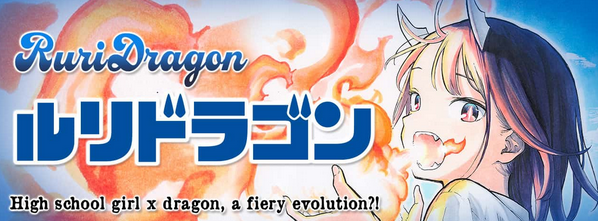
Time flies. Try to adjust your frame of mind back to whatever it was in the summer of 2022. That’s when RuriDragon, debut work from mangaka Shindou Masaoki, first appeared in the pages of Jump. RuriDragon is a great story, but it also has a great story.

It is difficult to overstate just how big an out-of-nowhere success this manga was. It is equally difficult to overstate how sudden and shocking its lengthy, unplanned hiatus was. The details remain somewhat cloudy even two years later—“health issues” is the bulk of what we know—and for a while, many people, myself included, assumed that Jump’s official stance that the series was ‘on hiatus’ was a polite way of saying it would not be returning. Given the gap, it’s hard to call anyone who didn’t think it would come back “pessimistic.” And it really must be emphasized that entire other Jump manga have lived and died since Ruri last published a chapter, and an equal number of major world events have taken place. The world in which RuriDragon returns is distinct from the one it left, and I wouldn’t blame anyone for some amount of skepticism about the manga picking up where it left off. (After all, even Jesus only kept his followers waiting a couple days. Ruri has kept us on the edge of our seats for almost 600.) But, by whatever provenance, and however unlikely it’s seemed, today, March 3rd 2024, saw the manga return. The dragon, like the phoenix, has risen.

Perhaps the strangest thing about RuriDragon‘s seventh chapter is how un-strange it feels; the manga essentially picks up right where it left off. There are no sly attempts to wink at the gap or rush any character development to “make up for lost time” or anything of that nature. Things settle back into the groove the manga had just gotten into when it went on hiatus; Ruri continues developing strange new dragon powers, furthering the manga’s central growing up-as-growing monstrous metaphor. Here, it’s electrical buildup, revealed in the chapter’s last few panels as the ability of dragons to call lightning.

As previously alluded to, and more directly foreshadowed back in the Starbucks chapter, Ruri’s developing abilities put distance between herself and her classmates, in particular the standoffish light-haired girl, Maeda, first introduced then. The two share a decidedly awkward moment as Ruri’s schoolday comes to a close, with Maeda pretty bluntly rejecting Ruri’s (admittedly slapdash) attempts to get her to open up. This clearly weighs on Ruri’s mind as the chapter ends, which is where we get the aforementioned lightning reveal.

All this said, while it’s definitely great that RuriDragon is getting back into the swing of things, what’s in the new chapter is almost less important than the fact that there even is a new chapter. It’s true that we probably won’t know the full extent of what the “new RuriDragon” will look like until it switches to biweekly publishing on Jump Digital and Jump+ in a month or so, but for now, it is enough that the blade-horned high school girl is back. (Personally, I’m interested in the other person in Ruri’s class who’s been absent for most chapters of the manga so far. Another demihuman? Who can say!) For the first time in a long time, the future looks good for RuriDragon; brighter than a gout of fire, or a flash of lightning.


Like what you’re reading? Consider following Magic Planet Anime to get notified when new articles go live. If you’d like to talk to other Magic Planet Anime readers, consider joining my Discord server! Also consider following me on Anilist or Tumblr to get even more anime and manga thoughts, and supporting me on Ko-Fi or Patreon. If you want to read more of my work, consider heading over to the Directory to browse by category.

All views expressed on Magic Planet Anime are solely my own opinions and conclusions and should not be taken to reflect the opinions of any other persons, groups, or organizations. All text is manually typed and edited, and no machine learning or other automatic tools are used in the creation of Magic Planet Anime articles, with the exception of a basic spellchecker. However, some articles may have additional tags placed by WordPress. All text, excepting direct quotations, is owned by Magic Planet Anime. Do not duplicate without permission. All images are owned by their original copyright holders.

Seasonal First Impressions: Under Cover of Darkness, Enters NINJA KAMUI

Seasonal First Impressions is a column where I detail my thoughts, however brief or long, about a currently-airing anime’s first episode or so.


There are a handful of interesting cultural currents running through Ninja Kamui. The most obvious has to do with its status as a Toonami co-fund—this is why it premiered so late in the season—and a likely-deliberate invocation of nostalgia for a bygone era of [adult swim]’s action programming. This might be the shallowest of these currents, however; despite the fact that it really would fit right in with [as]’ late-night action programming in the pre-Toonami revival days, and despite the fact that Main Toonami Guy Jason DeMarco has his name on it, I think Ninja Kamui would exist in some form regardless of Toonami’s involvement, and that’s because of the two other currents running through the anime.

The first is the recent spurt in ninja anime again. Not enough to be called a revival, but perhaps the tip of a trend is starting to show up. Over the past couple years we’ve had the straightforward, shonen-y Shinobi no Ittoki and the, apparently, deeply strange Under Ninja (I haven’t seen it), and now, with Ninja Kamui, we have an invocation of the grittier, bloodier ninja anime of the past. I’m probably not the first person to compare this series to ’93 sleaze classic Ninja Scroll, even if it’s only a distant resemblance. This, too, is only a loose thread, probably more indicative of something in the air than anything else. Again, I think Ninja Kamui would exist with or without those other anime. It would very much not exist, however, without Sunghoo Park, the series’ director and main creative brain.

You don’t come to this blog for in-depth production talk, most likely, (and if you do, you’re in the wrong place. I’m not the Sakugablog guy), but Park is a name that’s been well-known and in the air for a few years now. He is probably best-known as the guy who made a good chunk of the first season of Jujutsu Kaisen look as engaging and kinetic as it did. He’s since left MAPPA (I would also leave MAPPA if I were made to direct God of High School, so I get it), and founded his own studio, E&H Productions. Ninja Kamui is not the first thing E&H have done, but it is the first TV series, and thus, in a sense, their big coming-out party. Ninja Kamui isn’t based on anything, so it’s clear that this series’ story is one that somebody at E&H has had in their back pocket for a minute (I imagine Park himself, though I can’t prove that). So with that creative freedom, what did they deliver?

Well, a pretty good action series, so far.

Ninja Kamui‘s premise is very simple; an ex-ninja, our protagonist Higan [Kenjirou Tsuda] has fled to the United States to live with his wife and kid, using Cyber Ninja DisguisesTM to hide their true identities and live in relative peace. Things are great, until one day, Higan’s past catches up to him, and his wife and son are killed as part of his enemies’ ploy to ruin his life. All told, this is a pretty straightforward revenge tale of a kind that dots the whole history of the medium. While there’s something to be said for the baked-in sexism of having your handsome gruff guy protagonist survive while his family are murdered in cold blood, for the most part this is an effective setup. I don’t love Higan, but I like him, and any excuse to hear Kenjirou Tsuda do his thing for 20 minutes is a welcome one, the guy’s a fantastic voice actor.

The supporting cast is solid as well. The case of Higan’s family being murdered is taken up by the local PD, who are of course very much unequipped to handle secret ninja revenge killings. The one cop we spend any amount of time with is Mike Morris [Atsushi Ono], who, despite the obvious caveat that, you know, ACAB, I actually do kind of like as a character. He’s essentially a pretty basic genre stereotype who voices pretty frequent disbelief with the hyper-violent absurdity around him, and of course he’s the token One Good Cop (along with his assistant) in the force, the rest of which is all too willing to ignore a case they have no hope of solving and are ordered to do so by their mysterious higher-ups. He’s hardly revelatory or anything, but he’s fun.

The second episode sets up a further wrinkle in the plot, implying that the CEO of a virtual reality company is somehow tied to both the deaths of Higan’s family and goings-on in the ninja world more generally. This is a nice little twist that helps the show feel a little more distinct, and it’s not like there’s ever been a better time to make a douchebag tech guy your villain; the world is not exactly overflowing with love for Elon Musk and the like right now.

As for style, the series has what you’d expect from Park; lots of absolutely crazy action, with everything else being a little bit secondary. There are a lot of great “what, he can just do that?” moments, like Higan exhaling some kind of magic smoke that makes him grow extra arms (?!) in the second episode so he can more effectively fight off an assailant. Said assailant is disguised as an off-brand UberEats driver, because Ninja Kamui is also a little bit funny with it. The series is also not afraid to invoke truly ridiculous levels of violence and gore, which again makes it feel very much of a piece with [adult swim]’s late ’00s anime offerings. There is a very memorable bit in episode two where Higan, still recovering from the same attack that killed his family, takes out his anger and frustration by leaving one of the offending enemy ninjas tied, hanging upside-down, from the ceiling of a warehouse. Each day he spends recovering, he stabs the guy with a different knife, which he leaves inside of him after he’s done. Then, on the fifth day, when he’s fully recovered, he just lights the guy on fire! It would be downright Jack Bauer-y if he was doing this as an interrogation thing, but he’s not! It’s strictly a revenge play.

Which gets at the one problem I do have with Ninja Kamui which is that even with everything I just said in mind, it just feels a little….basic? So for all the praise I’ve given it here, I wouldn’t say I’m necessarily super invested. I think it’s being beaten out even in the fairly narrow category of “anime I’m not crazy into but which I enjoy watching for their fight scenes” by Bucchigiri?! Still, if you like by-the-book revenge thrillers, you could probably do a lot worse than this.


Like what you’re reading? Consider following Magic Planet Anime to get notified when new articles go live. If you’d like to talk to other Magic Planet Anime readers, consider joining my Discord server! Also consider following me on AnilistBlueSky, or Tumblr and supporting me on Ko-Fi or Patreon. If you want to read more of my work, consider heading over to the Directory to browse by category.

All views expressed on Magic Planet Anime are solely my own opinions and conclusions and should not be taken to reflect the opinions of any other persons, groups, or organizations. All text is manually typed and edited, and no machine learning or other automatic tools are used in the creation of Magic Planet Anime articles, with the exception of a basic spellchecker. However, some articles may have additional tags placed by WordPress. All text, excepting direct quotations, is owned by Magic Planet Anime. Do not duplicate without permission. All images are owned by their original copyright holders.

The Manga Shelf: So Long, CIPHER ACADEMY

The Manga Shelf is a column where I go over whatever I’ve been reading recently in the world of manga. Ongoing or complete, good or bad. These articles contain spoilers.


Yes, here we are. It’s the first time I’ve ever written two Manga Shelf columns about the same manga, and it’s for this sad, sad occasion. Funeral for a friend. Or at least, my friend. I get the impression that most Shonen Jump readers would rather chew glass than read all 58 chapters of Cipher Academy, Bakemonogatari author NisioisiN‘s first and, if I had to guess, last contribution to the magazine. Let’s be serious for a moment; I genuinely did like Cipher Academy, in spite of a number of obvious flaws, but there was no way that it was going to last particularly long. It is a terrible fit for Shonen Jump, and is perhaps proof that NisioisiN really just genuinely doesn’t know how to get out of his own way. Especially given that his version of a simple battle shonen plot involves a tangled mess of cryptography and puzzle-solving that only makes any kind of sense about half the time.

That said, it’s easy to claim with hindsight that there was no way Cipher Academy could ever succeed in the context of Jump, but is that actually true? After all, despite its infamously hard to follow “code battles” and goofy storyline, the series does have its fair share of strengths. In particular, Isshin’s ability to hide real character depth inside of weird gimmicks remains unmatched, with characters like Tayuu and her strange, strained friendship with Iroha’s early-antagonist-turned-ally Kyora being a point of genuine interest. And similar examples coincide with the gimmicks themselves being novel, such as Kyora’s filthy mouth and how it contrasts with her ojou-sama demeanor, and how these both belie a fairly caring person underneath that persona. Or Anonymity Requested, who spends most of the manga hidden behind a censor bar both in- and out-of-universe, only for it to become clear that she’s actually both an impulsive hothead and kind of a jerk.

On the other hand, the manga’s biggest weakness is the actual “code battles” themselves, the series’ cutesy name for fast, real-time code-swapping and cracking. A normal battle shonen can rely on any number of visual tricks to make its fights compelling, but Cipher Academy has no access to a majority of those, given that by definition its ‘battles’ are light on actual action. Furthermore, most of them are nakedy convoluted owing to the conceits of the setting. A lot of shonen fights boil down to characters working within sometimes quite complex rulesets in order to outmaneuver and defeat their opponent, but that fact is much easier to hide in something that involves actual combat or a similarly physical activity. In Cipher Academy, it sometimes feels like watching a chess game while only being passingly familiar with the rules.

In general, it both feels markedly less naturalistic and lays bare how dry “a bunch of characters mess around within a given set of rules” can get if not handled carefully. At its worst, the manga devolves into back-and-forth spiderwebs of speech balloons, especially in the case of its many word games. These both suffer greatly in the translation process and also kneecap one of the manga’s best assets; its art. Isshin’s usual, verbose style doesn’t work here, given that this isn’t a light novel.

Furthermore, even later on, when the battles do get a little more visually dynamic, they still suffer from feeling confusing and arbitrary. That’s kind of a problem, given that these puzzles are, on top of everything else, supposed to be user-solvable.

I’ll concede that I have seen some people claim to be able to solve the cryptograms in Cipher Academy, but the fact remains that not only could most people not do so, a good chunk of the readerbase did not even try, and given the way the manga presents these puzzles, it’s tough to blame them. Some of this might be down to the translation—infamously, translating this manga to a satisfactory degree while still keeping MangaPlus’ deadlines was impossible enough that its first official translator walked and had to be replaced—but the manga’s poor performance domestically implies to me that this was a problem across languages. There might also just be a demographic mismatch here; Shonen Jump’s core readership groups are teenagers and people who really like battle shonen as a genre. Neither of these groups are necessarily going to pop for galaxy-brain puzzle solving. Even for those that do, as mentioned, Cipher Academy‘s codes and cryptograms are a mixed bag.

Speaking of “crypto,” we should probably touch on that facet of the manga as well, since, yes, as alluded to in the first chapter, Cipher Academy’s plot does in fact involve cryptocurrency.

Let’s put two facts out there as we do this. One; cryptocurrency is boring. There are people who (incorrectly) think it’s useful or desirable to have, but it’s not interesting in of itself, and if you think otherwise I would love to know how you found my blog from /r/dogecoin. Two; NisiosiN’s writing is not cool. It is a great number of other things; bizarre, ambitious, mysterious, campy, fun, complex, convoluted, goofy, theatrical, self-assured, horny to a sometimes troubling degree, problematic, incredibly autodidactic, impossible to mistake for anyone else’s, etc. But it’s not cool. Isshin is a NEET-ass geek of a writer whose work absolutely drips with evidence that he’s a complete dork. I say this with love, as a fan of some of his work, and as a fellow uncool person, but it’s important to note. NisiosiN’s work has never been and will not ever be cool, and when we’re talking about a Jump manga, that does matter. Combined with the whole crypto / metaverse aspect, I think this was genuinely be a big contributing factor to the manga’s poor performance. You can get away with a lot when you’re writing in this format as long as your stuff is cool. Isshin’s work is fundamentally not.

As for the other stuff, well, cryptocurrency garbage is not quite the PR death sentence over in Japan that it is in the Anglosphere, at least not yet, but that doesn’t mean any regular person actually thinks it’s interesting. At best, they think of it as a way to make money. This fundamentally dull piece of recurring subject matter, when combined with the fact that Isshin is Isshin, plus the generally spotty quality of the puzzles themselves, creates a situation where it’s easy to see how Cipher Academy failed to create and maintain a strong fanbase. There are simply too many hurdles for the average shonen manga reader here. Which would you rather read; this, or a manga where a guy can summon shadow goldfish with a magic katana?

That’s what I thought.

Of course, all this gets at is why the manga failed with its readership at large, which is only half the story. At the top of this article I mentioned that I actually liked Cipher Academy, and that’s mostly true. Why? Well, put plainly, as a fellow-traveler complete dork I tend to find NisiosiN’s particular brand of absurdity more entertainingly silly than obnoxious. But I think, perhaps unfortunately for Isshin, that I’m fairly rare in this regard. At least, rare among the sorts of people who routinely check out new MangaPlus titles.

Cipher Academy‘s central theme is that of code creation as communication. This idea that by hiding things about yourself on purpose, you’re more likely to be honest with people who can see through that obfuscation. The manga does a few interesting things with this, including a really great early moment where Iroha basically sneaks his entire backstory into a code battle a good 30 chapters before we get most of it spelled out in plain-text. Things like this make Cipher Academy‘s best moments feel actively rewarding instead of just convoluted. It’s also worth noting that Yuuji Iwasaki’s art is consistently great and occasionally fantastic, and may be the best part of the series overall.

Unfortunately though, I think trying to get people onboard a manga this willfully obtuse for a handful of moments where what it’s trying to do actually clicks is a tough sell no matter how you slice it. By the end of its run, even I was bored with Cipher Academy, and as it wears on—and the effects of its looming cancellation become more and more obvious as plotlines are condensed and rushed through—it becomes harder and harder to root for. By the conclusion, I was pretty much fed up.

Indeed, if we turn the manga’s theme of the cryptic-as-the clarifying back on the manga itself, we’re left with a decidedly unflattering portrait of its author. The manga’s final chapters offer simple and clean solutions to massive problems; wars end with a handshake, and the real global problem is a lack of mutual respect. This is an uncharitable read, but its emblematic of the problems found in some of Isshin’s less refined work, and “less refined” really does just define Cipher Academy in general. The whole thing ends in a giant, glossed-over shrug, and a decidedly unearned (and very boring) happy endings epilogue, because it has neither the time nor depth to do anything else.

At the end of the day, the problem is obvious. NisiosiN’s greatest strength as a writer is also his greatest weakness, his ability to absorb and scramble basically any kind of theme or subject matter into a fresh and surprising story. Cipher Academy, frustratingly, is those things, it just isn’t terribly coherent. Describing the series to someone else makes it sound like the ramblings of a conspiracy theorist; cryptocurrency vaults, the NSA infiltrating high schools, child soldiers with real guns that look like toys, dancing prisoners of war, superpowered cheerleaders, hyper-advanced spy tool glasses, and so on, but unlike Isshin’s best work, Cipher Academy can’t actually support all of this, and when it tries to, it veers from “goofy” into “just generally wretched.” It’s too brief and too tossed-off to explore most of its ideas in detail, so on the rare occasional it gestures to them, it feels unfinished and almost insulting. Much of the manga ends up reading like a random sampling of whatever ideas happened to furrow their way into Isshin’s head as he wrote it. He’s a ridiculously prolific writer, and this smashed-open spigot approach has led to some great work, but Cipher Academy is a decidedly minor piece of his bibliography.

I won’t discount the possibility that Isshin’s real crime here is greatly overestimating his readerbase (up to and including yours truly), and that if read from a certain angle, Cipher Academy somehow makes more sense and coheres into some kind of wonderful whole. I liked the series for the moments where it clicks, its colorful cast of bizarre characters, and its great art. But—and I can’t say this too loudly—the ugly fact is that those things alone aren’t enough to float a manga in the most competitive magazine in the industry, at least not for very long. As it stands, this is a minor work from a guy who has done much, much more interesting stuff. I doubt anyone but Isshin’s true diehards will remember this manga existed even a few years down the line. So it goes.


Like what you’re reading? Consider following Magic Planet Anime to get notified when new articles go live. If you’d like to talk to other Magic Planet Anime readers, consider joining my Discord server! Also consider following me on AnilistBlueSky, or Tumblr and supporting me on Ko-Fi or Patreon. If you want to read more of my work, consider heading over to the Directory to browse by category.

All views expressed on Magic Planet Anime are solely my own opinions and conclusions and should not be taken to reflect the opinions of any other persons, groups, or organizations. All text is manually typed and edited, and no machine learning or other automatic tools are used in the creation of Magic Planet Anime articles, with the exception of a basic spellchecker. However, some articles may have additional tags placed by WordPress. All text, excepting direct quotations, is owned by Magic Planet Anime. Do not duplicate without permission. All images are owned by their original copyright holders.

Seasonal First Impressions: SENGOKU YOUKO is Good, Thank God

Seasonal First Impressions is a column where I detail my thoughts, however brief or long, about a currently-airing anime’s first episode or so.


You who lament this barbarous age; rejoice! Sengoku Youko is pretty good, the work of cult mangaka Satoshi Mizukami will not all be turned into anime sludge in the vein of the previous project to bear his name, the absolutely tragic anime adaptation of The Lucifer & Biscuit Hammer.

To be realistic for a moment, after that debacle, the bar is basically on the floor. Sengoku Youko is playing with a stacked deck, with both the greatly hedged expectations coming off of the last Mizukami adaptation and the fact that Sengoku Youko the manga is probably the least-read of Mizukami’s major works. (It’s the only one that I haven’t read, in fact.) As with Biscuit Hammer, it’s also on the old side to be getting an anime adaptation now, having started back in 2007 and wrapped up almost a decade later, but historical fantasy is a timeless genre on this medium, so this is not really any kind of issue. Given all this, it has a much better chance at making a favorable first impression than its ill-fated sibling. Still, even that in mind, Sengoku Youko’s premiere is just a solid slice of historical fantasy, featuring a great dynamic between its three leads, a couple funky monster designs, and some really nice action animation.

As for what it’s actually about, our setup here is pretty simple. Set in the mid-1500s, during the massively unstable sengoku period (hence the name), Sengoku Youko follows a pair of spirits, the short fox girl Tama Youko [Yuuki Takada] and her ‘little brother’ Jinka Yamato [Souma Saitou], as they fight evil.

Tama is the one with the adorable fox ears.

No, literally, that’s their whole thing, per Tama’s instruction. (Jinka, who is bigoted against the humans they often end up saving, only seems to go along with it with great reluctance.) They’re also joined by a cowardly ronin, Shinsuke Hyoudou [Ryouhei Kimura], who is transfixed by the vast strength that Tama and Jinka display, and hopes to somehow get stronger by going along with them.

The first episode sees Tama break up a bandit ring that turns out to be led by….ah, this.

This leads to some of the episode’s best visuals, in particular a very striking sequence where Tama and Jinka combine their powers, turning Jinka into a white-haired fox warrior that trounces his opposition fairly easily.

A later confrontation with a strange monster menacing some Buddhist monks ends on a cliffhanger, providing a nice hook to get folks coming back next week. That said, I have a suspicion that all is not as it appears in Sengoku Youko. Even if it stays episodic like this, it will probably be a fun time. However, given Mizukami’s usual M.O.—a desire to take genres apart and then stitch them back together in a different shape, exhibited with battle shonen in the Biscuit Hammer manga, reincarnation fantasy in Spirit Circle, and mecha anime in Planet With—I really doubt that it’ll be content to stick to any kind of formula. Time will tell, but I’m interested in finding out, and I can give this first episode no better endorsement than that.


Like what you’re reading? Consider following Magic Planet Anime to get notified when new articles go live. If you’d like to talk to other Magic Planet Anime readers, consider joining my Discord server! Also consider following me on AnilistBlueSky, or Tumblr and supporting me on Ko-Fi or Patreon. If you want to read more of my work, consider heading over to the Directory to browse by category.

All views expressed on Magic Planet Anime are solely my own opinions and conclusions and should not be taken to reflect the opinions of any other persons, groups, or organizations. All text is manually typed and edited, and no machine learning or other automatic tools are used in the creation of Magic Planet Anime articles, with the exception of a basic spellchecker. However, some articles may have additional tags placed by WordPress. All text, excepting direct quotations, is owned by Magic Planet Anime. Do not duplicate without permission. All images are owned by their original copyright holders.

Seasonal First Impressions: Munch Squad for Monsters in DELICIOUS IN DUNGEON

Seasonal First Impressions is a column where I detail my thoughts, however brief or long, about a currently-airing anime’s first episode or so.


There are two ways you can look at Delicious in Dungeon.

The first is as an adaptation of a very well-liked manga; a classic fantasy series with a notable twist and some strong worldbuilding that sets it apart from many of its peers, and a strong sense of characterization as well.

The second is as Studio TRIGGER’s first plain ol’ TV anime since SSSS.DYNAZENON three years ago.1 If we discount sequels, it’s their first since Brand New Animal back in 2020. It’s also the first full directorial turn for Yoshihiro Miyajima, who’s been part of the studio for years but has mostly done storyboarding and direction of single episodes.

Combined, these facets put Delicious in Dungeon‘s anime in an interesting (if not necessarily enviable) spot. Fans of the manga are largely going to demand fidelity to the source material. Long-time TRIGGER heads will be disappointed if the series doesn’t go all-out with explosive action animation. (This has never been all that TRIGGER is good at, but it remains the studio’s defining characteristic in the minds of its western fanbase at the very least.) So far, it seems like those who want a fairly straightforward adaptation of the manga are winning out.2 This first episode is, true to the opening chapters of the manga, fairly slow and expository, neatly setting up and then demonstrating our premise.

Speaking of, that premise is thus; some years ago, an ordinary village was disrupted by a fissure from the ground. From the fissure came the undead form of an ancient king, who promised riches to those who would liberate his kingdom from a wicked magician. The only problem? The kingdom, and the magician, are buried beneath what were once crypts and graves, but have through magical influence grown and warped into a massive, labyrinthine dungeon. Delicious thus marks itself out as one of the relatively few pieces of fantasy media that kind of cops Wizardry‘s Whole Thing but actually tries to explain how any of this—including such gamey staples as partying up, an entire ‘dungeon town’ economy, complete with in-universe resurrection in town upon dying, etc.—actually works, and integrate those mechanics into the story. From what I’ve read of the manga, it’s not always successful at this and I’ll admit to being a bit less enamored with Delicious in Dungeon than some, but it’s still a solid idea, and I give the series a fair amount of credit for trying.

As for whose story specifically we’re following, the anime opens as the manga does, with a party deep in the dungeon encountering a mighty red dragon—our second of the anime season, if you’ll remember the last article I wrote—which they cannot defeat. Of these adventurers; two quit, one, Falin [Saori Hayami], is eaten by the dragon, and the other three; Laios [Kentarou Kumagai], Marcille [Sayaka Senbongi], and Chilchuk [Asuna Tomari], are resurrected in town without a penny to their names, stuck in a pretty awful spot in that if they don’t hurry back to the bottom of the dungeon, Falin will be digested, and at that point there’s certainly no hope of resurrecting her at all. (Thankfully, we learn that dragons digest things very slowly. Still, our heroes are definitely on a clock here.)

So, with a little prodding from Laios, who seems awfully eager to try this in the first place, the party adopts an unorthodox approach which forms the crux of the whole series; they’ll live off of whatever they can procure in the dungeon, which means a whole lot of meals prepared from JRPG enemy staples like giant scorpions, slimes, ambulatory mushrooms, and so on.

The final piece of the puzzle here is the dwarf Senshi [Hiroshi Naka], who the party meets while trying (and failing) to prep scorpion meat. Senshi claims to have been researching monsters and the food that can be made from them down in the dungeon for over a decade. A fact Marcille openly questions, but nobody can fault his cooking prowess. Using the aforementioned Floor 1 mobs, Senshi is able to whip up a pretty tasty-looking stew, and goes into a fair amount of detail about how he’s doing so while he does it. This is the show’s essential appeal; the fun thought experiment of using a D&D Monster Manual as a cookbook.

All told, the premiere promises a fun if straightforward adaptation of the source material. What’s carried over particularly well is the character dynamics, which are enhanced by the obvious benefits of an anime adaptation (voice acting, character animation, and so on). Laios and Marcille have the best of it, here. The former is largely a lovable dumbass, whose fixation on eating monsters (considered strange even in-universe) contrasts with how Marcille is only going along with this very begrudgingly. Marcille’s delightfully bitchy, nervy personality in turn pings ineffectually off of Senshi, who is too busy imparting Cooking Wisdom to care. All three are rounded off by Chilchuck, who serves as a snarky sounding board in this early stage of the story.

Some specific scenes are worth highlighting; there’s a particularly great bit of comedic editing where Laios asks Marcille, just freed from the clutches of a predatory plant, how it felt. In his mind, since the plant has to secure prey (mostly animals) without making them uncomfortable enough to struggle, he thinks it probably feels pretty nice. Marcille’s reaction is this;

I didn’t edit that. (Although I will ask you to forgive my subpar screen-recording software.)

Elsewhere, the actual cooking scenes are the star of the show. This only makes sense, given that they’re the main draw of the series, and the pseudo-tart3 that Senshi prepares in the second half of the episode looks good enough that you’ll be a bit annoyed it’s not a real thing.

All told, this looks like a solid adaptation of an all-around good source manga. I fell off of said manga a while back (not for any reason to do with the story, to be clear, sometimes I just lose track of things), so it’s nice to be reminded of why I liked these characters in the first place. I think, despite the differing desires of the two main groups that are going to check this show out, everyone will walk away satisfied. There’s nothing to complain about here, and with a slated 24 episodes, the series looks to be a delicious two-cour-se meal of fun fantasy anime.


1: Cyberpunk: Edgerunners was a weird net animation thing. This series is being released by Netflix in the west as well, but as a simulcast rather than as something they directly funded, at least going by who’s listed as being on the production committee.

2: I know some folks were worried that TRIGGER might insert a bunch of extra fanservice that wasn’t in the original manga a la the Mieruko-chan anime or something. I’m not sure why people were worried about that, given that TRIGGER’s few other adaptations have been very faithful and straightforward, but if you’re in that crowd do rest assured that there’s nothing like that, here. Even in the one scene where there’d be an easy opportunity to add a bunch of extraneous ecchi material, they simply do not. Also, anyone who has read the manga knows that the character it’s horniest about is Senshi.

3: Pseudo because the crust isn’t edible. Which I guess makes it more like some kind of weird pudding?


Like what you’re reading? Consider following Magic Planet Anime to get notified when new articles go live. If you’d like to talk to other Magic Planet Anime readers, consider joining my Discord server! Also consider following me on AnilistBlueSky, or Tumblr and supporting me on Ko-Fi or Patreon. If you want to read more of my work, consider heading over to the Directory to browse by category.

All views expressed on Magic Planet Anime are solely my own opinions and conclusions and should not be taken to reflect the opinions of any other persons, groups, or organizations. All text, excepting direct quotations, is owned by Magic Planet Anime. Do not duplicate without permission. All images are owned by their original copyright holders.