Seasonal Anime First Impressions: The Thorny Debut of ROCK IS A LADY’S MODESTY

Seasonal First Impressions is a column where I detail my thoughts, however brief or long, about a currently-airing anime’s first episode or so.


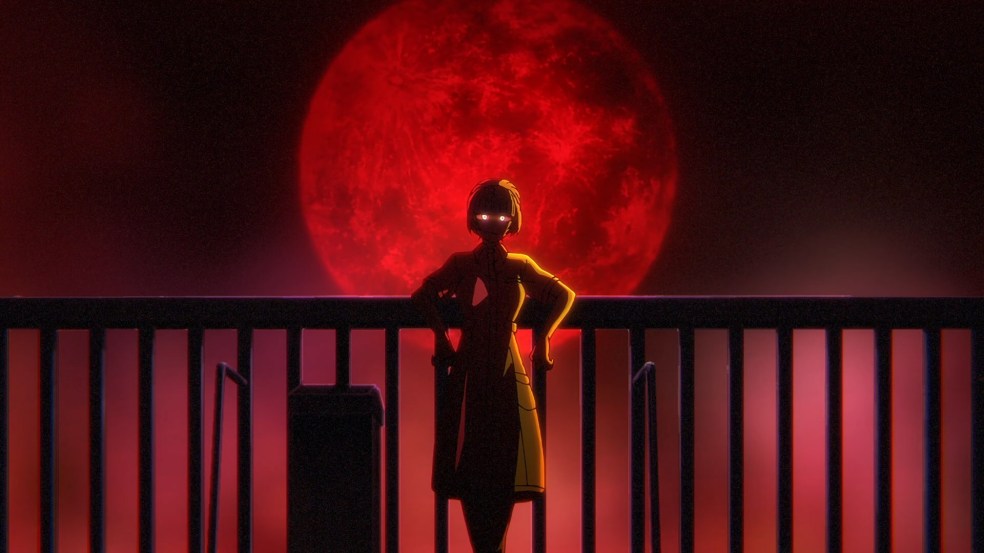
Suzunomiya Lilisa [Sekine Akira] is repressed. The daughter of a rich family by marriage, she doesn’t really feel like herself at her prestigious finishing school, the kind of all-girls mannering academy that’s all but extinct in real life but lives on through cultural touchstones such as anime. It’s not that her classmates dislike her, quite the opposite actually, she’s very popular. It’s that the academy’s curriculum of education, culture, and politeness does not come naturally to her, and she works very hard to keep up appearances. This is in spite of what’s implied to be a pretty strong culture shock from her current living situation. Throughout this first episode we see glimpses of a very different home life than the one Lilisa currently lives: not one of wealth and class with a real estate mogul father who’s yet to be seen on camera, but one with her loving, guitar-playing biological father. Unless I missed something, we don’t directly hear that said father is no longer alive, but that’s certainly the implication.

What does all of that add up to for Lilisa? Well, she’s left most of her passions behind her, and is focusing on getting a prestigious award from her school. (She has a reason for wanting it, we don’t yet know what that is.)

The internal turmoil of a repressed rich girl is not that interesting on its own, and I will be honest in that Rock is a Lady’s Modesty took a while to hook me here. It does help that there’s an eclectic set of influences being worn on the show’s sleeve right out the gate: the shoujo and Class S yuri manga responsible for keeping these sorts of girls’ schools in the public memory, Love is War!‘s later arcs, with their fixations on the often-empty inner lives of the wealthy, and of course the broader girl band current of which Lady’s Modesty is undeniably a part. (Although, as a matter of record-keeping, this is an adaptation, not an original series. The manga dates from late 2022, and having to adapt an existing story explains some of the more unusual structural choices, as we’ll get to.) These disparate sources add up to a very straightforward core conflict: the person who Lilisa is trying to be and the person who Lilisa is do not match up, and this is getting to her.

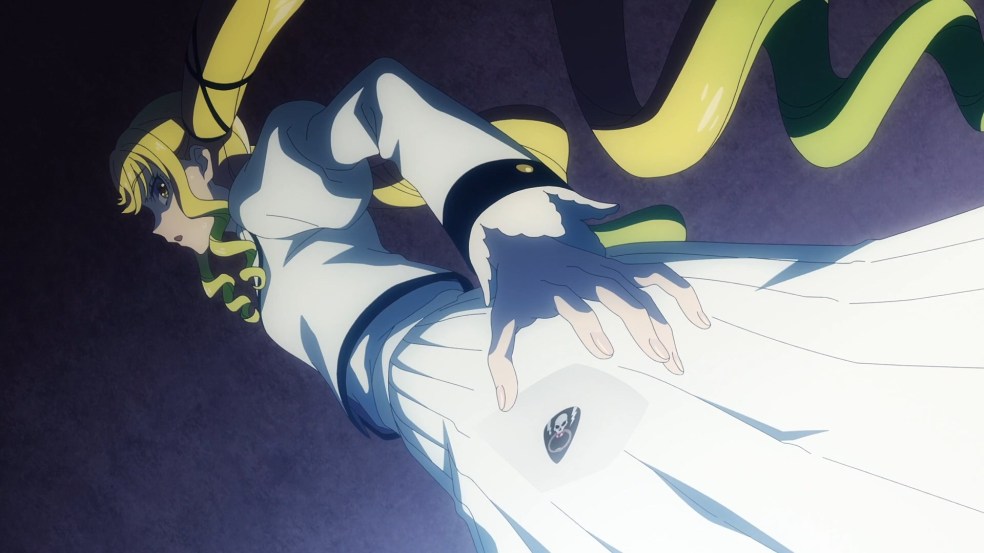
Which again, would not be that interesting, were it not for Kurogane Otoha [Shimabukuro Miyuri]. Otoha is a similarly well-mannered girl from a rich family. She and Lilisa meet by chance when they literally bump into each other, causing Otoha to drop a guitar pick. Lilisa tries to find a good time to return it to her—a classy lady having a guitar pick is uncouth, of course, especially one with a Hot Topicky skull-and-blood design like this one has—and in doing so learns that Otoha has been using an abandoned building on campus as a makeshift practice room. Now, small twist here, Otoha is actually a drummer. We don’t know who that guitar pick originally belonged to or what its significance is, but Otoha doesn’t use it herself.

Instead, she talks Lilisa into a jam session, first just by asking, and then, when Lilisa pushes back, by insinuating that Lilisa might not be very good at guitar.

Our heroine takes this very personally, and what ensues is a 1v1 music battle, the two trying to outdo each other, Lilisa on guitar, Otoha on the drums, over a backing track called “GHOST DANCE.” Lilisa, tellingly, imagines Otoha’s overpowering, thunderous drumwork as akin to being made to submit by a dominatrix. Those are her words, not mine.

And it only makes sense that she sees it this way, because Otoha really does overpower her completely. Which is to say, Lilisa’s guitar playing really isn’t that good. It’s fine. But not only are her actual skills not all that impressive for this genre but the show doesn’t really pick up any slack for her visually. (Most of the visual panache goes into her fantasies of being tied up in thorned rose vines instead.) We get shots of her playing, clearly very intensely focused and pouring a huge amount of sweat and effort into what she’s doing, but it lacks that ephemeral quality to make it truly memorable.

That’s how I’d put it, anyway.

Otoha is significantly less nice.

So that’s our big first episode twist. Surprise, you were supposed to think her guitar playing is kind of lame! It’s an interesting idea, certainly, but it’s not actually that unusual given that at this point a show actually having a barn-burner first episode performance would be the more surprising thing. (My baseless guess is that we’re saving that for, I don’t know, episode three?) Still, it’s a nice setup; Otoha flips her off before instantly flipping her ojou-sama switch back on, and just fuckin’ leaves, leaving Lilisa to stew in her own failure. The implication being of course that she’s realized that she cares about being good at this much more than she cares about being a good student. It’s a good hook, and I’m interested to see where the show takes it.

Of course, all of this is dodging a simpler question: is this show, at least this first episode, like, you know, good? I’d say so, but that comes with some caveats. The great Girl Band Renaissance in anime is, in the grand scheme of things, a recent and ongoing development. Bocchi the Rock, for reference, only aired in 2022, and the source manga for this series is from around the same time. Still, I have a hunch some might find the relatively slow start here a turnoff, and it is admittedly hard to imagine it stacking up, in the long run, to elephants in the room like Girls Band Cry or the It’s MyGO!!!!! / Ave Mujica subseries of BanG Dream! But Bocchi itself isn’t a bad reference point here, that show also took a bit to really get going, but once it did, it was one of the best anime of its year and is easily as iconic—moreso, honestly, if we’re talking simple name recognition, at least in the Anglosphere—than the other two shows I just mentioned. Still, by directly making competition part of its narrative, Rock is a Lady’s Modesty invites these comparisons, which I would probably otherwise avoid.

Can it live up to those expectations? I’m not sure, but I want to at least see it try, and that counts for a lot all on its own. Besides, I really do just need to see what is going on in Lilisa’s head that makes her imagine a guitar/drum duet as some kind of BDSM thing, although admittedly, the fact that she refers to Otoha in her narration as her “lifelong partner” might be a clue. I think you might be repressed in more ways than one, girl.


Like what you’re reading? Consider following Magic Planet Anime to get notified when new articles go live. If you’d like to talk to other Magic Planet Anime readers, consider joining my Discord server! Also consider following me on AnilistBlueSky, or Tumblr and supporting me on Ko-Fi. If you want to read more of my work, consider heading over to the Directory to browse by category.

All views expressed on Magic Planet Anime are solely my own opinions and conclusions and should not be taken to reflect the opinions of any other persons, groups, or organizations. All text is manually typed and edited, and no machine learning or other automatic tools are used in the creation of Magic Planet Anime articles, with the exception of a basic spellchecker. However, some articles may have additional tags placed by WordPress. All text, excepting direct quotations, is owned by Magic Planet Anime. Do not duplicate without permission. All images are owned by their original copyright holders.
AVE MUJICA at the Edge of the World

This article contains spoilers for the reviewed material, and assumes familiarity with it.


Few people nowadays know what man is. Many sense this ignorance and die the more easily because of it, the same way that I will die more easily once I have completed this story.

This is going to be a mess, so let’s start it with a question, so we at least have something to work off of.

Is a tragedy deferred a happy ending? Ave Mujica is at least willing to entertain the idea, but it’s never a clear-cut thing. Nothing about Ave Mujica is clear-cut, and the thinkpieces that will roll out over the coming weeks and months about this series might obscure how much of a rollercoaster ride it was, week to week, start to finish, in the moment. They might also obscure how wild it will keep being, as we now know—we’ll get back to this—that this isn’t the end.

To trot out the neatest and tidiest labels possible for a show that is the neither of those things, Ave Mujica is a series that deals with, among other topics; familial violence, how generational wealth drains the humanity from those that hold it, a number of different expressions of trauma and self-loathing, Dissociative Identity Disorder, and incest. All of this from a series that—despite some misguided English marketing trying to downplay this fact—is part of the BanG Dream! franchise. It, thus, is also still an anime about guitar music, at heart, a cousin of other recent genre entries like Girls Band Cry and Bocchi the Rock! (not to mention the other entries in its own series), in that it does still very much deal with a group of young girls using that music to process their traumas. The methodology is very different, and if Ave Mujica is the best of these (and I’d be willing to say that it is, even if the competition is very close), it’s not because its approach is inherently “just better”, or because more serious subject matter automatically leads to better content, but rather because it’s a logical outgrowth of what this genre was already doing. People will make their little jokes, of course: you can call it the dollposting anime, Perfect Blue for zoomers, etc. But none of these really capture Ave Mujica‘s fundamental observations and themes, and none of them can dent a show that’s this bulletproof.

All this to say, the walk from the earliest days of the BanG Dream! project to here is less extreme than it might appear at first glance. Poppin’ Party never went through most of this stuff, that’s true, but they’d absolutely be willing to throw horns at one of Ave Mujica’s concerts. The music, even when it’s not actively being heard—and it’s not heard for long stretches of this series—is both a connective tissue and a useful metaphor. If you can’t say something, maybe you can sing it.

That was the main thesis, too, of Ave Mujica‘s immediate predecessor and sister series, It’s MyGO!!!!!, effectively the first season of what becomes a two-parter here. AveMuji puts that theory to the toughest stress tests it can think of, and for a while, it seems like it might break under them. Consider that this is a band anime, and then recall that there is a gap from episode 2 to episode 7—almost half the season!—where there are absolutely zero in-show performances. Consider that this seemed at the time, given everything else going on in the narrative, more like a disband anime, an argument that Ave Mujica the group were not a good thing for anyone involved and maybe they’d all be better off apart.

It’s tempting to run through the absolute basics one more time. High school girl and neurodivergent icon Takamatsu Tomori [Youmiya Hina], and her first real friend Togawa Sakiko [Takao Kanon] form a band. This band, CRYCHIC, collapses not long after their first concert for a plethora of interpersonal reasons that are not really anyone’s fault in particular. It’s MyGO!!!!!, the first season of this show, focused on Tomori healing from this fallout with the help of both some of her old CRYCHIC bandmates and new friends alike. That group formed MyGO, title band of that season, pledging to build the rest of their lives, moment by moment, together as a band and as friends. So far, so girl band.

Ave Mujica—both the band and the show—run in the opposite direction, Sakiko attempts to put on a cold, merciless persona, and gathers a band based not on shared experiences or even particularly liking each other, but by a cynical rundown of what each member can add to the group. Sakiko’s childhood friend Mutsumi [Watase Yuzuki], another former CRYCHIC member, is added because of her guitar skills and her famous parents. Nyamu [Yonezawa Akane], the band’s drummer, is recruited as much for her looks and the flashiness of her ambidexterity as her actual chops, etc. If you’re reading this, you know all this already, so I won’t get too much farther into the nitty-gritty.

The result of all this? Probably the most seismic anime event of the 2020s thusfar. If not that, at least one that has exerted a deep and powerful pull on a certain kind of person. If you’re active on certain corners of tumblr or BlueSky you already know who I’m talking about. If not, we’ll just say: queer, gender-nonconformant, neurodivergent sorts. Which is a more formal and less fun way to say: the girlies. Ave Mujica takes the already intense emotional palette of MyGO and freezes it solid, erecting gothic cathedrals around the sharp, jagged pieces of pain and trauma that inform who we are, with a particular focus on the inherent violence of the family unit. Do you have bad parents? Mutsumi has the worst parent, a controlling, cruel stage mom who sees her daughter as competition instead of family. Furthermore, she’s plural, hosting, among others, a rambunctious protector alter who adopts the name Mortis from her stage name. From what we see, her mother treats this as a frightening burden, a sadly true-to-life read on how many singlet parents treat their plural children.

Uika [Sasaki Rico], the band’s singer, might be even worse off, the daughter of an illicit relationship between Sakiko’s grandfather and a house servant who has lived much of her life isolated from society. If this all seems rather melodramatic, I can only reiterate that that’s exactly the point, and anyone who writes the show—and honestly, much of this genre—off on those grounds is missing the most interesting artistic movement in the medium to happen this decade. More specifically, that heightened, arch theatricality has been present in the Ave Mujica project since we first knew it existed. This is a group of girls who were introduced to us as masked dolls, and who here leave us again as knights of a forgotten god. It feels a little ridiculous to criticize the series for a lack of “realism,” whether we’re referring to its literal events or its emotional palette. (And anyone who calls Nyamu and Umiri’s problems minor, even by comparison, is missing the very fact that by show’s end they’ve still willingly thrown their lot in with everyone else in the band.)

That tense, coiled sense of façade is also why it hits so hard when, in its very last episode, Ave Mujica finally lets all of that tension out. No one would walk away from this series thinking everything is neatly solved, but the finale is more concert than anime episode: 5 songs, two from MyGO, three from AveMuji themselves, all fantastic, and importantly, both bands are clearly having a blast. MyGO have the simpler story, but their sound has genuinely developed in some interesting directions, and centering a new song around Tomori’s jumbled, Jenga Tower-block poetry is never going to be a bad call.

Ave Mujica, meanwhile, have somehow gone stadium-level yet again (the episode’s lack of a traditional narrative leaves us in the dark about how that happened. Season three material, most likely). Their doll motifs replaced with a warped Round Table-style knightly mythos, Uika-Doloris as an amnesiac who finds herself returning to the embrace of Oblivionis, god of forgetfulness, over and over. Sakiko literally portraying herself as a deity within the world of the scripts is sure to have ramifications going forward as a plot point, but, consider that outside of the series itself, it also easily cements her as one of the most interesting and iconic characters of her generation. It has been way, way too long since we had someone to add to the Anime Girl Pantheon, and if Sakiko needs to actively force herself up alongside older legends like Lain, Haruhi, and Madoka, that’s all the better. It fits.

(Also, let’s just be honest here. Sakiko’s god complex is probably not great for her, mental health-wise, but if it’s making her write stuff like this, well, at some point you can’t argue with the music.)

As for the literalities of the last story arc, episodes eleven, twelve, and so on, it seems impossible that this won’t all fall down around them someday, possibly even someday soon.

So again, to ask the question, can tragedy deferred really be considered a happy ending? Even a bittersweet one?

Maybe we should reframe that, and turn it back on ourselves; can you be happy, knowing you will one day die? If Ave Mujica are a fleeting dream, that’s at least partly because everything is a fleeting dream. Any comparison between MyGO‘s “a series of moments adds up to a lifetime” and Ave Mujica‘s embrace of an illusory eternity needs to understand that, despite the obvious differences between these groups of people, these are fundamentally two ways to say the same thing. Something lasts forever until it doesn’t. You take things day by day, and one day is eventually the last one. (I don’t have much to say about this series, as I’ve made clear from how I’m framing this article, but I am a little surprised how rarely I’ve seen discussion of death in relation with Ave Mujica; Sakiko’s late mother is a shadow who looms over much of the series, and there is a broad implication that Uika’s sister, the actual Uika, is no longer with us either.)

I have spoken before in my work about hating the term “messy” and how it’s often used to paper over the flaws in works that a certain stripe of critic, myself very much included, like. Something is messy if it induces strong emotion but has some kind of missed shot or some kind of frustrating loose end. To that, I refuse to apply the term to Ave Mujica, even though I’m sure many other people will. Every time I had a doubt about this show, it proved me wrong. Mortis disappearing for much of the show’s final act? She shows up in the finale to wink at the mirror and reassure us she’s fine. Umiri “not getting” a proper character arc? Her tragic backstory is presented in a funny way, sure, but it’s as legitimate a reason for trauma as anything else, this stuff isn’t a competition. Not enough songs? The last episode has fucking five of them. The fact that Hatsune is down awful for her niece? That makes their relationship more interesting, and sure, more troubling. I won’t entertain any suggestion otherwise. You can’t catch Ave Mujica off guard.

Even if you could, the curious thing about something as arresting as Ave Mujica is that after a while one’s emotional attachment stops being to the work itself so much and more the general orbit of it. The characters make such an impression on screen that they will live in our hearts forever. There is also the actual band, of course, who are fantastic, and a small spiderweb of ancillary media that enhances and sharpens the show in a number of interesting ways. None of this softens the point that the show itself is excellent, of course, one of the best I’ve ever seen, but it is worth keeping in mind.

And if you don’t agree….well honestly that’s fine? Why is talking about anime expected to be didactic like this anyway?

Isn’t all of this sort of silly? Another thing Ave Mujica has made me realize is that, despite the fact that I enjoy writing about anime, I also kind of hate doing it. (A love-hate relationship that I am all too aware is ironically somewhat reflective of what I’m reviewing.) Not because I’ve lost any love of prose or any love of analyzing fiction, but because there is this constant unending pressure to be correct about everything. (Or at least, I feel that there is. Maybe this feeling says more about me than it does anything else.) I had an inkling of this back when I reviewed Wonder Egg Priority years ago, which is why the two are somewhat connected in my mind even though the reception to AveMuji has been much more positive overall. Most of my really fulfilling engagement with Ave Mujica has not stemmed from my collective efforts of reviewing it. (Longtime readers will probably remember that we are a system ourselves, and if you didn’t know, well, surprise.) I—Ediva—have gotten much more out of talking about it with others, making of it a living discourse as opposed to a series of endlessly prolix pages where I try to prove that my opinion is the right one, man!, than almost anything else I’ve ever seen. I, Opal, have written fucking fanfiction for this series, weird and outlandish fanfiction—fanfiction I would never in a million years link here, mind you!—that has made me feel so much more connected to its world and its characters than laying them down on a table to cut them open ever could. And I, Ollie, have simply reveled in the fact that I got to feel seen. It’s very rare for popular fiction to touch on systems. I am not going to quit writing about anime—this is not my version of Brent DiCrescenzo’s To the 5 Boroughs review—but Ave Mujica has once again made me reevaluate how I really think about this stuff. How I feel about this stuff. In a way, that’s a higher compliment than anything I could actually say about it could ever be. Here’s something that sounds like a joke but isn’t: in the previews for one of the later episodes, 10 I want to say, Sakiko was shown reading Hermann Hesse’s Demian. We decided to read it too—why not, right?—and loved it. Some shows are bigger than just what’s on the screen.

None of me are saying that any of this makes analysis of the series wrong. But it does, increasingly, feel wrong for us. This is a world to be lived in, an atmosphere to be breathed, and a dream to set drift upon. I can’t pin the butterfly to the board like that. If you can, I’m not going to tell you you’re doing something wrong, but it’s not the right fit for how we feel about this show. Hence this instead of a “proper” review. Hence leaving it all up in the air.

That’s a temporary solution, but this, too, is the beautiful paradox of Ave Mujica: we can stay asleep in this dream forever—Until we wake up.


Like what you’re reading? Consider following Magic Planet Anime to get notified when new articles go live. If you’d like to talk to other Magic Planet Anime readers, consider joining my Discord server! Also consider following me on AnilistBlueSky, or Tumblr and supporting me on Ko-Fi. If you want to read more of my work, consider heading over to the Directory to browse by category.

All views expressed on Magic Planet Anime are solely my own opinions and conclusions and should not be taken to reflect the opinions of any other persons, groups, or organizations. All text is manually typed and edited, and no machine learning or other automatic tools are used in the creation of Magic Planet Anime articles, with the exception of a basic spellchecker. However, some articles may have additional tags placed by WordPress. All text, excepting direct quotations, is owned by Magic Planet Anime. Do not duplicate without permission. All images are owned by their original copyright holders.

The Weekly Orbit [3/4/25]

The Weekly Orbit is a weekly(-ish) column collecting and refining my more casual anime- and manga-related thoughts from the previous week. Mostly, these are taken from my tumblr blog, and assume familiarity with the works covered. Be wary of spoilers!


So, just to be very honest dear readers, this one was a struggle to get finished. I think I’m in the middle of a depressive period again and, without getting too into it, getting this together at all was pretty tough. I hope you can forgive the relative lack of images once again this week. (I couldn’t even do a banner image this time, as something is wrong with WordPress’s image processor at the moment, seemingly? Sigh.) I’m not sure if I’ll be back to do this again next week or not.

Ave Mujica – Episode 9

In this past week’s episode of everyone’s favorite fun time girl’s band party, Uika thinks about murdering her former coworker. Ain’t it nice?

At this point, I’ve sort of run out of things to say about individual episodes of Ave Mujica beyond doubling back on praise I’ve already given it. The only issue with a show like this is that saying the same things about it over and over can get a bit dry: nonetheless, I will say that the psychodrama is on point as ever this week. Uika returns, gaining some actual focus for the first time in quite a while. This pays off magnificently since, well, yeah, she does in fact get a pointed intrusive thought about throwing Mutsumi down the stairs when the two meet for the first time since Ave Mujica’s breakup. If you’re worried about Mutsumi’s safety though, you should really be keeping more of an eye on Mortis, who accidentally “kills” her in headspace this episode. (She’s probably fine. Probably. Ignore that Mortis spends the rest of the episode pretending to be Mutsumi.)

The real highlight for me is actually the final scene of the episode, where, for the first time, every single member of MyGO and AveMuji have gathered in the same place: Livehouse RiNG, naturally. This feels like an absolute tempest waiting to happen, and Nyamu gets the final word of the episode in with a visceral reaction of disgust. Not an inappropriate response to “Mutsumi” (actually Mortis) bending to Umiri’s plan to get Ave Mujica back together. When part of your show’s central narrative has been compared by its director to a “double suicide,” you have to account for these things. Next episode looks like it will be even worse. (And thus even better.) What can I possibly say at this point? It’s simply great.

Mobile Suit Gundam GQuuuuuuXEpisodes 1-3*

The ridiculously-titled GQuuuuuuX is set to celebrate Gundam’s 45th anniversary when it premieres in April, but, as is common these days, the first three episodes have been stitched together and released as a theatrical film ahead of time to build hype for the series’ premiere. I happened to have the opportunity to go see this movie—a subtitled release, no less—in theaters here in Chicago. (I went with my girlfriend and we had a lovely time. Hi, CC!)

There are obvious disadvantages to the three-episodes-as-a-movie structure, but for the most part they’re not really a huge problem with the GQuuuuuuX film. But it is notable that the first third thereof is pretty different from the rest. The opening act is a broad-strokes, impressionist what-if of the original Mobile Suit Gundam, in which behelmeted antagonist Char Aznable [Shin Yuuki] steals (this continuity’s version of) the original Gundam before Amuro ever so much as shows up. From there, the entire One Year War that makes up the original series’ plot goes wildly differently, and this culminates with Char’s mysterious disappearance at the end of the first act. Evidently flung through time, Samurai Jack-style, after a plan goes awry and he’s confronted with Some Newtype Bullshit.

I’ll admit, as someone who’s very much a Gundam neophyte, the first act here was a little bit of a tough sell. It’s excellently-directed, and the faux-retro look works shockingly well, but from what comparatively little I’ve seen of 0079 I was not super attached to Char, so him being the viewpoint character for most of the film’s buildup did not immediately excite me even if I can recognize that it was well done. Instead, it is the remainder of the film that most interests me. GQuuuuuuX here pulls off the impressive trick of drawing a direct line through the original Gundam, through the “Daicon Spirit” school of anime—that’s the zeitgeist of Gainax and her stylistic descendants, if you need a refresher—up to the present day. The most surprising thing about this is that it’s not more common: a full-color illustration that “real robot” and “super robot” are just points on a graph, it’s what you draw between them that matters.

Once we leave the original 0079 setting behind, we set off for something that is decidedly this show’s own thing, and the obvious ambition on display here clicks into place. Izuna is a burned-out space colony patrolled by Zaku in police deco, and there’s a theme of class warfare run through the whole thing. Our main characters are a schoolgirl, Yuzuriha “Machu” Amate [Kurosawa Tomoyo], driven and curious, who is eventually drawn into a world of underground mecha fighting and hijacks a Zeon test unit, the titular GQuuuuuuX. a “courier” (read: smuggler) she falls in with, Nyaan [Ishikawa Yui], her tie to that world. Joining them for the movie’s final act is Itou Shuji [Tsuchiya Shinba], a graffiti artist who’s somehow come into possession of what used to be Char’s Gundam. The movie only just came out, so I don’t want to spoil too much beyond what I already have, so instead, I’ll just say that the presentation and atmosphere here is absolutely fantastic. Especially with regard to the action, you can really tell that the Diebuster guy [Tsurumaki Kazuya] is directing this.

Manga

Destroy It All & Love Me in Hell – Chapters 1-19

The girl band golden age has coincided with toxic yuri as a subgenre—or strain, or whatever you want to call it—of girls’ love media gaining about as much attention as it ever has. This, I feel, cannot possibly be a coincidence. While the girl band characters use their medium to entangle themselves in each others’ neuroses and, hopefully at least, eventually come to some kind of resolution, the toxic yuri manga needs no such pretense and no such happy ending.

A year and a half ago, I talked about the then-seven chapters of Destroy It All & Love Me in Hell, explaining the general idea and appeal of toxic romance as I did so. My opinion has more or less not changed now that I’ve caught back up with it quite some time later. I am really just in awe of how compelling this series makes two girls ruining each others’ lives. Since that initial post, Kokoro has gone off the deep end as well, becoming obsessive to the point of forcing herself on Kurumi at one point. We’ve also met a new character, a hanger-on of Naoi’s who is enough of a masochist that she resorts to trying to bribe the girl into treating her badly. All this to say, it’s as toxic as it’s ever been. This is really more of a PSA than anything else: yes, if you want to read the girlies despairing, it has remained very good at delivering that. There’s also something to be said, though, about Kurumi’s quest to live free of expectations, and how every step she’s taken, seemingly toward that goal, has ended her right back where she started. I may review this manga when it finally finishes, whenever that will be, since I’m very interested in how this story ends.


That’s about all for this week. As always, I ask that you make a contribution if you enjoyed this column and are able to do so.

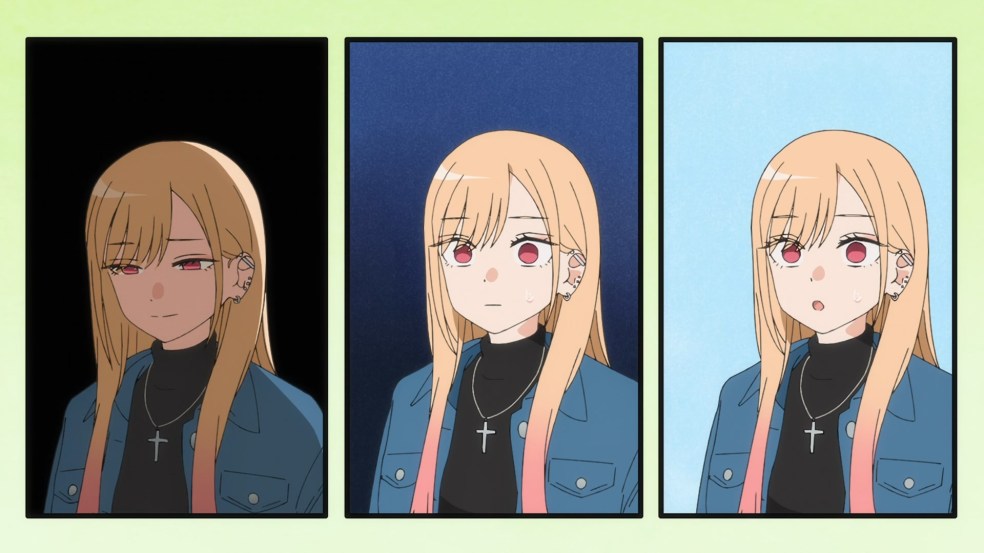
In lieu of the usual Bonus Image, have two, taken from this unofficial translation of an event from the BanG Dream! game, where Tomori says that Taki reminds her of a coffee bean. It is cute enough that I may die.


Like what you’re reading? Consider following Magic Planet Anime to get notified when new articles go live. If you’d like to talk to other Magic Planet Anime readers, consider joining my Discord server! Also consider following me on AnilistBlueSky, or Tumblr and supporting me on Ko-Fi. If you want to read more of my work, consider heading over to the Directory to browse by category. If you’re looking for me to watch a specific show, watch this space. I am planning to reopen commissions in the near future.

All views expressed on Magic Planet Anime are solely my own opinions and conclusions and should not be taken to reflect the opinions of any other persons, groups, or organizations. All text is manually typed and edited, and no machine learning or other automatic tools are used in the creation of Magic Planet Anime articles, with the exception of a basic spellchecker. However, some articles may have additional tags placed by WordPress. All text, excepting direct quotations, is owned by Magic Planet Anime. Do not duplicate without permission. All images are owned by their original copyright holders.

The Weekly Orbit [2/11/25]

The Weekly Orbit is a weekly(-ish) column collecting and refining my more casual anime- and manga-related thoughts from the previous week. Mostly, these are taken from my tumblr blog, and assume familiarity with the works covered. Be wary of spoilers!


Another week, another batch of girlies being absolutely dramatic. I’ll be honest, between the seasonals and the manga I read for this column, this might have the highest “girlies being dramatic” ratio of anything I’ve written in a long long while. I’d say in this respect at least, I’m living my best life. I hope you are too.


Anime – Seasonal

Ave Mujica – Episode 6

Every week I walk in to the torment nexus and walk out with my heart broken in three places. What a show.

Some interesting play with structure and framing this episode. At last week’s conclusion Soyo was shown discovering Mortis, and the whole scene was framed in slasher movie tones. Here, now that she has a better idea of Mortis’ whole, you know, thing, Mortis is instead framed as the angry, lost girl that she really is. I really enjoyed (and did not at all expect) Soyo actually playing along with Mortis’ whole ‘calling the doctor’ bit, it shows a pretty deep empathy that I don’t really know if we’ve seen the character express before? (It’s been a while since I watched MyGO, so I may be forgetting something.) Also, she apparently spends 3 whole days sleeping over there trying to patch things up, which, while there’s definitely a selfish aspect to her motive (she misses CRYCHiC too, after all), I still think deserves serious real one points. I don’t think I’d have the emotional stamina to spend 3 whole days consoling anyone about anything.

Full credit to Rana also, who can just intuit what’s going on with Mortis and Mutsumi without even actually being told. (She doesn’t actually go out of her way to help, though, and spends a decent amount of time this episode playing with cats. Rana remains this subseries’ most mysterious character.) Mortis actually seems to develop a bit of a crush on her, and is that a twinge of jealousy I detect from Soyo about that fact? In the tumblr version of this post I made a joke about the relationship chart this series must have, and then they just actually published one. Way to undercut my quips, Bushiroad.

I like Umiri’s brief scene in this episode. Forever the eternal mercenary, she describes the breakup of Ave Mujica as though it happened around her and not to her. And yet when Ricky Taki calls her on this, she gets annoyed. Truly the “fake ass IDGF’er” meme in human form.

The first half of this episode, I must stress, is actually pretty light by this show’s standards. So of course, there needs to be a breaking point somewhere. Here, that breaking point is between Mortis and Mutsumi, who stirs for the first time in a solid month only to find how awry things have gone in her absence. This isn’t what she wanted, and Mortis is appalled to learn so. The two have an argument in headspace, which of course to anyone outside of the Mutsumi-Mortis system’s own head just looks like an argument with herself, and she actually carries on so bad that she ends up tripping and falling in front of Live House Ring and making a huge scene, which of course a throng of anonymous busybodies are nearby to witness. It’s SO much that it would come off as contrived if the show weren’t so set on showing us how badly this is fucking over Mutsumi and Mortis. It’s hard to watch.

There is something admirable about the show’s complete lack of handholding with this kind of thing. This episode alone depicts multiple conflicts within a fully-realized mental space, a tug-of-war between Mortis and Mutsumi for their collective fate that is just profoundly sad to witness. I do wonder how legible this is to audiences who aren’t plural. Part of me is worried this series might actually be too ahead of its time for most audiences to properly appreciate.

(I’ve barely talked about Sakiko here and she is absolutely going through it up and down this entire episode. From the horrible, obviously untrue claims she makes about not caring about either band or even about Mutsumi, to the folder of sticky notes she’s gotten from Tomori over the years, to the fact that she sadly looks for another one despite telling Tomori off for them last week. To. This fucking expression, just, god.)

There’s a mostly-lighthearted interlude with Nyamu (it remains really funny that her dark secret, compared to everyone else’s, seems to just be that she’s from the sticks), but even that is twinged with her finding out about Mortis and Mutsumi’s public breakdown. The episode then ends with MyGO finding out about Sakiko’s whole extremely fucking complicated family situation. Episode 7 is entitled “Post nubila Phoebus,” “after the clouds, the Sun.” In most other contexts that would be a shining beam of hope, and maybe it is here too, but I’m fairly sure things will get worse before they get better. (Recall, we still have no idea what’s going on with Uika, just as one example, and she’s the only character from either band who doesn’t put in even a cursory appearance in this episode. Where is she!)

Flower and Asura – Episodes 2-5

I don’t usually try to predict how an anime will end before it gets there. But, by the same token, I tend to usually have at least a broad idea of what something “is doing” for most of its run. A first episode or so might need some room to establish itself, but by the halfway point of a series, one can usually figure out its whole deal with relative ease, especially if you’ve been watching anime for a while. All this is the long way around to say; I don’t get caught out by an anime very often. When I’m surprised it’s usually the addition of some new element, as opposed to something I had just outright been misunderstanding. Flower and Asura thus gets to join a pretty exclusive club with its fifth episode, and I am left to consider if I’ve maybe been underrating the show a little. (And by the time you’re reading this another episode will have aired, sigh! The unrelenting march of time.)

The gist is this: so far, Flower and Asura has largely been presented through the eyes of its main character, Hana. Hana’s insecurities and need to find a way to express herself defined the first episode or two of the series, and—perhaps this is the show’s fault, but I’m more inclined to blame myself—because of that, I had not really given terribly much consideration to the interiority of the show’s other characters. Natsue An, the snippy girl with the twin-tails, is a direct challenge to this, in her interactions with Hana she essentially addresses the viewer directly. This is the case with the rest of the cast, but the other two members’ inner lives we’ve explored to any extent are those of Mizuki, the free-spirited upperclassman that recruited Hana in the first place, and Ryouko, who, while not exactly a one-note character, has a deep interest in classic literature that aligns her nicely with Hana and Mizuki’s philosophy that recitation is primarily an art. The NHK Cup, the tournament looming in the show’s background, is to them secondary to reading what they want to be reading, and Ryouko says as much directly. Winning is not hugely important to either of them. (Certainly not to Ryouko, whose gleeful joy at the ancient drama frozen in glass by the Japanese Classics is outright described in-show as fetishistic. I feel very strongly I would get along with this character.)

Natsue is an irregularity here. She actually wants to win the Cup. As such, she’s not performing literary recitations like the characters we’ve discussed so far but rather a technical program, an altogether different thing that relies on a different skillset. Despite their different paths, Natsue is clearly at least appreciative of Hana’s talent, and, in her particularly brusque way, urges her to choose Kafka’s The Metamorphosis from among the available works to read a selection from. This is in contrast to Hana’s own desire to read from a contemporary work. (A work which in fact appears to be about a romance between two girls. Subtle.) If we’re just judging on taste, Natsue is clearly completely right; Hana’s particular timbre, especially the lower and more menacing end of her arsenal, which we know of from episode one, would lend itself very well to something as dark as The Metamorphosis. But this just isn’t what Hana wants to do, and it’s easy to read Natsue’s insistence that she do it as jealousy. It makes almost too much sense, right? Natsue, clearly someone who has very strong opinions on literature from her insistence on Hana’s selection and her denigration of the book Hana actually wants to read as shallow, would rather be doing recitation, right? I certainly read things that way. But we should stop ourselves here, because what that assumption actually is, I am a little embarrassed to say, is probably just projection.

Natsue, after an entire episode of Hana bugging her about it (including a magnetic—and also kind of embarrassing!—scene where Hana actually recites from the book she is planning to read from. In public, where the whole student body can see it), eventually explains that no, the real reason she’s so set on winning the tournament is nothing this complicated. She relates an anecdote from middle school where, in that school’s broadcasting club, an enthusiastic friend was selected to go to the nationals over her. Despite that friend’s insistence that Natsue was actually better at recitation than she was, the condescension—intentional or not—stung more than the actual failure. It has nothing to do with her specific talents and everything to do with just wanting to win in the first place.

Hana is left with the figurative egg on her face, although it’s not so bad, given that this causes the two to actually roughly get along for the first time in the entire show. Still, there’s an important point in there about not just assuming motives for this sort of thing. A point well made to both high school girls and, it turns out, anime critics more than a decade removed from high school.

All this and I’ve barely mentioned how utterly gay Mizuki and Hana’s entire relationship is. How embarrassing!

You and Idol Precure – Episodes 1 & 2

Idol anime are dead, long live idol anime.

Really interesting stuff with this show these past two episodes. Very clearly this is trying to be an “old school” Precure season in that it’s very physical and has a certain kind of comedy that’s been absent for the past couple years. Some people have been a little down on this but to be honest I’m really enjoying it, especially the return of the fisticuffs after an absence in Wonderful. (Not that that show needed them, but it’s always good to have some punching.) Our lead, Uta, alias Cure Idol [Matsuoka Misato], is probably the goofiest main Cure we’ve had in a while. I’m here for it. (That said, it seems like the blue Cure is going to have A Somewhat Sad Backstory and if I know myself I’m going to probably like her most, but who knows.)

Manga

Black and White: Tough Love at the Office

In the best possible way: this is wretched.

What we have here is a yuri manga where the “girls love” is two women, Shirakawa Junko and Kuroda Kayo, attempting to just completely destroy each others’ professional and personal lives over the course of several months after they begin working together in the same department of a bank. There’s a lot of talk about “toxic yuri” in the air right now, moreso than ever before I think, but this is a pretty potent strain of the stuff. These two are bad for each other, they don’t like each other, they become psychologically obsessed with each other, and their “intimacy” consists of violent, questionably-consensual sexual encounters where they alternate between actually fucking and throwing punches and the like at each other. It’s violent! Very violent!

None of this is a complaint of course, the primal and twisted nature of these scenes—which there are really only a couple throughout the whole manga, and they’re all pretty brief—is a big part of the point. There’s an idea floated here that while these two women are both trapped within the financial system that employs them, they’re at each others’ throats. Junko is BY FAR the more vicious of the two, and once Kayo starts seeing another woman, she gets that woman, a fund manager, fired for financial fraud. And yet, when the manga ends, Junko finds herself a pawn of the shadiest parts of the company she works for, possibly for the rest of her life, despite being “successful” in the business sense (and having picked up a new partner along the way). It’s Kayo who gets off with the comparatively happy ending; she quits the company entirely, and leaves to pursue love and happiness, things more important than success and failure. It’s honestly a surprisingly romantic ending for something that’s otherwise so vicious. Of course, not for Junko, who in the final page of the manga literally vanishes into darkness to join the other behind-the-scenes power brokers who run the company and Japan’s finances in general. I guess who really “won” is a matter of perspective, but I know who I’d rather be. (And not just because I’d rather have Junko making all of those twisted, sadistic grimaces at me, but you didn’t hear me say that.)


And that’ll do us for the second week of February. As with last week, I’m going to directly request that you drop a donation if you like reading these columns. They’re my only source of income, and every penny really does help a lot.

See you next week, but before I go, allow me to leave you with this week’s Bonus Thought, a sacred legend from the old days.


Like what you’re reading? Consider following Magic Planet Anime to get notified when new articles go live. If you’d like to talk to other Magic Planet Anime readers, consider joining my Discord server! Also consider following me on AnilistBlueSky, or Tumblr and supporting me on Ko-Fi. If you want to read more of my work, consider heading over to the Directory to browse by category. If you’re looking for me to watch a specific show, watch this space. I am planning to reopen commissions in the near future.

All views expressed on Magic Planet Anime are solely my own opinions and conclusions and should not be taken to reflect the opinions of any other persons, groups, or organizations. All text is manually typed and edited, and no machine learning or other automatic tools are used in the creation of Magic Planet Anime articles, with the exception of a basic spellchecker. However, some articles may have additional tags placed by WordPress. All text, excepting direct quotations, is owned by Magic Planet Anime. Do not duplicate without permission. All images are owned by their original copyright holders.

Seasonal First Impressions: Pining For Those SAKAMOTO DAYS

Seasonal First Impressions is a column where I detail my thoughts, however brief or long, about a currently-airing anime’s first episode or so.


Picture a killer of legend. The kind of man whose very presence makes the blood of his foes freeze in their veins. Picture an unstoppable, elemental force of violence. Add gray hair and a pair of round spectacles, and you’ve got Taro Sakomoto [Sugita Tomokazu]. Now, picture what it would take to tame that man. Picture what could remove him from this life of ceaseless bloodshed. What could that be? What could possibly get him to hang up his gun?

Well, a pretty store clerk with a winning smile is probably a good start.

This, the tale of an ostensibly-retired uber-hitman, is Sakamoto Days. It’s a member of a particular genre that’s found increased purchase in recent years, a kind of post-Spy x Family melding of action anime with the domestic comedy. Usually involving a fundamentally good natured protagonist who can, nonetheless, throw down with the best of them. Spy x Family has the likable but duplicitous Loid Forger. Kindergarten Wars has its single woman—seeking good man—in Rita. And of course, Sakamoto Days has Sakamoto himself. Sakamoto Days has been a favorite among Jump readers in the know for a good while now, and thus this adaptation comes with a pretty weighty set of expectations placed upon it. For my purposes, I’m not super interested in engaging with that, although I will say this is the rare case of a shonen manga I actually follow somewhat regularly getting adapted into animation, so I’m happy for the series if nothing else. (It’ll be joined in this category by Witch Watch, also from Shonen Jump, later this year.)

Our story really begins when Shin [Shimazaki Nobunaga], formerly one of Sakamoto’s partners-in-crime, is tasked with killing the man. He left “the organization” which he and Shin both belonged to without permission and thus, he’s gotta die. Shin is initially perfectly willing to go along with this, and when he first sees the retired Sakamoto, he’s upset by what comes off to him as weakness. Most obviously, Sakamoto has put on quite a lot of weight in the five years since he retired, and we should take a quick detour to talk about this.

So! Fat jokes! There’s quite a few of them in Sakamoto Days. In the anglosphere, these have generally been considered in poor taste for a good 20 years now, but obviously, this isn’t the case everywhere. I reiterate all this basic-ass explanation of cultural differences just to say, as someone who’s also fairly big, I am not super upset by how Sakamoto Days handles its main character in this regard, even later on when we get into less-jokey but arguably dicier territory. I also think it helps that the character himself seems to have a good sense of humor about it (check the “Slim” shirt in the picture above). But if you are upset by it, I get that, and I’m also not going to tell you you Need To Get Over It or whatever other piece of canned finger-wagging rhetoric a certain kind of anime fan is sure to lean on when people want to discuss this subject. This is an area on which people will understandably be pretty polarized. So at the risk of making it seem more serious than it necessarily is, I think it’s important to just acknowledge that this specific subject gets under some peoples’ skin, and that’s fine. I have a very live and let live approach to arguably-problematic material in the arts, and this is no different a case than anything else, it’s just somewhat new territory for anime I’ve covered on this site specifically.

It is worth noting though, that Shin’s initial judgement of Sakamoto is wholly incorrect. He sees Sakamoto, now grown happy and fat and the proud proprietor of a small konbini with his wife [Aoi, played by Touyama Nao] and their adorable daughter [Hina, played by Kino Hina, no relation], and assumes he’s grown soft in a metaphorical sense, too. This is not so.

Despite some reluctance once he senses that Sakamoto’s killer instincts haven’t actually dulled terribly much—he’s an esper, and can read minds, and is thus treated to Sakamoto’s amusingly gory idle fantasies of stabbing him to death—Shin is eventually convinced to try taking him out. This goes poorly for him, and this is where we get to the anime’s biggest strength.

All told, it is simply just a solid, good translation of the manga’s inventive action scenes to animation. Sakamoto immediately gets to flex both his wits and his still-sharp combat skills here, deflecting a pistol bullet with a gumball and using various other random objects around his store to render Shin harmless. There’s too much slow-mo, and the presence of merely some traditional sakuga instead of wall to wall sakuga will leave some unhappy, but so far, there’s really not a lot to complain about. (I’ve seen some scuttlebutt about the color palette, too. But honestly I think the gritty, somewhat dingy look works well for this series.) The vibe is captured pretty much perfectly.

These setpieces are what Sakamoto Days is about. There is a story, to be sure, a decently interesting one at that, where various characters are torn between the sprawling assassin underworld and the call of a normal, quiet life. There’s comedy, which is amusing if rarely laugh-out-loud funny. And there are also some quite sweet domestic scenes, as well. But the real main concern of Sakamoto Days are these setpieces, wild everything-but-the-kitchen-sink affairs that grew only moreso as the manga went on, and which make a good first showing here. There’s an escalation in the first episode already, even, as Sakamoto opts to rescue Shin once his employers try to take him out for not fulfilling his contract. This second scene is even flashier, all glinting gunmetal, roundhouse kicks, and taser lightning as Sakamoto cuts through a warehouse of goons with ease.

The sell is simply this, if you liked those scenes, you’ll get a kick out of Sakamoto Days. If you like the scene afterward, where Sakamoto hires Shin as an employee at his store, since the esper has nowhere else to go, you’ll like Sakamoto Days a lot. What you see is what you get. I think what we see is pretty cool.


Like what you’re reading? Consider following Magic Planet Anime to get notified when new articles go live. If you’d like to talk to other Magic Planet Anime readers, consider joining my Discord server! Also consider following me on AnilistBlueSky, or Tumblr and supporting me on Ko-Fi. If you want to read more of my work, consider heading over to the Directory to browse by category. If you’re looking for me to watch a specific show, watch this space. I am planning to reopen commissions in the near future.

All views expressed on Magic Planet Anime are solely my own opinions and conclusions and should not be taken to reflect the opinions of any other persons, groups, or organizations. All text is manually typed and edited, and no machine learning or other automatic tools are used in the creation of Magic Planet Anime articles, with the exception of a basic spellchecker. However, some articles may have additional tags placed by WordPress. All text, excepting direct quotations, is owned by Magic Planet Anime. Do not duplicate without permission. All images are owned by their original copyright holders.

Seasonal First Impressions: Mysteries, Medicine, and Malpractice in AMEKU M.D.: DOCTOR DETECTIVE

Seasonal First Impressions is a column where I detail my thoughts, however brief or long, about a currently-airing anime’s first episode or so.


On a basic level, aside from the fact that I want to watch anime premieres for their own sake, the main question I’m seeking to answer with a lot of my first impression writeups is this: is this given show, provided you’re in to what it’s trying to do, worth your time? Admittedly a very straightforward and mercenary time-is-money way to look at things, but when so much anime is being made every season, it’s a necessity. Separating the wheat from the chaff is not always easy, but something that at least makes the case that a show might be interesting is a novel premise. Ameku M.D.: Doctor Detective, awkward punctuation and all, has that. I’ll give it to you in one sentence; Ameku would like you to go into it thinking that it’s House, M.D., but with an anime girl. For some of you, that’s going to be enough of a sell that you’ve probably already tabbed away from this article to pull it up on Crunchyroll. I’m not sure if you’ll like what the show is actually doing, but godspeed and good luck.

For the rest of you who might be interested in the particulars, let me get this out of the way: unlike many other LGBTQ millennials I know, I’ve never really liked House. Not that I ever watched a ton of it, but it very much did not seem like my sort of mystery series from what little I did see. Also, while this is not the show’s fault, the whole thing with it “never being Lupus” hits a little differently when your mother suffers from chronic Lupus flare-ups. (Ameku M.D. actually makes reference to this little meme almost immediately, which soured me on the show right out the gate pretty hard.)

Suffice to say, the deck was stacked against this series from the very beginning, at least as far as I’m concerned. Still, something can be not for me but still be worthwhile, so I committed to watching the whole premiere regardless. Having now seen the first two episodes (they released in tandem), I’m still unsure if I’ll watch more, but I am glad I gave it a chance, because, as it turns out, this House influence is sort of a feint.

The first episode opens with our main character, Ameku Takao [Sakura Ayane], rapid-fire solving a pair of mysterious diagnoses in the hospital she works at, quickly deducing that a young boy’s mysterious nerve pain is caused by a Vitamin A overdose, and that an older gentleman’s agony of the stomach is the result of accidentally ingesting a fish parasite. In both cases, she makes the prognosis in a vaguely judgey way, and, going off of my admittedly very limited exposure to that series, this is the part that’s more or less “like House.” After this introductory segment though, the show promptly takes an abrupt swerve, and it’s here where we need to draw attention to the series’ English language subtitle, Doctor Detective. Because that is a much more honest indication of what this series is trying to be, as is the title of the first episode, the hilariously on-the-nose “Dr. Sherlock.”

Not long after Dr. Ameku solves these little mysteries, a much bigger one rears its head as a man is rushed to the emergency room, where he promptly dies. (My understanding is that House rarely if ever dealt with outright murders, so that’ll be another difference.) Two curious details make themselves immediately obvious; this man had his leg bitten off by a very large predator, and his blood is inexplicably a bright blue color. The victim and detective thus present, the stage is set for what’s actually a pretty typical murder mystery. An interesting one, at that. I won’t spoil the specifics of what precisely occurred (I’m not sure if the series is strictly fair-play, but I wouldn’t be surprised if it were), but this mystery, and Dr. Ameku’s eventual unraveling of it, complete with the denouement-inducing catchphrase “let me give you my diagnosis”, and a very fun little sequence where she’s depicted “putting the clues together” by floating in a sphere of abstract math, is very much in the vein of of an orthodox whodunnit. It’s just that the detective is, again per the subtitle, also a doctor, and therefore there’s a bit of a medical focus.

She’s pretty entertaining as she does it, too. Dr. Ameku is the kind of smugly charismatic lead you want in something like this, she’s incredibly immature (said the anime blogger) but also extremely intelligent. The Sherlock comparisons make themselves obvious in the way she picks up on seemingly random details as vital clues. All of this is stuff that’s been done before, of course, but it’s well-executed here, and Takao is, overall, a very watchable protagonist. It helps that she’s got a solid supporting cast already as well. Mostly, this consists of her very own Watson, Takanashi Yuu [Ono Kenshou], also a medical professional—and an impressive karateka!—but much less of a detective, who asks just the right questions to set Dr. Ameku up to deliver her precision diagnoses. But there’s also Takao’s uncle, a different Dr. Ameku [Tachiki Fumihiko], who owns the hospital that she works at, and with whom she appears to have quite a lot of friction. (The elder Dr. Ameku, perhaps understandably, does not like one of his doctors playing Columbo in her off hours.) Speaking of Columbo-a-likes, Takao also has a contact in the police department, the trenchcoated detective Sakurai Kimiyasu [Hirata Hiroaki], who was in this case mostly cooperative, but who seems poised to evolve into an interesting foil later on.

Visually, the show goes for a restrained, mostly realistic look. Given the studio involved here, the somewhat infamous project no. 9, I’m a little surprised at how well they pull this off. The series is, for sure, visually unshowy, but it’s a clean, grounded look, heavy on greys and blues, that works well for a detective series, even one that has lines of dialogue like this in its very first case.

All told, despite my initial misgivings there’s some real promise here, and I’ll say the show is solidly worth checking out. A post-credits scene seems to indicate that the cases will only ramp up in stakes from here, which is good, since if we simmered back down to stuff like “a kid accidentally ate a ridiculous amount of blueberries and gave himself Vitamin A poisoning” I think we’d be in for a much less interesting show. I’ll say this much, this is the first 2025 anime I’ve watched anything of at all, and simply by virtue of having a novel premise that it does fairly well, Doctor Detective here is well ahead both of how I started last year’s anime and, honestly, much of the pack for this season, if what else has aired so far is any indication. I’m pleasantly surprised, given my initial bias against what I thought this series was going to be. As I said up at the top of this piece, I still don’t know if I’ll watch much more of this, but if I do, don’t be surprised to hear about Ameku M.D. here on Magic Planet Anime again.


Like what you’re reading? Consider following Magic Planet Anime to get notified when new articles go live. If you’d like to talk to other Magic Planet Anime readers, consider joining my Discord server! Also consider following me on AnilistBlueSky, or Tumblr and supporting me on Ko-Fi. If you want to read more of my work, consider heading over to the Directory to browse by category. If you’re looking for me to watch a specific show, watch this space. I am planning to reopen commissions in the near future.

All views expressed on Magic Planet Anime are solely my own opinions and conclusions and should not be taken to reflect the opinions of any other persons, groups, or organizations. All text is manually typed and edited, and no machine learning or other automatic tools are used in the creation of Magic Planet Anime articles, with the exception of a basic spellchecker. However, some articles may have additional tags placed by WordPress. All text, excepting direct quotations, is owned by Magic Planet Anime. Do not duplicate without permission. All images are owned by their original copyright holders.

New Manga First Impressions: Shot Through The Heart – Love, Loss, and the Ephemeral Beauty of a Grassroots Fandom: The Story of LOVE BULLET

A Disclaimer: I don’t usually do this sort of thing, but even moreso than usual, if you’re just looking for a simple “is this good or bad? Thumbs up or thumbs down?” kind of thing, I would actually urge you to go read this manga as it currently exists before reading this article. It’s quite short so far (only a single volume), and well worth it. I get into a lot of minutiae about the plot below, and I’d hate to spoil the experience for anybody.

New Manga First Impressions is a column where I detail my thoughts, however brief or long, about the first chapter volume or so of a new manga.


Love, to hear it told, is war. It’s a battlefield. It stinks, It hurts. It bites and bleeds. It’s rough going, in other words. It’s a little surprising, considering all that, that it’s taken this long for someone to have the idea of giving Cupid a handgun. But that is the basic concept of Love Bullet, the manga from newcomer inee that’s recently blown up in certain circles, depending on where you are on the internet. This is a case where the story outside the story is almost as interesting as the work itself, but we’ll save getting into all that for the end of this article. Here’s the, if you’ll forgive the pun, bullet points: Love Bullet follows a group of supernatural beings called cupids. Their task, armed as they are with a variety of firearms and explosives decorated with heart motifs, is to observe their targets in the human world and, with careful observation, decide who the best partner for them would be before pulling the trigger, as doing so makes the targets fall in love. There’s an additional twist to this, however. The cupids themselves are former humans, those who died before their time with some unresolved love of their own still in their hearts.

Becoming a cupid thus offers those who suffer this fate a second chance. And the pilot “0th” chapter goes some further way to laying out our premise and cast. Koharu, our main girl, is the rookie on the job. Kanna, her mentor, is laid back and does her best to help Koharu through the twists and turns of her new profession, there’s also the conscientious Ena, as well as Chiyo, who is, we’ll say, rambunctious.

Chapter 0 sees these four disagree over how precisely to resolve a love triangle of teenagers at a local not-McDonald’s. Three of the four cupids are in favor of pairing Hina, their target, with one of her childhood two childhood friends, Aoi or Daito. (The casual bisexuality of almost every ‘target’ character is worth mentioning, here, as an aside. It feels like an unshowy but powerful acknowledgement that the whims of the heart are often too complex to be so easily pinned down.)

Setting Hina up with either of these two would break the heart of the other, so this isn’t a decision to be made lightly. When the cupids are unable to come to an agreement, Chiyo, the one of the three who most likes to talk with her fists, starts a fight.

Fights between cupids aren’t lethal or anything—cupids can’t fall in love, so being shot or blown up or whatever with their equipment instead renders them temporarily indisposed by making them ridiculously jealous—so some trickery on the part of her mentor eventually gives Koharu, who is determined to somehow solve this problem in a way that doesn’t compromise Hina’s friendships, the deciding shot. Thinking outside of the box, she pulls the trigger between Hina and one of the younger employees at the McDonald’s, saving her friendships and setting her up with a sudden-onset crush instead. The takeaway here is this; Koharu has a good eye for unconventional solutions, something that will serve her well as a cupid in the stories of romance-to-be to come.

However, those stories don’t actually exist yet. The first main arc of the series—which comprises the first and currently only volume of the manga—is actually an origin story for our inventive matchmaker, and this is where Love Bullet goes from merely interesting to positively arresting.

Things begin simply enough. Koharu reminisces on her days as human high school girl Sakurada Koharu. She had a reputation as a matchmaker even then, and her talent for noticing these things put her in enough demand that we see her best friend, one Tamaki Aki, having to occasionally step in.

Koharu in fact seems so wrapped up in this little role she’s made for herself that she doesn’t really consider her own feelings very often. Aki directly says as much to her, only for Koharu to self-deprecatingly reply that beyond this talent of hers, there’s not much to her as a person. This is pretty blatantly untrue, but it gives us a good first look at someone who clearly struggles with her own self-worth. For her part, Aki also has ulterior motives behind trying to get Koharu to put herself first a bit more. Those motives? The obvious, Aki wants Koharu to like herself because Aki likes Koharu.

Unfortunately for both Koharu and Aki, however, this is where the series really earns that “doomed yuri” descriptor. Not a full minute after Aki admits her feelings, Koharu, frozen with indecision, promptly has a head-first meeting with the consequences of choosing to have long talks with your friend next to a construction site, and she promptly dies.

This is perhaps the one writing decision in this arc that I could, writing this a few days after having first read it, think of someone perhaps finding cheesy or even contrived. Honestly it kind of is! But that’s not really a criticism, at least it’s not coming from me, because Love Bullet uses this moment to explode into a bomb-burst of grief. A demonstration of how the world absolutely stops when someone you love leaves it. Love Bullet can afford to be a little loose with the actual literalities of how we get to that point, because, setting aside any fundamentally silly complaints about a lack of realism—people die in freak accidents every day—the actual point of all this stuff is to explore the feelings themselves.

This also marks a notable shift in style for the manga. As Koharu passes away, Love Bullet reveals one of its best visual tricks. The four-page sequence where Koharu dies is a pair of mirrored halves, and is just an absolutely excellent execution of this technique, to such a degree that I am surprised to see it from someone who’s relatively new to the medium1. On the first of these pages, three vertically stacked panels depict Aki’s grief-stricken face as she sees the life fade from her best friend. On the second, Koharu lies at the center of the page’s sole panel, in the midst of a heart-shaped pool of blood, finally realizing that she wanted to fall in love too. On the third, cherry blossom petals fall around her as she awakes, again in the center of a monopanel, newly sporting angel wings. Lastly, on the fourth page, three vertically stacked panels again herald the arrival of Kanna, Koharu’s new mentor, here to induct her into the cupids and thus begin our proper story. In the final signal that Sakurada Koharu the human is dead, Kanna addresses her as just “Koharu.” The scanlators helpfully point out that this change is even more drastic than it seems in English. “Sakurada Koharu” is of course a person’s name and is thus written with Kanji in its native Japanese, but “Koharu”, the cupid she’s just become, is addressed with her name written only in katakana, thus reducing it to pure phonics and making it clear that in some profound metaphysical sense, Koharu the human and Koharu the cupid aren’t precisely identical.

We don’t simply leave Aki behind as the story progresses, though. Koharu’s first assignment as a cupid is, in fact, to help Aki herself find a new love. What’s worse—or better, perhaps, depending on your perspective—is that time has not stood still for the human world between Koharu’s death and resurrection. In fact, it’s been half a decade. There’s again a brilliant use of mirroring here. Aki, now a college student at a prestigious art school who looks drastically different than she did just five years prior, is visually contrasted with Koharu, now an eternally-young angelic being, who looks more or less the same aside from her hair, eyes, and, of course, wings. Even their color schemes are stark opposites!

What’s more, successfully matchmaking as a cupid earns that cupid “karma.” Get enough, and history is casually rewritten such that you’re brought back to your human life. Of course, that doesn’t reverse the time that’s passed since then. Even when the prospect of becoming human again is dangled in front of Koharu, it’s very clear that for the most part, these changes that have happened are permanent. Kanna, who seems to style herself an upright mentor type, reveals that she’s actually the one who chose Aki as Koharu’s first target. From both a practical and personal point of view it makes sense; Koharu knew Aki very well, and there are few people more qualified to pick out a partner for her. On an emotional level, Koharu has to deal with the loss eventually, so she might as well take it head on. Still, it does all feel a little cruel, too. Of course, that too is almost certainly the exact reaction we’re supposed to have, and it’s one that gives this whole scenario some extra resonance. The feelings involved in romance, present or past, are rarely straightforward.

Eventually, by peeking at a “data record” that the cupids are given about their targets, Koharu learns that Aki has held a flame for her this entire time. This only makes sense, a person never really “gets over” something like that, but enough time has finally passed that, presumably with no small amount of effort from Aki herself, she’s able to move on to a new person to at least some extent. Kanna is able to gently coax Koharu into accepting her role as a cupid, and she resolves to find the best partner for Aki that she possibly can.

This is where we meet Chiyo.

You give love a bad name.

Chiyo serves as, more or less, the antagonist of this first arc, and is established as “battle-crazy” bad news who doesn’t really care about the people she’s ostensibly trying to partner up. In fact, when initially targeting Koharu here, she taunts that she thinks it would be “more fun” to just pair her up with somebody at random. According to Kanna, this kind of situation isn’t terribly uncommon. Cupids might technically all have the same job, but fights break out over who gets the karma payout off of claiming a particular heart.

All of this, of course, makes Chiyo a perfect counterpart to Koharu. The wild, battle-hungry fighter who’s here for a good time but not a long one vs. the shy newbie who has some actual investment in the fate of Aki’s love life. It’s actually Kanna who does most of the fighting with Chiyo, though, which would seem like a missed opportunity if they didn’t clearly have some sort of shared history of their own. (Chiyo calls Kanna out on trying to act like “a goodie two-shoes.”) Kanna is able to get Chiyo mostly off of Koharu’s trail by challenging her to a straight-up fistfight, which the heavily armed angel finds interesting enough to agree to.

Koharu, meanwhile, is sent to infiltrate the school with some angel magic. She can actually use this “cupid’s charm” to disguise herself as a human and interact with the college students, including Aki herself. (Who, in another melancholy development, can’t recognize her under the glamour.) Koharu is able to get a general sense of Aki’s current state in life by doing this, and while tons of Aki’s classmates are head over heels for her straightforward, honest nature and deep knowledge of art, most of them are pretty forward about trying to earn her affection, something she doesn’t really seem to care for. Koharu gets the sense that Aki needs someone more reserved and on the quieter side. In another brilliant little page-to-page compositional trick, the thought balloon that begins with “It’s like they need to be someone more reserved. Someone like–” is interrupted by another student calling Koharu’s name on the next page.

It’s perhaps unsurprising that Sakura there, a reserved and shy girl not terribly unlike Koharu herself, is who Koharu eventually picks as Aki’s love interest. I worry that reducing the setup to who “wins” though might make it sound like Koharu is being selfish or even living vicariously through Sakura. In actuality, the manga goes some length to demonstrate that Koharu’s decision is one she comes to after careful consideration. (And after Kanna wins her little bout with Chiyo in a very fun sequence I’ll leave unspoiled.) What gives her the conviction to finally pull the trigger is a conversation between Sakura and Aki herself. By this point, she’s shed her human guise, and the two thus can’t see her. As such, she’s given the surreal experience of hearing Aki recount her own death, and how she’s been dealing with the aftermath since then. It’s a beautiful scene, Aki quietly lays out how she managed to come to terms with Koharu’s passing, and Koharu, improbably, is there to hear all of it.

What really makes this work is how it helps Koharu come to terms with her own loss. In the final moments before she shoots, Aki’s feelings of loss seem to overlap with her own. Aki’s loss of Koharu reflects Koharu’s loss of Aki, the time that’s now forever lost between them, and both of their respective needs to continue onward in spite of all that. To put it bluntly, this all really, really got to me. I don’t cry over fiction easily, but that last page, where Koharu finally pulls the love pistol’s trigger and destines Aki and Sakura to fall for each other, made me start sobbing.

If you love something, set it free.

This, all of it, is fantasy in the purest sense. We don’t know, by the very nature of these things, whether our departed loved ones would want us to move on from them, but the idea that they would seems to be common across cultures, and these ideas that hit so close to the root of the human experience that they’re nearly universal are much of what I come to anime and manga for in the first place. Love Bullet is written by someone who is in all ways quite a different person from me, but the pain at the back of our minds, when we remember those who aren’t with us anymore, connects me to a girl in this story. That means something, and shouldn’t be dismissed.

Case in point: over a decade ago, an internet friend of mine vanished after being grievously harassed in the way that was all too common back then. Shortly before leaving, she told me she’d been crushing on me since we met. That was a very long time ago, and I don’t really have any way of knowing what happened to her, as this was before having all of your alternate social media accounts listed in some convenient place was common. Suffice it to say, my situation and Aki’s are quite different. But the fact that her story stirred this memory in me at all is a testament to the power of the narrative being put together here.

It is, I hope I’ve made clear, excellent stuff. These feelings are what art is for. What’s most impressive about Love Bullet is how it’s clearly the product of a unique and mature artistic voice, from someone who is clearly incredibly talented despite being relatively early on in her career. But what makes it worth reading are those moments of connection, the ones that hit you in the heart.

Obviously, I love this thing to death and want it to continue very, very badly. Inee has mentioned that she has a whole saga for Koharu planned out. (Plus there are so many opportunities for other interesting stories here as well. I am sure Chiyo, for example, has some heart-stompingly sad backstory that I simply need to see.) Unfortunately, though, this is where we get to the part of the article that’s not about the manga itself. Love Bullet, you see, is serialized in a magazine, and thus like any manga bound to that format, is subject to the whims of various people working on the business side of that endeavor. Those people are, often, absolutely ruthless about axing any manga that threatens to underperform. (A counterproductive approach that tends to part ongoing manga from their audiences right as they’re getting to know each other, it must be pointed out.) Love Bullet has, apparently, been underperforming in its volume 1 sales, and its future is therefore rather uncertain.

This is upsetting not just because it’s a fantastic story but also because, god damn it, I’m an author too. One of a very different kind, of course, but it’s impossible for me to see this person writing this story, pouring their entire heart into it, only for it to be threatened by the scythe of capitalism, and just sit here and do nothing. Rarely if ever are my articles capable of affecting tangible, direct change on the world. But this might be an uncommon exception. Sancho Step, the group responsible for scanlating the manga and thus bringing it to international attention (and whose scans I’ve been showing off here), have a very handy guide to purchasing the first volume either physically or digitally. Sancho Step have already done a lot for Love Bullet, and I’m under no delusion that my site has a massive reach, especially not compared to the #ReadLoveBullet campaign they’ve already had well under way for some time now. Still, if I can help move even one copy of the manga and possibly forestall its demise, that’s worth it. Good, impactful, resonant art is worth it, and Love Bullet is absolutely every single one of those things.


1: As is the case with most mangaka who get a debut serial, there is ample evidence that inee published some amount of independent oneshots and such before writing Love Bullet, so it’s not like she’d never picked up a pen before drawing it. Still, the command of panel composition displayed here is exceptional.


Like what you’re reading? Consider following Magic Planet Anime to get notified when new articles go live. If you’d like to talk to other Magic Planet Anime readers, consider joining my Discord server! Also consider following me on AnilistBlueSkyTumblr, or Twitter and supporting me on Ko-Fi. If you do the latter soon enough after this article goes up, I will probably use the donation to buy a copy of Love Bullet, so thanks 🙂 If you want to read more of my work, consider heading over to the Directory to browse by category.

All views expressed on Magic Planet Anime are solely my own opinions and conclusions and should not be taken to reflect the opinions of any other persons, groups, or organizations. All text is manually typed and edited, and no machine learning or other automatic tools are used in the creation of Magic Planet Anime articles, with the exception of a basic spellchecker. However, some articles may have additional tags placed by WordPress. All text, excepting direct quotations, is owned by Magic Planet Anime. Do not duplicate without permission. All images are owned by their original copyright holders.

Seasonal First Impressions: Dead or Alive 1333 – In Search of THE ELUSIVE SAMURAI

Seasonal First Impressions is a column where I detail my thoughts, however brief or long, about a currently-airing anime’s first episode or so.


The opening few minutes of The Elusive Samurai are mostly setup, to establish our feudal Japanese setting, and some basic character humor. I must stress, not very good character humor. These are all cracks at the expense of one-note stereotypes; an ableist caricature that serves as a puppet ruler, a greedy, homely girl who hounds our main character because she has Mon signs in her eyes over the idea of marrying him someday, etc. I bring this up first not to criticize a Jump adaptation for having Jump manga humor (it’s an unfortunate reality of most things that run in the magazine, honestly), but to point out that Elusive Samurai pulls off a pretty nasty little trick with it, one that I can only respect. By the end of the episode, no matter what you thought of these characters and their flat interjections of comedy the first time around, you’re going to miss them, and appreciate the stabs of comedy that remain, no matter how out of place they’d otherwise seem.

The Elusive Samurai is interesting as an adaptation, essentially holding the manga open and bleeding it. The resulting effect is a series of incredibly strong tones, moods, and single scenes that work excellently in of themselves but only cohere if you take a step back. This isn’t a major departure from the manga, to be clear. Both feature a wild tonal seesaw. But the manga’s visual experimentation in the first chapter is constrained. Panels align to grids, pages are more or less orderly. Ambitious, but typical. The anime, meanwhile, is a shattered, slivered kind of chaos. Everything clashes with everything. All abrupt jolts. A procession of staccato jumps. It’s abrupt. Percussive. An analogy: Elusive Samurai is a song. Its plot beats, the rhythm. Tokiyuki, our lead, is the melody. When the action follows him, it sings and soars. He’s like a rabbit; nimble, ferociously committed to his own survival, and so cute you can’t help but be on his side. Yuikawa Asaki gives him an endearingly boyish voice, which goes a long way to elevating his already strong characterization from the manga.

I’m not trying to downplay that manga; it still does quite a lot with the 50ish pages of its opening chapter. But one gets the clear sense that it’s straining against the format a little1, which simply isn’t true of the anime. Every hook and jab designed to throw you off kilter feels intentional. Around the episode’s halfway point, Tokiyuki and his older brother—the child of a concubine—are playing with a kickball. It ends up on a roof, and it never comes back down. Instead, an ice-cold match cut turns it into a severed head, and from then on, Tokiyuki’s idyllic life is over.

Let’s rewind a little. Hojo Tokiyuki was a real person, a member of the Hojo, a house in 14th century Japan who were, in loose terms, nominal rulers of the country but several steps removed from any actual power. (The Hojo were, and Tokiyuki is the heir of at the start of the story, something absurd like the regents for the shogun for the Emperor. In turn, they, via Tokiyuki’s father, who is here the ableist caricature mentioned up at the top of this article.) The Elusive Samurai is thus, very loosely, historical fiction. Its events comprise the leadup to, and depending on the time period this series spans, possibly the actual events of, the Nanboku-chō Wars.

This friendly-looking tale of straightforward heroism is presented to us at the start of the series as an example of what we will not be seeing here.

This setting contextualizes all of these tone shifts somewhat. On the one hand, Tokiyuki is a child. He’s a boy of scarcely 8 whose tutors, throughout the episode’s bright forehalf, chastise him for being lazy, for running away when he doesn’t want to do something, and just generally being too carefree. But he is also a noble, and while his father’s position is that of a puppet, it is still a position. These expectations must weigh on him, and we get some sense of how when we’re introduced to our other main character.

Suwa Yorishige [Nakamura Yuuichi], a priest, is introduced to us, to Tokiyuki, literally beaming. The boy-prince finds himself in a tree and Yorishige appears suddenly behind him, offering portents of glory and doom in an extremely overbearing, forceful fashion.

A divinity dwells within him and seems to spill out of the screen; when he’s “on,” he emits radiant lights, dimmed somewhat only by his snarky assistant Shizuku [Yano Hinaki], who explains he’s a sham of a priest, but a real oracle. When Yorishige proclaims that Tokiyuki will, in a few years time, be a war hero beloved and feared in alteration, the prince is skeptical, and he promptly darts off once again.

Returning to his castle, we return to the scene of he and his brother playing. We return to the ball, and to the severed head.

When the violence intrudes in the episode’s second half, it is immediate, overwhelming, and oppressive. Like the smoke from a fire, but not like the smoke from a fire, as the city burns in very literal flames. The betrayal of Takauji [Konishi Katsuyuki], a vassal of Tokiyuki’s, marks a massive and irreversible turning point in the individual lives of not just Tokiyuki and every other character, but history itself. The two are juxtaposed; big, white text pops up like news headlines, proclaiming mass death, including of characters we met in the lighthearted first half of the episode. Tokiyuki’s archery teachers? Dead. His father? Committed suicide alongside his retainers. Kiyoko [Matsuda Satsumi], the girl who teases him in the very first main scene of the episode? “Violated and brutally killed,” per the sub track. These things aren’t dwelled on, exactly. They’re just presented as cold facts as the city of Kamakura burns to cinders. (Although it doesn’t feel like a coincidence that many of these characters are the very same who offhandedly called him cowardly in the episode’s first half.) The pounding drums of what’s become a war song.

One can hardly blame Tokiyuki for being completely devastated. When Yorishige appears to rescue him, he initially rejects the offer. He wants to die alongside his father. What’s more surprising is that the sham shaman obliges, pushing the displaced prince off of a cliff and alerting a group of samurai to his presence. In this hopeless situation, does the rabbit lay down and die?

Of course not. The running, ducking, bobbing, hiding, and dodging of the first half of the show comes flooding back. This time, with consequence. The samurai hack and cleave at him, but only hit each other. They go from an indistinct, merged smear of viciousness to cutting each other’s limbs off; both senses of the phrase “bleeding together” bleeding together. Improbably, Tokiyuki escapes. He, Yorishige, and Shizuku retreat into the night. The composition of the show has flipped around; now, Tokiyuki is the percussion, and the melody are the smoldering flames reaching into the night sky as he flees.

Yorishige lays out a plan. Tokiyuki can’t defeat Takauji alone, he must hide, he must flee, he must court allies and deceive his enemies. Tokiyuki must become El-ahrairah; cunning, full of tricks, listener and runner. That’s just how it goes for a prince with a thousand enemies. If it feels hard to read any glory into such a tale, that’s probably the point. A story where the hero is a coward and the villain sends armies to rape and murder townsfolk isn’t the cheeriest thing, no matter how much cheesing for the camera Yorishige might do. Then again, brutal violence is hardly a foreign element to this kind of historical fiction. That’s probably part of the point, too. The show spells it out directly; Tokiyuki is a hero of life. Takauji, his nemesis, one of death.

The series asks us to take on faith that this will be worth it, in the end, that it will tell a satisfying story. It’s a fair point to raise! All of these visual tricks are great and lovely and engaging, but does this story come together? If you take a very big picture view, you can read its dizzying fractiousness as intentional, as I’ve chosen to do here, but we’re in for 11 more episodes of this stuff, so it’s fair to ask what it will all add up to. And there is always the temptation to try to be definitive. If you forecast that a show will do this or that, and then it does, you look like a prophet. (Or, at least, someone who knows their Japanese history, in this case.) The honest answer though is that we won’t know if it feels “worth it” until we get there, and I think looking to divine the future is, in the case of something so freewheeling, probably doomed to frustration. The Elusive Samurai‘s visual element alone gives me more than enough to chew on to want to come back next week, but combined with the plight of Tokiyuki, fleeing into the night with his whole world in smoldering splinters behind him, it becomes magnetic. I have to know more.


1: Although it does experiment in its own way, eg. a raised sword jutting through one panel to pierce another on the opposite page.


Like what you’re reading? Consider following Magic Planet Anime to get notified when new articles go live. If you’d like to talk to other Magic Planet Anime readers, consider joining my Discord server! Also consider following me on AnilistBlueSky, or Tumblr and supporting me on Ko-Fi or Patreon. If you want to read more of my work, consider heading over to the Directory to browse by category.

All views expressed on Magic Planet Anime are solely my own opinions and conclusions and should not be taken to reflect the opinions of any other persons, groups, or organizations. All text is manually typed and edited, and no machine learning or other automatic tools are used in the creation of Magic Planet Anime articles, with the exception of a basic spellchecker. However, some articles may have additional tags placed by WordPress. All text, excepting direct quotations, is owned by Magic Planet Anime. Do not duplicate without permission. All images are owned by their original copyright holders.

Seasonal First Impressions: Otaku Hot Girl Summer in 2.5 DIMENSIONAL SEDUCTION

Seasonal First Impressions is a column where I detail my thoughts, however brief or long, about a currently-airing anime’s first episode or so.


Something’s in the air. Maybe Dress-Up Darling was the warning shot, but to hear Megan Thee Stallion tell it, the era of the Otaku Hot Girl is upon us. If we are not prepared, that’s probably on us.

Look upon your god and despair.

2.5 Dimensional Seduction, another entry in the “girl with a gimmick” subgenre of romcom, opens with insert narration. Here, our female lead, in voiceover, waxes rhapsodic about cosplay as the ultimate form of transformation and devotion. I don’t know about all that, but it’s certainly a very involved hobby. I don’t have the figure for it, myself, but I can imagine someone caring this much about it pretty easily. When we meet this person a few minutes later, we will find that she cares this much about basically every aspect of otakudom, so it’s certainly in character.

The first character we meet after the OP plays isn’t her, though. It’s Okumura Masamune [Enoki Junya], the president and sole member of his high school’s ‘Manga Research Club.’ Which is to say; he spends his free periods holed up in a club room watching OVAs by himself. In introducing himself to us, he tells us, charmingly, that he doesn’t like real women and only cares about anime girls. In telling us this, he recounts a remarkably quick series of mini-vignettes of romantic rejection and ostracization from his peers. This is as good a place as any to pause.

I already talked at length about the girl-with-a-gimmick setup on the 4th when I wrote about Roshidere, so I won’t repeat myself too much. But it’s worth briefly contrasting these shows to bring up a main difference between them. In Roshidere, the male lead seems to have a reasonable amount of self-esteem, despite being a huge nerd. In 2.5D, this is clearly not the case, or is only the case in that sort of weird sideways way that nerdy people tend to do where we convince ourselves we’re somehow better than everyone else for having slightly unusual interests. The geekboy persecution complex is a whole thing I don’t have the space or desire to get into here1, but there are two key things we should take away here. A. Given everything else we see in this episode, Masamune talking about how he only likes 2D chicks is clearly a coping method for managing rejection. B. Related to that, he is not a reliable narrator of his own feelings. This makes him a bit interesting, because it means, despite his misogynistic sentiments which they are clearly meant to be able to relate to, that he is not just a cipher for the audience to project onto. You’re not as much supposed to think that you are this guy, and more that you’re at least kind of like him. (Even if you’d handle the situation better. Maybe especially if so.) We’re led to both empathize with and look down on him, a perspective that bears some distant relation to the strange, schadenfreude-driven ethos of manga like Rent-a-Girlfriend. Thankfully, despite that, there’s nothing so heavy here. Our main boy is mostly just kind of a twit, and I’m pretty confident that we’re supposed to be laughing at him at least a little, even if the show does assume you’ll also root for him as a sympathetic (and presumably also nerdy, teenage, male) audience.

This becomes more obvious when our female lead, and in many senses our actual main character, Amano Ririsa [Maeda Kaori], barges into the clubroom and into Masamune’s life. They quickly bond, to Masamune’s own frustration, over a shared love of the character Lilliel, a magical girl from a series called Ashword Wars. From Masamune’s own point of view, this is a perfectly Shakespearean tragedy. Here he is, having proudly sworn off real women, only for one that he can’t ignore to crash into his life. Even without that other element that I’m deliberately dancing around this far up the page, this would already be a perfectly serviceable romantic fantasy for this show’s target demo. The two talk about minutiae in the Ashword Wars OVAs. Ririsa compliments Masamune’s frighteningly extensive collection of Lilliel figures, including the one with an exploding outfit. They play a fighting game together. What’s not to love?

In fact, if Masamune were more confident and well-adjusted there almost wouldn’t be a story here at all. There’s a real “Man vs. The Self” element to his inner monologue, which runs throughout much of the episode, in which he denies any attraction to this girl. He acknowledges that she’s attractive, and can even bring himself to say that “despite her gender” (goodness), she’s a true otaku. Were it not, he thinks, for the fact that she just has one too many dimensions, she’d be perfect.

Thus enters the cosplay angle.

I might describe the overall plot of the first episode as “guy gets incredibly freaked out upon learning a girl is way, way more of an otaku than he is.” Ririsa, you see, loves the same sexy heroines that Masamune does, claiming she projects herself onto them. This is—I hope I’m not shocking anyone by saying this—a real thing. Tons and tons and tons of girls, the world over, love and adore female characters who are, in some sense, made to cater to some kind of male fantasy. The world we live in is, unfortunately, patriarchal, and thus dominated by male fantasy. One plays the hand they’re dealt, and active reappropriation of these characters is a thing that any woman engaging with a male-led fandom2 learns to do. It’s second nature at a certain point. I found myself vibing pretty hard with Ririsa here, essentially proving the show’s own point! We’re not otherwise particularly similar people, but I love magical girls a lot, too! If I looked good doing it, I would probably cosplay at least occasionally. All of this is taking the long way around of saying; it is not actually surprising or unrealistic that Ririsa is who she is and loves to cosplay. Her sheer boldness in undressing in front of a male classmate is surprising and unrealistic—as is her taking him at his word when he says he’s not attracted to actual girls—but we can excuse that, as you please, as either naivete on her part or just a necessary narrative greasing of the wheels to make this setup work at all.

Ririsa explains that she truly fell in love with cosplay when a nascent fascination with the idea led her to attend an in-person event. Seeing all the other beautiful girls there dressed up in sexy outfits awakened something in her (I have rarely so quickly decided a character is bisexual), even after she was gently shooed off for being too young to attend. (To give you an idea, one of the cosplayers describes it as a “softcore” event. These girls are selling photoCDs filled with suggestive pictures of themselves, and that’s not something the show avoids talking about.)

Driven by the, ahem, beauty and passion on display she saw that day, she’s determined to eventually sell a photo CD of her own. Honestly, despite the ostensibly saucy subject matter, her attitude toward the whole thing is mostly just cute, but her passion for the hobby is clearly genuine. She ropes Masamune into taking pics of her in not one but several Lilliel outfits, and predictably he gets really into it. Enough so that he conks out from Ririsa calling him “Ashford-sama” (another character in the manga, you understand). Some further developments aside, the episode ends with Ririsa wondering why her heart is pounding so fast when remembering the photoshoot later that day, thus setting us up for future romantic adventures that will presumably involve a lot more photos of Ririsa in kinky outfits.

The fairly straightforward resolution may make one wonder. All of this subtext, the stuff about reappropriation and whatnot, that I’m reading onto the show, is any of it actually intentional? Without a direct line to the mangaka, it’s hard to say, but it also only half matters. A funny side effect of the show’s focus Ririsa is that, despite everything I said earlier about Masamune not being a simple audience stand-in, and despite not being the one with a running inner monologue, she actually comes off as having more interiority than he does, especially given that the interiority he does have is not particularly flattering! Ririsa is certainly the more sympathetic of the two, and I would not be at all shocked if this series picks up a decent-sized periphery of female fans who relate to Ririsa in some loose sense, even as the show, going by various promotional materials, gears up to get racier. This wouldn’t even be the first time such a thing has happened in recent memory.

My Dress-Up Darling, the other hot 2020s property about a guy and his hot cosplayer gf, is the obvious point of comparison here. But what’s striking to me is how different the shows feel. Dress-Up Darling has a lot of delicate character work, but it’s also actually more salacious than 2.5D has been so far. (In terms of the respective anime at least. I’ve read neither manga.) The two halves of that show can, in fact, feel like they fit together uncomfortably, when it’s doing closeups of lovingly-animated boob sweat in one episode and melancholic-romantic train rides home in the next. I can only speak for myself, but when watching that anime I often wished it would settle down a little. It really sings in its more character-driven moments, so the ecchi elements can feel like a distraction except in the rare occasion that they gel just so with everything else that show is doing. Even so, Dress-Up Darling is pretty straightforwardly the better series, and not just because Gojou is a much more likable male lead. I would be very surprised to see 2.5D even attempt to access some of the more complex emotional currents that MDUD consistently manages to, even in its weaker episodes.

2.5D is a series of much more limited ambitions, in general. The goals here, as of now, are to gently push Masamune and Ririsa together and have them engage in Convoluted Horny Situations, goofy antics, or both—in alteration or combination—the entire long way. There’s still a character arc visible from the start here, but Masamune is a much simpler character than Gojou from MDUD, and because he is also an otaku, he and Ririsa are instantly much more on the same page than Gojou and Marin are. Masamune denying his attraction to Ririsa, and then justifying it by claiming she’s a “2.5D girl”, is a bit. Something to make You, The Horny Teenage Boy Watching This Show, think he’s a lucky bastard but laugh at the same time.

A less cut-and-dry way it’s less ambitious lay in its visuals. 2.5D’s first episode has essentially one standout moment—the “headshot” when Masamune sees Ririsa in costume for the first time—against a general temperature of looking pretty good. But it’s not quite as striking as Dress-Up Darling or even Roshidere, so that does count against it a little. Even then, it’s hard to care too much when even “not as good as those other two shows” still looks pretty good. It also doesn’t seem nearly as interested in the finer details of cosplay and costuming as MDUD is, so I could see that being a negative for folks who want an authentic depiction of the experience. Certainly, I found myself missing it.

Overall, though, while I don’t know if I’d call 2.5D a particularly great show, I’m forced to respect its craftsmanship, as an honest critic. I can appreciate that, on some level, it is doing everything in its power to get these two dating. I will also admit to just having a weak spot for shameless audacity, and because 2.5D’s audacity isn’t tying a romance narrative I like a lot more down (so far, anyway), I am more charitable toward it than I might be if it were trying to do more things at once. Is that unfair? Yes! But that’s just how these things go sometimes. I think this show is alright; long may the Otaku Hot Girls reign.


1: For one thing, it’s not unique to otaku, at least not in the loanword sense of that term. When I was in high school, people were just as willing to get this kind of defensive over liking comic books, D&D, fantasy literature, alternative music, even video games well past the point where those had gone firmly mainstream. I imagine the boys at the younger end of Gen Z are fighting this particular fight even still, as we speak.

2: Which is most fandoms. Because the patriarchy privileges men in any given hierarchical system, you see.


Like what you’re reading? Consider following Magic Planet Anime to get notified when new articles go live. If you’d like to talk to other Magic Planet Anime readers, consider joining my Discord server! Also consider following me on AnilistBlueSky, or Tumblr and supporting me on Ko-Fi or Patreon. If you want to read more of my work, consider heading over to the Directory to browse by category.

All views expressed on Magic Planet Anime are solely my own opinions and conclusions and should not be taken to reflect the opinions of any other persons, groups, or organizations. All text is manually typed and edited, and no machine learning or other automatic tools are used in the creation of Magic Planet Anime articles, with the exception of a basic spellchecker. However, some articles may have additional tags placed by WordPress. All text, excepting direct quotations, is owned by Magic Planet Anime. Do not duplicate without permission. All images are owned by their original copyright holders.

Seasonal First Impressions: The Revolution Never Ended for CODE GEASS: ROZÉ OF THE RECAPTURE

Seasonal First Impressions is a column where I detail my thoughts, however brief or long, about a currently-airing anime’s first episode or so.


They fucking got me again.

Let me explain. Nearly 20 years ago, a little anime called Code Geass (subtitled Lelouch of The Rebellion) premiered, and it barged into the hearts and minds of myself and so many other impressionable young teens with reckless abandon. Short of perhaps Death Note, no anime was more synonymous with a certain kind of mid-aughts I’m 14 And This Is Deep chuuni shit. Quite unlike its former chief contender, Code Geass has remained an active franchise in the years since.1 I haven’t seen them myself, but the Akito the Exiled spinoff films have their following, and the series has kept chugging along with various ancillary media too, some available in English and some not. In 2019, the Lelouch of the Re;surrection film staked out an alternate continuity where Lelouch comes back to life. That movie was a bit of an up-and-down experience, and mostly succeeded off the strength of being a movie full of Lelouch doing Lelouch Shit, but its best moments were classic Code Geass camp and proved that the franchise still had some life left in it. Code Geass has been around, so the existence of Rozé of the Recapture, a new series of theatrical OVAs that are also being streamed week to week as a regular TV series (don’t ask me how this works, I don’t know), is not too surprising.

It’s also probably not too surprising to any longtime readers of this blog that I, the Magia Record defender, think that the first episode of what some would deride as a pointless spinoff project is actually really fucking good. In hindsight, I don’t know why I ever doubted the project. I am still the same person I was in 8th grade in one very important way; I love campy goofball shit, and Code Geass is and always has been some Grade-A campy goofball shit.

Rozé of The Recapture takes place many years after some version of the original series’ events—I’m not totally clear on how many, but it’s been long enough to let some additional light sci-fi elements seep into the setting—but rehashes the same fundamental premise. A resurgent “Neo-Britannian”2 empire has once again conquered and subjugated Japan (or at least Hokkaido), once again rebranding the region itself as Area 11 and its citizens as second-class Elevens. Once again, an underground cadre of resistance fighters struggle against their imperial overlords. There are some extra elements this time around (such as a gigantic energy barrier called the Situmpe Wall that surrounds Area 11), but the fundamental premise is the same. And once again, it’s up to a Britannian outsider to help the resistance win the day. More or less. We’ll come back to that part.

The main difference is the most obvious one. There’s no Lelouch, here. He’s gone. The emperor is dead.

In his place we have a mysterious pair of Britannian siblings named Rozé [Amasaki Kouhei] and Ash [Furukawa Makoto]. Ash has yet to make much of an impression on me, but his brother is a different story. Rozé is not Lelouch—nobody could be Lelouch, that’s an impossible pair of shoes to fill—but he’s a pretty fun protagonist so far, with a whimsical and playful personality that belies the brain of a serious tactician. Rozé, however, commands a battlefield that is significantly weathered from his predecessor’s day. In general, Rozé of the Recapture has a marginally more grim aesthetic sensibility than the original series. It’s as though the order was to make it just as camp but twice as dark. Everyone still dresses like a lunatic, and the show has that same love of cutting from battlefield to command room shenanigans to domestic scene and back at a wild pace that the original did, and it even also has its love of bold—perhaps reckless—incorporation of very bleak imagery into something that’s otherwise so fun, but it does feel a bit less bright, even literally, than the original Code Geass did. It’s as though Code Geass knows it is returning to a world that is, if you can believe it, even bleaker than the one it left in 2008. Having not seen them, I can’t comment on how directly this follows from the sensibilities of the Akito the Exiled side series, but I wouldn’t be shocked if those have been quietly building a bridge from the original series’ point of view to that of this anime.

As for the actual events of this episode, despite the slightly updated setting they’ll be very familiar to any returning Code Geass heads. We open with some exposition, and after the OP, a pretty grim scene of Britannian noble siblings—both of a class of knight called Einbergs, something that seems like it will be a recurring thing over the course of this show—Greede and Gran Kirkwayne [Nojima Hirofumi and Ono Yuuki, respectively] being absolutely horrible to a group of random Japanese citizens. This culminates with Gran, the more hotheaded of the two, shooting a man he’s holding hostage in the head. When his wife cries out in grief, Greede makes a token effort to perfunctorily apologize, only to then shoot her when she understandably spits on him. The scene ends with Greede ordering his men to unceremoniously massacre the rest of the gathered group. The message is pretty clear; the Kirkwaynes are bad people, power-drunk authoritarians and bigots with no redeeming qualities whatsoever. Fair enough.

So of course, our protagonists are tasked by the fabulously-named Seven Shining Stars resistance group with taking them out. Their infiltration into the Britannian base, to the extent that it even counts as infiltration, is classic Code Geass. Ash’s knightmare frame emerges from a wrapped-up present box and Rozé spends much of the scene dressed like a clown; you can’t ask for much better than that. Rozé does eventually actually properly infiltrate the base, confronting Greede, the brains of the operation, directly.

The two have a very classically Geassian back and forth. The series’ famous chess motifs return here, as absolutely ridiculously goofball as they were in 2006. Rozé and Greede strategize while poking at some kind of holographic tabletop chess display. When the moment is right, Rozé orders his brother to go all out, and back in the actual battlefield we get some genuinely riveting mecha action, complete with Ash skewering Gran and his knightmare frame with a pair of its own swords after laying down some pretty fantastic shit-talk about how Gran’s a worthless coward.

The robot is pretty cool too. We don’t get a name for it here, but look at it!

Back in the base, we get a fantastic twist here as Rozé, with Greede at gunpoint, offers the Britannian noble a choice. Or, perhaps it’s better to say that he doesn’t give him a choice per se. Because Rozé doesn’t do anything per se. There is no Rozé.

Meet Sumeragi Sakuya [Ueda Reina], the actual protagonist of Rozé of the Recapture.

I am almost never at a loss for words when writing these columns. There’s a lot to say about even fairly uninteresting anime, and Rozé of the Recapture is anything but that so far. But seriously, what the hell does anyone want me to say? They made a character who looks like Lelouch a woman and had her crossdress for most of the first episode. I’m in love, sue me. I’ve seen the phrase “Lelouch of the Transition” drift around the Internet in regards to this twist and, I mean, what can I possibly say that’s better than that? (It does say a lot that this random tweet showcasing the scene immediately following this has done more marketing for Rozé of The Recapture than Disney+, who are distributing it in North America, have, but that is perhaps unsurprising, given their track record.) This scene is what made it truly obvious to me that the show is dedicated to recapturing that spirit of the original as much as possible, hopefully without too-directly rehashing many of its plot points. Rozé of The Recapture does basically nothing at all here to endear itself to any new audiences, and it definitely isn’t going to change the opinion of anyone in the “Code Geass sucks, actually” crowd, but I honestly think that is fine. Code Geass is so entirely itself that trying to “adapt to the times” would’ve been doomed to fail. Call this the rare Millennial nostalgia play that I’m fully onboard for.

In any case, Sakuya shows off her Geass. We don’t know how she got it or precisely how it works—my reverse-engineering attempt here is that it somehow forces the target to choose between two options if they hear her give a command—but she offers Greede the choice of saving a hundred times more Japanese people than he’s ordered dead or killing himself. Suffice to say, Mr. Kirkwayne does not survive to the end of the episode.

We close on Sakuya—back in-character as Rozé—talking to the Stars. She says that she and Ash knew from the jump that this entire mission was more of a test than anything else, and asks what the real objective they’re being hired for is. The answer? To liberate an Alcatraz-like offshore prison to free some of the Stars’ comrades. It just so happens that someone that Sakuya euphemistically calls a ‘friend’—someone named Sakura, who looks so similar to Sakuya that they could be mistaken for each other—is also being held there, under the pretense that she’s Sakuya. The amount of hilarious shenanigans this is setting up is truly dizzying to consider, but the main takeaway is one very important thing; if Code Geass isn’t back per se, that’s only because it never really left.


1: Technically, there actually have been a few short story collections and one-shots and things. But I think there’s a reason that there’s no Death Note spinoff airing right now. Lelouch would whip Light’s ass in any serious battle of wits, by the way. Just saying.

2: I will be using the series’ ridiculous alternate history terminology religiously while discussing it as it airs, thank you.


Like what you’re reading? Consider following Magic Planet Anime to get notified when new articles go live. If you’d like to talk to other Magic Planet Anime readers, consider joining my Discord server! Also consider following me on AnilistBlueSky, or Tumblr and supporting me on Ko-Fi or Patreon. If you want to read more of my work, consider heading over to the Directory to browse by category.

All views expressed on Magic Planet Anime are solely my own opinions and conclusions and should not be taken to reflect the opinions of any other persons, groups, or organizations. All text is manually typed and edited, and no machine learning or other automatic tools are used in the creation of Magic Planet Anime articles, with the exception of a basic spellchecker. However, some articles may have additional tags placed by WordPress. All text, excepting direct quotations, is owned by Magic Planet Anime. Do not duplicate without permission. All images are owned by their original copyright holders.