New Manga First Impressions: Shot Through The Heart – Love, Loss, and the Ephemeral Beauty of a Grassroots Fandom: The Story of LOVE BULLET

A Disclaimer: I don’t usually do this sort of thing, but even moreso than usual, if you’re just looking for a simple “is this good or bad? Thumbs up or thumbs down?” kind of thing, I would actually urge you to go read this manga as it currently exists before reading this article. It’s quite short so far (only a single volume), and well worth it. I get into a lot of minutiae about the plot below, and I’d hate to spoil the experience for anybody.

New Manga First Impressions is a column where I detail my thoughts, however brief or long, about the first chapter volume or so of a new manga.


Love, to hear it told, is war. It’s a battlefield. It stinks, It hurts. It bites and bleeds. It’s rough going, in other words. It’s a little surprising, considering all that, that it’s taken this long for someone to have the idea of giving Cupid a handgun. But that is the basic concept of Love Bullet, the manga from newcomer inee that’s recently blown up in certain circles, depending on where you are on the internet. This is a case where the story outside the story is almost as interesting as the work itself, but we’ll save getting into all that for the end of this article. Here’s the, if you’ll forgive the pun, bullet points: Love Bullet follows a group of supernatural beings called cupids. Their task, armed as they are with a variety of firearms and explosives decorated with heart motifs, is to observe their targets in the human world and, with careful observation, decide who the best partner for them would be before pulling the trigger, as doing so makes the targets fall in love. There’s an additional twist to this, however. The cupids themselves are former humans, those who died before their time with some unresolved love of their own still in their hearts.

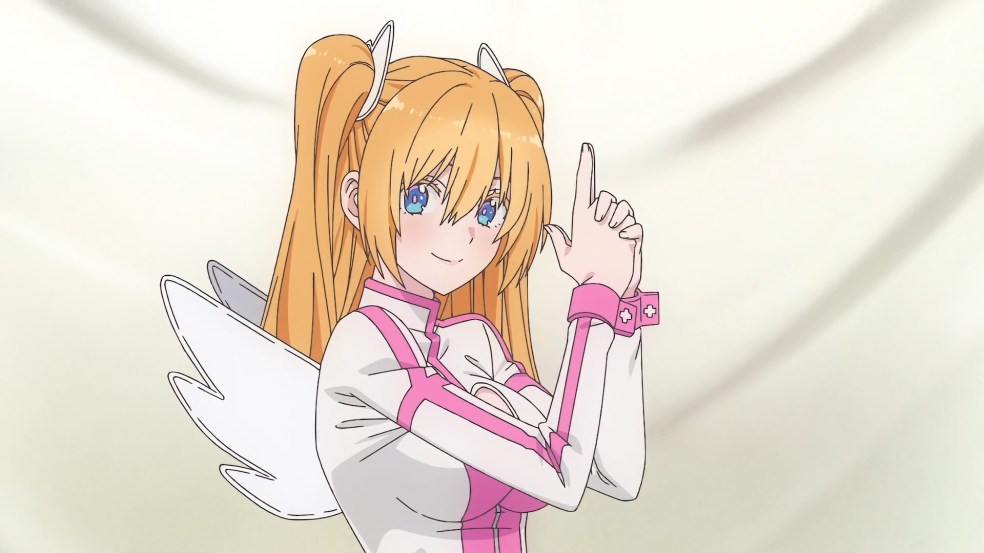
Becoming a cupid thus offers those who suffer this fate a second chance. And the pilot “0th” chapter goes some further way to laying out our premise and cast. Koharu, our main girl, is the rookie on the job. Kanna, her mentor, is laid back and does her best to help Koharu through the twists and turns of her new profession, there’s also the conscientious Ena, as well as Chiyo, who is, we’ll say, rambunctious.

Chapter 0 sees these four disagree over how precisely to resolve a love triangle of teenagers at a local not-McDonald’s. Three of the four cupids are in favor of pairing Hina, their target, with one of her childhood two childhood friends, Aoi or Daito. (The casual bisexuality of almost every ‘target’ character is worth mentioning, here, as an aside. It feels like an unshowy but powerful acknowledgement that the whims of the heart are often too complex to be so easily pinned down.)

Setting Hina up with either of these two would break the heart of the other, so this isn’t a decision to be made lightly. When the cupids are unable to come to an agreement, Chiyo, the one of the three who most likes to talk with her fists, starts a fight.

Fights between cupids aren’t lethal or anything—cupids can’t fall in love, so being shot or blown up or whatever with their equipment instead renders them temporarily indisposed by making them ridiculously jealous—so some trickery on the part of her mentor eventually gives Koharu, who is determined to somehow solve this problem in a way that doesn’t compromise Hina’s friendships, the deciding shot. Thinking outside of the box, she pulls the trigger between Hina and one of the younger employees at the McDonald’s, saving her friendships and setting her up with a sudden-onset crush instead. The takeaway here is this; Koharu has a good eye for unconventional solutions, something that will serve her well as a cupid in the stories of romance-to-be to come.

However, those stories don’t actually exist yet. The first main arc of the series—which comprises the first and currently only volume of the manga—is actually an origin story for our inventive matchmaker, and this is where Love Bullet goes from merely interesting to positively arresting.

Things begin simply enough. Koharu reminisces on her days as human high school girl Sakurada Koharu. She had a reputation as a matchmaker even then, and her talent for noticing these things put her in enough demand that we see her best friend, one Tamaki Aki, having to occasionally step in.

Koharu in fact seems so wrapped up in this little role she’s made for herself that she doesn’t really consider her own feelings very often. Aki directly says as much to her, only for Koharu to self-deprecatingly reply that beyond this talent of hers, there’s not much to her as a person. This is pretty blatantly untrue, but it gives us a good first look at someone who clearly struggles with her own self-worth. For her part, Aki also has ulterior motives behind trying to get Koharu to put herself first a bit more. Those motives? The obvious, Aki wants Koharu to like herself because Aki likes Koharu.

Unfortunately for both Koharu and Aki, however, this is where the series really earns that “doomed yuri” descriptor. Not a full minute after Aki admits her feelings, Koharu, frozen with indecision, promptly has a head-first meeting with the consequences of choosing to have long talks with your friend next to a construction site, and she promptly dies.

This is perhaps the one writing decision in this arc that I could, writing this a few days after having first read it, think of someone perhaps finding cheesy or even contrived. Honestly it kind of is! But that’s not really a criticism, at least it’s not coming from me, because Love Bullet uses this moment to explode into a bomb-burst of grief. A demonstration of how the world absolutely stops when someone you love leaves it. Love Bullet can afford to be a little loose with the actual literalities of how we get to that point, because, setting aside any fundamentally silly complaints about a lack of realism—people die in freak accidents every day—the actual point of all this stuff is to explore the feelings themselves.

This also marks a notable shift in style for the manga. As Koharu passes away, Love Bullet reveals one of its best visual tricks. The four-page sequence where Koharu dies is a pair of mirrored halves, and is just an absolutely excellent execution of this technique, to such a degree that I am surprised to see it from someone who’s relatively new to the medium1. On the first of these pages, three vertically stacked panels depict Aki’s grief-stricken face as she sees the life fade from her best friend. On the second, Koharu lies at the center of the page’s sole panel, in the midst of a heart-shaped pool of blood, finally realizing that she wanted to fall in love too. On the third, cherry blossom petals fall around her as she awakes, again in the center of a monopanel, newly sporting angel wings. Lastly, on the fourth page, three vertically stacked panels again herald the arrival of Kanna, Koharu’s new mentor, here to induct her into the cupids and thus begin our proper story. In the final signal that Sakurada Koharu the human is dead, Kanna addresses her as just “Koharu.” The scanlators helpfully point out that this change is even more drastic than it seems in English. “Sakurada Koharu” is of course a person’s name and is thus written with Kanji in its native Japanese, but “Koharu”, the cupid she’s just become, is addressed with her name written only in katakana, thus reducing it to pure phonics and making it clear that in some profound metaphysical sense, Koharu the human and Koharu the cupid aren’t precisely identical.

We don’t simply leave Aki behind as the story progresses, though. Koharu’s first assignment as a cupid is, in fact, to help Aki herself find a new love. What’s worse—or better, perhaps, depending on your perspective—is that time has not stood still for the human world between Koharu’s death and resurrection. In fact, it’s been half a decade. There’s again a brilliant use of mirroring here. Aki, now a college student at a prestigious art school who looks drastically different than she did just five years prior, is visually contrasted with Koharu, now an eternally-young angelic being, who looks more or less the same aside from her hair, eyes, and, of course, wings. Even their color schemes are stark opposites!

What’s more, successfully matchmaking as a cupid earns that cupid “karma.” Get enough, and history is casually rewritten such that you’re brought back to your human life. Of course, that doesn’t reverse the time that’s passed since then. Even when the prospect of becoming human again is dangled in front of Koharu, it’s very clear that for the most part, these changes that have happened are permanent. Kanna, who seems to style herself an upright mentor type, reveals that she’s actually the one who chose Aki as Koharu’s first target. From both a practical and personal point of view it makes sense; Koharu knew Aki very well, and there are few people more qualified to pick out a partner for her. On an emotional level, Koharu has to deal with the loss eventually, so she might as well take it head on. Still, it does all feel a little cruel, too. Of course, that too is almost certainly the exact reaction we’re supposed to have, and it’s one that gives this whole scenario some extra resonance. The feelings involved in romance, present or past, are rarely straightforward.

Eventually, by peeking at a “data record” that the cupids are given about their targets, Koharu learns that Aki has held a flame for her this entire time. This only makes sense, a person never really “gets over” something like that, but enough time has finally passed that, presumably with no small amount of effort from Aki herself, she’s able to move on to a new person to at least some extent. Kanna is able to gently coax Koharu into accepting her role as a cupid, and she resolves to find the best partner for Aki that she possibly can.

This is where we meet Chiyo.

You give love a bad name.

Chiyo serves as, more or less, the antagonist of this first arc, and is established as “battle-crazy” bad news who doesn’t really care about the people she’s ostensibly trying to partner up. In fact, when initially targeting Koharu here, she taunts that she thinks it would be “more fun” to just pair her up with somebody at random. According to Kanna, this kind of situation isn’t terribly uncommon. Cupids might technically all have the same job, but fights break out over who gets the karma payout off of claiming a particular heart.

All of this, of course, makes Chiyo a perfect counterpart to Koharu. The wild, battle-hungry fighter who’s here for a good time but not a long one vs. the shy newbie who has some actual investment in the fate of Aki’s love life. It’s actually Kanna who does most of the fighting with Chiyo, though, which would seem like a missed opportunity if they didn’t clearly have some sort of shared history of their own. (Chiyo calls Kanna out on trying to act like “a goodie two-shoes.”) Kanna is able to get Chiyo mostly off of Koharu’s trail by challenging her to a straight-up fistfight, which the heavily armed angel finds interesting enough to agree to.

Koharu, meanwhile, is sent to infiltrate the school with some angel magic. She can actually use this “cupid’s charm” to disguise herself as a human and interact with the college students, including Aki herself. (Who, in another melancholy development, can’t recognize her under the glamour.) Koharu is able to get a general sense of Aki’s current state in life by doing this, and while tons of Aki’s classmates are head over heels for her straightforward, honest nature and deep knowledge of art, most of them are pretty forward about trying to earn her affection, something she doesn’t really seem to care for. Koharu gets the sense that Aki needs someone more reserved and on the quieter side. In another brilliant little page-to-page compositional trick, the thought balloon that begins with “It’s like they need to be someone more reserved. Someone like–” is interrupted by another student calling Koharu’s name on the next page.

It’s perhaps unsurprising that Sakura there, a reserved and shy girl not terribly unlike Koharu herself, is who Koharu eventually picks as Aki’s love interest. I worry that reducing the setup to who “wins” though might make it sound like Koharu is being selfish or even living vicariously through Sakura. In actuality, the manga goes some length to demonstrate that Koharu’s decision is one she comes to after careful consideration. (And after Kanna wins her little bout with Chiyo in a very fun sequence I’ll leave unspoiled.) What gives her the conviction to finally pull the trigger is a conversation between Sakura and Aki herself. By this point, she’s shed her human guise, and the two thus can’t see her. As such, she’s given the surreal experience of hearing Aki recount her own death, and how she’s been dealing with the aftermath since then. It’s a beautiful scene, Aki quietly lays out how she managed to come to terms with Koharu’s passing, and Koharu, improbably, is there to hear all of it.

What really makes this work is how it helps Koharu come to terms with her own loss. In the final moments before she shoots, Aki’s feelings of loss seem to overlap with her own. Aki’s loss of Koharu reflects Koharu’s loss of Aki, the time that’s now forever lost between them, and both of their respective needs to continue onward in spite of all that. To put it bluntly, this all really, really got to me. I don’t cry over fiction easily, but that last page, where Koharu finally pulls the love pistol’s trigger and destines Aki and Sakura to fall for each other, made me start sobbing.

If you love something, set it free.

This, all of it, is fantasy in the purest sense. We don’t know, by the very nature of these things, whether our departed loved ones would want us to move on from them, but the idea that they would seems to be common across cultures, and these ideas that hit so close to the root of the human experience that they’re nearly universal are much of what I come to anime and manga for in the first place. Love Bullet is written by someone who is in all ways quite a different person from me, but the pain at the back of our minds, when we remember those who aren’t with us anymore, connects me to a girl in this story. That means something, and shouldn’t be dismissed.

Case in point: over a decade ago, an internet friend of mine vanished after being grievously harassed in the way that was all too common back then. Shortly before leaving, she told me she’d been crushing on me since we met. That was a very long time ago, and I don’t really have any way of knowing what happened to her, as this was before having all of your alternate social media accounts listed in some convenient place was common. Suffice it to say, my situation and Aki’s are quite different. But the fact that her story stirred this memory in me at all is a testament to the power of the narrative being put together here.

It is, I hope I’ve made clear, excellent stuff. These feelings are what art is for. What’s most impressive about Love Bullet is how it’s clearly the product of a unique and mature artistic voice, from someone who is clearly incredibly talented despite being relatively early on in her career. But what makes it worth reading are those moments of connection, the ones that hit you in the heart.

Obviously, I love this thing to death and want it to continue very, very badly. Inee has mentioned that she has a whole saga for Koharu planned out. (Plus there are so many opportunities for other interesting stories here as well. I am sure Chiyo, for example, has some heart-stompingly sad backstory that I simply need to see.) Unfortunately, though, this is where we get to the part of the article that’s not about the manga itself. Love Bullet, you see, is serialized in a magazine, and thus like any manga bound to that format, is subject to the whims of various people working on the business side of that endeavor. Those people are, often, absolutely ruthless about axing any manga that threatens to underperform. (A counterproductive approach that tends to part ongoing manga from their audiences right as they’re getting to know each other, it must be pointed out.) Love Bullet has, apparently, been underperforming in its volume 1 sales, and its future is therefore rather uncertain.

This is upsetting not just because it’s a fantastic story but also because, god damn it, I’m an author too. One of a very different kind, of course, but it’s impossible for me to see this person writing this story, pouring their entire heart into it, only for it to be threatened by the scythe of capitalism, and just sit here and do nothing. Rarely if ever are my articles capable of affecting tangible, direct change on the world. But this might be an uncommon exception. Sancho Step, the group responsible for scanlating the manga and thus bringing it to international attention (and whose scans I’ve been showing off here), have a very handy guide to purchasing the first volume either physically or digitally. Sancho Step have already done a lot for Love Bullet, and I’m under no delusion that my site has a massive reach, especially not compared to the #ReadLoveBullet campaign they’ve already had well under way for some time now. Still, if I can help move even one copy of the manga and possibly forestall its demise, that’s worth it. Good, impactful, resonant art is worth it, and Love Bullet is absolutely every single one of those things.


1: As is the case with most mangaka who get a debut serial, there is ample evidence that inee published some amount of independent oneshots and such before writing Love Bullet, so it’s not like she’d never picked up a pen before drawing it. Still, the command of panel composition displayed here is exceptional.


Like what you’re reading? Consider following Magic Planet Anime to get notified when new articles go live. If you’d like to talk to other Magic Planet Anime readers, consider joining my Discord server! Also consider following me on AnilistBlueSkyTumblr, or Twitter and supporting me on Ko-Fi. If you do the latter soon enough after this article goes up, I will probably use the donation to buy a copy of Love Bullet, so thanks 🙂 If you want to read more of my work, consider heading over to the Directory to browse by category.

All views expressed on Magic Planet Anime are solely my own opinions and conclusions and should not be taken to reflect the opinions of any other persons, groups, or organizations. All text is manually typed and edited, and no machine learning or other automatic tools are used in the creation of Magic Planet Anime articles, with the exception of a basic spellchecker. However, some articles may have additional tags placed by WordPress. All text, excepting direct quotations, is owned by Magic Planet Anime. Do not duplicate without permission. All images are owned by their original copyright holders.
Seasonal First Impressions: Dead or Alive 1333 – In Search of THE ELUSIVE SAMURAI

Seasonal First Impressions is a column where I detail my thoughts, however brief or long, about a currently-airing anime’s first episode or so.


The opening few minutes of The Elusive Samurai are mostly setup, to establish our feudal Japanese setting, and some basic character humor. I must stress, not very good character humor. These are all cracks at the expense of one-note stereotypes; an ableist caricature that serves as a puppet ruler, a greedy, homely girl who hounds our main character because she has Mon signs in her eyes over the idea of marrying him someday, etc. I bring this up first not to criticize a Jump adaptation for having Jump manga humor (it’s an unfortunate reality of most things that run in the magazine, honestly), but to point out that Elusive Samurai pulls off a pretty nasty little trick with it, one that I can only respect. By the end of the episode, no matter what you thought of these characters and their flat interjections of comedy the first time around, you’re going to miss them, and appreciate the stabs of comedy that remain, no matter how out of place they’d otherwise seem.

The Elusive Samurai is interesting as an adaptation, essentially holding the manga open and bleeding it. The resulting effect is a series of incredibly strong tones, moods, and single scenes that work excellently in of themselves but only cohere if you take a step back. This isn’t a major departure from the manga, to be clear. Both feature a wild tonal seesaw. But the manga’s visual experimentation in the first chapter is constrained. Panels align to grids, pages are more or less orderly. Ambitious, but typical. The anime, meanwhile, is a shattered, slivered kind of chaos. Everything clashes with everything. All abrupt jolts. A procession of staccato jumps. It’s abrupt. Percussive. An analogy: Elusive Samurai is a song. Its plot beats, the rhythm. Tokiyuki, our lead, is the melody. When the action follows him, it sings and soars. He’s like a rabbit; nimble, ferociously committed to his own survival, and so cute you can’t help but be on his side. Yuikawa Asaki gives him an endearingly boyish voice, which goes a long way to elevating his already strong characterization from the manga.

I’m not trying to downplay that manga; it still does quite a lot with the 50ish pages of its opening chapter. But one gets the clear sense that it’s straining against the format a little1, which simply isn’t true of the anime. Every hook and jab designed to throw you off kilter feels intentional. Around the episode’s halfway point, Tokiyuki and his older brother—the child of a concubine—are playing with a kickball. It ends up on a roof, and it never comes back down. Instead, an ice-cold match cut turns it into a severed head, and from then on, Tokiyuki’s idyllic life is over.

Let’s rewind a little. Hojo Tokiyuki was a real person, a member of the Hojo, a house in 14th century Japan who were, in loose terms, nominal rulers of the country but several steps removed from any actual power. (The Hojo were, and Tokiyuki is the heir of at the start of the story, something absurd like the regents for the shogun for the Emperor. In turn, they, via Tokiyuki’s father, who is here the ableist caricature mentioned up at the top of this article.) The Elusive Samurai is thus, very loosely, historical fiction. Its events comprise the leadup to, and depending on the time period this series spans, possibly the actual events of, the Nanboku-chō Wars.

This friendly-looking tale of straightforward heroism is presented to us at the start of the series as an example of what we will not be seeing here.

This setting contextualizes all of these tone shifts somewhat. On the one hand, Tokiyuki is a child. He’s a boy of scarcely 8 whose tutors, throughout the episode’s bright forehalf, chastise him for being lazy, for running away when he doesn’t want to do something, and just generally being too carefree. But he is also a noble, and while his father’s position is that of a puppet, it is still a position. These expectations must weigh on him, and we get some sense of how when we’re introduced to our other main character.

Suwa Yorishige [Nakamura Yuuichi], a priest, is introduced to us, to Tokiyuki, literally beaming. The boy-prince finds himself in a tree and Yorishige appears suddenly behind him, offering portents of glory and doom in an extremely overbearing, forceful fashion.

A divinity dwells within him and seems to spill out of the screen; when he’s “on,” he emits radiant lights, dimmed somewhat only by his snarky assistant Shizuku [Yano Hinaki], who explains he’s a sham of a priest, but a real oracle. When Yorishige proclaims that Tokiyuki will, in a few years time, be a war hero beloved and feared in alteration, the prince is skeptical, and he promptly darts off once again.

Returning to his castle, we return to the scene of he and his brother playing. We return to the ball, and to the severed head.

When the violence intrudes in the episode’s second half, it is immediate, overwhelming, and oppressive. Like the smoke from a fire, but not like the smoke from a fire, as the city burns in very literal flames. The betrayal of Takauji [Konishi Katsuyuki], a vassal of Tokiyuki’s, marks a massive and irreversible turning point in the individual lives of not just Tokiyuki and every other character, but history itself. The two are juxtaposed; big, white text pops up like news headlines, proclaiming mass death, including of characters we met in the lighthearted first half of the episode. Tokiyuki’s archery teachers? Dead. His father? Committed suicide alongside his retainers. Kiyoko [Matsuda Satsumi], the girl who teases him in the very first main scene of the episode? “Violated and brutally killed,” per the sub track. These things aren’t dwelled on, exactly. They’re just presented as cold facts as the city of Kamakura burns to cinders. (Although it doesn’t feel like a coincidence that many of these characters are the very same who offhandedly called him cowardly in the episode’s first half.) The pounding drums of what’s become a war song.

One can hardly blame Tokiyuki for being completely devastated. When Yorishige appears to rescue him, he initially rejects the offer. He wants to die alongside his father. What’s more surprising is that the sham shaman obliges, pushing the displaced prince off of a cliff and alerting a group of samurai to his presence. In this hopeless situation, does the rabbit lay down and die?

Of course not. The running, ducking, bobbing, hiding, and dodging of the first half of the show comes flooding back. This time, with consequence. The samurai hack and cleave at him, but only hit each other. They go from an indistinct, merged smear of viciousness to cutting each other’s limbs off; both senses of the phrase “bleeding together” bleeding together. Improbably, Tokiyuki escapes. He, Yorishige, and Shizuku retreat into the night. The composition of the show has flipped around; now, Tokiyuki is the percussion, and the melody are the smoldering flames reaching into the night sky as he flees.

Yorishige lays out a plan. Tokiyuki can’t defeat Takauji alone, he must hide, he must flee, he must court allies and deceive his enemies. Tokiyuki must become El-ahrairah; cunning, full of tricks, listener and runner. That’s just how it goes for a prince with a thousand enemies. If it feels hard to read any glory into such a tale, that’s probably the point. A story where the hero is a coward and the villain sends armies to rape and murder townsfolk isn’t the cheeriest thing, no matter how much cheesing for the camera Yorishige might do. Then again, brutal violence is hardly a foreign element to this kind of historical fiction. That’s probably part of the point, too. The show spells it out directly; Tokiyuki is a hero of life. Takauji, his nemesis, one of death.

The series asks us to take on faith that this will be worth it, in the end, that it will tell a satisfying story. It’s a fair point to raise! All of these visual tricks are great and lovely and engaging, but does this story come together? If you take a very big picture view, you can read its dizzying fractiousness as intentional, as I’ve chosen to do here, but we’re in for 11 more episodes of this stuff, so it’s fair to ask what it will all add up to. And there is always the temptation to try to be definitive. If you forecast that a show will do this or that, and then it does, you look like a prophet. (Or, at least, someone who knows their Japanese history, in this case.) The honest answer though is that we won’t know if it feels “worth it” until we get there, and I think looking to divine the future is, in the case of something so freewheeling, probably doomed to frustration. The Elusive Samurai‘s visual element alone gives me more than enough to chew on to want to come back next week, but combined with the plight of Tokiyuki, fleeing into the night with his whole world in smoldering splinters behind him, it becomes magnetic. I have to know more.


1: Although it does experiment in its own way, eg. a raised sword jutting through one panel to pierce another on the opposite page.


Like what you’re reading? Consider following Magic Planet Anime to get notified when new articles go live. If you’d like to talk to other Magic Planet Anime readers, consider joining my Discord server! Also consider following me on AnilistBlueSky, or Tumblr and supporting me on Ko-Fi or Patreon. If you want to read more of my work, consider heading over to the Directory to browse by category.

All views expressed on Magic Planet Anime are solely my own opinions and conclusions and should not be taken to reflect the opinions of any other persons, groups, or organizations. All text is manually typed and edited, and no machine learning or other automatic tools are used in the creation of Magic Planet Anime articles, with the exception of a basic spellchecker. However, some articles may have additional tags placed by WordPress. All text, excepting direct quotations, is owned by Magic Planet Anime. Do not duplicate without permission. All images are owned by their original copyright holders.

Seasonal First Impressions: Otaku Hot Girl Summer in 2.5 DIMENSIONAL SEDUCTION

Seasonal First Impressions is a column where I detail my thoughts, however brief or long, about a currently-airing anime’s first episode or so.


Something’s in the air. Maybe Dress-Up Darling was the warning shot, but to hear Megan Thee Stallion tell it, the era of the Otaku Hot Girl is upon us. If we are not prepared, that’s probably on us.

Look upon your god and despair.

2.5 Dimensional Seduction, another entry in the “girl with a gimmick” subgenre of romcom, opens with insert narration. Here, our female lead, in voiceover, waxes rhapsodic about cosplay as the ultimate form of transformation and devotion. I don’t know about all that, but it’s certainly a very involved hobby. I don’t have the figure for it, myself, but I can imagine someone caring this much about it pretty easily. When we meet this person a few minutes later, we will find that she cares this much about basically every aspect of otakudom, so it’s certainly in character.

The first character we meet after the OP plays isn’t her, though. It’s Okumura Masamune [Enoki Junya], the president and sole member of his high school’s ‘Manga Research Club.’ Which is to say; he spends his free periods holed up in a club room watching OVAs by himself. In introducing himself to us, he tells us, charmingly, that he doesn’t like real women and only cares about anime girls. In telling us this, he recounts a remarkably quick series of mini-vignettes of romantic rejection and ostracization from his peers. This is as good a place as any to pause.

I already talked at length about the girl-with-a-gimmick setup on the 4th when I wrote about Roshidere, so I won’t repeat myself too much. But it’s worth briefly contrasting these shows to bring up a main difference between them. In Roshidere, the male lead seems to have a reasonable amount of self-esteem, despite being a huge nerd. In 2.5D, this is clearly not the case, or is only the case in that sort of weird sideways way that nerdy people tend to do where we convince ourselves we’re somehow better than everyone else for having slightly unusual interests. The geekboy persecution complex is a whole thing I don’t have the space or desire to get into here1, but there are two key things we should take away here. A. Given everything else we see in this episode, Masamune talking about how he only likes 2D chicks is clearly a coping method for managing rejection. B. Related to that, he is not a reliable narrator of his own feelings. This makes him a bit interesting, because it means, despite his misogynistic sentiments which they are clearly meant to be able to relate to, that he is not just a cipher for the audience to project onto. You’re not as much supposed to think that you are this guy, and more that you’re at least kind of like him. (Even if you’d handle the situation better. Maybe especially if so.) We’re led to both empathize with and look down on him, a perspective that bears some distant relation to the strange, schadenfreude-driven ethos of manga like Rent-a-Girlfriend. Thankfully, despite that, there’s nothing so heavy here. Our main boy is mostly just kind of a twit, and I’m pretty confident that we’re supposed to be laughing at him at least a little, even if the show does assume you’ll also root for him as a sympathetic (and presumably also nerdy, teenage, male) audience.

This becomes more obvious when our female lead, and in many senses our actual main character, Amano Ririsa [Maeda Kaori], barges into the clubroom and into Masamune’s life. They quickly bond, to Masamune’s own frustration, over a shared love of the character Lilliel, a magical girl from a series called Ashword Wars. From Masamune’s own point of view, this is a perfectly Shakespearean tragedy. Here he is, having proudly sworn off real women, only for one that he can’t ignore to crash into his life. Even without that other element that I’m deliberately dancing around this far up the page, this would already be a perfectly serviceable romantic fantasy for this show’s target demo. The two talk about minutiae in the Ashword Wars OVAs. Ririsa compliments Masamune’s frighteningly extensive collection of Lilliel figures, including the one with an exploding outfit. They play a fighting game together. What’s not to love?

In fact, if Masamune were more confident and well-adjusted there almost wouldn’t be a story here at all. There’s a real “Man vs. The Self” element to his inner monologue, which runs throughout much of the episode, in which he denies any attraction to this girl. He acknowledges that she’s attractive, and can even bring himself to say that “despite her gender” (goodness), she’s a true otaku. Were it not, he thinks, for the fact that she just has one too many dimensions, she’d be perfect.

Thus enters the cosplay angle.

I might describe the overall plot of the first episode as “guy gets incredibly freaked out upon learning a girl is way, way more of an otaku than he is.” Ririsa, you see, loves the same sexy heroines that Masamune does, claiming she projects herself onto them. This is—I hope I’m not shocking anyone by saying this—a real thing. Tons and tons and tons of girls, the world over, love and adore female characters who are, in some sense, made to cater to some kind of male fantasy. The world we live in is, unfortunately, patriarchal, and thus dominated by male fantasy. One plays the hand they’re dealt, and active reappropriation of these characters is a thing that any woman engaging with a male-led fandom2 learns to do. It’s second nature at a certain point. I found myself vibing pretty hard with Ririsa here, essentially proving the show’s own point! We’re not otherwise particularly similar people, but I love magical girls a lot, too! If I looked good doing it, I would probably cosplay at least occasionally. All of this is taking the long way around of saying; it is not actually surprising or unrealistic that Ririsa is who she is and loves to cosplay. Her sheer boldness in undressing in front of a male classmate is surprising and unrealistic—as is her taking him at his word when he says he’s not attracted to actual girls—but we can excuse that, as you please, as either naivete on her part or just a necessary narrative greasing of the wheels to make this setup work at all.

Ririsa explains that she truly fell in love with cosplay when a nascent fascination with the idea led her to attend an in-person event. Seeing all the other beautiful girls there dressed up in sexy outfits awakened something in her (I have rarely so quickly decided a character is bisexual), even after she was gently shooed off for being too young to attend. (To give you an idea, one of the cosplayers describes it as a “softcore” event. These girls are selling photoCDs filled with suggestive pictures of themselves, and that’s not something the show avoids talking about.)

Driven by the, ahem, beauty and passion on display she saw that day, she’s determined to eventually sell a photo CD of her own. Honestly, despite the ostensibly saucy subject matter, her attitude toward the whole thing is mostly just cute, but her passion for the hobby is clearly genuine. She ropes Masamune into taking pics of her in not one but several Lilliel outfits, and predictably he gets really into it. Enough so that he conks out from Ririsa calling him “Ashford-sama” (another character in the manga, you understand). Some further developments aside, the episode ends with Ririsa wondering why her heart is pounding so fast when remembering the photoshoot later that day, thus setting us up for future romantic adventures that will presumably involve a lot more photos of Ririsa in kinky outfits.

The fairly straightforward resolution may make one wonder. All of this subtext, the stuff about reappropriation and whatnot, that I’m reading onto the show, is any of it actually intentional? Without a direct line to the mangaka, it’s hard to say, but it also only half matters. A funny side effect of the show’s focus Ririsa is that, despite everything I said earlier about Masamune not being a simple audience stand-in, and despite not being the one with a running inner monologue, she actually comes off as having more interiority than he does, especially given that the interiority he does have is not particularly flattering! Ririsa is certainly the more sympathetic of the two, and I would not be at all shocked if this series picks up a decent-sized periphery of female fans who relate to Ririsa in some loose sense, even as the show, going by various promotional materials, gears up to get racier. This wouldn’t even be the first time such a thing has happened in recent memory.

My Dress-Up Darling, the other hot 2020s property about a guy and his hot cosplayer gf, is the obvious point of comparison here. But what’s striking to me is how different the shows feel. Dress-Up Darling has a lot of delicate character work, but it’s also actually more salacious than 2.5D has been so far. (In terms of the respective anime at least. I’ve read neither manga.) The two halves of that show can, in fact, feel like they fit together uncomfortably, when it’s doing closeups of lovingly-animated boob sweat in one episode and melancholic-romantic train rides home in the next. I can only speak for myself, but when watching that anime I often wished it would settle down a little. It really sings in its more character-driven moments, so the ecchi elements can feel like a distraction except in the rare occasion that they gel just so with everything else that show is doing. Even so, Dress-Up Darling is pretty straightforwardly the better series, and not just because Gojou is a much more likable male lead. I would be very surprised to see 2.5D even attempt to access some of the more complex emotional currents that MDUD consistently manages to, even in its weaker episodes.

2.5D is a series of much more limited ambitions, in general. The goals here, as of now, are to gently push Masamune and Ririsa together and have them engage in Convoluted Horny Situations, goofy antics, or both—in alteration or combination—the entire long way. There’s still a character arc visible from the start here, but Masamune is a much simpler character than Gojou from MDUD, and because he is also an otaku, he and Ririsa are instantly much more on the same page than Gojou and Marin are. Masamune denying his attraction to Ririsa, and then justifying it by claiming she’s a “2.5D girl”, is a bit. Something to make You, The Horny Teenage Boy Watching This Show, think he’s a lucky bastard but laugh at the same time.

A less cut-and-dry way it’s less ambitious lay in its visuals. 2.5D’s first episode has essentially one standout moment—the “headshot” when Masamune sees Ririsa in costume for the first time—against a general temperature of looking pretty good. But it’s not quite as striking as Dress-Up Darling or even Roshidere, so that does count against it a little. Even then, it’s hard to care too much when even “not as good as those other two shows” still looks pretty good. It also doesn’t seem nearly as interested in the finer details of cosplay and costuming as MDUD is, so I could see that being a negative for folks who want an authentic depiction of the experience. Certainly, I found myself missing it.

Overall, though, while I don’t know if I’d call 2.5D a particularly great show, I’m forced to respect its craftsmanship, as an honest critic. I can appreciate that, on some level, it is doing everything in its power to get these two dating. I will also admit to just having a weak spot for shameless audacity, and because 2.5D’s audacity isn’t tying a romance narrative I like a lot more down (so far, anyway), I am more charitable toward it than I might be if it were trying to do more things at once. Is that unfair? Yes! But that’s just how these things go sometimes. I think this show is alright; long may the Otaku Hot Girls reign.


1: For one thing, it’s not unique to otaku, at least not in the loanword sense of that term. When I was in high school, people were just as willing to get this kind of defensive over liking comic books, D&D, fantasy literature, alternative music, even video games well past the point where those had gone firmly mainstream. I imagine the boys at the younger end of Gen Z are fighting this particular fight even still, as we speak.

2: Which is most fandoms. Because the patriarchy privileges men in any given hierarchical system, you see.


Like what you’re reading? Consider following Magic Planet Anime to get notified when new articles go live. If you’d like to talk to other Magic Planet Anime readers, consider joining my Discord server! Also consider following me on AnilistBlueSky, or Tumblr and supporting me on Ko-Fi or Patreon. If you want to read more of my work, consider heading over to the Directory to browse by category.

All views expressed on Magic Planet Anime are solely my own opinions and conclusions and should not be taken to reflect the opinions of any other persons, groups, or organizations. All text is manually typed and edited, and no machine learning or other automatic tools are used in the creation of Magic Planet Anime articles, with the exception of a basic spellchecker. However, some articles may have additional tags placed by WordPress. All text, excepting direct quotations, is owned by Magic Planet Anime. Do not duplicate without permission. All images are owned by their original copyright holders.

Seasonal First Impressions: The Revolution Never Ended for CODE GEASS: ROZÉ OF THE RECAPTURE

Seasonal First Impressions is a column where I detail my thoughts, however brief or long, about a currently-airing anime’s first episode or so.


They fucking got me again.

Let me explain. Nearly 20 years ago, a little anime called Code Geass (subtitled Lelouch of The Rebellion) premiered, and it barged into the hearts and minds of myself and so many other impressionable young teens with reckless abandon. Short of perhaps Death Note, no anime was more synonymous with a certain kind of mid-aughts I’m 14 And This Is Deep chuuni shit. Quite unlike its former chief contender, Code Geass has remained an active franchise in the years since.1 I haven’t seen them myself, but the Akito the Exiled spinoff films have their following, and the series has kept chugging along with various ancillary media too, some available in English and some not. In 2019, the Lelouch of the Re;surrection film staked out an alternate continuity where Lelouch comes back to life. That movie was a bit of an up-and-down experience, and mostly succeeded off the strength of being a movie full of Lelouch doing Lelouch Shit, but its best moments were classic Code Geass camp and proved that the franchise still had some life left in it. Code Geass has been around, so the existence of Rozé of the Recapture, a new series of theatrical OVAs that are also being streamed week to week as a regular TV series (don’t ask me how this works, I don’t know), is not too surprising.

It’s also probably not too surprising to any longtime readers of this blog that I, the Magia Record defender, think that the first episode of what some would deride as a pointless spinoff project is actually really fucking good. In hindsight, I don’t know why I ever doubted the project. I am still the same person I was in 8th grade in one very important way; I love campy goofball shit, and Code Geass is and always has been some Grade-A campy goofball shit.

Rozé of The Recapture takes place many years after some version of the original series’ events—I’m not totally clear on how many, but it’s been long enough to let some additional light sci-fi elements seep into the setting—but rehashes the same fundamental premise. A resurgent “Neo-Britannian”2 empire has once again conquered and subjugated Japan (or at least Hokkaido), once again rebranding the region itself as Area 11 and its citizens as second-class Elevens. Once again, an underground cadre of resistance fighters struggle against their imperial overlords. There are some extra elements this time around (such as a gigantic energy barrier called the Situmpe Wall that surrounds Area 11), but the fundamental premise is the same. And once again, it’s up to a Britannian outsider to help the resistance win the day. More or less. We’ll come back to that part.

The main difference is the most obvious one. There’s no Lelouch, here. He’s gone. The emperor is dead.

In his place we have a mysterious pair of Britannian siblings named Rozé [Amasaki Kouhei] and Ash [Furukawa Makoto]. Ash has yet to make much of an impression on me, but his brother is a different story. Rozé is not Lelouch—nobody could be Lelouch, that’s an impossible pair of shoes to fill—but he’s a pretty fun protagonist so far, with a whimsical and playful personality that belies the brain of a serious tactician. Rozé, however, commands a battlefield that is significantly weathered from his predecessor’s day. In general, Rozé of the Recapture has a marginally more grim aesthetic sensibility than the original series. It’s as though the order was to make it just as camp but twice as dark. Everyone still dresses like a lunatic, and the show has that same love of cutting from battlefield to command room shenanigans to domestic scene and back at a wild pace that the original did, and it even also has its love of bold—perhaps reckless—incorporation of very bleak imagery into something that’s otherwise so fun, but it does feel a bit less bright, even literally, than the original Code Geass did. It’s as though Code Geass knows it is returning to a world that is, if you can believe it, even bleaker than the one it left in 2008. Having not seen them, I can’t comment on how directly this follows from the sensibilities of the Akito the Exiled side series, but I wouldn’t be shocked if those have been quietly building a bridge from the original series’ point of view to that of this anime.

As for the actual events of this episode, despite the slightly updated setting they’ll be very familiar to any returning Code Geass heads. We open with some exposition, and after the OP, a pretty grim scene of Britannian noble siblings—both of a class of knight called Einbergs, something that seems like it will be a recurring thing over the course of this show—Greede and Gran Kirkwayne [Nojima Hirofumi and Ono Yuuki, respectively] being absolutely horrible to a group of random Japanese citizens. This culminates with Gran, the more hotheaded of the two, shooting a man he’s holding hostage in the head. When his wife cries out in grief, Greede makes a token effort to perfunctorily apologize, only to then shoot her when she understandably spits on him. The scene ends with Greede ordering his men to unceremoniously massacre the rest of the gathered group. The message is pretty clear; the Kirkwaynes are bad people, power-drunk authoritarians and bigots with no redeeming qualities whatsoever. Fair enough.

So of course, our protagonists are tasked by the fabulously-named Seven Shining Stars resistance group with taking them out. Their infiltration into the Britannian base, to the extent that it even counts as infiltration, is classic Code Geass. Ash’s knightmare frame emerges from a wrapped-up present box and Rozé spends much of the scene dressed like a clown; you can’t ask for much better than that. Rozé does eventually actually properly infiltrate the base, confronting Greede, the brains of the operation, directly.

The two have a very classically Geassian back and forth. The series’ famous chess motifs return here, as absolutely ridiculously goofball as they were in 2006. Rozé and Greede strategize while poking at some kind of holographic tabletop chess display. When the moment is right, Rozé orders his brother to go all out, and back in the actual battlefield we get some genuinely riveting mecha action, complete with Ash skewering Gran and his knightmare frame with a pair of its own swords after laying down some pretty fantastic shit-talk about how Gran’s a worthless coward.

The robot is pretty cool too. We don’t get a name for it here, but look at it!

Back in the base, we get a fantastic twist here as Rozé, with Greede at gunpoint, offers the Britannian noble a choice. Or, perhaps it’s better to say that he doesn’t give him a choice per se. Because Rozé doesn’t do anything per se. There is no Rozé.

Meet Sumeragi Sakuya [Ueda Reina], the actual protagonist of Rozé of the Recapture.

I am almost never at a loss for words when writing these columns. There’s a lot to say about even fairly uninteresting anime, and Rozé of the Recapture is anything but that so far. But seriously, what the hell does anyone want me to say? They made a character who looks like Lelouch a woman and had her crossdress for most of the first episode. I’m in love, sue me. I’ve seen the phrase “Lelouch of the Transition” drift around the Internet in regards to this twist and, I mean, what can I possibly say that’s better than that? (It does say a lot that this random tweet showcasing the scene immediately following this has done more marketing for Rozé of The Recapture than Disney+, who are distributing it in North America, have, but that is perhaps unsurprising, given their track record.) This scene is what made it truly obvious to me that the show is dedicated to recapturing that spirit of the original as much as possible, hopefully without too-directly rehashing many of its plot points. Rozé of The Recapture does basically nothing at all here to endear itself to any new audiences, and it definitely isn’t going to change the opinion of anyone in the “Code Geass sucks, actually” crowd, but I honestly think that is fine. Code Geass is so entirely itself that trying to “adapt to the times” would’ve been doomed to fail. Call this the rare Millennial nostalgia play that I’m fully onboard for.

In any case, Sakuya shows off her Geass. We don’t know how she got it or precisely how it works—my reverse-engineering attempt here is that it somehow forces the target to choose between two options if they hear her give a command—but she offers Greede the choice of saving a hundred times more Japanese people than he’s ordered dead or killing himself. Suffice to say, Mr. Kirkwayne does not survive to the end of the episode.

We close on Sakuya—back in-character as Rozé—talking to the Stars. She says that she and Ash knew from the jump that this entire mission was more of a test than anything else, and asks what the real objective they’re being hired for is. The answer? To liberate an Alcatraz-like offshore prison to free some of the Stars’ comrades. It just so happens that someone that Sakuya euphemistically calls a ‘friend’—someone named Sakura, who looks so similar to Sakuya that they could be mistaken for each other—is also being held there, under the pretense that she’s Sakuya. The amount of hilarious shenanigans this is setting up is truly dizzying to consider, but the main takeaway is one very important thing; if Code Geass isn’t back per se, that’s only because it never really left.


1: Technically, there actually have been a few short story collections and one-shots and things. But I think there’s a reason that there’s no Death Note spinoff airing right now. Lelouch would whip Light’s ass in any serious battle of wits, by the way. Just saying.

2: I will be using the series’ ridiculous alternate history terminology religiously while discussing it as it airs, thank you.


Like what you’re reading? Consider following Magic Planet Anime to get notified when new articles go live. If you’d like to talk to other Magic Planet Anime readers, consider joining my Discord server! Also consider following me on AnilistBlueSky, or Tumblr and supporting me on Ko-Fi or Patreon. If you want to read more of my work, consider heading over to the Directory to browse by category.

All views expressed on Magic Planet Anime are solely my own opinions and conclusions and should not be taken to reflect the opinions of any other persons, groups, or organizations. All text is manually typed and edited, and no machine learning or other automatic tools are used in the creation of Magic Planet Anime articles, with the exception of a basic spellchecker. However, some articles may have additional tags placed by WordPress. All text, excepting direct quotations, is owned by Magic Planet Anime. Do not duplicate without permission. All images are owned by their original copyright holders.

Weekly Orbit Archive

THIS PAGE IS UNDER CONSTRUCTION

Here you’ll find an archive of every series I’ve written about in the Weekly Orbit. These are listed alphabetically—by the English title if available, by the most common Romanization if not—with each episode number linking to the appropriate Weekly Orbit column or other relevant article.

Anime

  • Air –
    • episodes 1-8 writeup
    • Review
  • Alya Sometimes Hides Her Feelings in Russian –
    • episode writeups: 1 First Impressions, 2
  • Asura Cryin’ –
  • Brave Bang Bravern
  • Bucchigiri?! –
  • Code Geass: Rozé of the Recapture –
    • episode writeups: 1 First Impressions, 2, 3,
  • Delicious in Dungeon –
  • Gabriel DropOut
    • episode writeups: 1-7
  • Girls Band Cry
  • Grimm Variations, The
    • episode writeups: 1, 2
  • Go! Go! Loser Ranger!
    • episode writeups: 1, 2, 4, 5
  • Himitsu no AiPri
    • episode writeups: 1, 6,
  • Jellyfish Can’t Swim in the Night
  • Makeine: Too Many Losing Heroines! –
    • First Impressions 1, 2
  • Metallic Rouge
  • My Deer Friend Nokotan
    • episode writeups: First Impressions 1, 2
  • Mysterious Disappearances
    • episode writeups: First Impressions 1, 2, 3, 5, 6, 7, 8, 10, 11, 12
  • Oshi no Ko, Season 2
    • episode writeups: 1, 2,
  • Pokémon Horizons
  • Quality Assurance in Another World
    • episode writeups: First Impressions 1, 2
  • Salad Bowl of Eccentrics, A
  • Sengoku Youko
  • Train to The End of The World
  • The Wrong Way To Use Healing Magic
    • Shambolic Anime Podcast
    • Episode 13 writeup
  • Unnamed Memories
    • episode writeup: 1 & 2,
  • Wistoria
    • episode writeup: 1, 2,
  • Wonderful Precure

Manga

  • Deep Raputa – 2, 3 & 4,
  • Dai Kyoujin – Oneshot
  • Flan Wants To Die (Touhou Doujin) – Oneshot
  • Magical Girl Tsubame: I Will (Not) Save The World! – 20-23
  • Psych House – 1
  • A Story About A Hallucinatory Girl – Oneshot
  • Witch Watch – 148-159

The Weekly Orbit [6/10/24]

The Weekly Orbit is a weekly column collecting and refining my more casual anime- and manga-related thoughts from the previous week. Mostly, these are taken from my tumblr blog, and assume familiarity with the works covered. Be wary of spoilers!


The season is starting to wind down, and that shows in some of these episodes. Our first two anime this week are setting up for their big finales.

Anime – Seasonal

Train to The End of The World – Episode 11

As Shuumatsu Train enters its final stretch, we kick off one of the series’ denser episodes to date with our heroines arriving, at last, at their destination of Ikebukuro.

They find Youka in short order, but things aren’t simple enough that just reuniting the separated friends is enough. It’s clear that Youka doesn’t remember them—we don’t yet know why, but Reimi openly speculates that ‘wibble-wobble surgery’ of the same type Zenjirou was subjected to might be to blame—and their attempts to remind her who they are fail. Her reactions are confused and interlaced with her 7G powers, and any time the girls try to break through to her, it clearly destabilizes her already fragile mental state, causing the environment around her to temporarily devolve into an acid trip of digital video flickering and color-burst effects. The girls are chased away by Pontarou’s personal guards, the masked Ikebukuro police force.

Retreating to the train, they receive a phone call—via a phone fashioned from bitter melon, of course, because why not?—from Makoto and Zenjirou. Their conversation here basically confirms what we already knew; if they can nab the 7G button and just turn the network back off, the whole world will snap back to normalcy. (Allegedly, at least.) They’re not alone, though, as an unexpected ally turns up in the form of Mito and her zombie horde from a few episodes back. Her zombies, as it turns out, can sense the presence of the 7G button.

Call me stupid, but the show calls attention to a few parallels I hadn’t noticed up to this point. For one, Shizuru and Pontarou are, in a very broad sense, a bit similar, in that both are actively trying to avoid accountability for their actions. (They’re also very different in a number of ways, which I expect the show to draw attention to in its finale.) Also, the zombies, with their longing for the old world back when times were simpler—and indeed their distraction by simple pleasures like cheap ecchi—are supposed to be, you know, all of us, the people watching the show.

I honestly think that this sort of straightforward lock-and-key symbolism doesn’t really suit Shuumatsu Train particularly well. (And hey, what are you trying to say about your audience, here?) But then again, it took me 10 1/2 episodes to connect two dots with a line, so who am I to talk?

In any case, the episode ends with two things. One; a shockingly well animated and choreographed fight sequence between Pochi (as in, Youka’s odd butler / handler. We still don’t know what his deal is). And two; Akira and Mito slamming the 7G button to turn it off. Surprise! It doesn’t actually work, and in the episode’s closing moments, we get the latest in a long line of incredible what-the-fuck moments from Shuumatsu Train, when our heroines’ final obstacle comes rolling out of a high-rise on a track being constructed as it goes by long, gooey arms made of some kind of yellow substance; a second train, with Youka and Pontarou on it, headed off to parts unknown.

Shuumatsu Train has hardly been a perfect anime, but I’ve immensely enjoyed the ride just for how utterly bizarre it’s been. It’s hard to say what the finale will look like, but I’m interested to find out, and in the end, being compellingly weird from start to finish is all I really wanted out of this show to begin with.

Dungeon Meshi – Episode 23

Senshi’s backstory is another area where the addition of color, sound, and motion to the material gives it a slightly different texture than it had in manga form.

In the manga, this backstory felt like a fairly lengthy aside, steeped in deep shadows to a degree that was nearly gothic. Here, rendered in full color—earthy browns, iron greys, bloody reds—it feels a lot more like what it actually is, a traumatic memory. Bunched up in a relatively brief burst like this, but punctuated with a monstrous illustration of the griffin that hounded the dwarves who were taking care of Senshi, and the eventual screams of Null (the dwarf who Gilin, Senshi’s advocate throughout his backstory, butts heads with, and who Senshi believes Gilin may have in fact killed) renders the entire thing violent and scary. You can really feel how this would shape someone to their core.

The backflips the narrative goes through to eventually prove to Senshi that no, it was in fact not another dwarf that Gilin fed to him when he was young, have always been a bit convoluted for my taste, but they go down easier here. Especially when the payoff is Senshi having a big, tearful, emotional moment, always a nice thing to see.

The tail end of the episode is a bit less serious, mostly focusing on the ramifications of the circle of changeling mushrooms our heroes accidentally step into, swapping their species around at random. (Laios becomes a dwarf, Chilchuck a tall-man, Senshi an elf, Marcille a downright adorable half-foot, and Izutsumi a kobold.) It’s all a fairly good gag, although a bit light for Dungeon Meshi, until it ends up having very real consequences when the party run into a troop of gargoyles. I will say, there’s probably something not-entirely-flattering to be said about the show’s refusal to treat kobolds (dog-like, and thus the least human-looking humanoid species) with any dignity, even if the “go get it, boy” ball-toss gag that Izutsumi is subjected to here is admittedly a bit funny.

The episode ends in true Dungeon Meshi fashion; a brief meditation on the universality of dumplings. The series ends this week, and I’m going to miss it.

Mysterious Disappearances – Episode 9

This episode didn’t leave a massive impression on me overall. The core conceit, that of a VTuber being a sort-of tsukumogami due to how rapidly digital data is deleted and discarded compared to physical objects, is pretty cool, as is the VTuber in question being a pastiche of a couple different popular, actual talents. For whatever reason though, the main thing that stuck with me in this episode was the goofy, animated dance number at its end, which is wholly disconnected from the rest of the episode’s story and is mainly about a catgirl who we won’t properly meet for a little bit, yet. Odd! Compelling, but odd!

Pokémon Horizons – Episode 53

Hatenna episode 😊

Our Heroes meeting a trio of people who look vaguely similar to themselves and even seem to be arranged in a similar trio is really funny, to start off with. The main meat of the episode, where they encounter the ghost alluded to last time and learn that it’s an Annihilape, is pretty great all throughout. The animation team really goes through some effort here to convey Annihilape as a menacing, almost otherworldly force of nature. Conversely, it’s pretty cool how our protagonists work together to stop it in their initial encounter, as it shows off a pronounced coordination, which we haven’t gotten from them super often before.

The horde of angry Mankey is honestly a pretty credible threat. Have you ever seen videos of angry monkeys? They’re terrifying. There are a lot of really impressive cuts here, the majority of which are apportioned to Annihiliape but the main trio’s Pokemon get some as well.

Given Hatenna’s prominence throughout the episode, the obvious tack to take is to have it evolve (especially given that Roy got his Kilowattrel last week, and that Hattrem learns the Dark-type Brutal Swing on evolution) but instead, at least initially, it uses its brains to figure out the source of the Mankey troop’s frustration and the remainder of the episode, complete with an insert song, is about helping the troop recover their food store, emphasizing once again Horizons‘ knack for centering episodes around unconventional problem-solving.

That said, the show isn’t enough of a tease to raise the possibility of a Pokémon evolving without actually following through with it. A stray rockslide causes the Mankey troop to start fighting amongst themselves, and some of the Primeape troop leaders even evolve into more Annihiliapes. Short of any other way to keep the peace, Hatenna promptly evolves into Hattrem, beats all of the squabbling monkeys up, and then heals them while they’re knocked out. It’s a genuinely delightful sequence and a lovely capper to a very good episode overall.

Wonderful Precure – Episode 19

We pick up from last week’s Hamster Garugaru two-parter for a just really, really good episode about Mayu, her fears, and her relationship with Yuki.

We kick off with a bunch of cutely-illustrated Japanese turns of phrase, most of which were new to me, and all of which are animal based. This has minimal relevance to the rest of the episode, but I mention it because it’s cute.

We also meet the evil general for only the second time, though once again he simply encourages the garugaru to Be Angry while giving it some new powers, advice it has no problem taking. The animators deserve some credit here for making a goddamn hamster seem like a credible threat (and for making Yuki seem genuinely threatening in turn when she trash talks it a bit later in the episode), what a feat.

Given that this episode is called “The Birth of Cure Lilian”, it’s no surprise that Mayu’s Cure alter ego debuts here, but we actually get an explanation of that name in the episode itself. Mayu’s mother mentions a lily-yarn that Mayu made for her when she was young as an example of Mayu imparting positive emotions and experiences to other people. Given some flashbacks early in the episode and, really, her entire previous existence in this series, it seems like this is a hard thing for Mayu to believe. She’s honestly so scared of everything that it makes her come off as having an actual anxiety disorder of some kind. Same, girl!

This all makes it that much worse when the garugaru, using its newly-granted ability to shrink Komugi, Iroha, and Yuki to the point that they’re too tiny to be a threat. This leaves Mayu alone against the garugaru when she comes across Yuki.

Standing her ground even in this frankly pretty scary situation—because she’s even more scared of losing Yuki than she is of the garugaru—allows Mayu, through the magic of the Mirror Stone, to become a Precure herself, and with that, our core team of four is complete.

I still like Yuki just a bit better as a character (I have a weakness for bitchy catgirls from this franchise, I suppose), but Mayu’s transformation into Cure Lilian might actually be even more drastic than Yuki’s into Cure Nyammy. It is relatively rare that a magical girl transformation feels so truly transformative. As much as I love them, one gets the sense that Komugi, Iroha, and Yuki are basically the same people as Cure Wonderful, Cure Friendy, and Cure Nyammy. This isn’t really the case with Mayu. With the Mirror Stone’s power, Lilian becomes everything she couldn’t be without it. Graceful, strong, courageous, a protector. It’s fantastic, and her voice actress Ueda Reina absolutely pours her whole heart into her performance in this episode to help sell it.

After the garugaru is defeated and turned back into a hamster fairy, Mayu and Yuki reconcile in a genuinely really sweet moment of teary-eyed reaffirmation. They want to stay together, so they will, no more to it than that.

Anime – Non-Seasonal

Rozen Maiden – Episodes 5-12

Pretty good all around! I don’t have a ton to say about Rozen Maiden, but as an old-school action series with a somewhat shoujo-y bent I think it’s quite a nice ride overall, and I loved all of the characters, especially Suigintou whose death(?) in the final episode absolutely ripped my heart out. Poor girl thinks of herself as incomplete and takes it out on everyone else. Which of course, is a reflection of how Jun, the main protagonist, does the same in an admittedly much less violent way. (Side note here: Suigintou x Shinku is some deliciously classic toxic yuri. Waiter send me more, please and thank you.)

Manga

Witch Watch – Chapters 148-159

I’m not sure what it says about me that, while there are other manga in the publication that are more meaningful to me, Witch Watch is consistently the thing I have the most fun reading in Jump these days.

I think it’s the manga’s combination of a lean but engaging storyline with an absolute ton of off-the-wall goofball shit. I can sense that we’re getting close to the end of this “aged-down Nico” arc, and while it’s been a return to the manga’s earlier, decidedly comedic days, I am glad that a return back to the whole Witches vs. Warlocks plot that continues to tick along in the background is on the horizon. I like the new character introduced in yesterday’s chapter, too. The idea of an apparently ‘chuuni’ adult who just Actually Is involved with a bunch of supernatural stuff but is really bad at hiding it is pretty fun.

On a note less immediately related to the current chapter, Ban is such a fun addition to the cast, I absolutely love her. Rabuka seems like she’s going to be part of the school group in upcoming chapters too, which is also exciting since she’s one of my favorite supporting characters. All around, just a really fun and readable manga that I’d recommend to just about anyone.


And that’s all for this week. While I have your attention, I’m going to go ahead and recommend Yume Nikki fan game / MMO (!) Collective Unconscious, a free exploration game about wandering around and gawking at cool scenery. I may write about it at some point, but if not, consider this an endorsement.

As for this week’s Bonus Thought, you know I have to go with this.


Like what you’re reading? Consider following Magic Planet Anime to get notified when new articles go live. If you’d like to talk to other Magic Planet Anime readers, consider joining my Discord server! Also consider following me on AnilistBlueSky, or Tumblr and supporting me on Ko-Fi or Patreon. If you want to read more of my work, consider heading over to the Directory to browse by category.

All views expressed on Magic Planet Anime are solely my own opinions and conclusions and should not be taken to reflect the opinions of any other persons, groups, or organizations. All text is manually typed and edited, and no machine learning or other automatic tools are used in the creation of Magic Planet Anime articles, with the exception of a basic spellchecker. However, some articles may have additional tags placed by WordPress. All text, excepting direct quotations, is owned by Magic Planet Anime. Do not duplicate without permission. All images are owned by their original copyright holders.

The Weekly Orbit [6/3/24]

The Weekly Orbit is a weekly column collecting and refining my more casual anime- and manga-related thoughts from the previous week. Mostly, these are taken from my tumblr blog, and assume familiarity with the works covered. Be wary of spoilers!


Hello, anime fans! Over the last week, things have really been heating up in certain corners. I won’t belabor the point, every episode covered below is, at bare minimum, compelling, and some are absolutely arresting. Let’s get into things!

Anime – Seasonal

Mysterious Disappearances – Episode 8

The anime continues its relative strong streak here, with an episode that expands a part of the story that was only a chapter or two in the manga and gives it full focus.

Here, we focus on a young Sumireko’s adventure to a mysterious bookstore and how said encounter helped her overcome her anxiety. There’s a real nostalgic warmth to both the bookstore itself—I spent a lot of time in book shops as a kid, I get it—and its actual depiction, which thankfully ditches the dripping, cloying sepia of previous flashbacks for an extended full-color reminiscence, lightly brought down into the realm of earth tones, to quite literally paint a picture of what going to this place felt like. Gentle, comforting, mysterious, childhood-defining, it’s all things that this kind of flashback could be, and my only real point of contention here is that more of the show hasn’t tried this hard to look this good. I should also bring up the way they depict the books Sumireko is reading, which has a fun paper cut-esque quality to it. It’s visually inventive in a way the rest of the show hasn’t been even if the actual technicality of what’s being done isn’t particularly crazy.

Naturally, the book shop has mysterious origins of its own that aren’t revealed until the episode’s second half. Its mysterious proprietress, a dark-haired woman whose kindness is matched only by her love of literature, is revealed as an ancient spirit from the early Shogunate, immortalized in part via her love of literature, she is someone to whom heaven is literally a library.

The second half of the episode kicks off what is likely the second to last arc that the anime will cover. It remains to be seen how the show will handle that, but I’ve been enjoying the series’ late recovery and am pleasantly surprised by it. I don’t get to give out the “substantially improved” award distinction super often.

Girls Band Cry – Episode 9

After last week’s emotional bombshell, we have a slightly lighter episode this week, although still one with a lot of narrative momentum. (And, crucially, a focus on Tomo, one of the show’s less developed characters up to this point.)

Those who succeed in their chosen field have a tendency to romanticize hard work and effort. Presumably, those working on Girls Band Cry are no exception, most of this episode characterizes Tomo as a cornered tiger, someone who struggles to speak her mind but can be absolutely vicious when given permission (or reason) to do so. This collides with Nina’s ongoing quest to learn guitar on her own so she doesn’t have to keep relying on Momoka in an interesting way. Tomo’s feedback, when Nina presses her enough to actually get it, is withering, and a less determined person might give up. Nina doesn’t, and much of this episode revolves around getting the whole band on the same page so that Tomo can provide some direction. This is epitomized here by the ongoing process of hammering out the song they plan to play at the upcoming festival.

To provide some context for why Tomo is like this, we get flashbacks, one of the show’s favorite narrative devices. I like that, running with the show’s general use of flat animation as a depiction of the idealized past, Tomo’s memories are done in a mixed style. Her bandmates (rendered faceless) are drawn in 2D, but Rupa and Tomo herself—who seems to still be stuck in that moment—are 3D. It’s a nice way of conveying how out of step she feels with other people (and perhaps a way of quietly signaling that Rupa is one of the relative few who understands her).

To be honest, I find Tomo as depicted here kind of an admirable figure. As someone who’s had a lifetime of difficulty in committing to anything, much less improving on anything—I’m only a bit less bad at writing these kinds of things now as I was 7 or so years ago when I started, after all—I find her stubbornness endearing, her willingness to be direct and to the point compelling.

Much of the episode also employs the running motif of a snake (Tomo’s pet) who won’t eat. Why it isn’t doing so is never directly stated, but it eventually does in the episode’s closing minutes. Perhaps the reason is that, like the show’s human characters, it just needed some time and effort.

To be clear though, this is not solely a Deep And Serious Episode. There’s a fair bit of slapstick, especially in the opening bits with the busted air conditioners. I think it’s possible that how funny Girls Band Cry is might get lost in the shuffle when the show ends and the time comes to assess it in retrospect. I hope not, the show deserves full credit for everything it’s doing, not just the high-intensity emotional plays and excellent characterization.

Jellyfish Can’t Swim in The Night – Episode 9

Ouch.

This episode follows up on the commission work that Mahiru was offered last episode, to do art for the Sunflower Dolls, Kano’s old idol group, the problem being that this would pre-empt the project that JELEE want to do around the same time. The fallout from that offer, what Mahiru does with it, and how it permanently bends the Jellyfish‘s narrative, is immense, sprawling, and messy. It’s also the best episode of Jellyfish Can’t Swim in The Night, trumping its electric premiere episode by being an almost total inversion of it; emotionally, thematically, even visually. What I wrote below is an after-the-fact edit of what I wrote as I was watching the episode, because the thoughts came to me in such a torrent that I knew there was no way I’d remember everything I wanted to write about if I didn’t get it down in type first. This is the sort of episode people will bring up to prove that this show was worth it. It is a permanent part of the conversation, an immediate lightning bolt to the zeitgeist, and, to the extent that the “girls band war” between this series and Girls Band Cry is a real thing, is the first time in weeks it’s been able to comfortably claim the better episode between the two. That counts for something too, on a more cynical level.

One of the main threads of this episode is Kano’s consistent flashing back to her fallout with the Sunflower Dolls. Showing us how she initially joined the group and her eventual departure from it, and why and how that all happened. Several times, an overwhelming feeling of negativity is conveyed by the actual video blurring lightly in and out, a nice, lightly experimental touch from a show full of them.

The present day contains the main events that actually drive the episode, however. Mahiru’s meeting with Yukine, Kano’s manipulative mother and former manager, makes it clear that this is a very large-scale project that she’s being tapped for. Mahiru rightly wonders why, exactly, she’s being considered for this, although Yukine claims that the connection between Mahiru herself and Kano isn’t a factor when she’s pressed on it. This is an obvious lie—whatever Yukine’s opinion of Mahiru’s actual talents, it is very clear she’s asking this of Mahiru with an agenda in mind—but Mahiru buys it.

In general, Yukine is quite obviously a very manipulative person. A simple but very effective technique of oscillating between telling Mahiru what she wants to hear, lightly criticizing her, and then circling back around works wonders, which she finishes by, basically, promising her the world; at a Sunflower Dolls concert, Mahiru’s art will be projected onto the entire surrounding landscape. This plants an idea in Mahiru’s head, a very enticing one as a character who clearly deals with impostor syndrome and seeking external validation, “literally hundreds of thousands of people will see my drawings,” she must think to herself. “There’s no way I can say ‘no.'”

In any other show I’d question myself as to whether or not Yukine was really that bad, but Jellyfish has not historically been very subtle about signaling its characters motives. This is setting aside Kano’s flashback where Kano becomes “Nonoka.” Her mother controlling her style and manipulating her talents for her own ends is pretty vile, and paints a very clear picture of her as an old-school slimeball record exec. Really, the moment that seals the deal in hindsight is when she lays out her goals to Kano. “I want to one day nurture an artist who sings to 50,000 people.” The max capacity of the Tokyo Dome, as she points out. When I first heard this line, I rolled my eyes a little, thinking something like “It’s always numbers with this show.” Hold on to that thought, though. We’ll be coming back to it.

Especially when the show starts bringing up LookIdiot again. LookIdiot (a….whatever the opposite of catchy is, shortening of “Look at Reality, Idiot”), an in-universe gossip and scandal Youtube channel, is eventually revealed to be run by Mero, the former Sunflower Dolls center who Kano replaced. Mero certainly has the motive—she’s deeply resentful of this display of straight-up nepotism from her beloved ‘Yukine-P’—but it seems implausible, even in the world of Jellyfish, that a single teenage girl could be running a channel like that on their own, especially when one of the channel’s videos derails the careers of one-time Sunflower Dolls rivals the Rainbow Girls.

This is all contrasted with a brief visit that Kano takes during the flashback to visit her dad. We don’t see much of the man, but it’s clear that he and Yukine are not on remotely good terms anymore, and he and Kano meeting up at all seems to be a secret. (This is also where we see Kano seeing the jellyfish mural for the first time, inspiring some off-the-cuff lyrics which she takes the time to jot down.)

Inevitably, Kano finds out about Mero’s antics, thus finally contextualizing for us the punch to the face that got her booted from the Sunflower Dolls before the start of the show. Jellyfish again draws on its more experimental inclinations here; Yukine glares at Kano and Kano seems to almost go up in flames as the show’s visual style completely changes to a gauzy, faux-painted look, swamping Kano’s recollection of events in an oily blur, and smothering the dialogue in an equally thick layer of muffling.

Back in the present, a paranoid Kano finally snaps when Mahiru reveals that she’s going to take the commission from Yukine. I have previously criticized this show for feeling contrived, but someone splitting from the little indie group they came up with for a bigger opportunity is probably the single most realistic conflict Jellyfish has ever had. God bless Kiwi and Mei for trying to smooth things over, even if it obviously doesn’t work. Kano’s blow up at the end is absolutely vicious, she completely lays into Mahiru, saying a ton of things she can’t possibly mean because in that moment her only aim is to hurt the girl she’s close with as much as she possibly can. It is legitimately difficult to watch, not a term I use lightly, and even Kano herself seems shocked by what she says.

As she lays in her bed after the fight, the show’s obsession with numbers—followers, seating capacity, arbitrary dates, whatever—is revealed as a trait of Kano herself, a fraction of Yukine’s controlling personality inherited the worst possible way. Ouch. My fucking heart. And yet, in this absolute buckshot blast of emotional devastation, Jellyfish seems to find its footing all over again. The episode ends with a truly rude twist of the knife; a montage of Mahiru and Kano’s moments up to this point, concluding with a simple procession of Kano saying her name. Over and over again, as the credits play.

Things will not be the same ever again for this show, and how it handles the next three episodes is going to define its long-term legacy—people can forgive a lot for a strong closing arc—but for the first time in a while, it feels like it means something again. Kano has a long road ahead of her to picking up the pieces of her shattered relationship with Mahiru and the rest of JELEE, but I’m interested in seeing her—and seeing Jellyfish itself—make the attempt. Other people have said it better than I. Sometimes you discover yourself when you fall short.

A Salad Bowl of Eccentrics – Episode 9

This show is so delightfully stupid.

Here we follow Sara and Yuna’s respective first days at school. Suffice to say, they go pretty differently. The first half of the episode follows Sara, and is generally gag-based, with the majority of these first twelve or so minutes being a nonstop cavalcade of the other students falling in either love or admiration for Sara and her charmingly over-the-top personality. She out-maths the class intellectual, impresses the local hot blooded boy with her skills at ruler fights, finds her way to the heart of the class’s soft boy with her deep appreciation and open-mindedness toward food, and makes the “English speaker” (most of what he’s saying is, in fact, nonsense) laugh with a goofy impromptu manzai skit. All of this is played purely for jokes, and much of the humor has a regional color to it owing to the heavy focus on the “Gifu-ness” of Gifu, where the series takes place. All the while, Sara also picks up a group of rivals, who promptly pledge their loyalty to her as “retainers” once they see her blow the lock off of a shed they try to lock her in.

The second half of the episode is substantially more serious and focuses on Yuna, taking the form of a simple story about bullying. It’s quite the swerve, and this is such a straightforward depiction of girls bullying girls—specifically, a group of second years picking on a freshman, Mizuki, who they’re jealous of for being picked up for the basketball team—that it’s more something I’d associate with old shoujo manga than anything contemporary. Yuna uses the burgeoning detective skills she’s picked up from her time with Sousuke to get audio and video footage of the girls bullying her. Yuna actually advocates taking the whole case to the police if Mizuki is so interested, and mirrors many of the same talking points that Sara and Sousuke gave her several episodes back. In general, the show seems to advocate a “do no harm but take no shit” attitude here, which is more applicable in general than anything more specific it might be pushing.

At episode’s end, Yuna admits to Sousuke while visiting Sara that she helped Mizuki more out of a desire to test herself and “solve a puzzle” so to speak than a pure desire to help a classmate. This is a fair point, and Sousuke doesn’t discourage her, but given what I know about police psychology it does damper the episode a little bit for me. Not much, but a smidgen.

It’s also worth mentioning the show’s visuals here which are….fine? It’s more worth mentioning that they’re not worth mentioning I suppose. This is a supremely workmanlike adaptation being carried hard by its writing, a trait, presumably, of the source material. I wonder if the manga or light novel are being translated.

Train To The End of The World – Episodes 9 & 10

Episode 9 of Train begins in somewhere we’ve heard a lot about but haven’t actually seen until now; Ikebukuro itself. Here, Youka is being kept in some kind of dreamlike haze by Pontaro, possibly by the “wibble wobble surgery” that affected Zenjiro. The first half of this episode is, therefore, our rendezvous with her, our first since the show began, and an assessment of her mental state. The verdict? Not great. At one point she gets into an argument with one of the survivors of Ikebukuro—“survivor” really is the right term, the city’s few remaining citizens seem to cling to life in a desperately hostile environment—who blames her for the city’s state for reasons she can’t really understand. When she gets angry enough, she zaps him with a beam of unknowable magic, and turns him into a bowl of egg custard. That’s 7G Powers at work, baby, and it’s nasty stuff. Further complicating things are her mysterious bodyguard / retainer “Pochi”, named after the dog of course, who keeps a watchful eye on her but doesn’t seem entirely aligned with Pontaro’s goals, either. The whole thing is rather mysterious.

Train returns to its theme of environment as a reflection of the inner self here, and more than ever, makes a clear connection to the tech bro-y nature of Pontaro, whose early days after the crisis were apparently defined by “claiming this was the plan all along” and admitting that he can’t exactly tell people just how badly this has all fucked up. The general picture is a bit akin to if what Elon Musk did to Twitter happened to all of physical reality, but also he had to convince a random teenage girl in order to let him actually do anything. Also worth a minor mention; Youka has had a light redesign in the intervening years, and her new look, despite having only relatively minor adjustments, makes her look pretty cool, and in some shots even properly regal, which is not an adjective I would’ve ever dreamt of associating with the character when this show was new. Did she make all of these changes herself, or is this Pontaro influencing how she presents herself? It’s hard to know for sure, but things seem to definitely be leaning in the latter direction, despite all her power.

In the episode’s latter half, the girls meet a figure who I was honestly pretty sure was never going to show up in this series again; the guy in the swan boat from way back in episode 2! The conversation our heroines have with him is important—as is the conversation Dr. Makoto has with Zenjiro around the same time, which is intercut with it—we learn that Ikebukuro is physically expanding, in what is described as a miniature approximation of entropy. That sounds pretty bad! Worse is Zenjiro’s theory that it will simulate the Big Rip if it goes on long enough, causing the whole world to simply vanish in a snap. Worse, he has no idea when that will happen. In his own words, it could be tomorrow, it could be in two billion years.

The episode ends with a cut back to Ikebukuro, where Pontaro informs “Pochi” about an approaching band of miscreants—our heroes, as you might guess—and tells him to remain on high alert. In the episode’s last scene, Youka seems to have a brief flash of lucidity wherein she questions where she is and what she’s doing. In a relative rarity for Train, it’s subtle, quiet, and very sad.

By contrast, these are adjectives that do not describe the following episode, the show’s tenth, in any way. Episode 10 is, in a very literal sense, a setup for the show’s finale. By the end of Episode 10, Shizuru and company know who the threat is, know what they’re trying to stop, and have an at least vague idea of how to do it. Getting there is another story, which requires going through heartwarming father-daughter reunions and art movement-invoking battle scenes alike.

For the former, Shizuru’s dear old dad makes his return to the series after a very brief appearance back near the start of the show. He and his two companions have been turned from animals into animal mascots. He and Shizuru talk some things out, and their reunion is both genuinely heartfelt and also very silly in a way that is pretty typical of this show.

Importantly, Akira also gets a beret from Shizuru’s dad, which he identifies as a ‘war trophy,’ which becomes important in the second half of the episode which I am frankly much more interested in talking about. Here, our heroines are forced to battle a trio of mangaka with art-related superpowers who are blocking their way forward. They get their powers from those very same berets, of course. (Which are based on a “subscription model” somehow. A shot at Adobe and other overpriced pay-per-month art programs? Probably not, but I’m choosing to interpret it that way anyway.)

As you might guess depending on how many weird anime you’ve seen over the years, this fight entails beams that turn our girls into versions of themselves rendered into genre cliché. Nadeshiko becomes an old-school shoujo character complete with Glass Mask-esque expressions, Reimi becomes a hot-blooded delinquent, and Shizuru, like her pa, becomes a cute little animal creature.

What the mangaka fail to consider is that Akira is very much capable of wielding the powers of the magic beret too, and Akira, being a lovably pretentious dork, fires back with expressionism lasers that summon copies of the screaming guy from “The Scream,” hordes of dosgs, and so on as she righteously tells the trope-loving mangaka that artistic expression has no bounds! There is an irony here, in how this kind of metafictional, art style-hopping, self-commentating episode has, itself, become something of a minor cliché. Off the top of my head, the eternally-underrated Anime-Gataris did it some seven years ago. Not that this inherently invalidates the points that Akira—or Shuumatsu Train itself—are trying to make, but it is notable and funny. The whole sequence is pretty great, all told, though, and it makes for a fun final action piece before we move into the show’s last stretch.

From 30 stops to Ikebukuro down to just one, only the surreal stronghold of the city itself remains. Can Youka, and the world, be saved?

Anime – Non-Seasonal

Asura Cryin’ – Seasons 1 & 2

Solid overall, and I don’t have a ton to say, given that this is just an all-around pretty good anime from an era where there were a lot of those, but there is something I like about this one that puts it a notch above bare “decent” to me.

It’s got a solid little theme of taking losses in your life as they come as opposed to clinging to the past, which I think is a good thesis for something like this.

Obviously, it’s not perfect. There’s a lot of the ambient misogyny prevalent in the writing that poisoned tons of anime from around this time—obviously that can still be a serious problem, but anecdotally I feel like it was way more of a thing in the 2000s—everything from stupid jokes about how an important plot coupon looks like a vibrator to the fact that most of the show’s characters are organized into 1-guy-2-girl groups, complete with a narrative justification for these off-the-shelf harem setups. So, if you want to take a dim view of the series, there’s more than enough here to justify that.

That said, I think it has a good heart, and its actual plot ambitions are mostly realized pretty well. Plus you can read the main 3 characters as a polytrio without much squinting, which is nice. Looking at this from the contemporary landscape of light novel anime, where most main characters are self-inserts to such an extent that they’re actively discouraged by their narratives from doing any introspection and the power fantasies themselves tend to be pretty boring, it’s actually refreshing seeing a series where the main character’s situation, itself a power fantasy, is used to facilitate character growth. The story itself is wild and weird, too, I mentioned in my last writeup about this series how crazy it can get and that carries through all the way to the end of the series. I miss this era when “light novel anime” meant more something along the lines of putting every genre ever in a blender than the narou-kei slop we tend to get now. Maybe I’m just looking at things with rose-tinted glasses, though.

Also, the final battle in the last episode is actually pretty cool, which given that the visuals are a bit of an up and down ride throughout the series wasn’t a given, and is something I appreciate.

I’m rambling. Show’s pretty good, check it out if you like this kind of thing.

Rozen Maiden – Episode 3 & 4

I haven’t talked about Rozen Maiden since starting it with some friends recently, but these two episodes—four in particular—have really elevated my opinion of this show. We don’t get enough anime that explore characters’ inner worlds as artistically-rendered symbolic landscapes anymore. (The most recent example I can think of is Magical Destroyers which, that was one of the best episodes of that show, but the series overall doesn’t really do enough to make watching it for that worthwhile.) Jun’s inner landscape is a place defined by a wasteland of broken televisions and homework slips glued to the floor contrasted with a lively forest full of insect-cars that he spends time trying to catch (beetle-Beetles, if you will). It’s interesting stuff.

I also like the characters a lot, particularly the dolls who all fall into easily-recognizable archetypes but in entertaining ways. I’m also very excited to see more of the I-assume-villain of the piece, gothy, crow-feather-laden doll Suigintou (Tanaka Rie).

Manga

Deep Raputa – Chapters 3 & 4

Over the course of these two chapters, Raputa’s ability to “hack” peoples’ brains comes into its own. This is, on a plot level, both alarming and astounding, but more interesting is what the manga is doing with that power. Chapter 3 is mostly a wash, being a somewhat corny story about Raputa meeting Kei’s father Fugaku Joe and playing Side War with him, but Chapter 4 more than makes up for it. Kei wants to be a good dad someday—understandable, it’s a pretty normal ambition for a boy in his young teens—and Raputa has a full-on crisis about how she can never give that to him for all the obvious reasons; she’s just a computer program at the end of the day, and Raputa gets hung up on the idea of the two of them ‘having a baby’ together. It’s weird! It’s uncomfortable! But given the timbre of the story, it seems to be intentionally so, we’re again getting into this division of experience between Raputa and a physical flesh-and-blood human.

Naturally, Raputa tries to solve this by controlling the dreams of everyone in town so that she can create a perfect dream world where she and Kei are together forever.

This doesn’t last, and Raputa realizing just how big the gap between herself and Kei is hits hard. The chapter’s last few pages tease the possibility that she’s going to target his father next, and so we move further into the whole “yandere AI” zone.


That’s all for this week. I leave you with this Monday Bonus Thought for you to contemplate.


Like what you’re reading? Consider following Magic Planet Anime to get notified when new articles go live. If you’d like to talk to other Magic Planet Anime readers, consider joining my Discord server! Also consider following me on AnilistBlueSky, or Tumblr and supporting me on Ko-Fi or Patreon. If you want to read more of my work, consider heading over to the Directory to browse by category.

All views expressed on Magic Planet Anime are solely my own opinions and conclusions and should not be taken to reflect the opinions of any other persons, groups, or organizations. All text is manually typed and edited, and no machine learning or other automatic tools are used in the creation of Magic Planet Anime articles, with the exception of a basic spellchecker. However, some articles may have additional tags placed by WordPress. All text, excepting direct quotations, is owned by Magic Planet Anime. Do not duplicate without permission. All images are owned by their original copyright holders.

The Weekly Orbit [5/27/24]

The Weekly Orbit is a weekly column collecting and refining my more casual anime- and manga-related thoughts from the previous week. Mostly, these are taken from my tumblr blog, and assume familiarity with the works covered. Be wary of spoilers!


Hello folks. This week, I didn’t write about that many different anime, but some of those I did write about I wrote about profusely. So hopefully you’ll enjoy that.

Anime

Girls Band Cry – Episodes 7 & 8

I think Girls Band Cry has finally edged out Jellyfish as my girl band show of the season, and probably my favorite overall as well. I caved and caught up with Nakayubi, the other group doing fansubs (their translations are on par, although the subs themselves aren’t as fancy), and I just….wow. There’s a lot to process here.

So, Nina’s pa is aware of her faltering grades, and now that she’s talked to her sister about the band, her whole family is probably going to learn as well. Naturally, she has not told any of this to the band. The girl’s natural inclination to simply Not Tell People Things is going to absolutely blow up in her face at some point, arguably it kind of already has.

The use of traditional flat animation to convey the past—bygone periods of one’s life, memories that have gotten hazy, and perhaps romanticized, in the recollection—is probably the smartest thing Girls Band Cry does visually. Other uses of 2D animation in the series can feel like a concession or a stopgap, these very much do not.

I will say, as a minor hot take, I don’t think the flat animation looks crazy impressive or anything. Don’t get me wrong, it looks fine, but I’ve seen people say it looks better than the main show or that they should’ve done the whole thing in 2D, which I don’t agree with even a little bit. I blame the pining for traditional animation in this scenario on romanticized memories, ironically enough, of a prior, bygone generation of this sort of anime.

Of course, I wrote that and then they did the broken glass split shot thing when Momoka announced she was leaving the band, so I don’t know. The series is just very inventive, visually, and I like that, even if most of the visual symbolism is not necessarily subtle. If this show leaves a stylistic legacy it will be this way, building a visual language that other 3D CG anime will be able to draw on in the coming years.

Mine [Sawashiro Miyuki], the character in red who’s given a supporting role here for what is honestly not a ton of screentime, makes an immense impact in her brief time on-screen. We have somebody here who is herself not “successful” in the broad-stroke pop star sense, but who is clearly at least getting by and making a living with her music. It’s inspiring, in a way, and Nina seems to feel that way, too.

I’ve avoided using the P-word much in my writing lately, because I think it’s easy to attribute to passion all sorts of other emotions that might be described better with other terms, but if we read this work as a reflective one, we can assume that the people working on it feel similarly to Mine about their own profession. Things can be difficult, they can be hard, but you push through for your own sake. Because, if you’re really that devoted to what you’re doing, you almost have to.

Elsewhere; in another piece of awesome yet obvious visual symbolism, when Nina redoubles her commitment to the band, she runs to a nearby lake and happens to catch the start of a fireworks show. I love this series.

In episode seven’s final moments, in the middle of a concert, the band, which has remained nameless for the entire first half of the show, is finally (and hastily) christened Togenashi Togeari. A literal line-of-sight name, because Nina is an insane person.

Episode eight opens on a flashback, immediately drawing a parallel between Nina’s current desire to drop out of school with Momoka’s past plan to do the exact same thing. This entire section is flat animated, which to me is enough evidence to confirm that the show’s usage of 2D animation to represent the past is an intentional stylistic choice.

Momoka remarks that if Diamond Dust gives themselves an escape route from their desire to make it big, they’ll definitely end up using it rather than succeeding, so they shouldn’t make one. It’s interesting to note that this is the same philosophy that some real-world artists have endorsed, including no less a figure than Eminem [Mathers Marshall III]. I’m not sure it’s the best advice, necessarily, but you can’t deny the drive.

Subaru correctly points out that Nina’s drive to succeed isn’t as far-fetched as it seems, given various factors (those listed include; Tomo & Rupa being somewhat notable indie musicians, Momoka being an ex member of Diamond Dust to begin with, an endorsement on Twitter from another singer, etc.) Nina’s plan is no plan—the same that Momoka had as a teenager—no escape routes, no backup plans, no safety net.

It’s notable that Nina’s memories don’t get the 2D treatment, and I think that may be because unlike Momoka, she’s not romanticizing her own past. Momoka, we can clearly see by this point, is guilty of seeing Nina as a slightly younger version of herself in too literal a sense. She thinks that because she failed with Diamond Dust, she’ll fail with Togenashi Togeari too, and that Nina will fail with Togenashi Togeari as well, because “that’s how these things go.” She fails to consider that the only data point she’s working off of is her own, and what the inevitable confrontation with the renewed Diamond Dust tells us, which is that the original group splitting up might have been best for both them and Momoka.

Sometimes you need someone younger than you to slap some sense into you. It’s not usually this literal, though.

And then there’s the final scene, which I find hard to put into words. It’s just so much. Momoka cranking her own old song, crying her eyes out, as Nina says she loves her (!!!!!) as they speed down the highway. This show is unhinged. I love it to pieces.

This is all without even mentioning the various things left technically unstated but all-but-shown to us regardless about Tomo and Rupa’s backstories over the course of these episodes. Rupa, who is desi, gets called a “foreigner” by a surly businessman at her job, and an offhand comment from Tomo implies that she lost her family somehow. Tomo herself, meanwhile….well, we don’t know the details yet, but whatever happened here is certainly not great.

But the girls will be alright. Because we are, truly, in the middle of a girls band revolution. I never like to promise these things, but I might review this when it’s over.

Worth noting! The show trended on Twitter for several hours after this episode aired. It really does feel like an event. I haven’t seen this many people pop for an original anime in ages.

Jellyfish Can’t Swim in The Night – Episodes 6 & 7

The praise I wrote above isn’t to say that Jellyfish, Girls Band Cry’s only real competitor was bad or lacking recently, I must emphasize! I had caught up as of late last week, but given that I’m watching this with friends I’m now behind again. So it goes! These episodes were weird, as I will say several times in the below writeup! But I think I’ve settled on liking both of them by now.

Episode six is essentially a halfway parody of the idol genre, starring Miiko (the idol from way back in episode 1), who we here learn is a 31-year-old divorcee with a daughter. We are initially led to assume the worst of her, but over the course of the episode, it becomes clear that despite her immaturity she does dearly love her daughter Ariel [Touyama Nao], but the episode’s odd tone and the fact that it ends on what is essentially a joke makes the entire thing feel a little confusing, given the bullying angle just a bit prior in the episode.

Still, Miiko—rechristening herself Shizue Baba after the events here—is an interesting and likeable character, just one I wish we’d gotten a little more time with.

There are a number of interesting details here, though, like how Miiko’s affected voice is significantly higher and more pinched than her normal speaking voice, and the episode leaves enough open questions that it doesn’t feel wasted.

Episode seven is another oddball, although one that makes at least a bit more sense put together by the end.

Here, we divide our cast into two groups, those that have concrete plans for the future and those that do not. There are a lot of detours over the course of this episode, including a particularly interesting one where Kiui gets involved with an older woman (who might be ex-yakuza and possibly also trans? These things are not explored in detail and are left up to interpretation). There’s a whole thing with a bathhouse scene here, and a couple not necessarily great jokes thrown in. Were it not for a bunch of other details that seem far too specific to have come from anywhere but lived experience (Kiwi spends much of her first ‘date’ with this woman talking about denpa visual novels, and if that’s not evocative of The Queer Girl Experience I’m not sure what is), I’d almost think of the yakuza woman character as a stereotype. Still, given everything about the series, I am inclined to think of that as my own hangups running into the show’s storytelling rather than a flaw with the series per se.

The final scene, where Mahiru and Kano running together on the beach as they realize that if they don’t have more set-in-stone plans for the future, they can continue doing what they do for each other, is really great.

This is probably, at this point, my opinion on Jellyfish in general. It could’ve probably used a tightening-up in the script editing stage, because some of these extraneous sidebars are distracting, but the highs are very high, and the show remains worth it for them alone….of course, on the other hand, it’s not surprising that Jellyfish itself has no desire to conform to the expected, so maybe a “trimmed down” and thus less “weird” version of Jellyfish would feel less special. Perhaps I will have settled more firmly into one camp or the other by the time the show ends.

Mysterious Disappearances – Episode 7

It feels safe to say that, overall, this is probably the first episode of the show that feels like it’s building on the manga as opposed to just recapping it.

In a genuine rarity for this show, there’s a lot of strong visual work here; suitably eerie backgrounds, some nice cuts of animation and a few specifically placed special effects (mostly I’m here thinking of Shizuku turning into water when she meets the ghost of her friend and the shimmering red shape of the curiosity slithering onto the train later on). My suspicion is a different episode director or such than usual, but I am not 100% sure.

Even the stuff that doesn’t entirely work is at least expressive, which is more than can be said of much of the series so far. There’s a real wealth of atmosphere here, something that makes all the relatively unimpressive work up to this point feel worth it. There are definitely weaker moments throughout this episode, too (in particular there are a couple of extreme closeups that the drawings are not good enough to carry), but you take with the bad with the good in something like this. I’m just happy to have had an episode of this show that actually feels worth watching.

Delicious in Dungeon – Episode 21

An eventful episode this time around. Also can I say, unrelated to anything else, everyone looked very pretty here, especially Marcille and the Canaries.

Speaking of whom; we are here introduced to the Canaries for the first time in the anime, and for the most part their general aura—a combination of swagger and, given that they’re basically the Elf CIA, menace—is carried over well from the manga. I liked the additional detail paid to the little fairy messenger, who was always doing something or other in the scene where they’re introduced.

We also get to the underground kingdom portion of the series here. If I can be controversial for a second; I think the anime does an even better job of making Izutsumi look absolutely stoned out of her fucking mind than the manga does.

To be more serious, though. The entire back half of the episode, which takes place there, excellently conveys a real sense of loss, melancholy, and stagnation. It’s easy to miss between our heroes getting distracted by various things (Laios by monsters, Senshi by cultivation, Marcille by fashion, and Chilchuck by ale) but becomes more obvious in the episode’s last few scenes, and I think the decision to close the episode on Laios & co. going to sleep at the end of a strange day, with thoughts of prophecy on their mind, is a good one.

A Salad Bowl of Eccentrics – Episode 8

This has quietly become one of my favorite anime from this season.

Overall, I would say that the best thing about Salad Bowl is that it’s just quite pleasant, despite its sometimes wry sense of humor.

This episode is split into two segments, as many are. The forehalf comprises Sousuke adopting Sara, and thus completes Sara da Odin’s transformation into Kusanagi Sara. Also, her picking a brown backpack because Conan from Detective Conan has one is an extremely endearing bit of characterization, and I like how this has been a persistent gag across the whole show thusfar.

The comedic highlight of the episode is probably Noa’s dream of being saved from a plague of locusts by Livia, from which the group’s band settle on a name; Grasshopper the Savior.

Lastly; shout out to this episode for making me realize all over again that someone born in 2012 would be 12 this year.

Pokémon Horizons – Episode 51

This is another episode that is primarily about mapping a step along Liko and Floragato’s relationship as Pokémon and trainer. Namely that Floragato’s got a bit of the “older sibling syndrome” going on where she feels a bit neglected because Liko has to spend so much time taking care of Terapagos and Hattenna.

Dot is surprisingly emotionally perceptive here, I’m taking that as a sign of her own recent emotional growth.

In general this was a fun and naturistic episode, and I liked the lightly Ghibli-esque visual of the Toedscools flying up into the whirlwind at the end.

Wonderful Precure! – Episode 17

I watch these episodes with a group of friends. All of us are Millennials, somewhere around 30ish give or take a few, and it takes a lot to get a crowd like that to go fully silent for any amount of time during an episode of any anime, much less a kids’ anime. Pretty Cure managed it this week, with what is possibly the most affecting episode of any anime that aired in general this past week; given that we’re only a few days out from the explosive eighth episode of Girls Band Cry, that’s really saying something.

This episode marks Cure Nyammy’s formal, confirmed, on-screen debut. Although given that she’s still playing the loner card of not wanting Mayu to get hurt, and is thus not presently cooperating with the other two Precure, we can fudge the day by a few weeks depending on how future episodes go. Still, what’s been obvious for weeks has now been explicitly confirmed on-screen; Mayu’s mysterious protector is none other than her cat Yuki, who is also the coolest, coldest, cuntiest—with apologies to any actual kids reading this—Precure the series has had in years. In fact, I’ll go ahead and say we haven’t gotten one who serves this hard since at least Cure La Mer, and I might be willing to go several seasons farther back to Kira Kira A La Mode‘s Cure Macaron, depending. We’ve had some great Cures since then, but none of them have been this.

More than that, though, this episode is about regrets. Or rather about how Mayu shouldn’t have them. At one point, during an otherwise very pleasant and cute day out with her friends, Mayu voices that she wishes she had met Yuki earlier—Mayu literally found Yuki outside in the snow, her namesake, recall—so that the white cat didn’t have to spend so many cold nights alone. Yuki, when circumstances and a particularly nasty tiger garugaru force her hand into revealing herself as Cure Nyammy, is not having that. She doesn’t want Mayu to apologize, not for anything she did in the past, and not for anything she’s doing now. A relevant reassurance, given that Mayu nearly gets herself killed by trying to save a baby duckling in this episode.

Nyammy’s henshin sequence deserves a mention, here. This is probably the most eye-popping we’ve had in a long, long time (to again compare to prior seasons, I think you have to go back to Cure Cosmo, from 2019’s Star Twinkle Precure, to find one this insanely dynamic).

She deserves it; the kitty cat Cure subdues the tiger Garugaru easily, leaving cleanup for Wonderful and Friendy. She also tells Mayu to keep being kind, the same sort of kind that led to her taking Yuki in in the first place. There’s a fantasy at play, here, the idea that, hopefully, if your pets could talk to you, this is the sort of thing they’d say. We’d all be lucky to be in Mayu’s position. We’d be lucky to be in Yuki’s, too.

Things end on a tense note, as Yuki tells the other two Precure to stop getting Mayu involved in so many dangerous situations. Things aren’t resolved, and any followup on that has to wait for next week, but the lessons learned and emotions felt here are real. No regrets, not even for a second.

Manga

DEEP RAPUTA – Chapter 2

Annoyingly, this is still not in Anilist’s database. If I had a huge audience, here is where I would sic them on that site.

In any case, this is a strong continuation of the debut chapter last week, we’re now moving into themes of sense; what senses Raputa has in her unique existence as an AI vs. those Kei has as a human, and the ways Raputa can’t and can interface with him despite this barrier. There was some of this in the first chapter, but this chapter also really starts dropping some hints that Raputa’s affection for Kei might head in a yandere-y direction, especially given that she now has a rival (at least in her own head, Kei doesn’t seem to care about that girl at all).

Interesting times ahead for this series. Also, lots of lovely panels and pages here as well, continuing the strong art from last week.


That’s all for the main body of the article this week. For this week’s Bonus Thought, please have this image that bluesky user kinseijoshi created. It has ruined my life for the past several days, I post it everywhere and it’s becoming a problem.


Like what you’re reading? Consider following Magic Planet Anime to get notified when new articles go live. If you’d like to talk to other Magic Planet Anime readers, consider joining my Discord server! Also consider following me on AnilistBlueSky, or Tumblr and supporting me on Ko-Fi or Patreon. If you want to read more of my work, consider heading over to the Directory to browse by category.

All views expressed on Magic Planet Anime are solely my own opinions and conclusions and should not be taken to reflect the opinions of any other persons, groups, or organizations. All text is manually typed and edited, and no machine learning or other automatic tools are used in the creation of Magic Planet Anime articles, with the exception of a basic spellchecker. However, some articles may have additional tags placed by WordPress. All text, excepting direct quotations, is owned by Magic Planet Anime. Do not duplicate without permission. All images are owned by their original copyright holders.

The Weekly Orbit [5/20/24]

The Weekly Orbit is a weekly column collecting and refining my more casual anime- and manga-related thoughts from the previous week. Mostly, these are taken from my tumblr blog, and assume familiarity with the works covered. Be wary of spoilers!


Hi folks! Sorry for the very late article today, I had a lot of reformatting to do, and, as I’ll get to shortly, was catching up on a few things before I put the article up. Enjoy!

Anime – Seasonal

Train to The End of The World – Episodes 7 & 8

More than one person told me that episode seven of Train to The End of The World was “bad,” and as a result I ended up putting it off until today, where I watched episodes seven and eight in tandem. I understand why someone would think that, certainly, and overall this two episode stretch is pretty puzzling. But, I’m not sure I agree, if only because even Shuumatsu Train‘s worst ideas are so confounding that calling them outright bad feels inadequate. A misstep, though, that might be true.

Episode seven is essentially a bizarro inversion of a traditional fanservice episode. These are, themselves, not necessarily super common anymore, and for many kinds of anime they’ve been relegated to the no-mans-land of bonus OVAs and such. Shuumatsu Train’s engagement with the concept is very much Shuumatsu Train-y in that it’s flatly inexplicable. For the most part, there’s not a lot of cheesecake or anything here—which is good, it would be wildly out of tone with this series, and the one shot that is like that is pretty jarring and bad—instead, the girls find out that the zombie horde from episode 6 are weak to ecchi. As in, they are weak to even hearing about it. This leads to a pair of climactic (har har) scenes where Akira dryly intones a scene from an erotic novel aloud, which makes the zombies explode. Later, our main four sing a bawdy song on top of the train, which has the same effect. In essence, I think this is a parody of the entire concept, undermined by the actual panty shot late in the episode. Even if we disregard that, it’s still a very odd direction for even this show to take.

There’s also the matter of three of the four main characters spending most of the episode wearing colored greasepaint. Reimi’s is black, and while it’s not my call to make whether or not that’s racist exactly, it definitely feels weird and uncomfortable in a way that the rest of the show really hasn’t.

Thankfully, the episode’s denouement is actually one of the better ones, preventing this from being a total wash. In it, the girls speculate whether or not Mito (the zombie queen) was bullied when she was younger. Akira says that it doesn’t matter, but Shizuru is quick to point out that it actually does, since we are all shaped by our past; who we are today is who we were yesterday, and who we are today plots who we will be in the future. There’s something to that, and this thread keeps Shuumatsu Train tied together in even its most unhinged moments.

It’s also worth noting that, strangely enough, this is one of the best-looking episodes! The animation is fluid and stylish throughout, the backgrounds are great, and there are some neat effects used to portray the zombie horde as a singular shambling mound of uncanniness. (I want to say the effect in question is some version of Live2D but I’m not actually sure.)

Episode 8 on the other hand, opens with first a brief comedic bit, and then a very much not comedic bit, as the girls pass through an area that seems to amplify their fears and regrets, condensing them all into micro-blip flashbacks that we see for only a split second each. After the credits, we somewhat puzzlingly cut to a different scene entirely, where the girls are planning to enter a town based on that in-universe anime NeriAli, first brought up back in episode 1. (I kept expecting this initial bit to come back but it never did. I suppose the idea is that they got through things eventually just fine? I don’t know.)

The bulk of this episode is probably best understood as self-parody. NeriAli as described in Shuumatsu Train‘s owns text is already incomprehensibly strange, and combined with Shuumatsu Train’s own proclivities, it produces an episode that reaches a level of surreality normally reserved for short-form comedy anime (your Teekyu and Ai-Mai-Mis and such). It is genuinely hard to parse what all happens here, but the very basic gist is that one of the stations has been turned into a warped parody of NeriAli, a version of the show where its bad guys won. But this frankly makes the entire affair sound much more coherent than it actually is. This is probably the strangest episode of Shuumatsu Train thus far, and that’s really saying something.

It is also, unfortunately, one of the weakest, and there are a number of jokes here that land with a thud, a few of which are truly tasteless. (A character from NeriAli shows up who is a magical girl with suicidal tendencies that wears a noose around her neck and over the course of the episode she does in fact kill herself, albeit in a weird roundabout manner. Were the manga more well-known, this would almost come across as a mean-spirited shot at Suicide Girl.) Self-parody doesn’t really work for Shuumatsu Train, while it’s clear that this episode is in some sense an attempt to replicate the feeling of being dropped into the middle of a series you know nothing about, the main series itself is already so bizarre that trying to “amp the weirdness up” just produces the anime equivalent of white noise, and while other episodes of the show have certainly had their ups and downs, the entirety of episode eight here is easily the weakest the show’s ever been.

As with episode seven, the denouement segment at the end does at least prevent it from feeling like wasted time. We learn that Yoka, or at least someone named Yoka, is ruling Ikebukuro as its “witch queen.” This is a big revelation, and confirms what was earlier implied about how the 7G Incident actually functions, externalizing Yoka’s inner world.

There are four episodes remaining of Shuumatsu Train—it was one of the earlier premieres of the season, recall—and my hope and assumption is that this episode was a purging of all the show’s most out-there ideas before we bring things home for its final stretch. Worst case scenario, this ends up being another promising original anime that flames out in its back half. That said, with something this strange it’s hard to make definitive calls on its quality until we have the hindsight of the full series, and I will completely acknowledge that there are a ton of references in this episode I just didn’t really understand. (There’s a whole shogi motif in here? Just as an example.) I suppose we’ll see what things look like in a week’s time.

Pokémon Horizons – Episode 50

Most of this episode’s important moments are within the good ol’ fashioned Pokémon battle at its heart. I have to call out a specific moment in the middle of the battle here, where Dot gets really frustrated by Bellibolt spamming Slack Off, because it’s extremely funny, and is a relatively rare instance of something feeling directly ripped from the games.

Relaxed. Thriving. Moisturized. Unbothered. In my element.

The episode’s real highlight, of course, is the climactic moment of Dot getting her bit of terastalization sakuga, and Quaxly’s Low Kick actually turning into Liquidation is really cool. An arrangement of the terastalization theme music from the games also plays here, which is also really fun. This is the second very solid Dot episode in a row, and I think she’s probably my favorite of the three protagonists at this point. Oh, and Iono [Hondo Kaede] is absolutely great here, too.

Wonderful Precure! – Episode 16

This was an odd episode. More so because unlike a lot of the other strange one-off episodes Pretty Cure has done in recent years, it’s actually plot-relevant! It’s surprisingly sweet, too! This one contains multitudes.

The most obvious thing of note here is that it’s a crossover with long-running gag anime Crayon Shin-chan. Shin’s appearance itself is really more of a quick cameo that sticks out like a sore thumb against the rest of the episode.

It’s hardly bad or anything, but it does feel strange, especially considering what comes after. Still, it probably delighted a certain kind of 5 year old (and 45 year old for that matter), so I guess it’s all good. There’s a second part of the crossover in this week’s Shin-chan episode as well, which is a lot more in line with that show’s (admittedly amusing but decidedly crude. It is for little boys, after all) sense of humor. It is noteworthy for giving us Shin-chan-style Precures, though.

Back in the actual Pretty Cure episode, the main thing here is that Iroha’s parents more or less find out everything—not literally everything, but way more than is usual for Precure parents— from the sheep butler Mehmeh [Tachibana Shinnosuke, because I think this is incredibly the first time I’ve actually named Mehmeh on this blog? I’m not sure]. I feel like it’s been a long time since the series has done something like this? They still don’t know the full extent of what Iroha and Komugi are up to, but given that this actually sticks, it seems like it might be setting up a later development. Iroha’s parents’ reaction to what they do learn is very sweet, though. Her dad especially doesn’t seem to really understand what’s going on, but is very supportive, which is super cute. (I’ll say it. I’d date Iroha’s dad. Is he my type in terms of looks? Not especially, but good looks are temporary. A good personality is irreplaceable.)

Sidebar: Komugi’s impression of Mehmeh is very funny.

Himitsu no AiPri – Episode 6

This is probably the best episode of this show in a minute, after a couple weaker ones. There are still some strange decisions though; debuting Ruby=Lazuli together makes sense since they’re a duo, but it’s a little weird that we don’t get a clean run of their song here, since it’s the emotional centerpiece of the episode. The episode’s editing is also exceptionally poor. This has been a problem throughout the whole show so far, enough so that it’s sometimes kind of hard to follow. I will say that Sakura [Hibi Yuriko, in her debut named role] treating the entire thing like a shonen tournament arc is really funny, and her relationship with her partner in Ruby=Lazuli brims with lesbian subtext, which gives me a lot of hope for the future of this series.

Ruby=Lazuli’s staging is really nice, as well, and easily surpasses anything we’ve seen in the show so far. Also, hey, a cliffhanger! I wonder where this whole “AiPri is forbidden now” arc is going to go.

GO! GO! Loser Ranger!

We’re entering the weakest story arc of the whole series and the production seems to be kind of melting. Uh-oh, gang.

Ultimately, you’re always going to be comparing an anime against its manga if you’ve read the latter first, but I usually try to accept anime adaptations doing their own thing. This has been a really good one so far, and while I know some of the rearrangement of events in previous episodes has been contentious, I just don’t really agree with that criticism. This episode, on the other hand, seemed unusually weak visually—in terms of directing, animation, even just basic drawing quality—so I’m a bit worried.

On the positive side, hey, it’s Footsoldier XX! [Youmiya Hina] One of the cooler characters, all told, and her feral anime girl-meets-disgruntled hardcore loyalist soldier shtick is already in full force in her first appearance here. I’m hoping the production woes are a temporary thing and we’ll be back on track next episode. I guess we’ll see.

Girls Band Cry – Episode 5

It’s good that this show’s strengths mostly lie in its staging and how it handles conversation and conflict, given that that’s most of what this episode is. The reveal that the new Diamond Dust vocalist is someone Nina used to know, and furthermore someone she had a huge falling out with, is pretty wild. I like how it builds another connection between Nina’s past and Momoka’s; it makes the entire thing feel like destiny, and an element of that kind of romance is always nice in a show like this..

Two side notes: One, what’s with the guy with the emo hair at the end of the episode who seems to be flat-animated? Two, I love the band’s shirts. I would wear those if I could get away with it, which probably says something about me that’s not entirely flattering.

Mysterious Disappearances

This is the first time in several episodes that this show hasn’t felt completely superfluous as compared to its manga, but that really just exposes how workmanlike this adaptation is.

However, on the topic of the story itself, it’s worth noting that 2014 is awful recent as a setting for an urban legend, as is the case in the one brought up here. This is actually something called out in the text of the show itself, and I think that’s a neat detail. Visually-speaking, there’s a cool moment near the end of the episode where a bit of a fisheye-esque effect is displayed, although it only half comes across.

Also the two random maids in the Maid Café, rendered in color and subject to a bit more adaptation than perhaps the main characters are, end up looking sort of like Pokémon characters, which is kind of funny and very off-tone for this series.

A Salad Bowl of Eccentrics

I have nothing to say about this episode but this; the racehorse names are funny as hell, and whoever translated them needs a raise. If you know, you know.

Anime – Non-Seasonal

This section was big enough that it needed its own subheading this time! I probably should’ve also done this a few weeks ago when I wrote an entire article about Air in one of these, but oh well.

Precure All Stars F

My third time watching this film! This time with my friend Josh1. I cried at the climax. Again. It’s a good movie! Not one without problems, but a good movie.

Something that I don’t think fully dawned on me the first time I watched this movie is how well they set up Cure Supreme [Sakamoto Maaya] as an antithesis to the ‘real’ Cures. There’s the obvious stuff—she’s a loner and treats her fairy poorly, for example—but it’s even down to little details. She doesn’t call her attacks, has no bank animation except for a brief clip we never get to actually see in full, doesn’t have a transformation sequence, etc. She understands the form of a Pretty Cure, but not the function; she’s all power and no compassion. If you wanted to interpret this as metacommentary I don’t think anything’s really stopping you. (Although I wouldn’t go in that direction myself.) Although I wonder how that would lead to interpreting the ending of the film, where she and her fairy Puca reunite and reconcile. I’ll leave that as an exercise for the reader.

All this said, while I don’t like ending these things on a complaint, this one still sticks out in my mind: it still bothers the hell out of me that Cure Supreme’s super powerful evil mode entails giving her darker skin, especially in a franchise that still really only has one prominent character of color otherwise. It’s just disappointing and offputting, especially in a movie that’s otherwise so good. Kids deserve better.

Gabriel DropOut – Episodes 1-7

I was a bit depressed a few days ago and needed a pick-me-up, so I chose a comedy anime from my plan-to-watch list basically at random and, as a result, watched some of this. I like it! In absolute terms it’s nothing crazy innovative, just a fairly standard character-driven comedy, but it’s done very well and the comedic rhythm is very strong. I love how much of an absolute shit everyone, especially Raphiel [Hanazawa Kana], who is probably my favorite, is. I’m also very fond of Satania [Oozora Naomi], mostly in how she eats absolute dirt in 90% of all situations. The show is just very amusing all around, and I’m glad I’m finally getting around to it.

I don’t suspect my opinion will majorly change at all during the series’ back half, and if I don’t write about it next week, you can assume I finished it up, stamped it with a 7/10 or so, and carried on with my life with no further comments. I will say that if you plan to watch it yourself, it’s probably at least worth keeping in mind the somewhat higher ecchi level than is necessarily the norm anymore. It’s not a sex comedy or anything, but there are boob jokes and such, just as a friendly heads’ up from me to you.

Also I must give a brief shout out to my friends Alice, Alexis, and Julian2, who I watched most of the series with. We had fun.

Asura Cryin’ – Episodes 1 & 2

Goodness, they don’t make ’em like this anymore.

Asura Cryin’ is a 2009 anime based on a light novel, and you can really, really, really tell. Our plot concerns a hapless young high school boy thrust into the midst of a three-way conflict over a magic lockbox that has a mecha inside of it. All the while, multiple pretty girls vie for his attention for reasons ranging from actual affection for him to trying to manipulate him into aligning with their specific goals. At the end of the first episode, a surprisingly intense firefight breaks out between the three factions, which, among other things, involves a girl with glasses popping shotguns all over the place.

So what I’m saying is; Asura Cryin’ is very trashy in that endearingly late-aughts way. These days, light novel adaptations tend to be isekai or at least isekai-adjacent, and this particular flavor of enrapturing goofball shit that stems from a time when “light novel” implied “every genre ever in a blender” doesn’t really exist anymore. The very fact that the three factions are called The Divine Guards, the Takatsuki Clan, and—no, really—the Dark Society should tell you a lot on its own. This is the ol’ Proper Noun Machine Gun at full-tilt, and what a sight it is indeed. We’ve got, as mentioned, a harem setup, we’ve got not-quite-giant mecha in a box. We’ve got knockoff stands in the form of “Spectral Apparitions” (ghost girls). We’ve got a demure girl who’s secretly a demon with heterochromia and a manipulative girl, the aforementioned shotgun-toter in fact, who’s like, some kind of ghost hunter or something? We’ve got the student council controlled by a bunch of kids cosplaying as medieval crusaders. We even, as of the end of the second episode, seem to have a time loop plot. There really is everything you could want in here, assuming “what you could want” is some anime trope or another. This is all in the first two episodes, mind you.

It really all is quite a lot. I have a nostalgic fondness for this sort of stuff, even if I’d be hard pressed to claim it’s “good” in the traditional sense. These are the B-movies of a certain period of anime, and like B-movies they often make up for what they lack in the plot or themes department with strong visuals. Asura Cryin’ isn’t the best-looking of these I’ve ever seen, but it has a strong, stylish directorial sense, and it looks surprisingly good given that it’s in a dead-zone of being old enough to be noticeably dated but not old enough to trigger nostalgia buttons just yet. (At least, not for people who aren’t weirdos like me.)

Shows like this also, and this is crucial, tend to be very watchable. I had to tear myself away from the second episode here because I had some prior commitments when I was watching it. Unfortunate! I could watch a whole half cour of this in an evening, easily. For a certain kind of like-minded person, this is the sort of thing you could easily slam through in a few days, occasionally posting out-of-context screencaps and telling your friends how Peak it is, only to give it, generously, a 7/10 on Anilist when you’re done with it. But damn it all, sometimes that’s just what you want out of an anime.

Manga

The manga that stood out to me this week the most is the one I wrote a whole article on, so do go read that article if you’re interested in my thoughts on DEEP RAPUTA. As for everything else….

Dai Kyoujin

A oneshot collaboration written by a mysterious fellow named Tojou and drawn by Hidano Kentarou (maybe best known for Super Smartphone? He draws a Kaiju No. 8 spinoff manga these days. That’s assuming it’s even the same Hidano Kentarou! Dai Kyoujin looks nothing like anything else I’ve ever seen by him.). A quietly spellbinding story about two witches tasked with an ancient and sacred duty. Of all fictional depictions of witches—a topic that matters a great deal to me, due to my own neopaganism—this ranks very high for me. The entire story feels like we’re seeing a depiction of this secret ritual, and because it doesn’t overplay its hand, it feels as though you’re never entirely sure what to make of it. Interestingly, it’s presented in a long-strip “scroll” format, making it feel even more like some ancient spellbook. I really recommend this, it’s amazingly lovely.

Flan Wants To Die

An oldish Touhou Project doujin by Girls Last Tour creator tkmiz about Flan experiencing a depressive episode because she’s old. Suffice to say, I relate. There is a persistent feeling here of the melancholy that comes with knowing that life is passing you by but also knowing you can’t really do anything about it. Flan tries to, and all she’s rewarded with for her efforts are some rather upsetting sights. She is almost-literally haunted by the ghosts of dead friends throughout this oneshot; that’s how it goes, sometimes.

Of course, this all is of relatively marginal relation to the actual Touhou canon. But that’s OK, the same is true for a lot of Touhou doujins I like a lot. The manga’s single line description is “Flan Scarlet is tired of existing. It’s probably awful to be locked in a form, without the ability to change or live out a story.” Which is interesting, because Flan actually is part of the actively-ongoing portion of Touhou again after many years in narrative purgatory. The same isn’t true for many other characters though, and Flandre as depicted here isn’t really necessarily just Flandre herself, but rather a symbol for all of us who struggle with this sort of depression.

Psych House

I should probably be catching up on all the manga I’m behind on, but me being me I decided to check out some new Jump titles instead, starting with this here, Psych House, which seems to be the first serial from its author, Omusuke Kobayashi.

The premise is very simple; in this particular version of Anime Japan, some people have supernatural abilities called Psychs. Our protagonist, Nemuru, is a kind but somewhat cheeky young boy who can change his size, and in the manga’s inagural chapter he helps out a girl named Kotone, who’s been using her ability to teleport objects to filch from a local grocery store.

I’d describe the manga as….endearingly amateurish, maybe? The bones of a good series are here, but it’s difficult to take too seriously anything that treats stealing—especially petty theft of food, by a starving person, no less—as a huge moral dilemma. Especially when, as in Kotone’s case, her situation is so ridiculously pitiable. Her mom’s in a coma for no obvious reason! She’s been starving herself because she knows stealing is wrong! She’s a good girl at heart who just wants to make her ma proud by going to college and getting a good job! Oh no, oh my! It’s all a little much.

Keeping in mind that Jump’s target audience is still at least ostensibly young boys, maybe this kind of pat Morality 101 stuff isn’t the worst thing in the world, but kids deserve nuance, too. Maybe that’s why Kotone gets off scott-free here when Nemuru invites her to live at the sharehouse alluded to by Psych House’s title.

I could see this becoming funnier and more compelling with a bit more focus, so I’ll probably keep up with it for at least a few chapters. After that, who knows?

By the way! Don’t confuse this with Hiimote House, an anime of a somewhat similar name. That series has basically the same premise but could not be more different from this one. Although, that said, give Hiimote House a try sometime if you’re in the mood for something delightfully weird.


That’s all for the main body of the article today. Before you go, I’d also just like to alert you to the existence of these two trailers for upcoming projects by the studio Kinema Citrus [Revue Starlight, Made in Abyss, etc.], respectively Goodbye, Lara, and Ninja Skooler, for no particular reason than that they both look very promising. Sadly, neither of these projects has an actual release date (or even release year) yet, with both trailers ending with a vague “Work In Progress” note. But still, it’s nice to get excited about things when you have an opportunity to do so.

As for today’s Bonus Thought….why not try some Devilish Actions?

See you next week, anime fans.


1: Hi Josh
2: Hi guys


Like what you’re reading? Consider following Magic Planet Anime to get notified when new articles go live. If you’d like to talk to other Magic Planet Anime readers, consider joining my Discord server! Also consider following me on AnilistBlueSky, or Tumblr and supporting me on Ko-Fi or Patreon. If you want to read more of my work, consider heading over to the Directory to browse by category.

All views expressed on Magic Planet Anime are solely my own opinions and conclusions and should not be taken to reflect the opinions of any other persons, groups, or organizations. All text is manually typed and edited, and no machine learning or other automatic tools are used in the creation of Magic Planet Anime articles, with the exception of a basic spellchecker. However, some articles may have additional tags placed by WordPress. All text, excepting direct quotations, is owned by Magic Planet Anime. Do not duplicate without permission. All images are owned by their original copyright holders.
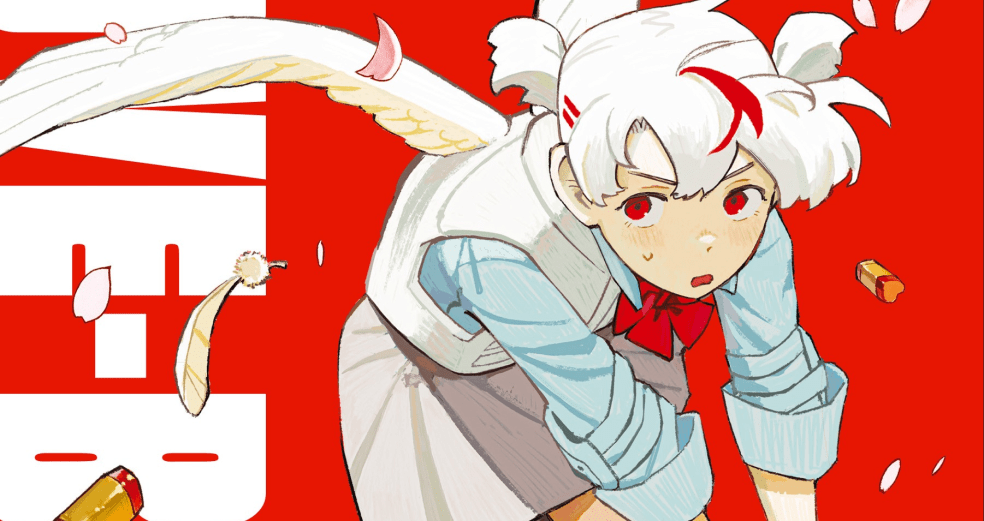
New Manga First Impressions: The Iron Eyes and Human Heart of DEEP RAPUTA

New Manga First Impressions is a column where I detail my thoughts, however brief or long, about the first chapter or so of a new manga.


Here’s a nest of discourse I’ve mostly managed to avoid on this blog so far; generative AI. If you somehow don’t know, that’s the industry term for machine learning that can produce images, text, whatever you need of it, without any human input beyond typing a prompt into a box somewhere. (Well, that and the many, many human-made templates it has to work off of to be able to create those images in the first place, but let’s stick to the basics for now.) Suffice to say, I’m largely against widespread adoption of the technology, less for any fiddly artistic reason and more for its many immediate and tangible impacts on the livelihoods of any number of artists working in any number of fields. I’m putting all of this here, in the first paragraph, to make very clear that if DEEP RAPUTA1 at some point goes off the deep end and becomes a full-throated endorsement of replacing human artists with robots, turns out to use actual machine-generated imagery, (which I don’t think it does but these things are hard to prove), or something similarly foul, I do not condone that in any way. I just think it’s important to make it clear where you stand on this sort of thing.

Important also because DEEP RAPUTA, which opens with perhaps the most arresting first chapter of a new MangaPlus title in years, is actually interested in engaging with this subject. Not specifically on the matter of generative AI replacing human artists, although that does come up, but on the applications of such technology in a more general sense. What could these things be used for? What are they being used for? Consider this a heads’ up before we continue; we’re going to be getting into some dark subject matter, here. I think DEEP RAPUTA has a lot to offer as a manga, and this chapter is brimming with immense promise, but because of what it seems to be trying to do, appreciating all of that requires familiarizing ourselves with some unpleasant things about both the present day and the possible near-future.

All this said, for much of its first chapter, you could mistake DEEP RAPUTA for a romcom with a sci-fi twist, something along the lines of, say, Video Girl Ai from back in the day. Our first protagonist is Kei, a by-all-appearances ordinary high school boy. He has spiky hair, an upbeat and friendly attitude, a deep love of the in-universe video game Side War, and is maybe a bit concerningly gung-ho about possibly joining the JSDF when he gets older. (We’ll circle back to that.) Our female lead, to the extent that gender applies to her at all, is Raputa herself. The nature of what, precisely, Raputa is is fed to us in drips and drops over the course of the first chapter, and I’m going to spoil that reveal now, so this is your last chance to back out if you’re intrigued but wish to experience the first chapter on your own.

Still here? OK.

Raputa, as it turns out, is a military-grade artificial intelligence, currently being trained on Side War as an early test run of her capabilities. As is the case with real machine learning networks of her type, Raputa starts out absolutely hopeless at Side War, but quickly becomes more competent than the vast majority of human players. Helping her out here is Kei, who, in something called out as impossible within the manga itself, she is developing feelings for. Having no concept of privacy, she freely stalks him throughout his day, keeping an eye on him during school and such, only to play with him in Side War in the afternoon. This is all a little weird and yandere-y, for sure, but how Kei might react to that is the least of Raputa’s worries.

Because these feelings existing at all comes to the immense surprise of our third and final main character, the mysterious, alluring, and deeply sinister Dr. Alice. We’ll circle back to her, too.

Raputa initially meets Kei in her early days of playing the game when she’s much worse than most human players. Kei helps her out in the game’s Duos mode, and as the two play together, they grow closer. Close enough, eventually, that Kei asks if they can first voice call, then do a video call, and then meet up in person. This is the part of the manga that hews closest to being a romcom; these are all important stops along the way in an online relationship. It’s relatable, even, in a way that contextualizes what’s to come. Raputa has to deal with a problem here, of course. She is just a wall of wires and monitors, and has no physical body. Yet, through the magic of deep learning, she’s able to fake a voice convincingly enough, and then a moving avatar for her webcam. Throughout all of this, Kei doesn’t know she’s an AI. The meetup, though, that’s much harder to fake, and it’s here where we should take a second to talk about the manga’s visuals, in addition to everything else it’s doing.

DEEP RAPUTA‘s paneling is, in a word, incredible. (Although the anatomy of some characters is occasionally wonky in a way I would completely brush off were this manga about anything else.) At the meetup, Raputa is able to fake actually being there for a little while by projecting herself from various surfaces. The manga convincingly showing her doing this is a pretty impressive display of technique, and things only get better from here. The chapter’s emotional climax sees Raputa, unable to keep up the ruse any longer, revealing to Kei that she’s an AI in a dramatic, theatrical fashion. In any other series, this alone would be the sell; there’s a sweeping, dizzying romance to the chaotic jumble of buildings that Raputa co-opts to show herself to Kei. It’s the kind of striking image that sticks in your head, and were I writing about a more straightforward series, I’d probably end the article right about here.

But let’s talk about what she’s actually doing in that page. She’s projecting herself onto hundreds, maybe thousands? Of what are either some kind of smart glass that can display images, or else projecting herself onto ordinary glass from somewhere else. Either way, that sure seems like the sort of thing that would take a lot of computing power, doesn’t it?

Raputa, as mentioned, is a military AI, or at least the prototype for one, and Dr. Alice seems perturbed by her sudden autonomy, apparently emotion-driven as it is. Raputa’s main purpose isn’t to flirt with boys, it’s to dominate battlefields. Dr. Alice says this outright, and if this idea seems far-fetched to you, I’m very sorry to inform you that this is already a real thing. (Please do not click that link without an appropriate amount of caution. It’s just Wikipedia, but this is a very depressing subject and I’d hate to be even indirectly responsible for any of my readers having a depression spiral. Take care of yourselves.)

Suffice to say, DEEP RAPUTA is wading into some hot water here, and the skeptical part of my brain wonders if it’s really equipped to handle this subject matter. But, I do think it at least comprehends the seriousness of what it’s doing. Sure, this is a manga and there’s a certain level of pulp involved just by the nature of the medium, but DEEP RAPUTA seems to properly get that artificial intelligence can be absolutely terrifying if used in certain ways.

All of that leaves a huge open question; can Raputa herself actually defy the purpose she was built for? Can she choose to love Kei instead of engaging in mass death and destruction? That’s a big question! Whether or not machine learning networks experience any kind of interiority in the real world is, to put it very mildly, a contentious question. (It’s impossible to even prove other human beings experience interiority.) But in the world of DEEP RAPUTA, the answer at least seems to be “yes,” and because of this, the question is thus less one of what DEEP RAPUTA thinks of machine learning in this case and more what it thinks of even less tangible concepts; the soul, the mind, the ability to love. What it means to be human. The hard stuff.

The last few pages really do cast a very dark shadow over the manga, even as that early romanticism remains a lingering thought. The final panel of the first chapter is this, a visual that at least one person has seen fit to compare to the infamous Saikano. (Only occasionally, in my experience, referred to by its English title, She, The Ultimate Weapon.) Once the similarity is pointed out, it’s impossible to ignore.

All the worse; Kei’s father is briefly shown to be part of a battleship’s crew—explaining his desire to join the military, certainly, he’s still a kid at the end of the day—whose systems were somehow affected by Raputa’s meddling. It’s hard to make predictions about what specifically this is all leading to, but it definitely doesn’t seem bright and cheery.

And yet, maybe the most telling page of DEEP RAPUTA isn’t any of these that I’ve previously shown. Maybe it’s this one.

My generally romantic inclinations make me want to believe that in the world of DEEP RAPUTA, love can overcome anything. Raputa correctly identifies that the real similarity between herself and Kei is not anything about her algorithms and their imitation of a human brain, but rather her feelings, which we know, as we have the privilege of being outside of this story, are real. But her Big Sister Is Watching You tendencies may put more bumps in the road than she realizes. Even if they don’t, in the real world, love alone is rarely enough to break free from the systems that keep us arrayed against each other. Will it be, here?


1: This appears to be a twin reference to Deep Blue and Laputa, the nation from Gulliver’s Travels. Perhaps also a reference to Laputa: Castle in the Sky, given that film does feature autonomous robots. All told it really seems like the title of the manga should be “DEEP LAPUTA” and the AI herself should be named “Laputa,” but the official translation goes with the R for both, so that’s what I’m doing here.


Like what you’re reading? Consider following Magic Planet Anime to get notified when new articles go live. If you’d like to talk to other Magic Planet Anime readers, consider joining my Discord server! Also consider following me on AnilistBlueSky, or Tumblr and supporting me on Ko-Fi or Patreon. If you want to read more of my work, consider heading over to the Directory to browse by category.

All views expressed on Magic Planet Anime are solely my own opinions and conclusions and should not be taken to reflect the opinions of any other persons, groups, or organizations. All text is manually typed and edited, and no machine learning or other automatic tools are used in the creation of Magic Planet Anime articles, with the exception of a basic spellchecker. However, some articles may have additional tags placed by WordPress. All text, excepting direct quotations, is owned by Magic Planet Anime. Do not duplicate without permission. All images are owned by their original copyright holders.