Seasonal First Impressions: The Poet’s Soul of FLOWER AND ASURA

Seasonal First Impressions is a column where I detail my thoughts, however brief or long, about a currently-airing anime’s first episode or so.


“For in my wrath, I am Asura.”

Can I level with you? The anime season’s been a bit rough so far. I’ve certainly lived through more dire seasons in terms of there just being nothing to watch, but it feels like a lot of the more up-in-the-air premieres have been whiffs. Even some of the actual good stuff is being held back by extenuating circumstances. Things are tough in the winterlands right now.

But, spring is on the way. And if you feel the Sun on your face and can imagine it as the warmth of the green season, Flower and Asura might be why. Blessedly, this is probably the best premiere of the season so far, a study in subtle emotional shades, and an interesting, empathetic look into the mind of a performer. Longtime readers will know that anything of that nature is absolute catnip to me, but even so, this is a strong, strong, strong opener. I could nitpick a handful of things, but just as a fair warning, I am absolutely not going to.

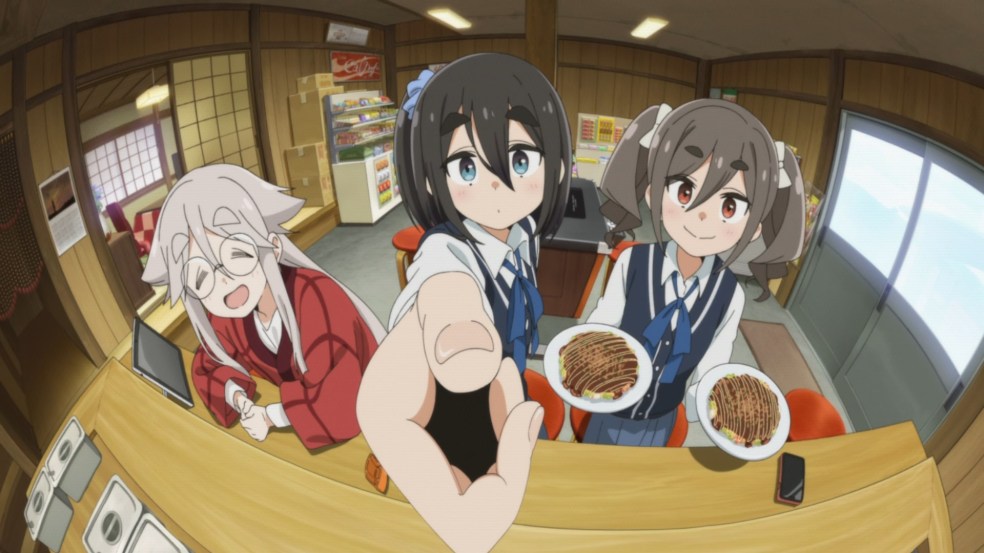
Our main character is Haruyama Hana [Fujidera Minori], the sole teenage girl in the tiny island village of Tonakijima (population ~600). Hana, who’s entering high school soon, spends much of her time reading children’s books for the local kids. Her readings are popular, and she’s clearly pretty good at them. What these kids of course do not know is that they stem from something deeper in the back of her mind.

As a child herself, Hana saw a young woman, of about the same age that she now is, recite a poem on TV. That poem, Miyazawa Kenji’s “Haru to Shura”, is, at least as translated into English, an angry burst of splintering, smoldering imagery. It’s not something that one would necessarily assume a child would like, and yet, that poem and that recitation of it, grabs Hana’s imagination in a stranglehold. Here, at this very early moment in her life—the very start of the episode, as well—her passion is ignited.

Cut back to that quaint reading circle and, we will learn over the course of this first episode, you have a girl who is trying to channel this roil inside of her into….reading books called things like Mr. Seagull’s Deep Sea Adventure to a gaggle of children. There is, of course, nothing wrong with reading books to children, and she’s damn good at it from what we see here. But given what we later learn about Hana, it feels fair to say that there is something going unfulfilled. She’s using a wildfire to light a candlestick.

One person who seems to immediately pick up on at least a little of this is Usurai Mizuki [Shimabukuro Miyuri]. Mizuki is our other main character, and she blithely walks into Hana’s life after one of those quaint little reading circles, immediately trying to press her into joining her high school broadcast club. At first, it’s as simple as the fact that Mizuki loves Hana’s voice. But as the first episode progresses, it becomes clear to Mizuki, and to us, that there’s more to Hana than is necessarily obvious at first glance.

Mizuki, I think, will in fact be a sticking point for some people. While clearly friendly, she is determined to recruit Hana for the broadcasting club. To be honest, she’s pretty overbearing. I like this—anime girls with less-than-perfect personalities are always a good thing to have more of—but I could imagine someone finding her sheer inability to take ‘no’ for an answer annoying, and she’s even a little manipulative over the course of this premiere. That said, it takes Hana actually mentioning the poetry recitation for Mizuki to really double down on the idea of her joining the club, so I think much of this insistence can in fact be attributed to the fact that Mizuki is also very observant. She’s enough so that she waves off a logistical issue, Hana being able to catch the last ferry back to her home island in time. “It isn’t right”, she says, “to assume something’s impossible just because it’s difficult.” She’s right about that, and this is one of a few central ideas that the episode quietly expands on over the course of its premiere. (Still, that couldn’t be me. I’d be in that clubroom in a heartbeat.) Hana takes a bit more convincing than this, but before we fast forward to that, it’s worth going into some detail, given the emphasis on voice here, what these voices are like.

Hana has perhaps the closest vocal to a typical “protagonist voice” in this sort of thing, but her sometimes stopped-up cadence has a halting shyness to it that most lesser anime would overplay, and it’s to Flower & Asura‘s benefit that it knows to keep it on the subtle side, for the most part. Mizuki’s voice is rustic, narrow, and scratchy, and it often sounds like she’s talking directly from her throat. This compliments her appearance, to be sure, but it also makes her sound bolder and more assertive than Hana. It also makes her sound older, which makes sense. I’m not going to call this a yuri series just yet, but if it does go that route, I want to commend whoever did the casting for having the main girls not just look good together but sound good together. That’s an attention to detail that’s all too rare.

Cut to classroom, Hana’s first day of high school. Things are going as they often do in a show like this, Hana settles in and meets a friendly classmate. Things are straightforward, until the Broadcast Club takes over the morning radio. Evidently, at this particular high school, morning poetry is recited over the speakers. This sounds, frankly, crazy to me. (If anyone had played poetry over my high school’s speakers there would’ve been riots.) But it’s an effective bit of scene-setting, because who else should read the poem but Hana’s now-senpai, Mizuki?

Poetry, of course, is not merely about being able to set scenes. It’s about using words to conjure images, and also knowing when and how to deploy them. In its mirroring of its subject matter, Flower & Asura demonstrates this beautifully. The poem in question, Takamura Kotaro’s “The Journey”, is not just read aloud, but also visually depicted. Hana, listening intently, imagines herself on a grey train track, walking through a void. She isn’t alone for long; Mizuki is there as well, blazing a trail of light through the black, providing a beacon despite her sly smirk.

The imagery of a track for Hana’s reaction is apt—she is moved. Continuing the show’s generally understated vibe, Hana’s reaction to hearing the poem read is not big or loud. It’s very soft, and very quiet. Just a wordless shiver of a sigh as the classroom window blows the spring breeze through her hair and things wind back down. The interlude ends, and Hana presumably has an unremarkable rest of her schoolday.

After school is a different matter. On the ferry home Hana begins reading some poetry to herself. Aloud, but, perhaps due to the presence of the ferry captain, given that the boat is quite small, rather quietly. She’s interrupted, as who else but Mizuki makes her presence known aboard the boat, once again pestering Hana to join the Broadcast Club. Mizuki needles Hana with pointed questions, asking why she restrains herself so much when reading this, here, as compared to when she reads for the kids back home. That’s interrupted by a much more pressing and practical concern, though. The ferry Hana goes home on is the last for the day. Thus, Mizuki has no way to get home.

Perhaps feeling obligated, Hana’s family houses Mizuki for the evening. Surprisingly, Hana doesn’t seem to mind this so much. She says she’s never had a sleepover before, so it may be the case that she’s simply unwilling to look a gift horse in the mouth. Mizuki stays on the attack throughout this entire sequence. Even when the two are ostensibly trying to get to sleep, Mizuki catches Hana staring, and takes that as yet another opportunity to pepper her with questions, whether out of genuine curiosity, out of trying to find something she can leverage to get Hana onboard with joining the Broadcast Club, or both, Mizuki’s sheer persistence has a charm of its own. But things hit a slightly off note when Hana admits that she likes recitation because it lets her be someone she’s not. Mizuki, for the first time in the episode, frowns, and bluntly asks,

“Do you not like yourself?”

Hana admits to it. “I don’t. Because I have no confidence.”

“That can’t be true. It’s there, somewhere in you.”

To that, Hana offers only a meek “I’m sorry” before rolling over and nodding off, and we end on a shot of Mizuki’s expression. Puzzled, frustrated. What does she have to do, she seems to wonder, to get through to this girl? We don’t get an explicit answer as to why she just can’t let go of Hana. That’s likely a thread to be pulled on in a future episode.

An earlier scene may provide a smidgen of clarity, however. Here, Hana’s mother briefly talks to Mizuki after dinner. She explains outright that Hana’s reluctance to seek better things for herself comes from feeling that she needs to be a role model for the island’s younger children. One could argue, perhaps, that Hana’s mother simply directly spelling out her daughter’s reticence and the reason for it is lazy writing, but all of this is noticeable well before this scene, and her mother’s comment to Mizuki is mere confirmation.

Put together, these two scenes paint a pretty sad portrait of Hana, someone who’s repressing herself less because of any particularly strong singular reason and more because she just feels that she has to. That it’s part and parcel of being who she is. (And I have to admit that by this point in the episode I was already really feeling for Hana. I have been in her shoes here, down to the meek saying-“I’m sorry”-and-retreating-to-your-comfort-space-trick.) But that portrait isn’t entirely complete. The last, boldest stroke is the one hinted at by the start of the episode.

It’s the next morning, and Hana has woken up before Mizuki and seems to have gotten up to go somewhere. This is a bit puzzling to Mizuki, given the early hour, so she sets out to find Hana, perhaps worried, perhaps simply curious. She finds her standing on the beach in the rain, oblivious to it, or uncaring of it, as it pours down on her. Here, Hana recites. She declaims. Performs. Performs for no one but herself and the crashing waves of the ocean. Her script is the same poem we heard back at the start of the show, but when she recites it here, she absolutely subsumes herself into it. The image-space that breaks into Mizuki’s reading of “The Journey” earlier in the episode is fairly restrained, fitting her declarative, guiding tone. Hana’s is the exact opposite, in reciting “Haru to Shura”, Hana completely turns herself inside-out. Vines sprout from the ground to restrain her as she thrashes against them like a wild animal, she crumbles to pieces against them, and those pieces turn to shreds of paper. Those shreds are blown into the sky, carried away on the cold wind. She is a woman possessed, drunk on the power of her own voice as it bends and warps around the poem’s syllables in ways that make the entire preceding 20 minutes of the episode feel like a distant dream as the paper-scraps she’s been reduced to return to the sand, sewing her back together as she raises her arms to the sky, a wild, ecstatic grin across her face as she screams truth to the heavens: in her wrath, she is Asura. Hana is gone during this reading. The manic, glowering figure who remains is someone else entirely.

Mizuki, of course, is the one feeling all of this in her mind’s eye, and we see that depicted almost literally as the scene unfolding before her fills the width of her iris. She, too, is consumed.

It goes without saying that the visual work here, the best in the episode by a fair margin, has to work hard to match Hana’s energy here, and that it successfully manages to do so is no small feat in of itself. But the incredible strength of Hana’s performance, really Fujidera Minori’s, is such that even if you completely shut your eyes during this segment, you would not just know something had changed, you’d be able to feel it.

And then, as quickly as it came, this moment ends. Hana, in an act that showcases nearly as much talent as the recitation itself, simply flips her act back off like a light switch, reacting initially with trepidation and embarrassment that Mizuki has seen her doing something that, we must assume, is very personal for her. Mizuki herself meanwhile, looking utterly spellbound (who could blame her?), grabs Hana by the shoulder, once again insisting, pleading that she join the Broadcast Club, fingers of light piercing the grey sky as the rain ends at precisely the right moment. Mizuki has figured out what’s going on here, but despite her persistence, she wouldn’t actually force Hana to do anything even if she could. She leaves the decision in Hana’s hands, asking to know what she wants, even though she already knows. Hana, tearful, confirms it a moment later. She really does want to join the Broadcast Club. She wants to—this part she doesn’t say aloud—find a place to be free, she wants to find some actual confidence in herself, and she wants to find people who understand the passion within her. Her self-loathing means that she’s spent the whole episode running from it. But nonetheless, here it is. The hardest part, Flower and Asura seems to suggest, was getting her to be kind enough to herself to ask in the first place. Still, both she and we would do well to remember, just because something is difficult, doesn’t mean it’s impossible.

The episode ends with Hana entering the Broadcast Club’s clubroom for the first time. The show has a sizable cast, so it’s doubtful that every episode will be quite this much about Hana and Mizuki. Still, the groundwork here naturally leads to so many questions that I am desperate to know the answers to: does anyone else in the club get like that too, or is Hana the odd one out? What of Hana and Mizuki’s relationship going forward? Friends? Mutual inspirations? Something more? What about the rest of the club? What are their stories? All of these are questions that, with variation, you could ask about any good show in this genre, but Flower & Asura‘s strength is not in reinventing the wheel, it is—fittingly enough for a show about an artform where you perform work written by another—in artfully expressing the emotions that define this genre’s very best work. It’s poetry in motion, keep an eye and an ear on it.

“Say what it is you really want. And I’ll make it happen.”


Like what you’re reading? Consider following Magic Planet Anime to get notified when new articles go live. If you’d like to talk to other Magic Planet Anime readers, consider joining my Discord server! Also consider following me on AnilistBlueSky, or Tumblr and supporting me on Ko-Fi. If you want to read more of my work, consider heading over to the Directory to browse by category. If you’re looking for me to watch a specific show, watch this space. I am planning to reopen commissions in the near future.

All views expressed on Magic Planet Anime are solely my own opinions and conclusions and should not be taken to reflect the opinions of any other persons, groups, or organizations. All text is manually typed and edited, and no machine learning or other automatic tools are used in the creation of Magic Planet Anime articles, with the exception of a basic spellchecker. However, some articles may have additional tags placed by WordPress. All text, excepting direct quotations, is owned by Magic Planet Anime. Do not duplicate without permission. All images are owned by their original copyright holders.
Seasonal First Impressions: Enter Oblivion with BANG DREAM! AVE MUJICA

Seasonal First Impressions is a column where I detail my thoughts, however brief or long, about a currently-airing anime’s first episode or so.


“Will you give me the rest of your life?”

God help us all, a short girl with blue hair is here to make her trauma everyone’s problem.

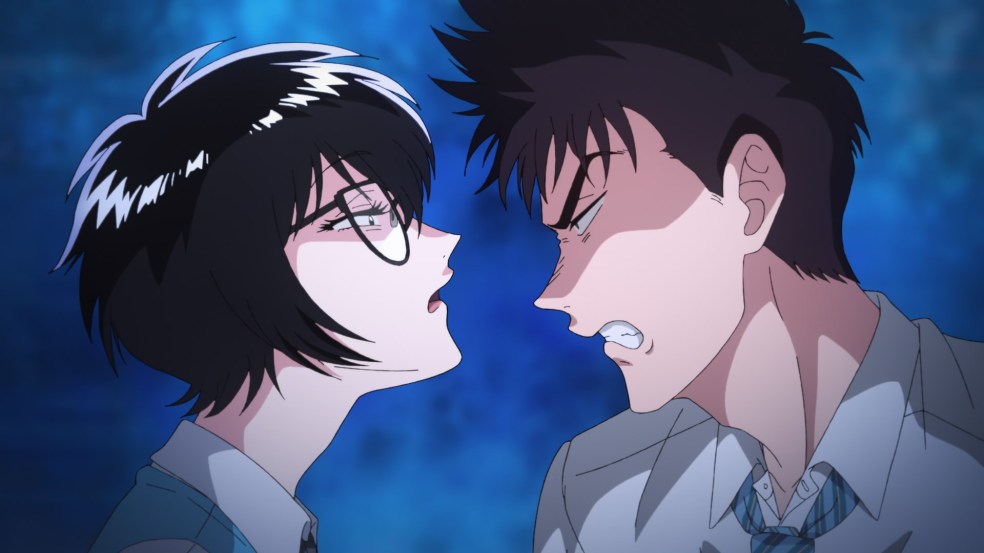
At the end of the final episode of BanG Dream! It’sMyGO!!!!!, the show was essentially hijacked. That series’ finale doesn’t really have anything to do with MyGO directly. Instead, it follows Togawa Sakiko [Takao Kanon], a cryptic, antagonistic presence for of much of that season and a former member of pre-MyGO band CRYCHIC, whose extremely messy dissolution still haunts that show’s cast. MyGO‘s finale made the argument that Sakiko, actually, was more haunted than any of them. Recruiting a supergroup of musicians from across BanG Dream‘s talent-overstuffed universe, she made them wear black lace face masks and gave them goth metal code names; Doloris for lead singer, guitarist, and childhood friend Misumi Uika [Sasaki Rico], Mortis for rhythm guitarist and also childhood friend Wakaba Mutsumi [Watase Yuzuki], Timoris for bassist Yahata Umiri [Okada Mei]—she of the famous “I’m in roughly 30 bands” screenshot—Amoris for capricious drummer Yuutenji Nyamu [Yonezawa Akane], and, finally, Oblivionis for herself, Sakiko, composing and on keyboard. It is their story, we’ve been promised, that BanG Dream! Ave Mujica will tell us.

Thus so established, Sakiko joined a long lineage of real and fictional masked musicians. From Slipknot to Daft Punk, from MF DOOM to KISS. Her reason for adopting a mask is, at its heart, the same as many real musicians who do so: a rejection of her “real” face allows her to become lost in persona, the old self subsumed into a dramatic, shadow-casting new self. A puppetmaster in a near-literal sense, given how her stage shows involve so much doll imagery. Welcome to her beautiful dark twisted fantasy, right?

Wrong. A driving theme here is that Sakiko is not nearly as in control of any of this—not her band, not her life—as she’d like to be. Most of this first episode, aside from Ave Mujica’s killer performance of opening theme “KILLxKISS” at the start, an interview immediately after where there is some tension between Sakiko and Nyamu, and a sequence at the end, is flashback.

Here, we learn a little about Sakiko’s life. The usage of traditional animation for some of these flashbacks is interesting. Readers may recall that Girls Band Cry used a similar technique to similar ends; to emphasize an idealization of these moments, to underscore that we’re not necessarily seeing them as they really were but rather how they felt. Ave Mujica, befitting its goth theater kid vibe, hammers the point home further by also drowning the earliest, still mostly happy memories in an amber sepia filter. More memories follow, and these get no filter and no flat animation; we learn how Sakiko’s mother died suddenly, tragically young. We see her inspired to found a band for the first time after seeing BanG Dream! veterans Morfonica in a small concert. We briefly retrace the rise and fall of CRYCHIC, Sakiko’s father losing his high-paying job at his own father-in-law’s company, and his collapsing into a broken drunk. Sakiko’s struggles to find some kind of job—any kind of job—to make ends meet for herself and her father. We relitigate CRYCHIC’s breakup, this time from Sakiko’s perspective and with a whole lot more crying in the rain, making it clear that leaving the band was just as painful for Sakiko as it was for anyone else. At one point, later in the episode and back in the present day, her father chucks a beer can at her face, giving her a noticeable bruise, and tells her to leave the house. Sakiko can’t take any of this. Thus, the mask.

All of this theater, mind you, lasts for less than a single full episode. On the stage before Ave Mujica are set to give a performance to their largest audience yet, Amoris promptly torches the entire thing, tossing her mask off and unmasking the rest of the band’s members in short order, underscoring both her status as the cast’s wildcard and her general lack of patience for Sakiko’s theatrics. There is something genuinely bold about undoing your characters’ central gimmick right at the end of the first episode, but it only matters so much. It’s true that the audience now knows of Ave Mujica’s civilian identities, but the real masks are something much less material than the flimsy lace that Amoris chucks on the ground.

The command of drama throughout this first episode is superb, but it’s fair to say that where any of this will go is still very much up in the air. Ave Mujica is a theater kid at heart, it lives and breathes drama, and drama, as we’ve seen in anime like MyGO, or, to name an even darker example something like Oshi no Ko, can keep the fire burning for a long, long time. But not forever! This upturning of a core component of the band’s—and thus the show’s—mythos is a promising start, but I do hope we get some actual character growth here, in one way or another. Sakiko’s awful home life is another factor that I do hope the show explores. It’d definitely be a lot more interesting than another rehash of the usual commercialism vs. authenticity stuff, which some of Nyamu’s antics can’t help but bring to mind, given that she’s an influencer off-stage. (Any commentary along those lines is doomed to fail anyway. Ave Mujica are a lot of things, and they make great music, but they’re not any kind of “authentic,” in-universe or out.)

That’s all hypotheticals though. The real nitpick as of now is in the subtitling. What would a girl band anime release be without bitching about the subtitles? I’m only going to touch on this, since other people have already pointed out the obvious, but Crunchyroll’s subtitles for this first episode are notably subpar, stilted in places and lacking song translations. Hopefully this will be fixed at some point, to say the least. Regardless of this glaring issue, which isn’t really even the show’s own fault, I’ve left the first episode confident that we’re in for a hell of a ride, episode 2’s title, Exitus acta probat, “the outcome justifies the deed”, is hugely promising. 11 more weeks of this! Strap in.


Like what you’re reading? Consider following Magic Planet Anime to get notified when new articles go live. If you’d like to talk to other Magic Planet Anime readers, consider joining my Discord server! Also consider following me on AnilistBlueSky, or Tumblr and supporting me on Ko-Fi. If you want to read more of my work, consider heading over to the Directory to browse by category. If you’re looking for me to watch a specific show, watch this space. I am planning to reopen commissions in the near future.

All views expressed on Magic Planet Anime are solely my own opinions and conclusions and should not be taken to reflect the opinions of any other persons, groups, or organizations. All text is manually typed and edited, and no machine learning or other automatic tools are used in the creation of Magic Planet Anime articles, with the exception of a basic spellchecker. However, some articles may have additional tags placed by WordPress. All text, excepting direct quotations, is owned by Magic Planet Anime. Do not duplicate without permission. All images are owned by their original copyright holders.

Seasonal First Impressions: Battle Girl Acid Ramen – What Even Is MOMENTARY LILY?

Seasonal First Impressions is a column where I detail my thoughts, however brief or long, about a currently-airing anime’s first episode or so.


This show should not exist.

Let me be clear about something, that’s not a qualitative judgement. I’m pretty happy that Momentary Lily does exist, but it really shouldn’t.

There are many reasons why it shouldn’t. Point 1: the relevance of the relatively short-lived battle girl genre, the post-mahou shoujo warrior anime defined by Symphogear, ended when Symphogear XV concluded, with the only real aftershock of even marginal note being Assault Lily Bouquet—no relation—and honestly that’s being generous with the word “marginal.” Point 2: there is an agreed-upon, rough template for opening an action series. That template very much is not “huge cool fight, long sequence where a new girl meets the rest of the protagonists and cooks them food, second cool fight,” which is how this first episode is structured. Both of these points can be explained, though, by Point 3: Momentary Lily comes to us from GoHands mindbender-in-chief Suzuki Shingo and his fellow GH lifers Kudou Susumu and Yokomine Katsumasa. GoHands, for better or worse, seem to exist in active defiance of God, the natural order, and everything else under heaven and earth. Love them or hate them, the studio and its house style are a true one of one, nothing else looks like this, and in its best moments, their work can be genuinely stunning.

For some of their work, that’s an active detriment. At the end of the day, The Girl I Like Forgot Her Glasses, despite its iffy characterization in its premiere episode, was a pretty normal romance series. There is no real reason the anime should’ve looked how it did, and GoHands’ attempts to restrain themselves to produce a “standard” TV anime benefits no one. Momentary Lily, though, is on the opposite end of the spectrum. Based on nothing and beholden to no one, this is an original work, precisely from whose mind is hard to say, but it’s worth noting that Yanagi Tamazou, the main scriptwriter of Hand Shakers and Scar on the Praeter—both of which are prior GoHands attempts at action anime—is credited with that role here, so perhaps it was them. Or maybe it was someone else. Or maybe Momentary Lily is adapted from a pair of stone tablets that Suzuki Shingo brought down from a mountaintop after a religious experience. Honestly, nothing would be surprising. If it’s not overwhelmingly, abundantly clear from everything I just said, this show is fucking weird. Excitingly, it’s poised to get weirder.

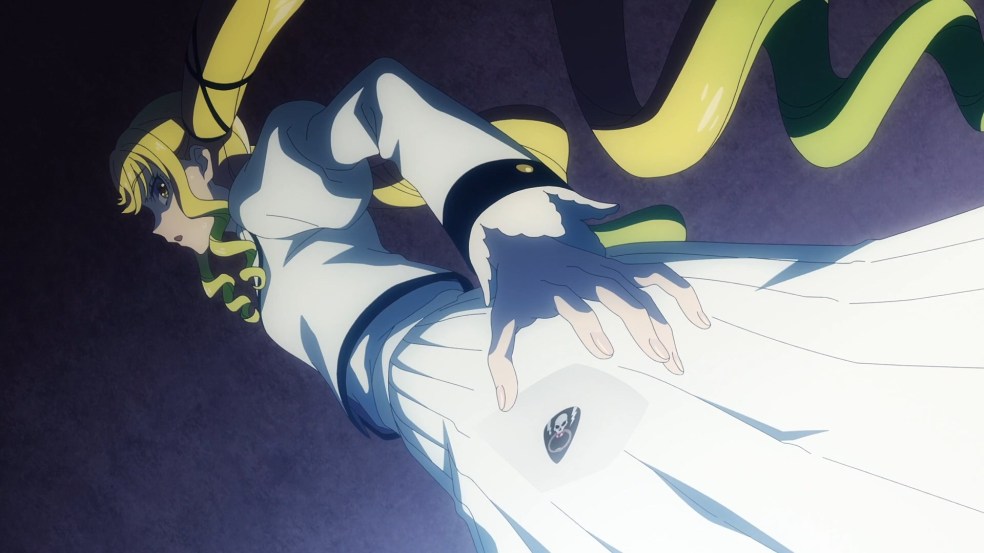
As with everything this studio has ever touched, the visuals are the obvious standout point of discussion, but we should make some attempt to get at least the very broad strokes of the plot nailed down. The show isn’t exactly Finnegan’s Wake or anything, but the fighting game combo juggling approach to storytelling, including the characters sometimes stepping on each others’ lines, does mean a bit untangling is required to suss out what’s actually going on here. Very basically, in a near-future Japan, a horde of extradimensional machines that our protagonists call Wild Hunts appear. They can make people vanish into thin air simply by being near them, so predictably, this promptly wipes out most human life on the island and, quite possibly, in the world in general. Our protagonists, are a group of teenage girls; leader Yui [Abe Natsuko, in what seems to be her first role of any real note], self-proclaimed big sister-type who seems to have shoved water balloons down her chest Erika [Sakuragi Tsugumi, in what seems to be her literal first role at all], honorary green Precure / gamer girl Hinageshi [Wakayama Shion, killing it as always], pink cutie and fashionista Sazanka [Kuno Misaki], and the raven-haired, chuuni-stoic Ayame [Shimabukuro Miyuri]. Through means as of yet undisclosed, they have access to powerful weapons / very shiny CGI assets that they can use to fight back against and destroy these creatures. The episode opens, after a short conversation about eczema (naturally), with one of these fights.

After that, though, it promptly introduces another teenage girl, Kasumi Renge [Murakami Manatsu], amnesiac and having been wandering on her own for some time. After managing to momentar-lily overcome her incredible shyness—also placing this show at least adjacent to the Bocchi-core “anxious girls learning to make friends” genre—she promptly cooks them a bunch of food, styled as a cooking segment in a slice of life show. Then, the Wild Hunts attack again, and we get another battle, where it’s revealed that Kasumi also has a weapon and that hers, furthermore, is self-propelling, a truly awesome-looking pink guitar rocket skateboard thing. She proceeds to wipe out the Wild Hunts that are attacking her and her new friends. Roll credits.

This loses something in the retelling, even more than is the case for most anime I cover here. It is hard to describe, let alone capture, GoHands’ pure eye-bombing when they’re at the peak of their powers as they are here. The action sequences are genuinely very good, but they require putting yourself in a different headspace than is usual for action anime (I do have a few complaints, mostly relating to a shakycam segment early on, but all told this might be the most cogent a GoHands production has looked this decade). To put it mildly, the show’s visual aspects are an acquired taste, and there is still the odd stylistic quirk I can’t quite get over (the spaghetti hair, threadlike and infinite, that covers every character’s head, must truly be seen to be believed), but I think the studio’s staff acquit themselves nicely here, and I’m hoping it can keep up the polish.

As for the writing? So far it’s honestly too inscrutable to make many strong claims in that direction yet, aside from the observation that like previous GoHands originals, the show seems to somewhat haphazardly pull from mythology for show concepts (the weapons all seem to be named after things from Norse myth). But the characters, simple though they are, are mostly pretty fun, and are thus the real script highlight so far. I’m particularly fond of leader Yui’s can-do attitude, Ayame’s broodiness, and Hinageshi’s whole epic gamer girl shtick. The dialogue also has a bent, catchphrase-laden quality that I’m betting will prove as or more polarizing as the show’s visual elements. Personally I find it charming, but I can imagine someone who’s not myself getting sick of the bam! bam! vocal ticcing very quickly. The overall plot promises to evolve in unpredictably strange directions as well, with the preview for next week’s episode indicating that Erika will face mortal peril and, presumably, be rescued by her comrades.

Is this a must watch or anything? I’m not sure I’d say that, but if you like anime that are decidedly different from the norm it’s probably at least worth checking out. My own opinions on GoHands have evolved a lot since I last wrote about them, partly due to conversations with a friend1 who is a big fan of the studio’s work and partly just because, honestly, anything that stands out against the constant deluge of isekai and 6/10 romcoms is nice. Still, go into Momentary Lily with an open mind, and you might just find something worth going to bat for.


1: Hi May.


Like what you’re reading? Consider following Magic Planet Anime to get notified when new articles go live. If you’d like to talk to other Magic Planet Anime readers, consider joining my Discord server! Also consider following me on AnilistBlueSky, or Tumblr and supporting me on Ko-Fi. If you want to read more of my work, consider heading over to the Directory to browse by category. If you’re looking for me to watch a specific show, watch this space. I am planning to reopen commissions in the near future.

All views expressed on Magic Planet Anime are solely my own opinions and conclusions and should not be taken to reflect the opinions of any other persons, groups, or organizations. All text is manually typed and edited, and no machine learning or other automatic tools are used in the creation of Magic Planet Anime articles, with the exception of a basic spellchecker. However, some articles may have additional tags placed by WordPress. All text, excepting direct quotations, is owned by Magic Planet Anime. Do not duplicate without permission. All images are owned by their original copyright holders.

Seasonal First Impressions: Mysteries, Medicine, and Malpractice in AMEKU M.D.: DOCTOR DETECTIVE

Seasonal First Impressions is a column where I detail my thoughts, however brief or long, about a currently-airing anime’s first episode or so.


On a basic level, aside from the fact that I want to watch anime premieres for their own sake, the main question I’m seeking to answer with a lot of my first impression writeups is this: is this given show, provided you’re in to what it’s trying to do, worth your time? Admittedly a very straightforward and mercenary time-is-money way to look at things, but when so much anime is being made every season, it’s a necessity. Separating the wheat from the chaff is not always easy, but something that at least makes the case that a show might be interesting is a novel premise. Ameku M.D.: Doctor Detective, awkward punctuation and all, has that. I’ll give it to you in one sentence; Ameku would like you to go into it thinking that it’s House, M.D., but with an anime girl. For some of you, that’s going to be enough of a sell that you’ve probably already tabbed away from this article to pull it up on Crunchyroll. I’m not sure if you’ll like what the show is actually doing, but godspeed and good luck.

For the rest of you who might be interested in the particulars, let me get this out of the way: unlike many other LGBTQ millennials I know, I’ve never really liked House. Not that I ever watched a ton of it, but it very much did not seem like my sort of mystery series from what little I did see. Also, while this is not the show’s fault, the whole thing with it “never being Lupus” hits a little differently when your mother suffers from chronic Lupus flare-ups. (Ameku M.D. actually makes reference to this little meme almost immediately, which soured me on the show right out the gate pretty hard.)

Suffice to say, the deck was stacked against this series from the very beginning, at least as far as I’m concerned. Still, something can be not for me but still be worthwhile, so I committed to watching the whole premiere regardless. Having now seen the first two episodes (they released in tandem), I’m still unsure if I’ll watch more, but I am glad I gave it a chance, because, as it turns out, this House influence is sort of a feint.

The first episode opens with our main character, Ameku Takao [Sakura Ayane], rapid-fire solving a pair of mysterious diagnoses in the hospital she works at, quickly deducing that a young boy’s mysterious nerve pain is caused by a Vitamin A overdose, and that an older gentleman’s agony of the stomach is the result of accidentally ingesting a fish parasite. In both cases, she makes the prognosis in a vaguely judgey way, and, going off of my admittedly very limited exposure to that series, this is the part that’s more or less “like House.” After this introductory segment though, the show promptly takes an abrupt swerve, and it’s here where we need to draw attention to the series’ English language subtitle, Doctor Detective. Because that is a much more honest indication of what this series is trying to be, as is the title of the first episode, the hilariously on-the-nose “Dr. Sherlock.”

Not long after Dr. Ameku solves these little mysteries, a much bigger one rears its head as a man is rushed to the emergency room, where he promptly dies. (My understanding is that House rarely if ever dealt with outright murders, so that’ll be another difference.) Two curious details make themselves immediately obvious; this man had his leg bitten off by a very large predator, and his blood is inexplicably a bright blue color. The victim and detective thus present, the stage is set for what’s actually a pretty typical murder mystery. An interesting one, at that. I won’t spoil the specifics of what precisely occurred (I’m not sure if the series is strictly fair-play, but I wouldn’t be surprised if it were), but this mystery, and Dr. Ameku’s eventual unraveling of it, complete with the denouement-inducing catchphrase “let me give you my diagnosis”, and a very fun little sequence where she’s depicted “putting the clues together” by floating in a sphere of abstract math, is very much in the vein of of an orthodox whodunnit. It’s just that the detective is, again per the subtitle, also a doctor, and therefore there’s a bit of a medical focus.

She’s pretty entertaining as she does it, too. Dr. Ameku is the kind of smugly charismatic lead you want in something like this, she’s incredibly immature (said the anime blogger) but also extremely intelligent. The Sherlock comparisons make themselves obvious in the way she picks up on seemingly random details as vital clues. All of this is stuff that’s been done before, of course, but it’s well-executed here, and Takao is, overall, a very watchable protagonist. It helps that she’s got a solid supporting cast already as well. Mostly, this consists of her very own Watson, Takanashi Yuu [Ono Kenshou], also a medical professional—and an impressive karateka!—but much less of a detective, who asks just the right questions to set Dr. Ameku up to deliver her precision diagnoses. But there’s also Takao’s uncle, a different Dr. Ameku [Tachiki Fumihiko], who owns the hospital that she works at, and with whom she appears to have quite a lot of friction. (The elder Dr. Ameku, perhaps understandably, does not like one of his doctors playing Columbo in her off hours.) Speaking of Columbo-a-likes, Takao also has a contact in the police department, the trenchcoated detective Sakurai Kimiyasu [Hirata Hiroaki], who was in this case mostly cooperative, but who seems poised to evolve into an interesting foil later on.

Visually, the show goes for a restrained, mostly realistic look. Given the studio involved here, the somewhat infamous project no. 9, I’m a little surprised at how well they pull this off. The series is, for sure, visually unshowy, but it’s a clean, grounded look, heavy on greys and blues, that works well for a detective series, even one that has lines of dialogue like this in its very first case.

All told, despite my initial misgivings there’s some real promise here, and I’ll say the show is solidly worth checking out. A post-credits scene seems to indicate that the cases will only ramp up in stakes from here, which is good, since if we simmered back down to stuff like “a kid accidentally ate a ridiculous amount of blueberries and gave himself Vitamin A poisoning” I think we’d be in for a much less interesting show. I’ll say this much, this is the first 2025 anime I’ve watched anything of at all, and simply by virtue of having a novel premise that it does fairly well, Doctor Detective here is well ahead both of how I started last year’s anime and, honestly, much of the pack for this season, if what else has aired so far is any indication. I’m pleasantly surprised, given my initial bias against what I thought this series was going to be. As I said up at the top of this piece, I still don’t know if I’ll watch much more of this, but if I do, don’t be surprised to hear about Ameku M.D. here on Magic Planet Anime again.


Like what you’re reading? Consider following Magic Planet Anime to get notified when new articles go live. If you’d like to talk to other Magic Planet Anime readers, consider joining my Discord server! Also consider following me on AnilistBlueSky, or Tumblr and supporting me on Ko-Fi. If you want to read more of my work, consider heading over to the Directory to browse by category. If you’re looking for me to watch a specific show, watch this space. I am planning to reopen commissions in the near future.

All views expressed on Magic Planet Anime are solely my own opinions and conclusions and should not be taken to reflect the opinions of any other persons, groups, or organizations. All text is manually typed and edited, and no machine learning or other automatic tools are used in the creation of Magic Planet Anime articles, with the exception of a basic spellchecker. However, some articles may have additional tags placed by WordPress. All text, excepting direct quotations, is owned by Magic Planet Anime. Do not duplicate without permission. All images are owned by their original copyright holders.

Seasonal First Impressions: Can DEMON LORD 2099 Bring Isekai into The Future?

Seasonal First Impressions is a column where I detail my thoughts, however brief or long, about a currently-airing anime’s first episode or so three.


I talk enough about how I don’t really like contemporary isekai that I risk repeating myself. So instead of lamenting the state of the genre let’s just jump right into the important things about Demon Lord 2099 specifically.

So! This show! Our premise is that your archetypal demon lord—Veltol Velvet Velsvalt [Hino Satoshi], great name—has been defeated. Some centuries later, his world collides with and fuses with ours, plunging the globe into a magic-infested apocalypse that kills most of the planet and reduces what remains to a squabbling landscape of feuding city-states. In the ashes, magic and technology combine to forge a broadly cyberpunk-inflected setting. So far, so “reverse isekai with a twist.” There’s a bit more to things than that, though.

Veltol is of course resurrected in the present day (2099, natch), and as he gets his bearings in the first episode, with the assistance of his loyal servant Machina [Itou Miku], two things immediately stand out about both his character and the timbre of the show itself.

1: Veltol is portrayed, barring a big exception that we’ll get to, with a fair amount of genuine gravitas and dignity. That’s not to say the character is taken 100% seriously all the time, but rather that the series devotes a fair amount of space to his thoughts and feelings, and how they interact with the world he’s returned to. He feels like an actual person rather than a boxed archetype.

2: The series on the whole seems, at least going off of the three episodes that have currently aired, to be surprisingly faithful to the original ideas of the cyberpunk genre. While the tiresome stock fantasy racism metaphors that pockmark the narou-kei scene are present here, they are more of a background element than a defining feature (and at one point are blamed on a specific character, in a seemingly deliberate move on 2099‘s part). The real antagonistic force is unchecked technocapitalism and all that it enables; stressful, strained paycheck-to-paycheck living, the inequality it foments, etc. As a force, this is embodied by Marcus [Matsukaze Masaya], one of Veltol’s former lieutenants who has found a new position in the world, as the overtly ill-intentioned head of a massive tech company.

This is not to say that Veltol is a straightforward good guy. He’s still an aspiring world-conquering tyrant after all, but because the series is from his point of view, he’s humanized in a way that a lesser show just wouldn’t bother with. This is most obvious at the end of the first episode, where his most loyal devotee, the aforementioned fire immortal Machina, takes him to her new home, a tiny, ratty apartment on the outskirts of the city. Veltol initially assumes this place is some sort of storeroom, and when Machina gently corrects him and makes it clear she’s not joking, breaking down in tears at the “shameful” fact that she lives in such a small home, he pulls her close to comfort her.

A later episode shows us Machina’s backstory, which involves her being thrown into an active volcano. And remarkably, the show still portrays her current state, struggling to get by and making minimum wage, as being even less dignified than that. The message that this is an environment that makes monsters of all of us is clear. It’s also a nice bit of character building for Veltol, and a cheaty (but not invalid!) way to get us, the audience, on his side. Veltol as he’s portrayed here, even accounting for the evil required for his conceptualization as a demon lord, is a nearly admirable figure. I admit to having a personal weakness for a certain kind of principled villain in fiction, depending on what those principles are, so I may be in the minority in that I’d follow this guy into hell. Still, I imagine even if you’re less susceptible to such things, he comes off well here.

The second episode is a slightly different story. For one thing, it’s a fair bit more typical for this genre. Veltol attempts to find work, reasoning that having Machina take care of all of his expenses is unbecoming, and is rejected at every turn due to his lack of experience and inability to get a Familia implant, the magic-producing cyber-chip smartphone-things that that Marcus’ company produces. This doesn’t pan out, and per the suggestion of his and Machina’s mutual friend, the resident punk-hacker Takahashi [Hishikawa Hana, in one of her first major roles since her time as Cure Precious came to an end], he takes up a career in streaming, which surprisingly works out rather well for him.

This whole bit certainly seems like a stupid gag that’s going to derail the whole show, and it takes up most of the second episode, but things get back on track with the much more serious third. (Which has a fun double-meaning title, it’s called “Debut of a Demon Lord”, alluding to both the beginning of his streamer career sure, but more importantly his actual return as a force of real impact in the world.) There are great scenes throughout; Veltol meets his old enemy Gram [Namikawa Daisuke], now granted eternal youth by a goddess as a reward for his service and profoundly disillusioned with the 500 years of war, death, and betrayal he’s endured since the two last met. Veltol tries to make Gram see things his way, that the world needs a strong leader like him for true peace, but it doesn’t take. (Remember, Veltol is the protagonist, but he’s not actually a “good guy”. “Peace through tyranny” and all that.) And he finishes off the episode by reasserting his might against an oni who kicked his ass back in the first episode, which is a fun full-circle moment.

As with many anime like this, it’s hard to make a called shot as to whether or not 2099 will really live up to its potential, but these first few episodes are promising, and in what’s been a pretty dry season, any show that’s good or at least interesting is worth keeping tabs on.


Like what you’re reading? Consider following Magic Planet Anime to get notified when new articles go live. If you’d like to talk to other Magic Planet Anime readers, consider joining my Discord server! Also consider following me on AnilistBlueSkyTumblr, or Twitter and supporting me on Ko-Fi. If you want to read more of my work, consider heading over to the Directory to browse by category. If you’re looking for me to watch a specific show, watch this space. I am planning to reopen commissions in the near future.

All views expressed on Magic Planet Anime are solely my own opinions and conclusions and should not be taken to reflect the opinions of any other persons, groups, or organizations. All text is manually typed and edited, and no machine learning or other automatic tools are used in the creation of Magic Planet Anime articles, with the exception of a basic spellchecker. However, some articles may have additional tags placed by WordPress. All text, excepting direct quotations, is owned by Magic Planet Anime. Do not duplicate without permission. All images are owned by their original copyright holders.

Seasonal First Impressions: Maid in Abyss – Is YOU ARE MS. SERVANT Strange Enough To Stand Out?

Seasonal First Impressions is a column where I detail my thoughts, however brief or long, about a currently-airing anime’s first episode or so.


I’ve been trying to be slightly less longwinded in my writing as of late, so let me just lay the cards on the table here. You Are Ms. Servant, an odd little sort-of romcom from Felix Film, is primarily concerned with two equally-important questions. Question 1: Isn’t the anime pop cultural archetype of the maid-as-assassin, who exists only to kill on behalf of her master, as typified by examples as diverse as Izayoi Sakuya from Touhou and Roberta Cisneros from Black Lagoon, kind of fucked up? Question 2: Do you want a soft dommy mommy gf? Because whoever wrote this certainly does.

It’s probably best to think of You Are Ms. Servant as a pretty typical anime of this present moment for the medium. Visually, it’s all over the place, some shots are absolutely gorgeous, others are just barely passable. Overall, one gets the sense that, even accounting for the fact that this first episode looks pretty good on the whole, the production could fall to pieces at any moment and one wouldn’t be that surprised. There’s also a mashup of visual signifiers here that feels less original than it would have even a few years ago. Frequent cuts in the chibi style emphasize comedic moments, as does the technique of simply rattling a character back and forth very rapidly when they express surprise. At the same time, there’s a pretty heavy use of what we might call denpa imagery throughout this debut episode; shots of railroad tracks as trains breeze by, static-tinged memories, etc. It’s a weird mix, one that leaves the show feeling fairly incoherent tonally. A fact that is, in of itself, hardly notable at this point in this genre’s history.

The setup here is, as it often is in these shows, very simple. Yokoya Hitoyoshi [Kumagai Toshiki] is an ordinary high school boy who struggles with keeping his home clean and whose parents are presently conveniently out of town. Yuki [Ueda Reina], whose name we don’t actually learn in this first episode but which I am plucking from Anilist’s character sheet for convenience, is a “maid” seeking work, who has for reasons only vaguely explained in passing, decided to come to Hitoyoshi for her prospective employment. Obviously, this makes no sense and is the realm of pure fantasy. This is fine on its own, of course, and I’d even argue that the fact that Yuki goes to Hitoyoshi shaves some of the inherent ickiness off of the basic concept here. More the problem is that Yuki is cast firmly in the Yor Forger mold, she’s preternaturally talented at murder, but absolutely hopeless at anything else, in a way that is clearly supposed to be humorous but mostly hits a somewhat sour note. It’s hard to get the thought “we’re doing this again?” out of one’s head throughout a lot of the comedic material. This is a trope that’s been quickly run into the ground over the past few years, and Ms. Servant is not going to be the one to make it funny again.

If You Are Ms. Servant can claim any great innovation, it’s in attempting to return the character archetype to its roots. Yuki is a goofball a lot of the time, baffled by the idea that anyone would enjoy food instead of just thinking of it as pure sustenance and flummoxed by even the simplest of household chores, but there are moments that reveal some real darkness within her. Memories of being raised as a child assassin, Noir-style, intrude on the otherwise simple world of the series. One gets the sense that Yuki’s past is something she’s actively running from, and that her turning up on Hitoyoshi’s doorstep is no coincidence.

Hitoyoshi has his own demons, too. His parents’ absence would be unremarkable in most anime with this setup, but we learn toward the conclusion of this episode that he’s prone to having nightmares wherein he cries out for his mother. The implication here seems to be that Hitoyoshi is a child of divorce. So, it is perhaps inevitable that the varying needs of this narrative, in this format, conspire to give the final moments of this episode a, we’ll say, very particular feeling. This is where Question 2 starts coming up.

Technically, at least in this first episode, it is never outright said that these two are attracted to each other, but come on.

So that, it seems, is You Are Ms. Servant, an age gap romance informed by its characters respective troubled upbringings, standing on an unsteady foundation of hacky comedy, reaching for denpa signifiers in search of meaning. Will the series ever actually do anything with the obvious wellspring of disquiet here? It’s hard to predict these things ahead of time, but the example of some past similar anime doesn’t incline me to get my hopes up. Still, its blend of disparate elements is at least distinct. I want the series to dig into the pasts of its main characters more, and I want that direct namedrop of the term “found family” in the closing narration to actually mean something. Time will tell if it does.


Like what you’re reading? Consider following Magic Planet Anime to get notified when new articles go live. If you’d like to talk to other Magic Planet Anime readers, consider joining my Discord server! Also consider following me on AnilistBlueSkyTumblr, or Twitter and supporting me on Ko-Fi. If you want to read more of my work, consider heading over to the Directory to browse by category.

All views expressed on Magic Planet Anime are solely my own opinions and conclusions and should not be taken to reflect the opinions of any other persons, groups, or organizations. All text is manually typed and edited, and no machine learning or other automatic tools are used in the creation of Magic Planet Anime articles, with the exception of a basic spellchecker. However, some articles may have additional tags placed by WordPress. All text, excepting direct quotations, is owned by Magic Planet Anime. Do not duplicate without permission. All images are owned by their original copyright holders.

Seasonal First Impressions: Out of Luck, Out of Love in MAKEINE: TOO MANY LOSING HEROINES!

Seasonal First Impressions is a column where I detail my thoughts, however brief or long, about a currently-airing anime’s first episode or so.


Like so many of this season’s premieres—the good, the bad, and the strange—the real meat of Makeine‘s first episode is in its closing few minutes. Unlike with some of those shows, though, we’re going to start from the beginning. Makeine: Too Many Losing Heroines, deserves to be taken on its own terms.

Nukumizu Kazuhiko [Umeda Shuichirou] is a cynical sort. Not in a bad way—this is not the sort of show that tries to pass off an asshole male protagonist as having depth by making him a snarky jerk—but he’s pretty sure he’s got some things figured out. Nukumizu is a big light novel reader, fitting considering that that’s his own home medium, and he loves romance LNs. These are stories he clearly deeply appreciates, despite or maybe even because of their generally cliché- and trope-ridden nature, and as we’re introduced to him, he’s sitting in a café finishing one up by himself. Now, Nukumizu isn’t delusional, he’s aware that romance novels aren’t reality, and in fact, he has a little opening monologue here about how most high school couples break up. “Nearly all,” in fact, if you count people who break up after graduation, according to him. ([citation needed] But it’s the kind of thing you can’t blame a single teenager for believing.) Still, he wonders, and maybe even wishes—and who hasn’t wished for things, every now and again?—that he could know what it’s like. He’s never had a girlfriend, and he doesn’t know how it feels to have your life upended by fleeting and sudden feelings. You can’t really blame him for being curious.

Some of that feeling might vanish though, by his meeting (or really, getting to know) our other main character, Yanami Anna [Toono Hikaru]. Anna and her friend Sousuke [Oosaka Ryouta] are having what at first seems to be some kind of lovers’ quarrel, but as Nukumizu eavesdrops, it becomes clear that Anna is actually encouraging Sousuke to make his feelings for someone else known. Somewhere in the conversation, it slips out that Anna, a friend of his since childhood, loves him too.

This is all quite awkward. Moreso when Sousuke has little hesitation in making his choice, despite Anna’s own hurt feelings, she encourages Sousuke to tell his crush how he feels before she transfers to England in the coming months. Thus encouraged, Sousuke runs off, his own romance story beginning off-screen and somewhere else. Meanwhile, left behind, Anna pathetically nips at the bitten-down straw of the soda he’s left behind, an act that Nukumizu happens to catch her in. Unfortunately for him, Anna notices and pulls up to his table.

Thus begins a full-on unwelcome venting session. A torrent of TMI traumadumping that makes Nukumizu feel equally awkward and unable to really wriggle out of the situation. Worse, Anna orders a bunch of food and stress-eats all of it (relatable) while getting over what she charitably describes as her “breakup.” Anna, as you may notice, is not the most considerate person in the world, but as a noted fan of anime girls with bad personalities, I enjoy her antics. Especially when she complains further about how they’re too lovey-dovey later in the episode when they invite her to karaoke and she has to hear them sing duets.

This is, in fact, the central comedic conceit of this series. Nukumizu acts relatively normal, everyone around him is a font of romcom light novel clichés and bad coping strategies post-getting rejected. This applies to Anna throughout the episode, who runs Nukumizu’s charge up at the cafe ordering first a big plate of fries and then, we later learn, several other things as well. (This sprouts a whole side-plot where the reason that Anna and Nukumizu keep interacting after this point at all is because Nukumizu wants Anna to pay him back. When she eventually reveals that she can’t, she starts making lunches for him, giving them further reason to talk to each other.) It also seems like it’s going to be true of the other main girls. Lemon [Wakayama Shion], for example, laments that her boycrush only likes smart girls. I am interested to see what bad decisions she ends up making as a result of this.

Mind you, I’d also be fine with it if Lemon just got to be uncomplicatedly happy. She’s like a sad puppy here, it really got to me.

The joke is thus Nukumizu’s constant pinballing off of everyone’s antics and drama, essentially making this a harem comedy where the girls more want the main guy as a shoulder to cry on than a love interest. However, if this were to just be a harem series where the protagonist is also secondarily the girls’ therapist, it might get a little formulaic. Thankfully, more than that, there’s a slightly deeper world being built here. Since Anna and, eventually, all of the main girls, seem to have unrequited crushes on other people, there is an entire cast of minor supporting characters who are off living happy romcom stories of their own. Our main characters are, thus, “the losers,” hence the title of the show. Admittedly, it is also true that the “winning and losing” nature of romcom media discussion can feel tedious and childish, but that is perhaps more a consequence of their being read largely by teens and teens-at-heart than anything else. Even so, this seems like something that Makeine wants to seriously engage with rather than simply inverting.

This creates an interesting effect whereby Makeine feels like the B-Side of a “normal” romcom anime that doesn’t actually exist. Our characters are the weirdos, the outcasts, or simply the awkward. People too shy or too strange to properly make their feelings known to others. Makeine‘s protagonist being somewhat genre-aware of all the clichés the other characters speak and do is not terribly original in of itself. Indeed, you could argue that “protagonist somewhat aware of the clichés of the genre he’s in” has become a cliché itself over the years. But this broader, wide-net arrangement of characters where the entire cast feel like the background characters of another anime certainly is. This is Makeine‘s subtle innovation, and it’s why, of the 3 (to 4, it depends on how you count) romcom premieres I’ve covered on the site this season, this is easily the best. It extends to the character designs to a certain extent, even. While our own hero and heroines have nice designs of their own, the supporting characters meant to come off as the “real protagonists” of their own stories often have similarly striking ones. This is particularly true for Karen [Waki Azumi], Sousuke’s love interest, a pink-haired sweetheart who seems for all the world like a born romcom lead and is even the rare contemporary anime girl with hair vents1, but who is nonetheless a minor character in the actual story of Makeine.

She even talks like the lead in a “normal” romcom.

This might even explain the otherwise-puzzling decision to give the girls’ uniform a vertical array of four bowties for each character, as it draws some attention to the lightly heightened nature of the setting. That it looks funny (and provides an opportunity to color-code each character’s ties to their general appearance) is a nice bonus.

I want to pause there, because these claims of subversion are the kind of proclamations that get anime saddled with heavy, meaningless terms like “genre deconstruction” or its equally-meaningless cousin “reconstruction.”2 Makeine is neither of these things. By all indications, it is not going to sit you down and lecture you about why Romcom Light Novels Are Bad, nor is it going to gently reassure you that Romcom Light Novels Are Good. Makeine is taking it as a given that you understand the value of its own genre. The B-Side feeling is a structural trick—a very impressive one, no doubt, but a structural trick nonetheless—a way of delivering this story in an intriguing and engaging way.

As Nukumizu finds out, a romantic comedy that takes place on the B-Side, underneath some other story, is still a romance story. Despite his own cynicism, his own awareness of how these things usually play out both in reality and in fiction, the final scene of the episode sees him shot through the heart. He sees Anna on the school’s rooftop—a shamelessly stereotypical occurrence, completely unrealistic, lifted from a hundred other anime, other manga, other light novels—her sky-azure hair against the backdrop of a billowing white cumulus cloud, and the wind catches it just so. Just like that, it is completely fucking over for our boy.

Anna doesn’t clock his smitten stare. The two talk for a while, and after spotting Lemon running track in the field below, she suddenly begins crying. This, she says, is her heart catching up to her head that she won’t ever be with Sousuke, which threatens to leave the episode on a bitter and sad note.

Instead, after she lets it out, she and Nukumizu talk for a bit about how “getting dumped” feels. There’s something very subtle and sweet about the complexity of feeling captured here. How the utter hole left by a love lost can hijack your thoughts in strange, unintuitive ways. Anna says it herself; thinking about Lemon running track down below her suddenly crashes into the feeling of rejection. Makeine is very observant here; rejection is not a “logical” feeling. Anna describing this whole thing as “getting dumped” in the first place is frankly a little generous, as she admits in an earlier scene she and Sousuke were never dating in the first place. But the human heart is not driven by what does and doesn’t make sense, and so here she is, crying on a rooftop, she and Nukumizu looking absolutely miniscule beneath the massive sky.

They talk, eventually Anna stops crying, and after collecting herself—admitting in the process that it doesn’t even “feel like a fresh start”—she takes a massive, hearty chomp out of a chikuwa. All the while, Nukumizu is thinking. Thinking about himself, about Anna, about boys and girls, and about the romance novels he loves.

He repeats the episode’s opening monologue to himself. Perhaps in denial, perhaps in realization that he is not immune to a good yarn, even if he’s the one living it. The episode ends here, on a soaring, hopeful note. It’s an open question as to how long it will take Nukumizu to realize what’s happened to him here, but I’m sure he eventually will. Because this, after all, is a love story.


1: A kind of hair style that was popular in anime character designs in the ’00s. Sadly, it seems to have fallen out of favor somewhere near the turn of the last decade. Perhaps it’s starting to come back? We can only hope.

2: I am here referring to both of these terms in their latter day TVTropes-y usage. I would actually argue that both are wholly artificial concepts and neither really applies to almost any piece of media, but even if we take the framework that these terms create to be a real thing, Makeine doesn’t fall into it.


Like what you’re reading? Consider following Magic Planet Anime to get notified when new articles go live. If you’d like to talk to other Magic Planet Anime readers, consider joining my Discord server! Also consider following me on AnilistBlueSkyTumblr, or Twitter and supporting me on Ko-Fi or Patreon. If you want to read more of my work, consider heading over to the Directory to browse by category.

All views expressed on Magic Planet Anime are solely my own opinions and conclusions and should not be taken to reflect the opinions of any other persons, groups, or organizations. All text is manually typed and edited, and no machine learning or other automatic tools are used in the creation of Magic Planet Anime articles, with the exception of a basic spellchecker. However, some articles may have additional tags placed by WordPress. All text, excepting direct quotations, is owned by Magic Planet Anime. Do not duplicate without permission. All images are owned by their original copyright holders.

Seasonal First Impressions: Summer 2024 Stragglers, Part II

Seasonal First Impressions is a column where I detail my thoughts, however brief or long, about a currently-airing anime’s first episode or so.


The Magical Girl and the Evil Lieutenant Used to be Archenemies: Bit of an unusual story with this one, as it’s an adaptation of a manga, the author of whom, Fujiwara Cocoa, passed away a good nine years ago. My initial understanding is that they signed off on the project before then, so there’s nothing scummy going on here, but having since looked around I can’t actually find a source for that, so I have no idea! I like to think she’d be happy about this but it’s hard to know. It’s always a complex thing when a work is an adaptation by a creator who’s no longer with us.

Anyway, this is an entry in two separate but related anime genres. Firstly, it’s a romcom with a heavy speculative fiction element—this time, as you’d probably guess, derived from magical girl anime—and secondly, related to that conceit, it’s also a show purporting to show the “behind the scenes” workings of a Saturday morning kids’ action cartoon genre. If you think of it as Demon Girl Next Door meets Miss Kuroitsu From The Monster Development Department you’re not ridiculously far off.

I quite liked this! The jokes are very simple, mostly they consist of the Evil Lieutenant [Ono Yuuki] seeing the Magical Girl [Nakahara Mai] (neither character is actually named in this first episode) be cute, and then having a crisis of conscience when he finds this endearing or attractive instead of wanting to blast her off the face of the Earth. But I think this works for the show’s half-length episode format, any longer and it’d be a slog, any shorter and we’d be left wanting. 12 minutes is just about exactly enough to get the point across without it feeling like it’s overextending itself.

Visually the series is very pastel in a way I like (there’s an argument to be made that this is the better-looking between the two Bones shows I’ve seen this year. It might end up being the stronger one overall as well), and while the Magical Girl’s design is a little cheesecakey for my tastes it’s still pretty cute overall, and I love her hair. The Lieutenant has to settle for merely being passably handsome, so it goes! We also get lots of nice aesthetic touches indebted to the show’s latter parent genre; the Magical Girl has a henshin sequence (a very nice one, in fact), and the Lieutenant has faceless monster-person goons akin to the little ninja guys from Heartcatch Precure.

All around this is pretty fun and I enjoyed it a lot, it’s definitely filling that ‘Tis Time For Torture Princess niche of a character comedy with a nice warmth to it that I’ve been missing since that series ended a few months back.

Plus-Sized Elf: This is a fetish show for a fetish I don’t have, so, you know, I don’t really know what I expected here. I only watched this because a friend (who I will leave unnamed)1 roped me into it.

Some people might try to reach and say oh well it’s good to have any representation of different body types in anime, but that would require this to be representation and not a fetishizing joke, so I’m not really inclined to take that claim seriously. (Never has an anime made me so self-conscious about the thing I was going to drink while watching it.)

Also it looks bad and is paced like shit. This just makes me think of when Eiken got a TV anime back in the day. Even if you’re into this, what does it being on TV accomplish for you or anyone? I don’t get it.

SHOSHIMIN: How to Become Ordinary: This is….interesting. Specifically because it isn’t interesting.

The story, such that it is, is a pileup of artfully-arranged images. Images of normal, everyday things. Strawberry tarts, cakes, hallways, lost purses, street signs, bikes, grain, rivers.

Such that when things explode at the end, it’s by something as simple as someone stealing one of those images. (The bike.) There’s a strange elliptical quality to the whole thing, as though none of this really matters in any major sense, but of course, the case is always that if nothing in a situation matters, then everything does. This, I suspect, is some part of the point of SHOSHIMIN. Compelling stuff, in its own quiet way. I feel like I only half understand it at the moment, though.

Oshi no Ko – Season 2: I kind of wish I had never pledged to stop writing about this show on my site. It’s true that I have a lot of issues with the worst parts of the fanbase but the series itself is fucking brilliant and the anime is a compelling elevation of already-fantastic source material. Copying this entry over from my tumblr is a kind of half-compromise, since I’m still not giving it its own article. You can all feel free to tell me if you think this counts or not.

In any case, this Doga Kobo team should never be making anything but adaptations of excellent psychological dramas, I swear to god. If you had told me four years ago that Hiramaki Daisuke would be an easy A-List director, I would’ve laughed at you. (Which to be VERY clear, is an indictment of me, not him.) I have no idea how this guy went from directing the anime adaptation of fucking Koisuru Asteroid to this in just four years. (I have a friend2 who really likes that anime, maybe they saw something in his work back then that I did not. Who knows.)

The stunning trick they introduce here, okay. This arc revolves around Aqua, Kanna, and Akane participating in a 2.5D stage play for a popular manga. Whether or not a character is invested in their acting, whether or not they’ve actively got stage presence, is telegraphed by splattering paint around the environment, except instead of being a single color, the paint changes their entire character design, changing them from their mundane selves—the actors—to their transformed selves—their characters—it’s beautiful. I have no idea how hard this must’ve been to board and animate but it was completely worth it.

Sakuna: of Rice and Ruin: I was surprised that I did not like this that much? It doesn’t seem bad by any means, visually it’s very strong and there’s tons of atmosphere, but it’s also extremely exposition-heavy and the subtitles are very stilted, which hurts both my understanding of what’s going on and my ability to immerse myself in the world of the show. I’ll give it another episode or two, but unless the subtitles improve (or I can find a better translation) I’m not optimistic.

Wistoria: Wand and Sword: Another not-quite-isekai thing, yay.

This one is notable in that a lot of it is very clearly riffing on Harry Potter, down to character archetypes and even designs. Will [Amasaki Kouhei], our hero, is Harry (he even kind of looks like Harry) and other characters include a rude Draco-ish noble named Sion [Mizunaka Masaaki], a pretty clear Hermione stand-in, and an even clearer Professor Snape stand-in. Although the general premise, that our main character is the lone, magic-less swordsman in a world of sorcerors, actually borrows a fair bit more from Black Clover. No “boy who lived” stuff here, thankfully.

Most of this is fairly standard, but there’s a whole Wizard / Angel war in the backstory that comes up which is notionally interesting, as is the fact that the setting is basically a magic habitat dome. Will’s core motivation thus is to eventually become a Mage (I’m not using the show’s over-wrought titles) so he can see his childhood friend / love interest Elfaria [Sekine Akira] again. There’s some interesting visual symbolism in the flashback with Will’s arm literally dissolving to sand as he ponders that he’s “talentless” and can’t use magic.

The school he’s attending uses a numerical credits system. Which is of course solely a convenient plot device to get the ball rolling so we can get to our under-school dungeon and have a big ol’ fight break out. The fight in question is quite the spectacle. In content, it’s very basic, simply Will saving Sion, who’d stuck his nose at him earlier (and bullied him a long time before that) from a vicious, minotaur-looking thing, but the style is important here, there’s a lot of impressive action animation. It doesn’t have the most cohesiveness in the world, but conversely that means the individual cuts are compellingly expressive and if you’re a real sakuga-head type you’ll probably have a lot of fun with this one.

From that, you might think I was basically describing a shonen anime, and that’s because that’s actually exactly what this is. Unlike most examples of this genre-space which originate as amateur webfiction, Wistoria here started life as a manga, and the slightly higher barrier to entry of that format really does make all the difference here. Every single piece of this story has been done a hundred times before, from its xeroxed walled city setting, to the tsundere-ish girl who’s clearly crushing on Will, to Will himself, clearly based on the “has some innocuous skill that allows him to out-power his ostensible betters” sort of isekai protagonist, but the simple presence of flash and professionalism on the visual side, and basic storytelling competence on the other (Will has an actual motive beyond a vague desire for power, for example) make all the difference. I actually had a fair amount of fun with this overall, and I might keep up with it.

Bye Bye, Earth: This was an interesting one, it really grew on me over the course of the premiere and sitting with it after the fact, I think I kind of love it?

The decision to have the show’s very first scene of any length be our hero, Belle [Fairouz Ai], fighting and killing a majestic but destructive sea creature / plant animal called a fish flower is certainly something. If I could criticize it for anything here, the animation looks very nice and the show is solidly boarded and all, but backgrounds are a bit of an up and down thing. The first area we see is fairly nonspecific, but the forest we see later on is nice, and the interior of our protagonist’s house, where she lives with her mentor / surrogate father Sian [Suwabe Junichi] is cozy and meaningfully cluttered with esoterica.

At one point Sian and Belle talk about Belle’s “condition.” ie. she’s the only normal human in a world filled with anthros and kemonomimi. Somewhere in there, Sian drops the extremely Earth Maiden Arjuna-ass quote “Everything in this world tries to intermingle with everything else”, and this turns out to be basically the key to the whole episode. There’s a real running theme of interconnection (and our protagonist’s corresponding solitude) here. Sian describes Belle’s isolation as “homesickness”—for wherever she belongs, something she’s never really known—and advises her to go wandering in search of people like herself to cure it. She takes him up on that offer at the end of the episode.

I really like Belle, something about a powerful warrior who’s very philosophically-inclined and thoughtful is an automatic +1 from me in terms of protagonists. I had the thought in the middle of writing this that, oh my god, this is why they went with making everyone but the main girl an anthro, they all have ears, tails, something that marks them as being part of one animal tribe or another. very literally, they all have something she lacks. I’m an easy mark for obvious visual symbolism, what can I say?

She was also born from a stone, and in general her flashback to her strange childhood feels very esoteric and mythological. As a child, she attempts to steal Runding, now her sword in the present day, from the palace it’s locked up in, and this all happens under the glow of a massive, blue moon, a piece of visual iconography that feels intentional considering the series’ title. Runding talks, incidentally, and Belle seems to be able to communicate with it, which makes me wonder what it exactly is. Erewhon is written on it, which Sian claims means ‘utopia.’

At the end of the episode, Belle begins the trial she needs to undertake to become a wanderer, and in doing so, Sian erases himself from her memories as the two of them spar and he bestows her with a “curse” that she will carry with her for the rest of her life. There’s something deeply sad about the idea that Belle doesn’t even get to keep her one genuine connection with the man who’s basically her father.

And the episode just….ends, on that note! I’m actually very invested in this. I suppose you could criticize its narrative and symbolism for being obvious, but I like the journey Belle’s being set up to take, and I like how the world feels thought-out to some degree as opposed to being Generic ISO Fantasy Setting #7 (still got the ringed cities, though). All told I really liked this, I would rank it fairly highly among seasonal premieres.

ATRI -My Dear Memories- This, too, is an interesting one. I kept going back and forth on it while watching the premiere but I think I’d say my overall impressions are positive? It’s complicated.

What we have here is a future setting where massive flooding has sunk a good chunk of humanity. The state of things is telegraphed via the small-seeming islands that our protagonists live on; lots of overgrown buildings, using oil lamps for light and heat, that kind of thing. In the midst of all this we’re introduced to our lead, Natsuki [Ono Kenshou], who’s being lent a submersible by his “friend”, the generally scummy Catherine [Hikasa Youko]. While diving for salvage into what used to be the city he grew up in, he finds an android sealed in a capsule. This is the titular Atri [Akao Hikaru], and the rest of the episode is about Natsuki, Catherine, and innocent schoolgirl(?) Minamo [Takahashi Minami] interacting with her.

Their interactions are a bit fraught and this is where I started getting a bit skeptical. Catherine’s first instinct is to sell Atri despite the fact that the robo-girl is clearly human in all but biology, and the idea is taken seriously throughout the episode. Our characters go so far as to head to an appraiser. My immediate first reaction to this was very negative, and it’s definitely still possible that Atri (the show) will faceplant here, but I think what we’re actually doing is drawing a parallel between Atri herself and Natsuki with regard to the commodification of bodies. Natsuki, you see, is disabled, and only gets around with a prosthetic leg (which is noted to be old and finnicky; it locks up on him a few times throughout the episode and he has to break out an extendable cane). Natsuki needs money for a replacement prosthetic, something that will just allow him to live a comparably normal life, and Atri is considered a faulty machine—the appraiser outright calls her a collector’s item. There’s a difference in what kind of struggles they’re facing, but the connection is there, or at least the show seems to think it is. At the episode’s conclusion, Atri offers “I’ll be your leg!” to Natsuki. It’s definitely meant to read as heartwarming, but it’s a touchy subject to be sure, and I’m not sure how well the show handles it.

In general this seems like it could be a recurring problem. The series is definitely treating Atri’s status as a trade good as a bad thing, but there’s still something weirdly patronizing about the way she’s immediately super grateful to Natsuki for, say, buying her shoes. (I would argue that if you’re responsible for another human being, keeping them clothed is a pretty basic thing.) I think I’ll want to give this a few more episodes, seeing how it handles this whole setup, before I come down firmly on one side of liking its writing or not.

The visuals are a much less complicated thing to enjoy, though. They’re honestly just pretty great! I’ve seen a few people say that they’re bad which really puzzled me, the character animation is excellent throughout this first episode and the environments are fantastic. It may just be the title and the fact that I’ve watched it recently, but some of the shoreside scenes actually reminded me a little bit of AIR, another A-title anime based on a visual novel, just in how well they convey the feeling of summer, even if the overall goals of these anime are clearly quite different. The CGI isn’t the best, but it’s kept to a minimum and restricted to places where it logically makes sense, such as the submersible itself, so I wasn’t bothered. Also there’s a visual trick early on where some of Natsuki’s memories of living on the surface play out through the port windows of the sub, and that’s just really a lovely thing.

Enjoyed this overall I’d say, looking forward to seeing how Natsuki deals with the legacy of his late marine geologist mean butch grandma over the next few episodes.


1: You know who you are.

2: Hi Josh.


Like what you’re reading? Consider following Magic Planet Anime to get notified when new articles go live. If you’d like to talk to other Magic Planet Anime readers, consider joining my Discord server! Also consider following me on AnilistBlueSky, Tumblr, or Twitter and supporting me on Ko-Fi or Patreon. If you want to read more of my work, consider heading over to the Directory to browse by category.

All views expressed on Magic Planet Anime are solely my own opinions and conclusions and should not be taken to reflect the opinions of any other persons, groups, or organizations. All text is manually typed and edited, and no machine learning or other automatic tools are used in the creation of Magic Planet Anime articles, with the exception of a basic spellchecker. However, some articles may have additional tags placed by WordPress. All text, excepting direct quotations, is owned by Magic Planet Anime. Do not duplicate without permission. All images are owned by their original copyright holders.

Seasonal First Impressions: Succumb To The Power of MY DEER FRIEND NOKOTAN

Seasonal First Impressions is a column where I detail my thoughts, however brief or long, about a currently-airing anime’s first episode or so.


It will inevitably sound like hyperbole, but I’m serious. I don’t think I’ve ever seen anything quite like this before. Normally, when an anime picks up a pre-release hype train, it’s a dramatic work. Something with action, something that will make you hyped up or make you cry or maybe both. My Deer Friend Nokotan, a blisteringly absurd comedy series, is a rare exception to this rule. Its own hype seems to have come from its gleefully demented trailers. Not one, but two complete masterworks of the form whose onslaught of relentless shitposting and brutally catchy sloganeering seem to have more or less just beaten the entire English-speaking anime fandom into submission. The year of the deer is here. The rest of us are just living in it.

If I seem like I’m harping on about this, please understand that this is legitimately pretty weird. People were already doing things as zany as remixing the show’s theme song weeks before it even premiered, that kind of pre-release hype just doesn’t really happen for comedy anime. The only obvious point of comparison is Pop Team Epic, a similar example of a violently goofy show picking up a big following before it actually started airing.

So, obviously, this thing is a huge hit, right? Everyone’s watching it, everyone’s talking about it? Surely the only way it would be anything less than a consensus anime-of-the-season candidate is if a distributor did something very stupid, like, say, forcing every official English-language release to use subtitles so bad that there’s an ongoing debate about whether or not they were machine translated. In such a terrifying hypothetical, you might not even be able to watch the English dub, because the dub would be based on those unreadable subtitles.

Of course, that would never happen, right?

Right?

That you’re reading this at all is due to a person, group of people, or herd of deer in human guise going by DeerGod, who have seen fit to fansub the series. Their subs are lucid, carry the jokes well, and have a nice bit of flair to them. If there were any sense in the world, they’d be getting paid for it. Don’t blame me, OK? I, and most people who were excited for this series, tried going through official channels, and they did not have a version of this series that conveyed any amount of its original artistic intent.1 I will paraphrase DeerGod’s release post; if you want to support this project, buy the official English translation of the manga, done by Seven Seas. That translation clearly had actual work and care put into it, unlike the anime’s subtitles. Suffice to say I’m a bit annoyed about feeling the need to preface this whole thing with a rant about bad subtitles before we can even talk about the actual goddamn show.

Which is a shame, because My Deer Friend Nokotan is pretty fucking funny. As the trailers suggest, it’s a baldly silly, perfectly-engineered, 20-car pileup of a cartoon. This is a rare breed in the contemporary anime landscape, the most recent I can think of is TEPPEN!!!!!!!!!!!!!!!, and that show had the manzai routine framing device to tame its nonsense into a semi-logical shape. Nokotan is a bit like a manzai routine too, at least in that there’s a clear fool and straight-man. Respectively the titular Noko-tan [Han Megumi], and her blonde classmate, the overachieving former delinquent Torako [Fujita Saki]. But unlike Teppen, and indeed unlike most comedy anime (but like Pop Team Epic and some similar anime, such as Teekyuu! and Ai Mai Mi), there is no “behind the curtain” here where we can be relatively sure we’re seeing these characters act in a sincere way that’s “outside” of their respective bits. Nokotan is all bit, all the time, and that’s part of what makes it work.

Torako, we’re told, has spent a great deal of effort into trying to put her past behind her. It seems to have worked, because every character she encounters treats her like a perfect girl-about-town, up to and including the Narrator [Toriumi Kousuke]. This all changes when she meets Noko suspended between on a power line on her way to school. Torako freaks out, eventually helping her down when Noko guilts her into it, and this, in some cosmic sense, seems to be Torako falling into a trap. Because from that moment on, Noko is a constant presence in her life, and the show leaves any remote semblance of common sense behind.

For example; at one point, when Noko transfers into Torako’s class, she finds that her antlers don’t fit through the doorway. Undeterred, she simply marches right in anyway, destroying the wall and peppering a bunch of her fellow students in the face with random debris in glorious slow motion.

Meanwhile, the soundtrack switches over to the menacing “shika shika shika” theme music that it returns to, time and again, for whenever This Shit happens. The situation is clear; Torako lives in Noko’s world now, and there’s nothing she or her incredulous reactions (which serve as more of a break between comedic beats than comedic beats unto themselves) can do about it. This sets the tone for the rest of the episode; Noko will do something bizarre, Torako will be taken aback, and every other character present will act as though it’s the most normal thing in the world. We are basically watching Torako being gaslit, it’s great.

This continues for the rest of the episode. Noko does bizarre things like attempting to “thank” Torako for her help with a massive pile of deer crackers that the honor student obviously doesn’t want. She refuses to call her anything but “Delinquent-san” and “Virgin”, since her antlers (which appear to house some kind of sensors) and “animal instincts” tell her that Torako is both of those things. When she complains about a different nickname later on, Noko reverts to calling her those two things in order to get the new nickname to stick. In the episode’s last few minutes, Noko founds a “Deer Club”, an absurdist parody of the kind of do-nothing hobby clubs so common to the kind of school-based, lightly yuri-inflected light comedy that often gets filed under the “cute girls doing cute things” banner (see this frighteningly exhaustive reddit post, for a list). The club’s sole purpose is to “take care of deer, mostly”, and she manages to trick Torako into being its president with the enthusiastic help of her teacher. Played even a little bit differently, all of this would amount to a horror anime, and frankly with the bizarre visual touch of copy-and-pasted 3D CGI deer wandering around and spying on everyone to their apparent ignorance, it’s halfway there already.

I realize my choice of verbs is making Noko sound like a malevolent figure. To be honest, she’s actually mostly a cipher, we are given very little sense of her inner life—if she even has one—because the show is primarily, at least so far, from Torako’s perspective. Seven Seas’ manga listing asks the question, again from Torako’s point of view, “Is Noko[-]tan a deer, a girl, or something in-between?”, this seems a limited set of options only because it doesn’t include “terrifying deer-god from beyond the realms of time”, but it goes some way to conveying her utter confusion at this strange scenario she’s found herself in. Noko could be malevolent, she could simply be stupid, she could be a force of nature with no interiority at all and this entire show is basically the equivalent of being struck down by the gods for hubris. It flummoxes Torako all the same. Torako’s confusion, despite being the expected behavior for a straight-man character, is interesting, because she actually breaks the fourth wall a few times over the course of this episode. If she has the awareness of medium to know that she’s in an anime, then surely there’s nothing truly inexplicable about this situation, right? And yet, the thought never occurs to her, which just makes it all the funnier.

That Torako seems aware of the artificial nature of her world is telling, however, as it reveals Nokotan‘s structure as a deliberately depthless un-reality. These characters don’t exist beyond the jokes they were created to tell. This is true to some extent, with assorted minor variations, of any work of fiction, but it’s rare for a TV anime to draw this much attention to it. It extends even to the visual aspect of the series, which has a flatness to it that seems intentional or at least serendipitous. All of that is a fairly heady, maybe even pretentious, way of saying “the Deer Show is pretty funny.” But I can hardly help that I find the way in which it’s funny interesting. And besides, it’s not like this somehow puts the series above criticism, I could certainly make my nitpicks. In fact, I will!

  • Nitpick 1. Two scene slowing down = funny bits in one episode is hilarious, but definitely pushing it. Three is entirely too many and gives the episode a weird herky-jerky energy.
  • Nitpick 2. Compared to everything else, the jokes about Torako being a virgin just aren’t that funny, although how much it hurts her feelings kind of is.
  • Nitpick 3. There’s more bodily humor than I’d like: which is to say, any. I don’t really like thinking about spit or snot basically ever. I will admit this is a preference thing.

But nitpicks these remain. Nokotan is an oddity, but I hope it does well despite the obvious obstacles in its path relating to its distribution and such. It’s a legitimately brilliant little show, if this first episode is any indication, and the promise of more freaks characters being added to the mix only makes me more excited for what’s to come.


1. That this would happen the season immediately after the Girls Band Cry fiasco, wherein that series simply wasn’t licensed in English at all, is instructive. After all, simply not entering a market in the first place is to some extent a declaration that you don’t care what happens in that market. There just wasn’t an official product in the case of that series. This situation, where a disastrously low-quality one has been provided instead, is significantly more insulting, because it signals that you care enough to enter the market at all in an attempt to get peoples’ money, but not enough to actually provide a quality product.


Like what you’re reading? Consider following Magic Planet Anime to get notified when new articles go live. If you’d like to talk to other Magic Planet Anime readers, consider joining my Discord server! Also consider following me on AnilistBlueSky, or Tumblr and supporting me on Ko-Fi or Patreon. If you want to read more of my work, consider heading over to the Directory to browse by category.

All views expressed on Magic Planet Anime are solely my own opinions and conclusions and should not be taken to reflect the opinions of any other persons, groups, or organizations. All text is manually typed and edited, and no machine learning or other automatic tools are used in the creation of Magic Planet Anime articles, with the exception of a basic spellchecker. However, some articles may have additional tags placed by WordPress. All text, excepting direct quotations, is owned by Magic Planet Anime. Do not duplicate without permission. All images are owned by their original copyright holders.

Seasonal First Impressions: MAYONAKA PUNCH is a Total Knockout

Seasonal First Impressions is a column where I detail my thoughts, however brief or long, about a currently-airing anime’s first episode or so.


There have been anime about the Internet before, from Serial Experiments Lain all the way up to VTuber Legend also airing this very season. Mayonaka Punch is distinct from all of these in a single, very specific way; it feels terminally online. I have never seen anything so expertly convey the feeling of just being way, way, way too plugged in to social media and its various microdramas. Every Youtuber scandal, every shitposting Twitter account, every celebrity faux pas, feels equally important, even though it really isn’t. MayoPunch has the good sense to center this feeling, because it puts us in the head of our main character, Masaki [Hasegawa Ikumi].

Masaki is the rare anime girl who just completely sucks as a human being. To a degree that it’s actually a little surprising. Sure, she has a cute design, but short of actual villains it’s rare for a girl in the medium to be so toxic. It’s not that she has no redeeming qualities, but over the course of the first episode a portrait is painted where she comes off as self-absorbed and angry to a ridiculous degree. That anger might have a real motive, but if it does, we aren’t really privy to it here, and regardless of whether or not MayoPunch might decide to hedge its bets later on, it’s legitimately pretty bold to lead with such a thoroughly unlikeable main character. She’s a Youtuber, the recently-fired third member of a trio (now a duo) called the Hyped-Up Sisters, let go after complaining about the other two members endlessly on social media, bitching about the actual content of their videos, and finally, slugging one of the other girls live on-camera1. Not helping her case is that during the livestream where she’s fired, she actually goes to their house and tries to attack them again. That’s wild! That’s an insane thing to lead your show with!

And yet, her sheer toxicity makes her strangely compelling. Partly because there’s something clearly very wrong with her. This isn’t (or at least, isn’t yet) an Iseri Nina situation where her stubbornness seems to stem from some kind of earnest moral code. We don’t really have a good grip on what Masaki’s motivations actually are—she claims late in the episode that she started making Youtube videos because she just wanted to make things that are fun to watch, but this is a bit dubious given everything else here—so she comes off as more of a chronic self-sabotager than anything. She tries to kickstart a new Youtube channel but can’t pry herself away from a flood of negative comments long enough to really make anything good. Later in the episode, she ends up absolutely blitzed off her ass at some random hole-in-the-wall restaurant, drunkenly rambling about how she was the heart of Hype-Sis, damn it. When she’s kicked out (by an employee who knows who she is no less, how mortifying) she wanders into an abandoned hospital where Hype-Sis shot their first major video some years prior.

She wanders around, wallows in self-pity, and smacks her face into a rebar. It’s all compellingly pathetic, and the sight of her wandering in a daze, lazily recording everything with her cellphone in a desperate bid to recapture past glories, does an amazing job of capturing total emotional burnout. There’s a scene later on where she falls off a roof, and her initial reaction is relief. She’s tired; of this, of everything.

The event with the most immediate tangible consequence, though, turns out to be hitting her face on that support beam. This gives her a nosebleed. Why does that matter?

Because there’s a vampire in the hospital, too, of course.

Live [Fairouz Ai, absolutely fucking killing it as usual], is our other protagonist. She’s a counterpart to Masaki in some ways, and in some other ways, they’re oddly similar people. For instance, they’re both very selfish. Live, when she runs into Masaki, could not care less about her emotional state. She just wants to suck Masaki’s blood. Why? Because she saw her on the Internet for the first time earlier in the day, and Masaki happens to resemble a girl from the 20-year-long slumber that Live has just woken up from. Masaki is, literally, Live’s dream girl.

Yes, the show is gay, too. Albeit only in a way that’s equally as unhinged as everything else. Live wants Masaki’s blood. Live needs Masaki’s blood; those are her words, not mine. It’s fairly horny, and honestly the show is a fair bit more hot-blooded than some of the actual ecchi airing right now.

We don’t learn many specifics of Live’s situation before she goes girl-hunting in a local abandoned hospital. What we do learn is that her two-decade slumber was apparently unusually long even for a vampire, and in the meantime her henchwoman (who has a crush on her, no less) has been playing the stock market. Ichiko [Itou Yuina], the character in question, is a tiny little thing with huge pigtails, meaning that she’s another entry in the proud anime tradition of “childlike character does something mundane and adult, because that’s funny.” To be fair to the show; it is pretty funny. After being brought up to speed on new innovations like “the Internet” and “smartphones,” Live spots Masaki in a news story and, noting the resemblance to the girl from her dream, sets out to find her, thus uniting the two halves of this story. (They’re actually inter-cut in the show itself, you’ll have to forgive me for not reproducing that effect here.)

Live and Masaki’s relationship has a rocky start, to say the least. Masaki has no idea who Live is, so when she spots the vampire casually hanging out on the hospital’s ceiling, she’s understandably freaked out. She’s even more understandably freaked out when Live knows who she is. And even more freaked out when she expresses a desire to suck her blood.2 You can understand where Masaki’s coming from, here! (She’s a coward for that, though. I would’ve turned over my neck without a second thought.) There’s what one might describe as a chase scene, and the last major locale of the episode is the hospital rooftop, where Masaki accidentally falls, and almost bites it. Naturally, Live can sprout pink energy wings from her back, and is thus able to save Masaki without much trouble.

There’s the obvious comparison to be made to Call of the Night, and there’s some of the nocturnal romance that that series conjures here in the flight scene, even if it’s interrupted for a gag at the end when Masaki gets airsick. (MayoPunch seems to like cutting itself off to say “sike!”) The shared joy of the air seems to be what brings Masaki back to her senses, and by the time she’s on the ground she’s regained enough composure to make a proposal to Live. Help her new channel get a million subscribers3, and she’ll let Live have all the blood she wants. The vampire, of course, is all too happy to accept, and this first episode closes on the beautiful beginnings of what I imagine is going to be a weird relationship. It’s a lot! The show is a whirlwind of emotions and gags, and to capture some of that feeling I challenged myself to finish a first impressions article about it as quickly as possible.4 I don’t know if I succeeded, but I do know that I’m all too happy to like and subscribe for more of whatever’s going to happen here. I heartily recommend giving the show a try for yourself, to see if you’d like to do the same.


1: Making this the second season in a row to feature an anime where a main character was let go from a group after punching one of its other members on camera. Is this a reference to something that actually happened? If not, what a weird coincidence.

2: At one point she yells at Live for “phrasing it like she’s bumming a cig.” Not for nothing is Mayonaka Punch a good argument for having real translators in the season of My Deer Friend Nokotan‘s utter scuttling via machine translation. Misaki comes off as having an incredibly foul mouth despite not actually swearing that much, and it adds a lot to her characterization.

3: Normally I roll my eyes at things like this in anime, but the number-based goal actually makes sense here, given that we’re literally talking about a group of Youtubers who make variety content. The king of this approach is Mr. Beast, but there are tons of these guys all over the Internet, making content in dozens of languages that defies any simpler categorization.

4: It took about 40 minutes from having seen the show to final tagging and posting, if you’re wondering. This footnote was one of the last things I did.


Like what you’re reading? Consider following Magic Planet Anime to get notified when new articles go live. If you’d like to talk to other Magic Planet Anime readers, consider joining my Discord server! Also consider following me on AnilistBlueSky, or Tumblr and supporting me on Ko-Fi or Patreon. If you want to read more of my work, consider heading over to the Directory to browse by category.

All views expressed on Magic Planet Anime are solely my own opinions and conclusions and should not be taken to reflect the opinions of any other persons, groups, or organizations. All text is manually typed and edited, and no machine learning or other automatic tools are used in the creation of Magic Planet Anime articles, with the exception of a basic spellchecker. However, some articles may have additional tags placed by WordPress. All text, excepting direct quotations, is owned by Magic Planet Anime. Do not duplicate without permission. All images are owned by their original copyright holders.