Let’s Watch BANG DREAM YUME∞MITA – Episode 5

Let’s Watch is a weekly recap column where I follow an anime for the course of its entire runtime.

For the BanG Dream Yumemita column, new entries will be posted either on each Thursday an episode airs, or as soon as possible during the week thereafter.


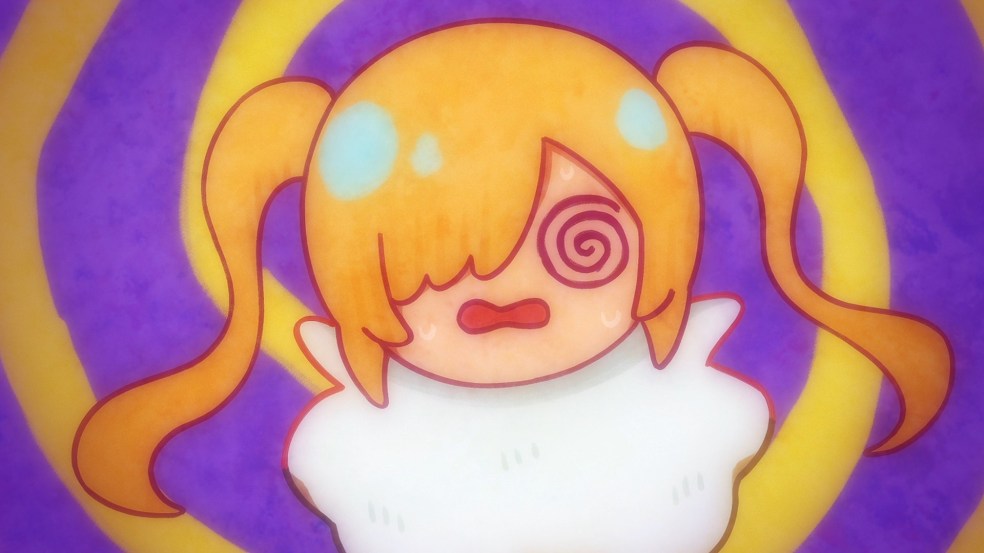
We open this week with Arale down in the dumps. As we saw in last week’s episode, Ritsu tried to reach out to her, and Arale quite literally slapped her hand away. She feels bad, because she knows her friend is in trouble, but doesn’t really think she can do anything about it. This is also affecting her time with Mugendai Mewtype, and she’s so checked out that she doesn’t even sign into the VR program the other girls are using properly, instead being relegated to a flat square with a picture of her and the words “SOUND ONLY” written on it. She pops in for a few perfunctory moments before bouncing. The situation is clear; Arale is really banged up about this whole situation.

Elsewhere in town, Ritsu is streaming, and, crucially, when she goes to stop streaming, she’s distracted by one of Viola’s nasty little texts and actually forgets to properly turn the stream off. She then plays Arale’s song from their LaGirls days, and absent-mindedly mutters “Arale-chan…” out loud to herself, as one does when they are a forlorn yearning lesbian. Viola being Viola, is watching the stream elsewhere and immediately hatches a plot to turn this little incident into more numbers for Fairy Bouquet, the new girl group that she, Ritsu (as Clematis), and two other girls going by Popo and Bell have since formed. (F.B. have been around since the beginning of the show, but this is the first episode where they’re truly plot relevant as a unit. And, in fact, their scene here where Popo, Bell, and Viola are at some kind of…rooftop pool place? demonstrates that they’re both actively complicit in Viola’s behavior toward Ritsu, since it’s Popo who tells Viola about the stream and describes it as her “doing something interesting.”)

Fast forward to Fairy Bouquet’s first in-person event a few days later, and Arale, still depressed and also very frazzled after an incident with Nonoka earlier in the day, finds herself near the event, by total coincidence. Seized by some inner desire to, we must suppose, do the right thing, she actually enters. Unfortunately, Viola spies her in the crowd, and things very quickly go off the rails in the episode’s second half as she calls her out by name and Popo and Bell (who I suppose in addition to being the other two members of Fairy Bouquet are also Viola’s little personal Team Rocket) promptly grab her and shuffle her onstage.

Viola’s little scheme here appears to be to squeeze Arale into panicking in front of the crowd, and if that is the case, then it certainly works out pretty well for her. She frames Arale and Ritsu’s “reunion” to the audience as making up after a fight. (That anyone in the crowd would buy any of this strains credulity, but for someone like Viola who seems to largely just want to be the center of attention, any publicity is good publicity. Gotta turn everything into #content, after all.)

What she may or may not have anticipated is that Arale’s reaction—after freezing up in front of the crowd, at least—is to pull Ritsu offstage and straight up run away. (That she reacts to this by probably-fake-crying tells me she at least thought this might happen and is going to spin it to her own ends.)

In spite of how obviously bad an idea this is, it does make Ritsu remember her admiration for Arale. A small sequence of Arale briefly losing her grip on Ritsu’s hand, only to snatch it again, is a legitimately sweet moment, regardless of anything else. It has also been pointed out to me (by a friend*, I can’t claim to have noticed this on my own) that, interestingly, it is a nearly shot-for-shot mirror of the whole “lost girls” scene from It’s MyGO!!!!!

Ritsu and Arale spend some time talking as the episode comes to a close, and despite Arale putting herself down, Ritsu recognizes her old friend acting to help her. (And, she says, more like how Arale used to be.) It’s nice to see Ritsu being assertive, too, assuring Arale that regardless of what happens from this point on, they’ll figure it out. It’s touching! And a great way to end the episode! Except for the fact that the final shot, as it zooms out and crops in, goes up in CGI flames, pretty directly implying that things are going to get worse before they’re fully resolved. (Which only makes sense, we’re just nearing the halfway point of the series now.)

If you wanted to say that there was a problem with Yumemita that it needs to solve—I don’t think this, but some might—it could, perhaps, be with Viola. The show’s narrative frames her as almost an abusive girlfriend sort of figure, keeping Ritsu under her thumb not just because she’s a sadist (although she’s that, too) but for the sake of controlling Ritsu. What the show has yet to provide is any deeper reason that she does this. Whether it be some underlying trauma, being treated like this herself at one point, whatever it may be. So far, it really seems like she just is that way because that’s how she is. I don’t personally consider this a huge problem, but it’s definitely a different style of character writing than what fans who hopped onto BanG Dream with MyGO and its sequel may be expecting, so if it loses some people because of this I do more or less understand why.

Still, I cannot stress enough that the above does not describe me. I’ve seen more than one person observe that at this point, the show is more about the trio of Arale, Ritsu, and Viola than it is about Mugendai Mewtype as a band. (Plot elements about the latter have largely been relegated to the margins at the start of each episode.) This would be frustrating, perhaps, were Arale, Ritsu, and Viola not extremely compelling characters. But they are! And three weeks in, I have not gotten remotely tired of Viola’s cackling villain shtick, even if I’m as curious as to what deeper reasons she may have for her actions as anyone. (In particular her seemingly almost compulsive need for attention is very interesting, as is the whole imouto image she attempted to cultivate for herself as part of the LaGirls and indeed still seems to. I do think the show will probably address these points at least, in some form or another, so in the final estimation the character writing may not be as different from the prior two BanG Dream seasons as it first appears.) The flames closing the final scene, and the next-episode preview, both imply that Viola is not remotely done Viola-ing yet, which I can only say that I’m extremely looking forward to. Even the series’ promotional materials have gotten in on it, and I will end this week’s writeup by making you all aware of this promotional video, uploaded to the official Mugendai Mewtype account earlier today. It is, essentially, a 30 second compilation of some of the best Viola Moments from the series so far, and features a truly deranged, vore-tastic promotional image as its thumbnail. I don’t know where we’re going with all this, but I am very much still here for the ride


*Hi Astro 🙂


Like what you’re reading? Consider following Magic Planet Anime to get notified when new articles go live. If you’d like to talk to other Magic Planet Anime readers, consider joining my Discord server! Also consider following me on AnilistBlueSky, or Tumblr and supporting me on Ko-Fi. If you want to read more of my work, consider heading over to the Directory to browse by category.

All views expressed on Magic Planet Anime are solely my own opinions and conclusions and should not be taken to reflect the opinions of any other persons, groups, or organizations. All text is manually typed and edited, and no machine learning or other automatic tools are used in the creation of Magic Planet Anime articles, with the exception of a basic spellchecker. However, some articles may have additional tags placed by WordPress. All text, excepting direct quotations, is owned by Magic Planet Anime. Do not duplicate without permission. All images are owned by their original copyright holders.

Let’s Watch BANG DREAM YUME∞MITA – Episode 4

Let’s Watch is a weekly recap column where I follow an anime for the course of its entire runtime.

For the BanG Dream Yumemita column, new entries will be posted either on each Thursday an episode airs, or as soon as possible during the week thereafter.


It’s an interesting move to make the first “regular” episode of BanG Dream! Yumemita as much about Ritsu and Viola as any of the girls in the actual main band, but it does make sense. Ritsu is our little lost lamb. We get further confirmation in this episode that she is, mainly, a victim under Viola’s thumb and, accordingly, Viola gets to do her whole evil vizier routine up and down the entire episode. She’s the real star of the show here, and I think she’d be thrilled to hear me say that, because in this episode we get some indication of why she does what she does.

As I said in the first impressions article, it’s fairly rare for an anime in this genre to have an out-and-out antagonist. But there are some logical extrapolations you can make from how the music industry works—especially the very online digital space that Mugendai Mewtype work in—to craft a compelling villain. Viola’s is just that she’s a complete fucking clout shark. Viola wants big views, she wants the number to go up, and she wants the attention on her specifically. Much of this episode details the brief history of the LaLaLaLaGirls, her previous group with Ritsu and Arale. (There are two other girls but, bluntly, they don’t matter. One of them is literally named “A-ko.” The only thing you need to know is that one of them was the group’s center.) This is also scaffolded with the very specific way that she wants to tailor herself for her audience. In the context of the LaGirls’ group dynamic, she’s the imouto, the cute little sister that everyone’s supposed to want to dote on. She’s pretty insistent about this from the word “go” and is all the more so when the LaGirls actually get signed to a proper agency. The contrast between this and how much of a complete snake-in-the-grass she actually is is both obvious and absolutely delicious. This is a real kind of person! I think anyone who’s on the internet enough has tangled with at least one person who puts up a paper-thin façade of obnoxiously twee cutesiness to hide an inner core of jealousy and venom. I’m not the first person who’s made jokes about Viola posting Google Docs, and I surely won’t be the last.

You know this girl runs the absolute gnarliest antiship blog you’ve ever seen in your life.

The villain cred-building reaches its apex during the episode’s climactic story beat. Where we actually see the real conversations that Viola clip-mined for the edited-together “erea01” video from the premiere. I have to admit, I actually assumed myself that Arale really was being that blunt—I didn’t think she was being mean, mind you, but it’s not crazy for someone so forthright to occasionally stick her foot in her mouth—but no, even that much isn’t true! Viola straight up “Coolsville Sucks!”‘d her. Of course, when the video actually hits the group’s page and the consequences roll in, she plays ignorant and makes with the crocodile tears, all while being absolutely thrilled just offscreen.

Did I mention that the only way she even could do any of this is that cameras were set up to film the LaGirls hanging out together basically whenever they were around each other? And that earlier in the episode, the previous center of the LaGirls mysteriously and suddenly resigns, almost as if Viola had a bunch of dirt on her too and was jealous that she wasn’t the main focus of attention on the group? (She’s definitely the main focus of her new group. Which, incidentally, the other two girls in that band seem to be just fine with Viola’s open displays of domineering behavior toward Ritsu. Birds of a feather, one supposes!)

In any case, the video results in Arale being outed from the LaGirls, and Ritsu, in a moment that seems to really haunt her, does not do anything to help or offer support. After all, Ritsu’s image within the group is that of the perfect model student, and model students, as Viola is keen to remind her, don’t associate with troublemakers. (Never mind of course that Viola is the one causing the problems. To her, the image matters much more than the reality of the situation.) The episode ends with Ritsu once again meeting Arale by chance back in the present, and attempting to apologize. But Arale, who seems understandably hurt by Ritsu’s lack of support back then, smacks her outstretched hand away. This is not something that’s going to be resolved quite that easily, it seems.

There’s more I haven’t gone into here, of course.. Yuno, for example, seems to have a hunch that something is up with Arale (she saw her and Ritsu meet up in one of last week’s episodes, so she knows something is going on) and is doing a bit of investigating near the episode’s start. The preview for next week also seems to imply that the full band might be in the same place as Viola next week, which would certainly be interesting. Viola, it must be pointed out, is obviously being set up to either undergo some sort of comeuppance or one hell of a redemption arc. I think both options are interesting, although she’s so fun as the gleefully evil fame glutton that I’d almost prefer the former. We shall see what the weeks ahead bring us.

I’m going to be keeping these Yumemita writeups pretty casual. I love the show so far, but that has more to do with it being extremely fun to watch than me necessarily thinking I have a ton of deep insightsTM to offer, so I will be keeping things breezy. See you next week, Girl Band Fans.


Like what you’re reading? Consider following Magic Planet Anime to get notified when new articles go live. If you’d like to talk to other Magic Planet Anime readers, consider joining my Discord server! Also consider following me on AnilistBlueSky, or Tumblr and supporting me on Ko-Fi. If you want to read more of my work, consider heading over to the Directory to browse by category.

All views expressed on Magic Planet Anime are solely my own opinions and conclusions and should not be taken to reflect the opinions of any other persons, groups, or organizations. All text is manually typed and edited, and no machine learning or other automatic tools are used in the creation of Magic Planet Anime articles, with the exception of a basic spellchecker. However, some articles may have additional tags placed by WordPress. All text, excepting direct quotations, is owned by Magic Planet Anime. Do not duplicate without permission. All images are owned by their original copyright holders.

Seasonal First Impressions: Blood in the Lilyfields in I WANT TO LOVE YOU TILL YOUR DYING DAY

Seasonal First Impressions is a column where I detail my thoughts, however brief or long, about a currently-airing anime’s first episode or so.


In the grand scheme of all of the anime that have premiered (or have yet to premiere) in the Summer 2026 anime season, my most anticipated show wasn’t the new Kyoto Animation series, ScienceSARU’s take on Ghost in the Shell, the new BanG Dream anime, or anything of the sort. No, I saw that title, and the little bit of atmospheric teasing built up by its first trailer, and—despite knowing nothing at all about the manga it’s based on other than that it’s generally well-liked—knew that it was going to be this. This was my called shot, I’ve been saying for months that this is going to be the premiere of the season; forget whatever hyped-up sequel you have in your mind, the A-O-T-S is I Want To Love You Till Your Dying Day.

Does the actual premiere live up to those predictions? Well, to be perfectly honest, no. Not really. But, I do still think it’s a good premiere. And before I get into why, let’s talk about what this thing actually is first.

Looked at through a certain lens, Dying Day is not terribly different from any of a vast number of ‘magic school’ anime that have existed over the past 15 years. Our protagonist attends an academy that teaches its students how to effectively wield the arcane talents they are born with. The most immediate difference is one of tone; the school of Dying Day is a misty, floodlight gray, and we open in medias res, one of the students having just been killed in a recent “operation.” This school, you see, trains its students not for careers or for their own enrichment, but as soldiers in a war. Young girls and boys learn to conjure magic primarily as a weapon, summoning small, dagger-like wooden wands to do so. The emotional timbre in this opening is more Madoka Magica than Harry Potter, in other words.

Our protagonist is the dead girl’s roommate. In a relatively straightforward move for this show, she’s behind everyone else in her class in terms of talent. Her name is Totsuki Sheena [Takahashi Rie], and she spends most of this episode’s opening minutes wondering why. Why is everyone so blasé about the death of her roommate? Is this how this is all really supposed to be? Flashing back to conversations with that late roommate, Sheena remembers being told she was lucky for being as weak as she was. That her weakness was a privilege that exempted her from thinking about the war. And that night, as she’s continuing to ponder all this, she runs quite unexpectedly into a girl a good bit younger than herself, who is absolutely drenched in blood. Not her own blood, either.

This is Kagari Mimi [Hidaka Rina]. Mimi, who eagerly gobbles up the riceballs that Sheena offers her, is the key to the other half of this show’s tonal space and, I suspect, will be central to whatever it decides to do long-term. (I use that vague phrasing because to be honest, this episode is slow and setup-heavy enough that I don’t really know what that is yet.) Mimi is a few years younger than Sheena and, when she enrolls in Sheena’s class the next day and is announced to be Sheena’s new roommate, the classroom is abuzz with gossip. The other girls (and the boys, too) whisper that Mimi might be that Mimi, a girl who the staff supposedly keep on retainer as some kind of invincible superweapon. In introducing all this, Dying Day does a peculiar little waltz where it tiptoes back into the foggy duskiness of its opening minutes and a goofier sensibility more willing to embrace light novel clichés. In the former camp you have Sheena and Mimi’s wanderings around the school at night, and the funeral for Sheena’s former roommate where Sheena chucks a rabbit into her empty coffin. (The school’s soldiers, we’re told, dissolve instantly upon death. If they were captured, their foes—who we know almost nothing about at this juncture—might “learn things” from their corpses.) In the latter camp, you have everyone’s gleeful fangirling over how cute Mimi is, and one particular detail of the setting; the school’s soldiers (or at least the girls) can kiss each other to use “healing magic.” Essentially, Fate/stay Night‘s “mana transfer” but in slightly less H-game terms. It’s an uneasy dance, but Dying Day largely makes it work.

One of those kisses ends the episode. After witnessing another pair of girls do it, Mimi unexpectedly kisses Sheena when the latter is unable to sleep that night due to stomach problems that, it seems a fair guess, are caused by stress. Sheena narrates that this little problematically age-gapped kiss tastes faintly of soap and, of course, blood…and that’s where the episode ends! Aside from a few minor details (such as a very chummy couple who seem like they’re going to be our main supporting cast) I have really left out very little. It’s a slow, buildup-heavy first episode that is big on atmosphere and raising questions in the mind of its audience. Honestly? Partly because of that uneasy yoyoing between moods, I suspect Dying Day will probably be relegated to cult favorite at best. And even on a technical level it isn’t a perfect premiere. (There are a few obvious visual shortcuts, in particular the use of CGI for some distance models, a general sign of a show that is trying its hardest but isn’t necessarily the most resource-rich production. They’re the only real ding to the otherwise excellent atmosphere.) Still, if you like sapphic overtones so heavy that “overtone” is honestly not the right word anymore and a curious, mysterious atmosphere, I really do think this is worth checking out. Anime of the year? No, not in a year with legitimate masterpieces in this space like Shiboyugi and Kamiina Botan. Of the season? Even then, probably not. But, it is worthwhile in its own right, in a time where everything is rushing to grab your attention as quickly as possible, something taking the slow path shouldn’t be underestimated.


Like what you’re reading? Consider following Magic Planet Anime to get notified when new articles go live. If you’d like to talk to other Magic Planet Anime readers, consider joining my Discord server! Also consider following me on AnilistBlueSky, or Tumblr and supporting me on Ko-Fi. If you want to read more of my work, consider heading over to the Directory to browse by category.

All views expressed on Magic Planet Anime are solely my own opinions and conclusions and should not be taken to reflect the opinions of any other persons, groups, or organizations. All text is manually typed and edited, and no machine learning or other automatic tools are used in the creation of Magic Planet Anime articles, with the exception of a basic spellchecker. However, some articles may have additional tags placed by WordPress. All text, excepting direct quotations, is owned by Magic Planet Anime. Do not duplicate without permission. All images are owned by their original copyright holders.

Mini First Impressions: GROW UP SHOW, GOODBYE LARA, & SPARKS OF TOMORROW

Seasonal First Impressions is a column where I detail my thoughts, however brief or long, about a currently-airing anime’s first episode or so.


Another season, another roundup post for the stuff I didn’t quite have enough to say about to do a full post on. Let’s get into it.


Goodbye, Lara – I am only passingly familiar with the original The Little Mermaid story. Like a lot of Americans, I could tell you a lot more about the Disney version (although it’s been a long time since I’ve seen even that). This…may or may not matter to appreciating Goodbye, Lara in the long-term. But I bring it up because the anime’s opening episode takes an interesting approach to its classic source material.

Goodbye, Lara is not an adaptation of The Little Mermaid. Instead, it’s an original story that uses the original tale as, essentially, a prologue. (I am reminded, vaguely, of the old Peter & The Starcatchers series of young adult novels and their relationship to the original Peter Pan.) It’s hard to make many strong claims about what the series will “be like” in terms of actual narrative because of this, as the story here is that prologue. With some reworked framing, the fundamentals of a mermaid princess—Lara [Hishikawa Hana, who it is honestly great to hear around in a main role again], this time around—fascinated by the human world are the same. The main deviation, as far as I’m aware, being that Lara’s father Rowan actually contextualizes contact with (or even speaking out in favor of) humans as a “sin.” Something about them, he says, corrupts a mermaid’s inner light. This seems like a moral framing at first, but events late in the episode suggest it may be something more fundamental than that. In any case, Lara nonetheless develops a fixation on humans early on, even keeping a collection of various artifacts that fall into the sea over the years, dolls, jewelry, glasses, and so on, as she grows up in the 1770s. She is, eventually, tempted by the words of a delightfully cackle-cackle muahaha villain-ass villain, the sea-witch, Grace [Fukami Rica], exiled from her father’s kingdom.

Of course, she offers Lara a potion that will turn her human. And of course, as we all likely know, this potion has a catch; she has to find true love before it wears off, or she’ll dissolve into foam.

And she does! She falls for a prince of the surface world, and they have a lovely time together right up until the potion starts wearing off and she changes back into a mermaid before his very eyes. In doing so, she finds out that the human/mermaid animosity is mutual, and she fizzles into ocean spray, tears in her eyes.

Grace, watching from a magic mirror, is unimpressed by this, dismissing her tragic ending as boring. (Which, hey, seems a touch disrespectful, since I think that’s how the original book ends? But, then, she is the villain here, so maybe it’s fine.) Which would be an odd note to end on, but of course, Lara isn’t truly dead. Via some magical means, she is resurrected inside of a giant seashell, and is shocked to find her father’s kingdom in ruins. This, if the magic mirrors that she consults to learn the kingdom’s fate can be trusted, is because of her own actions. Lara merely making contact with the surface world was somehow enough to “corrupt” the inner light of not just the mermaids themselves but the land in which they lived. (It’s around here that this starts to feel a bit like commentary on pollution, but it’s really too early to say for sure.)

Grace contacts her again, telling her that, if she’s willing, she might be able to save the kingdom and revive her family (who are not dead per se, but merely in the same kind of stasis that Lara herself seemed to be up until her resurrection). Without any other choice, Lara agrees, and is promptly rocketed back to the human world on a beautifully-animated jet of water.

She finds it quite different from her last go-around, because—small detail—her resurrection took about 200 years and change, and it’s now 2026. The episode ends with her falling from the sky into the waiting arms of a young girl named Otsu Mari [Kawaishi Nana], who does the only logical thing and puts on the boxing gloves she’s carrying to parry the incoming mermaid with a solid left hook. You know, just to prove that she’s no casual.

No but really, why did she do that?

Suffice to say that all of this is just endlessly interesting. How did Lara merely making contact with a human mess up the mermaid kingdom so badly? Why is Grace so hellbent on seeing her try again when the kingdom’s ruin seems to have been her goal in the first place? Why does the girl that Lara falls onto after being blown out of the water have boxing gloves? No, seriously, how on earth does boxing of all things factor into this story? A good premiere leaves you asking questions, and a great premiere does so with style. Goodbye, Lara, as you can probably guess, is by my estimation a great premiere. Good enough to stand out in a season that hasn’t been short on those and isn’t going to let up with them anytime soon. Koide Takushi, directing here, was previously the animation director on the Revue Starlight movie. So this series, with its sea-deep colors and bold, immediately-iconic character designs, was probably always destined to look good. But the premiere promises that Goodbye, Lara will be more than a mere return to form for Kinema Citrus, it could very well be truly great in its own right.


Grow Up Show – What we have here is a classic “girls passionate about some performing art”-style slice of life series from A-1 Pictures and their relatively new subsidiary Psyde Kick. It’s an original with no prior source material, which is always neat, and Grow Up Show lacks even the public domain roots of Goodbye, Lara. Unfortunately, it’s also the first premiere of the season that I just really did not care for at all.

Grow Up Show‘s premise—that lead Tsurumaki Mizuka [Hirohashi Ryou]is roped into working for the traveling Sunflower Circus after her deadbeat dad, a legendary circus performer himself, essentially sold her to them for 40,000 yen—is precisely the kind of wacky plot motor you’d expect in a show that’s this zany. (And we’re clearly supposed to think that her dad is a terrible person for doing this, even that tone in mind, to be clear.) Accordingly, Grow Up Show is pretty silly, and it makes sure you know that by having Mizuka pull all kinds of wacky faces and such. On top of that, the show is passingly cute, so those who don’t need much more out of their anime than those two things will be satisfied here. However, it’s also pretty cloying in a way I found immediately obnoxious and which did not really let up over the course of its premiere. Mizuka herself is hardly the world’s most compelling protagonist. She’s a grumpy sourpuss who isn’t at all thrilled to be drafted into doing circus work due to its association with her asshole dad. Unfortunately, that’s probably the second most common type of lead for this sort of thing after the completely played-straight “bundle of joy and passion” type, so that isn’t terribly interesting, and is less so because we’re obviously setting up a turnaround narrative here where, by the end of the show, she’ll actually love the circus and maybe even come to reconnect with her estranged father. (If this doesn’t happen, feel free to come back after the finale and call me a fool in the comments section, but, come on.) Beyond that, the only truly noteworthy thing about her is that she’s really flexible. Definitely helpful for a circus acrobat, but not exactly the sort of thing that leads to a character brimming with personality on its own.

The other characters are an unfortunate combination of rote, annoying, and interchangeable, and more than once while they had their little exchanges I found my eyes glazing over. Most of them have one obvious personality trait, if that, few distinguishing physical characteristics, and even the voice actresses seem to largely phone it in, so none of them sound particularly distinct either. The show attempts to make an exception to this nondescriptness with Kawasumi Ouka [Kurosaki Shiori in what is, admittedly, apparently her first major role], a character set up as Mizuka’s partner in the circus’ acrobatic shows. But the two don’t really get any memorable interactions in their time together here. Even when actually practicing one of those acrobatic routines, the attempt to establish chemistry between them just feels very paint-by-numbers. In fact, all of that, the ultra-simple character dynamics, the gimmicky core hook (not a lot of anime about circus acrobatics admittedly, it’s, what, this and Kaleido Star?), and plausibly-deniable girl x girl fanservice, Grow Up Show feels like a slice of life anime from a decade ago, and not in a good way. Even the art style, a poor stab at middle-of-the-last-decade generic moe, feels symptomatic of this. Likewise, the animation, while competent, isn’t particularly compelling either. Perhaps I just don’t have enough appreciation of the inherent beauty of bodies in motion or whatever, but, it did not speak to me despite its technical proficiency.

The real nail in the coffin, though, at least for me, came in the episode’s second half, where Mizuka watches the Sunflower Circus girls’ performances and is asked to critique them. It is a tragic fact that, if any narrative attempts to speak on the arts themselves, it will often do so through a character. In doing this, it then hands idiots with blogs like myself endless ammo, because it’s so easy to fling comments made by these characters back at the narrative itself. But, being complete easy-mode for critics doesn’t actually make it wrong, and I was not happy to realize that the admittedly-lazy buzz of “aha, it’s like the show is talking about itself” was the most engagement I was going to get out of the episode. I am not exaggerating when I say I had to really struggle to not completely check out for everything afterward.

Maybe I’m being mean, and yes, sure, it is technically possible that this series will somehow pick up later in its run and I’ll look like a fool for writing it off, but I truly doubt it. In an anime season that is this packed, both with excellent things that have already premiered (including specifically those about young girls in the performing arts) and things that are about to, it’s hard to imagine anyone wanting to stick with this for a full twelve weeks. Slice of life “cute girls doing cute things” anime often fly under the radar in terms of anime genres that seem to only get new entries due to some perceived bottomless demand for them, in comparison to say narou-kei isekai or harem romcoms (both of which are made in much higher quantities and, I would say at least, have much lower averages in terms of quality over all), but an anime like this is a nice reminder that it is perhaps good that there aren’t actually way more of these things, because at some point you’re just diluting the scene with cruft.

Also there’s not even a girl who’s a clown, which is an enormous missed opportunity.


Sparks of Tomorrow – These three anime are listed in alphabetical order, but even so, it might be appropriate that I’ve saved this one for last, as it’s by some measure the one I have the least to say about. Sparks of Tomorrow‘s big claim to fame is being the newest Kyoto Animation project, and to be sure, Oota Minoru (who has been at KyoAni since the Haruhi days but hasn’t actually directed an entire anime of his own until now) and his crew bring the usual levels of expected polish and style to the production. The backgrounds are also very nice, and give a real sense of believability to the series’ setting, an alternate-history, steam-powered 1907 Japan where electrical engineering never caught on and electric lighting and the like is still very much a novelty. Our hero is Sakamoto Kihachi [Uchida Yuuma], younger brother of a presently-vanished electrical genius whose dream was to bring electricity to the masses.

Now, this is the second paragraph and I have already used the word “electrical” and its variants five times. (It is perhaps for the best that the show’s early, unofficial English title, The 20th Century Electric Catalogue, taken from an important book and plot token in the story, was never canonized.) Kihachi’s brother, the contents of the Catalogue itself, and how he would’ve revolutionized the world with it, are all left pretty up in the air at the moment, and while you could argue that the show is indulging in some Great Man Theory here—in an opening bit of narration we’re told the present state of affairs is because all of the early “electrical geniuses” died young, so clearly it’s up to Kihachi’s older brother to fill their shoes—it really feels, at present, like we’re more supposed to latch on to the feeling of something important as opposed to any specifics. Fair enough, but it does make the premiere feel a little odd overall.

What it does have going for it is a decent cast of characters. Kihachi himself is disillusioned by his brothers’ disappearance, and spends most of his days fixing various machinery at a Buddhist altar shop that took him in. His opposite number, our female lead Momokawa Inako [Amamiya Sora], is very impressed by the electrical inventions Kihachi shows her. Toward the end of the episode she literally thinks she’s in heaven for a moment, thanks to a particularly impressive display. Inako’s main talents are an intense credulity and open devoutness in, um, just about everything, really. It’s a somewhat strange, cartoonishly naïve personality for a character to have, but it works in its own way. The real linchpin of the cast though, for my money, is actually our villain, a bizarre, scheming sleazeball named Mizoe Yousuke [Uchiyama Kouki] who is the heir to a steam engine zaibatsu and strong-arms Inako’s dad into letting him marry her as part of a plot to claim the Electric Catalogue for himself. All of this is, in a word, odd, and I’d be lying if I said I had any idea of what to make of it at this early juncture. (And the often extremely zany animation, which is fairly uncharacteristic of KyoAni’s usual house style, really only emphasizes the strangeness.) But odd is good in the world of the anime premiere, and while this isn’t entirely my thing, I can imagine it appealing to some on novelty alone.


Like what you’re reading? Consider following Magic Planet Anime to get notified when new articles go live. If you’d like to talk to other Magic Planet Anime readers, consider joining my Discord server! Also consider following me on AnilistBlueSky, or Tumblr and supporting me on Ko-Fi. If you want to read more of my work, consider heading over to the Directory to browse by category.

All views expressed on Magic Planet Anime are solely my own opinions and conclusions and should not be taken to reflect the opinions of any other persons, groups, or organizations. All text is manually typed and edited, and no machine learning or other automatic tools are used in the creation of Magic Planet Anime articles, with the exception of a basic spellchecker. However, some articles may have additional tags placed by WordPress. All text, excepting direct quotations, is owned by Magic Planet Anime. Do not duplicate without permission. All images are owned by their original copyright holders.

Seasonal First Impressions: JAADUGAR: A WITCH IN MONGOLIA

Seasonal First Impressions is a column where I detail my thoughts, however brief or long, about a currently-airing anime’s first episode or so.


A genre represented a bit sparingly in the usual churn of seasonal anime is the historical drama. That’s not to say that there aren’t any—this isn’t even the first one I’m covering this season—but they’re a little less common than some genres, and when they do happen, they tend to stick to a pretty narrow geographical range; Japan itself, or, sometimes, China. As its title suggests, Jaadugar: A Witch in Mongolia, is an outlier in this regard, and it actually starts farther west than that, in Iran, but while this is notable on its own, it’s not the only reason the series is worth attention.

For one thing, this is the latest offering from Science SARU, who are pulling double duty this season between this and their upcoming Ghost in the Shell reboot. (Witch in Mongolia in particular is the work of a creative team led by chief director Yamada Naoko and director Abel Gongora.) Here, they’re working to translate the striking art style of the original manga, whose creator goes by the pseudonym Tomato Soup, into animated form. The result is something that, likely more by convergent evolution than anything, looks just a bit like Kaiba‘s art style, but translated into a rich and breathing portrait of the medieval middle east as opposed to that series’ far-future psychadelic sci fi. So what you have here is a very strongly-realized historical setting presenting a compelling story about the power of knowledge and how it can help us deal with our circumstances, even when those circumstances are very bleak indeed. That’s interesting. That’s something truly different.

Of course, being a series set in the real-world past does come with a few hurdles we all need to jump together as viewers. To put it more bluntly; slavery is a major plot element of this series. I will never tell anyone that they have to put any discomfort with that aside and just push on through, but I think there is a huge, huge difference in how the practice is depicted here—an honest acknowledgement of a historical reality—and, say, the two-bit power fantasies of bottom of the barrel narou-kei dreck, which is where this stuff tends to pop up most frequently in anime. If you want your off-ramp, it’s here. This stuff is part of the story, and I am going to talk about it as frankly as the story itself does, there isn’t really any way to write about it without doing so.

Because—silly as this may sound—the actual events of the story are very important to establishing what the story is going for here, I am going to recap these first two episodes, looping in my own thoughts and observations where applicable. If this seems a little more “recappy” (and longer) than my usual first impressions pieces these days, that’ll be why.

Seeking a new servant in her household after the death of her husband, a woman named Fatima [Kuwashima Houko] visits a slave market run by a man named Ahmad [Takaoka Binbin]. There, she’s sold a new housekeeper and, in return for Ahmad knocking a few hundred dinar off the price, she’s also to take in a young girl named Sitara [Sekine Akira]. Fatima’s brother Muhammad [Mogami Tsuguo] attempts to instill some learning in Sitara, as Ahmad told Fatima that the girl has a knack for it, but finds himself frustrated when she’s unable to even learn the very basics of Quran recitation. Frustrated, Muhammad says that he’ll just pay back the discount and return her. Left alone after this, Sitara attempts to escape.

She does not, quite understandably, want to spend the rest of her life enslaved. She says she’s going home, but in her attempts to find her way out of the manor, she gets lost. In a garden, she encounters a young boy, also named Muhammad [Saito Jun]. (He’s the elder Muhammad’s nephew, son to Fatima and a late father. I will be differentiating him and the elder Muhammad by age.) She takes an immediate interest in him, including teasing him after her headdress accidentally slips off. Unfortunately! This leads to her being caught, and upon being scolded she breaks down that she misses the home that she and her mother used to serve in. (Zumurrud [Nikray Farahnaz], one of Fatima’s other servants, is unsympathetic and tells her that if she really wants a home to call her own, she should study hard so she’ll get bought by a worthwhile master. Ouch.)

In spite of this, the younger Muhammad makes an earnest attempt to connect with her. Enough of an attempt that he tries to teach her a little something; taking a metal bucket from Zumurrud, young Muhammad drops it in the courtyard from a great height, making a terrible racket. When this sends everyone but Sitara and Zumurrud into a momentary panic, he notes that, because these two had the time to see that the bucket was about to fall, and therefore to prepare themselves, they knew to cover their ears and avoided the clamor.

The younger Muhammad says that this kind of foresight; preparation to avoid calamity, big or small, is what defines learning. In saying this, he calls back to an earlier line from Fatima—when attempting to convince the elder Muhammad to teach Sitara the Quran, she explains that seeking knowledge is the duty of all Muslims—and highlights what is sure to be a main theme of the series.

This is enough to convince her to take studying seriously. And thus, we are treated to a montage. Sitara learns household tasks, learns to pray, and recieves an outfit from the house. As the montage (and Fatima’s period of prescribed mourning for her husband, the synchronization of the two feels deliberate) ends, Sitara speaks with the younger Muhammad once again. The two are clearly close at this point, and she’s surprised (and a little upset!) to learn that he plans to journey to Nishapur, and to other cities of the world beyond, to learn as much as he can about the world from as many different peoples and faiths as possible. It’s an admirable goal, and young Muhammad believes that it’s what his father wanted for him, but Sitara is visibly upset by the prospect of not seeing him again, and it’s not hard to conclude that the two have some nascent feelings for each other. No matter, young Muhammad promises Sitara that he’ll write to her. Now, Sitara is illiterate, but this is his way of encouraging her to practice her letters. He wants to become a great scholar and, hopefully, someday, teach many young folks like herself. With some sadness, she and the rest of the household see young Muhammad off on his journey, and the narration tells us that he will become a person of some renown. (This is true, because the younger Muhammad is the Persian polymath Nasir al-Din al-Tusi.)

The narration also tells us something else, however. That this is the last time he and Sitara will ever see each other in person.*

We cut to eight years later. One of Sitara’s recitation practices is interrupted by the sounds of the Tussian militia outside, heading off to fight a band of troublesome nomads. This disruption is quickly forgotten as one of young Muhammad’s letters arrives. In it he talks about how in love he’s fallen with the sciences; astronomy, geometry, medicine, and how he prefers their methods of learning to the purely theological. He also encourages his family to let Sitara learn these disciplines, as well, suggesting Ptolemy and Euclid as starting points. Euclid’s Elements is a bit hard for her to grasp, but when Fatima introduces her to a book on astrology and astronomy (recall, this was the 12th century and the two were not well delineated), she’s captivated. In here, Fatima repeats the “seeking knowledge” line, once again underlining it as a main theme of this story.

Back in the manor proper, one of Fatima’s other servants, Anis [Ise Mariya], scolds Sitara as she burns something in the oven. It’s true, she tells Sitara, that some slaves are given education to entertain or delight their masters, but decisions of this nature aren’t made by the slaves themselves. “We’re property, not people.” She says, in a way that is so matter of fact that what she’s saying actually comes off as more chilling. All the moreso because of how this episode ends.

The militia, mentioned briefly earlier, are revealed to have fallen to the nomads. The episode closes on a brief exchange between two of these men; a commander of some sort, and his superior, on horseback, who asks if Tus has any scholars because he’s “looking for something.”

When the Mongols are inbound to the city, Muhammad and the rest of the household treat them more like a natural disaster that will blow over. The slaves, along with the rest of the valuables and Fatima as well, hide in a spacious cellar underneath the manor while the elder Muhammad takes his sons up to the mountains to hopefuly ride out the proverbial storm.

Fatima and Sitara have a bit of a heart to heart in the standstillish world of the cellar, speaking about Fatima’s books (a collection her late husband spent a lifetime building) and how important they are.

She also asks Fatima if she “cares for” Muhammad, and both her actual reply and the little flight of fancy she has—she and Muhammad decked out in fancy clothes, eating pomegranates together—make it a clear yes. Fatima says that she wants Sitara to serve Muhammad “by his side, as a human being.” For someone in Sitara’s position, that’s high praise. Days pass, and after a few, there’s some noise outside the cellar. Fatima assumes it’s the older Muhammad, returned to come get them. It is not.

It is here that we are formally introduced to the Mongols invading the city. We don’t learn his name just yet, but the leader of this little expedition appears to be a prince, one of the sons of Genghis Khan. For whatever reason they may have, he is looking for a copy of Euclid’s Elements, a book that has of course come to mean a lot to Sitara over the years. Unable to restrain herself, she shouts at the Mongol prince to return it and calls him a thief. Unfortunately, not only is the prince clearly offended by the mere act of being yelled at, he has a servant on hand of his own, who translates the insult into his language. This is enough to incur his wrath; he tells Sitara—his servant translating all the while—that bravery from one as delicate as she is unseemly, and promptly brings down his sword on her head.

Fatima, of course, cares enough for Sitara to not stand idly by while she’s attacked, and jumps in front of the blade. Dying in Sitara’s arms, she calls her her daughter. It is a sad and tragic event, and it does not seem like it’ll be the last of those in this series.

Brought up in the first episode is the limit of theoretical knowledge. The younger Muhammad embarked on his journey in part because his own teacher scolded him for his lack of life experience. Here, we see those limits in plain relief. There is simply not anything that Sitara, as she currently is, could possibly have done.

No matter the era, the place, or the reason, an invading army is almost never welcome. Witch in Mongolia portrays this pain with a very raw, immediate touch. After Fatima’s death, Sitara is left to watch as the invaders plunder the manor, and when they finally lead her away in a train of captives, we see the beautiful sandstone buildings and sky-blue dome tops of Tus rendered as so much rubble underneath the smoke and fire.

This happens all over the world, and has happened, from the dawn of human history to the present day. The methods change, both those for delivering the killing blow and those for extracting the wealth, but the fundamental injustice of the strong trampling the weak has not. Tus, after its sacking in 1220, was, in fact, eventually rebuilt, but it did not last, and the city didn’t survive the 1200s. Those are incalculable lives and stories either lost or displaced, and Witch in Mongolia is about just one of them. As Tus burns, Sitara and a throng of other captives are marched out of the city and into the surrounding desert. She manages to meet back up with Zumurrud and Anis, although the former is badly suffering from watching her brother be shot by archers before her very eyes. Later, the captive train comes across a field of the dead, and a woman attempts to run off upon recognizing one of the bodies. She, too, is promptly shot to death by one of the Mongol archers.

This is all very, very bleak. Obviously. Even saying as much feels a bit trivial. Keeping Sitara going are memories of her time with Fatima, eagerly awaiting the bloom of the flowers in Safar and her letters from young Muhammad. It may seem somewhat strange, to an audience living in the modern world, and given Sitara’s own reaction in the opening minutes of the first episode to the prospect, that she looks back on serving under Fatima so well. But, we must remember that despite their arrangement being what it was, it is clear that Fatima cared a good deal for Sitara, and it was under her tutelage that she was able to learn about the world. I am of course not remotely saying—and I do not think the show is trying to say—that this justifies the practice, merely that it explains Sitara’s own feelings on the matter. It’s also important context for the decisions she makes toward the end of the episode.

When the train of captives reaches the Mongol city camp, the exhaustion and emotional turmoil is too much. Learning from some of its few survivors that Nishapur, too, has been burned to the ground (for the crime of defending itself; an entire city for the head of the invading force’s commander, per the Khan’s orders) pushes everyone to the absolute brink, as it now seems impossible that even young Muhammad is still alive. It’s too much for Sitara, too much for Anis, and too much for Zumurrud, who, later this same day, collapses, dying as she remembers her brother Mikhail, leading Sitara to wonder if she wasn’t missing her brother the entire time they lived together with Fatima. Sitara losing more people close to her does nothing to help her emotional state, of course. Anis attempts to calm her down by telling her not to blame herself for Fatima’s death. She reasons that, as slaves, they aren’t really held responsible for what they do in the same way as a free person would be. Whether she truly believes this or is saying it as much to comfort herself as Sitara isn’t entirely clear. But, it ends up not mattering, as with Zumurrud’s death, Anis has clearly reached the end of her rope as well. Overnight, she lunges at one of the Mongol soldiers out of nowhere, and is shot dead.

With essentially everyone in her life now gone, Sitara wonders if she shouldn’t just pick a direction and walk; an arrow will pierce her, too, if she does this for long enough, she thinks.

Then, unexpectedly, she’s interrupted not by one of the Mongol soldiers, but by the Mongol prince’s servant, the translator who was with her when Fatima was killed. He obliquely offers her a way to reclaim the copy of Euclid’s Elements that the prince stole, and on that note, the premiere comes to a close.

All told, this is clearly the opening act of a very considered story with a lot of long-term goals. I really, really want to know how the translator is going to go about getting the book back. It’s clear that this is, at this point, one of the very few things Sitara still has from her old life to hang on to, and that it’s an object with such obvious ties to the story’s themes is interesting as well. (And accordingly, what she might do with that book is inherently interesting as well.) Something I’ve neglected to mention up until this point is the opening narration, which promises us a “witch who made a vast continent her plaything.” I don’t know, precisely, how we get there from here, but I want to find out.


*In real life, there is apparently little to no evidence that these two people knew each other, but drawing a connection between the two—Sitara is based on a real figure as well, known only by that name and as “Fatima” to the historical record—is a fair use of writer’s privilege I’d say. For both the former of these particular factlets and the aforementioned historical identity of young Muhammad, I must thank my good friend Zersk (googling “Muhammad of Tus” and the like was getting me nowhere), who, fun fact, is also the artist who drew the witch icon I use to comment on this website. 🙂


Like what you’re reading? Consider following Magic Planet Anime to get notified when new articles go live. If you’d like to talk to other Magic Planet Anime readers, consider joining my Discord server! Also consider following me on AnilistBlueSky, or Tumblr and supporting me on Ko-Fi. If you want to read more of my work, consider heading over to the Directory to browse by category.

All views expressed on Magic Planet Anime are solely my own opinions and conclusions and should not be taken to reflect the opinions of any other persons, groups, or organizations. All text is manually typed and edited, and no machine learning or other automatic tools are used in the creation of Magic Planet Anime articles, with the exception of a basic spellchecker. However, some articles may have additional tags placed by WordPress. All text, excepting direct quotations, is owned by Magic Planet Anime. Do not duplicate without permission. All images are owned by their original copyright holders.

Seasonal First Impressions: BANG DREAM YUME∞MITA Is Out of This World

Seasonal First Impressions is a column where I detail my thoughts, however brief or long, about a currently-airing anime’s first episode or so.


2026 has been, to undersell it, a strong year for anime thus far. But if we’ve been missing anything, it might be the girl band renaissance that’s consistently been a highlight of the medium’s last few years. A year-ish since the last major show of this genre is not, by any means, a drought, but it felt like we were absolutely swimming in them for a little while, so it can feel like an absence regardless. If you’ve been feeling that way, fear not, the drought is over; Mugendai Mewtype are here. BanG Dream! Yume∞Mita (which I will be spelling without the infinity symbol interpunct, cool as it is, from this point onward) is the latest entry in that longrunning series. It dropped with a gargantuan three-part premiere earlier today, because, well, of course it did. BanG Dream season waits for no one.

Mugendai Mewtype are a bit of an oddity within BanG Dream on the whole, however. This anime is absolutely accessible to anyone who’s not been following them for years—they’ve been active in some form or another since 2022—but it is nonetheless notable that this thing was only made after a retooling of their overall concept. (My very limited understanding, as someone who is a casual BanG Dream fan at best, is that they were originally mostly a VTuber outfit and only became an actual live band later. This anime was, presumably, conceived somewhere after that point.) As such, Mewtype are underdogs of a sort, so it’s nice to see them getting their own story.

As for what that story is like, I’m going to actually flip my usual script here and talk about the style and tone of the series first, and save the actual plot for the bottom half of this article. Worth mentioning, more than anything, with this multipart premiere, is the show’s extremely expressive visual style. A far cry from the frozen and elegant gothica of Ave Mujica, its immediate predecessor, Yumemita is a cartoon-ass cartoon. Characters bend and stretch to express contentment or shock, other art styles or locations are beamed in for a few seconds for comedic effect, the works. I would go so far as saying that off these three episodes alone it really gives Girls Band Cry a run for its money in terms of being one of the most visually impressive 3DCGI anime to date, not just within its genre but outside it as well. The colors are, similarly and once again in contrast to Ave Mujica, brighter than a fresh lightbulb and more colorful than a pack of Skittles, extremely vibrant and practically radiating off of the screen. Ultimately this is the sort of thing you need to see to truly appreciate, but if my recommendation is worth anything I can safely say that the anime is worth watching for its visuals alone.

From this, you might surmise that Yumemita is on the lighter end of the tonal spectrum. You’d be correct to! Overall, this is a pointedly less heavy affair than the previous two BanG Dream anime have been. That’s not to say there are no stakes (there are, and there’s one delightfully glowering exception to everything I’m about to say that we’ll get to), but there is, for example, no long-simmering backstory involving—spoilers for those two shows, by the way—parental abuse or incestuous niece/aunt romantic pining. Yumemita is thus perhaps more in line with a “normal” BanG Dream anime, if what I’ve seen of the first season is representative. But this isn’t a show content to rest on its laurels. In its more straightforward moments, Yumemita experiments visually, as previously outlined. In its more serious ones, it turns that experimentation toward something more tense. It manages to pull this shift off with surprising ease, and the show’s few (few so far, at least) darker moments read more as deliberate contrast than lack of cohesion.

It’s worth taking a detour to discuss one further aspect of the presentation; the subtitles. Mostly, they’re fine, but seem to be strictly single-line, meaning there are a couple of cases where lines aren’t subbed because they’re spoken under another, usually longer, set of dialog. (There’s a particularly annoying instance of this in the third episode.) In a few cases, pretty important-looking text messages aren’t translated at all. This doesn’t majorly impact the show’s basic comprehensibility in the same way that Ave Mujica‘s truly busted official subs did, but it’s still annoying, and it feels like we’re missing a bit of nuance, and it’s aggravating to have to take time out of so many premiere writeups I do just to note that the subs are scuffed. This may be another one where the wait for fansubs is worthwhile, but I don’t think the officials are bad enough to wave anyone away from entirely. It will come down to personal preference, in the end.

Speaking of the show’s writing, Yumemita also has an exceptional command of comedy, and I’d in fact say that were it not for the aforementioned exceptions you could get away with just calling the series a comedy outright. (As-is it’s more of a dramedy.) Much of this revolves around Arale1, our main protagonist, vocalist of Mugendai Mewtype, and owner of a truly impressive mile-a-minute motormouth that she tries and often fails to keep a lid on. Bandmates Nonoka, a happy, bunny-coded airhead that serves as the group’s guitarist, and Miyako, a mangaka who also does illustrations for Mewtype and is their keyboardist, get their fair share of jokes in, too, however. Final group member Yuno, Mewtype’s DJ and general doodad manipulator, is essentially the group’s collective straight man and is more a subject of comedy than anything else.

(From left to right: Yuno, Arale, Miyako, and Nonoka, rocking out while singing the OP)

With all this said, the actual plot of the show is an interesting beast in its own right, and we shouldn’t discard it. In premise, Mugendai Mewtype’s actual formation is extremely straightforward. Our heroines were individually-successful creators in their own right—Nonoka livestreams, Miyako has her manga and illustrations, Yuno both contributes songwriting and composition to other artists’ projects and was in a previous band of her own, and Arale was also in a previous musical group (a different one, it should be stressed). As would be expected of people who meet as part of, essentially, a business arrangement, none of the Mewtype girls directly knew each other before the events of the first episode, and it feels safe to say that none of them are on the same page. (Although some of them were at least aware of each other. Arale in particular fangirls to hell and back over Miyako’s manga.) In fact, none of them really seemed to know that they were going to be in a band together as such at all. Especially not Miyako, who explicitly simply didn’t read the terms of her contract. (Get a lawyer to go over these things, kids!) Worth mentioning here is also the band’s manager, a horrible little voxel FunkoPop thing, because the band’s actual meetings, you see, occur entirely within something akin to VRChat.

The main point-of-view character for most of these three episodes is Arale herself. Arale’s past experiences with online fame lead to her to be, to put it nicely, a little neurotic about how she acts around other people. Constantly, over the course of the premiere, she wants to say something but doesn’t, or can’t stop herself from saying something that she doesn’t want to. In neither case do either of these cause much issue for Arale in the present at least, but they clearly embarrass her and she spends most of the premiere trying to worm her way out of having to sing as part of Mugendai Mewtype at all. (In fact, in a commonality with the MyGo/Ave Mujica trilogy-to-be, there’s pretty much no actual music in this first trio of episodes aside from the OP and ED themes.) Especially early on when speaking to her IRL schoolmates, she only says a few words out loud while an entire internal monologue plays over top and, indeed, is what’s actually subtitled.

Arale gets up to quite a few antics over the course of these first three episodes, but trying to avoid singing (especially in front of anyone) is her main thing at the moment.

Why? Well, as mentioned, Arale used to be part of a different group. The LaLa Girls, as they were known, were together for a while until they weren’t. We don’t know all the details, but one thing is quite clear: a video of Arale talking shit about both her bandmates and some other, unrelated people was leaked on their Youtube page, and our girl got very cancelled. We first learn of this when she runs into two of her former bandmates. Ritsu, who really seems to miss her and want to reconnect with her, and Viola2 [Kaede Hondo], who is, even in just her brief screentime here, a magnetic presence who seems very determined to make sure that doesn’t happen. Both are part of a new band with a flower theme, we don’t know a ton about them (or there other two members) yet, but it seems like they’ll be an important presence here.

(From left to right: Bell, Viola, Ritsu aka Clematis, and Popo)

Earlier, I mentioned that this series has a largely fairly light atmosphere compared to the last two BanG Dream anime. That’s mostly true, I mentioned an exception, that would be Viola and her general role in this story. Arale has a flashback / bad dream at the start of the second episode that really makes it seem like she’s in the wrong with the whole “leaked video” thing. But a good chunk of Viola’s dialog, and her weird, touchy-feely actions while speaking to Arale (including petting her hair and talking about how she looked better with twintails), definitely imply something weird going on. This comes to its head at the premiere’s conclusion, in a post-credits scene after the third episode. Here, she pretty heavily implies that she either somehow set Arale up, or kept the video in her pocket as a weapon the entire time. Ritsu, in particular, seems very uncomfortable with all of this, and Viola is clearly keeping her under her thumb by threatening to hurt Arale even further unless Ritsu cuts contact. She goes on a monologue here that is just pure cartoon supervillain shit; she strings together a speech about how human civilization rose because the first humans weren’t afraid of fire and how it only takes one spark to set something alight. If she didn’t draw attention to it herself, you could easily miss that this is pretty much entirely just wordplay riffing on the term “getting flamed online.” The performance from her voice actress, the permanent cat smile plastered across her face, and the deployment of the show’s SD squishiness to highlight just how much sadistic joy she’s taking in this all serve to make her almost outlandishly EEEEEEVIIIIIIILLLLL. The only thing she’s missing is an ojou laugh and a threat to kick someone’s dog. It’s quite a contrast from the rest of the show! Arale, in spite of her past mistakes, is trying to better herself and most of the interpersonal issues between Mugendai Mewtype themselves seem comparatively minor! So this is all a bit of a twist, for certain.

It’s not necessarily the only thing in this premiere to suggest some darker directions this series may take—Miyako has an entire subplot about pushing herself to the brink of exhaustion to juggle the band and her existing job as a mangaka, for example—but it’s by far the most obvious.

This is, of course, still nowhere near the kind of hair-raising stuff that happens in, especially, the later parts of Ave Mujica, but the tonal pivot is pulled off with such finesse that’s easy to forget that this is the same show where, an episode earlier, Arale and Nonoka lure Miyako into talking to them by scattering a bunch of candy on the ground in front of her. Or, indeed, earlier in this same episode that same pair of characters convince themselves that Yuno is secretly a highly-advanced AI and try to trick her into revealing herself by making her solve captchas and shit. (This gets a hell of a punchline a couple minutes later where it’s shown that, while Yuno herself is not a robot, she’s perfectly happy to use ChatGPT to reply to Nonoka’s incessant text messages. Ouch.)

Suffice to say, if Yumemita wants to make a more permanent pivot to darker material, it has the tools to do so even if the material in question is a bit different in presentation than that of other recent BanG Dream entries. Viola is being set up as an outright antagonist, and not a ton of band girl anime actually have those! Usually, a character in that position has sympathetic motives of their own, and while it’s very possible that something like that will eventually happen with Viola as well, nothing here telegraphs that at all. So far, she just really seems like a possessive, sadistic bitch! It’s honestly really compelling! If in part, admittedly, because it’s such a contrast to the goofball shit in the rest of the premiere.

Still, I’d hasten to say that I don’t think these two halves of the show contradict each other in any way, either. If the past few years of BanG Dream anime have proven anything, it’s that the wild risks these shows take tend to pay off. I am here for this, and you should be, too.


1: Normally, this is where I credit voice actors. However, to my understanding, all of the Mewtype girls are just credited as the characters themselves in all BanG Dream projects. This seems weird to me! but it’s how they do things with this particular part of the project, for whatever reason. If I had to take a random guess, it relates to their origins as a VTuber group.

2: Viola’s group all have stage names, and given the flower theming, we can guess “Viola” isn’t her real name. Whatever that real name might be, we don’t get it here.


Like what you’re reading? Consider following Magic Planet Anime to get notified when new articles go live. If you’d like to talk to other Magic Planet Anime readers, consider joining my Discord server! Also consider following me on AnilistBlueSky, or Tumblr and supporting me on Ko-Fi. If you want to read more of my work, consider heading over to the Directory to browse by category.

All views expressed on Magic Planet Anime are solely my own opinions and conclusions and should not be taken to reflect the opinions of any other persons, groups, or organizations. All text is manually typed and edited, and no machine learning or other automatic tools are used in the creation of Magic Planet Anime articles, with the exception of a basic spellchecker. However, some articles may have additional tags placed by WordPress. All text, excepting direct quotations, is owned by Magic Planet Anime. Do not duplicate without permission. All images are owned by their original copyright holders.