Let’s Watch UMAMUSUME: CINDERELLA GRAY – Episode 16 – “The World’s Best”

Let’s Watch is a weekly recap column where I follow an anime for the course of its entire runtime.

For the Cinderella Gray column, new installments will be posted either on the Sunday each episode airs, or as soon as possible over the succeeding week. Expect spoilers!

Cinderella Gray can be watched, legally and for free, on It’s Anime By REMOW on Youtube. A link is provided below for your convenience. The descriptive blurbs for these articles are taken from those of REMOW’s Youtube uploads.


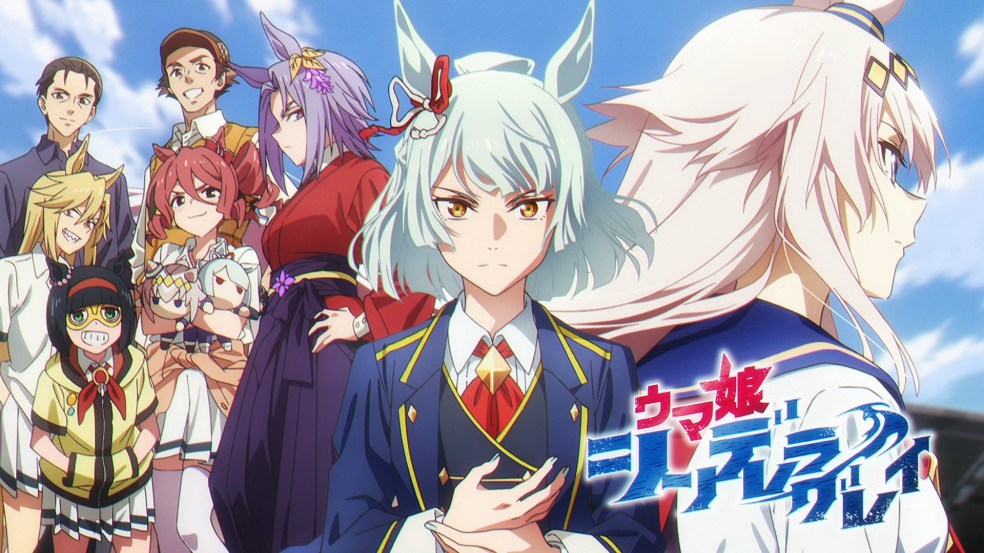
Hello, umadacchi. Your beloved blogger is a bit under the weather this week, but luckily, this particular episode of Cinderella Gray is mostly one of laying groundwork and doing some character introductions. As such, it’s pretty simple to cover.

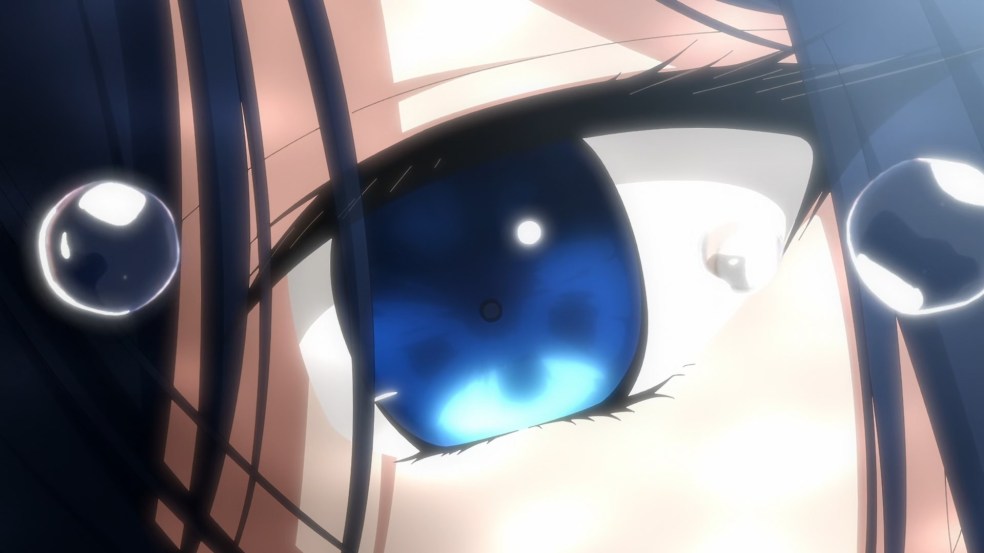
Plainly, this episode serves to introduce (or reintroduce, in a few cases) Oguri Cap’s competition at the upcoming Japan Cup. The episode is actually structured as such that it largely introduces Oguri’s foreign rivals first—which makes sense, there’s more to cover there—but we’re going to flip that around and talk about her domestic competition to start with. There are just fewer umamusume in this category, and one of them, Tamamo Cross, is essentially the show’s defending champion. Tamtam gets a nice little practice vignette with her trainer, who warns her against pushing herself. A gentle reassurance from someone who cares, or foreshadowing of something greater? We can’t yet say, but it’s good to see Tamamo around, and it also gives us the delightful treat of seeing her with her head ornamentation removed. Cute!

Oguri’s other main competitor from Japan is Gold City, who actually practices with her at Musaka’s behest as they try to build Oguri’s stamina, given that the Japan Cup, at 2400 meters, is longer than any race Oguri’s yet run.

Oguri and Gold City, in a nice change of pace from some of Oguri’s more serious rivalries, hit it off pretty much immediately, and the episode’s penultimate scene is a funny exchange between the two of them wherein Oguri asks Gold how she keeps her hair so nice, leading to a whole bit about shampoo.

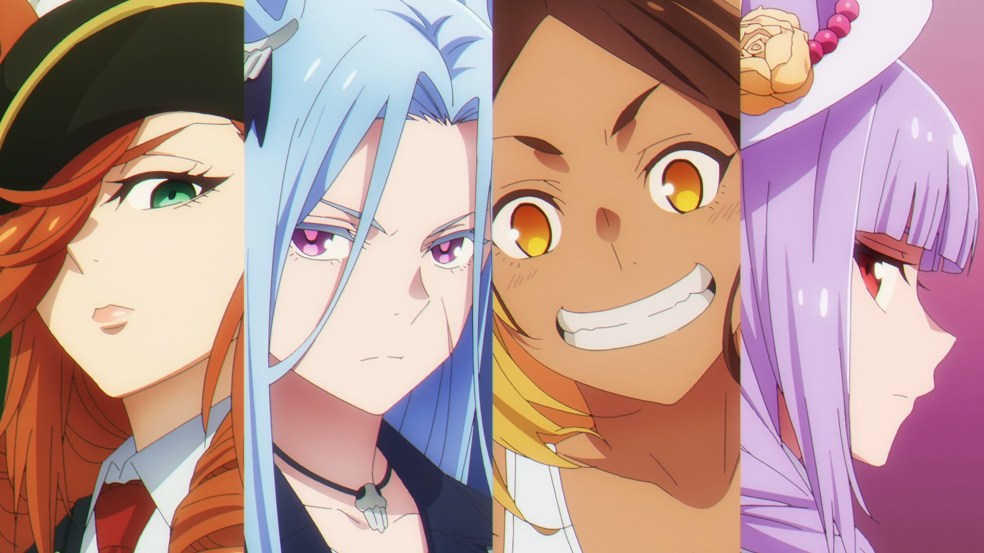
Perhaps unsurprisingly, the international competition is given a bit more focus. Umamusume doesn’t get the chance to feature horsegirls from anywhere but Japan terribly often, so when they do, they tend to go all out. It is also worth noting that this is another case where the umamusume aren’t named directly after the real racehorses—rights issues, one imagines—and it’s fun to compare whose legally-distinct name is an upgrade and try to imagine how they might have gotten from one name to another.

Easily the most prominent of the umamusume featured here is Toni Bianca [Kaida Yuuko, based on the real horse Tony Bin], presented as a genuine menace. Enough so to merit an at least passing comparison to Symboli Rudolf (herself the last Japanese horsegirl to win the Japan Cup). She has an impressive record, too, most notably, she’s the most recent Prix de l’Arc de Triomphe champion.

Of the girls introduced here, Bianca is perhaps the most classically in the ‘arrogant rival’ mold. When our good friend the reporter Fuuji, a recurring presence throughout this episode, asks her what she intends to accomplish by running in the Japan Cup, Toni replies nothing. She intends to win, and she will win, and that’s that. Fuuji is impressed by this of course, but there’s the subtle implication of something more complex going on when later, on her own, she contemplates that the upcoming race will be her magnum opus. What that could mean, we don’t yet know, but it’s enough to raise some intrigue about a character who is otherwise a bit broad.

Even more so is the UK’s representative, Moonlight Lunacy [Sekine Akira, based on Moon Madness. I’m honestly not sure how they got away with that one].

She has a refined and elegant design, and some banter with Fuuji reveals that the two have at least some prior history together—she apparently competed in the last Japan Cup, only to come in fifth—and she kicks him for being tactless when he brings up her previous defeat in the race. Still, I’d say she’s firmly the least interesting of the umamusume introduced here.

Contrast, for example, Ellerslie Pride [Tomita Miyu, based on Bonecrusher, easily the biggest name downgrade here], the sole Japan Cup runner from the southern hemisphere and representing the hope of not just her home country New Zealand, but that entire half of the globe in general.

Her somewhat tough appearance (and the straight-up intimidating name of her inspiration) belie a horsegirl who is clearly a little desperate to put her country on the map. She actually visits a shrine as her first order of business in Japan, apparently praying for her own success. (Fuuji bothers her, too, and gets a giant shrine bell dropped on his head for the trouble.)

And of course, there are the Americans. Michelle My Baby [Takagaki Ayahi, based on My Big Boy] is incredibly tall compared to almost every other character we’ve seen in the series so far. We don’t learn terribly much about her—although on a fact-finding mission for Musaka, Belno Light describes her as having the strength of a bulldozer—but when you’re introduced by slam dunking a basketball from across the court, maybe you don’t need much in the way of complicated character motivation.

Which leaves us with one last character to meet. The other American umamusume is an apparently utterly unremarkable racer, no G1 wins, no record of really any note at all, and she’s also rather hard to get ahold of. Fuuji tries to find her but doesn’t succeed. Belno does, though, although one gets the sense it might be because she wanted to be found.

This is how we meet Obey Your Master

[Ishigami Shizuka, based on Pay The Butler].

When Belno finds her, Obey is literally face down, ass in the air, sniffing the grass. Why is she doing this? Who knows! Belno asks her, and her response is that it “smells amazing.” So at first, one might reasonably conclude that Obey is just weird. Weird girls are not new territory for Umamusume—see Gold Ship, a generational cryptid sort of girl, as just one example—but Belno, and indeed Oguri Cap, are not so lucky. Obey seems to immediately cotton on to what Belno is doing (and jokingly calls her “James Bond”). In fact, Obey knows all about Oguri Cap, starting from her career as a regional star in Kasamatsu up to the Fall Tenno Sho where she lost to Tamamo Cross. But actually, Obey even knows who Belno is, and it is with some sense of alarm that Belno Light processes that the last girl she’s been sent to find is not normal.

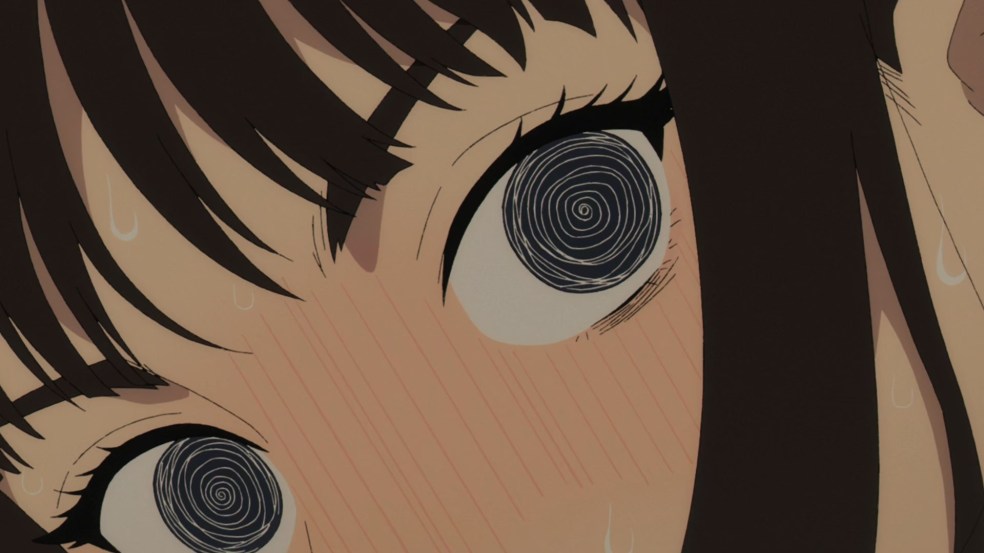
We can just say it. Obey is a freak. I fucking love her, she is one of my favorite charcters from Cinderella Gray in general, but she is an odd, odd character. The combination of everything we see here; her wild eccentricity, the star-shaped pupils, her encyclopedic knowledge of the competition, and of course the episode’s instantly-infamous final scene where she dances alone in the dark, Oguri Cap and Tamamo Cross’ race playing on her television and her rivals’ photos plastered all over her walls, brings to mind nothing less specific than Kurokawa Akane from Oshi no Ko. In fact, despite some obvious differences, she comes off as an outright interpolation of the character into a radically different context. I can’t prove that the inspiration actually worked that way—if it did, mangaka Kuzumi Taiyou would have to have been pretty quick on the draw, as Cinderella Gray and OnK started serializing around the same time—so if that reference point seems improbable to you, we can also just say that Obey comes off as a bit serial killer-y in, especially, that final sequence. This is, of course, fantastic, and it implicitly suggests that the true showdown in the Japan Cup will not be between Oguri Cap, Tamamo Cross, and—as one could be fooled into thinking from the start of this episode—Toni Bianca, but between those two and Obey.

Obey explicitly identifies Tamamo Cross and Oguri Cap as her “enemies” for the Japan Cup. And they both, it seems, will have to be careful to not be her next victim.


Like what you’re reading? Consider following Magic Planet Anime to get notified when new articles go live. If you’d like to talk to other Magic Planet Anime readers, consider joining my Discord server! Also consider following me on AnilistBlueSky, or Tumblr and supporting me on Ko-Fi. If you want to read more of my work, consider heading over to the Directory to browse by category.

All views expressed on Magic Planet Anime are solely my own opinions and conclusions and should not be taken to reflect the opinions of any other persons, groups, or organizations. All text is manually typed and edited, and no machine learning or other automatic tools are used in the creation of Magic Planet Anime articles, with the exception of a basic spellchecker. However, some articles may have additional tags placed by WordPress. All text, excepting direct quotations, is owned by Magic Planet Anime. Do not duplicate without permission. All images are owned by their original copyright holders.
Let’s Watch UMAMUSUME: CINDERELLA GRAY – Episode 15 – “Our Story”

Let’s Watch is a weekly recap column where I follow an anime for the course of its entire runtime.

For the Cinderella Gray column, new installments will be posted either on the Sunday each episode airs, or as soon as possible over the succeeding week. Expect spoilers!

Cinderella Gray can be watched, legally and for free, on It’s Anime By REMOW on Youtube. A link is provided below for your convenience.


Let’s talk about Super Creek [Yuuki Kana].

Actually, before we talk about Super Creek, let’s talk about characters, and how Umamusume handles them. Full disclosure, I’m going to be pulling extensively here—both in this column specifically and, honestly, probably whenever I talk about Umamusume going forward—from IronicLark’s excellent Umadacchi Densetsu blog, a fantastic resource for all things Umamusume and, so far as I am aware, easily the most thorough exploration of the series and its various components available in English. I highly recommend diving into it yourself sometime if what I am doing in these columns interests you even a little bit. Frankly, Lark is significantly more knowledgeable on the subject than I am.

So, characters. Most things I cover on this blog are either standalone anime projects, or they’re anime adapted from some single specific source, a manga, a light novel, etc. Umamusume belongs to the other category of things I cover here, and has more in common structurally with, say, Love Live, than most other anime I write about. What I mean by this is that it’s a media mix1 franchise. Without getting too into it (because that distinction alone is worth having a long conversation about) what this essentially means is that rather than one component of the franchise being the “primary” unit that all other adaptations pull from, there are many distinct components given roughly equal weight. Now, this isn’t strictly the case with all or even most media mix properties, as in the case of Umamusume and many others, there is a “central” project—the game—but the distribution of influence is much more horizontal than it is in something like, say, the Yano-kun anime airing this season, which is a straight one-to-one adaptation of a single specific story.

This approach changes how a series handles many things, but most relevant here is how it handles characterization. Because, if you primarily know Super Creek from the Umamusume game—and I’m betting that describes at least some of you—you might wonder how that character and her doting, motherly personality fit in to the generally fairly serious ‘sports anime’ tone that Cinderella Gray has going on. The answer is that Umamusume, as with many media mix properties, tends to emphasize or scale back different character traits depending on the needs of the story. As such, different iterations of the same character can feel pretty distinct, even if the “core” remains the same. (As a complete tangent, the most extreme example of this approach I can think of is actually Transformers, a series in which this guy, this guy, and this guy all have the same name, at least some of the time, despite being nothing alike.) Nothing so extreme as that example is present in Umamusume, but I bring all this up just to say: when we see Creek here, she is somewhat different from the Super Creek you’ve seen people make all those googoo babies jokes about on the internet. (Although, elements of that doting characterization do remain, I don’t want to overstate the differences.)

Creek is formally introduced here after having kicked around in the background of Part 1, and—not to spoil anything—we are going to be following her, at least intermittently, for quite a while. Her introduction is actually relatively low-key at first, though. We see her training. We see her trainer, Fumino Nase [Yū Shimamura2] apparently a prodigy who’s brought her trainees pretty significant success even early on in her career, beset by reporters. Nase seems to find all the media attention annoying at best (and particularly bristles at an offhand mention of her father, evidently also a trainer), but she’s willing to throw them a bone by telling them that she intends to have Super Creek compete in the Kikuka Sho, one third of Japan’s Triple Crown and, importantly, the longest race of the three. This comes as a surprise to the reporter interviewing her as, to hear that reporter tell it, Creek’s race results haven’t been that impressive, and she’s actually not even a sure thing to so much as run in the race, as someone would have to drop out first. Nase is of course aware of all this, though, and explains that as a trainer, she considers it part of her job to believe in miracles, no matter how unlikely they might be.

Naturally, just then, word comes down the line that one of the other competitors has had to drop out. Super Creek has an in.

The actual Kikuka Sho race follows both Creek and one of her main competitors. Yaeno Muteki, whose name you probably remember. It’s hard not to feel a bit bad for Muteki, who keeps getting put in these situations where she’s trained so hard and has good prospects only to end up facing a rare, generational talent.

And make no mistake, Super Creek is one of those. For a race as long as the Kikuka Sho both physical stamina and clarity of mind are important, so while Muteki holds the most promising position for a majority of the race, Creek is eventually able to angle her way from the middle of the pack straight to the front, and she ends up not only winning but winning by a pretty large margin. (A quick reference check on the real race that this episode is based on shows that the real Super Creek overtook the second-place horse, Gakuten to Beat, by five lengths. I am choosing to assume a similar margin here, in the absence of any other evidence. I suppose he really did beat Gakuten.)

Creek’s strength, as emphasized here, lies in her incredible endurance. Something she and Nase have evidently been working on for some time. A brief flashback between the two invokes the Cinderella metaphor once again.

Apropos of nothing, it is worth pointing out that Creek and her trainer seem very close.

It’s worth going over again, the term “Cinderella story” refers to, in sports, a longshot victory by an underdog. Usually several such victories over the course of a tournament or the like. In the context of Cinderella Gray, well, the second part of the title spoils that this mostly refers to Oguri Cap. But it can, just as easily, be taken to refer to many of Oguri’s contemporaries, including Tamamo Cross and, yes, Super Creek as well. (Given her chestnut brown hair, she’s an almost-literal dark horse.) Her victory here is clearly hard-fought, and the fire in her eyes on the final spurt is really something to behold. I’m probably not going to surprise anyone by saying I absolutely love Creek, especially this incarnation of the character. I am hoping this episode might turn at least a few more people in the world into Super Creek fans. Fingers crossed.

(On the note of “beholding”, it’s worth addressing the elephant in the room at least briefly. There has been some amount of discourse about the show’s somewhat reduced animation prowess from the first part of the first season, the Kasamatsu arc. There’s some truth to this, probably related to staff being shuffled around, but the highlights of this race stack up to anything else in the series so far. We’ll see how the rest of the season plays out in this regard. I feel the need to give a good amount of credit to the show continually paying attention to how the racers run, though. Even in the weakest moments of the race, Creek is consistently drawn as taking long, comparatively slow strides. Right up until that final spurt, where she starts really putting the pedal to the metal.)

In any case, while Yaeno Muteki takes her loss hard, she and her master keep up their training. Muteki has an endurance of her own, in this regard, and as I’ve gone through this story she’s become one of my favorite supporting pieces of Cinderella Gray‘s cast, which is not exactly lacking for strong characters.

And as for the Ashen Beast? Well, this arc does mark the point at which Cinderella Gray goes from being largely about Oguri Cap to being something of an ensemble piece, and I suspect we’ll get a lot more of these focus episodes in the weeks (and hopefully, years) ahead. But, she is here. The entire time Super Creek is making history on the racetrack, a pair of distant eyes are on her, and they are those of none other than our very own Gray Monster. She, Belno, and Musaka make a number of comments during the race, in fact, but what sticks out to me most are the ice-blue bullets Oguri stares into the screen when she senses she has gained yet another rival. Truly, our girl is a monster.

Super Creek will not be the last girl to give Oguri a hard time this arc, by a long shot. A brief post credits scene introduces us to Toni Bianca [Kaida Yuuko], the Italian umamusume who stands as one of many international racers Oguri and all other Japanese racers competing in the Japan Cup will have to face. Toni is wildly dismissive of them, time will tell if she can back up that talk.

Oh, and there’s another umamusume from abroad who arrives as well. Some blonde girl with tacky stars-and-stripes leggings. Probably no one important, in any case.

Famously a thing us Americans say a lot.

But! We’ll get to find out together. See you next week, Umamusume fans.


1: While the Japanese term “media mix” is quite similar to the English phrase “mixed media”, I’m rendering it as-is here, because “mixed media” has a different connotation in English, whereas a “media mix” is something a fair bit more specific.

2: As with the Sirius Symboli case in Part 1 of the anime, my usual sources are not helping me here, but I found a few stray references indicating that she’s voiced by Yu Shimamura, and am taking those at their word.


Like what you’re reading? Consider following Magic Planet Anime to get notified when new articles go live. If you’d like to talk to other Magic Planet Anime readers, consider joining my Discord server! Also consider following me on AnilistBlueSky, or Tumblr and supporting me on Ko-Fi. If you want to read more of my work, consider heading over to the Directory to browse by category.

All views expressed on Magic Planet Anime are solely my own opinions and conclusions and should not be taken to reflect the opinions of any other persons, groups, or organizations. All text is manually typed and edited, and no machine learning or other automatic tools are used in the creation of Magic Planet Anime articles, with the exception of a basic spellchecker. However, some articles may have additional tags placed by WordPress. All text, excepting direct quotations, is owned by Magic Planet Anime. Do not duplicate without permission. All images are owned by their original copyright holders.

Seasonal First Impressions: Deep Space Wolves at The Door in GNOSIA

Seasonal First Impressions is a column where I detail my thoughts, however brief or long, about a currently-airing anime’s first episode or so.


Everyone who knows anything about GNOSIA has made essentially the same joke about it. Finally, an Among Us anime! It’s the kind of essentially-obligatory reference that can quickly get old, but, honestly, in the case of GNOSIA it’s not really a bad place to start in terms of describing the thing. And the series itself directly invokes Among Us‘ public-domain, lycanthropic predecessor werewolf.

GNOSIA is set aboard a space ship en route from one planet to another. On the planet they departed from, they were attacked by something called a gnosia, and now the gnosia is one of the people on board. What’s a gnosia? How does it spread from one person to another? We don’t really know that, yet! Things are kept in deliberately broad terms in this first episode. From what little we do know, it seems like some kind of virus that….turns people into? Replaces them with? Alien shapeshifters. Again! It’s all a bit vague.

But that’s part of the point, as it turns out. Because our viewpoint character is Yuri [Anzai Chika], an amnesiac freshly woken from suspended animation by Setsu [Hasegawa Ikumi], a non-binary soldier who seems to be the unofficial semi-leader of the proceedings. Setsu explains the entire wolf-among-us situation to Yuri, and Yuri’s drafted into the process of voting on which of the crew will be placed back into suspended animation. There are a few key points to absorb here, and the bulk of the episode is devoted to fleshing these out.

Here’s what we—along with Yuri—learn over the course of the first episode. One, this voting-out-the-impostor situation is mandatory, because the ship’s controlling AI, LeVi, will enable the self-destruct sequence if the passengers don’t attempt to get rid of the gnosia themselves. Two, the ship periodically jumps into hyperspace. Humans can’t stay awake during these jumps, but the gnosia can, giving them an opportunity to attack. Three, the fact that one person is placed back into cold sleep “per round” means that if the gnosia isn’t caught by a certain point, it will be down to just one human and the gnosia, at which point the human “loses.”

If all of this sounds very video game-y, that’s because GNOSIA is a relatively rare anime that’s actually adapted from a video game, in this case originally a Vita title that’s been ported several times over the years. (Hilariously, dating from 2019, it actually predates Among Us‘ explosion in popularity.) Usually, when an anime is said to feel “gamey” that’s a bad thing. But, for the second time this season, I’m going to suggest that something that’s usually a negative is not necessarily one. The gaminess lets us, the viewers, feel involved as Yuri learns about the setting and the cast of characters.

Speaking of, in addition to Yuri and Setsu themselves, the first episode also introduces a quiet, reserved woman named Jina [Seto Asami], a blunt enby who’s so straightforward that it’s to their own detriment who goes by Racio [Nanami Hiroki], and a flirtatious, charming, deeply suspicious, and radioactively hot woman with the somewhat cryptic moniker of SQ [Kitou Akari].

I have my favorites already, but in general this is a really strong group of characters, enough so that I didn’t want any of them to be the gnosia. (Another way my own point of view sympathized with Yuri. As they, naïve to the world, want to trust everyone here equally.) Of course, after two rounds of voting, we learn that, nonetheless, one of them is.

The second round ends with Yuri and SQ, who’s managed to sway Yuri to her side of things, locking Setsu in cold storage, after having lost Racio to the previous round and Jina to a gnosia attack during a hyperjump. This turns out to be the wrong decision, as SQ—the one who’s been acting very suspicious the entire episode—is, in fact, the gnosia. The good news for Yuri is that now that they’re equipped with knowledge of how the gnosia operates, they can do a better job next time around. But, ah, SQ attacks and kills them, right, since she’s the gnosia? So how could there be a “next time” for Yuri?

Well, before entering cryosleep, Setsu hands Yuri a mysterious cube which promptly breaks when Yuri tries handling it. This, they explain, will let them go beyond death.

Yes, on top of its main premise, GNOSIA is also a time loop anime. This takes things from merely interesting to absolutely fascinating. Introducing as it does two interlocking rings of mystery that must somehow be related, each of which raises more questions about the other than it answers. There’s a lot to like here, and with the anime slated for a full two cours there’s a lot of time for it to bend and twist our expectations in myriad ways. All this in mind, it might be the season’s easiest recommend, I could see almost any anime fan getting something out of this.

I should mention at least in passing that the show looks and sounds good, too. In particular, there are some really great cuts of SQ emoting in the premiere here that make me very optimistic about how much fun this show is going to be long-term, and the cold, sealed-off atmosphere of the ship itself is hard to beat.


Like what you’re reading? Consider following Magic Planet Anime to get notified when new articles go live. If you’d like to talk to other Magic Planet Anime readers, consider joining my Discord server! Also consider following me on AnilistBlueSky, or Tumblr and supporting me on Ko-Fi. If you want to read more of my work, consider heading over to the Directory to browse by category.

All views expressed on Magic Planet Anime are solely my own opinions and conclusions and should not be taken to reflect the opinions of any other persons, groups, or organizations. All text is manually typed and edited, and no machine learning or other automatic tools are used in the creation of Magic Planet Anime articles, with the exception of a basic spellchecker. However, some articles may have additional tags placed by WordPress. All text, excepting direct quotations, is owned by Magic Planet Anime. Do not duplicate without permission. All images are owned by their original copyright holders.

Seasonal First Impressions: The All-Consuming Love of THIS MONSTER WANTS TO EAT ME

Seasonal First Impressions is a column where I detail my thoughts, however brief or long, about a currently-airing anime’s first episode or so.


“Until the day that beautiful monster grants my wish with her own two hands….”

The first thing is the pacing, and the second is the sound design. I’m late to this one, I know, but upon watching the first two episodes of This Monster Wants To Eat Me, the latest in a growing number of decent-to-great yuri adaptations from up and down this year, those were the two elements that stuck out to me the most. Normally, when one brings up an anime’s pacing, it’s to complain. It is all too easy to fuck up the sequencing of events when adapting a manga to animation; by rearranging them illogically, by sticking so close to the source material that you sap the life out of the thing (the more common of those two scenarios these days), or simply by pacing them wrong. Events that are snappy on paper aren’t necessarily so in motion, timing is a key consideration when it comes to picking an approach for adapting this material.

Keep all this in mind as I say, usually, when an anime feels slow, that’s said as a bad thing. Especially if it was based on a manga. Watatabe—as This Monster is more commonly known—proves that it’s not necessarily so. This is an anime that creeps, lurches, and crawls. What it lacks in traditional production polish it more than compensates with in deploying its sense of timing and its audio to create atmosphere. Despite being set in the dead of summer, this is an anime that most makes sense as a Fall series. Mermaids should get to trick or treat, too.

As for what this is all actually about? Well, our main character, Hinako [Ueda Reina], is depressed. We don’t have the details yet, but it seems that she lost her family to some tragic accident some time ago. She wants to die, but she either doesn’t want to or can’t bring herself to end her own life, so she spends a lot of time gazing into the sea and waiting for her time to come. Early in the first episode she runs into a mysterious girl, Shiori [Ishikawa Yui], who warns her that leaning over the railing by the coast isn’t safe. She could fall in, after all! Nonetheless, when she returns to the same spot to do more or less exactly that later that day, strands of thick, dark hair creep out of the water like animate seaweed. Our heroine is thus attacked by an iso-onna, who drags her into the water to consume her.

In its way, this isn’t so bad, Hinako thinks. Sure, it was out of the blue, but this is what she’s been looking for, isn’t it? And nothing, not even the attempts of her best friend (the rowdy Yashiro Miko, played by Fairouz Ai), has really helped. But, in an even more surprising turn of events, the girl from earlier intervenes, sprouting fishscales and a long, sickle-wicked claw to drive the water ghost away.

This isn’t anything as simple as a rescue, though. Shiori wants to eat Hinako, too. She’s just not quite tender enough, yet. So begins a particular flavor of twisted love story.

These first two episodes, especially the second, largely take us through the paces of Hinako’s daily life, and how it changes in the presence of Shiori. Hinako technically never straight up says she’s infatuated with Shiori, but lines like the one quoted at the top of this article make it pretty clear how she feels. The dynamic Watatabe is building here is an interesting one. Hinako wants Shiori to kill and eat her. Shiori is explicitly interested in keeping Hinako alive until her flavor reaches its peak. She explicitly compares Hinako to livestock, in fact.

The important bit here is that Shiori is going to eat her eventually, but not right now. This actually bothers Hinako, not because she’s afraid or repulsed, but because if she’s going to be eaten she’d really rather it be soon. Despite the grim tone and the slow, creaking nature of the storytelling, there’s also an almost bratty overtone to the whole thing, as though Hinako is a needy submissive and Shiori, her domme, is teasingly avoiding giving her what she wants most.

This is, of course, the point. Watatabe’s premise is a take on the whole “domestic girlfriend” fantasy—found more often in heteroromantic romance manga, but it can be seen in yuri as well—wherein a depressed character is lifted to life and warmth by someone who insists on taking care of them. (There is in fact an entire style of romance manga and light novels built on this premise. If you’ve ever seen anything tagged “Rehabilitation” on Anilist or MyAnimeList, that’s what that means.) The roles of the nurturer and romantic partner are rolled into one in these scenarios, and Watatabe‘s playful skewering of them involves giving the caretaker/partner character an explicitly malicious overtone. Remember, within the world of the story itself this isn’t actually a metaphor: Shiori literally wants to kill Hinako and eat her, head to toe. But Hinako, depressed and longing to be reunited with her family, either figuratively in death or literally in the hereafter, is fine with that, and in fact wants that. In its way, Watatabe‘s story is quite a wicked little thing.

I don’t think it would work nearly so well without the audio component. The music here is straightforward but devastatingly effective, an arsenal of simple piano and string pieces that hammer home the oppressive summer that Hinako has been living for so long, and remind us that there is a final, sharp end to her relationship with Shiori. The voice acting here is excellent, too. Ishikawa Yui lends a breathy, ethereal tone to Shiori that really sells the idea of her as some otherworldly creature. She can also make Shiori sound forceful, which is helpful when the character needs to project ferocity (as at the end of the first episode), or make clear to Hinako that she doesn’t get to make all of her own decisions anymore (as at the end of the second). Ueda Reina makes Hinako sound exactly the right amount of withdrawn and closed-off. For an example, visually speaking, her daydreams about ocean life intruding into her everyday existence are reasonably effective but hardly flashy. It’s really the flat, deep-sighing tone of voice Ueda brings to the role that ties it all together.

Having the aural advantage is good. The elephant in the room here is that the show doesn’t look fantastic. It doesn’t look bad, I wouldn’t say—although its frequent use of frame-blending pushes things—but it’s definitely a shoestring production and looks the part, and doesn’t hit the visual heights of, say, the best episodes of the similarly-abbreviated Watanare. (Although that had its lesser moments, too.) Similarly, the actual shot composition is effective but largely unspectacular except for a few particularly striking moments. None of this is all that surprising for a low-resource anime at this stage in the medium’s history, but it is at least worth knowing going into it, and if it pushes people toward the manga instead, I don’t think that’s necessarily such a bad thing, even if they are missing out on the lovely sound design here. It is, in any case, a minor weakness. Or at least it is if I’m the one being asked.

The second episode ends set against the interesting love triangle building between Hinako, Shiori, and Miko, who spends much of the episode being jealous of the mysterious relationship that Hinako and Shiori seem to have suddenly developed.

She, in fact, asks Hinako to a festival. Hinako turns her down—it would seem that the accident that caused the deaths of her family is somehow related to this very same festival—but Shiori, not content to let her prized pig simply sit and girlrot, forces her to go. We don’t know how that’s going to work out for either of them, yet. (Or for Miko, for that matter.) But I certainly plan on tuning in to find out.


Like what you’re reading? Consider following Magic Planet Anime to get notified when new articles go live. If you’d like to talk to other Magic Planet Anime readers, consider joining my Discord server! Also consider following me on AnilistBlueSky, or Tumblr and supporting me on Ko-Fi. If you want to read more of my work, consider heading over to the Directory to browse by category.

All views expressed on Magic Planet Anime are solely my own opinions and conclusions and should not be taken to reflect the opinions of any other persons, groups, or organizations. All text is manually typed and edited, and no machine learning or other automatic tools are used in the creation of Magic Planet Anime articles, with the exception of a basic spellchecker. However, some articles may have additional tags placed by WordPress. All text, excepting direct quotations, is owned by Magic Planet Anime. Do not duplicate without permission. All images are owned by their original copyright holders.

Let’s Watch UMAMUSUME: CINDERELLA GRAY – Episode 14 – “Another Peak to Climb”

Let’s Watch is a weekly recap column where I follow an anime for the course of its entire runtime.

For the Cinderella Gray column, new installments will be posted either on the Sunday each episode airs, or as soon as possible over the succeeding week. Expect spoilers!

Cinderella Gray can be watched, legally and for free, on It’s Anime By REMOW on Youtube. A link is provided below for your convenience.


Oguri Cap faced her first major defeat on the race track at the hands of her rival Tamamo Cross in the finale of Cinderella Gray‘s first cour back in late June. Since then, the world has appreciably changed for Umamusume as a series. Perhaps most notably, the Global (read: English-language) version of the mobile game this is all meant to promote finally launched, and I know for a fact I was hardly the only person there on launch day to redeem my 3* voucher to get Oguri herself. This is relevant because, due to the game’s success, there is a very real possibility that this column going forward will have a much larger potential audience than it did back in Part 1. To that end, I’m gonna go ahead and say that if you’re not caught up with these columns, I, a completely unbiased source, think they’re pretty worth reading, and you can do so here. Also, welcome aboard.

I’ve also read the manga, or at least, what exists of the manga fan translated into English. I won’t spoil any twists before they come, but it has given me the confidence to say that Cinderella Gray not only remains as good a powerful sports shonen narrative as it was in the first cour, but it actually gets even better over time, right up to the present. There are stories I can’t wait to share with you all, and characters I can’t wait for you to meet. But we’ll get to those as they happen.

What’s not a spoiler, or indeed a surprise to anyone who’s been watching the trailers ReMOW has been putting up, is that this upcoming arc focuses on the Japan Cup, a prestigious international race that will see Oguri and some of her domestic rivals compete against umamusume from all over the globe. That Cinderella Gray returns today, on the day of the Prix de l’Arc de Triomphe—a different prestigious international horse race that Umamusume as a series is somewhat obsessed with (it was a plot point in Umamusume‘s third season, in fact. This despite the fact that a Japanese horse has never won it)—feels significant.

Interestingly though, that’s not where Part 2 starts. Instead, it makes the rather interesting decision to adapt the one-off spinoff The Mermaid Left Behind. What this means is that rather than diving straight into the Japan Cup stuff—what all of Part 2’s trailers were about, mind you—we instead return to the setting of the first half of Part 1, Kasamatsu, and the first story of the second cour is not about any of Oguri’s current rivals, but her first: Fujimasa March.

As Umamusume goes, what unfolds here is a pretty simple tale of rivals whose emotional bonds are unaffected by the physical distance between them. March is fresh off a haircut and a major loss at the Tokai Derby. We saw her conversation with Oguri Cap back in episode ten, where it seemed to reignite her competitive fire and give her renewed confidence to try again.

Yamano Thousand, the umamusume that March actually lost to in the Tokai Derby, does not see things that way.

Thousand is offended that March keeps trying to chase after someone who isn’t even here, and accuses her of running after ghosts. (She also insults the Norn Ace / Mini the Lady / Rudy Lemono trio by calling them Oguri’s “groupies”, which is admittedly pretty funny.) But if this seriously shakes March in any way, we don’t see it. It’s Mini, funny enough, who assesses Thousand accurately; her bark is worse than her bite, and her end closer strategy is a poor fit for a track with corners as tight as the ones here. In the end, March’s renewed passion perhaps as much as any strategic consideration lets her win handily, and she explains to Thousand—and implicitly to us as well—that she’s not chasing Oguri’s ghost. She’s chasing the real thing. This is the same March who first lit Oguri Cap’s competitive fire, and Thousand failing to understand that the glint in her eye and the blush on her cheeks are both because of Oguri Cap is part of why she loses. I don’t believe we’ll get another check-in on Fujimasa March like this, so this episode is, in a way, a nice sendoff to a Oguri’s first rival. A promise that her story is still being written, somewhere just out of view.1

The second half of the episode returns us to Tokyo. It largely focuses on Oguri’s national rivals but, once again, opts to refocus on who we already know instead of rushing headlong into introducing new characters. Most of these little vignettes focus on the umamusume preparing for their next race. For Oguri, that’s the Japan Cup that’s the center of this arc. Some of her rivals will be there too, but others, such as Dicta Striker [Hanamori Yumiri] have different aims. The latter in particular leads to a very charming scene where Striker attempts to do the old “intimidating rival challenging the protagonist on a level playing field” bit, talking about how she wants to hand Oguri her second loss in the Mile Championship, only for Oguri to promptly explain that she isn’t actually running in that. (She’s tailing Tamamo Cross, of course: the Japan Cup and the Arima Kinen, best known to players of the Umamusume game as where careers go to die, are her next two destinations.)

If there’s a unifying theme here, it’s that Oguri Cap and Tamamo Cross’ showdown has inspired everyone with an eye on the scene, from Oguri’s hometown friends to her rivals in the nationals, to greater heights. Even Sakura Chiyono O, the actual winner of the Japanese Derby that really was haunted by the ghost of the missing Oguri Cap, gets a scene here to show off that she’s not resting on her laurels. Nor is Yaeno Muteki, another of Oguri’s rivals and a perpetual underdog. Dicta Striker will get to run against her eventually, as well: she’s aiming for the Arima Kinen, too.

This even applies to Oguri herself to some extent, as Fujimasa March looks toward her, so does Oguri look toward Tamamo Cross. Each serves as the proverbial new peak to climb for the previous racer. (We must naturally assume that there is, thus, also some fresh-faced new student at Kasamatsu who thinks of Fujimasa March as an ideal to aspire to.)

All told, this is an odd and transitional episode and, generally speaking, a bit of a strange choice for Cinderella Gray‘s triumphant return. Still, it’s nice to see Fujimarch again, and the strong thematic throughline makes it make emotional sense as a returning point. Plus, the few crumbs we get here are going to feed March x Oguri fans for the next several months, so it certainly isn’t a bad episode by any means. It’s hard to deny though that the real lightning-in-a-bottle moments from this arc are very much still ahead of us. Part 2 is short—just ten episodes as opposed to the thirteen of the first cour—so I imagine we’re going to be getting into the main body of the arc relatively soon, within a couple episodes at most. We’ll see what that looks like in the weeks ahead.


1: Interestingly, March’s race against Thousand is also done in full racing silks. This goes against the series’ usual conventions as I understand them, where only national G1s are run in silks. Still, I’m not going to complain. March’s snazzy blue outfit is lovely.


Like what you’re reading? Consider following Magic Planet Anime to get notified when new articles go live. If you’d like to talk to other Magic Planet Anime readers, consider joining my Discord server! Also consider following me on AnilistBlueSky, or Tumblr and supporting me on Ko-Fi. If you want to read more of my work, consider heading over to the Directory to browse by category.

All views expressed on Magic Planet Anime are solely my own opinions and conclusions and should not be taken to reflect the opinions of any other persons, groups, or organizations. All text is manually typed and edited, and no machine learning or other automatic tools are used in the creation of Magic Planet Anime articles, with the exception of a basic spellchecker. However, some articles may have additional tags placed by WordPress. All text, excepting direct quotations, is owned by Magic Planet Anime. Do not duplicate without permission. All images are owned by their original copyright holders.

Seasonal First Impressions: Love Hurts in YANO-KUN’S ORDINARY DAYS

Seasonal First Impressions is a column where I detail my thoughts, however brief or long, about a currently-airing anime’s first episode or so.


Yoshida Kiyoko has a crush. Kiyoko [Nukui Yuka], a friendly, kind, and if we’re being honest, slightly dim high school girl finds herself seated next to Yano Tsuyoshi [Amasaki Kouhei] at the start of the school year. Yano, himself friendly, kind and a bit dim, is also horrifically accident-prone, getting knocked with all sorts of bumps, bruises, breaks, and other injuries. This is, naturally, played totally for laughs.

Yes, in a world full of girl-with-a-gimmick romcoms—a subgenre I’ve covered extensively in these seasonal premiere columns, ranging as they do from the good, to the merely okay to the confounding—Yano-kun is a boy-with-a-gimmick romcom. I’m not going to go so far as to say that merely switching the usual genders makes some huge difference—if this show didn’t have the fundamentals nailed down it’d be as tedious as any lesser example of this style—but it’s refreshing in its own right. That the show is actually pretty good makes this a quietly charming early seasonal highlight.

I’d pitch the series this way: if you’re the sort of person who enjoys screencapping characters making gag faces or doing silly things, likes lines written with the kind of amusingly clever dumb-ness that you can only get from someone with a keen eye for character, and generally pointing at your favorite and sarcastically asking “are they stupid?” (the answer is always yes), you’ll probably get a kick out of Yano-kun. If you don’t, you probably won’t. It really is that simple, and so in a sense, there’s not much more to say. Especially in terms of what passes for a plot here. Yano is seated next to Kiyoko and it really only takes a few days of worrying about him and his endless parade of injuries for Kiyoko to realize she’s got it bad for the boy. So invigorated, she and her friend Mei [Tanezaki Atsumi, doing what’s essentially a slightly higher-pitched take on her Frieren voice] brainstorm ideas as to how to get the two closer together.

This leads to a few amusing hijinks on its own, but it turns out that they needn’t have bothered. The final stretch of the episode sees a horribly worried Kiyoko run to the hospital after finding out that Yano’s been hit by a truck. It turns out this isn’t actually what happened, and he’s fine (or at least as fine as Yano ever is). But it leads to a sweet, short scene where Kiyoko asks if there’s anything she can do for Yano, offering to treat his injuries when they happen while she’s around (a small medical bag she carries as the result of being an older sister comes into play here), and Yano, touched, responds that he just wants to live an ordinary high school life. Roll credits, simple and sweet.

A premise this bone-simple is always going to come off a slightly corny to a certain kind of person. Honestly it is slightly corny, but it’s also very sweet, and the overall light and fluffy tone presents it from feeling cloying or overbearing. Many of the show’s best moments are in little details that are tough to nail down outside of their home medium. In addition to just generally having a very pleasant art style, Yano-kun frequently deploys a further simplified one for straightforward reaction shots.

There’s nothing technically crazy going on here, but they’re incredibly endearing, and, as the friend I was watching the premiere with (hi Josh) pointed out, they give Kiyoko a tiny dash of Bocchi-ness that makes her even more likable. Tied together with the gentle, flat coloring of the art style, and rookie director Matsuo Shinpei‘s team at Ajiado capably translating mangaka Tamura Yui‘s realistic character designs into something slightly more stylized, Yano-kun is, overall, filled with the exact kind of easygoing warmth you’d want out of something like this. If you’re looking for a simple romcom anime to round out your Fall season, consider this one an easy recommendation.


Like what you’re reading? Consider following Magic Planet Anime to get notified when new articles go live. If you’d like to talk to other Magic Planet Anime readers, consider joining my Discord server! Also consider following me on AnilistBlueSky, or Tumblr and supporting me on Ko-Fi. If you want to read more of my work, consider heading over to the Directory to browse by category.

All views expressed on Magic Planet Anime are solely my own opinions and conclusions and should not be taken to reflect the opinions of any other persons, groups, or organizations. All text is manually typed and edited, and no machine learning or other automatic tools are used in the creation of Magic Planet Anime articles, with the exception of a basic spellchecker. However, some articles may have additional tags placed by WordPress. All text, excepting direct quotations, is owned by Magic Planet Anime. Do not duplicate without permission. All images are owned by their original copyright holders.