Ranking Every 2024 Anime (That I Actually Finished) From Worst to Best

“Ranking Every Anime” is a yearly column where I rank every single anime I finished from a given year, from the very worst to the absolute best. Expect spoilers for all anime covered.


Way back in the middle of June, I wrote a different and much shorter introduction for this list. However, in early December, I realized it wasn’t going to cut it, and I wanted to properly establish just why it is that I write these things in the first place. (I would apologize to anyone who finds such endless digressing distracting, but I imagine they checked out years ago.) I don’t want to spout a cliché about how every month feels like an eternity these days, but there is some truth to that. And on a more personal level it’s been yet another rough year. I’m a little sick of rough years, so I’ve been trying to make some positive changes for myself. Hopefully, this article will be the first thing of mine that you read where those changes are visible, if only in subtle ways. Here’s the first of those changes, I think I’ve finally come to terms with why I write articles like this at all: I like writing them. More than that, other people seem to like that I’m writing them. Pardon me if this all seems rather obvious, but yes, after a solid 4 years of running this site, I have finally come to terms with the fact that at least some people enjoy what I’m doing here, including myself.

For years, I convinced myself that this was somehow not a good enough reason. That I needed some grandiose motive to rant about anime on the Internet. But honestly, why? There are mountains and mountains of anime criticism out there, some better than what I do, admittedly, but a lot that is much worse. None of those people spend time wracking their brain with an entirely artificial existential crisis over “why” they do what they do. And if I’m being really honest, I have also come to think that I’ve gotten pretty good at this whole writing-about-cartoons thing over the past several years. I have wanted to be a writer for a lot of my adult life, but for whatever reason, criticism—interpretation, really. I am still reluctant to call myself a critic per se—comes easier to me than fiction. So be it, if I am destined to wax poetic about girl bands, demon lords, and the Daicon Spirit forever, there are worse boulders to push up the mountain. Imagine Sisyphus-san happy, and you will see me in your mind’s eye.

I also just think there is still inherently some amount of value in me, a single independent writer beheld to no one, making one of these lists without any kind of interference. In a world where even a lot of the people bringing anime over here in the first place describe what they do as building “a pipeline of content,” it feels meaningful to just be one woman penning one opinion without any corpo shit involved. Maybe that’s silly, I leave it for you to decide.

Lastly, I also wanted to make sure to get out a list this year because I was so frustrated that I didn’t do a proper one last year. Last year was really rough for me, and this year has arguably been even worse, but I didn’t want to just sit here and not do even things I enjoy anymore because my life has been going through a rough patch for several years straight. Technically, I did a messy, deliberately disorganized list of stuff I liked last year, but it was both not up to my usual standards in large chunks and also not really formatted the same way. I do think there’s some merit to the idea of a list (maybe a second list?), unranked, of other media that’s positively impacted my year in some way, even if mashing the two together isn’t the solution. (It feels criminal that I have nowhere to mention Heaven Burns Red in this article, for example.) But this year, I really just wanted to focus on getting back to brass tacks. A list of 20-some anime. Harsh, cold numbers to cruelly sort them. Me, the writer. You, the reader. Let’s get this thing started.

We start, as always, from the bottom.


#27. ISHURA

True story! Months and months ago, I got into a huge argument with a guy on the internet because I said ISHURA was bad. That guy’s argument was essentially, well, ISHURA couldn’t possibly be a bad anime, because it wasn’t really an anime at all. It was based on a series of fantasy novels. His point of view was that ISHURA isn’t an anime series. It was an animated realization of a series of books. (I’m editing out a lot of slurs and name-calling on his end, here. Forgive me for not wanting to reproduce that on my own site.) I don’t agree with this point of view at all, but it is illuminating for me, as someone who has struggled to understand the isekai boom that has dominated mainstream TV anime for the past decade. I think some part of it is truly just that to a certain kind of person, these things really don’t scan as anime per se, in that anime are cartoons and are thus considered to be inherently visual pieces of work, and what this sort of person really wants is more just a direct translation of what’s on the page. (As direct as possible, anyway.)

Does that hold up to scrutiny? I’m not sure. If it does, I still don’t really think it’s an excuse. If we’re taking it as a given that ISHURA is an anime, or an animated version of a novel, or whatever, it is quite clearly the worst of its kind that, at the very least, I’ve seen this year end to end. I’ve rarely felt safer making the call, actually. Compared to everything else I finished this year, ISHURA, which I trudged through out of a sense of—I’m not sure, obligation? Inertia?—is just plain crap. Crap in an uninspiring, uninteresting way.

Because of that, and in spite of how confident I am that it is in fact bad, its placement this far down the list does feel a little wrong. ISHURA didn’t disappoint me in some grand way. It didn’t have some great promise that went unfulfilled. It didn’t make me want to slap its writer, director, etc. upside the head and ask “why would you do this?!” ISHURA just sucks. It is bad, but crucially, it’s a common kind of bad. ISHURA is a scapegoat, the lame isekai that I watched at the top of the year to justify not giving most of the others much of a chance to myself. ISHURA dies in their place despite the fact that ISHURA itself is fairly unremarkable within its genre, and, hell, despite trying a few things to attempt to innovate. So it goes.

Don’t feel bad; ISHURA doesn’t deserve your pity. What we have here is a grab-bag of the least impressive parts of the narou-kei scene; a bloated and mostly flat cast of characters with miscellaneous Cool Powers in place of actual personalities, a molasses-slow narrative that drags like a motherfucker from end to end—the result, I must imagine, of adapting the original novels at an extremely unimaginative 1 to 1 pace—and a fairly boring fantasy setting that only barely rises above being purely stock. But as is often the case, the little things ISHURA does right actually cast the show in an even worse light for their contrast with how dull and dry everything else is. Voice actors die in the booth to try to breathe some semblance of life into ISHURA’s ramshackle attempt at a high fantasy narrative, animators do their damnedest to make their cuts stand out against a background of visual cardboard and janky CGI. None of it is enough, not even Yuuki Aoi, who turns in what might be one of the flattest performances of her otherwise illustrious career. ISHURA is, for sure, not the technically worst thing that aired this year. It’s not the most offensive, and it’s not the biggest letdown. But, in being yet another brick in the wall for its genre, a field that is way, way, way past its expiration date, it might be the least interesting.

I don’t want to seem unfair to the series, though. So just as a final point of record-keeping, here is a short list of the isekai anime that I started this year and didn’t even finish, often kicking them after only an episode or two, dishonorable mentions that were somehow more disappointing, less engaging, or just overall even worse than ISHURA. These include Doctor Elise: The Royal Lady with the Lamp, Failure Frame: I Became the Strongest and Annihilated Everything with Low-Level Spells, Fluffy Paradise, My Instant Death Ability Is So Overpowered, No One in This Other World Stands a Chance Against Me!, Quality Assurance in Another World (annoyingly enough I actually liked that one at first), The Ossan Newbie Adventurer, Trained to Death by the Most Powerful Party, Became Invincible, The Strongest Magician in the Demon Lord’s Army was a Human, The Strongest Tank’s Labyrinth Raids -A Tank with a Rare 9999 Resistance Skill Got Kicked from the Hero’s Party-, The Unwanted Undead Adventurer, The Weakest Tamer Began a Journey to Pick Up Trash, Unnamed Memory, which is technically not an isekai but absolutely falls under the narou-kei umbrella, and finally Villainess Level 99: I May Be the Hidden Boss but I’m Not the Demon Lord, which commits the additional sin of casting Fairouz Ai in a role where she can’t emote at all. So take some solace, rare ISHURA fans, in that your show was hardly the worst thing to air this year. As if to provide some perspective by illustrating the gap in importance between my opinion and that of the wider anime-watching community, ISHURA was apparently successful enough either on its own terms or in moving volumes of the light novel that it was renewed for a second season, which is just days away by the time you’re reading this. I will not be watching it, god bless.

#26. METALLIC ROUGE

Sigh.

Metallic Rouge should’ve been a slam dunk. It had everything; a futuristic, lightly cyberpunky setting on Mars, a great main couple made up of a kickass female protagonist, Rouge Redstar, who could transform into a killer toku robot and her snarky, sometimes overbearing handler, Naomi Ortmann. It had a bunch of other killer toku robots who acted as obstacles to our main girl. It had a New Jack Swing OP for some fucking reason. (Not the last show on this list whose opening theme is as much a standout to me as the series itself.) It should’ve been great. Metallic Rouge being mediocre is proof that we live in a fundamentally uncaring universe.

Wild exaggerations aside, it really does seem with hindsight that Metallic Rouge just never had any idea what it was doing. Its basic robots = oppressed minority symbology doubles down on all of the obvious problems with that setup and leaves us with a narrative that both stridently manages to avoid saying anything of substance while also arguing that maybe we can boil the origins of bigotry down to the actions of one or two bad people. This pits our ostensible hero against an android liberation army who would be the good guys in a show that wasn’t pathologically obsessed with both-sides’ing what’s essentially slavery. Worse, they’re led by a beautiful silver-haired butch. Again; obviously the good guys in basically any other show that actually had decent writing.

Still, it wasn’t all bad. The fights were pretty good, and that’s worth something. A handful of individual episodes are interesting, especially the space cruise ship murder mystery that launched this scene into minor virality for good reason. It has a great soundtrack, even if it doesn’t really use it properly. And, well, by the end of the series Rouge and Naomi are still in a gay situationship of some description, which does count for something, too. Even so, all these attempts to dig for gems in the refuse must acknowledge what we’re digging through. The show is just badly considered, at the end of the day, and a persistent rumor that it had its episode count cut in half can only explain so much.

#25. PON NO MICHI

The weirdest thing about Pon no Michi is how un-weird it is. It really seems like a hobby comedy focused around mahjong with some light magical realist elements should add up to more than this, but it’s probably not a great sign that the most interesting thing I can think of about Pon no Michi itself, with hindsight, is that its character designs were done by the Quintessential Quintuplets guy. It really feels like even a very dry anime should have more going on than that, doesn’t it?

Pon no Michi is hardly the first mahjong anime to fail to find much of an audience outside of its home country, and I doubt it’ll be the last. It is worth noting though that for most of its run you couldn’t watch it in the US even if you wanted to without resorting to piracy. In what would signal the start of an unfortunate trend throughout the year, Pon no Michi simply wasn’t licensed in North America at all, the situation only changing fairly late in its run. It was also blessed with one of the most astoundingly hooky opening themes of the entire year, a heavily-autotuned, maddeningly catchy little ditty that will get stuck in your head relentlessly. Even now, echoes of “pon pon pon pon pon pon pon” reverberate in my noggin.

If it seems like I’m dancing around the subject of the show itself, well, there just honestly isn’t that much to say. Pon no Michi’s general premise of five girls who hang out in an abandoned mahjong parlor and learn the basics of the game from a talking bird that only one of them can see is, somehow, just not that interesting. The final episode, where the girls’ parlor (and therefore friendship) is threatened via the amusingly mundane event of their shuffle table breaking, managed to get some emotion out of me just because any characters you stick with for twelve weeks are going to be characters you have some attachment to, no matter how minor, but when so much else of note aired this year, it feels difficult to drum up a strong opinion on Pon no Michi. For that reason, more than any other, it’s down here, near the bottom of the list.

#24. MYSTERIOUS DISAPPEARANCES

Mysterious Disappearances is a case of disparity. An adaptation not gone wrong per se, but certainly held back by the transition in medium. Unlike some other manga adaptations this year, Mysterious Disappearances was, to begin with, a series of modest strengths and a whole lot of caveats. A decently fun mystery-adventure-horror thing with a sexy lead and a snarky deuteragonist that she swaps quips with at the best of times, Mysterious Disappearances is also chockablock with cheesecake, and tiresome questions of “censorship” aside, there does seem to have been a concerted effort to tone that down for the anime. Some of this is understandable—protagonist Sumireko’s whole age-shifting bit is weird even in-context and it’s to the manga’s benefit that it stops using it as an excuse to ogle her after a certain point—but some of it is sort of puzzling, and this general inclination to mess with a story that could actually have been adapted chapter by chapter basically fine is the source of a lot of these issues. In this sense, it’s the opposite of ISHURA; too much of the production seems to have focused on haphazardly rearranging events and scenes for little discernible reason, and far too little of it was trained on adapting those scenes to their new medium effectively. What could’ve been a pretty fun mystery-adventure series is thus scuttled by bad pacing and just generally poor visuals.

It’s not all bad. There’s a pretty good run of episodes near the show’s middle where it really hits a stride and manages to summon up some of the same dusky esoterica as its source material as our protagonists deal with poltergeists, vague childhood memories of mysterious bookshops, and VTuber rigs come to haunted un-life. But compared to the original manga it feels sanded-off and less weird, and therefore just plainly less interesting. It’s hardly the worst thing in the world, certainly. But when judged on its own merits, it’s hard to score it higher than “fine”, and if we’re talking about it as an adaptation, you’re better off reading the manga. Or just skipping it entirely if any of the aforementioned seems like it would bother you. This is a case of what you see is what you get.

Like Pon no Michi, Mysterious Disappearances is also notable for its odd theme music—in this case it’s the ending theme— its “Viva La Vida Loca” trumpets absolutely do not match the tone of the show or even really of the rest of the elements of the song. But hey, it’s a pretty good tune! That’s something!

#23. THE WRONG WAY TO USE HEALING MAGIC

Another notch on the list, another isekai anime, one of just a few others that I watched this year. Putting Wrong Way To Use Healing Magic this far down the list feels very unfair in some ways and the only possible route to take in some others. Still, I have to own up to my biases here. At the risk of harping on an already-obvious point, I just don’t like this genre very much. Even a “good” one is only ever going to rank so high. And even within that framework we’re not talking about Princess Connect or something, Healing Magic is not some kind of undeniable visual spectacle. Instead, it is a decidedly fine bog standard isekai series, distinguished from the genre’s dreck mostly by how its author seems to have a basic grasp of storytelling fundamentals that many of his peers in the field don’t. If that sounds like damning with feint praise, that’s because it is. Our heroes have actual personalities, and while the whole shy guy-to-magically-empowered-jock power fantasy that our lead Usato Ken embodies very much still is a power fantasy, it’s at least one with some depth that requires effort on his part.

Still, all of this feels like giving the show credit for having a handle on the absolute basics of storytelling, and it landing a few spots from the bottom rungs of the list can be chalked up to the fact that I was just never invested enough in it to have any kind of strong negative reactions to anything it was doing. A few memorable characters aside, such as Ken’s drill sergeant / magic trainer Rose and the captured demoness the Black Knight, there’s just not a lot to say here.

Speaking of demons, while they’re given a fair shake as-written, the fact that “demon” in the world of Healing Magic seems to just mean “dark-skinned person with horns” is fairly damning. (Not to mention just sort of stupid.) Although, it was still not the worst treatment demons in fantasy anime got this year. We’ll get back to that.

#22. ALYA SOMETIMES HIDES HER FEELINGS IN RUSSIAN

The lower-middle part of the list is always the hardest. What is a trans woman expected to say about Roshidere that’s not incredibly obvious? It’s a romcom aimed at teen boys, this one with “dating the foreign girl in your class” as the requisite gimmick. There’s a tendency among writers like myself to treat this genre as a plague unto the medium, but I have always thought that was kind of silly. In hindsight even my relatively mild criticisms of, say, My Dress-Up Darling seem like a bridge too far, these stories tap into a real emotional framework, even if the specifics are, obviously, blown up for the TV screen.

Roshidere is hardly a highlight of its genre, but it doesn’t especially need to be. The two leads have a distinct enough brand of banter—a kind of distant descendant of that old Haruhi/Kyon dynamic, that’s probably at least one reason that a cover of “Hare Hare Yukai” was used as an ED theme for one episode—that I was engaged through most of the show’s episodes, and I honestly don’t think a series like this needs much more than that. That said; Roshidere also has a pretty poor command of its own strengths, in that it seems to feel like it can pull of domestic drama in the vein of something like Kaguya-sama: Love is War! It can’t, and in trying it loses its way a little bit. Hence its placement relatively low on the list.

There is also a temptation, of course, is to compare this to the other Doga Kobo romcom from recent years that’s roughly along these same lines. Between them, I’d say Roshidere is slightly better overall, but Shikimori’s Not Just A Cutie is the better-looking show and has more standout episodes. Neither is exactly going to set the world on fire, though, so it ends up feeling like a moot point.

I didn’t hate Roshidere, and my previous caveats about whether my opinion on it even matters aside, I personally know a few people who liked it much more than I did. I’m happy for those people, but I just can’t get there, personally. It is what it is, I wish the lead couple the best.

#21. BUCCHIGIRI?!

Hey, remember that action anime with the loose “Middle Eastern” theme? No, not that one, that’s Magi which aired years ago. I’m talking about the one from this year that was also a delinquent show. Yeah that one, there you go.

If time has already left Bucchigiri?! behind, that’s a bit of a shame. Never the most high-profile series, it was at least something notably unique in its season and, quite honestly, against the often-repetitive backdrop of contemporary TV anime in general. Its generally out-there nature—the Jojo stands, the colorful character and set design, the intense fujobait—can probably be attributed to the presence of Utsumi Hiroko, also a guiding force in that same role on the more visible and better-liked SK8 The Infinity, not to mention much of Free! So Bucchigiri?! is a minor work for her, but I don’t think that’s necessarily a bad thing.

The show explores some classic, well-worn themes of coming of age via the framework of an old-school delinquent rumble series. Our main protagonist Arajin (like Aladdin, get it?) is a bit unlikable, admittedly by design, so it’s mostly left to the redheaded and good-natured Matakara to win the audience’s favor. It worked on me at least, enough so that I was genuinely worried for him as the show moved into its surprisingly dark final few episodes. I think in another lifetime, where this show were of a slightly older vintage and at least a bit longer, it might’ve gotten a solid dub and found a home for itself on Toonami. Still, Bucchigiri?! did amass a contemporary Anglophone fanbase, and if you didn’t know that, it’s probably because you don’t lurk around fujo tumblr very much. (I usually don’t either, and I only knew that they were obsessed with it because of my habit of picking through the tumblr tags for most anime I watch.) There are worse things for an anime to be remembered for. By the same token, while there were definitely better anime that aired this year—even better anime in the specific category of “beloved by tumblr fujos”—I remember Bucchigiri?! fondly, and probably always will. Godspeed, boys.

#20. A SALAD BOWL OF ECCENTRICS

There were a few solid ensemble comedies this year. A Salad Bowl of Eccentrics was the least of these, but do not in any sense take that to mean the show is bad or even mediocre. Its silly reverse-isekai-but-not-exactly premise is basically a bit of misdirection, Salad Bowl’s real specialty is an incredibly droll sense of humor. Its protagonist is a detective, but far from being your Sherlock Holmes, Hercule Poirot, Benoit Blanc, etc., he mostly does what actual detectives do, try to catch people cheating and other mundane and vaguely depressing shit like that. The show’s other protagonist is a little girl, princess of another world, who mostly uses her powers to blow up his spot in humorous ways before the two eventually form a surprisingly sweet surrogate (and then actual!) father/daughter relationship. Elsewhere, an archetypal lady knight is used to lampoon Japan’s homelessness problem, a few episodes tackle the country’s disproportionately large amount of cults, and others take on the kinds of shady gig-work that permeate the capitalist parts of the globe. Somewhere in there, Salad Bowl even finds the time to parody the ongoing girl band anime trend. All of this adds up to a light, but fun show overall. No complaints.

#19. FRIEREN: BEYOND JOURNEY’S END

So, hey, about those demons.

No, before I harp on my pet issue with this show let’s zoom out a little. I genuinely considered just not putting this on the list at all. Shows that start in one year and end in the next are tricky territory to begin with, and I only caught up on Frieren after it was several months in the rearview when I sought to review it. That review is on its own lengthy enough and thorough enough that I could probably have gotten away with resigning the series to a passing mention on this list. Nonetheless, the show ended in 2024, and my opinions have evolved yet further in the few months since I wrote that article, so not marking Frieren down somewhere here felt like neglect of duty.

Even so, what do you want me to say on Frieren that I haven’t already said? I find the show’s incoherence utterly maddening, and, at the risk of coming off like I’m whining, I do sometimes feel like the only person who thinks of the show in those terms. I’m provably not, but when the consensus was and remains so overwhelmingly positive, any other opinion can feel like it lives on an island of one.

The crazy thing is, of course, I don’t hate this series or anything. Not even close. The fact that it’s near the middle of the list is in of itself proof of that, and I stand by every positive thing I’ve ever said about the show; its gorgeous naturalistic art, its impressive and expressive magic animation, and the fleeting glimpses of the show it could be if it just had a better head on its shoulders. But that really is the rub, isn’t it? For every compliment I can fish up, there are two more complaints. I have beaten the point that Frieren writes its demons terribly into the ground by now, but it’s still true. It’s the rotten apple that diseases the tree: the telltale sign that this story is not nearly as well put-together as it might appear at first glance. The fact of the matter is that the very art direction I just praised is often turned to ugly ends in the face of the show’s empty heart. Frieren is, for better and worse, a decent battle shonen anime at its core, and trying to engage with it on any other level just makes the thing fall apart. But honestly? Even that much is insulting to battle shonen, a genre that is often capable of immense empathy even in the midst of its violence. Frieren just isn’t interested in that, even though it pretends to be.

So, why is it up even this far on the list? Well, to consider an anime is to consider all parts of it, and that art direction—and the visual work in general—does still exist. Saitou Keiichirou, director of this anime and of Bocchi the Rock! from back in 2022, is a rising star in his field, and he and his team deserve to be recognized for the work they put in to this adaptation in making it look as beautiful as they possibly could. It’s unfortunate that this dazzling fantasy animation is spent on something like Frieren, but the work has been done nonetheless, and I think they do all they can here to make magic out of nothing much. That’s a reality of the anime industry, and just the televisual arts in general: not everything blessed with a sumptuous production necessarily deserves it.

As such, I honestly think with hindsight that I was too nice to this show when I reviewed it. Maybe expecting it to be anything other than an action series is on me, and maybe someday the overwhelming critical consensus will make more sense. They’re making more, and I’m probably going to watch it, if only to appreciate what Saitou and his team bring to the table once again, so who knows. Plus, hey, that Yorushika OP is really nice.

#18. DEMON LORD 2099

I never deliberately court controversy with these rankings, because that’s cheap and I’m a small enough name that no one would care anyway. However, it does occur to me that if any placement on this list makes people mad, Demon Lord 2099 directly in front of Frieren might just be it. Honestly, if someone were to get mad about this placement, I can’t even blame them. I’m cheating a little to get this on the list in time at all (its finale doesn’t air for a few days yet, so if the last episode somehow torches my opinion of the show, Frieren and everything else behind it on the list have my apologies).

But what can I say? I’s true that in terms of production polish, Demon Lord 2099 doesn’t touch Frieren. (Few shows this year do, although there were a couple.) But, if you squint—quite hard, admittedly—the two make interesting foils for each other. Frieren is quite a self-serious show, Demon Lord 2099 is so goofy that its main character is both a traditional demon king figure and a livestreamer. Frieren ties itself in knots trying to figure out a reason, any reason, that it shouldn’t feel bad about having its main character be pathologically obsessed with killing demons. Demon Lord 2099 is not just written with surprising empathy for and consideration of the usually-trampled fantasy races subjected to this kind of thing, it takes place from the point of view of their once-and-future king. Put another way; there are three elves, but only one true demon lord. Veltol, the infernal monarch in question, would be able to carry the entire show on his back even if it had no other strengths at all, the guy is just that damn likable. A confidently narcissistic evil overlord in the vein of archetype’s true greats. The crux of the anime revolves around his attempts to conquer a world that is very different from the one he left. Hence the name, 2099 as in “shorthand for ‘cyberpunk’.” Along the way, he adapts to this new landscape in ways great and small as he deals with a treacherous underling and searches for lost treasures. The series drops off a bit in the back half, and the nature of these things is such that it’s hard to know if we’ll ever get a season two. Even so, Veltol’s adventures across the futurescape are more than compelling enough to put this toward the middle of the list at the very least.

More important than any high-minded analysis (is Veltol really trying to save his people from the gamer light-ridden gauntleted grip of technocapitalism? the jury’s still out) is the simple fact that Demon Lord 2099 feels like it’s carrying the torch for an older school of light novel anime; the genre puree that then became a genre unto itself that freely mixes and matches aesthetics and archetypes from high fantasy, cyberpunk, magic school fantasy, mafia movies, and so on. Even when the tropes of latter-day light novel adaptations show up, they’re usually there to be played with as opposed to just repeated verbatim (note how the deeply tedious cliché of the magic-measuring stone is literally shattered when Veltol breaks his, in the warped school arc that takes up the anime’s back half). In other words, the show is fun, instead of tedious and self-serious, and it’s refreshingly free of the constant snide winking at the fourth wall that defines so much modern narou-kei. It also has one of the best-looking mecha fights of the entire year, which is a very strange thing to say about a show that isn’t even part of that genre at all and is actually fairly visually inconsistent otherwise. (Although its actual action setpieces are consistently great.) Anyhow, if more light novel anime could start being like this I would love that. You can’t keep a good demon lord down.

#17. CODE GEASS: ROZé OF THE RECAPTURE

There is something deeply funny and twice as weird about Code Geass, of all fucking things, getting the millennial nostalgia sequel treatment. Is it that the original series is so 2000s it hurts? That it was the product of a very different anime landscape than the one we have today? Is it that the very notion of making something as, arguably, politically irresponsible as Code Geass feels really weird given Everything Going On Right Now in the world? (Not that 2006 was really any better, perhaps we were just more ignorant then.) Is it just the fact that our protagonist, Sakura, looks like Lelouch, 2 Years HRT? It’s all of the above.

The series picks up like no time has passed at all, despite the literal timeskip, and the difference in landscape between Rozé and the show it’s ostensibly a sequel to. (Or rather, it’s a sequel to the movies, which are a slightly different alternate continuity. God bless anime bullshit.) That’s not to say it’s interchangeable with its predecessor, though. Rozé takes a different, I might argue dimmer view toward its own protagonist than the original Code Geass ever did toward Lelouch. The result is a more compressed and in some ways more neurotic series, one that’s always looking over its shoulder, knowing it’s being judged both against its illustrious progenitor and against the rest of the year’s anime on the whole. It makes a good show of things, but Sakura’s own deep doubts about what she’s doing cast the show itself in a very different light than the original. I have said this before, but it’s almost as though she doesn’t quite have the right temperament to be a Code Geass protagonist. Maybe that’s a consequence of a real world environment where everyone is a bit less sure of themselves than they were even a few years ago.

Still, Rozé of The Recapture makes a good swing of it. As a mecha series, it’s solid and enjoyable, full of the kind of campy bullshit you’d expect (and which I love) from the genre, and managing to make it all more or less work within a tight twelve episodes. Still, as far as 2024 mecha anime go, there is a big red shadow looming over the whole genre, and as good an effort as Rozé puts in, it wasn’t that.

#16. JELLYFISH CAN’T SWIM IN THE NIGHT

Why are we always pitting the girls against each other? In hindsight, the unspoken competition between Jellyfish Can’t Swim in the Night and that other girl band show that aired in the same season was always going to be lopsided. Fundamentally, they’re just very different anime. But competition is competition: I and everyone else saw these two shows, striving for a very broadly similar thing, and turned them on each other. One of those shows is easily the better one, and it’s not the one you’re reading about right now.

But still, that’s kind of a stupid way to put it at the end of the day, isn’t it? Most “competitions” in the arts are not the Kendrick Lamar / Drake feud. It’s really just not that serious. Sure, maybe in some grand ranking of all the anime ever made Jellyfish Can’t Swim in the Night is well below that other show—as it is on this list—but on its own terms, it’s a solid piece about a specific bubble of contemporary culture, that of the very online pop musician. Jellyfish’s cast of characters meet more or less by chance, and the show’s central narrative, one of overcoming self-doubt to pursue your passions in a world that is either indifferent or actively hostile, is in line with what might be called more or less the standard for this genre.

Main character Yoru is similarly in the traditional protagonist mold for this sort of thing: beset by impostor syndrome and constantly doubting her own abilities, learning to believe in herself and finding that the attention that JELEE—the girls’ collective unit—gets on its own can’t make her happy. JELEE’s singer and Yoru’s kinda-situationship Kano gets an interesting arc too, exploring the underbelly of the entertainment industry and her attempts to escape the shadow of her controlling record executive mother. This makes it all the more notable that the show’s best moment doesn’t directly involve showbiz at all. Instead it comes when Kiui, a supporting character who struggles with denying her own identity in more ways than one, finishes their own arc, loudly, proudly, and bravely asserting their gender identity against a sea of their jeering fellow teenagers. It’s a powerful moment, one of the best of its kind of the year, and a better legacy for Jellyfish than its actual ending, which is somewhat muddled and unsatisfying. Definitely, there is a reason that Jellyfish is the less-fondly-remembered of the two big band anime originals of the year, but I would be unsurprised to see it pick up a surprising long tail in the years to come, and if that happens, I think Jellyfish will have deserved it.

#15. TRAIN TO THE END OF THE WORLD

I know I called it by what’s technically its official English title up there in the heading, but come on, you and I and everyone know this anime as Shuumatsu Train. An anime that, months after it ended, is still, on a broad level, just pretty inexplicable. Take for example its base ingredients: the traveler story genre, something in the very broad vein of Kino’s Journey or Girl’s Last Tour or, to name an example that’s even remotely close to Shuumatsu Train in tone, The Rolling Girls, a core cast of characters ripped right out of your standard schoolgirl slice of life show, and a hellishly surreal post-apocalypse for them to navigate, activated by a mysterious reality-warping electrical signal called 7G. All of this makes for a show that unites the literal and figurative definitions of denpa, and as someone who places a premium on anime that just make me go “what the hell”, Shuumatsu Train was always going to end up decently high on my list, with its mind control mushrooms, hyperspeed anime-within-anime, minature towns, and so on.

So what holds it back from being even higher? Well, for all the bizarreness thrown about, the show’s underlying thematics are pretty typical. That’s not a huge problem, but more of one is the show’s incredibly crass sense of humor, which is more annoying than anything else. Episodes that culminate with our heroines destroying a zombie army by declaiming old-fashioned erotic poetry get points for audacity and for their light metacommentary on the nature of fanservice, but that doesn’t mean they’re all that interesting to actually watch, and, accordingly, I think these are the weakest parts of the series. What pulls Shuumatsu Train into the station is the central relationship between protagonist Shizuru and her lost friend Youka. In hindsight, I’d call the show an exploration of anxiety; Shizuru hurts Youka before the series even begins. She fucks up, and she obsesses over the fuckup until it’s so big in her mind that it seems insurmountable. It’s not insurmountable though. The finale proves that the two have a bond strong enough that it will eventually restore the broken world of the series itself, and thus, the train keeps on rolling.

#14. ATRI: My Dear Moments

Here’s a random fact about me for you. Every year—or at least, most years—I make an end-of-the-year mix of songs I liked from the preceding twelve months and slap it up on my Mixcloud. I’m not much of a DJ, and my taste in music is, to put it politely, insular and very uncool, so these are mostly for myself rather than anyone else. On this year’s mix, sitting between a sun-blurry ambient piece by punnily-named slushwave artist Imagine Drowning, and the scintillating, raindrop prisms of underrated v-idol group The Virtual Witch Phenomenon’s “Bouquet“, is “Anohikari,” the opening to ATRI: My Dear Moments. That’s not some kind of gimmick or in-joke—these mixes are mostly for myself, there’d be no point—it’s just genuinely one of my favorite songs to come out this year, a rapturously joyful slice of pure sunshine that comes to us from the well-oiled pop machinery of Nogizaka46, the “official rivals”—sister group, basically—of world-conquering institution AKB48. The visual is great too, featuring Atri, the title character engaging in some rhythmic gymnastics, tossing a moon-like ball around beneath an open, shimmering sky.

You might not-unreasonably ask what this has to do with the show itself. After all, if I were ranking these things based solely on their openings, the similarly warm Yorushika song that powers the second half of Frieren and the inexplicable New Jack Swing revivalism present in Metallic Rouge would place them much higher up the list. But here’s the connection: ATRI is a genre study, specifically one for a now largely-bygone era of VN adaptations from the visual novel company KEY. And when you’re trying to invoke memories of those adaptations—especially AIR, which I had the good fortune of watching not long before ATRI premiered—nailing the vibe is crucial. ATRI, for its various ups and downs, nails the vibe.

As for the actual plot, well, if you’re cynical, you could view it as little more than a contrived piece of cry-bait. ATRI‘s bigheartedness could never be mistaken for subtlety; it’s mostly about tugging at your heartstrings and establishing a cozy post-apocalyptic coastal atmosphere. As was the case with many actual KEY VNs, it’s a romance at its heart, and the relationship between the leads works well enough (although how young Atri herself looks might skeeve some viewers out), and the environmental messaging is honestly so hopeful that I’m tempted to call it irresponsible. Its after-the-endmosphere is thus not unimpeachable, and falls short compared to genre greats: vibes can only take you so far. Still, that atmosphere is what ties the whole show together, and that alone is enough to make it one of the year’s more rewarding slow-burns if taken on its own terms.

#13. ‘TIS TIME FOR TORTURE, PRINCESS

One of the year’s more successful Jump adaptations wasn’t an action series or anything really even close. Instead, it was this, an easygoing and charming comedy series that takes place in the kind of endlessly-copied ISO standard fantasy settings that really only work anymore if some kind of joke is being made of them. Thus is of course the case here, but the show is not at this spot on the list for its satirical wit (most of Torture Princess‘ jokes about the fantasy genre are pretty tame).

Instead, its cast, including but not limited to the Princess herself, her talking sword Ex, the “grand inquisitor” Tortura, etc. form a goofy, funny, and surprisingly warm at times relationship. Torture Princess is light on plot, so it’s hard to say it suggests anything in particular by having the Princess’ current life as a “prisoner” of the incredibly nice Demon King be evidently better than her previous existence as a warrior, but it certainly suggests a way forward for this genre that doesn’t rely quite so heavily on the swordfights. In a year that had more than its fair share of that, it’s a nice thought. Also, they’re making more. Will I tune in? You better believe it.

#12. MY DEER FRIEND NOKOTAN

Sing along, you know the words:

shikanoko nokonoko koshitantan

and so on, and so forth.

More than anything, I think My Deer Friend Nokotan is an interesting example of a show that’s been tripped up by its own marketing. Months before anyone knew what this show really even was, a looped edit of its maddeningly-catchy opening theme went viral, thus giving a whole lot of people who would otherwise not have given it a second glance a whole lot of opinions on the once-and-forever Shikanoko Nokonoko Koshitantan. That pre-release hype train promptly collided with the reality of nearly-unreadable official subs for the show’s English release on day one, and a lot of puffed-up expectations. I’m not here to say that a show should never be called out on any shortcomings, but in the wake of Nokotan I saw a whole lot of posts all across the internet describing the series as a lot of wasted potential and an unworthy pretender to the throne of Nichijou (admittedly a high water mark of its genre, but often treated by admirers like the only good comedy anime).

Put as simply as possible, I don’t really think any of this is true. What Nokotan is, at its cervine heart, is a solid slice of throwback comedy, essentially more in line with something like SHAFT’s early forays into comedy anime, what with its easygoing pace and the often rather meta bent to its humor. The rest is good old-fashioned absurdism, often staking whole scenes on obtuse wordplay or just randomness-for-randomness’ sake. The hitching post of all this is Nokotan herself, some sort of Bugs Bunnian force of nature / minor eldritch deity that arrives one day and throws the life of ostensible main character Koshi “Koshitan” Torako into chaos, often in ways that would slide up to the eerie or unnerving if played even slightly differently. The result is probably the year’s best pure comedy, and given that 2024 was fairly light on those, that stands as a notable accomplishment.

#11. MAYONAKA PUNCH

I did not watch a single idol anime in 2024, for maybe the first time since I’ve started this blog. The genre seems to be on its way out, and the few offerings we did get this year simply didn’t interest me. They’ve been replaced, in some sense. By girls’ band anime like Jellyfish Can’t Swim in the Night, sure, but also a second genre, one with no name as of yet, and one that’s overall weirder, goofier, and maybe a little harder to nail down.

Mayonaka Punch is about a group of vampires who run a Youtube channel. Scratch that, it’s about a girl, who used to run a Youtube channel, got very cancelled for punching one of her cohosts, and is now running a different Youtube channel, with the help of a group of vampires, most notably Live, a lemonade pink live wire voiced by Fairouz Ai, who is devastatingly down bad for her. Mayopan is more than just a vehicle for vampire thirst, though, as the series repeatedly touches on the idea that we should do the things we love to do because we love them, rather than it being down to “deserving” to. When the show explores this theme via Masaki attempting to motivate herself back into Youtubing work after being cancelled, it’s well-intentioned but a little clunky. Where the show really sings is its fourth episode, largely atypical for the series. There, Mayonaka Punch briefly transforms into a tragedy of doomed yuri as we learn about the history of Fu, another vampire from the group, and a lost love who taught her to sing. Mayopan never reaches quite that high ever again, but the animus is there, and the rest of the cast is so likable that you’re unlikely to particularly mind that the rest of the show is more lighthearted.

What might catch you off is how seriously this show takes capital-C Content, and I think if it’s a little tough for people to get onboard with Mayopan for that reason, that’s fair. Consider, though, that later in the show’s run they do a song and dance number just like any other idol group, highlighting the similarity between this setup and that one. Of course, the show ends with something entirely different, a high-stakes chase scene finale framed as a prank gone wrong, so perhaps it’s all a bit up in the air. I don’t know if “Youtuber girl” anime will ever be a particularly large genre, but if it’s giving us shows like Mayonaka Punch, I think it has, at minimum, proven its worth.

#10. MECHA-UDE: MECHANICAL ARMS

It might have been the single most straightforward action anime in a year that also contained Bucchigiri?!. Take that earnestness, and a desire to work within its genre’s existing archetypes, as laziness at your peril, though. Mecha-Ude, the debut TV series from studio TriF (that’s “Try F”, folks, not “triff”), is a surprisingly solid thing, even as it retains a lot of that rough web OVA charm from the original short that birthed this project some five years ago. It feels fairly uncontroversial, unless I’m blatantly missing something, to say that this show’s large cast of colorful, eccentric characters, and specific take on battle scenes point to it being a pretty direct pastiche of Studio TRIGGER’s work (particularly that of Hiroyuki Imaishi, their most prominent and most action-focused director). Still, just by being that, it’s a pretty unique thing, and it makes for one of the year’s true hidden gems.

Our main characters are everyman Amatsuga Hikaru and Alma, a hand-shaped mechanoid alien, one of the mecha-ude / mechanical arms of the title, that he symbiotically bonds with. Hikaru’s story is nothing new, a straightforward heroic narrative where most of the focus is placed on the fights as well as his relationship with Aki, the secondary—and honestly much cooler—protagonist. Along the way he makes a rival in the green-haired asthmatic Jun. But, true to its inspirations, a larger threat looms, and by the finale we’re at full-on “battle for the fate of the world” territory. All told, it’s nothing super innovative, but as a solidly-done execution of a well-worn idea, it’s a good time. It does feel particularly bittersweet, though, as some last-minute scenes that play over the credits hint that there were more ideas for Mecha-Ude than could reasonably fit into its single cour. If there’s justice in the world, the show’s creators will get to tell those stories some day in some fashion or another.

#9. THE ELUSIVE SAMURAI

If you boil it down to the numbers, most shonen manga heroes are renowned for winning fights. The Elusive Samurai, a slice of sometimes-zany sometimes-incredibly dark nominal historical fiction originally from the pen of Assassination Classroom mangaka Matsui Yuusei, attempts to flip that on its head. Dirty tricks, leaning on your friends for help, and even outright cowardice are all fine as long as you live to see another sunrise. Life itself, Elusive Samurai argues, is the best vengeance of all, explicitly defining its protagonist as a “hero of life” in contrast to the “heroes of death” that permeate history, and, implicitly, the rest of this genre.

And Hojo Tokiyuki, the titular Elusive Samurai, would know a thing or two about death. At the start of this story his idyllic life as minor nobility is shattered, his family is killed and Kamakura, his home, is burned to cinders by the army of Ashikaga Takauji, founder of the historical Ashikaga shogunate and portrayed here as a barely-human demon that’s some deranged cross between a time-displaced fascist dictator and Satan. Tokiyuki is thus recruited by Suwa Yorishige, a “sham priest but real mystic” who can see the future, to potentially retake his rightful position from Takauji’s grasp. So far, so revenge narrative.

But most stories that start this way do not have nearly as many jokes as Elusive Samurai does. Indeed, this sense of humor is both a defining characteristic and probably the show’s biggest flaw. It’s not that it can’t help itself—it knows when to dial the comedy back to let things get truly dire—but it’s more that it doesn’t want to. The humor is an extension of Elusive Samurai‘s command, almost relentless, to live and live happily even in the presence of oppressive darkness. It’s a tall ask, and Elusive Samurai does not quite live up to its own standards, with the humor being a decidedly mixed bag of caricature jokes and shock value (the mostly very grim episode six ends with the thief Genba literally taking a piss on the camera, for just one example). But there is a purpose to it, and for every gag that doesn’t land there’s a genuinely sweet moment where Tokiyuki bonds with one of his “retainers” (really just other displaced warrior-children like himself), or where the series expresses a genuine and surprising sense of spirituality. Late in the season, Yorishige laments the decline of the age of the gods in the centuries to come—centuries that for us are already the distant past—as science overtakes faith, and as the natural world loses its mystique. All of this doesn’t quite add up to the most coherent show, as Elusive Samurai‘s attempts to tie all this to its ideas of twin heroes of life and death doesn’t entirely gel, but it makes for one that is compelling in its struggles to find its footing. Maybe all of these disparate elements are the real Kamakura Style, or maybe this will all seem more cohesive in hindsight when season two drops. Either way, Elusive Samurai as it stands is certainly a worthy, interesting show, even now.

#8. POKéMON HORIZONS

Shows that run for multiple years are new territory for these year-end lists, because I don’t watch a lot of those, and the few that I do are generally divided into discrete seasons. Such isn’t the case with Pokémon Horizons, which finds its placement on this list on the back of the episodes that aired from, roughly speaking, about the middle of December last year to the middle of December this year. This ’23-’24 run encompasses several distinct arcs, all of which lead up to the still-recent revelations as to what our main villain’s deal is. That in of itself is kind of the interesting thing about Horizons, though. The OG Pokemon anime, in its thousand-odd episodes, was never quite this kind of adventure. Horizons has been, and continues to be, an exploration of something very different both in terms of vibe and in its actual storytelling goals, being more of a proper coming-of-age story as opposed to the sometimes vague direction of the original series.

Still, that only explains why it’s good by comparison. Even if this was your introduction to Pokémon, you’d be able to immediately clock the show’s immense sense of fun and surprisingly ambitious scale. Over the course of this past year of adventures, our heroes Liko, Roy, and Dot have attended a Pokémon academy, they’ve fought gym leaders and—in a series highlight—even Paldea Elite Four member Rika, they’ve fought their recurring foes the Explorers several times over, and they’ve even met one of Liko’s own ancestors from the distant past. Running through the background of all of these arcs is a persistent affirmation that Liko, Dot, and Roy, and thus the children this show is made for, are never really alone. Liko and Dot have learned how to get out of their shells, Roy has learned how to listen to his partner Pokemon, and all three have learned the real value of friendship. In a world that’s still firmly post-pandemic, something like this being so much about the bonding experience that makes Pokemon great in the first place feels reaffirming.

What you get overall is the show this year that feels the most like watching Sunday morning cartoons as a kid, the kind of anime you could enjoy equally well at ages 5, 25, and 50. Don’t be surprised if it’s even higher on the list next year. We’ll see what 2025 brings.

#7. WONDERFUL PRECURE!

Hey kids, who loves learning about animals?

Good, okay, I’m seeing a lot of hands.

Now then, who loves learning about how humans drive animals to extinction, and how the disappearance of the Japanese Wolf is an interesting case study on this subject?

Hmm, fewer hands. Surprising!

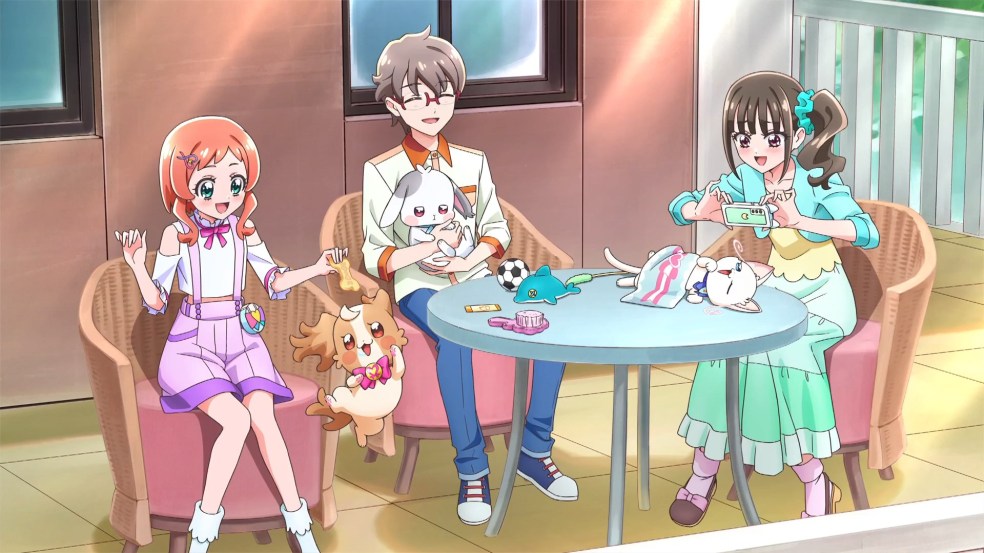
Wonderful Precure has been a weird one for the long-running magical girl franchise. It might be the best Precure season since I started mentioning them in my year-end writeups, and if it doesn’t surpass Tropical Rouge, it’s at least on roughly the same level. I’ll confess that I often feel like I end up saying roughly the same thing about Precure every year, and, I mean, you know the drill, right? Solid action fundamentals plus warm and personable character relationships plus a classic tough-cute aesthetic equals excellent magical girl anime. Since I started keeping up with the show yearly back when 2019’s Star Twinkle was the season of the hour, I’ve walked away from basically every Precure series thinking more or less the same thing. I love the series to pieces but it’s definitely mostly variations on a theme. That’s not a problem, and if I don’t say some variation of all this for You & I-dol next year when it’s wrapping up its run, it shouldn’t be taken as a slight against that show, but Wonderful does feel a little different in this regard.

It might just be a logical consequence of trying to do a season about animals. Our lead character, Cure Wonderful, is a dog in human form. It would be a little wild to have that be the case, have her best friend Iroha / Cure Friendy be on the same team, and not at least touch on the idea of that relationship eventually ending, thus making Wonderful the only Precure season that, to my knowledge, has an episode about an old woman’s dog dying. Wonderful Precure really only Goes There for a handful of episodes, and most of the time, it’s more traditionally Precure-related stuff, but when it does go there, it does a damn good job of it. The obvious point of comparison here aside from other Precure seasons is Tokyo Mew Mew New, but while TMMN was a nostalgia exercise, a deliberate throwback created for Tokyo Mew Mew’s original fanbase, Wonderful Precure exists in the here and now, speaking to the young children of today. I think that matters, and if I’ve placed the series higher than you might expect, that’s a good chunk of why.

The rest of why is that Cure Nyammy is in it, and she’s quickly become one of my favorite Cures ever, having both a killer design, an amusingly bitchy attitude, and a very compelling character arc that just wrapped up a few days ago as of the time of this publication. Faves matter, too.

#6. BRAVE BANG BRAVERN

Brave Bang Bravern, perhaps the single piece of giant robot animation most willing to embrace the notion of “dare to be stupid” since the original Transformers cartoon, embarked on a quest back in January to be the greatest Dudes Rock anime of all time. I’m not sure if it succeeded, but it made a strong showing, and I respect the hell out of that. On its face, the series is a baldly silly pastiche of super robot anime. Slightly below the surface is the fact that it also just is a super robot anime—like any good pastiche, it stays on the loving side of “loving parody”—as the biggest super robot otaku related to the show is Bravern himself, a hammy intergalactic powerhouse here to save the Earth from an alien invasion that is much more serious than seems apropos for his goofy demeanor. Indeed, in the first episode when he appears out of the sky like a bolt of lightning, that seems like it should be the “trick.” Instead, it’s the first of many, and Bravern is one of the year’s best anime for this very reason.

Bravern’s entrance in that first episode alone is fantastic, probably the best single capital A capital M Anime Moment of the whole year. He appears in a flash of green from the heavens, he annhiliates the invaders coldly exterminating humanity, he demands that Isami, our protagonist and his initially unwilling pilot, yell out attack names alongside him, he has his own theme song. His own diegetic theme song. During all this, in the first crack in a suit of emotional armor that takes the entire show to fully break, Isami admits that he never wanted to be in particular a soldier or a fighter pilot, he wanted to be a hero. Lucky for him, this is a show about heroism.

It’s an odd show about heroism, though. Bravern the show goes through pains to stress that heroism is a group thing. Bravern the robot seems to at least nominally think that too, going through the effort that he does to win over the displaced military folks who make up the bulk of the show’s cast, including both Isami and his buddy / rival Lewis, as important a character in this story as Isami himself. This is perhaps the one aspect of the show I have some trouble with, given the military setting, but more than that’s the only area of the series that betrays any insecurity at all about the premise. This is the one bit of bet-hedging, and the main reason it’s not in the top five. Everything else belongs to the titular giant space robot from the future, to the power of love, and to us the audience.

Yes, from the future. There are twists, because why wouldn’t there be? Lewis eventually finds one of the aliens, a suspiciously human-looking girl named Lulu, who becomes another part of the regular cast. With Lulu’s help, Superbia, one of the giant death machines spearheading the alien invasion turns face and becomes a valued ally. The biggest twist—and I’m about to spoil the end of the show here, just a heads’ up for you—is saved for Bravern himself. It turns out that Bravern is Lewis, transformed by cosmic forces and from another timeline, but Lewis nonetheless. I don’t make a secret of being a pretty big yuri fan on this blog, and it takes a lot to get me on a yaoi train. Nonetheless, I have to acknowledge this one, Bravern made me care about these two macho military guys and how they save the world with the power of love and also very homoerotic ending themes. That’s some real dedication. You won’t see that in a half-assed romcom.

And the final thing is this, for as great as Bravern is, hindsight has already made it feel like a herald of things to come. Not long ago, a new, suspiciously Daicon-y Gundam series was announced. Pedantic questions of where that falls on the largely imaginary super robot / real robot scale aside, it really does seem like the future continues to belong to the mecha ‘heads. So move forward, and make sure you bang brave bang bravern all over the place the entire way.

#5. DELICIOUS IN DUNGEON

This one’s a little tricky. Not because I feel any need to hedge my bets about how good Dungeon Meshi is. The top five is when we tend to get in to “unrestrained gushing” territory for me, and even if it weren’t, we’re talking about TRIGGER‘s first TV anime in a good while, and the debut turn for director Miyajima Yoshihiro who handily proves himself here. But! This is the rare case where I’ve read the manga. Dungeon Meshi, being what it is, is the sort of story where spoiling it doesn’t ruin it, but I’d still hate to do such a thing, even by implication. What I can say is that even here, in the two-cour adaptation of the first chunk of the manga, Dungeon Meshi weaves a complex, rich world. A magical ecosystem that puts many dedicated worldbuilding projects to shame. The story it threads through this world is one of conflicting principles and loyalties, and how those principles and loyalties fall away to the most basic underlying motivator of all; hunger. Hunger both literal and metaphorical, mind you—there is so much material on the theme of consumption in this story that you could cut it like a layer cake all on its own—but hunger nonetheless.

In this early section of the story, that hunger is mostly on the literal end, and you could indeed enjoy most of what’s here as a relatively lighthearted romp through a traditional fantasy dungeon where our heroes are forced to munch on monsters to survive. The characterization here, of Laios, our kindhearted and eccentric lead, the somewhat aloof and self-interested Chilchuck, the powerfully neurotic Marcille, and the survivalist, wisdom-dispensing Senshi, is fantastic across the board, and you could do a lot with a cast this strong. But if all Dungeon Meshi were was a decent comedy, it wouldn’t be this high on the list, and I don’t think it’d be anywhere near as well regarded in general. The adaptation really excels at playing up these darker, more serious elements, cracking them wide open, animating them less like an artist and more like a necromancer.

Indeed, fundamentally what TRIGGER is bringing to the table are all the usual benefits of an adaptation, the addition of sound and color and the transformation of texture that this brings with it. They’re just executed here with uncommon deftness. This may be a somewhat contentious statement, given all the discourse about what the anime cuts (I am sad about the lack of the Marcille-running-her-hands-through-her-hair panel in that one scene too, believe me), but overall, the anime presents a worthy alternate take on the same foundational story, remixing and reemphasizing different elements to highlight or dim different elements. Senshi’s backstory, late in the season, is an excellent example of this. In the manga, it’s tightly-wound and claustrophobic. A lengthy aside, but an aside nonetheless. Here, it’s much more akin to how it probably feels for Senshi; a traumatic memory that resurfaces again and again, rendered in full, earthy color, with all the violence and fear a party of dwarves losing their composure as a monster picks them off one by one requires. Similar examples rebound throughout the season, especially on the topic of Falin, Laios’ lost sister whose rescue the entire story revolves around, and whose eventual resurrection sets up the second half of the manga, yet to be animated. I’ll say no more on that front, other than that Falin, in all her forms, is perhaps my single favorite character to feature in any anime this year period. If it’s not her, the list of competition is very, very short.

Like the next anime on the list, and like Chainsaw Man in 2022 (I stand by what I said there), Dungeon Meshi is primarily not higher up because I have full faith that what’s to come will be even better, and I want to save giving it the gold or silver for a year when it’s at its absolute best. Staying hungry makes the meal all the tastier, I’m told.

#4. DAN DA DAN

Do you believe in Pikmins? Dandadan does. That and a whole menagerie of ghosts, goblins, ghouls, monsters, giants, and little green men from Mars. Lurid, even questionable at first blush, Dandadan deploys these gonzo Weekly World News escapees to weave a portrait of a world that is vastly, overwhelmingly, totally unknowable and hostile. I am tempted to here again compare two very different anime. Both Dandadan and Elusive Samurai, several spots back on the list, are intensely—surprisingly, even—spiritual works. But if that similarity is real, it’s to opposite ends in each given show. Elusive Samurai sees the wonders of the world as something fading, something beautiful to treasure while they still exist. Dandadan sees them as something unknown and frightening, every bit as potent today as they were centuries ago. If all this seems heady for a show that has an astoundingly straightforward (and frightening) “probed by aliens” scene in its first episode, well, that’s just the sort of leap of faith you have to make with Dandadan, a show that rewards a cursory watch just fine but a thoughtful one even more so. This is an anime for the kids who held Charles Fort as a personal hero, or at least, whoever his Japanese equivalent is. I like to try to nail down a show’s central theme in these high-spot writeups, but with Dandadan that’s difficult because it’s about so many different things.

But, if I have to boil it down to just one idea, it’s perseverance. Momo and Okarun, our heroes, are thrust into a world they don’t understand by hostile forces beyond their control. For Momo, this takes the sadly very realistic form of having her bodily autonomy constantly assaulted, in some of the show’s darkest and most upsetting moments—this is a big enough fixation for the series that this first season actually ends in the middle of such a scene—for Okarun, the violation is less intense but no less real. The fact that he spends most of the first season looking for his missing family jewels is more than just a dirty joke, it’s an indication that this disruption has left him incomplete and shaken up as a person. And yet, Dandadan never argues that the world should be shut out or burned down because of its dangers, our heroes push on as they do regardless because they have each other.

Throughout, Okarun and Momo fall for each other, giving the series a playful streak of young love that helps take the edge off and also giving them a ton of reason to banter, some of the best of the year, in fact. They also help a variety of both human and non-human allies come to terms with their own problems; a ghost hounding their classmate Aira is eventually laid to rest in the show’s untouchable seventh episode with the help of Aira herself, the unimaginable pain of the phantom’s waking life is given meaning and pathos, and she is able to move on feeling that it wasn’t all for nothing. But Dandadan is unwilling to focus solely on the obvious plays to pull at your heartstrings, just a few episodes later, our heroes are helping a displaced alien gig worker, and that somehow hits almost as hard. The romance angle doesn’t slack either, as both Momo and Okarun make the very teenagery mistake of thinking of a budding relationship as a zero-sum game in different ways over the course of the season: they clearly like each other a lot, but they’re both still learning.

This is what really separates Dandadan from the pack, not just a belief but an unshakable conviction in the human spirit, no matter what may go bump in the night and how many flailing miscommunications may happen. That would be all well and good in of itself, but combine that with the fact that this is easily one of the best looking shows of the year, maybe the best full stop, depending on your aesthetic preferences (I might give it that crown myself), make for an absolute fucking treat. That it’s taken me this long to even mention its action in passing feels like a crime, given how well the show delivers on that front, being not only visually pleasing but also inventive (episode nine, where they’re underwater in the school while fighting a bunch of aliens? That shit goes hard). It’s also, when it wants to be, the rare horror anime that’s actually scary, and its most disquieting episodes had me as rattled as anything I read on UnexplainedMysteries.org as a kid.

All told, this is a very welcome example of the zeitgeist turning its attention to something that clearly deserves it. A second season announced for summer of 2025 feels not only just right but also inevitable. The main reason Dandadan isn’t even further up on the list? I have no doubt that it has even higher peaks to climb. We’re just getting started with this one.

#3. MAKEINE: TOO MANY LOSING HEROINES!

Alongside the more obvious narou-kei boom of the past decade and a half, there has also been a surge in romance light novels. Alya Sometimes Hides Her Feelings in Russian, from farther up the page, is one of these. Makeine is too. It’s just that unlike most anime based on romance light novels, it just happened to be one of the absolute best things to air this year. Funny how that goes.

What sets Makeine apart from its peers is not something as simple or ineffable as quality, but rather both its metatextual nature and its commentary on—and celebration of—romance LNs as a medium. I am a sucker for this kind of thing, but it would be meaningless if Makeine wasn’t any good. Not only is it in fact very good, a best-in-genre for its year and an elevation of that genre overall, but it’s also full of a genuine love for romance LNs as a scene. For every sly observation about their clichés, there is a stock situation lovingly played to an exaggerated tee or turned on its head. For every brilliant little gemstone of genuine sentimentality, there is an equal and opposite locked shed with two characters stuck inside. Some would consider this embrace of the shamelessly goofy a flaw, but I can’t put myself in those shoes. There’s a huge difference between doing something because it’s the default and doing it with intent, and Makeine has intent in spades. Intent allows it to get away with the audacious trick of pretending to not be a “real” romcom while at the same time doing shit like having a character freestyle a children’s story off the top of her head out of pure heartbreak.

That love of the romantic in the broad, older sense of that term informs Makeine‘s whole style. The series has a real knack for rearranging the traditional tropes and setpieces of a romcom to be about just about anything but romantic love. Despite some early signs, and some teasing in its final episode, the main arc of Makeine is not about our lead boy, Nukumizu, getting together with anyone in particular. He and ostensible lead girl Anna even make a whole thing out of how they’re not going out. Will that change? Who knows! Makeine is such an obvious virtuoso with this material that bending it into almost any shape imaginable doesn’t seem out of the question. (Of course, we’re really talking about some combination of the talents of Amamori Takibi, the original novelist, director Kitamura Shoutarou, and overall scriptwriter / series comp guy Yokotani Masahiro, but the reality of any given anime as a group effort has never stopped me from anthropomorphizing them before.) All told, I’ve rarely been so happy to have so little idea of how a story is going to end.

What is apparent this early on is that Makeine’s focus on human connection doesn’t privilege romance over anything else, which is a very rare thing not just for this genre or even this medium but for fiction in general, and without getting too into it, as someone who engages with romance in a bit of a different way than a lot of people, that really spoke to me. Throughout the series, characters get their hearts broken, or romance never blooms at all, but they’re there for each other. This is the common element throughout the three main arcs here, each focusing on one of the show’s main girls; Anna, Lemon, and Komari. You can’t control what happens in life, but you can control how you respond to it. Cherish your friends, take your losses on the chin with dignity, stay determined to forge your own path. No regrets.

#2. OSHI NO KO – SEASON 2

Look, what do you want from me? Last year I raked myself over the coals for the crime of talking about Oshi no Ko at all in a period where its fanbase was being very awful to a real person involved with a real tragedy. I think, in hindsight, assuming I have the platform where choosing to write about this show or not would make any kind of tangible difference was an act of arrogance. If you disagree, I can only ask for your forgiveness here. This is one of the year’s best anime, I want to talk about it, and I am going to do so.

That bitter aftertaste isn’t irrelevant to discussing Oshi no Ko itself, though, we should admit. The second season of the series breaks protagonist Aquamarine’s search for vengeance against the man who killed his mother and the rise of his profile as an actor down to its base elements and interlaces them. The result is bitter, prickly, and insular, despite its lavish, often extremely colorful production. Indeed, some parts of this season can feel like petty score settling, take the character of Tokyo Blade mangaka Abiko, whose manga is the source material for the 2.5D stage play that much of the season revolves around. Abiko is depicted as a complete weirdo, someone with poor personal hygiene and even poorer social skills. She clashes with the play’s staff, admittedly also depicted with a fair amount of sympathy, at one point threatening to pull her endorsement of the play itself, not because she’s power tripping or anything like that, but because this coiled hedgehog of a woman is, Oshi no Ko argues, a would-be auteur, someone who cares deeply about her work even as everyone else around her tries to snip pieces off of it to make it fit into a more acceptable, commercial box. Oshi no Ko isn’t so simple as to suggest she’s entirely in the right, but Abiko is a telling cipher for the anime itself, and not just because she might be loosely based on OnK’s own mangaka Akasaka Aka. It is tough to escape an uncomfortable knot in my gut about this show, and this plotline in particular, like I’m listening to 2015 Drake and can see the eventual crashing-down-and-out coming a decade in advance.

Elsewhere, there’s much more light. Akane and Kana return in full fucking force in this second season, bristling with ambition and talent and locked in a rivalry throughout to upstage the other and win the affections of Aqua. In practice, this is basically a battle shonen rivalry, with all the “unintentional” homoerotic subtext that entails, and I will admit that no small amount of Oshi no Ko‘s placement this high up on the list is due to the absolute blast I had shipping these two. It will never happen, and it’d be pure hell for the both of them if it did, but seriously, I’ve read actual yuri manga where I was less invested in making two girls kiss about their weird, complicated feelings for each other. That’s not to say either of them aren’t a good pair with Aqua, though. (For my money, Akane wins that competition when she casually reveals she’d be down to help him murder a dude.) This is ultimately all part of the same spiderweb of entangled neuroses as Aqua’s whole deal, but it feels less serious since it’s not literal life-or-death.

In fact, the focus on acting as an art is pretty astounding through. It’s such that even very minor characters get a star turn. Melt, the prettyboy actor who unintentionally sabotaged the Sweet Today production in season one, returns here, committed to working on his acting after a few cutting remarks from one of the other Tokyo Blade actors, and his spotlight episode is one of the best single anime episodes of the whole year. He works hard at it, at some points with Aqua’s help, and the time he gets to truly be a star—mere minutes, both in-universe and out—is enrapturing. There’s a very telling bit of this episode in particular, actually, where Aqua explains to Melt that if he puts his all into one singular moment, people will remember his performance. This, of course, is reflective of the show’s own construction; Melt really does have only those few minutes, and outside of them, he barely exists. Oshi no Ko‘s greatest feat is its ability to explain these tricks to you as it’s pulling them off, a truly breathtaking piece of showmanship that had no real peers this year and is short on them even outside of it.

All of this praise heaped on it, you might wonder why I didn’t put ONK at the number one spot as opposed to down here in second place. Honestly? It all comes back to that unease I mentioned earlier. Oshi no Ko has genuine, well-articulated themes about how fame works and how it can ultimately destroy people, but I think that in the end, what Oshi no Ko is actually about is the spectacle of it all, prisms that trap stage-burning spotlight beams and refract them into cartoon paint. Sometimes that spectacle is hellish. People bleed and die on stage, sometimes almost literally. The crux of this story, remember, is the psychosis of someone who’s died and lived again times two, with the promise that the one whose head we haven’t spent time in yet is somehow the more poisonous flower. The message is not the point of Oshi no Ko. I don’t know if Aka knows that, but the people at Doga Kobo making the anime definitely do (a quick shout out to director Hiramaki Daisuke, who has been absolutely killing it with this adaptation for two years in a row now). Like I said, this is a spectacle. An incredibly good spectacle, but a spectacle nonetheless.

If we’re being honest with ourselves, it’s entirely possible that with its final arc this season, it’s writing checks it can’t cash. The radiating, vantablack stars that the series knocks into Ruby’s eyes in the last few episodes threaten to spill out and swallow the rest of the story whole. Plot, characters, themes, ideas, subsumed under a tide of black and red bile as the trauma and obsession overtake Ruby and stain her with a palpable dark charisma. But that’s the thing about metaphors; there isn’t really a jewel, there’s no marble to play this game with. At the end of the day, no matter the shape of the pupils, eyes are just eyes. I find it hard to believe that Oshi no Ko really has the guts to go out in a blaze of glory as the last few episodes of this season seem to set up, but I’d be happy to be wrong. Given how polarized the reception to the manga’s ending has been, I just might be, I don’t know the details. Either way, just enough put me off-kilter about this show to put it here, the second to last spot from the top. Very much unlike some other shows on this list, I don’t think Oshi no Ko has any higher to climb, and I think this cursed, jewel-encrusted artifact of a season might be the best we ever get out of it, not that I could complain if that were the case. Who knows, though? Showbiz is full of surprises.


Now, before we get to the very top of the list, there are two other pieces of business to take care of. Let’s get the brand new one out of the way.

#?. HONORABLE MENTIONS

Also known as: Things I watched at least some of from this year but didn’t finish, or didn’t fit the format, but which I still had some stray comment or another on that I wanted to note down here before the year ended. This was a super last minute addition—I’m literally writing this the night before this article goes live, having already filled out the other entries—but it felt like a fun little bonus to add, and I have a handful of thoughts on these shows, so why not?

  • NINJA KAMUI: One day, Toonami will bankroll a good anime again. Basically every thing they’ve done since the first pair of FLCL “sequels” has been a complete miss and unfortunately this is no different. Yes, the JJK director is involved. No, that doesn’t automatically make it good. Seriously one of the most boring things to air this year. This might’ve gone below ISHURA.
  • NEGATIVE POSITIVE ANGLER: I really, really wanted to like this, but I could just not get invested enough in the main character’s struggles. There’s a problem when your main guy is such a jerk in such an uninteresting way that I don’t care that he’s literally terminally ill.
  • QUALITY ASSURANCE IN ANOTHER WORLD: Another isekai that broke my heart this year. Oh QA-sekai, I thought you were different! But no, it eventually devolved into being just as boring as most of them.
  • NARENARE -CHEER FOR YOU!-: Serious question, what the hell was this show? Ostensibly a simple anime about cheerleading, in the four episodes I saw it managed to meander through some five or six different main ideas, switching up its tone each time. Weird show. I’m told it gets even weirder later on.
  • THE GRIMM VARIATIONS: Netflix horror / fairy tale anthology anime with CLAMP character designs. I only watched two episodes of the six, or else I might have put it on the list proper, where it probably would’ve sat comfortably near the upper middle. The two shorts I saw were interesting breaths of fresh air against the contemporary landscape. Cool shit, and I do plan to eventually finish this. (Although being an anthology means it doesn’t have that same “just one more episode” hook, doesn’t it? Oh well.)
  • GO! GO! LOSER RANGER: Another one that would probably have scored pretty well if I’d actually finished it. Life got in the way and I happened to fall off of this right as it was getting to what is, to my recollection, the weakest arc from the manga. Nonetheless, I want to catch up when season 2 drops, since the material after that arc is a lot better. Don’t be too shocked if Footsoldier D shows up on the list proper next year, should I do one.
  • BYE, BYE, EARTH: Bit of a heartbreaker, this one. It started out very promisingly, being a very peculiar original-setting fantasy thing with a really fun protagonist (voiced by Fairouz Ai, who feels like she’s truly achieved Star Voice Actress status at this point) but eventually the pacing got so fast that watching episodes started feeling like a chore. I may read the source material at some point if I can get my hands on it, since the fantasy worldbuilding here is incredibly interesting, probably the only real competitor Dungeon Meshi had in that department this year.
  • SENGOKU YOUKO: This was the big cut from the list proper. I’ve actually finished the first season of this, and I quite enjoyed it. (I’m honestly mostly just over the fucking moon that we have another Mizukami Satoshi adaptation that’s actually good.) However, I fell off of the second, ongoing season for boring life reasons—noticing a pattern?—and it felt weird to put only half the show on the list. Maybe that’s silly considering I’ve got Precure on here, but oh well.
  • SHOSHIMIN: HOW TO BECOME ORDINARY: This one I am really kicking myself for not finishing. Yet another where life just kind of got in the way and I had to put something on hold and it ended up being this. I really like what I’ve seen of this show! It’s an intriguing ‘mystery’ series where the mysteries themselves are quite mundane, but serve as a vehicle for the show’s interesting examination of how the world treats people who are different (and thus implicitly, how it treats the neurodivergent). Also has a really interesting, photography-aided art style. I really want to get back to this one. My one close friend, who is almost certainly reading this, you know who you are, I promise we’ll watch this together soon!
  • THE TRANSFORMERS 40TH ANNIVERSARY SPECIAL MOVIE: Essentially a music video for a Bump of Chicken song, this TRIGGER-animated short, directed by major Transfan and SSSS.GRIDMAN brain Amemiya Akira, was one of my favorite anime things period to air this year. If this had a spot on the proper list it would be very high, because this is just pure fanservice in the old sense of the word, endless cuts of giant robots from every corner of the Transformers franchise duking it out, no rhyme or reason, just pure metal-on-metal action. Fantastic stuff.
  • CHOCOLAT CADABRA: The other fantastic shortform thing directed by a TRIGGER director—Yoshinari You in this case—this year. This music video for an absolute slap of an Ado song / very involved chocolate commercial is maybe the best thing Yoshinari has ever been responsible for, and I say that as a huge Little Witch Academia fan. Maybe the chocolate company involved here will like….sponsor a TV-length version of this? Please?

Alright, that was probably way too many, but hey! I still have to pen my customary shout out here before we move on to the top spot (you are reading this in order, right?). Each year, I ask people to guess what my favorite anime of a given year was, and I mention them in this little lead-in paragraph if they get it right. Normally, only a couple people get it right, since I tend to pick things that speak to me and not really give a damn as to whether many other people have seen them at all, much less whether anyone likes them, hence previous list-toppers Wonder Egg Priority and Healer Girl.

That was not the case this year! This year, lots of people had my number. And how could they not? This show really was that good, and I’m not even remotely alone in thinking that. So a big shout out to Josh, Sredni, Wolfie, Ox, and Shrike (I’ve got a veritable menagerie going on here).

#1. Girls Band Cry

Nina, cue me up.

If I can be very honest, I’m pretty sick of talking about how my life sucks on this blog. It was the main thrust of my write up for Healer Girl when I put it at number 1 on 2022’s year-end list, and things have, as I noted at the start of this article, not really improved since then. (They’ve arguably gotten worse!) It was the reason I didn’t make a proper list at all last year. It’s the reason I only barely made one this year and why the Weekly Orbit has stalled out, and so on, and so forth. You get it. I’m tired. You’re tired. We’re all tired. The world is such a nightmarish mess that even mentioning it in passing on something as ephemeral and trivial as an anime blog feels disrespectful.

Girls Band Cry is not an antidote to that. The best anime, cartoon, film, work of art ever conceived and created is not an antidote to that. Girls Band Cry is also not a call to action, it’s not a profound statement about the state of the world, it’s not something that cuts to the heart of why life is how it is, or anything of that sort. Here’s what Girls Band Cry is, though: a testament to the salve that is kickass music, and kickass art more generally. Its ability to help us hold on, for one more day. Through anything. Through everything. This is not subtext, it’s what the show is about, and pardon yours truly for being corny, but I think that really does fucking matter. Things are bad, but we can make the best of it by belting from the top of our lungs. Art isn’t a solution, but it can help, sometimes a lot.

Case in point: Our lead Nina’s suicidal urges, revealed in or strongly implied by a single line of dialogue depending on whose sub track you were watching. The music of her favorite band, Diamond Dust, served as an escape, more than that, as a balm, something to ease the pain, something to staunch the bleeding for just another minute longer. When Diamond Dust’s vocalist, Momoka, left and was replaced, it felt like an acute betrayal. Naturally, she meets Momoka in the first episode, and before too long we see that initial attachment to Diamond Dust grow into a need to be her own cure, to make music of the kind that saved her. It takes a while for even Nina herself to realize that that’s what she’s doing (and she technically never expresses such outright at all), but that journey of growth is the year’s single most rewarding character arc.

For Nina, we get to watch her overcome that pain and see her find her voice both figuratively and, as she becomes the vocalist for the band eventually known as Togenashi Togeari, literally. Art is not an indulgence for Nina, it is a necessity. The same is true, of course, for us, and thus, as is the case for most truly great anime, the work reflects itself, a mirrored ball of hollered songs of rage.

That, of course, is only part of the story. The nuts and bolts of how a show like this becomes good is beyond the scope of this list, even if this is the top spot. (And god knows I’ve already written a fair amount about Girls Band Cry this year, so forgive me for not wanting to repeat myself.) But a number of things, both about the actual content of the show and the context around it, are worth at least touching on. Nina and Momoka’s relationship is the biggest of these, evolving from a one-side admiration to a mutual one, then to friendship, loyalty, and young love. It’s fascinating, and all too rare, how Nina and Momoka actually inspire each other, the kind of genuine partnership that makes real bands work. Of course, they don’t get to that point without a lot of bickering, and overlapping emotional outbursts and misunderstanding power a lot of Girls Band Cry. (Those with good memories may recall that it actually took the show a while to click with me, mostly for precisely this reason.) Moreso when the series comes to involve the group’s drummer Subaru, an actress-in-training who secretly resents the grandmother making her study that trade, and keyboardist Tomo and bassist Rupa, who form a sort of two-part unit unto themselves. A common point among all of them is the breaking down of facade, as they all use the music they make together as a tool for processing their trauma. As the show goes on, these girls come to trust each other, because they feel they can truly be themselves around each other, blemishes and all. Thus, TogeToge is not just a band but also a place to belong, a place to pursue their dreams, not anyone else’s.

Visually, Girls Band Cry is the rare TV anime that really looks like nothing else. All-CGI anime are still a little polarizing, but this show looking this good proves it’s completely possible for 3D anime to look every bit as fluid and expressive as the flat stuff. Girls Band Cry more or less tosses out all conventional wisdom as to how to make a 3D anime look good, too, eschewing old tricks like halving model framerates or emulating traditional anime cuts. Instead, it basically builds a new visual language as it goes, innovations that are sure to have trickledown effects in the years to come. The show is mostly pretty grounded, but when it wants to, it can absolutely soar with the stylization, whether this is as simple as giving Nina red and black “rage needles” to show her brimming with anger or as complex as the full-on music video the show explodes into at the climax of the eleventh episode, its best. There, every part of Girls Band Cry—writing, music, visuals—work in perfect concert to stage a perfect concert. Togenashi Togeari premiere their song “Void & Catharsis”, and it is, quite simply, the best moment in this medium this year. Little else even came close.

All this about an anime you had to pirate when it was new! I wonder if people will forget that over time, that GBC’s anglophone fanbase was a completely organic phenomenon. I wonder if the competing translations for that one line in that one episode will go down in history or be forgotten to the mists of time. I wonder if people will remember the jokes, the stupid memes, the conversations, the collection of translated tweets from Japanese fans calling Momoka a lesbian. I hope they do, Girls Band Cry was, in addition to everything else I’ve said here and in my original review, probably just the most fun I’ve had watching an anime in ages, and the community was no small part of that. Perhaps a reflection of the fact that this is the show in the top five that feels most like a single, complete thought? Maybe! Who knows. I could talk for forever about things big and small I loved to pieces about GBC, but I think you get the point by now.

There is some expectation to begrudgingly acknowledge flaws with things you think are basically perfect when you’re writing as a critic, so sure, I’ll do that. It’s not literally flawless. (Of course it’s not, nothing is.) Its structure is a bit lopsided, such that Rupa and Tomo don’t get much focus. Everything after episode eleven is basically postscript, not bad in any sense of the word, but not strictly “necessary” either. And, of course, the big one, after its immense success, the series is being subsumed into the sort of forever-franchise moneyball dreams that compose most of the current multimedia landscape. A mobile, likely gacha, game is on the way, which will probably unnecessarily complicate the shit out of Girls Band Cry‘s universe. This is the way of things, unfortunately. While it’s ridiculous to think of a band that was at best half-real (and certainly purely corporate) in the first place as “selling out,” that is nonetheless kind of what this feels like. It’s unfortunate, but not unexpected.

And yet, none of that will ever ding the show itself, a screaming knot of anger, drama, teenage angst, tears, fights. Joy and rage, drunk off youthful indiscretion and pure fucking spite. Flipped fingers, middle and pinky. Guitar solos, drum checks, broken facades, t-shirts with “LIAR”, “COWARD”, and “DROPOUT” hastily scrawled on them. Suicidal ideation and the incomparable peace when it leaves you for however long it does. Ceiling lamps spun around like ceiling fans, pet snakes, Undertale shirts, Rupa’s groupies and “nice beer!” Screaming into the void to feel the catharsis. No matter what else might bear the logo, all of that shit is the real Girls Band Cry. Everything else is commentary.

That’s not to say the actual series will have no impact beyond its own episodes, though. Over the past few years, the girl bands have steadily replaced the once-prolific idol-anime-with-a-gimmick genre, and while it’s impossible to say if that’ll continue, or if they’ll keep delivering the same level of quality seen in Bocchi the Rock, BanG Dream: It’s MyGO!!!, and of course Girls Band Cry itself, the future—or at least this incredibly narrow slice of the future—is bright. 2025 promises the goth-metal melodrama of Ave Mujica, at this point just days away, and Rock Is A Lady’s Modesty, an outside contender based on a manga, looks insane enough that it shouldn’t be written off either.

All this to say, what I’d really like to sign this entry, and thus the whole list, off with, is some pithy one-liner about how the girl bands will save us. That of course isn’t really true, and sometimes you have to sacrifice wit for honesty. But what is true is that they provide just a few more little bright spots for us going forward. I honestly, truly think that the show’s real legacy will be exactly that. Be it out of spite, out of pride, out of hope, or whatever else, hang in there, we’re in this together. If you’re angry, sing it to the heavens.

Play me out, girls.


And that’s the list, or it will be, at least. Since I’m writing this before I have the full thing actually finished. (Tempting fate? Maybe!) I had to make sure I took the time to properly thank each and every person who read this article, though. I know it’s a fair bit to get through and I’m not sure how leaving it as a single article as opposed to breaking it up into several as I’ve done in years past will affect things. Hopefully though, whether you largely agreed with my rankings or not, you found some pearl of insight in here somewhere, or at least an entertaining read. If you did, I’d be really thankful if you could drop me a donation on my Ko-Fi page. I don’t have a traditional job, and Ko-Fi donations are my only source of income, so it really helps.

With that out of the way, I’d like to end the year here on Magic Planet Anime by thanking all of you, since y’all, my readers, give me motivation to keep doing this and y’all mean the world to me. I say that a lot, but I do really mean it. I also want to specifically thank my friend and sometimes podcast cohost Julian M. of THEM Anime Reviews, without whom this list would not exist at all, since several months ago I mentioned to them that I was on the fence about making one, and they strongly encouraged me to try my damnedest.

In addition to Julian, I want to take the time to individually thank some friend groups of mine, mostly in the form of Discord servers with funny names. Shout out to: Magic Planet Anime’s very own server, which you can still join in the link below, the similarly named but unrelated Magic Planet server, Mugcord, the Secret Scrunkly Server, The Donut Zone, and the LOVE BULLET fan server. I’ll just also go ahead and shout out every single person who follows me on Bluesky, Tumblr, and Anilist. You guys rock, and you make my life better. I mean that.

As for what 2025 will hold for Magic Planet Anime? I don’t know! I’ve learned to not try to make any big predictions, but I want to keep writing. Because I love doing it, because you guys like reading it. I hit the big 3-0 this year, no more need for rounding up, but I don’t think MPA is going anywhere. I’m going to do this until they put me in the ground.

Now then, I’m going to be taking the rest of the year off. See you in January for seasonal premieres!


Like what you’re reading? Consider following Magic Planet Anime to get notified when new articles go live. If you’d like to talk to other Magic Planet Anime readers, consider joining my Discord server! Also consider following me on AnilistBlueSky, or Tumblr, and supporting me on Ko-Fi. If you want to read more of my work, consider heading over to the Directory to browse by category. If you’re looking for me to watch a specific show, watch this space. I am planning to reopen commissions in the near future.

All views expressed on Magic Planet Anime are solely my own opinions and conclusions and should not be taken to reflect the opinions of any other persons, groups, or organizations. All text is manually typed and edited, and no machine learning or other automatic tools are used in the creation of Magic Planet Anime articles, with the exception of a basic spellchecker. However, some articles may have additional tags placed by WordPress. All text, excepting direct quotations, is owned by Magic Planet Anime. Do not duplicate without permission. All images are owned by their original copyright holders.

“Goodbye, sekai!”

The Weekly Orbit [7/22/24]

The Weekly Orbit is a weekly column collecting and refining my more casual anime- and manga-related thoughts from the previous week. Mostly, these are taken from my tumblr blog, and assume familiarity with the works covered. Be wary of spoilers!


Hello anime fans. I’m going to keep things brief and without too many pictures this week. I’ve been under the weather, so I didn’t have as much time to put this together as I’d have liked. Hopefully I’ll be feeling better when next Monday rolls around.

Anime

Mayonaka Punch – Episode 2

Mayonaka Punch‘s second episode gives us a pretty good notion of the show’s strengths and weaknesses. On the plus side, it’s still very funny, there are a lot of good gags here (mayo-garlic turning out to be a hallucinogen for vampires is probably my favorite of these), and the character dynamics work well when the show isn’t trying to overexplain itself. The art and animation are also top notch, which is good, because it’s always difficult to forecast ahead of time whether or not there will be a fall-off after the first episode.

On a lesser note, though, what the show isn’t as good at is the broad-strokes plot points. This entire episode sort of feels like a weird detour; Masaki, Live, Ichiko, and Fu start a channel called the Chu Chu Girls, find some surprisingly early success, but are then forced to delete it via the intervention of a red-haired vampire named Yuki [Kayano Ai], who Live has some prior history with, and who threatens to rat them out to a figure identified only as “Mother.” This is all well and good, but our girls end up making a second channel—this time without using their vampire abilities—at the end of the episode, so this episode essentially ends in the same place as the last. It feels a bit like we’re skipping ahead and resetting to avoid having to depict these characters getting to actually know each other. There’s a lack of specifics here that I find frustrating, especially when Masaki flashes back to meeting the other two Hyped-Up Girls, and they bond over liking the same kinds of Youtube videos. What those videos are and how they brought them together is left unstated (although I suppose this tracks with the show’s general depiction of Youtube as a thicket of content-for-content’s sake. Not an inaccurate depiction, but certainly not a complete one.)

Still, I’m optimistic. There are strong character moments here, too, like when Masaki returns to her now-empty house after the Hyped-Up Girls have moved out and spends yet another night egosurfing negative comments about her. Additionally, the next episode looks much more gag-focused, and I think if the series sticks to its guns in that way, it will serve it well.

Alya Sometimes Hides Her Feelings in Russian – Episode 3

Less comedic episode this time around. Mostly a flashback so we can learn how Alya and Kuze met. Pretty cute! I like that all Alya really wants is someone to recognize her hard work, that’s cute, and I think it works for the character. Again, this show is firmly still on my “just pretty good” list, but there are worse things to be.

Wistoria: Wand & Sword

Every minute I watch of this I have a nagging thought in the back of my head. Something like “this is fine, but I kind of wish this production team were working on something more innovative.” That’s unfair, because it’s not like if this show didn’t exist all of this polish would be magically going to Tower of God or something else airing right now, but it feels a bit hollow. You could probably get most of what’s genuinely worthwhile out of this show by watching gifs from it on sakugabooru.

I’m going to make a strange extended metaphor, please follow me down this path. Todd in the Shadows, noted Youtube Music Guy, once put forward the theory that there are two categories of pop stars, there are those who get the public interested in their personas and points of view and who will probably be at least somewhat famous forever, and there are those who will only remain in the public eye until their hits run out, and not a day longer.

Oomori Fujino, author of both the manga this is based on and more notably of the Danmachi series is, if we’re comparing creatives in this industry to pop stars—an admittedly dubious comparison, but bear with me here—the second one. His work has craft and fluidity and skill, and those are not by any means worthless things to have, but I am always at least a little cognizant of the fact that I’m seeing the sausage be made as he’s making it. More than just the fact that this series is a pretty direct riff on two other more popular IPs (Harry Potter and Black Clover), I just sort of can’t imagine someone caring all that much about this story on its own terms unless they have severe light novel poisoning. Even then, it mostly sticks out because it uses a number of basic storytelling techniques that actual narou-kei light novels tend to try to shortcut their way through. In other words, he is a consummate professional in a section of the industry presently dominated by amateurs.

This might seem like a weird turnaround because I think my first post on Wistoria came off as much more positive, but this is kind of just a different (arguably more cynical) way to frame what I thought upon finishing the first episode. Whether I phrase it as “wow, this is way better than the other narou-kei fantasy stuff going around right now. The main character has an actual motivation, clearly laid-out obstacles to overcome, and there’s not a pop-up stat screen in sight” or “It’s pretty grim that this is so much better than the other narou-kei fantasy stuff going around right now just because the main character has an actual motivation, clearly laid-out obstacles to overcome, and there aren’t any pop-up stat screens in sight” is kind of a matter of semantics. We will see if I manage to actually develop a strong opinion on this show by the time it ends, assuming I finish it.

Code Geass: Rozé of The Recapture

I don’t have a ton to say here. I appreciated the further ties back to the original series and the ever-more-absurd mecha action.

I think there’s an interesting discussion to be had about the contrast drawn between Toumi’s [Chiba Shouya] successful sacrifice, framed as heroic and worthwhile and even met with a salute, vs. the (failed) sacrifice performed by the bigoted Britannian commander whose name I’ve already forgotten. Obviously, within the literal text of the narrative Toumi is completely in the right while the commander is completely in the wrong, but it does draw attention to Code Geass‘ nationalist overtones, which are as much a part of the work as the things I actually like about it (most other parts of it, honestly. I’ve gone on at length before how weak I am to campy bullshit) are.

Bye, Bye Earth – Episode 2

Two episodes in, in what I suspect is probably the more indicative of the two we’ve had so far. My main takeaway from this episode was how much it reminded me of, surprisingly enough, Kino’s Journey.

Here, Belle journeys to Park City on the first step of her quest to become a Nomad and find her people. The Kino comparison sprang to mind because there’s an odd morality play sort of setup here. The City is divided in two, the good Topdogs and evil Underdogs, who live in different sections of it, but something about the specific use of “good and evil” here is….funny. Especially since the Priestess-King Rawhide [Tsuda Kenjirou & Satou Setsuji], who Belle eventually meets and forms a contract with, seems to embody both of them, there’s a sort of duality thing going on here.

My overall impression is honestly just that this is a very particular series going for a very particular thing. This is probably down to the age of the work—the Kino’s Journey analogue is less ridiculous than it may seem given the vintage of the original novels—and where this genre, the traveler story, has gone since. I am interested to see what the next step in Belle’s journey looks like, since it seems she will have to duel a centaur next week.

SHOSHIMIN: How to Become Ordinary

If I could identify any coherent thesis behind SHOSHIMIN Series, it’s how the world is often unfair and cruel to those who don’t fit in. Implicitly, then, it is also about how the world is often unfair and cruel to neurodivergent people. In fact, if I can identify a commonality among the conversations here, it’s that none of these people are “normal,” and they are continuously striving for a normalcy that they don’t have. Often by trying to impose it on others. Such a thing is common among friend groups with a lot of neurodivergent people in them, unless care is taken to avoid it.

The extremely mundane “detective work” provides something of a hook (and while I haven’t seen it, I believe it also calls back to the author’s previous series), but these are only indirectly, I think, related to the show’s actual point. Who can say, though? It might have some other cards to play, SHOSHIMIN remains an intriguingly circumspect work, the kind to make you resort to two-word chestnuts like “intriguingly circumspect.”

My Deer Friend Nokotan – Episode 2

How do you raise the stakes when your character dynamic already consists of a complete weirdo and the comparative straight-man forced to bounce off of her? Why, you add another weirdo of course. Thus, we meet Koshi-tan’s little sister Anko [Tanabe Rui] here. Anko is a bit less fundamentally unknowable than Nokotan (who accordingly has her implicit eldritch-ness toned down a little here, since it doesn’t work with the structure of this episode so much), but she’s about as much a force of nature.

I like Anko. Siscon characters are way overdone by now, but having one fits with the show’s ’00s comedy vibe and Anko is significantly scarier than is the norm for her archetype. She spends the (weaker) first half of the episode swearing revenge on Nokotan because she has it in her head that the deer has somehow stolen her sister’s virginity, a misconception that Nokotan herself of course does nothing to dispel. I am sad to report that whatever else may be said about me, if you have an anime character accuse her sister of making a “love nest” for herself and a deer, I will still find it pretty funny.

The second half of the episode is the real highlight here, though, as Anko and Nokotan compete in an absurd quiz show wherein Nokotan will have to be “deported” to a wildlife park if she loses. The subject of the show is, of course, Koshi-tan, and thus the episode once again gets most of its charge from humiliating its main character. Eventually, Anko, on the brink of losing, unleashes a flurry of kunai (where did she get those from? Who knows) on Nokotan, and while she dodges most of them with ease, she takes a bullet for Koshitan, and is promptly mourned by Koshi-tan and the rest of the cast with all the fanfare of Elmer Fudd weeping over Bugs Bunny. Meanwhile, she’s up in Deer Heaven, meeting with Deer God (not the subtitle group) and getting kicked back to Earth for unknowable reasons.

All told, a solid episode in a solid series, and I like the twist that Anko and Nokotan become friends at the end. My assumption is that life is not about to get any easier for Koshi-tan.

Makeine: Too Many Losing Heroines! – Episode 2

This was fantastic! Much more of a straightforward harem comedy than the first episode (except for that scene near the end), but a very good one, so I can hardly complain. Lemon [Wakayama Shion] is a wonderful character and I think she might be my favorite of the main 3 girls, I suppose we’ll have to see how things shake out with Chika, the short girl from the literature club. Some people will be put off by the comparatively horny nature of the first half of this episode. I can’t really pretend I care, much, personally. I thought it was pretty damn funny. (“But Nukumizu, it’s just us girls here!” can only be the result of truly intense heat stroke. Or maybe it’s foreshadowing and this will somehow turn into the first harem anime to star a trans girl. Anything is possible!)

Also, the nurse! Casually mentions having fucked in what is now her own office back when she was a student (possibly with the other woman who’s now her coworker?)! Wiretaps her office! Has a shipping chart! Most of the meta stuff from this episode came from her and she seems like she’ll be a great supporting character going forward.

The scene at the end of the episode where Lemon deals with her heartbreak by running laps after sunset is phenomenal, and I think if the show can continue hitting those sorts of emotional beats it’ll easily make my personal Top 5 by the end of the year.

2.5 Dimensional Seduction – Episode 3

I thought this was….fine, I suppose. I remain undecided on if the few things this show does well are worth putting up with the parts where it’s obviously lacking.

In this episode Mikari [Kitou Akari], the obligate normie girl in the harem who we met last week, does a cospaly shoot with Masamune and Ririsa. There is a little kernel of real feeling in how Mikari relates to Miriella, the character she’s cosplaying, because the character could never tell Ashford how she felt, and Mikari herself can’t be straightforward with Masamune, so she relates to her in that way. That said, sitting with it for a minute made me just think about how the various in-universe anime in Dress-Up Darling aren’t a contrived bespoke metaphor for part of the main plot in that series, and how they thus feel much more like real anime that could exist in some alternate timeline than the fairly thin picture of Ashword Wars that the show’s given us so far. I can also imagine the target audience actually finding the stuff in Dress-Up Darling hot, which, just to be super blunt, is not the case here. The visual chops just aren’t there, so the show is failing even in its intended basic goals.

A small point in the show’s favor is that I think this whole mana infusion thing is a crack about Fate/stay Night, which, hey, that’s something. Even then, that’s also kind of a weirdly dated reference point for a show in 2024, even keeping in mind that the manga is 5 years old.

There remains something broadly structurally impressive about most of the show being set in a single room with only a few characters, but it also makes the series feel kind of claustrophobic. This is a cousin of the same problem the Giji Harem anime is having right now. It’s not as severe here, but one does get the distinct sense that this probably works better in print where there’s not as much of a sense of place as in an anime. It’s also extremely languid in pace, and compared to how well-structured the other romcoms airing this season are that’s a very notable weakness. Although at the end of the episode, our leads stay overnight at school to get work on a cosROM done, which is a nice interruption from what has quickly become this series’ norm.

All this said, I think I am fairly close to dropping this. It doesn’t hold a candle to Makeine obviously, but it’s also not nearly as good as Roshidere, an equally low-stakes romcom with a horny streak that, despite its vastly different premise, is just handling itself with much more confidence and style than this has so far.

Wonderful Precure – Episode 25

This is a very fun and antics-heavy episode. I particularly like Mayu’s ongoing quest to play matchmaker with Satoru and Iroha (up to “narrating his inner thoughts” at one, hilarious point).

Mayu helping Yuki into the water is really cute until Komugi (intentionally) ruins the moment. I also quite liked their fight against the sea turtle garugaru and the nice “wonder of nature” moment with the normal sea turtle afterward toward the end of the episode.

Wonderful Precure has just kind of been quietly tossing off great episodes for a while now, and I’m a little sad that I haven’t always had the presence of mind to talk about them. This is not as hands-down excellent as the episode from a few weeks back where we finally get some hint as to who our main villain might be, but it was still very good, and next week’s episode promises to be so as well.


And that’s about all I’ve got for you, today. As today’s Bonus Thought, I’ll ask you to ponder this screencap, also from Wonderful Precure. I don’t know what it is, maybe lingering affection for that one OG Transformers episode? But something makes protagonists surfing inherently very funny to me. Maybe you agree.

“She will never be surfing.”
Spits out cereal.

With the bustle of premiere week firmly behind us, I’d like to again ask for you to consider making a small donation if you enjoy what I do here on the site. I don’t have a traditional job, so every penny helps.


Like what you’re reading? Consider following Magic Planet Anime to get notified when new articles go live. If you’d like to talk to other Magic Planet Anime readers, consider joining my Discord server! Also consider following me on AnilistBlueSkyTumblr, or Twitter and supporting me on Ko-Fi or Patreon. If you want to read more of my work, consider heading over to the Directory to browse by category.

All views expressed on Magic Planet Anime are solely my own opinions and conclusions and should not be taken to reflect the opinions of any other persons, groups, or organizations. All text is manually typed and edited, and no machine learning or other automatic tools are used in the creation of Magic Planet Anime articles, with the exception of a basic spellchecker. However, some articles may have additional tags placed by WordPress. All text, excepting direct quotations, is owned by Magic Planet Anime. Do not duplicate without permission. All images are owned by their original copyright holders.

The Weekly Orbit [6/24/24]

The Weekly Orbit is a weekly column collecting and refining my more casual anime- and manga-related thoughts from the previous week. Mostly, these are taken from my tumblr blog, and assume familiarity with the works covered. Be wary of spoilers!


The season is winding down, and the winds of the upcoming Summer season are already on the horizon (we’ll hopefully get to that tomorrow, if my writing schedule holds up). We’ll be kicking off with the three finales that aired over the last week, one of which only came out today. I realized after compiling this that in all three finale writeups, I quoted a character from the show in summarizing how I felt about the show itself. That was not intentional! But it’s kind of funny. I’ll also be blunt in saying I liked some of these more than others. Read on to learn why.

Anime

Jellyfish Can’t Swim in the Night – Episode 12 (Finale)

I’ve compared Jellyfish to other anime a lot while writing these off-the-cuff posts, but to pull from an otherwise very different series, the ending here almost reminds me of that of Witch From Mercury? Decidedly pretty good, and definitely fine-tuned to make you feel happy that our main pair are back together, but with just enough that doesn’t quite add up that I feel remiss not to mention it. It’s now been a few days since I wrote the original version of this entry over on Tumblr, and it’s clear to me that most people did not like this ending. I mostly did! But I don’t think it redeems the series largely faceplanting in its second half, so I’m not sure how willing I am to contest the consensus. Personally I think this is a case where I like the characters more than the show they’re from.

To be clear, if the series’ representational efforts—more in the realm of Kiwi than the Mahiru / Yoru thing, which the show largely drops for its final stretch—outlive the actual text of the show itself, as may well happen, that’s not actually a bad thing. Most anime would be lucky to have that legacy.

I want to zero in on one moment during the episode, though. Kano during the concert, where we’re early in the episode and she’s clearly nervous. Flashbacks, intrusive-thoughts-as-voiceover. The literally-faceless masses. This is imagery we’ve seen associated with her before, as she’s clearly reliving her trauma from her days with the Sunflower Dolls.

We see her basically bomb; the backing track kicks in but she can’t sing, and suddenly the sound cuts out entirely, putting her in the bottom of the ocean. Mero, surprisingly, is the one who calls out to her to egg her on, although it’s Mahiru’s jellyfish that she looks at as Mahiru calls out to her as well. We get our big, swelling concert song, and then the moment is over. Jellyfish‘s actual narrative ends the second the music dies, for better and worse.

We get a mirror of the first episode as the two meet again for the first time in a while after Kano’s performance. Ultimately, the conclusion they come to is that they kept their promises to each other, so everything’s basically fine. This is clearly to some extent what the show wants us collectively to think, as well. Kano as the aimless singer who’s finally found something to sing for, Mahiru as the ever down-on-herself visual artist who’s found someone inspired by her paintings. Kano says she wants to be a reason for people to keep looking forward, an interesting thought. But I’m not sure how much I agree with the show’s assertion here. The two definitely seem like they’ll be fine in the long-term, but given that we aren’t going to get to see the long-term, that’s a bit of a bittersweet pill.

In the Sunflower Dolls / JELEE show’s credit roll, Kano is credited under her preferred name. Yukine, the closest thing Jellyfish has had to an antagonist, seems to mean this as—and certainly the show wants us to take it as—a gesture that despite her past treatment of her daughter, she respects her now. (An analogy is also drawn between the virtual audience the show draws and the 50,000 person capacity of the Tokyo Dome. Originally referred to several episodes ago, having one of her artists sing there was a long-term goal of Yukine’s. The rest of JELEE is a little weirded out by Kano bringing this up, and that much is obviously intentional.) Clearly, not all is forgiven, as Kano playfully spurns her mother in the finale’s closing minutes. Still, something about this feels…a little wishy-washy in a way I can’t entirely put my finger on. It’s a good ending, maybe the best ending this iteration of the series could’ve had, but not a great one. There’s a distinction there, and this is the sort of show that practically begs rumination on distinctions of that nature. Yukine herself says, and I quote directly, “The difference between buzz and backlash ultimately hinges on an idea being meaningful.” Are Jellyfish‘s ideas meaningful? I think that’s an open question. Despite everything—Kano’s trauma, the falling out with Mahiru and Mahiru’s own impostor syndrome, the show’s own strange pacing, Kiwi being bullied for their gender expression and for being “weird”, the discrimination Mei faced as a child, Mero detonating the careers of the Sunflower Dolls’ onetime rivals The Rainbow Girls—this ends as a feelgood story, despite its gestures otherwise. That may be a bit too neat for me, I’m not sure.

I hate to bring up That Other Music Anime Airing Right Now while writing about this one yet again, but the main distinction between the two, I’ve finally realized, is that Girls Band Cry‘s emotional material feels much more consistently raw. Jellyfish’s best episodes hit those nerves as well, but the show on the whole feels like it can’t quite thread the needle in the same way. The comparison is perhaps unflattering to both anime, but I can’t help myself here. Jellyfish clearly wants to have a complex, somewhat open-ended ending, but it also wants to leave us on a positive note, not unlike fellow polarizing aftermath anime Wonder Egg Priority. In that show’s case, I felt that it was doing enough both overall and with its ending in particular that I felt compelled to defend it. I can’t really do that, here. I’m not as disappointed as some have been, for sure, but if someone feels significantly more let down than I do, I can’t really blame them.

The series ends on a short run-through of denouement scenes, for the individual members of JELEE both apart and together as a group. Tellingly, it might be Kiwi’s that works the best. The relatively straightforward nature of their arc makes their development feel the most earned and the most logical. The whole thing with Koharu is, to say the least, odd, but even that fits in pretty well with their arc in coming to accept themself as a queer person in a world of queer people. At the same time—and I couldn’t quite pin this down the other day when I was first writing this—that same coherence just isn’t there for the other characters. Perhaps because Mei was never particularly well-developed to begin with, and Kano and Mahiru’s reunion feels contrived. I can forgive letting a kiss on the cheek hang for six episodes. Letting that falling-out hang for, what, 3? Is a bit harder to stomach though. The entire plot there takes away a bit from what the show is trying to do, and when what you’re trying to do is this delicate, “a bit” can feel like a lot.

The over-painting scenes in the last few minutes of the episode being drawn as though they’re shot through the phone is a cool touch, I like it. On the note of that scene, something that Jellyfish does manage to capture is the warm mundanities of friendship and life in the digital age, and I like Kano’s little speech to the others at the end here. That’s worth something, I think. Not many anime end with their casts literally waving goodbye to the camera.

Time, as my memories of the show crystalize and harden, will tell whether I end up truly feeling that those warm feelings are “enough” to rate Jellyfish particularly highly, both on its own terms and as compared to other anime that have come and gone (and will come and go) this year. But that’s also sort of a way of looking at art that is ruthless enough to not always be appropriate. So I’ll say it here if I never remember to again, the people who made this clearly cared about it a lot. There’s love in it, and love does matter. I can’t speak for anyone else, though. Some songs just don’t reach everybody.

A Salad Bowl of Eccentrics – Episode 12 (Finale)

So ends one of the season’s true hidden gems. A series that combines a freewheeling and loosey-goosey sensibility to both its worldbuilding and characters with just enough emotional warmth to make it worth connecting to. Good chance this ends up being my favorite of the two finales I’m watching tonight!

An aside: the live action screen camera-point screen recording of some random-ass actual pachinko machine is really funny.

It’s either astounding luck or meticulous planning that a pretty funny parody of a band performance episode dropped here, in the gay girl band season. It’s obviously nowhere near the bowl-you-over powerchord of say Girls Band Cry‘s eleventh episode, but Grasshopper the Savior put in an okay (and more importantly, amusing) showing here. How does that whole plot conclude? With Noa getting arrested for insider trading. Roll credits!

Sara, meanwhile, exits her ongoing plot by graduating the school she was enrolled in just three months prior, universally acclaimed and beloved by her fellow students and their parents alike. She sings an idol song. It’s all pretty great.

All told the main takeaway here is that Salad Bowl is, true to its title, a gathering of truly eccentric souls and bizarre situations. Sousuke’s reaction to Olivia’s band getting broken up because of Noa’s antics? “I see this is all insane as usual.” I couldn’t have said it better myself. The series ends on what passes for a cliffhanger in a show that has never really been focused on its plot. I can’t imagine this getting a second season, but who knows? I’d be pleasantly surprised.

Train To The End of The World – Episode 12 (Finale)

Here, we have easily the best of this past week’s finales. A pitch-perfect ending to a show that was not always so effortless. An ending I appreciate a lot, the sort of thing that makes me view the whole series in a better light.

A brief summary of the literal events here; We get a final battle while the two trains drive through what I’m going to call Windows 95 screensavers. We get Shizuru and Youka making up for lost time. We get the world returning to something that’s not normalcy but at least approximates it. (Another theme running through this show is acceptance of inevitable change, naturally.) We get to see scumbag techbro villain Pontarou get his comeuppance. It’s all very nice.

I think with hindsight the show is perhaps best considered as a longform metaphor for anxiety, specifically that stemming from social conflict. You fuck up, and the fucking up is blown up so big in your mind that it becomes impossible to move past. As somebody who just spent a few hours agonizing over and then rescheduling a doctor’s appointment, and then agonizing over the fact that I did reschedule it, I get it. It happens. It usually doesn’t result in the world degrading into a surreal hell of the senses that threatens to drive all within it to death or madness, but it happens. If you want to stretch a little, you can rope in the show’s technological motifs—the externalization of the internal through the medium of the Internet, as turned outward by the 7G Phenomenon—into all this. You could argue that Shuumatsu Train advocates for resolving conflicts of the social media age by talking to each other and treating each other as humans. I’m not sure how intentional that read is, but if it is, it’s a fine thesis, and the series pulls it off pretty well.

Incidentally, anxiety like that, which can end up fracturing friend groups as it has in Shuumatsu Train, doesn’t usually involve one of the parties being a near-omnipotent goddess either. Nonetheless that is what Shizuru and co. have to deal with at this episode’s climax, and while the results are a little saccharine, I think this whole arrangement works better than not. The final argument (such that it is) between Shizuru and Yoka is just great all around, and ties up their interpersonal conflict perfectly.

Shuumatsu Train was hardly a perfect show (I ask readers to remember the run of relatively weak episodes at about the 2/3rds mark. We probably could’ve skipped the ecchi zombie plot) but it did what it wanted to do and it did it well. This is another one in the grand tradition of oddball fare like The Rolling Girls or even the Akiba’s Trip anime, and it’s a worthy addition to whatever you’d like to call that genre, regardless of any flaws. To quote Shizuru herself, it’s better to try and have regrets than to do nothing at all.

Pokémon Horizons – Episode 55

This episode is mostly just an excuse for a procession of several fun, short battles. I say “just”, but that’s hardly a bad thing, since at the end of the day that’s what this series is about.

The second is the best of these, with an impressive showing from Elite Four artiste Hassel and his Baxcalibur and Flapple. Roy and his partner, the Grass-type gym leader Brassius pull off a number of coordinated double moves. Our brief detour over into what Coral’s doing is also pretty fun, since “what she’s doing” is having her Glalie blow everybody up again.

The real treat seems like it will be next week, though, when Liko faces off against Rika. I will spare you all the gay rant, although I can’t promise I will do the same when next week rolls around.

Wonderful Precure – Episode 21

I must say, my main surprise in watching this episode was how much of it was an episode of a Class S yuri school comedy. Yuki transfers in to the gang’s school in this episode, and most of the episode, accordingly, focuses on that.

Her personality, or at least, the one she sort of grows out of here is—and I realize that what I’m about to say is very silly—almost a little Homura-esque? It’s something about her single-minded fixation on Mayu that makes me think that, I think. I assume she’ll continue to develop out of it as the show goes on. (Something Homura never had the chance to do given the way her show is structured but, well, they’re very different anime to say the very least. It’s a loose comparison at best, but let me have my fun here.)

We get a pretty melancholy little flashback here where we learn about Mayu drifting away from a friend at her previous school. The anecdote, I think more than anything before it, seems to position Mayu as neurodivergent, as what drives a wedge between Mayu and her former friend is simply Mayu’s tendency to become fixated on tasks, and, implicitly, her more general habit of keeping to herself. Yuki is the one who tells Komugi and Iroha (and, well, us) all this, and I don’t think it’s a reach to say she’s projecting her own hurt into the anecdote as well. Much of this episode’s focus is her learning to deal with her own reluctance to get close to people. That’s all a bit heavy for a kids’ show, but Precure being Precure, it handles it all with relative ease.

Of course, all that and the action part of the episode involves waking up a sleeping panda garugaru by using the fox fairy to transform Komugi into a giant tire. The animation goes all out for this, of course, and around here I started to wonder if this might honestly be the best Precure season, or at least a new personal favorite.

Mysterious Disappearances – Episode 11

What would be a fairly nice transitory episode leading into the finale is once again held back by a lackluster visual presentation.

Honestly this one shoots past “workmanlike” into just generally pretty bad to look at all around, especially in its first half it’s just remarkably shoddy. (I can’t even meaningfully directly compare to the manga, as this is after the point where I stopped reading, but I almost guarantee you it looks better there, and anyone can read any of my Dungeon Meshi writeups to know I’m not normally a “haw haw manga better” person.)

If you can look past that—and the fairly gratuitous pool scene a bit after the halfway point—this is a decent bit of plotting. Rei and Oto possibly having a way back home is a decent final conflict. What I will say, the secret Rei is keeping where he plans to become the ticket is a compellingly dark twist. My main hope is just that things can get back in order visually by the time the anime ends next week. I’m also interested to see how the cat boss youkai factors in.

Girls Band Cry – Episode 12

A slower episode this week, but certainly an eventful one. TogeToge are officially signed! Rupa and Tomo are working their last day at their job! I am very happy for these people who don’t exist!

As one might predict, Nina seems almost as anxious about their current situation as she is happy. After all, Diamond Dust were still the main attraction at the concert TogeToge played at. And despite Nina claiming her band is better (she’s right) and that they completely rocked (she’s right about that, too), they aren’t the ones being talked about on socials. Rarely do the best artists get the most coverage, as Nina is learning.

The callbacks to the first episode are absolutely adorable, as is Tomo’s cute but muted reaction to the card and flowers Subaru buys her. The hotpot party scene is nice; a restrained sort of comfort and a chance to recuperate after the big, billowing emotions of last episode.

Their songwriting sessions are motivated by a desire not just to one-up Diamond Dust, but also, as you might recall, to get to the Budokan, a feat that would put them on par with many famous bands up to and including The Beatles, but most amusingly, Cheap Trick. These are subject to montage, the first in the series I think. We cap with a little scene of Momoka asleep on Nina’s shoulder, on the train home. It’s so cute, I wanted to cry.

The show’s final twist seems to be to make the whole Diamond Dust / TogeToge fight very literal. TogeToge are offered a co-bill, with composing the theme for a TV series on the line for the band that draws a bigger crowd. This is a stacked fight at best, and TogeToge have a lot to lose. Ultimately, the band put it to a vote, and, despite Nina’s misgivings (and being collectively unsure of what DiaDust’s actual goal was, here), they opt to decline. This leaves Nina in something of an emotional rut. Being a rockstar, she has learned, is not all about huge bursts of emotional catharsis. There’s a lot of boring bookkeeping and shady politicking, too. (I would refer her to the wisdom of KRS-One on this topic, myself.)

Momoka, however, knows that. There’s a running B-plot through this episode about a song she’s working on, first mentioned during the hotpot party. Throughout, she’s stuck on a specific part of it (we’re not shown what, specifically). Why exactly is left unstated, but it seems to be at least in part because, in her own way, Momoka wants to beat Diamond Dust, too. She’s just being more subtle about it.

Or at least, she thinks she is. Nina seems to pick up on this, and the rest of the band are convinced to accept DiaDust’s challenge after all. There’s fear in Momoka’s shadowed mood throughout the episode too. That much she says herself. She lost everything once before, and she’s afraid to lose it again.

The episode ends with an upturn of mood; Momoka admitting that she wants to win against Diamond Dust too, TogeToge’s sound engineer and manager telling them they really like the new song (which Momoka finally finishes, naturally), and all seems to be going well in the leadup to the finale.

And then, at the last possible second, we get this; the new song releases, Nina goes to check the metrics. 103 views. Ouch.

It is hard to tie genuine emotion to numbers floating up and down. This is a big mistake that frankly a lot of music anime make these days, but here, that 103 feels like a legit punch to the gut. We only have one episode left! What the hell is going to happen?! It’s hard to know, and there’s of course the knot of anxiety that GBC won’t “stick the landing” so to speak, but I have a lot of faith in the series. TogeToge will figure it out.

Anime – Non-Seasonal

Ruin Explorers Fam & Ihrie

A fun, if not particularly challenging, fantasy action-comedy romp from the heyday of the 90s OVA boom.

On the one hand, there’s not a ton to say about this one; we’ve got a very basic fantasy premise here with our two lead protagonists—a pair of treasure hunters named Ihrie [Neya Michiko] and Fam [Shiina Hekiru]—who seek an ancient wish-granting treasure. (That’s “Fam” pronounced to rhyme with “fawn” by the way. Don’t ask her if she’s cheesin’, though.) This eventually spirals out into a quest to help the last prince of a destroyed kingdom reclaim his throne from a very classic wizardly overlord bad guy. It’s all solid stuff and the main strengths here are visual; the show’s choices of color and shadow are consistently fantastic and the animation is similarly excellent with a lot of standout moments both in more action-oriented scenes and in the more comedic ones that make use of a lot of good character acting. (This is most obvious with Fam, whose kitty tail gets to telegraph her mood sometimes. It’s a cute touch.)

On the writing side, while the plot is truly nothing special, the characters, broadly-written as they are, are solid and likeable. Aside from the two leads, my favorites ended up being Rasha [Matsumoto Rika], a snarky and full-of herself wizardess who starts out as an antagonist before she and her partner Migel [Yamadera Kouichi] join the main party to help them take down the bad guy, and surprisingly, the cowardly merchant Galuff [Ootsuka Chikao]. Usually such characters come off as vaguely uncomfortable, and he’s not entirely free of that, but he’s such a petty and ineffective scoundrel that it becomes kind of endearing.

All told, this is a pretty fun and accessible watch. I dock a few points for some of the thematic material in the fourth and final episode (I’ve never been a big fan of the whole ‘divine right of kings’ thing, even in inherited form as a stock genre plot in fantasy stuff like this.) But all around, it’s a good time, and there are way worse ways to burn two hours. This is a strain of fantasy anime that still exists albeit in somewhat reduced form, so it’s not like this stuff has really gone away, but obviously something like eg. Dungeon Meshi (or even like, I dunno, Helck) is a fair bit more sophisticated on the writing and thematic level, so the comparison isn’t direct. Either way, yeah, fun time. Enjoyed myself here.


That’s all for this week, anime fans. Consider tipping your girl if you liked any of the entries this week, every penny helps me cover basic life necessities like food and medicine. As for this week’s Bonus Thought, I wanted to give it to Train, since we won’t be seeing it in this column again. Take it away, Akira!


Like what you’re reading? Consider following Magic Planet Anime to get notified when new articles go live. If you’d like to talk to other Magic Planet Anime readers, consider joining my Discord server! Also consider following me on AnilistBlueSky, or Tumblr and supporting me on Ko-Fi or Patreon. If you want to read more of my work, consider heading over to the Directory to browse by category.

All views expressed on Magic Planet Anime are solely my own opinions and conclusions and should not be taken to reflect the opinions of any other persons, groups, or organizations. All text is manually typed and edited, and no machine learning or other automatic tools are used in the creation of Magic Planet Anime articles, with the exception of a basic spellchecker. However, some articles may have additional tags placed by WordPress. All text, excepting direct quotations, is owned by Magic Planet Anime. Do not duplicate without permission. All images are owned by their original copyright holders.

The Weekly Orbit [6/10/24]

The Weekly Orbit is a weekly column collecting and refining my more casual anime- and manga-related thoughts from the previous week. Mostly, these are taken from my tumblr blog, and assume familiarity with the works covered. Be wary of spoilers!


The season is starting to wind down, and that shows in some of these episodes. Our first two anime this week are setting up for their big finales.

Anime – Seasonal

Train to The End of The World – Episode 11

As Shuumatsu Train enters its final stretch, we kick off one of the series’ denser episodes to date with our heroines arriving, at last, at their destination of Ikebukuro.

They find Youka in short order, but things aren’t simple enough that just reuniting the separated friends is enough. It’s clear that Youka doesn’t remember them—we don’t yet know why, but Reimi openly speculates that ‘wibble-wobble surgery’ of the same type Zenjirou was subjected to might be to blame—and their attempts to remind her who they are fail. Her reactions are confused and interlaced with her 7G powers, and any time the girls try to break through to her, it clearly destabilizes her already fragile mental state, causing the environment around her to temporarily devolve into an acid trip of digital video flickering and color-burst effects. The girls are chased away by Pontarou’s personal guards, the masked Ikebukuro police force.

Retreating to the train, they receive a phone call—via a phone fashioned from bitter melon, of course, because why not?—from Makoto and Zenjirou. Their conversation here basically confirms what we already knew; if they can nab the 7G button and just turn the network back off, the whole world will snap back to normalcy. (Allegedly, at least.) They’re not alone, though, as an unexpected ally turns up in the form of Mito and her zombie horde from a few episodes back. Her zombies, as it turns out, can sense the presence of the 7G button.

Call me stupid, but the show calls attention to a few parallels I hadn’t noticed up to this point. For one, Shizuru and Pontarou are, in a very broad sense, a bit similar, in that both are actively trying to avoid accountability for their actions. (They’re also very different in a number of ways, which I expect the show to draw attention to in its finale.) Also, the zombies, with their longing for the old world back when times were simpler—and indeed their distraction by simple pleasures like cheap ecchi—are supposed to be, you know, all of us, the people watching the show.

I honestly think that this sort of straightforward lock-and-key symbolism doesn’t really suit Shuumatsu Train particularly well. (And hey, what are you trying to say about your audience, here?) But then again, it took me 10 1/2 episodes to connect two dots with a line, so who am I to talk?

In any case, the episode ends with two things. One; a shockingly well animated and choreographed fight sequence between Pochi (as in, Youka’s odd butler / handler. We still don’t know what his deal is). And two; Akira and Mito slamming the 7G button to turn it off. Surprise! It doesn’t actually work, and in the episode’s closing moments, we get the latest in a long line of incredible what-the-fuck moments from Shuumatsu Train, when our heroines’ final obstacle comes rolling out of a high-rise on a track being constructed as it goes by long, gooey arms made of some kind of yellow substance; a second train, with Youka and Pontarou on it, headed off to parts unknown.

Shuumatsu Train has hardly been a perfect anime, but I’ve immensely enjoyed the ride just for how utterly bizarre it’s been. It’s hard to say what the finale will look like, but I’m interested to find out, and in the end, being compellingly weird from start to finish is all I really wanted out of this show to begin with.

Dungeon Meshi – Episode 23

Senshi’s backstory is another area where the addition of color, sound, and motion to the material gives it a slightly different texture than it had in manga form.

In the manga, this backstory felt like a fairly lengthy aside, steeped in deep shadows to a degree that was nearly gothic. Here, rendered in full color—earthy browns, iron greys, bloody reds—it feels a lot more like what it actually is, a traumatic memory. Bunched up in a relatively brief burst like this, but punctuated with a monstrous illustration of the griffin that hounded the dwarves who were taking care of Senshi, and the eventual screams of Null (the dwarf who Gilin, Senshi’s advocate throughout his backstory, butts heads with, and who Senshi believes Gilin may have in fact killed) renders the entire thing violent and scary. You can really feel how this would shape someone to their core.

The backflips the narrative goes through to eventually prove to Senshi that no, it was in fact not another dwarf that Gilin fed to him when he was young, have always been a bit convoluted for my taste, but they go down easier here. Especially when the payoff is Senshi having a big, tearful, emotional moment, always a nice thing to see.

The tail end of the episode is a bit less serious, mostly focusing on the ramifications of the circle of changeling mushrooms our heroes accidentally step into, swapping their species around at random. (Laios becomes a dwarf, Chilchuck a tall-man, Senshi an elf, Marcille a downright adorable half-foot, and Izutsumi a kobold.) It’s all a fairly good gag, although a bit light for Dungeon Meshi, until it ends up having very real consequences when the party run into a troop of gargoyles. I will say, there’s probably something not-entirely-flattering to be said about the show’s refusal to treat kobolds (dog-like, and thus the least human-looking humanoid species) with any dignity, even if the “go get it, boy” ball-toss gag that Izutsumi is subjected to here is admittedly a bit funny.

The episode ends in true Dungeon Meshi fashion; a brief meditation on the universality of dumplings. The series ends this week, and I’m going to miss it.

Mysterious Disappearances – Episode 9

This episode didn’t leave a massive impression on me overall. The core conceit, that of a VTuber being a sort-of tsukumogami due to how rapidly digital data is deleted and discarded compared to physical objects, is pretty cool, as is the VTuber in question being a pastiche of a couple different popular, actual talents. For whatever reason though, the main thing that stuck with me in this episode was the goofy, animated dance number at its end, which is wholly disconnected from the rest of the episode’s story and is mainly about a catgirl who we won’t properly meet for a little bit, yet. Odd! Compelling, but odd!

Pokémon Horizons – Episode 53

Hatenna episode 😊

Our Heroes meeting a trio of people who look vaguely similar to themselves and even seem to be arranged in a similar trio is really funny, to start off with. The main meat of the episode, where they encounter the ghost alluded to last time and learn that it’s an Annihilape, is pretty great all throughout. The animation team really goes through some effort here to convey Annihilape as a menacing, almost otherworldly force of nature. Conversely, it’s pretty cool how our protagonists work together to stop it in their initial encounter, as it shows off a pronounced coordination, which we haven’t gotten from them super often before.

The horde of angry Mankey is honestly a pretty credible threat. Have you ever seen videos of angry monkeys? They’re terrifying. There are a lot of really impressive cuts here, the majority of which are apportioned to Annihiliape but the main trio’s Pokemon get some as well.

Given Hatenna’s prominence throughout the episode, the obvious tack to take is to have it evolve (especially given that Roy got his Kilowattrel last week, and that Hattrem learns the Dark-type Brutal Swing on evolution) but instead, at least initially, it uses its brains to figure out the source of the Mankey troop’s frustration and the remainder of the episode, complete with an insert song, is about helping the troop recover their food store, emphasizing once again Horizons‘ knack for centering episodes around unconventional problem-solving.

That said, the show isn’t enough of a tease to raise the possibility of a Pokémon evolving without actually following through with it. A stray rockslide causes the Mankey troop to start fighting amongst themselves, and some of the Primeape troop leaders even evolve into more Annihiliapes. Short of any other way to keep the peace, Hatenna promptly evolves into Hattrem, beats all of the squabbling monkeys up, and then heals them while they’re knocked out. It’s a genuinely delightful sequence and a lovely capper to a very good episode overall.

Wonderful Precure – Episode 19

We pick up from last week’s Hamster Garugaru two-parter for a just really, really good episode about Mayu, her fears, and her relationship with Yuki.

We kick off with a bunch of cutely-illustrated Japanese turns of phrase, most of which were new to me, and all of which are animal based. This has minimal relevance to the rest of the episode, but I mention it because it’s cute.

We also meet the evil general for only the second time, though once again he simply encourages the garugaru to Be Angry while giving it some new powers, advice it has no problem taking. The animators deserve some credit here for making a goddamn hamster seem like a credible threat (and for making Yuki seem genuinely threatening in turn when she trash talks it a bit later in the episode), what a feat.

Given that this episode is called “The Birth of Cure Lilian”, it’s no surprise that Mayu’s Cure alter ego debuts here, but we actually get an explanation of that name in the episode itself. Mayu’s mother mentions a lily-yarn that Mayu made for her when she was young as an example of Mayu imparting positive emotions and experiences to other people. Given some flashbacks early in the episode and, really, her entire previous existence in this series, it seems like this is a hard thing for Mayu to believe. She’s honestly so scared of everything that it makes her come off as having an actual anxiety disorder of some kind. Same, girl!

This all makes it that much worse when the garugaru, using its newly-granted ability to shrink Komugi, Iroha, and Yuki to the point that they’re too tiny to be a threat. This leaves Mayu alone against the garugaru when she comes across Yuki.

Standing her ground even in this frankly pretty scary situation—because she’s even more scared of losing Yuki than she is of the garugaru—allows Mayu, through the magic of the Mirror Stone, to become a Precure herself, and with that, our core team of four is complete.

I still like Yuki just a bit better as a character (I have a weakness for bitchy catgirls from this franchise, I suppose), but Mayu’s transformation into Cure Lilian might actually be even more drastic than Yuki’s into Cure Nyammy. It is relatively rare that a magical girl transformation feels so truly transformative. As much as I love them, one gets the sense that Komugi, Iroha, and Yuki are basically the same people as Cure Wonderful, Cure Friendy, and Cure Nyammy. This isn’t really the case with Mayu. With the Mirror Stone’s power, Lilian becomes everything she couldn’t be without it. Graceful, strong, courageous, a protector. It’s fantastic, and her voice actress Ueda Reina absolutely pours her whole heart into her performance in this episode to help sell it.

After the garugaru is defeated and turned back into a hamster fairy, Mayu and Yuki reconcile in a genuinely really sweet moment of teary-eyed reaffirmation. They want to stay together, so they will, no more to it than that.

Anime – Non-Seasonal

Rozen Maiden – Episodes 5-12

Pretty good all around! I don’t have a ton to say about Rozen Maiden, but as an old-school action series with a somewhat shoujo-y bent I think it’s quite a nice ride overall, and I loved all of the characters, especially Suigintou whose death(?) in the final episode absolutely ripped my heart out. Poor girl thinks of herself as incomplete and takes it out on everyone else. Which of course, is a reflection of how Jun, the main protagonist, does the same in an admittedly much less violent way. (Side note here: Suigintou x Shinku is some deliciously classic toxic yuri. Waiter send me more, please and thank you.)

Manga

Witch Watch – Chapters 148-159

I’m not sure what it says about me that, while there are other manga in the publication that are more meaningful to me, Witch Watch is consistently the thing I have the most fun reading in Jump these days.

I think it’s the manga’s combination of a lean but engaging storyline with an absolute ton of off-the-wall goofball shit. I can sense that we’re getting close to the end of this “aged-down Nico” arc, and while it’s been a return to the manga’s earlier, decidedly comedic days, I am glad that a return back to the whole Witches vs. Warlocks plot that continues to tick along in the background is on the horizon. I like the new character introduced in yesterday’s chapter, too. The idea of an apparently ‘chuuni’ adult who just Actually Is involved with a bunch of supernatural stuff but is really bad at hiding it is pretty fun.

On a note less immediately related to the current chapter, Ban is such a fun addition to the cast, I absolutely love her. Rabuka seems like she’s going to be part of the school group in upcoming chapters too, which is also exciting since she’s one of my favorite supporting characters. All around, just a really fun and readable manga that I’d recommend to just about anyone.


And that’s all for this week. While I have your attention, I’m going to go ahead and recommend Yume Nikki fan game / MMO (!) Collective Unconscious, a free exploration game about wandering around and gawking at cool scenery. I may write about it at some point, but if not, consider this an endorsement.

As for this week’s Bonus Thought, you know I have to go with this.


Like what you’re reading? Consider following Magic Planet Anime to get notified when new articles go live. If you’d like to talk to other Magic Planet Anime readers, consider joining my Discord server! Also consider following me on AnilistBlueSky, or Tumblr and supporting me on Ko-Fi or Patreon. If you want to read more of my work, consider heading over to the Directory to browse by category.

All views expressed on Magic Planet Anime are solely my own opinions and conclusions and should not be taken to reflect the opinions of any other persons, groups, or organizations. All text is manually typed and edited, and no machine learning or other automatic tools are used in the creation of Magic Planet Anime articles, with the exception of a basic spellchecker. However, some articles may have additional tags placed by WordPress. All text, excepting direct quotations, is owned by Magic Planet Anime. Do not duplicate without permission. All images are owned by their original copyright holders.

The Weekly Orbit [5/27/24]

The Weekly Orbit is a weekly column collecting and refining my more casual anime- and manga-related thoughts from the previous week. Mostly, these are taken from my tumblr blog, and assume familiarity with the works covered. Be wary of spoilers!


Hello folks. This week, I didn’t write about that many different anime, but some of those I did write about I wrote about profusely. So hopefully you’ll enjoy that.

Anime

Girls Band Cry – Episodes 7 & 8

I think Girls Band Cry has finally edged out Jellyfish as my girl band show of the season, and probably my favorite overall as well. I caved and caught up with Nakayubi, the other group doing fansubs (their translations are on par, although the subs themselves aren’t as fancy), and I just….wow. There’s a lot to process here.

So, Nina’s pa is aware of her faltering grades, and now that she’s talked to her sister about the band, her whole family is probably going to learn as well. Naturally, she has not told any of this to the band. The girl’s natural inclination to simply Not Tell People Things is going to absolutely blow up in her face at some point, arguably it kind of already has.

The use of traditional flat animation to convey the past—bygone periods of one’s life, memories that have gotten hazy, and perhaps romanticized, in the recollection—is probably the smartest thing Girls Band Cry does visually. Other uses of 2D animation in the series can feel like a concession or a stopgap, these very much do not.

I will say, as a minor hot take, I don’t think the flat animation looks crazy impressive or anything. Don’t get me wrong, it looks fine, but I’ve seen people say it looks better than the main show or that they should’ve done the whole thing in 2D, which I don’t agree with even a little bit. I blame the pining for traditional animation in this scenario on romanticized memories, ironically enough, of a prior, bygone generation of this sort of anime.

Of course, I wrote that and then they did the broken glass split shot thing when Momoka announced she was leaving the band, so I don’t know. The series is just very inventive, visually, and I like that, even if most of the visual symbolism is not necessarily subtle. If this show leaves a stylistic legacy it will be this way, building a visual language that other 3D CG anime will be able to draw on in the coming years.

Mine [Sawashiro Miyuki], the character in red who’s given a supporting role here for what is honestly not a ton of screentime, makes an immense impact in her brief time on-screen. We have somebody here who is herself not “successful” in the broad-stroke pop star sense, but who is clearly at least getting by and making a living with her music. It’s inspiring, in a way, and Nina seems to feel that way, too.

I’ve avoided using the P-word much in my writing lately, because I think it’s easy to attribute to passion all sorts of other emotions that might be described better with other terms, but if we read this work as a reflective one, we can assume that the people working on it feel similarly to Mine about their own profession. Things can be difficult, they can be hard, but you push through for your own sake. Because, if you’re really that devoted to what you’re doing, you almost have to.

Elsewhere; in another piece of awesome yet obvious visual symbolism, when Nina redoubles her commitment to the band, she runs to a nearby lake and happens to catch the start of a fireworks show. I love this series.

In episode seven’s final moments, in the middle of a concert, the band, which has remained nameless for the entire first half of the show, is finally (and hastily) christened Togenashi Togeari. A literal line-of-sight name, because Nina is an insane person.

Episode eight opens on a flashback, immediately drawing a parallel between Nina’s current desire to drop out of school with Momoka’s past plan to do the exact same thing. This entire section is flat animated, which to me is enough evidence to confirm that the show’s usage of 2D animation to represent the past is an intentional stylistic choice.

Momoka remarks that if Diamond Dust gives themselves an escape route from their desire to make it big, they’ll definitely end up using it rather than succeeding, so they shouldn’t make one. It’s interesting to note that this is the same philosophy that some real-world artists have endorsed, including no less a figure than Eminem [Mathers Marshall III]. I’m not sure it’s the best advice, necessarily, but you can’t deny the drive.

Subaru correctly points out that Nina’s drive to succeed isn’t as far-fetched as it seems, given various factors (those listed include; Tomo & Rupa being somewhat notable indie musicians, Momoka being an ex member of Diamond Dust to begin with, an endorsement on Twitter from another singer, etc.) Nina’s plan is no plan—the same that Momoka had as a teenager—no escape routes, no backup plans, no safety net.

It’s notable that Nina’s memories don’t get the 2D treatment, and I think that may be because unlike Momoka, she’s not romanticizing her own past. Momoka, we can clearly see by this point, is guilty of seeing Nina as a slightly younger version of herself in too literal a sense. She thinks that because she failed with Diamond Dust, she’ll fail with Togenashi Togeari too, and that Nina will fail with Togenashi Togeari as well, because “that’s how these things go.” She fails to consider that the only data point she’s working off of is her own, and what the inevitable confrontation with the renewed Diamond Dust tells us, which is that the original group splitting up might have been best for both them and Momoka.

Sometimes you need someone younger than you to slap some sense into you. It’s not usually this literal, though.

And then there’s the final scene, which I find hard to put into words. It’s just so much. Momoka cranking her own old song, crying her eyes out, as Nina says she loves her (!!!!!) as they speed down the highway. This show is unhinged. I love it to pieces.

This is all without even mentioning the various things left technically unstated but all-but-shown to us regardless about Tomo and Rupa’s backstories over the course of these episodes. Rupa, who is desi, gets called a “foreigner” by a surly businessman at her job, and an offhand comment from Tomo implies that she lost her family somehow. Tomo herself, meanwhile….well, we don’t know the details yet, but whatever happened here is certainly not great.

But the girls will be alright. Because we are, truly, in the middle of a girls band revolution. I never like to promise these things, but I might review this when it’s over.

Worth noting! The show trended on Twitter for several hours after this episode aired. It really does feel like an event. I haven’t seen this many people pop for an original anime in ages.

Jellyfish Can’t Swim in The Night – Episodes 6 & 7

The praise I wrote above isn’t to say that Jellyfish, Girls Band Cry’s only real competitor was bad or lacking recently, I must emphasize! I had caught up as of late last week, but given that I’m watching this with friends I’m now behind again. So it goes! These episodes were weird, as I will say several times in the below writeup! But I think I’ve settled on liking both of them by now.

Episode six is essentially a halfway parody of the idol genre, starring Miiko (the idol from way back in episode 1), who we here learn is a 31-year-old divorcee with a daughter. We are initially led to assume the worst of her, but over the course of the episode, it becomes clear that despite her immaturity she does dearly love her daughter Ariel [Touyama Nao], but the episode’s odd tone and the fact that it ends on what is essentially a joke makes the entire thing feel a little confusing, given the bullying angle just a bit prior in the episode.

Still, Miiko—rechristening herself Shizue Baba after the events here—is an interesting and likeable character, just one I wish we’d gotten a little more time with.

There are a number of interesting details here, though, like how Miiko’s affected voice is significantly higher and more pinched than her normal speaking voice, and the episode leaves enough open questions that it doesn’t feel wasted.

Episode seven is another oddball, although one that makes at least a bit more sense put together by the end.

Here, we divide our cast into two groups, those that have concrete plans for the future and those that do not. There are a lot of detours over the course of this episode, including a particularly interesting one where Kiui gets involved with an older woman (who might be ex-yakuza and possibly also trans? These things are not explored in detail and are left up to interpretation). There’s a whole thing with a bathhouse scene here, and a couple not necessarily great jokes thrown in. Were it not for a bunch of other details that seem far too specific to have come from anywhere but lived experience (Kiwi spends much of her first ‘date’ with this woman talking about denpa visual novels, and if that’s not evocative of The Queer Girl Experience I’m not sure what is), I’d almost think of the yakuza woman character as a stereotype. Still, given everything about the series, I am inclined to think of that as my own hangups running into the show’s storytelling rather than a flaw with the series per se.

The final scene, where Mahiru and Kano running together on the beach as they realize that if they don’t have more set-in-stone plans for the future, they can continue doing what they do for each other, is really great.

This is probably, at this point, my opinion on Jellyfish in general. It could’ve probably used a tightening-up in the script editing stage, because some of these extraneous sidebars are distracting, but the highs are very high, and the show remains worth it for them alone….of course, on the other hand, it’s not surprising that Jellyfish itself has no desire to conform to the expected, so maybe a “trimmed down” and thus less “weird” version of Jellyfish would feel less special. Perhaps I will have settled more firmly into one camp or the other by the time the show ends.

Mysterious Disappearances – Episode 7

It feels safe to say that, overall, this is probably the first episode of the show that feels like it’s building on the manga as opposed to just recapping it.

In a genuine rarity for this show, there’s a lot of strong visual work here; suitably eerie backgrounds, some nice cuts of animation and a few specifically placed special effects (mostly I’m here thinking of Shizuku turning into water when she meets the ghost of her friend and the shimmering red shape of the curiosity slithering onto the train later on). My suspicion is a different episode director or such than usual, but I am not 100% sure.

Even the stuff that doesn’t entirely work is at least expressive, which is more than can be said of much of the series so far. There’s a real wealth of atmosphere here, something that makes all the relatively unimpressive work up to this point feel worth it. There are definitely weaker moments throughout this episode, too (in particular there are a couple of extreme closeups that the drawings are not good enough to carry), but you take with the bad with the good in something like this. I’m just happy to have had an episode of this show that actually feels worth watching.

Delicious in Dungeon – Episode 21

An eventful episode this time around. Also can I say, unrelated to anything else, everyone looked very pretty here, especially Marcille and the Canaries.

Speaking of whom; we are here introduced to the Canaries for the first time in the anime, and for the most part their general aura—a combination of swagger and, given that they’re basically the Elf CIA, menace—is carried over well from the manga. I liked the additional detail paid to the little fairy messenger, who was always doing something or other in the scene where they’re introduced.

We also get to the underground kingdom portion of the series here. If I can be controversial for a second; I think the anime does an even better job of making Izutsumi look absolutely stoned out of her fucking mind than the manga does.

To be more serious, though. The entire back half of the episode, which takes place there, excellently conveys a real sense of loss, melancholy, and stagnation. It’s easy to miss between our heroes getting distracted by various things (Laios by monsters, Senshi by cultivation, Marcille by fashion, and Chilchuck by ale) but becomes more obvious in the episode’s last few scenes, and I think the decision to close the episode on Laios & co. going to sleep at the end of a strange day, with thoughts of prophecy on their mind, is a good one.

A Salad Bowl of Eccentrics – Episode 8

This has quietly become one of my favorite anime from this season.

Overall, I would say that the best thing about Salad Bowl is that it’s just quite pleasant, despite its sometimes wry sense of humor.

This episode is split into two segments, as many are. The forehalf comprises Sousuke adopting Sara, and thus completes Sara da Odin’s transformation into Kusanagi Sara. Also, her picking a brown backpack because Conan from Detective Conan has one is an extremely endearing bit of characterization, and I like how this has been a persistent gag across the whole show thusfar.

The comedic highlight of the episode is probably Noa’s dream of being saved from a plague of locusts by Livia, from which the group’s band settle on a name; Grasshopper the Savior.

Lastly; shout out to this episode for making me realize all over again that someone born in 2012 would be 12 this year.

Pokémon Horizons – Episode 51

This is another episode that is primarily about mapping a step along Liko and Floragato’s relationship as Pokémon and trainer. Namely that Floragato’s got a bit of the “older sibling syndrome” going on where she feels a bit neglected because Liko has to spend so much time taking care of Terapagos and Hattenna.

Dot is surprisingly emotionally perceptive here, I’m taking that as a sign of her own recent emotional growth.

In general this was a fun and naturistic episode, and I liked the lightly Ghibli-esque visual of the Toedscools flying up into the whirlwind at the end.

Wonderful Precure! – Episode 17

I watch these episodes with a group of friends. All of us are Millennials, somewhere around 30ish give or take a few, and it takes a lot to get a crowd like that to go fully silent for any amount of time during an episode of any anime, much less a kids’ anime. Pretty Cure managed it this week, with what is possibly the most affecting episode of any anime that aired in general this past week; given that we’re only a few days out from the explosive eighth episode of Girls Band Cry, that’s really saying something.

This episode marks Cure Nyammy’s formal, confirmed, on-screen debut. Although given that she’s still playing the loner card of not wanting Mayu to get hurt, and is thus not presently cooperating with the other two Precure, we can fudge the day by a few weeks depending on how future episodes go. Still, what’s been obvious for weeks has now been explicitly confirmed on-screen; Mayu’s mysterious protector is none other than her cat Yuki, who is also the coolest, coldest, cuntiest—with apologies to any actual kids reading this—Precure the series has had in years. In fact, I’ll go ahead and say we haven’t gotten one who serves this hard since at least Cure La Mer, and I might be willing to go several seasons farther back to Kira Kira A La Mode‘s Cure Macaron, depending. We’ve had some great Cures since then, but none of them have been this.

More than that, though, this episode is about regrets. Or rather about how Mayu shouldn’t have them. At one point, during an otherwise very pleasant and cute day out with her friends, Mayu voices that she wishes she had met Yuki earlier—Mayu literally found Yuki outside in the snow, her namesake, recall—so that the white cat didn’t have to spend so many cold nights alone. Yuki, when circumstances and a particularly nasty tiger garugaru force her hand into revealing herself as Cure Nyammy, is not having that. She doesn’t want Mayu to apologize, not for anything she did in the past, and not for anything she’s doing now. A relevant reassurance, given that Mayu nearly gets herself killed by trying to save a baby duckling in this episode.

Nyammy’s henshin sequence deserves a mention, here. This is probably the most eye-popping we’ve had in a long, long time (to again compare to prior seasons, I think you have to go back to Cure Cosmo, from 2019’s Star Twinkle Precure, to find one this insanely dynamic).

She deserves it; the kitty cat Cure subdues the tiger Garugaru easily, leaving cleanup for Wonderful and Friendy. She also tells Mayu to keep being kind, the same sort of kind that led to her taking Yuki in in the first place. There’s a fantasy at play, here, the idea that, hopefully, if your pets could talk to you, this is the sort of thing they’d say. We’d all be lucky to be in Mayu’s position. We’d be lucky to be in Yuki’s, too.

Things end on a tense note, as Yuki tells the other two Precure to stop getting Mayu involved in so many dangerous situations. Things aren’t resolved, and any followup on that has to wait for next week, but the lessons learned and emotions felt here are real. No regrets, not even for a second.

Manga

DEEP RAPUTA – Chapter 2

Annoyingly, this is still not in Anilist’s database. If I had a huge audience, here is where I would sic them on that site.

In any case, this is a strong continuation of the debut chapter last week, we’re now moving into themes of sense; what senses Raputa has in her unique existence as an AI vs. those Kei has as a human, and the ways Raputa can’t and can interface with him despite this barrier. There was some of this in the first chapter, but this chapter also really starts dropping some hints that Raputa’s affection for Kei might head in a yandere-y direction, especially given that she now has a rival (at least in her own head, Kei doesn’t seem to care about that girl at all).

Interesting times ahead for this series. Also, lots of lovely panels and pages here as well, continuing the strong art from last week.


That’s all for the main body of the article this week. For this week’s Bonus Thought, please have this image that bluesky user kinseijoshi created. It has ruined my life for the past several days, I post it everywhere and it’s becoming a problem.


Like what you’re reading? Consider following Magic Planet Anime to get notified when new articles go live. If you’d like to talk to other Magic Planet Anime readers, consider joining my Discord server! Also consider following me on AnilistBlueSky, or Tumblr and supporting me on Ko-Fi or Patreon. If you want to read more of my work, consider heading over to the Directory to browse by category.

All views expressed on Magic Planet Anime are solely my own opinions and conclusions and should not be taken to reflect the opinions of any other persons, groups, or organizations. All text is manually typed and edited, and no machine learning or other automatic tools are used in the creation of Magic Planet Anime articles, with the exception of a basic spellchecker. However, some articles may have additional tags placed by WordPress. All text, excepting direct quotations, is owned by Magic Planet Anime. Do not duplicate without permission. All images are owned by their original copyright holders.

The Weekly Orbit [5/20/24]

The Weekly Orbit is a weekly column collecting and refining my more casual anime- and manga-related thoughts from the previous week. Mostly, these are taken from my tumblr blog, and assume familiarity with the works covered. Be wary of spoilers!


Hi folks! Sorry for the very late article today, I had a lot of reformatting to do, and, as I’ll get to shortly, was catching up on a few things before I put the article up. Enjoy!

Anime – Seasonal

Train to The End of The World – Episodes 7 & 8

More than one person told me that episode seven of Train to The End of The World was “bad,” and as a result I ended up putting it off until today, where I watched episodes seven and eight in tandem. I understand why someone would think that, certainly, and overall this two episode stretch is pretty puzzling. But, I’m not sure I agree, if only because even Shuumatsu Train‘s worst ideas are so confounding that calling them outright bad feels inadequate. A misstep, though, that might be true.

Episode seven is essentially a bizarro inversion of a traditional fanservice episode. These are, themselves, not necessarily super common anymore, and for many kinds of anime they’ve been relegated to the no-mans-land of bonus OVAs and such. Shuumatsu Train’s engagement with the concept is very much Shuumatsu Train-y in that it’s flatly inexplicable. For the most part, there’s not a lot of cheesecake or anything here—which is good, it would be wildly out of tone with this series, and the one shot that is like that is pretty jarring and bad—instead, the girls find out that the zombie horde from episode 6 are weak to ecchi. As in, they are weak to even hearing about it. This leads to a pair of climactic (har har) scenes where Akira dryly intones a scene from an erotic novel aloud, which makes the zombies explode. Later, our main four sing a bawdy song on top of the train, which has the same effect. In essence, I think this is a parody of the entire concept, undermined by the actual panty shot late in the episode. Even if we disregard that, it’s still a very odd direction for even this show to take.

There’s also the matter of three of the four main characters spending most of the episode wearing colored greasepaint. Reimi’s is black, and while it’s not my call to make whether or not that’s racist exactly, it definitely feels weird and uncomfortable in a way that the rest of the show really hasn’t.

Thankfully, the episode’s denouement is actually one of the better ones, preventing this from being a total wash. In it, the girls speculate whether or not Mito (the zombie queen) was bullied when she was younger. Akira says that it doesn’t matter, but Shizuru is quick to point out that it actually does, since we are all shaped by our past; who we are today is who we were yesterday, and who we are today plots who we will be in the future. There’s something to that, and this thread keeps Shuumatsu Train tied together in even its most unhinged moments.

It’s also worth noting that, strangely enough, this is one of the best-looking episodes! The animation is fluid and stylish throughout, the backgrounds are great, and there are some neat effects used to portray the zombie horde as a singular shambling mound of uncanniness. (I want to say the effect in question is some version of Live2D but I’m not actually sure.)

Episode 8 on the other hand, opens with first a brief comedic bit, and then a very much not comedic bit, as the girls pass through an area that seems to amplify their fears and regrets, condensing them all into micro-blip flashbacks that we see for only a split second each. After the credits, we somewhat puzzlingly cut to a different scene entirely, where the girls are planning to enter a town based on that in-universe anime NeriAli, first brought up back in episode 1. (I kept expecting this initial bit to come back but it never did. I suppose the idea is that they got through things eventually just fine? I don’t know.)

The bulk of this episode is probably best understood as self-parody. NeriAli as described in Shuumatsu Train‘s owns text is already incomprehensibly strange, and combined with Shuumatsu Train’s own proclivities, it produces an episode that reaches a level of surreality normally reserved for short-form comedy anime (your Teekyu and Ai-Mai-Mis and such). It is genuinely hard to parse what all happens here, but the very basic gist is that one of the stations has been turned into a warped parody of NeriAli, a version of the show where its bad guys won. But this frankly makes the entire affair sound much more coherent than it actually is. This is probably the strangest episode of Shuumatsu Train thus far, and that’s really saying something.

It is also, unfortunately, one of the weakest, and there are a number of jokes here that land with a thud, a few of which are truly tasteless. (A character from NeriAli shows up who is a magical girl with suicidal tendencies that wears a noose around her neck and over the course of the episode she does in fact kill herself, albeit in a weird roundabout manner. Were the manga more well-known, this would almost come across as a mean-spirited shot at Suicide Girl.) Self-parody doesn’t really work for Shuumatsu Train, while it’s clear that this episode is in some sense an attempt to replicate the feeling of being dropped into the middle of a series you know nothing about, the main series itself is already so bizarre that trying to “amp the weirdness up” just produces the anime equivalent of white noise, and while other episodes of the show have certainly had their ups and downs, the entirety of episode eight here is easily the weakest the show’s ever been.

As with episode seven, the denouement segment at the end does at least prevent it from feeling like wasted time. We learn that Yoka, or at least someone named Yoka, is ruling Ikebukuro as its “witch queen.” This is a big revelation, and confirms what was earlier implied about how the 7G Incident actually functions, externalizing Yoka’s inner world.

There are four episodes remaining of Shuumatsu Train—it was one of the earlier premieres of the season, recall—and my hope and assumption is that this episode was a purging of all the show’s most out-there ideas before we bring things home for its final stretch. Worst case scenario, this ends up being another promising original anime that flames out in its back half. That said, with something this strange it’s hard to make definitive calls on its quality until we have the hindsight of the full series, and I will completely acknowledge that there are a ton of references in this episode I just didn’t really understand. (There’s a whole shogi motif in here? Just as an example.) I suppose we’ll see what things look like in a week’s time.

Pokémon Horizons – Episode 50

Most of this episode’s important moments are within the good ol’ fashioned Pokémon battle at its heart. I have to call out a specific moment in the middle of the battle here, where Dot gets really frustrated by Bellibolt spamming Slack Off, because it’s extremely funny, and is a relatively rare instance of something feeling directly ripped from the games.

Relaxed. Thriving. Moisturized. Unbothered. In my element.

The episode’s real highlight, of course, is the climactic moment of Dot getting her bit of terastalization sakuga, and Quaxly’s Low Kick actually turning into Liquidation is really cool. An arrangement of the terastalization theme music from the games also plays here, which is also really fun. This is the second very solid Dot episode in a row, and I think she’s probably my favorite of the three protagonists at this point. Oh, and Iono [Hondo Kaede] is absolutely great here, too.

Wonderful Precure! – Episode 16

This was an odd episode. More so because unlike a lot of the other strange one-off episodes Pretty Cure has done in recent years, it’s actually plot-relevant! It’s surprisingly sweet, too! This one contains multitudes.

The most obvious thing of note here is that it’s a crossover with long-running gag anime Crayon Shin-chan. Shin’s appearance itself is really more of a quick cameo that sticks out like a sore thumb against the rest of the episode.

It’s hardly bad or anything, but it does feel strange, especially considering what comes after. Still, it probably delighted a certain kind of 5 year old (and 45 year old for that matter), so I guess it’s all good. There’s a second part of the crossover in this week’s Shin-chan episode as well, which is a lot more in line with that show’s (admittedly amusing but decidedly crude. It is for little boys, after all) sense of humor. It is noteworthy for giving us Shin-chan-style Precures, though.

Back in the actual Pretty Cure episode, the main thing here is that Iroha’s parents more or less find out everything—not literally everything, but way more than is usual for Precure parents— from the sheep butler Mehmeh [Tachibana Shinnosuke, because I think this is incredibly the first time I’ve actually named Mehmeh on this blog? I’m not sure]. I feel like it’s been a long time since the series has done something like this? They still don’t know the full extent of what Iroha and Komugi are up to, but given that this actually sticks, it seems like it might be setting up a later development. Iroha’s parents’ reaction to what they do learn is very sweet, though. Her dad especially doesn’t seem to really understand what’s going on, but is very supportive, which is super cute. (I’ll say it. I’d date Iroha’s dad. Is he my type in terms of looks? Not especially, but good looks are temporary. A good personality is irreplaceable.)

Sidebar: Komugi’s impression of Mehmeh is very funny.

Himitsu no AiPri – Episode 6

This is probably the best episode of this show in a minute, after a couple weaker ones. There are still some strange decisions though; debuting Ruby=Lazuli together makes sense since they’re a duo, but it’s a little weird that we don’t get a clean run of their song here, since it’s the emotional centerpiece of the episode. The episode’s editing is also exceptionally poor. This has been a problem throughout the whole show so far, enough so that it’s sometimes kind of hard to follow. I will say that Sakura [Hibi Yuriko, in her debut named role] treating the entire thing like a shonen tournament arc is really funny, and her relationship with her partner in Ruby=Lazuli brims with lesbian subtext, which gives me a lot of hope for the future of this series.

Ruby=Lazuli’s staging is really nice, as well, and easily surpasses anything we’ve seen in the show so far. Also, hey, a cliffhanger! I wonder where this whole “AiPri is forbidden now” arc is going to go.

GO! GO! Loser Ranger!

We’re entering the weakest story arc of the whole series and the production seems to be kind of melting. Uh-oh, gang.

Ultimately, you’re always going to be comparing an anime against its manga if you’ve read the latter first, but I usually try to accept anime adaptations doing their own thing. This has been a really good one so far, and while I know some of the rearrangement of events in previous episodes has been contentious, I just don’t really agree with that criticism. This episode, on the other hand, seemed unusually weak visually—in terms of directing, animation, even just basic drawing quality—so I’m a bit worried.

On the positive side, hey, it’s Footsoldier XX! [Youmiya Hina] One of the cooler characters, all told, and her feral anime girl-meets-disgruntled hardcore loyalist soldier shtick is already in full force in her first appearance here. I’m hoping the production woes are a temporary thing and we’ll be back on track next episode. I guess we’ll see.

Girls Band Cry – Episode 5

It’s good that this show’s strengths mostly lie in its staging and how it handles conversation and conflict, given that that’s most of what this episode is. The reveal that the new Diamond Dust vocalist is someone Nina used to know, and furthermore someone she had a huge falling out with, is pretty wild. I like how it builds another connection between Nina’s past and Momoka’s; it makes the entire thing feel like destiny, and an element of that kind of romance is always nice in a show like this..

Two side notes: One, what’s with the guy with the emo hair at the end of the episode who seems to be flat-animated? Two, I love the band’s shirts. I would wear those if I could get away with it, which probably says something about me that’s not entirely flattering.

Mysterious Disappearances

This is the first time in several episodes that this show hasn’t felt completely superfluous as compared to its manga, but that really just exposes how workmanlike this adaptation is.

However, on the topic of the story itself, it’s worth noting that 2014 is awful recent as a setting for an urban legend, as is the case in the one brought up here. This is actually something called out in the text of the show itself, and I think that’s a neat detail. Visually-speaking, there’s a cool moment near the end of the episode where a bit of a fisheye-esque effect is displayed, although it only half comes across.

Also the two random maids in the Maid Café, rendered in color and subject to a bit more adaptation than perhaps the main characters are, end up looking sort of like Pokémon characters, which is kind of funny and very off-tone for this series.

A Salad Bowl of Eccentrics

I have nothing to say about this episode but this; the racehorse names are funny as hell, and whoever translated them needs a raise. If you know, you know.

Anime – Non-Seasonal

This section was big enough that it needed its own subheading this time! I probably should’ve also done this a few weeks ago when I wrote an entire article about Air in one of these, but oh well.

Precure All Stars F

My third time watching this film! This time with my friend Josh1. I cried at the climax. Again. It’s a good movie! Not one without problems, but a good movie.

Something that I don’t think fully dawned on me the first time I watched this movie is how well they set up Cure Supreme [Sakamoto Maaya] as an antithesis to the ‘real’ Cures. There’s the obvious stuff—she’s a loner and treats her fairy poorly, for example—but it’s even down to little details. She doesn’t call her attacks, has no bank animation except for a brief clip we never get to actually see in full, doesn’t have a transformation sequence, etc. She understands the form of a Pretty Cure, but not the function; she’s all power and no compassion. If you wanted to interpret this as metacommentary I don’t think anything’s really stopping you. (Although I wouldn’t go in that direction myself.) Although I wonder how that would lead to interpreting the ending of the film, where she and her fairy Puca reunite and reconcile. I’ll leave that as an exercise for the reader.

All this said, while I don’t like ending these things on a complaint, this one still sticks out in my mind: it still bothers the hell out of me that Cure Supreme’s super powerful evil mode entails giving her darker skin, especially in a franchise that still really only has one prominent character of color otherwise. It’s just disappointing and offputting, especially in a movie that’s otherwise so good. Kids deserve better.

Gabriel DropOut – Episodes 1-7

I was a bit depressed a few days ago and needed a pick-me-up, so I chose a comedy anime from my plan-to-watch list basically at random and, as a result, watched some of this. I like it! In absolute terms it’s nothing crazy innovative, just a fairly standard character-driven comedy, but it’s done very well and the comedic rhythm is very strong. I love how much of an absolute shit everyone, especially Raphiel [Hanazawa Kana], who is probably my favorite, is. I’m also very fond of Satania [Oozora Naomi], mostly in how she eats absolute dirt in 90% of all situations. The show is just very amusing all around, and I’m glad I’m finally getting around to it.

I don’t suspect my opinion will majorly change at all during the series’ back half, and if I don’t write about it next week, you can assume I finished it up, stamped it with a 7/10 or so, and carried on with my life with no further comments. I will say that if you plan to watch it yourself, it’s probably at least worth keeping in mind the somewhat higher ecchi level than is necessarily the norm anymore. It’s not a sex comedy or anything, but there are boob jokes and such, just as a friendly heads’ up from me to you.

Also I must give a brief shout out to my friends Alice, Alexis, and Julian2, who I watched most of the series with. We had fun.

Asura Cryin’ – Episodes 1 & 2

Goodness, they don’t make ’em like this anymore.

Asura Cryin’ is a 2009 anime based on a light novel, and you can really, really, really tell. Our plot concerns a hapless young high school boy thrust into the midst of a three-way conflict over a magic lockbox that has a mecha inside of it. All the while, multiple pretty girls vie for his attention for reasons ranging from actual affection for him to trying to manipulate him into aligning with their specific goals. At the end of the first episode, a surprisingly intense firefight breaks out between the three factions, which, among other things, involves a girl with glasses popping shotguns all over the place.

So what I’m saying is; Asura Cryin’ is very trashy in that endearingly late-aughts way. These days, light novel adaptations tend to be isekai or at least isekai-adjacent, and this particular flavor of enrapturing goofball shit that stems from a time when “light novel” implied “every genre ever in a blender” doesn’t really exist anymore. The very fact that the three factions are called The Divine Guards, the Takatsuki Clan, and—no, really—the Dark Society should tell you a lot on its own. This is the ol’ Proper Noun Machine Gun at full-tilt, and what a sight it is indeed. We’ve got, as mentioned, a harem setup, we’ve got not-quite-giant mecha in a box. We’ve got knockoff stands in the form of “Spectral Apparitions” (ghost girls). We’ve got a demure girl who’s secretly a demon with heterochromia and a manipulative girl, the aforementioned shotgun-toter in fact, who’s like, some kind of ghost hunter or something? We’ve got the student council controlled by a bunch of kids cosplaying as medieval crusaders. We even, as of the end of the second episode, seem to have a time loop plot. There really is everything you could want in here, assuming “what you could want” is some anime trope or another. This is all in the first two episodes, mind you.

It really all is quite a lot. I have a nostalgic fondness for this sort of stuff, even if I’d be hard pressed to claim it’s “good” in the traditional sense. These are the B-movies of a certain period of anime, and like B-movies they often make up for what they lack in the plot or themes department with strong visuals. Asura Cryin’ isn’t the best-looking of these I’ve ever seen, but it has a strong, stylish directorial sense, and it looks surprisingly good given that it’s in a dead-zone of being old enough to be noticeably dated but not old enough to trigger nostalgia buttons just yet. (At least, not for people who aren’t weirdos like me.)

Shows like this also, and this is crucial, tend to be very watchable. I had to tear myself away from the second episode here because I had some prior commitments when I was watching it. Unfortunate! I could watch a whole half cour of this in an evening, easily. For a certain kind of like-minded person, this is the sort of thing you could easily slam through in a few days, occasionally posting out-of-context screencaps and telling your friends how Peak it is, only to give it, generously, a 7/10 on Anilist when you’re done with it. But damn it all, sometimes that’s just what you want out of an anime.

Manga

The manga that stood out to me this week the most is the one I wrote a whole article on, so do go read that article if you’re interested in my thoughts on DEEP RAPUTA. As for everything else….

Dai Kyoujin

A oneshot collaboration written by a mysterious fellow named Tojou and drawn by Hidano Kentarou (maybe best known for Super Smartphone? He draws a Kaiju No. 8 spinoff manga these days. That’s assuming it’s even the same Hidano Kentarou! Dai Kyoujin looks nothing like anything else I’ve ever seen by him.). A quietly spellbinding story about two witches tasked with an ancient and sacred duty. Of all fictional depictions of witches—a topic that matters a great deal to me, due to my own neopaganism—this ranks very high for me. The entire story feels like we’re seeing a depiction of this secret ritual, and because it doesn’t overplay its hand, it feels as though you’re never entirely sure what to make of it. Interestingly, it’s presented in a long-strip “scroll” format, making it feel even more like some ancient spellbook. I really recommend this, it’s amazingly lovely.

Flan Wants To Die

An oldish Touhou Project doujin by Girls Last Tour creator tkmiz about Flan experiencing a depressive episode because she’s old. Suffice to say, I relate. There is a persistent feeling here of the melancholy that comes with knowing that life is passing you by but also knowing you can’t really do anything about it. Flan tries to, and all she’s rewarded with for her efforts are some rather upsetting sights. She is almost-literally haunted by the ghosts of dead friends throughout this oneshot; that’s how it goes, sometimes.

Of course, this all is of relatively marginal relation to the actual Touhou canon. But that’s OK, the same is true for a lot of Touhou doujins I like a lot. The manga’s single line description is “Flan Scarlet is tired of existing. It’s probably awful to be locked in a form, without the ability to change or live out a story.” Which is interesting, because Flan actually is part of the actively-ongoing portion of Touhou again after many years in narrative purgatory. The same isn’t true for many other characters though, and Flandre as depicted here isn’t really necessarily just Flandre herself, but rather a symbol for all of us who struggle with this sort of depression.

Psych House

I should probably be catching up on all the manga I’m behind on, but me being me I decided to check out some new Jump titles instead, starting with this here, Psych House, which seems to be the first serial from its author, Omusuke Kobayashi.

The premise is very simple; in this particular version of Anime Japan, some people have supernatural abilities called Psychs. Our protagonist, Nemuru, is a kind but somewhat cheeky young boy who can change his size, and in the manga’s inagural chapter he helps out a girl named Kotone, who’s been using her ability to teleport objects to filch from a local grocery store.

I’d describe the manga as….endearingly amateurish, maybe? The bones of a good series are here, but it’s difficult to take too seriously anything that treats stealing—especially petty theft of food, by a starving person, no less—as a huge moral dilemma. Especially when, as in Kotone’s case, her situation is so ridiculously pitiable. Her mom’s in a coma for no obvious reason! She’s been starving herself because she knows stealing is wrong! She’s a good girl at heart who just wants to make her ma proud by going to college and getting a good job! Oh no, oh my! It’s all a little much.

Keeping in mind that Jump’s target audience is still at least ostensibly young boys, maybe this kind of pat Morality 101 stuff isn’t the worst thing in the world, but kids deserve nuance, too. Maybe that’s why Kotone gets off scott-free here when Nemuru invites her to live at the sharehouse alluded to by Psych House’s title.

I could see this becoming funnier and more compelling with a bit more focus, so I’ll probably keep up with it for at least a few chapters. After that, who knows?

By the way! Don’t confuse this with Hiimote House, an anime of a somewhat similar name. That series has basically the same premise but could not be more different from this one. Although, that said, give Hiimote House a try sometime if you’re in the mood for something delightfully weird.


That’s all for the main body of the article today. Before you go, I’d also just like to alert you to the existence of these two trailers for upcoming projects by the studio Kinema Citrus [Revue Starlight, Made in Abyss, etc.], respectively Goodbye, Lara, and Ninja Skooler, for no particular reason than that they both look very promising. Sadly, neither of these projects has an actual release date (or even release year) yet, with both trailers ending with a vague “Work In Progress” note. But still, it’s nice to get excited about things when you have an opportunity to do so.

As for today’s Bonus Thought….why not try some Devilish Actions?

See you next week, anime fans.


1: Hi Josh
2: Hi guys


Like what you’re reading? Consider following Magic Planet Anime to get notified when new articles go live. If you’d like to talk to other Magic Planet Anime readers, consider joining my Discord server! Also consider following me on AnilistBlueSky, or Tumblr and supporting me on Ko-Fi or Patreon. If you want to read more of my work, consider heading over to the Directory to browse by category.

All views expressed on Magic Planet Anime are solely my own opinions and conclusions and should not be taken to reflect the opinions of any other persons, groups, or organizations. All text is manually typed and edited, and no machine learning or other automatic tools are used in the creation of Magic Planet Anime articles, with the exception of a basic spellchecker. However, some articles may have additional tags placed by WordPress. All text, excepting direct quotations, is owned by Magic Planet Anime. Do not duplicate without permission. All images are owned by their original copyright holders.

The Weekly Orbit [5/6/24]

Hello, anime fans. We’ve got a bit of a light selection this week as I’m behind on several shows and have been too preoccupied to write about a few others. (Mostly from writing my Air article, but that’s certainly not the only thing. There’s quite a lot going on in the music industry these days.)

Anime

Train to The End of the World

Because a big part of Shuumatsu Train is the externalization of the internal, the girls’ general discord as a friend group remains a main concern. Here, we see for the first time the argument that caused Youka to run away to Ikebukuro in the first place.

And, well, this whole conversation does not make her look very good at all. This is an externalization of the internal too, Youka shares her dream to become a space engineer with Shizuru and Shizuru basically makes fun of her for having her head in the clouds; clearly projecting her own insecurity onto Youka’s ambitious dreams.

Telling the rest of the group about this causes a fight, and Shizuru ends up setting out on her own along with Pochi the dog. This is, to say the least, a poor idea, but it becomes obvious just how bad of an idea it is when she runs into zombies of all things overnight. Zombies are pretty tame for this show, although their having a “Zombie Queen” who’s a young girl with blonde twintails seems about right.

All told, this remains one of the year’s most inscrutable and strange anime. This episode gave us some hints about how it all might tie together, but I’m definitely excited for the show’s back half now that we’re past the halfway point. I particularly liked the final scene where the possibility of Shizuru becoming a zombie is refuted by comparing her to a messy boyfriend. “She’s such a zombie, but she’s still our friend!” indeed, I also like that they all have enough faith in Youka to assume she thinks the same way.

Wonderful Precure – Episode 13

A very cute, and rather interesting-looking episode.

The main thing that stuck out to me here is the comedic direction in the episode’s forehalf. Lots of odd timing to sharpen the jokes and lots of funny facial expressions. The second half is not quite as good but any lack of visual panache is more than made up with for the fact that it has an oddly pronounced amount of ship-bait-y charge to it. Is it inappropriate for someone’s cat to hit on them in human form? No idea!

Wonderful Precure – Episode 14

So, it looks like Yuki’s antics in her human form have been taking a toll on her, huh?

She turns out to be mostly fine long-term, and Mayu ends up sleeping over at Iroha’s house, since it’s attatched to her parents’ vet clinic.

Thus begins a marathon of Quite Good Mayu Faces. Mayu’s anxieties (and Yuki’s jealousy) are on full display up and down the whole episode. Mayu is a fun character, and this is her best showcase in a while. (Pretty Cure often includes a character that can work as a stand-in for the neurodivergent members of its target audience, but, as my friend Alice put it, this is “the first time they’ve ever straight up included a Bocchi the Rock.” And really, that’s a good way to put it. Mayu being so generally tightly-wound is painfully relatable, I remember being this person.)

Inevitably, of course, a Garugaru shows up, this time a rooster shattering the early-morning tranquility. I basically love this entire second half of the episode; from Mayu being baptized into the magical girl world by fire, to the fight with the rooster Garugaru itself, to Satoru’s brief story-so-far sum up, to Wonderful and Friendy defeating the Gargugaru by reflecting its own super-powerful sonic attack back at it. This is just good stuff.

Pokémon Horizons – Episode 48

So the early highlight of this episode is obviously Roy fighting Nemona and getting screwed over by the sudden rain. The episode in general is thus about Roy learning to be aware of his environment and how he can use that to his advantage both on the battlefield and off it.

What stands out to me is the art segment, which is just very nice in general. I like how their little creations come together over the course of the sequence. (Also, Roy’s Wattrel puts in a rare appearance here.) My favorite of the various pieces is actually Dot’s miniature Ferris wheel. (There’s a fun bit of orphaned etymology here. Ferris wheels in the real world are named after a guy, so is there just a different Ferris in the Pokémon universe, or what?)

The third part of the episode then sees Roy apply this newfound knowledge in a fight against the gym leader Brassisu. It’s genuinely a fairly tense fight! (Although there’s a LOT of stock footage.) After terrastalizing, Roy becomes the first of the protagonists of Pokémon Horizons to score a clean victory over a gym leader. That’s pretty significant! More generally, combined, these three segments form a nice little triptych of an episode; a fun experience overall.

A Salad Bowl of Eccentrics – Episode 5

Salad Bowl decides to take a break from being funny or decently-animated this week to do a very half-assed pastiche of the various strains of Girls Do Music anime in the air right now. I don’t really have much to say about this, the episode just isn’t particularly good, doesn’t look particularly good, and what you could charitably call satire just doesn’t really land. Also, Priketsu’s one bandmate seems like kind of a jerk. The phrase “Girls Band Cry for SWERFs” springs to mind.

As for the second half of the episode…jeez, is recruiting the desperate to do shopping for you so you can resell the items as a scalper a real thing? I’d hope not, but I guess you never know. The episode’s only joke that really lands in any way is Olivia’s dramatic overreaction to finding out what she’s been involved with. The whole thing comes off more as a PSA than satire.

Delicious in Dungeon – Episode 18

Don’t have a ton to say here, just a good episode adapted from a good part of the manga. (One that serves as a bit of a breather, if I recall.)

I know some are unhappy with the removal of the rice joke. I think the decision to play the scene a bit straighter largely works, and regardless, I think what the anime adds—especially in how good the final confrontation between Laios and the shapeshifter looks—more than makes up for it. Also, there were a lot of good faces in this episode. I like that, I’ve missed those. And of course, we have The Reveal at the end of the episode! The latest She’s Here moment in a series that’s been full of them.

Jellyfish Can’t Swim in the Night – Episode 4

Ultimately, this ends up being the first episode where we fully see JELEE operating as a coherent unit.

I didn’t particularly expect that we’d get any scenes from the point of view of the Sunflower Dolls. The fact that we are seems like it’s definitely setting something up long-term. The comments about the producer really make me furrow my brow, in particular. Doubly so when we learn, from Kano’s boozy older sister, that said producer is her mom.

So it’s clear that at least some of this is about showing her up, especially Kano’s desire to drop JELEE’s next song on the same day as the Sunflower Dolls’ comeback single. (A ploy which, as we see in the episode’s final moments, actually does work.) Just as important though, this is the first time we’ve seen all four of the JELEE members interact, it lends us some space for great character moments like Kano’s little freakout and panic run to a sweets shop.

All told, Jellyfish continues to be an interesting sideways take on the “music girls” genre. Also; if we’re going tune for tune, the ED to episode 4 here is the best of any song so far1 between both the rest of this show and Girls’ Band Cry, probably its closest competition.

Jellyfish Can’t Swim in The Night – Episode 5

“Maybe I managed to shine just a little.”

I like the direction and sound design throughout this episode emphasizing Yoru’s sudden sense of inadequacy; she unfortunately learns here that attention alone can’t provide one with self-esteem. It’s sweet how quickly Kano catches on, and really displays the progression of their friendship.

It doesn’t solve the issue immediately though and Yoru just kind of melting during the livestream is genuinely like kind of uncomfortable. This recurs several times throughout the episode and it seems pretty clear that this is going to be a running insecurity of Yoru’s. She seems to channel it into applying herself at the end of the episode. That’s….admirable, I wish I could do that. I do wonder if it’ll come up again, I have a feeling it might, we’re not even halfway through this show after all.

And hey, an aquarium scene! The gentle blue light melting all of the tension off is really lovely. The bit where Kano being wowed by Yoru’s drawing is represented by bubbles literally flowing out of her phone is very good. I do have to admit that the end of the episode actually daring to show a girl kissing another girl on-screen blindsided me so thoroughly that I sort of lost most of the other thoughts I’d collected about this episode. It’s a great capper, an interesting setup for possible future developments, and is—intentionally or not—a fairly direct challenge to all the other yuri and yuri-lite anime airing right now.


And once again, that’s all for this week, but before you go, please have this week’s bonus thought.


1: As of May 1st, when I wrote this.


Like what you’re reading? Consider following Magic Planet Anime to get notified when new articles go live. If you’d like to talk to other Magic Planet Anime readers, consider joining my Discord server! Also consider following me on AnilistBlueSky, or Tumblr and supporting me on Ko-Fi or Patreon. If you want to read more of my work, consider heading over to the Directory to browse by category.

All views expressed on Magic Planet Anime are solely my own opinions and conclusions and should not be taken to reflect the opinions of any other persons, groups, or organizations. All text is manually typed and edited, and no machine learning or other automatic tools are used in the creation of Magic Planet Anime articles, with the exception of a basic spellchecker. However, some articles may have additional tags placed by WordPress. All text, excepting direct quotations, is owned by Magic Planet Anime. Do not duplicate without permission. All images are owned by their original copyright holders.

The Weekly Orbit [4/22/24]

The Weekly Orbit is a weekly column collecting and refining my more casual anime- and manga-related thoughts from the previous week. Mostly, these are taken from my tumblr blog, and assume familiarity with the works covered. Be wary of spoilers!

Hello, people of Earth! As the season rolls into its third main week, I’ve picked up an additional show, checked out a Netflix series that I think is probably worth diving into, and just all around had a pretty solid time. Hopefully you will, too, as you read on.


Anime

Mysterious Disappearances – Episode 2

I have been somewhat down on this show’s visual direction but I like the “cut in half” motif at the very start of this episode. Overall, this is an alright episode that forms the first half of the—yuck—Dribblers arc. I maintain that this series doesn’t entirely work in motion, to the extent that it works at all, but I think this is about as well as they could’ve done it? The ecchi scenes continue to stick out like a sore thumb. Also, it must be said that the whole “drooling sickness” bit is significantly more viscerally unpleasant in motion than it was in the manga, and it was already kind of gross, there.

The Grimm Variations – Episode 1

The Grimm Variations is a hell of a thing, and essentially my big ‘discovery’ for this week. (To the extent that getting into an anime that recently released on Netflix counts as any kind of discovery of anything.) I really liked what I’ve seen so far, and not just because this is the first anime with CLAMP character designs in a good long while. I’m going to spoil much of the first episode, which is a self-contained story as this is an anthology, right here. So if you’d prefer to just get a quick yes/no recommendation, I’d say skip this entry and go watch the first episode for yourself to see what you think. Although do be aware that it, and indeed every episode of this show, is double-length. Personally, I would say the first episode is pretty great, though not without some caveats.

Essentially, this is a twist on the Cinderella story, wherein Cinderella is evil. Kind of. It’s nuanced, but she’s definitely at least an antagonistic force. This version of the story is transplanted to Japan in, if I had to guess, roughly the 1800s, and our Cinderella figure is named Kiyoko [Kugimiya Rie]. There’s also a frame story featuring the brothers Grimm themselves and a young girl named Charlotte [Fukuen Misato], but they’re not a major factor here.

The main force of this tale is the stepsisters’ own greed, at least at first, since they move into Kiyoko’s home as their mother marries her father. But there’s more going on here, and it’s difficult to tell where the dividing line quite is between what happens to the stepsisters being the result of their own actions vs. it being a consequence of Kiyoko being actively malicious. The slide from the former to the latter is gradual, and the episode’s final moments make it unclear if perhaps this entire thing wasn’t her plan from the start. The fact that Kiyoko displays no obvious malice until the episode’s halfway mark actually makes her more unsettling. The living doll in her possession is an interesting development, as well, especially since she looks like Charlotte from the frame story and seems to actively dislike how ruthless Kiyoko is being.

In the episode’s last act, Kiyoko, of course, unexpectedly shows up at the ball outshining both her sisters, propelling us to the end of the Cinderella storyline in which it is inevitably her, and not her stepsisters, who is wed to the prince. (Or, in this interpretation, the heir of a noble family. Same difference. As a sidebar, the show’s translation of various Japanese noble titles into words like “Count” and such is a little strange, although given that this is ultimately based on a European story, perhaps it works.)

It’s interesting how open to interpretation the entire story is. When the stepsisters first arrive, the affection Kiyoko gives them seems genuine, but over time, she begins mocking them, and it seems to grow into a twisted thing where she thinks of them as her playthings. (That she feels this way at least by the end of the story is one of relatively few things we know to be true.) Is this some kind of twisted vengeance? Is this the entitlement of the upper class? Maybe a bit of both? A conversation with a friend of mine (hello, Lexi) led me to think it’s interesting how the stepsisters’ fate can be read in a number of different ways if one is so inclined. For example, as the tendency of moneyed society to shut out anyone who tries to rise above their station. You can see this with how Kiyoko relies on the trust of the house servants, despite throwing one of them under the bus in order to frame her sisters, and how she arranges events such that their “impure” tendencies from their upbringing, their poor etiquette and gaudy dress sense, are exposed and mocked.

On another note entirely, the show’s visuals are worth praising. Overall, it mostly looks good, but I do wish it looked just a little more so. In its best moments it really captures the sickly elegance and sumptuousness of a rich household, but it falters just often enough that it only works some of the time instead of all of the time. Notably, the characters look significantly better in profile than they do dead-on, which is mostly to the episode’s benefit but occasionally saps a bit of impact out of closeups and such.

But these shortcomings are more than made up for by specific, highly stylish moments. The shot of Kiyoko in a bloodied kimono, juxtaposed over herself as she stands in the ballroom, is lovely. As is her expression, visible for only a frame or two, of a sadistic grin when she’s (correctly) accused of killing her stepmother.

The final reveal; that the stepsisters are also acting, is quite the twist, but makes sense with what we’re presented beforehand, and leaves the tale on a suitably unsettling and disquieting note. All questions, no answers.

A Salad Bowl of Eccentrics – Episode 3

This is easily the best episode of Salad Bowl so far. It’s also really weird! The two things are connected. In general, the series continues to have a very modern and satirical sense of humor, which is not really something I was expecting when I started watching it. There’s an unstated irony (and perhaps an implied parallel being drawn) between the actual genre of fiction this show occupies and the roped-off world of the Branch Hill cult, who are the main element introduced in this episode. They’re a cloistered, faux-positive, new-age hack religion, of the kind that is very prominent in Japan, and seeing an anime tackle this at all, much less this brazenly, is pretty impressive.

The absolutely incredible parody of a cult recruitment video would be the highlight of the episode were it not for Livia inadvertently turning herself into the cult’s Jesus by healing a stab wound in its final act. I’m sure we’ll see the Branch Hill folks more as the show goes on, and I’m interested to see how they factor in to the series’ overall goals.

Unnamed Memory – Episodes 1 & 2

I watched the first two episodes of this with friends because I heard from some other folks that it was amusing, and also because one of the main characters is a witch and that’s a whole Thing with me. I’m not sure what I think of the series on the whole so far, but it’s definitely at least decent. The first episode is extremely dry and expository, though, so if someone got a bad first impression of it I wouldn’t be that surprised.

So, what is Unnamed Memory on the whole? Well, something with the very broad structure of a fairytale, basically. The crown prince Oscar [Nakajima Yoshiki] needs an heir but has had his, ahem, manhood cursed by a witch. He sets out to find, and conquers, a mystical tower, petitioning the (unrelated) witch of the tower, Tinasha of the Azure Moon [Tanezaki Atsumi], to free him of his curse. When she can’t, he tries to convince her to become his wife instead, since the curse won’t affect her. (It’s complicated.) When she refuses, he instead asks her to live in the capitol for a year, which she agrees to. Implicitly, this is also to give Oscar time to woo her over.

Fundamentally all of this is basically fine, but it’s a little dry. That said, as someone with very strong opinions as to how such characters should be written, Tinasha, to my own surprise, works a lot more than she doesn’t. She’s powerful, mercurial, a little silly, and full of secrets. Still, her ultimate purpose in this story is to eventually marry Oscar, a fact that the show, in its first two episodes, circles around but (perhaps unsurprisingly given how we’re not very far in), doesn’t directly address. Tinasha says herself that witches are objects of fear, but does the narrative fear her? If it doesn’t, it’s hard for us to do so either, which makes it difficult to buy into the series’ central conceits. The additional fact that she occasionally is played as nothing more than a staid tsundere is pretty bad, too. So it’s a mixed bag on that front.

On the other hand, Unnamed Memory is hardly the anime actually responsible for reducing the sorceress archetype to a gag character, and Tinasha is still given more depth here than many are, and when she’s on she’s on. There’s a particular scene in the second episode where she takes out a cadre of evil wizards and a giant wolf imprisoned in a chunk of ice all on her own, and it’s far and away the best thing in the entire show so far.

Basically, the impression I’m getting here is of a story carried by one of its characters having a lot more appeal and charisma than the rest. (Not a unique phenomenon at all. See The Detective is Already Dead, by this same studio, for an example from a few years ago.) Oscar is broadly Fine as a protagonist but he’s hardly worth talking about compared to Tinasha, and I’ll acknowledge my own biases there, but I really just can’t imagine this show working with a less interesting female lead….and it’s entirely possible they’ll fumble that aspect, anyway. So I’m not sure if I’m going to stick with this or not. If I am, it will mostly be for Tinasha herself.

Also, it’s worth addressing the visuals since this is a series, as mentioned, this series comes to us from the infamous jankmeisters at Studio ENGI. All told, it actually looks pretty much fine, at least not any worse than any of its narou-kei anime contemporaries, and there are actually a few scenes where the animation pops in a nice way, so that’s cool. Will it keep that up? Who knows! But I’m interested in finding out, so that’s definitely one thing in the show’s favor.

Jellyfish Can’t Swim in the Night – Episode 2

Great second episode from this one.

I do not see enough discussion of how unique this show’s soundtrack is. I haven’t heard this many analog (or at least analog-sounding) synthesizers in an anime OST. Not recently, and possibly not ever? Certainly not in something released this decade.

Let’s talk about the new character, Takanashi Kim Anouk Mei [Shimabukuro Miyuri]. She seems to be a little older than the rest of the cast, but more to the point, is a hardcore idol otaku to the point where it’s actively offputting to the other characters. Especially offputting to Kano, whose old idol persona Mei is a diehard stan of.

This is, on the surface, a very strange move for this show to be making, but I think I see what they’re doing here, casting Mei as someone who is clearly working through her own stuff by burying herself deep in idol fandom. And indeed, we soon learn she was bullied, possibly for being biracial and perhaps neurodivergent. The text isn’t technically explicit, but it’s fairly clear that these things are factors. One of the people bullying her literally just outright says that she’s bad at social cues, and her hair, apparently naturally a reddish-orange, sticks out, as does her name, which she’s openly mocked for. When she first met Kano in a flashback, she was adrift and purposeless, but it’s clear that over time the sincere connection they made at that point has curdled into something sour. It takes realigning herself with Kano the person, and finding an internal acceptance of how she’s changed, that lets her open back up. The show playing this whole very idol anime-y “prior meeting of destiny” bit completely straight is a little surprising, although it can’t resist playing with it as Mei makes a bunch of goofy gay disaster faces the entire time, but I think that by the episode’s end it works out pretty well, with Mei accepting Kano as she is now, and allowing herself to move on.

On another note: there’s a whole thing with hair dye (and more generally, changing one’s appearance) as a motif through this series. Kano goes blonde to avoid any association with her past life as an idol, Mei dyes her hair black both to emulate Kano-as-Nono-tan and to hide her unusual hair color, and this even sort of extends to Kiui, who we haven’t really met yet, who doesn’t physically dye her hair but has a VTuber rig with a different hair color. (Kiui’s hair being pink puts a kink in this whole thing, but not a major one.)

Overall, this was a really strong second episode and I’m glad that this show has kept up the momentum so well.

Delicious in Dungeon – Episode 16

Another good episode this week. I don’t have a ton of thoughts, this time around, but I do have a few minor observations.

In general, watching Laios say entirely too much while talking to Shuro is a lot more uncomfortable when it’s animated and voice acted. This is one of the least visually-impressive parts of the anime (which isn’t to say it looks bad. It looks quite good and TRIGGER delivers well on what is there, but there just isn’t a ton to draw), but it’s one of the most effective. Especially when Shuro absolutely freaks out on Laios during the pivotal scene where he finds out just what Laios and company have done to resurrect Falin.

We get a little more acquainted with Shuro’s retainerate (is that the term?) here, as well. I always wished we could spend a little more time with these characters, so I’m savoring every moment they’re on-screen, they’re all super fun. Inutade [Furuya Yoshino] will probably emerge as the fan favorite but I like all of them, personally.

As for that final little reveal at the end, what can I—or anybody?—say? She’s here! I’m very excited for the next few weeks.

Pokémon Horizons – Episode 47

With the delinquent, rude rival trainer involved and the battle itself being preceded by some unrelated challenge, this felt oddly like a season 1 episode of the original Pokémon anime.

Largely that’s not a complaint; I think Liko’s ongoing internal struggles are compelling. If I can criticize something though, the “losing the battle doesn’t necessarily mean failing the test” thing seems like it might do weird things to this series’ structure? I guess we’ll see.

Wonderful Pretty Cure – Episode 12

We get a surprisingly moody and starkly-directed episode of Pretty Cure this week, and I am very much here for it.

Cure Nyammy [Matsuda Satsumi], as teased last week, is real! But she’s also a brooding loner and kind of a hardass, and it seems like the disjunct between her more violent method of dealing with the Garugaru and our original duo’s caring, hug-it-out process is going to be a conflict for at least the next few episodes. It is wild how strongly her violent approach contrasts with Wonderful and Friendy’s, and I am a little surprised the show goes there.

Visually, this is the best episode of Wonderful Precure so far. Lots of really stylish animation, especially with the fight scenes, and in general, a surprisingly eerie vibe throughout much of the episode’s back half. If I can make a potentially controversial claim, I actually think this season has (so far!) had a higher batting average of great to merely decent-looking episodes than Hirogaru Sky. But then, we’re only a quarter of the way through Wonderful, so perhaps the comparison is meaningless as of yet.

Anyway, yes, Nyammy. It’s been a while since they’ve done the Cure Honey approach of having a character become a Precure offscreen and then be introduced to the other characters in a piecemeal sort of fashion. I really like the approach here, given Nyammy’s antiheroic personality and general moodiness. Since we already know her backstory, we can make some educated guesses as to how she ended up this way and what she’s prioritizing. (Hint: it’s protecting Mayu.) Although I do wonder if this might be a little intense for your average kid? That aside, Nyammy might be my favorite Precure overall in a hot minute, to be honest.

Himitsu no AiPri – Episode 2

This show is so wonderfully incoherent that I only barely know what actually happened in this episode. Everything else is just a pure sugar rush of digital imagery, only loosely tied together by this whole plot of Himari and Mitsuki trying and failing to keep a mutual secret from each other. I liked this episode, but gosh was it a lot to absorb.

Girls Band Cry – Episode 2

A very good second episode, although one I could not really wrangle my thoughts into a coherent whole about. Have a bulleted list instead. Also I must say, I could relate to this episode a lot, as someone who also often fails at basic household tasks and ends up crying on the floor.

  • I like the sky-patterened bird cutout as a metaphor for bottled-up feelings. I wonder if it’ll recur in later episodes.
  • We learn more about Nina’s weird rich girl country family and her bad school experiences.
  • The meal becomes an immediate metaphor for both Nina’s own past and her emotional baggage in general. It’s clear that she wants to devote herself to music, despite her own protests, but can’t bring herself to focus on anything but studying.
  • NOT THE EMOTIONALLY RESONANT ENGLISH HOMEWORK?
  • Momoka bringing her a light fixture literally vs. symbolically “giving her light” is very funny.
  • The subtle alienation in the scene where Momoka and her new friend/bandmate Subaru invite Nina for a meal and largely talk with each other without involving her is really sad.
  • I really liked the lashing out and making up scenes at the end.

Train to The End of the World – Episode 4

It has been a while since an anime made me think “what the fuck am I watching?” verbatim. Shuumatsu Train really probably should have joined this illustrious club a while ago, but maybe it took four episodes for it to really sink in just how utterly weird this series is. Episode 4 continue the stretch of the show that I’m tentatively referring to as the “Akira just has a generally quite bad time” arc.

I was right last week, she had a mushroom growing on her backside, and she spends most of this week’s episode hiding it from her fellow travelers as they go through an increasingly esoteric series of whacked-out train stops populated by bizarre, sometimes hostile creatures. We don’t get a long look at any of these, which is possibly for the better (sometimes it’s best to let the audience’s imagination fill in the gaps). Angry goat people who compulsively run at and headbutt the train? Screaming plants that cackle insanely as the train rolls past? Floating internal organs? Hails of golf balls? Why the hell not? Reimi openly speculates within the text of the show itself that these might all be former people, which is an even more mortifying thought.

Akira’s dilemma is the real central concern here, though. When the others find out about her mushroom, they yank it out, and in what I believe is a reference to the idea of a shirikodama, seem to take her soul with it, leaving her a babbling, sleepy mess who can barely sit upright on her own. The entire thing is pretty sad, and with this being the show’s first two-parter, we don’t see how or even if Akira will be returned to normal. I’m worried for my girl! Even though her normal personality is basically outright said to be a coping mechanism for the depressing state of the world both before the 7G Incident but also very much after it!

I also have to point out an excellent piece of analysis I saw elsewhere. I generally check /r/anime (as well as a few other places, namely, the relevant tumblr tags, Twitter hashtags, and BlueSky hashtags) for shows I’m keeping up with, because I like to have a general feel for the timbre of conversation about a given series while it airs. Usually, I do not see anyone make any inferences I didn’t make myself, but this post on the former by user 8andahalfby11 postulates an interesting—and sensible!—source for all of the weirdness in the series.


And that’s all for this week. Putting this column together took several hours, which is a lot more than I thought it would! I need to streamline my process, perhaps.

Here’s this week’s bonus thought: things that seem insignificant to you might mean the world to others, so mind what you say when speaking to people.


Like what you’re reading? Consider following Magic Planet Anime to get notified when new articles go live. If you’d like to talk to other Magic Planet Anime readers, consider joining my Discord server! Also consider following me on AnilistBlueSky, or Tumblr and supporting me on Ko-Fi or Patreon. If you want to read more of my work, consider heading over to the Directory to browse by category.

All views expressed on Magic Planet Anime are solely my own opinions and conclusions and should not be taken to reflect the opinions of any other persons, groups, or organizations. All text is manually typed and edited, and no machine learning or other automatic tools are used in the creation of Magic Planet Anime articles, with the exception of a basic spellchecker. However, some articles may have additional tags placed by WordPress. All text, excepting direct quotations, is owned by Magic Planet Anime. Do not duplicate without permission. All images are owned by their original copyright holders.

Seasonal First Impressions: WONDERFUL PRECURE is Doggone Great

Seasonal First Impressions is a column where I detail my thoughts, however brief or long, about a currently-airing anime’s first episode or so.


Now I do not know whether I was then a man dreaming I was a butterfly, or whether I am now a butterfly, dreaming I am a man.

-Zhuangzhi

After last year’s season proved that adults, magic babies, and even boys can be Precures, Wonderful Precure continues the trend by introducing the first Cure who is buppy. An absolute good girl. A magical woofer. What I’m telling you is that the lead character of this season is a literal dog. Truly, we are breaking new ground here.

It’s a little meaningless to ask ourselves if this is a “gimmick” or not. Precure seasons tend to make pretty heavy use of loose visual themes, so in some sense they’re all gimmicks, other than perhaps the original Futari wa team. (And even they had the whole black/white duality. Plus the hand-holding thing.) It’s more important to acknowledge that, for however silly this premise may seem on its surface, Wonderful Precure‘s first episode is exactly that. It’s a significantly more low-key affair than last year’s opening blast of explosive punch, but it trades that in for a surprising amount of character depth given the relatively short amount of time we get to know the characters in question.

It goes something like this; Iroha [Atsumi Tanezaki] and her cute little dog Komugi [Maria Naganawa] live in the happy burg of Animal Town, a place known for how much its residence love their pets. We open, as so many magical girl anime do, on a typical day. Iroha is late for school, and Komugi wants to play but sadly, her human can’t stay. Anyone who’s ever owned a pet knows this whole song and dance, and it makes for a cute and relatable opening few minutes of the show.

Pictured: The main character of the show, and a human.

Komugi herself, despite still very much being nothing but an ordinary dog at this point, is given a fair bit of internality here as well. While Iroha is away at school, Komugi dreams a sad little dog nightmare about how she and Iroha will always live separate lives. That sadness is here represented by a washed-out shade of denim-y blue-grey, and a pair of shadow girls who look like they’re on leave from Revolutionary Girl Utena, representing Iroha’s human friends.

Iroha herself seems very kind and peppy, it’s clear she loves animals, as in when she hollers a greeting at the cat in a window of a local Pretty Holic shop just opening up in her neighborhood. That cat, Yuki [Satsumi Matsuda], is a haughty little furball in the classic cartoon mold, and seems to lightly scold her own owner Mayu [Reina Ueda] when the latter actually hides upon hearing Iroha’s cheerful how-do-ya-do at her cat. One gets the sense that she’s very shy and anxious, a likely hint toward the direction her own character development will take in later episodes.

Finally, there’s Satoru [Takuma Terashima] and his pet bunny Daifuku, who are introduced as the former studies a local landmark called the Mirror Rock. Satoru seems to be our supporting boy, at the moment, a character archetype many previous seasons of Precure have used to greater or lesser effect. He gets flustered when Iroha chats him up and it’s clear the two already know each other, so if you want to place your bets on who the token puppy-love interest is here, it’s probably him.

Daifuku does rather little in the few minutes they’re on screen, but still manages to convey an immense amount of personality just by Looking Like That.

This early part of the episode is very character-driven, and it does a great job of balancing all of these different introductions, giving us just enough of a look into these characters (both pet and human!) to tell us what they’re like, while firmly foregrounding Komugi and Iroha as the show’s actual leads. Frankly, it’s actually fairly light on any indication that this is even is a magical girl anime. Only a brief cut over to a mysterious, sinister-looking orb and a demonstration of its corrupting effects on a land of magical talking animals reminds us that this is a Precure series we’re watching, and the more typically mahou shoujo genre elements largely only emerge in the episode’s second half. It’s worth noting, though; the orb seals all of these animals in magical black eggs. These are, it would seem, our local plot devices this time around.

In the episode’s second half, Iroha, at a dog park with Komugi, has an encounter with a giant, rampaging sheep that seems to have been taken over by some sort of sinister force, which we shortly learn is termed “garugaru.” (The work of the aforementioned orb, no doubt.)

Iroha is able to distract the beast, helping a local boy out of danger, but she fails to account for the sheer speed of the thing, and the fact she’s now in danger herself. Komugi, initially trembling at the sight of this monster, rushes in to save her owner, despite being outmatched in comparison to this angry ram creature in just about every respect.

You can probably guess what happens next.

That “three, two, wan!” countdown is ungodly cute.

Yes, suddenly filled with magical energy, Komugi becomes a real, entire human girl, and then transforms into a Precure. Every Cure’s first henshin is an event, and Komugi’s is just as much of one as any long-time fan would expect. The new Cure Wonderful’s approach to fighting the monster is novel, as she doesn’t really attack it per se (perhaps owing to the fact that the baddies this time around are, you know, animals). Instead, she blocks its own attacks with a giant, paw-shaped shield and chases it around to wear it out.

Finally, when it’s exhausted and cornered, she realizes it’s in pain, and gives it a gentle hug, which is enough to purify it and turn it back into a regular sheep.

What this simple textual description leaves out is the sheer amount of personality the animation has here. Cure Wonderful is, on the inside at least, still a jumpy little puppy, and she’s drawn as such even as a human and even when in her magical girl form. It’s honestly just absolutely delightful, and if this is any indication of how the character will be written and drawn going forward, we’re in for a year of adorable, fuzzy charm.

But let’s give some credit to Iroha, too, who ends the episode in exactly the fashion you’d expect a baffled middle schooler to respond to their dog suddenly turning into a person. At first, she has no idea who this girl is and wonders where her cute little dog went. Then, as the facts of the situation slowly dawn on her, she is completely dumbfounded. Her expressions really must be seen to be believed, especially when she tries the whole “give me your paw” trick on the newly-human Komugi and the former dog still responds as expected.

All told, and to the surprise of few, Wonderful Precure marks another fantastic opening episode for a series that has gotten very, very good at doing those. It’s already February, but I think I can safely predict that we’re in for a wonderful year.


Like what you’re reading? Consider following Magic Planet Anime to get notified when new articles go live. If you’d like to talk to other Magic Planet Anime readers, consider joining my Discord server! Also consider following me on AnilistBlueSky, or Tumblr and supporting me on Ko-Fi or Patreon. If you want to read more of my work, consider heading over to the Directory to browse by category.

All views expressed on Magic Planet Anime are solely my own opinions and conclusions and should not be taken to reflect the opinions of any other persons, groups, or organizations. All text is manually typed and edited, and no machine learning or other automatic tools are used in the creation of Magic Planet Anime articles, with the exception of a basic spellchecker. However, some articles may have additional tags placed by WordPress. All text, excepting direct quotations, is owned by Magic Planet Anime. Do not duplicate without permission. All images are owned by their original copyright holders.