

This review contains spoilers for, and assumes familiarity with, the reviewed material. This is your only warning.
“Sometimes adults seem like a different species.”
Six months that now feel like a decade ago, the first episode of Wonder Egg Priority premiered on Nippon TV. No one, least of all myself, really knew what to expect. Most pre-release scuttlebutt came from the odd title and charming character designs. (Courtesy of Saki Takahashi, and still excellent.) Some smaller amount came from its intriguing staff list and its status as an original project from CloverWorks. I don’t think anyone, really, expected the bizarre technicolor magical girl psychodrama we were given.

Many people ran to the series with an outstretched hand, myself included. When I wrote about that first episode not long after its premiere, the horizon was endless before us. Wonder Egg Priority could have been anything, and as long as you had the patience for a little bit of overt artiness, you could join the ride. And many people did! I made quite a few friends and acquaintances over the course of watching this series, some of whom are quite possibly now reading this article. A sizable amount of them now dislike, or at least are no longer fond of the series. Asking “what happened?” is the easy, but in my view incorrect, thing to do.
And for this series, which meant–and still means–so much to me personally, I do not want to take the easy way out. I have been workshopping different versions of my notes since the original twelve-episode run of the series concluded. But I wanted to wait until its finale–unlucky number 13, delayed after a truly awful production fiasco–aired to make any last calls. As I’m writing this opening trio of paragraphs, I sit in a limbo, aware of the sharply divisive reactions the ending has brought on but not having seen it myself. What will I think of it? It almost doesn’t matter, self-defeating as that may sound. The fire is out and the wizard is dead. Wonder Egg Priority seems tragically destined to exist as a footnote in popcultural memory.

But enough of that. Let’s start with the very first note I wrote, when the series had just ended its original run, over a month ago.
The world is a vampire. Those in power prey on the marginalized, who often feel helpless to escape their situation. If they do, it is often by opting out of existence entirely, either directly via suicide or indirectly via other self-destructive behaviors.
That thought out in the world, it is natural to ask what can save us. Wonder Egg Priority does not answer that question, and indeed I think the great contributor to the finale’s negative reputation is that it doesn’t actually try to. A fact I think many are finding frustrating and alienating.

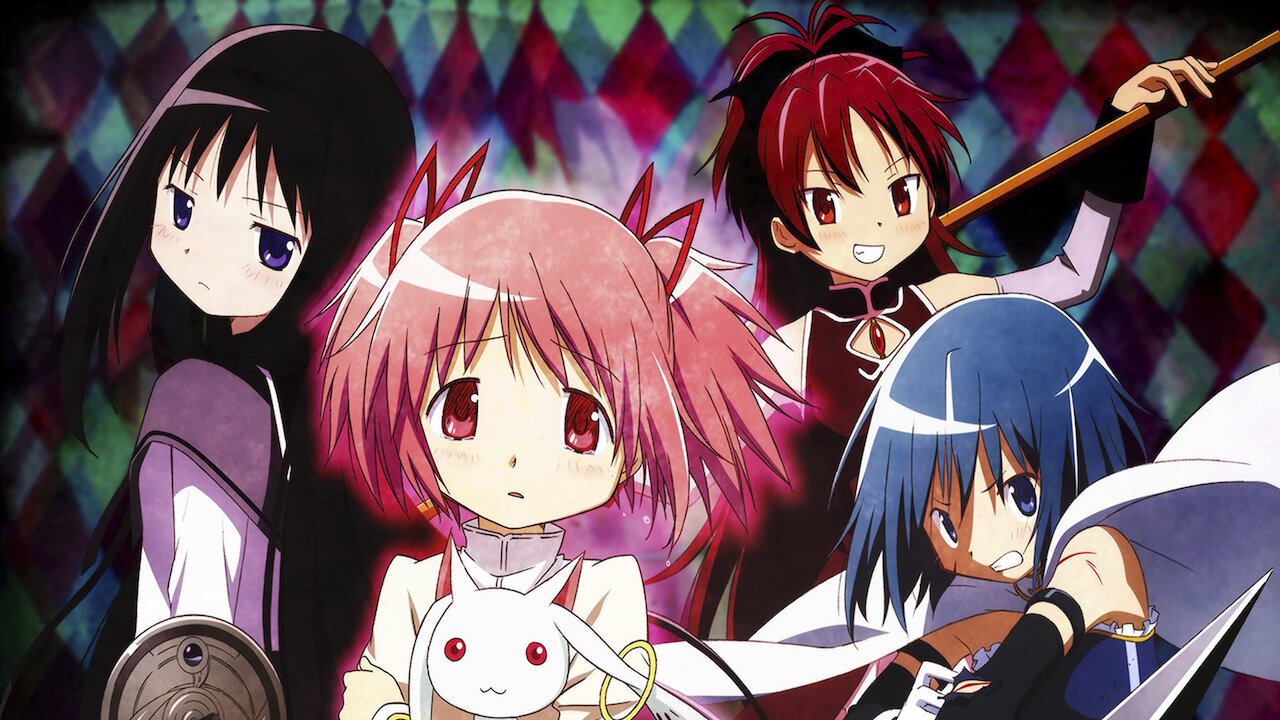
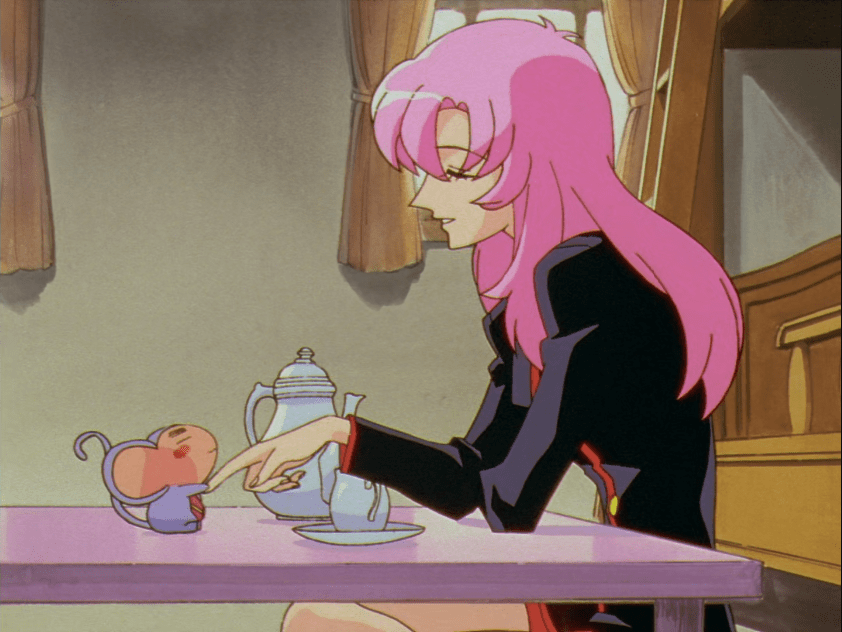
The natural human impulse to seek an end to a story finds no recourse here. Wonder Egg draws on a long lineage; from Perfect Blue to Revolutionary Girl Utena, from Puella Magi Madoka Magica to Flip Flappers. But the key distinction to be made is that Wonder Egg Priority does not draw a conclusion in the same way that these works do. Utena, most dramatically among these, famously advocates rejection of and escape from oppressive systems entirely.
What is Wonder Egg‘s contribution here? Well, from this point of view, nothing. Wonder Egg Priority ends where it began, the only major change made being who protagonist Ai Ohto is seeking to find again.
Instead, it captures a strange, extremely specific feeling. The series’ final minutes billow and dissolve in the air like a dream the night after a tragedy. Was anything in Wonder Egg Priority “real” to begin with? It’s a fair question to ask, and if the answer one comes up with is “no” they might well feel cheated.

But perhaps we should back up a bit. Let us remind ourselves of the actual facts of the series, its characters and narratives.
As you know, Wonder Egg Priority is the story of Ai, a heterochromiac hikikomori. Before the series begins, her only friend Koito Nagase throws herself from her school’s rooftop, adding Wonder Egg Priority to a long list of anime from the past twenty-five years that fixate on suicide. Ai is given a chance by a pair of mysterious, magical benefactors to bring her friend back to life. The only catch? She has to purge monsters from the strange mental elseworlds of the recently-suicided, in a bizarre funhouse mirror of a typical modern magical girl setup. It’s quite the premise, bearing a passing but notable resemblance to the aforementioned Madoka Magica, but otherwise escaping easy description.
Eventually, she is joined by three other young girls, who form what becomes her new friend group; the playful and blunt Rikka, a former idol, the stern and serious Neiru, the young nominal head of a corporation, and the androgynous Momoe, whose gender nonconformance forms a plot point all its own.

Thematically, the topic of suicide is made mystical and ascribed a sinister, sapient character, named The Temptation of Death here. All else leads back to this, and understanding that is key to understanding the bulk of Wonder Egg Priority. The truth the main run of the show wishes to shine a spotlight on is a very simple one; people, particularly young women, are cast into idealized shapes by the world we live in. If they do not conform to them, they are punished and ostracized. Their eventual death by their own hand is seen as a tragic inevitability, rather than a preventable, active action on the part of the ostracizers. Those who survive eventually become the oppressors themselves, and the cycle repeats. (This, roughly, is what happened to the character of Frill. She is an oppressed-turned-oppressor.)

So all this in mind, what do we make of the show’s ending?
Ai and her friends, in a literal sense, solve very little. Frill, implied to be responsible for the Temptation of Death phenomenon, is not stopped. Acca and Ur-Acca, the maintainers of the entire eggs-and-elseworlds system, are not openly rebelled against, and Ai ends up back on their doorstep at the end of the show. (One might even indeed read certain things as implying that this has happened many times, and the main run of Wonder Egg Priority is just a single one of these iterations.) Even the less supernatural driving questions, such as why Koito killed herself, and whether Sawaki, Ai and Koito’s teacher, is a sexual predator, are not directly answered. Everything remains obscure. One might, not unreasonably, demand to know what the point of all this was. After all, the middle of the show seems to criticize these systems so sharply. What is the point of offering no solution, or even any obvious catharsis?
Well, rarely do I reach for the author(s) in cases like this. But Director Shin Wakabayashi offers this thought, and I find it illuminating:

On the surface it’s a curious notion, given the actual events depicted. But if considered in the proper light, it makes sense.
When Ai finds the garden in which she meets Acca and Ur-Acca in the first episode, she is distraught and directionless. When she returns in the finale, it is after much time has passed, and despite surface appearances, it is on her own terms. Note, specifically, the lack of the Acca-possessed beetle in her second arrival to the garden.
Whether or not she will succeed “this time” is not terribly relevant. She has returned to the unconquered mountain to try again. In her life, it is all she can be asked to do. The same is true of all of us in ours.
Evaluating whether Wonder Egg Priority “works”. Whether or not it “earns” its right to hash through all this difficult material and provide no definitive answers, and so on, is difficult. The series, especially its ending, is challenging and highly unconventional. I do not mean to suggest anything as pedestrian as those disappointed by the ending simply “not understanding it”, but I do think it deserves time and patience that it is not necessarily being given.

To go back to my opening remarks, I have never more in my brief career as a critic wanted to be wrong about the afterlife of an anime. Nothing would make me happier than five, ten, twenty years from now learning of some director, writer, or animator citing Wonder Egg Priority as an influence. But even if that never comes to pass, those to whom this series would speak will find it, I am confident of that much.
Even if we take Wakabayashi’s tweet as the series’ sole artistic aim, it well succeeded. Ai, Rika, Neiru, and Momoe will live forever in a certain corner of my mind for the rest of my life. As is true of all truly impactful works of fiction. If that was all the team went for, well, mission accomplished.
In these ephemeral, fleeting lives of ours, all that we can truly ask of each other is understanding. More than maybe any anime I’ve ever seen, Wonder Egg Priority understands that, if nothing else, on a deep level. In the end, it asks of us just two things; do your best, and take care of each other.
And surely, I think, we can do that.
If you like my work, consider following me on Twitter, supporting me on Ko-Fi, or checking out my other anime-related work on Anilist or for The Geek Girl Authority.
All views expressed on Magic Planet Anime are solely my own opinions and conclusions and should not be taken to reflect the opinions of any other persons, groups, or organizations. All text is owned by Magic Planet Anime. Do not duplicate without permission. All images are owned by their original copyright holders.












 The Magic Planet
