Seasonal First Impressions is a column where I detail my thoughts, however brief or long, about a currently-airing anime’s first episode or so.
In 2017’s extremely metafictional club comedy anime Anime-Gataris, there is a scene where the main characters, all members of their school’s anime club, debate what makes a “classic anime.” The gag here being that they all just list off certain tropes or canned setups and scenarios rather than anything particularly deep (at one point someone ventures that if a main character vomits on screen? Well, that’s a classic anime). If I could put forward a candidate for that list, it would be this: any slice of life / comedy anime in which an older character is shown to be an absolutely terrible driver is an instant classic. Call it the Azumanga Daioh Principle.
mono, stylized in no-caps, is the latest member of that particular club, and it’s fairly meta in of itself. Consider that this is a slice of life comedy about two girls who take pictures, but one of the other characters is a mangaka who, by the end of this first episode, is writing a yonkoma about two girls who take pictures.
Her first idea for a manga, from earlier in the episode, isn’t bad either. She’s right that everyone likes comics about cats.
Unlike Anime-Gataris, that metafictionality (much lighter here than in that series) is not the point in of itself, but rather an underline that this is a show that understands its genre, and why people like and connect to that genre, very well. mono isn’t the first series like this we’ve had in a while, but it’s definitely the best in a while. To find something with a comparably great first episode you have to reach at least as far back as 2022’s Do It Yourself!!, maybe farther.
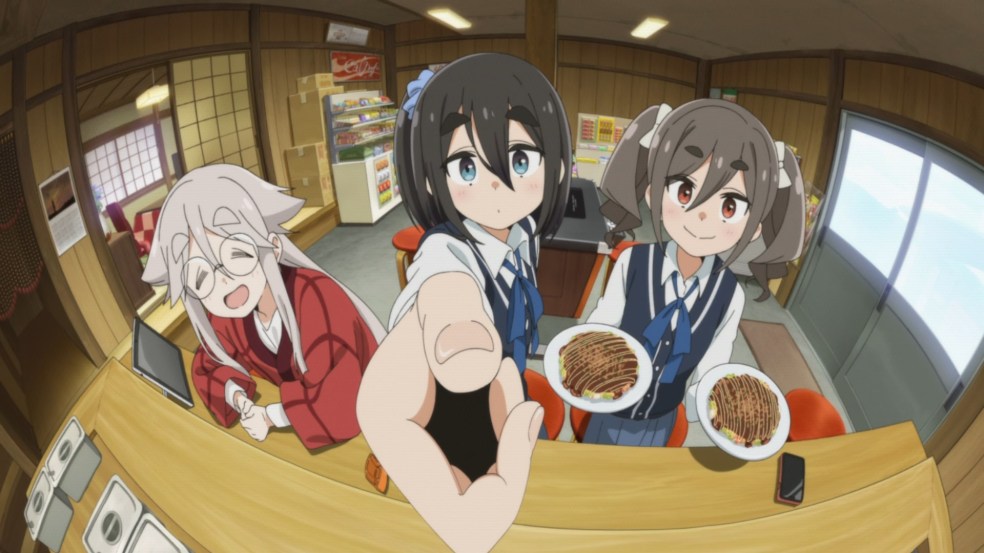
The actual plot, such as it is, is nothing terribly complicated. (Such stories rarely are.) Amamiya Satsuki [Mikawa Haruna] joins a photography club at her high school in her first year, implicitly because of a crush on her upperclassman who’s the head of the club. (That’s Satsuki at the top of this article in the banner image, looking like she’s offering you something.) Fast forward a year later, and said upperclassman has graduated, leaving Satsuki and her friend Kiriyama An [Koga Aoi] as its sole members, and Satsuki herself listless and lacking in motivation. An, who herself feels such a way about Satsuki that she describes “sitting together with her in the garden in [their] elder years” as a “dream,” is worried that the club might dissolve with just the two of them, and that Satsuki might remain a proverbial lump on a log forever.
After a motivating speech, Satsuki regains some amount of motivation, deciding to finally get a proper camera after a full year of exclusively taking photographs on her phone (most of which were of her sempai, and most of which were taken pictures of, in turn, by An). She buys a wide-angle camera off of an online auction, but oops! It doesn’t actually arrive. Thankfully, the seller actually lives in their city, making it relatively easy for Satsuki and An to track them down.
Which, if I’m the one being asked, is where the episode really takes off. I have a passing interest in photography (and a mostly-defunct phone photography blog over on tumblr), but it’s not a deep-seated passion, so it alone is not enough to sell me on a series. What puts me onto mono is its sheer joie de vivre. Every inch of it is stuffed with expressive animation and vibrant color, and it’s also just really damn funny. This is all crucial, since even if you, like me, are not super “into photography,” mono needs to convey its love of the world as a subject of art.
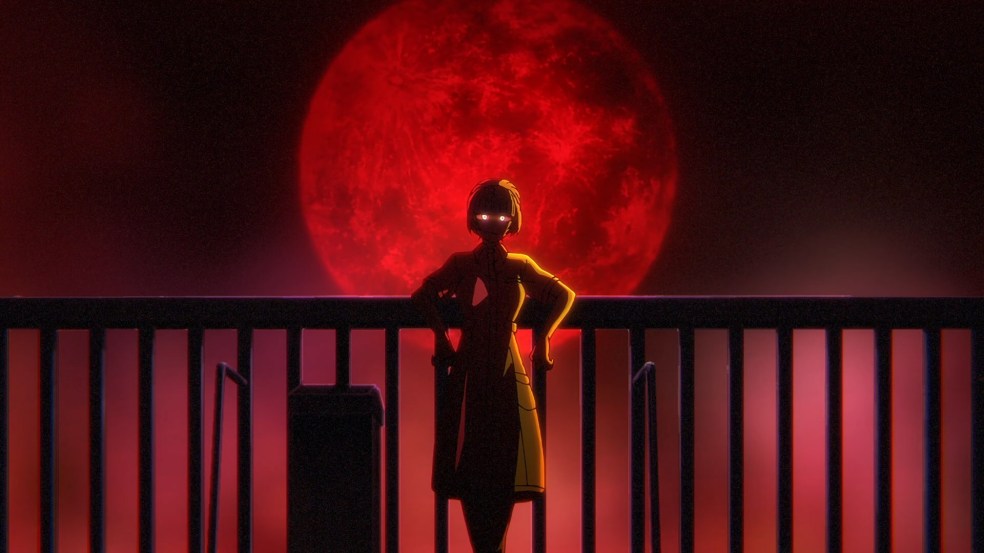
The camera seller turns out to be aforementioned mangaka Akiyama Haruno [Toono Hikaru]. She, and a gaggle of young kids who stop by her grandmother’s shop, where she also lives, completes the character dynamic of the series, being an older character who is decidedly not really a mentor in any way. Her spacey demeanor provides a nice contrast to the more high-energy dynamics between An and Satsuki. More importantly, she’s also a good (and literal) driver of plot, in as much as a series like this has plots. It’s she who provides Satsuki and An with that wide-angle camera, and, later, she drives them to a nearby landmark to take nightscape photos. For my money, she’s the best character, and her lackadaiscal and laid-back attitude instantly endeared her to me. That she coincidentally looks kind of like my VTuber rig certainly doesn’t hurt either. I am not biased in any way, I promise.
In any case, those nightscape photos cap off the first episode, otherwise quite zany and comedic, with a more contemplative tone. I don’t know if the “mono” in mono is “mono” as in the term mono no aware, as this would on the surface contradict the show’s comedic incliniations. But if it is, that’s a pretty solid allusion. The idea of photographs as permanent, fixed records of memories that are themselves inherently transient isn’t a new one, but I would love to see the show explore it regardless, and it provides a nice counterweight to the fast pace and upbeat tone of the rest of the series.
Brilliantly, one of the last scenes in the episode is a timelapse the girls took. The sequence lasts only a few seconds, but as the sun sets and the city lights glitter to life, the impression it leaves is forever.
Like what you’re reading? Consider following Magic Planet Anime to get notified when new articles go live.If you’d like to talk to other Magic Planet Anime readers, consider joining my Discord server! Also consider following me on Anilist, BlueSky, or Tumblrand supporting me on Ko-Fi. If you want to read more of my work, consider heading over to the Directoryto browse by category.
All views expressed on Magic Planet Anime are solely my own opinions and conclusions and should not be taken to reflect the opinions of any other persons, groups, or organizations. All text is manually typed and edited, and no machine learning or other automatic tools are used in the creation of Magic Planet Anime articles, with the exception of a basic spellchecker. However, some articles may have additional tags placed by WordPress. All text, excepting direct quotations, is owned by Magic Planet Anime. Do not duplicate without permission. All images are owned by their original copyright holders.
Seasonal First Impressions is a column where I detail my thoughts, however brief or long, about a currently-airing anime’s first episode or so.
It has been entirely too long since I got weirdly, uncomfortably personal on this blog (a few months, at least), so let’s fix that.
I have been thinking about my own mortality a lot lately. I won’t go into why, but suffice to say this dwelling is neither wholly rational nor entirely unfounded. I mention my own recent fixation here to give some context for why I’m checking out Apocalypse Hotel, and why I was initially reluctant to check it out. Stories like this, stories of mankind’s extinction or departure and what we may leave behind in our wake, stories that inherently deal with loss and finality as themes, are incredibly aggravating when done poorly. I won’t name names, but there have been some unimpressive examples in recent years, and I have somewhat burned out on this genre of post-apocalyptic iyashikei as a result. (The less said about its mutant cousin, the isekai slow life genre, the better.) All this in mind, I planned to pass on Apocalypse Hotel. Surely it would not become one of the most instantly-beloved premieres of the season, right?
If that’s overselling it, it’s only just so. Within my circles at least, Apocalypse Hotel has become something of a surprise standout among the season’s premieres. Enough of one to cover it over GQuuuuuuX? I’m not sure about that, but the praise eventually got to me and I was inspired to give it a whirl. I’m glad I did, because this is a series that not only understands the fundamentals of its parent genre very well, it’s also a bit of casual leg-stretching for Cygames Pictures, who have established themselves as one of the more reliable studios around in recent years. (For reference, Apocalypse Hotel is a follow-on from last year’s Uma Musume film and Brave Bang Bravern. This year, they’re doing Cinderella Gray, also from this season, and an adaptation of acclaimed manga The Summer Hikaru Died in just a few months. Going back a bit farther, you might also know them from Princess Connect Re:Dive.)
As for the actual plot here, there honestly isn’t terribly much. We begin with a truly spine-chilling opening, in which an advertisement for the titular Ginza Hotel, then brand-new, is intercut with news reports of a deadly, plantborne virus that is rapidly rendering the Earth’s atmosphere hostile to human life. Just five years out from the COVID pandemic, this sort of imagery is still very pointed, and the uncomfortable contrast between the luxury of the hotel and the violence we see as the world becomes less and less habitable, culminating with a lucky few escaping to the stars in an “ark” (supposedly for just a few years while Earth’s ecosystem sorts itself out), is of course very intentional. It is equally so that most of the rest of the episode doesn’t directly deal with that discomfort. Instead, the series dances around it in a deliberate, careful way, only drawing attention to it directly at key moments.
Most of the episode is fairly comedic, in fact. We meet our cast of characters, a group of robots maintaining the Ginza Hotel. The most prominent of these, and the only one in the group that could conceivably pass as a human, is Yachiyo [Shirasu Saho], the “acting acting” head of reception and thus the one in charge of the hotel in a general sense. Yachiyo spends her days keeping her crew on-task as they make sure the hotel is kept clean and orderly, in preparation for humanity’s eventual return.
A return that, at this point, they have waited on for a hundred years and counting.
I don’t want to make Apocalypse Hotel seem darker than it actually is, because most of this episode genuinely is pretty upbeat. Gags like Yachiyo absolutely losing her cool because a single shampoo hat goes missing from one of the hotel’s bathrooms, or the bulky, extremely serious Doorman Robot [Touchi Hiroki] and his sheer dedication to his simple job of opening the front doors for any prospective guests, are a genuine delight.
Get Door Robo
Even the music is pretty upbeat while the crew go about their daily routine of keeping things clean and sparkling. But the undertone of massive loss is always there. Firstly from the simple fact that the thing they’re keeping so pristine is a giant hotel with nobody in it, and secondly from the more general post-apocalyptic trappings. A century is more than enough time for plants to have grown over much of the world outside the hotel, and these gorgeous wide shots instill a solid sense of longing and emptiness.
In other words, this show is quite clearly picking up the thread left by seminal works such as Yokohama Shopping Log. Being that good would be, frankly, too much to ask—Yokohama is arguably the definitive work of its genre—but that the two can even be in the same conversation is a good sign. There is one point in the episode in particular in which this influence is extremely evident, and that is when one “Driller Robot” does not report to the morning roll call at the hotel. Yachiyo goes out to find him, only to see that he’s been killed; massive metal spikes have been driven through him, and he’s completely motionless. Clearly saddened in a way she either can’t or won’t entirely express, Yachiyo solemnly places him on “indefinite leave,” and consigns him to a storeroom full of other similarly broken-down robots. An earlier gag draws attention to the fact that the Doorman no longer has any coolant in his systems, and one has to wonder how long it’ll be before he, too, joins that pile. We have already seen, via flashbacks, that Yachiyo’s crew used to be much larger.
Yachiyo’s behavior, as well, seems to indicate that she’s not as together as she’d like to put on. It’s mostly played as a joke here, but she has an angry outburst near the end of the episode, and she’s also been keeping detailed logs of operations every day since the hotel’s owner left. She tells herself that new guests will be coming soon, but it doesn’t really seem like she believes it.
Which makes the end of the episode all the more surprising. I can’t bring myself to spoil what, exactly, happens there, but I do think it points Apocalypse Hotel in an interesting direction going forward. Does all of this relate, that much, at the end of the day, to the fears I discussed opening this article? Eh, yes and no. Apocalypse Hotel is clearly a part of this cozy apocalypse genre—it’s right there in the name, after all—but it’s much more lighthearted, even whimsical, than I first assumed. Yet, that sense of loss and transience still very much does color everything about the series, and it’s difficult to say what it will end up leaning more into as it goes on. In other words, it’s hard make many long-term predictions. But, regardless of what happens on this particular after-the-end vacation, I’m planning on at least a short-term stay. Hopefully you are, too.
Like what you’re reading? Consider following Magic Planet Anime to get notified when new articles go live.If you’d like to talk to other Magic Planet Anime readers, consider joining my Discord server! Also consider following me on Anilist, BlueSky, or Tumblrand supporting me on Ko-Fi. If you want to read more of my work, consider heading over to the Directoryto browse by category.
All views expressed on Magic Planet Anime are solely my own opinions and conclusions and should not be taken to reflect the opinions of any other persons, groups, or organizations. All text is manually typed and edited, and no machine learning or other automatic tools are used in the creation of Magic Planet Anime articles, with the exception of a basic spellchecker. However, some articles may have additional tags placed by WordPress. All text, excepting direct quotations, is owned by Magic Planet Anime. Do not duplicate without permission. All images are owned by their original copyright holders.
This article contains spoilers for the reviewed material, and assumes familiarity with it.
Few people nowadays know what man is. Many sense this ignorance and die the more easily because of it, the same way that I will die more easily once I have completed this story.
This is going to be a mess, so let’s start it with a question, so we at least have something to work off of.
Is a tragedy deferred a happy ending? Ave Mujica is at least willing to entertain the idea, but it’s never a clear-cut thing. Nothing about Ave Mujica is clear-cut, and the thinkpieces that will roll out over the coming weeks and months about this series might obscure how much of a rollercoaster ride it was, week to week, start to finish, in the moment. They might also obscure how wild it will keep being, as we now know—we’ll get back to this—that this isn’t the end.
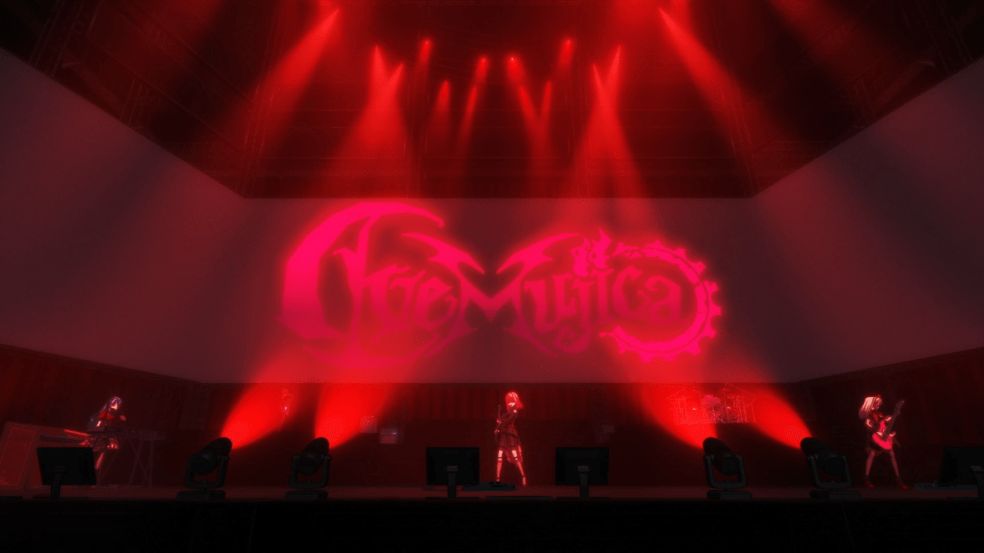
To trot out the neatest and tidiest labels possible for a show that is the neither of those things, Ave Mujica is a series that deals with, among other topics; familial violence, how generational wealth drains the humanity from those that hold it, a number of different expressions of trauma and self-loathing, Dissociative Identity Disorder, and incest. All of this from a series that—despite some misguided English marketing trying to downplay this fact—is part of the BanG Dream! franchise. It, thus, is also still an anime about guitar music, at heart, a cousin of other recent genre entries like Girls Band Cry and Bocchi the Rock! (not to mention the other entries in its own series), in that it does still very much deal with a group of young girls using that music to process their traumas. The methodology is very different, and if Ave Mujica is the best of these (and I’d be willing to say that it is, even if the competition is very close), it’s not because its approach is inherently “just better”, or because more serious subject matter automatically leads to better content, but rather because it’s a logical outgrowth of what this genre was already doing. People will make their little jokes, of course: you can call it the dollposting anime, Perfect Blue for zoomers, etc. But none of these really capture Ave Mujica‘s fundamental observations and themes, and none of them can dent a show that’s this bulletproof.
All this to say, the walk from the earliest days of the BanG Dream! project to here is less extreme than it might appear at first glance. Poppin’ Party never went through most of this stuff, that’s true, but they’d absolutely be willing to throw horns at one of Ave Mujica’s concerts. The music, even when it’s not actively being heard—and it’s not heard for long stretches of this series—is both a connective tissue and a useful metaphor. If you can’t say something, maybe you can sing it.
That was the main thesis, too, of Ave Mujica‘s immediate predecessor and sister series, It’s MyGO!!!!!, effectively the first season of what becomes a two-parter here. AveMuji puts that theory to the toughest stress tests it can think of, and for a while, it seems like it might break under them. Consider that this is a band anime, and then recall that there is a gap from episode 2 to episode 7—almost half the season!—where there are absolutely zero in-show performances. Consider that this seemed at the time, given everything else going on in the narrative, more like a disband anime, an argument that Ave Mujica the group were not a good thing for anyone involved and maybe they’d all be better off apart.
It’s tempting to run through the absolute basics one more time. High school girl and neurodivergent icon Takamatsu Tomori [Youmiya Hina], and her first real friend Togawa Sakiko [Takao Kanon] form a band. This band, CRYCHIC, collapses not long after their first concert for a plethora of interpersonal reasons that are not really anyone’s fault in particular. It’s MyGO!!!!!, the first season of this show, focused on Tomori healing from this fallout with the help of both some of her old CRYCHIC bandmates and new friends alike. That group formed MyGO, title band of that season, pledging to build the rest of their lives, moment by moment, together as a band and as friends. So far, so girl band.
Ave Mujica—both the band and the show—run in the opposite direction, Sakiko attempts to put on a cold, merciless persona, and gathers a band based not on shared experiences or even particularly liking each other, but by a cynical rundown of what each member can add to the group. Sakiko’s childhood friend Mutsumi [Watase Yuzuki], another former CRYCHIC member, is added because of her guitar skills and her famous parents. Nyamu [Yonezawa Akane], the band’s drummer, is recruited as much for her looks and the flashiness of her ambidexterity as her actual chops, etc. If you’re reading this, you know all this already, so I won’t get too much farther into the nitty-gritty.
The result of all this? Probably the most seismic anime event of the 2020s thusfar. If not that, at least one that has exerted a deep and powerful pull on a certain kind of person. If you’re active on certain corners of tumblr or BlueSky you already know who I’m talking about. If not, we’ll just say: queer, gender-nonconformant, neurodivergent sorts. Which is a more formal and less fun way to say: the girlies. Ave Mujica takes the already intense emotional palette of MyGO and freezes it solid, erecting gothic cathedrals around the sharp, jagged pieces of pain and trauma that inform who we are, with a particular focus on the inherent violence of the family unit. Do you have bad parents? Mutsumi has the worst parent, a controlling, cruel stage mom who sees her daughter as competition instead of family. Furthermore, she’s plural, hosting, among others, a rambunctious protector alter who adopts the name Mortis from her stage name. From what we see, her mother treats this as a frightening burden, a sadly true-to-life read on how many singlet parents treat their plural children.
Uika [Sasaki Rico], the band’s singer, might be even worse off, the daughter of an illicit relationship between Sakiko’s grandfather and a house servant who has lived much of her life isolated from society. If this all seems rather melodramatic, I can only reiterate that that’s exactly the point, and anyone who writes the show—and honestly, much of this genre—off on those grounds is missing the most interesting artistic movement in the medium to happen this decade. More specifically, that heightened, arch theatricality has been present in the Ave Mujica project since we first knew it existed. This is a group of girls who were introduced to us as masked dolls, and who here leave us again as knights of a forgotten god. It feels a little ridiculous to criticize the series for a lack of “realism,” whether we’re referring to its literal events or its emotional palette. (And anyone who calls Nyamu and Umiri’s problems minor, even by comparison, is missing the very fact that by show’s end they’ve still willingly thrown their lot in with everyone else in the band.)
That tense, coiled sense of façade is also why it hits so hard when, in its very last episode, Ave Mujica finally lets all of that tension out. No one would walk away from this series thinking everything is neatly solved, but the finale is more concert than anime episode: 5 songs, two from MyGO, three from AveMuji themselves, all fantastic, and importantly, both bands are clearly having a blast. MyGO have the simpler story, but their sound has genuinely developed in some interesting directions, and centering a new song around Tomori’s jumbled, Jenga Tower-block poetry is never going to be a bad call.
Ave Mujica, meanwhile, have somehow gone stadium-level yet again (the episode’s lack of a traditional narrative leaves us in the dark about how that happened. Season three material, most likely). Their doll motifs replaced with a warped Round Table-style knightly mythos, Uika-Doloris as an amnesiac who finds herself returning to the embrace of Oblivionis, god of forgetfulness, over and over. Sakiko literally portraying herself as a deity within the world of the scripts is sure to have ramifications going forward as a plot point, but, consider that outside of the series itself, it also easily cements her as one of the most interesting and iconic characters of her generation. It has been way, way too long since we had someone to add to the Anime Girl Pantheon, and if Sakiko needs to actively force herself up alongside older legends like Lain, Haruhi, and Madoka, that’s all the better. It fits.
(Also, let’s just be honest here. Sakiko’s god complex is probably not great for her, mental health-wise, but if it’s making her write stuff like this, well, at some point you can’t argue with the music.)
As for the literalities of the last story arc, episodes eleven, twelve, and so on, it seems impossible that this won’t all fall down around them someday, possibly even someday soon.
So again, to ask the question, can tragedy deferred really be considered a happy ending? Even a bittersweet one?
Maybe we should reframe that, and turn it back on ourselves; can you be happy, knowing you will one day die? If Ave Mujica are a fleeting dream, that’s at least partly because everything is a fleeting dream. Any comparison between MyGO‘s “a series of moments adds up to a lifetime” and Ave Mujica‘s embrace of an illusory eternity needs to understand that, despite the obvious differences between these groups of people, these are fundamentally two ways to say the same thing. Something lasts forever until it doesn’t. You take things day by day, and one day is eventually the last one. (I don’t have much to say about this series, as I’ve made clear from how I’m framing this article, but I am a little surprised how rarely I’ve seen discussion of death in relation with Ave Mujica; Sakiko’s late mother is a shadow who looms over much of the series, and there is a broad implication that Uika’s sister, the actual Uika, is no longer with us either.)
I have spoken before in my work about hating the term “messy” and how it’s often used to paper over the flaws in works that a certain stripe of critic, myself very much included, like. Something is messy if it induces strong emotion but has some kind of missed shot or some kind of frustrating loose end. To that, I refuse to apply the term to Ave Mujica, even though I’m sure many other people will. Every time I had a doubt about this show, it proved me wrong. Mortis disappearing for much of the show’s final act? She shows up in the finale to wink at the mirror and reassure us she’s fine. Umiri “not getting” a proper character arc? Her tragic backstory is presented in a funny way, sure, but it’s as legitimate a reason for trauma as anything else, this stuff isn’t a competition. Not enough songs? The last episode has fucking five of them. The fact that Hatsune is down awful for her niece? That makes their relationship more interesting, and sure, more troubling. I won’t entertain any suggestion otherwise. You can’t catch Ave Mujica off guard.
Even if you could, the curious thing about something as arresting as Ave Mujica is that after a while one’s emotional attachment stops being to the work itself so much and more the general orbit of it. The characters make such an impression on screen that they will live in our hearts forever. There is also the actual band, of course, who are fantastic, and a small spiderweb of ancillary media that enhances and sharpens the show in a number of interesting ways. None of this softens the point that the show itself is excellent, of course, one of the best I’ve ever seen, but it is worth keeping in mind.
And if you don’t agree….well honestly that’s fine? Why is talking about anime expected to be didactic like this anyway?
Isn’t all of this sort of silly? Another thing Ave Mujica has made me realize is that, despite the fact that I enjoy writing about anime, I also kind of hate doing it. (A love-hate relationship that I am all too aware is ironically somewhat reflective of what I’m reviewing.) Not because I’ve lost any love of prose or any love of analyzing fiction, but because there is this constant unending pressure to be correct about everything. (Or at least, I feel that there is. Maybe this feeling says more about me than it does anything else.) I had an inkling of this back when I reviewed Wonder Egg Priority years ago, which is why the two are somewhat connected in my mind even though the reception to AveMuji has been much more positive overall. Most of my really fulfilling engagement with Ave Mujica has not stemmed from my collective efforts of reviewing it. (Longtime readers will probably remember that we are a system ourselves, and if you didn’t know, well, surprise.) I—Ediva—have gotten much more out of talking about it with others, making of it a living discourse as opposed to a series of endlessly prolix pages where I try to prove that my opinion is the right one, man!, than almost anything else I’ve ever seen. I, Opal, have written fucking fanfiction for this series, weird and outlandish fanfiction—fanfiction I would never in a million years link here, mind you!—that has made me feel so much more connected to its world and its characters than laying them down on a table to cut them open ever could. And I, Ollie, have simply reveled in the fact that I got to feel seen. It’s very rare for popular fiction to touch on systems. I am not going to quit writing about anime—this is not my version of Brent DiCrescenzo’s To the 5 Boroughs review—but Ave Mujica has once again made me reevaluate how I really think about this stuff. How I feel about this stuff. In a way, that’s a higher compliment than anything I could actually say about it could ever be. Here’s something that sounds like a joke but isn’t: in the previews for one of the later episodes, 10 I want to say, Sakiko was shown reading Hermann Hesse’s Demian. We decided to read it too—why not, right?—and loved it. Some shows are bigger than just what’s on the screen.
None of me are saying that any of this makes analysis of the series wrong. But it does, increasingly, feel wrong for us. This is a world to be lived in, an atmosphere to be breathed, and a dream to set drift upon. I can’t pin the butterfly to the board like that. If you can, I’m not going to tell you you’re doing something wrong, but it’s not the right fit for how we feel about this show. Hence this instead of a “proper” review. Hence leaving it all up in the air.
That’s a temporary solution, but this, too, is the beautiful paradox of Ave Mujica: we can stay asleep in this dream forever—Until we wake up.
Like what you’re reading? Consider following Magic Planet Anime to get notified when new articles go live.If you’d like to talk to other Magic Planet Anime readers, consider joining my Discord server! Also consider following me on Anilist, BlueSky, or Tumblrand supporting me on Ko-Fi. If you want to read more of my work, consider heading over to the Directoryto browse by category.
All views expressed on Magic Planet Anime are solely my own opinions and conclusions and should not be taken to reflect the opinions of any other persons, groups, or organizations. All text is manually typed and edited, and no machine learning or other automatic tools are used in the creation of Magic Planet Anime articles, with the exception of a basic spellchecker. However, some articles may have additional tags placed by WordPress. All text, excepting direct quotations, is owned by Magic Planet Anime. Do not duplicate without permission. All images are owned by their original copyright holders.
The Weekly Orbit is a weekly(-ish) column collecting and refining my more casual anime- and manga-related thoughts from the previous week. Mostly, these are taken from my tumblr blog, and assume familiarity with the works covered. Be wary of spoilers!
Hello folks. It’s been two weeks, and if that makes you think “wow, you must have a ton of Girlies Being Dramatic stuff to catch up on”, you’d be absolutely correct.
Ave Mujica – Episode 7 – 8
Two weeks ago, in my long catch-up of the series, I pointed out that a number of people have asked the question: is Ave Mujica even actually a music anime? Generally speaking, that term implies some amount of actual musical performance within the body of the show itself, whatever form that may take. Ave Mujica has been very short on that up to this point, and now that we’re halfway through the series, some viewers have begun to lose their patience with AveMuji’s lack of adherence to those genre norms.
I am not one of those viewers. Nor am I particularly surprised or upset by the fact that we do get a performance in this episode. It just isn’t from Ave Mujica. Nor even from MyGO!!!!!, their counterparts and protagonists of the series’ first season. The band that sing a song—two songs, actually—in this episode are CRYCHIC. This isn’t some kind of formal reunion and it’s certainly not a flashback episode. It’s a very brief, fleeting moment shared on a stage with almost no one at all watching. It’s more group therapy than the traditional music video-esque band anime insert song.
Very, very few people ever get to eulogize the passing of their own adolescence as it occurs. Teenagers, real teenagers anyway, do not usually have the presence of mind to capture those moments in amber before they disappear forever. Sometimes, though, both in reality and fiction, it does happen, even if the people involved don’t necessarily know that they’re doing that. Here, in the seventh episode of Ave Mujica, CRYCHIC’s story comes to its conclusion. CRYCHIC are able to, for a fleeting moment, recognize that even over just the relatively short amount of time since their breakup, their lives have changed permanently. They mattered to each other, and maybe still can, in different ways, but there is no returning to that brief time together. You can, they all seem to understand, revisit that moment as many times as you want in your own head, but you can’t ever return to it. CRYCHIC is thus, in a way, actually torn down as the romantic ideal it’s spent most of the past two seasons being: it was, per the show’s own words, an ordinary band like any other. In reckoning with that, its former members can finally take the first steps to truly moving on.
How we get to that point is a long and winding road that involves Sakiko being tackled to the ground, spending long periods just sort of standing outside of Mutsumi’s house after Mortis refuses to see her, and a non-zero amount of various characters performing the MyGO Special (roughly shoving their way into someone’s current goings-on, and sometimes literally their home, to resolve an emotional conflict). In terms of overall plotting this is honestly one of the messier episodes in this subseries, but that’s not really a problem when every individual scene is this compelling. In addition to the aforementioned reunion performance there’s a lot of great tension between Mortis, Mutsumi, Sakiko, and Soyo, in various combinations throughout the episode.
The insert songs themselves are the highlight of course. To such an extent that, in a bold bit of fanservice-in-the-old-sense-of-the-term, an actual, real version of CRYCHIC, recorded a performance for The First Take, being sandwiched in between legendary art-rockers Shinsei Kamattechan and “You Broke Me First” singer/songwriter Tate McRae, a truly insane three-artist stretch that is emblematic of The First Take’s eclectic nature.
This makes any complaint about a relative (and it would be relative) lack of technical precision in the episode’s performance twice as absurd, of course. Not only do we hear MyGO practicing near the start of the episode where they sound as tight as ever, but CRYCHIC are playing for nobody but themselves. Aside from a tiny group of bystanders; Anon, Raana, and Umiri, who sneaks in midway, there’s no audience that they’re aware of, this is a purely cathartic exercise between them, and we are witness to it purely as viewers of a television program. No one is being performed for, and as if to emphasize the point, Tomori spends most of both songs singing not out from the stage but toward the rest of the band. “Scenes From An Alternate Universe Where CRYCHIC Never Broke Up” this is not.
In any case, while this is pretty clearly the brightest episode of Ave Mujica so far, and perhaps a true turnaround point where healing can begin, it’s probably going to get worse before it gets better. Umiri’s sneaking in to the performance is not a mistake, and the jealous snarl of a grimace she makes while watching CRYCHIC work their baggage with each other out must truly be seen to be believed. That’s not to even mention Uika, following there in the footsteps of the show itself, which she has spent two weeks conspicuously absent from, and very nearly makes it a third in episode eight.
Episode 8, by the by, is not quite the event that episode seven was, but it’s nonetheless another excellent one. And, here’s a distinction I didn’t think I’d bother making for any episode of this show: it’s probably the funniest Ave Mujica has ever been. This matters, since most of that comedy comes from Umiri, finally getting some proper focus here that really peels back the layer of her cool-girl façade. Watching the CRYCHIC temp reunion in episode seven evidently really got to her, as she spends most of this episode coping with her jealousy in comically bad ways. Being given this much time to follow her also puts the lie to any notion of her being “the normal one” of Ave Mujica, given that we here learn that she almost exclusively drinks protein shakes for her meals and is Soulja Boy levels of terrible with her money. (I really cannot believe that this show features someone buying out an entire jewelry case. Retail therapy isn’t the answer, Umiri!)
She also tries to sets out on her personal goal of reforming Ave Mujica, starting with Nyamu of all people, to whom she relays her “tragic backstory” after struggling to down a single ginger ale.
Said backstory scans as more of a parody of this kind of flashback sequence than anything. All we get is that Umiri was in a band when she was a bit younger but was bossy enough that everyone was put off by it and left her stranded on stage during what was supposed to be an important concert. That’s why she’s like that: burned once for being too pushy, she went to the opposite extreme of far too hands-off, to the point of seeming untrustworthy (something Taki points out to her, early in her half of the episode). It tracks, but the droll undercutting of what’s rapidly become a trope in this relatively young genre is pretty funny, and shows that Ave Mujica isn’t all doom and gloom. (Nyamu is similarly unimpressed, and reacts to the story with a dry “wow, how sad” while inspecting her nails.)
All of this is relative, of course, because the “funniest” episode of this series does nonetheless open with a dramatic headspace sequence in which Mortis screams that she doesn’t want to die. The whole first half of the episode is actually pretty fucking dire, with all of Umiri’s stuff being in the latter half. Things start out decently enough, after the OP at least, but we’re reminded of the screaming Mortis pretty quickly when a nostalgic karaoke outing for Sakiko and Mutsumi turns into—well, it turns into something.
Intercut with that scene is one where Nyamu runs into Minami Mori, Mutsumi’s mother. Minami is, if it were not already obvious from prior episodes, a real piece of work. She describes her own child as a monster, “acting without realizing it,” but so talented she could outshine Minami herself if she put her mind to it. The Mutsumi-Mortis System’s expressiveness is not in question, but, just to put the tiger on the table here, it is pretty appalling for someone to be saying all of this about her own child. Worse, Mutsumi and co. have clearly internalized all of this, because the scene keeps cutting back to Mutsumi, Mortis, and Sakiko, arguing over whether CRYCHIC or Ave Mujica should reform. At some point, we’re locked out of seeing the objective events of the conflict entirely, Mortis’ desire to get Ave Mujica back together so she’ll have some reason to continue to exist is batted aside by Mutsumi’s unwillingness to let go of CRYCHIC. Sakiko just wants her friend to stop hurting, and she promises a lot to make that happen, but Mortis raises the idea that Sakiko doesn’t really even know who her friend actually is. She claims that the entire system has been a revolving cast of personalities who emerge and dissolve to fit the ongoing situation this entire time. Mortis and Mutsumi are exceptions to this rule, not the norm. We have some reason to be a bit skeptical of Mortis’ specific narration of events, but certainly, whatever good intentions might sit at the heart of that narration are discarded when Mutsumi seems to do to her what she did to Mutsumi back in episode three. There is a lot of internal strife here, and it’s hard not to feel for the both of them.
We do not see the results of the argument, the next time “Mortis” shows up, it’s toward the end of the episode, and the two halves thereof unite here. You may have noticed that, terrifyingly enough, Umiri and Mortis are actually aligned in goals at this point. After Nyamu half-heartedly promises to get back with AveMuji if and only if Umiri can get Mutsumi as well, Mortis is the first person to jump at the call. (Or is she? I’ve seen some theorizing that this last scene actually features Mutsumi pretending to be Mortis. Something to keep in mind as you read on.)
Mortis, you may recall, can’t actually play guitar. Thus, the episode ends with Umiri teaching her, delivering—in an episode where she’s otherwise a complete goofball and impossible to take seriously—probably her best line in the entire show so far, one that’s heavy with connotation and charge, given the whole doll motif this series has been almost obsessively fixated on since its opening minutes.
What is it with the girls in this show pulling out the exact kind of raw line that works as an armor-penetrating seduction bullet on other queer girls with mental problems?
She is, furthermore, rebuked by narration: from Uika, her first lines of any substantial length in three whole episodes. A doll, she says, will always be just that. Cue “Georgette Me, Georgette You.”
I’ve seen some concern about Ave Mujica potentially not having enough time to tie up all these loose ends, but even accounting for the fact that there are the live shows, band stories in the gacha game, and so on to look forward to, there are still five more episodes of this anime, two-ish hours of footage that could contain just about anything. Ironically, I think about the only danger the show is actually in is simply being misunderstood. Not many anime so much as approach the studied character dynamics at play here, especially those within the Mutsumi-Mortis system. As for the rest, the stage is open with possibility, and it is not over until the curtain drops. Episode 9 is called “If you leave, I shall not live.” Terrifying! I can’t wait.
Flower and Asura – Episode 6 – 7
Episode 6 sees Hana choose her selection for the NHK Cup. This is a bigger deal than it might sound, since doing so requires convincing her teacher of the passage she wants to read. Still, with everything considered, she finds one that she enjoys and which suits her. On her side of the story, everything is honestly going pretty well at the moment. Similarly, while Natsue is having more trouble than her, she’s still at least making progress on her script. It’s actually pretty incredible how much air the show can put into her script reading, given that her script is just a food ad. (It also gives us this, which, as a writer I must say I deeply relate to.)
The other end of the episode is the more interesting one here. For the first time we focus on following Matsuyuki [Yamashita Seiichirou], who we learn has a difficult home life with overbearing parents that expect him to follow in their footsteps as a doctor. He doesn’t actually seem terribly interested in doing that, and there is thus a clear central tension there, but from what we see here, he mostly acquiesces to their wishes at least face to face. Similarly, when Shuudai asks him to pen a drama script—not a small task!—he accepts with no apparent hesitation. It’s not wholly clear what Matsuyuki actually wants, although his appreciation for Hana’s readings to children and the possibly covert contact he keeps with his siblings in spite of his parents’ opinion that they’re “failures” provide some clues. There’s a clear good parent / bad parent contrast too, with Matsuyuki’s father caring for him mostly as a successor and nothing more, whereas Hana’s mother is openly proud that her daughter has made friends and found a passion.
Episode 7 spells Matsuyuki’s situation out more clearly. His older sister, a poet, left home and left him behind. This is something that clearly rests heavy on his mind, and it influences the script he’s agreed to write very heavily. It’s very interesting to me that within the drama, he writes three characters, one of whom is a girl whose parents expect her to become a doctor, but who wants to be a poet. He’s merged himself and his sister into one person. Any eggy questions this raises aside, it’s also a pretty solid bit of character building on the show’s part. He clearly admires his sister for walking away, and that admiration creeps out of him in a way that’s so unsubtle that even the other characters pick up on it by episode’s end. We also get to learn that Hana is a surprisingly fantastic actor when she plays the poet in the script. The show is cheating a little more than in the recitations here—a lot of the subtler visual characterization—that Hana has is replaced when she gets into character—but still, it’s great overall, and Hana’s performance in the climactic beach scene of the drama would be worth the price of admission for episode seven all on its own.
I like this show overall. Quite a lot, actually. But if it’s been missing one thing, it’s much in the way of stakes, aside from the looming promise of the NHK Cup. We get some of them here for the first time when it’s revealed that a meeting of Broadcast Clubs from across the country is on the horizon. Described as a “joint practice” session, this provides the show with an excuse to rejoin our main cast with Shura Saionji, the then-child actress whose recitation so inspired Hana as a child herself. The path we’re on here is obvious, in that Shura Saionji is being set up as essentially the villain of the piece. Any kvetching about the lack of stakes is admittedly partly a circumstantial complaint—anything would seem lacking in stakes airing in the same season as Ave Mujica, which manages to make its source material feel like genuine life or death—but I want Hana’s talent to be truly tested, and I want it to mean something if she’s to come out on top. To that end, the introduction of an antagonistic figure of some sort might just be exactly what the show needed. We’ll have to see.
A bit light on images this week, but hopefully that’s fine with everyone. Once again, I do ask that if you liked the article, consider dropping me a donation. Every penny helps.
To help compensate the lack of images in this article, go grab a drink from the oeosi machine as your Bonus Thought of the week.
Like what you’re reading? Consider following Magic Planet Anime to get notified when new articles go live.If you’d like to talk to other Magic Planet Anime readers, consider joining my Discord server! Also consider following me on Anilist, BlueSky, or Tumblrand supporting me on Ko-Fi. If you want to read more of my work, consider heading over to the Directoryto browse by category.If you’re looking for me to watch a specific show, watch this space. I am planning to reopen commissions in the near future.
All views expressed on Magic Planet Anime are solely my own opinions and conclusions and should not be taken to reflect the opinions of any other persons, groups, or organizations. All text is manually typed and edited, and no machine learning or other automatic tools are used in the creation of Magic Planet Anime articles, with the exception of a basic spellchecker. However, some articles may have additional tags placed by WordPress. All text, excepting direct quotations, is owned by Magic Planet Anime. Do not duplicate without permission. All images are owned by their original copyright holders.
The Weekly Orbit is a weekly(-ish) column collecting and refining my more casual anime- and manga-related thoughts from the previous week. Mostly, these are taken from my tumblr blog, and assume familiarity with the works covered. Be wary of spoilers!
Another week, another batch of girlies being absolutely dramatic. I’ll be honest, between the seasonals and the manga I read for this column, this might have the highest “girlies being dramatic” ratio of anything I’ve written in a long long while. I’d say in this respect at least, I’m living my best life. I hope you are too.
Anime – Seasonal
Ave Mujica – Episode 6
Every week I walk in to the torment nexus and walk out with my heart broken in three places. What a show.
Some interesting play with structure and framing this episode. At last week’s conclusion Soyo was shown discovering Mortis, and the whole scene was framed in slasher movie tones. Here, now that she has a better idea of Mortis’ whole, you know, thing, Mortis is instead framed as the angry, lost girl that she really is. I really enjoyed (and did not at all expect) Soyo actually playing along with Mortis’ whole ‘calling the doctor’ bit, it shows a pretty deep empathy that I don’t really know if we’ve seen the character express before? (It’s been a while since I watched MyGO, so I may be forgetting something.) Also, she apparently spends 3 whole days sleeping over there trying to patch things up, which, while there’s definitely a selfish aspect to her motive (she misses CRYCHiC too, after all), I still think deserves serious real one points. I don’t think I’d have the emotional stamina to spend 3 whole days consoling anyone about anything.
Full credit to Rana also, who can just intuit what’s going on with Mortis and Mutsumi without even actually being told. (She doesn’t actually go out of her way to help, though, and spends a decent amount of time this episode playing with cats. Rana remains this subseries’ most mysterious character.) Mortis actually seems to develop a bit of a crush on her, and is that a twinge of jealousy I detect from Soyo about that fact? In the tumblr version of this post I made a joke about the relationship chart this series must have, and then they just actually published one. Way to undercut my quips, Bushiroad.
I like Umiri’s brief scene in this episode. Forever the eternal mercenary, she describes the breakup of Ave Mujica as though it happened around her and not to her. And yet when Ricky Taki calls her on this, she gets annoyed. Truly the “fake ass IDGF’er” meme in human form.
The first half of this episode, I must stress, is actually pretty light by this show’s standards. So of course, there needs to be a breaking point somewhere. Here, that breaking point is between Mortis and Mutsumi, who stirs for the first time in a solid month only to find how awry things have gone in her absence. This isn’t what she wanted, and Mortis is appalled to learn so. The two have an argument in headspace, which of course to anyone outside of the Mutsumi-Mortis system’s own head just looks like an argument with herself, and she actually carries on so bad that she ends up tripping and falling in front of Live House Ring and making a huge scene, which of course a throng of anonymous busybodies are nearby to witness. It’s SO much that it would come off as contrived if the show weren’t so set on showing us how badly this is fucking over Mutsumi and Mortis. It’s hard to watch.
There is something admirable about the show’s complete lack of handholding with this kind of thing. This episode alone depicts multiple conflicts within a fully-realized mental space, a tug-of-war between Mortis and Mutsumi for their collective fate that is just profoundly sad to witness. I do wonder how legible this is to audiences who aren’t plural. Part of me is worried this series might actually be too ahead of its time for most audiences to properly appreciate.
(I’ve barely talked about Sakiko here and she is absolutely going through it up and down this entire episode. From the horrible, obviously untrue claims she makes about not caring about either band or even about Mutsumi, to the folder of sticky notes she’s gotten from Tomori over the years, to the fact that she sadly looks for another one despite telling Tomori off for them last week. To. This fucking expression, just, god.)
There’s a mostly-lighthearted interlude with Nyamu (it remains really funny that her dark secret, compared to everyone else’s, seems to just be that she’s from the sticks), but even that is twinged with her finding out about Mortis and Mutsumi’s public breakdown. The episode then ends with MyGO finding out about Sakiko’s whole extremely fucking complicated family situation. Episode 7 is entitled “Post nubila Phoebus,” “after the clouds, the Sun.” In most other contexts that would be a shining beam of hope, and maybe it is here too, but I’m fairly sure things will get worse before they get better. (Recall, we still have no idea what’s going on with Uika, just as one example, and she’s the only character from either band who doesn’t put in even a cursory appearance in this episode. Where is she!)
Flower and Asura – Episodes 2-5
I don’t usually try to predict how an anime will end before it gets there. But, by the same token, I tend to usually have at least a broad idea of what something “is doing” for most of its run. A first episode or so might need some room to establish itself, but by the halfway point of a series, one can usually figure out its whole deal with relative ease, especially if you’ve been watching anime for a while. All this is the long way around to say; I don’t get caught out by an anime very often. When I’m surprised it’s usually the addition of some new element, as opposed to something I had just outright been misunderstanding. Flower and Asura thus gets to join a pretty exclusive club with its fifth episode, and I am left to consider if I’ve maybe been underrating the show a little. (And by the time you’re reading this another episode will have aired, sigh! The unrelenting march of time.)
The gist is this: so far, Flower and Asura has largely been presented through the eyes of its main character, Hana. Hana’s insecurities and need to find a way to express herself defined the first episode or two of the series, and—perhaps this is the show’s fault, but I’m more inclined to blame myself—because of that, I had not really given terribly much consideration to the interiority of the show’s other characters. Natsue An, the snippy girl with the twin-tails, is a direct challenge to this, in her interactions with Hana she essentially addresses the viewer directly. This is the case with the rest of the cast, but the other two members’ inner lives we’ve explored to any extent are those of Mizuki, the free-spirited upperclassman that recruited Hana in the first place, and Ryouko, who, while not exactly a one-note character, has a deep interest in classic literature that aligns her nicely with Hana and Mizuki’s philosophy that recitation is primarily an art. The NHK Cup, the tournament looming in the show’s background, is to them secondary to reading what they want to be reading, and Ryouko says as much directly. Winning is not hugely important to either of them. (Certainly not to Ryouko, whose gleeful joy at the ancient drama frozen in glass by the Japanese Classics is outright described in-show as fetishistic. I feel very strongly I would get along with this character.)
Natsue is an irregularity here. She actually wants to win the Cup. As such, she’s not performing literary recitations like the characters we’ve discussed so far but rather a technical program, an altogether different thing that relies on a different skillset. Despite their different paths, Natsue is clearly at least appreciative of Hana’s talent, and, in her particularly brusque way, urges her to choose Kafka’s The Metamorphosis from among the available works to read a selection from. This is in contrast to Hana’s own desire to read from a contemporary work. (A work which in fact appears to be about a romance between two girls. Subtle.) If we’re just judging on taste, Natsue is clearly completely right; Hana’s particular timbre, especially the lower and more menacing end of her arsenal, which we know of from episode one, would lend itself very well to something as dark as The Metamorphosis. But this just isn’t what Hana wants to do, and it’s easy to read Natsue’s insistence that she do it as jealousy. It makes almost too much sense, right? Natsue, clearly someone who has very strong opinions on literature from her insistence on Hana’s selection and her denigration of the book Hana actually wants to read as shallow, would rather be doing recitation, right? I certainly read things that way. But we should stop ourselves here, because what that assumption actually is, I am a little embarrassed to say, is probably just projection.
Natsue, after an entire episode of Hana bugging her about it (including a magnetic—and also kind of embarrassing!—scene where Hana actually recites from the book she is planning to read from. In public, where the whole student body can see it), eventually explains that no, the real reason she’s so set on winning the tournament is nothing this complicated. She relates an anecdote from middle school where, in that school’s broadcasting club, an enthusiastic friend was selected to go to the nationals over her. Despite that friend’s insistence that Natsue was actually better at recitation than she was, the condescension—intentional or not—stung more than the actual failure. It has nothing to do with her specific talents and everything to do with just wanting to win in the first place.
Hana is left with the figurative egg on her face, although it’s not so bad, given that this causes the two to actually roughly get along for the first time in the entire show. Still, there’s an important point in there about not just assuming motives for this sort of thing. A point well made to both high school girls and, it turns out, anime critics more than a decade removed from high school.
All this and I’ve barely mentioned how utterly gay Mizuki and Hana’s entire relationship is. How embarrassing!
You and Idol Precure – Episodes 1 & 2
Idol anime are dead, long live idol anime.
Really interesting stuff with this show these past two episodes. Very clearly this is trying to be an “old school” Precure season in that it’s very physical and has a certain kind of comedy that’s been absent for the past couple years. Some people have been a little down on this but to be honest I’m really enjoying it, especially the return of the fisticuffs after an absence in Wonderful. (Not that that show needed them, but it’s always good to have some punching.) Our lead, Uta, alias Cure Idol [Matsuoka Misato], is probably the goofiest main Cure we’ve had in a while. I’m here for it. (That said, it seems like the blue Cure is going to have A Somewhat Sad Backstory and if I know myself I’m going to probably like her most, but who knows.)
Manga
Black and White: Tough Love at the Office
In the best possible way: this is wretched.
What we have here is a yuri manga where the “girls love” is two women, Shirakawa Junko and Kuroda Kayo, attempting to just completely destroy each others’ professional and personal lives over the course of several months after they begin working together in the same department of a bank. There’s a lot of talk about “toxic yuri” in the air right now, moreso than ever before I think, but this is a pretty potent strain of the stuff. These two are bad for each other, they don’t like each other, they become psychologically obsessed with each other, and their “intimacy” consists of violent, questionably-consensual sexual encounters where they alternate between actually fucking and throwing punches and the like at each other. It’s violent! Very violent!
None of this is a complaint of course, the primal and twisted nature of these scenes—which there are really only a couple throughout the whole manga, and they’re all pretty brief—is a big part of the point. There’s an idea floated here that while these two women are both trapped within the financial system that employs them, they’re at each others’ throats. Junko is BY FAR the more vicious of the two, and once Kayo starts seeing another woman, she gets that woman, a fund manager, fired for financial fraud. And yet, when the manga ends, Junko finds herself a pawn of the shadiest parts of the company she works for, possibly for the rest of her life, despite being “successful” in the business sense (and having picked up a new partner along the way). It’s Kayo who gets off with the comparatively happy ending; she quits the company entirely, and leaves to pursue love and happiness, things more important than success and failure. It’s honestly a surprisingly romantic ending for something that’s otherwise so vicious. Of course, not for Junko, who in the final page of the manga literally vanishes into darkness to join the other behind-the-scenes power brokers who run the company and Japan’s finances in general. I guess who really “won” is a matter of perspective, but I know who I’d rather be. (And not just because I’d rather have Junko making all of those twisted, sadistic grimaces at me, but you didn’t hear me say that.)
And that’ll do us for the second week of February. As with last week, I’m going to directly request that you drop a donation if you like reading these columns. They’re my only source of income, and every penny really does help a lot.
See you next week, but before I go, allow me to leave you with this week’s Bonus Thought, a sacred legend from the old days.
Like what you’re reading? Consider following Magic Planet Anime to get notified when new articles go live.If you’d like to talk to other Magic Planet Anime readers, consider joining my Discord server! Also consider following me on Anilist, BlueSky, or Tumblrand supporting me on Ko-Fi. If you want to read more of my work, consider heading over to the Directoryto browse by category.If you’re looking for me to watch a specific show, watch this space. I am planning to reopen commissions in the near future.
All views expressed on Magic Planet Anime are solely my own opinions and conclusions and should not be taken to reflect the opinions of any other persons, groups, or organizations. All text is manually typed and edited, and no machine learning or other automatic tools are used in the creation of Magic Planet Anime articles, with the exception of a basic spellchecker. However, some articles may have additional tags placed by WordPress. All text, excepting direct quotations, is owned by Magic Planet Anime. Do not duplicate without permission. All images are owned by their original copyright holders.
Seasonal First Impressions is a column where I detail my thoughts, however brief or long, about a currently-airing anime’s first episode or so.
Picture a killer of legend. The kind of man whose very presence makes the blood of his foes freeze in their veins. Picture an unstoppable, elemental force of violence. Add gray hair and a pair of round spectacles, and you’ve got Taro Sakomoto [Sugita Tomokazu]. Now, picture what it would take to tame that man. Picture what could remove him from this life of ceaseless bloodshed. What could that be? What could possibly get him to hang up his gun?
Well, a pretty store clerk with a winning smile is probably a good start.
This, the tale of an ostensibly-retired uber-hitman, is Sakamoto Days. It’s a member of a particular genre that’s found increased purchase in recent years, a kind of post-Spy x Family melding of action anime with the domestic comedy. Usually involving a fundamentally good natured protagonist who can, nonetheless, throw down with the best of them. Spy x Family has the likable but duplicitous Loid Forger. Kindergarten Wars has its single woman—seeking good man—in Rita. And of course, Sakamoto Days has Sakamoto himself. Sakamoto Days has been a favorite among Jump readers in the know for a good while now, and thus this adaptation comes with a pretty weighty set of expectations placed upon it. For my purposes, I’m not super interested in engaging with that, although I will say this is the rare case of a shonen manga I actually follow somewhat regularly getting adapted into animation, so I’m happy for the series if nothing else. (It’ll be joined in this category by Witch Watch, also from Shonen Jump, later this year.)
Our story really begins when Shin [Shimazaki Nobunaga], formerly one of Sakamoto’s partners-in-crime, is tasked with killing the man. He left “the organization” which he and Shin both belonged to without permission and thus, he’s gotta die. Shin is initially perfectly willing to go along with this, and when he first sees the retired Sakamoto, he’s upset by what comes off to him as weakness. Most obviously, Sakamoto has put on quite a lot of weight in the five years since he retired, and we should take a quick detour to talk about this.
So! Fat jokes! There’s quite a few of them in Sakamoto Days. In the anglosphere, these have generally been considered in poor taste for a good 20 years now, but obviously, this isn’t the case everywhere. I reiterate all this basic-ass explanation of cultural differences just to say, as someone who’s also fairly big, I am not super upset by how Sakamoto Days handles its main character in this regard, even later on when we get into less-jokey but arguably dicier territory. I also think it helps that the character himself seems to have a good sense of humor about it (check the “Slim” shirt in the picture above). But if you are upset by it, I get that, and I’m also not going to tell you you Need To Get Over It or whatever other piece of canned finger-wagging rhetoric a certain kind of anime fan is sure to lean on when people want to discuss this subject. This is an area on which people will understandably be pretty polarized. So at the risk of making it seem more serious than it necessarily is, I think it’s important to just acknowledge that this specific subject gets under some peoples’ skin, and that’s fine. I have a very live and let live approach to arguably-problematic material in the arts, and this is no different a case than anything else, it’s just somewhat new territory for anime I’ve covered on this site specifically.
It is worth noting though, that Shin’s initial judgement of Sakamoto is wholly incorrect. He sees Sakamoto, now grown happy and fat and the proud proprietor of a small konbini with his wife [Aoi, played by Touyama Nao] and their adorable daughter [Hina, played by Kino Hina, no relation], and assumes he’s grown soft in a metaphorical sense, too. This is not so.
Despite some reluctance once he senses that Sakamoto’s killer instincts haven’t actually dulled terribly much—he’s an esper, and can read minds, and is thus treated to Sakamoto’s amusingly gory idle fantasies of stabbing him to death—Shin is eventually convinced to try taking him out. This goes poorly for him, and this is where we get to the anime’s biggest strength.
All told, it is simply just a solid, good translation of the manga’s inventive action scenes to animation. Sakamoto immediately gets to flex both his wits and his still-sharp combat skills here, deflecting a pistol bullet with a gumball and using various other random objects around his store to render Shin harmless. There’s too much slow-mo, and the presence of merely some traditional sakuga instead of wall to wall sakuga will leave some unhappy, but so far, there’s really not a lot to complain about. (I’ve seen some scuttlebutt about the color palette, too. But honestly I think the gritty, somewhat dingy look works well for this series.) The vibe is captured pretty much perfectly.
These setpieces are what Sakamoto Days is about. There is a story, to be sure, a decently interesting one at that, where various characters are torn between the sprawling assassin underworld and the call of a normal, quiet life. There’s comedy, which is amusing if rarely laugh-out-loud funny. And there are also some quite sweet domestic scenes, as well. But the real main concern of Sakamoto Days are these setpieces, wild everything-but-the-kitchen-sink affairs that grew only moreso as the manga went on, and which make a good first showing here. There’s an escalation in the first episode already, even, as Sakamoto opts to rescue Shin once his employers try to take him out for not fulfilling his contract. This second scene is even flashier, all glinting gunmetal, roundhouse kicks, and taser lightning as Sakamoto cuts through a warehouse of goons with ease.
The sell is simply this, if you liked those scenes, you’ll get a kick out of Sakamoto Days. If you like the scene afterward, where Sakamoto hires Shin as an employee at his store, since the esper has nowhere else to go, you’ll like Sakamoto Days a lot. What you see is what you get. I think what we see is pretty cool.
Like what you’re reading? Consider following Magic Planet Anime to get notified when new articles go live.If you’d like to talk to other Magic Planet Anime readers, consider joining my Discord server! Also consider following me on Anilist, BlueSky, or Tumblrand supporting me on Ko-Fi. If you want to read more of my work, consider heading over to the Directoryto browse by category.If you’re looking for me to watch a specific show, watch this space. I am planning to reopen commissions in the near future.
All views expressed on Magic Planet Anime are solely my own opinions and conclusions and should not be taken to reflect the opinions of any other persons, groups, or organizations. All text is manually typed and edited, and no machine learning or other automatic tools are used in the creation of Magic Planet Anime articles, with the exception of a basic spellchecker. However, some articles may have additional tags placed by WordPress. All text, excepting direct quotations, is owned by Magic Planet Anime. Do not duplicate without permission. All images are owned by their original copyright holders.
Seasonal First Impressions is a column where I detail my thoughts, however brief or long, about a currently-airing anime’s first episode or so.
On a basic level, aside from the fact that I want to watch anime premieres for their own sake, the main question I’m seeking to answer with a lot of my first impression writeups is this: is this given show, provided you’re in to what it’s trying to do, worth your time? Admittedly a very straightforward and mercenary time-is-money way to look at things, but when so much anime is being made every season, it’s a necessity. Separating the wheat from the chaff is not always easy, but something that at least makes the case that a show might be interesting is a novel premise. Ameku M.D.: Doctor Detective, awkward punctuation and all, has that. I’ll give it to you in one sentence; Ameku would like you to go into it thinking that it’s House, M.D., but with an anime girl. For some of you, that’s going to be enough of a sell that you’ve probably already tabbed away from this article to pull it up on Crunchyroll. I’m not sure if you’ll like what the show is actually doing, but godspeed and good luck.
For the rest of you who might be interested in the particulars, let me get this out of the way: unlike many other LGBTQ millennials I know, I’ve never really liked House. Not that I ever watched a ton of it, but it very much did not seem like my sort of mystery series from what little I did see. Also, while this is not the show’s fault, the whole thing with it “never being Lupus” hits a little differently when your mother suffers from chronic Lupus flare-ups. (Ameku M.D. actually makes reference to this little meme almost immediately, which soured me on the show right out the gate pretty hard.)
Suffice to say, the deck was stacked against this series from the very beginning, at least as far as I’m concerned. Still, something can be not for me but still be worthwhile, so I committed to watching the whole premiere regardless. Having now seen the first two episodes (they released in tandem), I’m still unsure if I’ll watch more, but I am glad I gave it a chance, because, as it turns out, this House influence is sort of a feint.
The first episode opens with our main character, Ameku Takao [Sakura Ayane], rapid-fire solving a pair of mysterious diagnoses in the hospital she works at, quickly deducing that a young boy’s mysterious nerve pain is caused by a Vitamin A overdose, and that an older gentleman’s agony of the stomach is the result of accidentally ingesting a fish parasite. In both cases, she makes the prognosis in a vaguely judgey way, and, going off of my admittedly very limited exposure to that series, this is the part that’s more or less “like House.” After this introductory segment though, the show promptly takes an abrupt swerve, and it’s here where we need to draw attention to the series’ English language subtitle, Doctor Detective. Because that is a much more honest indication of what this series is trying to be, as is the title of the first episode, the hilariously on-the-nose “Dr. Sherlock.”
Not long after Dr. Ameku solves these little mysteries, a much bigger one rears its head as a man is rushed to the emergency room, where he promptly dies. (My understanding is that House rarely if ever dealt with outright murders, so that’ll be another difference.) Two curious details make themselves immediately obvious; this man had his leg bitten off by a very large predator, and his blood is inexplicably a bright blue color. The victim and detective thus present, the stage is set for what’s actually a pretty typical murder mystery. An interesting one, at that. I won’t spoil the specifics of what precisely occurred (I’m not sure if the series is strictly fair-play, but I wouldn’t be surprised if it were), but this mystery, and Dr. Ameku’s eventual unraveling of it, complete with the denouement-inducing catchphrase “let me give you my diagnosis”, and a very fun little sequence where she’s depicted “putting the clues together” by floating in a sphere of abstract math, is very much in the vein of of an orthodox whodunnit. It’s just that the detective is, again per the subtitle, also a doctor, and therefore there’s a bit of a medical focus.
She’s pretty entertaining as she does it, too. Dr. Ameku is the kind of smugly charismatic lead you want in something like this, she’s incredibly immature (said the anime blogger) but also extremely intelligent. The Sherlock comparisons make themselves obvious in the way she picks up on seemingly random details as vital clues. All of this is stuff that’s been done before, of course, but it’s well-executed here, and Takao is, overall, a very watchable protagonist. It helps that she’s got a solid supporting cast already as well. Mostly, this consists of her very own Watson, Takanashi Yuu [Ono Kenshou], also a medical professional—and an impressive karateka!—but much less of a detective, who asks just the right questions to set Dr. Ameku up to deliver her precision diagnoses. But there’s also Takao’s uncle, a different Dr. Ameku [Tachiki Fumihiko], who owns the hospital that she works at, and with whom she appears to have quite a lot of friction. (The elder Dr. Ameku, perhaps understandably, does not like one of his doctors playing Columbo in her off hours.) Speaking of Columbo-a-likes, Takao also has a contact in the police department, the trenchcoated detective Sakurai Kimiyasu [Hirata Hiroaki], who was in this case mostly cooperative, but who seems poised to evolve into an interesting foil later on.
Visually, the show goes for a restrained, mostly realistic look. Given the studio involved here, the somewhat infamous project no. 9, I’m a little surprised at how well they pull this off. The series is, for sure, visually unshowy, but it’s a clean, grounded look, heavy on greys and blues, that works well for a detective series, even one that has lines of dialogue like this in its very first case.
All told, despite my initial misgivings there’s some real promise here, and I’ll say the show is solidly worth checking out. A post-credits scene seems to indicate that the cases will only ramp up in stakes from here, which is good, since if we simmered back down to stuff like “a kid accidentally ate a ridiculous amount of blueberries and gave himself Vitamin A poisoning” I think we’d be in for a much less interesting show. I’ll say this much, this is the first 2025 anime I’ve watched anything of at all, and simply by virtue of having a novel premise that it does fairly well, Doctor Detective here is well ahead both of how I started last year’s anime and, honestly, much of the pack for this season, if what else has aired so far is any indication. I’m pleasantly surprised, given my initial bias against what I thought this series was going to be. As I said up at the top of this piece, I still don’t know if I’ll watch much more of this, but if I do, don’t be surprised to hear about Ameku M.D. here on Magic Planet Anime again.
Like what you’re reading? Consider following Magic Planet Anime to get notified when new articles go live.If you’d like to talk to other Magic Planet Anime readers, consider joining my Discord server! Also consider following me on Anilist, BlueSky, or Tumblrand supporting me on Ko-Fi. If you want to read more of my work, consider heading over to the Directoryto browse by category.If you’re looking for me to watch a specific show, watch this space. I am planning to reopen commissions in the near future.
All views expressed on Magic Planet Anime are solely my own opinions and conclusions and should not be taken to reflect the opinions of any other persons, groups, or organizations. All text is manually typed and edited, and no machine learning or other automatic tools are used in the creation of Magic Planet Anime articles, with the exception of a basic spellchecker. However, some articles may have additional tags placed by WordPress. All text, excepting direct quotations, is owned by Magic Planet Anime. Do not duplicate without permission. All images are owned by their original copyright holders.
This review contains spoilers for the reviewed material. This is your only warning.
Note: this is a review of the English dub.
In the shadows, nameless assassins load their pistols. The bullets in the chamber end the lives of the rich, the powerful, the damned. It happens everywhere; abandoned construction sites in Japan, the coasts of South America, the heart of Paris, just outside the Arc de Triomphe, the glittering skyscrapers of New York City, the cold landscape of Russia, just before winter’s first snowfall. It happens by the hands of two women, hitmen without equal, twin goddesses of death. The result? Something between an action movie and a slow-burn nightmare, filled with pinging gunshots, glinting dagger blades, and poisonous incense. Enter this dreamy vein and you find Noir; a haunting, gauzy series whose emotional and literal palette is dark and thick as tar pitch. Fitting enough for something whose title is just the French word for “black.”
The reference point here is of course film noir, the genre of black and white movies. But Noir‘s inspiration is less a direct aping of tropes and more a signal that it intends to replicate that movement’s sense of mood and place. Indeed, even as Noir‘s marriage of action movie tropes and dramatic, philosophical dialogue spins out into a storyline of rival assassins and inherited codenames spanning the globe and across time, it never loses that sense of dreaminess, underscored by the lack of blood despite all the violence. This is the aspirational case for highly stylish death-dealing as compelling psychodrama. Firefights are frequent enough to be something you can set your watch to, but every one punctuates big-question themes of loss, fate, memory, revenge, and of course, death.
Our twin deathbirds are Yuumura Kirika [Monica Rial] and Mireille Bouquet [Shelley Calene-Black]. Kirika is an amnesiac Japanese high schooler whose almost supernatural abilities as a hitman seem impossible for someone her age. Mireille, the older of the two by a good five years, is the only remaining member of a powerful Corsican crime family. Together, the two work under the codename Noir, the moniker of a legendary assassin who’s stalked Europe for a thousand years, and take on various hit jobs to make ends meet while pursuing their deeper goals. All the while, their alliance is an uneasy one; sometimes friends, sometimes more than friends, and yet other times keeping each other at arm’s length, they are united by a sworn pact and, as eventually becomes clear, a shared history.
Kirika is introduced to us when she sends Mireille an e-mail, containing a cryptic comment about taking a pilgrimmage to their respective pasts and an audio file, recorded from a silver pocket watch, that plays a haunting melody from Mireille’s own. When they meet, they’re almost immediately attacked by throngs of faceless assailants. This opening action piece sets the tone in many ways, as all of the elements Noir will follow are here; Kirika being so good at killing that she can hang a man by his necktie without a second thought, Mireille holding her own but being equal parts stunned and unnerved by Kirika’s abilities. All this while the two exchange gunfire with the nameless men pursuing them in a construction site that serves as a murderous, surreal jungle gym. Even the use of light and shadow, the look of Noir itself, is laid out in these first fifteen or so minutes. Eventually, the gunsmoke clears, and Mireille offers Kirika her terms: the two will help each other discover who the amnesiac Kirika really is and why she has a pocket watch once owned by Mireille’s late parents. Then, when the truth is clearer than light, Mireille will kill Kirika. The schoolgirl accepts, and our story begins.
Thus set is the stage for a heavy, dramatic narrative. Both of our leads are seeking answers from their pasts. Kirika wants to know who she is, the ordinary self she’s convinced lies underneath all of the murderous conditioning. Mireille has a more concrete goal; she wants to know who killed her parents and brother, and why they did it. These two seemingly parallel roads meet under the sinister gaze of Les Soldats, the show’s assassin-death cult-Illuminati, a powerful force that veils the entire world in a suffocating black shroud, and the main antagonists of the series.
Early episodes, though, touch on the Soldats only briefly, or not at all. They aren’t introduced until several episodes in, and they’re more of a background presence throughout the first half of the series. These earlier, episodic adventures are more defined by the locales the main duo visit and who they take out while they’re there, emphasizing action and mood-setting as opposed to the strong central through-line that soon develops.
Even still, there’s a streak of profound melancholy that runs through Noir from its very first episode. Despite its excellent action, this is not a show that boils down to a mindless exchange of bullets. Kirika’s quest for identity in particular is central to the series from its very beginning. An early episode sees her befriend a lost cat, first comparing herself to it and then remarking that since the cat is only lost physically, they aren’t truly that similar at all.
That cat belongs to a former Soviet prison camp commander, one who used that position to further an ethnic conflict between his own people and another group, rounding up the latter and sending them to their deaths. When the duo, tasked with killing this man, actually meet him, what they find is an old man who devotes his every waking hour to feeding the poor and homeless.
Setting aside that these kind of complete moral 180s don’t really happen very often in the real world, Noir asks a very pointed question here, the first hint at a larger overall theme. Does this turnaround actually matter? It is certainly a good thing to be helping the needy, but it doesn’t revive the people he’s murdered. This one of the show’s more extreme extensions of one of its basic ideas, that of killers of all sorts are notably distinct from regular society in a way that isn’t reversible. The notion permeates Noir. So too does the dichotomy between this underworld and the “daylight” world of ordinary people, who are rarely ever particularly relevant in this series. When they are, it’s to draw attention to this painful contrast.
Take, for example, in episode 4 when Kirika and Mireille fly to South America. There, they assassinate the head of a private military company called Atride, who are aiding an ongoing coup d’etat. After killing the man, Kirika unknowingly crosses paths with his daughter, who doesn’t yet know that her father is dead. We never see her reaction at all, in fact. The emphasis is not put on the victims, or those they leave behind. The grieving families are left implied, and the pain permeates the series in only an indirect way. Instead, the focus is squarely on the staining of the killers’ hands, and, by implication, their souls.
This isn’t to say that Noir is moralizing. It really isn’t, certainly not in comparison to some other anime from this time period that I’ve reviewed on this site. It’s more of a question than a strong stance; are these methods worth it? Does it ever result in anything but violence begetting violence, down through the generations, again and again? Noir is much more an interrogative work than it is one that’s keen to offer up clear, simple solutions.
If you, personally, want to either exonerate or condemn the Noir duo, you’re certainly free to. As the series hands you more than enough evidence to do either. In the former column, the world is arguably better off without most of the people they kill; the aforementioned PMC CEO and prison camp commander, French right-wing extremists, Mafia dons, Triad elders, etc. In the latter column, there’s the obvious counter that they’re still killing people extrajudicially based on not even their own judgement but the judgement of those who hire them. But making moral calls like this, in either direction, risks getting lost in the weeds. It’s fair to raise the point that if Noir does not want to be seen as endorsing some form of real world politics, it should not have its main characters involve themselves with so many political conflicts, but the series’ focus on the question of violence as an acceptable tool (or not) of change is more general and philosophical than tied to any movement in particular. Again, it must be emphasized that this is a recurring idea throughout the series. The notion that violence begets itself. As one of the duo’s one-arc enemies—Silvana [Heather LeMaster], the scion of a Mafia family—puts it, only blood can wash out blood.
Noir thrives on contrasts such as these. Once again, this is most obvious with Kirika, whose dark talents are always juxtaposed against her desire for an ordinary life. Sometimes simply represented by her high school ID (a highly symbolic object, the lone remnant of a normal life she may have lived, however briefly), and other times personified by connections that she makes which are ripped away, such as when she learns to draw from tragic character-of-the-day Milosh [Jay Hickman], who naturally does not survive his debut episode. It’s present with Mireille too, however, as her comparative involvement with ordinary society is always cut against how profoundly the loss of her parents stung her, and how her past sometimes pops up in unexpected ways to fill her with dread. The largest of all of these contrasts however, is much bigger than any single character. Rather, it’s the twin notions of self-determination and fatalism. The opening spiel at the start of each episode tells us that Noir is “the name of an ancient fate”, and that’s a thought the anime takes very seriously.
In episode 11, around the show’s halfway point, we’re introduced to Chloe [Hilary Haag], our third main character.
Chloe, like Kirika, is a teenage girl who is also a ridiculously skilled hitman, possibly to an even greater extent than Kirika herself. Quite unlike Kirika, Chloe is a Soldat, under the thumb of one of the Soldat leaders, the mysterious priestess Altena [Tiffany Lynn Grant]. Chloe and Kirika are quite quickly established to have a mysterious connection that is only elaborated upon at length toward the very end of the series. They’re on a similar wavelength in general, a fact that clearly disturbs Mireille. All the more troubling is Chloe’s claim of being a “true Noir.” As we eventually learn, that name was originally given to the pairs of agents serving the Soldat high priestess. Our main duo are thus left to consider the idea that their meeting and adopting the Noir codename was determined from the very beginning, a suggestion that only becomes more likely as the show crams detail upon detail into the margins of the characters’ pasts, most especially Mireille’s backstory. I can imagine a certain kind of person finding this overbearing, even convoluted. I’m inclined to accept it for what it is; a further reinforcement of the dreamlike, haunted nature of this entire story.
It’s worth pointing out, too, how all of these characters—our leads of course, but also Chloe and her mysterious handler Altena—are weomen. Noir features a fairly intense homoeroticism, culminating in, when the main duo temporarily break up during the final arc, Kirika referring to Mireille as “my dear Mireille” in a tearful letter. I’ve seen it claimed that Noir has “yuri undertones,” but frankly this seems far too cautious, the show simply has romantic yearning as another thread of its emotional tapestry. This marriage of themes isn’t coincidental, either. Noir seems to suggest that its characters being queer reinforces their outcast nature within society. As queer people, we are present in society’s clockwork, but not truly a part of it, and that separation is only further reinforced by the girls’ occupations. It’d be easy to assume the contrary, that Noir was conflating homosexuality and the girls’ professions to condemn both of them, but this is at odds with the immense humanity that all of these relationships are written with. (And Noir‘s complicated views on violence.) Even the spiny, borderline-yandere obsession Silvana has with Mireille is well-considered, and it goes without saying that Mireille and Kirika’s relationship is the center of the series. Chloe, too, gets a lot of consideration, and when she dies in the final episode, seemingly as punishment for daring to kiss Kirika on the lips just fifteen or so realtime minutes before, it feels less like Noir spitting on a character’s grave and more simply a grim reflection that there are times and places where this sort of thing does, in fact, get you killed.
That last arc is where Noir tries to answer at least a few of the many questions it raised earlier in the story. To leave out a great many details (both for the sake of preserving some of the show’s tricks and to not bog this article down with any further length), Kirika is eventually revealed as being another of the Soldats’ trained-from-birth assassins. What’s more surprising is that this is also true of Mireille, and her parents’ murder stems directly from their refusal, when she was a child, to hand her over to Altena. Altena is revealed to be behind this program of “saplings” in the first place. This raises the obvious question of why she’s doing this, and what the Soldats are actually seeking to gain.
Just as our leads take jobs from whoever will pay for them, and pursue no coherent agenda but what they’re seeking from their own pasts, the Soldats, similarly, don’t seem to be shaping the world to anyone’s ends but their own. Power not only corrupts, Noir ventures, it blinds. The Soldats, despite their mystical trappings and Illuminati-coded global reach, are not really any different from any other group of soldiers or guerillas. Lethal violence to reinforce the power of the group is the order of the day, and all else is bloviating self-justification. Altena, despite the motherly countenance she puts on throughout the series, and her own claims that the Soldats were once champions of the oppressed, isn’t really doing much more than lying to herself.
Altena is only given a fairly subtle characterization, in fact. Without close viewing I imagine some might come away from Noir finding her actions nonsensical. The only direct look at Altena’s past we get is through a handful of un-narrated, brief flashbacks. Despite their brevity, they paint a bleak picture; a girl whose home was destroyed by invading soldiers, and whose innocence was stolen from her at gunpoint. How she fell in with the Soldats from there goes unsaid, but it’s easy to make the leap that learning this organization existed, and that they didn’t help her and her people despite their lofty ideals, simply broke her. In her role as a leader of the Soldats, she passes this pain onto her “saplings” in motherly guise. In the final episode, she outlines the real purpose of, at least, her version of the “true Noir.” To simply be a scapegoat for humanity’s worst impulses, to kill for no reason but to perpetuate the killing, again and again, across the globe, and through time.
That fatalistic outlook runs counter to the nihilism (in the neutral sense) of Noir itself, so it’s unsurprising that she doesn’t succeed. In the final episode, Altena’s grand plans come to little, and the final sacrificial victim of her “ritual” is the woman herself. Neither Mireille nor Kirika kill her directly, in doing so breaking Altena’s hold on their lives. Instead, cornered, Altena attempts to get Kirika to shoot her.
Kirika refuses this, choosing to shoulder her actions not under the codename Noir but as herself, attempting to sacrifice herself while saving Mireille and stopping Altena’s plans. In the end, Kirika is saved, and Altena dies without her intervention. The threat gone, our girls cast off the mantle of Noir, and declining any alliance with the remaining factions of the Soldats that remain, they strike out on their own. They may never know peace, but they have each other. In a sense, they are free.
It’s a very open ended conclusion to a show that asks many questions but offers few answers, only that we must all ultimately take responsibility for what we do (or indeed what we don’t), regardless of our choices.
Time has done curious things to the legacy of Noir, perhaps appropriately for an anime so concerned with the past. In its day, the series seems to have been both widely-liked and fairly widely-watched, but “its day” was more than 20 years ago, and unlike some other anime of roughly that vintage that prominently feature f/f pairings (say Revolutionary Girl Utena from a few years prior), Noir seems to have been largely written out of the history books, at least in the anglosphere.1 Despite this, its reputation was still such that as recently as 2012, Starz, the American network, hadn’t fully given up on trying to adapt the series to live action for American audiences, well before the “anime live action remake” became a trend and then a punchline. It was clearly a success for its studio, the late Bee Train, as well, as positive reception prompted the creation of two spiritual sequels in the form of Madlax and El Cazador de la Bruja. And from a fandom perspective, it’s historically important, as it indirectly led to the creation of Yuri Hime.2 So while it’s a shame that Noir doesn’t come up more in retrospectives of yuri as an umbrella term, or just in discussions of early aughts anime in general, it can’t really be said to have left no footprint. Stories that have aged this well will probably always be waiting to be rediscovered by each subsequent generation. I doubt Noir will truly fade from the collective awareness of the dedicated anime fan any time soon. Indeed, I only came across the show by total serendipity myself. It happened to be airing on one of PlutoTV’s anime channels, and I was instantly hooked off of the few episodes I saw there. (Maybe that’s the real magic planet of anime at work right there.)
There is, to be sure, also a lot I’ve left unsaid here. It’s nearly criminal that I haven’t mentioned Kajiura Yuki‘s soundtrack up to this point, as its ghostly choirs and mysterious melodies not only presage what she’d later do on Puella Magi Madoka Magica, they’re just as crucial to establishing the show’s atmosphere as the delicate visual work of, most especially, the painterly backgrounds. There’s also a few nitpicks I could make, but they’re minor enough that I’ve left them by the wayside here, because the series does so much right that they truly do feel like nitpicks as opposed to major complaints. That’s Noir, arresting, haunting, cool as hell, worth counting as among the standouts of its generation. It’s probably not going to truly go away anytime soon.
1: My hunch is that this is at least partly because of the noticeable age gap in the main pairing of Kirika/Mireille. It’s not the sort of thing that bothers me—and honestly I’d argue there are bigger obstacles to those two having a relationship you could truly call healthy—but I can imagine others minding it. Also maybe Chloe’s death? I am of the impression that my reading of that plot beat is not universal or necessarily even common. A cynical part of me wonders if Kirika seemingly crushing on Milosh in his one episode might be part of it, too. But I’d prefer not to think so.
Like what you’re reading? Consider following Magic Planet Anime to get notified when new articles go live.If you’d like to talk to other Magic Planet Anime readers, consider joining my Discord server! Also consider following me on Anilist, BlueSky, Tumblr, or Twitterand supporting me on Ko-Fi. If you want to read more of my work, consider heading over to the Directoryto browse by category.
All views expressed on Magic Planet Anime are solely my own opinions and conclusions and should not be taken to reflect the opinions of any other persons, groups, or organizations. All text is manually typed and edited, and no machine learning or other automatic tools are used in the creation of Magic Planet Anime articles, with the exception of a basic spellchecker. However, some articles may have additional tags placed by WordPress. All text, excepting direct quotations, is owned by Magic Planet Anime. Do not duplicate without permission. All images are owned by their original copyright holders.
The Weekly Orbit is a weekly column collecting and refining my more casual anime- and manga-related thoughts from the previous week. Mostly, these are taken from my tumblr blog, and assume familiarity with the works covered. Be wary of spoilers!
Hello, anime fans! I’m quite behind on basically everything this week, but hopefully you’ll enjoy reading about what I did manage to cover, regardless. Also, here’s an odd thing, in two of the below entries I end up talking at length about the shows’ ED themes. That wasn’t on purpose! But hey, serendipity and all that.
Anime
Wistoria: Wand and Sword – Episode 3
Another week, another pretty OK Wistoria episode.
Will meets an underclassman here with the fairly incredible name Iris Churchill [Ookubo Rumi]. Initially, she seems like any other bumbling student, and Will spends the majority of this episode helping her defeat a giant ice monster. However, because Wistoria knows every trick in the fantasy book, Iris is actually a double agent for the Magia Vander and is scouting for promising students for what seems to be some kind of upcoming confrontation between the wizards and the angels that were mentioned back in episode 1, the ones that live “beyond the sky.”
This whole plot is the most interesting thing Wistoria has going for it so far. It’s still hardly original, and when we meet the Magia Vander here they too all fall into classic archetypes (most obvious with the haughty elf sorceress Alf Ellenor Ljos [Amamiya Sora]), but it’s at least decently compelling.
Iris herself seems to have some kind of Thing™ going on with Elfie, and I wouldn’t be surprised if there’s more to the both of them than is obvious here, even taking the little twists we’ve been shown so far into account.
Oh, one other thing I did appreciate. When Will gears up to head to the dungeon (and we briefly meet his artificer friend Rosty), they draw him ripped as hell while he’s changing his shirt. I applaud the lack of cowardice, it would’ve been really easy to just make him look nondescript there.
Narenare -Cheer for you!- – Episode 3
The only way out is trusting the process.
Okay, no, let’s stop for a second. What is this show? I thought I knew. In fact, as of the end of this episode, I thought I might have some idea again, but I’m now sitting with it and thinking and….seriously, what is going on here?
In theory, Narenare could not be simpler. It’s a show about cheerleading. That’s a little unusual in the context of the “girls do stuff” supergenre of anime, but it’s nowhere near the weirdest of these things in premise. But that hides how strange the execution of this all is. In this episode alone, we see several scenes from the last two weeks involving the character Suzuha. Except this time, they’re from her perspective, and we see that far from being the cool, aloof near-cryptid we’ve been presented with so far, she’s actually just extremely shy.
The show lets us in on her inner monologue by way of a chibi version of herself that hangs out in thought bubbles and occasionally just rides around on her head. It’s hardly the strangest thing I’ve seen in an anime this season (Nokotan is airing, after all), but it’s a notably weird way to present this information given the show’s genre. This is a general trend that’s true of everything in this episode; Kanata suddenly getting “the yips” about cheerleading (treated with grave seriousness by those around her), Shion’s singer-songwriter aspirations, and so on. The show seems allergic to anything that would make its several running plot lines any easier to follow. Things are mostly followed up on by having them plonked onto the existing storyline in a decidedly odd way.
A friend1 compared this to Pride of Orange, another Girls Do X show that clearly had no idea what it was doing. But to be honest, I don’t really see it. Pride of Orange‘s main flaws were an overwhelming lack of interest in its own premise and cast, and just a general deep cynicism toward the entire idea of the hobby/club anime as a genre. I don’t get that off of Narenare at all. It is clearly sincerely trying to present an inspiring and straightforward sports girls narrative, but it seems either unable or unwilling to understand why those shows usually present things in the way that they do. The result is a strange, alienating effect, in a way that feels uncannily GoHands-y in vibe if not looks. (Despite a shared affinity for weird color filter bullshit, Narenare looks much nicer than anything GoHands have ever done.)
Anyway, I plan to keep watching, because I am interested in if this effect is intentional or not. My guess is that it isn’t, this thing has three different people on script and you could absolutely get something like this just by having too many cooks in the kitchen, but still, I’m curious to see if it manages to pull something out of this regardless or if it just completely crashes.
OTP, by the way.
Quality Assurance in Another World – Episodes 3 & 4
This show has a lot of issues, and I want to appreciate what it’s going for regardless, but it doesn’t make it easy.
The issues first; over the past two episodes it’s been saddled with a light-novely writing style that just actively saps the series’ momentum. I actually thought this was adapted from a light novel, and having since learned that this was a manga first, I’m baffled that this is how this is all being delivered. There’s tons of exposition just rattled off in a very flat way and the sheer incuriosity Nikola has about her own world is kind of weird (this, to be fair, might be on purpose). Some of the exposition is fine because it’s spiced up with flashbacks or some similar other visual trick, but when it’s literally just two characters talking it gets old quick. I’m hoping we’re moving past this part of the story.
What I appreciate though is just how utterly fucking weird this show is. There’s a bit here with our leads in a dungeon, and Nikola gets carted off to be sacrificed by…monsters that are giant coins with human faces? And the thing they’re sacrificing her to is a huge hand with a mouth that acts like a sea serpent?
These legitimately feel like monsters out of a buggy shovelware RPG, and I appreciate that about the show. Similarly, the fate of Haga’s two companions that we meet here are legitimately pretty eerie. One is stuck in the floor and the other is trapped in a kill loop, buggily hovering over a death trap that she can’t properly trigger because she has invincibility mode turned on. (All this is used to explain Haga’s disdain for the debug mode feature, fair enough.)
We also meet a gamemaster AI called Tesla here who introduces herself by abruptly possessing Nikola so she can give Haga orders. All rather bizarre!
And then the episode ends with our leads running into an NPC who’s T-posing. Which brings us to episode 4, which I did not particularly care for.
The comedic side of the series is still strong here. It’s hard to mess up something as inherently goofy as “a whole village is stuck T-posing because their model animations are fucked up.” But we also meet a pair of new characters here, a furry bug-tester named Amano who aspires to be a mangaka back in the real world, and Ru, an NPC he’s fallen for, who he ends up drawing manga within the game for. Ru is a pretty compelling, if simple, character; a disabled girl who loves hearing stories. But then, oops, she dies at the end of the episode, by having a literal building dropped on her head when some of the baddies from episode 2 return to stomp through town while riding a dragon. It just feels kind of hacky and I’ve rarely seen such a straightforward example of a female character being killed to give another Man Pain to motivate him. I’m not a fan, suffice to say.
So who knows where Quality Assurance is going to end up by the time it’s over. This is one of several anime that have had the broadcasts of their next episode delayed because of Olympics coverage, and depending on what my schedule looks like in nine days when it returns, I may just drop this entirely, if that’s how it’s going to handle things going forward. I don’t know, my opinion on this series soured fairly quickly.
The Elusive Samurai – Episode 4
Our first two parter and unfortunately I don’t think it entirely works. Still a good episode, but it doesn’t feel quite as essential as the last three.
Lots of eye imagery here, which makes sense given that Tokiyuki’s adversary this time around is an archer known for his preternatural eyesight. The whole dog-hunting competition is kind of where the episode falls apart a little bit because while I applaud experimenting around, the CGI just doesn’t look as good as the other weird shit the show has done. Even elsewhere in this episode, that stuff looks better.
Alya Sometimes Hides Her Feelings in Russian – Episode 4
Honestly most of this episode is pretty dull. School drama is almost never compelling to me and that’s what the whole episode is built around. Worse, Alya and Kuze spend most of it apart so we don’t get any of their banter. (Also he basically solves the problem Alya’s caught up in for her which is not great from like an optics perspective, eh. This is minor compared to my other issues with the episode, but it still feels worth mentioning.)
The shorter second part of the episode is better since they’re back together and we get more of their repartee, which is the show’s main strength, and also a bit of relationship development (punctuated with a very powerful slap, since this is a pretty straightforward romcom anime at heart).
All of this is beside the real point of the episode, though; the song covered in the ED this week is fucking “Hare Hare Yukai”!
This is less of a weird pull than it might seem, given that Alya’s voice actress is a millennial and presumably grew up on the series, and there is a line to be drawn from Haruhi to this series, even if Roshidere‘s self-awareness is itself a pretty standard and accepted thing by now. (Somewhere in here Kuze thinks to himself that something doesn’t befit the main character in a romcom. Slow down, buddy, the fourth wall can only take so many hits.) I was delighted by this, and it redeemed an otherwise iffy episode in my eyes, so I’m happy it was done.
ATRI -My Dear Moments- – Episodes 2 & 3
I have realized that I like this show quite a bit.
On the face of it, ATRI depicts a fairly difficult situation. Its two main characters, Atri herself and her human caretaker Natsuki, aren’t exactly the most likeable of people. (Although Atri, who is merely clumsy and loud, is so more than Natsuki, who is sometimes outright nasty to her.) But something about these characters, and their world, compels me. I think it’s a fairly common thing to feel (even if you don’t necessarily think it rationally) that we are living in the end times of some sort, so post-apocalyptic fiction like this takes on a specific resonance in the modern day. But it’s more than just “the show is good because it depicts people getting by after a climate collapse,” which I think would be oversimplifying it.
I think I was closer on the mark with the AIR comparison I made last week than I initially realized. In addition to the obvious similarities—both take place in a coastal town, both have a heavily summer-drenched aesthetic that is a key part of the show’s visual and aural appeal—the general setup is fairly similar too, both in depicting a young (or at least young-seeming) girl and her male caretaker and their strange relationship that doesn’t neatly fall into any single category.
I’ve seen a lot of people deride the show as a rote male fantasy (in the vein of the many girl-with-a-quirk romcoms I’ve discussed this season) and while I’m not going to deny that there’s definitely at least a little of that, I don’t think it’s remotely the entire picture and seeing people write this off entirely because the main character is kind of a dick annoys me. Especially since I think his being a dick is part of the point of the series. (Hell, we get a very straightforward motivation for that here; when the ocean started rising, his dream of becoming an astronaut and helping with a climateering project fell apart and he hasn’t had any motivation to do much of anything since. It’s pretty understandable that this would turn someone crabby.)
I also like Minamo, one of the island town’s few remaining schoolgirls, very much an endangered species after the climate collapse that took place in this series’ backstory. There’s a very pronounced melancholy to almost everything she does, and she and Atri have a nice conversational scene together in her house—also half reclaimed by nature—in this episode where we learn her father evacuated to the mainland, and she chose to stay behind despite his wishes. That’s interesting! And when Atri visits her school at the end of the episode she seems to have some kind of weird flashback thing, which is also interesting.
The series has a lot going for it. In addition to everything I’ve just said, and also its deeper themes which are only just starting to take shape (persisting in the face of loss, even massive loss, is definitely going to be one), it’s also pretty funny! I can technically imagine how Atri’s antics might grate on someone but I find them endearing, and it’s hard not to when the character animation is so expressive.
Episode 3 isn’t quite as strong as Episode 2, but it’s still pretty good. Here we’re introduced to an entire secondary cast, the three young children that Minamo teaches about whatever she can at the high school, plus their older brother figure Ryuuji [Hosoya Yoshimasa]. The kids, especially their ringleader Ririka, seem fond of Natsuki, arbitrarily deciding that he’s secretly an assassin sent from the mainland and playing pretend with him based on that premise. Ryuuji is a lot colder to him, and seems to think his showing up at the school at all is an act of condescension. The episode deals in a lot of exposition about the situation on the mainland and the main thing to take away here is that the people of this island have essentially been abandoned. The kids, we’re told, actually did try to evacuate to the mainland and attend school there, but they were treated poorly and through circumstances we’re not given a super clear picture of, they eventually ended back on the island. They actually live at the school, with Ririka in particular spending a lot of late nights essentially camping out on the rooftop as she reads about electricity generation, hoping she might fix the island’s lack of electricity. By episode’s end, Natsuki has some idea of how that might be done, and his radical plan involves salvaging parts from the flooded-over disused windmills (a lovely shot of which serves as the episode’s visual center) and the fact that the school’s second floor floods at high tide.
All told, while this might be the weakest episode so far, the general buildup saves it, as does Atri’s continuing antics. I particularly like the bit here where she insists that she’s a “combat android” and we get a detailed, completely fake, flashback to her last days in “the war.”
Unrelated to the show itself, I want to briefly talk about the OP and ED and specifically the songs used for them. The OP, with a theme by mega-idol group Nogizaka46, is just an absolutely gorgeous thing and I really recommend watching it for yourself even if you have no interest in the show. The part where Atri dances and whips the ball (which later turns into the Moon!) around has such lovely, fluid motion that it’d make the entire project a worthwhile endeavor on its own even if the show itself were a complete throwaway.
But the ED, more specifically its theme, is actually even more interesting to me despite the fact that I like it less. Because it’s by 22/7. Yes, that 22/7, the idol group tied to the multimedia project of the same name, including its profoundly disappointing anime from a few years ago. That anime also had a great OP with some incredible visuals and a fantastic theme song, but the show itself was meandering and mediocre, and I don’t think it’s really stayed in the public consciousness over the past four years. (You’re more likely to find defenders of the earlier slice of life shorts.) Nonetheless, the group itself has stuck around. The ED is significantly cheerier than most of their songs, or at least the ones that I’m familiar with. But it’s pretty good! To be honest I’m just sort of shocked that they’re still active, although I think a good chunk of the original members have since departed (not that odd with idol groups, and I can’t imagine there’s much incentive to stay in 22/7 specifically).
It will be very odd if they end up soundtracking one of my favorite anime of the summer, but they well might! ATRI has tons of potential and I’m eager to see if it lives up to it, each individual episode has had its ups and downs so far, but it’s going to be the aggregate that really makes or breaks the show. I’m hardly the only person to have compared this to the KEY visual novel adaptations of old, and I’ve gotten the feeling that people really want that style back in some capacity. As such, I think there is a real chance for the series to leave a big impression on people. Here’s hoping.
Manga
“Hitokiri” Shoujo, Koushaku Reijou no Goei ni Naru
This manga feels like someone read all of those “I wish somebody would just make a shonen manga with a lesbian as the main character” posts and took it as a challenge, to an almost comical degree.
To wit; the plot is basically a string of excuses for our lead to get into fights. Our lead girl was raised to be the bodyguard of a noble in fantasy-Japan, but before she could actually do that, her would-be master was murdered. The opening pages of the story are thus her getting revenge on this other person’s killer and then fleeing the country to go to fantasy-Europe, where she remains for what exists of the story so far. There, she meets a noblewoman on a train in the midst of said noblewoman getting attacked by assassins and offers her services. The noblewoman agrees to this, and from there forward the manga has, so far, solely been these characters moving from place to place and situation to situation, with bodyguard defending noblewoman (and her maid, a character in her own right) from attack.
All of this is handled in an almost childish fashion. Half of the dialogue consists of people threatening to kill each other. Of the half that remains, half of that half is the main girl explaining to her present opponent how she plans to kill them. This probably sounds like a complaint, but it’s honestly pretty funny. The end result is that our protagonist has such a matter-of-fact approach to murder that the whole manga feels like dry humor. Like, look at all this.
Interestingly, though. The manga implies that all this violence is something that weighs on her mind a lot. There are really only three kinds of scenes where she shows any real emotion, and two of them have to do with murder. For one, during battle, whether she’s being particularly sadistic or enjoying the high of fighting someone who’s an actual match for her.
For another, the one time her charge tries to exonerate her behavior by claiming that she’s not a murderer, our girl actually rather strongly insists that she is, even if what she does isn’t illegal. She seems surprised that anyone would even suggest otherwise.
The only non-violent strong reaction she has to anything is when she meets her future employer, who gets attacked shortly thereafter. We don’t have an inner monologue for her here, so we can’t know for sure what she’s thinking, but this thing is being marketed as a yuri series, so I don’t think I’m off in calling this gay.
All this together, I don’t really know if I’d call “Hitokiri” Shoujo, Koushaku Reijou no Goei ni Naru good exactly, but it’s definitely at least compelling. I’m not sure how much of that is intentional, these apparent character quirks could just as easily be the side effects of the shortcut-heavy nature of the narou-kei scene (and this does appear to have been adapted from a light novel). But with only four chapters out I’m at least willing to give it some time to see where it goes.
That’s all for this week, anime fans! Enjoy this book, as your Bonus Thought.
1: Hi Josh.
Like what you’re reading? Consider following Magic Planet Anime to get notified when new articles go live.If you’d like to talk to other Magic Planet Anime readers, consider joining my Discord server! Also consider following me on Anilist, BlueSky, Tumblr, or Twitterand supporting me on Ko-Fi or Patreon. If you want to read more of my work, consider heading over to the Directoryto browse by category.
All views expressed on Magic Planet Anime are solely my own opinions and conclusions and should not be taken to reflect the opinions of any other persons, groups, or organizations. All text is manually typed and edited, and no machine learning or other automatic tools are used in the creation of Magic Planet Anime articles, with the exception of a basic spellchecker. However, some articles may have additional tags placed by WordPress. All text, excepting direct quotations, is owned by Magic Planet Anime. Do not duplicate without permission. All images are owned by their original copyright holders.
The Weekly Orbit is a weekly column collecting and refining my more casual anime- and manga-related thoughts from the previous week. Mostly, these are taken from my tumblr blog, and assume familiarity with the works covered. Be wary of spoilers!
Hello anime fans. I’m going to keep things brief and without too many pictures this week. I’ve been under the weather, so I didn’t have as much time to put this together as I’d have liked. Hopefully I’ll be feeling better when next Monday rolls around.
Anime
Mayonaka Punch – Episode 2
Mayonaka Punch‘s second episode gives us a pretty good notion of the show’s strengths and weaknesses. On the plus side, it’s still very funny, there are a lot of good gags here (mayo-garlic turning out to be a hallucinogen for vampires is probably my favorite of these), and the character dynamics work well when the show isn’t trying to overexplain itself. The art and animation are also top notch, which is good, because it’s always difficult to forecast ahead of time whether or not there will be a fall-off after the first episode.
On a lesser note, though, what the show isn’t as good at is the broad-strokes plot points. This entire episode sort of feels like a weird detour; Masaki, Live, Ichiko, and Fu start a channel called the Chu Chu Girls, find some surprisingly early success, but are then forced to delete it via the intervention of a red-haired vampire named Yuki [Kayano Ai], who Live has some prior history with, and who threatens to rat them out to a figure identified only as “Mother.” This is all well and good, but our girls end up making a second channel—this time without using their vampire abilities—at the end of the episode, so this episode essentially ends in the same place as the last. It feels a bit like we’re skipping ahead and resetting to avoid having to depict these characters getting to actually know each other. There’s a lack of specifics here that I find frustrating, especially when Masaki flashes back to meeting the other two Hyped-Up Girls, and they bond over liking the same kinds of Youtube videos. What those videos are and how they brought them together is left unstated (although I suppose this tracks with the show’s general depiction of Youtube as a thicket of content-for-content’s sake. Not an inaccurate depiction, but certainly not a complete one.)
Still, I’m optimistic. There are strong character moments here, too, like when Masaki returns to her now-empty house after the Hyped-Up Girls have moved out and spends yet another night egosurfing negative comments about her. Additionally, the next episode looks much more gag-focused, and I think if the series sticks to its guns in that way, it will serve it well.
Alya Sometimes Hides Her Feelings in Russian – Episode 3
Less comedic episode this time around. Mostly a flashback so we can learn how Alya and Kuze met. Pretty cute! I like that all Alya really wants is someone to recognize her hard work, that’s cute, and I think it works for the character. Again, this show is firmly still on my “just pretty good” list, but there are worse things to be.
Wistoria: Wand & Sword
Every minute I watch of this I have a nagging thought in the back of my head. Something like “this is fine, but I kind of wish this production team were working on something more innovative.” That’s unfair, because it’s not like if this show didn’t exist all of this polish would be magically going to Tower of God or something else airing right now, but it feels a bit hollow. You could probably get most of what’s genuinely worthwhile out of this show by watching gifs from it on sakugabooru.
I’m going to make a strange extended metaphor, please follow me down this path. Todd in the Shadows, noted Youtube Music Guy, once put forward the theory that there are two categories of pop stars, there are those who get the public interested in their personas and points of view and who will probably be at least somewhat famous forever, and there are those who will only remain in the public eye until their hits run out, and not a day longer.
Oomori Fujino, author of both the manga this is based on and more notably of the Danmachi series is, if we’re comparing creatives in this industry to pop stars—an admittedly dubious comparison, but bear with me here—the second one. His work has craft and fluidity and skill, and those are not by any means worthless things to have, but I am always at least a little cognizant of the fact that I’m seeing the sausage be made as he’s making it. More than just the fact that this series is a pretty direct riff on two other more popular IPs (Harry Potter and Black Clover), I just sort of can’t imagine someone caring all that much about this story on its own terms unless they have severe light novel poisoning. Even then, it mostly sticks out because it uses a number of basic storytelling techniques that actual narou-kei light novels tend to try to shortcut their way through. In other words, he is a consummate professional in a section of the industry presently dominated by amateurs.
This might seem like a weird turnaround because I think my first post on Wistoria came off as much more positive, but this is kind of just a different (arguably more cynical) way to frame what I thought upon finishing the first episode. Whether I phrase it as “wow, this is way better than the other narou-kei fantasy stuff going around right now. The main character has an actual motivation, clearly laid-out obstacles to overcome, and there’s not a pop-up stat screen in sight” or “It’s pretty grim that this is so much better than the other narou-kei fantasy stuff going around right now just because the main character has an actual motivation, clearly laid-out obstacles to overcome, and there aren’t any pop-up stat screens in sight” is kind of a matter of semantics. We will see if I manage to actually develop a strong opinion on this show by the time it ends, assuming I finish it.
Code Geass: Rozé of The Recapture
I don’t have a ton to say here. I appreciated the further ties back to the original series and the ever-more-absurd mecha action.
I think there’s an interesting discussion to be had about the contrast drawn between Toumi’s [Chiba Shouya] successful sacrifice, framed as heroic and worthwhile and even met with a salute, vs. the (failed) sacrifice performed by the bigoted Britannian commander whose name I’ve already forgotten. Obviously, within the literal text of the narrative Toumi is completely in the right while the commander is completely in the wrong, but it does draw attention to Code Geass‘ nationalist overtones, which are as much a part of the work as the things I actually like about it (most other parts of it, honestly. I’ve gone on at length before how weak I am to campy bullshit) are.
Bye, Bye Earth – Episode 2
Two episodes in, in what I suspect is probably the more indicative of the two we’ve had so far. My main takeaway from this episode was how much it reminded me of, surprisingly enough, Kino’s Journey.
Here, Belle journeys to Park City on the first step of her quest to become a Nomad and find her people. The Kino comparison sprang to mind because there’s an odd morality play sort of setup here. The City is divided in two, the good Topdogs and evil Underdogs, who live in different sections of it, but something about the specific use of “good and evil” here is….funny. Especially since the Priestess-King Rawhide [Tsuda Kenjirou & Satou Setsuji], who Belle eventually meets and forms a contract with, seems to embody both of them, there’s a sort of duality thing going on here.
My overall impression is honestly just that this is a very particular series going for a very particular thing. This is probably down to the age of the work—the Kino’s Journey analogue is less ridiculous than it may seem given the vintage of the original novels—and where this genre, the traveler story, has gone since. I am interested to see what the next step in Belle’s journey looks like, since it seems she will have to duel a centaur next week.
SHOSHIMIN: How to Become Ordinary
If I could identify any coherent thesis behind SHOSHIMIN Series, it’s how the world is often unfair and cruel to those who don’t fit in. Implicitly, then, it is also about how the world is often unfair and cruel to neurodivergent people. In fact, if I can identify a commonality among the conversations here, it’s that none of these people are “normal,” and they are continuously striving for a normalcy that they don’t have. Often by trying to impose it on others. Such a thing is common among friend groups with a lot of neurodivergent people in them, unless care is taken to avoid it.
The extremely mundane “detective work” provides something of a hook (and while I haven’t seen it, I believe it also calls back to the author’s previous series), but these are only indirectly, I think, related to the show’s actual point. Who can say, though? It might have some other cards to play, SHOSHIMIN remains an intriguingly circumspect work, the kind to make you resort to two-word chestnuts like “intriguingly circumspect.”
My Deer Friend Nokotan – Episode 2
How do you raise the stakes when your character dynamic already consists of a complete weirdo and the comparative straight-man forced to bounce off of her? Why, you add another weirdo of course. Thus, we meet Koshi-tan’s little sister Anko [Tanabe Rui] here. Anko is a bit less fundamentally unknowable than Nokotan (who accordingly has her implicit eldritch-ness toned down a little here, since it doesn’t work with the structure of this episode so much), but she’s about as much a force of nature.
I like Anko. Siscon characters are way overdone by now, but having one fits with the show’s ’00s comedy vibe and Anko is significantly scarier than is the norm for her archetype. She spends the (weaker) first half of the episode swearing revenge on Nokotan because she has it in her head that the deer has somehow stolen her sister’s virginity, a misconception that Nokotan herself of course does nothing to dispel. I am sad to report that whatever else may be said about me, if you have an anime character accuse her sister of making a “love nest” for herself and a deer, I will still find it pretty funny.
The second half of the episode is the real highlight here, though, as Anko and Nokotan compete in an absurd quiz show wherein Nokotan will have to be “deported” to a wildlife park if she loses. The subject of the show is, of course, Koshi-tan, and thus the episode once again gets most of its charge from humiliating its main character. Eventually, Anko, on the brink of losing, unleashes a flurry of kunai (where did she get those from? Who knows) on Nokotan, and while she dodges most of them with ease, she takes a bullet for Koshitan, and is promptly mourned by Koshi-tan and the rest of the cast with all the fanfare of Elmer Fudd weeping over Bugs Bunny. Meanwhile, she’s up in Deer Heaven, meeting with Deer God (not the subtitle group) and getting kicked back to Earth for unknowable reasons.
All told, a solid episode in a solid series, and I like the twist that Anko and Nokotan become friends at the end. My assumption is that life is not about to get any easier for Koshi-tan.
Makeine: Too Many Losing Heroines! – Episode 2
This was fantastic! Much more of a straightforward harem comedy than the first episode (except for that scene near the end), but a very good one, so I can hardly complain. Lemon [Wakayama Shion] is a wonderful character and I think she might be my favorite of the main 3 girls, I suppose we’ll have to see how things shake out with Chika, the short girl from the literature club. Some people will be put off by the comparatively horny nature of the first half of this episode. I can’t really pretend I care, much, personally. I thought it was pretty damn funny. (“But Nukumizu, it’s just us girls here!” can only be the result of truly intense heat stroke. Or maybe it’s foreshadowing and this will somehow turn into the first harem anime to star a trans girl. Anything is possible!)
Also, the nurse! Casually mentions having fucked in what is now her own office back when she was a student (possibly with the other woman who’s now her coworker?)! Wiretaps her office! Has a shipping chart! Most of the meta stuff from this episode came from her and she seems like she’ll be a great supporting character going forward.
The scene at the end of the episode where Lemon deals with her heartbreak by running laps after sunset is phenomenal, and I think if the show can continue hitting those sorts of emotional beats it’ll easily make my personal Top 5 by the end of the year.
2.5 Dimensional Seduction – Episode 3
I thought this was….fine, I suppose. I remain undecided on if the few things this show does well are worth putting up with the parts where it’s obviously lacking.
In this episode Mikari [Kitou Akari], the obligate normie girl in the harem who we met last week, does a cospaly shoot with Masamune and Ririsa. There is a little kernel of real feeling in how Mikari relates to Miriella, the character she’s cosplaying, because the character could never tell Ashford how she felt, and Mikari herself can’t be straightforward with Masamune, so she relates to her in that way. That said, sitting with it for a minute made me just think about how the various in-universe anime in Dress-Up Darling aren’t a contrived bespoke metaphor for part of the main plot in that series, and how they thus feel much more like real anime that could exist in some alternate timeline than the fairly thin picture of Ashword Wars that the show’s given us so far. I can also imagine the target audience actually finding the stuff in Dress-Up Darling hot, which, just to be super blunt, is not the case here. The visual chops just aren’t there, so the show is failing even in its intended basic goals.
A small point in the show’s favor is that I think this whole mana infusion thing is a crack about Fate/stay Night, which, hey, that’s something. Even then, that’s also kind of a weirdly dated reference point for a show in 2024, even keeping in mind that the manga is 5 years old.
There remains something broadly structurally impressive about most of the show being set in a single room with only a few characters, but it also makes the series feel kind of claustrophobic. This is a cousin of the same problem the Giji Harem anime is having right now. It’s not as severe here, but one does get the distinct sense that this probably works better in print where there’s not as much of a sense of place as in an anime. It’s also extremely languid in pace, and compared to how well-structured the other romcoms airing this season are that’s a very notable weakness. Although at the end of the episode, our leads stay overnight at school to get work on a cosROM done, which is a nice interruption from what has quickly become this series’ norm.
All this said, I think I am fairly close to dropping this. It doesn’t hold a candle to Makeine obviously, but it’s also not nearly as good as Roshidere, an equally low-stakes romcom with a horny streak that, despite its vastly different premise, is just handling itself with much more confidence and style than this has so far.
Wonderful Precure – Episode 25
This is a very fun and antics-heavy episode. I particularly like Mayu’s ongoing quest to play matchmaker with Satoru and Iroha (up to “narrating his inner thoughts” at one, hilarious point).
Mayu helping Yuki into the water is really cute until Komugi (intentionally) ruins the moment. I also quite liked their fight against the sea turtle garugaru and the nice “wonder of nature” moment with the normal sea turtle afterward toward the end of the episode.
Wonderful Precure has just kind of been quietly tossing off great episodes for a while now, and I’m a little sad that I haven’t always had the presence of mind to talk about them. This is not as hands-down excellent as the episode from a few weeks back where we finally get some hint as to who our main villain might be, but it was still very good, and next week’s episode promises to be so as well.
And that’s about all I’ve got for you, today. As today’s Bonus Thought, I’ll ask you to ponder this screencap, also from Wonderful Precure. I don’t know what it is, maybe lingering affection for that one OG Transformers episode? But something makes protagonists surfing inherently very funny to me. Maybe you agree.
“She will never be surfing.” Spits out cereal.
With the bustle of premiere week firmly behind us, I’d like to again ask for you to consider making a small donation if you enjoy what I do here on the site. I don’t have a traditional job, so every penny helps.
Like what you’re reading? Consider following Magic Planet Anime to get notified when new articles go live.If you’d like to talk to other Magic Planet Anime readers, consider joining my Discord server! Also consider following me on Anilist, BlueSky, Tumblr, or Twitterand supporting me on Ko-Fi or Patreon. If you want to read more of my work, consider heading over to the Directoryto browse by category.
All views expressed on Magic Planet Anime are solely my own opinions and conclusions and should not be taken to reflect the opinions of any other persons, groups, or organizations. All text is manually typed and edited, and no machine learning or other automatic tools are used in the creation of Magic Planet Anime articles, with the exception of a basic spellchecker. However, some articles may have additional tags placed by WordPress. All text, excepting direct quotations, is owned by Magic Planet Anime. Do not duplicate without permission. All images are owned by their original copyright holders.