Seasonal First Impressions: Breaking Down the Madness of BRAVE BANG BRAVERN!

Seasonal First Impressions is a column where I detail my thoughts, however brief or long, about a currently-airing anime’s first episode or so.


Anime with protagonists in the military are a bit of a tough sell for me, for a variety of reasons, with only a couple of exceptions. Thus, when I went into Brave Bang Bravern!, the latest from CygamesPictures (and a rare original from them), it was mostly off the strength of its staff. That studio, Masami Ōbari involved as the director, etc. I had no idea what to expect, since all promotional materials suggested that this was going to be on the “fairly realistic war drama” end of the spectrum, as far as mecha anime go. You know, your Gundams and such.

In hindsight, there were several tells that this wasn’t exactly the case. For one thing, there’s that title; “Bravern” does not sound really sound like the name of a robot in that sort of thing. But I admit that’s a dubious imperfect metric (“Gundam” doesn’t necessarily sound like that either). And secondly, Obari is not really known for being involved in anime that are, in basically any way, down to Earth. So this show, with its JSDF mecha brigade protagonist Isami [Ryouta Suzuki], seemed like an outlier.

All this in my head, I went into Bravern a bit skeptical and very unsure of what to actually expect. To the show’s credit, that uncertainty turned out to be intentional. On the other hand, I’m still not entirely sure to what end precisely it’s doing all this, but there’s something to be said for going for broke, and I think there’s some good evidence that Bravern‘s heart is in the right place, as we’ll get to.

As for what it’s actually about, well, we open in the middle of a joint US / Japan / a couple other countries it’s not totally clear mecha training exercise, as one does, where Isami wins the day in-simulation by storming an enemy position by himself, backed up only by US Titanostrider pilot Lewis Smith [Youhei Azakami]. This opening scene portrays Isami as a classic wild gun, loose cannon sort. He goes against orders to do this, and is duly reprimanded, but the narrative seems to paint him in the opening half of the first episode here as a guy Willing To Do What Must Be Done. You know the sort if you’re familiar with any even vaguely macho military fiction.

As it turns out, this is the first of several fakeouts. The characterization of Lewis as a stock cool guy, on the other hand, seems pretty accurate. The show’s opening minutes do a lot to build up a tense but ultimately still friendly rivalry between the two. At one point, Lewis challenges Isami to a mecha showdown, asking if he’s not “brave enough” to accept, in a bit of fun foreshadowing.

The second fakeout dispels any idea that this is going to be a grounded, politically-driven mecha series. Somewhere in a control room, an alarm suddenly blares and a mysterious object appears on-screen. You know the deal here, too, most likely; an invasion from space, they show no mercy. The same bullet points that indie game ZeroRanger memorably pared down to their barest, most elemental form in its opening cutscene. They’re treated with a similar, perfunctory but punchy approach here. The invasion is swift and brutal, some real War of the Worlds shit as the aliens stride in, coldly levelling anything and anyone in sight with their pinkish UFO-mecha. This is about where most people might assume they’ve got Bravern figured out, if they’re entering sight-unseen. Those people would be wrong.

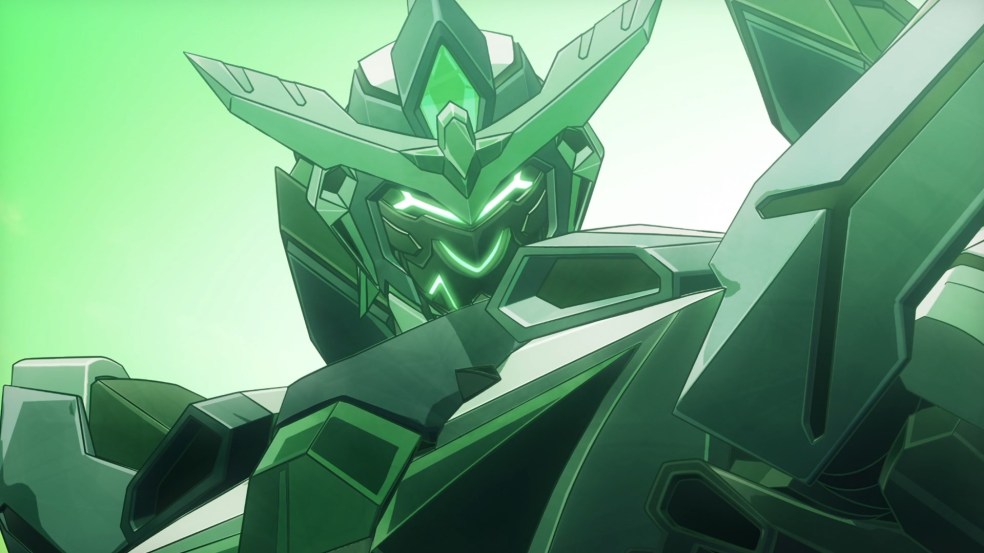
The situation falls to pieces quickly enough that the group who engaged in training exercises early on are left to fend for themselves. Isami tries and fails to save some of his comrades, including his blue-haired girl buddy Hibiki [Yume Miyamoto]. He does not do well, and it really seems like this is the end for Isami right up until the exact moment that one of the enemy’s blazing lasers is intercepted by an equally-bright green flash from the heavens above. Enter the show’s title character, Bravern [Kenichi Suzumura], a giant robot of a very different sort than we’ve seen up to this point.

Regardless of anything else I have or will ever say about this show, the turn-on-a-dime “what the actual fuck” spectacle of what happens here is absolutely immaculate. It’s the best capital A-M Anime Moment of the year so far. It is some absolutely cool as fuck nonsense. Isami goes from a foot soldier to plunged into the cockpit of Bravern, a dyed-in-the-wool super robot in the classic mold and a character in his own right. He has a flaming sword, he fires blasts of green energy, he arrived on a beam of green energy. He has diegetic in-cockpit theme music. It is a few absolutely wonderful, absurd, totally ridiculous minutes, and even if everything else this show does ends up absolutely paling in comparison, it will always have this.

It’ll also always have its actual, real opening credits, which seem designed with that same classic, old-school mentality in mind; a steel aircraft carrier beneath an azure sky, glowing, neon outlines around a cast of menacing, gargantuan robot silhouettes aglow with neon lines that we have yet to meet. It’s awesome. It promises a lot. Delivering on that is going to be the hard part, but it’s a promising sign that, as he sits in Bravern, Isami realizes that when he was a kid with dreams of justice, he didn’t really want to be a spec. ops. guy, a fighter pilot, a tank driver, or even a Titanostrider operator. He wanted to be a hero.

All of that is to the show’s benefit, because from here on out, starting in episode two which I’m also covering here, figuring out what this series even is becomes a lot more complicated. Because, you see, in addition to being a willful juxtaposition of super robot science-fantasy against a fairly gritty invasion story sort of thing, Bravern is also….a BL-inflected comedy.

No, really. Buckle in, because this is where things get weird weird.

When we see Isami at the start of the second episode, he’s being detained by some shadowy group or another and very literally tortured. This is a pretty sharp tonal departure from the end of the last episode, but what’s intercut with it is even stranger; Bravern, attempting to explain the situation to the group of military officials still gathered on the aircraft carrier and them largely not understanding. To be fair to them, his explanations include a lot of shouting his own name, Isami’s name, and doing things like relating his life story like a literal book complete with chapter titles. Also, his fixation on Isami is very clearly meant to resemble a gay crush, and his description of their first time “piloting” together very quickly becomes laden with so much innuendo that the term ‘subtext’ no longer feels sufficient. The show playing this for comedy is….a little blue, to say the least. (As is the show’s apparent intentional juxtaposition here. Isami is literally being tortured, the military officials are being ‘tortured’ by Bravern’s mannerisms. Eh.) Much of this seems designed to raise the question “what if the super robot you were piloting had a thing for you, and he was kind of annoying about it?”

By contrast, the actual situation Bravern’s explaining is pretty dire. The peril invading their world is an alien invasion of bio-machines, spearheaded by eight ships called Deathdrives, each containing a swarm of mecha and a single more powerful unit. One of which, the blue anti-Bravern called Superbia, we meet here. Superbia and Bravern fight, of course. Since Isami is still being detained by some aloha-shirted torturer guy, Bravern comes very close to losing that fight, as he’s noticeably weaker without someone in the driver’s seat.

Isami has to be convinced to get back in Bravern, in true mecha anime fashion, as his, ahem, “first time,” was not had under the best circumstances and he’s still processing all this stuff. (That’s all text, by the way, I am doing very little interpreting here.) At one point, Lewis tries to pilot Bravern instead, sweet-talking to the big red boyscout with talk of how he, too, wants to save the world and everyone on it. This almost works, and we are treated to a delightfully goofy scene where the whole conversation is rendered like something out of an old shoujo series, but Bravern seems to be monogamous. No one gets in him but Isami, and that’s final.

When he finally does get in Bravern, the dynamic duo kick Superbia’s tailpipe, of course. Including a charming, doofy scene where Bravern goes in for the super move kill and then stops himself because he insists that he do a different one this time. It’s charming, it’s very silly, and I think all this taken together maps out Bravern as being focused on, in roughly this order; being awesome, being gay, and being funny. That’s not a bad thing to be, even if the finer details of its themes remain ambiguous. Isami still has military command to deal with, after all.

My bet, if I can try to manifest something into existence here, is that Isami’s emotional journey will be attached to his learning to grow out of this role he’s built for himself as a soldier—one he’s already very much leaving behind as of episode 2—and into the role of a real hero, and there’s one final piece of evidence that might support that reading.

Just when it seems like the second episode could not possibly get sillier, Isami’s clothes explode in the final minutes of its main closing scene, and he is stuck inside Bravern as the episode ends, in an apparent parody of that one Evangelion episode. A ridiculous gag with no further meaning? A symbol of him being forced to shed his “soldier’s uniform” and confront reality as it truly is? Both of these things, somehow? Bravern’s sheer absurdity practically demands this kind of overanalysis, even as it can absolutely just be enjoyed as pure entertainment.

All told, the operative adjective here is definitely “campy.” And there’s a lot that I haven’t mentioned, including our main mechanic character, Miyu [Ai Kakuma], whose interest in Bravern quickly gets into robotfucker territory. (She thinks he’s handsome. Can you blame her?) There’s a pretty great scene where a German official speculates in her native language with one of her cohorts that this whole thing might be some kind of ploy by the Americans, only for her to be loudly reprimanded with Bravern’s absolutely awful German. There’s the show’s bizarre, maybe intentionally funny? art style dimorphism between the men and the women, where the former look like they’re from a relatively grounded military series and the latter look like they’re from a KyoAni production. (Quite possibly also just reflective of the interests of main character designer Jae-Uk No.) There’s a gag where Bravern cuts off a government official by loudly yelling his transformation phrase (obviously, he can turn into a futuristic jet fighter) and flying away. The fact that this thing is clearly heavily inspired by—and might be part of? I’m not clear on this—the Brave series. The fact that Isami and Bravern’s shouts are out of sync the first time they do their finishing attacks. And on, and on, and on. There’s a lot to like here, a lot to be puzzled over, and a few things to take issue with. It adds up to one of the season’s best premieres, and certainly one of its most ambitious.

It’s totally possible that all of this completely flames out, of course. This has happened before. Giving a story tons of slack because it’s weird or absurd can lead to Magical Destroyers situations, or even, in a worst-case-scenario, a Darling in the FranXX. Still, what’s the point of flying close to the Sun if there’s no risk you’ll be burned? Icarus was a chump.

After a supremely homoerotic ED sequence, Bravern‘s second episode features a brief post-credits scene, where Lewis quite literally stumbles over a girl in a crashed UFO-like ship, by implication, this was the pilot of Superbia, and is our local Rei Ayanami. This fairly standard sci-fi twist after such a weird premiere made me absolutely redouble my commitment. More than anything else that’s premiered this season, for Bravern, I will be there no matter what. I have got to see where this goes. Join me if you’re brave enough.


Like what you’re reading? Consider following Magic Planet Anime to get notified when new articles go live. If you’d like to talk to other Magic Planet Anime readers, consider joining my Discord server! Also consider following me on AnilistBlueSky, or Tumblr and supporting me on Ko-Fi or Patreon. If you want to read more of my work, consider heading over to the Directory to browse by category.

All views expressed on Magic Planet Anime are solely my own opinions and conclusions and should not be taken to reflect the opinions of any other persons, groups, or organizations. All text is manually typed and edited, and no machine learning or other automatic tools are used in the creation of Magic Planet Anime articles, with the exception of a basic spellchecker. However, some articles may have additional tags placed by WordPress. All text, excepting direct quotations, is owned by Magic Planet Anime. Do not duplicate without permission. All images are owned by their original copyright holders.

SEASONAL FIRST IMPRESSIONS: Amou Shiiba is Wanted Dead or Alive in AMAIM WARRIOR AT THE BORDERLINE

Seasonal First Impressions is a column where I detail my thoughts, however brief or long, about a currently-airing anime’s first episode or so.


Or: Teenage Boy is Accused of Terrorism, Becomes Actual Terrorist in Response.

AMAIM Warrior at The Borderline (known more succinctly as Kyoukai Senki in its native Japanese) is a bit of a tricky one, so let’s get the simple stuff out of the way first. Point one: this is a mecha anime and the mecha are traditionally animated instead of 3D. That alone is going to be enough for some to hop on board. Point two: it’s a production by Sunrise Beyond, a subsidiary of Sunrise proper whose work outside of this show consists almost entirely of various Gundam spinoffs. Point three: Hey! The show looks pretty good, at least so far. The mecha are the obvious highlights, but in general its vision of an occupied near-future Japan comes across pretty well, and that’s worth noting.

The complicated stuff comes from that last part. AMAIM takes place in the 2060s, after vaguely-described internal problems lead to Japan being divvied up, late Qin Dynasty-style, into a number of foreign-administered extraterritorial zones. And friends, let me just say, yours truly is not an expert on history, contemporary politics, or anything of the sort, so the fact that I even have to entertain this notion hurts me deeply. But, well, the setup does seem kind of….conservative fever dream-y?

Say, in the same way that something like Red Dawn was for us here in the US of A in the ’80s.

Haha. Oh boy.

Were it only established in the opening narration, it would be easy enough to write off as a stock setup. But this comes up over and over again throughout the first episode–indeed, the main antagonists are some of said foreign military occupiers. It is they who falsely accuse protagonist Amou Shiiba of conspiracy to commit terrorism and it is they who he eventually fights against. The regime–whoever they may be, their nationality is not explicitly identified here and the one time we see flags they’re all stand-ins–is unambiguously depicted as brutal, petty, and evil.

Now, all this said. Does that immediately discount AMAIM? I wouldn’t say so. Even if you’re not simply willing to write all this off, it’s not terribly hard to figure out why there might be some Japanese resentment about foreign military presence. And perhaps interpreting all of this so literally is a mistake anyway; there are (tragically) lots of places on Earth where this kind of thing happens. It is easy to imagine simply relocating this sort of incident at home to make it more immediately relatable for domestic audiences. So, while the overtone is there at first glance, I think it irresponsible of me to hold on to my knee-jerk reaction.

But admittedly! For as much as I do try to always hold myself to the standard of taking everything on its own terms. If AMAIM weren’t so tightly-plotted, I might’ve been less charitable. The story here is quite streamlined, and there are really only two important characters in the first episode; Amou himself, and GAI, an autonomous artificial intelligence that he, no joke, finds in a box in the woods.

Me when I run out of Arizona Tea.

Amou near-literally falls into the cockpit of his AMAIM (yes, that’s what the mecha are called here, hence the title of the show.) Something called out as rare in the present day, where most are apparently remote-controlled. A night scavenging mecha parts in the woods makes him a suspect for the local occupiers, and the plot thus kicks off when he ends up having to rescue his friends from them. He ends the episode a wanted man, leaving the whole thing on a cliffhanger.

Amou is easy to root for, as a vaguely-depressed seeming kid bummed out by the state of the world who finally has a purpose. It’s decent stuff. I just wish I less felt the need to couch it in so many caveats and disclaimers. But one should always be willing to turn the critical lens inward. Maybe all this says more about me than it does about the series.

Honestly, I’ve said all I’ve said, but it’s just fun to see traditionally-animated mecha in a mainstream TV anime in 2021. (Even if I was never really against CGI, myself. SSSS.DYNAZENON remains one of the year’s best anime, for my money.)

More than most anime I’ve covered on this column, what you get AMAIM is going to depend on what you put in. Does even the vaguest scent of possibly-conservative politics put you off? You’ll want to keep far away. Are you willing to power through almost anything as long as it’ll draw a robot in two dimensions instead of three? Well, I’ve got your anime of the season. For everyone else, I think simply giving the first episode a spin to try it out is the right call, assuming mecha anime appeal to you at all.

Grade: Wow! Cool Robot!
The Takeaway: If you’re into mecha, at least give the first episode a shot. If you’re put off by the possible undertones, I’m certainly not going to blame you, but I do think it’s at least worth giving a chance.


Wanna talk to other Magic Planet Anime readers? Consider joining my Discord server! Also consider following me on Twitter and supporting me on Ko-Fi or Patreon. If you want to read more of my work, consider heading over to the Directory to browse by category.

All views expressed on Magic Planet Anime are solely my own opinions and conclusions and should not be taken to reflect the opinions of any other persons, groups, or organizations. All text is owned by Magic Planet Anime. Do not duplicate without permission. All images are owned by their original copyright holders.


(REVIEW) Love in Wartime: The Politics and Emotion of EUREKA SEVEN

This review was commissioned. That means I was paid to watch and review the series in question. You can learn about my commission policies and how to buy commissions of your own here.

This review contains spoilers for the reviewed material. This is your only warning.


Amazing grace
how sweet the sound

Sekai-kei, or “world story”, is a term of disputed origin. Held by many to be a westernism, invented by bloggers searching for a term to describe Neon Genesis Evangelion and stories of its ilk. Stories where the fate of the universe is tied inextricably to that of a central relationship and the mental state of its lead characters. NGE may hold the title as the series that inspired the term, but no anime has ever worn it as well as Eureka Seven. And no matter its origin, more than many anime the phrase is used to describe, “world story” feels like it fits Eureka Seven like a glove. Fifteen years after it began airing, E7 is capable of an astounding thematic and emotional resonance that hits as hard in 2020 as it did when the series ended in 2006. It’s matched by little else.

Try to grab hold of it, and it breaks down into images. Blood on wedding rings, underground rainbows, Superflat monsters and sky-fish, mecha on surfboards, political intrigue, social upheaval. Love, war, death and more, all soundtracked to trance, house, pop, and soul. This is Eureka Seven. Wildly ambitious, flawed but magnificent. Riddled with paradoxes, it is gangly and perfect.

It’s not hard to understand E7’s methodology. It combines an older, political strain of mecha anime with the metaphysical, psychological approach of the NGE* era. In this way, its closest contemporary cousin, funnily enough, might be another ambitious mecha series of the same era that attempted a similar approach; Code Geass. But while that anime traffics chiefly in camp, the minutiae of revolution, and shock value, Eureka Seven deals in much simpler, more universal substance. As promised in the title; emotion, politics, and the messy grey area that is their intersection.

It is again helpful to consider Eureka Seven as a series of meaningful contradictions. It bursts with music, but is punctuated by the shellshocked silence of war trauma. Dozens of opposites run through the show; love, and death, built things and natural things, Wide-eyed romantic idealism and stoic pragmatism, new life and disease, and so on. In this way, despite the fantastical nature of its soft sci-fi setting, Eureka Seven’s world is a lot like our own. This is important, because Eureka Seven is an anime with things to say, even if it takes a little while to get there.

Eureka Seven opens presenting itself as a classic adventure story. That of Renton Thurston, son of the late war hero Adroc Thurston, and his encounter with–and eventual admittance to–‘terrorist’ group The Gekkostate. It never sheds the structure of a latter-day bildungsroman, especially since Renton’s romance with the titular Eureka is a key part of the series, but it does go significantly beyond it in several other ways.

Other coming-of-age stories have dealt with the realities of growing up in a politically tense period. Few have depicted the rise of fascism with such polished, unsettling ease as Eureka Seven. The ascent of the dictatorial Dewey Novac ties to broader political sensibilities throughout the show. It is not a coincidence that Novac’s forces are generally clad in Nazi-evoking black uniforms, while the Gekkostate and affiliated resistance have a wide variety of looks, often inspired by musical subcultures. (The series overflows with musical reference, down to the name of Renton’s father. A namecheck of Beastie Boys member Ad-Rock.) Later, as Novac’s regime seizes power (complete with a by-the-fascist-book “big speech” to accompany his coup in episode 37) he launches a genocidal campaign against the scub coral. And plans involving surgically-altered super soldier children stretch back in-series years.

Elsewhere, the plight of the Coralians and their complex relationship to the humans in the world of Eureka Seven speak to an environmental bent. The series’ use of what is essentially technobabble may seem campy or silly, but it belies an internal logic that maps cleanly onto many different real-world problems. The “Question Limitation” is not something we will ever have to deal with, but similarly ominous two-word phrases (such as say, “Global Warming”) seem quite certain to define our immediate future.

The show’s long, rough middle third, meanwhile, where Renton is first hazed and then downright abused by many different members of The Gekkostate (but especially Holland) is a bleak, raw look at how such cycles of abuse perpetuate. Renton’s own journey to maturity is hamstrung by the existence of three malformed father figures; Adroc, the war hero who was never there for his own son, Holland, who grapples with his own complex feelings of responsibility regarding Eureka and often takes this frustration out on Renton in this portion of the series, and Charles, a loving father like Renton’s never had, but also a bloodlust-driven bounty hunter, whose conflicts with The Gekkostate eventually see him shot dead by Holland. It is only Renton’s ability to rise above all this–and to forgive–that allows these cycles to cease, and for him and Holland (the only one of the three still alive) to move forward.

All of this only scratches the surface, but you get the point. You may ask what ties all of these disparate themes together, and the answer is shockingly simple. One of anime’s great achievements as a medium is the ease and sheer emotional intensity with which it is often capable of portraying the simple, necessary, terrifying joy of human connection. In Eureka Seven, all of these problems, to a one, can be overcome by communication. By mutual understanding. By love. The show’s final opening theme–“Sakura”–interpolating, in a genuinely brilliant compositional move, the hymn “Amazing Grace”, gives the game away. It seems to say; If God lives not above, then we must love each other in his place. We have a duty to see the worth inherent in each other.

Indeed, Eureka Seven‘s greatest achievement is not any great subversion of expectations, any particular cut or shot (though many excellent examples of both exist throughout), its unique soundtrack, or anything else of the sort. It is this emotional core of empathy triumphing above all else that stands out. It is a spirit that persists in the medium to this very day, shining through from time to time in even the least of Eureka Seven‘s successors.

By Eureka Seven‘s end, and the incomparably romantic imagery of Renton and Eureka cradling each other in their arms as they hurdle through the sky, the series has made its point. Fifteen years later, in a world that every day feels closer to falling apart, Eureka Seven‘s message that even in our darkest hours we must hold each other close feels more resonant, immediate, and heartfelt than ever. That it’s so beautifully put together feels like proof that it’s the truth. How sweet, indeed, the sound.


*NGE of course did not invent this particular sort of mecha series, it merely popularized it. I’m inclined to suspect a shared lineage dating back to perhaps Macross. But without having seen that series myself it’s hard to say more, definitively. Eureka Seven is flooded with shared DNA both between and directly from other mecha anime and other sci-fi in general. I spotted more than one point of homage to another Gainax series; Gunbuster, and have been informed of several that draw from sci-fi novels. Director Tomoki Kyoda has called the series an “homage to his rebellious phase”, a sentiment that tracks with its empathetic state of mind and general feel quite wonderfully.

If you like my work, consider following me on Twitter, supporting me on Ko-Fi, or checking out my other anime-related work on Anilist or for The Geek Girl Authority.

All views expressed on Magic Planet Anime are solely my own opinions and conclusions and should not be taken to reflect the opinions of any other persons, groups, or organizations. All text is owned by Magic Planet Anime. Do not duplicate without permission. All images are owned by their original copyright holders.