Seasonal First Impressions: TAKOPI’S ORIGINAL SIN

Seasonal First Impressions is a column where I detail my thoughts, however brief or long, about a currently-airing anime’s first episode or so.

Content Warning: This article contains discussion of suicide, child abuse, bullying, and other heavy topics. Please use your discretion before reading.


I’m open to the idea that this is a real “these three points make a line” sort of statement, but in my experience, it seems to me that when a show premieres before the bulk of its season, it’s usually lightweight and lighthearted. Something like Fluffy Paradise, or what have you. Why that is, I couldn’t tell you, but maybe there’s a sentiment that if you’re going to put yourself out there ahead of the pack, it doesn’t make sense to demand too much from viewers. That’s a guess, but it’s the best one I’ve got.

In any case, Takopi’s Original Sin—an ONA adaptation, slated for six episodes, of Taizen 5‘s Jump+ manga—does not follow this pattern. At all. In fact, before I say anything else, let me hit you with the same exact warnings that the show itself does.

Those two content warnings, one from the anime’s production committee and the other, as far as I can tell, inserted by distributors, are not a joke. Takopi is in the running for the heaviest anime I’ve ever covered on this site, and I’m saying that as a statement of fact, not some kind of tasteless “you won’t believe how dark this show is!” clickbait sort of thing. So please, if reading about anything described abvove is distressing to you, or if watching it is distressing, please exercise your judgment. Take care of yourself, alright?

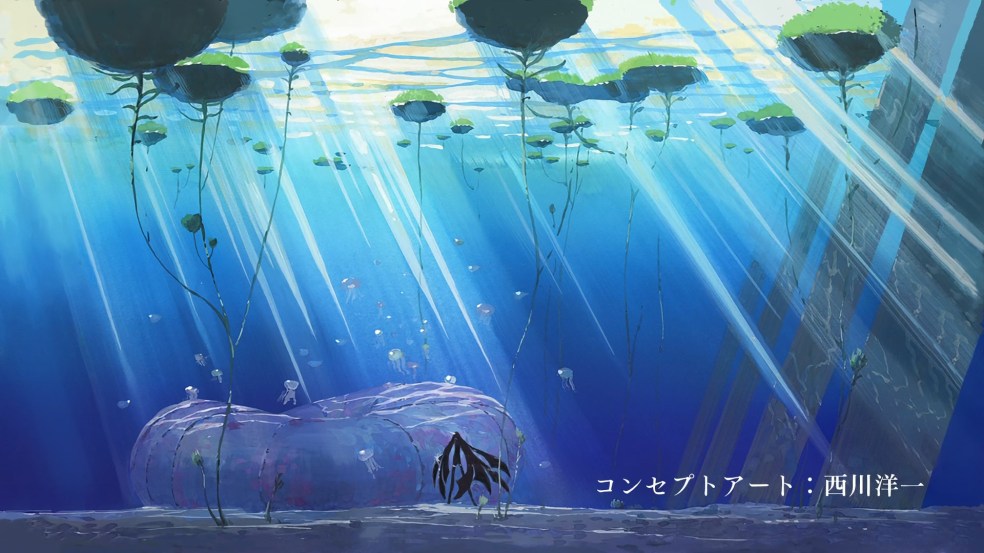
Beyond that, it’s actually the visual element of this show I’d like to discuss first. (Coming to us from director Iino Shinya, previously best known for the Dr. Stone adaptation, and his team at Studio ENISHIYA. As far as I can tell, this is their first work that’s not a music video or something of that nature.) Despite this being an anime blog, I usually save notes on production polish and such for the last few paragraphs, mostly because the ins and outs of how an anime actually gets made are not my specialty, and there are only so many ways for a comparative layman to say something looks good. Takopi is different: its human character designs have a distinctive feel, I’d almost say a weathered appearance, that sets them apart from the norm. They’re not “realistic” per se, but they’re expressive and feel like stories unto themselves, most notably with Kuze Shizuka [Ueda Reina], a fourth-grader and one of our leads; rail-thin, with a stringy mop of black hair, dressed in a battered white t-shirt, and a face that conveys an exhaustion beyond her years. Deliberately cutting against all of that is our non-human lead, Takopi himself [Mamiya Kurumi]. Takopi is a round alien, essentially a pink sphere with some stumpy legs, a mouth, eyes, and two tentacles. He looks like something out of a children’s storybook, and he thinks like one too, most scenes that depict something he imagines do so in this painted, storybook style, and it adds an incredible amount of depth to the show.

As for the alien himself, Takopi comes from The Happy Planet. His mission? To spread joy far and wide across the galaxy.

To that end, he has a bag full of gadgets—Happy Gadgets—that can do just about anything; a wrist band that lets you fly, an instant camera / time machine, a talking moai-like head that gives advice, an infinitely-long ribbon that can make any two people who are fighting resolve their differences. You know, the basic stuff. Takopi is, textually speaking, a literal extraterrestrial. But from the moment he’s introduced to Shizuka’s life, it’s clear that he’s also meant to come off as rather childlike. He’s immensely naïve about how the world works, and his gizmos do little to solve Shizuka’s problems. Still, Shizuka, at least initially, seems to be grateful to have someone to talk to at the very least. Over the course of a few days, she feeds Takopi bread and the little alien offers her various widgets to improve her life. It should be pointed out that she declines to use any of them, other than allowing Takopi to take a picture with the aforementioned camera, for the stated reason that even something like being able to fly through the sky “wouldn’t change anything.”

One gets a sense of what she means when we’re first introduced to Kirarazaka Marina [Kohara Konomi]. Marina, a classmate of Shizuka’s and, it quickly becomes clear to us if not Takopi, her bully. From the very moment she’s introduced, Marina is so awful to Shizuka that it’s almost impressive. One of her first lines is her and an underling talking about how they’ve broken Shizuka’s writing board, about which Marina sneers that she can use her “welfare money” to buy another. Further details like insults scribbled on Shizuka’s bookbag and simply how insistent she is about hiding from Marina paint Shizuka’s school life as a living hell even before we get to actually see it in the episode’s second half.

There’s a sense of suffocation here, and the environment reflects it; a relatively small town where everyone knows everyone else but doesn’t necessarily like them. Shizuka’s home life paints an equally-bleak picture; her only real companion is her dog Chappy, a giant ball of fur and affection that truly seems to be the one light in her life. Her mother, an “escort”, doesn’t really seem to ever be home, and an innocent question about Takopi regarding where her father is is met with “I don’t have a dad.”

Even so. All of this is contrasted with Shizuka’s moments with Takopi, which she does seem to genuinely appreciate. After seeing Shizuka’s home for the first time, Takopi tries to cheer her up by offering to take her to his home planet. He’s rebuffed, but Shizuka, Takopi, and Chappy end that night by walking together under the star-woven night sky. Shizuka smiles, Takopi is overjoyed.

If Takopi’s Original Sin is ever “misleading” in any way—and I really don’t think it is, this is not a show that’s coy about what kind of story it’s trying to tell, but for the sake of argument—it’s probably here. For a few seconds, it seems like things are looking up.

And then tomorrow comes.

Shizuka, badly beaten and clutching an empty dog leash—did Chappy run away? What happened? We aren’t told—meets up with Takopi again. For neither the first nor the last time, Takopi tragically doesn’t really understand what he’s looking at, interpreting her bloody mouth and black eye as “decoration.” Shizuka can only mumble out that she had a “fight” with her “friend,” at which point Takopi likens the way Shizuka’s face has changed to how he blushes when he gets embarrassed. (Moments of this nature, where Takopi just fundamentally misunderstands something about how humanity works, are excellent in how thoroughly they can sink your heart in just a few lines of his cheery delivery, and they’re scattered all up and down the episode.)

He latches on to the “fight with a friend” description, though. Offering Shizuka a “Reconciliation Ribbon” that can make any two people reconcile so long as they each tie it around their fingers. For me at least, this is around where the feelings of unease cultivated by the opening minutes of the episode blossomed into full-blown dread.

Takopi somewhat reluctantly lets Shizuka borrow the ribbon, despite the rules of his mission (as dictated in a flashback by a large, white specimen of his species) saying that the gadgets should never be used without direct supervision. Time passes, and Takopi gets worried.

He eventually makes his way back to Shizuka’s home, only to find it empty. Empty except for the Ribbon, fashioned into a makeshift noose, and except for Shizuka, having hung herself. The scene is harrowing, an explosion of pure, black dread. (I think one can make the case that Takopi’s lending the Ribbon to Shizuka is the titular “original sin,” though given that we’re only one-sixth of the way through this story, I’m sure other interpretations will make themselves known.)

Understandably, the little pink alien panics. He wonders how this happened, blaming himself and lamenting that death is the one constant across the vast universe. He can’t bring back the dead, but there is one thing he can do with his extraordinary gadgetry. The camera’s hidden function as a time machine is revealed here, allowing Takopi to travel back to the moment the photo was taken. (This seems to require him to have the photo on-hand, and it’s said outright that the camera can only store one picture at a time. Both of these facts seem like they’ll eventually be relevant.)

Thus, the second part of this episode revolves around Takopi trying his damnedest to avert Shizuka’s tragic fate, to find a world where she lives. To do this, he feels the need to learn more about her. Traveling back to the past, he accompanies her to school, trying to solve various minor problems he incorrectly pegs as the source of her pain (forgetting her homework, being unable to finish her school lunch, etc.), and one of the episode’s most visually interesting moments consists of a montage juxtaposing these problems and Takopi’s stopgap solutions to them, splitting the video down the middle and showing both at the same time.

But what Takopi still doesn’t entirely get until the episode’s final act is that all of these things are symptoms of a bigger problem that Shizuka is dealing with. Namely, Marina. Everything else that happens to her in school is a direct result of Marina’s bullying; she didn’t forget her homework, Marina stole it. She might be able to actually finish her lunch were it not for Marina and her fellow bullies mocking Shizuka to her face while she’s trying to eat. And so on and so forth.

Takopi, heartbreakingly, doesn’t really understand this either. He assumes that Marina and Shizuka are former friends who’ve had some kind of falling out, and that if he can just get them to talk, things will be fine. The problems with this approach are left unsaid, but are obvious. What if someone just fucking hates you for no obvious reason? What if someone is abusing you because they themselves are abused and you’re just an outlet for their anger? What if someone is mad at some other specific person and you’re just a proxy for their rage? Takopi can’t consider these angles, and when he naively tries to use another of his gizmos (a palette that lets him take the appearance of anyone he wants) to take Shizuka’s place when Marina wants to “talk to her,” it predictably goes very poorly.

I have to confess, as awful and stomach-churning as Shizuka’s suicide was, this was actually the scene that made me pause the episode and necessitated me taking some time to collect myself before resuming. Marina just absolutely beats Takopi-as-Shizuka black and blue, ranting at him about how “she” is the daughter of a “parasite” who’s preying on her father, and concludes her assault by jamming a mechanical pencil in Takopi-Shizuka’s eye. The narrative revelation—that Shizuka’s mother is sleeping with Marina’s father, and this is one of the sources of Marina’s anger—is crammed into the margins by the visceral pummeling she’s giving Takopi-Shizuka, a clouding of cause-and-effect that is all too reflective of how these things can play out in real life. Marina, a child herself, is of course wholly unable to strike back against a grown woman who she thinks is ruining her family. Shizuka, comparatively defenseless, is an easy target.

Takopi simply has no frame of reference for any of this; nothing of this nature happens on his planet, and this single beating is enough to traumatize him. The next time loop around, he can’t make himself move to go help Shizuka, even as he knows exactly what’s happening to her. The best he can eventually think to do is to run and grab a teacher while still disguised as Shizuka. Even this doesn’t really work long term, it just gets Marina off of her for the time being.

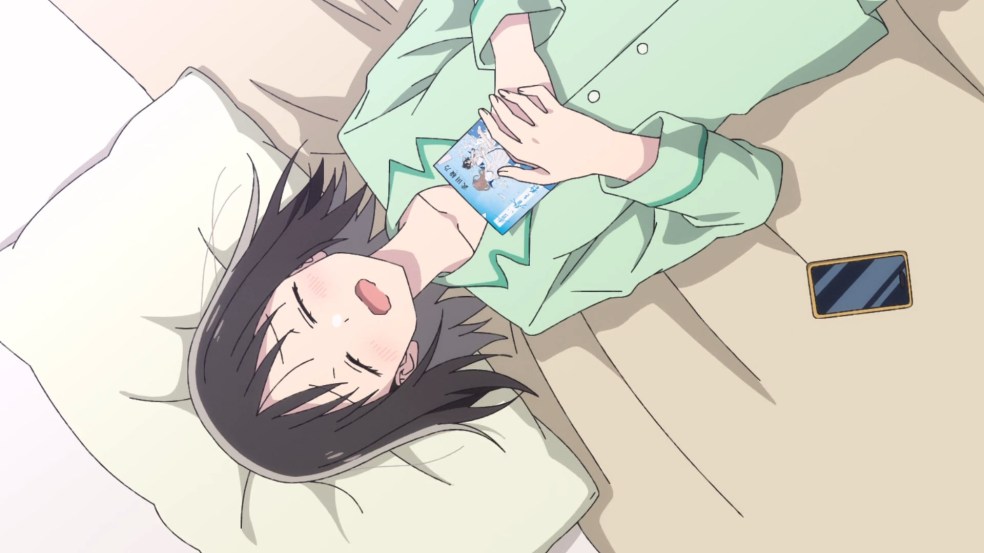
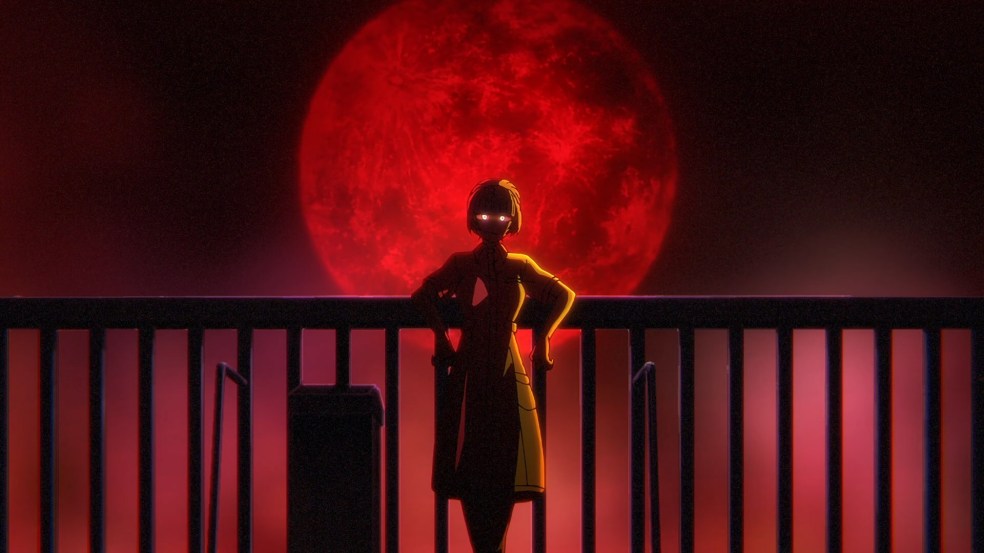
The episode’s closing minutes see Takopi pledge to stay with Shizuka, even though he feels like a failure for not being able to truly protect her. They also follow Marina, further contextualizing her anger as the result of her mother, who is sitting at their dining room table and seething over her husband spending so much time with another woman. The episode ends on two distinct epilogues. Shizuka goes home and falls asleep in her living room with Takopi and Chappy, the closest to being happy we’ve yet seen her. Marina, on the other hand, exits the episode as her mother creepily puts her hand on her face, all about the scene implying that Marina is about to be the target of abuse herself, for nowhere near the first time. She begins crying, headlight-yellow eyes darting away from her mother and, full of fear and resentment, burning holes in the camera.

This show is….a difficult one to discuss productively, for lack of a better term. To be honest, I have felt a touch out of my depth writing this, most anime—including most anime I deeply love—has some escapist element that can make even quite dark storylines go down more easily. There’s a little of that here, and Takopi’s presence provides a dose of pitch-black humor when he’s not just making things worse with his childlike naiveite, but, like I said at the top, this is one of the bleakest things I’ve ever written about on this site. Still, I do hope I’ve made it clear that none of this is a problem. The series is outstanding at what it’s setting out to do, and I think if you can weather the storm Takopi’s Original Sin is putting down, you’ll find easily one of the year’s best premieres. I would not at all be surprised, if it keeps up the quality—and I imagine it will—to find Takopi making a lot of year-end best-of lists come December or so. This story may be dark, but it’s one worth telling.


Like what you’re reading? Consider following Magic Planet Anime to get notified when new articles go live. If you’d like to talk to other Magic Planet Anime readers, consider joining my Discord server! Also consider following me on AnilistBlueSky, or Tumblr and supporting me on Ko-Fi. If you want to read more of my work, consider heading over to the Directory to browse by category.

All views expressed on Magic Planet Anime are solely my own opinions and conclusions and should not be taken to reflect the opinions of any other persons, groups, or organizations. All text is manually typed and edited, and no machine learning or other automatic tools are used in the creation of Magic Planet Anime articles, with the exception of a basic spellchecker. However, some articles may have additional tags placed by WordPress. All text, excepting direct quotations, is owned by Magic Planet Anime. Do not duplicate without permission. All images are owned by their original copyright holders.
Seasonal First Impressions: LAZARUS is Dead on Arrival

Seasonal First Impressions is a column where I detail my thoughts, however brief or long, about a currently-airing anime’s first episode or so.


More than its genre, who was involved with the actual creative process of making it, etc., the involvement of one person in particular stands head and shoulders above everything else when talking about Lazarus, the latest from Cowboy Bebop brain Watanabe Shinichirou, and it’s not Watanabe himself. No, upon starting the first episode of the show you’re greeted with the [adult swim] logo, and then, a few minutes later, an executive producer credit for [adult swim]/Toonami….main guy, Jason DeMarco.

I have dreaded the day I would have to talk about DeMarco at length on this blog, but the time has finally come, so here are the very basics. Back in the day, DeMarco was in charge of the original Toonami block. In that role, he was responsible for bringing a number of generational anime over to Cartoon Network, most notably Dragonball Z and Sailor Moon, and exposing them to a broad, English-speaking audience for the first time. He’s certainly not solely responsible for that, although he sometimes certainly likes to make it sound that way, but credit where it’s due, the guy had taste and not just for obvious hits, not just anyone would think to pick up, say, The Big O. In the years since then, though, with the rebooted Toonami block that proved a surprise success for [adult swim] back in 2012, DeMarco has taken a more active role in getting anime actually made, usually by putting up funding and often snagging one of those executive producer credits for himself in the process. The first results of this particular effort were the original pair of FLCL “sequels,” the extremely controversial FLCL Progressive and FLCL Alternative. To defend DeMarco (and just the entire staffs of those shows) here for a minute, I actually like both of those seasons, essentially because they’re so different from the original and indeed from each other. (Alternative honestly has more in common with one of Gainax’s other out-there 00s anime, Diebuster.)

Somewhere along the way, though, DeMarco’s involvement began to be associated with a certain kind of staid, neo-traditional action anime. Examples include the Shenmu anime, Fena: The Pirate Princess, and last year’s Ninja Kamui, which, again, to be entirely fair, I actually liked at first, but it quickly dropped off in quality. Whether DeMarco’s presence somehow causes these anime to be like this or if it’s more the other way around—that he’s attracted to projects that will end up like this because of his own tastes—I can’t say. But the point is, there’s a pattern. If DeMarco’s name is attached to it, and it has a somewhat subdued color palette, you pretty much know what you’re getting. (The less said about the other half of DeMarco’s credits in this position, which include the Rick & Morty anime and last year’s instantly-infamous Uzumaki adaptation, the better.)

I bring this up despite the fact that DeMarco’s actual creative involvement on the project was, we must assume, fairly minimal, because again, it feels like a tell. Consider the actual creative force behind this project, Watanabe, nearly thirty years removed from his masterpiece.

In fact, here’s a brief review of that masterpiece, and also the other two Watanabe anime I’ve seen. Cowboy Bebop? Genuinely really good, although admittedly outside forces (mostly a certain kind of tedious forum nerd insisting it’s The Only Good Anime) have dimmed my opinion of it over the years, and it’s been a long time since I last watched it. (Speaking of Toonami, I always preferred Outlaw Star. How much can I trust this opinion I formed as a teenager now that I’m 31? Who knows.) Space Dandy? Solid but very much not my thing, one of the first shows the revived Toonami block had a hand in bringing into existence, and I dimly remember that back in 2014 this seemed like a good thing, although I can’t remember precisely why we all thought that. Carole & Tuesday? Eugh. It really feels like an anime that is in part about how computers can replace human creativity should have a lot of relevance and vitality in 2025, but anecdotally, I don’t know anyone who rates this series particularly highly and I never even finished it myself, mostly because what I did see was maudlin to a ridiculous, Hallmarkian degree.

All of this is a lot of context, most of which is about me and my own relationship to these peoples’ works, and a lot of bolded, italicized titles that are not Lazarus. But I can only blame Lazarus itself, because the show itself doesn’t give me a lot to work with in this first episode. There’s not really much of a hook, I don’t care about any of these characters, and what we get of a plot is boring and simply not engaging. As is usual in Watanabe’s anime, there are some good moments of moody contemplation, (though they’re obviously not nearly as memorable as Bebop‘s) some solid action pieces (although I found these lacking compared to past works), and some well-chosen bits of background music. Not to mention Watanabe entirely does deserve credit for being one of the few anime directors that seems to give a shit about having a realistically racially diverse cast. But I have to be careful here, because if I’m talking about a sci-fi anime with good music and action, but with bad writing, you might assume I was talking about Metallic Rouge. This is a rude comparison, partly because Lazarus‘ writing is not wildly irresponsible (at least so far) in the way that Metallic Rouge‘s was, but honestly? Also because Metallic Rouge was actually intermittently fun, and did manage to put together a solid first episode, despite its many flaws in other areas, something Lazarus doesn’t have much of a handle on.

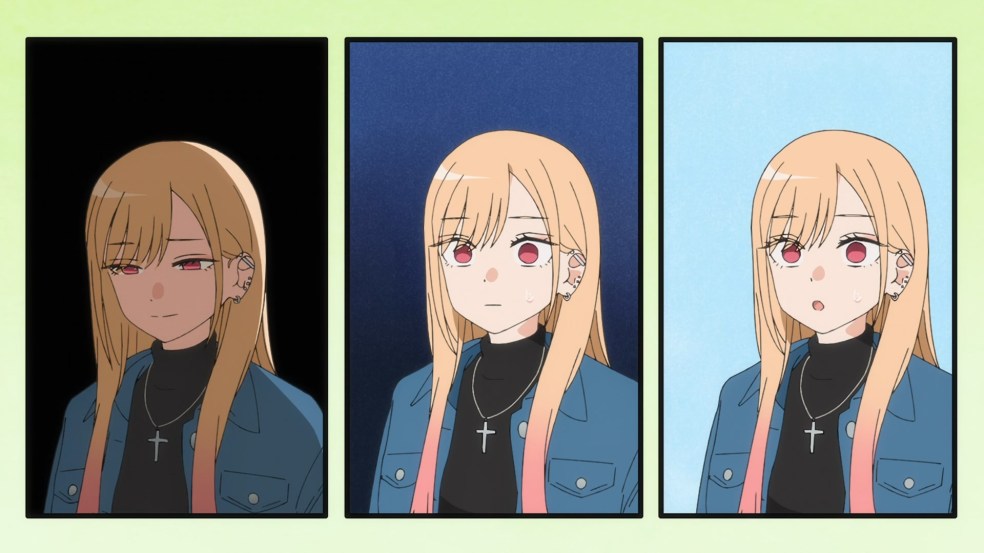
Incidentally, aside from the waxy look of the 2D art, this girl’s underdye is about the only indication that this anime was made in the 2020s.

Just to not make this piece entirely me being a hater, here are the simple facts of Lazarus‘ plot. A scientist named Dr. Skinner, some years prior to the events of the series, developed a miracle drug called Hapna. Skinner disappears for three years as the world happily embraces freedom from pain and sickness. When he returns, it’s to sound the trumpet of Judgment Day. Hapna, he reveals, is actually designed to remain in the body permanently, and will kill anyone who takes it about three years after the first, and the first deaths will start just 30 days after his announcement. So betrayed, the world quickly descends into chaos.

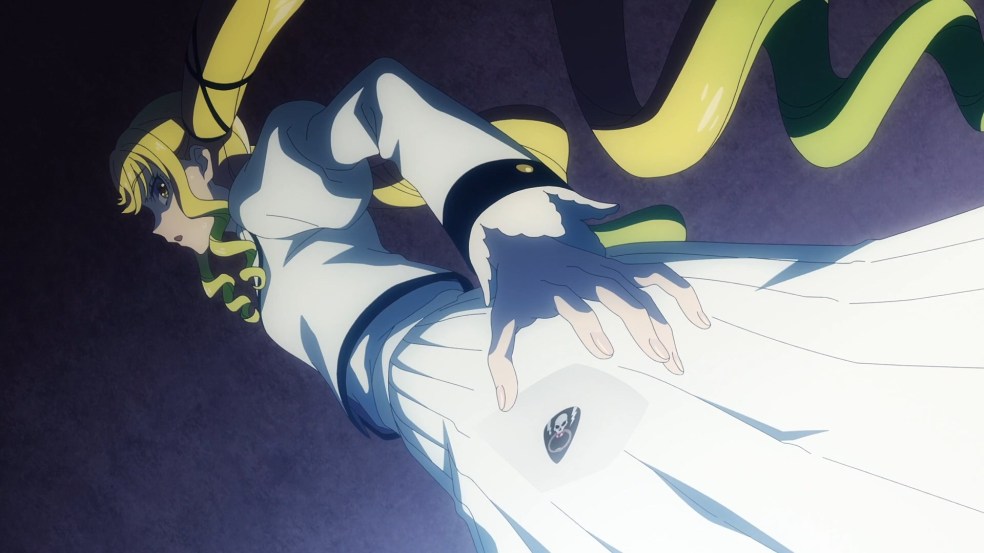
In the midst of all this, Brazilian escape artist Axel Gilberto [Miyano Mamoru/Jack Stansbury] is serving an 888-year prison sentence. In the midst of a visit from the mysterious Hersch [Hayashibara Megumi/Jade Kelly], he makes another break for it and spends the remainder of the episode on the run. Thus, we follow Axel as he dodges the law before finally being cornered by Douglas Hadine [Furukawa Makoto/Jovan Jackson], who he seems to think is a police officer. One more escape attempt and a final subduing later (by having local blonde girl Christine [Uchida Maaya/Luci Christian] lure him into taking a picture with him and then zapping him with the shock bracelets on her wrist, naturally), it is revealed to Axel, and to us, that all of the people who’ve been chasing him are actually part of a secret organization called (dun dun dun) Lazarus! The first episode ends there, roll credits.

If that seems a little thin on the ground in recap form, I promise you it’s moreso to actually watch. Yeah, chase scenes are cool and all, but it’s hard to get a bead on who any of these people are or why I should care about any of them. My gut reaction is that introducing so much of the cast at once was a mistake and it would’ve made more sense to have us spend time with Axel. Maybe this will all make sense by episode six or seven, but I’d have to actually want to watch that far to see if it does. At present, I don’t. I really, truly tried to go into this series with as open a mind as possible, but there’s just nothing here to reward that.

Upsides are minor and fleeting. There’s a funny moment where Axel runs into a police officer while still in his jumpsuit from prison and the officer convinces himself that it’s “some fashion trend.” The action setpieces are cool enough, although some of them, especially later in the episode, feel bizarrely floaty. Axel himself is….likable enough, I guess?

Can you tell I’m grasping for straws here? Last season I wrote a scathing writeup of Sorairo Utility‘s first episode and I kind of regret it because A) that was not the most objectionable thing to air that season by an order of magnitude, Zenshu, which I did not and will not cover on this site, was, and B) because a slice of life series, no matter how bad—and don’t get me wrong, I do think that first episode of that show was very bad—just doesn’t deserve that vitriol. So, I am trying to frame my dislike of things in a more productive way when I dislike them, but I truly cannot think of anything nice to say about this show beyond what I’ve already said. It really is just a very dull first episode.

That, and it also seems very convinced of its own importance. The whole engineered drug-based death epidemic plot is extremely “hard sci fi with something to say.” In this way, Lazarus almost feels more like a very dim reflection of something like Ghost in the Shell: Standalone Complex more than anything else. It’s not cyberpunk enough for that comparison to be airtight, but what I mean here is that that was a series that also had a lot on its mind. The difference of course is that GiTS:SC, or any other such show you care to name, did not need to try to convince you that it had some relevance to modern life, it just was relevant to modern life. I am not saying that GiTS:SC is itself flawless or that its politics are beyond reproach (they certainly aren’t), but it is at least worth having a conversation about. That’s an ineffable, hard-to-pin-down difference, but it is unfortunately what ultimately puts the final nail in the coffin for this premiere. I simply don’t think, unless its subsequent episodes are a massive improvement, that anyone is going to care about what Lazarus is saying enough to talk about it. This feels absurd, given that the show is so obviously Trying To Say Stuff that it even features an economic crash just days after this fucking mess. Normally, coincidental timing like that locks a series in as a must-discuss talk of the season, but I just can’t see it happening with Lazarus.

I have never liked the “it insists upon itself” chestnut. Especially because, in the Family Guy scene that it’s from, the joke is that Peter is voicing a pompous opinion on something inane in the middle of a life-threatening situation. But hey, given the state of the world right now that’s basically what I’m doing, too. So sure, we’ll say Lazarus insists upon itself. Tedious, dry, lacking charm or compelling drama, the latest product of the Neo-Toonami Industrial Complex simply feels replaceable.


Like what you’re reading? Consider following Magic Planet Anime to get notified when new articles go live. If you’d like to talk to other Magic Planet Anime readers, consider joining my Discord server! Also consider following me on AnilistBlueSky, or Tumblr and supporting me on Ko-Fi. If you want to read more of my work, consider heading over to the Directory to browse by category.

All views expressed on Magic Planet Anime are solely my own opinions and conclusions and should not be taken to reflect the opinions of any other persons, groups, or organizations. All text is manually typed and edited, and no machine learning or other automatic tools are used in the creation of Magic Planet Anime articles, with the exception of a basic spellchecker. However, some articles may have additional tags placed by WordPress. All text, excepting direct quotations, is owned by Magic Planet Anime. Do not duplicate without permission. All images are owned by their original copyright holders.

Seasonal First Impressions: UMA MUSUME CINDERELLA GREY at the Starting Gate

Seasonal First Impressions is a column where I detail my thoughts, however brief or long, about a currently-airing anime’s first episode or so.


Somehow, this is the first full article I’ve devoted on this site to Uma Musume. I have to admit that that’s mostly my own fault, I was very late to this particular party, and only got onboard the proverbial horse-drawn carriage earlier this year. (I still haven’t seen the series’ proper third season.) Uma Musume, occasionally also called Pretty Derby, is a series whose reputation precedes it, given its odd premise and ties to a large, very successful franchise that most English-speaking anime fans are unfamiliar with beyond said premise.

The long and short of it is this; Uma Musume takes place in a world where horse-eared animal girls compete in vigorous races. The horse girls are named after actual, real horses—and in Uma Musume’s fiction they actually are those horses, reborn into the show’s setting—and the races themselves are largely patterned after real races. Using the real-world horse races as a scaffolding, Uma Musume then constructs a triumphant, pulse-pounding sports anime. Visually, the later Uma Musume entries, especially the OVA series Road To The Top and the movie Beginning of a New Era (which I have been trying to write an article about for months, incidentally) are some of the best and most intense anime of the 2020s, and one ignores them because they’re “silly” at their own peril. The rough-around-the-edges first season followed ambitious sweetheart Special Week. Season 2 traced the path of rocketship superstar Tokai Teio and her shonen rivalry girlfriend Mejiro McQueen. The Road To The Top OVAs studied a trio of often-intense rising stars, and the New Era film explored a rivalry between its leads that bordered on a deranged, psychosexual obsession. Each entry in the series has been increasingly spectacular, especially visually, which only makes sense. Remember: this is a sports anime.

All this in mind, Cinderella Gray has big horseshoes to fill, following as it does the story of Oguri Cap [Takayanagi Tomoyo] and her rise to fame. Perhaps wisely, right out the gate, Cinderella Gray actually engages in some scaling-back from the New Era film, the otherwise most-recent Uma Musume anime. We don’t begin our story at Tracen, the prestigious racing academy from the previous three seasons of the anime. Instead, our setting is a smaller academy that trains racers for regional competitions.

Our point of view character for most of this opening bit of scene-setting isn’t actually Oguri Cap herself, but rather Berno Light [Seto Momoko, in what looks to be one of her first roles], a much more ordinary horse girl (although one whose cute hair decorations shaped like capital Bs should not be ignored), and it’s through her that we get some sense of the reduced grandeur here. When she asks her homeroom teacher about the national races, she’s just straight up told that it’s not something she needs to worry about. A little rough! Inauspicious beginnings for what’s sure to be a tale of a meteoric rise to the top!

In fact, the very first character we follow isn’t even Berno, but rather Kitahara Jou [Konishi Katsuyuki], a trainer—and a human, as is traditional in Uma Musume’s trainer / horse girl setup—who laments the sorry state of the local scene. He’s looking for a star, and he’s pretty sure he’s not going to find one in the Gifu regionals.

Enter, of course, Oguri Cap. Cap, whose real-life counterpart was nicknamed “The Gray Monster,” is presented here as, essentially, an old-school shonen protagonist. She’s kind of dim, eats her own weight in food on the regular, and trains way, way harder than anyone else. She’s an archetype to be sure, but an instantly likeable and endearing one. “Someone you can root for from the bottom of your heart,” per Jou’s own words.

Not everyone necessarily feels that way, though. For much of her first day (and thus much of this episode), Oguri Cap is actually bullied by a trio of delinquent horses; the gyaru Norn Ace, the mean-looking Rudy Lemono, and the decidedly short Mini the Lady.

Lest anyone get the impression that Uma Musume is taking a sharp turn into being a school drama however, Oguri Cap is actually so oblivious to anything that’s not food or running that these attempts to get under her skin completely slide off of her. Up to and including Norn Ace, her dormmate, making her sleep in a supply closet. (Oguri, the very definition of a cartoon country girl, is just stoked to have her own room.)

She has the last laugh anyway. The episode’s final stretch consists of a practice race where Cap is set to run against Rudy, Mini, and Berno, and the former two prank her by undoing her shoelaces before the start of the race. In spite of having to stop to re-tie them, Oguri absolutely annihilates her competition, leaving them in the dust as she blasts past them, completely outpacing them.

Uma Musume has developed its own visual language with which to depict racing as its gone on; broad sweeping ‘karate chop’ hand motions, coiled cock-and-fire pistol shots of forward, springing motion, glowing Black Rock Shooter eyes and electrical auras, and so on. Oguri is drawn in a subtly different way, telegraphing her unusual gait, the secret weapon that makes her interesting to Jou beyond her raw talent, it’s explicated in just a line or two of dialogue, but as is often the case with Uma Musume, seeing is believing.

Can we root for Oguri Cap from the bottom of our hearts? It doesn’t take much to convince me when the show looks this good, but I do really think that this is not only a treat for longtime fans of the series but also an ideal jumping-on point for anyone who’s been waiting for one. Being set chronologically earlier in the franchise than seasons 1-3 means that the attention-grabbing cameos of previous seasons’ characters are kept to a minimum. There’s no real risk of feeling lost here, so I would say that just about anyone should check this thing out. You really have nothing to lose. (If anything, I think longtime fans are the ones more likely to have nitpicks. One could argue this is a slower start than, say, the first episode of season two. But this feels like such a minor point that, to me at least, it isn’t really worth making.)

Personally, what interests me most is not just Oguri Cap and the way she runs. We’re introduced to another horse girl here as well, alongside Cap, Berno, and the delinquent trio. That girl, Fujimasa March [Ise Mariya], who shares Cap’s white-gray hair and her immense talent as a runner, but is distinguished by an intense, sharp gaze, and a serious demeanor, seems like she’s being set up as Cap’s long-term rival. As Oguri Cap wins her practice race, blowing her competition out of the water, March is watching from the sidelines, ignoring the trainers trying to get her attention. Fujimasa March clearly knows that something big has just happened. In a subtle way, here in this particular place, the world has changed, and she can feel it. Can you?


Like what you’re reading? Consider following Magic Planet Anime to get notified when new articles go live. If you’d like to talk to other Magic Planet Anime readers, consider joining my Discord server! Also consider following me on AnilistBlueSky, or Tumblr and supporting me on Ko-Fi. If you want to read more of my work, consider heading over to the Directory to browse by category.

All views expressed on Magic Planet Anime are solely my own opinions and conclusions and should not be taken to reflect the opinions of any other persons, groups, or organizations. All text is manually typed and edited, and no machine learning or other automatic tools are used in the creation of Magic Planet Anime articles, with the exception of a basic spellchecker. However, some articles may have additional tags placed by WordPress. All text, excepting direct quotations, is owned by Magic Planet Anime. Do not duplicate without permission. All images are owned by their original copyright holders.

Seasonal Anime First Impressions: The Thorny Debut of ROCK IS A LADY’S MODESTY

Seasonal First Impressions is a column where I detail my thoughts, however brief or long, about a currently-airing anime’s first episode or so.


Suzunomiya Lilisa [Sekine Akira] is repressed. The daughter of a rich family by marriage, she doesn’t really feel like herself at her prestigious finishing school, the kind of all-girls mannering academy that’s all but extinct in real life but lives on through cultural touchstones such as anime. It’s not that her classmates dislike her, quite the opposite actually, she’s very popular. It’s that the academy’s curriculum of education, culture, and politeness does not come naturally to her, and she works very hard to keep up appearances. This is in spite of what’s implied to be a pretty strong culture shock from her current living situation. Throughout this first episode we see glimpses of a very different home life than the one Lilisa currently lives: not one of wealth and class with a real estate mogul father who’s yet to be seen on camera, but one with her loving, guitar-playing biological father. Unless I missed something, we don’t directly hear that said father is no longer alive, but that’s certainly the implication.

What does all of that add up to for Lilisa? Well, she’s left most of her passions behind her, and is focusing on getting a prestigious award from her school. (She has a reason for wanting it, we don’t yet know what that is.)

The internal turmoil of a repressed rich girl is not that interesting on its own, and I will be honest in that Rock is a Lady’s Modesty took a while to hook me here. It does help that there’s an eclectic set of influences being worn on the show’s sleeve right out the gate: the shoujo and Class S yuri manga responsible for keeping these sorts of girls’ schools in the public memory, Love is War!‘s later arcs, with their fixations on the often-empty inner lives of the wealthy, and of course the broader girl band current of which Lady’s Modesty is undeniably a part. (Although, as a matter of record-keeping, this is an adaptation, not an original series. The manga dates from late 2022, and having to adapt an existing story explains some of the more unusual structural choices, as we’ll get to.) These disparate sources add up to a very straightforward core conflict: the person who Lilisa is trying to be and the person who Lilisa is do not match up, and this is getting to her.

Which again, would not be that interesting, were it not for Kurogane Otoha [Shimabukuro Miyuri]. Otoha is a similarly well-mannered girl from a rich family. She and Lilisa meet by chance when they literally bump into each other, causing Otoha to drop a guitar pick. Lilisa tries to find a good time to return it to her—a classy lady having a guitar pick is uncouth, of course, especially one with a Hot Topicky skull-and-blood design like this one has—and in doing so learns that Otoha has been using an abandoned building on campus as a makeshift practice room. Now, small twist here, Otoha is actually a drummer. We don’t know who that guitar pick originally belonged to or what its significance is, but Otoha doesn’t use it herself.

Instead, she talks Lilisa into a jam session, first just by asking, and then, when Lilisa pushes back, by insinuating that Lilisa might not be very good at guitar.

Our heroine takes this very personally, and what ensues is a 1v1 music battle, the two trying to outdo each other, Lilisa on guitar, Otoha on the drums, over a backing track called “GHOST DANCE.” Lilisa, tellingly, imagines Otoha’s overpowering, thunderous drumwork as akin to being made to submit by a dominatrix. Those are her words, not mine.

And it only makes sense that she sees it this way, because Otoha really does overpower her completely. Which is to say, Lilisa’s guitar playing really isn’t that good. It’s fine. But not only are her actual skills not all that impressive for this genre but the show doesn’t really pick up any slack for her visually. (Most of the visual panache goes into her fantasies of being tied up in thorned rose vines instead.) We get shots of her playing, clearly very intensely focused and pouring a huge amount of sweat and effort into what she’s doing, but it lacks that ephemeral quality to make it truly memorable.

That’s how I’d put it, anyway.

Otoha is significantly less nice.

So that’s our big first episode twist. Surprise, you were supposed to think her guitar playing is kind of lame! It’s an interesting idea, certainly, but it’s not actually that unusual given that at this point a show actually having a barn-burner first episode performance would be the more surprising thing. (My baseless guess is that we’re saving that for, I don’t know, episode three?) Still, it’s a nice setup; Otoha flips her off before instantly flipping her ojou-sama switch back on, and just fuckin’ leaves, leaving Lilisa to stew in her own failure. The implication being of course that she’s realized that she cares about being good at this much more than she cares about being a good student. It’s a good hook, and I’m interested to see where the show takes it.

Of course, all of this is dodging a simpler question: is this show, at least this first episode, like, you know, good? I’d say so, but that comes with some caveats. The great Girl Band Renaissance in anime is, in the grand scheme of things, a recent and ongoing development. Bocchi the Rock, for reference, only aired in 2022, and the source manga for this series is from around the same time. Still, I have a hunch some might find the relatively slow start here a turnoff, and it is admittedly hard to imagine it stacking up, in the long run, to elephants in the room like Girls Band Cry or the It’s MyGO!!!!! / Ave Mujica subseries of BanG Dream! But Bocchi itself isn’t a bad reference point here, that show also took a bit to really get going, but once it did, it was one of the best anime of its year and is easily as iconic—moreso, honestly, if we’re talking simple name recognition, at least in the Anglosphere—than the other two shows I just mentioned. Still, by directly making competition part of its narrative, Rock is a Lady’s Modesty invites these comparisons, which I would probably otherwise avoid.

Can it live up to those expectations? I’m not sure, but I want to at least see it try, and that counts for a lot all on its own. Besides, I really do just need to see what is going on in Lilisa’s head that makes her imagine a guitar/drum duet as some kind of BDSM thing, although admittedly, the fact that she refers to Otoha in her narration as her “lifelong partner” might be a clue. I think you might be repressed in more ways than one, girl.


Like what you’re reading? Consider following Magic Planet Anime to get notified when new articles go live. If you’d like to talk to other Magic Planet Anime readers, consider joining my Discord server! Also consider following me on AnilistBlueSky, or Tumblr and supporting me on Ko-Fi. If you want to read more of my work, consider heading over to the Directory to browse by category.

All views expressed on Magic Planet Anime are solely my own opinions and conclusions and should not be taken to reflect the opinions of any other persons, groups, or organizations. All text is manually typed and edited, and no machine learning or other automatic tools are used in the creation of Magic Planet Anime articles, with the exception of a basic spellchecker. However, some articles may have additional tags placed by WordPress. All text, excepting direct quotations, is owned by Magic Planet Anime. Do not duplicate without permission. All images are owned by their original copyright holders.

AVE MUJICA at the Edge of the World

This article contains spoilers for the reviewed material, and assumes familiarity with it.


Few people nowadays know what man is. Many sense this ignorance and die the more easily because of it, the same way that I will die more easily once I have completed this story.

This is going to be a mess, so let’s start it with a question, so we at least have something to work off of.

Is a tragedy deferred a happy ending? Ave Mujica is at least willing to entertain the idea, but it’s never a clear-cut thing. Nothing about Ave Mujica is clear-cut, and the thinkpieces that will roll out over the coming weeks and months about this series might obscure how much of a rollercoaster ride it was, week to week, start to finish, in the moment. They might also obscure how wild it will keep being, as we now know—we’ll get back to this—that this isn’t the end.

To trot out the neatest and tidiest labels possible for a show that is the neither of those things, Ave Mujica is a series that deals with, among other topics; familial violence, how generational wealth drains the humanity from those that hold it, a number of different expressions of trauma and self-loathing, Dissociative Identity Disorder, and incest. All of this from a series that—despite some misguided English marketing trying to downplay this fact—is part of the BanG Dream! franchise. It, thus, is also still an anime about guitar music, at heart, a cousin of other recent genre entries like Girls Band Cry and Bocchi the Rock! (not to mention the other entries in its own series), in that it does still very much deal with a group of young girls using that music to process their traumas. The methodology is very different, and if Ave Mujica is the best of these (and I’d be willing to say that it is, even if the competition is very close), it’s not because its approach is inherently “just better”, or because more serious subject matter automatically leads to better content, but rather because it’s a logical outgrowth of what this genre was already doing. People will make their little jokes, of course: you can call it the dollposting anime, Perfect Blue for zoomers, etc. But none of these really capture Ave Mujica‘s fundamental observations and themes, and none of them can dent a show that’s this bulletproof.

All this to say, the walk from the earliest days of the BanG Dream! project to here is less extreme than it might appear at first glance. Poppin’ Party never went through most of this stuff, that’s true, but they’d absolutely be willing to throw horns at one of Ave Mujica’s concerts. The music, even when it’s not actively being heard—and it’s not heard for long stretches of this series—is both a connective tissue and a useful metaphor. If you can’t say something, maybe you can sing it.

That was the main thesis, too, of Ave Mujica‘s immediate predecessor and sister series, It’s MyGO!!!!!, effectively the first season of what becomes a two-parter here. AveMuji puts that theory to the toughest stress tests it can think of, and for a while, it seems like it might break under them. Consider that this is a band anime, and then recall that there is a gap from episode 2 to episode 7—almost half the season!—where there are absolutely zero in-show performances. Consider that this seemed at the time, given everything else going on in the narrative, more like a disband anime, an argument that Ave Mujica the group were not a good thing for anyone involved and maybe they’d all be better off apart.

It’s tempting to run through the absolute basics one more time. High school girl and neurodivergent icon Takamatsu Tomori [Youmiya Hina], and her first real friend Togawa Sakiko [Takao Kanon] form a band. This band, CRYCHIC, collapses not long after their first concert for a plethora of interpersonal reasons that are not really anyone’s fault in particular. It’s MyGO!!!!!, the first season of this show, focused on Tomori healing from this fallout with the help of both some of her old CRYCHIC bandmates and new friends alike. That group formed MyGO, title band of that season, pledging to build the rest of their lives, moment by moment, together as a band and as friends. So far, so girl band.

Ave Mujica—both the band and the show—run in the opposite direction, Sakiko attempts to put on a cold, merciless persona, and gathers a band based not on shared experiences or even particularly liking each other, but by a cynical rundown of what each member can add to the group. Sakiko’s childhood friend Mutsumi [Watase Yuzuki], another former CRYCHIC member, is added because of her guitar skills and her famous parents. Nyamu [Yonezawa Akane], the band’s drummer, is recruited as much for her looks and the flashiness of her ambidexterity as her actual chops, etc. If you’re reading this, you know all this already, so I won’t get too much farther into the nitty-gritty.

The result of all this? Probably the most seismic anime event of the 2020s thusfar. If not that, at least one that has exerted a deep and powerful pull on a certain kind of person. If you’re active on certain corners of tumblr or BlueSky you already know who I’m talking about. If not, we’ll just say: queer, gender-nonconformant, neurodivergent sorts. Which is a more formal and less fun way to say: the girlies. Ave Mujica takes the already intense emotional palette of MyGO and freezes it solid, erecting gothic cathedrals around the sharp, jagged pieces of pain and trauma that inform who we are, with a particular focus on the inherent violence of the family unit. Do you have bad parents? Mutsumi has the worst parent, a controlling, cruel stage mom who sees her daughter as competition instead of family. Furthermore, she’s plural, hosting, among others, a rambunctious protector alter who adopts the name Mortis from her stage name. From what we see, her mother treats this as a frightening burden, a sadly true-to-life read on how many singlet parents treat their plural children.

Uika [Sasaki Rico], the band’s singer, might be even worse off, the daughter of an illicit relationship between Sakiko’s grandfather and a house servant who has lived much of her life isolated from society. If this all seems rather melodramatic, I can only reiterate that that’s exactly the point, and anyone who writes the show—and honestly, much of this genre—off on those grounds is missing the most interesting artistic movement in the medium to happen this decade. More specifically, that heightened, arch theatricality has been present in the Ave Mujica project since we first knew it existed. This is a group of girls who were introduced to us as masked dolls, and who here leave us again as knights of a forgotten god. It feels a little ridiculous to criticize the series for a lack of “realism,” whether we’re referring to its literal events or its emotional palette. (And anyone who calls Nyamu and Umiri’s problems minor, even by comparison, is missing the very fact that by show’s end they’ve still willingly thrown their lot in with everyone else in the band.)

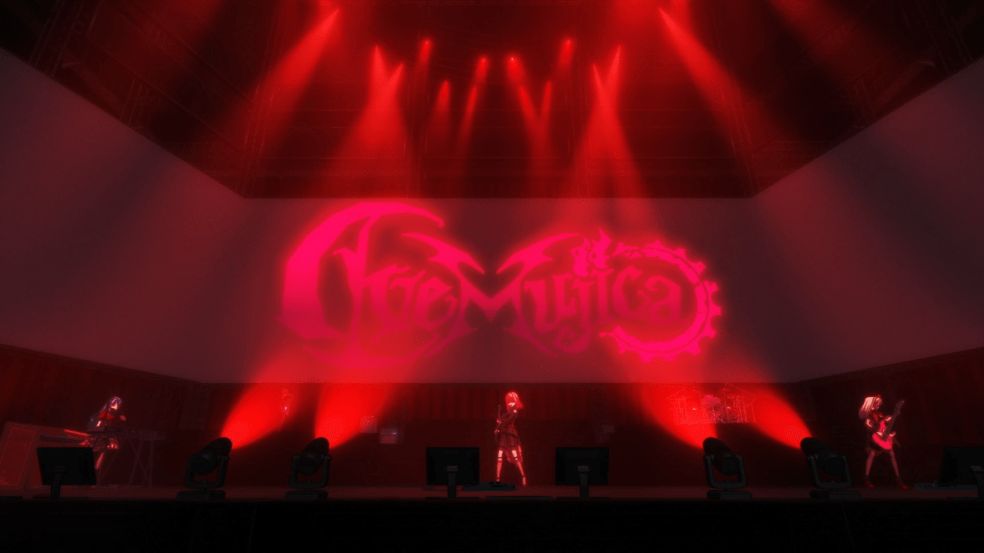
That tense, coiled sense of façade is also why it hits so hard when, in its very last episode, Ave Mujica finally lets all of that tension out. No one would walk away from this series thinking everything is neatly solved, but the finale is more concert than anime episode: 5 songs, two from MyGO, three from AveMuji themselves, all fantastic, and importantly, both bands are clearly having a blast. MyGO have the simpler story, but their sound has genuinely developed in some interesting directions, and centering a new song around Tomori’s jumbled, Jenga Tower-block poetry is never going to be a bad call.

Ave Mujica, meanwhile, have somehow gone stadium-level yet again (the episode’s lack of a traditional narrative leaves us in the dark about how that happened. Season three material, most likely). Their doll motifs replaced with a warped Round Table-style knightly mythos, Uika-Doloris as an amnesiac who finds herself returning to the embrace of Oblivionis, god of forgetfulness, over and over. Sakiko literally portraying herself as a deity within the world of the scripts is sure to have ramifications going forward as a plot point, but, consider that outside of the series itself, it also easily cements her as one of the most interesting and iconic characters of her generation. It has been way, way too long since we had someone to add to the Anime Girl Pantheon, and if Sakiko needs to actively force herself up alongside older legends like Lain, Haruhi, and Madoka, that’s all the better. It fits.

(Also, let’s just be honest here. Sakiko’s god complex is probably not great for her, mental health-wise, but if it’s making her write stuff like this, well, at some point you can’t argue with the music.)

As for the literalities of the last story arc, episodes eleven, twelve, and so on, it seems impossible that this won’t all fall down around them someday, possibly even someday soon.

So again, to ask the question, can tragedy deferred really be considered a happy ending? Even a bittersweet one?

Maybe we should reframe that, and turn it back on ourselves; can you be happy, knowing you will one day die? If Ave Mujica are a fleeting dream, that’s at least partly because everything is a fleeting dream. Any comparison between MyGO‘s “a series of moments adds up to a lifetime” and Ave Mujica‘s embrace of an illusory eternity needs to understand that, despite the obvious differences between these groups of people, these are fundamentally two ways to say the same thing. Something lasts forever until it doesn’t. You take things day by day, and one day is eventually the last one. (I don’t have much to say about this series, as I’ve made clear from how I’m framing this article, but I am a little surprised how rarely I’ve seen discussion of death in relation with Ave Mujica; Sakiko’s late mother is a shadow who looms over much of the series, and there is a broad implication that Uika’s sister, the actual Uika, is no longer with us either.)

I have spoken before in my work about hating the term “messy” and how it’s often used to paper over the flaws in works that a certain stripe of critic, myself very much included, like. Something is messy if it induces strong emotion but has some kind of missed shot or some kind of frustrating loose end. To that, I refuse to apply the term to Ave Mujica, even though I’m sure many other people will. Every time I had a doubt about this show, it proved me wrong. Mortis disappearing for much of the show’s final act? She shows up in the finale to wink at the mirror and reassure us she’s fine. Umiri “not getting” a proper character arc? Her tragic backstory is presented in a funny way, sure, but it’s as legitimate a reason for trauma as anything else, this stuff isn’t a competition. Not enough songs? The last episode has fucking five of them. The fact that Hatsune is down awful for her niece? That makes their relationship more interesting, and sure, more troubling. I won’t entertain any suggestion otherwise. You can’t catch Ave Mujica off guard.

Even if you could, the curious thing about something as arresting as Ave Mujica is that after a while one’s emotional attachment stops being to the work itself so much and more the general orbit of it. The characters make such an impression on screen that they will live in our hearts forever. There is also the actual band, of course, who are fantastic, and a small spiderweb of ancillary media that enhances and sharpens the show in a number of interesting ways. None of this softens the point that the show itself is excellent, of course, one of the best I’ve ever seen, but it is worth keeping in mind.

And if you don’t agree….well honestly that’s fine? Why is talking about anime expected to be didactic like this anyway?

Isn’t all of this sort of silly? Another thing Ave Mujica has made me realize is that, despite the fact that I enjoy writing about anime, I also kind of hate doing it. (A love-hate relationship that I am all too aware is ironically somewhat reflective of what I’m reviewing.) Not because I’ve lost any love of prose or any love of analyzing fiction, but because there is this constant unending pressure to be correct about everything. (Or at least, I feel that there is. Maybe this feeling says more about me than it does anything else.) I had an inkling of this back when I reviewed Wonder Egg Priority years ago, which is why the two are somewhat connected in my mind even though the reception to AveMuji has been much more positive overall. Most of my really fulfilling engagement with Ave Mujica has not stemmed from my collective efforts of reviewing it. (Longtime readers will probably remember that we are a system ourselves, and if you didn’t know, well, surprise.) I—Ediva—have gotten much more out of talking about it with others, making of it a living discourse as opposed to a series of endlessly prolix pages where I try to prove that my opinion is the right one, man!, than almost anything else I’ve ever seen. I, Opal, have written fucking fanfiction for this series, weird and outlandish fanfiction—fanfiction I would never in a million years link here, mind you!—that has made me feel so much more connected to its world and its characters than laying them down on a table to cut them open ever could. And I, Ollie, have simply reveled in the fact that I got to feel seen. It’s very rare for popular fiction to touch on systems. I am not going to quit writing about anime—this is not my version of Brent DiCrescenzo’s To the 5 Boroughs review—but Ave Mujica has once again made me reevaluate how I really think about this stuff. How I feel about this stuff. In a way, that’s a higher compliment than anything I could actually say about it could ever be. Here’s something that sounds like a joke but isn’t: in the previews for one of the later episodes, 10 I want to say, Sakiko was shown reading Hermann Hesse’s Demian. We decided to read it too—why not, right?—and loved it. Some shows are bigger than just what’s on the screen.

None of me are saying that any of this makes analysis of the series wrong. But it does, increasingly, feel wrong for us. This is a world to be lived in, an atmosphere to be breathed, and a dream to set drift upon. I can’t pin the butterfly to the board like that. If you can, I’m not going to tell you you’re doing something wrong, but it’s not the right fit for how we feel about this show. Hence this instead of a “proper” review. Hence leaving it all up in the air.

That’s a temporary solution, but this, too, is the beautiful paradox of Ave Mujica: we can stay asleep in this dream forever—Until we wake up.


Like what you’re reading? Consider following Magic Planet Anime to get notified when new articles go live. If you’d like to talk to other Magic Planet Anime readers, consider joining my Discord server! Also consider following me on AnilistBlueSky, or Tumblr and supporting me on Ko-Fi. If you want to read more of my work, consider heading over to the Directory to browse by category.

All views expressed on Magic Planet Anime are solely my own opinions and conclusions and should not be taken to reflect the opinions of any other persons, groups, or organizations. All text is manually typed and edited, and no machine learning or other automatic tools are used in the creation of Magic Planet Anime articles, with the exception of a basic spellchecker. However, some articles may have additional tags placed by WordPress. All text, excepting direct quotations, is owned by Magic Planet Anime. Do not duplicate without permission. All images are owned by their original copyright holders.

The Weekly Orbit [3/4/25]

The Weekly Orbit is a weekly(-ish) column collecting and refining my more casual anime- and manga-related thoughts from the previous week. Mostly, these are taken from my tumblr blog, and assume familiarity with the works covered. Be wary of spoilers!


So, just to be very honest dear readers, this one was a struggle to get finished. I think I’m in the middle of a depressive period again and, without getting too into it, getting this together at all was pretty tough. I hope you can forgive the relative lack of images once again this week. (I couldn’t even do a banner image this time, as something is wrong with WordPress’s image processor at the moment, seemingly? Sigh.) I’m not sure if I’ll be back to do this again next week or not.

Ave Mujica – Episode 9

In this past week’s episode of everyone’s favorite fun time girl’s band party, Uika thinks about murdering her former coworker. Ain’t it nice?

At this point, I’ve sort of run out of things to say about individual episodes of Ave Mujica beyond doubling back on praise I’ve already given it. The only issue with a show like this is that saying the same things about it over and over can get a bit dry: nonetheless, I will say that the psychodrama is on point as ever this week. Uika returns, gaining some actual focus for the first time in quite a while. This pays off magnificently since, well, yeah, she does in fact get a pointed intrusive thought about throwing Mutsumi down the stairs when the two meet for the first time since Ave Mujica’s breakup. If you’re worried about Mutsumi’s safety though, you should really be keeping more of an eye on Mortis, who accidentally “kills” her in headspace this episode. (She’s probably fine. Probably. Ignore that Mortis spends the rest of the episode pretending to be Mutsumi.)

The real highlight for me is actually the final scene of the episode, where, for the first time, every single member of MyGO and AveMuji have gathered in the same place: Livehouse RiNG, naturally. This feels like an absolute tempest waiting to happen, and Nyamu gets the final word of the episode in with a visceral reaction of disgust. Not an inappropriate response to “Mutsumi” (actually Mortis) bending to Umiri’s plan to get Ave Mujica back together. When part of your show’s central narrative has been compared by its director to a “double suicide,” you have to account for these things. Next episode looks like it will be even worse. (And thus even better.) What can I possibly say at this point? It’s simply great.

Mobile Suit Gundam GQuuuuuuXEpisodes 1-3*

The ridiculously-titled GQuuuuuuX is set to celebrate Gundam’s 45th anniversary when it premieres in April, but, as is common these days, the first three episodes have been stitched together and released as a theatrical film ahead of time to build hype for the series’ premiere. I happened to have the opportunity to go see this movie—a subtitled release, no less—in theaters here in Chicago. (I went with my girlfriend and we had a lovely time. Hi, CC!)

There are obvious disadvantages to the three-episodes-as-a-movie structure, but for the most part they’re not really a huge problem with the GQuuuuuuX film. But it is notable that the first third thereof is pretty different from the rest. The opening act is a broad-strokes, impressionist what-if of the original Mobile Suit Gundam, in which behelmeted antagonist Char Aznable [Shin Yuuki] steals (this continuity’s version of) the original Gundam before Amuro ever so much as shows up. From there, the entire One Year War that makes up the original series’ plot goes wildly differently, and this culminates with Char’s mysterious disappearance at the end of the first act. Evidently flung through time, Samurai Jack-style, after a plan goes awry and he’s confronted with Some Newtype Bullshit.

I’ll admit, as someone who’s very much a Gundam neophyte, the first act here was a little bit of a tough sell. It’s excellently-directed, and the faux-retro look works shockingly well, but from what comparatively little I’ve seen of 0079 I was not super attached to Char, so him being the viewpoint character for most of the film’s buildup did not immediately excite me even if I can recognize that it was well done. Instead, it is the remainder of the film that most interests me. GQuuuuuuX here pulls off the impressive trick of drawing a direct line through the original Gundam, through the “Daicon Spirit” school of anime—that’s the zeitgeist of Gainax and her stylistic descendants, if you need a refresher—up to the present day. The most surprising thing about this is that it’s not more common: a full-color illustration that “real robot” and “super robot” are just points on a graph, it’s what you draw between them that matters.

Once we leave the original 0079 setting behind, we set off for something that is decidedly this show’s own thing, and the obvious ambition on display here clicks into place. Izuna is a burned-out space colony patrolled by Zaku in police deco, and there’s a theme of class warfare run through the whole thing. Our main characters are a schoolgirl, Yuzuriha “Machu” Amate [Kurosawa Tomoyo], driven and curious, who is eventually drawn into a world of underground mecha fighting and hijacks a Zeon test unit, the titular GQuuuuuuX. a “courier” (read: smuggler) she falls in with, Nyaan [Ishikawa Yui], her tie to that world. Joining them for the movie’s final act is Itou Shuji [Tsuchiya Shinba], a graffiti artist who’s somehow come into possession of what used to be Char’s Gundam. The movie only just came out, so I don’t want to spoil too much beyond what I already have, so instead, I’ll just say that the presentation and atmosphere here is absolutely fantastic. Especially with regard to the action, you can really tell that the Diebuster guy [Tsurumaki Kazuya] is directing this.

Manga

Destroy It All & Love Me in Hell – Chapters 1-19

The girl band golden age has coincided with toxic yuri as a subgenre—or strain, or whatever you want to call it—of girls’ love media gaining about as much attention as it ever has. This, I feel, cannot possibly be a coincidence. While the girl band characters use their medium to entangle themselves in each others’ neuroses and, hopefully at least, eventually come to some kind of resolution, the toxic yuri manga needs no such pretense and no such happy ending.

A year and a half ago, I talked about the then-seven chapters of Destroy It All & Love Me in Hell, explaining the general idea and appeal of toxic romance as I did so. My opinion has more or less not changed now that I’ve caught back up with it quite some time later. I am really just in awe of how compelling this series makes two girls ruining each others’ lives. Since that initial post, Kokoro has gone off the deep end as well, becoming obsessive to the point of forcing herself on Kurumi at one point. We’ve also met a new character, a hanger-on of Naoi’s who is enough of a masochist that she resorts to trying to bribe the girl into treating her badly. All this to say, it’s as toxic as it’s ever been. This is really more of a PSA than anything else: yes, if you want to read the girlies despairing, it has remained very good at delivering that. There’s also something to be said, though, about Kurumi’s quest to live free of expectations, and how every step she’s taken, seemingly toward that goal, has ended her right back where she started. I may review this manga when it finally finishes, whenever that will be, since I’m very interested in how this story ends.


That’s about all for this week. As always, I ask that you make a contribution if you enjoyed this column and are able to do so.

In lieu of the usual Bonus Image, have two, taken from this unofficial translation of an event from the BanG Dream! game, where Tomori says that Taki reminds her of a coffee bean. It is cute enough that I may die.


Like what you’re reading? Consider following Magic Planet Anime to get notified when new articles go live. If you’d like to talk to other Magic Planet Anime readers, consider joining my Discord server! Also consider following me on AnilistBlueSky, or Tumblr and supporting me on Ko-Fi. If you want to read more of my work, consider heading over to the Directory to browse by category. If you’re looking for me to watch a specific show, watch this space. I am planning to reopen commissions in the near future.

All views expressed on Magic Planet Anime are solely my own opinions and conclusions and should not be taken to reflect the opinions of any other persons, groups, or organizations. All text is manually typed and edited, and no machine learning or other automatic tools are used in the creation of Magic Planet Anime articles, with the exception of a basic spellchecker. However, some articles may have additional tags placed by WordPress. All text, excepting direct quotations, is owned by Magic Planet Anime. Do not duplicate without permission. All images are owned by their original copyright holders.

The Weekly Orbit [2/11/25]

The Weekly Orbit is a weekly(-ish) column collecting and refining my more casual anime- and manga-related thoughts from the previous week. Mostly, these are taken from my tumblr blog, and assume familiarity with the works covered. Be wary of spoilers!


Another week, another batch of girlies being absolutely dramatic. I’ll be honest, between the seasonals and the manga I read for this column, this might have the highest “girlies being dramatic” ratio of anything I’ve written in a long long while. I’d say in this respect at least, I’m living my best life. I hope you are too.


Anime – Seasonal

Ave Mujica – Episode 6

Every week I walk in to the torment nexus and walk out with my heart broken in three places. What a show.

Some interesting play with structure and framing this episode. At last week’s conclusion Soyo was shown discovering Mortis, and the whole scene was framed in slasher movie tones. Here, now that she has a better idea of Mortis’ whole, you know, thing, Mortis is instead framed as the angry, lost girl that she really is. I really enjoyed (and did not at all expect) Soyo actually playing along with Mortis’ whole ‘calling the doctor’ bit, it shows a pretty deep empathy that I don’t really know if we’ve seen the character express before? (It’s been a while since I watched MyGO, so I may be forgetting something.) Also, she apparently spends 3 whole days sleeping over there trying to patch things up, which, while there’s definitely a selfish aspect to her motive (she misses CRYCHiC too, after all), I still think deserves serious real one points. I don’t think I’d have the emotional stamina to spend 3 whole days consoling anyone about anything.

Full credit to Rana also, who can just intuit what’s going on with Mortis and Mutsumi without even actually being told. (She doesn’t actually go out of her way to help, though, and spends a decent amount of time this episode playing with cats. Rana remains this subseries’ most mysterious character.) Mortis actually seems to develop a bit of a crush on her, and is that a twinge of jealousy I detect from Soyo about that fact? In the tumblr version of this post I made a joke about the relationship chart this series must have, and then they just actually published one. Way to undercut my quips, Bushiroad.

I like Umiri’s brief scene in this episode. Forever the eternal mercenary, she describes the breakup of Ave Mujica as though it happened around her and not to her. And yet when Ricky Taki calls her on this, she gets annoyed. Truly the “fake ass IDGF’er” meme in human form.

The first half of this episode, I must stress, is actually pretty light by this show’s standards. So of course, there needs to be a breaking point somewhere. Here, that breaking point is between Mortis and Mutsumi, who stirs for the first time in a solid month only to find how awry things have gone in her absence. This isn’t what she wanted, and Mortis is appalled to learn so. The two have an argument in headspace, which of course to anyone outside of the Mutsumi-Mortis system’s own head just looks like an argument with herself, and she actually carries on so bad that she ends up tripping and falling in front of Live House Ring and making a huge scene, which of course a throng of anonymous busybodies are nearby to witness. It’s SO much that it would come off as contrived if the show weren’t so set on showing us how badly this is fucking over Mutsumi and Mortis. It’s hard to watch.

There is something admirable about the show’s complete lack of handholding with this kind of thing. This episode alone depicts multiple conflicts within a fully-realized mental space, a tug-of-war between Mortis and Mutsumi for their collective fate that is just profoundly sad to witness. I do wonder how legible this is to audiences who aren’t plural. Part of me is worried this series might actually be too ahead of its time for most audiences to properly appreciate.

(I’ve barely talked about Sakiko here and she is absolutely going through it up and down this entire episode. From the horrible, obviously untrue claims she makes about not caring about either band or even about Mutsumi, to the folder of sticky notes she’s gotten from Tomori over the years, to the fact that she sadly looks for another one despite telling Tomori off for them last week. To. This fucking expression, just, god.)

There’s a mostly-lighthearted interlude with Nyamu (it remains really funny that her dark secret, compared to everyone else’s, seems to just be that she’s from the sticks), but even that is twinged with her finding out about Mortis and Mutsumi’s public breakdown. The episode then ends with MyGO finding out about Sakiko’s whole extremely fucking complicated family situation. Episode 7 is entitled “Post nubila Phoebus,” “after the clouds, the Sun.” In most other contexts that would be a shining beam of hope, and maybe it is here too, but I’m fairly sure things will get worse before they get better. (Recall, we still have no idea what’s going on with Uika, just as one example, and she’s the only character from either band who doesn’t put in even a cursory appearance in this episode. Where is she!)

Flower and Asura – Episodes 2-5

I don’t usually try to predict how an anime will end before it gets there. But, by the same token, I tend to usually have at least a broad idea of what something “is doing” for most of its run. A first episode or so might need some room to establish itself, but by the halfway point of a series, one can usually figure out its whole deal with relative ease, especially if you’ve been watching anime for a while. All this is the long way around to say; I don’t get caught out by an anime very often. When I’m surprised it’s usually the addition of some new element, as opposed to something I had just outright been misunderstanding. Flower and Asura thus gets to join a pretty exclusive club with its fifth episode, and I am left to consider if I’ve maybe been underrating the show a little. (And by the time you’re reading this another episode will have aired, sigh! The unrelenting march of time.)

The gist is this: so far, Flower and Asura has largely been presented through the eyes of its main character, Hana. Hana’s insecurities and need to find a way to express herself defined the first episode or two of the series, and—perhaps this is the show’s fault, but I’m more inclined to blame myself—because of that, I had not really given terribly much consideration to the interiority of the show’s other characters. Natsue An, the snippy girl with the twin-tails, is a direct challenge to this, in her interactions with Hana she essentially addresses the viewer directly. This is the case with the rest of the cast, but the other two members’ inner lives we’ve explored to any extent are those of Mizuki, the free-spirited upperclassman that recruited Hana in the first place, and Ryouko, who, while not exactly a one-note character, has a deep interest in classic literature that aligns her nicely with Hana and Mizuki’s philosophy that recitation is primarily an art. The NHK Cup, the tournament looming in the show’s background, is to them secondary to reading what they want to be reading, and Ryouko says as much directly. Winning is not hugely important to either of them. (Certainly not to Ryouko, whose gleeful joy at the ancient drama frozen in glass by the Japanese Classics is outright described in-show as fetishistic. I feel very strongly I would get along with this character.)

Natsue is an irregularity here. She actually wants to win the Cup. As such, she’s not performing literary recitations like the characters we’ve discussed so far but rather a technical program, an altogether different thing that relies on a different skillset. Despite their different paths, Natsue is clearly at least appreciative of Hana’s talent, and, in her particularly brusque way, urges her to choose Kafka’s The Metamorphosis from among the available works to read a selection from. This is in contrast to Hana’s own desire to read from a contemporary work. (A work which in fact appears to be about a romance between two girls. Subtle.) If we’re just judging on taste, Natsue is clearly completely right; Hana’s particular timbre, especially the lower and more menacing end of her arsenal, which we know of from episode one, would lend itself very well to something as dark as The Metamorphosis. But this just isn’t what Hana wants to do, and it’s easy to read Natsue’s insistence that she do it as jealousy. It makes almost too much sense, right? Natsue, clearly someone who has very strong opinions on literature from her insistence on Hana’s selection and her denigration of the book Hana actually wants to read as shallow, would rather be doing recitation, right? I certainly read things that way. But we should stop ourselves here, because what that assumption actually is, I am a little embarrassed to say, is probably just projection.

Natsue, after an entire episode of Hana bugging her about it (including a magnetic—and also kind of embarrassing!—scene where Hana actually recites from the book she is planning to read from. In public, where the whole student body can see it), eventually explains that no, the real reason she’s so set on winning the tournament is nothing this complicated. She relates an anecdote from middle school where, in that school’s broadcasting club, an enthusiastic friend was selected to go to the nationals over her. Despite that friend’s insistence that Natsue was actually better at recitation than she was, the condescension—intentional or not—stung more than the actual failure. It has nothing to do with her specific talents and everything to do with just wanting to win in the first place.

Hana is left with the figurative egg on her face, although it’s not so bad, given that this causes the two to actually roughly get along for the first time in the entire show. Still, there’s an important point in there about not just assuming motives for this sort of thing. A point well made to both high school girls and, it turns out, anime critics more than a decade removed from high school.

All this and I’ve barely mentioned how utterly gay Mizuki and Hana’s entire relationship is. How embarrassing!

You and Idol Precure – Episodes 1 & 2

Idol anime are dead, long live idol anime.

Really interesting stuff with this show these past two episodes. Very clearly this is trying to be an “old school” Precure season in that it’s very physical and has a certain kind of comedy that’s been absent for the past couple years. Some people have been a little down on this but to be honest I’m really enjoying it, especially the return of the fisticuffs after an absence in Wonderful. (Not that that show needed them, but it’s always good to have some punching.) Our lead, Uta, alias Cure Idol [Matsuoka Misato], is probably the goofiest main Cure we’ve had in a while. I’m here for it. (That said, it seems like the blue Cure is going to have A Somewhat Sad Backstory and if I know myself I’m going to probably like her most, but who knows.)

Manga

Black and White: Tough Love at the Office

In the best possible way: this is wretched.

What we have here is a yuri manga where the “girls love” is two women, Shirakawa Junko and Kuroda Kayo, attempting to just completely destroy each others’ professional and personal lives over the course of several months after they begin working together in the same department of a bank. There’s a lot of talk about “toxic yuri” in the air right now, moreso than ever before I think, but this is a pretty potent strain of the stuff. These two are bad for each other, they don’t like each other, they become psychologically obsessed with each other, and their “intimacy” consists of violent, questionably-consensual sexual encounters where they alternate between actually fucking and throwing punches and the like at each other. It’s violent! Very violent!

None of this is a complaint of course, the primal and twisted nature of these scenes—which there are really only a couple throughout the whole manga, and they’re all pretty brief—is a big part of the point. There’s an idea floated here that while these two women are both trapped within the financial system that employs them, they’re at each others’ throats. Junko is BY FAR the more vicious of the two, and once Kayo starts seeing another woman, she gets that woman, a fund manager, fired for financial fraud. And yet, when the manga ends, Junko finds herself a pawn of the shadiest parts of the company she works for, possibly for the rest of her life, despite being “successful” in the business sense (and having picked up a new partner along the way). It’s Kayo who gets off with the comparatively happy ending; she quits the company entirely, and leaves to pursue love and happiness, things more important than success and failure. It’s honestly a surprisingly romantic ending for something that’s otherwise so vicious. Of course, not for Junko, who in the final page of the manga literally vanishes into darkness to join the other behind-the-scenes power brokers who run the company and Japan’s finances in general. I guess who really “won” is a matter of perspective, but I know who I’d rather be. (And not just because I’d rather have Junko making all of those twisted, sadistic grimaces at me, but you didn’t hear me say that.)


And that’ll do us for the second week of February. As with last week, I’m going to directly request that you drop a donation if you like reading these columns. They’re my only source of income, and every penny really does help a lot.

See you next week, but before I go, allow me to leave you with this week’s Bonus Thought, a sacred legend from the old days.


Like what you’re reading? Consider following Magic Planet Anime to get notified when new articles go live. If you’d like to talk to other Magic Planet Anime readers, consider joining my Discord server! Also consider following me on AnilistBlueSky, or Tumblr and supporting me on Ko-Fi. If you want to read more of my work, consider heading over to the Directory to browse by category. If you’re looking for me to watch a specific show, watch this space. I am planning to reopen commissions in the near future.

All views expressed on Magic Planet Anime are solely my own opinions and conclusions and should not be taken to reflect the opinions of any other persons, groups, or organizations. All text is manually typed and edited, and no machine learning or other automatic tools are used in the creation of Magic Planet Anime articles, with the exception of a basic spellchecker. However, some articles may have additional tags placed by WordPress. All text, excepting direct quotations, is owned by Magic Planet Anime. Do not duplicate without permission. All images are owned by their original copyright holders.

Seasonal First Impressions: Pining For Those SAKAMOTO DAYS

Seasonal First Impressions is a column where I detail my thoughts, however brief or long, about a currently-airing anime’s first episode or so.


Picture a killer of legend. The kind of man whose very presence makes the blood of his foes freeze in their veins. Picture an unstoppable, elemental force of violence. Add gray hair and a pair of round spectacles, and you’ve got Taro Sakomoto [Sugita Tomokazu]. Now, picture what it would take to tame that man. Picture what could remove him from this life of ceaseless bloodshed. What could that be? What could possibly get him to hang up his gun?

Well, a pretty store clerk with a winning smile is probably a good start.

This, the tale of an ostensibly-retired uber-hitman, is Sakamoto Days. It’s a member of a particular genre that’s found increased purchase in recent years, a kind of post-Spy x Family melding of action anime with the domestic comedy. Usually involving a fundamentally good natured protagonist who can, nonetheless, throw down with the best of them. Spy x Family has the likable but duplicitous Loid Forger. Kindergarten Wars has its single woman—seeking good man—in Rita. And of course, Sakamoto Days has Sakamoto himself. Sakamoto Days has been a favorite among Jump readers in the know for a good while now, and thus this adaptation comes with a pretty weighty set of expectations placed upon it. For my purposes, I’m not super interested in engaging with that, although I will say this is the rare case of a shonen manga I actually follow somewhat regularly getting adapted into animation, so I’m happy for the series if nothing else. (It’ll be joined in this category by Witch Watch, also from Shonen Jump, later this year.)

Our story really begins when Shin [Shimazaki Nobunaga], formerly one of Sakamoto’s partners-in-crime, is tasked with killing the man. He left “the organization” which he and Shin both belonged to without permission and thus, he’s gotta die. Shin is initially perfectly willing to go along with this, and when he first sees the retired Sakamoto, he’s upset by what comes off to him as weakness. Most obviously, Sakamoto has put on quite a lot of weight in the five years since he retired, and we should take a quick detour to talk about this.

So! Fat jokes! There’s quite a few of them in Sakamoto Days. In the anglosphere, these have generally been considered in poor taste for a good 20 years now, but obviously, this isn’t the case everywhere. I reiterate all this basic-ass explanation of cultural differences just to say, as someone who’s also fairly big, I am not super upset by how Sakamoto Days handles its main character in this regard, even later on when we get into less-jokey but arguably dicier territory. I also think it helps that the character himself seems to have a good sense of humor about it (check the “Slim” shirt in the picture above). But if you are upset by it, I get that, and I’m also not going to tell you you Need To Get Over It or whatever other piece of canned finger-wagging rhetoric a certain kind of anime fan is sure to lean on when people want to discuss this subject. This is an area on which people will understandably be pretty polarized. So at the risk of making it seem more serious than it necessarily is, I think it’s important to just acknowledge that this specific subject gets under some peoples’ skin, and that’s fine. I have a very live and let live approach to arguably-problematic material in the arts, and this is no different a case than anything else, it’s just somewhat new territory for anime I’ve covered on this site specifically.

It is worth noting though, that Shin’s initial judgement of Sakamoto is wholly incorrect. He sees Sakamoto, now grown happy and fat and the proud proprietor of a small konbini with his wife [Aoi, played by Touyama Nao] and their adorable daughter [Hina, played by Kino Hina, no relation], and assumes he’s grown soft in a metaphorical sense, too. This is not so.

Despite some reluctance once he senses that Sakamoto’s killer instincts haven’t actually dulled terribly much—he’s an esper, and can read minds, and is thus treated to Sakamoto’s amusingly gory idle fantasies of stabbing him to death—Shin is eventually convinced to try taking him out. This goes poorly for him, and this is where we get to the anime’s biggest strength.

All told, it is simply just a solid, good translation of the manga’s inventive action scenes to animation. Sakamoto immediately gets to flex both his wits and his still-sharp combat skills here, deflecting a pistol bullet with a gumball and using various other random objects around his store to render Shin harmless. There’s too much slow-mo, and the presence of merely some traditional sakuga instead of wall to wall sakuga will leave some unhappy, but so far, there’s really not a lot to complain about. (I’ve seen some scuttlebutt about the color palette, too. But honestly I think the gritty, somewhat dingy look works well for this series.) The vibe is captured pretty much perfectly.

These setpieces are what Sakamoto Days is about. There is a story, to be sure, a decently interesting one at that, where various characters are torn between the sprawling assassin underworld and the call of a normal, quiet life. There’s comedy, which is amusing if rarely laugh-out-loud funny. And there are also some quite sweet domestic scenes, as well. But the real main concern of Sakamoto Days are these setpieces, wild everything-but-the-kitchen-sink affairs that grew only moreso as the manga went on, and which make a good first showing here. There’s an escalation in the first episode already, even, as Sakamoto opts to rescue Shin once his employers try to take him out for not fulfilling his contract. This second scene is even flashier, all glinting gunmetal, roundhouse kicks, and taser lightning as Sakamoto cuts through a warehouse of goons with ease.

The sell is simply this, if you liked those scenes, you’ll get a kick out of Sakamoto Days. If you like the scene afterward, where Sakamoto hires Shin as an employee at his store, since the esper has nowhere else to go, you’ll like Sakamoto Days a lot. What you see is what you get. I think what we see is pretty cool.


Like what you’re reading? Consider following Magic Planet Anime to get notified when new articles go live. If you’d like to talk to other Magic Planet Anime readers, consider joining my Discord server! Also consider following me on AnilistBlueSky, or Tumblr and supporting me on Ko-Fi. If you want to read more of my work, consider heading over to the Directory to browse by category. If you’re looking for me to watch a specific show, watch this space. I am planning to reopen commissions in the near future.

All views expressed on Magic Planet Anime are solely my own opinions and conclusions and should not be taken to reflect the opinions of any other persons, groups, or organizations. All text is manually typed and edited, and no machine learning or other automatic tools are used in the creation of Magic Planet Anime articles, with the exception of a basic spellchecker. However, some articles may have additional tags placed by WordPress. All text, excepting direct quotations, is owned by Magic Planet Anime. Do not duplicate without permission. All images are owned by their original copyright holders.

Seasonal First Impressions: Mysteries, Medicine, and Malpractice in AMEKU M.D.: DOCTOR DETECTIVE

Seasonal First Impressions is a column where I detail my thoughts, however brief or long, about a currently-airing anime’s first episode or so.


On a basic level, aside from the fact that I want to watch anime premieres for their own sake, the main question I’m seeking to answer with a lot of my first impression writeups is this: is this given show, provided you’re in to what it’s trying to do, worth your time? Admittedly a very straightforward and mercenary time-is-money way to look at things, but when so much anime is being made every season, it’s a necessity. Separating the wheat from the chaff is not always easy, but something that at least makes the case that a show might be interesting is a novel premise. Ameku M.D.: Doctor Detective, awkward punctuation and all, has that. I’ll give it to you in one sentence; Ameku would like you to go into it thinking that it’s House, M.D., but with an anime girl. For some of you, that’s going to be enough of a sell that you’ve probably already tabbed away from this article to pull it up on Crunchyroll. I’m not sure if you’ll like what the show is actually doing, but godspeed and good luck.

For the rest of you who might be interested in the particulars, let me get this out of the way: unlike many other LGBTQ millennials I know, I’ve never really liked House. Not that I ever watched a ton of it, but it very much did not seem like my sort of mystery series from what little I did see. Also, while this is not the show’s fault, the whole thing with it “never being Lupus” hits a little differently when your mother suffers from chronic Lupus flare-ups. (Ameku M.D. actually makes reference to this little meme almost immediately, which soured me on the show right out the gate pretty hard.)

Suffice to say, the deck was stacked against this series from the very beginning, at least as far as I’m concerned. Still, something can be not for me but still be worthwhile, so I committed to watching the whole premiere regardless. Having now seen the first two episodes (they released in tandem), I’m still unsure if I’ll watch more, but I am glad I gave it a chance, because, as it turns out, this House influence is sort of a feint.

The first episode opens with our main character, Ameku Takao [Sakura Ayane], rapid-fire solving a pair of mysterious diagnoses in the hospital she works at, quickly deducing that a young boy’s mysterious nerve pain is caused by a Vitamin A overdose, and that an older gentleman’s agony of the stomach is the result of accidentally ingesting a fish parasite. In both cases, she makes the prognosis in a vaguely judgey way, and, going off of my admittedly very limited exposure to that series, this is the part that’s more or less “like House.” After this introductory segment though, the show promptly takes an abrupt swerve, and it’s here where we need to draw attention to the series’ English language subtitle, Doctor Detective. Because that is a much more honest indication of what this series is trying to be, as is the title of the first episode, the hilariously on-the-nose “Dr. Sherlock.”

Not long after Dr. Ameku solves these little mysteries, a much bigger one rears its head as a man is rushed to the emergency room, where he promptly dies. (My understanding is that House rarely if ever dealt with outright murders, so that’ll be another difference.) Two curious details make themselves immediately obvious; this man had his leg bitten off by a very large predator, and his blood is inexplicably a bright blue color. The victim and detective thus present, the stage is set for what’s actually a pretty typical murder mystery. An interesting one, at that. I won’t spoil the specifics of what precisely occurred (I’m not sure if the series is strictly fair-play, but I wouldn’t be surprised if it were), but this mystery, and Dr. Ameku’s eventual unraveling of it, complete with the denouement-inducing catchphrase “let me give you my diagnosis”, and a very fun little sequence where she’s depicted “putting the clues together” by floating in a sphere of abstract math, is very much in the vein of of an orthodox whodunnit. It’s just that the detective is, again per the subtitle, also a doctor, and therefore there’s a bit of a medical focus.

She’s pretty entertaining as she does it, too. Dr. Ameku is the kind of smugly charismatic lead you want in something like this, she’s incredibly immature (said the anime blogger) but also extremely intelligent. The Sherlock comparisons make themselves obvious in the way she picks up on seemingly random details as vital clues. All of this is stuff that’s been done before, of course, but it’s well-executed here, and Takao is, overall, a very watchable protagonist. It helps that she’s got a solid supporting cast already as well. Mostly, this consists of her very own Watson, Takanashi Yuu [Ono Kenshou], also a medical professional—and an impressive karateka!—but much less of a detective, who asks just the right questions to set Dr. Ameku up to deliver her precision diagnoses. But there’s also Takao’s uncle, a different Dr. Ameku [Tachiki Fumihiko], who owns the hospital that she works at, and with whom she appears to have quite a lot of friction. (The elder Dr. Ameku, perhaps understandably, does not like one of his doctors playing Columbo in her off hours.) Speaking of Columbo-a-likes, Takao also has a contact in the police department, the trenchcoated detective Sakurai Kimiyasu [Hirata Hiroaki], who was in this case mostly cooperative, but who seems poised to evolve into an interesting foil later on.

Visually, the show goes for a restrained, mostly realistic look. Given the studio involved here, the somewhat infamous project no. 9, I’m a little surprised at how well they pull this off. The series is, for sure, visually unshowy, but it’s a clean, grounded look, heavy on greys and blues, that works well for a detective series, even one that has lines of dialogue like this in its very first case.

All told, despite my initial misgivings there’s some real promise here, and I’ll say the show is solidly worth checking out. A post-credits scene seems to indicate that the cases will only ramp up in stakes from here, which is good, since if we simmered back down to stuff like “a kid accidentally ate a ridiculous amount of blueberries and gave himself Vitamin A poisoning” I think we’d be in for a much less interesting show. I’ll say this much, this is the first 2025 anime I’ve watched anything of at all, and simply by virtue of having a novel premise that it does fairly well, Doctor Detective here is well ahead both of how I started last year’s anime and, honestly, much of the pack for this season, if what else has aired so far is any indication. I’m pleasantly surprised, given my initial bias against what I thought this series was going to be. As I said up at the top of this piece, I still don’t know if I’ll watch much more of this, but if I do, don’t be surprised to hear about Ameku M.D. here on Magic Planet Anime again.


Like what you’re reading? Consider following Magic Planet Anime to get notified when new articles go live. If you’d like to talk to other Magic Planet Anime readers, consider joining my Discord server! Also consider following me on AnilistBlueSky, or Tumblr and supporting me on Ko-Fi. If you want to read more of my work, consider heading over to the Directory to browse by category. If you’re looking for me to watch a specific show, watch this space. I am planning to reopen commissions in the near future.

All views expressed on Magic Planet Anime are solely my own opinions and conclusions and should not be taken to reflect the opinions of any other persons, groups, or organizations. All text is manually typed and edited, and no machine learning or other automatic tools are used in the creation of Magic Planet Anime articles, with the exception of a basic spellchecker. However, some articles may have additional tags placed by WordPress. All text, excepting direct quotations, is owned by Magic Planet Anime. Do not duplicate without permission. All images are owned by their original copyright holders.