The Shambolic Anime Podcast Presents: Discussing ALIEN NINE

Today on the rarely-seen, once-in-a-while when we feel up to it Shambolic Anime podcast, my co-host Julian M. and I discuss seminal 2000s miniseries Alien Nine, and the manga it’s based on. Mind the content warning at the start of the episode, and enjoy!


If you want to read more of my work, consider heading over to the Directory to browse by category.

All views expressed on Magic Planet Anime are solely my own opinions and conclusions and should not be taken to reflect the opinions of any other persons, groups, or organizations. All text, excepting direct quotations, is owned by Magic Planet Anime. Do not duplicate without permission. All images are owned by their original copyright holders.
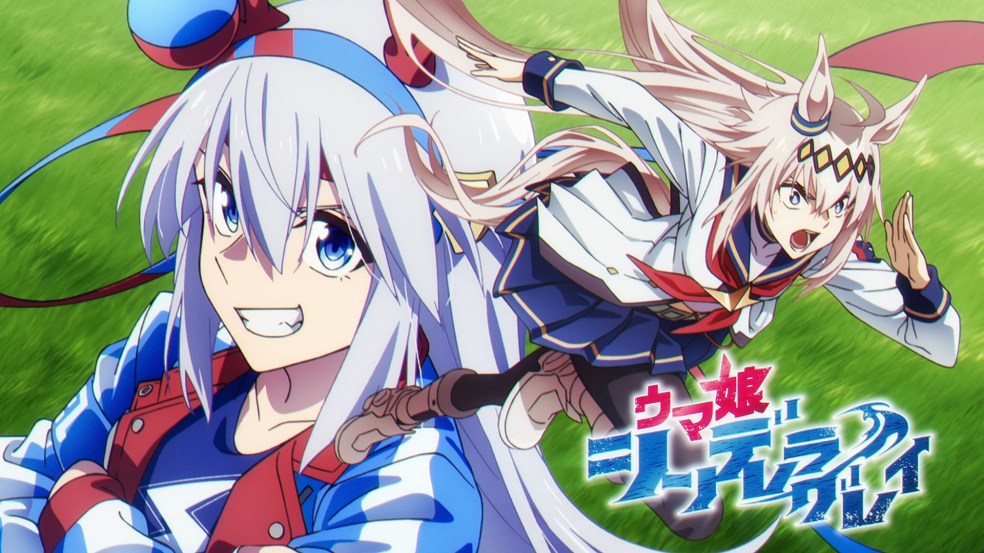
Let’s Watch: UMA MUSUME – CINDERELLA GRAY Episode 4 – “The Junior Crown”

Let’s Watch is a weekly(?) recap column where I follow an anime for the course of its entire(?) runtime. Expect spoilers!


I have not written a recap article for a currently-airing anime in nearly two years. It’s a surprisingly tough thing to nail down, at least if you want to write a good one. One has to capture the literal events of the episode, sure, but also nail its essence. What does the episode mean? Where is the show going from here? How does it fit into the contemporary landscape? What trends does it point to, present and future?

It’s a lot to consider, and that, combined with the inherent time pressure, is why I’ve largely dropped them from Magic Planet Anime. We’re making an exception today, because Cinderella Gray is, very plainly, the best thing airing right now. Despite—or perhaps because— of the fact that it’s “just” a very, very good sports series. There is a lot of great stuff airing right now (none of which I’m trying to knock), so that’s a big claim, but I stand by it. I haven’t really been beating the drum about the show as hard as I feel like I could be, and not everyone who reads these articles necessarily follows me on social media. Thus; this article. Hopefully the first of many, we’ll see.

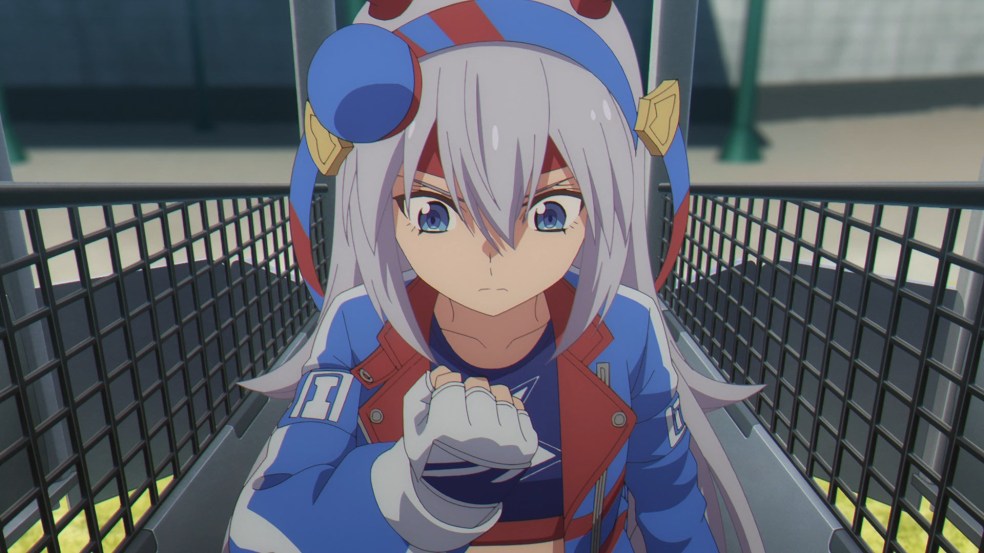
It’s been a few weeks since I first wrote about Cinderella Gray, so let’s get up to speed real quick. After the first episode’s blowout, the second saw Oguri Cap take on Fujimasa March, the other extremely gifted, ash-haired horse girl at their school. That episode ends on a cliffhanger, and the third revealed that March narrowly edged Oguri Cap out of the victory in their first race together. The win wasn’t so definitive that she couldn’t attribute the victory to outside factors and, indeed, she becomes a little obsessed with trying to prove that she can beat Oguri fair and square. (This isn’t even an unreasonable thing to think; we also learned that Oguri’s old racing shoes were in absolutely terrible condition.) Episode three also saw Cap win a different race, absolutely demolishing the other racers and winning both the race itself and—I’m just gonna assume anyone reading this recap on my site is as yuri-brained as I am—the heart of gyaru horse girl / bully Norn Ace. Later, some more training led her to have a long, extremely shonen rival-y conversation with March, who directly challenged her to the Junior Crown.

This little conversation sets something inside Oguri alight. And that’s more or less where we begin this week. There’s a short sequence at the very top of the episode where Belno Light, Oguri’s gal pal and teammate, enters her own first race and loses quite badly. But I imagine we’ll be circling back around to her own story at a later date, as the vast majority of this episode is about Oguri, March, and this rivalry that’s grown between them.

It’s worth zeroing in on March’s line from the third episode; Without a peak to aim for there’s no point in climbing the mountain. We can make our little jokes, obviously—“peak” has taken on an adjectival meaning in English anime fandom over the past half decade, and it’s one that suits this series quite well—but it is really important that we don’t lose sight of this central metaphor.

When first asked about it, Oguri Cap is just grateful she can run at all. We already know from past episodes that when she was younger she could barely walk at all and it took active intervention on her mother’s part to turn her into the athlete she is today. This is great on its own of course, and it’s genuinely touching how truly grateful she seems to be that she can exert herself in the way she can, but this is a sports series. Oguri feels she has something to prove now.

There is an immense amount of appeal, in fact, just in watching Oguri do her thing, whether training or actually running. Aside from being a massively-endearing protagonist in the “strong but a bit of a doofus” mold (like dozens of classic shonen characters), there is a real joy to seeing her determination harden and sharpen now that she has a rival. At one point in this episode, she reveals that she’s been training with extremely heavy cleats on, a modern update on the whole “weighted clothing” trope from countless battle manga (which is promptly called attention to).

When the actual Junior Crown begins, Oguri’s trainer Jou takes note of her newfound motivation, self-deprecatingly quipping that he sometimes wonders why he’s there at all. This promptly gets him an earful from the episode’s new character; Jou’s uncle Musaka “Roppei” Ginjirou [Ootsuka Houchuu], also a horsegirl trainer, unexpectedly in town from Tokyo on vacation and scoping out the Junior Crown apparently on a whim.

Oguri Cap isn’t the only one training, of course. We get a look at March doing some “image training” (a minor obsession for this series, it played a fairly big role in Season 2), trying to imagine every possible scenario on the racetrack and conceiving of how to beat Oguri every single time. She claims to have thought up 100 different possibilities by the end of this scene, and given the fun visual of her dreaming up the blue and red colored ghosts of Cap and herself in the void of her own imagination, it’s easy to believe her.

There’s also an interesting contrast drawn between the relationships Oguri and March have to their trainers. Despite Jou’s self-effacing remark, it’s clear that Oguri likes and trusts him, and he has in fact contributed somewhat to developing her strengths. March’s trainer, meanwhile, gives her a presentation on the race, which she completely ignores in favor of her “concentration,” even going so far as to tell him to shut up. Whether this is something the series will continue to focus on as it goes forward is for those reading the original manga to know, but the difference is interesting, perhaps remarking on trust between trainer and athlete as just as important a component in a well-rounded competitor as anything else.

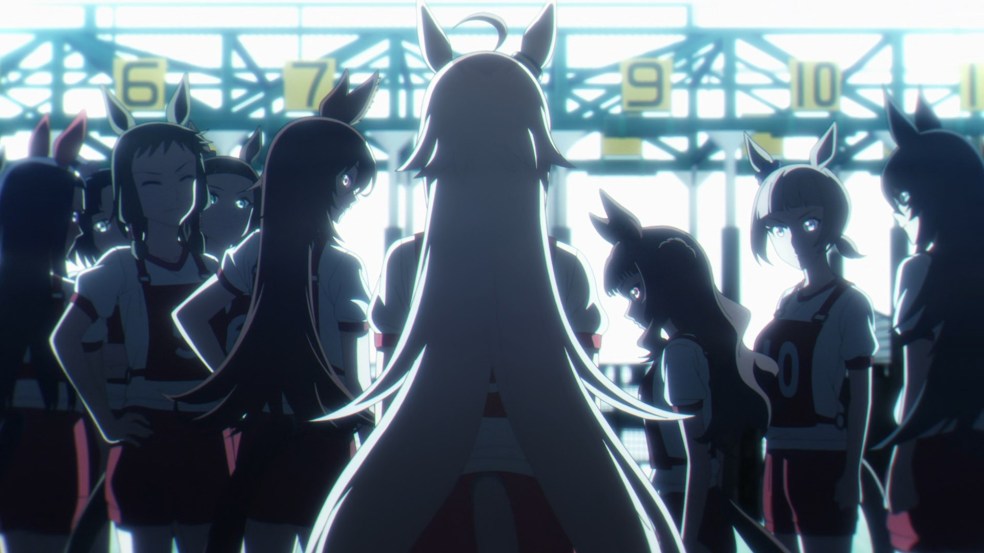
All of this leads up to the race, of course, and the Junior Crown is probably the show’s high point thus far. The race takes up a decent chunk of the episode, and we can basically break it down into two main parts, structurally-speaking. Firstly, there’s the race itself, which visually focuses on the actual motions of the racers as well as their mentalities while on the field, including a few full-on flashbacks to provide motivation, context, and color. (And toward the end we get some of the truly spectacular “auras” literally coloring the racers, a favorite technique of this series.) Secondly, there is the commentary, mostly coming from Jou and Belno who are watching in the stands, but also occasionally from Ginjirou and from an observing Tamamo Cross [Oozora Naomi], an uma musume visiting from Tokyo, who attends Tracen Academy, the prestigious racing school that is also the main setting of the three mainline Uma Musume seasons.

The race is spectacular. There’s a really great exchange between Cap and March just before the race begins, where Oguri interrupts March’s image training (which she’s still doing even as she prepares to run the actual race!), to say this.

I could write an entire separate article about the absolutely incredible character work the show has done with Oguri Cap so far. She’s goofy and silly often enough, and for just long enough, that as the audience we get sort of tricked into forgetting that she’s also basically Goku. This single line, probably the closest thing Oguri has offered so far in the series to a taunt, has more character in it than some anime’s entire casts. March, for the record, offers a shocked expression, but then a grin. This is largely a battle between the two of them, and they both know it.

Following on from the first three episodes, the racing in Cinderella Gray is a little less overtly fantastical than the approach taken in some more recent material from the series (certainly it’s quite a bit more grounded than the fantastical imagery in, say, New Era). But this isn’t a criticism, the grittier approach works really well for Cinderella Gray, and this race is probably the best demonstration of it yet. Particular attention is paid to Oguri Cap’s unique, low-to-the-ground stride, pointed out as a distinctive feature of her racing style as early as episode one.

Throughout, the race is a tug-of-war between Oguri Cap and Fujimasa March. (Spare a thought for Okan Maker, an extra who’s in the lead for a decent bit of the race but ends up left in the dust by both of them.) Accordingly we hear a lot from Fujimasa March. We even get a flashback showing how she’s been dedicated to winning her entire life, starting from when she was a child. In fact, much of the tone during the latter half of the race seems to sell the idea that March is going to inch out a win. She’s ahead of Oguri—admittedly just barely—starting after they both launch into a burst of speed at the same time. But what every single thing and person in the episode raising the flag that this is March’s race doesn’t understand is that Oguri Cap is….I mean, there’s no way to put it politely. She’s a monster.

The very last stretch of the race is spectacular, and here Cinderella Gray does lean into the more overt, battle shonen-esque stylings of some of its predecessors. That it’s only in such a short burst actually heightens its impact; just as March thinks she’s cinched the win, Oguri pulls a second burst of speed out of nowhere, treated with all the suddenness and gravitas of a warrior revealing a secret technique, and just like that, March is simply done.

Oguri Cap storms to victory, and the first arc of the series comes to a close.

After the race, March, initially in complete disbelief (and quite understandably pissed off) demands to know how she did that. Oguri speculates—as though she herself cannot entirely account for the power within her—that it was, in some way, March’s own doing. By directly challenging Oguri, she gave her something she didn’t have before. Oguri, of course, is quite grateful for all this, and we must imagine that the two will meet on the racetrack again in the future. Oguri directly offers such.

In doing this, Oguri seals the two’s relationship as rivals spurring each other to greater heights. I doubt March will be the last of these she picks up on her journey.

The episode’s denounement is fun, including the post-race concert, an oddity of the series that’s always felt a little tacked on—and at worst, reminiscent of the bottom of the barrel of the “idols but also other stuff” genre—here, in a relative rarity, it actually feels meaningful. Oguri has improved vastly as a performer since the previous episode where she listlessly danced to enka music and inspired Norn Ace to give her some dance lessons. (You know you’re living the sports yuri dream when all three of your former bullies show up to cheer you on at your race and one of them went out of her way to teach you how to dance. If we include Belno—and why not include Belno?—by my count Oguri has three different girls with their eyes on her. Four if we count Tamamo’s intrigued parting remark in this episode.)

The next decision to be made in Oguri’s journey is where she will race next. Jou wants to take her to the Chukyo Hai. Ginjirou advises him to skip it—he doesn’t directly say why—but Jou seems pretty determined, seeing it as an important stepping stone to Jou and Oguri’s mutual goal of winning the Tokai Derby. It might turn out to be a good thing that he’s so insistent, since an interesting post-credits scene reveals that another horsegirl attending that race—to observe, mind you—is Symboli Rudolf [Tadokoro Azusa], the Triple Crown winner that Uma Musume treats as the unofficial ur-horsegirl, president of Tracen Academy’s student council and looked up to by just about everyone. One of the final moments of the episode is a meaningful shot of the placard displaying Tracen’s motto, an artifact originally introduced way back in Uma Musume‘s first season. The motto itself is cryptic (and grammatically shaky) as always, but the shot imbues it with a certain power. Oguri Cap has much higher to climb. Both she, and her show, are just getting started.


Like what you’re reading? Consider following Magic Planet Anime to get notified when new articles go live. If you’d like to talk to other Magic Planet Anime readers, consider joining my Discord server! Also consider following me on AnilistBlueSky, or Tumblr and supporting me on Ko-Fi. If you want to read more of my work, consider heading over to the Directory to browse by category.

All views expressed on Magic Planet Anime are solely my own opinions and conclusions and should not be taken to reflect the opinions of any other persons, groups, or organizations. All text is manually typed and edited, and no machine learning or other automatic tools are used in the creation of Magic Planet Anime articles, with the exception of a basic spellchecker. However, some articles may have additional tags placed by WordPress. All text, excepting direct quotations, is owned by Magic Planet Anime. Do not duplicate without permission. All images are owned by their original copyright holders.

Seasonal First Impressions: Be Aware of MONO

Seasonal First Impressions is a column where I detail my thoughts, however brief or long, about a currently-airing anime’s first episode or so.


In 2017’s extremely metafictional club comedy anime Anime-Gataris, there is a scene where the main characters, all members of their school’s anime club, debate what makes a “classic anime.” The gag here being that they all just list off certain tropes or canned setups and scenarios rather than anything particularly deep (at one point someone ventures that if a main character vomits on screen? Well, that’s a classic anime). If I could put forward a candidate for that list, it would be this: any slice of life / comedy anime in which an older character is shown to be an absolutely terrible driver is an instant classic. Call it the Azumanga Daioh Principle.

mono, stylized in no-caps, is the latest member of that particular club, and it’s fairly meta in of itself. Consider that this is a slice of life comedy about two girls who take pictures, but one of the other characters is a mangaka who, by the end of this first episode, is writing a yonkoma about two girls who take pictures.

Her first idea for a manga, from earlier in the episode, isn’t bad either. She’s right that everyone likes comics about cats.

Unlike Anime-Gataris, that metafictionality (much lighter here than in that series) is not the point in of itself, but rather an underline that this is a show that understands its genre, and why people like and connect to that genre, very well. mono isn’t the first series like this we’ve had in a while, but it’s definitely the best in a while. To find something with a comparably great first episode you have to reach at least as far back as 2022’s Do It Yourself!!, maybe farther.

The actual plot, such as it is, is nothing terribly complicated. (Such stories rarely are.) Amamiya Satsuki [Mikawa Haruna] joins a photography club at her high school in her first year, implicitly because of a crush on her upperclassman who’s the head of the club. (That’s Satsuki at the top of this article in the banner image, looking like she’s offering you something.) Fast forward a year later, and said upperclassman has graduated, leaving Satsuki and her friend Kiriyama An [Koga Aoi] as its sole members, and Satsuki herself listless and lacking in motivation. An, who herself feels such a way about Satsuki that she describes “sitting together with her in the garden in [their] elder years” as a “dream,” is worried that the club might dissolve with just the two of them, and that Satsuki might remain a proverbial lump on a log forever.

After a motivating speech, Satsuki regains some amount of motivation, deciding to finally get a proper camera after a full year of exclusively taking photographs on her phone (most of which were of her sempai, and most of which were taken pictures of, in turn, by An). She buys a wide-angle camera off of an online auction, but oops! It doesn’t actually arrive. Thankfully, the seller actually lives in their city, making it relatively easy for Satsuki and An to track them down.

Which, if I’m the one being asked, is where the episode really takes off. I have a passing interest in photography (and a mostly-defunct phone photography blog over on tumblr), but it’s not a deep-seated passion, so it alone is not enough to sell me on a series. What puts me onto mono is its sheer joie de vivre. Every inch of it is stuffed with expressive animation and vibrant color, and it’s also just really damn funny. This is all crucial, since even if you, like me, are not super “into photography,” mono needs to convey its love of the world as a subject of art.

The camera seller turns out to be aforementioned mangaka Akiyama Haruno [Toono Hikaru]. She, and a gaggle of young kids who stop by her grandmother’s shop, where she also lives, completes the character dynamic of the series, being an older character who is decidedly not really a mentor in any way. Her spacey demeanor provides a nice contrast to the more high-energy dynamics between An and Satsuki. More importantly, she’s also a good (and literal) driver of plot, in as much as a series like this has plots. It’s she who provides Satsuki and An with that wide-angle camera, and, later, she drives them to a nearby landmark to take nightscape photos. For my money, she’s the best character, and her lackadaiscal and laid-back attitude instantly endeared her to me. That she coincidentally looks kind of like my VTuber rig certainly doesn’t hurt either. I am not biased in any way, I promise.

In any case, those nightscape photos cap off the first episode, otherwise quite zany and comedic, with a more contemplative tone. I don’t know if the “mono” in mono is “mono” as in the term mono no aware, as this would on the surface contradict the show’s comedic incliniations. But if it is, that’s a pretty solid allusion. The idea of photographs as permanent, fixed records of memories that are themselves inherently transient isn’t a new one, but I would love to see the show explore it regardless, and it provides a nice counterweight to the fast pace and upbeat tone of the rest of the series.

Brilliantly, one of the last scenes in the episode is a timelapse the girls took. The sequence lasts only a few seconds, but as the sun sets and the city lights glitter to life, the impression it leaves is forever.


Like what you’re reading? Consider following Magic Planet Anime to get notified when new articles go live. If you’d like to talk to other Magic Planet Anime readers, consider joining my Discord server! Also consider following me on AnilistBlueSky, or Tumblr and supporting me on Ko-Fi. If you want to read more of my work, consider heading over to the Directory to browse by category.

All views expressed on Magic Planet Anime are solely my own opinions and conclusions and should not be taken to reflect the opinions of any other persons, groups, or organizations. All text is manually typed and edited, and no machine learning or other automatic tools are used in the creation of Magic Planet Anime articles, with the exception of a basic spellchecker. However, some articles may have additional tags placed by WordPress. All text, excepting direct quotations, is owned by Magic Planet Anime. Do not duplicate without permission. All images are owned by their original copyright holders.

Seasonal First Impressions: Checking in to the APOCALYPSE HOTEL

Seasonal First Impressions is a column where I detail my thoughts, however brief or long, about a currently-airing anime’s first episode or so.


It has been entirely too long since I got weirdly, uncomfortably personal on this blog (a few months, at least), so let’s fix that.

I have been thinking about my own mortality a lot lately. I won’t go into why, but suffice to say this dwelling is neither wholly rational nor entirely unfounded. I mention my own recent fixation here to give some context for why I’m checking out Apocalypse Hotel, and why I was initially reluctant to check it out. Stories like this, stories of mankind’s extinction or departure and what we may leave behind in our wake, stories that inherently deal with loss and finality as themes, are incredibly aggravating when done poorly. I won’t name names, but there have been some unimpressive examples in recent years, and I have somewhat burned out on this genre of post-apocalyptic iyashikei as a result. (The less said about its mutant cousin, the isekai slow life genre, the better.) All this in mind, I planned to pass on Apocalypse Hotel. Surely it would not become one of the most instantly-beloved premieres of the season, right?

If that’s overselling it, it’s only just so. Within my circles at least, Apocalypse Hotel has become something of a surprise standout among the season’s premieres. Enough of one to cover it over GQuuuuuuX? I’m not sure about that, but the praise eventually got to me and I was inspired to give it a whirl. I’m glad I did, because this is a series that not only understands the fundamentals of its parent genre very well, it’s also a bit of casual leg-stretching for Cygames Pictures, who have established themselves as one of the more reliable studios around in recent years. (For reference, Apocalypse Hotel is a follow-on from last year’s Uma Musume film and Brave Bang Bravern. This year, they’re doing Cinderella Gray, also from this season, and an adaptation of acclaimed manga The Summer Hikaru Died in just a few months. Going back a bit farther, you might also know them from Princess Connect Re:Dive.)

As for the actual plot here, there honestly isn’t terribly much. We begin with a truly spine-chilling opening, in which an advertisement for the titular Ginza Hotel, then brand-new, is intercut with news reports of a deadly, plantborne virus that is rapidly rendering the Earth’s atmosphere hostile to human life. Just five years out from the COVID pandemic, this sort of imagery is still very pointed, and the uncomfortable contrast between the luxury of the hotel and the violence we see as the world becomes less and less habitable, culminating with a lucky few escaping to the stars in an “ark” (supposedly for just a few years while Earth’s ecosystem sorts itself out), is of course very intentional. It is equally so that most of the rest of the episode doesn’t directly deal with that discomfort. Instead, the series dances around it in a deliberate, careful way, only drawing attention to it directly at key moments.

Most of the episode is fairly comedic, in fact. We meet our cast of characters, a group of robots maintaining the Ginza Hotel. The most prominent of these, and the only one in the group that could conceivably pass as a human, is Yachiyo [Shirasu Saho], the “acting acting” head of reception and thus the one in charge of the hotel in a general sense. Yachiyo spends her days keeping her crew on-task as they make sure the hotel is kept clean and orderly, in preparation for humanity’s eventual return.

A return that, at this point, they have waited on for a hundred years and counting.

I don’t want to make Apocalypse Hotel seem darker than it actually is, because most of this episode genuinely is pretty upbeat. Gags like Yachiyo absolutely losing her cool because a single shampoo hat goes missing from one of the hotel’s bathrooms, or the bulky, extremely serious Doorman Robot [Touchi Hiroki] and his sheer dedication to his simple job of opening the front doors for any prospective guests, are a genuine delight.

Get Door Robo

Even the music is pretty upbeat while the crew go about their daily routine of keeping things clean and sparkling. But the undertone of massive loss is always there. Firstly from the simple fact that the thing they’re keeping so pristine is a giant hotel with nobody in it, and secondly from the more general post-apocalyptic trappings. A century is more than enough time for plants to have grown over much of the world outside the hotel, and these gorgeous wide shots instill a solid sense of longing and emptiness.

In other words, this show is quite clearly picking up the thread left by seminal works such as Yokohama Shopping Log. Being that good would be, frankly, too much to ask—Yokohama is arguably the definitive work of its genre—but that the two can even be in the same conversation is a good sign. There is one point in the episode in particular in which this influence is extremely evident, and that is when one “Driller Robot” does not report to the morning roll call at the hotel. Yachiyo goes out to find him, only to see that he’s been killed; massive metal spikes have been driven through him, and he’s completely motionless. Clearly saddened in a way she either can’t or won’t entirely express, Yachiyo solemnly places him on “indefinite leave,” and consigns him to a storeroom full of other similarly broken-down robots. An earlier gag draws attention to the fact that the Doorman no longer has any coolant in his systems, and one has to wonder how long it’ll be before he, too, joins that pile. We have already seen, via flashbacks, that Yachiyo’s crew used to be much larger.

Yachiyo’s behavior, as well, seems to indicate that she’s not as together as she’d like to put on. It’s mostly played as a joke here, but she has an angry outburst near the end of the episode, and she’s also been keeping detailed logs of operations every day since the hotel’s owner left. She tells herself that new guests will be coming soon, but it doesn’t really seem like she believes it.

Which makes the end of the episode all the more surprising. I can’t bring myself to spoil what, exactly, happens there, but I do think it points Apocalypse Hotel in an interesting direction going forward. Does all of this relate, that much, at the end of the day, to the fears I discussed opening this article? Eh, yes and no. Apocalypse Hotel is clearly a part of this cozy apocalypse genre—it’s right there in the name, after all—but it’s much more lighthearted, even whimsical, than I first assumed. Yet, that sense of loss and transience still very much does color everything about the series, and it’s difficult to say what it will end up leaning more into as it goes on. In other words, it’s hard make many long-term predictions. But, regardless of what happens on this particular after-the-end vacation, I’m planning on at least a short-term stay. Hopefully you are, too.


Like what you’re reading? Consider following Magic Planet Anime to get notified when new articles go live. If you’d like to talk to other Magic Planet Anime readers, consider joining my Discord server! Also consider following me on AnilistBlueSky, or Tumblr and supporting me on Ko-Fi. If you want to read more of my work, consider heading over to the Directory to browse by category.

All views expressed on Magic Planet Anime are solely my own opinions and conclusions and should not be taken to reflect the opinions of any other persons, groups, or organizations. All text is manually typed and edited, and no machine learning or other automatic tools are used in the creation of Magic Planet Anime articles, with the exception of a basic spellchecker. However, some articles may have additional tags placed by WordPress. All text, excepting direct quotations, is owned by Magic Planet Anime. Do not duplicate without permission. All images are owned by their original copyright holders.

Seasonal First Impressions: This City Knows Your Name – Remembering and Forgetting in KOWLOON GENERIC ROMANCE

Seasonal First Impressions is a column where I detail my thoughts, however brief or long, about a currently-airing anime’s first episode or so.


Look at them individually, and no part of Kowloon Generic Romance seems all that strange. Its setting, the historical Kowloon Walled City, is probably the most individually unusual factor, but still, oddball places to set a romance series are hardly a new idea. The romance itself? An ice queen and a guy who’s too pushy by half, maybe more. Nothing strange going on there, even if it really is leaning into the self-deprecating part of its title. The atmosphere? Wistful. Thoughtful. Slow. But still, nothing too out of the ordinary.

Tying these things together, and making it clear that we have something strange on our hands, is the final element. Kowloon doesn’t actually take place in the historical Walled City, you see. It takes place in an alternate past-future present of it. The year is nineteen-exty-something, and a bizarre 3D-rendered floating octahedron hovers above the city, looking for all viewers like a nepo baby whose mom played Ramiel in Neon Genesis Evangelion. A mysterious pharmaceutical company has a hand in everything. Everything too, true to life, is old, used, and hand-me-down. Reiko [Shiraishi Haruka] our protagonist, points out that new shops rarely last in Kowloon, as though the city itself rejects the march of time. That may well be true of Reiko herself, too, although if it is, she doesn’t seem to be aware of it.

Reiko has a hot-cold relationship with her coworker Kudou [Sugita Tomokazu], she knows that this is a crush, but hasn’t acted on it. I can’t personally sympathize with that because, honestly, Kudou, easily the weak link here, is an unlikable dipshit, but people who aren’t me have crushes on unlikable dipshits all the time, so, fair enough. (Sidebar: He is clearly hiding something and I’m sure the narrative will take great steps to paint him as pained and with a heart of gold. This is whatever to me, I am passingly interested at best in the Generic part of Kowloon‘s Romance.) Their rapport works as well as it needs to, which is to say, I buy that Reiko genuinely likes this guy even if I wouldn’t. More interesting is where they go, after a day of work, Kudou takes Reiko out on the town, to a variety of small bars and eateries, before eventually showing her the Goldfish Tea House, a place with an eerie, unstuck-in-time atmosphere that feels very intentional.

The bartender—an odd term for a guy in charge of a teahouse, but I can think of no other—makes a comment that Kudou, evidently an old friend of his, has brought his girlfriend along again. This flusters Reiko, who is further perplexed by Kudou’s lack of a reaction. This sticks with her even more after an incident at their workplace, where Kudou, half-asleep, pulls Reiko into an impassioned kiss. (He seems half-asleep anyway. I don’t really buy, and I don’t think we’re supposed to buy, that this was entirely accidental. While forced kisses like this are an unlikable and common element of much romance fiction, the context makes me think we’re supposed to find this strange. If not, well, there’s no accounting for taste I suppose.) All of this then comes to a head when Reiko uncovers a mysterious photo among Kudou’s belongings, which seems to depict him with….her. But the woman in the photograph is smiling and cheerful, and it’s clear that even though the two look almost identical, physically speaking, Reiko doesn’t feel a direct connection to this other woman. The episode ends there, leaving us to ponder the mystery of what, precisely, is going on here.

The mystery, and the various visual bits and pieces that float through the episode, that is. Goldfish, watermelons, cigarettes, the moon juxtaposed with Generic Terra, the aforementioned octahedron, cramped city alleys marked with numbers, including 8s, which Kudou makes a habit of brushing against, defining it as a personal quirk. Plus noisy neighbors, traditional music. The episode’s slow pace and emphasis on the visual and aural, despite not having what we might traditionally call a “strong production”, makes it clear that it intends to plant them in the minds of its viewers, this array of symbolic objects contains, somewhere within it, the key to understanding just what exactly is going on with the woman in the photograph. A drifting mix of signifiers meant to rouse our interest without answering too many questions upfront.

Kowloon Generic Romance is based on a manga, so if one wanted to, it would be trivial to spoil themselves silly. Even the anime’s Anilist recommendations tab tells a story, being populated more by the likes of Sonny Boy and Summertime Rendering than any romance anime. This all but spoils that there’s something weird going on here, something weirder than simple coincidence. The involvement of a pharmaceutical company makes my educated guess induced amnesia, but honestly, who can say?

Something I’ve learned over the past few years of doing these previews is that there are two kinds of anime whose premieres strike me less as good or bad and more as puzzling. Those where the mystery is clearly an intended hook to rope in the audience, and those where I—and sometimes others as well—are reading in a subversiveness or intrigue that’s not actually there. Shoshimin Series (despite its mundane subject matter) and Summertime Rendering are the former, Reign of the Seven Spellblades is the latter. These categories are only obvious in hindsight, so while I think Kowloon is the former, only time will tell. Still, its mystery is enough for me to stick with it for now.


Like what you’re reading? Consider following Magic Planet Anime to get notified when new articles go live. If you’d like to talk to other Magic Planet Anime readers, consider joining my Discord server! Also consider following me on AnilistBlueSky, or Tumblr and supporting me on Ko-Fi. If you want to read more of my work, consider heading over to the Directory to browse by category.

All views expressed on Magic Planet Anime are solely my own opinions and conclusions and should not be taken to reflect the opinions of any other persons, groups, or organizations. All text is manually typed and edited, and no machine learning or other automatic tools are used in the creation of Magic Planet Anime articles, with the exception of a basic spellchecker. However, some articles may have additional tags placed by WordPress. All text, excepting direct quotations, is owned by Magic Planet Anime. Do not duplicate without permission. All images are owned by their original copyright holders.

Seasonal First Impressions: LAZARUS is Dead on Arrival

Seasonal First Impressions is a column where I detail my thoughts, however brief or long, about a currently-airing anime’s first episode or so.


More than its genre, who was involved with the actual creative process of making it, etc., the involvement of one person in particular stands head and shoulders above everything else when talking about Lazarus, the latest from Cowboy Bebop brain Watanabe Shinichirou, and it’s not Watanabe himself. No, upon starting the first episode of the show you’re greeted with the [adult swim] logo, and then, a few minutes later, an executive producer credit for [adult swim]/Toonami….main guy, Jason DeMarco.

I have dreaded the day I would have to talk about DeMarco at length on this blog, but the time has finally come, so here are the very basics. Back in the day, DeMarco was in charge of the original Toonami block. In that role, he was responsible for bringing a number of generational anime over to Cartoon Network, most notably Dragonball Z and Sailor Moon, and exposing them to a broad, English-speaking audience for the first time. He’s certainly not solely responsible for that, although he sometimes certainly likes to make it sound that way, but credit where it’s due, the guy had taste and not just for obvious hits, not just anyone would think to pick up, say, The Big O. In the years since then, though, with the rebooted Toonami block that proved a surprise success for [adult swim] back in 2012, DeMarco has taken a more active role in getting anime actually made, usually by putting up funding and often snagging one of those executive producer credits for himself in the process. The first results of this particular effort were the original pair of FLCL “sequels,” the extremely controversial FLCL Progressive and FLCL Alternative. To defend DeMarco (and just the entire staffs of those shows) here for a minute, I actually like both of those seasons, essentially because they’re so different from the original and indeed from each other. (Alternative honestly has more in common with one of Gainax’s other out-there 00s anime, Diebuster.)

Somewhere along the way, though, DeMarco’s involvement began to be associated with a certain kind of staid, neo-traditional action anime. Examples include the Shenmu anime, Fena: The Pirate Princess, and last year’s Ninja Kamui, which, again, to be entirely fair, I actually liked at first, but it quickly dropped off in quality. Whether DeMarco’s presence somehow causes these anime to be like this or if it’s more the other way around—that he’s attracted to projects that will end up like this because of his own tastes—I can’t say. But the point is, there’s a pattern. If DeMarco’s name is attached to it, and it has a somewhat subdued color palette, you pretty much know what you’re getting. (The less said about the other half of DeMarco’s credits in this position, which include the Rick & Morty anime and last year’s instantly-infamous Uzumaki adaptation, the better.)

I bring this up despite the fact that DeMarco’s actual creative involvement on the project was, we must assume, fairly minimal, because again, it feels like a tell. Consider the actual creative force behind this project, Watanabe, nearly thirty years removed from his masterpiece.

In fact, here’s a brief review of that masterpiece, and also the other two Watanabe anime I’ve seen. Cowboy Bebop? Genuinely really good, although admittedly outside forces (mostly a certain kind of tedious forum nerd insisting it’s The Only Good Anime) have dimmed my opinion of it over the years, and it’s been a long time since I last watched it. (Speaking of Toonami, I always preferred Outlaw Star. How much can I trust this opinion I formed as a teenager now that I’m 31? Who knows.) Space Dandy? Solid but very much not my thing, one of the first shows the revived Toonami block had a hand in bringing into existence, and I dimly remember that back in 2014 this seemed like a good thing, although I can’t remember precisely why we all thought that. Carole & Tuesday? Eugh. It really feels like an anime that is in part about how computers can replace human creativity should have a lot of relevance and vitality in 2025, but anecdotally, I don’t know anyone who rates this series particularly highly and I never even finished it myself, mostly because what I did see was maudlin to a ridiculous, Hallmarkian degree.

All of this is a lot of context, most of which is about me and my own relationship to these peoples’ works, and a lot of bolded, italicized titles that are not Lazarus. But I can only blame Lazarus itself, because the show itself doesn’t give me a lot to work with in this first episode. There’s not really much of a hook, I don’t care about any of these characters, and what we get of a plot is boring and simply not engaging. As is usual in Watanabe’s anime, there are some good moments of moody contemplation, (though they’re obviously not nearly as memorable as Bebop‘s) some solid action pieces (although I found these lacking compared to past works), and some well-chosen bits of background music. Not to mention Watanabe entirely does deserve credit for being one of the few anime directors that seems to give a shit about having a realistically racially diverse cast. But I have to be careful here, because if I’m talking about a sci-fi anime with good music and action, but with bad writing, you might assume I was talking about Metallic Rouge. This is a rude comparison, partly because Lazarus‘ writing is not wildly irresponsible (at least so far) in the way that Metallic Rouge‘s was, but honestly? Also because Metallic Rouge was actually intermittently fun, and did manage to put together a solid first episode, despite its many flaws in other areas, something Lazarus doesn’t have much of a handle on.

Incidentally, aside from the waxy look of the 2D art, this girl’s underdye is about the only indication that this anime was made in the 2020s.

Just to not make this piece entirely me being a hater, here are the simple facts of Lazarus‘ plot. A scientist named Dr. Skinner, some years prior to the events of the series, developed a miracle drug called Hapna. Skinner disappears for three years as the world happily embraces freedom from pain and sickness. When he returns, it’s to sound the trumpet of Judgment Day. Hapna, he reveals, is actually designed to remain in the body permanently, and will kill anyone who takes it about three years after the first, and the first deaths will start just 30 days after his announcement. So betrayed, the world quickly descends into chaos.

In the midst of all this, Brazilian escape artist Axel Gilberto [Miyano Mamoru/Jack Stansbury] is serving an 888-year prison sentence. In the midst of a visit from the mysterious Hersch [Hayashibara Megumi/Jade Kelly], he makes another break for it and spends the remainder of the episode on the run. Thus, we follow Axel as he dodges the law before finally being cornered by Douglas Hadine [Furukawa Makoto/Jovan Jackson], who he seems to think is a police officer. One more escape attempt and a final subduing later (by having local blonde girl Christine [Uchida Maaya/Luci Christian] lure him into taking a picture with him and then zapping him with the shock bracelets on her wrist, naturally), it is revealed to Axel, and to us, that all of the people who’ve been chasing him are actually part of a secret organization called (dun dun dun) Lazarus! The first episode ends there, roll credits.

If that seems a little thin on the ground in recap form, I promise you it’s moreso to actually watch. Yeah, chase scenes are cool and all, but it’s hard to get a bead on who any of these people are or why I should care about any of them. My gut reaction is that introducing so much of the cast at once was a mistake and it would’ve made more sense to have us spend time with Axel. Maybe this will all make sense by episode six or seven, but I’d have to actually want to watch that far to see if it does. At present, I don’t. I really, truly tried to go into this series with as open a mind as possible, but there’s just nothing here to reward that.

Upsides are minor and fleeting. There’s a funny moment where Axel runs into a police officer while still in his jumpsuit from prison and the officer convinces himself that it’s “some fashion trend.” The action setpieces are cool enough, although some of them, especially later in the episode, feel bizarrely floaty. Axel himself is….likable enough, I guess?

Can you tell I’m grasping for straws here? Last season I wrote a scathing writeup of Sorairo Utility‘s first episode and I kind of regret it because A) that was not the most objectionable thing to air that season by an order of magnitude, Zenshu, which I did not and will not cover on this site, was, and B) because a slice of life series, no matter how bad—and don’t get me wrong, I do think that first episode of that show was very bad—just doesn’t deserve that vitriol. So, I am trying to frame my dislike of things in a more productive way when I dislike them, but I truly cannot think of anything nice to say about this show beyond what I’ve already said. It really is just a very dull first episode.

That, and it also seems very convinced of its own importance. The whole engineered drug-based death epidemic plot is extremely “hard sci fi with something to say.” In this way, Lazarus almost feels more like a very dim reflection of something like Ghost in the Shell: Standalone Complex more than anything else. It’s not cyberpunk enough for that comparison to be airtight, but what I mean here is that that was a series that also had a lot on its mind. The difference of course is that GiTS:SC, or any other such show you care to name, did not need to try to convince you that it had some relevance to modern life, it just was relevant to modern life. I am not saying that GiTS:SC is itself flawless or that its politics are beyond reproach (they certainly aren’t), but it is at least worth having a conversation about. That’s an ineffable, hard-to-pin-down difference, but it is unfortunately what ultimately puts the final nail in the coffin for this premiere. I simply don’t think, unless its subsequent episodes are a massive improvement, that anyone is going to care about what Lazarus is saying enough to talk about it. This feels absurd, given that the show is so obviously Trying To Say Stuff that it even features an economic crash just days after this fucking mess. Normally, coincidental timing like that locks a series in as a must-discuss talk of the season, but I just can’t see it happening with Lazarus.

I have never liked the “it insists upon itself” chestnut. Especially because, in the Family Guy scene that it’s from, the joke is that Peter is voicing a pompous opinion on something inane in the middle of a life-threatening situation. But hey, given the state of the world right now that’s basically what I’m doing, too. So sure, we’ll say Lazarus insists upon itself. Tedious, dry, lacking charm or compelling drama, the latest product of the Neo-Toonami Industrial Complex simply feels replaceable.


Like what you’re reading? Consider following Magic Planet Anime to get notified when new articles go live. If you’d like to talk to other Magic Planet Anime readers, consider joining my Discord server! Also consider following me on AnilistBlueSky, or Tumblr and supporting me on Ko-Fi. If you want to read more of my work, consider heading over to the Directory to browse by category.

All views expressed on Magic Planet Anime are solely my own opinions and conclusions and should not be taken to reflect the opinions of any other persons, groups, or organizations. All text is manually typed and edited, and no machine learning or other automatic tools are used in the creation of Magic Planet Anime articles, with the exception of a basic spellchecker. However, some articles may have additional tags placed by WordPress. All text, excepting direct quotations, is owned by Magic Planet Anime. Do not duplicate without permission. All images are owned by their original copyright holders.

Seasonal First Impressions: UMA MUSUME CINDERELLA GREY at the Starting Gate

Seasonal First Impressions is a column where I detail my thoughts, however brief or long, about a currently-airing anime’s first episode or so.


Somehow, this is the first full article I’ve devoted on this site to Uma Musume. I have to admit that that’s mostly my own fault, I was very late to this particular party, and only got onboard the proverbial horse-drawn carriage earlier this year. (I still haven’t seen the series’ proper third season.) Uma Musume, occasionally also called Pretty Derby, is a series whose reputation precedes it, given its odd premise and ties to a large, very successful franchise that most English-speaking anime fans are unfamiliar with beyond said premise.

The long and short of it is this; Uma Musume takes place in a world where horse-eared animal girls compete in vigorous races. The horse girls are named after actual, real horses—and in Uma Musume’s fiction they actually are those horses, reborn into the show’s setting—and the races themselves are largely patterned after real races. Using the real-world horse races as a scaffolding, Uma Musume then constructs a triumphant, pulse-pounding sports anime. Visually, the later Uma Musume entries, especially the OVA series Road To The Top and the movie Beginning of a New Era (which I have been trying to write an article about for months, incidentally) are some of the best and most intense anime of the 2020s, and one ignores them because they’re “silly” at their own peril. The rough-around-the-edges first season followed ambitious sweetheart Special Week. Season 2 traced the path of rocketship superstar Tokai Teio and her shonen rivalry girlfriend Mejiro McQueen. The Road To The Top OVAs studied a trio of often-intense rising stars, and the New Era film explored a rivalry between its leads that bordered on a deranged, psychosexual obsession. Each entry in the series has been increasingly spectacular, especially visually, which only makes sense. Remember: this is a sports anime.

All this in mind, Cinderella Gray has big horseshoes to fill, following as it does the story of Oguri Cap [Takayanagi Tomoyo] and her rise to fame. Perhaps wisely, right out the gate, Cinderella Gray actually engages in some scaling-back from the New Era film, the otherwise most-recent Uma Musume anime. We don’t begin our story at Tracen, the prestigious racing academy from the previous three seasons of the anime. Instead, our setting is a smaller academy that trains racers for regional competitions.

Our point of view character for most of this opening bit of scene-setting isn’t actually Oguri Cap herself, but rather Berno Light [Seto Momoko, in what looks to be one of her first roles], a much more ordinary horse girl (although one whose cute hair decorations shaped like capital Bs should not be ignored), and it’s through her that we get some sense of the reduced grandeur here. When she asks her homeroom teacher about the national races, she’s just straight up told that it’s not something she needs to worry about. A little rough! Inauspicious beginnings for what’s sure to be a tale of a meteoric rise to the top!

In fact, the very first character we follow isn’t even Berno, but rather Kitahara Jou [Konishi Katsuyuki], a trainer—and a human, as is traditional in Uma Musume’s trainer / horse girl setup—who laments the sorry state of the local scene. He’s looking for a star, and he’s pretty sure he’s not going to find one in the Gifu regionals.

Enter, of course, Oguri Cap. Cap, whose real-life counterpart was nicknamed “The Gray Monster,” is presented here as, essentially, an old-school shonen protagonist. She’s kind of dim, eats her own weight in food on the regular, and trains way, way harder than anyone else. She’s an archetype to be sure, but an instantly likeable and endearing one. “Someone you can root for from the bottom of your heart,” per Jou’s own words.

Not everyone necessarily feels that way, though. For much of her first day (and thus much of this episode), Oguri Cap is actually bullied by a trio of delinquent horses; the gyaru Norn Ace, the mean-looking Rudy Lemono, and the decidedly short Mini the Lady.

Lest anyone get the impression that Uma Musume is taking a sharp turn into being a school drama however, Oguri Cap is actually so oblivious to anything that’s not food or running that these attempts to get under her skin completely slide off of her. Up to and including Norn Ace, her dormmate, making her sleep in a supply closet. (Oguri, the very definition of a cartoon country girl, is just stoked to have her own room.)

She has the last laugh anyway. The episode’s final stretch consists of a practice race where Cap is set to run against Rudy, Mini, and Berno, and the former two prank her by undoing her shoelaces before the start of the race. In spite of having to stop to re-tie them, Oguri absolutely annihilates her competition, leaving them in the dust as she blasts past them, completely outpacing them.

Uma Musume has developed its own visual language with which to depict racing as its gone on; broad sweeping ‘karate chop’ hand motions, coiled cock-and-fire pistol shots of forward, springing motion, glowing Black Rock Shooter eyes and electrical auras, and so on. Oguri is drawn in a subtly different way, telegraphing her unusual gait, the secret weapon that makes her interesting to Jou beyond her raw talent, it’s explicated in just a line or two of dialogue, but as is often the case with Uma Musume, seeing is believing.

Can we root for Oguri Cap from the bottom of our hearts? It doesn’t take much to convince me when the show looks this good, but I do really think that this is not only a treat for longtime fans of the series but also an ideal jumping-on point for anyone who’s been waiting for one. Being set chronologically earlier in the franchise than seasons 1-3 means that the attention-grabbing cameos of previous seasons’ characters are kept to a minimum. There’s no real risk of feeling lost here, so I would say that just about anyone should check this thing out. You really have nothing to lose. (If anything, I think longtime fans are the ones more likely to have nitpicks. One could argue this is a slower start than, say, the first episode of season two. But this feels like such a minor point that, to me at least, it isn’t really worth making.)

Personally, what interests me most is not just Oguri Cap and the way she runs. We’re introduced to another horse girl here as well, alongside Cap, Berno, and the delinquent trio. That girl, Fujimasa March [Ise Mariya], who shares Cap’s white-gray hair and her immense talent as a runner, but is distinguished by an intense, sharp gaze, and a serious demeanor, seems like she’s being set up as Cap’s long-term rival. As Oguri Cap wins her practice race, blowing her competition out of the water, March is watching from the sidelines, ignoring the trainers trying to get her attention. Fujimasa March clearly knows that something big has just happened. In a subtle way, here in this particular place, the world has changed, and she can feel it. Can you?


Like what you’re reading? Consider following Magic Planet Anime to get notified when new articles go live. If you’d like to talk to other Magic Planet Anime readers, consider joining my Discord server! Also consider following me on AnilistBlueSky, or Tumblr and supporting me on Ko-Fi. If you want to read more of my work, consider heading over to the Directory to browse by category.

All views expressed on Magic Planet Anime are solely my own opinions and conclusions and should not be taken to reflect the opinions of any other persons, groups, or organizations. All text is manually typed and edited, and no machine learning or other automatic tools are used in the creation of Magic Planet Anime articles, with the exception of a basic spellchecker. However, some articles may have additional tags placed by WordPress. All text, excepting direct quotations, is owned by Magic Planet Anime. Do not duplicate without permission. All images are owned by their original copyright holders.

Seasonal Anime First Impressions: The Thorny Debut of ROCK IS A LADY’S MODESTY

Seasonal First Impressions is a column where I detail my thoughts, however brief or long, about a currently-airing anime’s first episode or so.


Suzunomiya Lilisa [Sekine Akira] is repressed. The daughter of a rich family by marriage, she doesn’t really feel like herself at her prestigious finishing school, the kind of all-girls mannering academy that’s all but extinct in real life but lives on through cultural touchstones such as anime. It’s not that her classmates dislike her, quite the opposite actually, she’s very popular. It’s that the academy’s curriculum of education, culture, and politeness does not come naturally to her, and she works very hard to keep up appearances. This is in spite of what’s implied to be a pretty strong culture shock from her current living situation. Throughout this first episode we see glimpses of a very different home life than the one Lilisa currently lives: not one of wealth and class with a real estate mogul father who’s yet to be seen on camera, but one with her loving, guitar-playing biological father. Unless I missed something, we don’t directly hear that said father is no longer alive, but that’s certainly the implication.

What does all of that add up to for Lilisa? Well, she’s left most of her passions behind her, and is focusing on getting a prestigious award from her school. (She has a reason for wanting it, we don’t yet know what that is.)

The internal turmoil of a repressed rich girl is not that interesting on its own, and I will be honest in that Rock is a Lady’s Modesty took a while to hook me here. It does help that there’s an eclectic set of influences being worn on the show’s sleeve right out the gate: the shoujo and Class S yuri manga responsible for keeping these sorts of girls’ schools in the public memory, Love is War!‘s later arcs, with their fixations on the often-empty inner lives of the wealthy, and of course the broader girl band current of which Lady’s Modesty is undeniably a part. (Although, as a matter of record-keeping, this is an adaptation, not an original series. The manga dates from late 2022, and having to adapt an existing story explains some of the more unusual structural choices, as we’ll get to.) These disparate sources add up to a very straightforward core conflict: the person who Lilisa is trying to be and the person who Lilisa is do not match up, and this is getting to her.

Which again, would not be that interesting, were it not for Kurogane Otoha [Shimabukuro Miyuri]. Otoha is a similarly well-mannered girl from a rich family. She and Lilisa meet by chance when they literally bump into each other, causing Otoha to drop a guitar pick. Lilisa tries to find a good time to return it to her—a classy lady having a guitar pick is uncouth, of course, especially one with a Hot Topicky skull-and-blood design like this one has—and in doing so learns that Otoha has been using an abandoned building on campus as a makeshift practice room. Now, small twist here, Otoha is actually a drummer. We don’t know who that guitar pick originally belonged to or what its significance is, but Otoha doesn’t use it herself.

Instead, she talks Lilisa into a jam session, first just by asking, and then, when Lilisa pushes back, by insinuating that Lilisa might not be very good at guitar.

Our heroine takes this very personally, and what ensues is a 1v1 music battle, the two trying to outdo each other, Lilisa on guitar, Otoha on the drums, over a backing track called “GHOST DANCE.” Lilisa, tellingly, imagines Otoha’s overpowering, thunderous drumwork as akin to being made to submit by a dominatrix. Those are her words, not mine.

And it only makes sense that she sees it this way, because Otoha really does overpower her completely. Which is to say, Lilisa’s guitar playing really isn’t that good. It’s fine. But not only are her actual skills not all that impressive for this genre but the show doesn’t really pick up any slack for her visually. (Most of the visual panache goes into her fantasies of being tied up in thorned rose vines instead.) We get shots of her playing, clearly very intensely focused and pouring a huge amount of sweat and effort into what she’s doing, but it lacks that ephemeral quality to make it truly memorable.

That’s how I’d put it, anyway.

Otoha is significantly less nice.

So that’s our big first episode twist. Surprise, you were supposed to think her guitar playing is kind of lame! It’s an interesting idea, certainly, but it’s not actually that unusual given that at this point a show actually having a barn-burner first episode performance would be the more surprising thing. (My baseless guess is that we’re saving that for, I don’t know, episode three?) Still, it’s a nice setup; Otoha flips her off before instantly flipping her ojou-sama switch back on, and just fuckin’ leaves, leaving Lilisa to stew in her own failure. The implication being of course that she’s realized that she cares about being good at this much more than she cares about being a good student. It’s a good hook, and I’m interested to see where the show takes it.

Of course, all of this is dodging a simpler question: is this show, at least this first episode, like, you know, good? I’d say so, but that comes with some caveats. The great Girl Band Renaissance in anime is, in the grand scheme of things, a recent and ongoing development. Bocchi the Rock, for reference, only aired in 2022, and the source manga for this series is from around the same time. Still, I have a hunch some might find the relatively slow start here a turnoff, and it is admittedly hard to imagine it stacking up, in the long run, to elephants in the room like Girls Band Cry or the It’s MyGO!!!!! / Ave Mujica subseries of BanG Dream! But Bocchi itself isn’t a bad reference point here, that show also took a bit to really get going, but once it did, it was one of the best anime of its year and is easily as iconic—moreso, honestly, if we’re talking simple name recognition, at least in the Anglosphere—than the other two shows I just mentioned. Still, by directly making competition part of its narrative, Rock is a Lady’s Modesty invites these comparisons, which I would probably otherwise avoid.

Can it live up to those expectations? I’m not sure, but I want to at least see it try, and that counts for a lot all on its own. Besides, I really do just need to see what is going on in Lilisa’s head that makes her imagine a guitar/drum duet as some kind of BDSM thing, although admittedly, the fact that she refers to Otoha in her narration as her “lifelong partner” might be a clue. I think you might be repressed in more ways than one, girl.


Like what you’re reading? Consider following Magic Planet Anime to get notified when new articles go live. If you’d like to talk to other Magic Planet Anime readers, consider joining my Discord server! Also consider following me on AnilistBlueSky, or Tumblr and supporting me on Ko-Fi. If you want to read more of my work, consider heading over to the Directory to browse by category.

All views expressed on Magic Planet Anime are solely my own opinions and conclusions and should not be taken to reflect the opinions of any other persons, groups, or organizations. All text is manually typed and edited, and no machine learning or other automatic tools are used in the creation of Magic Planet Anime articles, with the exception of a basic spellchecker. However, some articles may have additional tags placed by WordPress. All text, excepting direct quotations, is owned by Magic Planet Anime. Do not duplicate without permission. All images are owned by their original copyright holders.

AVE MUJICA at the Edge of the World

This article contains spoilers for the reviewed material, and assumes familiarity with it.


Few people nowadays know what man is. Many sense this ignorance and die the more easily because of it, the same way that I will die more easily once I have completed this story.

This is going to be a mess, so let’s start it with a question, so we at least have something to work off of.

Is a tragedy deferred a happy ending? Ave Mujica is at least willing to entertain the idea, but it’s never a clear-cut thing. Nothing about Ave Mujica is clear-cut, and the thinkpieces that will roll out over the coming weeks and months about this series might obscure how much of a rollercoaster ride it was, week to week, start to finish, in the moment. They might also obscure how wild it will keep being, as we now know—we’ll get back to this—that this isn’t the end.

To trot out the neatest and tidiest labels possible for a show that is the neither of those things, Ave Mujica is a series that deals with, among other topics; familial violence, how generational wealth drains the humanity from those that hold it, a number of different expressions of trauma and self-loathing, Dissociative Identity Disorder, and incest. All of this from a series that—despite some misguided English marketing trying to downplay this fact—is part of the BanG Dream! franchise. It, thus, is also still an anime about guitar music, at heart, a cousin of other recent genre entries like Girls Band Cry and Bocchi the Rock! (not to mention the other entries in its own series), in that it does still very much deal with a group of young girls using that music to process their traumas. The methodology is very different, and if Ave Mujica is the best of these (and I’d be willing to say that it is, even if the competition is very close), it’s not because its approach is inherently “just better”, or because more serious subject matter automatically leads to better content, but rather because it’s a logical outgrowth of what this genre was already doing. People will make their little jokes, of course: you can call it the dollposting anime, Perfect Blue for zoomers, etc. But none of these really capture Ave Mujica‘s fundamental observations and themes, and none of them can dent a show that’s this bulletproof.

All this to say, the walk from the earliest days of the BanG Dream! project to here is less extreme than it might appear at first glance. Poppin’ Party never went through most of this stuff, that’s true, but they’d absolutely be willing to throw horns at one of Ave Mujica’s concerts. The music, even when it’s not actively being heard—and it’s not heard for long stretches of this series—is both a connective tissue and a useful metaphor. If you can’t say something, maybe you can sing it.

That was the main thesis, too, of Ave Mujica‘s immediate predecessor and sister series, It’s MyGO!!!!!, effectively the first season of what becomes a two-parter here. AveMuji puts that theory to the toughest stress tests it can think of, and for a while, it seems like it might break under them. Consider that this is a band anime, and then recall that there is a gap from episode 2 to episode 7—almost half the season!—where there are absolutely zero in-show performances. Consider that this seemed at the time, given everything else going on in the narrative, more like a disband anime, an argument that Ave Mujica the group were not a good thing for anyone involved and maybe they’d all be better off apart.

It’s tempting to run through the absolute basics one more time. High school girl and neurodivergent icon Takamatsu Tomori [Youmiya Hina], and her first real friend Togawa Sakiko [Takao Kanon] form a band. This band, CRYCHIC, collapses not long after their first concert for a plethora of interpersonal reasons that are not really anyone’s fault in particular. It’s MyGO!!!!!, the first season of this show, focused on Tomori healing from this fallout with the help of both some of her old CRYCHIC bandmates and new friends alike. That group formed MyGO, title band of that season, pledging to build the rest of their lives, moment by moment, together as a band and as friends. So far, so girl band.

Ave Mujica—both the band and the show—run in the opposite direction, Sakiko attempts to put on a cold, merciless persona, and gathers a band based not on shared experiences or even particularly liking each other, but by a cynical rundown of what each member can add to the group. Sakiko’s childhood friend Mutsumi [Watase Yuzuki], another former CRYCHIC member, is added because of her guitar skills and her famous parents. Nyamu [Yonezawa Akane], the band’s drummer, is recruited as much for her looks and the flashiness of her ambidexterity as her actual chops, etc. If you’re reading this, you know all this already, so I won’t get too much farther into the nitty-gritty.

The result of all this? Probably the most seismic anime event of the 2020s thusfar. If not that, at least one that has exerted a deep and powerful pull on a certain kind of person. If you’re active on certain corners of tumblr or BlueSky you already know who I’m talking about. If not, we’ll just say: queer, gender-nonconformant, neurodivergent sorts. Which is a more formal and less fun way to say: the girlies. Ave Mujica takes the already intense emotional palette of MyGO and freezes it solid, erecting gothic cathedrals around the sharp, jagged pieces of pain and trauma that inform who we are, with a particular focus on the inherent violence of the family unit. Do you have bad parents? Mutsumi has the worst parent, a controlling, cruel stage mom who sees her daughter as competition instead of family. Furthermore, she’s plural, hosting, among others, a rambunctious protector alter who adopts the name Mortis from her stage name. From what we see, her mother treats this as a frightening burden, a sadly true-to-life read on how many singlet parents treat their plural children.

Uika [Sasaki Rico], the band’s singer, might be even worse off, the daughter of an illicit relationship between Sakiko’s grandfather and a house servant who has lived much of her life isolated from society. If this all seems rather melodramatic, I can only reiterate that that’s exactly the point, and anyone who writes the show—and honestly, much of this genre—off on those grounds is missing the most interesting artistic movement in the medium to happen this decade. More specifically, that heightened, arch theatricality has been present in the Ave Mujica project since we first knew it existed. This is a group of girls who were introduced to us as masked dolls, and who here leave us again as knights of a forgotten god. It feels a little ridiculous to criticize the series for a lack of “realism,” whether we’re referring to its literal events or its emotional palette. (And anyone who calls Nyamu and Umiri’s problems minor, even by comparison, is missing the very fact that by show’s end they’ve still willingly thrown their lot in with everyone else in the band.)

That tense, coiled sense of façade is also why it hits so hard when, in its very last episode, Ave Mujica finally lets all of that tension out. No one would walk away from this series thinking everything is neatly solved, but the finale is more concert than anime episode: 5 songs, two from MyGO, three from AveMuji themselves, all fantastic, and importantly, both bands are clearly having a blast. MyGO have the simpler story, but their sound has genuinely developed in some interesting directions, and centering a new song around Tomori’s jumbled, Jenga Tower-block poetry is never going to be a bad call.

Ave Mujica, meanwhile, have somehow gone stadium-level yet again (the episode’s lack of a traditional narrative leaves us in the dark about how that happened. Season three material, most likely). Their doll motifs replaced with a warped Round Table-style knightly mythos, Uika-Doloris as an amnesiac who finds herself returning to the embrace of Oblivionis, god of forgetfulness, over and over. Sakiko literally portraying herself as a deity within the world of the scripts is sure to have ramifications going forward as a plot point, but, consider that outside of the series itself, it also easily cements her as one of the most interesting and iconic characters of her generation. It has been way, way too long since we had someone to add to the Anime Girl Pantheon, and if Sakiko needs to actively force herself up alongside older legends like Lain, Haruhi, and Madoka, that’s all the better. It fits.

(Also, let’s just be honest here. Sakiko’s god complex is probably not great for her, mental health-wise, but if it’s making her write stuff like this, well, at some point you can’t argue with the music.)

As for the literalities of the last story arc, episodes eleven, twelve, and so on, it seems impossible that this won’t all fall down around them someday, possibly even someday soon.

So again, to ask the question, can tragedy deferred really be considered a happy ending? Even a bittersweet one?

Maybe we should reframe that, and turn it back on ourselves; can you be happy, knowing you will one day die? If Ave Mujica are a fleeting dream, that’s at least partly because everything is a fleeting dream. Any comparison between MyGO‘s “a series of moments adds up to a lifetime” and Ave Mujica‘s embrace of an illusory eternity needs to understand that, despite the obvious differences between these groups of people, these are fundamentally two ways to say the same thing. Something lasts forever until it doesn’t. You take things day by day, and one day is eventually the last one. (I don’t have much to say about this series, as I’ve made clear from how I’m framing this article, but I am a little surprised how rarely I’ve seen discussion of death in relation with Ave Mujica; Sakiko’s late mother is a shadow who looms over much of the series, and there is a broad implication that Uika’s sister, the actual Uika, is no longer with us either.)

I have spoken before in my work about hating the term “messy” and how it’s often used to paper over the flaws in works that a certain stripe of critic, myself very much included, like. Something is messy if it induces strong emotion but has some kind of missed shot or some kind of frustrating loose end. To that, I refuse to apply the term to Ave Mujica, even though I’m sure many other people will. Every time I had a doubt about this show, it proved me wrong. Mortis disappearing for much of the show’s final act? She shows up in the finale to wink at the mirror and reassure us she’s fine. Umiri “not getting” a proper character arc? Her tragic backstory is presented in a funny way, sure, but it’s as legitimate a reason for trauma as anything else, this stuff isn’t a competition. Not enough songs? The last episode has fucking five of them. The fact that Hatsune is down awful for her niece? That makes their relationship more interesting, and sure, more troubling. I won’t entertain any suggestion otherwise. You can’t catch Ave Mujica off guard.

Even if you could, the curious thing about something as arresting as Ave Mujica is that after a while one’s emotional attachment stops being to the work itself so much and more the general orbit of it. The characters make such an impression on screen that they will live in our hearts forever. There is also the actual band, of course, who are fantastic, and a small spiderweb of ancillary media that enhances and sharpens the show in a number of interesting ways. None of this softens the point that the show itself is excellent, of course, one of the best I’ve ever seen, but it is worth keeping in mind.

And if you don’t agree….well honestly that’s fine? Why is talking about anime expected to be didactic like this anyway?

Isn’t all of this sort of silly? Another thing Ave Mujica has made me realize is that, despite the fact that I enjoy writing about anime, I also kind of hate doing it. (A love-hate relationship that I am all too aware is ironically somewhat reflective of what I’m reviewing.) Not because I’ve lost any love of prose or any love of analyzing fiction, but because there is this constant unending pressure to be correct about everything. (Or at least, I feel that there is. Maybe this feeling says more about me than it does anything else.) I had an inkling of this back when I reviewed Wonder Egg Priority years ago, which is why the two are somewhat connected in my mind even though the reception to AveMuji has been much more positive overall. Most of my really fulfilling engagement with Ave Mujica has not stemmed from my collective efforts of reviewing it. (Longtime readers will probably remember that we are a system ourselves, and if you didn’t know, well, surprise.) I—Ediva—have gotten much more out of talking about it with others, making of it a living discourse as opposed to a series of endlessly prolix pages where I try to prove that my opinion is the right one, man!, than almost anything else I’ve ever seen. I, Opal, have written fucking fanfiction for this series, weird and outlandish fanfiction—fanfiction I would never in a million years link here, mind you!—that has made me feel so much more connected to its world and its characters than laying them down on a table to cut them open ever could. And I, Ollie, have simply reveled in the fact that I got to feel seen. It’s very rare for popular fiction to touch on systems. I am not going to quit writing about anime—this is not my version of Brent DiCrescenzo’s To the 5 Boroughs review—but Ave Mujica has once again made me reevaluate how I really think about this stuff. How I feel about this stuff. In a way, that’s a higher compliment than anything I could actually say about it could ever be. Here’s something that sounds like a joke but isn’t: in the previews for one of the later episodes, 10 I want to say, Sakiko was shown reading Hermann Hesse’s Demian. We decided to read it too—why not, right?—and loved it. Some shows are bigger than just what’s on the screen.

None of me are saying that any of this makes analysis of the series wrong. But it does, increasingly, feel wrong for us. This is a world to be lived in, an atmosphere to be breathed, and a dream to set drift upon. I can’t pin the butterfly to the board like that. If you can, I’m not going to tell you you’re doing something wrong, but it’s not the right fit for how we feel about this show. Hence this instead of a “proper” review. Hence leaving it all up in the air.

That’s a temporary solution, but this, too, is the beautiful paradox of Ave Mujica: we can stay asleep in this dream forever—Until we wake up.


Like what you’re reading? Consider following Magic Planet Anime to get notified when new articles go live. If you’d like to talk to other Magic Planet Anime readers, consider joining my Discord server! Also consider following me on AnilistBlueSky, or Tumblr and supporting me on Ko-Fi. If you want to read more of my work, consider heading over to the Directory to browse by category.

All views expressed on Magic Planet Anime are solely my own opinions and conclusions and should not be taken to reflect the opinions of any other persons, groups, or organizations. All text is manually typed and edited, and no machine learning or other automatic tools are used in the creation of Magic Planet Anime articles, with the exception of a basic spellchecker. However, some articles may have additional tags placed by WordPress. All text, excepting direct quotations, is owned by Magic Planet Anime. Do not duplicate without permission. All images are owned by their original copyright holders.

Twenty Perfect Minutes: BanG Dream! It’s MyGO!!!!! Episode 13 – The Only One I Can Trust Is Myself

Twenty Perfect Minutes is an irregular column where I take a look at a single, specific anime episode that shaped my experience with the medium in some way, was personally important to me, or that I just really, really like. These columns contain spoilers.

This column contains additional spoilers for episodes 1-5 of BanG Dream! Ave Mujica.

This column is a companion piece to the 2/2/25 edition of The Weekly Orbit. They can be read independently, but make more sense together.


“Because….you seem like you’re about to break apart, Sakiko.”

No one ever would, but if someone were to ask me what the biggest whiff of my career was, it was far and away not covering BanG Dream! It’s MyGO!!!!! while it was still airing. I wrote a little about it, but not nearly enough. Hilariously, in that article, I call the series “fine,” and mostly gloss over Togawa Sakiko as a character except in how she relates to Tomori. Readers with long memories will recall it actually took me until last year to even finish the damn thing. I can’t defend my own lack of taste there, but I’ve certainly come around since then. (And to anyone who thinks I’m overrating the hell out of one or both seasons of this series, well, you’re not going to come away from this article with your mind changed.)

So, think of this as making up for lost time. As I’ve watched Ave Mujica, MyGO‘s direct sequel and a significantly darker take on (and inversion of) some of MyGO‘s same themes, I’ve felt compelled to revisit the origin story of that season’s eponymous band. With the benefit of hindsight, this feels like doing an autopsy. Anyone caught up on Ave Mujica as of the time of this writing knows that Ave Mujica themselves have broken up. If they get back together, it probably won’t be for a while, and it probably won’t be in the same way. So in hindsight, the first episode they appear in, MyGO‘s thirteenth (which is essentially just Ave Mujica episode zero), feels like the only real example of Ave Mujica as Sakiko, their founder, keyboardist, and composer, intended them to be. Sakiko’s unwillingness to compromise on her vision is one of a number of factors that led to the band’s eventual dissolution, but really, we should have seen this coming.

I mean, it’s kind of right there in the title, isn’t it?

The episode actually opens, at least after a brief and ominous prelude, by focusing on MyGO‘s own core cast. This only makes sense, It’s MyGO!!!!! the band are MyGO‘s main characters, and this is the immediate aftermath of their moment of triumph. Things are, for once, relatively clear, and the anime’s opening song is as clear and shining as the sapphire sky in its visuals. Of particular interest to us in this first half of the episode is a scene between Soyo and Tomori on the bridge near the latter’s home. Soyo says plainly that initially, when they were both members of their previous band CRYCHiC, the emotional rawness of Tomori’s lyrics was never something she was entirely comfortable with. But now, she says, she realizes the emotions expressed in those lyrics weren’t Tomori’s alone. They were hers, too.

Through Tomori’s music, she and Soyo are able to relate to each other. This of course is MyGO‘s last great expression of its thematic core, music as a tool of communication, openness, and honesty. In this, MyGO is overall not entirely dissimilar to the show that replaced it as the girl band anime of the moment the following year, Girls Band Cry. (A fact both franchises took notice and advantage of.) The two have one major difference though, Girls Band Cry wraps its story up around the time that main band Togenashi Togeari’s members begin to truly understand each other, and in this way it’s actually fairly straightforward. (Not even remotely a knock on it, I must stress.) MyGO does not do this. It knows it has to set the stage for its successor, and it knows that it has further work to do.

Thus, when Tomori attempts to reconcile with the last former CRYCHiC member she’s yet to reach out to, it doesn’t go nearly so well, and she finds Sakiko, her former bandmate, holed up in her school’s piano room banging out the sinister classical music like the Phantom of the damn Opera, a final indication, if anyone really needed one, that this is not going to all work out so neatly.

After Sakiko coldly brushes Tomori off, Anon, the somewhat airheaded guitarist of MyGO, attempts to cheer Tomori up by taking her out and about. At a planetarium, they run in to Uika, who Tomori has met before but doesn’t really know. The three have a nice chat, although after Uika leaves, Tomori notes that it’s odd that she calls her by her name, given that Tomori never told her it. All of this is significant because immediately after this conversation, Uika gets in a black cab, and is driven to the first night of her new job: the vocalist for Ave Mujica.

Again, hindsight makes two things really obvious: one, we almost immediately flip the “music is a tool of honesty and open communication” thing on its head. Sakiko’s plan for Ave Mujica requires deliberately obfuscating everything about its members, naturally including Sakiko’s own involvement. As far as she’s concerned, this is her show, and the rest of the band are actors within it. Which leads us to two: this band was never going to stay together. It’s at a fairly tame level here, but even this early on it is very obvious that Ave Mujica do not really “get” each other. Nyamu records behind-the-scenes footage on her phone, which Sakiko confiscates since if it ever got out it would destroy the band’s mystique.

There’s also this little exchange which….honestly, good question?

Nyamu also directly mentions rhythm guitarist Mutsumi’s famous parents, something she’s insecure about to put it very mildly, while Mutsumi ignores her and continues stone-facedly practicing her guitar. All of this was easy to dismiss as light bickering during the episode itself. Five episodes deep into Ave Mujica, where Mutsumi has retreated into herself, Nyamu has publicly unmasked the entire band, Uika’s obsession with Sakiko is starting to bubble to the surface, and Sakiko’s own self-loathing is at an all-time high, it reads as some truly spooky foreshadowing. This is also where the episode gets its title, upon presenting the girls with their masks, Sakiko says that on stage, the only person one can trust is themselves. A little under halfway into Ave Mujica, we can see how that attitude worked out.

And yet, for all that, the closing minutes of this episode are still such a trip. Ave Mujica are introduced to the world with a stage play about dolls discarded by humans who come to life under the light of a certain moon, and following that, a grandiose, fuming fire of a debut tune named after the band itself. Obviously, the idea of the discarded doll reflects back on Sakiko herself, but Ave Mujica’s audience have no way of knowing that. To them, and really, to us, while we’re under the anime’s spell, Ave Mujica’s purple and red gothic smoke is something enticingly dark and obscure.

This is the first and best argument for the exact opposite of MyGO‘s own point of view. Maybe “communicating your feelings” is secondary to putting on a good show, given that all of these characters are, you know, in a band. That’s certainly what Nyamu thinks, and it’s why, a third of the way into the Ave Mujica anime, she asks if the band even needs to be a band. She’s probably not entirely right to suggest that even in-context, and hell, Ave Mujica’s actual music is some of the absolute best that’s ever come out of girl band anime as a format, but there’s a grain of truth in there. We are all at least a little complicit, because we clearly love the drama, and the drama is why, both on a Watsonian and Doylistic level, the music even exists to begin with. This episode was our first hint of how truly toxic this story would get, and far from being taken aback—checking on this stuff is one of the few things reddit is useful for—people wanted things to get worse. And, fair play to Nyamu’s point of view, they did! And it’s really only seemed to raise the show’s esteem in the eyes of its audience. The series has given us exactly what we asked for. As a production, it’s realized it doesn’t actually need the music of the group itself to capture our imagination and attention.

I resurrected the Twenty Perfect Minutes name to talk about this episode because I do really think the seeds of Ave Mujica the series, probably the best thing airing right now, really start germinating here. But admittedly it’s an uneasy fit for what this column is about, to the extent that it ever had a specific, rigid format. Ideally, these episodes should stand out starkly from the anime they’re part of. This much is definitely true of “The Only One I Can Trust Is Myself,” but because it’s in large part a torch-passing to the Ave Mujica anime proper, it feels a bit like cheating. And since that series isn’t over yet, I have no definitive thesis or grand prediction to make. Some forecasts feel safer than others, especially with the sheer amount of ancillary text surrounding the series (the ARG for example), but anyone who says they know where Ave Mujica is going to go is lying to you.

And right now the “myself” I’m choosing to trust in is my theory that Uika is a lesbian, but we don’t need to worry about that for right now.

But, I did build in the caveat that sometimes this column is just about episodes that I really like, and I really fucking like this episode. I like its starry, clear opening half, where it feels like everything’s been resolved and anything is possible in the best way. And—this is bad of me—I love its second half, where it becomes clear that anything is possible in the worst way. I really like more than one episode of both of these seasons, in fact. (Off the top of my head I could probably do one of these on both the third and fourth episodes of Ave Mujica, if I wanted to. And as for MyGO, my first impressions column basically already is about its third episode. I’d be remiss to not mention that the very first hints of these themes are present even there. After all CRYCHiC is only founded because of a miscommunication, when Sakiko mistakes Tomori’s diary pages for song lyrics.) Will I do any of that? Who knows. It’s been three whole years since the last TPM column, so I’m clearly not exactly in a hurry to crank these out. But, like I said, I’m making up for lost time. To me, this episode is really special, and everything that’s happened since has only made it moreso.

This is Ave Mujica in the brief, shining moment when Sakiko was still in relative control. Before the inevitable clash of personalities tore it all apart. This is about as close as she ever gets to being genuinely cool, in fact, but even she seems to know that it can’t last. One of the very first things she does in this episode, when recruiting Uika to join the band, is declare that the weak version of herself is dead, a completely untrue statement that nonetheless sounds like irrefutable fact when she says it. Her very last action in the episode, in all of MyGO, in fact, is to icily suggest that she needs to come down from the stage high of Ave Mujica’s triumphant, cult-making first concert. She changes back into her everyday clothes and takes a public train back home, a dingy little place with a small forest of beer cans dotting the floor. She grimaces, she sneers a greeting to her “rotten” drunk of a father. If you didn’t understand before where her need to be in control, to portray herself as this theatrical, literal puppet-master came from, it hits you all at once. And then, just as you’re processing the thought, it ends.


Like what you’re reading? Consider following Magic Planet Anime to get notified when new articles go live. If you’d like to talk to other Magic Planet Anime readers, consider joining my Discord server! Also consider following me on AnilistBlueSky, or Tumblr and supporting me on Ko-Fi. If you want to read more of my work, consider heading over to the Directory to browse by category. If you’re looking for me to watch a specific show, watch this space. I am planning to reopen commissions in the near future.

All views expressed on Magic Planet Anime are solely my own opinions and conclusions and should not be taken to reflect the opinions of any other persons, groups, or organizations. All text is manually typed and edited, and no machine learning or other automatic tools are used in the creation of Magic Planet Anime articles, with the exception of a basic spellchecker. However, some articles may have additional tags placed by WordPress. All text, excepting direct quotations, is owned by Magic Planet Anime. Do not duplicate without permission. All images are owned by their original copyright holders.