The Weekly Orbit [2/11/25]

The Weekly Orbit is a weekly(-ish) column collecting and refining my more casual anime- and manga-related thoughts from the previous week. Mostly, these are taken from my tumblr blog, and assume familiarity with the works covered. Be wary of spoilers!


Another week, another batch of girlies being absolutely dramatic. I’ll be honest, between the seasonals and the manga I read for this column, this might have the highest “girlies being dramatic” ratio of anything I’ve written in a long long while. I’d say in this respect at least, I’m living my best life. I hope you are too.


Anime – Seasonal

Ave Mujica – Episode 6

Every week I walk in to the torment nexus and walk out with my heart broken in three places. What a show.

Some interesting play with structure and framing this episode. At last week’s conclusion Soyo was shown discovering Mortis, and the whole scene was framed in slasher movie tones. Here, now that she has a better idea of Mortis’ whole, you know, thing, Mortis is instead framed as the angry, lost girl that she really is. I really enjoyed (and did not at all expect) Soyo actually playing along with Mortis’ whole ‘calling the doctor’ bit, it shows a pretty deep empathy that I don’t really know if we’ve seen the character express before? (It’s been a while since I watched MyGO, so I may be forgetting something.) Also, she apparently spends 3 whole days sleeping over there trying to patch things up, which, while there’s definitely a selfish aspect to her motive (she misses CRYCHiC too, after all), I still think deserves serious real one points. I don’t think I’d have the emotional stamina to spend 3 whole days consoling anyone about anything.

Full credit to Rana also, who can just intuit what’s going on with Mortis and Mutsumi without even actually being told. (She doesn’t actually go out of her way to help, though, and spends a decent amount of time this episode playing with cats. Rana remains this subseries’ most mysterious character.) Mortis actually seems to develop a bit of a crush on her, and is that a twinge of jealousy I detect from Soyo about that fact? In the tumblr version of this post I made a joke about the relationship chart this series must have, and then they just actually published one. Way to undercut my quips, Bushiroad.

I like Umiri’s brief scene in this episode. Forever the eternal mercenary, she describes the breakup of Ave Mujica as though it happened around her and not to her. And yet when Ricky Taki calls her on this, she gets annoyed. Truly the “fake ass IDGF’er” meme in human form.

The first half of this episode, I must stress, is actually pretty light by this show’s standards. So of course, there needs to be a breaking point somewhere. Here, that breaking point is between Mortis and Mutsumi, who stirs for the first time in a solid month only to find how awry things have gone in her absence. This isn’t what she wanted, and Mortis is appalled to learn so. The two have an argument in headspace, which of course to anyone outside of the Mutsumi-Mortis system’s own head just looks like an argument with herself, and she actually carries on so bad that she ends up tripping and falling in front of Live House Ring and making a huge scene, which of course a throng of anonymous busybodies are nearby to witness. It’s SO much that it would come off as contrived if the show weren’t so set on showing us how badly this is fucking over Mutsumi and Mortis. It’s hard to watch.

There is something admirable about the show’s complete lack of handholding with this kind of thing. This episode alone depicts multiple conflicts within a fully-realized mental space, a tug-of-war between Mortis and Mutsumi for their collective fate that is just profoundly sad to witness. I do wonder how legible this is to audiences who aren’t plural. Part of me is worried this series might actually be too ahead of its time for most audiences to properly appreciate.

(I’ve barely talked about Sakiko here and she is absolutely going through it up and down this entire episode. From the horrible, obviously untrue claims she makes about not caring about either band or even about Mutsumi, to the folder of sticky notes she’s gotten from Tomori over the years, to the fact that she sadly looks for another one despite telling Tomori off for them last week. To. This fucking expression, just, god.)

There’s a mostly-lighthearted interlude with Nyamu (it remains really funny that her dark secret, compared to everyone else’s, seems to just be that she’s from the sticks), but even that is twinged with her finding out about Mortis and Mutsumi’s public breakdown. The episode then ends with MyGO finding out about Sakiko’s whole extremely fucking complicated family situation. Episode 7 is entitled “Post nubila Phoebus,” “after the clouds, the Sun.” In most other contexts that would be a shining beam of hope, and maybe it is here too, but I’m fairly sure things will get worse before they get better. (Recall, we still have no idea what’s going on with Uika, just as one example, and she’s the only character from either band who doesn’t put in even a cursory appearance in this episode. Where is she!)

Flower and Asura – Episodes 2-5

I don’t usually try to predict how an anime will end before it gets there. But, by the same token, I tend to usually have at least a broad idea of what something “is doing” for most of its run. A first episode or so might need some room to establish itself, but by the halfway point of a series, one can usually figure out its whole deal with relative ease, especially if you’ve been watching anime for a while. All this is the long way around to say; I don’t get caught out by an anime very often. When I’m surprised it’s usually the addition of some new element, as opposed to something I had just outright been misunderstanding. Flower and Asura thus gets to join a pretty exclusive club with its fifth episode, and I am left to consider if I’ve maybe been underrating the show a little. (And by the time you’re reading this another episode will have aired, sigh! The unrelenting march of time.)

The gist is this: so far, Flower and Asura has largely been presented through the eyes of its main character, Hana. Hana’s insecurities and need to find a way to express herself defined the first episode or two of the series, and—perhaps this is the show’s fault, but I’m more inclined to blame myself—because of that, I had not really given terribly much consideration to the interiority of the show’s other characters. Natsue An, the snippy girl with the twin-tails, is a direct challenge to this, in her interactions with Hana she essentially addresses the viewer directly. This is the case with the rest of the cast, but the other two members’ inner lives we’ve explored to any extent are those of Mizuki, the free-spirited upperclassman that recruited Hana in the first place, and Ryouko, who, while not exactly a one-note character, has a deep interest in classic literature that aligns her nicely with Hana and Mizuki’s philosophy that recitation is primarily an art. The NHK Cup, the tournament looming in the show’s background, is to them secondary to reading what they want to be reading, and Ryouko says as much directly. Winning is not hugely important to either of them. (Certainly not to Ryouko, whose gleeful joy at the ancient drama frozen in glass by the Japanese Classics is outright described in-show as fetishistic. I feel very strongly I would get along with this character.)

Natsue is an irregularity here. She actually wants to win the Cup. As such, she’s not performing literary recitations like the characters we’ve discussed so far but rather a technical program, an altogether different thing that relies on a different skillset. Despite their different paths, Natsue is clearly at least appreciative of Hana’s talent, and, in her particularly brusque way, urges her to choose Kafka’s The Metamorphosis from among the available works to read a selection from. This is in contrast to Hana’s own desire to read from a contemporary work. (A work which in fact appears to be about a romance between two girls. Subtle.) If we’re just judging on taste, Natsue is clearly completely right; Hana’s particular timbre, especially the lower and more menacing end of her arsenal, which we know of from episode one, would lend itself very well to something as dark as The Metamorphosis. But this just isn’t what Hana wants to do, and it’s easy to read Natsue’s insistence that she do it as jealousy. It makes almost too much sense, right? Natsue, clearly someone who has very strong opinions on literature from her insistence on Hana’s selection and her denigration of the book Hana actually wants to read as shallow, would rather be doing recitation, right? I certainly read things that way. But we should stop ourselves here, because what that assumption actually is, I am a little embarrassed to say, is probably just projection.

Natsue, after an entire episode of Hana bugging her about it (including a magnetic—and also kind of embarrassing!—scene where Hana actually recites from the book she is planning to read from. In public, where the whole student body can see it), eventually explains that no, the real reason she’s so set on winning the tournament is nothing this complicated. She relates an anecdote from middle school where, in that school’s broadcasting club, an enthusiastic friend was selected to go to the nationals over her. Despite that friend’s insistence that Natsue was actually better at recitation than she was, the condescension—intentional or not—stung more than the actual failure. It has nothing to do with her specific talents and everything to do with just wanting to win in the first place.

Hana is left with the figurative egg on her face, although it’s not so bad, given that this causes the two to actually roughly get along for the first time in the entire show. Still, there’s an important point in there about not just assuming motives for this sort of thing. A point well made to both high school girls and, it turns out, anime critics more than a decade removed from high school.

All this and I’ve barely mentioned how utterly gay Mizuki and Hana’s entire relationship is. How embarrassing!

You and Idol Precure – Episodes 1 & 2

Idol anime are dead, long live idol anime.

Really interesting stuff with this show these past two episodes. Very clearly this is trying to be an “old school” Precure season in that it’s very physical and has a certain kind of comedy that’s been absent for the past couple years. Some people have been a little down on this but to be honest I’m really enjoying it, especially the return of the fisticuffs after an absence in Wonderful. (Not that that show needed them, but it’s always good to have some punching.) Our lead, Uta, alias Cure Idol [Matsuoka Misato], is probably the goofiest main Cure we’ve had in a while. I’m here for it. (That said, it seems like the blue Cure is going to have A Somewhat Sad Backstory and if I know myself I’m going to probably like her most, but who knows.)

Manga

Black and White: Tough Love at the Office

In the best possible way: this is wretched.

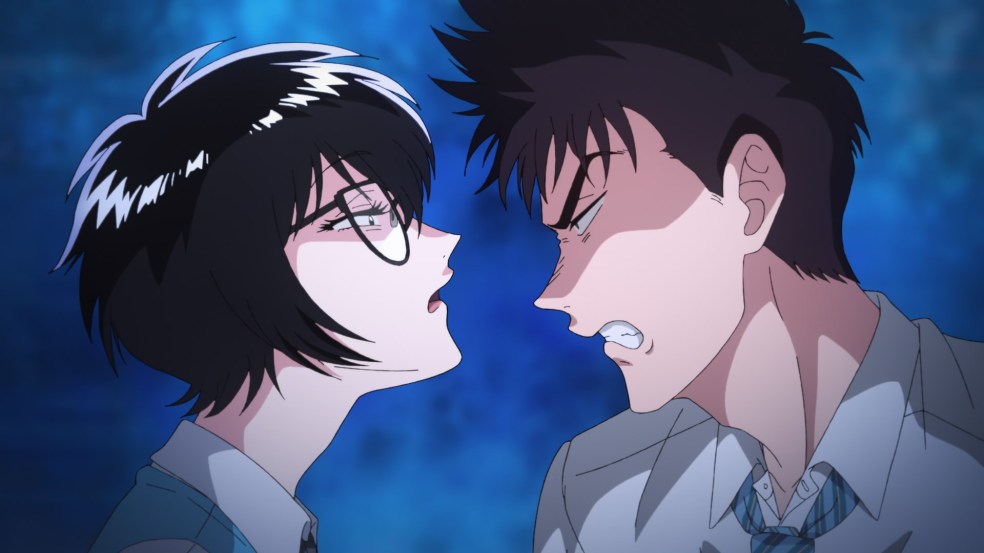
What we have here is a yuri manga where the “girls love” is two women, Shirakawa Junko and Kuroda Kayo, attempting to just completely destroy each others’ professional and personal lives over the course of several months after they begin working together in the same department of a bank. There’s a lot of talk about “toxic yuri” in the air right now, moreso than ever before I think, but this is a pretty potent strain of the stuff. These two are bad for each other, they don’t like each other, they become psychologically obsessed with each other, and their “intimacy” consists of violent, questionably-consensual sexual encounters where they alternate between actually fucking and throwing punches and the like at each other. It’s violent! Very violent!

None of this is a complaint of course, the primal and twisted nature of these scenes—which there are really only a couple throughout the whole manga, and they’re all pretty brief—is a big part of the point. There’s an idea floated here that while these two women are both trapped within the financial system that employs them, they’re at each others’ throats. Junko is BY FAR the more vicious of the two, and once Kayo starts seeing another woman, she gets that woman, a fund manager, fired for financial fraud. And yet, when the manga ends, Junko finds herself a pawn of the shadiest parts of the company she works for, possibly for the rest of her life, despite being “successful” in the business sense (and having picked up a new partner along the way). It’s Kayo who gets off with the comparatively happy ending; she quits the company entirely, and leaves to pursue love and happiness, things more important than success and failure. It’s honestly a surprisingly romantic ending for something that’s otherwise so vicious. Of course, not for Junko, who in the final page of the manga literally vanishes into darkness to join the other behind-the-scenes power brokers who run the company and Japan’s finances in general. I guess who really “won” is a matter of perspective, but I know who I’d rather be. (And not just because I’d rather have Junko making all of those twisted, sadistic grimaces at me, but you didn’t hear me say that.)


And that’ll do us for the second week of February. As with last week, I’m going to directly request that you drop a donation if you like reading these columns. They’re my only source of income, and every penny really does help a lot.

See you next week, but before I go, allow me to leave you with this week’s Bonus Thought, a sacred legend from the old days.


Like what you’re reading? Consider following Magic Planet Anime to get notified when new articles go live. If you’d like to talk to other Magic Planet Anime readers, consider joining my Discord server! Also consider following me on AnilistBlueSky, or Tumblr and supporting me on Ko-Fi. If you want to read more of my work, consider heading over to the Directory to browse by category. If you’re looking for me to watch a specific show, watch this space. I am planning to reopen commissions in the near future.

All views expressed on Magic Planet Anime are solely my own opinions and conclusions and should not be taken to reflect the opinions of any other persons, groups, or organizations. All text is manually typed and edited, and no machine learning or other automatic tools are used in the creation of Magic Planet Anime articles, with the exception of a basic spellchecker. However, some articles may have additional tags placed by WordPress. All text, excepting direct quotations, is owned by Magic Planet Anime. Do not duplicate without permission. All images are owned by their original copyright holders.

Twenty Perfect Minutes: BanG Dream! It’s MyGO!!!!! Episode 13 – The Only One I Can Trust Is Myself

Twenty Perfect Minutes is an irregular column where I take a look at a single, specific anime episode that shaped my experience with the medium in some way, was personally important to me, or that I just really, really like. These columns contain spoilers.

This column contains additional spoilers for episodes 1-5 of BanG Dream! Ave Mujica.

This column is a companion piece to the 2/2/25 edition of The Weekly Orbit. They can be read independently, but make more sense together.


“Because….you seem like you’re about to break apart, Sakiko.”

No one ever would, but if someone were to ask me what the biggest whiff of my career was, it was far and away not covering BanG Dream! It’s MyGO!!!!! while it was still airing. I wrote a little about it, but not nearly enough. Hilariously, in that article, I call the series “fine,” and mostly gloss over Togawa Sakiko as a character except in how she relates to Tomori. Readers with long memories will recall it actually took me until last year to even finish the damn thing. I can’t defend my own lack of taste there, but I’ve certainly come around since then. (And to anyone who thinks I’m overrating the hell out of one or both seasons of this series, well, you’re not going to come away from this article with your mind changed.)

So, think of this as making up for lost time. As I’ve watched Ave Mujica, MyGO‘s direct sequel and a significantly darker take on (and inversion of) some of MyGO‘s same themes, I’ve felt compelled to revisit the origin story of that season’s eponymous band. With the benefit of hindsight, this feels like doing an autopsy. Anyone caught up on Ave Mujica as of the time of this writing knows that Ave Mujica themselves have broken up. If they get back together, it probably won’t be for a while, and it probably won’t be in the same way. So in hindsight, the first episode they appear in, MyGO‘s thirteenth (which is essentially just Ave Mujica episode zero), feels like the only real example of Ave Mujica as Sakiko, their founder, keyboardist, and composer, intended them to be. Sakiko’s unwillingness to compromise on her vision is one of a number of factors that led to the band’s eventual dissolution, but really, we should have seen this coming.

I mean, it’s kind of right there in the title, isn’t it?

The episode actually opens, at least after a brief and ominous prelude, by focusing on MyGO‘s own core cast. This only makes sense, It’s MyGO!!!!! the band are MyGO‘s main characters, and this is the immediate aftermath of their moment of triumph. Things are, for once, relatively clear, and the anime’s opening song is as clear and shining as the sapphire sky in its visuals. Of particular interest to us in this first half of the episode is a scene between Soyo and Tomori on the bridge near the latter’s home. Soyo says plainly that initially, when they were both members of their previous band CRYCHiC, the emotional rawness of Tomori’s lyrics was never something she was entirely comfortable with. But now, she says, she realizes the emotions expressed in those lyrics weren’t Tomori’s alone. They were hers, too.

Through Tomori’s music, she and Soyo are able to relate to each other. This of course is MyGO‘s last great expression of its thematic core, music as a tool of communication, openness, and honesty. In this, MyGO is overall not entirely dissimilar to the show that replaced it as the girl band anime of the moment the following year, Girls Band Cry. (A fact both franchises took notice and advantage of.) The two have one major difference though, Girls Band Cry wraps its story up around the time that main band Togenashi Togeari’s members begin to truly understand each other, and in this way it’s actually fairly straightforward. (Not even remotely a knock on it, I must stress.) MyGO does not do this. It knows it has to set the stage for its successor, and it knows that it has further work to do.

Thus, when Tomori attempts to reconcile with the last former CRYCHiC member she’s yet to reach out to, it doesn’t go nearly so well, and she finds Sakiko, her former bandmate, holed up in her school’s piano room banging out the sinister classical music like the Phantom of the damn Opera, a final indication, if anyone really needed one, that this is not going to all work out so neatly.

After Sakiko coldly brushes Tomori off, Anon, the somewhat airheaded guitarist of MyGO, attempts to cheer Tomori up by taking her out and about. At a planetarium, they run in to Uika, who Tomori has met before but doesn’t really know. The three have a nice chat, although after Uika leaves, Tomori notes that it’s odd that she calls her by her name, given that Tomori never told her it. All of this is significant because immediately after this conversation, Uika gets in a black cab, and is driven to the first night of her new job: the vocalist for Ave Mujica.

Again, hindsight makes two things really obvious: one, we almost immediately flip the “music is a tool of honesty and open communication” thing on its head. Sakiko’s plan for Ave Mujica requires deliberately obfuscating everything about its members, naturally including Sakiko’s own involvement. As far as she’s concerned, this is her show, and the rest of the band are actors within it. Which leads us to two: this band was never going to stay together. It’s at a fairly tame level here, but even this early on it is very obvious that Ave Mujica do not really “get” each other. Nyamu records behind-the-scenes footage on her phone, which Sakiko confiscates since if it ever got out it would destroy the band’s mystique.

There’s also this little exchange which….honestly, good question?

Nyamu also directly mentions rhythm guitarist Mutsumi’s famous parents, something she’s insecure about to put it very mildly, while Mutsumi ignores her and continues stone-facedly practicing her guitar. All of this was easy to dismiss as light bickering during the episode itself. Five episodes deep into Ave Mujica, where Mutsumi has retreated into herself, Nyamu has publicly unmasked the entire band, Uika’s obsession with Sakiko is starting to bubble to the surface, and Sakiko’s own self-loathing is at an all-time high, it reads as some truly spooky foreshadowing. This is also where the episode gets its title, upon presenting the girls with their masks, Sakiko says that on stage, the only person one can trust is themselves. A little under halfway into Ave Mujica, we can see how that attitude worked out.

And yet, for all that, the closing minutes of this episode are still such a trip. Ave Mujica are introduced to the world with a stage play about dolls discarded by humans who come to life under the light of a certain moon, and following that, a grandiose, fuming fire of a debut tune named after the band itself. Obviously, the idea of the discarded doll reflects back on Sakiko herself, but Ave Mujica’s audience have no way of knowing that. To them, and really, to us, while we’re under the anime’s spell, Ave Mujica’s purple and red gothic smoke is something enticingly dark and obscure.

This is the first and best argument for the exact opposite of MyGO‘s own point of view. Maybe “communicating your feelings” is secondary to putting on a good show, given that all of these characters are, you know, in a band. That’s certainly what Nyamu thinks, and it’s why, a third of the way into the Ave Mujica anime, she asks if the band even needs to be a band. She’s probably not entirely right to suggest that even in-context, and hell, Ave Mujica’s actual music is some of the absolute best that’s ever come out of girl band anime as a format, but there’s a grain of truth in there. We are all at least a little complicit, because we clearly love the drama, and the drama is why, both on a Watsonian and Doylistic level, the music even exists to begin with. This episode was our first hint of how truly toxic this story would get, and far from being taken aback—checking on this stuff is one of the few things reddit is useful for—people wanted things to get worse. And, fair play to Nyamu’s point of view, they did! And it’s really only seemed to raise the show’s esteem in the eyes of its audience. The series has given us exactly what we asked for. As a production, it’s realized it doesn’t actually need the music of the group itself to capture our imagination and attention.

I resurrected the Twenty Perfect Minutes name to talk about this episode because I do really think the seeds of Ave Mujica the series, probably the best thing airing right now, really start germinating here. But admittedly it’s an uneasy fit for what this column is about, to the extent that it ever had a specific, rigid format. Ideally, these episodes should stand out starkly from the anime they’re part of. This much is definitely true of “The Only One I Can Trust Is Myself,” but because it’s in large part a torch-passing to the Ave Mujica anime proper, it feels a bit like cheating. And since that series isn’t over yet, I have no definitive thesis or grand prediction to make. Some forecasts feel safer than others, especially with the sheer amount of ancillary text surrounding the series (the ARG for example), but anyone who says they know where Ave Mujica is going to go is lying to you.

And right now the “myself” I’m choosing to trust in is my theory that Uika is a lesbian, but we don’t need to worry about that for right now.

But, I did build in the caveat that sometimes this column is just about episodes that I really like, and I really fucking like this episode. I like its starry, clear opening half, where it feels like everything’s been resolved and anything is possible in the best way. And—this is bad of me—I love its second half, where it becomes clear that anything is possible in the worst way. I really like more than one episode of both of these seasons, in fact. (Off the top of my head I could probably do one of these on both the third and fourth episodes of Ave Mujica, if I wanted to. And as for MyGO, my first impressions column basically already is about its third episode. I’d be remiss to not mention that the very first hints of these themes are present even there. After all CRYCHiC is only founded because of a miscommunication, when Sakiko mistakes Tomori’s diary pages for song lyrics.) Will I do any of that? Who knows. It’s been three whole years since the last TPM column, so I’m clearly not exactly in a hurry to crank these out. But, like I said, I’m making up for lost time. To me, this episode is really special, and everything that’s happened since has only made it moreso.

This is Ave Mujica in the brief, shining moment when Sakiko was still in relative control. Before the inevitable clash of personalities tore it all apart. This is about as close as she ever gets to being genuinely cool, in fact, but even she seems to know that it can’t last. One of the very first things she does in this episode, when recruiting Uika to join the band, is declare that the weak version of herself is dead, a completely untrue statement that nonetheless sounds like irrefutable fact when she says it. Her very last action in the episode, in all of MyGO, in fact, is to icily suggest that she needs to come down from the stage high of Ave Mujica’s triumphant, cult-making first concert. She changes back into her everyday clothes and takes a public train back home, a dingy little place with a small forest of beer cans dotting the floor. She grimaces, she sneers a greeting to her “rotten” drunk of a father. If you didn’t understand before where her need to be in control, to portray herself as this theatrical, literal puppet-master came from, it hits you all at once. And then, just as you’re processing the thought, it ends.


Like what you’re reading? Consider following Magic Planet Anime to get notified when new articles go live. If you’d like to talk to other Magic Planet Anime readers, consider joining my Discord server! Also consider following me on AnilistBlueSky, or Tumblr and supporting me on Ko-Fi. If you want to read more of my work, consider heading over to the Directory to browse by category. If you’re looking for me to watch a specific show, watch this space. I am planning to reopen commissions in the near future.

All views expressed on Magic Planet Anime are solely my own opinions and conclusions and should not be taken to reflect the opinions of any other persons, groups, or organizations. All text is manually typed and edited, and no machine learning or other automatic tools are used in the creation of Magic Planet Anime articles, with the exception of a basic spellchecker. However, some articles may have additional tags placed by WordPress. All text, excepting direct quotations, is owned by Magic Planet Anime. Do not duplicate without permission. All images are owned by their original copyright holders.

The Weekly Orbit [2/2/2025]

The Weekly Orbit is a weekly(-ish) column collecting and refining my more casual anime- and manga-related thoughts from the previous week. Mostly, these are taken from my tumblr blog, and assume familiarity with the works covered. Be wary of spoilers!


We persist, we survive, and we thrive. A lot has happened since the last Weekly Orbit column, and I could spend this opening bit bloviating about how or why I’ve chosen to bring the column back now. The actual answer is much less romantic: for the first time in a while, I not only had something I wanted to talk about, but I had the mental bandwidth to do it. A lot’s happened over the past few months even in the specific realm of my relationship with anime (I got really into Uma Musume, for example), but the honest truth is just that I found the time and energy to get around to it. Thus, Weekly Orbit is back. At least for now. You can probably assume it will be a similarly on and off affair going forward.

That said, if you wanted to be dramatic—and who doesn’t love being dramatic?—you could point out that the last thing I wrote about in the last column before this series went on a months-long hiatus was BanG Dream! It’s MyGO!!!!! No prizes for guessing how that relates to this week’s column. Between this and the other column that will be going up later today, this is basically Ave Mujica Day on Magic Planet Anime. I cannot pretend I’m sorry about that.


Anime – Seasonal

BanG Dream! Ave Mujica

Where to even start?

What follows is a collation of two separate tumblr posts I’ve written over the past few days. A funny fact about anime—art in general, really—is that it’s always constrained by the circumstances around its production. Ave Mujica, as anyone who’s read my first impressions article or, honestly, just taken a gander at them knows, is cursed with very bad official subtitles right now. The practical effect of this is that I’ve had to wait for some brave souls (a group going by LoftMoon and a lone warrior calling themselves Nyamuchi after the in-show character, respectively) to pick up Crunchyroll’s slack before I could bring myself to actually catch up with the series.

All that is to say, I watched episodes two, three, four, and five of Ave Mujica over the past couple of days rather than the past couple of weeks. I would describe the overall effect as bulldozer-esque. It’s some of the most fun I’ve had with an anime in ages, but it’s also genuinely emotionally exhausting. At one point, I attempted to just write a literal list of the show’s ongoing events, but that in of itself got a bit out of control, so I pared it down to just these. Episodes two through four are defined by an arc in which Wakaba Mutsumi, the band’s rhythm guitarist and thus the core of their sound, does the following:

  • Flubs an interview by voicing what appears to be an intrusive thought, thus sparking rumors that the band is going to break up.
  • Freezes up on stage, sitting stone-still before the audience. Or, to invoke the metaphor we’re actually intended to see, sitting like a puppet with her strings cut.
  • Experiences a psychotic break, at which point a dissociative alter naming herself Mortis, after Mutsumi’s stage pseudonym, takes over as the primary personality, placing herself at front in what we are now aware is a system.
  • Mortis proceeds to hog the spotlight in interviews, leading to a bunch of tension with the other members, especially Nyamu. Mortis in general is flighty and theatrical. More importantly, she can’t actually play guitar. (At the very least, she claims to not be able to, and we’re not given a reason to disbelieve her on this subject.)
  • All of this, as well as Mortis’ generally confrontational nature towards Sakiko, who she claims to hate, culminates in the band breaking up. We are, at this point, four episodes in, and the band our show is named after is gone. “The dolls no longer exist.”

What is all this?

Usually, when you’re asking that question about an anime, it’s rhetorical. With Ave Mujica I’ve genuinely found myself with very little idea of where exactly it’s going to go. It’s fair to ask the question, and people have asked the question, is this even really a music anime anymore? We haven’t really gotten anything in the way of new songs, and Ave Mujica as a group, at least in the show’s narrative, are less defined by their music and more defined by what interrupts it and what grows around it.

An acquaintance has been watching the show ahead of me, and in doing so described it to me as going in more of a horror direction. My initial assumption was that they were exaggerating. Ave Mujica are a goth metal band, sure, but even considering the rich vein of drama mined by this show’s own immediate predecessor, MyGO, “horror” just seemed like a step beyond believability. And yet, here we are. To be sure, these horrors are largely in the mind, but that doesn’t really make them any less arresting. (See also Perfect Blue, clearly at least an indirect influence on this series.) Episode three, with its haunted, surreal visuals as we go directly inside Mutsumi’s mind, is the big turning point for the series. Yes, this is all “in Mutsumi’s head” and what is depicted in this scene is not literally happening. The lack of material reality does not change the fact that Mortis’ usurpation of the system is portrayed by her cute little doll form morphing into a shadow monster and eating Mutsumi. Yeah, sure, it doesn’t “actually happen,” but someone gets eaten alive in a fucking BanG Dream anime! What the hell!

This does raise the question, boring but admittedly necessary, as to whether or not Mortis’ depiction is problematic. When I wrote the tumblr version of this post I was on the fence, but having had the time to think it over I don’t really think so. Despite clearly being some kind of protector alter, Mortis is also naïve and rather kiddish. Most of the “horror” elements are framing of her own experiences or those of others reacting to her, especially Sakiko who is clearly just very unequipped to deal with this entire situation. It gives us some deliciously spooky shots, but Mortis is very clearly not actually a monster, all of this is part of the theater of the anime itself. (Still though! Episode 3! What the fuck!)

And then there’s episode five. The most recent, as of the time of this writing.

In the immediate aftermath of Ave Mujica’s dissolution, its members largely go their separate ways. Here, for the first time in a while, Sakiko gets to be the main character in her own show. Unfortunately, since that show is Ave Mujica, this does not necessarily mean she has a particularly good time.

Despite Uika’s—that’s Doloris, Ave Mujica’s vocalist, in case you’ve forgotten—pleas, Sakiko does not stay with her, where she’d been crashing for the past couple of episodes. Instead, she returns to her soul-crushing call center 9-to-5, and the abuse of her drunken father. Until, that is, her grandfather shows up, tells her he’s paid off the—I must imagine, significant—debts incurred from the cancellation of Ave Mujica’s arena tour. This is a pretty classic rich older asshole relative move, they take care of some financial problem for you so you’ll owe them. An episode one Sakiko would probably not have caved to this, but at this point in the series she’s been beaten down by the fallout from both her own bad decisions and the bad decisions of others, and so, she surrenders her agency to her grandfather. We don’t get to hear any explicit promises made, but it feels safe to say that the path forward for Sakiko, if things do not change, is a life as a physically comfortable but emotionally miserable pawn in the interminable power-play games of the wealthy.

Seeing Sakiko like this is, of course, a huge fucking bummer. At the core of it all, Sakiko is only human, but it must be remembered that she was introduced to us as an antagonistic, somewhat cryptic presence throughout the second half of MyGO. Seen through the eyes of others, Sakiko is massively charismatic—Char Aznable with a girl band, recall—but here she’s stripped of everything that makes her so. Seeing her cowed, beaten, rendered painfully clearly as just the teenage girl she actually is, is heartbreaking, a painting so sad the colors run off the canvas. She’s been reduced to a rich girl playing pretend. It hurts to watch.

All the more so because the second half of episode five reintroduces some of the MyGO cast. We get to see some of Sakiko’s past through Tomori’s memories. This person, a happy, fulfilled Sakiko in the early days of CRYCHiC’s activities, is someone that we the audience barely know. It’s difficult to even reconcile that this is the same girl who had a catastrophic falling out with the rest of that group and then spent the remainder of MyGO lurking around in the background. This is the girl who would be Oblivionis? And yet, it’s obviously so. What we are seeing—and have been seeing, this whole time—is someone who’s badly lost her way. The show’s oppressive atmosphere lets up for the first time in the parts of this episode dominated by the MyGO cast. They absolutely have their own shit going on, but compared to simply everything else the series has been so far, it’s small potatoes.

MyGO definitely paved the way for this to exist in both a sense of literal continuity and also in its particular approach to storytelling, but a lot is still up in the air, and episode five’s twin endings raise many, many more questions than they answer. Not to mention I have barely talked at all about what Uika and Nyamu have going on, those two are clearly powderkegs all their own. (One of the very few things I can say with confidence about the future direction of this show is that it will not end without them exploding.) Not that I’m complaining, mind you, the show’s intense, pulsating goth-drama is far and away its best quality. Things are almost placid when we’re within Tomori’s flashbacks, but the last parts of the episode bring us crashing back down to the depths pretty hard. I won’t say more, except that I think MyGO‘s central theme of music as a tool of honesty and communication is about to be very thoroughly tested.

One final thing: a fun aspect of being on the forever-dying tumblr is that most “active” fandoms, at least in the anime space, consist of a few dozen people batting ideas around. The result of this? There are a lot of other good posts on Ave Mujica too. So if you are not satisfied with the frankly way too long post you just read, or the even longer one that I intend to post later today, you can check out Iampiche’s analysis of parallels between characters, ouroborosorder’s analysis of parallels between this show and the series it’s a sequel to, this humorous but very much true assessment of the “girl band anime meta” by our-lady-of-haymakers, and a second post by that same person where they are just truly on some other shit that I don’t fully understand. Ave Mujica truly brings out the critic, and the chuuni, in everybody.

Sakamoto Days – Episode 4

Purely in terms of how much they can be mined for discourse in the old sense of the term, Sakamoto Days might be the least complex thing airing this season. There are zero hidden layers here, every episode is an excuse to get Sakamoto and a group of other assassins in a room, where they will fight, and Sakamoto will win. It is consistently entertaining and just as consistently absolutely nothing else. This episode’s got a fun one-off character in the form of Hard Boiled, whose whole thing is calling stuff “hard-boiled.” Also he has exploding ping pong balls. Pure popcorn TV, and I can’t fault it for that.


Anime – Non-Seasonal

Umamusume: Pretty Derby Season 2

The thing is this: everything anyone has ever told you about Uma Musume is true.

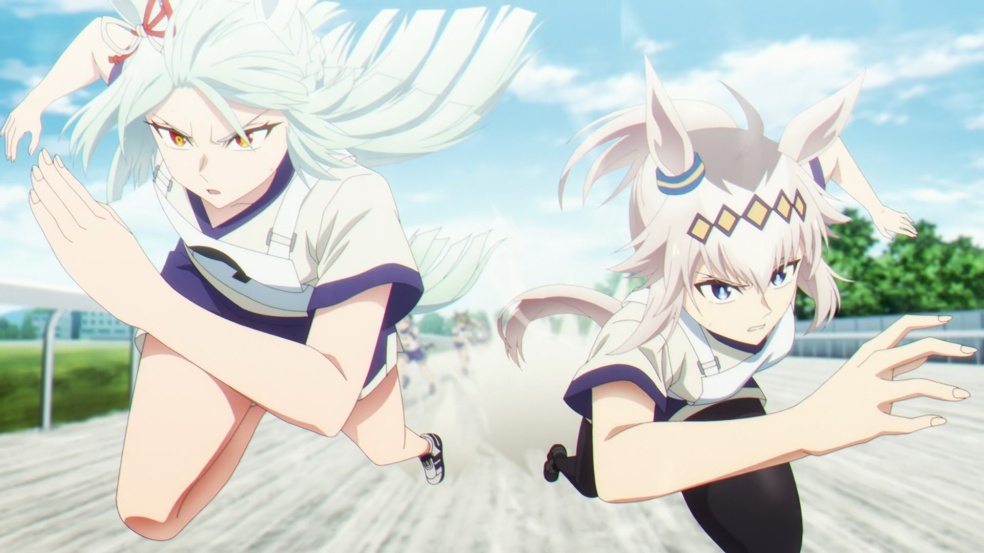
It is a ridiculous, meticulous setting where girls with horse ears compete in very serious, deadly serious races against each other for glory and the thrill of victory. Season 2 is not my favorite Uma Musume thing, that’s still the brain-scrambling New Era film, which I hope to write about someday in the not-too-distant future, but it’s very good, and it’s a really good take on the inspirational sports story formula, a vast improvement over the already pretty solid first season.

Tokai Teio [Machico]! I could kiss her. She’s the greatest prodigal runner ever. She’s our heroine. She suffers more than Jesus. The show repeats the basic plot beat of “Teio injures herself severely and might never run again” three times and somehow it actually hits harder each time. I don’t understand it, it flies in the face of conventional narrative logic, but here we are. It slaps end to end. By the end of the show I was cheering in my seat when she ran her final race.

Also of note: the story of Rice Shower [Iwami Manaka], the Assassin in Black, which is maybe the dark horse (haha) actual best story arc in this season, presented as a shy would-be contender and then revealed as a deadly spoiler who snatches a victory from, most crucially, co-protagonist Mejiro McQueen [Oonishi Saori]. All in all just really solid stuff throughout. The pacing problems inherent to having to write these stories loosely around real-life events are still here, but all told this is just an absolute blast and a huge improvement over season one. This is where I start to understand how we got to New Era.

As an aside, if you don’t follow me there you may not know that I actually livetweeted my experiences with much of Uma Musume on bluesky. I started with the Road To The Top OVA, and then the New Era movie, (although that one stalls out about halfway through for reasons that will be obvious if you read it), before going back and watching season one and season two. I won’t be doing this for the third season for reasons that will be apparent if you just scroll a bit further, but I figure I should mention this here where it’s relevant.

Umamusume: Pretty Derby Season 3 – Episodes 1 & 2

Interesting stuff.

These are just loose thoughts as opposed to more organized ones, and given that I’m only two episodes into this series I’m disinclined to re-edit them to the extent I did with some of the other stuff in this column. But the main thing that’s sticking out to me is this: a recurring fixture of this series is that you can’t compete against an idea, only the actual people on the field. Previously we see this with Teio’s fear that she’ll never be able to catch up to McQueen when she’s recovering in that show’s last arc, later on we’ll see it with Jungle Pocket and Agnes Tachyon in New Era. Here it takes something of a different form, in that our new protagonist Kitasan Black [Yano Hinaki]’s admiration of Teio is clearly constraining her in some way (probably most directly obvious during her flashback wherein she imagines Duramente, the horse who actually beat her, as Teio in full racing silks). Once Duramente is injured in the second part of the episode, this fixation almost immediately leaps to her instead.

All told this seems to be building up a somewhat more pronounced underdog story than is usual for this franchise. Also, one scene here has what I think is probably the most emotionally raw use of the vent stump (a recurring fixture of the series) that we’ve ever seen, in that Kitasan, fresh off a loss, doesn’t really say anything, she just fuckin’ hollers into it.

What all of this says about Kitasan is pretty interesting. A lot of what she does in these opening episodes is genuinely kind of offputting, which, ironically, kind of makes her more likable than she might’ve been as a more traditional protagonist for this series. I’m interested to see where the rest of this goes!


Manga

False Marigold

Interesting Taisho-period yuri with a nuanced, fraught central relationship, in which our protagonist is a young girl pretending to be her own dead brother in order to make his girlfriend, a blind girl, happy. This does not go smoothly, as you might expect, and I really like the story’s exploration of both Hana’s (the boymoder) and Lily’s (the girlfriend) internality. Both of them feel like very fully-realized people which makes it hurt all the more when they’re suffering and makes it all the nicer when things are going well for them.

Also there is a ton of hand and eye symbolism on the volume covers. Hana covering Lily’s eyes because yeah she’s literally blind but also she’s symbolically blind to the deception. (Or is she? As the series goes on it becomes apparent that Lily is sharper than Hana initially assumes. Still, it’s a nice bit of symbolism.)

I don’t have as much to say about this as I’d like to, so I might reread it at some point and take notes this time. All told though I do highly recommend it especially if you’re looking for a “toxic yuri” pickup. (True misery connoisseurs might be disappointed by a few aspects? I’m not sure.) Also if I ever see someone say that this “doesn’t count as yuri” I’m gonna slap them.


And that’s all for the big comeback piece. Hopefully you found something enlightening or just interesting somewhere in there. I’m going to make a rare direct request that, if you like my work in general and this article in particular, you drop a donation if you can spare it. It’s my only source of income, so every bit helps.

Now then, I leave you with this rare Anon W as your Bonus Thought of the week.


Like what you’re reading? Consider following Magic Planet Anime to get notified when new articles go live. If you’d like to talk to other Magic Planet Anime readers, consider joining my Discord server! Also consider following me on AnilistBlueSky, or Tumblr and supporting me on Ko-Fi. If you want to read more of my work, consider heading over to the Directory to browse by category. If you’re looking for me to watch a specific show, watch this space. I am planning to reopen commissions in the near future.

All views expressed on Magic Planet Anime are solely my own opinions and conclusions and should not be taken to reflect the opinions of any other persons, groups, or organizations. All text is manually typed and edited, and no machine learning or other automatic tools are used in the creation of Magic Planet Anime articles, with the exception of a basic spellchecker. However, some articles may have additional tags placed by WordPress. All text, excepting direct quotations, is owned by Magic Planet Anime. Do not duplicate without permission. All images are owned by their original copyright holders.

Seasonal First Impressions: Pining For Those SAKAMOTO DAYS

Seasonal First Impressions is a column where I detail my thoughts, however brief or long, about a currently-airing anime’s first episode or so.


Picture a killer of legend. The kind of man whose very presence makes the blood of his foes freeze in their veins. Picture an unstoppable, elemental force of violence. Add gray hair and a pair of round spectacles, and you’ve got Taro Sakomoto [Sugita Tomokazu]. Now, picture what it would take to tame that man. Picture what could remove him from this life of ceaseless bloodshed. What could that be? What could possibly get him to hang up his gun?

Well, a pretty store clerk with a winning smile is probably a good start.

This, the tale of an ostensibly-retired uber-hitman, is Sakamoto Days. It’s a member of a particular genre that’s found increased purchase in recent years, a kind of post-Spy x Family melding of action anime with the domestic comedy. Usually involving a fundamentally good natured protagonist who can, nonetheless, throw down with the best of them. Spy x Family has the likable but duplicitous Loid Forger. Kindergarten Wars has its single woman—seeking good man—in Rita. And of course, Sakamoto Days has Sakamoto himself. Sakamoto Days has been a favorite among Jump readers in the know for a good while now, and thus this adaptation comes with a pretty weighty set of expectations placed upon it. For my purposes, I’m not super interested in engaging with that, although I will say this is the rare case of a shonen manga I actually follow somewhat regularly getting adapted into animation, so I’m happy for the series if nothing else. (It’ll be joined in this category by Witch Watch, also from Shonen Jump, later this year.)

Our story really begins when Shin [Shimazaki Nobunaga], formerly one of Sakamoto’s partners-in-crime, is tasked with killing the man. He left “the organization” which he and Shin both belonged to without permission and thus, he’s gotta die. Shin is initially perfectly willing to go along with this, and when he first sees the retired Sakamoto, he’s upset by what comes off to him as weakness. Most obviously, Sakamoto has put on quite a lot of weight in the five years since he retired, and we should take a quick detour to talk about this.

So! Fat jokes! There’s quite a few of them in Sakamoto Days. In the anglosphere, these have generally been considered in poor taste for a good 20 years now, but obviously, this isn’t the case everywhere. I reiterate all this basic-ass explanation of cultural differences just to say, as someone who’s also fairly big, I am not super upset by how Sakamoto Days handles its main character in this regard, even later on when we get into less-jokey but arguably dicier territory. I also think it helps that the character himself seems to have a good sense of humor about it (check the “Slim” shirt in the picture above). But if you are upset by it, I get that, and I’m also not going to tell you you Need To Get Over It or whatever other piece of canned finger-wagging rhetoric a certain kind of anime fan is sure to lean on when people want to discuss this subject. This is an area on which people will understandably be pretty polarized. So at the risk of making it seem more serious than it necessarily is, I think it’s important to just acknowledge that this specific subject gets under some peoples’ skin, and that’s fine. I have a very live and let live approach to arguably-problematic material in the arts, and this is no different a case than anything else, it’s just somewhat new territory for anime I’ve covered on this site specifically.

It is worth noting though, that Shin’s initial judgement of Sakamoto is wholly incorrect. He sees Sakamoto, now grown happy and fat and the proud proprietor of a small konbini with his wife [Aoi, played by Touyama Nao] and their adorable daughter [Hina, played by Kino Hina, no relation], and assumes he’s grown soft in a metaphorical sense, too. This is not so.

Despite some reluctance once he senses that Sakamoto’s killer instincts haven’t actually dulled terribly much—he’s an esper, and can read minds, and is thus treated to Sakamoto’s amusingly gory idle fantasies of stabbing him to death—Shin is eventually convinced to try taking him out. This goes poorly for him, and this is where we get to the anime’s biggest strength.

All told, it is simply just a solid, good translation of the manga’s inventive action scenes to animation. Sakamoto immediately gets to flex both his wits and his still-sharp combat skills here, deflecting a pistol bullet with a gumball and using various other random objects around his store to render Shin harmless. There’s too much slow-mo, and the presence of merely some traditional sakuga instead of wall to wall sakuga will leave some unhappy, but so far, there’s really not a lot to complain about. (I’ve seen some scuttlebutt about the color palette, too. But honestly I think the gritty, somewhat dingy look works well for this series.) The vibe is captured pretty much perfectly.

These setpieces are what Sakamoto Days is about. There is a story, to be sure, a decently interesting one at that, where various characters are torn between the sprawling assassin underworld and the call of a normal, quiet life. There’s comedy, which is amusing if rarely laugh-out-loud funny. And there are also some quite sweet domestic scenes, as well. But the real main concern of Sakamoto Days are these setpieces, wild everything-but-the-kitchen-sink affairs that grew only moreso as the manga went on, and which make a good first showing here. There’s an escalation in the first episode already, even, as Sakamoto opts to rescue Shin once his employers try to take him out for not fulfilling his contract. This second scene is even flashier, all glinting gunmetal, roundhouse kicks, and taser lightning as Sakamoto cuts through a warehouse of goons with ease.

The sell is simply this, if you liked those scenes, you’ll get a kick out of Sakamoto Days. If you like the scene afterward, where Sakamoto hires Shin as an employee at his store, since the esper has nowhere else to go, you’ll like Sakamoto Days a lot. What you see is what you get. I think what we see is pretty cool.


Like what you’re reading? Consider following Magic Planet Anime to get notified when new articles go live. If you’d like to talk to other Magic Planet Anime readers, consider joining my Discord server! Also consider following me on AnilistBlueSky, or Tumblr and supporting me on Ko-Fi. If you want to read more of my work, consider heading over to the Directory to browse by category. If you’re looking for me to watch a specific show, watch this space. I am planning to reopen commissions in the near future.

All views expressed on Magic Planet Anime are solely my own opinions and conclusions and should not be taken to reflect the opinions of any other persons, groups, or organizations. All text is manually typed and edited, and no machine learning or other automatic tools are used in the creation of Magic Planet Anime articles, with the exception of a basic spellchecker. However, some articles may have additional tags placed by WordPress. All text, excepting direct quotations, is owned by Magic Planet Anime. Do not duplicate without permission. All images are owned by their original copyright holders.

Seasonal First Impressions: Check in to TASOKARE HOTEL

Seasonal First Impressions is a column where I detail my thoughts, however brief or long, about a currently-airing anime’s first episode or so.


Among the crop of a given anime season, you can usually sort the premieres into three categories: promising, not-so-promising, and those that make the viewer emit a long, drawn out, neutral “huuuuuuhhhh.” Tasokare Hotel is one of these. A decidedly low-key one, in fact. And in being so, it proves itself to be an understated, surprising standout of the season so far.

Tasokare Hotel‘s premise is quite simple. A hotel stands, bathed in perpetual, pinkish twilight as it straddles the world of the living and the world of the dead. Those on the brink of death, whether they actually pass on or not, visit this place, where they are checked in by a friendly flame-headed doorman [Yamamoto Kanehira]. They don’t necessarily remember who they are or how they got here, but over the course of their time as guests of the establishment, they will hopefully come to remember their past life. Aiding their quest to remember who they are is the invisible “room service” of the hotel itself, the suites magically fill themselves with items relating to the deceased. As they remember their pasts, the guests themselves change, starting out as caricatures, sometimes faceless and sometimes with their heads replaced with relevant objects, and eventually recovering their human appearance. Around then, most move on, either back to the world of the living or onward to the world of the dead. This isn’t so for everyone, though. Case in point, our protagonist Tsukahara Neko [Momokawa Rika, in what seems to be her first role of note in any anime].1

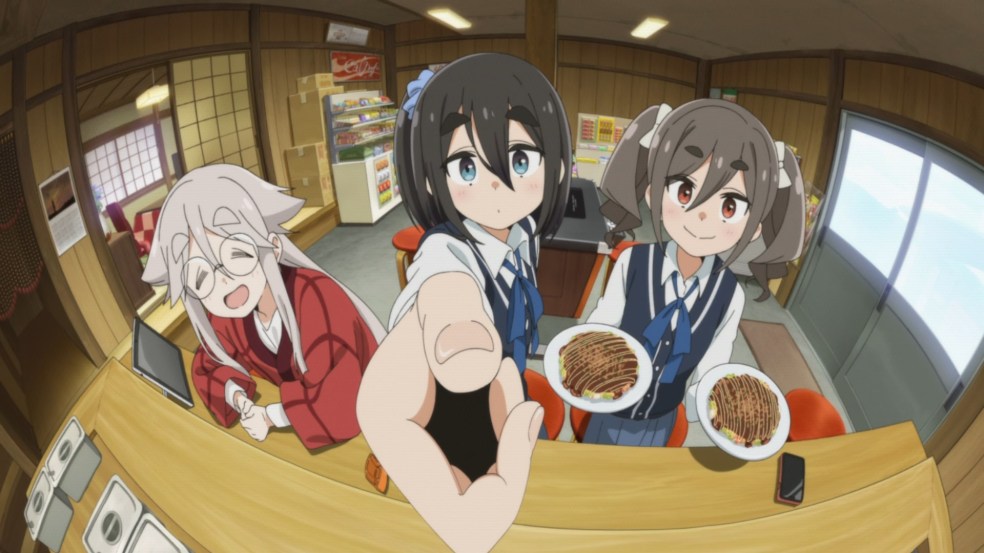
Neko, an idol fangirl in life, opts to stay at the hotel long-term, joining its staff. Her real role in the story though is to act as a sort of detective / memory recovery assistant. Across the cases in the two episodes so far she helps a prospective fortune teller disentangle herself from an occult streamer she was parasocially fixated on, and also aids a gambling addict remember the final bet that stuck him in the grave situation he presently finds himself in. She’s perceptive, quite cute, and has a dry wit about her. (This latter trait is emphasized by her similarly-dry, open vocal tone, which is a bit unconventional for an anime lead. I’m fond of it.)

Overall, the writing involved in these “cases” is fun, but it’s not terribly subtle. The fortune teller spends most of her screentime pining for her “boyfriend” (spoiler alert: he actually turns out to be the aforementioned streamer), and as such, her head is replaced with the Lovers tarot card.

The gambler? Well, his noggin is a giant pachinko ball. I have a serious soft spot for shows that are in love with blindingly obvious symbolism, so I’m into this. (And they make more sense when considered that Tasokare Hotel is actually an adaptation of a video game. I imagine what we’re seeing here is the equivalent of the tutorial and an easy first mystery.) Opinions will vary, naturally, but for me at least, it’s more endearing than anything. It also provides the additional bonus of allowing these characters to start out as flat, almost literal caricatures of themselves, before growing into the complexity they had in life. The gambler’s story in particular becomes genuinely affecting by its end, and even when the show isn’t quite hitting that high, it’s still interesting and charming.

Similar charm also runs through the show’s presentation, which is largely on the simple side. It’s crass and a vast oversimplification to reduce how a show looks to questions of its “budget,” but Tasokare Hotel gives the impression that those working on it knew they’d have only so much money and time to get everything done and plotted out how to use their resources very wisely. The set design carries most of the visuals, as animation is sparse and unshowy. This, in tandem with how dialogue-heavy the episodes are, can leave them feeling almost more like theater than anime per se. What might be a downside in the minds of some ends up being a bit of a blessing in disguise, focusing the viewer’s attention on what’s being said and saving focus on what’s being shown for a few key moments in a given episode. The device of physical objects appearing in the hotel rooms works really well here, as it allows the show to shuffle in meaningful, charged imagery “off-screen,” creating a subtle sense of momentum that carries the stories forward.

All told, these little mysteries work together in a perfect little clockwork. If you’re the sort of anime fan who enjoys the quieter side of the medium, check this out. You won’t be disappointed.


1: She was in Magical Somera-chan about a decade ago. Does that count as “notable”? I leave that as an exercise to you, the reader.


Like what you’re reading? Consider following Magic Planet Anime to get notified when new articles go live. If you’d like to talk to other Magic Planet Anime readers, consider joining my Discord server! Also consider following me on AnilistBlueSky, or Tumblr and supporting me on Ko-Fi. If you want to read more of my work, consider heading over to the Directory to browse by category. If you’re looking for me to watch a specific show, watch this space. I am planning to reopen commissions in the near future.

All views expressed on Magic Planet Anime are solely my own opinions and conclusions and should not be taken to reflect the opinions of any other persons, groups, or organizations. All text is manually typed and edited, and no machine learning or other automatic tools are used in the creation of Magic Planet Anime articles, with the exception of a basic spellchecker. However, some articles may have additional tags placed by WordPress. All text, excepting direct quotations, is owned by Magic Planet Anime. Do not duplicate without permission. All images are owned by their original copyright holders.

Seasonal First Impressions: The Poet’s Soul of FLOWER AND ASURA

Seasonal First Impressions is a column where I detail my thoughts, however brief or long, about a currently-airing anime’s first episode or so.


“For in my wrath, I am Asura.”

Can I level with you? The anime season’s been a bit rough so far. I’ve certainly lived through more dire seasons in terms of there just being nothing to watch, but it feels like a lot of the more up-in-the-air premieres have been whiffs. Even some of the actual good stuff is being held back by extenuating circumstances. Things are tough in the winterlands right now.

But, spring is on the way. And if you feel the Sun on your face and can imagine it as the warmth of the green season, Flower and Asura might be why. Blessedly, this is probably the best premiere of the season so far, a study in subtle emotional shades, and an interesting, empathetic look into the mind of a performer. Longtime readers will know that anything of that nature is absolute catnip to me, but even so, this is a strong, strong, strong opener. I could nitpick a handful of things, but just as a fair warning, I am absolutely not going to.

Our main character is Haruyama Hana [Fujidera Minori], the sole teenage girl in the tiny island village of Tonakijima (population ~600). Hana, who’s entering high school soon, spends much of her time reading children’s books for the local kids. Her readings are popular, and she’s clearly pretty good at them. What these kids of course do not know is that they stem from something deeper in the back of her mind.

As a child herself, Hana saw a young woman, of about the same age that she now is, recite a poem on TV. That poem, Miyazawa Kenji’s “Haru to Shura”, is, at least as translated into English, an angry burst of splintering, smoldering imagery. It’s not something that one would necessarily assume a child would like, and yet, that poem and that recitation of it, grabs Hana’s imagination in a stranglehold. Here, at this very early moment in her life—the very start of the episode, as well—her passion is ignited.

Cut back to that quaint reading circle and, we will learn over the course of this first episode, you have a girl who is trying to channel this roil inside of her into….reading books called things like Mr. Seagull’s Deep Sea Adventure to a gaggle of children. There is, of course, nothing wrong with reading books to children, and she’s damn good at it from what we see here. But given what we later learn about Hana, it feels fair to say that there is something going unfulfilled. She’s using a wildfire to light a candlestick.

One person who seems to immediately pick up on at least a little of this is Usurai Mizuki [Shimabukuro Miyuri]. Mizuki is our other main character, and she blithely walks into Hana’s life after one of those quaint little reading circles, immediately trying to press her into joining her high school broadcast club. At first, it’s as simple as the fact that Mizuki loves Hana’s voice. But as the first episode progresses, it becomes clear to Mizuki, and to us, that there’s more to Hana than is necessarily obvious at first glance.

Mizuki, I think, will in fact be a sticking point for some people. While clearly friendly, she is determined to recruit Hana for the broadcasting club. To be honest, she’s pretty overbearing. I like this—anime girls with less-than-perfect personalities are always a good thing to have more of—but I could imagine someone finding her sheer inability to take ‘no’ for an answer annoying, and she’s even a little manipulative over the course of this premiere. That said, it takes Hana actually mentioning the poetry recitation for Mizuki to really double down on the idea of her joining the club, so I think much of this insistence can in fact be attributed to the fact that Mizuki is also very observant. She’s enough so that she waves off a logistical issue, Hana being able to catch the last ferry back to her home island in time. “It isn’t right”, she says, “to assume something’s impossible just because it’s difficult.” She’s right about that, and this is one of a few central ideas that the episode quietly expands on over the course of its premiere. (Still, that couldn’t be me. I’d be in that clubroom in a heartbeat.) Hana takes a bit more convincing than this, but before we fast forward to that, it’s worth going into some detail, given the emphasis on voice here, what these voices are like.

Hana has perhaps the closest vocal to a typical “protagonist voice” in this sort of thing, but her sometimes stopped-up cadence has a halting shyness to it that most lesser anime would overplay, and it’s to Flower & Asura‘s benefit that it knows to keep it on the subtle side, for the most part. Mizuki’s voice is rustic, narrow, and scratchy, and it often sounds like she’s talking directly from her throat. This compliments her appearance, to be sure, but it also makes her sound bolder and more assertive than Hana. It also makes her sound older, which makes sense. I’m not going to call this a yuri series just yet, but if it does go that route, I want to commend whoever did the casting for having the main girls not just look good together but sound good together. That’s an attention to detail that’s all too rare.

Cut to classroom, Hana’s first day of high school. Things are going as they often do in a show like this, Hana settles in and meets a friendly classmate. Things are straightforward, until the Broadcast Club takes over the morning radio. Evidently, at this particular high school, morning poetry is recited over the speakers. This sounds, frankly, crazy to me. (If anyone had played poetry over my high school’s speakers there would’ve been riots.) But it’s an effective bit of scene-setting, because who else should read the poem but Hana’s now-senpai, Mizuki?

Poetry, of course, is not merely about being able to set scenes. It’s about using words to conjure images, and also knowing when and how to deploy them. In its mirroring of its subject matter, Flower & Asura demonstrates this beautifully. The poem in question, Takamura Kotaro’s “The Journey”, is not just read aloud, but also visually depicted. Hana, listening intently, imagines herself on a grey train track, walking through a void. She isn’t alone for long; Mizuki is there as well, blazing a trail of light through the black, providing a beacon despite her sly smirk.

The imagery of a track for Hana’s reaction is apt—she is moved. Continuing the show’s generally understated vibe, Hana’s reaction to hearing the poem read is not big or loud. It’s very soft, and very quiet. Just a wordless shiver of a sigh as the classroom window blows the spring breeze through her hair and things wind back down. The interlude ends, and Hana presumably has an unremarkable rest of her schoolday.

After school is a different matter. On the ferry home Hana begins reading some poetry to herself. Aloud, but, perhaps due to the presence of the ferry captain, given that the boat is quite small, rather quietly. She’s interrupted, as who else but Mizuki makes her presence known aboard the boat, once again pestering Hana to join the Broadcast Club. Mizuki needles Hana with pointed questions, asking why she restrains herself so much when reading this, here, as compared to when she reads for the kids back home. That’s interrupted by a much more pressing and practical concern, though. The ferry Hana goes home on is the last for the day. Thus, Mizuki has no way to get home.

Perhaps feeling obligated, Hana’s family houses Mizuki for the evening. Surprisingly, Hana doesn’t seem to mind this so much. She says she’s never had a sleepover before, so it may be the case that she’s simply unwilling to look a gift horse in the mouth. Mizuki stays on the attack throughout this entire sequence. Even when the two are ostensibly trying to get to sleep, Mizuki catches Hana staring, and takes that as yet another opportunity to pepper her with questions, whether out of genuine curiosity, out of trying to find something she can leverage to get Hana onboard with joining the Broadcast Club, or both, Mizuki’s sheer persistence has a charm of its own. But things hit a slightly off note when Hana admits that she likes recitation because it lets her be someone she’s not. Mizuki, for the first time in the episode, frowns, and bluntly asks,

“Do you not like yourself?”

Hana admits to it. “I don’t. Because I have no confidence.”

“That can’t be true. It’s there, somewhere in you.”

To that, Hana offers only a meek “I’m sorry” before rolling over and nodding off, and we end on a shot of Mizuki’s expression. Puzzled, frustrated. What does she have to do, she seems to wonder, to get through to this girl? We don’t get an explicit answer as to why she just can’t let go of Hana. That’s likely a thread to be pulled on in a future episode.

An earlier scene may provide a smidgen of clarity, however. Here, Hana’s mother briefly talks to Mizuki after dinner. She explains outright that Hana’s reluctance to seek better things for herself comes from feeling that she needs to be a role model for the island’s younger children. One could argue, perhaps, that Hana’s mother simply directly spelling out her daughter’s reticence and the reason for it is lazy writing, but all of this is noticeable well before this scene, and her mother’s comment to Mizuki is mere confirmation.

Put together, these two scenes paint a pretty sad portrait of Hana, someone who’s repressing herself less because of any particularly strong singular reason and more because she just feels that she has to. That it’s part and parcel of being who she is. (And I have to admit that by this point in the episode I was already really feeling for Hana. I have been in her shoes here, down to the meek saying-“I’m sorry”-and-retreating-to-your-comfort-space-trick.) But that portrait isn’t entirely complete. The last, boldest stroke is the one hinted at by the start of the episode.

It’s the next morning, and Hana has woken up before Mizuki and seems to have gotten up to go somewhere. This is a bit puzzling to Mizuki, given the early hour, so she sets out to find Hana, perhaps worried, perhaps simply curious. She finds her standing on the beach in the rain, oblivious to it, or uncaring of it, as it pours down on her. Here, Hana recites. She declaims. Performs. Performs for no one but herself and the crashing waves of the ocean. Her script is the same poem we heard back at the start of the show, but when she recites it here, she absolutely subsumes herself into it. The image-space that breaks into Mizuki’s reading of “The Journey” earlier in the episode is fairly restrained, fitting her declarative, guiding tone. Hana’s is the exact opposite, in reciting “Haru to Shura”, Hana completely turns herself inside-out. Vines sprout from the ground to restrain her as she thrashes against them like a wild animal, she crumbles to pieces against them, and those pieces turn to shreds of paper. Those shreds are blown into the sky, carried away on the cold wind. She is a woman possessed, drunk on the power of her own voice as it bends and warps around the poem’s syllables in ways that make the entire preceding 20 minutes of the episode feel like a distant dream as the paper-scraps she’s been reduced to return to the sand, sewing her back together as she raises her arms to the sky, a wild, ecstatic grin across her face as she screams truth to the heavens: in her wrath, she is Asura. Hana is gone during this reading. The manic, glowering figure who remains is someone else entirely.

Mizuki, of course, is the one feeling all of this in her mind’s eye, and we see that depicted almost literally as the scene unfolding before her fills the width of her iris. She, too, is consumed.

It goes without saying that the visual work here, the best in the episode by a fair margin, has to work hard to match Hana’s energy here, and that it successfully manages to do so is no small feat in of itself. But the incredible strength of Hana’s performance, really Fujidera Minori’s, is such that even if you completely shut your eyes during this segment, you would not just know something had changed, you’d be able to feel it.

And then, as quickly as it came, this moment ends. Hana, in an act that showcases nearly as much talent as the recitation itself, simply flips her act back off like a light switch, reacting initially with trepidation and embarrassment that Mizuki has seen her doing something that, we must assume, is very personal for her. Mizuki herself meanwhile, looking utterly spellbound (who could blame her?), grabs Hana by the shoulder, once again insisting, pleading that she join the Broadcast Club, fingers of light piercing the grey sky as the rain ends at precisely the right moment. Mizuki has figured out what’s going on here, but despite her persistence, she wouldn’t actually force Hana to do anything even if she could. She leaves the decision in Hana’s hands, asking to know what she wants, even though she already knows. Hana, tearful, confirms it a moment later. She really does want to join the Broadcast Club. She wants to—this part she doesn’t say aloud—find a place to be free, she wants to find some actual confidence in herself, and she wants to find people who understand the passion within her. Her self-loathing means that she’s spent the whole episode running from it. But nonetheless, here it is. The hardest part, Flower and Asura seems to suggest, was getting her to be kind enough to herself to ask in the first place. Still, both she and we would do well to remember, just because something is difficult, doesn’t mean it’s impossible.

The episode ends with Hana entering the Broadcast Club’s clubroom for the first time. The show has a sizable cast, so it’s doubtful that every episode will be quite this much about Hana and Mizuki. Still, the groundwork here naturally leads to so many questions that I am desperate to know the answers to: does anyone else in the club get like that too, or is Hana the odd one out? What of Hana and Mizuki’s relationship going forward? Friends? Mutual inspirations? Something more? What about the rest of the club? What are their stories? All of these are questions that, with variation, you could ask about any good show in this genre, but Flower & Asura‘s strength is not in reinventing the wheel, it is—fittingly enough for a show about an artform where you perform work written by another—in artfully expressing the emotions that define this genre’s very best work. It’s poetry in motion, keep an eye and an ear on it.

“Say what it is you really want. And I’ll make it happen.”


Like what you’re reading? Consider following Magic Planet Anime to get notified when new articles go live. If you’d like to talk to other Magic Planet Anime readers, consider joining my Discord server! Also consider following me on AnilistBlueSky, or Tumblr and supporting me on Ko-Fi. If you want to read more of my work, consider heading over to the Directory to browse by category. If you’re looking for me to watch a specific show, watch this space. I am planning to reopen commissions in the near future.

All views expressed on Magic Planet Anime are solely my own opinions and conclusions and should not be taken to reflect the opinions of any other persons, groups, or organizations. All text is manually typed and edited, and no machine learning or other automatic tools are used in the creation of Magic Planet Anime articles, with the exception of a basic spellchecker. However, some articles may have additional tags placed by WordPress. All text, excepting direct quotations, is owned by Magic Planet Anime. Do not duplicate without permission. All images are owned by their original copyright holders.

Seasonal First Impressions: SORAIRO UTILITY Is NOT Up to Par

Seasonal First Impressions is a column where I detail my thoughts, however brief or long, about a currently-airing anime’s first episode or so.


I told myself I was going to take today off. No such luck, I suppose. Rarely have I been this annoyed by an anime’s opening episode, consider this one unofficially—and when I put it in the archive, maybe actually officially—slapped with the [Negative Review] tag. Maybe bring in Fantano’s “NOT GOOD” just to underscore the point.

Sometimes, a work of art comes along, and it is not bad on the technical level, but it has such a clearly poor understanding of the medium or genre that it’s working in, that the base level technical competence is not enough. Work made with, if not active contempt, certainly a lack of care. An assumption that you don’t really need to try because, hey, the people who like this shit will watch anything, right? Making it is so easy, so why make it good?

This, fundamentally, is what Sorairo Utility is an example of.

We will spend very little time here talking about Sorairo Utility‘s “plot”, since I am more interested in its failure as a presentation, but certainly we can lay out the basics. High schooler Minami Aoba [Takagi Miyu] finds herself in crisis when her favorite mobage is shut down, as she no longer has a huge fucking waste of time to sink all of her money and effort into. Her friend, Akina Izumi [Hanamori Yumiri], suggests she join a club. Aoba spends much of the early part of the episode trying out various things; basketball, baseball, badmiton, traditional tea ceremony arrangement, tennis, sewing, etc. and finding that she sucks at all of them. She doesn’t quite care that she sucks for the reasons you might expect. Instead of being frustrated at being at a beginner level—an understandable thing—she is frustrated that none of this comes naturally to her. That itself would be understandable, even relatable, if it were for its own sake. I certainly have sometimes felt like I have no particular talents, and if the show were to explore that it would maybe be genuinely interesting. Instead, Aoba reveals herself to be, on a basic conceptual level, a gender-flip of a certain kind of narou-kei protagonist. She is mad that she can’t do any of this because it makes her “an NPC” instead of “the protagonist.” Oh god, she’s one of those people.

Aoba’s whole general vibe is my first problem with Sorairo Utility. It’s fine enough to write a character who’s bad at things, it’s even fine to write a character who’s sort of obnoxious about being bad at things, but you need to give her an actual motive. Certainly, there is a kind of person who is perpetually mad that they’re not instantly great at everything and are thus not the protagonist of reality, but just because that kind of person exists doesn’t necessarily mean they’re inherently interesting to watch.

Misstep one is thus that Aoba is just radioactively annoying, not in the fun way—I am on record as usually liking anime girls with bad personalities, ones with blue hair, even—but in a way that just makes you want to block them on Discord and never speak with them again. It’s made all the worse by the fact that her friend Izumi, a gyaru who joins the shogi club, is sitting right there, a much more interesting character embodying a frankly more unique setup overall, but who is in this anime relegated to a supporting player. Aoba’s personality has a “how do you do fellow kids?” stink to it as well, in that the writers seem to think that being obsessed with all those mobile phone video games the kids love and thinking of herself and reality in aggravatingly tropey terms—I used to use the TVTropes.org forums, I am an expert on this subject—are relatable and interesting qualities instead of profoundly irritating ones. I do not think this is an issue of my own age, either. It’s hard to imagine anyone finding Aoba endearing.

So OK, the protagonist kind of sucks. That’s bad, but she’s not alone, right? There’s an extended cast supporting her, surely? Nominally, this is true, but aside from Izumi there’s not much evidence in this first episode of any of these people being interesting. We’ll skip ahead to Aoba meeting Akane Haruka [Amami Yurina], deliberately overlooking the old man who is responsible for Aoba ending up at a golf range in the first place, since he’s just a walking Old People Are Old joke. Haruka becomes Aoba’s golf instructor over the course of this first episode. Given that these are two women, one of whom instructs another in a sport, you’d think there’d be some chemistry here. Not necessarily romantic chemistry, although that’d certainly be ideal, but something, right? Indeed, the show actually does make attempts to paint Aoba’s interest in golf that way. She seems to find Haruka’s form as she golfs impressive and maybe even attractive, but to talk about why that doesn’t really come off how it’s presumably supposed to, we need to talk about the show’s presentation, or rather it’s lack thereof.

Look, TV anime is in such a place as a medium right now that complaining that a show merely looks mid, man is always going to feel wrong. Nonetheless, that’s what I’m going to do here. There is a whole tidal wave of isekai dreck that I have not covered this season, because I’m trying to be nicer to myself and to my readers. I have no expectations for 99% of that shit. When it turns out to be bad, I’m not disappointed. I shrug my shoulders and wave my hands and say “well, it sucks, but I knew it was going to suck.” Something like this is a different thing. I didn’t necessarily go into Sorairo Utility thinking it would be a masterpiece, but the loosely-defined “girls get into some kind of hobby and are very passionate about it” supergenre comes with a certain set of expectations, and throughout, Sorairo Utility meets the letter of those expectations while stridently avoiding their spirit. Let’s hone in on one very specific example.

A common visual piece, one might even say internal cliché, to the aforementioned umbrella genre is the “passion ignited” sequence. This takes roughly the same form in most anime it’s in: our protagonist witnesses that special something being done just so, and it lights a fire in her heart. Often there’s a juxtaposition where we cut from the protagonist’s face, to the action being witnessed, and then back to their face as their expression slowly lights up with their new lease on life. Sometimes this happens several times, oftentimes there’s embellishment of reality as the sequence comes to an end; wind in the hair that can’t logically be there, lights that shine down from nowhere. Yes, our heroine decides, I am going to dedicate my life, or at least some part of it, to this. Naturally, Sorairo Utility has one of these, and like the rest of the show’s visual work, in isolation it looks fine, but when placed in the larger context of the show there’s a certain uncanny, going-through-the-motions-ness to it. I love these sequences; the best of them make you feel actively jealous of the protagonist, who has very literally found something to live for. Sorairo Utility‘s, despite being composed on a technical level just as well as anyone’s, makes me feel nothing. I even went back and rewatched it while writing this just to make sure it wasn’t the environment I was in while watching the show, some other aspect of my mood, something independent from the work itself. Nope! Nada. Hit it with a stick and it rings: it’s hollow.

In a broad sense, there is an ineffable lack of style that permeates the whole episode and, since the first is rarely the worst looking episode of an anime, probably the whole show. The show just feels fundamentally without passion. You can’t make an effective anime in this genre, a genre whose entire point is finding passion in things, even things some would deride as mundane or stupid, without having passion yourself. I don’t want to come out and say that no one who worked on this cared about it, but it definitely at least gives that impression. This is also why the anime’s attempts to play up a flirty tension between Aoba and Haruka don’t work, aside from some other nitpicks I could make as a yuri fan (the two just don’t look good together, mainly), the feelings conveyed here just don’t come across. I can see what the series wants me to feel, I just don’t feel it.

Now I’m going to start being mean. Birdie Wing, a very different anime than this on just about every level, does not factor into this conversation. There aren’t really many anime of this type about golf, and Birdie Wing‘s globe-trotting adventure spirit is just a different thing entirely, so to compare them directly is unfair, even if I really want to, in order to point out how that show is both a better sports anime and a gayer one. Here’s what absolutely is a fair comparison though, almost every other goddamn anime in this broad genre.

Remember, we’re comparing Sorairo Utility not to other golf anime, of which there are very few, but other anime that revolve around a girl or group of girls getting into some hobby, some sport, some field, to use the broadest possible word, and living and breathing it. Again we come back to Aoba as a huge a problem here, even late in the episode, in addition to everything else, she just doesn’t actually seem that into golf. (Worth noting in an aside; when Haruka wants to cheer her on, her pump-your-girl-up catchphrase is “become the protagonist,” which, holy shit, yuck.) Compare her to someone like Uma Musume‘s Special Week, a golden-hearted sweetie who is similarly vague in her goals at first but grows to love her sport within just the first few episodes in a very heartfelt way the feels real. Compare her to Yua Serufu of forever-underrated Pine Jam woodworking anime Do It Yourself!, a lovable gremlin whose affinity for the DIY of the title stems from her relationship with her childhood friend. Sonoue Masaki, from Mayonaka Punch, whose deep love for—of all possible things!—making stupid Youtube videos is practically her animus for existence, so much that she persists through getting extremely cancelled for punching a co-host on camera and rises from death like her vampire girlfriend to get back on the scene? Asakusa Midori of Keep Your Hands Off Eizouken!, still one of the best anime of the decade, and her burning passion for animation and direction, which is reflected in the series itself? The prognosis starts looking even worse if we get into anime where the passion in question is music. If you stack Aoba up against almost any of those girls, she simply looks ridiculous. Tamaki Kyouka from SHINEPOST? Takasaki Yuu from Nijigasaki High School Idol Club, whose “passion ignited” sequence, there married to a full-on music video, was such a fucking barnburner that it was able to take up a huge chunk of that show’s first episode and not feel unearned? Bocchi, she of The Rock? Iseri fucking Nina??? None of these shows are perfect 1 to 1 comparisons, and some of them are polarizing, but I dare anyone to walk out of the first episode of any of them without feeling that these diverse fields mean the absolute world to their protagonists. That comes through in the passion of those anime, and of course the staff who make them, for the subject matter, to greater or lesser degrees.

That is the real, central problem with Sorairo Utility, as of this first episode. It has no actual investment in its own subject matter. It’s hard to make golf visually interesting! That’s a fair point! But come on, fucking try! There is no world where Haruka should be giving her big inspirational speech about how she’s looking to make just one perfect shot, and then have that point “illustrated” by her listlessly plonking a cheap prefab CGI golfball into a net.

I will confess that I always feel pretty bad about writing something this negative. But I feel like I have to. In a sense, I have to give the show credit for making me feel something. Whenever the millionth narou-kei adaptation is bad, I have no reaction whatsoever. Anger and annoyance are, at least, emotional responses. I actually saw a couple people complain about this show before I watched it myself, and foolishly, I rolled my eyes a little. How bad can an anime about girls learning to love life through the medium of some sport or hobby or whatever really be? About this bad, apparently. At least Tamayomi and Pride of Orange had the decency to be ugly, too.

It is not, theoretically, impossible for this series to improve, but when the first episode itself simply feels so artless I do not have a lot of hope. (I feel a perverse inclination to keep watching it just to see if it can redeem itself, but if I’m being honest, I will probably not actually do that. Remember, trying to be nicer to myself.) Aoba feels, compared to all of those other people I just mentioned, like a phony. She doesn’t actually care about golf, she just wants to be special. Sorairo Utility doesn’t actually care about golf, it just wants you to like it. There’s a similarity there, for sure, and if it were intentional I’d feel obligated to give the show some credit, but it clearly isn’t, so I can’t. I do have to pause and give some credit due to the OP and ED animations, both genuinely very nice and the former much better at selling the supposed joy of the sport than the show itself. Cut those out of the anime and pretend they’re standalone (like the OVA that originally started this project, which I’m told is much better overall), and you can pretend Sorairo Utility is fun and good and interesting. But that’s the problem; you’re pretending, as this show is none of those things. Don’t waste your time.


If you want to read more of my work, consider heading over to the Directory to browse by category. I’m normally less of a grouch than this, I promise.

Seasonal First Impressions: Enter Oblivion with BANG DREAM! AVE MUJICA

Seasonal First Impressions is a column where I detail my thoughts, however brief or long, about a currently-airing anime’s first episode or so.


“Will you give me the rest of your life?”

God help us all, a short girl with blue hair is here to make her trauma everyone’s problem.

At the end of the final episode of BanG Dream! It’sMyGO!!!!!, the show was essentially hijacked. That series’ finale doesn’t really have anything to do with MyGO directly. Instead, it follows Togawa Sakiko [Takao Kanon], a cryptic, antagonistic presence for of much of that season and a former member of pre-MyGO band CRYCHIC, whose extremely messy dissolution still haunts that show’s cast. MyGO‘s finale made the argument that Sakiko, actually, was more haunted than any of them. Recruiting a supergroup of musicians from across BanG Dream‘s talent-overstuffed universe, she made them wear black lace face masks and gave them goth metal code names; Doloris for lead singer, guitarist, and childhood friend Misumi Uika [Sasaki Rico], Mortis for rhythm guitarist and also childhood friend Wakaba Mutsumi [Watase Yuzuki], Timoris for bassist Yahata Umiri [Okada Mei]—she of the famous “I’m in roughly 30 bands” screenshot—Amoris for capricious drummer Yuutenji Nyamu [Yonezawa Akane], and, finally, Oblivionis for herself, Sakiko, composing and on keyboard. It is their story, we’ve been promised, that BanG Dream! Ave Mujica will tell us.

Thus so established, Sakiko joined a long lineage of real and fictional masked musicians. From Slipknot to Daft Punk, from MF DOOM to KISS. Her reason for adopting a mask is, at its heart, the same as many real musicians who do so: a rejection of her “real” face allows her to become lost in persona, the old self subsumed into a dramatic, shadow-casting new self. A puppetmaster in a near-literal sense, given how her stage shows involve so much doll imagery. Welcome to her beautiful dark twisted fantasy, right?

Wrong. A driving theme here is that Sakiko is not nearly as in control of any of this—not her band, not her life—as she’d like to be. Most of this first episode, aside from Ave Mujica’s killer performance of opening theme “KILLxKISS” at the start, an interview immediately after where there is some tension between Sakiko and Nyamu, and a sequence at the end, is flashback.

Here, we learn a little about Sakiko’s life. The usage of traditional animation for some of these flashbacks is interesting. Readers may recall that Girls Band Cry used a similar technique to similar ends; to emphasize an idealization of these moments, to underscore that we’re not necessarily seeing them as they really were but rather how they felt. Ave Mujica, befitting its goth theater kid vibe, hammers the point home further by also drowning the earliest, still mostly happy memories in an amber sepia filter. More memories follow, and these get no filter and no flat animation; we learn how Sakiko’s mother died suddenly, tragically young. We see her inspired to found a band for the first time after seeing BanG Dream! veterans Morfonica in a small concert. We briefly retrace the rise and fall of CRYCHIC, Sakiko’s father losing his high-paying job at his own father-in-law’s company, and his collapsing into a broken drunk. Sakiko’s struggles to find some kind of job—any kind of job—to make ends meet for herself and her father. We relitigate CRYCHIC’s breakup, this time from Sakiko’s perspective and with a whole lot more crying in the rain, making it clear that leaving the band was just as painful for Sakiko as it was for anyone else. At one point, later in the episode and back in the present day, her father chucks a beer can at her face, giving her a noticeable bruise, and tells her to leave the house. Sakiko can’t take any of this. Thus, the mask.

All of this theater, mind you, lasts for less than a single full episode. On the stage before Ave Mujica are set to give a performance to their largest audience yet, Amoris promptly torches the entire thing, tossing her mask off and unmasking the rest of the band’s members in short order, underscoring both her status as the cast’s wildcard and her general lack of patience for Sakiko’s theatrics. There is something genuinely bold about undoing your characters’ central gimmick right at the end of the first episode, but it only matters so much. It’s true that the audience now knows of Ave Mujica’s civilian identities, but the real masks are something much less material than the flimsy lace that Amoris chucks on the ground.

The command of drama throughout this first episode is superb, but it’s fair to say that where any of this will go is still very much up in the air. Ave Mujica is a theater kid at heart, it lives and breathes drama, and drama, as we’ve seen in anime like MyGO, or, to name an even darker example something like Oshi no Ko, can keep the fire burning for a long, long time. But not forever! This upturning of a core component of the band’s—and thus the show’s—mythos is a promising start, but I do hope we get some actual character growth here, in one way or another. Sakiko’s awful home life is another factor that I do hope the show explores. It’d definitely be a lot more interesting than another rehash of the usual commercialism vs. authenticity stuff, which some of Nyamu’s antics can’t help but bring to mind, given that she’s an influencer off-stage. (Any commentary along those lines is doomed to fail anyway. Ave Mujica are a lot of things, and they make great music, but they’re not any kind of “authentic,” in-universe or out.)

That’s all hypotheticals though. The real nitpick as of now is in the subtitling. What would a girl band anime release be without bitching about the subtitles? I’m only going to touch on this, since other people have already pointed out the obvious, but Crunchyroll’s subtitles for this first episode are notably subpar, stilted in places and lacking song translations. Hopefully this will be fixed at some point, to say the least. Regardless of this glaring issue, which isn’t really even the show’s own fault, I’ve left the first episode confident that we’re in for a hell of a ride, episode 2’s title, Exitus acta probat, “the outcome justifies the deed”, is hugely promising. 11 more weeks of this! Strap in.


Like what you’re reading? Consider following Magic Planet Anime to get notified when new articles go live. If you’d like to talk to other Magic Planet Anime readers, consider joining my Discord server! Also consider following me on AnilistBlueSky, or Tumblr and supporting me on Ko-Fi. If you want to read more of my work, consider heading over to the Directory to browse by category. If you’re looking for me to watch a specific show, watch this space. I am planning to reopen commissions in the near future.

All views expressed on Magic Planet Anime are solely my own opinions and conclusions and should not be taken to reflect the opinions of any other persons, groups, or organizations. All text is manually typed and edited, and no machine learning or other automatic tools are used in the creation of Magic Planet Anime articles, with the exception of a basic spellchecker. However, some articles may have additional tags placed by WordPress. All text, excepting direct quotations, is owned by Magic Planet Anime. Do not duplicate without permission. All images are owned by their original copyright holders.

Seasonal First Impressions: Battle Girl Acid Ramen – What Even Is MOMENTARY LILY?

Seasonal First Impressions is a column where I detail my thoughts, however brief or long, about a currently-airing anime’s first episode or so.


This show should not exist.

Let me be clear about something, that’s not a qualitative judgement. I’m pretty happy that Momentary Lily does exist, but it really shouldn’t.

There are many reasons why it shouldn’t. Point 1: the relevance of the relatively short-lived battle girl genre, the post-mahou shoujo warrior anime defined by Symphogear, ended when Symphogear XV concluded, with the only real aftershock of even marginal note being Assault Lily Bouquet—no relation—and honestly that’s being generous with the word “marginal.” Point 2: there is an agreed-upon, rough template for opening an action series. That template very much is not “huge cool fight, long sequence where a new girl meets the rest of the protagonists and cooks them food, second cool fight,” which is how this first episode is structured. Both of these points can be explained, though, by Point 3: Momentary Lily comes to us from GoHands mindbender-in-chief Suzuki Shingo and his fellow GH lifers Kudou Susumu and Yokomine Katsumasa. GoHands, for better or worse, seem to exist in active defiance of God, the natural order, and everything else under heaven and earth. Love them or hate them, the studio and its house style are a true one of one, nothing else looks like this, and in its best moments, their work can be genuinely stunning.

For some of their work, that’s an active detriment. At the end of the day, The Girl I Like Forgot Her Glasses, despite its iffy characterization in its premiere episode, was a pretty normal romance series. There is no real reason the anime should’ve looked how it did, and GoHands’ attempts to restrain themselves to produce a “standard” TV anime benefits no one. Momentary Lily, though, is on the opposite end of the spectrum. Based on nothing and beholden to no one, this is an original work, precisely from whose mind is hard to say, but it’s worth noting that Yanagi Tamazou, the main scriptwriter of Hand Shakers and Scar on the Praeter—both of which are prior GoHands attempts at action anime—is credited with that role here, so perhaps it was them. Or maybe it was someone else. Or maybe Momentary Lily is adapted from a pair of stone tablets that Suzuki Shingo brought down from a mountaintop after a religious experience. Honestly, nothing would be surprising. If it’s not overwhelmingly, abundantly clear from everything I just said, this show is fucking weird. Excitingly, it’s poised to get weirder.

As with everything this studio has ever touched, the visuals are the obvious standout point of discussion, but we should make some attempt to get at least the very broad strokes of the plot nailed down. The show isn’t exactly Finnegan’s Wake or anything, but the fighting game combo juggling approach to storytelling, including the characters sometimes stepping on each others’ lines, does mean a bit untangling is required to suss out what’s actually going on here. Very basically, in a near-future Japan, a horde of extradimensional machines that our protagonists call Wild Hunts appear. They can make people vanish into thin air simply by being near them, so predictably, this promptly wipes out most human life on the island and, quite possibly, in the world in general. Our protagonists, are a group of teenage girls; leader Yui [Abe Natsuko, in what seems to be her first role of any real note], self-proclaimed big sister-type who seems to have shoved water balloons down her chest Erika [Sakuragi Tsugumi, in what seems to be her literal first role at all], honorary green Precure / gamer girl Hinageshi [Wakayama Shion, killing it as always], pink cutie and fashionista Sazanka [Kuno Misaki], and the raven-haired, chuuni-stoic Ayame [Shimabukuro Miyuri]. Through means as of yet undisclosed, they have access to powerful weapons / very shiny CGI assets that they can use to fight back against and destroy these creatures. The episode opens, after a short conversation about eczema (naturally), with one of these fights.

After that, though, it promptly introduces another teenage girl, Kasumi Renge [Murakami Manatsu], amnesiac and having been wandering on her own for some time. After managing to momentar-lily overcome her incredible shyness—also placing this show at least adjacent to the Bocchi-core “anxious girls learning to make friends” genre—she promptly cooks them a bunch of food, styled as a cooking segment in a slice of life show. Then, the Wild Hunts attack again, and we get another battle, where it’s revealed that Kasumi also has a weapon and that hers, furthermore, is self-propelling, a truly awesome-looking pink guitar rocket skateboard thing. She proceeds to wipe out the Wild Hunts that are attacking her and her new friends. Roll credits.

This loses something in the retelling, even more than is the case for most anime I cover here. It is hard to describe, let alone capture, GoHands’ pure eye-bombing when they’re at the peak of their powers as they are here. The action sequences are genuinely very good, but they require putting yourself in a different headspace than is usual for action anime (I do have a few complaints, mostly relating to a shakycam segment early on, but all told this might be the most cogent a GoHands production has looked this decade). To put it mildly, the show’s visual aspects are an acquired taste, and there is still the odd stylistic quirk I can’t quite get over (the spaghetti hair, threadlike and infinite, that covers every character’s head, must truly be seen to be believed), but I think the studio’s staff acquit themselves nicely here, and I’m hoping it can keep up the polish.

As for the writing? So far it’s honestly too inscrutable to make many strong claims in that direction yet, aside from the observation that like previous GoHands originals, the show seems to somewhat haphazardly pull from mythology for show concepts (the weapons all seem to be named after things from Norse myth). But the characters, simple though they are, are mostly pretty fun, and are thus the real script highlight so far. I’m particularly fond of leader Yui’s can-do attitude, Ayame’s broodiness, and Hinageshi’s whole epic gamer girl shtick. The dialogue also has a bent, catchphrase-laden quality that I’m betting will prove as or more polarizing as the show’s visual elements. Personally I find it charming, but I can imagine someone who’s not myself getting sick of the bam! bam! vocal ticcing very quickly. The overall plot promises to evolve in unpredictably strange directions as well, with the preview for next week’s episode indicating that Erika will face mortal peril and, presumably, be rescued by her comrades.

Is this a must watch or anything? I’m not sure I’d say that, but if you like anime that are decidedly different from the norm it’s probably at least worth checking out. My own opinions on GoHands have evolved a lot since I last wrote about them, partly due to conversations with a friend1 who is a big fan of the studio’s work and partly just because, honestly, anything that stands out against the constant deluge of isekai and 6/10 romcoms is nice. Still, go into Momentary Lily with an open mind, and you might just find something worth going to bat for.


1: Hi May.


Like what you’re reading? Consider following Magic Planet Anime to get notified when new articles go live. If you’d like to talk to other Magic Planet Anime readers, consider joining my Discord server! Also consider following me on AnilistBlueSky, or Tumblr and supporting me on Ko-Fi. If you want to read more of my work, consider heading over to the Directory to browse by category. If you’re looking for me to watch a specific show, watch this space. I am planning to reopen commissions in the near future.

All views expressed on Magic Planet Anime are solely my own opinions and conclusions and should not be taken to reflect the opinions of any other persons, groups, or organizations. All text is manually typed and edited, and no machine learning or other automatic tools are used in the creation of Magic Planet Anime articles, with the exception of a basic spellchecker. However, some articles may have additional tags placed by WordPress. All text, excepting direct quotations, is owned by Magic Planet Anime. Do not duplicate without permission. All images are owned by their original copyright holders.

Seasonal First Impressions: Mysteries, Medicine, and Malpractice in AMEKU M.D.: DOCTOR DETECTIVE

Seasonal First Impressions is a column where I detail my thoughts, however brief or long, about a currently-airing anime’s first episode or so.


On a basic level, aside from the fact that I want to watch anime premieres for their own sake, the main question I’m seeking to answer with a lot of my first impression writeups is this: is this given show, provided you’re in to what it’s trying to do, worth your time? Admittedly a very straightforward and mercenary time-is-money way to look at things, but when so much anime is being made every season, it’s a necessity. Separating the wheat from the chaff is not always easy, but something that at least makes the case that a show might be interesting is a novel premise. Ameku M.D.: Doctor Detective, awkward punctuation and all, has that. I’ll give it to you in one sentence; Ameku would like you to go into it thinking that it’s House, M.D., but with an anime girl. For some of you, that’s going to be enough of a sell that you’ve probably already tabbed away from this article to pull it up on Crunchyroll. I’m not sure if you’ll like what the show is actually doing, but godspeed and good luck.

For the rest of you who might be interested in the particulars, let me get this out of the way: unlike many other LGBTQ millennials I know, I’ve never really liked House. Not that I ever watched a ton of it, but it very much did not seem like my sort of mystery series from what little I did see. Also, while this is not the show’s fault, the whole thing with it “never being Lupus” hits a little differently when your mother suffers from chronic Lupus flare-ups. (Ameku M.D. actually makes reference to this little meme almost immediately, which soured me on the show right out the gate pretty hard.)

Suffice to say, the deck was stacked against this series from the very beginning, at least as far as I’m concerned. Still, something can be not for me but still be worthwhile, so I committed to watching the whole premiere regardless. Having now seen the first two episodes (they released in tandem), I’m still unsure if I’ll watch more, but I am glad I gave it a chance, because, as it turns out, this House influence is sort of a feint.

The first episode opens with our main character, Ameku Takao [Sakura Ayane], rapid-fire solving a pair of mysterious diagnoses in the hospital she works at, quickly deducing that a young boy’s mysterious nerve pain is caused by a Vitamin A overdose, and that an older gentleman’s agony of the stomach is the result of accidentally ingesting a fish parasite. In both cases, she makes the prognosis in a vaguely judgey way, and, going off of my admittedly very limited exposure to that series, this is the part that’s more or less “like House.” After this introductory segment though, the show promptly takes an abrupt swerve, and it’s here where we need to draw attention to the series’ English language subtitle, Doctor Detective. Because that is a much more honest indication of what this series is trying to be, as is the title of the first episode, the hilariously on-the-nose “Dr. Sherlock.”

Not long after Dr. Ameku solves these little mysteries, a much bigger one rears its head as a man is rushed to the emergency room, where he promptly dies. (My understanding is that House rarely if ever dealt with outright murders, so that’ll be another difference.) Two curious details make themselves immediately obvious; this man had his leg bitten off by a very large predator, and his blood is inexplicably a bright blue color. The victim and detective thus present, the stage is set for what’s actually a pretty typical murder mystery. An interesting one, at that. I won’t spoil the specifics of what precisely occurred (I’m not sure if the series is strictly fair-play, but I wouldn’t be surprised if it were), but this mystery, and Dr. Ameku’s eventual unraveling of it, complete with the denouement-inducing catchphrase “let me give you my diagnosis”, and a very fun little sequence where she’s depicted “putting the clues together” by floating in a sphere of abstract math, is very much in the vein of of an orthodox whodunnit. It’s just that the detective is, again per the subtitle, also a doctor, and therefore there’s a bit of a medical focus.

She’s pretty entertaining as she does it, too. Dr. Ameku is the kind of smugly charismatic lead you want in something like this, she’s incredibly immature (said the anime blogger) but also extremely intelligent. The Sherlock comparisons make themselves obvious in the way she picks up on seemingly random details as vital clues. All of this is stuff that’s been done before, of course, but it’s well-executed here, and Takao is, overall, a very watchable protagonist. It helps that she’s got a solid supporting cast already as well. Mostly, this consists of her very own Watson, Takanashi Yuu [Ono Kenshou], also a medical professional—and an impressive karateka!—but much less of a detective, who asks just the right questions to set Dr. Ameku up to deliver her precision diagnoses. But there’s also Takao’s uncle, a different Dr. Ameku [Tachiki Fumihiko], who owns the hospital that she works at, and with whom she appears to have quite a lot of friction. (The elder Dr. Ameku, perhaps understandably, does not like one of his doctors playing Columbo in her off hours.) Speaking of Columbo-a-likes, Takao also has a contact in the police department, the trenchcoated detective Sakurai Kimiyasu [Hirata Hiroaki], who was in this case mostly cooperative, but who seems poised to evolve into an interesting foil later on.

Visually, the show goes for a restrained, mostly realistic look. Given the studio involved here, the somewhat infamous project no. 9, I’m a little surprised at how well they pull this off. The series is, for sure, visually unshowy, but it’s a clean, grounded look, heavy on greys and blues, that works well for a detective series, even one that has lines of dialogue like this in its very first case.

All told, despite my initial misgivings there’s some real promise here, and I’ll say the show is solidly worth checking out. A post-credits scene seems to indicate that the cases will only ramp up in stakes from here, which is good, since if we simmered back down to stuff like “a kid accidentally ate a ridiculous amount of blueberries and gave himself Vitamin A poisoning” I think we’d be in for a much less interesting show. I’ll say this much, this is the first 2025 anime I’ve watched anything of at all, and simply by virtue of having a novel premise that it does fairly well, Doctor Detective here is well ahead both of how I started last year’s anime and, honestly, much of the pack for this season, if what else has aired so far is any indication. I’m pleasantly surprised, given my initial bias against what I thought this series was going to be. As I said up at the top of this piece, I still don’t know if I’ll watch much more of this, but if I do, don’t be surprised to hear about Ameku M.D. here on Magic Planet Anime again.


Like what you’re reading? Consider following Magic Planet Anime to get notified when new articles go live. If you’d like to talk to other Magic Planet Anime readers, consider joining my Discord server! Also consider following me on AnilistBlueSky, or Tumblr and supporting me on Ko-Fi. If you want to read more of my work, consider heading over to the Directory to browse by category. If you’re looking for me to watch a specific show, watch this space. I am planning to reopen commissions in the near future.

All views expressed on Magic Planet Anime are solely my own opinions and conclusions and should not be taken to reflect the opinions of any other persons, groups, or organizations. All text is manually typed and edited, and no machine learning or other automatic tools are used in the creation of Magic Planet Anime articles, with the exception of a basic spellchecker. However, some articles may have additional tags placed by WordPress. All text, excepting direct quotations, is owned by Magic Planet Anime. Do not duplicate without permission. All images are owned by their original copyright holders.