
Seasonal First Impressions is a column where I detail my thoughts, however brief or long, about a currently-airing anime’s first episode or so three.
I talk enough about how I don’t really like contemporary isekai that I risk repeating myself. So instead of lamenting the state of the genre let’s just jump right into the important things about Demon Lord 2099 specifically.
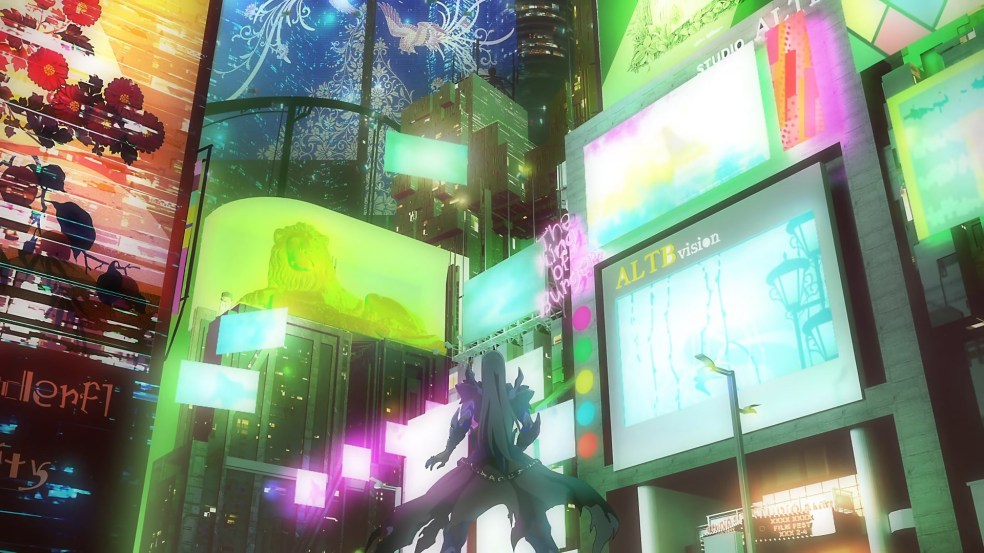
So! This show! Our premise is that your archetypal demon lord—Veltol Velvet Velsvalt [Hino Satoshi], great name—has been defeated. Some centuries later, his world collides with and fuses with ours, plunging the globe into a magic-infested apocalypse that kills most of the planet and reduces what remains to a squabbling landscape of feuding city-states. In the ashes, magic and technology combine to forge a broadly cyberpunk-inflected setting. So far, so “reverse isekai with a twist.” There’s a bit more to things than that, though.
Veltol is of course resurrected in the present day (2099, natch), and as he gets his bearings in the first episode, with the assistance of his loyal servant Machina [Itou Miku], two things immediately stand out about both his character and the timbre of the show itself.
1: Veltol is portrayed, barring a big exception that we’ll get to, with a fair amount of genuine gravitas and dignity. That’s not to say the character is taken 100% seriously all the time, but rather that the series devotes a fair amount of space to his thoughts and feelings, and how they interact with the world he’s returned to. He feels like an actual person rather than a boxed archetype.
2: The series on the whole seems, at least going off of the three episodes that have currently aired, to be surprisingly faithful to the original ideas of the cyberpunk genre. While the tiresome stock fantasy racism metaphors that pockmark the narou-kei scene are present here, they are more of a background element than a defining feature (and at one point are blamed on a specific character, in a seemingly deliberate move on 2099‘s part). The real antagonistic force is unchecked technocapitalism and all that it enables; stressful, strained paycheck-to-paycheck living, the inequality it foments, etc. As a force, this is embodied by Marcus [Matsukaze Masaya], one of Veltol’s former lieutenants who has found a new position in the world, as the overtly ill-intentioned head of a massive tech company.

This is not to say that Veltol is a straightforward good guy. He’s still an aspiring world-conquering tyrant after all, but because the series is from his point of view, he’s humanized in a way that a lesser show just wouldn’t bother with. This is most obvious at the end of the first episode, where his most loyal devotee, the aforementioned fire immortal Machina, takes him to her new home, a tiny, ratty apartment on the outskirts of the city. Veltol initially assumes this place is some sort of storeroom, and when Machina gently corrects him and makes it clear she’s not joking, breaking down in tears at the “shameful” fact that she lives in such a small home, he pulls her close to comfort her.

A later episode shows us Machina’s backstory, which involves her being thrown into an active volcano. And remarkably, the show still portrays her current state, struggling to get by and making minimum wage, as being even less dignified than that. The message that this is an environment that makes monsters of all of us is clear. It’s also a nice bit of character building for Veltol, and a cheaty (but not invalid!) way to get us, the audience, on his side. Veltol as he’s portrayed here, even accounting for the evil required for his conceptualization as a demon lord, is a nearly admirable figure. I admit to having a personal weakness for a certain kind of principled villain in fiction, depending on what those principles are, so I may be in the minority in that I’d follow this guy into hell. Still, I imagine even if you’re less susceptible to such things, he comes off well here.
The second episode is a slightly different story. For one thing, it’s a fair bit more typical for this genre. Veltol attempts to find work, reasoning that having Machina take care of all of his expenses is unbecoming, and is rejected at every turn due to his lack of experience and inability to get a Familia implant, the magic-producing cyber-chip smartphone-things that that Marcus’ company produces. This doesn’t pan out, and per the suggestion of his and Machina’s mutual friend, the resident punk-hacker Takahashi [Hishikawa Hana, in one of her first major roles since her time as Cure Precious came to an end], he takes up a career in streaming, which surprisingly works out rather well for him.
This whole bit certainly seems like a stupid gag that’s going to derail the whole show, and it takes up most of the second episode, but things get back on track with the much more serious third. (Which has a fun double-meaning title, it’s called “Debut of a Demon Lord”, alluding to both the beginning of his streamer career sure, but more importantly his actual return as a force of real impact in the world.) There are great scenes throughout; Veltol meets his old enemy Gram [Namikawa Daisuke], now granted eternal youth by a goddess as a reward for his service and profoundly disillusioned with the 500 years of war, death, and betrayal he’s endured since the two last met. Veltol tries to make Gram see things his way, that the world needs a strong leader like him for true peace, but it doesn’t take. (Remember, Veltol is the protagonist, but he’s not actually a “good guy”. “Peace through tyranny” and all that.) And he finishes off the episode by reasserting his might against an oni who kicked his ass back in the first episode, which is a fun full-circle moment.

As with many anime like this, it’s hard to make a called shot as to whether or not 2099 will really live up to its potential, but these first few episodes are promising, and in what’s been a pretty dry season, any show that’s good or at least interesting is worth keeping tabs on.
Like what you’re reading? Consider following Magic Planet Anime to get notified when new articles go live. If you’d like to talk to other Magic Planet Anime readers, consider joining my Discord server! Also consider following me on Anilist, BlueSky, Tumblr, or Twitter and supporting me on Ko-Fi. If you want to read more of my work, consider heading over to the Directory to browse by category. If you’re looking for me to watch a specific show, watch this space. I am planning to reopen commissions in the near future.
All views expressed on Magic Planet Anime are solely my own opinions and conclusions and should not be taken to reflect the opinions of any other persons, groups, or organizations. All text is manually typed and edited, and no machine learning or other automatic tools are used in the creation of Magic Planet Anime articles, with the exception of a basic spellchecker. However, some articles may have additional tags placed by WordPress. All text, excepting direct quotations, is owned by Magic Planet Anime. Do not duplicate without permission. All images are owned by their original copyright holders.


 The Magic Planet