Let’s Watch is a weekly recap column where I follow an anime for the course of its entire runtime.
For the Cinderella Gray column, new installments will be posted either on the Sunday each episode airs, or as soon as possible over the succeeding week. Expect spoilers!
We begin this week’s episode with a blowout. Last week’s episode went out of its way to at least suggest that Black Ale was a credible threat to Oguri Cap. But true as that might be in theory, in practice, Ale runs in this race how she’d run in any other, and she ends up paying for it. Oguri Cap finds an opening in the pack of runners in the middle placements and shoots through them like a silver bullet. Or perhaps we should say around them, since her big play here is to take advantage of the sheer width of the track to come from the outside, seizing the front position from Black Ale relatively late but without much trouble.
All that happens before the OP drops, mind you. And it’s enough to get the attention of the blonde journalist we met very briefly last week. That guy, Fuji Sensuke [Takahashi Daisuke], turns out to be a surprisingly important part of this week’s plot. But before we talk about what he’s up to, we should talk about the two other races that happen in this episode. Both are important, and while we only really see one of them in any detail, they’re both important as setup pieces for where this story appears to be going overall. In general, I would actually say this is one of the series’ weaker episodes so far, given the somewhat muddled pacing. But it’s to the show’s immense credit that even with that in mind, it’s still wildly entertaining.
The episode’s second and most elaborated-upon race pits Oguri Cap against Yaeno Muteki [Hinohara Ayumi]. I have to admit to feeling a little bad for Yaeno, who carries herself with a seriousness that would not be out of place in a much older martial arts series or the like (and this is a comparison Cinderella Gray draws directly, when we meet her trainer late in the episode, he’s an old-school martial arts anime sensei type, looks like a retired samurai, and carries a wooden sword around with him). She attempts to directly challenge Oguri in the Tracen Academy cafeteria, only to get ignored because Cap is too busy being awed at the variety (and sheer quantity) of food available.
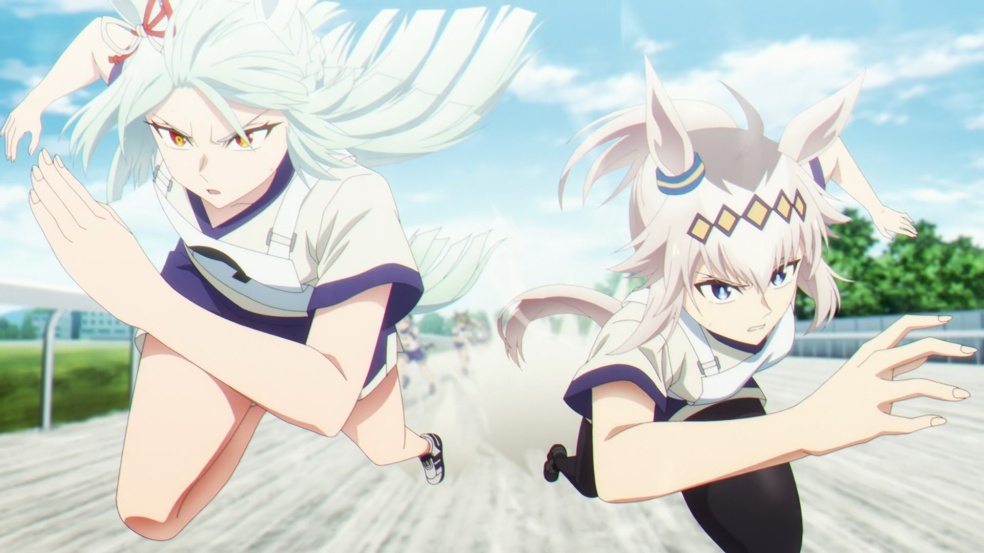
On the racetrack, Muteki is a more credible threat, deliberately hemming Oguri Cap in so she can’t pass the other racers on the inside of the track. What she doesn’t see coming is Oguri’s willingness to simply run much farther by taking the outside of the track, and while Cap is evidently impressed enough to actually remember who Yaeno Muteki is after this, she does still win, putting her at an impressive 2-0 within a single episode.
In spite of all this, I would say the episode’s actual main drama comes from somewhere else. In between all the racetrack action, we sometimes cut over to Symboli Rudolf and Maruzensky (voiced by mononymous seiyuu Lynn, she’s Rudolf’s assistant, and a horse girl from the same generation of racers). It’s worth honing in on this particular tidbit here.
Much effort has been put into reinforcing the idea that Symboli Rudolf was really something special. This makes sense given her obvious strength as an athlete, but what Maruzensky means is a bit more specific than that. What she really seems to find lacking in the modern Twinkle Series is the way that Rudolf lit up a crowd. That nebulous “superstar” quality is what Maruzensky thinks the game’s been missing. (And given the equally nebulous time scale of Uma Musume in general, we don’t have a great idea of how long ago that was, but it certainly seems like it’s been a while.) The obvious blank we’re supposed to fill in—made nearly-explicit when Maruzensky actually directly brings her up later in this scene—is that Oguri Cap is or at least could be that superstar. Were it not for the red tape getting in her way, of course.
Which brings us back to Fuji Sensuke. A reporter with the eye for sensational headlines, Sensuke gets wind of Oguri’s disbarment from the classics and runs with the story, publishing incendiary headlines and, by episode’s end, even getting a massive petition with tons of signatures in front of Symboli Rudolf. Sensuke is an evidently somewhat amoral figure, and Roppei expresses annoyance that he’s trying to make this happen when he sees the aforementioned headlines. (Does he think Oguri’s not ready? It’s hard to say.) The episode closes with a standoff between Sensuke and Rudolf—and I do have to give the guy credit for having the stones to demand she pull strings about this in person—but there’s one last foible we should touch on.
Yaeno Muteki’s loss to Oguri Cap seemed to disqualify her from the Satsuki Sho. However, one of the other racers—Dicta Striker [Hanamori Yumiri], who given her distinctive design seems like she’ll be important eventually—had to drop out, giving her an opportunity to enter in a replacement spot. The Satsuki Sho is a G1 race, and Yaeno Muteki actually wins it, although not without some serious competition. This, combined with Sensuke’s petition, certainly seems to be setting Oguri Cap and Yaeno Muteki up for a rematch. And this time, Oguri knows who she’s up against.
Like what you’re reading? Consider following Magic Planet Anime to get notified when new articles go live.If you’d like to talk to other Magic Planet Anime readers, consider joining my Discord server! Also consider following me on Anilist, BlueSky, or Tumblrand supporting me on Ko-Fi. If you want to read more of my work, consider heading over to the Directoryto browse by category.
All views expressed on Magic Planet Anime are solely my own opinions and conclusions and should not be taken to reflect the opinions of any other persons, groups, or organizations. All text is manually typed and edited, and no machine learning or other automatic tools are used in the creation of Magic Planet Anime articles, with the exception of a basic spellchecker. However, some articles may have additional tags placed by WordPress. All text, excepting direct quotations, is owned by Magic Planet Anime. Do not duplicate without permission. All images are owned by their original copyright holders.
Let’s Watch is a weekly recap column where I follow an anime for the course of its entire runtime.
For the Cinderella Gray column, new installments will be posted either on the Sunday each episode airs, or as soon as possible over the succeeding week. Expect spoilers!
Tracen Academy is, to any Uma Musume fan who got onboard before Cinderella Gray, synonymous with the series itself. Tracen is the main setting for seasons 1-3, as well as Road To The Top and the New Era film. It is Uma Musume. So it’s unsurprising that, just past the halfway point of its first cour, Cinderella Gray is also shifting setting to the storied racing academy. I admit I only barely fall into the category of “Uma Musume fan who got into it before Cinderella Gray” myself, having started with the aforementioned Road To The Top OVA near the top of the year. Still, Tracen is an already immensely nostalgic setting for me, and it’s lovely to see it again. Also worth looking at are the contrasts between this episode and episode 1, instructive and fascinating as they are. We began this story in what is, comparatively speaking, a backwater for Uma Musume racing. (The “boonies,” as one character puts it.) We begin this second part of it here, in Japan’s racing capitol. Make sure to keep up, things don’t seem like they’re going to slow down any time soon.
It’s worth also briefly touching on the contrast between Tracen as depicted here and its own past appearances in Uma Musume anime. While always portrayed as a prestigious and sprawling school, here it somehow feels even more enormous, as though it’s been blown up to truly massive proportions. This feeling of massiveness serves to amplify the fish-out-of-water effect; Oguri Cap takes the sights and sounds of Tracen in stride (although Belno super doesn’t), but the point remains; they’re not in Kasamatsu anymore.
Their first few days also don’t go smoothly, why would they? In fact, quite a lot happens in this episode. Basically everything short of an actual race.
Firstly, there’s the school itself. As mentioned, sprawling, enormous, not what either Oguri nor Belno are used to. Helping them get adjusted is Roppei (it’s Musaka), subbing in as Oguri’s trainer while Kitahara gets his national license. The pair briefly meet, ad hoc, with Symboli Rudolf, who takes the time to explain the ostensible meaning behind their school’s motto.
We’ve already talked about “Eclipse first, the rest nowhere,” since it came up in episode four. Here, the phrase is framed as a command to aim for the ace, to never be content with second best, to stand alone at the top of the mountain. Interestingly, what I did not know at the time—and what you already know, if you clicked that link I put in the header—is that that’s not what it means. It actually refers to the dominance of a single, specific historical horse; that’s who Eclipse is, or rather was. This isn’t a criticism of course, Uma Musume has a long-standing habit of attempting to imbue artifacts of real horseracing with some additional meaning, (the example that comes to mind is Satono Diamond explicitly comparing her unbreakability to her namesake in season three) and the transmutation of “Eclipse” referring to a specific individual to meaning the verb “eclipse” is just another instance of that, and a pretty slick one. It’s also relevant to the episode on the whole. Oguri Cap being such a goofball can obscure the fact that she’s very, very good at what she does, and is about as strong-willed. She does not, and will not, settle for second place, literal or figurative, in anything.
This brings us to the topic of Oguri’s actual classroom. When Oguri attends her new homeroom for the first time, we meet an absolute smorgasbord of new faces. I assume each will be relevant in their turn as this arc goes on, but worth immediately mentioning are Yaeno Muteki [Hinohara Ayumi], who meets her as a new comrade and challenger with respect, and Black Ale [Mori Nanako], who absolutely does not do either of those things.
Black Ale is incredibly arrogant and is vocally unimpressed by Oguri. She has the race record to back that arrogance up, so one can kind of see where she’s coming from in not necessarily thinking Oguri is all that based on her wins back home. Still, she doesn’t actually have a good measure of who she’s messing with. And indeed this doesn’t really faze Oguri Cap at all, at first, and she responds to that little “sandboxes” insult with the kind of dry remark where you can tell she doesn’t even realize she’s just punked Ale in front of their entire class.
Much later, toward the end of the episode. Ale confronts Oguri Cap again, this time directly insulting Kasamatsu, its racers, and Oguri herself, and that Oguri does not stand for. As is tradition with this kind of thing, the two make a bet. When they meet in the upcoming Pegasus Stakes, if Black Ale wins, Oguri Cap will return home. If Cap wins, Ale has to watch her language. It’s true that Black Ale has probably the mouthiest lines of any Uma Musume in the anime so far, but implicitly what Oguri Cap is really saying is more along the lines of telling her to watch her mouth, a subtly different thing. Cap is a hometown hero in the making now, something she’s clearly aware of.
We need to back up, though. Because Black Ale is not the only horse girl Oguri tells off in this episode, and she is by far not the most prominent one.
To rewind a bit, it’s mentioned, not long after the classroom scene, that in order to enter the G1 classics and attempt to obtain the Triple Crown—that’s the Satsuki Sho, the Japanese Derby, and the Kikuka Sho—you have to, you know, register to do that. Kitahara seemingly never considered that Oguri Cap would want to do this immediately (or just didn’t know about all this paperwork in the first place), and as such Oguri has none of the relevant forms. If it’s possible, seeing Oguri Cap live one of my recurring nightmares that’s haunted me since middle school has made me love the character even more.
Still, it’s hard not to feel for her, here, and it says a lot about Cinderella Gray‘s range that it can capture both this extremely relatable exasperation and confusion and the fiery feelings of a competition stoked in the same episode. In fact, it draws a connection between the two. Because Oguri Cap, who really wants to win the Japanese Derby for Kitahara (since she can’t win the Tokai Derby now, but since they’re both called the Something Derby they must be basically the same, right?), gets it in her head that surely, there’s at least one person she can talk to to work out some kind of exception.
She’s wrong about this, or at least, wrong for the time being (it seems odd to me that the Triple Crown would be brought up at all if Oguri isn’t going to somehow at least attempt it eventually), but you really have to give her credit for trying, because the person she has in mind is Symboli Rudolf.
Symboli Rudolf is a fascinating character in the history of Uma Musume. Throughout the previous episodes of Cinderella Gray and, indeed, throughout most of the history of the franchise, she’s been largely a background presence. Season 2’s protagonist, Tokai Teoi, admired her deeply, and Rudolf has been present, usually as a somewhat remote voice of reason, throughout all three of the Uma Musume TV seasons. She’s a franchise-wide bedrock, and her immaculate race record backs up the often-made claim that she’s the strongest Uma Musume ever, but we know surprisingly little about her as a character.
What this episode suggests is that Symboli Rudolf’s air of authority is derived not only from her strength—although certainly that, too—but also the deadly seriousness with which she takes the sport. Oguri Cap explains her predicament, and for what is to my recollection the first time ever, we see Symboli Rudolf get angry about something.
The show is clearly very proud of this shot, because there’s a flash back to it not long later.
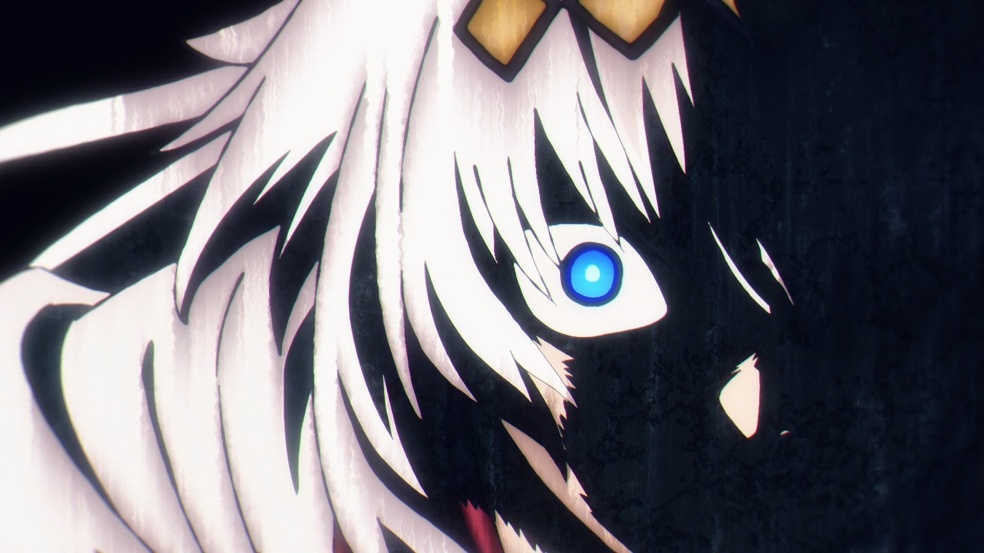
If anything, Rudolf is offended that Oguri Cap thinks she can waltz in and simply upend the proper order of things because she wants to. I really can only give it up for the character visuals here once again, that is a mean-looking horse right up there. In fact, her anger is overwhelming enough that Belno, also there while Oguri is asking about all this, actually falls to her knees in fear. I do get it! It’s not just Rudolf herself, it’s the gravity with which she treats this subject. There is no better illustration than this, the visual of a nameless Triple Crown winner standing atop a mountain of broken bodies, which fades into view with a grim grandiosity.
But of course, Oguri Cap is Oguri Cap. This is where we come back to that competitive mindset, typified by the motto which, remember, Rudolf herself expounded on earlier in this same episode. Oguri Cap will take these rules and traditions, and she will break them with her legs; her words, not mine. Arrogant! Arrogant, but really fucking cool! How does that even work? Is she going to just win so much that they’ll have no choice but to bump her up? I don’t know! I’m excited to find out!
One gets the sense from this single exchange that Rudolf is so used to most other people buckling in her presence that someone actively defying her is a bit of a shock. Am I reading too much into it? Maybe. But I’ve never met an anime I couldn’t over-analyze.
This article has already gotten super long, so I won’t go over every other little detail of the episode. But Oguri does meet her teammates, the other girls in Roppei’s stable; the preppy Meikun Tsukasa [Kazama Mayuko], the somber and shy Kraft Univer [Tanaka Takako], and–
[Kaiden Michiko]
It’s hard to say if these characters will be super relevant going forward or if they’ll mostly serve to help Oguri out with her training. Still, God Hannibal. What a name. I’m speechless.
In any case, the last scene of the episode cuts to the Pegasus Stakes, Oguri’s race against Black Ale. The race itself is territory for next episode, but one of the last scenes here is Oguri standing beneath the huge, open sky, drinking in the roar of the crowd, and being absolutely stoked out of her mind. It’s maybe the best possible way to tee up this particular cliffhanger; a reminder of why we love this absolute freak in the first place.
….Oh, and there’s a really cute post-credits scene where we check back in on Fujimasa March and company while they’re at what’s essentially a Denny’s. Norn gets called down bad, which I’m taking as validation of my ship, and Fujimarch ponders cutting her hair. It’s brief, but I’m very glad to see those characters even in passing.
Like what you’re reading? Consider following Magic Planet Anime to get notified when new articles go live.If you’d like to talk to other Magic Planet Anime readers, consider joining my Discord server! Also consider following me on Anilist, BlueSky, or Tumblr. If you want to read more of my work, consider heading over to the Directoryto browse by category.
All views expressed on Magic Planet Anime are solely my own opinions and conclusions and should not be taken to reflect the opinions of any other persons, groups, or organizations. All text is manually typed and edited, and no machine learning or other automatic tools are used in the creation of Magic Planet Anime articles, with the exception of a basic spellchecker. However, some articles may have additional tags placed by WordPress. All text, excepting direct quotations, is owned by Magic Planet Anime. Do not duplicate without permission. All images are owned by their original copyright holders.
Let’s Watch is a weekly recap column where I follow an anime for the course of its entire runtime.
For the Cinderella Gray column, new installments will be posted either on the Sunday each episode airs, or as soon as possible over the succeeding week. Expect spoilers!
Oguri Cap enters this episode devastated and conflicted. She leaves it a hometown hero. That’s how legends are born.
The previous episode of Cinderella Gray was a masterfully-crafted, coiling mechanism of tension. This episode is where that tension is released, and in that process we get to see some sides to our favorite characters that we haven’t seen before. But the true crux of the episode is the Gold Junior, an epic, psychological struggle on the racetrack. It ends with a huge, overwhelming moment of pure catharsis, one of the best of its kind in recent years. Remember; “Cap” meaning “peak.”
Getting there is another story. The episode opens with Oguri Cap furious, angrier than we’ve ever seen her, at Kitahara’s decision to transfer her to the nationals and stay behind. (Not to once again devote space on this site to my own thirsting, but there is a frightful beauty to Oguri’s angry faces, they’re very well-drawn and the fact that they’re such a stark contrast to how she normally acts really enhances the effect.) Her fury is easy to understand; she and Kitahara promised to take on the Tokai Derby together, and from her point of view he’s now breaking that promise. This is a recurring theme across the episode, the letters and spirit of these promises, and what breaking them means.
For Oguri, it makes it difficult for her to concentrate on the race, both in the training leading up to it and, eventually, for the race itself. For Kitahara, it’s the apex of his plague of self-doubt. No less a figure than once again, Symboli Rudolf, calls him out for his foolishness. Making either choice would’ve been better than trying to make none of them, and hinging the transfer on Oguri’s race results puts the horse girl in a truly unenviable situation.
The morning of the race is filled with contrast. Merch stalls sell adorable plushies of the rising local hero, and excitement is in the air from the audience at least, who clearly understand that they’re about to see Oguri build her legend up with another victory. But the track itself is bogged-down with mud after thudding, pounding rain from the previous night. Kitahara is in low spirits, and Oguri, now conflicted that her running is making others sad and without the confident support of her trainer, is in even lower ones.
Complicating things even further is the presence of Oguri’s rival up to this point, Fujimasa March. March, of course, is also furious. Word has by now spread that Oguri is going to be transferring to the nationals if she wins. Fujimasa demands to know why. They promised to race in the Tokai Derby together, and that promise is now falling apart before March’s eyes. Again, it’s easy to see why she’s upset, and moreover, why she’s hurt.
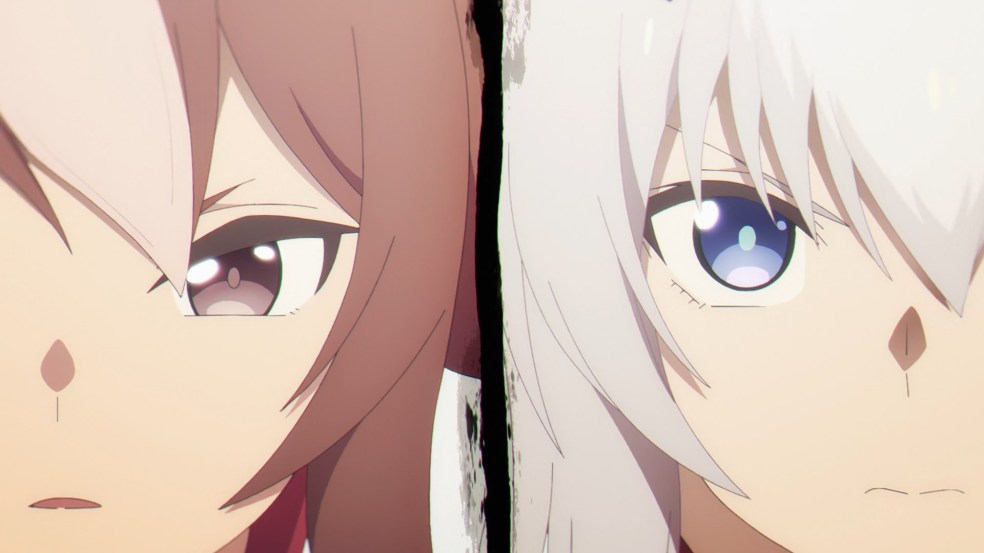
But she gets no sympathy from Cap herself. Deadened by having lost her reason to run, Oguri reminds her that all March has to do to keep her from transferring is to win. The presentation is immaculate here, with sweeping, low, buried-in-the-floor camera angles and easily the meanest face we’ve ever gotten from Oguri. The tension is palpable, and it says a lot that the slap across the face that Fujimarch opens the conversation with is not the highlight of this scene.
Nonetheless, the race waits for no one.
And indeed, the race itself is a struggle less between Oguri Cap and Fujimasa March, and more between Oguri Cap and herself. She’s out of form for much of the race, and imagines her legs bound by heavy iron chains dragging her down. For a while, it really does seem like Cap might actually lose, and it’s to the show’s credit that it keeps anyone who doesn’t have the real Oguri Cap’s racing history memorized guessing.
She’s so out of sorts that she doesn’t even make use of her trademark burst of speed, something which Fujimasa March notes with some incredulity, offended that her rival isn’t even trying. As it often does in these sorts of situations, it takes an external force to jostle Oguri Cap back into proper form.
That force is Kitahara, who, like Oguri, spends most of the race struggling with himself. His own doubts are quieter and get less direct attention (since he isn’t the protagonist, naturally), but he spends most of the Gold Junior sulking and not even actually looking at the race track. It takes Roppei, also in attendance, to snap him out of it, physically forcing him to look at Oguri Cap’s performance. Seeing his trainee obviously out of form and distraught is enough to spur Kitahara back to action, and he begins running too, fumbling through the crowd, bloodying his nose—that seems to happen to him a lot—and finally reaching a spot where he can cheer loud enough for Oguri to hear him. Just as Roppei shook Kitahara out of his stupor, Kitahara shakes Oguri out of hers by doing this.
For Oguri, his cheers, and the cheers from the others watching—Belno, the bully trio who have remained an important part of the supporting cast up to this point—are a reminder of why she’s running; to make herself happy, to make others happy.1 Regaining her confidence is enough: Oguri Cap takes the day.
In a beautiful touch, her hair comes undone as she crosses the finish line, leaving her final mark on the locals a wave of flowing, cloudy gray as she streaks into first place. The victory is immensely cathartic. The series makes a point here that Oguri Cap inspires her supporters; it’s obviously talking about Kitahara, Belno, Norn Ace, and so on, but it’s also talking about the people in the crowd, and thus, implicitly, us as well. The swell of joy is very real with this one, it’s perhaps one of the best-orchestrated victories in the whole franchise.
In the aftermath, Oguri’s stage show—which she rocks, by the way, and just generally looks great doing—becomes a platform for Kitahara to tell the crowd that, yes, the rumors are true. She’s moving on and up. The crowd is initially disappointed, but he reminds them—and anyone watching at home who might be sad to see this part of the story end—that there are higher dreams to aim for. This story isn’t over yet, and there are more mountains to climb.
The reason all of this works so well is that big dreams and stories of triumph are why we’re here in the first place. As Kitahara notes, it’s a Cinderella story! It’s right in the title! It’s also a testament to how ungodly well Cinderella Gray has been written so far that I’m genuinely going to miss every single character Oguri has to leave behind now that she’s transferring to Tracen! Norn Ace’s idea to take a commemorative picture (somehow framed as a polaroid photo despite her taking it on a smartphone, just one more drop of that trademark Uma Musume time weirdness) had me full-on crying.
I am aware I keep comparing Uma Musume to some kind of long-running battle shonen anime, which is, of course, not actually what it is. But I do have to bring that comparison out again, because this episode really does feel like the end of a long, long first season where there’s a notable changing of the guard and it’s all very bittersweet. I can only really again credit the writing for evoking that feeling over a scant six episodes (of a confirmed thirteen and a rumored 23). Perhaps the toughest departure is that of Fujimasa March, who vows to continue running despite her initial plan to quit if she lost to Oguri again. It doesn’t seem like they’ll meet again, at least not as competitors, as Oguri is going somewhere that March can’t reach. Nonetheless, their mutual respect for each other is genuinely touching, an excellent last note to their rivalry.
But we can’t dwell on who’s leaving, because two very important characters actually aren’t. Firstly, Kitahara vows to get a national trainer license—we aren’t explicitly told why he didn’t try to do this in the first place, but given some of the allusions to Kitahara’s still-murky past, we can make some educated guesses—and Belno Light, who is not just Oguri’s close friend but also her personal outfitter at this point, has quietly gotten acceptance into Tracen via its sports science program. This all ends the episode on a warm glow, bittersweet but with emphasis on the sweet. The main trio are going to Tracen, and the real race has yet to be run.
1: In this way, she isn’t actually terribly dissimilar to the protagonist of Uma Musume‘s third season, Kitasan Black. For a plethora of reasons, I think the approach works much better here.
Like what you’re reading? Consider following Magic Planet Anime to get notified when new articles go live.If you’d like to talk to other Magic Planet Anime readers, consider joining my Discord server! Also consider following me on Anilist, BlueSky, or Tumblrand supporting me on Ko-Fi. If you want to read more of my work, consider heading over to the Directoryto browse by category.
All views expressed on Magic Planet Anime are solely my own opinions and conclusions and should not be taken to reflect the opinions of any other persons, groups, or organizations. All text is manually typed and edited, and no machine learning or other automatic tools are used in the creation of Magic Planet Anime articles, with the exception of a basic spellchecker. However, some articles may have additional tags placed by WordPress. All text, excepting direct quotations, is owned by Magic Planet Anime. Do not duplicate without permission. All images are owned by their original copyright holders.
Let’s Watch is a weekly recap column where I follow an anime for the course of its entire runtime.
For the Cinderella Gray column, new installments will be posted either on the Sunday each episode airs, or as soon as possible over the succeeding week. Expect spoilers!
Cinderella Gray was never going to be all victory forever. No series is that, certainly not any sports anime and definitely not Uma Musume. (Even Season 2, which is the cleanest path-charting superstar story in the franchise, is defined perhaps even more by its dramatic, tragic moments as its triumphant ones.)
That said, the kind of dramatic conflict that emerges here is a bit surprising. Not unwelcome, but at the very least it isn’t something I saw coming.
First, a bit of racetrack politic: horse races in Japan (at least, in the Uma Musume universe, but I have little reason to assume this isn’t also true in real life) are separated into national and regional races. So far, Oguri Cap’s story has been at the regional level. The Tokai Derby she aims to run in against Fujimasa March, the race both she and her trainer Kitahara Jou dream of winning, is a regional race. To that end, the episode opens on Oguri competing in the Chukyo Hai, another regional race and a stop along the path to the Derby. She wins by a complete blowout, in fact. To the point that the race itself is basically an afterthought. This is all well and good, but as we learned last week, it’s not just the usual crowd of horsegirl enthusiasts watching the race, also present is Symboli Rudolf, president of Tracen Academy. Rudolf is extremely impressed by what she sees on the track, and sets about recruiting her to compete in the nationals. She talks to Kitahara first, and he is both starstruck and extremely intimidated that she wants to talk to him. Moreso when he finds out what she actually wants.
Cinderella Gray uses a fun structural trick in this episode, wherein after Kitahara’s talk with Rudolf, we actually cut to a flashback wherein a young Kitahara is first drafted into being a horsegirl trainer by his uncle Roppei. After we return to the present, Oguri is running training laps at her usual spot, and something has clearly happened to badly affect Kitahara’s mood, but we don’t yet know what.
The plain and pragmatic truth of the matter is this; Kitahara isn’t licensed to train on a national level. If Oguri Cap is recruited to compete in national races, she will have to leave Kitahara behind.
There is quite a lot of dancing around this through much of the episode’s middle third. Kitahara’s entire vibe is very off, and Oguri even picks up on it. (Not that it’s hard to tell that someone is out of sorts when they, say, forget to press the “start” button on a stopwatch when timing you. But still.) The drama here is pretty compelling, and through the earlier flashback, the series implies some prior failure on Kitahara’s part that has led to him being so hard on himself in the present day, although we don’t yet know what that might have been. Still, it takes a weeping Belno Light—the heart of the group, here—to get some sense through to him. What he wants or what Belno herself might want aren’t the important things, they have to ask Oguri what she wants directly.
Which, itself, Kitahara can’t seem to do in a straightforward way. He delivers the news firstly in a cloying, faux-bombastic tone, and then when Oguri asks if she’d be able to keep him as her trainer, starts viciously self-deprecating under a thin veneer of taking it instride. I love this entire scene, and it makes the whole episode. It really puts both Kitahara and Oguri’s personalities fully on display and shows what happens when they clash. Jou is, by this point, very much convinced that he has to take the loss and let Oguri go, and outright says at several points across the episode that he feels that he’s holding her back. His self-defeating mentality has already made this a given for him, and he doesn’t see any way out of it. Oguri, for her part, is upset, even offended that Kitahara would assume that she’d want to race anywhere where he wasn’t her trainer. Oguri is a very straightforward and direct person, and it’s clear that she’s been taking this talk of a shared dream of winning the Tokai Derby very seriously. She doesn’t say so outright, but it’s easy to imagine that even just being asked to race under a different trainer might feel like a betrayal.
And so, she storms off. Reminding Kitahara that the Tokai Derby is “our dream.” Were it that things ended there, this might seem like something of an anticlimax, but Kitahara doesn’t have the luxury of any kind of relief. He gets a phone call. Symboli Rudolf is on the other end of the line, and while she’s polite, she makes her position on the matter clear.
Thus, we come to the episode’s end, where Kitahara gives Oguri an ultimatum. In her next race, if she wins, she will be transferred to the nationals. If she loses, the two of them will aim for the Tokai Derby together.
That’s a rough hand to deal someone, and I am extremely interested in how Oguri is going to play it, especially with hints elsewhere in the episode that the national racing press are starting to catch on to the phenomenon brewing in Kasamatsu. The Gray Monster is waking up, and everyone but Oguri herself seems to be looking toward her eventual national rise to fame with great interest. Tamamo Cross, in a post-victory interview after one of her own races, makes note of her, while elsewhere mention is made that the two of them are defying a long-standing stereotype that ashen-coat horse girls can’t run. (A detail so bizarrely specific I can only imagine it’s a translation of some weird foible of actual horse racing culture.)
So ends an absolutely fantastic episode. There are tons of little details I haven’t had the space to cleanly fit in, and it’s hard to not just cram them all in here at the end. Belno blacksmithing new cleats for Oguri? The whole weird push and pull between Kitahara and his uncle Roppei, who seemed to know this entire thing with Oguri transferring to the nationals would play out how it did? Symboli Rudolf herself, who is fantastic here and whose nickname of “The Emperor” is treated almost literally given how everyone reacts to her? All told, this episode, its smaller, less-serious moments but especially its coiling tension, is the exact kind of stake-raising this show needed, and I am riveted to see where it all goes. The world is watching, Oguri Cap! What will you do?
Like what you’re reading? Consider following Magic Planet Anime to get notified when new articles go live.If you’d like to talk to other Magic Planet Anime readers, consider joining my Discord server! Also consider following me on Anilist, BlueSky, or Tumblrand supporting me on Ko-Fi. If you want to read more of my work, consider heading over to the Directoryto browse by category.
All views expressed on Magic Planet Anime are solely my own opinions and conclusions and should not be taken to reflect the opinions of any other persons, groups, or organizations. All text is manually typed and edited, and no machine learning or other automatic tools are used in the creation of Magic Planet Anime articles, with the exception of a basic spellchecker. However, some articles may have additional tags placed by WordPress. All text, excepting direct quotations, is owned by Magic Planet Anime. Do not duplicate without permission. All images are owned by their original copyright holders.
Let’s Watch is a weekly(?) recap column where I follow an anime for the course of its entire(?) runtime. Expect spoilers!
I have not written a recap article for a currently-airing anime in nearly two years. It’s a surprisingly tough thing to nail down, at least if you want to write a good one. One has to capture the literal events of the episode, sure, but also nail its essence. What does the episode mean? Where is the show going from here? How does it fit into the contemporary landscape? What trends does it point to, present and future?
It’s a lot to consider, and that, combined with the inherent time pressure, is why I’ve largely dropped them from Magic Planet Anime. We’re making an exception today, because Cinderella Gray is, very plainly, the best thing airing right now. Despite—or perhaps because— of the fact that it’s “just” a very, very good sports series. There is a lot of great stuff airing right now (none of which I’m trying to knock), so that’s a big claim, but I stand by it. I haven’t really been beating the drum about the show as hard as I feel like I could be, and not everyone who reads these articles necessarily follows me on social media. Thus; this article. Hopefully the first of many, we’ll see.
It’s been a few weeks since I first wrote about Cinderella Gray, so let’s get up to speed real quick. After the first episode’s blowout, the second saw Oguri Cap take on Fujimasa March, the other extremely gifted, ash-haired horse girl at their school. That episode ends on a cliffhanger, and the third revealed that March narrowly edged Oguri Cap out of the victory in their first race together. The win wasn’t so definitive that she couldn’t attribute the victory to outside factors and, indeed, she becomes a little obsessed with trying to prove that she can beat Oguri fair and square. (This isn’t even an unreasonable thing to think; we also learned that Oguri’s old racing shoes were in absolutely terrible condition.) Episode three also saw Cap win a different race, absolutely demolishing the other racers and winning both the race itself and—I’m just gonna assume anyone reading this recap on my site is as yuri-brained as I am—the heart of gyaru horse girl / bully Norn Ace. Later, some more training led her to have a long, extremely shonen rival-y conversation with March, who directly challenged her to the Junior Crown.
This little conversation sets something inside Oguri alight. And that’s more or less where we begin this week. There’s a short sequence at the very top of the episode where Belno Light, Oguri’s gal pal and teammate, enters her own first race and loses quite badly. But I imagine we’ll be circling back around to her own story at a later date, as the vast majority of this episode is about Oguri, March, and this rivalry that’s grown between them.
It’s worth zeroing in on March’s line from the third episode; Without a peak to aim for there’s no point in climbing the mountain. We can make our little jokes, obviously—“peak” has taken on an adjectival meaning in English anime fandom over the past half decade, and it’s one that suits this series quite well—but it is really important that we don’t lose sight of this central metaphor.
When first asked about it, Oguri Cap is just grateful she can run at all. We already know from past episodes that when she was younger she could barely walk at all and it took active intervention on her mother’s part to turn her into the athlete she is today. This is great on its own of course, and it’s genuinely touching how truly grateful she seems to be that she can exert herself in the way she can, but this is a sports series. Oguri feels she has something to prove now.
There is an immense amount of appeal, in fact, just in watching Oguri do her thing, whether training or actually running. Aside from being a massively-endearing protagonist in the “strong but a bit of a doofus” mold (like dozens of classic shonen characters), there is a real joy to seeing her determination harden and sharpen now that she has a rival. At one point in this episode, she reveals that she’s been training with extremely heavy cleats on, a modern update on the whole “weighted clothing” trope from countless battle manga (which is promptly called attention to).
When the actual Junior Crown begins, Oguri’s trainer Jou takes note of her newfound motivation, self-deprecatingly quipping that he sometimes wonders why he’s there at all. This promptly gets him an earful from the episode’s new character; Jou’s uncle Musaka “Roppei” Ginjirou [Ootsuka Houchuu], also a horsegirl trainer, unexpectedly in town from Tokyo on vacation and scoping out the Junior Crown apparently on a whim.
Oguri Cap isn’t the only one training, of course. We get a look at March doing some “image training” (a minor obsession for this series, it played a fairly big role in Season 2), trying to imagine every possible scenario on the racetrack and conceiving of how to beat Oguri every single time. She claims to have thought up 100 different possibilities by the end of this scene, and given the fun visual of her dreaming up the blue and red colored ghosts of Cap and herself in the void of her own imagination, it’s easy to believe her.
There’s also an interesting contrast drawn between the relationships Oguri and March have to their trainers. Despite Jou’s self-effacing remark, it’s clear that Oguri likes and trusts him, and he has in fact contributed somewhat to developing her strengths. March’s trainer, meanwhile, gives her a presentation on the race, which she completely ignores in favor of her “concentration,” even going so far as to tell him to shut up. Whether this is something the series will continue to focus on as it goes forward is for those reading the original manga to know, but the difference is interesting, perhaps remarking on trust between trainer and athlete as just as important a component in a well-rounded competitor as anything else.
All of this leads up to the race, of course, and the Junior Crown is probably the show’s high point thus far. The race takes up a decent chunk of the episode, and we can basically break it down into two main parts, structurally-speaking. Firstly, there’s the race itself, which visually focuses on the actual motions of the racers as well as their mentalities while on the field, including a few full-on flashbacks to provide motivation, context, and color. (And toward the end we get some of the truly spectacular “auras” literally coloring the racers, a favorite technique of this series.) Secondly, there is the commentary, mostly coming from Jou and Belno who are watching in the stands, but also occasionally from Ginjirou and from an observing Tamamo Cross [Oozora Naomi], an uma musume visiting from Tokyo, who attends Tracen Academy, the prestigious racing school that is also the main setting of the three mainline Uma Musume seasons.
The race is spectacular. There’s a really great exchange between Cap and March just before the race begins, where Oguri interrupts March’s image training (which she’s still doing even as she prepares to run the actual race!), to say this.
I could write an entire separate article about the absolutely incredible character work the show has done with Oguri Cap so far. She’s goofy and silly often enough, and for just long enough, that as the audience we get sort of tricked into forgetting that she’s also basically Goku. This single line, probably the closest thing Oguri has offered so far in the series to a taunt, has more character in it than some anime’s entire casts. March, for the record, offers a shocked expression, but then a grin. This is largely a battle between the two of them, and they both know it.
Following on from the first three episodes, the racing in Cinderella Gray is a little less overtly fantastical than the approach taken in some more recent material from the series (certainly it’s quite a bit more grounded than the fantastical imagery in, say, New Era). But this isn’t a criticism, the grittier approach works really well for Cinderella Gray, and this race is probably the best demonstration of it yet. Particular attention is paid to Oguri Cap’s unique, low-to-the-ground stride, pointed out as a distinctive feature of her racing style as early as episode one.
Throughout, the race is a tug-of-war between Oguri Cap and Fujimasa March. (Spare a thought for Okan Maker, an extra who’s in the lead for a decent bit of the race but ends up left in the dust by both of them.) Accordingly we hear a lot from Fujimasa March. We even get a flashback showing how she’s been dedicated to winning her entire life, starting from when she was a child. In fact, much of the tone during the latter half of the race seems to sell the idea that March is going to inch out a win. She’s ahead of Oguri—admittedly just barely—starting after they both launch into a burst of speed at the same time. But what every single thing and person in the episode raising the flag that this is March’s race doesn’t understand is that Oguri Cap is….I mean, there’s no way to put it politely. She’s a monster.
The very last stretch of the race is spectacular, and here Cinderella Gray does lean into the more overt, battle shonen-esque stylings of some of its predecessors. That it’s only in such a short burst actually heightens its impact; just as March thinks she’s cinched the win, Oguri pulls a second burst of speed out of nowhere, treated with all the suddenness and gravitas of a warrior revealing a secret technique, and just like that, March is simply done.
Oguri Cap storms to victory, and the first arc of the series comes to a close.
After the race, March, initially in complete disbelief (and quite understandably pissed off) demands to know how she did that. Oguri speculates—as though she herself cannot entirely account for the power within her—that it was, in some way, March’s own doing. By directly challenging Oguri, she gave her something she didn’t have before. Oguri, of course, is quite grateful for all this, and we must imagine that the two will meet on the racetrack again in the future. Oguri directly offers such.
In doing this, Oguri seals the two’s relationship as rivals spurring each other to greater heights. I doubt March will be the last of these she picks up on her journey.
The episode’s denounement is fun, including the post-race concert, an oddity of the series that’s always felt a little tacked on—and at worst, reminiscent of the bottom of the barrel of the “idols but also other stuff” genre—here, in a relative rarity, it actually feels meaningful. Oguri has improved vastly as a performer since the previous episode where she listlessly danced to enka music and inspired Norn Ace to give her some dance lessons. (You know you’re living the sports yuri dream when all three of your former bullies show up to cheer you on at your race and one of them went out of her way to teach you how to dance. If we include Belno—and why not include Belno?—by my count Oguri has three different girls with their eyes on her. Four if we count Tamamo’s intrigued parting remark in this episode.)
The next decision to be made in Oguri’s journey is where she will race next. Jou wants to take her to the Chukyo Hai. Ginjirou advises him to skip it—he doesn’t directly say why—but Jou seems pretty determined, seeing it as an important stepping stone to Jou and Oguri’s mutual goal of winning the Tokai Derby. It might turn out to be a good thing that he’s so insistent, since an interesting post-credits scene reveals that another horsegirl attending that race—to observe, mind you—is Symboli Rudolf [Tadokoro Azusa], the Triple Crown winner that Uma Musume treats as the unofficial ur-horsegirl, president of Tracen Academy’s student council and looked up to by just about everyone. One of the final moments of the episode is a meaningful shot of the placard displaying Tracen’s motto, an artifact originally introduced way back in Uma Musume‘s first season. The motto itself is cryptic (and grammatically shaky) as always, but the shot imbues it with a certain power. Oguri Cap has much higher to climb. Both she, and her show, are just getting started.
Like what you’re reading? Consider following Magic Planet Anime to get notified when new articles go live.If you’d like to talk to other Magic Planet Anime readers, consider joining my Discord server! Also consider following me on Anilist, BlueSky, or Tumblrand supporting me on Ko-Fi. If you want to read more of my work, consider heading over to the Directoryto browse by category.
All views expressed on Magic Planet Anime are solely my own opinions and conclusions and should not be taken to reflect the opinions of any other persons, groups, or organizations. All text is manually typed and edited, and no machine learning or other automatic tools are used in the creation of Magic Planet Anime articles, with the exception of a basic spellchecker. However, some articles may have additional tags placed by WordPress. All text, excepting direct quotations, is owned by Magic Planet Anime. Do not duplicate without permission. All images are owned by their original copyright holders.
Seasonal First Impressions is a column where I detail my thoughts, however brief or long, about a currently-airing anime’s first episode or so.
Somehow, this is the first full article I’ve devoted on this site to Uma Musume. I have to admit that that’s mostly my own fault, I was very late to this particular party, and only got onboard the proverbial horse-drawn carriage earlier this year. (I still haven’t seen the series’ proper third season.) Uma Musume, occasionally also called Pretty Derby, is a series whose reputation precedes it, given its odd premise and ties to a large, very successful franchise that most English-speaking anime fans are unfamiliar with beyond said premise.
The long and short of it is this; Uma Musume takes place in a world where horse-eared animal girls compete in vigorous races. The horse girls are named after actual, real horses—and in Uma Musume’s fiction they actually are those horses, reborn into the show’s setting—and the races themselves are largely patterned after real races. Using the real-world horse races as a scaffolding, Uma Musume then constructs a triumphant, pulse-pounding sports anime. Visually, the later Uma Musume entries, especially the OVA series Road To The Top and the movie Beginning of a New Era (which I have been trying to write an article about for months, incidentally) are some of the best and most intense anime of the 2020s, and one ignores them because they’re “silly” at their own peril. The rough-around-the-edges first season followed ambitious sweetheart Special Week. Season 2 traced the path of rocketship superstar Tokai Teio and her shonen rivalry girlfriend Mejiro McQueen. The Road To The Top OVAs studied a trio of often-intense rising stars, and the New Era film explored a rivalry between its leads that bordered on a deranged, psychosexual obsession. Each entry in the series has been increasingly spectacular, especially visually, which only makes sense. Remember: this is a sports anime.
All this in mind, Cinderella Gray has big horseshoes to fill, following as it does the story of Oguri Cap [Takayanagi Tomoyo] and her rise to fame. Perhaps wisely, right out the gate, Cinderella Gray actually engages in some scaling-back from the New Era film, the otherwise most-recent Uma Musume anime. We don’t begin our story at Tracen, the prestigious racing academy from the previous three seasons of the anime. Instead, our setting is a smaller academy that trains racers for regional competitions.
Our point of view character for most of this opening bit of scene-setting isn’t actually Oguri Cap herself, but rather Berno Light [Seto Momoko, in what looks to be one of her first roles], a much more ordinary horse girl (although one whose cute hair decorations shaped like capital Bs should not be ignored), and it’s through her that we get some sense of the reduced grandeur here. When she asks her homeroom teacher about the national races, she’s just straight up told that it’s not something she needs to worry about. A little rough! Inauspicious beginnings for what’s sure to be a tale of a meteoric rise to the top!
In fact, the very first character we follow isn’t even Berno, but rather Kitahara Jou [Konishi Katsuyuki], a trainer—and a human, as is traditional in Uma Musume’s trainer / horse girl setup—who laments the sorry state of the local scene. He’s looking for a star, and he’s pretty sure he’s not going to find one in the Gifu regionals.
Enter, of course, Oguri Cap. Cap, whose real-life counterpart was nicknamed “The Gray Monster,” is presented here as, essentially, an old-school shonen protagonist. She’s kind of dim, eats her own weight in food on the regular, and trains way, way harder than anyone else. She’s an archetype to be sure, but an instantly likeable and endearing one. “Someone you can root for from the bottom of your heart,” per Jou’s own words.
Not everyone necessarily feels that way, though. For much of her first day (and thus much of this episode), Oguri Cap is actually bullied by a trio of delinquent horses; the gyaru Norn Ace, the mean-looking Rudy Lemono, and the decidedly short Mini the Lady.
Lest anyone get the impression that Uma Musume is taking a sharp turn into being a school drama however, Oguri Cap is actually so oblivious to anything that’s not food or running that these attempts to get under her skin completely slide off of her. Up to and including Norn Ace, her dormmate, making her sleep in a supply closet. (Oguri, the very definition of a cartoon country girl, is just stoked to have her own room.)
She has the last laugh anyway. The episode’s final stretch consists of a practice race where Cap is set to run against Rudy, Mini, and Berno, and the former two prank her by undoing her shoelaces before the start of the race. In spite of having to stop to re-tie them, Oguri absolutely annihilates her competition, leaving them in the dust as she blasts past them, completely outpacing them.
Uma Musume has developed its own visual language with which to depict racing as its gone on; broad sweeping ‘karate chop’ hand motions, coiled cock-and-fire pistol shots of forward, springing motion, glowing Black Rock Shooter eyes and electrical auras, and so on. Oguri is drawn in a subtly different way, telegraphing her unusual gait, the secret weapon that makes her interesting to Jou beyond her raw talent, it’s explicated in just a line or two of dialogue, but as is often the case with Uma Musume, seeing is believing.
Can we root for Oguri Cap from the bottom of our hearts? It doesn’t take much to convince me when the show looks this good, but I do really think that this is not only a treat for longtime fans of the series but also an ideal jumping-on point for anyone who’s been waiting for one. Being set chronologically earlier in the franchise than seasons 1-3 means that the attention-grabbing cameos of previous seasons’ characters are kept to a minimum. There’s no real risk of feeling lost here, so I would say that just about anyone should check this thing out. You really have nothing to lose. (If anything, I think longtime fans are the ones more likely to have nitpicks. One could argue this is a slower start than, say, the first episode of season two. But this feels like such a minor point that, to me at least, it isn’t really worth making.)
Personally, what interests me most is not just Oguri Cap and the way she runs. We’re introduced to another horse girl here as well, alongside Cap, Berno, and the delinquent trio. That girl, Fujimasa March [Ise Mariya], who shares Cap’s white-gray hair and her immense talent as a runner, but is distinguished by an intense, sharp gaze, and a serious demeanor, seems like she’s being set up as Cap’s long-term rival. As Oguri Cap wins her practice race, blowing her competition out of the water, March is watching from the sidelines, ignoring the trainers trying to get her attention. Fujimasa March clearly knows that something big has just happened. In a subtle way, here in this particular place, the world has changed, and she can feel it. Can you?
Like what you’re reading? Consider following Magic Planet Anime to get notified when new articles go live.If you’d like to talk to other Magic Planet Anime readers, consider joining my Discord server! Also consider following me on Anilist, BlueSky, or Tumblrand supporting me on Ko-Fi. If you want to read more of my work, consider heading over to the Directoryto browse by category.
All views expressed on Magic Planet Anime are solely my own opinions and conclusions and should not be taken to reflect the opinions of any other persons, groups, or organizations. All text is manually typed and edited, and no machine learning or other automatic tools are used in the creation of Magic Planet Anime articles, with the exception of a basic spellchecker. However, some articles may have additional tags placed by WordPress. All text, excepting direct quotations, is owned by Magic Planet Anime. Do not duplicate without permission. All images are owned by their original copyright holders.
The Weekly Orbit is a weekly(-ish) column collecting and refining my more casual anime- and manga-related thoughts from the previous week. Mostly, these are taken from my tumblr blog, and assume familiarity with the works covered. Be wary of spoilers!
We persist, we survive, and we thrive. A lot has happened since the last Weekly Orbit column, and I could spend this opening bit bloviating about how or why I’ve chosen to bring the column back now. The actual answer is much less romantic: for the first time in a while, I not only had something I wanted to talk about, but I had the mental bandwidth to do it. A lot’s happened over the past few months even in the specific realm of my relationship with anime (I got really into Uma Musume, for example), but the honest truth is just that I found the time and energy to get around to it. Thus, Weekly Orbit is back. At least for now. You can probably assume it will be a similarly on and off affair going forward.
That said, if you wanted to be dramatic—and who doesn’t love being dramatic?—you could point out that the last thing I wrote about in the last column before this series went on a months-long hiatus was BanG Dream! It’s MyGO!!!!! No prizes for guessing how that relates to this week’s column. Between this and the other column that will be going up later today, this is basically Ave Mujica Day on Magic Planet Anime. I cannot pretend I’m sorry about that.
Anime – Seasonal
BanG Dream! Ave Mujica
Where to even start?
What follows is a collation of two separate tumblr posts I’ve written over the past few days. A funny fact about anime—art in general, really—is that it’s always constrained by the circumstances around its production. Ave Mujica, as anyone who’s read my first impressions article or, honestly, just taken a gander at them knows, is cursed with very bad official subtitles right now. The practical effect of this is that I’ve had to wait for some brave souls (a group going by LoftMoon and a lone warrior calling themselves Nyamuchi after the in-show character, respectively) to pick up Crunchyroll’s slack before I could bring myself to actually catch up with the series.
All that is to say, I watched episodes two, three, four, and five of Ave Mujica over the past couple of days rather than the past couple of weeks. I would describe the overall effect as bulldozer-esque. It’s some of the most fun I’ve had with an anime in ages, but it’s also genuinely emotionally exhausting. At one point, I attempted to just write a literal list of the show’s ongoing events, but that in of itself got a bit out of control, so I pared it down to just these. Episodes two through four are defined by an arc in which Wakaba Mutsumi, the band’s rhythm guitarist and thus the core of their sound, does the following:
Flubs an interview by voicing what appears to be an intrusive thought, thus sparking rumors that the band is going to break up.
Freezes up on stage, sitting stone-still before the audience. Or, to invoke the metaphor we’re actually intended to see, sitting like a puppet with her strings cut.
Experiences a psychotic break, at which point a dissociative alter naming herself Mortis, after Mutsumi’s stage pseudonym, takes over as the primary personality, placing herself at front in what we are now aware is a system.
Mortis proceeds to hog the spotlight in interviews, leading to a bunch of tension with the other members, especially Nyamu. Mortis in general is flighty and theatrical. More importantly, she can’t actually play guitar. (At the very least, she claims to not be able to, and we’re not given a reason to disbelieve her on this subject.)
All of this, as well as Mortis’ generally confrontational nature towards Sakiko, who she claims to hate, culminates in the band breaking up. We are, at this point, four episodes in, and the band our show is named after is gone. “The dolls no longer exist.”
What is all this?
Usually, when you’re asking that question about an anime, it’s rhetorical. With Ave Mujica I’ve genuinely found myself with very little idea of where exactly it’s going to go. It’s fair to ask the question, and people have asked the question, is this even really a music anime anymore? We haven’t really gotten anything in the way of new songs, and Ave Mujica as a group, at least in the show’s narrative, are less defined by their music and more defined by what interrupts it and what grows around it.
An acquaintance has been watching the show ahead of me, and in doing so described it to me as going in more of a horror direction. My initial assumption was that they were exaggerating. Ave Mujica are a goth metal band, sure, but even considering the rich vein of drama mined by this show’s own immediate predecessor, MyGO, “horror” just seemed like a step beyond believability. And yet, here we are. To be sure, these horrors are largely in the mind, but that doesn’t really make them any less arresting. (See also Perfect Blue, clearly at least an indirect influence on this series.) Episode three, with its haunted, surreal visuals as we go directly inside Mutsumi’s mind, is the big turning point for the series. Yes, this is all “in Mutsumi’s head” and what is depicted in this scene is not literally happening. The lack of material reality does not change the fact that Mortis’ usurpation of the system is portrayed by her cute little doll form morphing into a shadow monster and eating Mutsumi. Yeah, sure, it doesn’t “actually happen,” but someone gets eaten alive in a fucking BanG Dream anime! What the hell!
This does raise the question, boring but admittedly necessary, as to whether or not Mortis’ depiction is problematic. When I wrote the tumblr version of this post I was on the fence, but having had the time to think it over I don’t really think so. Despite clearly being some kind of protector alter, Mortis is also naïve and rather kiddish. Most of the “horror” elements are framing of her own experiences or those of others reacting to her, especially Sakiko who is clearly just very unequipped to deal with this entire situation. It gives us some deliciously spooky shots, but Mortis is very clearly not actually a monster, all of this is part of the theater of the anime itself. (Still though! Episode 3! What the fuck!)
And then there’s episode five. The most recent, as of the time of this writing.
In the immediate aftermath of Ave Mujica’s dissolution, its members largely go their separate ways. Here, for the first time in a while, Sakiko gets to be the main character in her own show. Unfortunately, since that show is Ave Mujica, this does not necessarily mean she has a particularly good time.
Despite Uika’s—that’s Doloris, Ave Mujica’s vocalist, in case you’ve forgotten—pleas, Sakiko does not stay with her, where she’d been crashing for the past couple of episodes. Instead, she returns to her soul-crushing call center 9-to-5, and the abuse of her drunken father. Until, that is, her grandfather shows up, tells her he’s paid off the—I must imagine, significant—debts incurred from the cancellation of Ave Mujica’s arena tour. This is a pretty classic rich older asshole relative move, they take care of some financial problem for you so you’ll owe them. An episode one Sakiko would probably not have caved to this, but at this point in the series she’s been beaten down by the fallout from both her own bad decisions and the bad decisions of others, and so, she surrenders her agency to her grandfather. We don’t get to hear any explicit promises made, but it feels safe to say that the path forward for Sakiko, if things do not change, is a life as a physically comfortable but emotionally miserable pawn in the interminable power-play games of the wealthy.
Seeing Sakiko like this is, of course, a huge fucking bummer. At the core of it all, Sakiko is only human, but it must be remembered that she was introduced to us as an antagonistic, somewhat cryptic presence throughout the second half of MyGO. Seen through the eyes of others, Sakiko is massively charismatic—Char Aznable with a girl band, recall—but here she’s stripped of everything that makes her so. Seeing her cowed, beaten, rendered painfully clearly as just the teenage girl she actually is, is heartbreaking, a painting so sad the colors run off the canvas. She’s been reduced to a rich girl playing pretend. It hurts to watch.
All the more so because the second half of episode five reintroduces some of the MyGO cast. We get to see some of Sakiko’s past through Tomori’s memories. This person, a happy, fulfilled Sakiko in the early days of CRYCHiC’s activities, is someone that we the audience barely know. It’s difficult to even reconcile that this is the same girl who had a catastrophic falling out with the rest of that group and then spent the remainder of MyGO lurking around in the background. This is the girl who would be Oblivionis? And yet, it’s obviously so. What we are seeing—and have been seeing, this whole time—is someone who’s badly lost her way. The show’s oppressive atmosphere lets up for the first time in the parts of this episode dominated by the MyGO cast. They absolutely have their own shit going on, but compared to simply everything else the series has been so far, it’s small potatoes.
MyGO definitely paved the way for this to exist in both a sense of literal continuity and also in its particular approach to storytelling, but a lot is still up in the air, and episode five’s twin endings raise many, many more questions than they answer. Not to mention I have barely talked at all about what Uika and Nyamu have going on, those two are clearly powderkegs all their own. (One of the very few things I can say with confidence about the future direction of this show is that it will not end without them exploding.) Not that I’m complaining, mind you, the show’s intense, pulsating goth-drama is far and away its best quality. Things are almost placid when we’re within Tomori’s flashbacks, but the last parts of the episode bring us crashing back down to the depths pretty hard. I won’t say more, except that I think MyGO‘s central theme of music as a tool of honesty and communication is about to be very thoroughly tested.
Purely in terms of how much they can be mined for discourse in the old sense of the term, Sakamoto Days might be the least complex thing airing this season. There are zero hidden layers here, every episode is an excuse to get Sakamoto and a group of other assassins in a room, where they will fight, and Sakamoto will win. It is consistently entertaining and just as consistently absolutely nothing else. This episode’s got a fun one-off character in the form of Hard Boiled, whose whole thing is calling stuff “hard-boiled.” Also he has exploding ping pong balls. Pure popcorn TV, and I can’t fault it for that.
Anime – Non-Seasonal
Umamusume: Pretty Derby Season 2
The thing is this: everything anyone has ever told you about Uma Musume is true.
It is a ridiculous, meticulous setting where girls with horse ears compete in very serious, deadly serious races against each other for glory and the thrill of victory. Season 2 is not my favorite Uma Musume thing, that’s still the brain-scrambling New Era film, which I hope to write about someday in the not-too-distant future, but it’s very good, and it’s a really good take on the inspirational sports story formula, a vast improvement over the already pretty solid first season.
Tokai Teio [Machico]! I could kiss her. She’s the greatest prodigal runner ever. She’s our heroine. She suffers more than Jesus. The show repeats the basic plot beat of “Teio injures herself severely and might never run again” three times and somehow it actually hits harder each time. I don’t understand it, it flies in the face of conventional narrative logic, but here we are. It slaps end to end. By the end of the show I was cheering in my seat when she ran her final race.
Also of note: the story of Rice Shower [Iwami Manaka], the Assassin in Black, which is maybe the dark horse (haha) actual best story arc in this season, presented as a shy would-be contender and then revealed as a deadly spoiler who snatches a victory from, most crucially, co-protagonist Mejiro McQueen [Oonishi Saori]. All in all just really solid stuff throughout. The pacing problems inherent to having to write these stories loosely around real-life events are still here, but all told this is just an absolute blast and a huge improvement over season one. This is where I start to understand how we got to New Era.
As an aside, if you don’t follow me there you may not know that I actually livetweeted my experiences with much of Uma Musume on bluesky. I started with the Road To The Top OVA, and then the New Eramovie, (although that one stalls out about halfway through for reasons that will be obvious if you read it), before going back and watching season one and season two. I won’t be doing this for the third season for reasons that will be apparent if you just scroll a bit further, but I figure I should mention this here where it’s relevant.
Umamusume: Pretty Derby Season 3 – Episodes 1 & 2
Interesting stuff.
These are just loose thoughts as opposed to more organized ones, and given that I’m only two episodes into this series I’m disinclined to re-edit them to the extent I did with some of the other stuff in this column. But the main thing that’s sticking out to me is this: a recurring fixture of this series is that you can’t compete against an idea, only the actual people on the field. Previously we see this with Teio’s fear that she’ll never be able to catch up to McQueen when she’s recovering in that show’s last arc, later on we’ll see it with Jungle Pocket and Agnes Tachyon in New Era. Here it takes something of a different form, in that our new protagonist Kitasan Black [Yano Hinaki]’s admiration of Teio is clearly constraining her in some way (probably most directly obvious during her flashback wherein she imagines Duramente, the horse who actually beat her, as Teio in full racing silks). Once Duramente is injured in the second part of the episode, this fixation almost immediately leaps to her instead.
All told this seems to be building up a somewhat more pronounced underdog story than is usual for this franchise. Also, one scene here has what I think is probably the most emotionally raw use of the vent stump (a recurring fixture of the series) that we’ve ever seen, in that Kitasan, fresh off a loss, doesn’t really say anything, she just fuckin’ hollers into it.
What all of this says about Kitasan is pretty interesting. A lot of what she does in these opening episodes is genuinely kind of offputting, which, ironically, kind of makes her more likable than she might’ve been as a more traditional protagonist for this series. I’m interested to see where the rest of this goes!
Manga
False Marigold
Interesting Taisho-period yuri with a nuanced, fraught central relationship, in which our protagonist is a young girl pretending to be her own dead brother in order to make his girlfriend, a blind girl, happy. This does not go smoothly, as you might expect, and I really like the story’s exploration of both Hana’s (the boymoder) and Lily’s (the girlfriend) internality. Both of them feel like very fully-realized people which makes it hurt all the more when they’re suffering and makes it all the nicer when things are going well for them.
Also there is a ton of hand and eye symbolism on the volume covers. Hana covering Lily’s eyes because yeah she’s literally blind but also she’s symbolically blind to the deception. (Or is she? As the series goes on it becomes apparent that Lily is sharper than Hana initially assumes. Still, it’s a nice bit of symbolism.)
I don’t have as much to say about this as I’d like to, so I might reread it at some point and take notes this time. All told though I do highly recommend it especially if you’re looking for a “toxic yuri” pickup. (True misery connoisseurs might be disappointed by a few aspects? I’m not sure.) Also if I ever see someone say that this “doesn’t count as yuri” I’m gonna slap them.
And that’s all for the big comeback piece. Hopefully you found something enlightening or just interesting somewhere in there. I’m going to make a rare direct request that, if you like my work in general and this article in particular, you drop a donation if you can spare it. It’s my only source of income, so every bit helps.
Now then, I leave you with this rare Anon W as your Bonus Thought of the week.
Like what you’re reading? Consider following Magic Planet Anime to get notified when new articles go live.If you’d like to talk to other Magic Planet Anime readers, consider joining my Discord server! Also consider following me on Anilist, BlueSky, or Tumblrand supporting me on Ko-Fi. If you want to read more of my work, consider heading over to the Directoryto browse by category.If you’re looking for me to watch a specific show, watch this space. I am planning to reopen commissions in the near future.
All views expressed on Magic Planet Anime are solely my own opinions and conclusions and should not be taken to reflect the opinions of any other persons, groups, or organizations. All text is manually typed and edited, and no machine learning or other automatic tools are used in the creation of Magic Planet Anime articles, with the exception of a basic spellchecker. However, some articles may have additional tags placed by WordPress. All text, excepting direct quotations, is owned by Magic Planet Anime. Do not duplicate without permission. All images are owned by their original copyright holders.