
Seasonal First Impressions is a column where I detail my thoughts, however brief or long, about a currently-airing anime’s first episode or so.
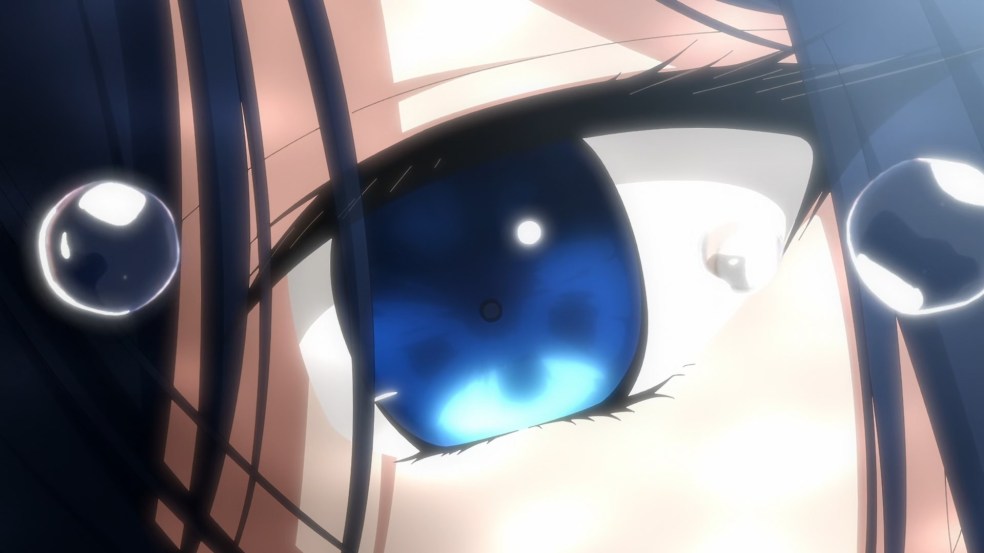
“Until the day that beautiful monster grants my wish with her own two hands….”
The first thing is the pacing, and the second is the sound design. I’m late to this one, I know, but upon watching the first two episodes of This Monster Wants To Eat Me, the latest in a growing number of decent-to-great yuri adaptations from up and down this year, those were the two elements that stuck out to me the most. Normally, when one brings up an anime’s pacing, it’s to complain. It is all too easy to fuck up the sequencing of events when adapting a manga to animation; by rearranging them illogically, by sticking so close to the source material that you sap the life out of the thing (the more common of those two scenarios these days), or simply by pacing them wrong. Events that are snappy on paper aren’t necessarily so in motion, timing is a key consideration when it comes to picking an approach for adapting this material.
Keep all this in mind as I say, usually, when an anime feels slow, that’s said as a bad thing. Especially if it was based on a manga. Watatabe—as This Monster is more commonly known—proves that it’s not necessarily so. This is an anime that creeps, lurches, and crawls. What it lacks in traditional production polish it more than compensates with in deploying its sense of timing and its audio to create atmosphere. Despite being set in the dead of summer, this is an anime that most makes sense as a Fall series. Mermaids should get to trick or treat, too.

As for what this is all actually about? Well, our main character, Hinako [Ueda Reina], is depressed. We don’t have the details yet, but it seems that she lost her family to some tragic accident some time ago. She wants to die, but she either doesn’t want to or can’t bring herself to end her own life, so she spends a lot of time gazing into the sea and waiting for her time to come. Early in the first episode she runs into a mysterious girl, Shiori [Ishikawa Yui], who warns her that leaning over the railing by the coast isn’t safe. She could fall in, after all! Nonetheless, when she returns to the same spot to do more or less exactly that later that day, strands of thick, dark hair creep out of the water like animate seaweed. Our heroine is thus attacked by an iso-onna, who drags her into the water to consume her.
In its way, this isn’t so bad, Hinako thinks. Sure, it was out of the blue, but this is what she’s been looking for, isn’t it? And nothing, not even the attempts of her best friend (the rowdy Yashiro Miko, played by Fairouz Ai), has really helped. But, in an even more surprising turn of events, the girl from earlier intervenes, sprouting fishscales and a long, sickle-wicked claw to drive the water ghost away.
This isn’t anything as simple as a rescue, though. Shiori wants to eat Hinako, too. She’s just not quite tender enough, yet. So begins a particular flavor of twisted love story.

These first two episodes, especially the second, largely take us through the paces of Hinako’s daily life, and how it changes in the presence of Shiori. Hinako technically never straight up says she’s infatuated with Shiori, but lines like the one quoted at the top of this article make it pretty clear how she feels. The dynamic Watatabe is building here is an interesting one. Hinako wants Shiori to kill and eat her. Shiori is explicitly interested in keeping Hinako alive until her flavor reaches its peak. She explicitly compares Hinako to livestock, in fact.


The important bit here is that Shiori is going to eat her eventually, but not right now. This actually bothers Hinako, not because she’s afraid or repulsed, but because if she’s going to be eaten she’d really rather it be soon. Despite the grim tone and the slow, creaking nature of the storytelling, there’s also an almost bratty overtone to the whole thing, as though Hinako is a needy submissive and Shiori, her domme, is teasingly avoiding giving her what she wants most.
This is, of course, the point. Watatabe’s premise is a take on the whole “domestic girlfriend” fantasy—found more often in heteroromantic romance manga, but it can be seen in yuri as well—wherein a depressed character is lifted to life and warmth by someone who insists on taking care of them. (There is in fact an entire style of romance manga and light novels built on this premise. If you’ve ever seen anything tagged “Rehabilitation” on Anilist or MyAnimeList, that’s what that means.) The roles of the nurturer and romantic partner are rolled into one in these scenarios, and Watatabe‘s playful skewering of them involves giving the caretaker/partner character an explicitly malicious overtone. Remember, within the world of the story itself this isn’t actually a metaphor: Shiori literally wants to kill Hinako and eat her, head to toe. But Hinako, depressed and longing to be reunited with her family, either figuratively in death or literally in the hereafter, is fine with that, and in fact wants that. In its way, Watatabe‘s story is quite a wicked little thing.

I don’t think it would work nearly so well without the audio component. The music here is straightforward but devastatingly effective, an arsenal of simple piano and string pieces that hammer home the oppressive summer that Hinako has been living for so long, and remind us that there is a final, sharp end to her relationship with Shiori. The voice acting here is excellent, too. Ishikawa Yui lends a breathy, ethereal tone to Shiori that really sells the idea of her as some otherworldly creature. She can also make Shiori sound forceful, which is helpful when the character needs to project ferocity (as at the end of the first episode), or make clear to Hinako that she doesn’t get to make all of her own decisions anymore (as at the end of the second). Ueda Reina makes Hinako sound exactly the right amount of withdrawn and closed-off. For an example, visually speaking, her daydreams about ocean life intruding into her everyday existence are reasonably effective but hardly flashy. It’s really the flat, deep-sighing tone of voice Ueda brings to the role that ties it all together.
Having the aural advantage is good. The elephant in the room here is that the show doesn’t look fantastic. It doesn’t look bad, I wouldn’t say—although its frequent use of frame-blending pushes things—but it’s definitely a shoestring production and looks the part, and doesn’t hit the visual heights of, say, the best episodes of the similarly-abbreviated Watanare. (Although that had its lesser moments, too.) Similarly, the actual shot composition is effective but largely unspectacular except for a few particularly striking moments. None of this is all that surprising for a low-resource anime at this stage in the medium’s history, but it is at least worth knowing going into it, and if it pushes people toward the manga instead, I don’t think that’s necessarily such a bad thing, even if they are missing out on the lovely sound design here. It is, in any case, a minor weakness. Or at least it is if I’m the one being asked.
The second episode ends set against the interesting love triangle building between Hinako, Shiori, and Miko, who spends much of the episode being jealous of the mysterious relationship that Hinako and Shiori seem to have suddenly developed.

She, in fact, asks Hinako to a festival. Hinako turns her down—it would seem that the accident that caused the deaths of her family is somehow related to this very same festival—but Shiori, not content to let her prized pig simply sit and girlrot, forces her to go. We don’t know how that’s going to work out for either of them, yet. (Or for Miko, for that matter.) But I certainly plan on tuning in to find out.
Like what you’re reading? Consider following Magic Planet Anime to get notified when new articles go live. If you’d like to talk to other Magic Planet Anime readers, consider joining my Discord server! Also consider following me on Anilist, BlueSky, or Tumblr and supporting me on Ko-Fi. If you want to read more of my work, consider heading over to the Directory to browse by category.
All views expressed on Magic Planet Anime are solely my own opinions and conclusions and should not be taken to reflect the opinions of any other persons, groups, or organizations. All text is manually typed and edited, and no machine learning or other automatic tools are used in the creation of Magic Planet Anime articles, with the exception of a basic spellchecker. However, some articles may have additional tags placed by WordPress. All text, excepting direct quotations, is owned by Magic Planet Anime. Do not duplicate without permission. All images are owned by their original copyright holders.


 The Magic Planet