
The Frontline Report is a weekly column where I summarize my journey through anime, manga, and the related spheres of popular culture over the past week. Expect spoilers for covered material.
Hello again, anime fans. I don’t have terribly much to say in my lead-in here. It’s been a bit of a week and I’m a bit struck by the winter blues. I hope you won’t begrudge me that this week’s column is only about two shows. For what it’s worth, I think they’re some of the best that have aired this year. One of 2021’s great stories comes to an end and another begins to hit its stride….
The Heike Story
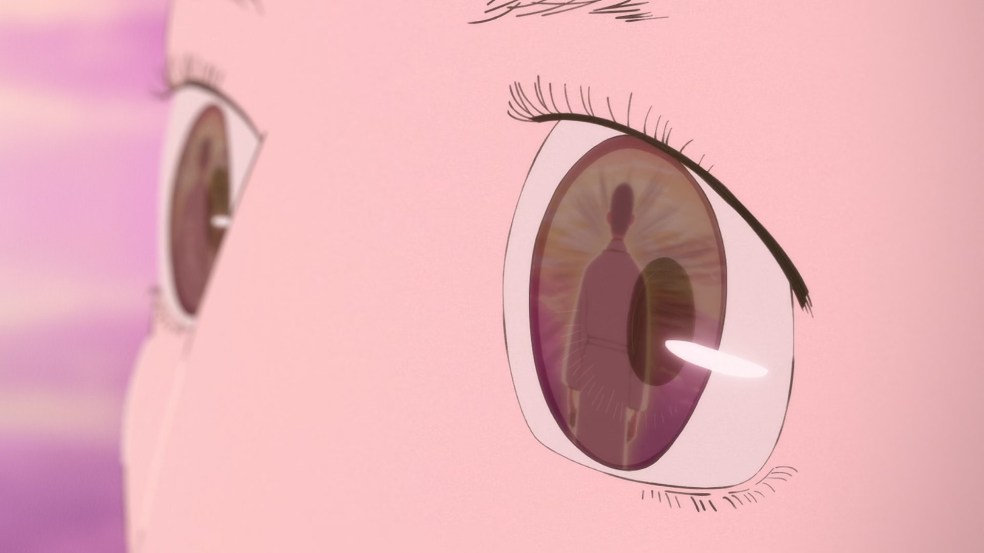
A common nugget of wisdom holds to show, not tell, when weaving a story. But it’s a false dichotomy in some ways. In the Heike Monogatari, now concluded after eleven weeks, the showing and the telling are one in the same. Never has this been more true than in the series’ final act, where Biwa, fully embracing her role as a chronicler of fate, tells us of the Heike’s demise as we see it happen; two perspectives unified like the visions from her own mystical eyes.

The series’ finale is a thing of beauty. The Heike Clan make their final stand in a battle at sea. They lose, as we knew they would from day one. Many, including the young Emperor, cast themselves into the sea. It is not what you’d call a happy ending.
A common criticism I saw of Heike Monogatari during its airing is why, exactly, Biwa did not “do more” to help the Heike who are, after all, her adopted family. As a critique it makes some sense on the surface. She can see the future, and if anime has trained us to expect anything it’s that those with heterochromia and mysterious powers will intervene to stop bad things from happening. But I cannot help but think this is a simplistic view of both Biwa’s personhood and her situation. She is a witness to history; as we all are, in spite of whatever unique talents we may or may not have. Many of us could “do more” to change things with our own talents, yet we do not. If it is a character flaw on her part, it is one most of us share.
And then there’s the series’ moral, such as it is. A fundamental truth of the world; all things are impermanent. Everything dies, empires rise only to fall. What remains are the stories we pass down and the feelings we hold with us. That, truly, is all.

This is a theme that has run through some seventy years of anime history, but if one wanted to find contemporary examples, they would not need to look all that hard. Surely critics who have studied more classical literature than I have will point out that this is a “very Japanese” and “very Buddhist” theme. Perhaps these things are true, the series is based on a historical epic after all and such things are very much informed by their era and place. I also think, though, it may also be a warning against self-importance akin to what we often grant ourselves here in the Anglosphere. We treat ourselves as living at history’s end, but it continues to happen every day in spite of us.
Heike Monogatari‘s true triumph is to delve into the minds of those gone by; to make the past feel real by showing us the human beings behind history’s academic brushstrokes. In doing so, it reminds us that we are all mortal, and we are all witnesses. Like Biwa, many of us will live to see the fall of all kinds of empires. The only question is whether we will deign to sing about it.
I do my best to sing. Do you?

Ranking of Kings

I don’t usually pick shows up mid-season, but Ranking of Kings (known as the somewhat snappier Ousama Ranking in its home country) just didn’t give me much of a choice. “Positive buzz” is one thing, but Ranking on a pure visual level does not look like most anime. This is a reflection of the source material, which seems to draw both on a western-influenced fairy tale book influence and on older strains of anime, not many of which have particularly many artistic descendants in the modern day. So provably, even speaking aesthetically, Ranking stands apart from the usual seasonal grind. This would be interesting on its own, but without a strong story to back it up, it wouldn’t be worth much. Thankfully, Ranking stands as a buzzer-beater candidate for one of the year’s most unique anime from just about every angle. Its visual style could fool one into thinking it’s a happy, straightforward story, but the truth of the matter is that it’s more of a deliberate contrast against the complex character writing and political machinations that our lead, the Deaf Prince Bojji, finds himself caught in.
It’s an utterly fascinating little show, and eight episodes in I can confidently say I have no idea where it’s going to go from here. But what I can do is tell you where it’s been. Doing so alone should be enough for any skeptics to hop aboard the Bojji Train before it’s too late.
Our setup is pretty simple. Bojji is the eldest son of Bosse, the king of a nameless kingdom of which he was the founder. In the show’s opening act, Bosse dies, leaving the question of succession a difficult one. Bojji is Deaf, physically small, and has the misfortune of living in a distinctly fantasy-medieval setting. (Ranking effortlessly pulls off letting us into Bojji’s inner world without any spoken dialogue, but many of the adults around him tend to treat him with vague disdain, or at best, an infantilizing overprotectiveness.) He’s also not much of a swordsman, despite the guideship of his trainer Domas. Though interestingly, he’s great at dodging, a skill that has yet to quite pay dividends narratively but is sure to later.
In contrast to Bojji, there is his younger half-brother, Prince Daida. Daida is much more in the image of a traditional heir to the throne than Bojji. It is thus unsurprising that when Bosse passes away, the kingdom’s council of advisors votes to install Daida as the king instead of his older brother. One might initially think that the story’s central conflict will come down to Bojji’s quest to reclaim his rightful throne, and it may still circle back around to that eventually, but something that simple would not do justice to the sheer amount of stuff this series has covered so far.
For instance; adding fuel to the movement to replace Bojji as the heir apparent is that when Bosse passes away, a massive red devil appears and gestures at the prince. What does this mean? We still don’t know a good half-cour later.

Which is good, because that’s how you build some genuine mystery. Details like this are packed into every minute of Ranking’s runtime and things are only explained directly if absolutely necessary. As a watching experience, it’s engrossing, and doesn’t have much recent competition. I haven’t even brought up Bojji’s plus-one, his shadowy friend Kage who the prince won over with his kindness, and whose obligate backstory episode is one of the show’s highlights.

Some of this attention to detail might come down to Ranking‘s runtime; it’d feel rushed were it only one cour, but it’s thankfully two. (This sadly puts it out of the running for my top five list I’ll be publishing at the end of December. I’m sure the folks at Wit Studio are just heartbroken.)
I have to admit that I considered doing a writeup of this week’s episode as well, but in deference to those who have perhaps not started watching the show yet but might find it interesting based on what I’ve said, I will not do so. Next week, though, you have my promise! Stay strong in the meantime, Prince Bojji!

He’s a mighty little man.
Wanna talk to other Magic Planet Anime readers? Consider joining my Discord server! Also consider following me on Twitter and supporting me on Ko-Fi or Patreon. If you want to read more of my work, consider heading over to the Directory to browse by category.
All views expressed on Magic Planet Anime are solely my own opinions and conclusions and should not be taken to reflect the opinions of any other persons, groups, or organizations. All text, excepting direct quotations, is owned by Magic Planet Anime. Do not duplicate without permission. All images are owned by their original copyright holders.
 The Magic Planet