
The Weekly Orbit is a weekly(-ish) column collecting and refining my more casual anime- and manga-related thoughts from the previous week. Mostly, these are taken from my tumblr blog, and assume familiarity with the works covered. Be wary of spoilers!
Hello folks. It’s been two weeks, and if that makes you think “wow, you must have a ton of Girlies Being Dramatic stuff to catch up on”, you’d be absolutely correct.
Ave Mujica – Episode 7 – 8
Two weeks ago, in my long catch-up of the series, I pointed out that a number of people have asked the question: is Ave Mujica even actually a music anime? Generally speaking, that term implies some amount of actual musical performance within the body of the show itself, whatever form that may take. Ave Mujica has been very short on that up to this point, and now that we’re halfway through the series, some viewers have begun to lose their patience with AveMuji’s lack of adherence to those genre norms.
I am not one of those viewers. Nor am I particularly surprised or upset by the fact that we do get a performance in this episode. It just isn’t from Ave Mujica. Nor even from MyGO!!!!!, their counterparts and protagonists of the series’ first season. The band that sing a song—two songs, actually—in this episode are CRYCHIC. This isn’t some kind of formal reunion and it’s certainly not a flashback episode. It’s a very brief, fleeting moment shared on a stage with almost no one at all watching. It’s more group therapy than the traditional music video-esque band anime insert song.
Very, very few people ever get to eulogize the passing of their own adolescence as it occurs. Teenagers, real teenagers anyway, do not usually have the presence of mind to capture those moments in amber before they disappear forever. Sometimes, though, both in reality and fiction, it does happen, even if the people involved don’t necessarily know that they’re doing that. Here, in the seventh episode of Ave Mujica, CRYCHIC’s story comes to its conclusion. CRYCHIC are able to, for a fleeting moment, recognize that even over just the relatively short amount of time since their breakup, their lives have changed permanently. They mattered to each other, and maybe still can, in different ways, but there is no returning to that brief time together. You can, they all seem to understand, revisit that moment as many times as you want in your own head, but you can’t ever return to it. CRYCHIC is thus, in a way, actually torn down as the romantic ideal it’s spent most of the past two seasons being: it was, per the show’s own words, an ordinary band like any other. In reckoning with that, its former members can finally take the first steps to truly moving on.

How we get to that point is a long and winding road that involves Sakiko being tackled to the ground, spending long periods just sort of standing outside of Mutsumi’s house after Mortis refuses to see her, and a non-zero amount of various characters performing the MyGO Special (roughly shoving their way into someone’s current goings-on, and sometimes literally their home, to resolve an emotional conflict). In terms of overall plotting this is honestly one of the messier episodes in this subseries, but that’s not really a problem when every individual scene is this compelling. In addition to the aforementioned reunion performance there’s a lot of great tension between Mortis, Mutsumi, Sakiko, and Soyo, in various combinations throughout the episode.
The insert songs themselves are the highlight of course. To such an extent that, in a bold bit of fanservice-in-the-old-sense-of-the-term, an actual, real version of CRYCHIC, recorded a performance for The First Take, being sandwiched in between legendary art-rockers Shinsei Kamattechan and “You Broke Me First” singer/songwriter Tate McRae, a truly insane three-artist stretch that is emblematic of The First Take’s eclectic nature.
This makes any complaint about a relative (and it would be relative) lack of technical precision in the episode’s performance twice as absurd, of course. Not only do we hear MyGO practicing near the start of the episode where they sound as tight as ever, but CRYCHIC are playing for nobody but themselves. Aside from a tiny group of bystanders; Anon, Raana, and Umiri, who sneaks in midway, there’s no audience that they’re aware of, this is a purely cathartic exercise between them, and we are witness to it purely as viewers of a television program. No one is being performed for, and as if to emphasize the point, Tomori spends most of both songs singing not out from the stage but toward the rest of the band. “Scenes From An Alternate Universe Where CRYCHIC Never Broke Up” this is not.
In any case, while this is pretty clearly the brightest episode of Ave Mujica so far, and perhaps a true turnaround point where healing can begin, it’s probably going to get worse before it gets better. Umiri’s sneaking in to the performance is not a mistake, and the jealous snarl of a grimace she makes while watching CRYCHIC work their baggage with each other out must truly be seen to be believed. That’s not to even mention Uika, following there in the footsteps of the show itself, which she has spent two weeks conspicuously absent from, and very nearly makes it a third in episode eight.
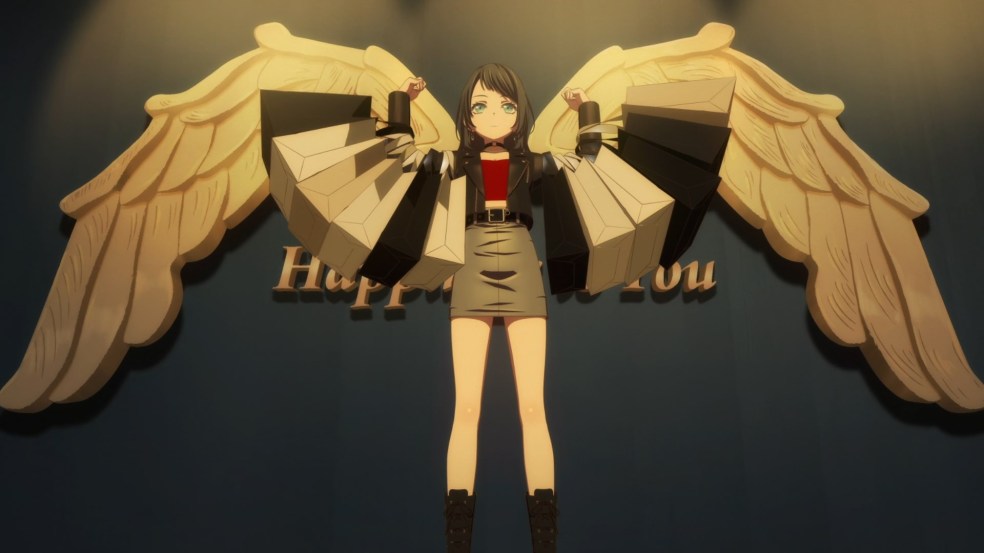
Episode 8, by the by, is not quite the event that episode seven was, but it’s nonetheless another excellent one. And, here’s a distinction I didn’t think I’d bother making for any episode of this show: it’s probably the funniest Ave Mujica has ever been. This matters, since most of that comedy comes from Umiri, finally getting some proper focus here that really peels back the layer of her cool-girl façade. Watching the CRYCHIC temp reunion in episode seven evidently really got to her, as she spends most of this episode coping with her jealousy in comically bad ways. Being given this much time to follow her also puts the lie to any notion of her being “the normal one” of Ave Mujica, given that we here learn that she almost exclusively drinks protein shakes for her meals and is Soulja Boy levels of terrible with her money. (I really cannot believe that this show features someone buying out an entire jewelry case. Retail therapy isn’t the answer, Umiri!)
She also tries to sets out on her personal goal of reforming Ave Mujica, starting with Nyamu of all people, to whom she relays her “tragic backstory” after struggling to down a single ginger ale.


Said backstory scans as more of a parody of this kind of flashback sequence than anything. All we get is that Umiri was in a band when she was a bit younger but was bossy enough that everyone was put off by it and left her stranded on stage during what was supposed to be an important concert. That’s why she’s like that: burned once for being too pushy, she went to the opposite extreme of far too hands-off, to the point of seeming untrustworthy (something Taki points out to her, early in her half of the episode). It tracks, but the droll undercutting of what’s rapidly become a trope in this relatively young genre is pretty funny, and shows that Ave Mujica isn’t all doom and gloom. (Nyamu is similarly unimpressed, and reacts to the story with a dry “wow, how sad” while inspecting her nails.)
All of this is relative, of course, because the “funniest” episode of this series does nonetheless open with a dramatic headspace sequence in which Mortis screams that she doesn’t want to die. The whole first half of the episode is actually pretty fucking dire, with all of Umiri’s stuff being in the latter half. Things start out decently enough, after the OP at least, but we’re reminded of the screaming Mortis pretty quickly when a nostalgic karaoke outing for Sakiko and Mutsumi turns into—well, it turns into something.

Intercut with that scene is one where Nyamu runs into Minami Mori, Mutsumi’s mother. Minami is, if it were not already obvious from prior episodes, a real piece of work. She describes her own child as a monster, “acting without realizing it,” but so talented she could outshine Minami herself if she put her mind to it. The Mutsumi-Mortis System’s expressiveness is not in question, but, just to put the tiger on the table here, it is pretty appalling for someone to be saying all of this about her own child. Worse, Mutsumi and co. have clearly internalized all of this, because the scene keeps cutting back to Mutsumi, Mortis, and Sakiko, arguing over whether CRYCHIC or Ave Mujica should reform. At some point, we’re locked out of seeing the objective events of the conflict entirely, Mortis’ desire to get Ave Mujica back together so she’ll have some reason to continue to exist is batted aside by Mutsumi’s unwillingness to let go of CRYCHIC. Sakiko just wants her friend to stop hurting, and she promises a lot to make that happen, but Mortis raises the idea that Sakiko doesn’t really even know who her friend actually is. She claims that the entire system has been a revolving cast of personalities who emerge and dissolve to fit the ongoing situation this entire time. Mortis and Mutsumi are exceptions to this rule, not the norm. We have some reason to be a bit skeptical of Mortis’ specific narration of events, but certainly, whatever good intentions might sit at the heart of that narration are discarded when Mutsumi seems to do to her what she did to Mutsumi back in episode three. There is a lot of internal strife here, and it’s hard not to feel for the both of them.
We do not see the results of the argument, the next time “Mortis” shows up, it’s toward the end of the episode, and the two halves thereof unite here. You may have noticed that, terrifyingly enough, Umiri and Mortis are actually aligned in goals at this point. After Nyamu half-heartedly promises to get back with AveMuji if and only if Umiri can get Mutsumi as well, Mortis is the first person to jump at the call. (Or is she? I’ve seen some theorizing that this last scene actually features Mutsumi pretending to be Mortis. Something to keep in mind as you read on.)
Mortis, you may recall, can’t actually play guitar. Thus, the episode ends with Umiri teaching her, delivering—in an episode where she’s otherwise a complete goofball and impossible to take seriously—probably her best line in the entire show so far, one that’s heavy with connotation and charge, given the whole doll motif this series has been almost obsessively fixated on since its opening minutes.

What is it with the girls in this show pulling out the exact kind of raw line that works as an armor-penetrating seduction bullet on other queer girls with mental problems?
She is, furthermore, rebuked by narration: from Uika, her first lines of any substantial length in three whole episodes. A doll, she says, will always be just that. Cue “Georgette Me, Georgette You.”
I’ve seen some concern about Ave Mujica potentially not having enough time to tie up all these loose ends, but even accounting for the fact that there are the live shows, band stories in the gacha game, and so on to look forward to, there are still five more episodes of this anime, two-ish hours of footage that could contain just about anything. Ironically, I think about the only danger the show is actually in is simply being misunderstood. Not many anime so much as approach the studied character dynamics at play here, especially those within the Mutsumi-Mortis system. As for the rest, the stage is open with possibility, and it is not over until the curtain drops. Episode 9 is called “If you leave, I shall not live.” Terrifying! I can’t wait.
Flower and Asura – Episode 6 – 7
Episode 6 sees Hana choose her selection for the NHK Cup. This is a bigger deal than it might sound, since doing so requires convincing her teacher of the passage she wants to read. Still, with everything considered, she finds one that she enjoys and which suits her. On her side of the story, everything is honestly going pretty well at the moment. Similarly, while Natsue is having more trouble than her, she’s still at least making progress on her script. It’s actually pretty incredible how much air the show can put into her script reading, given that her script is just a food ad. (It also gives us this, which, as a writer I must say I deeply relate to.)


The other end of the episode is the more interesting one here. For the first time we focus on following Matsuyuki [Yamashita Seiichirou], who we learn has a difficult home life with overbearing parents that expect him to follow in their footsteps as a doctor. He doesn’t actually seem terribly interested in doing that, and there is thus a clear central tension there, but from what we see here, he mostly acquiesces to their wishes at least face to face. Similarly, when Shuudai asks him to pen a drama script—not a small task!—he accepts with no apparent hesitation. It’s not wholly clear what Matsuyuki actually wants, although his appreciation for Hana’s readings to children and the possibly covert contact he keeps with his siblings in spite of his parents’ opinion that they’re “failures” provide some clues. There’s a clear good parent / bad parent contrast too, with Matsuyuki’s father caring for him mostly as a successor and nothing more, whereas Hana’s mother is openly proud that her daughter has made friends and found a passion.
Episode 7 spells Matsuyuki’s situation out more clearly. His older sister, a poet, left home and left him behind. This is something that clearly rests heavy on his mind, and it influences the script he’s agreed to write very heavily. It’s very interesting to me that within the drama, he writes three characters, one of whom is a girl whose parents expect her to become a doctor, but who wants to be a poet. He’s merged himself and his sister into one person. Any eggy questions this raises aside, it’s also a pretty solid bit of character building on the show’s part. He clearly admires his sister for walking away, and that admiration creeps out of him in a way that’s so unsubtle that even the other characters pick up on it by episode’s end. We also get to learn that Hana is a surprisingly fantastic actor when she plays the poet in the script. The show is cheating a little more than in the recitations here—a lot of the subtler visual characterization—that Hana has is replaced when she gets into character—but still, it’s great overall, and Hana’s performance in the climactic beach scene of the drama would be worth the price of admission for episode seven all on its own.

I like this show overall. Quite a lot, actually. But if it’s been missing one thing, it’s much in the way of stakes, aside from the looming promise of the NHK Cup. We get some of them here for the first time when it’s revealed that a meeting of Broadcast Clubs from across the country is on the horizon. Described as a “joint practice” session, this provides the show with an excuse to rejoin our main cast with Shura Saionji, the then-child actress whose recitation so inspired Hana as a child herself. The path we’re on here is obvious, in that Shura Saionji is being set up as essentially the villain of the piece. Any kvetching about the lack of stakes is admittedly partly a circumstantial complaint—anything would seem lacking in stakes airing in the same season as Ave Mujica, which manages to make its source material feel like genuine life or death—but I want Hana’s talent to be truly tested, and I want it to mean something if she’s to come out on top. To that end, the introduction of an antagonistic figure of some sort might just be exactly what the show needed. We’ll have to see.
A bit light on images this week, but hopefully that’s fine with everyone. Once again, I do ask that if you liked the article, consider dropping me a donation. Every penny helps.
To help compensate the lack of images in this article, go grab a drink from the oeosi machine as your Bonus Thought of the week.

Like what you’re reading? Consider following Magic Planet Anime to get notified when new articles go live. If you’d like to talk to other Magic Planet Anime readers, consider joining my Discord server! Also consider following me on Anilist, BlueSky, or Tumblr and supporting me on Ko-Fi. If you want to read more of my work, consider heading over to the Directory to browse by category. If you’re looking for me to watch a specific show, watch this space. I am planning to reopen commissions in the near future.
All views expressed on Magic Planet Anime are solely my own opinions and conclusions and should not be taken to reflect the opinions of any other persons, groups, or organizations. All text is manually typed and edited, and no machine learning or other automatic tools are used in the creation of Magic Planet Anime articles, with the exception of a basic spellchecker. However, some articles may have additional tags placed by WordPress. All text, excepting direct quotations, is owned by Magic Planet Anime. Do not duplicate without permission. All images are owned by their original copyright holders.


 The Magic Planet