
The Weekly Orbit is a weekly column collecting and refining my more casual anime- and manga-related thoughts from the previous week. Mostly, these are taken from my tumblr blog, and assume familiarity with the works covered. Be wary of spoilers!
Hello, anime fans! I’m quite behind on basically everything this week, but hopefully you’ll enjoy reading about what I did manage to cover, regardless. Also, here’s an odd thing, in two of the below entries I end up talking at length about the shows’ ED themes. That wasn’t on purpose! But hey, serendipity and all that.
Anime
Wistoria: Wand and Sword – Episode 3
Another week, another pretty OK Wistoria episode.
Will meets an underclassman here with the fairly incredible name Iris Churchill [Ookubo Rumi]. Initially, she seems like any other bumbling student, and Will spends the majority of this episode helping her defeat a giant ice monster. However, because Wistoria knows every trick in the fantasy book, Iris is actually a double agent for the Magia Vander and is scouting for promising students for what seems to be some kind of upcoming confrontation between the wizards and the angels that were mentioned back in episode 1, the ones that live “beyond the sky.”

This whole plot is the most interesting thing Wistoria has going for it so far. It’s still hardly original, and when we meet the Magia Vander here they too all fall into classic archetypes (most obvious with the haughty elf sorceress Alf Ellenor Ljos [Amamiya Sora]), but it’s at least decently compelling.

Iris herself seems to have some kind of Thing™ going on with Elfie, and I wouldn’t be surprised if there’s more to the both of them than is obvious here, even taking the little twists we’ve been shown so far into account.
Oh, one other thing I did appreciate. When Will gears up to head to the dungeon (and we briefly meet his artificer friend Rosty), they draw him ripped as hell while he’s changing his shirt. I applaud the lack of cowardice, it would’ve been really easy to just make him look nondescript there.
Narenare -Cheer for you!- – Episode 3
The only way out is trusting the process.
Okay, no, let’s stop for a second. What is this show? I thought I knew. In fact, as of the end of this episode, I thought I might have some idea again, but I’m now sitting with it and thinking and….seriously, what is going on here?
In theory, Narenare could not be simpler. It’s a show about cheerleading. That’s a little unusual in the context of the “girls do stuff” supergenre of anime, but it’s nowhere near the weirdest of these things in premise. But that hides how strange the execution of this all is. In this episode alone, we see several scenes from the last two weeks involving the character Suzuha. Except this time, they’re from her perspective, and we see that far from being the cool, aloof near-cryptid we’ve been presented with so far, she’s actually just extremely shy.
The show lets us in on her inner monologue by way of a chibi version of herself that hangs out in thought bubbles and occasionally just rides around on her head. It’s hardly the strangest thing I’ve seen in an anime this season (Nokotan is airing, after all), but it’s a notably weird way to present this information given the show’s genre. This is a general trend that’s true of everything in this episode; Kanata suddenly getting “the yips” about cheerleading (treated with grave seriousness by those around her), Shion’s singer-songwriter aspirations, and so on. The show seems allergic to anything that would make its several running plot lines any easier to follow. Things are mostly followed up on by having them plonked onto the existing storyline in a decidedly odd way.
A friend1 compared this to Pride of Orange, another Girls Do X show that clearly had no idea what it was doing. But to be honest, I don’t really see it. Pride of Orange‘s main flaws were an overwhelming lack of interest in its own premise and cast, and just a general deep cynicism toward the entire idea of the hobby/club anime as a genre. I don’t get that off of Narenare at all. It is clearly sincerely trying to present an inspiring and straightforward sports girls narrative, but it seems either unable or unwilling to understand why those shows usually present things in the way that they do. The result is a strange, alienating effect, in a way that feels uncannily GoHands-y in vibe if not looks. (Despite a shared affinity for weird color filter bullshit, Narenare looks much nicer than anything GoHands have ever done.)
Anyway, I plan to keep watching, because I am interested in if this effect is intentional or not. My guess is that it isn’t, this thing has three different people on script and you could absolutely get something like this just by having too many cooks in the kitchen, but still, I’m curious to see if it manages to pull something out of this regardless or if it just completely crashes.
OTP, by the way.

Quality Assurance in Another World – Episodes 3 & 4
This show has a lot of issues, and I want to appreciate what it’s going for regardless, but it doesn’t make it easy.
The issues first; over the past two episodes it’s been saddled with a light-novely writing style that just actively saps the series’ momentum. I actually thought this was adapted from a light novel, and having since learned that this was a manga first, I’m baffled that this is how this is all being delivered. There’s tons of exposition just rattled off in a very flat way and the sheer incuriosity Nikola has about her own world is kind of weird (this, to be fair, might be on purpose). Some of the exposition is fine because it’s spiced up with flashbacks or some similar other visual trick, but when it’s literally just two characters talking it gets old quick. I’m hoping we’re moving past this part of the story.
What I appreciate though is just how utterly fucking weird this show is. There’s a bit here with our leads in a dungeon, and Nikola gets carted off to be sacrificed by…monsters that are giant coins with human faces? And the thing they’re sacrificing her to is a huge hand with a mouth that acts like a sea serpent?

These legitimately feel like monsters out of a buggy shovelware RPG, and I appreciate that about the show. Similarly, the fate of Haga’s two companions that we meet here are legitimately pretty eerie. One is stuck in the floor and the other is trapped in a kill loop, buggily hovering over a death trap that she can’t properly trigger because she has invincibility mode turned on. (All this is used to explain Haga’s disdain for the debug mode feature, fair enough.)

We also meet a gamemaster AI called Tesla here who introduces herself by abruptly possessing Nikola so she can give Haga orders. All rather bizarre!
And then the episode ends with our leads running into an NPC who’s T-posing. Which brings us to episode 4, which I did not particularly care for.
The comedic side of the series is still strong here. It’s hard to mess up something as inherently goofy as “a whole village is stuck T-posing because their model animations are fucked up.” But we also meet a pair of new characters here, a furry bug-tester named Amano who aspires to be a mangaka back in the real world, and Ru, an NPC he’s fallen for, who he ends up drawing manga within the game for. Ru is a pretty compelling, if simple, character; a disabled girl who loves hearing stories. But then, oops, she dies at the end of the episode, by having a literal building dropped on her head when some of the baddies from episode 2 return to stomp through town while riding a dragon. It just feels kind of hacky and I’ve rarely seen such a straightforward example of a female character being killed to give another Man Pain to motivate him. I’m not a fan, suffice to say.

So who knows where Quality Assurance is going to end up by the time it’s over. This is one of several anime that have had the broadcasts of their next episode delayed because of Olympics coverage, and depending on what my schedule looks like in nine days when it returns, I may just drop this entirely, if that’s how it’s going to handle things going forward. I don’t know, my opinion on this series soured fairly quickly.
The Elusive Samurai – Episode 4
Our first two parter and unfortunately I don’t think it entirely works. Still a good episode, but it doesn’t feel quite as essential as the last three.
Lots of eye imagery here, which makes sense given that Tokiyuki’s adversary this time around is an archer known for his preternatural eyesight. The whole dog-hunting competition is kind of where the episode falls apart a little bit because while I applaud experimenting around, the CGI just doesn’t look as good as the other weird shit the show has done. Even elsewhere in this episode, that stuff looks better.

Alya Sometimes Hides Her Feelings in Russian – Episode 4
Honestly most of this episode is pretty dull. School drama is almost never compelling to me and that’s what the whole episode is built around. Worse, Alya and Kuze spend most of it apart so we don’t get any of their banter. (Also he basically solves the problem Alya’s caught up in for her which is not great from like an optics perspective, eh. This is minor compared to my other issues with the episode, but it still feels worth mentioning.)
The shorter second part of the episode is better since they’re back together and we get more of their repartee, which is the show’s main strength, and also a bit of relationship development (punctuated with a very powerful slap, since this is a pretty straightforward romcom anime at heart).
All of this is beside the real point of the episode, though; the song covered in the ED this week is fucking “Hare Hare Yukai”!
This is less of a weird pull than it might seem, given that Alya’s voice actress is a millennial and presumably grew up on the series, and there is a line to be drawn from Haruhi to this series, even if Roshidere‘s self-awareness is itself a pretty standard and accepted thing by now. (Somewhere in here Kuze thinks to himself that something doesn’t befit the main character in a romcom. Slow down, buddy, the fourth wall can only take so many hits.) I was delighted by this, and it redeemed an otherwise iffy episode in my eyes, so I’m happy it was done.
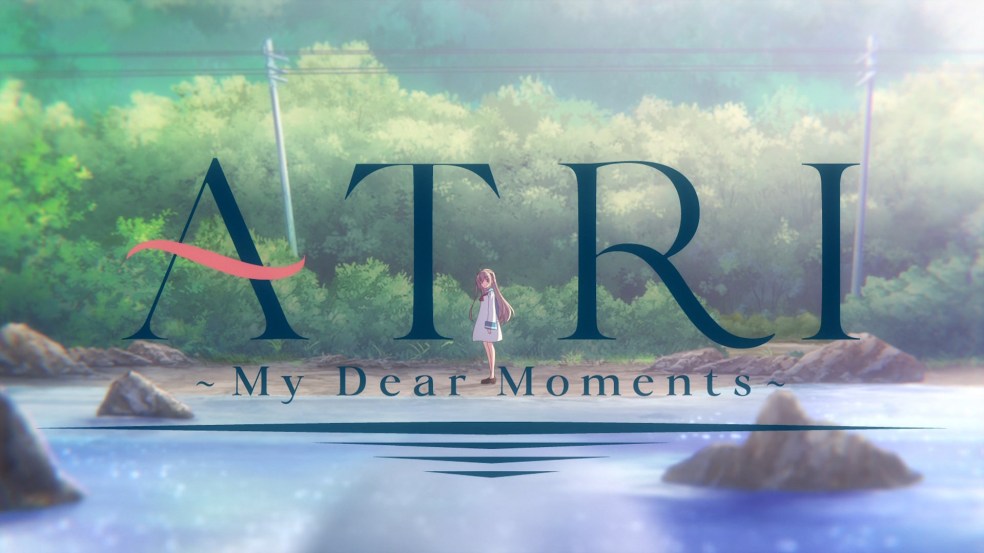
ATRI -My Dear Moments- – Episodes 2 & 3

I have realized that I like this show quite a bit.
On the face of it, ATRI depicts a fairly difficult situation. Its two main characters, Atri herself and her human caretaker Natsuki, aren’t exactly the most likeable of people. (Although Atri, who is merely clumsy and loud, is so more than Natsuki, who is sometimes outright nasty to her.) But something about these characters, and their world, compels me. I think it’s a fairly common thing to feel (even if you don’t necessarily think it rationally) that we are living in the end times of some sort, so post-apocalyptic fiction like this takes on a specific resonance in the modern day. But it’s more than just “the show is good because it depicts people getting by after a climate collapse,” which I think would be oversimplifying it.
I think I was closer on the mark with the AIR comparison I made last week than I initially realized. In addition to the obvious similarities—both take place in a coastal town, both have a heavily summer-drenched aesthetic that is a key part of the show’s visual and aural appeal—the general setup is fairly similar too, both in depicting a young (or at least young-seeming) girl and her male caretaker and their strange relationship that doesn’t neatly fall into any single category.
I’ve seen a lot of people deride the show as a rote male fantasy (in the vein of the many girl-with-a-quirk romcoms I’ve discussed this season) and while I’m not going to deny that there’s definitely at least a little of that, I don’t think it’s remotely the entire picture and seeing people write this off entirely because the main character is kind of a dick annoys me. Especially since I think his being a dick is part of the point of the series. (Hell, we get a very straightforward motivation for that here; when the ocean started rising, his dream of becoming an astronaut and helping with a climateering project fell apart and he hasn’t had any motivation to do much of anything since. It’s pretty understandable that this would turn someone crabby.)
I also like Minamo, one of the island town’s few remaining schoolgirls, very much an endangered species after the climate collapse that took place in this series’ backstory. There’s a very pronounced melancholy to almost everything she does, and she and Atri have a nice conversational scene together in her house—also half reclaimed by nature—in this episode where we learn her father evacuated to the mainland, and she chose to stay behind despite his wishes. That’s interesting! And when Atri visits her school at the end of the episode she seems to have some kind of weird flashback thing, which is also interesting.
The series has a lot going for it. In addition to everything I’ve just said, and also its deeper themes which are only just starting to take shape (persisting in the face of loss, even massive loss, is definitely going to be one), it’s also pretty funny! I can technically imagine how Atri’s antics might grate on someone but I find them endearing, and it’s hard not to when the character animation is so expressive.

Episode 3 isn’t quite as strong as Episode 2, but it’s still pretty good. Here we’re introduced to an entire secondary cast, the three young children that Minamo teaches about whatever she can at the high school, plus their older brother figure Ryuuji [Hosoya Yoshimasa]. The kids, especially their ringleader Ririka, seem fond of Natsuki, arbitrarily deciding that he’s secretly an assassin sent from the mainland and playing pretend with him based on that premise. Ryuuji is a lot colder to him, and seems to think his showing up at the school at all is an act of condescension. The episode deals in a lot of exposition about the situation on the mainland and the main thing to take away here is that the people of this island have essentially been abandoned. The kids, we’re told, actually did try to evacuate to the mainland and attend school there, but they were treated poorly and through circumstances we’re not given a super clear picture of, they eventually ended back on the island. They actually live at the school, with Ririka in particular spending a lot of late nights essentially camping out on the rooftop as she reads about electricity generation, hoping she might fix the island’s lack of electricity. By episode’s end, Natsuki has some idea of how that might be done, and his radical plan involves salvaging parts from the flooded-over disused windmills (a lovely shot of which serves as the episode’s visual center) and the fact that the school’s second floor floods at high tide.
All told, while this might be the weakest episode so far, the general buildup saves it, as does Atri’s continuing antics. I particularly like the bit here where she insists that she’s a “combat android” and we get a detailed, completely fake, flashback to her last days in “the war.”

Unrelated to the show itself, I want to briefly talk about the OP and ED and specifically the songs used for them. The OP, with a theme by mega-idol group Nogizaka46, is just an absolutely gorgeous thing and I really recommend watching it for yourself even if you have no interest in the show. The part where Atri dances and whips the ball (which later turns into the Moon!) around has such lovely, fluid motion that it’d make the entire project a worthwhile endeavor on its own even if the show itself were a complete throwaway.
But the ED, more specifically its theme, is actually even more interesting to me despite the fact that I like it less. Because it’s by 22/7. Yes, that 22/7, the idol group tied to the multimedia project of the same name, including its profoundly disappointing anime from a few years ago. That anime also had a great OP with some incredible visuals and a fantastic theme song, but the show itself was meandering and mediocre, and I don’t think it’s really stayed in the public consciousness over the past four years. (You’re more likely to find defenders of the earlier slice of life shorts.) Nonetheless, the group itself has stuck around. The ED is significantly cheerier than most of their songs, or at least the ones that I’m familiar with. But it’s pretty good! To be honest I’m just sort of shocked that they’re still active, although I think a good chunk of the original members have since departed (not that odd with idol groups, and I can’t imagine there’s much incentive to stay in 22/7 specifically).
It will be very odd if they end up soundtracking one of my favorite anime of the summer, but they well might! ATRI has tons of potential and I’m eager to see if it lives up to it, each individual episode has had its ups and downs so far, but it’s going to be the aggregate that really makes or breaks the show. I’m hardly the only person to have compared this to the KEY visual novel adaptations of old, and I’ve gotten the feeling that people really want that style back in some capacity. As such, I think there is a real chance for the series to leave a big impression on people. Here’s hoping.
Manga
“Hitokiri” Shoujo, Koushaku Reijou no Goei ni Naru
This manga feels like someone read all of those “I wish somebody would just make a shonen manga with a lesbian as the main character” posts and took it as a challenge, to an almost comical degree.
To wit; the plot is basically a string of excuses for our lead to get into fights. Our lead girl was raised to be the bodyguard of a noble in fantasy-Japan, but before she could actually do that, her would-be master was murdered. The opening pages of the story are thus her getting revenge on this other person’s killer and then fleeing the country to go to fantasy-Europe, where she remains for what exists of the story so far. There, she meets a noblewoman on a train in the midst of said noblewoman getting attacked by assassins and offers her services. The noblewoman agrees to this, and from there forward the manga has, so far, solely been these characters moving from place to place and situation to situation, with bodyguard defending noblewoman (and her maid, a character in her own right) from attack.
All of this is handled in an almost childish fashion. Half of the dialogue consists of people threatening to kill each other. Of the half that remains, half of that half is the main girl explaining to her present opponent how she plans to kill them. This probably sounds like a complaint, but it’s honestly pretty funny. The end result is that our protagonist has such a matter-of-fact approach to murder that the whole manga feels like dry humor. Like, look at all this.


Interestingly, though. The manga implies that all this violence is something that weighs on her mind a lot. There are really only three kinds of scenes where she shows any real emotion, and two of them have to do with murder. For one, during battle, whether she’s being particularly sadistic or enjoying the high of fighting someone who’s an actual match for her.

For another, the one time her charge tries to exonerate her behavior by claiming that she’s not a murderer, our girl actually rather strongly insists that she is, even if what she does isn’t illegal. She seems surprised that anyone would even suggest otherwise.

The only non-violent strong reaction she has to anything is when she meets her future employer, who gets attacked shortly thereafter. We don’t have an inner monologue for her here, so we can’t know for sure what she’s thinking, but this thing is being marketed as a yuri series, so I don’t think I’m off in calling this gay.

All this together, I don’t really know if I’d call “Hitokiri” Shoujo, Koushaku Reijou no Goei ni Naru good exactly, but it’s definitely at least compelling. I’m not sure how much of that is intentional, these apparent character quirks could just as easily be the side effects of the shortcut-heavy nature of the narou-kei scene (and this does appear to have been adapted from a light novel). But with only four chapters out I’m at least willing to give it some time to see where it goes.
That’s all for this week, anime fans! Enjoy this book, as your Bonus Thought.

1: Hi Josh.
Like what you’re reading? Consider following Magic Planet Anime to get notified when new articles go live. If you’d like to talk to other Magic Planet Anime readers, consider joining my Discord server! Also consider following me on Anilist, BlueSky, Tumblr, or Twitter and supporting me on Ko-Fi or Patreon. If you want to read more of my work, consider heading over to the Directory to browse by category.
All views expressed on Magic Planet Anime are solely my own opinions and conclusions and should not be taken to reflect the opinions of any other persons, groups, or organizations. All text is manually typed and edited, and no machine learning or other automatic tools are used in the creation of Magic Planet Anime articles, with the exception of a basic spellchecker. However, some articles may have additional tags placed by WordPress. All text, excepting direct quotations, is owned by Magic Planet Anime. Do not duplicate without permission. All images are owned by their original copyright holders.


 The Magic Planet