The Weekly Orbit is a weekly column collecting and refining my more casual anime- and manga-related thoughts from the previous week. Mostly, these are taken from my tumblr blog, and assume familiarity with the works covered. Be wary of spoilers!
Hello, anime fans! We have a quiet lineup this week, but that’s only because we’re in the between-season doldrums where last season’s shows have all ended and this season’s have mostly not yet premiered. We’re here to cover one of the few that already did and an ongoing annual that I’m fond of. (Also one last finale, but to be honest I had little to say about it.) There’s also a new section of the column, here. Keep scrolling and you’ll see what I mean.
Before that, I do just want to once again plug my reviews for Jellyfish Can’t Swim in the Night and Girls Band Cry, the twin music originals that aired this past season. Honestly, they started out fairly different and ended up miles away from each other in every important respect, but the sisters-by-circumstance will probably always be compared just because they happened to air at the same time. I feel a little bad for the former in that I can’t help but think it might have been a bit better received if it had aired back in Winter. Still, for my money, both have their strengths, and Girls Band Cry is basically an instant classic.
Anime
Code Geass: Rozé of the Recapture – Episode 2
I have a lot of positive things to say about this episode, but before we get to any of them we have to address my one big criticism of it. The main sour note here is just, man, do we really have to call the prison that the Japanese resistance are being held in a “concentration camp?” I’m not sure if the use of that term is to be blamed on the subtitlers or the writers (a bit of on-screen text actually says *relocation* camp instead, although I think that’s just a euphemism for the other thing anyway). Usually, I make some effort to excuse Code Geass‘ generally reckless use of politically-charged imagery, but it very much is possible to push these things too far, and that is definitely the case here. (The original series sometimes did so as well, so it’s not like this is a sin unique to Rozé, but still.) It’s very much a down note in an otherwise pretty good episode, and it put a damper on my mood. Not mentioning it would also just feel irresponsible. So! There it is. I don’t know why they did that and I’m not going to attempt to excuse it.
Anyway, the actual prison liberation itself is pretty good and very action-packed. The show’s establishing a pattern here with Ash taking down arrogant Britannian knights that is admittedly a cheap thrill but one that I’m pretty into. I like his little speeches when he inevitably bests them.
There are two main things we learn in this episode. One; Sakuya and Sakura don’t seem to actually be related and instead have a royal body double situation going on. What does this open us up for? Why, Code Geass Yuri, of course. I’m not going to blow anyone’s mind by praising wlw romantic tension in a show when the blog that I pull these weekly posts from has the URL “yurisorcerer.tumblr.com”, but nonetheless, I am going to say; good job with that, Rozé of the Recapture. May your bounty of lilies be endless.
The other thing is that hey, it turns out that Sakuya-as-Rozé doesn’t have as straightforward a relationship with Ash as we were initially led to believe (who could’ve seen that coming?). Given the flashback we’re shown, the case seems to be that Ash is under a very complicated iteration of Sakuya’s geass, and in fact plans to kill him after she’s completed her tasks of rescuing Sakura and freeing Area 11 from the Neo-Britannian yoke, to “avenge her father.”
We’ll learn more about that in the weeks to come, I’d guess. It really feels like Sakuya is a very complex character that we’re only getting to look at one layer at a time. I like that, it makes her notably distinct from Lelouch whose whole deal we basically understood right away even if it later became more complicated.
So, yeah, in spite of my major complaint, this was a solid episode. (I could complain about the fanservice too if I wanted to, but honestly I’m disinclined to do so. That’s always been a thing Code Geass has gone over the top with, and I feel like anyone still onboard with the series has to know that by now. Code Geass Ass Shots make a proud return here after being absent in the first week, in fact.) I’d put it about on par with the first episode overall.
Mysterious Disappearances – Episode 12 (Finale)
This sure was a final episode of a TV anime! I really don’t have a lot to say about this. The voice acting was good, Fairouz Ai and the cat boss youkai’s VA (who I can’t find for some reason) give their all here. This is a perfectly fine end to an extremely middling adaptation of a manga that is good but not like, that good, to begin with. Also it’s completely unrelated to any material in the actual manga! They just made a whole new ending up! This used to be a very common practice but it’s not anymore, and I’m surprised to see it brought back for an adaptation as underwhelming as this one.
Suffice to say, I’m glad to put this one in the books (har har har). Not the worst thing I’ve ever seen, and even this year I’ve seen much worse, but I’ve seen much better, too.
Pokémon Horizons – Episode 56
Normally when I write these, even the less serious ones for the weekly column, I try to keep in mind that my audience is not me and I am not my audience. Obviously, what you’re ultimately always getting is my opinion, but I normally attempt to give some consideration to how others might feel, too.
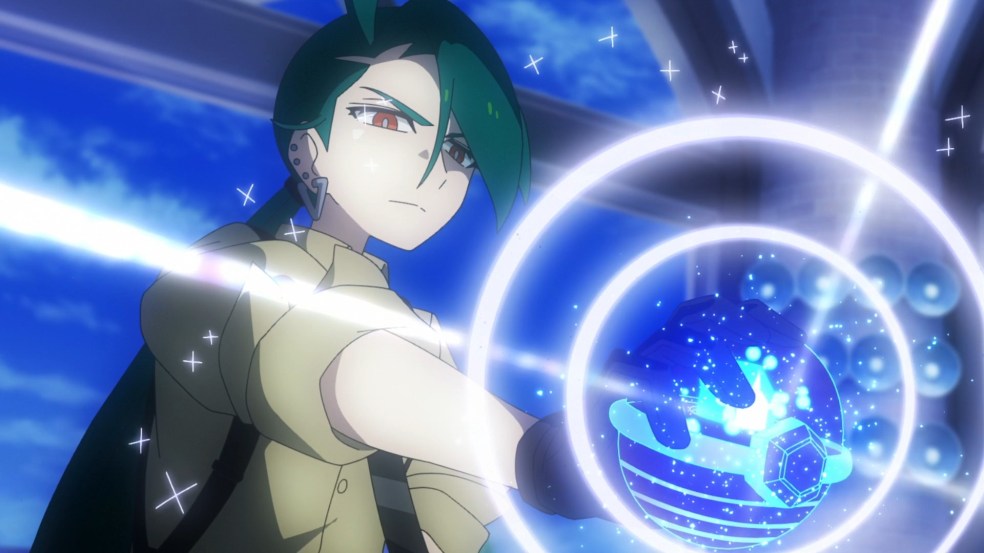
All this to say, I can’t do that here. This is an episode with a lot of Rika in it. I cannot be normal about Rika. I have tried in the past and failed.
It should’ve been me.
She’s beautiful, fantastic, gorgeous, amazing, dazzling, attractive, and her voice [provided by Saiga Mitsuki] makes my head spin. She speaks to a nervous Liko with empathy and humor, she lightly talks herself up during the (amazing) fight, but honestly she could be a lot more boastful and it still wouldn’t feel unjustified. I spent enough of the episode having a gay meltdown that I probably missed some of the finer details, but can you really blame me? She’s just electric to watch.
You guys have no idea how hard it is to not just post thirty examples of her winning smile in a row.
Right, the battle itself. Liko’s battle partner is Katy, the usual first gym leader in the Scarlet / Violet games. She puts in a good showing for the first half of the episode, with her Lokix really standing out in giving a Pokémon that isn’t particularly prominent in its home game some shine. The little guy comes off as every bit as cool as his Kamen Rider inspiration.
When the battle comes down to just Liko and Floragato against Rika and her Clodsire, things really fly off the rails, and we get the delightful experience of watching Liko undergo some character growth in real time when she (perhaps inevitably) loses. The Liko we see here, properly invested in the outcome of her battles because Floragato is, and she wants what’s best for her partner Pokémon, is a far cry from the shy little bean we met over a year ago in episode 1.
Over in the B-Part of the episode, Penny [Hirohashi Ryou] makes her on-screen debut, and she’s pretty great, too, terse and a little mysterious. What little drips we get of her backstory seem to vaguely imply that this anime actually takes place after some version of the game’s events? Which feels like it can’t possibly actually be what they’re going for, but it’s an interesting thought, regardless. (It would definitely explain the rather strange name of ‘The Explorers’ for our villain group. Thinking on this the day after I initially wrote it, maybe what’s being alluded to here is actually the earlier explorations of Area Zero.) Either way, we’re definitely getting into some interesting stuff here, Penny and Dot come across a mysterious “Scarlet Book” with what’s clearly Koraidon on its front cover. Mysteries upon mysteries! And really a good reminder that for all that’s happened over the past year or so, we’re still really just getting started with Pokémon Horizons. Not that I’m complaining! It’s quietly become one of my favorite ongoing anime.
Around The Internet
So! Here’s a new section of the columns that I haven’t figured out exactly how I’m going to handle in the archives. Essentially, I wanted to give a shout out to both to fellow anime bloggers and also just to various other critics I’ve been reading recently. Some of these people also write about anime, some of them write about other things entirely, but my hope is you’ll check some of them out if you like my own work.
Short Reflection: Spring 2024 Anime, by Anime Binge-Watcher – A tumblr post of decent length by fellow anime blogger (and Magic Planet Anime Discord Server member!), Anime Binge-Watcher. I don’t agree with all (or even most) of ABW’s ratings for the anime we both watched this past season, but I appreciate their perspective on things regardless, and it’s always interesting to read a well-thought-out opinion from someone who you don’t entirely align with. Even more interesting to me is their opening recommendation of the Dead Dead Demons’ Dededede Destruction anime (retrofitted from a film, not entirely unlike what’s happening with Rozé of the Recapture), that was just not on my radar at all but sounds (and looks, given their screencaps) pretty arresting. I’m also super happy to see another person really give it up for Girls Band Cry. And they even draw a connection between the traditional “rival group” in idol anime and that series that I hadn’t really considered before, but makes sense now that it’s been pointed out to me, especially when taken in context with eg. the rock-inflected stylings of a group like Saint Snow. In any case! It’s a good article, and I recommend it.
Aard Labor, by someone seemingly going by just “Tom”, at FreakyTrigger – Here’s something that’s both way out of my wheelhouse and could also easily eat up a whole afternoon. I’m not super familiar with UK-based pop culture criticism site FreakyTrigger, but it seems that earlier this year, a person there tasked themselves with the monumental and unenviable task of reading, and then reviewing, volume by volume, the entirety of Cerebus the Aardvark, the legendarily unhinged Canadian comic book epic that plots the evolution of its title character from a simple “funny animal” placed in a Conan the Barbarian parody up to frothing-at-the-mouth, ranting antifeminism and existential terror of its final volumes. Cerebus itself was (and I assume still is?) pretty infamous for many years as an early example of the kind of pure-id getting lost in the weeds that we now mostly associate with webcomics. I will cop to having never read the series myself, its massive length and reputation as moral bugspray have kept me away, but I’m more than happy to see someone else dive into it, especially if they’re as observant and thoughtful as article author Tom seems to be.
That’s all for this week, anime fans! The coming week proper is probably going to be pretty busy over here, although it’s hard to say for sure, so keep an eye on your inbox so you can know when any first impressions articles or such go up. Also! I will once again ask that if you like anything I’ve written in this column, or on the site in general recently, please consider dropping me a tip on Ko-Fi. Due to various life issues, I don’t have a regular job, so these donations help me afford basic necessities like food, medicine, clothes, yadda yadda. (And occasionally less essential things! I would really love to buy one of Togenashi Togeari’s albums, but I’m getting into Christmas Wishlist territory there.)
See you soon, anime fans!
Like what you’re reading? Consider following Magic Planet Anime to get notified when new articles go live.If you’d like to talk to other Magic Planet Anime readers, consider joining my Discord server! Also consider following me on Anilist, BlueSky, or Tumblrand supporting me on Ko-Fi or Patreon. If you want to read more of my work, consider heading over to the Directoryto browse by category.
All views expressed on Magic Planet Anime are solely my own opinions and conclusions and should not be taken to reflect the opinions of any other persons, groups, or organizations. All text is manually typed and edited, and no machine learning or other automatic tools are used in the creation of Magic Planet Anime articles, with the exception of a basic spellchecker. However, some articles may have additional tags placed by WordPress. All text, excepting direct quotations, is owned by Magic Planet Anime. Do not duplicate without permission. All images are owned by their original copyright holders.
The Weekly Orbit is a weekly column collecting and refining my more casual anime- and manga-related thoughts from the previous week. Mostly, these are taken from my tumblr blog, and assume familiarity with the works covered. Be wary of spoilers!
The season is winding down, and the winds of the upcoming Summer season are already on the horizon (we’ll hopefully get to that tomorrow, if my writing schedule holds up). We’ll be kicking off with the three finales that aired over the last week, one of which only came out today. I realized after compiling this that in all three finale writeups, I quoted a character from the show in summarizing how I felt about the show itself. That was not intentional! But it’s kind of funny. I’ll also be blunt in saying I liked some of these more than others. Read on to learn why.
Anime
Jellyfish Can’t Swim in the Night – Episode 12 (Finale)
I’ve compared Jellyfish to other anime a lot while writing these off-the-cuff posts, but to pull from an otherwise very different series, the ending here almost reminds me of that of Witch From Mercury? Decidedly pretty good, and definitely fine-tuned to make you feel happy that our main pair are back together, but with just enough that doesn’t quite add up that I feel remiss not to mention it. It’s now been a few days since I wrote the original version of this entry over on Tumblr, and it’s clear to me that most people did not like this ending. I mostly did! But I don’t think it redeems the series largely faceplanting in its second half, so I’m not sure how willing I am to contest the consensus. Personally I think this is a case where I like the characters more than the show they’re from.
To be clear, if the series’ representational efforts—more in the realm of Kiwi than the Mahiru / Yoru thing, which the show largely drops for its final stretch—outlive the actual text of the show itself, as may well happen, that’s not actually a bad thing. Most anime would be lucky to have that legacy.
I want to zero in on one moment during the episode, though. Kano during the concert, where we’re early in the episode and she’s clearly nervous. Flashbacks, intrusive-thoughts-as-voiceover. The literally-faceless masses. This is imagery we’ve seen associated with her before, as she’s clearly reliving her trauma from her days with the Sunflower Dolls.
We see her basically bomb; the backing track kicks in but she can’t sing, and suddenly the sound cuts out entirely, putting her in the bottom of the ocean. Mero, surprisingly, is the one who calls out to her to egg her on, although it’s Mahiru’s jellyfish that she looks at as Mahiru calls out to her as well. We get our big, swelling concert song, and then the moment is over. Jellyfish‘s actual narrative ends the second the music dies, for better and worse.
We get a mirror of the first episode as the two meet again for the first time in a while after Kano’s performance. Ultimately, the conclusion they come to is that they kept their promises to each other, so everything’s basically fine. This is clearly to some extent what the show wants us collectively to think, as well. Kano as the aimless singer who’s finally found something to sing for, Mahiru as the ever down-on-herself visual artist who’s found someone inspired by her paintings. Kano says she wants to be a reason for people to keep looking forward, an interesting thought. But I’m not sure how much I agree with the show’s assertion here. The two definitely seem like they’ll be fine in the long-term, but given that we aren’t going to get to see the long-term, that’s a bit of a bittersweet pill.
In the Sunflower Dolls / JELEE show’s credit roll, Kano is credited under her preferred name. Yukine, the closest thing Jellyfish has had to an antagonist, seems to mean this as—and certainly the show wants us to take it as—a gesture that despite her past treatment of her daughter, she respects her now. (An analogy is also drawn between the virtual audience the show draws and the 50,000 person capacity of the Tokyo Dome. Originally referred to several episodes ago, having one of her artists sing there was a long-term goal of Yukine’s. The rest of JELEE is a little weirded out by Kano bringing this up, and that much is obviously intentional.) Clearly, not all is forgiven, as Kano playfully spurns her mother in the finale’s closing minutes. Still, something about this feels…a little wishy-washy in a way I can’t entirely put my finger on. It’s a good ending, maybe the best ending this iteration of the series could’ve had, but not a great one. There’s a distinction there, and this is the sort of show that practically begs rumination on distinctions of that nature. Yukine herself says, and I quote directly, “The difference between buzz and backlash ultimately hinges on an idea being meaningful.” AreJellyfish‘sideas meaningful? I think that’s an open question. Despite everything—Kano’s trauma, the falling out with Mahiru and Mahiru’s own impostor syndrome, the show’s own strange pacing, Kiwi being bullied for their gender expression and for being “weird”, the discrimination Mei faced as a child, Mero detonating the careers of the Sunflower Dolls’ onetime rivals The Rainbow Girls—this ends as a feelgood story, despite its gestures otherwise. That may be a bit too neat for me, I’m not sure.
I hate to bring up That Other Music Anime Airing Right Now while writing about this one yet again, but the main distinction between the two, I’ve finally realized, is that Girls Band Cry‘s emotional material feels much more consistently raw. Jellyfish’s best episodes hit those nerves as well, but the show on the whole feels like it can’t quite thread the needle in the same way. The comparison is perhaps unflattering to both anime, but I can’t help myself here. Jellyfish clearly wants to have a complex, somewhat open-ended ending, but it also wants to leave us on a positive note, not unlike fellow polarizing aftermath anime Wonder Egg Priority. In that show’s case, I felt that it was doing enough both overall and with its ending in particular that I felt compelled to defend it. I can’t really do that, here. I’m not as disappointed as some have been, for sure, but if someone feels significantly more let down than I do, I can’t really blame them.
The series ends on a short run-through of denouement scenes, for the individual members of JELEE both apart and together as a group. Tellingly, it might be Kiwi’s that works the best. The relatively straightforward nature of their arc makes their development feel the most earned and the most logical. The whole thing with Koharu is, to say the least, odd, but even that fits in pretty well with their arc in coming to accept themself as a queer person in a world of queer people. At the same time—and I couldn’t quite pin this down the other day when I was first writing this—that same coherence just isn’t there for the other characters. Perhaps because Mei was never particularly well-developed to begin with, and Kano and Mahiru’s reunion feels contrived. I can forgive letting a kiss on the cheek hang for six episodes. Letting that falling-out hang for, what, 3? Is a bit harder to stomach though. The entire plot there takes away a bit from what the show is trying to do, and when what you’re trying to do is this delicate, “a bit” can feel like a lot.
The over-painting scenes in the last few minutes of the episode being drawn as though they’re shot through the phone is a cool touch, I like it. On the note of that scene, something that Jellyfish does manage to capture is the warm mundanities of friendship and life in the digital age, and I like Kano’s little speech to the others at the end here. That’s worth something, I think. Not many anime end with their casts literally waving goodbye to the camera.
Time, as my memories of the show crystalize and harden, will tell whether I end up truly feeling that those warm feelings are “enough” to rate Jellyfish particularly highly, both on its own terms and as compared to other anime that have come and gone (and will come and go) this year. But that’s also sort of a way of looking at art that is ruthless enough to not always be appropriate. So I’ll say it here if I never remember to again, the people who made this clearly cared about it a lot. There’s love in it, and love does matter. I can’t speak for anyone else, though. Some songs just don’t reach everybody.
A Salad Bowl of Eccentrics – Episode 12 (Finale)
So ends one of the season’s true hidden gems. A series that combines a freewheeling and loosey-goosey sensibility to both its worldbuilding and characters with just enough emotional warmth to make it worth connecting to. Good chance this ends up being my favorite of the two finales I’m watching tonight!
An aside: the live action screen camera-point screen recording of some random-ass actual pachinko machine is really funny.
It’s either astounding luck or meticulous planning that a pretty funny parody of a band performance episode dropped here, in the gay girl band season. It’s obviously nowhere near the bowl-you-over powerchord of say Girls Band Cry‘s eleventh episode, but Grasshopper the Savior put in an okay (and more importantly, amusing) showing here. How does that whole plot conclude? With Noa getting arrested for insider trading. Roll credits!
Sara, meanwhile, exits her ongoing plot by graduating the school she was enrolled in just three months prior, universally acclaimed and beloved by her fellow students and their parents alike. She sings an idol song. It’s all pretty great.
All told the main takeaway here is that Salad Bowl is, true to its title, a gathering of truly eccentric souls and bizarre situations. Sousuke’s reaction to Olivia’s band getting broken up because of Noa’s antics? “I see this is all insane as usual.” I couldn’t have said it better myself. The series ends on what passes for a cliffhanger in a show that has never really been focused on its plot. I can’t imagine this getting a second season, but who knows? I’d be pleasantly surprised.
Train To The End of The World – Episode 12 (Finale)
Here, we have easily the best of this past week’s finales. A pitch-perfect ending to a show that was not always so effortless. An ending I appreciate a lot, the sort of thing that makes me view the whole series in a better light.
A brief summary of the literal events here; We get a final battle while the two trains drive through what I’m going to call Windows 95 screensavers. We get Shizuru and Youka making up for lost time. We get the world returning to something that’s not normalcy but at least approximates it. (Another theme running through this show is acceptance of inevitable change, naturally.) We get to see scumbag techbro villain Pontarou get his comeuppance. It’s all very nice.
I think with hindsight the show is perhaps best considered as a longform metaphor for anxiety, specifically that stemming from social conflict. You fuck up, and the fucking up is blown up so big in your mind that it becomes impossible to move past. As somebody who just spent a few hours agonizing over and then rescheduling a doctor’s appointment, and then agonizing over the fact that I did reschedule it, I get it. It happens. It usually doesn’t result in the world degrading into a surreal hell of the senses that threatens to drive all within it to death or madness, but it happens. If you want to stretch a little, you can rope in the show’s technological motifs—the externalization of the internal through the medium of the Internet, as turned outward by the 7G Phenomenon—into all this. You could argue that Shuumatsu Train advocates for resolving conflicts of the social media age by talking to each other and treating each other as humans. I’m not sure how intentional that read is, but if it is, it’s a fine thesis, and the series pulls it off pretty well.
Incidentally, anxiety like that, which can end up fracturing friend groups as it has in Shuumatsu Train, doesn’t usually involve one of the parties being a near-omnipotent goddess either. Nonetheless that is what Shizuru and co. have to deal with at this episode’s climax, and while the results are a little saccharine, I think this whole arrangement works better than not. The final argument (such that it is) between Shizuru and Yoka is just great all around, and ties up their interpersonal conflict perfectly.
Shuumatsu Train was hardly a perfect show (I ask readers to remember the run of relatively weak episodes at about the 2/3rds mark. We probably could’ve skipped the ecchi zombie plot) but it did what it wanted to do and it did it well. This is another one in the grand tradition of oddball fare like The Rolling Girls or even the Akiba’s Trip anime, and it’s a worthy addition to whatever you’d like to call that genre, regardless of any flaws. To quote Shizuru herself, it’s better to try and have regrets than to do nothing at all.
Pokémon Horizons – Episode 55
This episode is mostly just an excuse for a procession of several fun, short battles. I say “just”, but that’s hardly a bad thing, since at the end of the day that’s what this series is about.
The second is the best of these, with an impressive showing from Elite Four artiste Hassel and his Baxcalibur and Flapple. Roy and his partner, the Grass-type gym leader Brassius pull off a number of coordinated double moves. Our brief detour over into what Coral’s doing is also pretty fun, since “what she’s doing” is having her Glalie blow everybody up again.
The real treat seems like it will be next week, though, when Liko faces off against Rika. I will spare you all the gay rant, although I can’t promise I will do the same when next week rolls around.
Wonderful Precure – Episode 21
I must say, my main surprise in watching this episode was how much of it was an episode of a Class S yuri school comedy. Yuki transfers in to the gang’s school in this episode, and most of the episode, accordingly, focuses on that.
Her personality, or at least, the one she sort of grows out of here is—and I realize that what I’m about to say is very silly—almost a little Homura-esque? It’s something about her single-minded fixation on Mayu that makes me think that, I think. I assume she’ll continue to develop out of it as the show goes on. (Something Homura never had the chance to do given the way her show is structured but, well, they’re very different anime to say the very least. It’s a loose comparison at best, but let me have my fun here.)
We get a pretty melancholy little flashback here where we learn about Mayu drifting away from a friend at her previous school. The anecdote, I think more than anything before it, seems to position Mayu as neurodivergent, as what drives a wedge between Mayu and her former friend is simply Mayu’s tendency to become fixated on tasks, and, implicitly, her more general habit of keeping to herself. Yuki is the one who tells Komugi and Iroha (and, well, us) all this, and I don’t think it’s a reach to say she’s projecting her own hurt into the anecdote as well. Much of this episode’s focus is her learning to deal with her own reluctance to get close to people. That’s all a bit heavy for a kids’ show, but Precure being Precure, it handles it all with relative ease.
Of course, all that and the action part of the episode involves waking up a sleeping panda garugaru by using the fox fairy to transform Komugi into a giant tire. The animation goes all out for this, of course, and around here I started to wonder if this might honestly be the best Precure season, or at least a new personal favorite.
Mysterious Disappearances – Episode 11
What would be a fairly nice transitory episode leading into the finale is once again held back by a lackluster visual presentation.
Honestly this one shoots past “workmanlike” into just generally pretty bad to look at all around, especially in its first half it’s just remarkably shoddy. (I can’t even meaningfully directly compare to the manga, as this is after the point where I stopped reading, but I almost guarantee you it looks better there, and anyone can read any of my Dungeon Meshi writeups to know I’m not normally a “haw haw manga better” person.)
If you can look past that—and the fairly gratuitous pool scene a bit after the halfway point—this is a decent bit of plotting. Rei and Oto possibly having a way back home is a decent final conflict. What I will say, the secret Rei is keeping where he plans to become the ticket is a compellingly dark twist. My main hope is just that things can get back in order visually by the time the anime ends next week. I’m also interested to see how the cat boss youkai factors in.
Girls Band Cry – Episode 12
A slower episode this week, but certainly an eventful one. TogeToge are officially signed! Rupa and Tomo are working their last day at their job! I am very happy for these people who don’t exist!
As one might predict, Nina seems almost as anxious about their current situation as she is happy. After all, Diamond Dust were still the main attraction at the concert TogeToge played at. And despite Nina claiming her band is better (she’s right) and that they completely rocked (she’s right about that, too), they aren’t the ones being talked about on socials. Rarely do the best artists get the most coverage, as Nina is learning.
The callbacks to the first episode are absolutely adorable, as is Tomo’s cute but muted reaction to the card and flowers Subaru buys her. The hotpot party scene is nice; a restrained sort of comfort and a chance to recuperate after the big, billowing emotions of last episode.
Their songwriting sessions are motivated by a desire not just to one-up Diamond Dust, but also, as you might recall, to get to the Budokan, a feat that would put them on par with many famous bands up to and including The Beatles, but most amusingly, Cheap Trick. These are subject to montage, the first in the series I think. We cap with a little scene of Momoka asleep on Nina’s shoulder, on the train home. It’s so cute, I wanted to cry.
The show’s final twist seems to be to make the whole Diamond Dust / TogeToge fight very literal. TogeToge are offered a co-bill, with composing the theme for a TV series on the line for the band that draws a bigger crowd. This is a stacked fight at best, and TogeToge have a lot to lose. Ultimately, the band put it to a vote, and, despite Nina’s misgivings (and being collectively unsure of what DiaDust’s actual goal was, here), they opt to decline. This leaves Nina in something of an emotional rut. Being a rockstar, she has learned, is not all about huge bursts of emotional catharsis. There’s a lot of boring bookkeeping and shady politicking, too. (I would refer her to the wisdom of KRS-One on this topic, myself.)
Momoka, however, knows that. There’s a running B-plot through this episode about a song she’s working on, first mentioned during the hotpot party. Throughout, she’s stuck on a specific part of it (we’re not shown what, specifically). Why exactly is left unstated, but it seems to be at least in part because, in her own way, Momoka wants to beat Diamond Dust, too. She’s just being more subtle about it.
Or at least, she thinks she is. Nina seems to pick up on this, and the rest of the band are convinced to accept DiaDust’s challenge after all. There’s fear in Momoka’s shadowed mood throughout the episode too. That much she says herself. She lost everything once before, and she’s afraid to lose it again.
The episode ends with an upturn of mood; Momoka admitting that she wants to win against Diamond Dust too, TogeToge’s sound engineer and manager telling them they really like the new song (which Momoka finally finishes, naturally), and all seems to be going well in the leadup to the finale.
And then, at the last possible second, we get this; the new song releases, Nina goes to check the metrics. 103 views. Ouch.
It is hard to tie genuine emotion to numbers floating up and down. This is a big mistake that frankly a lot of music anime make these days, but here, that 103 feels like a legit punch to the gut. We only have one episode left! What the hell is going to happen?! It’s hard to know, and there’s of course the knot of anxiety that GBC won’t “stick the landing” so to speak, but I have a lot of faith in the series. TogeToge will figure it out.
Anime – Non-Seasonal
Ruin Explorers Fam & Ihrie
A fun, if not particularly challenging, fantasy action-comedy romp from the heyday of the 90s OVA boom.
On the one hand, there’s not a ton to say about this one; we’ve got a very basic fantasy premise here with our two lead protagonists—a pair of treasure hunters named Ihrie [Neya Michiko] and Fam [Shiina Hekiru]—who seek an ancient wish-granting treasure. (That’s “Fam” pronounced to rhyme with “fawn” by the way. Don’t ask her if she’s cheesin’, though.) This eventually spirals out into a quest to help the last prince of a destroyed kingdom reclaim his throne from a very classic wizardly overlord bad guy. It’s all solid stuff and the main strengths here are visual; the show’s choices of color and shadow are consistently fantastic and the animation is similarly excellent with a lot of standout moments both in more action-oriented scenes and in the more comedic ones that make use of a lot of good character acting. (This is most obvious with Fam, whose kitty tail gets to telegraph her mood sometimes. It’s a cute touch.)
On the writing side, while the plot is truly nothing special, the characters, broadly-written as they are, are solid and likeable. Aside from the two leads, my favorites ended up being Rasha [Matsumoto Rika], a snarky and full-of herself wizardess who starts out as an antagonist before she and her partner Migel [Yamadera Kouichi] join the main party to help them take down the bad guy, and surprisingly, the cowardly merchant Galuff [Ootsuka Chikao]. Usually such characters come off as vaguely uncomfortable, and he’s not entirely free of that, but he’s such a petty and ineffective scoundrel that it becomes kind of endearing.
All told, this is a pretty fun and accessible watch. I dock a few points for some of the thematic material in the fourth and final episode (I’ve never been a big fan of the whole ‘divine right of kings’ thing, even in inherited form as a stock genre plot in fantasy stuff like this.) But all around, it’s a good time, and there are way worse ways to burn two hours. This is a strain of fantasy anime that still exists albeit in somewhat reduced form, so it’s not like this stuff has really gone away, but obviously something like eg. Dungeon Meshi (or even like, I dunno, Helck) is a fair bit more sophisticated on the writing and thematic level, so the comparison isn’t direct. Either way, yeah, fun time. Enjoyed myself here.
That’s all for this week, anime fans. Consider tipping your girl if you liked any of the entries this week, every penny helps me cover basic life necessities like food and medicine. As for this week’s Bonus Thought, I wanted to give it to Train, since we won’t be seeing it in this column again. Take it away, Akira!
Like what you’re reading? Consider following Magic Planet Anime to get notified when new articles go live.If you’d like to talk to other Magic Planet Anime readers, consider joining my Discord server! Also consider following me on Anilist, BlueSky, or Tumblrand supporting me on Ko-Fi or Patreon. If you want to read more of my work, consider heading over to the Directoryto browse by category.
All views expressed on Magic Planet Anime are solely my own opinions and conclusions and should not be taken to reflect the opinions of any other persons, groups, or organizations. All text is manually typed and edited, and no machine learning or other automatic tools are used in the creation of Magic Planet Anime articles, with the exception of a basic spellchecker. However, some articles may have additional tags placed by WordPress. All text, excepting direct quotations, is owned by Magic Planet Anime. Do not duplicate without permission. All images are owned by their original copyright holders.
The Weekly Orbit is a weekly column collecting and refining my more casual anime- and manga-related thoughts from the previous week. Mostly, these are taken from my tumblr blog, and assume familiarity with the works covered. Be wary of spoilers!
The season is starting to wind down, and that shows in some of these episodes. Our first two anime this week are setting up for their big finales.
Anime – Seasonal
Train to The End of The World – Episode 11
As Shuumatsu Train enters its final stretch, we kick off one of the series’ denser episodes to date with our heroines arriving, at last, at their destination of Ikebukuro.
They find Youka in short order, but things aren’t simple enough that just reuniting the separated friends is enough. It’s clear that Youka doesn’t remember them—we don’t yet know why, but Reimi openly speculates that ‘wibble-wobble surgery’ of the same type Zenjirou was subjected to might be to blame—and their attempts to remind her who they are fail. Her reactions are confused and interlaced with her 7G powers, and any time the girls try to break through to her, it clearly destabilizes her already fragile mental state, causing the environment around her to temporarily devolve into an acid trip of digital video flickering and color-burst effects. The girls are chased away by Pontarou’s personal guards, the masked Ikebukuro police force.
Retreating to the train, they receive a phone call—via a phone fashioned from bitter melon, of course, because why not?—from Makoto and Zenjirou. Their conversation here basically confirms what we already knew; if they can nab the 7G button and just turn the network back off, the whole world will snap back to normalcy. (Allegedly, at least.) They’re not alone, though, as an unexpected ally turns up in the form of Mito and her zombie horde from a few episodes back. Her zombies, as it turns out, can sense the presence of the 7G button.
Call me stupid, but the show calls attention to a few parallels I hadn’t noticed up to this point. For one, Shizuru and Pontarou are, in a very broad sense, a bit similar, in that both are actively trying to avoid accountability for their actions. (They’re also very different in a number of ways, which I expect the show to draw attention to in its finale.) Also, the zombies, with their longing for the old world back when times were simpler—and indeed their distraction by simple pleasures like cheap ecchi—are supposed to be, you know, all of us, the people watching the show.
I honestly think that this sort of straightforward lock-and-key symbolism doesn’t really suit Shuumatsu Train particularly well. (And hey, what are you trying to say about your audience, here?) But then again, it took me 10 1/2 episodes to connect two dots with a line, so who am I to talk?
In any case, the episode ends with two things. One; a shockingly well animated and choreographed fight sequence between Pochi (as in, Youka’s odd butler / handler. We still don’t know what his deal is). And two; Akira and Mito slamming the 7G button to turn it off. Surprise! It doesn’t actually work, and in the episode’s closing moments, we get the latest in a long line of incredible what-the-fuck moments from Shuumatsu Train, when our heroines’ final obstacle comes rolling out of a high-rise on a track being constructed as it goes by long, gooey arms made of some kind of yellow substance; a second train, with Youka and Pontarou on it, headed off to parts unknown.
Shuumatsu Train has hardly been a perfect anime, but I’ve immensely enjoyed the ride just for how utterly bizarre it’s been. It’s hard to say what the finale will look like, but I’m interested to find out, and in the end, being compellingly weird from start to finish is all I really wanted out of this show to begin with.
Dungeon Meshi – Episode 23
Senshi’s backstory is another area where the addition of color, sound, and motion to the material gives it a slightly different texture than it had in manga form.
In the manga, this backstory felt like a fairly lengthy aside, steeped in deep shadows to a degree that was nearly gothic. Here, rendered in full color—earthy browns, iron greys, bloody reds—it feels a lot more like what it actually is, a traumatic memory. Bunched up in a relatively brief burst like this, but punctuated with a monstrous illustration of the griffin that hounded the dwarves who were taking care of Senshi, and the eventual screams of Null (the dwarf who Gilin, Senshi’s advocate throughout his backstory, butts heads with, and who Senshi believes Gilin may have in fact killed) renders the entire thing violent and scary. You can really feel how this would shape someone to their core.
The backflips the narrative goes through to eventually prove to Senshi that no, it was in fact not another dwarf that Gilin fed to him when he was young, have always been a bit convoluted for my taste, but they go down easier here. Especially when the payoff is Senshi having a big, tearful, emotional moment, always a nice thing to see.
The tail end of the episode is a bit less serious, mostly focusing on the ramifications of the circle of changeling mushrooms our heroes accidentally step into, swapping their species around at random. (Laios becomes a dwarf, Chilchuck a tall-man, Senshi an elf, Marcille a downright adorable half-foot, and Izutsumi a kobold.) It’s all a fairly good gag, although a bit light for Dungeon Meshi, until it ends up having very real consequences when the party run into a troop of gargoyles. I will say, there’s probably something not-entirely-flattering to be said about the show’s refusal to treat kobolds (dog-like, and thus the least human-looking humanoid species) with any dignity, even if the “go get it, boy” ball-toss gag that Izutsumi is subjected to here is admittedly a bit funny.
The episode ends in true Dungeon Meshi fashion; a brief meditation on the universality of dumplings. The series ends this week, and I’m going to miss it.
Mysterious Disappearances – Episode 9
This episode didn’t leave a massive impression on me overall. The core conceit, that of a VTuber being a sort-of tsukumogamidue to how rapidly digital data is deleted and discarded compared to physical objects, is pretty cool, as is the VTuber in question being a pastiche of a couple different popular, actual talents. For whatever reason though, the main thing that stuck with me in this episode was the goofy, animated dance number at its end, which is wholly disconnected from the rest of the episode’s story and is mainly about a catgirl who we won’t properly meet for a little bit, yet. Odd! Compelling, but odd!
Pokémon Horizons – Episode 53
Hatenna episode 😊
Our Heroes meeting a trio of people who look vaguely similar to themselves and even seem to be arranged in a similar trio is really funny, to start off with. The main meat of the episode, where they encounter the ghost alluded to last time and learn that it’s an Annihilape, is pretty great all throughout. The animation team really goes through some effort here to convey Annihilape as a menacing, almost otherworldly force of nature. Conversely, it’s pretty cool how our protagonists work together to stop it in their initial encounter, as it shows off a pronounced coordination, which we haven’t gotten from them super often before.
The horde of angry Mankey is honestly a pretty credible threat. Have you ever seen videos of angry monkeys? They’re terrifying. There are a lot of really impressive cuts here, the majority of which are apportioned to Annihiliape but the main trio’s Pokemon get some as well.
Given Hatenna’s prominence throughout the episode, the obvious tack to take is to have it evolve (especially given that Roy got his Kilowattrel last week, and that Hattrem learns the Dark-type Brutal Swing on evolution) but instead, at least initially, it uses its brains to figure out the source of the Mankey troop’s frustration and the remainder of the episode, complete with an insert song, is about helping the troop recover their food store, emphasizing once again Horizons‘ knack for centering episodes around unconventional problem-solving.
That said, the show isn’t enough of a tease to raise the possibility of a Pokémon evolving without actually following through with it. A stray rockslide causes the Mankey troop to start fighting amongst themselves, and some of the Primeape troop leaders even evolve into more Annihiliapes. Short of any other way to keep the peace, Hatenna promptly evolves into Hattrem, beats all of the squabbling monkeys up, and then heals them while they’re knocked out. It’s a genuinely delightful sequence and a lovely capper to a very good episode overall.
Wonderful Precure – Episode 19
We pick up from last week’s Hamster Garugaru two-parter for a just really, really good episode about Mayu, her fears, and her relationship with Yuki.
We kick off with a bunch of cutely-illustrated Japanese turns of phrase, most of which were new to me, and all of which are animal based. This has minimal relevance to the rest of the episode, but I mention it because it’s cute.
We also meet the evil general for only the second time, though once again he simply encourages the garugaru to Be Angry while giving it some new powers, advice it has no problem taking. The animators deserve some credit here for making a goddamn hamster seem like a credible threat (and for making Yuki seem genuinely threatening in turn when she trash talks it a bit later in the episode), what a feat.
Given that this episode is called “The Birth of Cure Lilian”, it’s no surprise that Mayu’s Cure alter ego debuts here, but we actually get an explanation of that name in the episode itself. Mayu’s mother mentions a lily-yarn that Mayu made for her when she was young as an example of Mayu imparting positive emotions and experiences to other people. Given some flashbacks early in the episode and, really, her entire previous existence in this series, it seems like this is a hard thing for Mayu to believe. She’s honestly so scared of everything that it makes her come off as having an actual anxiety disorder of some kind. Same, girl!
This all makes it that much worse when the garugaru, using its newly-granted ability to shrink Komugi, Iroha, and Yuki to the point that they’re too tiny to be a threat. This leaves Mayu alone against the garugaru when she comes across Yuki.
Standing her ground even in this frankly pretty scary situation—because she’s even more scared of losing Yuki than she is of the garugaru—allows Mayu, through the magic of the Mirror Stone, to become a Precure herself, and with that, our core team of four is complete.
I still like Yuki just a bit better as a character (I have a weakness for bitchy catgirls from this franchise, I suppose), but Mayu’s transformation into Cure Lilian might actually be even more drastic than Yuki’s into Cure Nyammy. It is relatively rare that a magical girl transformation feels so truly transformative. As much as I love them, one gets the sense that Komugi, Iroha, and Yuki are basically the same people as Cure Wonderful, Cure Friendy, and Cure Nyammy. This isn’t really the case with Mayu. With the Mirror Stone’s power, Lilian becomes everything she couldn’t be without it. Graceful, strong, courageous, a protector. It’s fantastic, and her voice actress Ueda Reina absolutely pours her whole heart into her performance in this episode to help sell it.
After the garugaru is defeated and turned back into a hamster fairy, Mayu and Yuki reconcile in a genuinely really sweet moment of teary-eyed reaffirmation. They want to stay together, so they will, no more to it than that.
Anime – Non-Seasonal
Rozen Maiden – Episodes 5-12
Pretty good all around! I don’t have a ton to say about Rozen Maiden, but as an old-school action series with a somewhat shoujo-y bent I think it’s quite a nice ride overall, and I loved all of the characters, especially Suigintou whose death(?) in the final episode absolutely ripped my heart out. Poor girl thinks of herself as incomplete and takes it out on everyone else. Which of course, is a reflection of how Jun, the main protagonist, does the same in an admittedly much less violent way. (Side note here: Suigintou x Shinku is some deliciously classic toxic yuri. Waiter send me more, please and thank you.)
Manga
Witch Watch – Chapters 148-159
I’m not sure what it says about me that, while there are other manga in the publication that are more meaningful to me, Witch Watch is consistently the thing I have the most fun reading in Jump these days.
I think it’s the manga’s combination of a lean but engaging storyline with an absolute ton of off-the-wall goofball shit. I can sense that we’re getting close to the end of this “aged-down Nico” arc, and while it’s been a return to the manga’s earlier, decidedly comedic days, I am glad that a return back to the whole Witches vs. Warlocks plot that continues to tick along in the background is on the horizon. I like the new character introduced in yesterday’s chapter, too. The idea of an apparently ‘chuuni’ adult who just Actually Is involved with a bunch of supernatural stuff but is really bad at hiding it is pretty fun.
On a note less immediately related to the current chapter, Ban is such a fun addition to the cast, I absolutely love her. Rabuka seems like she’s going to be part of the school group in upcoming chapters too, which is also exciting since she’s one of my favorite supporting characters. All around, just a really fun and readable manga that I’d recommend to just about anyone.
And that’s all for this week. While I have your attention, I’m going to go ahead and recommend Yume Nikki fan game / MMO (!) Collective Unconscious, a free exploration game about wandering around and gawking at cool scenery. I may write about it at some point, but if not, consider this an endorsement.
As for this week’s Bonus Thought, you know I have to go with this.
Like what you’re reading? Consider following Magic Planet Anime to get notified when new articles go live.If you’d like to talk to other Magic Planet Anime readers, consider joining my Discord server! Also consider following me on Anilist, BlueSky, or Tumblrand supporting me on Ko-Fi or Patreon. If you want to read more of my work, consider heading over to the Directoryto browse by category.
All views expressed on Magic Planet Anime are solely my own opinions and conclusions and should not be taken to reflect the opinions of any other persons, groups, or organizations. All text is manually typed and edited, and no machine learning or other automatic tools are used in the creation of Magic Planet Anime articles, with the exception of a basic spellchecker. However, some articles may have additional tags placed by WordPress. All text, excepting direct quotations, is owned by Magic Planet Anime. Do not duplicate without permission. All images are owned by their original copyright holders.
The Weekly Orbit is a weekly column collecting and refining my more casual anime- and manga-related thoughts from the previous week. Mostly, these are taken from my tumblr blog, and assume familiarity with the works covered. Be wary of spoilers!
Hi folks! Sorry for the very late article today, I had a lot of reformatting to do, and, as I’ll get to shortly, was catching up on a few things before I put the article up. Enjoy!
Anime – Seasonal
Train to The End of The World – Episodes 7 & 8
More than one person told me that episode seven of Train to The End of The World was “bad,” and as a result I ended up putting it off until today, where I watched episodes seven and eight in tandem. I understand why someone would think that, certainly, and overall this two episode stretch is pretty puzzling. But, I’m not sure I agree, if only because even Shuumatsu Train‘s worst ideas are so confounding that calling them outright bad feels inadequate. A misstep, though, that might be true.
Episode seven is essentially a bizarro inversion of a traditional fanservice episode. These are, themselves, not necessarily super common anymore, and for many kinds of anime they’ve been relegated to the no-mans-land of bonus OVAs and such. Shuumatsu Train’s engagement with the concept is very much Shuumatsu Train-y in that it’s flatly inexplicable. For the most part, there’s not a lot of cheesecake or anything here—which is good, it would be wildly out of tone with this series, and the one shot that is like that is pretty jarring and bad—instead, the girls find out that the zombie horde from episode 6 are weak to ecchi. As in, they are weak to even hearing about it. This leads to a pair of climactic (har har) scenes where Akira dryly intones a scene from an erotic novel aloud, which makes the zombies explode. Later, our main four sing a bawdy song on top of the train, which has the same effect. In essence, I think this is a parody of the entire concept, undermined by the actual panty shot late in the episode. Even if we disregard that, it’s still a very odd direction for even this show to take.
There’s also the matter of three of the four main characters spending most of the episode wearing colored greasepaint. Reimi’s is black, and while it’s not my call to make whether or not that’s racist exactly, it definitely feels weird and uncomfortable in a way that the rest of the show really hasn’t.
Thankfully, the episode’s denouement is actually one of the better ones, preventing this from being a total wash. In it, the girls speculate whether or not Mito (the zombie queen) was bullied when she was younger. Akira says that it doesn’t matter, but Shizuru is quick to point out that it actually does, since we are all shaped by our past; who we are today is who we were yesterday, and who we are today plots who we will be in the future. There’s something to that, and this thread keeps Shuumatsu Train tied together in even its most unhinged moments.
It’s also worth noting that, strangely enough, this is one of the best-looking episodes! The animation is fluid and stylish throughout, the backgrounds are great, and there are some neat effects used to portray the zombie horde as a singular shambling mound of uncanniness. (I want to say the effect in question is some version of Live2D but I’m not actually sure.)
Episode 8 on the other hand, opens with first a brief comedic bit, and then a very much not comedic bit, as the girls pass through an area that seems to amplify their fears and regrets, condensing them all into micro-blip flashbacks that we see for only a split second each. After the credits, we somewhat puzzlingly cut to a different scene entirely, where the girls are planning to enter a town based on that in-universe anime NeriAli, first brought up back in episode 1. (I kept expecting this initial bit to come back but it never did. I suppose the idea is that they got through things eventually just fine? I don’t know.)
The bulk of this episode is probably best understood as self-parody. NeriAli as described in Shuumatsu Train‘s owns text is already incomprehensibly strange, and combined with Shuumatsu Train’s own proclivities, it produces an episode that reaches a level of surreality normally reserved for short-form comedy anime (your Teekyu and Ai-Mai-Mis and such). It is genuinely hard to parse what all happens here, but the very basic gist is that one of the stations has been turned into a warped parody of NeriAli, a version of the show where its bad guys won. But this frankly makes the entire affair sound much more coherent than it actually is. This is probably the strangest episode of Shuumatsu Train thus far, and that’s really saying something.
It is also, unfortunately, one of the weakest, and there are a number of jokes here that land with a thud, a few of which are truly tasteless. (A character from NeriAli shows up who is a magical girl with suicidal tendencies that wears a noose around her neck and over the course of the episode she does in fact kill herself, albeit in a weird roundabout manner. Were the manga more well-known, this would almost come across as a mean-spirited shot at Suicide Girl.) Self-parody doesn’t really work for Shuumatsu Train, while it’s clear that this episode is in some sense an attempt to replicate the feeling of being dropped into the middle of a series you know nothing about, the main series itself is already so bizarre that trying to “amp the weirdness up” just produces the anime equivalent of white noise, and while other episodes of the show have certainly had their ups and downs, the entirety of episode eight here is easily the weakest the show’s ever been.
As with episode seven, the denouement segment at the end does at least prevent it from feeling like wasted time. We learn that Yoka, or at least someone named Yoka, is ruling Ikebukuro as its “witch queen.” This is a big revelation, and confirms what was earlier implied about how the 7G Incident actually functions, externalizing Yoka’s inner world.
There are four episodes remaining of Shuumatsu Train—it was one of the earlier premieres of the season, recall—and my hope and assumption is that this episode was a purging of all the show’s most out-there ideas before we bring things home for its final stretch. Worst case scenario, this ends up being another promising original anime that flames out in its back half. That said, with something this strange it’s hard to make definitive calls on its quality until we have the hindsight of the full series, and I will completely acknowledge that there are a ton of references in this episode I just didn’t really understand. (There’s a whole shogi motif in here? Just as an example.) I suppose we’ll see what things look like in a week’s time.
Pokémon Horizons – Episode 50
Most of this episode’s important moments are within the good ol’ fashioned Pokémon battle at its heart. I have to call out a specific moment in the middle of the battle here, where Dot gets really frustrated by Bellibolt spamming Slack Off, because it’s extremely funny, and is a relatively rare instance of something feeling directly ripped from the games.
Relaxed. Thriving. Moisturized. Unbothered. In my element.
The episode’s real highlight, of course, is the climactic moment of Dot getting her bit of terastalization sakuga, and Quaxly’s Low Kick actually turning into Liquidation is really cool. An arrangement of the terastalization theme music from the games also plays here, which is also really fun. This is the second very solid Dot episode in a row, and I think she’s probably my favorite of the three protagonists at this point. Oh, and Iono [Hondo Kaede] is absolutely great here, too.
Wonderful Precure! – Episode 16
This was an odd episode. More so because unlike a lot of the other strange one-off episodes Pretty Cure has done in recent years, it’s actually plot-relevant! It’s surprisingly sweet, too! This one contains multitudes.
The most obvious thing of note here is that it’s a crossover with long-running gag anime Crayon Shin-chan. Shin’s appearance itself is really more of a quick cameo that sticks out like a sore thumb against the rest of the episode.
It’s hardly bad or anything, but it does feel strange, especially considering what comes after. Still, it probably delighted a certain kind of 5 year old (and 45 year old for that matter), so I guess it’s all good. There’s a second part of the crossover in this week’s Shin-chan episode as well, which is a lot more in line with that show’s (admittedly amusing but decidedly crude. It is for little boys, after all) sense of humor. It is noteworthy for giving us Shin-chan-style Precures, though.
Back in the actual Pretty Cure episode, the main thing here is that Iroha’s parents more or less find out everything—not literally everything, but way more than is usual for Precure parents— from the sheep butler Mehmeh [Tachibana Shinnosuke, because I think this is incredibly the first time I’ve actually named Mehmeh on this blog? I’m not sure]. I feel like it’s been a long time since the series has done something like this? They still don’t know the full extent of what Iroha and Komugi are up to, but given that this actually sticks, it seems like it might be setting up a later development. Iroha’s parents’ reaction to what they do learn is very sweet, though. Her dad especially doesn’t seem to really understand what’s going on, but is very supportive, which is super cute. (I’ll say it. I’d date Iroha’s dad. Is he my type in terms of looks? Not especially, but good looks are temporary. A good personality is irreplaceable.)
Sidebar: Komugi’s impression of Mehmeh is very funny.
Himitsu no AiPri – Episode 6
This is probably the best episode of this show in a minute, after a couple weaker ones. There are still some strange decisions though; debuting Ruby=Lazuli together makes sense since they’re a duo, but it’s a little weird that we don’t get a clean run of their song here, since it’s the emotional centerpiece of the episode. The episode’s editing is also exceptionally poor. This has been a problem throughout the whole show so far, enough so that it’s sometimes kind of hard to follow. I will say that Sakura [Hibi Yuriko, in her debut named role] treating the entire thing like a shonen tournament arc is really funny, and her relationship with her partner in Ruby=Lazuli brims with lesbian subtext, which gives me a lot of hope for the future of this series.
Ruby=Lazuli’s staging is really nice, as well, and easily surpasses anything we’ve seen in the show so far. Also, hey, a cliffhanger! I wonder where this whole “AiPri is forbidden now” arc is going to go.
GO! GO! Loser Ranger!
We’re entering the weakest story arc of the whole series and the production seems to be kind of melting. Uh-oh, gang.
Ultimately, you’re always going to be comparing an anime against its manga if you’ve read the latter first, but I usually try to accept anime adaptations doing their own thing. This has been a really good one so far, and while I know some of the rearrangement of events in previous episodes has been contentious, I just don’t really agree with that criticism. This episode, on the other hand, seemed unusually weak visually—in terms of directing, animation, even just basic drawing quality—so I’m a bit worried.
On the positive side, hey, it’s Footsoldier XX! [Youmiya Hina] One of the cooler characters, all told, and her feral anime girl-meets-disgruntled hardcore loyalist soldier shtick is already in full force in her first appearance here. I’m hoping the production woes are a temporary thing and we’ll be back on track next episode. I guess we’ll see.
Girls Band Cry – Episode 5
It’s good that this show’s strengths mostly lie in its staging and how it handles conversation and conflict, given that that’s most of what this episode is. The reveal that the new Diamond Dust vocalist is someone Nina used to know, and furthermore someone she had a huge falling out with, is pretty wild. I like how it builds another connection between Nina’s past and Momoka’s; it makes the entire thing feel like destiny, and an element of that kind of romance is always nice in a show like this..
Two side notes: One, what’s with the guy with the emo hair at the end of the episode who seems to be flat-animated? Two, I love the band’s shirts. I would wear those if I could get away with it, which probably says something about me that’s not entirely flattering.
Mysterious Disappearances
This is the first time in several episodes that this show hasn’t felt completely superfluous as compared to its manga, but that really just exposes how workmanlike this adaptation is.
However, on the topic of the story itself, it’s worth noting that 2014 is awful recent as a setting for an urban legend, as is the case in the one brought up here. This is actually something called out in the text of the show itself, and I think that’s a neat detail. Visually-speaking, there’s a cool moment near the end of the episode where a bit of a fisheye-esque effect is displayed, although it only half comes across.
Also the two random maids in the Maid Café, rendered in color and subject to a bit more adaptation than perhaps the main characters are, end up looking sort of like Pokémon characters, which is kind of funny and very off-tone for this series.
A Salad Bowl of Eccentrics
I have nothing to say about this episode but this; the racehorse names are funny as hell, and whoever translated them needs a raise. If you know, you know.
Anime – Non-Seasonal
This section was big enough that it needed its own subheading this time! I probably should’ve also done this a few weeks ago when I wrote an entire article about Air in one of these, but oh well.
Precure All Stars F
My third time watching this film! This time with my friend Josh1. I cried at the climax. Again. It’s a good movie! Not one without problems, but a good movie.
Something that I don’t think fully dawned on me the first time I watched this movie is how well they set up Cure Supreme [Sakamoto Maaya] as an antithesis to the ‘real’ Cures. There’s the obvious stuff—she’s a loner and treats her fairy poorly, for example—but it’s even down to little details. She doesn’t call her attacks, has no bank animation except for a brief clip we never get to actually see in full, doesn’t have a transformation sequence, etc. She understands the form of a Pretty Cure, but not the function; she’s all power and no compassion. If you wanted to interpret this as metacommentary I don’t think anything’s really stopping you. (Although I wouldn’t go in that direction myself.) Although I wonder how that would lead to interpreting the ending of the film, where she and her fairy Puca reunite and reconcile. I’ll leave that as an exercise for the reader.
All this said, while I don’t like ending these things on a complaint, this one still sticks out in my mind: it still bothers the hell out of me that Cure Supreme’s super powerful evil mode entails giving her darker skin, especially in a franchise that still really only has one prominent character of color otherwise. It’s just disappointing and offputting, especially in a movie that’s otherwise so good. Kids deserve better.
Gabriel DropOut – Episodes 1-7
I was a bit depressed a few days ago and needed a pick-me-up, so I chose a comedy anime from my plan-to-watch list basically at random and, as a result, watched some of this. I like it! In absolute terms it’s nothing crazy innovative, just a fairly standard character-driven comedy, but it’s done very well and the comedic rhythm is very strong. I love how much of an absolute shit everyone, especially Raphiel [Hanazawa Kana], who is probably my favorite, is. I’m also very fond of Satania [Oozora Naomi], mostly in how she eats absolute dirt in 90% of all situations. The show is just very amusing all around, and I’m glad I’m finally getting around to it.
I don’t suspect my opinion will majorly change at all during the series’ back half, and if I don’t write about it next week, you can assume I finished it up, stamped it with a 7/10 or so, and carried on with my life with no further comments. I will say that if you plan to watch it yourself, it’s probably at least worth keeping in mind the somewhat higher ecchi level than is necessarily the norm anymore. It’s not a sex comedy or anything, but there are boob jokes and such, just as a friendly heads’ up from me to you.
Also I must give a brief shout out to my friends Alice, Alexis, and Julian2, who I watched most of the series with. We had fun.
Asura Cryin’ – Episodes 1 & 2
Goodness, they don’t make ’em like this anymore.
Asura Cryin’ is a 2009 anime based on a light novel, and you can really, really, really tell. Our plot concerns a hapless young high school boy thrust into the midst of a three-way conflict over a magic lockbox that has a mecha inside of it. All the while, multiple pretty girls vie for his attention for reasons ranging from actual affection for him to trying to manipulate him into aligning with their specific goals. At the end of the first episode, a surprisingly intense firefight breaks out between the three factions, which, among other things, involves a girl with glasses popping shotguns all over the place.
So what I’m saying is; Asura Cryin’ is very trashy in that endearingly late-aughts way. These days, light novel adaptations tend to be isekai or at least isekai-adjacent, and this particular flavor of enrapturing goofball shit that stems from a time when “light novel” implied “every genre ever in a blender” doesn’t really exist anymore. The very fact that the three factions are called The Divine Guards, the Takatsuki Clan, and—no, really—the Dark Society should tell you a lot on its own. This is the ol’ Proper Noun Machine Gun at full-tilt, and what a sight it is indeed. We’ve got, as mentioned, a harem setup, we’ve got not-quite-giant mecha in a box. We’ve got knockoff stands in the form of “Spectral Apparitions” (ghost girls). We’ve got a demure girl who’s secretly a demon with heterochromia and a manipulative girl, the aforementioned shotgun-toter in fact, who’s like, some kind of ghost hunter or something? We’ve got the student council controlled by a bunch of kids cosplaying as medieval crusaders. We even, as of the end of the second episode, seem to have a time loop plot. There really is everything you could want in here, assuming “what you could want” is some anime trope or another. This is all in the first two episodes, mind you.
It really all is quite a lot. I have a nostalgic fondness for this sort of stuff, even if I’d be hard pressed to claim it’s “good” in the traditional sense. These are the B-movies of a certain period of anime, and like B-movies they often make up for what they lack in the plot or themes department with strong visuals. Asura Cryin’ isn’t the best-looking of these I’ve ever seen, but it has a strong, stylish directorial sense, and it looks surprisingly good given that it’s in a dead-zone of being old enough to be noticeably dated but not old enough to trigger nostalgia buttons just yet. (At least, not for people who aren’t weirdos like me.)
Shows like this also, and this is crucial, tend to be very watchable. I had to tear myself away from the second episode here because I had some prior commitments when I was watching it. Unfortunate! I could watch a whole half cour of this in an evening, easily. For a certain kind of like-minded person, this is the sort of thing you could easily slam through in a few days, occasionally posting out-of-context screencaps and telling your friends how Peak it is, only to give it, generously, a 7/10 on Anilist when you’re done with it. But damn it all, sometimes that’s just what you want out of an anime.
Manga
The manga that stood out to me this week the most is the one I wrote a whole article on, so do go read that article if you’re interested in my thoughts on DEEP RAPUTA. As for everything else….
Dai Kyoujin
A oneshot collaboration written by a mysterious fellow named Tojou and drawn by Hidano Kentarou (maybe best known for Super Smartphone? He draws a Kaiju No. 8 spinoff manga these days. That’s assuming it’s even the same Hidano Kentarou! Dai Kyoujin looks nothing like anything else I’ve ever seen by him.). A quietly spellbinding story about two witches tasked with an ancient and sacred duty. Of all fictional depictions of witches—a topic that matters a great deal to me, due to my own neopaganism—this ranks very high for me. The entire story feels like we’re seeing a depiction of this secret ritual, and because it doesn’t overplay its hand, it feels as though you’re never entirely sure what to make of it. Interestingly, it’s presented in a long-strip “scroll” format, making it feel even more like some ancient spellbook. I really recommend this, it’s amazingly lovely.
Flan Wants To Die
An oldish Touhou Project doujin by Girls Last Tour creator tkmiz about Flan experiencing a depressive episode because she’s old. Suffice to say, I relate. There is a persistent feeling here of the melancholy that comes with knowing that life is passing you by but also knowing you can’t really do anything about it. Flan tries to, and all she’s rewarded with for her efforts are some rather upsetting sights. She is almost-literally haunted by the ghosts of dead friends throughout this oneshot; that’s how it goes, sometimes.
Of course, this all is of relatively marginal relation to the actual Touhou canon. But that’s OK, the same is true for a lot of Touhou doujins I like a lot. The manga’s single line description is “Flan Scarlet is tired of existing. It’s probably awful to be locked in a form, without the ability to change or live out a story.” Which is interesting, because Flan actually is part of the actively-ongoing portion of Touhou again after many years in narrative purgatory. The same isn’t true for many other characters though, and Flandre as depicted here isn’t really necessarily just Flandre herself, but rather a symbol for all of us who struggle with this sort of depression.
Psych House
I should probably be catching up on all the manga I’m behind on, but me being me I decided to check out some new Jump titles instead, starting with this here, Psych House, which seems to be the first serial from its author, Omusuke Kobayashi.
The premise is very simple; in this particular version of Anime Japan, some people have supernatural abilities called Psychs. Our protagonist, Nemuru, is a kind but somewhat cheeky young boy who can change his size, and in the manga’s inagural chapter he helps out a girl named Kotone, who’s been using her ability to teleport objects to filch from a local grocery store.
I’d describe the manga as….endearingly amateurish, maybe? The bones of a good series are here, but it’s difficult to take too seriously anything that treats stealing—especially petty theft of food, by a starving person, no less—as a huge moral dilemma. Especially when, as in Kotone’s case, her situation is so ridiculously pitiable. Her mom’s in a coma for no obvious reason! She’s been starving herself because she knows stealing is wrong! She’s a good girl at heart who just wants to make her ma proud by going to college and getting a good job! Oh no, oh my! It’s all a little much.
Keeping in mind that Jump’s target audience is still at least ostensibly young boys, maybe this kind of pat Morality 101 stuff isn’t the worst thing in the world, but kids deserve nuance, too. Maybe that’s why Kotone gets off scott-free here when Nemuru invites her to live at the sharehouse alluded to by Psych House’s title.
I could see this becoming funnier and more compelling with a bit more focus, so I’ll probably keep up with it for at least a few chapters. After that, who knows?
By the way! Don’t confuse this with Hiimote House, an anime of a somewhat similar name. That series has basically the same premise but could not be more different from this one. Although, that said, give Hiimote House a try sometime if you’re in the mood for something delightfully weird.
That’s all for the main body of the article today. Before you go, I’d also just like to alert you to the existence of these two trailers for upcoming projects by the studio Kinema Citrus [Revue Starlight, Made in Abyss, etc.], respectively Goodbye, Lara, and Ninja Skooler, for no particular reason than that they both look very promising. Sadly, neither of these projects has an actual release date (or even release year) yet, with both trailers ending with a vague “Work In Progress” note. But still, it’s nice to get excited about things when you have an opportunity to do so.
As for today’s Bonus Thought….why not try some Devilish Actions?
See you next week, anime fans.
1: Hi Josh 2: Hi guys
Like what you’re reading? Consider following Magic Planet Anime to get notified when new articles go live.If you’d like to talk to other Magic Planet Anime readers, consider joining my Discord server! Also consider following me on Anilist, BlueSky, or Tumblrand supporting me on Ko-Fi or Patreon. If you want to read more of my work, consider heading over to the Directoryto browse by category.
All views expressed on Magic Planet Anime are solely my own opinions and conclusions and should not be taken to reflect the opinions of any other persons, groups, or organizations. All text is manually typed and edited, and no machine learning or other automatic tools are used in the creation of Magic Planet Anime articles, with the exception of a basic spellchecker. However, some articles may have additional tags placed by WordPress. All text, excepting direct quotations, is owned by Magic Planet Anime. Do not duplicate without permission. All images are owned by their original copyright holders.
Hello anime fans, it’s another light week here on Magic Planet Anime as I fight against the raging tide of getting sucked into playing Hades II all day every day. Anyhow, here’s what I do have to report on this week. Enjoy!
Anime
Delicious in Dungeon – Episode 19
We’ve got a split episode this time. Firstly dealing with Izutsumi joining the party.
I have to say, I think somebody on the staff is a bit thirsty for her. I can’t precisely explain why I think that but it has something to do with how her face is drawn compared to how it’s drawn in the manga, or even in scenes after this opening one.
The directing in the first half of this episode is otherwise actually a bit dry, but the second more than makes up for it.
The decision to render Marcille’s nightmare in black and white is bold. I don’t think many other studios would’ve even tried it, but it pays dividends here. Not just because it enhances the alternating terror and, yes, comedy of the nightmare. (Do keep in mind that against the backdrop of Marcille running from a monster symbolic of her fear of death we also have Laios Being Laios. Poor guy.) The moment where she retrieves the book from the monster, and it’s a golden yellow in contrast to the black and white dream is just absolutely brilliant. I love it.
Also, the Falin doll is really, really cute.
GO! GO! Loser Ranger! – Episode 4
God Suzukiri is so good here. Anyway!
The transition to Red just laying into the guy mouthing off to him is very sudden and I think it’s effective in how out of nowhere it is. This is the first time we really see unambiguously that the Rangers are deeply corrupt.
Thus begins Loser Ranger‘s flirtation with political metaphor. It’s, uh, a lot. The Invaders are genuinely a threat here; we see so in Hibiki’s flashback as their general murders his whole family. Yet, he clearly bears individual invaders like Footsoldier D no ill will.
What is the show trying to say by this being the case? Hard to say. This is very slight manga spoilers, but the series’ worldview eventually develops into what I’d call nuanced (although not without problems), but it takes a while to get there.
In any case, the fights remain tricky and full of surprising little twists and turns, and by episode’s end we’ve got D and Hibiki set up as our Lelouch and Suzaku (so to speak) respectively. Fun times all around.
Girls Band Cry – Episode 4
The fact that Momoka’s high school band photo is 2D and is thus literally a window into a prior era of the girls band genre is pretty great. I wonder how intentional that is.
We here meet the stern aristocratic grandma. Who is also a minor himejoshi, if her choice for the improv scene that she makes the girls act out is any indication.
Said scene is genuinely so intense with the secondhand embarrassment that I had to mute the audio on the first bit. The second half where it turns into Nina just putting Subaru on blast is brilliant though. (Also, hm, comparing being in a band to dating. Interesting angle for a show airing in The Yuri Season to take.)
There’s something about the visual of an anime girl saying she doesn’t like acting “because it’s embarrassing” and calmly turning off the TV behind her. Interesting stuff.
I was repeatedly warned by people that this episode has a “weird resolution.” I don’t really agree, Subaru clearly is more conflicted on her split loyalties than she’s actually letting on, and the final scene is Nina realizing that. I will grant that it’s an unusual emotional expression to hitch an entire episode on, but it’s far from the strangest I’ve ever seen.
Also, Nina being a serial meddler is going to come back to bite her at some point. Sadly, it doesn’t seem like SobsPlease have gotten to episode 5 yet. If they still haven’t fairly soon I might try out the other group fansubbing this. It would be a shame though, I really like SobsPlease’s work thus far.
Mysterious Disappearances – Episode 5
This adaptation reminds absolutely confounding.
In what I assume is some attempt to get around broadcast standards, the bath scene that should chronologically have been in the last episode has been split up in two, and the longer half has been wedged in here. It takes up a good half of the episode, isn’t titillating, and is only “comedic” in a very technical sense.
What survives the transition are little character moments; Oto’s friend getting annoyed that she can’t peep on the girls undressing, Oto herself being wooed by snacks into visiting the teacher’s apartment and later leaving some of those snacks at the altar of her late grandmother, etc.
In the episode’s last third, Oto is scared awake by haunting knocking and disembodied footsteps in the rain, creating a tension that is completely shattered the second that a new character is introduced by rushing at Oto, sans context.
There’s some other stuff in here. But for the most part, Mysterious Disappearances is so far mostly an example of the truism that horror anime are never anywhere near as good as horror manga. The original manga is trashy but fun. The anime has been mostly a series of puzzling decisions that dull the manga’s strong points and create new weaknesses. There’s still time for it to recover, of course, but this weak opening half is going to make it a hard sell to anyone who’s not already a pretty big fan.
A Salad Bowl of Eccentrics – Episode 6
Is your favorite girl band anime this season Girls Band Cry or Jellyfish? If you’re undecided, can I interest you in a dark horse candidate?
Salad Bowl is thankfully back on track this week, and quite honestly this episode is a complete odyssey, more than making up for last week. I’m never going to claim that an obsessive lesbian cult leader like Noa is good rep, exactly, but in The Yuri Season it’s as on-tone as anything else. The sugar mama arrangement that Livia stumbles into with Noa is pretty fantastic, whether it’s in the realm of taking her clothes off so Noa can 3D scan her and make dolls of her or convincing Noa, who is also a bedroom musician, to join Puriketsu’s faltering band.
This episode is the best of Salad Bowl as a series and as a concept. Pure uncut zaniness, no chaser.
As a side note, this is really the first time I’ve bought into Livia being hot. Maybe it’s the sharper visuals here than in prior episodes, maybe she just looks good with a guitar. You decide!
Pokémon Horizons – Episode 49
Dot episodes are always fun, and I’m a sucker for anything that even remotely touches on the performer / performance dichotomy, as this episode does with the dichotomy between Dot and Nidothing. So this episode was just an all-around hit with me. Also it’s a 2-parter! Cool!
That’s it for this week. Please bask in the glory of this week’s bonus thought before you go.
Like what you’re reading? Consider following Magic Planet Anime to get notified when new articles go live.If you’d like to talk to other Magic Planet Anime readers, consider joining my Discord server! Also consider following me on Anilist, BlueSky, or Tumblrand supporting me on Ko-Fi or Patreon. If you want to read more of my work, consider heading over to the Directoryto browse by category.
All views expressed on Magic Planet Anime are solely my own opinions and conclusions and should not be taken to reflect the opinions of any other persons, groups, or organizations. All text is manually typed and edited, and no machine learning or other automatic tools are used in the creation of Magic Planet Anime articles, with the exception of a basic spellchecker. However, some articles may have additional tags placed by WordPress. All text, excepting direct quotations, is owned by Magic Planet Anime. Do not duplicate without permission. All images are owned by their original copyright holders.
Seasonal First Impressions is a column where I detail my thoughts, however brief or long, about a currently-airing anime’s first episode or so.
From a certain point of view, this, not Oshi no Ko or Heavenly Delusion or any new or returning Shonen Jump adaptation, is the most anticipated premiere of the season. All of those other anime premieres are anime premieres, at the end of the day. Big Magikarp in a small pond, so to speak. Anything to do with Pokémon is a global event; it just plainly isn’t playing the same game that everything else I write about on this site is.
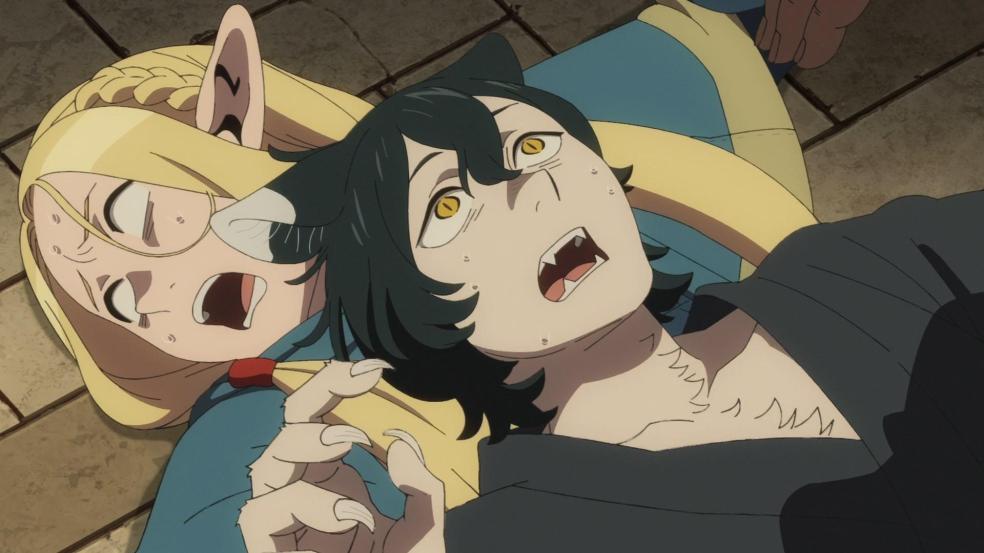
Pokémon Horizons, which began yesterday, is essentially the second “main” Pokémon anime, succeeding the storied 1,200-some episode saga of Ash Ketchum (Satoshi, as you likely know he’s known in his home country). The fact that Horizons exists and can be watched—although only via fansub for those of us outside Japan at the moment—still feels deeply surreal. But this first episode, which primarily exists as a from-square-one character building exercise for brand-new protagonist Liko [Minori Suzuki], makes it feel a bit less so. Liko, as we’re introduced to her here, feels very much like she should be the protagonist for this sort of story. She’s much more soft-spoken and a bit more of a thinker than her often hotheaded predecessor. She’s also rather insecure, in particular harboring a complex about how people often say that they don’t understand what she’s thinking. Indeed, leading with the protagonist of the two that seems to be much less like Ash first is probably the smart move. Also, her two-tone hair is pretty cute, and is further evidence for my conspiracy theory that, eventually, all anime characters will have at least two colors in their hair at minimum.
The first episode (one of two that aired back to back, but we’ll only be covering the first here, partly to give it parity with other shows this season but mostly just because the second isn’t available in English yet) sees Liko attending Indigo Academy, a school in the Kanto Region far from her native Paldea. There, she’s partnered with her starter Pokémon; a particularly willful Sprigatito that she spends much of the episode trying to bond with. There’s a distant echo of the Ash/Pikachu dynamic here, but aside from the fact that a cat scratch is not the equivalent of the Thundershock-to-the-face running gag of the first anime’s earlier seasons, Liko and Sprigatito also get on much sooner. Basically, as soon as Liko starts trying to understand the funny green cat on its own terms.
There’s a nice little bit of trackable progression in the series’ own language, too. Early in the episode Sprigatito struggles to even use Leafage, a very basic Grass-type move and a staple of its very first few levels in the games. By the episode’s end, it uses that same move to temporarily blind a freaking Rhyhorn, which it also promptly puts to sleep (seemingly with Sweet Scent. Which isn’t how that move works, but the show has never precisely followed the rules of the games, so that’s fine).
It’s super effective!
Yeah, about that Rhyhorn; anyone concerned that this is going to be some kind of laid-back slice of life series should stick around for the episode’s final few minutes. There, the mysterious “good luck charm” pendant that Liko’s been given by her grandmother turns out to be much more important than she could’ve possibly imagined. Our evident first antagonist, a fellow with black-and-white hair and weird eyes [Shun Horie], shows up with an obviously-falsified letter from Liko’s grandma on the first day of summer break, where the school just so happens to be sparsely populated. (Liko seems to be one of the relatively few students hanging out in the dorms over break rather than going home.) She’s rightly very suspicious of all this, and the guy’s demeanor doesn’t help. Eventually, she gets so freaked out that she tries fleeing out her bedroom window, only to be stopped by a minion working for this fellow, leading to the Rhyhorn battle previously described.
Things end on a truly exciting note; a man on a Charizard (of course it’s a Charizard) swoops in to protect Liko after she’s faced down with a Ceruledge. We know from pre-release press materials that this is Professor Friede [Taku Yashiro], and that the group of people he leads fly about the Pokemon World in an airship. But all of this is left to the realm of thrilling cliffhanger here, and we don’t get much more than that in this first episode, beyond one small twist that I’ll not spoil.
Taken on its own, this episode does definitely have the disadvantage of feeling like just one half of a whole. But, even then, this is clearly building up to being something special. Anyone worried that the spirit of true Pokémon adventure was in danger of dying out need not fret any longer, it’s clearly going to be just fine.
Like what you’re reading? Consider following Magic Planet Anime to get notified when new articles go live.If you’d like to talk to other Magic Planet Anime readers, consider joining my Discord server! Also consider following me on Twitter, Mastodon, or Anilist, and supporting me on Ko-Fi or Patreon. If you want to read more of my work, consider heading over to the Directoryto browse by category. If you have any questions about this or any article, feel free to leave a comment, or pop on over to my RetroSpring and ask me there. It’s up to you!
All views expressed on Magic Planet Anime are my own opinions and conclusions and should not be taken to reflect the opinions of any other persons, groups, or organizations. All text, excepting direct quotations, is owned by Magic Planet Anime. Do not duplicate without permission. All images are owned by their original copyright holders.