Seasonal First Impressions is a column where I detail my thoughts, however brief or long, about a currently-airing anime’s first episode or so.
Suzunomiya Lilisa [Sekine Akira] is repressed. The daughter of a rich family by marriage, she doesn’t really feel like herself at her prestigious finishing school, the kind of all-girls mannering academy that’s all but extinct in real life but lives on through cultural touchstones such as anime. It’s not that her classmates dislike her, quite the opposite actually, she’s very popular. It’s that the academy’s curriculum of education, culture, and politeness does not come naturally to her, and she works very hard to keep up appearances. This is in spite of what’s implied to be a pretty strong culture shock from her current living situation. Throughout this first episode we see glimpses of a very different home life than the one Lilisa currently lives: not one of wealth and class with a real estate mogul father who’s yet to be seen on camera, but one with her loving, guitar-playing biological father. Unless I missed something, we don’t directly hear that said father is no longer alive, but that’s certainly the implication.
What does all of that add up to for Lilisa? Well, she’s left most of her passions behind her, and is focusing on getting a prestigious award from her school. (She has a reason for wanting it, we don’t yet know what that is.)
The internal turmoil of a repressed rich girl is not that interesting on its own, and I will be honest in that Rock is a Lady’s Modesty took a while to hook me here. It does help that there’s an eclectic set of influences being worn on the show’s sleeve right out the gate: the shoujo and Class S yuri manga responsible for keeping these sorts of girls’ schools in the public memory, Love is War!‘s later arcs, with their fixations on the often-empty inner lives of the wealthy, and of course the broader girl band current of which Lady’s Modesty is undeniably a part. (Although, as a matter of record-keeping, this is an adaptation, not an original series. The manga dates from late 2022, and having to adapt an existing story explains some of the more unusual structural choices, as we’ll get to.) These disparate sources add up to a very straightforward core conflict: the person who Lilisa is trying to be and the person who Lilisa is do not match up, and this is getting to her.
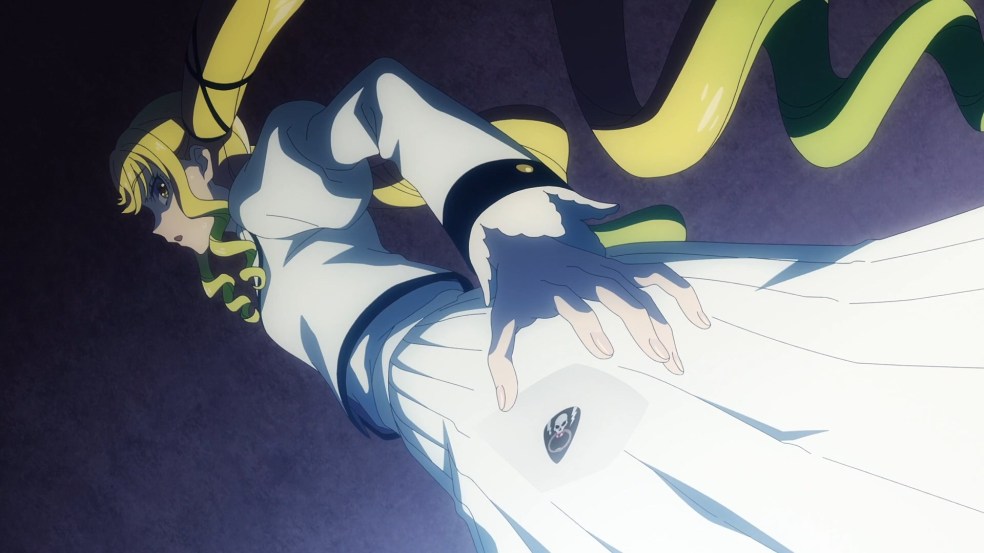
Which again, would not be that interesting, were it not for Kurogane Otoha [Shimabukuro Miyuri]. Otoha is a similarly well-mannered girl from a rich family. She and Lilisa meet by chance when they literally bump into each other, causing Otoha to drop a guitar pick. Lilisa tries to find a good time to return it to her—a classy lady having a guitar pick is uncouth, of course, especially one with a Hot Topicky skull-and-blood design like this one has—and in doing so learns that Otoha has been using an abandoned building on campus as a makeshift practice room. Now, small twist here, Otoha is actually a drummer. We don’t know who that guitar pick originally belonged to or what its significance is, but Otoha doesn’t use it herself.
Instead, she talks Lilisa into a jam session, first just by asking, and then, when Lilisa pushes back, by insinuating that Lilisa might not be very good at guitar.
Our heroine takes this very personally, and what ensues is a 1v1 music battle, the two trying to outdo each other, Lilisa on guitar, Otoha on the drums, over a backing track called “GHOST DANCE.” Lilisa, tellingly, imagines Otoha’s overpowering, thunderous drumwork as akin to being made to submit by a dominatrix. Those are her words, not mine.
And it only makes sense that she sees it this way, because Otoha really does overpower her completely. Which is to say, Lilisa’s guitar playing really isn’t that good. It’s fine. But not only are her actual skills not all that impressive for this genre but the show doesn’t really pick up any slack for her visually. (Most of the visual panache goes into her fantasies of being tied up in thorned rose vines instead.) We get shots of her playing, clearly very intensely focused and pouring a huge amount of sweat and effort into what she’s doing, but it lacks that ephemeral quality to make it truly memorable.
That’s how I’d put it, anyway.
Otoha is significantly less nice.
So that’s our big first episode twist. Surprise, you were supposed to think her guitar playing is kind of lame! It’s an interesting idea, certainly, but it’s not actually that unusual given that at this point a show actually having a barn-burner first episode performance would be the more surprising thing. (My baseless guess is that we’re saving that for, I don’t know, episode three?) Still, it’s a nice setup; Otoha flips her off before instantly flipping her ojou-sama switch back on, and just fuckin’ leaves, leaving Lilisa to stew in her own failure. The implication being of course that she’s realized that she cares about being good at this much more than she cares about being a good student. It’s a good hook, and I’m interested to see where the show takes it.
Of course, all of this is dodging a simpler question: is this show, at least this first episode, like, you know, good? I’d say so, but that comes with some caveats. The great Girl Band Renaissance in anime is, in the grand scheme of things, a recent and ongoing development. Bocchi the Rock, for reference, only aired in 2022, and the source manga for this series is from around the same time. Still, I have a hunch some might find the relatively slow start here a turnoff, and it is admittedly hard to imagine it stacking up, in the long run, to elephants in the room like Girls Band Cry or the It’s MyGO!!!!! / Ave Mujica subseries of BanG Dream! But Bocchi itself isn’t a bad reference point here, that show also took a bit to really get going, but once it did, it was one of the best anime of its year and is easily as iconic—moreso, honestly, if we’re talking simple name recognition, at least in the Anglosphere—than the other two shows I just mentioned. Still, by directly making competition part of its narrative, Rock is a Lady’s Modesty invites these comparisons, which I would probably otherwise avoid.
Can it live up to those expectations? I’m not sure, but I want to at least see it try, and that counts for a lot all on its own. Besides, I really do just need to see what is going on in Lilisa’s head that makes her imagine a guitar/drum duet as some kind of BDSM thing, although admittedly, the fact that she refers to Otoha in her narration as her “lifelong partner” might be a clue. I think you might be repressed in more ways than one, girl.
Like what you’re reading? Consider following Magic Planet Anime to get notified when new articles go live.If you’d like to talk to other Magic Planet Anime readers, consider joining my Discord server! Also consider following me on Anilist, BlueSky, or Tumblrand supporting me on Ko-Fi. If you want to read more of my work, consider heading over to the Directoryto browse by category.
All views expressed on Magic Planet Anime are solely my own opinions and conclusions and should not be taken to reflect the opinions of any other persons, groups, or organizations. All text is manually typed and edited, and no machine learning or other automatic tools are used in the creation of Magic Planet Anime articles, with the exception of a basic spellchecker. However, some articles may have additional tags placed by WordPress. All text, excepting direct quotations, is owned by Magic Planet Anime. Do not duplicate without permission. All images are owned by their original copyright holders.
Seasonal First Impressions is a column where I detail my thoughts, however brief or long, about a currently-airing anime’s first episode or so.
“Will you give me the rest of your life?”
God help us all, a short girl with blue hair is here to make her trauma everyone’s problem.
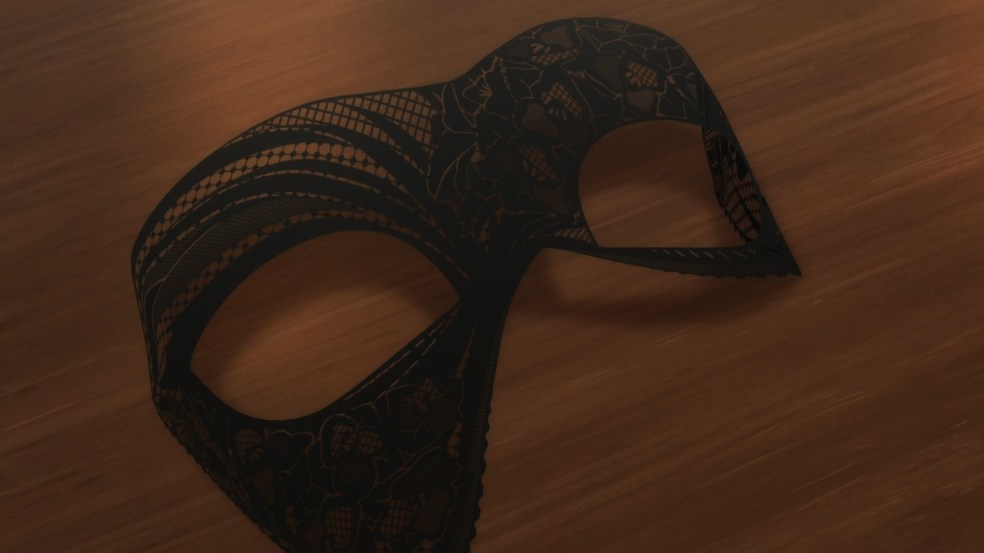
At the end of the final episode of BanG Dream! It’sMyGO!!!!!, the show was essentially hijacked. That series’ finale doesn’t really have anything to do with MyGO directly. Instead, it follows Togawa Sakiko [Takao Kanon], a cryptic, antagonistic presence for of much of that season and a former member of pre-MyGO band CRYCHIC, whose extremely messy dissolution still haunts that show’s cast. MyGO‘s finale made the argument that Sakiko, actually, was more haunted than any of them. Recruiting a supergroup of musicians from across BanG Dream‘s talent-overstuffed universe, she made them wear black lace face masks and gave them goth metal code names; Doloris for lead singer, guitarist, and childhood friend Misumi Uika [Sasaki Rico], Mortis for rhythm guitarist and also childhood friend Wakaba Mutsumi [Watase Yuzuki], Timoris for bassist Yahata Umiri [Okada Mei]—she of the famous “I’m in roughly 30 bands” screenshot—Amoris for capricious drummer Yuutenji Nyamu [Yonezawa Akane], and, finally, Oblivionis for herself, Sakiko, composing and on keyboard. It is their story, we’ve been promised, that BanG Dream! Ave Mujica will tell us.
Thus so established, Sakiko joined a long lineage of real and fictional masked musicians. From Slipknot to Daft Punk, from MF DOOM to KISS. Her reason for adopting a mask is, at its heart, the same as many real musicians who do so: a rejection of her “real” face allows her to become lost in persona, the old self subsumed into a dramatic, shadow-casting new self. A puppetmaster in a near-literal sense, given how her stage shows involve so much doll imagery. Welcome to her beautiful dark twisted fantasy, right?
Wrong. A driving theme here is that Sakiko is not nearly as in control of any of this—not her band, not her life—as she’d like to be. Most of this first episode, aside from Ave Mujica’s killer performance of opening theme “KILLxKISS” at the start, an interview immediately after where there is some tension between Sakiko and Nyamu, and a sequence at the end, is flashback.
Here, we learn a little about Sakiko’s life. The usage of traditional animation for some of these flashbacks is interesting. Readers may recall that Girls Band Cry used a similar technique to similar ends; to emphasize an idealization of these moments, to underscore that we’re not necessarily seeing them as they really were but rather how they felt. Ave Mujica, befitting its goth theater kid vibe, hammers the point home further by also drowning the earliest, still mostly happy memories in an amber sepia filter. More memories follow, and these get no filter and no flat animation; we learn how Sakiko’s mother died suddenly, tragically young. We see her inspired to found a band for the first time after seeing BanG Dream! veterans Morfonica in a small concert. We briefly retrace the rise and fall of CRYCHIC, Sakiko’s father losing his high-paying job at his own father-in-law’s company, and his collapsing into a broken drunk. Sakiko’s struggles to find some kind of job—any kind of job—to make ends meet for herself and her father. We relitigate CRYCHIC’s breakup, this time from Sakiko’s perspective and with a whole lot more crying in the rain, making it clear that leaving the band was just as painful for Sakiko as it was for anyone else. At one point, later in the episode and back in the present day, her father chucks a beer can at her face, giving her a noticeable bruise, and tells her to leave the house. Sakiko can’t take any of this. Thus, the mask.
All of this theater, mind you, lasts for less than a single full episode. On the stage before Ave Mujica are set to give a performance to their largest audience yet, Amoris promptly torches the entire thing, tossing her mask off and unmasking the rest of the band’s members in short order, underscoring both her status as the cast’s wildcard and her general lack of patience for Sakiko’s theatrics. There is something genuinely bold about undoing your characters’ central gimmick right at the end of the first episode, but it only matters so much. It’s true that the audience now knows of Ave Mujica’s civilian identities, but the real masks are something much less material than the flimsy lace that Amoris chucks on the ground.
The command of drama throughout this first episode is superb, but it’s fair to say that where any of this will go is still very much up in the air. Ave Mujica is a theater kid at heart, it lives and breathes drama, and drama, as we’ve seen in anime like MyGO, or, to name an even darker example something like Oshi no Ko, can keep the fire burning for a long, long time. But not forever! This upturning of a core component of the band’s—and thus the show’s—mythos is a promising start, but I do hope we get some actual character growth here, in one way or another. Sakiko’s awful home life is another factor that I do hope the show explores. It’d definitely be a lot more interesting than another rehash of the usual commercialism vs. authenticity stuff, which some of Nyamu’s antics can’t help but bring to mind, given that she’s an influencer off-stage. (Any commentary along those lines is doomed to fail anyway. Ave Mujica are a lot of things, and they make great music, but they’re not any kind of “authentic,” in-universe or out.)
That’s all hypotheticals though. The real nitpick as of now is in the subtitling. What would a girl band anime release be without bitching about the subtitles? I’m only going to touch on this, since other people have already pointed out the obvious, but Crunchyroll’s subtitles for this first episode are notably subpar, stilted in places and lacking song translations. Hopefully this will be fixed at some point, to say the least. Regardless of this glaring issue, which isn’t really even the show’s own fault, I’ve left the first episode confident that we’re in for a hell of a ride, episode 2’s title, Exitus acta probat, “the outcome justifies the deed”, is hugely promising. 11 more weeks of this! Strap in.
Like what you’re reading? Consider following Magic Planet Anime to get notified when new articles go live.If you’d like to talk to other Magic Planet Anime readers, consider joining my Discord server! Also consider following me on Anilist, BlueSky, or Tumblrand supporting me on Ko-Fi. If you want to read more of my work, consider heading over to the Directoryto browse by category.If you’re looking for me to watch a specific show, watch this space. I am planning to reopen commissions in the near future.
All views expressed on Magic Planet Anime are solely my own opinions and conclusions and should not be taken to reflect the opinions of any other persons, groups, or organizations. All text is manually typed and edited, and no machine learning or other automatic tools are used in the creation of Magic Planet Anime articles, with the exception of a basic spellchecker. However, some articles may have additional tags placed by WordPress. All text, excepting direct quotations, is owned by Magic Planet Anime. Do not duplicate without permission. All images are owned by their original copyright holders.
This review contains spoilers for the reviewed material. This is your only warning.
“We believe there’s a place where we belong. That’s why we sing.”
There is something fitting about the fact that, as of the time I’m writing this after the anime’s just ended, there is no way to legally watch Girls Band Cry in the west. It’s completely meaningless to call anything, much less an anime—the end result of many, many corporate machinations at the end of the day—“punk” in 2024, but there is something at least a little rock ‘n roll about how if you wanted to watch Girls Band Cry as it aired and you lived in North America, the UK, or many other parts of the world, you had to pirate it. Steal This Anime, they’ll call the documentary.
It’s appropriate because Girls Band Cry is a thirteen episode ode to the power of rock music, of youthful indiscretion, of the power of spite—of doing something just because everyone tells you you can’t—of love, of rebellion. I’m 30 years old, now, so I can’t speak to how Girls Band Cry may or may not be resonating with the actual teenagers of today, but I can say that for myself, for a generation that grew up on the pop-punk explosion, perhaps rock n’ roll’s last gasp of any real cultural relevance in the United States, it hits like revelation. The very short version is that this is an absolutely kickass tour de force, a complete triumph for Toei’s burgeoning 3D department, proof that Sakai Kazuo (also of Love Live! Sunshine!! fame, among other things) still has it and that his best work is ahead of him. This is a show that cements itself as an instant, iconic classic, and a series that other anime will build on in the future. If you haven’t watched this, you need to. Go look around, or ask a friend in the know if you don’t know where to search. You’ll find it, and it’ll find you. It’s a story about teenage rebellion. It’s a straightforward underdog rock band story, the best we’ve gotten in years, and a rare recent example to feel truly connected to the real world. It’s also, if you’re paying attention, a love story. Suffice to say, as is obvious from my effusive praise, I think Girls Band Cry is great. I could nitpick various things, and I don’t think it’s literally flawless, but it’s about as perfect as anime gets for me, at least. It’s an admirably dense text for its genre, too; thirteen episodes of the most emotionally resonant shit you’ve ever felt in your life. It’s an electric, nervy thing with a ton of heart. I love it.
Would you believe it all starts with a middle finger?
There’s an entire sub-article to be written about how Girls Band Cry makes use of the middle finger gesture. It starts as a running joke in the first episode, before being traded off for its more polite counterpart, giving someone the pinky finger. But then that becomes an in-group thing, something Togenashi Togeari, the band in Girls Band Cry (the name means something like ‘spineless spiny ant,’ I’m told), use to identify themselves, each other, their fans, their supporters. It becomes a fandom thing, a scene thing. A sign of belonging.
But before even that much, there’s Nina [Rina, in her first-ever anime role. All of Girls Band Cry‘s voice actresses go by mononyms and are new to the industry], a lonely girl keenly aware of her place in a world that is much, much bigger than she is. As our story begins, she’s just arrived in Tokyo, leaving behind a complicated home situation that we won’t learn more about until near the end of the series. The more specific reasons aside, the main sense we get early on is that the real reason Nina struck out on her own in the big city is just a sense that she felt like she didn’t belong in her hometown. Given some stuff later in the show, it is really easy to read Nina as a closeted (maybe even to herself) lesbian, but more generally, she definitely at least feels like a stranger in her own home. Getting away from it all makes an amount of sense. Much, much later in the series, we’ll learn that this all stems from trying to stick up for a girl in her class who was being bullied and being smacked down hard by the school system (and more literally, the actual bullies) for doing so. It quickly becomes clear that Nina is a pretty angry little thing, and that most of this anger is a justified expression of disgust with a deeply unfair world. That kind of anger can ignite a fire in a person, and I’ve always found these stick-to-your-guns-at-all-costs types admirable. I have a few friends like that, and they’re some of my favorite people.
Something that gives Nina relief from the general, well, pain of being herself, is the music of rock band Diamond Dust. Or at least, Diamond Dust as they used to be, before they replaced their lead vocalist Momoka [Yuuri] over what we later learn was a falling out about a shift in style at the behest of their label.
Nina, a real head, is a fan of their older stuff with Momoka, particularly the original version of their song “Void”, which makes things pretty astounding for her when she meets Momoka on a street corner, putting on a street performance. Nina introduces herself, starstruck, extremely awkward, and maybe a little smitten. The two hit it off pretty well, but Momoka plans to leave town the next day and quit the music business entirely.
Suffice to say, that doesn’t happen. Over the course of the remaining 12 episodes, Togenashi Togeari (who only actually get that name a fair ways into the series), gain three additional members; drummer Subaru [Mirei], keyboardist Tomo [Natsu], and bassist Rupa [Shuri]. All are fantastic characters, although they don’t get an even split of focus, as this is mostly Nina’s story, at the end of the day. Before we get more into that, though, we should actually talk about how this story is told, since the presentation is so important here.
Any anime is to some extent defined by its visual identity, and the sound work is always important as well, but both of these are particularly crucial to Girls Band Cry, which is genuinely attempting something new on the visual front, and sonically requires its viewers to buy into the idea of Togenashi Togeari as a credible rock band. The look of the show is the most notable thing about it, I’d argue (aside from that other elephant in the room we already addressed, anyhow). If you are one of the people who has held off on GBC because “it’s CGI” or “it just doesn’t look good,” this is me telling you, as politely as possible, that you are having an Goofball Moment and need to gently shake yourself out of it. I’ve long been a defender of 3D CGI in anime, but this is not a case like say, Estab Life, where the series is using CG to emulate the traditional “anime” look. Instead, Girls Band Cry focuses on capturing the feeling of being an anime, as opposed to clinging to techniques that don’t necessarily work in its particular format. This is obvious in details as basic as its apparent framerate. The common 3D CG shortcut of halving the final product’s framerate to make it look more like a series of traditional anime cuts is not present here, as Girls Band Cry‘s visuals are able to capture that look without relying on doing that. In general, the CG is fluid, cartoony, and wonderfully expressive. Not every trick it tries works perfectly, but it has an astoundingly high hit-rate for something that’s basically extending anime’s visual language on its own as it goes.
In more general terms of style, the show manages to pull off keeping things relatively grounded on a presentational level while still feeling cartoony. Some of the usual anime hallmarks are absent here—no one but post-Momoka-split Diamond Dust have any of the usual anime hair colors, for instance, and in their case there’s decent reason to think it’s dyed—and the backgrounds in particular lean toward the realistic. Despite this though, GBC is perfectly willing to break that illusion of restraint whenever it has a reason to. This can be as simple as a character making a goofy pull-face (something the show is shockingly good at considering how hard that is to do in 3D), or giving a character a literal aura that radiates off of them and impresses the other characters or telegraphs an emotional state to us, the audience. In one scene, for example, Momoka is given a gentle, cool lavender aura. We don’t need Nina to directly tell us that she thinks Momoka is beautiful and admirable. The entire series is loosely from her perspective, and devices like this let us directly see how she feels. This is even more obvious in the “rage spikes” the show draws around Nina when she’s angry; she literally brims with red and black needles, representing the barely-contained boil of her temper flares.
Girls Band Cry can and does use traditional 2D animation as well, but only in very specific contexts; the idealized, crystallized memories that we all have as part of our core personalities, very occasional flights of fancy when the show dreams up what “real rock stuff” looks like, including the opening theme, and for minor characters. If we interpret the show as being from Nina’s perspective, we can think of the 2D segments as her romantic notions filling in the gaps as she’s telling us her story, even in remembering minor characters she has no real extended contact with. It is certainly not a compromise or a concession, which is what a lot of people—myself included—might’ve initially thought, as it’s important that these are the only times when Girls Band Cry uses these techniques.
In terms of sound, Togenashi Togeari are surprisingly believable as a rock band. Obviously, despite the show’s gestures toward an independent rocker spirit—gestures that become more and more important as the show goes on—this is an anime series, and those need to be backed by corporate money, so they’re not, like, The Clash or anything. They’re pretty fucking good, though! It takes several episodes for their sound to really come together, as it doesn’t entirely click until they pick up Tomo for keyboards and Rupa for a real bass about a third of the way through the series. In the great Girls Band Anime Power Rankings I’d put them somewhere above (don’t kill me here) honestly most of the BanG Dream groups, and Kessoku Band, but below Ave Mujica, Raise a Suilen, and Sick Hack, bands whose very existence kind of feels like the series they’re from is getting away with something. (Even accounting for the last of these having only one song.) TogeToge aren’t that, but they’re great as the protagonists of this kind of thing, since they make straight-down-the-middle, fist-pumping, angst-shedding alt-rock of a kind that’s basically extinct as anything with any real cultural currency in the United States but remains a viable commercial and artistic force in other parts of the world, obviously including East Asia. Their biggest asset is Nina’s vocals; clear, piercing, incisive, bright as a shooting star. She sings like her vocal chords are trying to climb out of her throat to strangle everyone else in the room, and while she lacks the complete knockout punch holler of someone like, say, real-world rock star LiSA, she more than makes up for that in knowing her instrument and in her sheer on-mic charisma. This all rounds together as TogeToge being a pretty damn good band, I’ve found myself spinning their songs both from the show and from their album Togeari a fair bit, which is more than I can say of a great number of in-fiction acts from anime in this genre.
The important thing to note here is that TogeToge don’t have to be better than every other rock band from every other series, though. The main thing they have to do is be better than Diamond Dust, as over the course of its central narrative, Diamond Dust become TogeToge’s main rivals despite appearing only very rarely; TogeToge’s opposites in approach and philosophy, and also subject to a personal grudge from both Nina and to a lesser extent Momoka. This, TogeToge easily pull off. To the point where I feel a little bad for the actual people behind Diamond Dust, as DD’s music is just not nearly as good or interesting. (It’s polished and professional, certainly, but it lacks the magnetism that TogeToge eventually develop, and their own lead is a much less compelling vocalist.) The deck is clearly stacked in TogeToge’s favor in this way, but that’s not a bad thing. I think stoking a bit of fannish partisanship within its viewers is likely intentional, in fact. As though you’re supposed to hear Diamond Dust and think “what, people would rather listen to this than our girls?!” Given that Girls Band Cry clearly takes place in some version of ‘the real world,’ it’s distressingly plausible! It’s a fun little story-hack, and it makes GBC a nice exception to the trend of band anime main character bands being the least interesting groups in their own shows.
There’s a level of cognitive dissonance here that merits a quick aside. TogeToge, despite the show’s own themes, are, in fact, exactly as much a commercial product as Diamond Dust. The main reason this doesn’t really matter is that getting you to buy into the illusion that they aren’t is something the show goes through great lengths to accomplish, and I’d actually argue this is the main reason the show works at all. (It’s also why it took a few episodes to click for me! Nina is such an incredibly polished and talented vocalist right off the bat that I found it a little unbelievable. Imagine my shock upon learning that her voice actress is actually a year younger than she is.) I will confess that I think I’d like TogeToge even more if they had a little more grit in their sound, but that’s a personal preference.
In any case, the story of Togenashi Togeari has elements of a traditional up-from-the-bottom rock underdog story, but more important is the band’s members using music to process their personal traumas. Nina has the whole bullying situation, as well as an overbearing family and an equally-stubborn father who are not supportive of her sudden decision to drop out of school and pursue rock music when they learn about it. Momoka has the lingering pain of leaving the original Diamond Dust, and ends up projecting her own experiences onto Nina who she clearly sees as a slightly younger version of herself. Subaru is the granddaughter of a famous actress, and is expected to follow in her grandma’s footsteps despite her own disinterest in the profession. (She calls it “embarrassing”, even!) Tomo is living separated from her family for reasons we only get a very broad picture of, and has previously dealt with people cutting her off when they can’t handle her frank personality. Rupa, Tomo’s roommate and easily the most mysterious character of the main five, is originally from Nepal, and lost her mother in an unspecified tragedy before moving to Japan with her father. A common thread here is that of seizing your life, every minute of it, to do what matters to you, not bowing to anyone else’s whims. In one of the most casually-devastating lines in a series full of those, Rupa lays things out in one sentence.
In other words; Girls Band Cry will be romantic, because it clearly cares about that starry-eyed rocker girl shit a lot, but it’s not going to bullshit you. The window for anyone to make an actual rock band and have it work out in any way is very short, and Girls Band Cry is keenly aware of that. This frank attitude extends to the characters’ personal problems as well, and each has an issue they struggle with over the course of the show. Nina is a cute anime girl and she’s ridiculously fun to watch, but her prickly personality makes it hard for other people to get along with her and she tends to retreat into her anger when in difficult situations. Momoka is genuinely a beautiful and cool rocker lesbian1, but she also actively uses that persona to deflect tough conversations that she doesn’t want to have, and as mentioned she tends to project her own hangups onto Nina. Subaru is easily the funniest character in the series, a lovable goofball who gets most of the show’s most comedic moments, but her screwy attitude seems to stem from feeling repressed in her home life, and it’s downright uncanny how she acts around her grandmother. Tomo is similar to Nina in a lot of ways, as her blunt, often critical way of talking about things with people can make her seem rude or thoughtless to those not attuned to how she thinks. Rupa, lastly, actually seems to be the most well-adjusted member of the group, but there are a few moments when the façade cracks and it’s clear that something, perhaps the loss of her mother, is still weighing on her. It’s also worth noting that she drinks a lot, and while the show mostly plays this for laughs, it’s hard not to read a certain level of coping mechanism into it. The show’s command of characterization is just excellent overall, and it reminds me a lot of another anime original with a script by screenwriter Hanada Jukki, A Place Further Than The Universe, which also had a cast of strong characters and a deft hand with staging conversations.
Our central story is actually fairly straightforward, compared to all of this complex characterization. For the most part, we’re tracking TogeToge’s formation, relative rise, and as it turns out, very brief time on a major label here. I don’t want to bleed the anime of its specifics, but the short version is that the first 2/3rds of the show focus largely on Nina and Momoka’s relationship, which goes from that initial meeting to a sort of strained friendship before the two come to accept each other in episodes seven through nine.
We need to talk about one other character here, Mine [Sawashiro Miyuki], a singer-songwriter whose time in the show is brief but makes a huge impact, especially on Nina. In episode seven, Mine, who is an indie musician getting by even if she’s not famous, explains to Nina, after a joint show, that the reason she still does music for a living even if it’s very hard is that it feels like she has to. She goes into some detail about how she tried to compromise with herself, to take up a teaching position or something else more “stable”, but she couldn’t do it. Making songs, performing those songs, connecting with people via her art. It was too important. Nina seems to really internalize this. I’d argue it’s also basically the thesis of Girls Band Cry itself. Everything else is extraneous, what matters about making music—or any kind of art—is that you’re getting something of yourself, your soul, across to your audience. That’s what Nina got from the original version of “Void,” and that’s what she hopes to do with TogeToge.
Momoka can’t quite see that. She spends most of the early series convinced that Togenashi Togeari are destined to fail. Not just fail, crash and burn. Because she failed with Diamond Dust, and can’t seem to consider that the only data point she’s working off of is her own. Given what little we see of Diamond Dust, who mostly seem to be happy with their new direction, it’s entirely possible that Momoka splitting off was actually the best thing for both her and the band, but Momoka just can’t see it and continues to insist that she’s going to quit TogeToge in the near future. At one point, Nina is so fed up with all this that she just slaps Momoka across the face.
Would you believe that doing so actually makes their relationship much stronger? In fact, you can pretty easily argue that shortly after this, they become more than just friends. Nina, in episode eight, straightforwardly confesses to Momoka in the middle of a very hectic scene that I can’t bring myself to spoil the minutiae of. If you see people call Girls Band Cry a yuri series, that’s why. Does Momoka reciprocate? Well, she never actually says so, and I know that the lack of verbal confirmation will disqualify it in the minds of some, but based on what we actually see throughout the rest of the show; the two affectionately leaning on each other at various points, the fact that Nina has Momoka’s name circled on a calendar and a note reading “spend time with Momoka after practice” jotted down at one point, etc., I think the situation is fairly obvious. Maybe more than any of that is Momoka’s constant reassurance that she loves Nina’s voice. It’s clear that she’s not just talking about her literal vocals—although probably those, too—but Nina’s point of view, her passion, and her inner fire.
In fact, after this point the entire band seem to form a really coherent unit not just musically but as friends. I saw another fan of the series mention that the way you can really tell that TogeToge get along is that they’re comfortable being jerks around each other. And that’s honestly, completely true! TogeToge love to mess with each other, but it’s also obvious that they really do care. This is most obvious, at least it was to me, in episode ten, where Momoka has to be stopped from driving all the way back to Nina’s hometown by herself to pick her up. You don’t do long highway trips for people you only kind of care about.
About that; episode ten sees Nina return home to try to explain her situation to her parents, mostly her dad. Nina’s father is another great character who really shines despite a limited lack of screentime, and I’m absolutely in love with how the show stages the first conversation between the two where they’re not really listening to each other. How does Girls Band Cry communicate that? By sticking them on opposite sides of a sliding door. Subtlety is for losers.
The entire episode is fantastic, but the key points touched upon here, particularly where Nina says that the original Diamond Dust’s music saved her when she was feeling—she says this explicitly—suicidal in the aftermath of the bullying situation at school. That is the real power of art. That’s what TogeToge are seeking to channel, and episode ten is where Nina really starts understanding that. The self-acceptance she shows here is hard-won, and this is the sort of thing I refer to when I say that Girls Band Cry is really Nina’s show at the end of the day. I have rarely felt proud of an anime character, an emotion-object combination that just objectively doesn’t make any sense, but Girls Band Cry got it out of me.
As for the band themselves, they eventually sign with a real publishing company. (Or are they a label? To be honest, I am a little unclear on this point, but it doesn’t really matter.) The episode after this is where all of this buildup—the character arcs themselves, the emotional peaks, the sound, the love, the lightning—hit their climactic note. This is the best episode of the series, the best anime episode of the year so far, and one of the best of the ’20s in general. They play a festival, with TogeToge on a B-stage, in what is nonetheless the biggest moment of their careers. Diamond Dust are at the festival, too, but we only get to see a very brief glimpse of them playing, because this is not their story, and they’re not our real stars.
Togenashi Togeari aren’t up on the main stage, they aren’t playing to the biggest crowd, and they aren’t the main attraction, but for the three minutes and ten seconds of “Void & Catharsis”, their big roaring emotional fireworks display that is, in its own way, a response to Diamond Dust’s own “Void”, they feel like the best and most important band in the world. The entire series hinges on this concert scene, which is good, because it’s one of the best of its kind, and “Void & Catharsis” is TogeToge’s best song. It’s been weeks since I first saw it and it still blows me away. I might go as far as saying that it’s the best in-show rock band concert since the iconic performance of “God Knows” in The Melancholy of Haruhi Suzumiya, a full eighteen years ago. If it’s not, it’s definitely at bare minimum the best of this decade so far, and it’s hard to imagine it being topped by anyone any time soon.
It’s not just the visual tricks the show pulls out here; wild, zooming camera angles, cuts to 2D-animated segments that dramatize the girls’ own backstories and traumas in the way that so much great art does, some of the most raw rock poster animation I’ve ever seen in any television series, etc. It’s the song itself, a screaming and, yes, cathartic anthem about rebellion as personal salvation. Nina has no time for anyone’s bullshit. She’s busy screaming about insubordination as admiration, how telling someone they’re aiming too high is a rotten thing to do. She won’t be obedient but she’s scared to even try to resist. She doesn’t want to die. She wants to live so bad it hurts. She inhabits not just her own trauma but her bandmates’ as well, singing brief sections of the second verse from the perspective of Momoka, then Subaru, then Tomo, then Rupa. She channels the painful split Momoka endured from the original Diamond Dust, the towering expectations placed on Subaru, the forced clamping up that Tomo put herself through, and the unimaginable tragedy of Rupa’s loss of her mother. She’s not just a singer, she’s a medium. She takes on their pain as her own and lets every razor sharp line bleed her voice until there’s more blood on the stage than sweat. In a particularly astounding lyrical turn that I’m not entirely sure of the intentionality of, there’s a line in the chorus that is a completely coherent sentence in Japanese, translating very roughly to something like “because my anger can’t be stopped”, but sounds phonetically like the English phrase “so I can die young.” That kind of intentional bending of language, to facilitate a bilingual pun that calls back to and reinforces an earlier line, no less, is normally the domain of rappers. Particularly heady, lyrical ones (the likes of Kendrick Lamar or Lupe Fiasco or such), so part of me wonders if it’s not just an astounding coincidence. But if it’s not, that’s some 5D chess shit, and I feel wrong not pointing it out even if it is an accident because, holy fuck, what an accident.
It must also be said, she looks amazing throughout the entire concert scene; an honest-to-god icon of rock n’ roll rebellion in an age where the very idea should be a laughable archaism. She pumps her fist both toward the crowd and back at her own band to egg them on. She stomps around on the stage like she can barely control her anger. She glares at her audience, maybe Diamond Dust specifically, since they’re also watching, like she’s trying to kill them with her mind. All this while rocking a billowing yakuza shirt and with quick-apply teal dye that I must imagine smells like an unfathomable mix of chemicals slapped on the underside of her hair. In one particularly great moment, she makes an open-palmed gesture toward the crowd and then clenches her fist tight. It’s clear that not only is she insanely good at this, she really loves doing it. For all of her fury and thunder it’s also obvious that she’s having the time of her life on that stage, and who could possibly blame her? She gets to be in a rock band. Who wouldn’t love that? That feeling itself is embedded in “Void & Catharsis” as much as the righteous anger stuff. It’s subtextual, but it’s definitely there.
All this about Nina and barely a word about the other girls. The truth is that despite being a hobbyist musician myself I’m not much of a music theory gal, so I can comment only in generalities. Still, Rupa’s pounding, oscillating, heavy bassline grounds the song, as do Subaru’s nimble drums. Tomo’s key work—some of her best—provides some much needed texture to contrast the main sonic palette of the song, Momoka’s guitar, and have a sparkling, star-like quality that really reinforces the piece’s sky-looking aspirations. On the note of Momoka’s guitar, holy shit Momoka’s guitar. For the most part her riffs here are the song’s muscles, they give it strength and fullness and make it more than just a bed for Nina’s vocals, but there’s a really great moment where Momoka gets a full-on solo, a sparking piece of pyrotechnics that really sends “Void & Catharsis” over the top. I have it on authority from a guitarist acquaintance that it’s also fairly technically tricky, and I have no reason to doubt them.
All this to serve a song and a scene that streaks across the show like a comet. 3 minutes isn’t that long for a rock tune! I listened to the song a number of times while writing this piece and I was always astounded by how brief it is. Because in the moment, in the context of the show, it feels monumental and eternal. It’s not, though. When Nina hits that last note, the song ends, and in fact episode 11 on the whole ends. We are left with the feeling that we’ve just witnessed something rare and special. I wonder if the crowd that TogeToge attract during the show feel the same.
The rest of the show, really, is denouement. Falling action, of a sort, something that single cour anime have largely forgotten how to do. Episode 11 is the show’s peak both emotionally and qualitatively, but the miniature drama that follows, where TogeToge are briefly part of a real label, have their first single flop hard, and then quit to return to the indie grind, is compelling on its own. It’s a full extension of the show’s passion-driven spirit, and it also allows Nina to reconnect with an old friend.
Hina [Kondou Reina], the vocalist for the incarnation of Diamond Dust that TogeToge spend the entire show in the shadow of, was a classmate of Nina’s. She was there during the whole bullying thing, and she told Nina not to get involved. Nina, as we know, did get involved, and this led to a rift between the two that still doesn’t fully heal even by the end of the series. Honestly, in her sole on-screen appearance of any length, Hina comes across as a pretty nasty piece of work! Some of this is clearly affect, and the show’s final minutes state outright that she was deliberately pushing Nina’s buttons during their one meetup, but still! I would say that Hina would be the main character if this were an idol anime, but frankly I don’t think most idol anime have it in them to portray their characters with this much honesty. (Shinepost did, which is why Shinepost rules.)
The charitable read is that she’s a realist. Someone who knows how to play the game, someone who is actually interested in the monetary side of the whole industry, someone who wants to be famous. In pretty much every sense, she’s Nina’s complete opposite. Their meeting is enough to convince Nina that she was in the right back then, and she’s in the right now. This also concludes an entire plot about a dual Diamond Dust / Togenashi Togeari concert, that ends with TogeToge amicably leaving their label. Momoka, in one of her last lines in the entire series, gently teases Nina by suggesting that this whole thing was Hina trying to extend the Diamond Dust / TogeToge rivalry, partly because she enjoys playing the part, but also partly because Hina really loved Diamond Dust’s music too! Maybe not in the same way, maybe not to the same extent, but she did, and this is a commonality that connects the two similarly-named vocalists permanently, whether they like it or not.
This, then, is how the series ends, with Togenashi Togeari back on the indie circuit, a cult phenomenon at most. We will never know if they achieve success beyond this, although we do know they’ll keep trying. Either way, at the end of the day, part of the very point of this show is that success is secondary to being able to look yourself in the mirror. Nina is ridiculously, astoundingly, monstrously stubborn, but she sticks to her principles. In one of the flashbacks that dots the finale, Hina tells her that Nina’s intense “spikes” of justice make her feel like the bad guy. The thing is, in those flashbacks, Hina is the bad guy. She seems to even know this, on some level, given how she does everything she does in the last episode specifically to prod Nina into sticking to her guns. Arguably, that’s a pretty cold mercenary move too—after all, TogeToge and Diamond Dust are direct competition—but I choose to take it both ways. Yes, Hina is conveniently knocking a rival band down a peg, but she really does seem to care about Nina, too, in her own way. (Implicitly, there’s also some reason to wonder how happy Hina really is about having basically sold out, despite her own claims in the finale about how important success is. We may never know for sure.)
By design, we don’t see the rest of Togenashi Togeari’s story. We could write it ourselves, we could choose to extend the show’s text into the real world and keep an eye on how the inevitable actual touring version of the band do. You could argue, well, hey, Diamond Dust aren’t the ones with a Spotify ad or the goddamn branded earbuds. You could even argue there’s room for a hypothetical second season (there is, but I think people get way too caught up in that particular discussion). Ultimately all of that, all of the money and fame and success and legacy and popularity and on and on, is less important than the show’s overall dedication to sticking to the spirit of rock n’ roll in a time when that is a fast-fading phenomenon in even the most vestigial sense. These girls appreciate music as art, as life. They’d die without it. Even if TogeToge are never bigger than they are in episode 11, I have no trouble at all believing they will play together for the rest of their lives. In their very last concert of the series, in the middle of a charmingly awkward monologue, Nina declares her audience rebels and misfits, and while that’s true of TogeToge in a very different way than it was for rock and roll’s originators many years ago, it is still true, and it’s true of Girls Band Cry itself, too. In one very specific sense, TogeToge have a luxury that real bands don’t have. They get to ride off into the sunset and into our memories forever. The ED is something of a very short postscript, and it seems to suggest that TogeToge will soldier on together, living that indie rocker life, into eternity. That’s a bit ironic for a series that’s also in decent part about seizing life while you still can, but hey, it’s one of the perks of being an anime character instead of a flesh and blood human being.
All this said and there is so, so much I haven’t touched on. I think time might risk forgetting how funny Girls Band Cry is (seriously, it’s borderline a slapstick series in some spots). The girls have incredible costuming both in their day to day life and especially on stage. I didn’t talk at all about Subaru’s character arc, nearly as important to the show as Nina and Momoka’s. I didn’t talk about Tomo or Rupa that much even though they’re probably my favorite characters (one of the very few criticisms I could make of the show is that I wish it were just a bit longer so Rupa could’ve gotten an episode). I didn’t talk about Tomo’s pet snake or the fact that her outfit for the festival concert is an extended reference to Undertale. I didn’t talk about Rupa’s legion of gay fangirls, a real, canonical thing that we are shown in the series. Even in the parts of the plot I did go over, I skipped a lot of details. Hell, if I’m honest, I could write a whole other article about the sleazy indie rocker sex appeal of Momoka’s stupid fucking trucker hat that she wears while piss-drunk and acting like a jackass in one of the episodes. Like any good rock band, TogeToge have way more to them than any single writeup, video, whatever, could reasonably cover. The list is endless! But this review is not, and I need to stop somewhere, even if any point is ultimately going to feel arbitrary.
If this is the end of the series the fact remains that we were all here to see this, together. The moments themselves are more important than any lofty discussions of success or legacy, and if the show does find a long tail, which I really hope it will, it will be because it feels so huge and fiery in the moment. If you’re going to make an impact, make it electric. Connect with people, find your voice, live your life. Everything else is fluff.
1: Source: I’m Gay And I Can Fucking Tell, OK?
Like what you’re reading? Consider following Magic Planet Anime to get notified when new articles go live.If you’d like to talk to other Magic Planet Anime readers, consider joining my Discord server! Also consider following me on Anilist, BlueSky, or Tumblrand supporting me on Ko-Fi or Patreon. If you want to read more of my work, consider heading over to the Directoryto browse by category.
All views expressed on Magic Planet Anime are solely my own opinions and conclusions and should not be taken to reflect the opinions of any other persons, groups, or organizations. All text is manually typed and edited, and no machine learning or other automatic tools are used in the creation of Magic Planet Anime articles, with the exception of a basic spellchecker. However, some articles may have additional tags placed by WordPress. All text, excepting direct quotations, is owned by Magic Planet Anime. Do not duplicate without permission. All images are owned by their original copyright holders.
Seasonal First Impressions is a column where I detail my thoughts, however brief or long, about a currently-airing anime’s first episode or so.
There are two immediately noteworthy things about Girls Band Cry, one fairly frustrating, and the other very much a selling point for a series that is going to need it. Point one; you cannot legally watch Girls Band Cry anywhere in the anglosphere as of the time of this writing. There’s just no way to do it. For whatever reason, none of the major streaming services have picked this thing up, and it’s only because of a fansubbing team going by SobsPlease that this article exists at all, since I don’t speak Japanese and would otherwise have written the show off as beyond my reach. If we were talking about a show that was fairly uninteresting, this would still be a little sad, but mostly of no major consequence. However, in the case of Girls Band Cry it is very annoying because of point two. This series has an extremely distinctive visual style. I would go so far as arguing it doesn’t really look like any other TV anime. At the very least, it certainly doesn’t look like any that I’ve ever seen.
All-3D CGI is not new anymore, it’s been an accepted approach to creating TV anime—if a contentious one—for over a decade by now. What separates Girls Band Cry from even its most immediate peers like Bang Dream! It’s MyGO!!! is a stark juxtaposition between its fairly grounded environments and incredibly fluid, almost cartoony character animation. These twin approaches, combined with a flair for directly incorporating visualizations of pure feeling into the series, create a world that feels simultaneously very physical and very stylized. It’s a very interesting contrast, and I imagine some will be turned off of it just because it’s so different from even other 3D CG anime, but it works very well for what the show is trying to do, and I would not be at all surprised if Girls Band Cry ends up influencing other anime to attempt a similar style.
So, you may ask, what is the show trying to do? A fairly simple underdog story about rock bands, so far, but it’s doing it with a real, competitive vigor that’s all the more important because of where and when this is airing.
Our main character is Iseri Nina [Uchiyama Rina], newly arrived in Tokyo*, and apparently fleeing a somewhat difficult home situation, although the details are vague. Following the compass of some online hearsay, she, after a series of minor mishaps, catches a street performance by her favorite musician, Kawaragi Momoka [Yuuri]. Momoka is a former member of and songwriter for a group called Diamond Dust. They’re broken up now, and Momoka and Nina happen to meet after the latter awkwardly introduces herself to and professes her fandom of the former. Hijinks ensue, wherein Momoka is chased from her spot by a pair of punk-looking people, who she promptly flips off as Momoka and Nina, who finds herself caught up in all this, flee together. Momoka also happens to flip the double birdies to their pursuers, beginning both a running gag and an honest-to-god visual motif that I really hope the series keeps coming back to, because it’s funny and earnest in a way that centers the entire narrative.
Nina and Momoka develop a fast friendship, and as they learn about each others’ woes (Nina’s buttoned-up home life, Momoka’s falling out with her bandmates over a song ownership dispute), Momoka lets it slip that she’s moving away the very next day. Obviously, this doesn’t really happen. Nina, who is left Momoka’s guitar, pursues her, and with the unlikely help of the same punks that chased Momoka off earlier, convinces her to stay, and they put on an impromptu street performance that ends the episode. The real lingering message is the one Nina shouts into the crowd while trying to get Momoka’s attention in the show’s closing minutes;
What helps sell this whole unlikely, delightfully cartoony story, is that the motivation for Nina moving to Tokyo in the first place isn’t some grand ambition, it’s just a feeling that she doesn’t belong. As somebody who also moved halfway across the country to get away from family who just Kind of Don’t Get It, I am immediately and immensely sympathetic to her plight. This is admittedly a stretch, but given her reaction to learning that Momoka’s roommate is a gay man, I think she might be queer and closeted, possibly even to herself. I’ll admit that present textual evidence is minimal, but the situation makes the shoe fit. More generally, and even if that turns out to not be the case, there’s a real sense of earnest sincerity to the show’s pop-tough-guy fuck-the-world attitude. “Punk” is a meaningless descriptor in 2024, but the show is genuinely doing something pretty different here, and I think that counts for a lot on its own.
Because while its story is straightforward the way in which it’s delivered sets Girls Band Cry apart from its peers. When Nina is upset, she literally seethes prickly red particles. When she first hears Momoka’s song on the street, the first chord becomes a physical smear of pure blue that wafts over to her ears. When she hears Momoka sing, it’s with such force that an explosion of rock glass erupts behind her. None of these things physically happen, but the show’s willingness to illustrate feelings as though they were literal events is very striking. It also puts it in direct conversation with that other rule-bending underdog story about the power of music airing right now, Jellyfish Can’t Swim in the Night. In a battle of the bands setup, I still think Jellyfish might win, but it’s not really a competition in that way. (And both shows are still very early on in terms of episode count, so who knows where things will eventually end up.)
It might sort of be a competition in another sense, though. Nearly two years ago, I wrote an article about the state of the then-omnipresent idol girl group genre. In the nineteen months since then, that entire format of anime, quite contrary to my prediction in that article, has virtually disappeared. The only idol anime airing right now is THE IDOLM@STER: SHINY COLORS, and of the type that we normally think of when the term “idol anime” comes up, it’s the only one slated to air this year at all, every other example being a movie, a spinoff, or shows which fall outside of the traditional format (like Oshi no Ko‘s second season or, on the other end of things, kids’ anime Himitsu no AiPri). I bring this up not to make the claim that idol anime are dead necessarily, but to underline that there does seem to be some kind of shift occurring, as we move back to the similar but markedly less formulaic girls band genre. Once (BOCCHI THE ROCK!) is a fluke. Twice (the aforementioned MyGO) is coincidence. Three times is a trend. What’s remarkable is that despite these shows all being very different, there’s a running thread of visual experimentation that makes them exciting. If these two facts really are connected, then it’s a damn good time to think girls playing guitars are pretty cool. The rocker girls are back, and if this wave continues, they just might be the future.
1: Technically the place she moves in to is just outside of Tokyo, but even in-text, this is acknowledged as splitting hairs. A bit like the Chicago / Chicagoland distinction where I live.
Like what you’re reading? Consider following Magic Planet Anime to get notified when new articles go live.If you’d like to talk to other Magic Planet Anime readers, consider joining my Discord server! Also consider following me on Anilist, BlueSky, or Tumblrand supporting me on Ko-Fi or Patreon. If you want to read more of my work, consider heading over to the Directoryto browse by category.
All views expressed on Magic Planet Anime are solely my own opinions and conclusions and should not be taken to reflect the opinions of any other persons, groups, or organizations. All text is manually typed and edited, and no machine learning or other automatic tools are used in the creation of Magic Planet Anime articles, with the exception of a basic spellchecker. However, some articles may have additional tags placed by WordPress. All text, excepting direct quotations, is owned by Magic Planet Anime. Do not duplicate without permission. All images are owned by their original copyright holders.
Depending on how often you use the site, and what your browser history is like, you may recently have seen this two-tone haired character staring out at you from somewhere in your Youtube recommendations.
That’s how I first learned of Zutomayo, at least. The rock group’s full name (Zutto Mayonaka de Iinoni) means something like “I wish it was midnight all the time” (or more liberally and poetically; “Midnight Forever”), a phrase that gives some indication all on its own where the group are coming from. If you want the traditional rock critic-delivered backstory spiel, there isn’t much of one for Zutomayo. The group consists of the pseudonymous ACA-Ne and a cadre of other musicians, and are only a few years old. (Their debut single “Bite The Second Hand” dropped in 2018.) Despite all this; the group are no cult act, at least not domestically, with their two EPs ranking high both on Billboard of Japan’s Hot 100 and the pickier Oriconalbum charts.
But I’m not that interested in explaining why Zutomayo are popular. I think that’s pretty obvious; they’re a really good band with impressive chops that also tend to put their songs behind compelling and creative animated music videos. That they are well-liked makes perfect sense.
I am interested on a more personal level, here. It’s not much an exaggeration to say that Zutomayo are the most I’ve cared about what could probably be defined as an actual rock band since I was a teenager, being someone who mostly grew up on top 40 and later hip-hop as my preferred music formats of choice.
I first became aware of the “Study Me” video not long after it went live. The first time I listened to it, I “only” liked it. I saved it to a youtube playlist I keep good pop songs in, but I didn’t have an immediate strong reaction to it. How doing that tends to work for me is that I play something a few times, eventually get sick of it, and remove it from said playlist. (Very sophisticated, I know. This is why I’m not a music critic in any serious sense.)
The second time I heard it, something….clicked. I don’t know if it’s that I was also watching the music video with full attention this time, or if it was just something in the way ACA-Ne yells “FUN-KY!” during the chorus, but I was completely blown away. I listened to it back to back several times in a row (something I almost never do) and immediately started seeking out other songs by the band. I’ve developed my favorites over the relatively short time I’ve known of Zutomayo, but it took until I stumbled upona video by Youtuber Steve M. (I don’t normally like that kind of thing, but Steve’s video is one of the few solid sources of English-language information on Zutomayo and I think it’s quite good) for me to start really considering why this group’s music was resonating with me so much.
“Study Me” is a very defiant song. I’d argue you don’t need to understand a single syllable of the lyrics to get that; the music video’s background-character-gone-rogue plot makes it pretty clear. But Zutomayo’s songs, from the admittedly imperfect information I can gather via translated lyrics, often seem to traffic in two broad themes. One is alienation; from society as in “Study Me” or from other people via failed romantic or familial relationships, as in say “HAM” or indeed the aforementioned “Bite The Second Hand”. The other is defiant, sometimes radical self-reinvention, as in (again) “Study Me” or even “MILABO” which kind of appears to wed the two themes.
I’ve seen the popular theory floated that every one of Zutomayo’s two-tone-haired MV protagonists are actually the same character, either in alternate versions or at different stages of life. This is perhaps a little too heavy on capital-L Lore for most “serious” music consumers, but I think the idea is at least thematically sound. I won’t claim that I can “prove” that all of Zutomayo’s songs are autobiographical excerpts from ACA-Ne’s life, but she’s a good enough songwriter that whether or not they’re grounded in concrete reality doesn’t really matter. (And, this must be tempered with the claim I’ve seen from more than one song translator that Zutomayo’s lyrics tend to be….poetically circumspect, which can make concrete readings difficult even in the native language, but that’s not anything that’ll be news to say, fans of American indie rock. Plus, I’d argue that all truly great art is open to a plurality of interpretations.)
As a side note that I tried and failed to work into the main body of the article: the best scene in “Study Me” is where the camera zooms out and she sees all the footage of her alternate lives (or whatever they are) playing. You cannot change my mind on this.
Since properly “getting into” the group–that is to say, not long after watching that video– I sought out a fan community who have been nothing but pleasant to me (hello Zutomayo Zone!), which brings us to the present, and my own ruminations.
Alienation, failed relationships, distance from society, the pinpricks of light that constitute occasional and sometimes radical self-reinvention….it clicked for me sometime yesterday. I have no idea if ACA-Ne is part of the LGBTQ community (it’s not like anybody right now has any lack of reason to feel like it’s them against the world), but these are themes and ideas that tend to resonate with that community, which I am part of. Once I realized that, everything fell into place.
I’m not saying this character is necessarily trans, but come on one of the versions of her is a catgirl with striped blue and pink leggings.
Anecdotally, a good chunk of English-speaking Zutomayo fans I’ve met are queer or otherwise marginalized, and I would not be even remotely surprised if that holds true for much of the Anglophone fanbase in general. It is totally possible to read “Study Me” in particular as a defiant demand for understanding an acceptance–the song’s not called “Please Study Me”–and even if that’s a million miles away from its original intent, I’d argue it’s as valid a reading as any.
I have not made any secret of the fact that I’ve been in a rough mental spot recently due to recent events. Perhaps Zutomayo is just the music I needed for the moment. If that’s true, I wouldn’t quite say that Zutomayo saved my life, but it’s the closest any band has ever come. (An honorable mention should go to The Ataris, who got me out of a similar rut several years ago, but I never felt the same immediate connection to their music.) Given the specifics of my life and hell, just the world right now, I can completely understand, say, wanting to break out of the depressing shell you find yourself in and becoming a cute space idol instead.
Not that this song is exactly cheerful, but no one’s here for sunshine. The band is called “Midnight Forever“, after all.
This, of course, is not accounting for the more immediate appeal of Zutomayo’s music. I’ve often noticed that in particular I cannot quite tell if certain things in a given Zutomayo song are being played on “actual instruments” or if it’s actually very convincing programmed production. It usually at least sounds live, but it can be surprisingly hard to tell! Either way; the band’s timbrel palette is one of my favorites I’ve heard in years, especially the downright fatal bass on some of their funkier songs (“Study Me” once again and the slightly more recent “JK Bomber” come to mind here). This is without even mentioning ACA-Ne’s sharp, clear voice, which has a wonderful bright quality to it that I just don’t hear that often on either side of the Pacific.
I’ve since learned that Zutomayo are not completely without peers. One of the greatest music-related shocks of my life thusfar was learning that there’s an entire world of Japanese rock and pop that just kinda sounds like this–a non-Zutomayo track I’ve been greatly vibing with lately is Yorushika’s heart-rendingly depressing “That’s Why I Gave Up On Music“.
But there’s just something that, even after writing all of this, is unquantifiably special to me about Zutomayo. Maybe some of us just gravitate toward the nighttime, and maybe Zutomayo make music for those people. For those times when morning seems more like a curse than a blessing, I can think of no better act in music right now.
CORRECTION: This article previously stated the entire group was anonymous. This is only the case with lead singer ACA-Ne, who is only known by her pseudonym.
If you like my work, consider following me on Twitter, supporting me on Ko-Fi, or checking out my other anime-related work for The Geek Girl Authorityor my archived reviews on Anilist.
All views expressed on Magic Planet Anime are solely my own opinions and conclusions and should not be taken to reflect the opinions of any other persons, groups, or organizations. All text is owned by Magic Planet Anime. Do not duplicate without permission. All images are owned by their original copyright holders.





 The Magic Planet