New Manga First Impressions: The Iron Eyes and Human Heart of DEEP RAPUTA

New Manga First Impressions is a column where I detail my thoughts, however brief or long, about the first chapter or so of a new manga.


Here’s a nest of discourse I’ve mostly managed to avoid on this blog so far; generative AI. If you somehow don’t know, that’s the industry term for machine learning that can produce images, text, whatever you need of it, without any human input beyond typing a prompt into a box somewhere. (Well, that and the many, many human-made templates it has to work off of to be able to create those images in the first place, but let’s stick to the basics for now.) Suffice to say, I’m largely against widespread adoption of the technology, less for any fiddly artistic reason and more for its many immediate and tangible impacts on the livelihoods of any number of artists working in any number of fields. I’m putting all of this here, in the first paragraph, to make very clear that if DEEP RAPUTA1 at some point goes off the deep end and becomes a full-throated endorsement of replacing human artists with robots, turns out to use actual machine-generated imagery, (which I don’t think it does but these things are hard to prove), or something similarly foul, I do not condone that in any way. I just think it’s important to make it clear where you stand on this sort of thing.

Important also because DEEP RAPUTA, which opens with perhaps the most arresting first chapter of a new MangaPlus title in years, is actually interested in engaging with this subject. Not specifically on the matter of generative AI replacing human artists, although that does come up, but on the applications of such technology in a more general sense. What could these things be used for? What are they being used for? Consider this a heads’ up before we continue; we’re going to be getting into some dark subject matter, here. I think DEEP RAPUTA has a lot to offer as a manga, and this chapter is brimming with immense promise, but because of what it seems to be trying to do, appreciating all of that requires familiarizing ourselves with some unpleasant things about both the present day and the possible near-future.

All this said, for much of its first chapter, you could mistake DEEP RAPUTA for a romcom with a sci-fi twist, something along the lines of, say, Video Girl Ai from back in the day. Our first protagonist is Kei, a by-all-appearances ordinary high school boy. He has spiky hair, an upbeat and friendly attitude, a deep love of the in-universe video game Side War, and is maybe a bit concerningly gung-ho about possibly joining the JSDF when he gets older. (We’ll circle back to that.) Our female lead, to the extent that gender applies to her at all, is Raputa herself. The nature of what, precisely, Raputa is is fed to us in drips and drops over the course of the first chapter, and I’m going to spoil that reveal now, so this is your last chance to back out if you’re intrigued but wish to experience the first chapter on your own.

Still here? OK.

Raputa, as it turns out, is a military-grade artificial intelligence, currently being trained on Side War as an early test run of her capabilities. As is the case with real machine learning networks of her type, Raputa starts out absolutely hopeless at Side War, but quickly becomes more competent than the vast majority of human players. Helping her out here is Kei, who, in something called out as impossible within the manga itself, she is developing feelings for. Having no concept of privacy, she freely stalks him throughout his day, keeping an eye on him during school and such, only to play with him in Side War in the afternoon. This is all a little weird and yandere-y, for sure, but how Kei might react to that is the least of Raputa’s worries.

Because these feelings existing at all comes to the immense surprise of our third and final main character, the mysterious, alluring, and deeply sinister Dr. Alice. We’ll circle back to her, too.

Raputa initially meets Kei in her early days of playing the game when she’s much worse than most human players. Kei helps her out in the game’s Duos mode, and as the two play together, they grow closer. Close enough, eventually, that Kei asks if they can first voice call, then do a video call, and then meet up in person. This is the part of the manga that hews closest to being a romcom; these are all important stops along the way in an online relationship. It’s relatable, even, in a way that contextualizes what’s to come. Raputa has to deal with a problem here, of course. She is just a wall of wires and monitors, and has no physical body. Yet, through the magic of deep learning, she’s able to fake a voice convincingly enough, and then a moving avatar for her webcam. Throughout all of this, Kei doesn’t know she’s an AI. The meetup, though, that’s much harder to fake, and it’s here where we should take a second to talk about the manga’s visuals, in addition to everything else it’s doing.

DEEP RAPUTA‘s paneling is, in a word, incredible. (Although the anatomy of some characters is occasionally wonky in a way I would completely brush off were this manga about anything else.) At the meetup, Raputa is able to fake actually being there for a little while by projecting herself from various surfaces. The manga convincingly showing her doing this is a pretty impressive display of technique, and things only get better from here. The chapter’s emotional climax sees Raputa, unable to keep up the ruse any longer, revealing to Kei that she’s an AI in a dramatic, theatrical fashion. In any other series, this alone would be the sell; there’s a sweeping, dizzying romance to the chaotic jumble of buildings that Raputa co-opts to show herself to Kei. It’s the kind of striking image that sticks in your head, and were I writing about a more straightforward series, I’d probably end the article right about here.

But let’s talk about what she’s actually doing in that page. She’s projecting herself onto hundreds, maybe thousands? Of what are either some kind of smart glass that can display images, or else projecting herself onto ordinary glass from somewhere else. Either way, that sure seems like the sort of thing that would take a lot of computing power, doesn’t it?

Raputa, as mentioned, is a military AI, or at least the prototype for one, and Dr. Alice seems perturbed by her sudden autonomy, apparently emotion-driven as it is. Raputa’s main purpose isn’t to flirt with boys, it’s to dominate battlefields. Dr. Alice says this outright, and if this idea seems far-fetched to you, I’m very sorry to inform you that this is already a real thing. (Please do not click that link without an appropriate amount of caution. It’s just Wikipedia, but this is a very depressing subject and I’d hate to be even indirectly responsible for any of my readers having a depression spiral. Take care of yourselves.)

Suffice to say, DEEP RAPUTA is wading into some hot water here, and the skeptical part of my brain wonders if it’s really equipped to handle this subject matter. But, I do think it at least comprehends the seriousness of what it’s doing. Sure, this is a manga and there’s a certain level of pulp involved just by the nature of the medium, but DEEP RAPUTA seems to properly get that artificial intelligence can be absolutely terrifying if used in certain ways.

All of that leaves a huge open question; can Raputa herself actually defy the purpose she was built for? Can she choose to love Kei instead of engaging in mass death and destruction? That’s a big question! Whether or not machine learning networks experience any kind of interiority in the real world is, to put it very mildly, a contentious question. (It’s impossible to even prove other human beings experience interiority.) But in the world of DEEP RAPUTA, the answer at least seems to be “yes,” and because of this, the question is thus less one of what DEEP RAPUTA thinks of machine learning in this case and more what it thinks of even less tangible concepts; the soul, the mind, the ability to love. What it means to be human. The hard stuff.

The last few pages really do cast a very dark shadow over the manga, even as that early romanticism remains a lingering thought. The final panel of the first chapter is this, a visual that at least one person has seen fit to compare to the infamous Saikano. (Only occasionally, in my experience, referred to by its English title, She, The Ultimate Weapon.) Once the similarity is pointed out, it’s impossible to ignore.

All the worse; Kei’s father is briefly shown to be part of a battleship’s crew—explaining his desire to join the military, certainly, he’s still a kid at the end of the day—whose systems were somehow affected by Raputa’s meddling. It’s hard to make predictions about what specifically this is all leading to, but it definitely doesn’t seem bright and cheery.

And yet, maybe the most telling page of DEEP RAPUTA isn’t any of these that I’ve previously shown. Maybe it’s this one.

My generally romantic inclinations make me want to believe that in the world of DEEP RAPUTA, love can overcome anything. Raputa correctly identifies that the real similarity between herself and Kei is not anything about her algorithms and their imitation of a human brain, but rather her feelings, which we know, as we have the privilege of being outside of this story, are real. But her Big Sister Is Watching You tendencies may put more bumps in the road than she realizes. Even if they don’t, in the real world, love alone is rarely enough to break free from the systems that keep us arrayed against each other. Will it be, here?


1: This appears to be a twin reference to Deep Blue and Laputa, the nation from Gulliver’s Travels. Perhaps also a reference to Laputa: Castle in the Sky, given that film does feature autonomous robots. All told it really seems like the title of the manga should be “DEEP LAPUTA” and the AI herself should be named “Laputa,” but the official translation goes with the R for both, so that’s what I’m doing here.


Like what you’re reading? Consider following Magic Planet Anime to get notified when new articles go live. If you’d like to talk to other Magic Planet Anime readers, consider joining my Discord server! Also consider following me on AnilistBlueSky, or Tumblr and supporting me on Ko-Fi or Patreon. If you want to read more of my work, consider heading over to the Directory to browse by category.

All views expressed on Magic Planet Anime are solely my own opinions and conclusions and should not be taken to reflect the opinions of any other persons, groups, or organizations. All text is manually typed and edited, and no machine learning or other automatic tools are used in the creation of Magic Planet Anime articles, with the exception of a basic spellchecker. However, some articles may have additional tags placed by WordPress. All text, excepting direct quotations, is owned by Magic Planet Anime. Do not duplicate without permission. All images are owned by their original copyright holders.
New Manga First Impressions: Forging a Myth in KAGURABACHI

New Manga First Impressions is a column where I detail my thoughts, however brief or long, about the first chapter or so of a new manga.


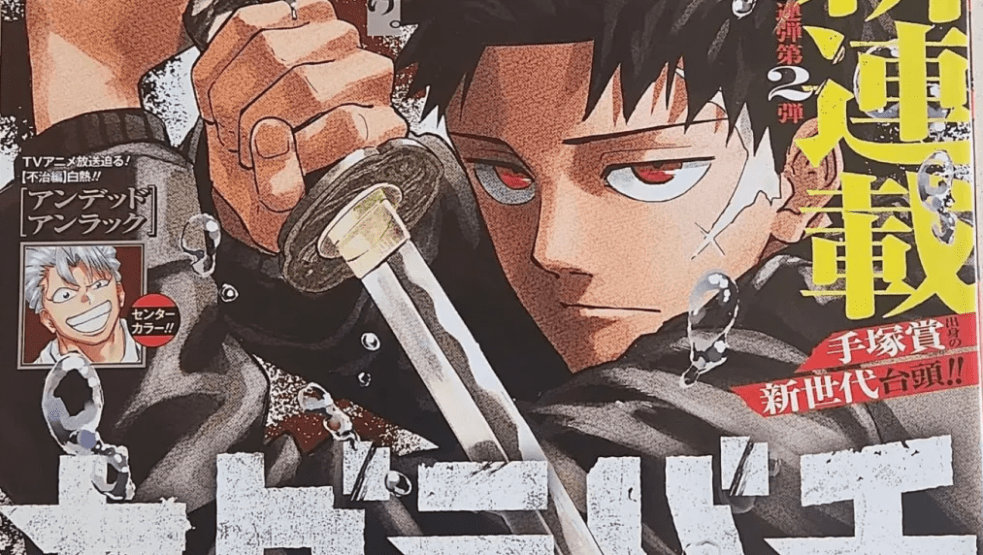
The life cycle of a meme—in the casual, internet sense of that term—is weird. Things can randomly spark some kind of cultural flame and within mere months you go from joking about, how, say, Morbius is the greatest movie of all time to it getting a second theatrical release and managing to flop twice. Simply because Shonen Jump is not as much of a presence in Anglophone pop culture as the MCU, Kagurabachi, a new title that began serializing earlier this week, is not there yet. Nor, unlike the Morbius example, is its fandom entirely ironic. But the same snowballing effect is there, if in a different way; something has a solid first chapter, maybe an exceptional one depending on your feelings on the all-sword-slashes-and-shadows school of shonen manga storytelling, and suddenly, there are lengthy copypastas calling it the greatest manga of all time, tweets about non-existent anime, game, and live-action adaptations, budget cosplays, a Discord server with some 4,000 members, and about a million jokes that all manipulate the same promo image of the protagonist drawing his sword. As of Thursday (9/21/23, for those of you reading this in the future), Shonen Jump’s English Twitter account has acknowledged the bit, so god only knows where this will eventually end.

This doesn’t need to be said, but just to get it out there; this is all pretty firmly tongue-in-cheek. I think perhaps the most telling of any of these memes that I’ve seen is the Kagurabachi bingo card, which allows for a number of standard contemporary action shonen plot beats. Plus the possibility that the series will either A) get an anime, B) flop outright, or C) get axed before either of those can happen. It also has the concession that the plot might end up being “basic.”

Nonetheless, however much or little irony any individual person making these images might have regarding their feelings for the series’ first chapter, I find it hard to believe that there isn’t something there. In comparison to its Class of ’23 contemporaries, Kagurabachi does indeed have a more immediately thrilling opening chapter than many. Time will tell if that holds up, of course—and even if it does, ongoing quality is not a guarantee of continued success. Just ask any fan of Ruri Dragon, myself included—but it’s worth at least looking at that promise, and figuring out what’s underneath all these jokes.

Kagurabachi‘s actual premise is so simple that the official summary is only a few lines long. Here it is, in its entirety:

Young Chihiro spends his days training under his famous swordsmith father. One day he hopes to become a great sword-maker himself. The goofy father and the serious son–they thought these days would last forever. But suddenly, tragedy strikes. A dark day soaked in blood. Chihiro and his blade now live only for revenge.

Kagurabachi, Manga PLUS Official Summary

True to that curt summary, what little we have of Kagurabachi so far paints it as a fairly straightforward tale of bloody revenge. There isn’t anything even remotely wrong with that of course; manga as a medium is rife with those, and some of them are very good.

We open on a bit of scene-setting, with Chihiro, as a young boy, living with his father while the latter runs a sword smithy. Chihiro’s father is eccentric, despite what one might assume from the gritty nature of his profession, and he’s introduced to us as talking with his pet goldfish. To hear him tell it, they have a lot to say.

Throughout this scene, we get little dollops of information about the world. The setting feels broadly contemporary, but Chihiro’s father’s friend, a fellow named Mr. Chiba, alludes to something called the “Seitei War” that Chihiro’s father’s swords somehow helped end. How mysterious.

For his part, Chihiro seems rather unimpressed by his old man’s reputation. In fact, as it’s nearing his fifteenth birthday it really seems like what Chihiro wants most is to follow his pa into the family business. He directly says as much, in fact, but his father is hesitant.

His father explains; swords are exemplary pieces of craftsmanship, sure. But at the end of the day, they’re weapons. Chihiro’s father believes that, whatever role they may have in ending conflict, they are also the tools used to start one, and the swordsmiths themselves are complicit in the lives lost by them. It’s a thoughtful approach. On a meta level, it’s also indicative of the many cultural differences between swords and, say, firearms, as storytelling tools. If one were to turn this guy into a dealer of almost any other kind of weapon, he’d be markedly less sympathetic than the already gray moral tone he has here.

Chihiro reassures his father that he’s willing to shoulder the burden of selling these things responsibly. Satisfied by that answer, his father brings their conversation—and this first, fairly light half of the manga—to a close by reaffirming that he believes in Chihiro.

Cue a timeskip; 38 months pass between two pages.

When we return, whatever city we’re in is not the peaceful one of the opening pages of the chapter. Wherever it may be, sword-toting yakuza rule the streets, and quash any resistance to their regime. That’s grim, if still in line with the fairly mundane world of swords and grit that the opening seemed to promise. But then, we learn that the yakuza are being bankrolled by this guy, a “sorcerer” of some description, who certainly seems to have enough magic to back that label up. In his few, gleefully villainous, pages of appearance here, he grows a black, spiky bush around a rebel’s head, leaving him to suffer until it decays on its own.

This, I think, is where Kagurabachi starts really staking out an identity. This guy’s character design alone is enough to hang a decent starter villain on, and depending on if we ever learn anything of substance about his motives, he could easily become an interesting recurring antagonist, too.

Naturally, when we next meet Chihiro he’s 3 years and change older, a fair bit taller, and a hell of a lot edgier. His face has been marked by a star-shaped scar, he’s clad in black, and toting a katana of his own. It’s honestly a little much! If you put him in tan instead of black he’d look like an Attack on Titan character. But my opinion on these things remains that it’s better to go hard on your character designs and risk overshooting than it is to play it so safe that you end up at “boring.” If there’s an artistic misstep here, it’s the former, not the latter.

Chihiro and Mr. Chiba (notably, Chihiro’s dad is nowhere to be seen) stride into the aforementioned yakuza city with, initially, plans to negotiate. Then they see a clutch of dead bodies hanging from a bridge, and at this point, the remainder of the chapter dissolves into pure action. Chihiro and Chiba can’t abide by what they’ve seen, so they bust up the yakuza controlling the city, and here, we learn just what it is that makes Chihiro’s father’s swords so special.

If you’re going to reveal that your protagonist has some kind of hidden power or technique, this is the way to do it. The sequence spans a few pages here, but it’s legitimately pretty damn cool, with Chihiro’s sword apparently possessed(?) by three inky goldfish specters which annihilate the rest of the yakuza in just a few swings.

This is not enough to pin a whole manga on, but it’s damn sure enough to pin an opening chapter on, and I think this particular trick is where Kagurabachi is getting most of its hype from right now, no matter how much ironic attachment there may or may not also be.

In general, this really is a strong first chapter, and it does a good job of providing emotional context for the burst of action that is going to be most of the reason Shonen Jump’s target audience pick this thing up. Clearly, something happened to Chihiro and his father. One does not go from a snarky but otherwise well-adjusted kid to an angel of death due to happy circumstances. Time will tell if the series can keep this momentum going, but I would say that the series’ surging popularity is, at least at this very early juncture, well-earned.

There are some weaknesses here, too, of course, very few manga absolutely nail everything right from chapter one. (The handful that do are exceptional for a reason.) The character art tends toward a bit stiff, and other than Chihiro himself and the villainous sorcerer I’d like to see the designs get a little more wild. The translation also tends toward the just slightly too-corny, with Chihiro calling the villains “slime” sticking out as a particularly bad offender. Of course, that part is not mangaka Takeru Hokazono‘s fault, and really, these are minor gripes more than serious complaints anyway. Overall, this is a very good first chapter, especially considering that it’s Hokazono’s first proper series.

At this early point, all that’s really left is to see what shape, if any, the series’ raw potential takes, not unlike the unforged swords in the chapter’s opening pages themselves. The manga’s early fan community will be a huge boon to it if it can manage to pull a good story from this setup (and if it can keep delivering on the action), and no amount of ironic distance will diminish that.


Like what you’re reading? Consider following Magic Planet Anime to get notified when new articles go live. If you’d like to talk to other Magic Planet Anime readers, consider joining my Discord server! Also consider following me on Anilist, BlueSky, or Tumblr and supporting me on Ko-Fi or Patreon. If you want to read more of my work, consider heading over to the Directory to browse by category.

All views expressed on Magic Planet Anime are solely my own opinions and conclusions and should not be taken to reflect the opinions of any other persons, groups, or organizations. All text, excepting direct quotations, is owned by Magic Planet Anime. Do not duplicate without permission. All images are owned by their original copyright holders.

The Manga Shelf: KINDERGARTEN WARS and The Struggle to be Loved

The Manga Shelf is a column where I go over whatever I’ve been reading recently in the world of manga. Ongoing or complete, good or bad. These articles contain spoilers.


Stop me if you’ve heard this one before. His codename is “Spade”, real name unknown and unknowable. He’s an assassin, a stalker in the shadows and a kiss of death to the unwary. He will kill anyone, anywhere, for the right price.

And unfortunately for him, this is not his story.

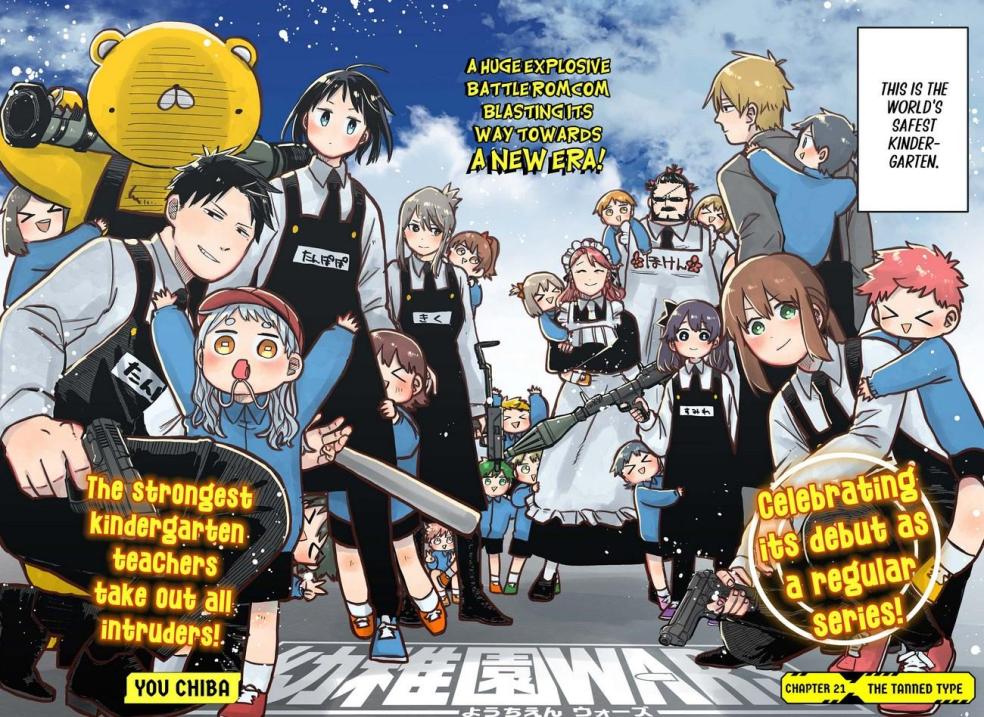
Kindergarten Wars doesn’t care much about Spade, who gets capped in the head not long after this and is not an important player in this story. The other person in that image, the woman who blocks his sniper bullet with a shovel, is our real protagonist. And I have to start this column with a confession; this was originally a completely different Manga Shelf article. I want to survey the recent rise in manga that take at least some degree of inspiration from Spy x Family and examine what they did with that influence. I still might write that column someday, but Kindergarten Wars deserves a spotlighting of its own. This is some good stuff. Of just 21 currently-available chapters, it does take a little while to find its footing, but once it does, it hits hard. This is a little surprising given its premise, which is goofy even by the standards of this emerging subgenre.

Speaking of, even though this column is no longer about the Spy x Family….Family, we should at least briefly define what “this subgenre” actually is, as there are a few common points. In particular, these manga usually juxtapose absurd, highly “genre” elements; mostly ridiculous hyperviolence, leagues of assassins, international conspiracies, a sprawling criminal underworld, etc. with down-to-earth concerns, and a particular focus on domesticity; romance, family, friendships, and finding one’s place in the world. The simple and slow things in life. Without fail, they come to the conclusion that the latter is better (and in this sense they find some common ground with the rather more out-there Chainsaw Man), and is the real thing worth fighting for. No one in any of these manga has ever truly been fulfilled by being a gun-toting killing machine. They’re fulfilled by little things; dates, shoujo manga, the laughter of children, and whatever found family they manage to rustle up along the way. Other than SpyFam itself, the most successful example is probably Sakamoto Days, which, if Kindergarten Wars isn’t also taking that series as an influence, its similarities are remarkable for being convergent evolution.

As for our actual premise? Nothing too weird for an action manga these days. Rita—that’s the lady blocking a bullet with a spade—works at the world’s safest kindergarten, Kindergarten Noir, where the children of the wealthy and influential are sent so they can receive a normal education away from the dangers of the world. The only problem is that the school is the frequent target of assassins and kidnappers, meaning that these teachers have to also be world-class bodyguards for their students. Rita is an ex-assassin herself, formerly a human swathe of destruction nicknamed the Witch. Not that you’d know it by looking at her, for most of the manga’s current run; despite her deadly skills, Rita is a gremlin obsessed with finding a hot boyfriend, and that contrast is where the manga gets most of its more comedic elements from.

To be honest, while this is hardly a bad gag, it is the primary reason that I way underestimated Kindergarten Wars when I first flipped it open. The series’ first several small mini-arcs are primarily comedic, and while they do still have the violence angle to supply some solid action, they’re more about humor and small-scale character developments. For example, Doug, Rita’s coworker and a secondary protagonist, develops a crush on her when she saves his life, despite a past as a swindler and a ladies’ man. This sort of setup is typical of this very early part of the manga, and is also the fuel for the manga’s “romantic” side, given that romcoms are a part of its DNA as well. You get a bit more of an idea as to where all of this is going when we’re introduced to Hana Bradley, the manga’s other main female character and who it hilariously tries to play as a comparative straight man despite the fact that her preferred method of attack is batting homeruns with live grenades. Still, where Kindergarten Wars goes from decent but unremarkable to actually feeling like it’s worth following is in its most recent half dozen or so chapters, where we get a peek at an inner darkness that may betray more ambition than might be expected.

Chapters 14-18 mark a turning point, and it’s here where we should consider two things. One, Rita’s old assassin nickname/persona of the Witch, a lingering phantom of her old self who threatens to come to the fore every now and again. Two, the character Natasha, a swordswoman just as deadly as Rita herself who is obsessed with The Witch, seeing her as a lone kindred soul in a world full of people who are otherwise nothing like herself.

Natasha, hired to attack the kindergarten just like any number of the scores of dead goons from earlier in the series, eventually confronts Rita directly, only to find herself absolutely perplexed that she doesn’t enjoy fighting this woman. If anything, she feels scared. All of this happens as we flash back through Natasha’s life as a prodigal killer. And all at once, like a bullet through the brain, a revelation hits Natasha; a blunt, heavy, deeply unsubtle and direct statement of what can only be the manga’s core theme.

This all manages to capture a very real desperation, from the mouth of someone who feels like she never had any other options in life. Trying to talk yourself into being satisfied with your place in the world is a rough thing even when that place is somewhere fairly innocuous. For Natasha, this revelation breaks her, and unfortunately, she doesn’t survive the arc. Chapter 18 is an entire postscript of her dying thoughts as Rita holds her in her arms. For just a little while, Kindergarten Wars transforms into something greater than the sum of its parts, and the spilled blood spells a plea for empathy.

It’s easy, and not at all wrong, to say that none of this is exactly revolutionary. God knows this isn’t the first manga to feed a character a line like “If I keep on killing, what will I find beyond it all?!”, but just dryly relaying the story in descriptive prose doesn’t capture its emotional impact and neither does chopping, cropping, and dropping select pages, even very good ones. There’s some real weight here, partly just from how much of a swerve this is from Kindergarten Wars‘ usual style, which is pretty lighthearted even as buildings and heads alike explode. Natasha seems like an early sign of things to come, and combined with more recent revelations about the actual nature of Kindergarten Noir it seems like the series is gearing up to tackle its first larger, more ambitious arc.

We should be taking all of this in context, of course. “Ambitious” is not a synonym for “good,” and there are plenty of ambitious manga and anime that have been done in by their own inability to stick to a single tone or topic. Most of what happens in Kindergarten Wars is still pretty cartoony, and its flashes of a more sincere and resonant emotional core are exactly that, flashes. We haven’t been handed a bombshell that turns this into a must-read just yet, even if some stories (like Natasha’s) are very good, they’re still playing with recognizable shapes. Time will tell what it eventually combines them into.

That’s what the cynical part of me says, anyway. The optimistic part says that the fact that something like this is being so well-received despite its obvious influences is evidence that there is an appetite for this kind of stuff, and that manga like Kindergarten Wars are rising to the occasion. Maybe it just wants to be loved, too.


Like what you’re reading? Consider following Magic Planet Anime to get notified when new articles go live. If you’d like to talk to other Magic Planet Anime readers, consider joining my Discord server! Also consider following me on TwitterMastodonCohostAnilist, or Tumblr and supporting me on Ko-Fi or Patreon. If you want to read more of my work, consider heading over to the Directory to browse by category.

All views expressed on Magic Planet Anime are solely my own opinions and conclusions and should not be taken to reflect the opinions of any other persons, groups, or organizations. All text, excepting direct quotations, is owned by Magic Planet Anime. Do not duplicate without permission. All images are owned by their original copyright holders.