(REVIEW) A Strange Dream About the Sky – The Weight of AIR

This review contains spoilers for the reviewed material. This is your only warning.


If you close your eyes, you can immerse yourself in it. The sweltering Sun, the sea breeze messing your hair and running the sharp scent of salt past your nostrils. The sound of the cicadas lighting up the trees with their songs, and the humid heat. During the day; the brilliant, sapphire-blue sky and the billowing white clouds across it. At night, it’s an inky black streaked by the starry Milky Way. This is a series of blurry photos from a blazing-hot July buried somewhere in your memories. This is Air.

If it seems strange to tie an adaptation of a member of the infamous nakige (“crying game”) genre to a specific season, it might help to think of it as Air‘s way of contextualizing its attempts to tug at your heartstrings; the joy and sadness of a human lifetime distilled down and squeezed into a single, eternal summer, bringing to mind similar works in different media, like Fennesz’ album of that same name. When the series began airing in 2005, I myself was a child, in Florida with my father, and the heat of the Sun feels as real in Air as it does in my own recollections. Air‘s vision of summer is mercifully devoid of crocodiles, geckos, and palmetto bugs, but the feeling is the same, and the tense dichotomy between “these days feel like they will never end” and “we don’t have many days left” is thick enough to break scissor blades. The summer lasts forever, until it doesn’t.

Air, you see, is not just a story, it’s a dream. A reference point, and a map for its structure and storytelling aims, that recurs many times over its twelve episodes. Its logic is dreamlike; characters are introduced suddenly and vanish out of sight when their stories conclude, the series is peppered with elements of magical realism, and the environment itself seems to bend around the characters’ emotions, especially in its last stretch when the cast winnows down to just two main characters. Its emotional impact is dreamlike, too; it can make you very sad without you necessarily understanding what’s happened or why. (If I seem to skimp on describing Air‘s actual plot throughout this article, that’ll be why. Some articles are very easy to write; this one was not.) Dreams are, too, a recurring story element. Our main heroine, Misuzu [Kawakami Tomoko], dreams of another version of herself, suspended in the sky and flying on wings of pure white feathers. Our main hero, Yukito [Ono Daisuke] is a crow who’s dreamt himself into the shape of a man, or perhaps the other way around. These dreams are just part of the larger dream of the series itself, one that only ends when Air concludes. It’s a vast dream, too, encompassing over a thousand years, from 994 AD to the summer of 2000. Millennium to millennium, era to era, life to life.

Fittingly, Air‘s depiction of the human condition is impressionistic and emotional. Its core concerns are faith, family, and the preciousness and brevity of life. At its best, it feels as light and ethereal as its namesake or as heavy as torrential rain; lifting you up and pummeling you back down. This isn’t to say it’s always at its best—this is now the third Maeda Jun project I’ve seen, and I’m starting to get a good sense of his strengths and weaknesses as a creative, and there are some questionable decisions in the show’s final stretch in particular—but the highs are very high, and they’re plentiful enough to make the series worth watching.

In terms of literal narrative, Yukito arrives to a nameless town (modeled on the real-world city of Kami, Hyogo Prefecture), searching for a place to stay and a way to earn money, yes, but also a half-remembered vision inherited from his mother; something about a woman in the sky. In an early indication of the series’ magical-realist bent, Yukito is a puppeteer whose magical control of his doll is treated as nothing more than a mildly amusing parlor trick. He meets Misuzu, an odd, clumsy girl who trips a lot and says “gao!” when frustrated, and is eventually roped into being Misuzu’s live-in caretaker by Misuzu’s surrogate mother, a drunkard aunt named Haruko [Hisakawa Aya].

From this setup, Yukito becomes entangled in the lives of a number of women around the city, possibly a consequence of the series’ origins as an eroge. (This adult VN -> clean rerelease -> anime pipeline used to be quite common, back in the day.) Stripped of their original context, Yukito meeting these characters and witnessing their stories takes on an anthology-esque quality. Among those we meet are the self-styled ‘alien’ Kano [Okamoto Asami], Kano’s older sister, the town doctor Hijiri [Touma Yumi], the rambunctious redhead Michiru [Tamura Yukari], and her older sister, the deliberately-spoken, astronomy-fixated Tohno [Yuzuki Ryouka]. Each of these girls has some issue that Yukito aids in, if not resolving, at least providing closure for. In the earlier episodes, anything explicitly supernatural is pushed to the margins and the tone is fairly ambiguous. However, in episode four, the series stops playing coy, and from the moment that a magic feather in a temple induces a shared hallucination of a bygone era, the show’s magical realism is fully realized.

The show’s main theme of family comes into focus over the course of these stories. Each one centers around a frayed familial connection of some kind—Kano’s strained relationship with Hijiri, Michiru being the disembodied spirit of Tohno’s miscarried sister, Tohno’s mother completely forgetting she exists, et cetera—all of which is just windup to the two main stories of the series, the one between Misuzu herself and Haruko, and a very different, but intimately connected tale that takes place a thousand years prior.

Because, you see, the recurring image of the flying maiden is what ties all of these disparate stories together. Sometimes mentioned directly, sometimes only alluded to. Air reflects its own structure here, as this unknowable woman in the sky means something different to everyone. Air’s big halfway point twist, then, is when we learn the story of that woman. This is the other half of Air, a story taking place in the Heian Era, first at a secluded temple-palace and then all up and down medieval Japan. Kannabi-no-Mikoto, alias Kanna [Nishimura Chinami], an enshrined woman who is among the last of a mystical race of angel-winged people. Her attendants Ryuuya [Kanna Nobutoshi] and Uraha [Inoue Kikuko] serve to care for and comfort her at the shrine, drawing a parallel between these characters and those taking care of Misuzu. In an act of grim foreshadowing, Kanna’s life at the palace is disrupted when forces unknown infiltrate it, seeking certainly to capture, and possibly to kill her, leading Kanna and her entourage to flee and seek her also-imprisoned mother. Here, Air‘s visual presentation completely flips upside-down; these portions of the story are clouded over with heavy monsoons of rain, and when the Sun does poke out, it looks noticeably different than it does in the modern day portions of the story; less omnipresent and less oppressive.

Really, this part of Air is a different anime entirely, a feeling further enhanced by the two-part Air in Summer OVA which further fleshes it out (you could give yourself a “streamlined experience” by weaving both halves of Air in Summer into the main anime’s episode count). Kanna’s status as a winged person marks her as both something divine and an outcast. We don’t get many details; when we eventually meet Kanna’s mother, she only mentions that she herself is ‘tainted,’ and Kanna eventually comes to realize that her life, at least, what of it we see, may be the dream of someone else. (There’s a real Butterfly Dream thing going on here.) When she and her attendants can no longer escape their would-be captors, she unveils her wings. And thus, in one of the story’s two climactic points, Kanna is shot to death. Riddled with arrows against the backdrop of the white, caustic moon.

Death marks the final boundary for Air‘s narrative. Kanna’s story ends—at least for us—when she dies, and so too does Misuzu’s when the series returns to her side of the story for its final stretch. Back in the (relative) present, Misuzu’s illness, now fully revealed to be a curse, worsens. She loses the use of her legs, and eventually her memory starts to go, too, leaving her unsure of who Haruko, the woman who has been her surrogate mother for many years, even is. (This is another unifying thread between Misuzu, Kanna, and the rest of the show’s heroines. None of them have a normal relationship with their mother figure.) The final arc sees Haruko attempting to prove that she’s worthy of being Misuzu’s real mother, to herself, implicitly to us the audience, and to Misuzu’s actual biological father, a man named Keisuke [Tsuda Kenjirou].

In Air‘s last episode, we see Haruko’s desperate attempts to connect with her daughter finally begin to bear fruit, only for Misuzu to realize that she is, in a sense, still sleeping. Air ends with her death, as she and Haruko both accept that their time together is over. It hits in the heart, unifying the series’ themes of faith and family as Haruko reflects on her mistakes in treating Misuzu poorly1. If you’re the type who can be hit by that kind of thing (and I definitely am), it’ll get you, but there are questions to be asked, here, and this is where we have to put on our rational hat a little bit.

For one, Maeda certainly has a thing for young, disabled girls, doesn’t he? I don’t necessarily mean that in an outright condemnatory way—although some would, and I wouldn’t even say they’re wholly wrong to—but it is a noticeable recurring character type throughout his work; a girl whose emotional fragility is reflected by physical frailty. It feels rooted in ableism and misogyny. Plus, on top of that, this ending is just sort of basic. Yes Jun, to paraphrase Young Thug, we all hate when girls die, but is that really all?

To be fair, in the case of Misuzu’s death, and the closing chapter of this story, it quite literally isn’t all. Misuzu’s soul reunites with Kanna, and it is implied (albeit only indirectly), that this frees both of them—since they are ultimately, metaphysically one in the same—from their shared curse. Still, there’s a very fine line being walked here. “Life is incredibly frail, and there is a certain tragic, inevitable beauty to death” is a perfectly fine notion. Adding just a couple of words in there to make it specifically about the disabled very quickly turns it ugly, and I am not sure Air manages to say the first thing entirely without saying the second even if it doesn’t ‘mean’ to, which is a shame, to say the least.

On the other hand, you can try to ignore any themes built into Air entirely. That seems to be what much of the Japanese game-buying public did with the visual novel. Maeda has recounted2 how many players’ main takeaway was that the game was “soothing,” and how frustrating this was to him. From a certain point of view, this is definitely true of the anime as well, and you’re free to strip it for parts if all you really need is a sumptuous bath of wonderfully retro visuals and sound. Indeed, in addition to its very deliberate sense of place, Air lives and breathes its era; it is Early 2000s as hell, and all of the signifiers that have become so inseparable from this era are present. This is especially obvious with the highly sexually dimorphic character designs, where the men are all tall, lanky, and comparatively realistic, and the women are all short, soft, and have huge headlight bug-eyes. There’s some really strong animation, too, especially in terms of the near-constant sea breeze that blows throughout the show. Every hair on many of the girls’ heads will happily billow in the wind throughout the series, it’s quite something. Reducing the series to its aesthetic components in this way, however, requires actively disregarding what Air is about. I can’t speak for the game, but I don’t think the series is helped by trying to flatten it into a Pure Moods CD, even given its flaws.

If you wanted to, though, you had an option there, too. The series’ companion album Ornithopter, a sprightly thing where trance and instrumental city pop meld and melt together into a hazy heat blur, is an interesting counterpoint to the sadder parts of the anime. Like a pleasant dream the night after a bad day, it seems to gently nudge us into remembering that life will go on.

Life did, in fact, go on for all involved with Air. This series was director Ishihara Tatsuya‘s debut in that capacity, and he shortly thereafter went on to helm the world-conquering anime adaptation of The Melancholy of Haruhi Suzumiya, and a number of excellent Kyoto Animation titles thereafter including Nichijou, arguably the best comedy anime ever made and certainly one of the best of its era. He’s still at it now, directing the currently-airing third season of Hibike! Euphonium. Main series compositionist Shimo Fumihiko is also still working, currently fulfilling that same role on the fifth season of cult series Date A Live. A good chunk of the voice cast is still active, not always a given for an anime that’s nearly 20 years old, although sadly Misuzu’s voice actress Kawakami Tomoko, perhaps best known as the title character in Revolutionary Girl Utena, passed away in 2011 after a battle with cancer. She was an incredible talent, and was taken from us too soon.

And then, there’s the case of Maeda Jun himself, certainly worth discussing given that he seems to have been the main creative brain behind Air. Maeda, of course, had a pretty successful career for quite a while after Air, working in a similar capacity as the main force behind Clannad and Angel Beats! (the latter of which became an anime that I deeply love), among other things. Then, in 2020, came The Day I Became A God, and, well, if you’re a longtime reader of this site, you know how that went. I more or less stand by what I said in that article, and Air‘s lowest moments foreshadow some of The Day I Became A God‘s core problems, but it’s worth noting that I was hardly alone, there. The Day I Became A God was so widely disliked that the backlash prompted Maeda to retire from writing for anime and the like entirely, and he claims he felt so disheartened by the reception that he apparently considered killing himself.

It never feels great to be a part—even a very small part—of that kind of reception. I would like to think Maeda has good work in him still, and overall, I’d say I quite liked Air, despite its flaws. (Certainly my feelings on Angel Beats! remain unchanged, as well.) But you can’t change what’s already been done, and if Maeda has decided to stick to composing, he’s at least certainly very good at that as well.

As for Air itself, the series, there’s a lot I haven’t touched on, here. The series’ first half has a lot of great storytelling moments that I have both skipped recounting for the sake of not making this article even longer and to leave some of the magic intact for anyone who reads this and wants to check the show out. I’ve also not really gone into the various highs and lows of the show’s comedic moments, of which it has a surprising amount. (The very short version; most of the humor is actually surprisingly great, but a few things have not aged well. Sexual harassment-as-joke is something we should be glad we’ve largely left behind.) There are lots of bizarre little details, like Misuzu’s constant referring to chicks as “dinosaurs’ children” (she knows her cladistics!), a dog that makes “piko-piko” noises instead of barking, and so on. Despite all I’ve written, I feel like I’ve only really scratched the surface, and the years of surrounding context that have built up around Air have only amplified that feeling.

In the end though, Air has given me a wider appreciation not just for Maeda’s work but for work in general. Art reflects life, and life doesn’t stop for anyone. There’s no point in not trying to enjoy every day you have, and the fact that Air could make me reflect on the value of my own life and the time I have left in it is, in a way, the greatest argument in favor of it being a worthy piece of art. Dreams can be beautiful, yes. But, we all wake up eventually.


1: In general, as I’ve pointed out in my previous writing on this series, their dynamic reminds me a lot of Rosa and Maria’s from Umineko. I do wonder if it was a direct inspiration or just a coincidence.

2: In the initial version of this article, I said I couldn’t find this interview. However, since then, someone has backed it up on the Internet Archive’s Wayback Machine, and if Google Translate is to be judged good enough to get the gist of the interview, that does in fact seem to be what he said, in essence if not literally.


Like what you’re reading? Consider following Magic Planet Anime to get notified when new articles go live. If you’d like to talk to other Magic Planet Anime readers, consider joining my Discord server! Also consider following me on AnilistBlueSky, or Tumblr and supporting me on Ko-Fi or Patreon. If you want to read more of my work, consider heading over to the Directory to browse by category.

All views expressed on Magic Planet Anime are solely my own opinions and conclusions and should not be taken to reflect the opinions of any other persons, groups, or organizations. All text is manually typed and edited, and no machine learning or other automatic tools are used in the creation of Magic Planet Anime articles, with the exception of a basic spellchecker. However, some articles may have additional tags placed by WordPress. All text, excepting direct quotations, is owned by Magic Planet Anime. Do not duplicate without permission. All images are owned by their original copyright holders.

The Weekly Orbit [4/29/24]

Hello folks. It’s been another solid week of the ongoing anime season, but the vast majority of this column is going to be taken up by something a little different. Read on, past the seasonals, to see what I mean.

Anime

Mysterious Disappearances – Episode 3

I am still kind of astounded by how much less this story works as an anime.

Granted, the particular choice of adapter definitely has something to do with it, but the resolution of the whole Dribblers arc here—I still hate typing that—just feels way less satisfying on screen than it did on the page. Also, why the hell was this episode so yellow? Everything was absolutely drenched in the color. I get that the flashback scenes were, you know, flashbacks, but the sepia look they were going for did not come across at all. The present-day scenes in the hallway look that way because of the time of day, but it kills all the visual dynamism giving us easily the worst-looking episode of the show so far.

The one thing that survives is the series’ very goofy sense of humor. A particularly memorable moment tonight as I watched this with some friends was when one of them (Alice, who I may have mentioned elsewhere on this site before? I don’t remember) remarked on how uncomfortable Sumireko’s tracksuit must’ve been right before it popped open in the most elbow-jabby we’re-playing-this-as-a-joke-but-it’s-mostly-here-so-you-can-ogle-this-girl’s-tits sequence I’ve seen in anything in a hot minute. I guess Studio Passione know their strengths. All told, I’d still rather they be doing this than Ishura. (A well after-the-fact correction from me here. I completely got the studio wrong! This is actually a Zero-G production. I have no idea how I got that wrong. Whoops!)

All of this stuff is in the manga, too, so it may seem unfair to criticize the anime for just adapting what’s already there. But again, the simple facts of the format make it stand out way more in motion than it does in a manga, this adaptation has thusfar largely been rote and workmanlike. It’s technically fine, I guess, if you’ve not experienced this story before, but the format change strips a lot of its moodiness, which is the main thing that makes Mysterious Disappearances work at all, to the extent that it works as a story in the first place.

A Salad Bowl of Eccentrics – Episode 4

For the most part, Salad Bowl delivered a solid and straightforward episode this past week, about stopping a middle school girl from being bullied. That said, the final few minutes of episode four are worth mentioning. Here, the show swerves into a solid three minutes of casually-insane worldbuilding, where it’s revealed that Sara’s original world is actually a parallel Japan where Oda Nobunaga became a literal demon king by acquiring magic powers. This sort of ridiculousness is more than enough to remind me why I like this show.

Delicious in Dungeon – Episode 17

SHE! IS! HERE!

The menace, the power, the unease, and yes, the beauty. These are all traits present in Chimera-Falin, who makes her grand debut this episode. It is probably the most hype I’ve been for a character introduction in a TRIGGER show in a decade.

No anime could reasonably match the absolutely radioactive presence that Chimera-Falin has in ink, on paper. So instead, this episode’s team bring an impressive arsenal of tricks of motion to convey her narrative (and literal!) weight. Chimera-Falin as a character literally bends the story around her, and from her introduction onwards, things change fairly sharply. The show displays this by showing in gruesome detail just how thoroughly she absolutely annhiliates all opposition. To dredge up the tired Dungeons & Dragons metaphor oft used for Dungeon Meshi once again, she’s one of those really high CR, thoroughly unfair monsters. She’s huge, incredibly robust and durable, can claw her foes—characters we’ve gotten to know over the past several episodes, mind you!—to shreds, and on top of all that, enough of her human mind remains that she can still cast spells. Can you imagine how absolutely defeated that mage must feel when Falin simply dispels his summoned undine? I’d be somewhere between furious and suicidal. In general, Falin is drawn and animated in a way that emphasizes her strength and presence. I’d also say she’s drawn with just about the right level of frightening allure. We are supposed to find this as enthralling as we do scary. (This is sort of how Laios seems to see it, in fact, albeit along a different axis than, say, many of the lesbians watching the anime.) Also, she gets a number of really fantastic facial expressions here, some of which are cribbed from the manga but many of which aren’t! I wish more online discussion of the Dungeon Meshi anime focused on what TRIGGER brought to the table in details like this rather than on what can’t be replicated from the original manga, but alas.

The action is excellent, too, almost so much so that saying anything other than that feels like underselling it somehow. Sakugabooru identifies many of the best individual moments as coming from mononymous animators Yooto and Sushio, but really, the entire episode is fantastic from top to bottom.

After Falin clambers offstage, we of course get the long heart-to-fist-to-face-to-heart between Shuro and Laios. I actually think this works slightly better here than in the manga, as it’s a case where stripping some of the ambiguity inherent to that format actually sharpens the show’s emotional impact.

We end with some comedy to take the edge off as our heroes venture ever-deeper into the dungeon, with their objective changed to explicitly defeating the Lunatic Magician. This, at roughly the story’s 1/3rd point, is a real rounding-the-corner moment for Dungeon Meshi, and to my recollection is where we shift from it being a very good story to it being a great one. I cannot wait to see TRIGGER adapt the rest of it.

Some stray additional observations:

  1. Not to be this person, but I am surprised they were allowed to draw the harpies’ nipples.
  2. There is blood everywhere. Several other commenters have pointed this out, but the difference between how striking the visual contrast is in the anime vs. the manga is pretty interesting, it’s amazing what just adding more red than a Playboi Carti album can do. This was an extremely gory episode all around!
  3. Marcille looks absolutely miserable throughout this entire episode. Not without reason! But still, my poor girl.
  4. To completely shoot myself in the foot vis-à-vis what I said in the first bullet point, I think Chimera Falin might be even more beautiful in motion than she was in the manga. Where’s the HRT I can take to get that body, huh, medical science?

Revolutionary Girl Utena – Episode 4

Entering the firmly non-seasonal part of the Anime writeups, hey, did you know I’m currently in the middle of a Revolutionary Girl Utena rewatch? Specifically, as part of a group effort by the Empty Movement folks wherein we watch one episode per week to replicate its original air schedule. I bring all this up because I think I’ve somehow forgotten to mention it on the site before now. I’m going to try to avoid giving anything away regarding episodes of the anime after the point I’m covering on a given week (and will also not be writing a ton in general, most likely, given that I often feel underqualified to discuss Utena), but given that I’ve seen this show before—and how heavily Utena rewards rewatching—it may prove a bit of a challenge, just as an honest heads’ up. I encourage everyone to get in on this, if they’re interested in the idea. We watch an episode every Tuesday.

In any case, Episode 4 is the first of several revolving around Miki [Hisakawa Aya]. Perhaps even more importantly, though, is an on-its-face comedic scene that takes up the middle third of the episode. Here, where local school mean girl Nanami [Shiratori Yuri] attempts to bully Anthy [Fuchizaki Yuriko], we get a sense that Nanami may be able to notice that things are strange even when others do not. The rest of the cast, including Utena [Kawakami Tomoko] herself, write Anthy’s strangeness off as quirky at most. Nanami, our proverbial canary, seems to be the only one distressed by it.

Air – Episodes 1-8

Oh, this is just going to be incomprehensible.

Okay, so, this is a problem I have not run into yet when writing these columns. I generally only watch an episode or two of something at a time, and because most of what I cover here is actively airing, I only have one episode at a time to cover. That’s not the case with older anime, where something like this can happen, where I get very sucked into it and end up making, say, several tumblr posts in a row—the raw material for this column, recall—in a way that defies easily merging them into a single snappy writeup. What I’ve presented below are lightly edited versions of my original posts in roughly chronological order. Bear with me, here, I’m aware that this is kind of a mess to read, but I couldn’t think of an easier way to do this. (I may very well also just review the series outright when I’m done watching it, but I’m loathe to outright promise such a thing.) I am also going to spoil the hell out of it, including some pretty important stuff. So if you just want a straight “is this good or not?” recommendation, I’d tentatively say yeah, it’s pretty great, but probably skip this big long section here and go down to the Manga writeup for this week if you’re spoiler-shy.

Maybe the length of this section is fine. Air has basically eaten my brain over the past week, and as I’ve entered what I believe is the second half of the show, I have only become more fascinated. It is a sticky series, and I think it might be kind of great, although we’ll see if I still think that by the time it ends.

Episode 1

“I had a dream. A strange dream about the sky.”

I started watching this today1, because my buddy Josh2 is watching it, and I am easily influenced by outside forces I suppose.

This is Air, a 2005 Kyoto Animation production from just before their legendary run that began with The Melancholy of Haruhi Suzumiya. It’s adapted from a KEY visual novel, and my first impression is that it is very visibly “VN-y” indeed.

The main feeling I get is one of overwhelming “summer energy.” There are near constant cicada sounds in the backdrop, the skies are a clear crystal blue with huge, billowing white clouds which flip to creamy streaks of the Milky Way across an inky black at night. Everyone, especially our main character, is sweating all the time because it’s so goddamn hot, and the whole thing takes place by the shore. The vibes are absolutely on-point.

In addition to this impeccable sense of place—a deliberate artistic vision—there is also a decidedly non-intentional sense of time. This show absolutely radiates 2005, most obviously from the character designs, which are of a highly sexually dimorphic kind that was common in VNs and adjacent work at the time. The main guy is tall, lanky, and angular. Almost all of the women are comparatively short, round, and have the massive headlamp bug-eyes inextricably associated with the period.

The plot, such that it is, is simple but also rather odd. Essentially, our main character, Kunisaki Yukito [Ono Daisuke], who we are given no backstory for at this point, simply arrives in town one day, nebulously “looking for” something, and attempting to earn money by plying his trade as a puppeteer—it is very much worth noting that he appears to control his puppets with no strings or other tricks—but has little success. When he meets an odd, clumsy girl named Kamio Misuzu [Kawakami Tomoko], who trips a lot and says “gao!” when upset or frustrated. He ends up following her home, and improbably, the girl’s drunkard mother, Kamio Haruko [Hisakawa Aya] drafts him as a live-in babysitter.

Some of this is probably a remnant of the show’s origins as a VN—an eroge, at that, although this particular pipeline of H-game -> clean visual novel -> anime or manga adaptation was not rare back in the day—where a man randomly shoehorning himself into the lives of various women about town is the norm.

About the “gao” thing; Kamio’s mother disapproves, and this dynamic can’t help but remind me of Rosa’s disapproval of her own daughter Maria’s verbal tic from Umineko, itself a visual novel that later got a (particularly poorly-regarded in that case) anime adaptation. So far, the dynamic here seems far less fraught and abuse-laden, but it’s an interesting parallel, and given that Umineko postdates Air, I wonder if it was an intentional reference. (Ryukishi07 surely would’ve been aware of Key at the time?)

The second girl our protagonist meets, Kirishima Kano [Okamoto Asami], seems to style herself an alien, from a planet where everyone is “free.” Freedom. Air. ‘Free as a bird’? There’s something here, especially when she rebuffs the idea later and makes fun of Yukito for believing her in the first place. We later learn that Kano has an odd pseudo-sleepwalking condition, and that her older sister Hijiri [Touma Yumi] is the town doctor.

I cannot shake a strong feeling that this show is keeping its cards close to its chest. Given how crazy the visual novels of this period could get, I really have no idea what to expect. Although, to sell the show more on what it’s doing now than what it might do later, the comedic aspects are very well done. It’s a nice mix of slapstick and conversational comedy. Also, as mentioned, the show’s atmosphere is just absolutely immaculate; you can practically taste the salt of the sea on the wind as you’re watching this.

At the end of the episode, at around sunset, Misuzu gives a little speech as she’s standing, arms stretched out, with her head tilted toward the sky. I don’t normally just include a bunch of screencaps in these little writeups because I like to keep them short3, but what she says here just struck me as so…profoundly odd, strangely beautiful, a little reminiscent of my own experiences with mania and spiritual fervor, that I just kind of need to include it.

In a much more serious sense than usual; what does she mean by this? This is the most taken I’ve been with the first episode of an older anime in quite a while, and I really feel like I need to know more.

Episodes 2 & 3

Something very interesting about how the “shocking”, overtly supernatural moments of the episodes are crammed into the margins, usually only truly laid bare in their final minute or so. That’s so far, of course, there are still ten more episodes of this thing left for me to watch.

The image of the girl in the sky that every character seems to be chasing in one way or another is a haunting one, one that burns with a pure white light that I can’t quite call clarity. It feels like something I have an intuitive understanding of, but can’t quite articulate. It means something different to everyone.

On another level, this series dearly loves its characters. You can tell, by the way it portrays them as whimsical little dolls when they roam around the scenery far from the ‘camera.’ Air is a beautiful show, so far, which makes the moment of outright violence at the end of this episode shocking and a little heartbreaking.

Episodes 4 & 5

“There was never such a thing as magic.”

In episode 4, we get what seems an awful lot like an after-the-fact rationalization of Kano’s condition. A clear-headed, scientific explanation. But the show itself seems almost as desperate as Hijiri is to explain away her younger sister’s “illness.”

Surely, there must be some rational explanation, it pleads, as the theory turns to DID and a feather in a shrine as a psychological trigger. It can’t truly be cursed, of course. No rational person, no doctor, could believe that.

“It was only a dream, it has nothing to do with you.”

Until this episode’s halfway point, this desperation feels like it might still point toward some kind of grounded explanation for all this, but that notion shatters into light when Yukito touches the shrine feather. In an instant, Air becomes a different story entirely; a history of persecution, of a mother and her child cursed from birth, fleeing wars, storms, and death to find refuge in the village that once stood on the same spot that Yukito and the others stand on now. Even here, there was no real refuge, and the scene morphs into some distant echo of the binding of Isaac; a mother sacrificing herself to save her child. No story, it is worth remembering, is ever just one story.

“You don’t have wings, be happy down there.”

In episode 5, we turn to dreams of the ocean. Yukito’s own, from when he was a child. Here, the show again takes a somewhat more grounded approach, but “grounded” is relative, and perhaps inappropriate, given that even the series’ episodes that are more “grounded”, “down-to-earth”, an other such terms that conflate mundanity with the soil beneath our feet, are themselves preoccupied with the heavens above, as we learn when we’re introduced to Tohno’s “Astronomy Club” here, consisting of more or less just herself and a large portable telescope. Despite briefly meeting her mother, Yukito returns the next day to find the woman claiming she has no daughter, and Tohno herself is missing.

Elsewhere, we learn that Misuzu suffers panic attacks when she gets close to people. This is a distinct yank back to reality from a show that has so far spent most of its time with its head in the clouds, but the loneliness Misuzu’s condition creates—typified by a quick cut to a shot of a lonesome cloud—works with what Air has previously done. A profound loneliness connects most of the show’s characters, although they largely don’t yet seem aware of this connection.

If there’s an emerging theme here, it’s that of lost or broken connections. Tohno is kicked out of her home because her mother has replaced one delusion with another and doesn’t recognize her, Misuzu feels unwelcome in her own house because her “mother” is actually her aunt whose care she was put in as a troubled, younger child, etc.

The cruel reality of the sky is that it can’t truly be reached from the ground, not without wings. The show’s color palette shifts drastically in the episode’s final moments to reflect this line of thought, running red and black like a gaping wound. A strange, stark turn from a strange, stark show.

Episode 6

More than a story in the usual sense, it might make more sense to compare Air to a composition.

It has motifs, themes, imagery, and core ideas, but the anime’s orbiting, circular structure makes it feel like any traditional forward plot motion is an impossibility. The world of Air is suspended in its namesake; a bubble riding a wind current, sealed off from the outside world. And yet, as soon as I had this realization, that sealed-off world was disrupted in this, its sixth episode, making me question it. Air is, if nothing else, great at getting you to think about its characters and its world, and how those aspects interact.

Air‘s two characters named Michiru are, as heavily implied in the last episode, revealed to be one in the same. “Our” Michiru [Tamura Yukari], a character with red twintails previously mostly confined to comedic scenes, confesses her status as a living dream of Minagi, a waking fantasy that must be, in her own mind, discarded for her dreamer to be happy. Still, she is given a good sendoff, and in a beautiful and understated scene, is allowed to try “her” mother’s cooking. It’s a wonderful sendoff for a very memorable character, and the moment in the closing minutes of the episode where Minagi, visiting her father, meets the ‘real’ Michuru are also exceptional.

Michiru’s departure marks a rare change in the otherwise hermetic world of Air. Maybe more are to come? After all, there is still talk of that girl who dreams in the sky, and there are the episode’s final moments, which seem to signal a major shakeup indeed….

Episode 7

I really thought I’d had this show figured out.

Everyone gradually leaves Misuzu’s life as she slowly dies, suffocated to death by her physical inability to be close with other people. Her mother leaves her, and, eventually, so does Yukito, despite how angry he is at her mother for doing the same thing. But then he comes back, only to vanish himself. We have no sense of time here; how long of a timescale is this taking place over? Days? Weeks? Months? It’s hard to say. But at the end, it seems like we’re about to reach some big revelation as to what this all means, only for Yukito himself to vanish, and for a time-and-place card to drop that absolutely slapped me upside the head.

What?!

What do you mean AD 994?!

And yet! It does this! It goes through with it, even, given the next episode preview! We’re just watching a different show now, being shown a completely different story, in a different time period entirely!

And yet again, I have a hunch that this has more to do with the present-day story of the prior six and a half episodes than it would seem.

Episode 8

“We don’t have many days left.”

Clearly, a parallel is being drawn between this new story and the one we were previously following. The situation that our new protagonist, Kanna [Nishimura Chinami], finds herself in and that of our previous protagonist, Misuzu. Indeed, it’s decently strongly implied that they are in fact the same person reincarnated across the centuries. So too, Ryuuya [Kanna Nobutoshi], Kanna’s retainer, is similar to Yukio (although more of a stock anime lech and consequently less likable until he and she grow closer over the course of the episode).

This is basically an entirely different show, albeit one with the same core thematic elements and visual vocabulary as the previous, so it’s a little hard to know just what to make of it as yet. But once he drops his “funny” pervert act, Ryuuya becomes every bit the companion to Kanna that Yukio was to Misuzu. Running away together to flee her sad, isolated fate in the palace is noble, but where is this all going? As of the time of this writing, I still don’t really know. But I’m hoping to finish Air this week, and maybe then I will have more of an understanding of its ambitions.

A side note: the music in this portion of the show, at least the new music, is notably different. Skewing traditional, with lots of flutes and the like.

So! Yeah! Air! It’s a lot! Hopefully I will still like it this much in a week’s time. I intend to keep you posted, anime fans.

Manga

Lily System

Now this is yuri. Gorgeous-as-hell sci-fi yuri, at that.

Once again! I’m gonna spoil the whole thing. So if you just want your basic read/don’t read recommendation I’d say this is quite good, maybe even great.

Lily System‘s premise is really simple. Two girls find an abandoned machine in a shed, and it turns out to be some kind of hyper-futuristic VR device that transports them to a virtual world, an abandoned cityscape overgrown with plants and populated by animals and the occasional strange being. On its own, “two girls wander around an abandoned place together” is inherently yuri, but Lily System doesn’t stick to the subtextual.

Over the course of this story, we learn the precise contours of the relationship between our leads, Nana and Mizuki. Nana is the sensitive intellectual, whereas Mizuki is more forward (with her feelings, romantically, sexually, etc.) and is just a touch tomboyish. Together, they explore the surreal VR world while probing each other with questions about life. With Nana in particular, these tend to revolve around a novel she wrote—a novel whose plot, it gradually becomes clear, is a metaphor both in- and out-of-text for the plot of the manga itself—Mizuki is fond of accusing her book of being ‘a lie,’ and we only really get a sense of what that means at the end of the manga.

The girls eventually become lost, both literally and figuratively, within the VR world, encountering echoes of themselves who kiss in a bell tower, and haunted, animate school uniforms that seem determined to charge at them. When they begin appearing in the ‘real world,’ the girls realize they’ve been in the machine the entire time.

And yet, the conclusion they eventually reach is that maybe that’s not so bad. In the manga’s final act, we learn of Nana’s forgotten middle school love confession to Mizuki, of Mizuki’s regretted rejection of that confession, and how both of them seek to course correct now that they’re a little older. In reality, Nana is headed to a college in Tokyo. Like the fairies in the book she wrote, she and Mizuki will be torn apart. It seems, for a moment, that Lily System will be a bittersweet tale, but that’s not the direction things go in, and I think this decision to avoid the obvious take is what makes Lily System so memorable.

Instead of abandoning each other for the sake of a “realistic” reckoning with the outside world, Nana and Mizuki abandon the world. They retreat, somehow, into their virtual Eden. If they’re ever heard from again, we don’t hear about it.

The manga ends on this note, with Nana and Mizuki in each other’s arms, in a paradise hidden to everyone else. They create their own space. It’s a beautiful ending, and more than anything, it will absolutely fill you with yearning.

The art, it must be said, is gorgeous throughout, with mangaka Yoshitomi Akihito‘s landscapes conveying a real sense of a lost world. The character art is great, too, although fairly subtle. There are many little nods and expressions that give almost as much characterization of our lead girls as the dialogue does.

Notably! The manga also—ahem—climaxes with an actual intimate scene. It’s kept tasteful, and I thought it made a great inflection point for the story, emphasizing that these two really are meant for each other.

All told, beautiful stuff. I have a few stray observations as well.

There’s the curious existence of “Yuuko and Kousuke.” This is an unrelated one-shot that seems to be grouped with Lily System for….reasons I’m not entirely clear on? Maybe someone else will know. It has little in common with Lily System in most terms, and it’s not even a yuri, being about the budding relationship between a young boy and a girl and the former’s first steps toward sexual development. Frankly, I didn’t like it very much, but that might just be because of its odd juxtaposition with Lily System, which is just a much better and more interesting piece of work overall.

Secondly, Yoshitomi Akihito wrote this, as mentioned! If you recognize that name it might be from Eat-Man or Blue Drop, the two series he is, I think, best known for in the west. Certainly though, I had no idea that, from what I can tell from looking at his catalogue, at some point he pivoted to writing….well, stuff like this. Romance, or at least romantically-inflected, works about the relationships between people set in strange, detailed worlds. At least one of these (the “boy meets girl fantasy” of Hanako in the 24th Ward) appears to actually be a spinoff or distant sequel to Eat-Man. Interesting career this guy has had! Although upon looking all this up, I learned that Blue Drop was also a yuri series, at least in part? I somehow didn’t know that, how embarrassing.


That’ll be all for this week. Once again, I really need to find a way to streamline my process a bit.

Here’s today’s bonus thought. So far, these have all been either random musings or screencaps of A Salad Bowl of Eccentrics. Guess which one this week’s is?


1: Or rather, April 24th, when I originally wrote this.
2: This is the same Josh that I sometimes reference when talking about Love Live. Hi, Josh.
3: In their original context as Tumblr posts, that is. They’re….well, they’re obviously not short here.


Like what you’re reading? Consider following Magic Planet Anime to get notified when new articles go live. If you’d like to talk to other Magic Planet Anime readers, consider joining my Discord server! Also consider following me on AnilistBlueSky, or Tumblr and supporting me on Ko-Fi or Patreon. If you want to read more of my work, consider heading over to the Directory to browse by category.

All views expressed on Magic Planet Anime are solely my own opinions and conclusions and should not be taken to reflect the opinions of any other persons, groups, or organizations. All text is manually typed and edited, and no machine learning or other automatic tools are used in the creation of Magic Planet Anime articles, with the exception of a basic spellchecker. However, some articles may have additional tags placed by WordPress. All text, excepting direct quotations, is owned by Magic Planet Anime. Do not duplicate without permission. All images are owned by their original copyright holders.

The Frontline Report [9/13/21]

The Frontline Report is a weekly column where I briefly summarize the past week of my personal journey through anime, manga, and the related spheres of pop culture. Expect some degree of spoilers for the covered shows.


Hey folks! I’ve been under the weather and generally low-energy this week so this writeup comes to you a day late. Hope y’all are doing well out there. Let’s jump right into things.


The Detective is Already Dead – Every time I try to talk about this series my breath is stolen from my mouth. Not because it’s Just That Bad and 𝕔𝕖𝕣𝕥𝕒𝕚𝕟𝕝𝕪 not because it’s Just That Good. I don’t know what I’d say about it if I could. Props for having the balls to go the obvious route? For daring to be so completely ridiculous in such a headstrong-stupid way? Here’s a question for you; how many anime feature heart transplants as a motif? I can only think of this one. The detective may be dead, but my faith in anime as a medium remains. God help us all.

Magia Record – As usual, you can read my thoughts over here. Short version? I really love this show. As a side note, it does bother me that so many people still seem to think that Madoka Magica‘s great contribution to its genre is realistic violence. Violence in art is a tool. In PMMM it is used to tell you that the systems the girls are trapped in are fucked up and horrible. The intent here, in this week’s MagiReco, is much the same.

Miss Kobayashi’s Dragon Maid S – I’ve somehow managed to go the whole season without so much as even acknowledging that I’m watching Dragon Maid. But now that it’s nearing its conclusion I’m confident in saying at least this much; it’s a lot of fun. Kyoto Animation remain an absolute powerhouse here, even in light of the tragic arson attack on their studio two years ago. The production, as such, is untouchable, and visually speaking it’s arguably the best anime airing right now. Its fun, adventurous animation is capable of flipping from hijinks to truly impressive battle sequences to more adventurous and bizarre comedic stylings at the drop of a hat. It’s damn great, and the series deserves high marks for that alone. Its writing remains a bit patchy, if only because it’s trying to be so many things at once.

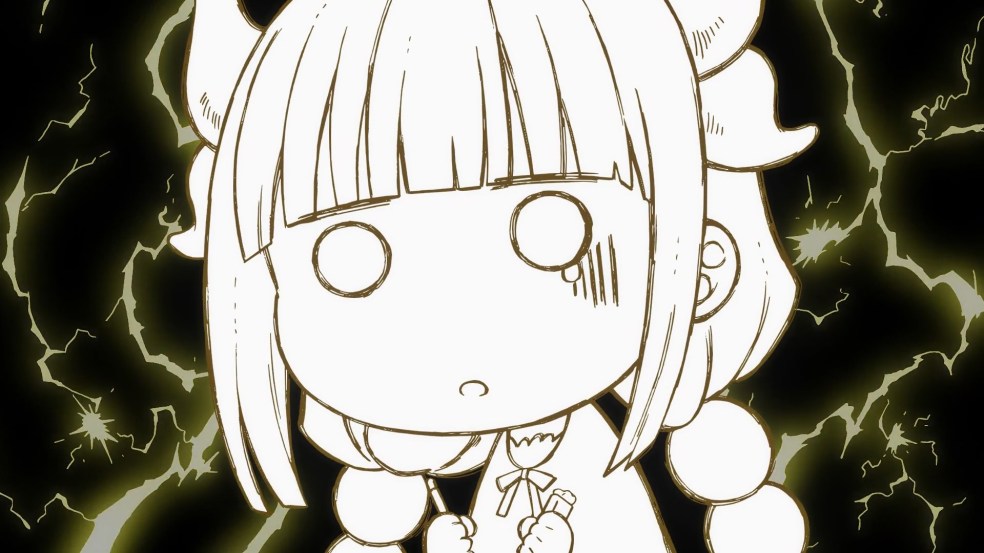
It’s at its best when it locks into a single swathe of the emotional spectrum, as with this past week’s episode, which sees Kanna on a journey to New York and back again as she makes a friend in the Big Apple. And of course, rescues her from Bad Guys ™. Her flight over the US is wonderful, being positively Ghibli-esque.

Beyond that, and despite its supernatural setting, Dragon Maid shines brightest in scenes that articulate the small joys of everyday life. A cut illustrating something as simple as pouring cold tea into a glass is given an opulence that magnifies its emotional impact. In these key moments, Dragon Maid is a magic spell. More real than our own world.

Sonny Boy – Is Sonny Boy losing people? I wouldn’t be too surprised if it was. I’m still definitely on-board with the series as purely a machine that pumps out bizarre, vaguely parable-esque vignettes. The background plot involving the fake teacher Ms. Aki and her schoolbus of cultists may or may not eventually resolve in interesting fashion. In the meantime, this week’s episode spotlights Mizuho’s cats and hands us a curious story of a boy and his clone that ends in as much a punchline as it does a moral lesson. Where does Sonny Boy go from here? I have no idea, and that’s exactly why I like it so much.


Manga

Puella Magi Homura Tamura – This past week I’ve been taking another read (it’s my second time through) of this obscure little corner of the Madoka Magica expanded universe. I think people have forgotten that said EU is, in fact, surprisingly large. Many have been mostly left behind by the passing of the initial Madoka hype wave, but there were actually quite a few interquels, spinoffs, and otherwise divergent-from-the-norm Madoka Stories. Most were fairly serious affairs, and perhaps predictably given the large number of hands involved, they varied pretty widely in quality. Homura Tamura is quite distinct from all that, though. It’s decidedly on the humorous side, though its offbeat sense of humor is more likely to remind readers of other entries in the comedy yonkoma genre than it is to provide any insight into what the girls of Madoka Magica act like “off-camera”.

Still, it’s a solid and fun read. It got licensed by Yen Press years ago so I’m sure you can find hard copies somewhere if you care to snoop around. There’s a lot of great genre parodies in here, and some truly out-there takes on some of Madoka’s core premises. Have you ever wanted to read a manga in which Homura travels through time so much that she eventually ends up at a café staffed and visited entirely by versions of herself from alternate timelines? Then friend, I’ve got a manga for you. Fun fact: This is illustrated by AFRO, who would soon become known as the artist behind YuruCamp. Second fun fact: if you google the name of this manga, the little Google Book Preview thing will claim it was illustrated by Italian painter Afro Basaldella. Close but no cigar, Google!


Wanna talk to other Magic Planet Anime readers? Consider joining my Discord server! Also consider following me on Twitter, supporting me on Ko-Fi, or checking out my other anime-related work on Anilist or for The Geek Girl Authority.

All views expressed on Magic Planet Anime are solely my own opinions and conclusions and should not be taken to reflect the opinions of any other persons, groups, or organizations. All text is owned by Magic Planet Anime. Do not duplicate without permission. All images are owned by their original copyright holders.