Seasonal First Impressions: Pining For Those SAKAMOTO DAYS

Seasonal First Impressions is a column where I detail my thoughts, however brief or long, about a currently-airing anime’s first episode or so.


Picture a killer of legend. The kind of man whose very presence makes the blood of his foes freeze in their veins. Picture an unstoppable, elemental force of violence. Add gray hair and a pair of round spectacles, and you’ve got Taro Sakomoto [Sugita Tomokazu]. Now, picture what it would take to tame that man. Picture what could remove him from this life of ceaseless bloodshed. What could that be? What could possibly get him to hang up his gun?

Well, a pretty store clerk with a winning smile is probably a good start.

This, the tale of an ostensibly-retired uber-hitman, is Sakamoto Days. It’s a member of a particular genre that’s found increased purchase in recent years, a kind of post-Spy x Family melding of action anime with the domestic comedy. Usually involving a fundamentally good natured protagonist who can, nonetheless, throw down with the best of them. Spy x Family has the likable but duplicitous Loid Forger. Kindergarten Wars has its single woman—seeking good man—in Rita. And of course, Sakamoto Days has Sakamoto himself. Sakamoto Days has been a favorite among Jump readers in the know for a good while now, and thus this adaptation comes with a pretty weighty set of expectations placed upon it. For my purposes, I’m not super interested in engaging with that, although I will say this is the rare case of a shonen manga I actually follow somewhat regularly getting adapted into animation, so I’m happy for the series if nothing else. (It’ll be joined in this category by Witch Watch, also from Shonen Jump, later this year.)

Our story really begins when Shin [Shimazaki Nobunaga], formerly one of Sakamoto’s partners-in-crime, is tasked with killing the man. He left “the organization” which he and Shin both belonged to without permission and thus, he’s gotta die. Shin is initially perfectly willing to go along with this, and when he first sees the retired Sakamoto, he’s upset by what comes off to him as weakness. Most obviously, Sakamoto has put on quite a lot of weight in the five years since he retired, and we should take a quick detour to talk about this.

So! Fat jokes! There’s quite a few of them in Sakamoto Days. In the anglosphere, these have generally been considered in poor taste for a good 20 years now, but obviously, this isn’t the case everywhere. I reiterate all this basic-ass explanation of cultural differences just to say, as someone who’s also fairly big, I am not super upset by how Sakamoto Days handles its main character in this regard, even later on when we get into less-jokey but arguably dicier territory. I also think it helps that the character himself seems to have a good sense of humor about it (check the “Slim” shirt in the picture above). But if you are upset by it, I get that, and I’m also not going to tell you you Need To Get Over It or whatever other piece of canned finger-wagging rhetoric a certain kind of anime fan is sure to lean on when people want to discuss this subject. This is an area on which people will understandably be pretty polarized. So at the risk of making it seem more serious than it necessarily is, I think it’s important to just acknowledge that this specific subject gets under some peoples’ skin, and that’s fine. I have a very live and let live approach to arguably-problematic material in the arts, and this is no different a case than anything else, it’s just somewhat new territory for anime I’ve covered on this site specifically.

It is worth noting though, that Shin’s initial judgement of Sakamoto is wholly incorrect. He sees Sakamoto, now grown happy and fat and the proud proprietor of a small konbini with his wife [Aoi, played by Touyama Nao] and their adorable daughter [Hina, played by Kino Hina, no relation], and assumes he’s grown soft in a metaphorical sense, too. This is not so.

Despite some reluctance once he senses that Sakamoto’s killer instincts haven’t actually dulled terribly much—he’s an esper, and can read minds, and is thus treated to Sakamoto’s amusingly gory idle fantasies of stabbing him to death—Shin is eventually convinced to try taking him out. This goes poorly for him, and this is where we get to the anime’s biggest strength.

All told, it is simply just a solid, good translation of the manga’s inventive action scenes to animation. Sakamoto immediately gets to flex both his wits and his still-sharp combat skills here, deflecting a pistol bullet with a gumball and using various other random objects around his store to render Shin harmless. There’s too much slow-mo, and the presence of merely some traditional sakuga instead of wall to wall sakuga will leave some unhappy, but so far, there’s really not a lot to complain about. (I’ve seen some scuttlebutt about the color palette, too. But honestly I think the gritty, somewhat dingy look works well for this series.) The vibe is captured pretty much perfectly.

These setpieces are what Sakamoto Days is about. There is a story, to be sure, a decently interesting one at that, where various characters are torn between the sprawling assassin underworld and the call of a normal, quiet life. There’s comedy, which is amusing if rarely laugh-out-loud funny. And there are also some quite sweet domestic scenes, as well. But the real main concern of Sakamoto Days are these setpieces, wild everything-but-the-kitchen-sink affairs that grew only moreso as the manga went on, and which make a good first showing here. There’s an escalation in the first episode already, even, as Sakamoto opts to rescue Shin once his employers try to take him out for not fulfilling his contract. This second scene is even flashier, all glinting gunmetal, roundhouse kicks, and taser lightning as Sakamoto cuts through a warehouse of goons with ease.

The sell is simply this, if you liked those scenes, you’ll get a kick out of Sakamoto Days. If you like the scene afterward, where Sakamoto hires Shin as an employee at his store, since the esper has nowhere else to go, you’ll like Sakamoto Days a lot. What you see is what you get. I think what we see is pretty cool.


Like what you’re reading? Consider following Magic Planet Anime to get notified when new articles go live. If you’d like to talk to other Magic Planet Anime readers, consider joining my Discord server! Also consider following me on AnilistBlueSky, or Tumblr and supporting me on Ko-Fi. If you want to read more of my work, consider heading over to the Directory to browse by category. If you’re looking for me to watch a specific show, watch this space. I am planning to reopen commissions in the near future.

All views expressed on Magic Planet Anime are solely my own opinions and conclusions and should not be taken to reflect the opinions of any other persons, groups, or organizations. All text is manually typed and edited, and no machine learning or other automatic tools are used in the creation of Magic Planet Anime articles, with the exception of a basic spellchecker. However, some articles may have additional tags placed by WordPress. All text, excepting direct quotations, is owned by Magic Planet Anime. Do not duplicate without permission. All images are owned by their original copyright holders.
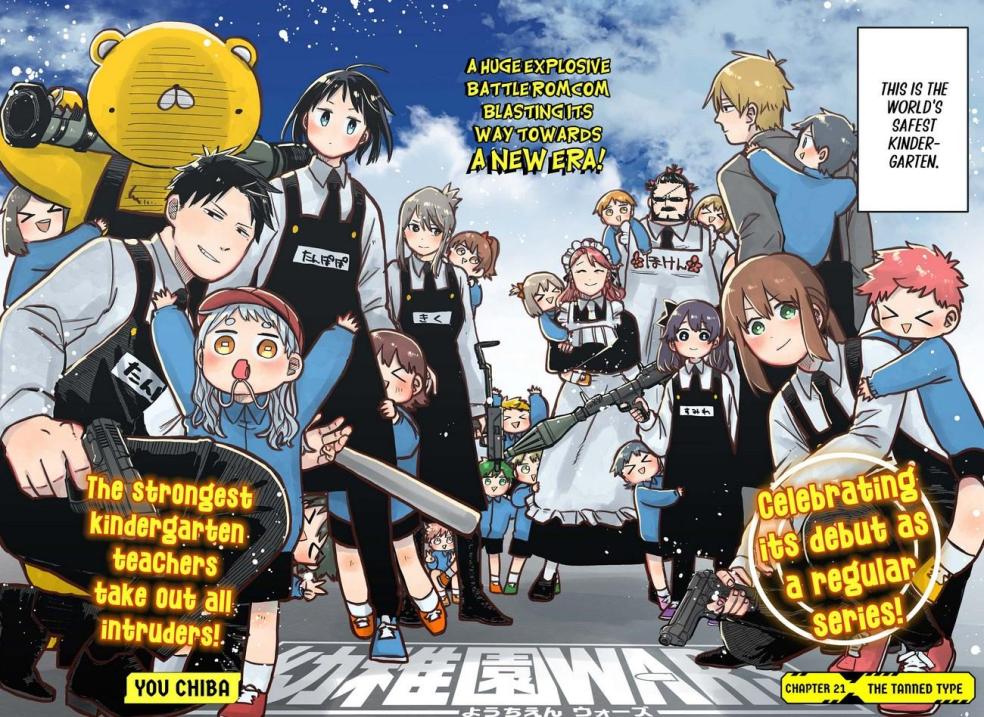
The Manga Shelf: KINDERGARTEN WARS and The Struggle to be Loved

The Manga Shelf is a column where I go over whatever I’ve been reading recently in the world of manga. Ongoing or complete, good or bad. These articles contain spoilers.


Stop me if you’ve heard this one before. His codename is “Spade”, real name unknown and unknowable. He’s an assassin, a stalker in the shadows and a kiss of death to the unwary. He will kill anyone, anywhere, for the right price.

And unfortunately for him, this is not his story.

Kindergarten Wars doesn’t care much about Spade, who gets capped in the head not long after this and is not an important player in this story. The other person in that image, the woman who blocks his sniper bullet with a shovel, is our real protagonist. And I have to start this column with a confession; this was originally a completely different Manga Shelf article. I want to survey the recent rise in manga that take at least some degree of inspiration from Spy x Family and examine what they did with that influence. I still might write that column someday, but Kindergarten Wars deserves a spotlighting of its own. This is some good stuff. Of just 21 currently-available chapters, it does take a little while to find its footing, but once it does, it hits hard. This is a little surprising given its premise, which is goofy even by the standards of this emerging subgenre.

Speaking of, even though this column is no longer about the Spy x Family….Family, we should at least briefly define what “this subgenre” actually is, as there are a few common points. In particular, these manga usually juxtapose absurd, highly “genre” elements; mostly ridiculous hyperviolence, leagues of assassins, international conspiracies, a sprawling criminal underworld, etc. with down-to-earth concerns, and a particular focus on domesticity; romance, family, friendships, and finding one’s place in the world. The simple and slow things in life. Without fail, they come to the conclusion that the latter is better (and in this sense they find some common ground with the rather more out-there Chainsaw Man), and is the real thing worth fighting for. No one in any of these manga has ever truly been fulfilled by being a gun-toting killing machine. They’re fulfilled by little things; dates, shoujo manga, the laughter of children, and whatever found family they manage to rustle up along the way. Other than SpyFam itself, the most successful example is probably Sakamoto Days, which, if Kindergarten Wars isn’t also taking that series as an influence, its similarities are remarkable for being convergent evolution.

As for our actual premise? Nothing too weird for an action manga these days. Rita—that’s the lady blocking a bullet with a spade—works at the world’s safest kindergarten, Kindergarten Noir, where the children of the wealthy and influential are sent so they can receive a normal education away from the dangers of the world. The only problem is that the school is the frequent target of assassins and kidnappers, meaning that these teachers have to also be world-class bodyguards for their students. Rita is an ex-assassin herself, formerly a human swathe of destruction nicknamed the Witch. Not that you’d know it by looking at her, for most of the manga’s current run; despite her deadly skills, Rita is a gremlin obsessed with finding a hot boyfriend, and that contrast is where the manga gets most of its more comedic elements from.

To be honest, while this is hardly a bad gag, it is the primary reason that I way underestimated Kindergarten Wars when I first flipped it open. The series’ first several small mini-arcs are primarily comedic, and while they do still have the violence angle to supply some solid action, they’re more about humor and small-scale character developments. For example, Doug, Rita’s coworker and a secondary protagonist, develops a crush on her when she saves his life, despite a past as a swindler and a ladies’ man. This sort of setup is typical of this very early part of the manga, and is also the fuel for the manga’s “romantic” side, given that romcoms are a part of its DNA as well. You get a bit more of an idea as to where all of this is going when we’re introduced to Hana Bradley, the manga’s other main female character and who it hilariously tries to play as a comparative straight man despite the fact that her preferred method of attack is batting homeruns with live grenades. Still, where Kindergarten Wars goes from decent but unremarkable to actually feeling like it’s worth following is in its most recent half dozen or so chapters, where we get a peek at an inner darkness that may betray more ambition than might be expected.

Chapters 14-18 mark a turning point, and it’s here where we should consider two things. One, Rita’s old assassin nickname/persona of the Witch, a lingering phantom of her old self who threatens to come to the fore every now and again. Two, the character Natasha, a swordswoman just as deadly as Rita herself who is obsessed with The Witch, seeing her as a lone kindred soul in a world full of people who are otherwise nothing like herself.

Natasha, hired to attack the kindergarten just like any number of the scores of dead goons from earlier in the series, eventually confronts Rita directly, only to find herself absolutely perplexed that she doesn’t enjoy fighting this woman. If anything, she feels scared. All of this happens as we flash back through Natasha’s life as a prodigal killer. And all at once, like a bullet through the brain, a revelation hits Natasha; a blunt, heavy, deeply unsubtle and direct statement of what can only be the manga’s core theme.

This all manages to capture a very real desperation, from the mouth of someone who feels like she never had any other options in life. Trying to talk yourself into being satisfied with your place in the world is a rough thing even when that place is somewhere fairly innocuous. For Natasha, this revelation breaks her, and unfortunately, she doesn’t survive the arc. Chapter 18 is an entire postscript of her dying thoughts as Rita holds her in her arms. For just a little while, Kindergarten Wars transforms into something greater than the sum of its parts, and the spilled blood spells a plea for empathy.

It’s easy, and not at all wrong, to say that none of this is exactly revolutionary. God knows this isn’t the first manga to feed a character a line like “If I keep on killing, what will I find beyond it all?!”, but just dryly relaying the story in descriptive prose doesn’t capture its emotional impact and neither does chopping, cropping, and dropping select pages, even very good ones. There’s some real weight here, partly just from how much of a swerve this is from Kindergarten Wars‘ usual style, which is pretty lighthearted even as buildings and heads alike explode. Natasha seems like an early sign of things to come, and combined with more recent revelations about the actual nature of Kindergarten Noir it seems like the series is gearing up to tackle its first larger, more ambitious arc.

We should be taking all of this in context, of course. “Ambitious” is not a synonym for “good,” and there are plenty of ambitious manga and anime that have been done in by their own inability to stick to a single tone or topic. Most of what happens in Kindergarten Wars is still pretty cartoony, and its flashes of a more sincere and resonant emotional core are exactly that, flashes. We haven’t been handed a bombshell that turns this into a must-read just yet, even if some stories (like Natasha’s) are very good, they’re still playing with recognizable shapes. Time will tell what it eventually combines them into.

That’s what the cynical part of me says, anyway. The optimistic part says that the fact that something like this is being so well-received despite its obvious influences is evidence that there is an appetite for this kind of stuff, and that manga like Kindergarten Wars are rising to the occasion. Maybe it just wants to be loved, too.


Like what you’re reading? Consider following Magic Planet Anime to get notified when new articles go live. If you’d like to talk to other Magic Planet Anime readers, consider joining my Discord server! Also consider following me on TwitterMastodonCohostAnilist, or Tumblr and supporting me on Ko-Fi or Patreon. If you want to read more of my work, consider heading over to the Directory to browse by category.

All views expressed on Magic Planet Anime are solely my own opinions and conclusions and should not be taken to reflect the opinions of any other persons, groups, or organizations. All text, excepting direct quotations, is owned by Magic Planet Anime. Do not duplicate without permission. All images are owned by their original copyright holders.