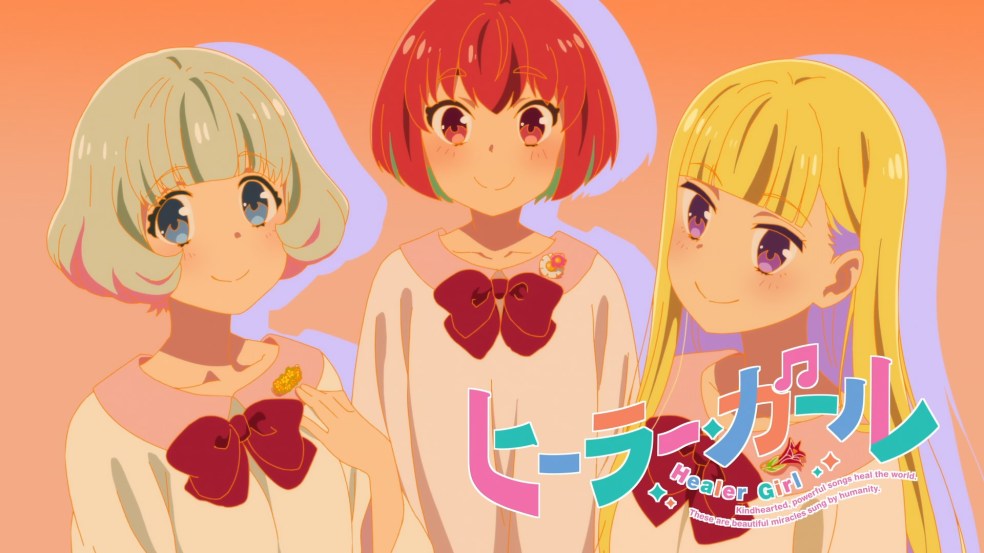
(REVIEW) To Heaven & Back on a Song: The Soothing World of HEALER GIRL

This review contains spoilers for the reviewed material. This is your only warning.


“These are the beautiful miracles sung by humanity.”

The first thing to know is that Healer Girl was inspired by Symphogear. Comparisons between anime rarely do either work any favors, but for Healer Girl, knowing the name of its stylistic ancestors puts some things into perspective. The Symphogear comparison is merely the most recent in a list that also included Macross and, less centrally, G Gundam.

Ostensibly, these are strange bedfellows for what is at its heart an iyashikei series / sometimes-musical. In practice, it makes perfect sense. Like in Symphogear, the music in Healer Girl is not a background element; it’s diegetic, and the very source of the protagonists’ abilities itself. I’ve taken to calling this sort of thing the “dynamic music” genre, perhaps you have some other pet neologism. In either case, understanding that the music is not just a plot element but what the entire work is built around is key to understanding Healer Girl at all. It’s not a complex series, but there is stuff going on here beyond pretty songs.

Take our protagonists. Three young girls; Kana (Carin Isobe), Hibiki (Akane Kumada), and Reimi (Marina Horiuchi). For the majority of the series, they serve as interns at a clinic run by their teacher, Hibiki’s cousin Ria (Ayahi Takagaki).

A clinic, because as Healer Girl quickly establishes, in its world, the power of music is literal. Carefully-applied musical treatments can literally heal injuries, soothe sickness away entirely, and aid in surgery. This sort of there-is-power-in-the-song thing is something idol anime have been flirting with for years but never really commit to. (A personal frustration of mine.) Part of me enjoys Healer Girl just because it has the stones to actually dive into this idea. At twelve episodes, it doesn’t have the time to answer every question I had (I really want to know what healing music looks like around the world, but the show sadly doesn’t really go into it), but maybe it doesn’t need to.

From that central premise, Healer Girl builds a few strong, simple metaphors. Healing music as art is the easiest to understand, and effectively renders the series as a defense of itself. Taken through this lens, the anime is a series of iterative exercises; how much can art really help with? In the first episode, Kana sings a song to a boy who’s scraped his knee to take the pain away. Just three episodes later, the girls assist in a surgery where someone nearly dies on an operating table, and they face the truly harrowing experience of possibly failing to help someone. Much like conventional medicine, healing music definitely has its limits, but also like medicine, it certainly helps. Is this Healer Girl‘s argument, that art can heal the world, if not by itself, at least in a supporting role? It’s a strong reading, and I do think that’s at least partly what the series is going for.

Consider also the show’s actual music. A lot of people—including myself—initially assumed Healer Girl was going to be an idol series, and it is true that there is an associated idol unit, the Healer Girls themselves. But, if we consider it a part of this idol anime lineage, it’s a highly unconventional one, at least for 2022. In style, the Healer Girls are a lot closer to forgotten ’90s American soft-pop sensation Wilson-Phillips than anything presented in, say, its seasonal contemporary Nijigasaki High School Idol Club. More to the point is the presentation; the titular healer girls don’t really dance, and their songs are not performances. They’re tools. And learning how to use those tools forms the show’s other main theme; the passing of knowledge and love from one generation to the next.

Much is made of the girls’ relationship with their mentor Ria, a well-developed character in her own right. Reimi has a cute, one-sided crush on her, and much is made of her incredible skills. (Which we finally get to see in action in episode 9.) Over the course of the series, Ria guides the girls through simply being her pupils toward being healers in their own right. In the show’s finale, it implies via paralleling that Kana may herself one day take students of her own. It’s rare to see teaching and imparting wisdom treated as something beautiful and graceful, but that just makes appreciating it when a show can properly pull it off all the more important.

And look, all this writing about what the show means, and I’ve barely told you anything about why you might want to watch it! The simple truth is that, like most of Studio 3Hz‘s productions, the show is just damn good-looking. It’s beautiful, colorful, wonderfully vibrant, almost a living thing itself, in a way that is truly rare and all too easy to take for granted. That vibrancy makes Healer Girl something to be treasured. Naturally, it translates to the soundtrack as well; Healer Girl is at most half a musical, but enough of the show is sung—including incidental dialogue, in some episodes—that if you enjoy that medium, you’ll like Healer Girl as well.

And on top of that, it’s simply fun to watch. Rarely are anime fans starving for some classic slice-of-life antics, but Healer Girl‘s are a particularly well done set thereof. The show is very funny when it sets its mind to it, and not working in that mode 100% of the time only renders it more amusing when it does.

There’s even a pastiche of an old, old slice of life trope, the obligate “high school rock band” episode—episode 7, here—that’s been sorely lacking from most modern anime for a whole generation at this point. I have to admit, seeing one in this day and age made me nostalgic, so I suppose that’s another emotion that Healer Girl can effortlessly tap into.

Because of this kaleidoscopic emotional approach, Healer Girl‘s characters feel truly alive as well, even comparatively minor ones like the girls from the rival healing clinic (of course there’s a rival healing clinic), Sonia (Chihaya Yoshitake) and Shinobu (Miyu Takagi).

And, of course, we should discuss Healer Girl‘s visual ace in the hole. The girls don’t merely sing; the world changes around them as they do, a literalized, visualized version of the consensus fantasy-reality created by the most powerful music here in the real world. But in Healer Girl‘s universe, it can change the world in a truly direct and immediate way, and these bubbles of magic are called image songs. Episode 9 is the best showcase of them, where we see Ria greatly aid a surgery with hers; she influences literal events by manipulating abstract visual material within the image song. In doing so, she herself is a metaphor for the real impact of art in our own world. It’s a curious, but justified little thematic mobius strip, something that impressively never feels pretentious or self-impressed. Healer Girl knows what it’s doing, maybe that’s why there isn’t a weak episode in the whole thing.

The only real tragedy about Healer Girl is that its strongest moments are those where it instills pure awe in the audience. And that, unfortunately, is not something I’m truly able to replicate in text format. You will just have to take my word for it, that my jaw dropped more than once throughout the show, that I teared up a few times, and that several episodes—particularly episode 5 and the latter half of the finale—left me frustrated, although in a strangely positive way, over my inability to fully convey their emotional impact in mere words. You will just have to see it for yourself, and if you haven’t, I again strongly recommend that you do.

If there’s justice in the world, Healer Girl will be a watershed moment. But even if it inspires nothing, even if this artistic lineage ends here, I find it impossible to imagine that it will ever lose its potency as a work unto itself or, indeed, as a healing tool.

There is often a desire—spoken or not—in seasonal anime watching culture for something to get “another season.” Healer Girl, however, was clearly crafted with just these twelve episodes in mind. That renders the show small, certainly, but it does not rob it of its power. In a way Healer Girl is like the over-the-counter medical records mentioned in the first episode. It will soothe your sickness if you let it; simply rewind the tape and play it all back again. One more time; if you feel it, it’ll heal you.


If you’d like to read more about Healer Girl, consider checking out my Let’s Watch columns on the series.

Like what you’re reading? Consider following Magic Planet Anime to get notified when new articles go live. If you’d like to talk to other Magic Planet Anime readers, consider joining my Discord server! Also consider following me on Twitter and supporting me on Ko-Fi or Patreon. If you want to read more of my work, consider heading over to the Directory to browse by category.

All views expressed on Magic Planet Anime are solely my own opinions and conclusions and should not be taken to reflect the opinions of any other persons, groups, or organizations. All text, excepting direct quotations, is owned by Magic Planet Anime. Do not duplicate without permission. All images are owned by their original copyright holders.
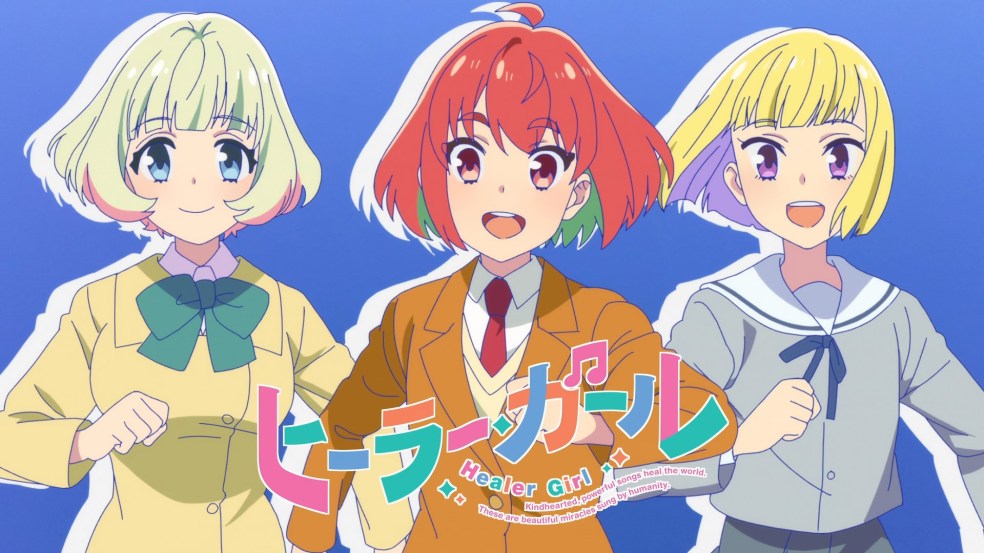
Let’s Watch HEALER GIRL Episodes 11 – 12

Let’s Watch is a weekly recap column where I follow an anime for the course of its entire runtime. Expect spoilers!


The time has come for measure-taking. Healer Girl ended today. I will not make a secret my feelings; I absolutely love this show. It’s a soft, glowing rainbow light that revitalizes the soul. If you don’t have the patience for unchecked fangirling, I suggest you turn back now.

A certain kind of studio hound will want to know where I rank Healer Girl among Studio 3Hz‘ other two well-known originals—Flip Flappers and Princess Principal—but in truth I find them so different that any comparison would be irrelevant. So instead, I will say this; Healer Girl, regardless of whether it’s the best or anyone’s personal favorite, is certainly the most healing and soul-soothing of the three. How appropriate, given its name.

We’ll spend much of this article talking about today’s episode, the finale, but it’s important to discuss last week’s as well (which I wasn’t able to cover on time). The gist is simple; our girls have found themselves in a rut with their C-Rank exams dangerously near on the horizon. When they try to sing, their image song breaks, and each of them is yanked out of it by a trio of biting orca-like creatures. Ria has the idea to send them to a training camp of sorts, spearheaded by Reimi’s former maid.

Over the course of the camp, they visit museums, take a pottery class, go bunging jumping, and hike in the mountains. None of it helps, because even as the diverse experiences temper and strengthen their songs, an underlying issue isn’t addressed: jealousy.

There were a few broad hints before, but episode 11 foregrounds the fact that all three of our leads are, in one way or another, jealous of each other. Once again, Ria actually notices this long beforehand. At the end of the episode, we’re given a quick peek at her notes, and they’re pretty revealing.

In a way this represents the first major interpersonal conflict these characters have ever had, but it’s entirely believable that a trio of teenagers, no matter how naturally talented, might develop inferiority complexes over that very same talent. All this leads to perhaps Healer Girl‘s single most unexpected scene; a full-on shouting match between the leads, each of them venting their jealousy. Even this, it’s to be expected, is sweet in its own way, given that the three are mostly yelling about how talented each of them thinks the other two are. (If you’re a certain sort of person, I could imagine finding this saccharine. But if you are that sort of person, I doubt you made it this far into Healer Girl unless you’re also a masochist.)

It will not surprise you to know that getting all of this out is exactly what they needed, and indeed if you read Ria’s notes up there, you’ll see that having the three of them grow closer together on their own, without her interference, was the plan all along. The camp completed; they return for exam day.

The image song, as sung during their exams, is a thing of beauty. They are more in harmony after their little fight, despite being physically apart and taking their exams in different rooms, than they were together, and the results are spectacular. Kana in particular, perhaps the one among them with the most raw talent, metamorphoses into a butterfly-winged fairy as she sings, the orca rendered nothing more than a blooming flower itself.

They all pass, because of course they do.

As the episode’s obligate heartwarming post-credits scene ends, Ria cheerily announces that all three of them are expelled. It’s a slammed door played like a punchline, but the underlying idea—that she’s taught them all she can, and they now have to stand on their own two feet—is sound. Ultimately though, any expectation that they move on permanently is to be ignored. Spoiler alert; at the end of the show they rejoin Ria’s clinic. Again as understudies, but also as proper healers in their own right. Still learning, but able to stand by themselves.

Still, episode 12 does deal with the girls out and about on their own for the first time. It splits into three parts for its first half, showing us the month-long internships that the girls enter. Reimi cuts her long blonde hair short and takes up residence at Sonia’s clinic. Hibiki interns at the newly founded audio medicine department at the hospital from episodes 4 and 9. Kana, who the episode returns the central spotlight to, interns abroad, at a hospital in what appears to be California.

This part of the episode is charming, especially in its depiction of how the girls remain in touch even when physically apart. Although Hibiki and Reimi in particular aren’t actually far from each other, and it seems like they occasionally hang out at the clinic. (Where Hibiki might still live? I’m not totally clear on this.) In what is easily the episode’s silliest scene, they embody every meaning of the term “moé blob.”

In general, episode 12 is concerned with legacy and the meaningful passage of knowledge and love from one generation to the next. Ria spends much of it with her own mentor, Sonia’s grandmother, but the real clincher takes the form of multiple callbacks to episode 1. Kana, in a land where she does not speak a lick of the local tongue, nonetheless soothes a crying, lost girl in the hospital’s lobby. Unlike her technically unauthorized use of healing from that first episode, this is exactly what she’s supposed to be doing, and it’s only through her study under Ria that she can accomplish it. Thus, here on her own, she draws on both her own life and the legacy of those who came before her. This is a difficult thematic balance to strike, but Healer Girl pulls it off.

There is an extremely funny comment made by Abigail, the woman with brown hair on the left, where she’s startled by “what Japan’s C-Ranks can do.” This would maybe come across as a little self-aggrandizing if this scene took place anywhere but the United States. As someone who lives here; yeah, that’s fair.

Later, when the threes’ internships end, Hibiki and Reimi get a cryptic email from Kana on the eve of her anticipated return to Japan. True friends and, apparently living in a world where commercial flight does not cost a small fortune, the two actually take a flight to California, where they find Kana helping out with the aftermath of a wildfire.

In any case, it’s on their return flight that Healer Girl makes this parallel between its first and final episodes most explicit. One of the passengers, a young girl, has an asthma attack. Our girls, of course, volunteer to help, directly referring back to the very incident that made Kana want to become a healer in the first place. I honestly cannot do this scene justice with words alone; the soothing song itself is one thing, but the imagery of Kana spiritually duetting with the younger incarnation of her master got to me in a way that I struggle to properly describe. The parallel invites you to imagine that the young girl they sing to might one day become a healer herself; wouldn’t that be a beautiful thing?

Amazingly, Healer Girl has another trick up its sleeve, its last, as the finale comes to a close. When the girls return home to Japan, they’re formally “given investiture” as healers (another of the series’ many strange and mystical religious parallels). And as they depart the graduating ceremony, they sing the song from the OP. The long version, with more verses.

Healer Girl—the very show itself—dissolves into magical dream sequence; their song fills the air like the light of drifting stars. Their friends and teachers come to join them. Is this all literally happening? Is it artistic license? A better question for you; who cares? In an interview, Director Yasuhiro Irie cited the Symphogear series as an influence on Healer Girl. These anime are, on many fundamental levels, very different. But they are alike in that both have a deep, intuitive understanding of the fact that with enough raw emotion, you can transmute literal events into symbols and back again.1 So the question of whether this is “really happening” is irrelevant, what it is, is Healer Girl‘s case for itself. A definitive answer to the question of whether these twelve weeks have been worth it.

During this fantastical, mesmerizing ending sequence, any lingering doubt vanishes like shadows against the morning Sun. Healer Girl takes its final showman’s bow, and it exits, as suddenly as it arrived.

If you feel it, it’ll heal you. That’s all there is to it.

Song Count: In episode 11, just one, but they sing it four times, only completing it on the fourth. In episode 12, three in total, all of which are wonderful in their own way. If you’ve liked the show’s songs and have more money than I do, consider buying the soundtrack or official vocal album.


1: Incidentally, Hibiki Tachibana would make a great healer. And the girls from this show would probably be pretty good Gear-wielders as well. There’s a free idea for the four of you who read this site but also write fanfiction.


Like what you’re reading? Consider following Magic Planet Anime to get notified when new articles go live. If you’d like to talk to other Magic Planet Anime readers, consider joining my Discord server! Also consider following me on Twitter and supporting me on Ko-Fi or Patreon. If you want to read more of my work, consider heading over to the Directory to browse by category.

All views expressed on Magic Planet Anime are solely my own opinions and conclusions and should not be taken to reflect the opinions of any other persons, groups, or organizations. All text, excepting direct quotations, is owned by Magic Planet Anime. Do not duplicate without permission. All images are owned by their original copyright holders.