The Weekly Orbit [2/24/25]

The Weekly Orbit is a weekly(-ish) column collecting and refining my more casual anime- and manga-related thoughts from the previous week. Mostly, these are taken from my tumblr blog, and assume familiarity with the works covered. Be wary of spoilers!


Hello folks. It’s been two weeks, and if that makes you think “wow, you must have a ton of Girlies Being Dramatic stuff to catch up on”, you’d be absolutely correct.

Ave Mujica – Episode 7 – 8

Two weeks ago, in my long catch-up of the series, I pointed out that a number of people have asked the question: is Ave Mujica even actually a music anime? Generally speaking, that term implies some amount of actual musical performance within the body of the show itself, whatever form that may take. Ave Mujica has been very short on that up to this point, and now that we’re halfway through the series, some viewers have begun to lose their patience with AveMuji’s lack of adherence to those genre norms.

I am not one of those viewers. Nor am I particularly surprised or upset by the fact that we do get a performance in this episode. It just isn’t from Ave Mujica. Nor even from MyGO!!!!!, their counterparts and protagonists of the series’ first season. The band that sing a song—two songs, actually—in this episode are CRYCHIC. This isn’t some kind of formal reunion and it’s certainly not a flashback episode. It’s a very brief, fleeting moment shared on a stage with almost no one at all watching. It’s more group therapy than the traditional music video-esque band anime insert song.

Very, very few people ever get to eulogize the passing of their own adolescence as it occurs. Teenagers, real teenagers anyway, do not usually have the presence of mind to capture those moments in amber before they disappear forever. Sometimes, though, both in reality and fiction, it does happen, even if the people involved don’t necessarily know that they’re doing that. Here, in the seventh episode of Ave Mujica, CRYCHIC’s story comes to its conclusion. CRYCHIC are able to, for a fleeting moment, recognize that even over just the relatively short amount of time since their breakup, their lives have changed permanently. They mattered to each other, and maybe still can, in different ways, but there is no returning to that brief time together. You can, they all seem to understand, revisit that moment as many times as you want in your own head, but you can’t ever return to it. CRYCHIC is thus, in a way, actually torn down as the romantic ideal it’s spent most of the past two seasons being: it was, per the show’s own words, an ordinary band like any other. In reckoning with that, its former members can finally take the first steps to truly moving on.

How we get to that point is a long and winding road that involves Sakiko being tackled to the ground, spending long periods just sort of standing outside of Mutsumi’s house after Mortis refuses to see her, and a non-zero amount of various characters performing the MyGO Special (roughly shoving their way into someone’s current goings-on, and sometimes literally their home, to resolve an emotional conflict). In terms of overall plotting this is honestly one of the messier episodes in this subseries, but that’s not really a problem when every individual scene is this compelling. In addition to the aforementioned reunion performance there’s a lot of great tension between Mortis, Mutsumi, Sakiko, and Soyo, in various combinations throughout the episode.

The insert songs themselves are the highlight of course. To such an extent that, in a bold bit of fanservice-in-the-old-sense-of-the-term, an actual, real version of CRYCHIC, recorded a performance for The First Take, being sandwiched in between legendary art-rockers Shinsei Kamattechan and “You Broke Me First” singer/songwriter Tate McRae, a truly insane three-artist stretch that is emblematic of The First Take’s eclectic nature.

This makes any complaint about a relative (and it would be relative) lack of technical precision in the episode’s performance twice as absurd, of course. Not only do we hear MyGO practicing near the start of the episode where they sound as tight as ever, but CRYCHIC are playing for nobody but themselves. Aside from a tiny group of bystanders; Anon, Raana, and Umiri, who sneaks in midway, there’s no audience that they’re aware of, this is a purely cathartic exercise between them, and we are witness to it purely as viewers of a television program. No one is being performed for, and as if to emphasize the point, Tomori spends most of both songs singing not out from the stage but toward the rest of the band. “Scenes From An Alternate Universe Where CRYCHIC Never Broke Up” this is not.

In any case, while this is pretty clearly the brightest episode of Ave Mujica so far, and perhaps a true turnaround point where healing can begin, it’s probably going to get worse before it gets better. Umiri’s sneaking in to the performance is not a mistake, and the jealous snarl of a grimace she makes while watching CRYCHIC work their baggage with each other out must truly be seen to be believed. That’s not to even mention Uika, following there in the footsteps of the show itself, which she has spent two weeks conspicuously absent from, and very nearly makes it a third in episode eight.

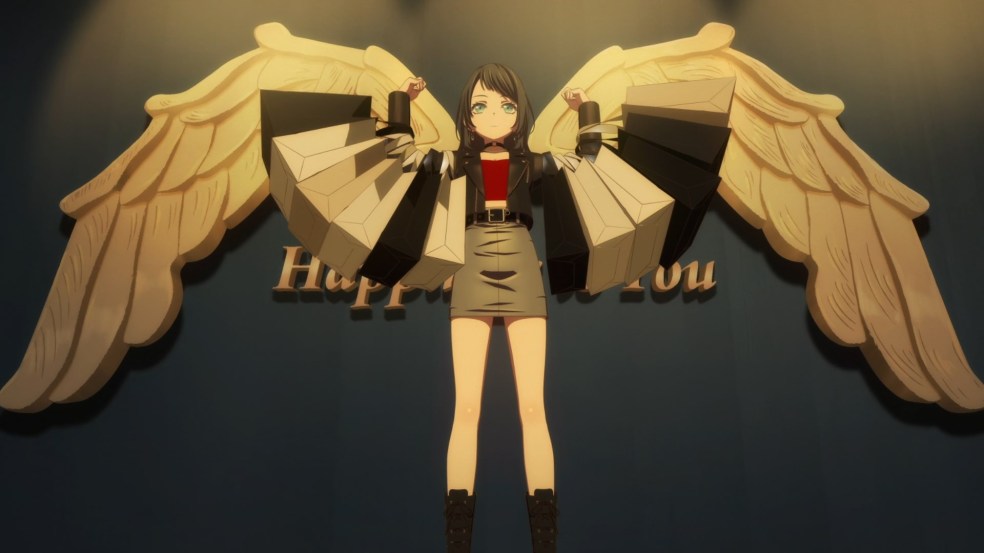
Episode 8, by the by, is not quite the event that episode seven was, but it’s nonetheless another excellent one. And, here’s a distinction I didn’t think I’d bother making for any episode of this show: it’s probably the funniest Ave Mujica has ever been. This matters, since most of that comedy comes from Umiri, finally getting some proper focus here that really peels back the layer of her cool-girl façade. Watching the CRYCHIC temp reunion in episode seven evidently really got to her, as she spends most of this episode coping with her jealousy in comically bad ways. Being given this much time to follow her also puts the lie to any notion of her being “the normal one” of Ave Mujica, given that we here learn that she almost exclusively drinks protein shakes for her meals and is Soulja Boy levels of terrible with her money. (I really cannot believe that this show features someone buying out an entire jewelry case. Retail therapy isn’t the answer, Umiri!)

She also tries to sets out on her personal goal of reforming Ave Mujica, starting with Nyamu of all people, to whom she relays her “tragic backstory” after struggling to down a single ginger ale.

Said backstory scans as more of a parody of this kind of flashback sequence than anything. All we get is that Umiri was in a band when she was a bit younger but was bossy enough that everyone was put off by it and left her stranded on stage during what was supposed to be an important concert. That’s why she’s like that: burned once for being too pushy, she went to the opposite extreme of far too hands-off, to the point of seeming untrustworthy (something Taki points out to her, early in her half of the episode). It tracks, but the droll undercutting of what’s rapidly become a trope in this relatively young genre is pretty funny, and shows that Ave Mujica isn’t all doom and gloom. (Nyamu is similarly unimpressed, and reacts to the story with a dry “wow, how sad” while inspecting her nails.)

All of this is relative, of course, because the “funniest” episode of this series does nonetheless open with a dramatic headspace sequence in which Mortis screams that she doesn’t want to die. The whole first half of the episode is actually pretty fucking dire, with all of Umiri’s stuff being in the latter half. Things start out decently enough, after the OP at least, but we’re reminded of the screaming Mortis pretty quickly when a nostalgic karaoke outing for Sakiko and Mutsumi turns into—well, it turns into something.

Intercut with that scene is one where Nyamu runs into Minami Mori, Mutsumi’s mother. Minami is, if it were not already obvious from prior episodes, a real piece of work. She describes her own child as a monster, “acting without realizing it,” but so talented she could outshine Minami herself if she put her mind to it. The Mutsumi-Mortis System’s expressiveness is not in question, but, just to put the tiger on the table here, it is pretty appalling for someone to be saying all of this about her own child. Worse, Mutsumi and co. have clearly internalized all of this, because the scene keeps cutting back to Mutsumi, Mortis, and Sakiko, arguing over whether CRYCHIC or Ave Mujica should reform. At some point, we’re locked out of seeing the objective events of the conflict entirely, Mortis’ desire to get Ave Mujica back together so she’ll have some reason to continue to exist is batted aside by Mutsumi’s unwillingness to let go of CRYCHIC. Sakiko just wants her friend to stop hurting, and she promises a lot to make that happen, but Mortis raises the idea that Sakiko doesn’t really even know who her friend actually is. She claims that the entire system has been a revolving cast of personalities who emerge and dissolve to fit the ongoing situation this entire time. Mortis and Mutsumi are exceptions to this rule, not the norm. We have some reason to be a bit skeptical of Mortis’ specific narration of events, but certainly, whatever good intentions might sit at the heart of that narration are discarded when Mutsumi seems to do to her what she did to Mutsumi back in episode three. There is a lot of internal strife here, and it’s hard not to feel for the both of them.

We do not see the results of the argument, the next time “Mortis” shows up, it’s toward the end of the episode, and the two halves thereof unite here. You may have noticed that, terrifyingly enough, Umiri and Mortis are actually aligned in goals at this point. After Nyamu half-heartedly promises to get back with AveMuji if and only if Umiri can get Mutsumi as well, Mortis is the first person to jump at the call. (Or is she? I’ve seen some theorizing that this last scene actually features Mutsumi pretending to be Mortis. Something to keep in mind as you read on.)

Mortis, you may recall, can’t actually play guitar. Thus, the episode ends with Umiri teaching her, delivering—in an episode where she’s otherwise a complete goofball and impossible to take seriously—probably her best line in the entire show so far, one that’s heavy with connotation and charge, given the whole doll motif this series has been almost obsessively fixated on since its opening minutes.

What is it with the girls in this show pulling out the exact kind of raw line that works as an armor-penetrating seduction bullet on other queer girls with mental problems?

She is, furthermore, rebuked by narration: from Uika, her first lines of any substantial length in three whole episodes. A doll, she says, will always be just that. Cue “Georgette Me, Georgette You.”

I’ve seen some concern about Ave Mujica potentially not having enough time to tie up all these loose ends, but even accounting for the fact that there are the live shows, band stories in the gacha game, and so on to look forward to, there are still five more episodes of this anime, two-ish hours of footage that could contain just about anything. Ironically, I think about the only danger the show is actually in is simply being misunderstood. Not many anime so much as approach the studied character dynamics at play here, especially those within the Mutsumi-Mortis system. As for the rest, the stage is open with possibility, and it is not over until the curtain drops. Episode 9 is called “If you leave, I shall not live.” Terrifying! I can’t wait.

Flower and Asura – Episode 6 – 7

Episode 6 sees Hana choose her selection for the NHK Cup. This is a bigger deal than it might sound, since doing so requires convincing her teacher of the passage she wants to read. Still, with everything considered, she finds one that she enjoys and which suits her. On her side of the story, everything is honestly going pretty well at the moment. Similarly, while Natsue is having more trouble than her, she’s still at least making progress on her script. It’s actually pretty incredible how much air the show can put into her script reading, given that her script is just a food ad. (It also gives us this, which, as a writer I must say I deeply relate to.)

The other end of the episode is the more interesting one here. For the first time we focus on following Matsuyuki [Yamashita Seiichirou], who we learn has a difficult home life with overbearing parents that expect him to follow in their footsteps as a doctor. He doesn’t actually seem terribly interested in doing that, and there is thus a clear central tension there, but from what we see here, he mostly acquiesces to their wishes at least face to face. Similarly, when Shuudai asks him to pen a drama script—not a small task!—he accepts with no apparent hesitation. It’s not wholly clear what Matsuyuki actually wants, although his appreciation for Hana’s readings to children and the possibly covert contact he keeps with his siblings in spite of his parents’ opinion that they’re “failures” provide some clues. There’s a clear good parent / bad parent contrast too, with Matsuyuki’s father caring for him mostly as a successor and nothing more, whereas Hana’s mother is openly proud that her daughter has made friends and found a passion.

Episode 7 spells Matsuyuki’s situation out more clearly. His older sister, a poet, left home and left him behind. This is something that clearly rests heavy on his mind, and it influences the script he’s agreed to write very heavily. It’s very interesting to me that within the drama, he writes three characters, one of whom is a girl whose parents expect her to become a doctor, but who wants to be a poet. He’s merged himself and his sister into one person. Any eggy questions this raises aside, it’s also a pretty solid bit of character building on the show’s part. He clearly admires his sister for walking away, and that admiration creeps out of him in a way that’s so unsubtle that even the other characters pick up on it by episode’s end. We also get to learn that Hana is a surprisingly fantastic actor when she plays the poet in the script. The show is cheating a little more than in the recitations here—a lot of the subtler visual characterization—that Hana has is replaced when she gets into character—but still, it’s great overall, and Hana’s performance in the climactic beach scene of the drama would be worth the price of admission for episode seven all on its own.

I like this show overall. Quite a lot, actually. But if it’s been missing one thing, it’s much in the way of stakes, aside from the looming promise of the NHK Cup. We get some of them here for the first time when it’s revealed that a meeting of Broadcast Clubs from across the country is on the horizon. Described as a “joint practice” session, this provides the show with an excuse to rejoin our main cast with Shura Saionji, the then-child actress whose recitation so inspired Hana as a child herself. The path we’re on here is obvious, in that Shura Saionji is being set up as essentially the villain of the piece. Any kvetching about the lack of stakes is admittedly partly a circumstantial complaint—anything would seem lacking in stakes airing in the same season as Ave Mujica, which manages to make its source material feel like genuine life or death—but I want Hana’s talent to be truly tested, and I want it to mean something if she’s to come out on top. To that end, the introduction of an antagonistic figure of some sort might just be exactly what the show needed. We’ll have to see.


A bit light on images this week, but hopefully that’s fine with everyone. Once again, I do ask that if you liked the article, consider dropping me a donation. Every penny helps.

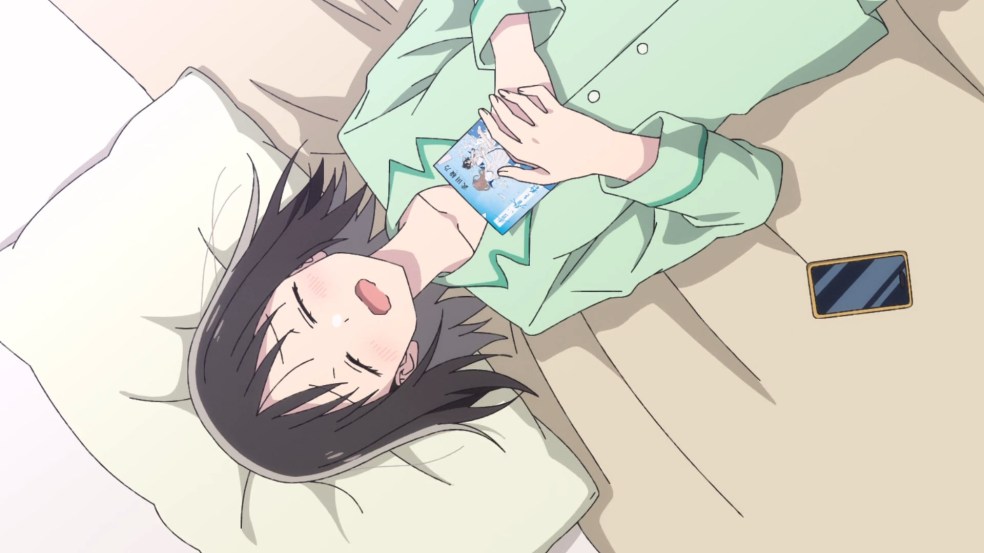
To help compensate the lack of images in this article, go grab a drink from the oeosi machine as your Bonus Thought of the week.


Like what you’re reading? Consider following Magic Planet Anime to get notified when new articles go live. If you’d like to talk to other Magic Planet Anime readers, consider joining my Discord server! Also consider following me on AnilistBlueSky, or Tumblr and supporting me on Ko-Fi. If you want to read more of my work, consider heading over to the Directory to browse by category. If you’re looking for me to watch a specific show, watch this space. I am planning to reopen commissions in the near future.

All views expressed on Magic Planet Anime are solely my own opinions and conclusions and should not be taken to reflect the opinions of any other persons, groups, or organizations. All text is manually typed and edited, and no machine learning or other automatic tools are used in the creation of Magic Planet Anime articles, with the exception of a basic spellchecker. However, some articles may have additional tags placed by WordPress. All text, excepting direct quotations, is owned by Magic Planet Anime. Do not duplicate without permission. All images are owned by their original copyright holders.
The Weekly Orbit [2/11/25]

The Weekly Orbit is a weekly(-ish) column collecting and refining my more casual anime- and manga-related thoughts from the previous week. Mostly, these are taken from my tumblr blog, and assume familiarity with the works covered. Be wary of spoilers!


Another week, another batch of girlies being absolutely dramatic. I’ll be honest, between the seasonals and the manga I read for this column, this might have the highest “girlies being dramatic” ratio of anything I’ve written in a long long while. I’d say in this respect at least, I’m living my best life. I hope you are too.


Anime – Seasonal

Ave Mujica – Episode 6

Every week I walk in to the torment nexus and walk out with my heart broken in three places. What a show.

Some interesting play with structure and framing this episode. At last week’s conclusion Soyo was shown discovering Mortis, and the whole scene was framed in slasher movie tones. Here, now that she has a better idea of Mortis’ whole, you know, thing, Mortis is instead framed as the angry, lost girl that she really is. I really enjoyed (and did not at all expect) Soyo actually playing along with Mortis’ whole ‘calling the doctor’ bit, it shows a pretty deep empathy that I don’t really know if we’ve seen the character express before? (It’s been a while since I watched MyGO, so I may be forgetting something.) Also, she apparently spends 3 whole days sleeping over there trying to patch things up, which, while there’s definitely a selfish aspect to her motive (she misses CRYCHiC too, after all), I still think deserves serious real one points. I don’t think I’d have the emotional stamina to spend 3 whole days consoling anyone about anything.

Full credit to Rana also, who can just intuit what’s going on with Mortis and Mutsumi without even actually being told. (She doesn’t actually go out of her way to help, though, and spends a decent amount of time this episode playing with cats. Rana remains this subseries’ most mysterious character.) Mortis actually seems to develop a bit of a crush on her, and is that a twinge of jealousy I detect from Soyo about that fact? In the tumblr version of this post I made a joke about the relationship chart this series must have, and then they just actually published one. Way to undercut my quips, Bushiroad.

I like Umiri’s brief scene in this episode. Forever the eternal mercenary, she describes the breakup of Ave Mujica as though it happened around her and not to her. And yet when Ricky Taki calls her on this, she gets annoyed. Truly the “fake ass IDGF’er” meme in human form.

The first half of this episode, I must stress, is actually pretty light by this show’s standards. So of course, there needs to be a breaking point somewhere. Here, that breaking point is between Mortis and Mutsumi, who stirs for the first time in a solid month only to find how awry things have gone in her absence. This isn’t what she wanted, and Mortis is appalled to learn so. The two have an argument in headspace, which of course to anyone outside of the Mutsumi-Mortis system’s own head just looks like an argument with herself, and she actually carries on so bad that she ends up tripping and falling in front of Live House Ring and making a huge scene, which of course a throng of anonymous busybodies are nearby to witness. It’s SO much that it would come off as contrived if the show weren’t so set on showing us how badly this is fucking over Mutsumi and Mortis. It’s hard to watch.

There is something admirable about the show’s complete lack of handholding with this kind of thing. This episode alone depicts multiple conflicts within a fully-realized mental space, a tug-of-war between Mortis and Mutsumi for their collective fate that is just profoundly sad to witness. I do wonder how legible this is to audiences who aren’t plural. Part of me is worried this series might actually be too ahead of its time for most audiences to properly appreciate.

(I’ve barely talked about Sakiko here and she is absolutely going through it up and down this entire episode. From the horrible, obviously untrue claims she makes about not caring about either band or even about Mutsumi, to the folder of sticky notes she’s gotten from Tomori over the years, to the fact that she sadly looks for another one despite telling Tomori off for them last week. To. This fucking expression, just, god.)

There’s a mostly-lighthearted interlude with Nyamu (it remains really funny that her dark secret, compared to everyone else’s, seems to just be that she’s from the sticks), but even that is twinged with her finding out about Mortis and Mutsumi’s public breakdown. The episode then ends with MyGO finding out about Sakiko’s whole extremely fucking complicated family situation. Episode 7 is entitled “Post nubila Phoebus,” “after the clouds, the Sun.” In most other contexts that would be a shining beam of hope, and maybe it is here too, but I’m fairly sure things will get worse before they get better. (Recall, we still have no idea what’s going on with Uika, just as one example, and she’s the only character from either band who doesn’t put in even a cursory appearance in this episode. Where is she!)

Flower and Asura – Episodes 2-5

I don’t usually try to predict how an anime will end before it gets there. But, by the same token, I tend to usually have at least a broad idea of what something “is doing” for most of its run. A first episode or so might need some room to establish itself, but by the halfway point of a series, one can usually figure out its whole deal with relative ease, especially if you’ve been watching anime for a while. All this is the long way around to say; I don’t get caught out by an anime very often. When I’m surprised it’s usually the addition of some new element, as opposed to something I had just outright been misunderstanding. Flower and Asura thus gets to join a pretty exclusive club with its fifth episode, and I am left to consider if I’ve maybe been underrating the show a little. (And by the time you’re reading this another episode will have aired, sigh! The unrelenting march of time.)

The gist is this: so far, Flower and Asura has largely been presented through the eyes of its main character, Hana. Hana’s insecurities and need to find a way to express herself defined the first episode or two of the series, and—perhaps this is the show’s fault, but I’m more inclined to blame myself—because of that, I had not really given terribly much consideration to the interiority of the show’s other characters. Natsue An, the snippy girl with the twin-tails, is a direct challenge to this, in her interactions with Hana she essentially addresses the viewer directly. This is the case with the rest of the cast, but the other two members’ inner lives we’ve explored to any extent are those of Mizuki, the free-spirited upperclassman that recruited Hana in the first place, and Ryouko, who, while not exactly a one-note character, has a deep interest in classic literature that aligns her nicely with Hana and Mizuki’s philosophy that recitation is primarily an art. The NHK Cup, the tournament looming in the show’s background, is to them secondary to reading what they want to be reading, and Ryouko says as much directly. Winning is not hugely important to either of them. (Certainly not to Ryouko, whose gleeful joy at the ancient drama frozen in glass by the Japanese Classics is outright described in-show as fetishistic. I feel very strongly I would get along with this character.)

Natsue is an irregularity here. She actually wants to win the Cup. As such, she’s not performing literary recitations like the characters we’ve discussed so far but rather a technical program, an altogether different thing that relies on a different skillset. Despite their different paths, Natsue is clearly at least appreciative of Hana’s talent, and, in her particularly brusque way, urges her to choose Kafka’s The Metamorphosis from among the available works to read a selection from. This is in contrast to Hana’s own desire to read from a contemporary work. (A work which in fact appears to be about a romance between two girls. Subtle.) If we’re just judging on taste, Natsue is clearly completely right; Hana’s particular timbre, especially the lower and more menacing end of her arsenal, which we know of from episode one, would lend itself very well to something as dark as The Metamorphosis. But this just isn’t what Hana wants to do, and it’s easy to read Natsue’s insistence that she do it as jealousy. It makes almost too much sense, right? Natsue, clearly someone who has very strong opinions on literature from her insistence on Hana’s selection and her denigration of the book Hana actually wants to read as shallow, would rather be doing recitation, right? I certainly read things that way. But we should stop ourselves here, because what that assumption actually is, I am a little embarrassed to say, is probably just projection.

Natsue, after an entire episode of Hana bugging her about it (including a magnetic—and also kind of embarrassing!—scene where Hana actually recites from the book she is planning to read from. In public, where the whole student body can see it), eventually explains that no, the real reason she’s so set on winning the tournament is nothing this complicated. She relates an anecdote from middle school where, in that school’s broadcasting club, an enthusiastic friend was selected to go to the nationals over her. Despite that friend’s insistence that Natsue was actually better at recitation than she was, the condescension—intentional or not—stung more than the actual failure. It has nothing to do with her specific talents and everything to do with just wanting to win in the first place.

Hana is left with the figurative egg on her face, although it’s not so bad, given that this causes the two to actually roughly get along for the first time in the entire show. Still, there’s an important point in there about not just assuming motives for this sort of thing. A point well made to both high school girls and, it turns out, anime critics more than a decade removed from high school.

All this and I’ve barely mentioned how utterly gay Mizuki and Hana’s entire relationship is. How embarrassing!

You and Idol Precure – Episodes 1 & 2

Idol anime are dead, long live idol anime.

Really interesting stuff with this show these past two episodes. Very clearly this is trying to be an “old school” Precure season in that it’s very physical and has a certain kind of comedy that’s been absent for the past couple years. Some people have been a little down on this but to be honest I’m really enjoying it, especially the return of the fisticuffs after an absence in Wonderful. (Not that that show needed them, but it’s always good to have some punching.) Our lead, Uta, alias Cure Idol [Matsuoka Misato], is probably the goofiest main Cure we’ve had in a while. I’m here for it. (That said, it seems like the blue Cure is going to have A Somewhat Sad Backstory and if I know myself I’m going to probably like her most, but who knows.)

Manga

Black and White: Tough Love at the Office

In the best possible way: this is wretched.

What we have here is a yuri manga where the “girls love” is two women, Shirakawa Junko and Kuroda Kayo, attempting to just completely destroy each others’ professional and personal lives over the course of several months after they begin working together in the same department of a bank. There’s a lot of talk about “toxic yuri” in the air right now, moreso than ever before I think, but this is a pretty potent strain of the stuff. These two are bad for each other, they don’t like each other, they become psychologically obsessed with each other, and their “intimacy” consists of violent, questionably-consensual sexual encounters where they alternate between actually fucking and throwing punches and the like at each other. It’s violent! Very violent!

None of this is a complaint of course, the primal and twisted nature of these scenes—which there are really only a couple throughout the whole manga, and they’re all pretty brief—is a big part of the point. There’s an idea floated here that while these two women are both trapped within the financial system that employs them, they’re at each others’ throats. Junko is BY FAR the more vicious of the two, and once Kayo starts seeing another woman, she gets that woman, a fund manager, fired for financial fraud. And yet, when the manga ends, Junko finds herself a pawn of the shadiest parts of the company she works for, possibly for the rest of her life, despite being “successful” in the business sense (and having picked up a new partner along the way). It’s Kayo who gets off with the comparatively happy ending; she quits the company entirely, and leaves to pursue love and happiness, things more important than success and failure. It’s honestly a surprisingly romantic ending for something that’s otherwise so vicious. Of course, not for Junko, who in the final page of the manga literally vanishes into darkness to join the other behind-the-scenes power brokers who run the company and Japan’s finances in general. I guess who really “won” is a matter of perspective, but I know who I’d rather be. (And not just because I’d rather have Junko making all of those twisted, sadistic grimaces at me, but you didn’t hear me say that.)


And that’ll do us for the second week of February. As with last week, I’m going to directly request that you drop a donation if you like reading these columns. They’re my only source of income, and every penny really does help a lot.

See you next week, but before I go, allow me to leave you with this week’s Bonus Thought, a sacred legend from the old days.


Like what you’re reading? Consider following Magic Planet Anime to get notified when new articles go live. If you’d like to talk to other Magic Planet Anime readers, consider joining my Discord server! Also consider following me on AnilistBlueSky, or Tumblr and supporting me on Ko-Fi. If you want to read more of my work, consider heading over to the Directory to browse by category. If you’re looking for me to watch a specific show, watch this space. I am planning to reopen commissions in the near future.

All views expressed on Magic Planet Anime are solely my own opinions and conclusions and should not be taken to reflect the opinions of any other persons, groups, or organizations. All text is manually typed and edited, and no machine learning or other automatic tools are used in the creation of Magic Planet Anime articles, with the exception of a basic spellchecker. However, some articles may have additional tags placed by WordPress. All text, excepting direct quotations, is owned by Magic Planet Anime. Do not duplicate without permission. All images are owned by their original copyright holders.

Seasonal First Impressions: The Poet’s Soul of FLOWER AND ASURA

Seasonal First Impressions is a column where I detail my thoughts, however brief or long, about a currently-airing anime’s first episode or so.


“For in my wrath, I am Asura.”

Can I level with you? The anime season’s been a bit rough so far. I’ve certainly lived through more dire seasons in terms of there just being nothing to watch, but it feels like a lot of the more up-in-the-air premieres have been whiffs. Even some of the actual good stuff is being held back by extenuating circumstances. Things are tough in the winterlands right now.

But, spring is on the way. And if you feel the Sun on your face and can imagine it as the warmth of the green season, Flower and Asura might be why. Blessedly, this is probably the best premiere of the season so far, a study in subtle emotional shades, and an interesting, empathetic look into the mind of a performer. Longtime readers will know that anything of that nature is absolute catnip to me, but even so, this is a strong, strong, strong opener. I could nitpick a handful of things, but just as a fair warning, I am absolutely not going to.

Our main character is Haruyama Hana [Fujidera Minori], the sole teenage girl in the tiny island village of Tonakijima (population ~600). Hana, who’s entering high school soon, spends much of her time reading children’s books for the local kids. Her readings are popular, and she’s clearly pretty good at them. What these kids of course do not know is that they stem from something deeper in the back of her mind.

As a child herself, Hana saw a young woman, of about the same age that she now is, recite a poem on TV. That poem, Miyazawa Kenji’s “Haru to Shura”, is, at least as translated into English, an angry burst of splintering, smoldering imagery. It’s not something that one would necessarily assume a child would like, and yet, that poem and that recitation of it, grabs Hana’s imagination in a stranglehold. Here, at this very early moment in her life—the very start of the episode, as well—her passion is ignited.

Cut back to that quaint reading circle and, we will learn over the course of this first episode, you have a girl who is trying to channel this roil inside of her into….reading books called things like Mr. Seagull’s Deep Sea Adventure to a gaggle of children. There is, of course, nothing wrong with reading books to children, and she’s damn good at it from what we see here. But given what we later learn about Hana, it feels fair to say that there is something going unfulfilled. She’s using a wildfire to light a candlestick.

One person who seems to immediately pick up on at least a little of this is Usurai Mizuki [Shimabukuro Miyuri]. Mizuki is our other main character, and she blithely walks into Hana’s life after one of those quaint little reading circles, immediately trying to press her into joining her high school broadcast club. At first, it’s as simple as the fact that Mizuki loves Hana’s voice. But as the first episode progresses, it becomes clear to Mizuki, and to us, that there’s more to Hana than is necessarily obvious at first glance.

Mizuki, I think, will in fact be a sticking point for some people. While clearly friendly, she is determined to recruit Hana for the broadcasting club. To be honest, she’s pretty overbearing. I like this—anime girls with less-than-perfect personalities are always a good thing to have more of—but I could imagine someone finding her sheer inability to take ‘no’ for an answer annoying, and she’s even a little manipulative over the course of this premiere. That said, it takes Hana actually mentioning the poetry recitation for Mizuki to really double down on the idea of her joining the club, so I think much of this insistence can in fact be attributed to the fact that Mizuki is also very observant. She’s enough so that she waves off a logistical issue, Hana being able to catch the last ferry back to her home island in time. “It isn’t right”, she says, “to assume something’s impossible just because it’s difficult.” She’s right about that, and this is one of a few central ideas that the episode quietly expands on over the course of its premiere. (Still, that couldn’t be me. I’d be in that clubroom in a heartbeat.) Hana takes a bit more convincing than this, but before we fast forward to that, it’s worth going into some detail, given the emphasis on voice here, what these voices are like.

Hana has perhaps the closest vocal to a typical “protagonist voice” in this sort of thing, but her sometimes stopped-up cadence has a halting shyness to it that most lesser anime would overplay, and it’s to Flower & Asura‘s benefit that it knows to keep it on the subtle side, for the most part. Mizuki’s voice is rustic, narrow, and scratchy, and it often sounds like she’s talking directly from her throat. This compliments her appearance, to be sure, but it also makes her sound bolder and more assertive than Hana. It also makes her sound older, which makes sense. I’m not going to call this a yuri series just yet, but if it does go that route, I want to commend whoever did the casting for having the main girls not just look good together but sound good together. That’s an attention to detail that’s all too rare.

Cut to classroom, Hana’s first day of high school. Things are going as they often do in a show like this, Hana settles in and meets a friendly classmate. Things are straightforward, until the Broadcast Club takes over the morning radio. Evidently, at this particular high school, morning poetry is recited over the speakers. This sounds, frankly, crazy to me. (If anyone had played poetry over my high school’s speakers there would’ve been riots.) But it’s an effective bit of scene-setting, because who else should read the poem but Hana’s now-senpai, Mizuki?

Poetry, of course, is not merely about being able to set scenes. It’s about using words to conjure images, and also knowing when and how to deploy them. In its mirroring of its subject matter, Flower & Asura demonstrates this beautifully. The poem in question, Takamura Kotaro’s “The Journey”, is not just read aloud, but also visually depicted. Hana, listening intently, imagines herself on a grey train track, walking through a void. She isn’t alone for long; Mizuki is there as well, blazing a trail of light through the black, providing a beacon despite her sly smirk.

The imagery of a track for Hana’s reaction is apt—she is moved. Continuing the show’s generally understated vibe, Hana’s reaction to hearing the poem read is not big or loud. It’s very soft, and very quiet. Just a wordless shiver of a sigh as the classroom window blows the spring breeze through her hair and things wind back down. The interlude ends, and Hana presumably has an unremarkable rest of her schoolday.

After school is a different matter. On the ferry home Hana begins reading some poetry to herself. Aloud, but, perhaps due to the presence of the ferry captain, given that the boat is quite small, rather quietly. She’s interrupted, as who else but Mizuki makes her presence known aboard the boat, once again pestering Hana to join the Broadcast Club. Mizuki needles Hana with pointed questions, asking why she restrains herself so much when reading this, here, as compared to when she reads for the kids back home. That’s interrupted by a much more pressing and practical concern, though. The ferry Hana goes home on is the last for the day. Thus, Mizuki has no way to get home.

Perhaps feeling obligated, Hana’s family houses Mizuki for the evening. Surprisingly, Hana doesn’t seem to mind this so much. She says she’s never had a sleepover before, so it may be the case that she’s simply unwilling to look a gift horse in the mouth. Mizuki stays on the attack throughout this entire sequence. Even when the two are ostensibly trying to get to sleep, Mizuki catches Hana staring, and takes that as yet another opportunity to pepper her with questions, whether out of genuine curiosity, out of trying to find something she can leverage to get Hana onboard with joining the Broadcast Club, or both, Mizuki’s sheer persistence has a charm of its own. But things hit a slightly off note when Hana admits that she likes recitation because it lets her be someone she’s not. Mizuki, for the first time in the episode, frowns, and bluntly asks,

“Do you not like yourself?”

Hana admits to it. “I don’t. Because I have no confidence.”

“That can’t be true. It’s there, somewhere in you.”

To that, Hana offers only a meek “I’m sorry” before rolling over and nodding off, and we end on a shot of Mizuki’s expression. Puzzled, frustrated. What does she have to do, she seems to wonder, to get through to this girl? We don’t get an explicit answer as to why she just can’t let go of Hana. That’s likely a thread to be pulled on in a future episode.

An earlier scene may provide a smidgen of clarity, however. Here, Hana’s mother briefly talks to Mizuki after dinner. She explains outright that Hana’s reluctance to seek better things for herself comes from feeling that she needs to be a role model for the island’s younger children. One could argue, perhaps, that Hana’s mother simply directly spelling out her daughter’s reticence and the reason for it is lazy writing, but all of this is noticeable well before this scene, and her mother’s comment to Mizuki is mere confirmation.

Put together, these two scenes paint a pretty sad portrait of Hana, someone who’s repressing herself less because of any particularly strong singular reason and more because she just feels that she has to. That it’s part and parcel of being who she is. (And I have to admit that by this point in the episode I was already really feeling for Hana. I have been in her shoes here, down to the meek saying-“I’m sorry”-and-retreating-to-your-comfort-space-trick.) But that portrait isn’t entirely complete. The last, boldest stroke is the one hinted at by the start of the episode.

It’s the next morning, and Hana has woken up before Mizuki and seems to have gotten up to go somewhere. This is a bit puzzling to Mizuki, given the early hour, so she sets out to find Hana, perhaps worried, perhaps simply curious. She finds her standing on the beach in the rain, oblivious to it, or uncaring of it, as it pours down on her. Here, Hana recites. She declaims. Performs. Performs for no one but herself and the crashing waves of the ocean. Her script is the same poem we heard back at the start of the show, but when she recites it here, she absolutely subsumes herself into it. The image-space that breaks into Mizuki’s reading of “The Journey” earlier in the episode is fairly restrained, fitting her declarative, guiding tone. Hana’s is the exact opposite, in reciting “Haru to Shura”, Hana completely turns herself inside-out. Vines sprout from the ground to restrain her as she thrashes against them like a wild animal, she crumbles to pieces against them, and those pieces turn to shreds of paper. Those shreds are blown into the sky, carried away on the cold wind. She is a woman possessed, drunk on the power of her own voice as it bends and warps around the poem’s syllables in ways that make the entire preceding 20 minutes of the episode feel like a distant dream as the paper-scraps she’s been reduced to return to the sand, sewing her back together as she raises her arms to the sky, a wild, ecstatic grin across her face as she screams truth to the heavens: in her wrath, she is Asura. Hana is gone during this reading. The manic, glowering figure who remains is someone else entirely.

Mizuki, of course, is the one feeling all of this in her mind’s eye, and we see that depicted almost literally as the scene unfolding before her fills the width of her iris. She, too, is consumed.

It goes without saying that the visual work here, the best in the episode by a fair margin, has to work hard to match Hana’s energy here, and that it successfully manages to do so is no small feat in of itself. But the incredible strength of Hana’s performance, really Fujidera Minori’s, is such that even if you completely shut your eyes during this segment, you would not just know something had changed, you’d be able to feel it.

And then, as quickly as it came, this moment ends. Hana, in an act that showcases nearly as much talent as the recitation itself, simply flips her act back off like a light switch, reacting initially with trepidation and embarrassment that Mizuki has seen her doing something that, we must assume, is very personal for her. Mizuki herself meanwhile, looking utterly spellbound (who could blame her?), grabs Hana by the shoulder, once again insisting, pleading that she join the Broadcast Club, fingers of light piercing the grey sky as the rain ends at precisely the right moment. Mizuki has figured out what’s going on here, but despite her persistence, she wouldn’t actually force Hana to do anything even if she could. She leaves the decision in Hana’s hands, asking to know what she wants, even though she already knows. Hana, tearful, confirms it a moment later. She really does want to join the Broadcast Club. She wants to—this part she doesn’t say aloud—find a place to be free, she wants to find some actual confidence in herself, and she wants to find people who understand the passion within her. Her self-loathing means that she’s spent the whole episode running from it. But nonetheless, here it is. The hardest part, Flower and Asura seems to suggest, was getting her to be kind enough to herself to ask in the first place. Still, both she and we would do well to remember, just because something is difficult, doesn’t mean it’s impossible.

The episode ends with Hana entering the Broadcast Club’s clubroom for the first time. The show has a sizable cast, so it’s doubtful that every episode will be quite this much about Hana and Mizuki. Still, the groundwork here naturally leads to so many questions that I am desperate to know the answers to: does anyone else in the club get like that too, or is Hana the odd one out? What of Hana and Mizuki’s relationship going forward? Friends? Mutual inspirations? Something more? What about the rest of the club? What are their stories? All of these are questions that, with variation, you could ask about any good show in this genre, but Flower & Asura‘s strength is not in reinventing the wheel, it is—fittingly enough for a show about an artform where you perform work written by another—in artfully expressing the emotions that define this genre’s very best work. It’s poetry in motion, keep an eye and an ear on it.

“Say what it is you really want. And I’ll make it happen.”


Like what you’re reading? Consider following Magic Planet Anime to get notified when new articles go live. If you’d like to talk to other Magic Planet Anime readers, consider joining my Discord server! Also consider following me on AnilistBlueSky, or Tumblr and supporting me on Ko-Fi. If you want to read more of my work, consider heading over to the Directory to browse by category. If you’re looking for me to watch a specific show, watch this space. I am planning to reopen commissions in the near future.

All views expressed on Magic Planet Anime are solely my own opinions and conclusions and should not be taken to reflect the opinions of any other persons, groups, or organizations. All text is manually typed and edited, and no machine learning or other automatic tools are used in the creation of Magic Planet Anime articles, with the exception of a basic spellchecker. However, some articles may have additional tags placed by WordPress. All text, excepting direct quotations, is owned by Magic Planet Anime. Do not duplicate without permission. All images are owned by their original copyright holders.