
This review contains spoilers for the reviewed material. This is your only warning.
This review was commissioned. That means I was paid to watch and review the series in question and give my honest thoughts on it. You can learn about my commission policies and how to buy commissions of your own here. This review was commissioned by Rakhshi. Thank you for your support.
The common wisdom is such; if you want to really take the measure of a period of time, don’t look at media from it that everyone remembers. Things that persist over the years tend to be your classics, your cult classics, and your so-bad-its-good’s. If you really want to get in the head of someone living in a period of time, look at the stuff no one remembers. Occasionally something will pick up a reputation as an “overlooked gem” and worm its way into that second category, but that’s rare. Things that are forgotten tend to stay forgotten and are often indicative of things that were popular at the time but not so much nowadays. So, the theory goes, they’re representative of an unfiltered look at a period.
If all this holds true, shows like Dragonaut – The Resonance may represent the true spirit of the late ’00s. A GONZO production from the period where basically all they were making was stuff like this, Dragonaut comes to us from 2007, one of an absurd even by modern standards nineteen projects GONZO produced that year. It aired that Fall to middling interest alongside similarly forgotten-today fare like Ayakashi and Night Wizard. As such, Dragonaut stands out not for any particularly exceptional quality but because, like many weird one-off projects from this era, it has ostentatious character designs and an absurd premise.
It is the near future, and poor Pluto, already stripped of the dignity of being a planet, has been obliterated by a massive asteroid called Thanatos. Some years later, a SpaceX-style civilian space plane launch goes awry when an alien dragon from said asteroid unexpectedly collides with the plane, killing everyone aboard sans a single survivor, the pilot’s son and our protagonist, Jin. (Voiced by the legendary Daisuke Ono.) The government promptly covers the whole business up, and a full two years pass as Jin has to endure the public at large blaming his father for the accident. He only uncovers the truth of things when by sheer chance, he meets a beautiful girl with supernatural abilities named Toa (Minori Chihara, best known as Yuki in The Melancholy of Haruhi Suzumiya). Obviously, she is also an alien dragon.

To put it bluntly, this is an absurd start to an equally absurd anime. Dragonaut isn’t totally devoid of merits, but the sheer, overbearing goofiness of its very setting makes it a little hard to take seriously. It quickly comes to involve bonded pairs of artificial dragon-people who can change from human to dragon-alien-mech-things (“Communicators”) and back and their riders / pilots who compose the titular Dragonaut program in the service of an international organization called the ISDA. It’s pretty cool and extremely dumb in equal measure. Moreso because the dragons, in dragon form, are handled by GONZO’s CGI department, which means we get huge, chunky CG rigs that are not quite articulated and lit enough to look fully convincing but do look like they’d make sick toys. (Their color palettes are also not the best, sadly. Which can make some of them hard to distinguish mid-fight.)
The corny tone is not really a bad thing. One of my favorite anime from this period is Witchblade, which has a similar issue. If anything, Dragonaut could stand to have been cornier. If there’s a real flaw here, it’s that Dragonaut starts out fairly self-serious and never really lets up. One might say it’s “very anime,” but it’s not camp. This contrasts in an ugly way with its sillier aspects.
Such as, for example, its character designs. With only a few exceptions each; the men are either emotionally sensitive feminine boys with period-appropriate emo haircuts, unreasonably diesel Chad-Gods who shake the Earth with each footstep, or grizzled, uniformed commanders who scowl as they make Tough Decisions. The women are warmhearted maidens who bring joy wherever they go, goofy brats, or gene lottery winners with chests so big that they have their own gravitational pull. I’m not one to moralize about this kind of thing, so to me the excessive fanservice mostly comes across as unintentional hilarity. If someone were less inclined to that point of view, I could absolutely understand it making the entire series unwatchable just on its own. Especially in the case of recurring antagonist Garnet MacLaine (played here by Haruhi herself, Aya Hirano), whose outfit looks like three other, unrelated, gratuitous sexy outfits crashed into each other at a hundred miles per hour, and also has the misfortune of being one of just two named POC characters in the series.

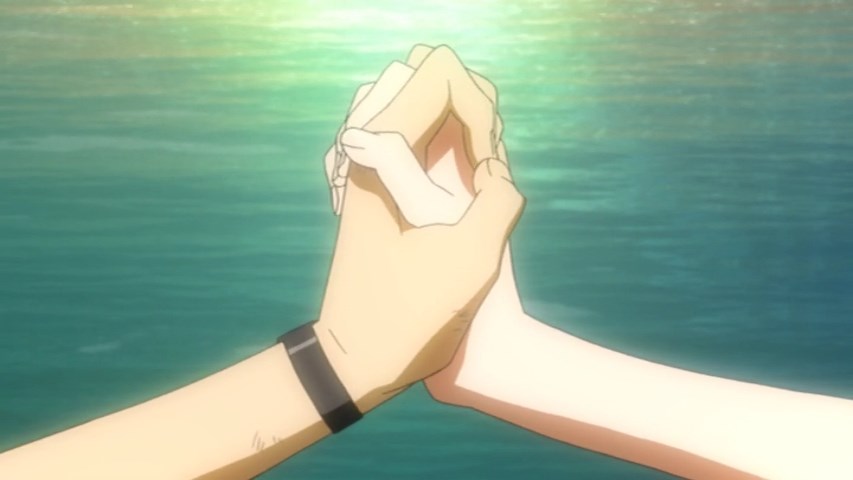
The plot is a sprawling kudzu vine of romance, political and military intrigue, and science-fantasy hokum. You might note that this is also true of a lot of great anime from around that time, but Dragonaut‘s handling of much of this material is pretty leaden. Enough so that details like, say, Toa’s name being derived from a bracelet Jin gave to his late sister Ai (“From Jin to Ai”, you see.) come across as comedic rather than stirring.
On one level, all this means that you could freely regard Dragonaut as the shlock that it is. By 2007, the hunt for the next Neon Genesis Evangelion, and the wave of “world story” anime it spawned had largely petered out. Eva had spawned numerous imitators and responses, and even shows outside its genre entirely were affected. By the late 2000’s, that influence had turned into background noise. The gulf between Dragonaut and something like, say, Eureka Seven, one of the very best anime in this vein and from just two years prior, is vast. If we wanted to draw an admittedly imperfect analogy, we could turn toward the history of pop music. If Evangelion was Nevermind–another 90s touchstone–Dragonaut is Daughtry. Everything challenging and artistically interesting about the movement has been squeezed out, and what you are left with is the sad backwash of an artistic point in time that was already firmly in the rearview. It’s not at all unfair to say that Dragonaut is a series of very limited ambition, at least.

On the other hand, that very inconsequentiality makes any judgement of Dragonaut that leans this harsh feel, frankly, a bit silly. (In much the same way that it’s hard to get too mad about the strained bluster of “It’s Not Over.”) No, it’s not some grand, generation-defining artistic statement. I doubt anyone–including anyone who worked on it–thought it was. That doesn’t make it criticism-proof and I certainly have quite a few qualms with it, but we should remind ourselves that we’re talking about a goofy-ass anime about goofy-ass space dragons, here. Condemning it in that manner is perhaps a bridge too far.
Because all this said and meant, the show does have its strong suits. Some of the character relationships are pulled off surprisingly well. Mostly these are various Dragon / Rider pairs. Jin and Toa will not win any originality-in-writing awards, but they’re cute together, and when they’re apart you do genuinely feel their longing for each other. Turning their couple into a trio is Gio (Junichi Suwabe, probably best known as Archer from Fate/), who seems to get on quite well with both of them. My favorite pair, though, is that of rider Akira (Miyuki Sawashiro, voice of Fujiko Mine since 2015) and her dragon Machina (Yuuko Gotou, VA of Mikuru Asahina, making Dragonaut something of a Haruhi Suzumiya cast reunion), whose affection for each other is warm and uncomplicated throughout the first half of the series series, as Akira grows to question the role that the ISDA has forced her into. The two are also very gay for each other; Akira here had a dragon wife long before Miss Kobayashi. (Sadly, the two are the victim of a pretty nasty instance of the “bury your gays” cliche, and they’re killed off around halfway through the show. I will leave the question of their sort-of resurrection as ghosts attuned to Thanatos making that better or worse as an exercise to the reader.)
Rounding out the most interesting characters are the rich girl / butler pair of Sieglinde (Nana Mizuki, who probably needs no introduction, but who you might variously know as Cure Blossom, Fate Testarossa, or Symphogear‘s Tsubasa Kazanari) and Amaedeus (Eiji Maruyama, active as both an anime VA and toku actor from the early ’70s until his death in 2015. Most of his anime roles were kindly and/or badass old guy parts like this, and if Amadeus is any indication, he was damn good at them) who have a cute surrogate daughter / father relationship, and lastly Kazuki (Tetsuya Kakihara and Sawahiro again, depending on where you get your credits from. I’m unsure of what the story was there. Perhaps it was a split role), who fosters an incredibly toxic yandere-leaning jealous streak over both Jin and Gio, and his dragon Widow, (Saeko Chiba, who has a string of supporting roles under her belt, although most of them were behind her at this point. You may know her as Nina Einstein from Code Geass) with whom he bonds over their mutual feeling of being spurned, until his jealousy inevitably mutates into an abusive streak.

Seen here in mid-distance, because getting an image of all of these characters together was quite difficult for some reason.
Production-wise, Dragonaut avoids the pitfalls of some of its uglier GONZO brethren. While the airborne fights are janky because of the CGI’s general inflexibility, the on-foot fight choreography is pretty excellent throughout, accounting for almost all of the show’s visual highlights. On a less technical level it’s also competently directed (by Manabu Ono, who directed a bunch of things for GONZO and has since gone on to helm some later Sword Art Online material) and the color choices are solid. (Outside of the dragons themselves, that is.) There’s generally at least a few cool shots per episode, etc. These are modest strengths, but Dragonaut makes the most of them.

Story wise, things are dicier. The plot aims for profundity and complexity but only occasionally gets farther than simply being complicated. Some of the arcs the show sets up have decent payoffs and others very much do not. In its best moments, like the mid-series episodes 13 and 14, where the ISDA save the world from being blown up by a magic nuke (!), Jin, Gio, Akira, and Machina depart to rescue Toa, who is trapped on Mars (!!), only to be intercepted by a characteristically jealous Kazuki, who they must then fight and seemingly kill (!!!), it is at least quite entertaining. Plot threads roll into each other like tumbleweeds across the desert. Or, indeed, run-on sentences. Occasionally, it’ll make an emotional moment hit just so, and Dragonaut achieves its greatest feat; the ability to perform a half-decent imitation of shows like Eureka Seven, or Eva, or even RahXephon (which I haven’t seen, but a friend who I was watching the series with has). It’s hard to tell if Dragonaut wants to be counted among that number or if it’s content just cribbing notes from those shows. Either way, it’s very much an imitation, not the genuine article.
Things go back and forth like this up and down the whole length of the series. Sometimes these various subplots and diversions end in a way that’s satisfying or at least entertainingly silly, other times they’re straight-up bad. Coming down to an almost even split across the show’s 25-episode runtime, I’d say. The fairly strong character writing contrasted with the relatively weak plotting does make it sometimes feel like a gaggle of good characters searching for a good show to be in and never quite finding one. There is a solid theme wound through here about how different sorts of love mean more to different people, but it’s subsumed by world story tropes riffing on Eva‘s Instrumentality plot in the finale–tropes that had become cliches by this point–and the series ends with a whimper rather than a bang.
Watching it, I was acutely aware of how tired of the pseudogenre everyone must have been at this point. Dragonaut‘s final few episodes seem to default to the Eva mode less out of any real commitment to the themes it explores and more because it lacks any better or more original ideas. It is a decidedly fine ending. Not offensively bad. Not particularly great either.

But being fine was enough, at least, for Dragonaut to be decently popular while it was airing. Hard numbers are difficult to come by, but it seems to have done well enough financially, though not enough to warrant sequels or spinoffs aside from a manga adaption that apparently takes a somewhat different spin on things. It did get a bonus OVA included on its DVD box set, a supremely ridiculous thing where the cast have their characters switched around via a wacky science machine. It is mostly an excuse to parade screwball situations out and have the camera zoom in on the girls’ busts some more; every sense of the word “fanservice” rolled into one. Perhaps unavoidably, given the general thrust of the female character designs, it was a popular fanart magnet for a little while. The few English-language reviews it got predictably nailed the show somewhere in the C-grade range, a trend I am all too aware I’m contributing to here.
All of this constitutes a minor legacy for a decidedly minor show. It still is a legacy, and that is worth something, but there is a reason that people still talk about even other Eva-indebted mecha anime from this time–say, Gurren Lagann, which I’m not a personally huge fan of but which is inarguably a better and more striking an interpretation of some of these same influences–but not Dragonaut. It has largely been left in the dustbin of history. Pierce the heavens, this does not.
Rather than any of its contemporaries, Dragonaut‘s status as an Extremely 2007 Anime reminds me of another, much more recent show, with which it has almost nothing else in common, The Detective is Already Dead. Like that anime (and a few others I’ve covered here over the years), it was a fossil from the day it began airing. Ultimately, Dragonaut represents a small side branch of a larger artistic tradition. That branch has largely come and gone, but the larger Evangelion and Eureka Seven-indebted school it represents survives to this day. Even in terms of fairly specific setups, one of the very few times Dragonaut is brought up in modern anime discussions at all is to compare it with Darling in the FranXX, another extremely-of-its-moment child of Eureka with which it shares a broadly similar premise and some thematic points. There are worse fates for an anime to have, even if DarliFra itself is extremely polarizing.
Most people who worked on Dragonaut went on to bigger things. (“Better” is subjective.) So, while it is always tempting to view the story of any largely forgotten series as a sad one, that really isn’t the case here. While GONZO themselves are gone, as far as I can tell, most of the staff from this project have continued to work in the field. Those who don’t seem to have either later found success elsewhere or had already established a legacy by the time they worked on Dragonaut. I feel comfortable in saying that for almost every single person who worked on it, Dragonaut was a minor step along their paths. I could easily spin this into a condemnation, but I’d be condemning plenty of other shows too. It is the fate of the vast majority of anime that air every year, even now. Hard to hate, equally hard to love, Dragonaut simply is what it is.
Anime is an art form, but it’s also a craft and a field of the entertainment business. In entertainment, works arise to fulfill a desire from their audience. In 2007, people wanted hopelessly romantic stories where high-flying science-fantasy heroes saved the world with the power of love. Dragonaut, for whatever faults it has, is one of those, and it is if nothing else, a competently made one. It was not the most notable, most successful, and certainly not the best of that sort of story, but it gave the people what they wanted. Perhaps sometimes that is enough.

Like what you’re reading? Consider following Magic Planet Anime to get notified when new articles go live. If you’d like to talk to other Magic Planet Anime readers, consider joining my Discord server! Also consider following me on Twitter and supporting me on Ko-Fi or Patreon. If you want to read more of my work, consider heading over to the Directory to browse by category.
All views expressed on Magic Planet Anime are solely my own opinions and conclusions and should not be taken to reflect the opinions of any other persons, groups, or organizations. All text is owned by Magic Planet Anime. Do not duplicate without permission. All images are owned by their original copyright holders.
 The Magic Planet