
A Disclaimer: I don’t usually do this sort of thing, but even moreso than usual, if you’re just looking for a simple “is this good or bad? Thumbs up or thumbs down?” kind of thing, I would actually urge you to go read this manga as it currently exists before reading this article. It’s quite short so far (only a single volume), and well worth it. I get into a lot of minutiae about the plot below, and I’d hate to spoil the experience for anybody.
New Manga First Impressions is a column where I detail my thoughts, however brief or long, about the first chapter volume or so of a new manga.
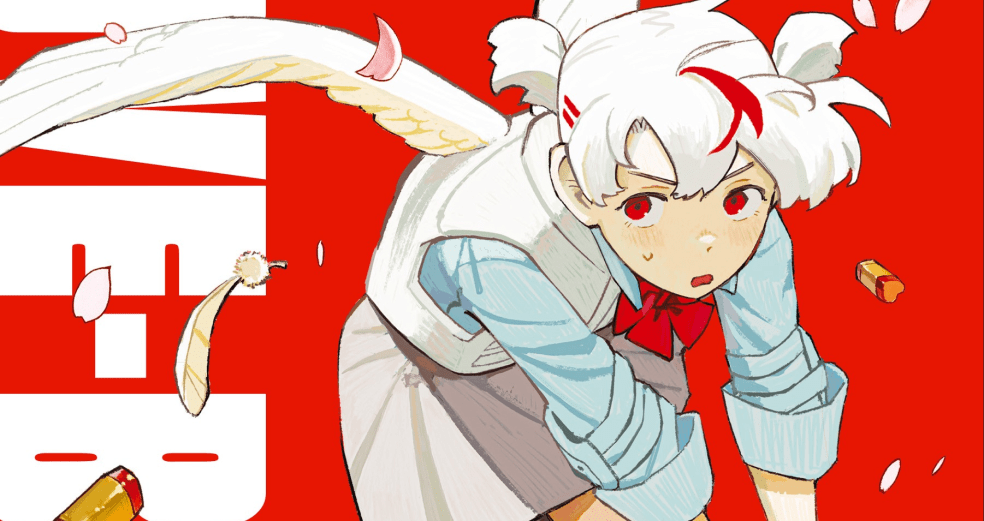
Love, to hear it told, is war. It’s a battlefield. It stinks, It hurts. It bites and bleeds. It’s rough going, in other words. It’s a little surprising, considering all that, that it’s taken this long for someone to have the idea of giving Cupid a handgun. But that is the basic concept of Love Bullet, the manga from newcomer inee that’s recently blown up in certain circles, depending on where you are on the internet. This is a case where the story outside the story is almost as interesting as the work itself, but we’ll save getting into all that for the end of this article. Here’s the, if you’ll forgive the pun, bullet points: Love Bullet follows a group of supernatural beings called cupids. Their task, armed as they are with a variety of firearms and explosives decorated with heart motifs, is to observe their targets in the human world and, with careful observation, decide who the best partner for them would be before pulling the trigger, as doing so makes the targets fall in love. There’s an additional twist to this, however. The cupids themselves are former humans, those who died before their time with some unresolved love of their own still in their hearts.

Becoming a cupid thus offers those who suffer this fate a second chance. And the pilot “0th” chapter goes some further way to laying out our premise and cast. Koharu, our main girl, is the rookie on the job. Kanna, her mentor, is laid back and does her best to help Koharu through the twists and turns of her new profession, there’s also the conscientious Ena, as well as Chiyo, who is, we’ll say, rambunctious.

Chapter 0 sees these four disagree over how precisely to resolve a love triangle of teenagers at a local not-McDonald’s. Three of the four cupids are in favor of pairing Hina, their target, with one of her childhood two childhood friends, Aoi or Daito. (The casual bisexuality of almost every ‘target’ character is worth mentioning, here, as an aside. It feels like an unshowy but powerful acknowledgement that the whims of the heart are often too complex to be so easily pinned down.)
Setting Hina up with either of these two would break the heart of the other, so this isn’t a decision to be made lightly. When the cupids are unable to come to an agreement, Chiyo, the one of the three who most likes to talk with her fists, starts a fight.

Fights between cupids aren’t lethal or anything—cupids can’t fall in love, so being shot or blown up or whatever with their equipment instead renders them temporarily indisposed by making them ridiculously jealous—so some trickery on the part of her mentor eventually gives Koharu, who is determined to somehow solve this problem in a way that doesn’t compromise Hina’s friendships, the deciding shot. Thinking outside of the box, she pulls the trigger between Hina and one of the younger employees at the McDonald’s, saving her friendships and setting her up with a sudden-onset crush instead. The takeaway here is this; Koharu has a good eye for unconventional solutions, something that will serve her well as a cupid in the stories of romance-to-be to come.

However, those stories don’t actually exist yet. The first main arc of the series—which comprises the first and currently only volume of the manga—is actually an origin story for our inventive matchmaker, and this is where Love Bullet goes from merely interesting to positively arresting.
Things begin simply enough. Koharu reminisces on her days as human high school girl Sakurada Koharu. She had a reputation as a matchmaker even then, and her talent for noticing these things put her in enough demand that we see her best friend, one Tamaki Aki, having to occasionally step in.


Koharu in fact seems so wrapped up in this little role she’s made for herself that she doesn’t really consider her own feelings very often. Aki directly says as much to her, only for Koharu to self-deprecatingly reply that beyond this talent of hers, there’s not much to her as a person. This is pretty blatantly untrue, but it gives us a good first look at someone who clearly struggles with her own self-worth. For her part, Aki also has ulterior motives behind trying to get Koharu to put herself first a bit more. Those motives? The obvious, Aki wants Koharu to like herself because Aki likes Koharu.


Unfortunately for both Koharu and Aki, however, this is where the series really earns that “doomed yuri” descriptor. Not a full minute after Aki admits her feelings, Koharu, frozen with indecision, promptly has a head-first meeting with the consequences of choosing to have long talks with your friend next to a construction site, and she promptly dies.

This is perhaps the one writing decision in this arc that I could, writing this a few days after having first read it, think of someone perhaps finding cheesy or even contrived. Honestly it kind of is! But that’s not really a criticism, at least it’s not coming from me, because Love Bullet uses this moment to explode into a bomb-burst of grief. A demonstration of how the world absolutely stops when someone you love leaves it. Love Bullet can afford to be a little loose with the actual literalities of how we get to that point, because, setting aside any fundamentally silly complaints about a lack of realism—people die in freak accidents every day—the actual point of all this stuff is to explore the feelings themselves.
This also marks a notable shift in style for the manga. As Koharu passes away, Love Bullet reveals one of its best visual tricks. The four-page sequence where Koharu dies is a pair of mirrored halves, and is just an absolutely excellent execution of this technique, to such a degree that I am surprised to see it from someone who’s relatively new to the medium1. On the first of these pages, three vertically stacked panels depict Aki’s grief-stricken face as she sees the life fade from her best friend. On the second, Koharu lies at the center of the page’s sole panel, in the midst of a heart-shaped pool of blood, finally realizing that she wanted to fall in love too. On the third, cherry blossom petals fall around her as she awakes, again in the center of a monopanel, newly sporting angel wings. Lastly, on the fourth page, three vertically stacked panels again herald the arrival of Kanna, Koharu’s new mentor, here to induct her into the cupids and thus begin our proper story. In the final signal that Sakurada Koharu the human is dead, Kanna addresses her as just “Koharu.” The scanlators helpfully point out that this change is even more drastic than it seems in English. “Sakurada Koharu” is of course a person’s name and is thus written with Kanji in its native Japanese, but “Koharu”, the cupid she’s just become, is addressed with her name written only in katakana, thus reducing it to pure phonics and making it clear that in some profound metaphysical sense, Koharu the human and Koharu the cupid aren’t precisely identical.
We don’t simply leave Aki behind as the story progresses, though. Koharu’s first assignment as a cupid is, in fact, to help Aki herself find a new love. What’s worse—or better, perhaps, depending on your perspective—is that time has not stood still for the human world between Koharu’s death and resurrection. In fact, it’s been half a decade. There’s again a brilliant use of mirroring here. Aki, now a college student at a prestigious art school who looks drastically different than she did just five years prior, is visually contrasted with Koharu, now an eternally-young angelic being, who looks more or less the same aside from her hair, eyes, and, of course, wings. Even their color schemes are stark opposites!

What’s more, successfully matchmaking as a cupid earns that cupid “karma.” Get enough, and history is casually rewritten such that you’re brought back to your human life. Of course, that doesn’t reverse the time that’s passed since then. Even when the prospect of becoming human again is dangled in front of Koharu, it’s very clear that for the most part, these changes that have happened are permanent. Kanna, who seems to style herself an upright mentor type, reveals that she’s actually the one who chose Aki as Koharu’s first target. From both a practical and personal point of view it makes sense; Koharu knew Aki very well, and there are few people more qualified to pick out a partner for her. On an emotional level, Koharu has to deal with the loss eventually, so she might as well take it head on. Still, it does all feel a little cruel, too. Of course, that too is almost certainly the exact reaction we’re supposed to have, and it’s one that gives this whole scenario some extra resonance. The feelings involved in romance, present or past, are rarely straightforward.
Eventually, by peeking at a “data record” that the cupids are given about their targets, Koharu learns that Aki has held a flame for her this entire time. This only makes sense, a person never really “gets over” something like that, but enough time has finally passed that, presumably with no small amount of effort from Aki herself, she’s able to move on to a new person to at least some extent. Kanna is able to gently coax Koharu into accepting her role as a cupid, and she resolves to find the best partner for Aki that she possibly can.
This is where we meet Chiyo.


You give love a bad name.
Chiyo serves as, more or less, the antagonist of this first arc, and is established as “battle-crazy” bad news who doesn’t really care about the people she’s ostensibly trying to partner up. In fact, when initially targeting Koharu here, she taunts that she thinks it would be “more fun” to just pair her up with somebody at random. According to Kanna, this kind of situation isn’t terribly uncommon. Cupids might technically all have the same job, but fights break out over who gets the karma payout off of claiming a particular heart.
All of this, of course, makes Chiyo a perfect counterpart to Koharu. The wild, battle-hungry fighter who’s here for a good time but not a long one vs. the shy newbie who has some actual investment in the fate of Aki’s love life. It’s actually Kanna who does most of the fighting with Chiyo, though, which would seem like a missed opportunity if they didn’t clearly have some sort of shared history of their own. (Chiyo calls Kanna out on trying to act like “a goodie two-shoes.”) Kanna is able to get Chiyo mostly off of Koharu’s trail by challenging her to a straight-up fistfight, which the heavily armed angel finds interesting enough to agree to.

Koharu, meanwhile, is sent to infiltrate the school with some angel magic. She can actually use this “cupid’s charm” to disguise herself as a human and interact with the college students, including Aki herself. (Who, in another melancholy development, can’t recognize her under the glamour.) Koharu is able to get a general sense of Aki’s current state in life by doing this, and while tons of Aki’s classmates are head over heels for her straightforward, honest nature and deep knowledge of art, most of them are pretty forward about trying to earn her affection, something she doesn’t really seem to care for. Koharu gets the sense that Aki needs someone more reserved and on the quieter side. In another brilliant little page-to-page compositional trick, the thought balloon that begins with “It’s like they need to be someone more reserved. Someone like–” is interrupted by another student calling Koharu’s name on the next page.

It’s perhaps unsurprising that Sakura there, a reserved and shy girl not terribly unlike Koharu herself, is who Koharu eventually picks as Aki’s love interest. I worry that reducing the setup to who “wins” though might make it sound like Koharu is being selfish or even living vicariously through Sakura. In actuality, the manga goes some length to demonstrate that Koharu’s decision is one she comes to after careful consideration. (And after Kanna wins her little bout with Chiyo in a very fun sequence I’ll leave unspoiled.) What gives her the conviction to finally pull the trigger is a conversation between Sakura and Aki herself. By this point, she’s shed her human guise, and the two thus can’t see her. As such, she’s given the surreal experience of hearing Aki recount her own death, and how she’s been dealing with the aftermath since then. It’s a beautiful scene, Aki quietly lays out how she managed to come to terms with Koharu’s passing, and Koharu, improbably, is there to hear all of it.

What really makes this work is how it helps Koharu come to terms with her own loss. In the final moments before she shoots, Aki’s feelings of loss seem to overlap with her own. Aki’s loss of Koharu reflects Koharu’s loss of Aki, the time that’s now forever lost between them, and both of their respective needs to continue onward in spite of all that. To put it bluntly, this all really, really got to me. I don’t cry over fiction easily, but that last page, where Koharu finally pulls the love pistol’s trigger and destines Aki and Sakura to fall for each other, made me start sobbing.

If you love something, set it free.
This, all of it, is fantasy in the purest sense. We don’t know, by the very nature of these things, whether our departed loved ones would want us to move on from them, but the idea that they would seems to be common across cultures, and these ideas that hit so close to the root of the human experience that they’re nearly universal are much of what I come to anime and manga for in the first place. Love Bullet is written by someone who is in all ways quite a different person from me, but the pain at the back of our minds, when we remember those who aren’t with us anymore, connects me to a girl in this story. That means something, and shouldn’t be dismissed.
Case in point: over a decade ago, an internet friend of mine vanished after being grievously harassed in the way that was all too common back then. Shortly before leaving, she told me she’d been crushing on me since we met. That was a very long time ago, and I don’t really have any way of knowing what happened to her, as this was before having all of your alternate social media accounts listed in some convenient place was common. Suffice it to say, my situation and Aki’s are quite different. But the fact that her story stirred this memory in me at all is a testament to the power of the narrative being put together here.
It is, I hope I’ve made clear, excellent stuff. These feelings are what art is for. What’s most impressive about Love Bullet is how it’s clearly the product of a unique and mature artistic voice, from someone who is clearly incredibly talented despite being relatively early on in her career. But what makes it worth reading are those moments of connection, the ones that hit you in the heart.
Obviously, I love this thing to death and want it to continue very, very badly. Inee has mentioned that she has a whole saga for Koharu planned out. (Plus there are so many opportunities for other interesting stories here as well. I am sure Chiyo, for example, has some heart-stompingly sad backstory that I simply need to see.) Unfortunately, though, this is where we get to the part of the article that’s not about the manga itself. Love Bullet, you see, is serialized in a magazine, and thus like any manga bound to that format, is subject to the whims of various people working on the business side of that endeavor. Those people are, often, absolutely ruthless about axing any manga that threatens to underperform. (A counterproductive approach that tends to part ongoing manga from their audiences right as they’re getting to know each other, it must be pointed out.) Love Bullet has, apparently, been underperforming in its volume 1 sales, and its future is therefore rather uncertain.
This is upsetting not just because it’s a fantastic story but also because, god damn it, I’m an author too. One of a very different kind, of course, but it’s impossible for me to see this person writing this story, pouring their entire heart into it, only for it to be threatened by the scythe of capitalism, and just sit here and do nothing. Rarely if ever are my articles capable of affecting tangible, direct change on the world. But this might be an uncommon exception. Sancho Step, the group responsible for scanlating the manga and thus bringing it to international attention (and whose scans I’ve been showing off here), have a very handy guide to purchasing the first volume either physically or digitally. Sancho Step have already done a lot for Love Bullet, and I’m under no delusion that my site has a massive reach, especially not compared to the #ReadLoveBullet campaign they’ve already had well under way for some time now. Still, if I can help move even one copy of the manga and possibly forestall its demise, that’s worth it. Good, impactful, resonant art is worth it, and Love Bullet is absolutely every single one of those things.
1: As is the case with most mangaka who get a debut serial, there is ample evidence that inee published some amount of independent oneshots and such before writing Love Bullet, so it’s not like she’d never picked up a pen before drawing it. Still, the command of panel composition displayed here is exceptional.
Like what you’re reading? Consider following Magic Planet Anime to get notified when new articles go live. If you’d like to talk to other Magic Planet Anime readers, consider joining my Discord server! Also consider following me on Anilist, BlueSky, Tumblr, or Twitter and supporting me on Ko-Fi. If you do the latter soon enough after this article goes up, I will probably use the donation to buy a copy of Love Bullet, so thanks 🙂 If you want to read more of my work, consider heading over to the Directory to browse by category.
All views expressed on Magic Planet Anime are solely my own opinions and conclusions and should not be taken to reflect the opinions of any other persons, groups, or organizations. All text is manually typed and edited, and no machine learning or other automatic tools are used in the creation of Magic Planet Anime articles, with the exception of a basic spellchecker. However, some articles may have additional tags placed by WordPress. All text, excepting direct quotations, is owned by Magic Planet Anime. Do not duplicate without permission. All images are owned by their original copyright holders.
 The Magic Planet