Twenty Perfect Minutes: BanG Dream! It’s MyGO!!!!! Episode 13 – The Only One I Can Trust Is Myself

Twenty Perfect Minutes is an irregular column where I take a look at a single, specific anime episode that shaped my experience with the medium in some way, was personally important to me, or that I just really, really like. These columns contain spoilers.

This column contains additional spoilers for episodes 1-5 of BanG Dream! Ave Mujica.

This column is a companion piece to the 2/2/25 edition of The Weekly Orbit. They can be read independently, but make more sense together.


“Because….you seem like you’re about to break apart, Sakiko.”

No one ever would, but if someone were to ask me what the biggest whiff of my career was, it was far and away not covering BanG Dream! It’s MyGO!!!!! while it was still airing. I wrote a little about it, but not nearly enough. Hilariously, in that article, I call the series “fine,” and mostly gloss over Togawa Sakiko as a character except in how she relates to Tomori. Readers with long memories will recall it actually took me until last year to even finish the damn thing. I can’t defend my own lack of taste there, but I’ve certainly come around since then. (And to anyone who thinks I’m overrating the hell out of one or both seasons of this series, well, you’re not going to come away from this article with your mind changed.)

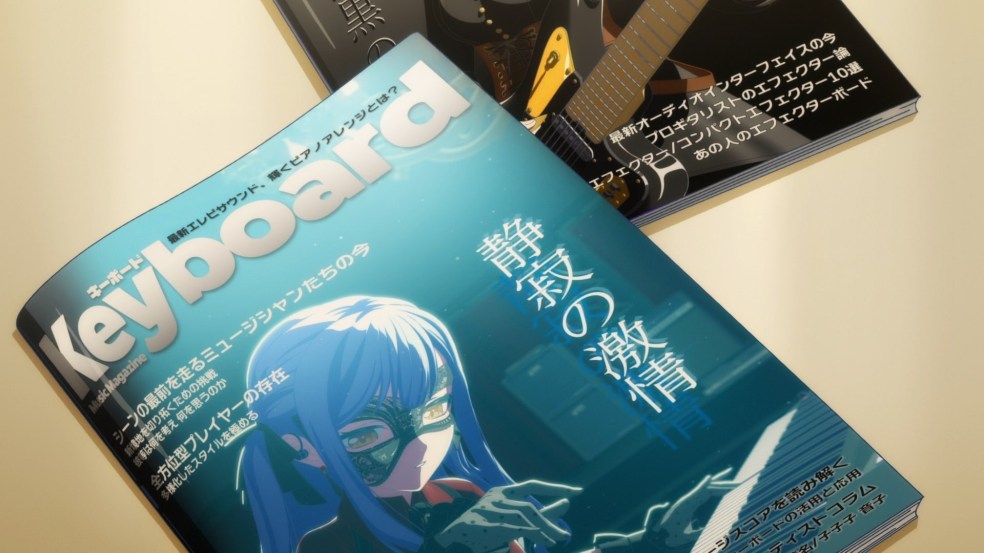
So, think of this as making up for lost time. As I’ve watched Ave Mujica, MyGO‘s direct sequel and a significantly darker take on (and inversion of) some of MyGO‘s same themes, I’ve felt compelled to revisit the origin story of that season’s eponymous band. With the benefit of hindsight, this feels like doing an autopsy. Anyone caught up on Ave Mujica as of the time of this writing knows that Ave Mujica themselves have broken up. If they get back together, it probably won’t be for a while, and it probably won’t be in the same way. So in hindsight, the first episode they appear in, MyGO‘s thirteenth (which is essentially just Ave Mujica episode zero), feels like the only real example of Ave Mujica as Sakiko, their founder, keyboardist, and composer, intended them to be. Sakiko’s unwillingness to compromise on her vision is one of a number of factors that led to the band’s eventual dissolution, but really, we should have seen this coming.

I mean, it’s kind of right there in the title, isn’t it?

The episode actually opens, at least after a brief and ominous prelude, by focusing on MyGO‘s own core cast. This only makes sense, It’s MyGO!!!!! the band are MyGO‘s main characters, and this is the immediate aftermath of their moment of triumph. Things are, for once, relatively clear, and the anime’s opening song is as clear and shining as the sapphire sky in its visuals. Of particular interest to us in this first half of the episode is a scene between Soyo and Tomori on the bridge near the latter’s home. Soyo says plainly that initially, when they were both members of their previous band CRYCHiC, the emotional rawness of Tomori’s lyrics was never something she was entirely comfortable with. But now, she says, she realizes the emotions expressed in those lyrics weren’t Tomori’s alone. They were hers, too.

Through Tomori’s music, she and Soyo are able to relate to each other. This of course is MyGO‘s last great expression of its thematic core, music as a tool of communication, openness, and honesty. In this, MyGO is overall not entirely dissimilar to the show that replaced it as the girl band anime of the moment the following year, Girls Band Cry. (A fact both franchises took notice and advantage of.) The two have one major difference though, Girls Band Cry wraps its story up around the time that main band Togenashi Togeari’s members begin to truly understand each other, and in this way it’s actually fairly straightforward. (Not even remotely a knock on it, I must stress.) MyGO does not do this. It knows it has to set the stage for its successor, and it knows that it has further work to do.

Thus, when Tomori attempts to reconcile with the last former CRYCHiC member she’s yet to reach out to, it doesn’t go nearly so well, and she finds Sakiko, her former bandmate, holed up in her school’s piano room banging out the sinister classical music like the Phantom of the damn Opera, a final indication, if anyone really needed one, that this is not going to all work out so neatly.

After Sakiko coldly brushes Tomori off, Anon, the somewhat airheaded guitarist of MyGO, attempts to cheer Tomori up by taking her out and about. At a planetarium, they run in to Uika, who Tomori has met before but doesn’t really know. The three have a nice chat, although after Uika leaves, Tomori notes that it’s odd that she calls her by her name, given that Tomori never told her it. All of this is significant because immediately after this conversation, Uika gets in a black cab, and is driven to the first night of her new job: the vocalist for Ave Mujica.

Again, hindsight makes two things really obvious: one, we almost immediately flip the “music is a tool of honesty and open communication” thing on its head. Sakiko’s plan for Ave Mujica requires deliberately obfuscating everything about its members, naturally including Sakiko’s own involvement. As far as she’s concerned, this is her show, and the rest of the band are actors within it. Which leads us to two: this band was never going to stay together. It’s at a fairly tame level here, but even this early on it is very obvious that Ave Mujica do not really “get” each other. Nyamu records behind-the-scenes footage on her phone, which Sakiko confiscates since if it ever got out it would destroy the band’s mystique.

There’s also this little exchange which….honestly, good question?

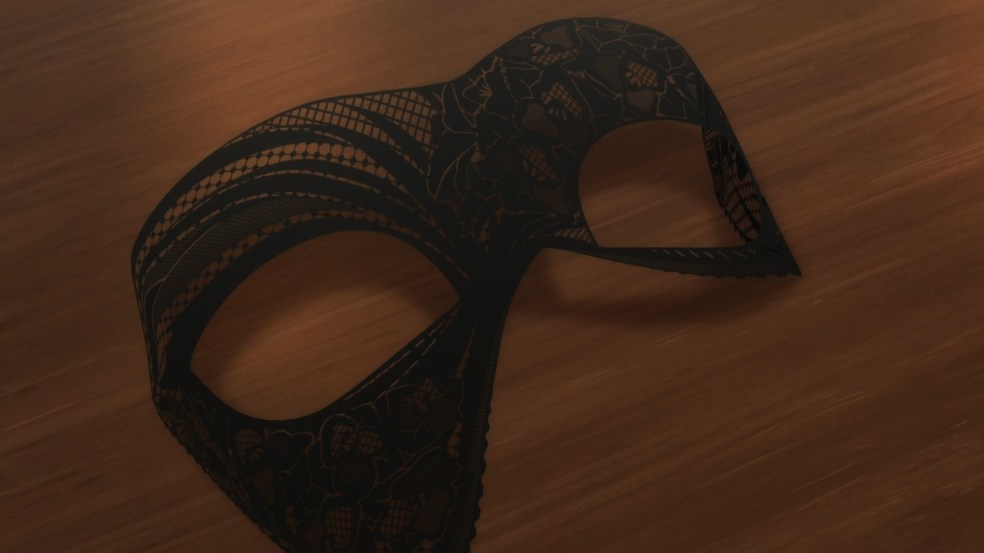
Nyamu also directly mentions rhythm guitarist Mutsumi’s famous parents, something she’s insecure about to put it very mildly, while Mutsumi ignores her and continues stone-facedly practicing her guitar. All of this was easy to dismiss as light bickering during the episode itself. Five episodes deep into Ave Mujica, where Mutsumi has retreated into herself, Nyamu has publicly unmasked the entire band, Uika’s obsession with Sakiko is starting to bubble to the surface, and Sakiko’s own self-loathing is at an all-time high, it reads as some truly spooky foreshadowing. This is also where the episode gets its title, upon presenting the girls with their masks, Sakiko says that on stage, the only person one can trust is themselves. A little under halfway into Ave Mujica, we can see how that attitude worked out.

And yet, for all that, the closing minutes of this episode are still such a trip. Ave Mujica are introduced to the world with a stage play about dolls discarded by humans who come to life under the light of a certain moon, and following that, a grandiose, fuming fire of a debut tune named after the band itself. Obviously, the idea of the discarded doll reflects back on Sakiko herself, but Ave Mujica’s audience have no way of knowing that. To them, and really, to us, while we’re under the anime’s spell, Ave Mujica’s purple and red gothic smoke is something enticingly dark and obscure.

This is the first and best argument for the exact opposite of MyGO‘s own point of view. Maybe “communicating your feelings” is secondary to putting on a good show, given that all of these characters are, you know, in a band. That’s certainly what Nyamu thinks, and it’s why, a third of the way into the Ave Mujica anime, she asks if the band even needs to be a band. She’s probably not entirely right to suggest that even in-context, and hell, Ave Mujica’s actual music is some of the absolute best that’s ever come out of girl band anime as a format, but there’s a grain of truth in there. We are all at least a little complicit, because we clearly love the drama, and the drama is why, both on a Watsonian and Doylistic level, the music even exists to begin with. This episode was our first hint of how truly toxic this story would get, and far from being taken aback—checking on this stuff is one of the few things reddit is useful for—people wanted things to get worse. And, fair play to Nyamu’s point of view, they did! And it’s really only seemed to raise the show’s esteem in the eyes of its audience. The series has given us exactly what we asked for. As a production, it’s realized it doesn’t actually need the music of the group itself to capture our imagination and attention.

I resurrected the Twenty Perfect Minutes name to talk about this episode because I do really think the seeds of Ave Mujica the series, probably the best thing airing right now, really start germinating here. But admittedly it’s an uneasy fit for what this column is about, to the extent that it ever had a specific, rigid format. Ideally, these episodes should stand out starkly from the anime they’re part of. This much is definitely true of “The Only One I Can Trust Is Myself,” but because it’s in large part a torch-passing to the Ave Mujica anime proper, it feels a bit like cheating. And since that series isn’t over yet, I have no definitive thesis or grand prediction to make. Some forecasts feel safer than others, especially with the sheer amount of ancillary text surrounding the series (the ARG for example), but anyone who says they know where Ave Mujica is going to go is lying to you.

And right now the “myself” I’m choosing to trust in is my theory that Uika is a lesbian, but we don’t need to worry about that for right now.

But, I did build in the caveat that sometimes this column is just about episodes that I really like, and I really fucking like this episode. I like its starry, clear opening half, where it feels like everything’s been resolved and anything is possible in the best way. And—this is bad of me—I love its second half, where it becomes clear that anything is possible in the worst way. I really like more than one episode of both of these seasons, in fact. (Off the top of my head I could probably do one of these on both the third and fourth episodes of Ave Mujica, if I wanted to. And as for MyGO, my first impressions column basically already is about its third episode. I’d be remiss to not mention that the very first hints of these themes are present even there. After all CRYCHiC is only founded because of a miscommunication, when Sakiko mistakes Tomori’s diary pages for song lyrics.) Will I do any of that? Who knows. It’s been three whole years since the last TPM column, so I’m clearly not exactly in a hurry to crank these out. But, like I said, I’m making up for lost time. To me, this episode is really special, and everything that’s happened since has only made it moreso.

This is Ave Mujica in the brief, shining moment when Sakiko was still in relative control. Before the inevitable clash of personalities tore it all apart. This is about as close as she ever gets to being genuinely cool, in fact, but even she seems to know that it can’t last. One of the very first things she does in this episode, when recruiting Uika to join the band, is declare that the weak version of herself is dead, a completely untrue statement that nonetheless sounds like irrefutable fact when she says it. Her very last action in the episode, in all of MyGO, in fact, is to icily suggest that she needs to come down from the stage high of Ave Mujica’s triumphant, cult-making first concert. She changes back into her everyday clothes and takes a public train back home, a dingy little place with a small forest of beer cans dotting the floor. She grimaces, she sneers a greeting to her “rotten” drunk of a father. If you didn’t understand before where her need to be in control, to portray herself as this theatrical, literal puppet-master came from, it hits you all at once. And then, just as you’re processing the thought, it ends.


Like what you’re reading? Consider following Magic Planet Anime to get notified when new articles go live. If you’d like to talk to other Magic Planet Anime readers, consider joining my Discord server! Also consider following me on AnilistBlueSky, or Tumblr and supporting me on Ko-Fi. If you want to read more of my work, consider heading over to the Directory to browse by category. If you’re looking for me to watch a specific show, watch this space. I am planning to reopen commissions in the near future.

All views expressed on Magic Planet Anime are solely my own opinions and conclusions and should not be taken to reflect the opinions of any other persons, groups, or organizations. All text is manually typed and edited, and no machine learning or other automatic tools are used in the creation of Magic Planet Anime articles, with the exception of a basic spellchecker. However, some articles may have additional tags placed by WordPress. All text, excepting direct quotations, is owned by Magic Planet Anime. Do not duplicate without permission. All images are owned by their original copyright holders.
The Weekly Orbit [2/2/2025]

The Weekly Orbit is a weekly(-ish) column collecting and refining my more casual anime- and manga-related thoughts from the previous week. Mostly, these are taken from my tumblr blog, and assume familiarity with the works covered. Be wary of spoilers!


We persist, we survive, and we thrive. A lot has happened since the last Weekly Orbit column, and I could spend this opening bit bloviating about how or why I’ve chosen to bring the column back now. The actual answer is much less romantic: for the first time in a while, I not only had something I wanted to talk about, but I had the mental bandwidth to do it. A lot’s happened over the past few months even in the specific realm of my relationship with anime (I got really into Uma Musume, for example), but the honest truth is just that I found the time and energy to get around to it. Thus, Weekly Orbit is back. At least for now. You can probably assume it will be a similarly on and off affair going forward.

That said, if you wanted to be dramatic—and who doesn’t love being dramatic?—you could point out that the last thing I wrote about in the last column before this series went on a months-long hiatus was BanG Dream! It’s MyGO!!!!! No prizes for guessing how that relates to this week’s column. Between this and the other column that will be going up later today, this is basically Ave Mujica Day on Magic Planet Anime. I cannot pretend I’m sorry about that.


Anime – Seasonal

BanG Dream! Ave Mujica

Where to even start?

What follows is a collation of two separate tumblr posts I’ve written over the past few days. A funny fact about anime—art in general, really—is that it’s always constrained by the circumstances around its production. Ave Mujica, as anyone who’s read my first impressions article or, honestly, just taken a gander at them knows, is cursed with very bad official subtitles right now. The practical effect of this is that I’ve had to wait for some brave souls (a group going by LoftMoon and a lone warrior calling themselves Nyamuchi after the in-show character, respectively) to pick up Crunchyroll’s slack before I could bring myself to actually catch up with the series.

All that is to say, I watched episodes two, three, four, and five of Ave Mujica over the past couple of days rather than the past couple of weeks. I would describe the overall effect as bulldozer-esque. It’s some of the most fun I’ve had with an anime in ages, but it’s also genuinely emotionally exhausting. At one point, I attempted to just write a literal list of the show’s ongoing events, but that in of itself got a bit out of control, so I pared it down to just these. Episodes two through four are defined by an arc in which Wakaba Mutsumi, the band’s rhythm guitarist and thus the core of their sound, does the following:

  • Flubs an interview by voicing what appears to be an intrusive thought, thus sparking rumors that the band is going to break up.
  • Freezes up on stage, sitting stone-still before the audience. Or, to invoke the metaphor we’re actually intended to see, sitting like a puppet with her strings cut.
  • Experiences a psychotic break, at which point a dissociative alter naming herself Mortis, after Mutsumi’s stage pseudonym, takes over as the primary personality, placing herself at front in what we are now aware is a system.
  • Mortis proceeds to hog the spotlight in interviews, leading to a bunch of tension with the other members, especially Nyamu. Mortis in general is flighty and theatrical. More importantly, she can’t actually play guitar. (At the very least, she claims to not be able to, and we’re not given a reason to disbelieve her on this subject.)
  • All of this, as well as Mortis’ generally confrontational nature towards Sakiko, who she claims to hate, culminates in the band breaking up. We are, at this point, four episodes in, and the band our show is named after is gone. “The dolls no longer exist.”

What is all this?

Usually, when you’re asking that question about an anime, it’s rhetorical. With Ave Mujica I’ve genuinely found myself with very little idea of where exactly it’s going to go. It’s fair to ask the question, and people have asked the question, is this even really a music anime anymore? We haven’t really gotten anything in the way of new songs, and Ave Mujica as a group, at least in the show’s narrative, are less defined by their music and more defined by what interrupts it and what grows around it.

An acquaintance has been watching the show ahead of me, and in doing so described it to me as going in more of a horror direction. My initial assumption was that they were exaggerating. Ave Mujica are a goth metal band, sure, but even considering the rich vein of drama mined by this show’s own immediate predecessor, MyGO, “horror” just seemed like a step beyond believability. And yet, here we are. To be sure, these horrors are largely in the mind, but that doesn’t really make them any less arresting. (See also Perfect Blue, clearly at least an indirect influence on this series.) Episode three, with its haunted, surreal visuals as we go directly inside Mutsumi’s mind, is the big turning point for the series. Yes, this is all “in Mutsumi’s head” and what is depicted in this scene is not literally happening. The lack of material reality does not change the fact that Mortis’ usurpation of the system is portrayed by her cute little doll form morphing into a shadow monster and eating Mutsumi. Yeah, sure, it doesn’t “actually happen,” but someone gets eaten alive in a fucking BanG Dream anime! What the hell!

This does raise the question, boring but admittedly necessary, as to whether or not Mortis’ depiction is problematic. When I wrote the tumblr version of this post I was on the fence, but having had the time to think it over I don’t really think so. Despite clearly being some kind of protector alter, Mortis is also naïve and rather kiddish. Most of the “horror” elements are framing of her own experiences or those of others reacting to her, especially Sakiko who is clearly just very unequipped to deal with this entire situation. It gives us some deliciously spooky shots, but Mortis is very clearly not actually a monster, all of this is part of the theater of the anime itself. (Still though! Episode 3! What the fuck!)

And then there’s episode five. The most recent, as of the time of this writing.

In the immediate aftermath of Ave Mujica’s dissolution, its members largely go their separate ways. Here, for the first time in a while, Sakiko gets to be the main character in her own show. Unfortunately, since that show is Ave Mujica, this does not necessarily mean she has a particularly good time.

Despite Uika’s—that’s Doloris, Ave Mujica’s vocalist, in case you’ve forgotten—pleas, Sakiko does not stay with her, where she’d been crashing for the past couple of episodes. Instead, she returns to her soul-crushing call center 9-to-5, and the abuse of her drunken father. Until, that is, her grandfather shows up, tells her he’s paid off the—I must imagine, significant—debts incurred from the cancellation of Ave Mujica’s arena tour. This is a pretty classic rich older asshole relative move, they take care of some financial problem for you so you’ll owe them. An episode one Sakiko would probably not have caved to this, but at this point in the series she’s been beaten down by the fallout from both her own bad decisions and the bad decisions of others, and so, she surrenders her agency to her grandfather. We don’t get to hear any explicit promises made, but it feels safe to say that the path forward for Sakiko, if things do not change, is a life as a physically comfortable but emotionally miserable pawn in the interminable power-play games of the wealthy.

Seeing Sakiko like this is, of course, a huge fucking bummer. At the core of it all, Sakiko is only human, but it must be remembered that she was introduced to us as an antagonistic, somewhat cryptic presence throughout the second half of MyGO. Seen through the eyes of others, Sakiko is massively charismatic—Char Aznable with a girl band, recall—but here she’s stripped of everything that makes her so. Seeing her cowed, beaten, rendered painfully clearly as just the teenage girl she actually is, is heartbreaking, a painting so sad the colors run off the canvas. She’s been reduced to a rich girl playing pretend. It hurts to watch.

All the more so because the second half of episode five reintroduces some of the MyGO cast. We get to see some of Sakiko’s past through Tomori’s memories. This person, a happy, fulfilled Sakiko in the early days of CRYCHiC’s activities, is someone that we the audience barely know. It’s difficult to even reconcile that this is the same girl who had a catastrophic falling out with the rest of that group and then spent the remainder of MyGO lurking around in the background. This is the girl who would be Oblivionis? And yet, it’s obviously so. What we are seeing—and have been seeing, this whole time—is someone who’s badly lost her way. The show’s oppressive atmosphere lets up for the first time in the parts of this episode dominated by the MyGO cast. They absolutely have their own shit going on, but compared to simply everything else the series has been so far, it’s small potatoes.

MyGO definitely paved the way for this to exist in both a sense of literal continuity and also in its particular approach to storytelling, but a lot is still up in the air, and episode five’s twin endings raise many, many more questions than they answer. Not to mention I have barely talked at all about what Uika and Nyamu have going on, those two are clearly powderkegs all their own. (One of the very few things I can say with confidence about the future direction of this show is that it will not end without them exploding.) Not that I’m complaining, mind you, the show’s intense, pulsating goth-drama is far and away its best quality. Things are almost placid when we’re within Tomori’s flashbacks, but the last parts of the episode bring us crashing back down to the depths pretty hard. I won’t say more, except that I think MyGO‘s central theme of music as a tool of honesty and communication is about to be very thoroughly tested.

One final thing: a fun aspect of being on the forever-dying tumblr is that most “active” fandoms, at least in the anime space, consist of a few dozen people batting ideas around. The result of this? There are a lot of other good posts on Ave Mujica too. So if you are not satisfied with the frankly way too long post you just read, or the even longer one that I intend to post later today, you can check out Iampiche’s analysis of parallels between characters, ouroborosorder’s analysis of parallels between this show and the series it’s a sequel to, this humorous but very much true assessment of the “girl band anime meta” by our-lady-of-haymakers, and a second post by that same person where they are just truly on some other shit that I don’t fully understand. Ave Mujica truly brings out the critic, and the chuuni, in everybody.

Sakamoto Days – Episode 4

Purely in terms of how much they can be mined for discourse in the old sense of the term, Sakamoto Days might be the least complex thing airing this season. There are zero hidden layers here, every episode is an excuse to get Sakamoto and a group of other assassins in a room, where they will fight, and Sakamoto will win. It is consistently entertaining and just as consistently absolutely nothing else. This episode’s got a fun one-off character in the form of Hard Boiled, whose whole thing is calling stuff “hard-boiled.” Also he has exploding ping pong balls. Pure popcorn TV, and I can’t fault it for that.


Anime – Non-Seasonal

Umamusume: Pretty Derby Season 2

The thing is this: everything anyone has ever told you about Uma Musume is true.

It is a ridiculous, meticulous setting where girls with horse ears compete in very serious, deadly serious races against each other for glory and the thrill of victory. Season 2 is not my favorite Uma Musume thing, that’s still the brain-scrambling New Era film, which I hope to write about someday in the not-too-distant future, but it’s very good, and it’s a really good take on the inspirational sports story formula, a vast improvement over the already pretty solid first season.

Tokai Teio [Machico]! I could kiss her. She’s the greatest prodigal runner ever. She’s our heroine. She suffers more than Jesus. The show repeats the basic plot beat of “Teio injures herself severely and might never run again” three times and somehow it actually hits harder each time. I don’t understand it, it flies in the face of conventional narrative logic, but here we are. It slaps end to end. By the end of the show I was cheering in my seat when she ran her final race.

Also of note: the story of Rice Shower [Iwami Manaka], the Assassin in Black, which is maybe the dark horse (haha) actual best story arc in this season, presented as a shy would-be contender and then revealed as a deadly spoiler who snatches a victory from, most crucially, co-protagonist Mejiro McQueen [Oonishi Saori]. All in all just really solid stuff throughout. The pacing problems inherent to having to write these stories loosely around real-life events are still here, but all told this is just an absolute blast and a huge improvement over season one. This is where I start to understand how we got to New Era.

As an aside, if you don’t follow me there you may not know that I actually livetweeted my experiences with much of Uma Musume on bluesky. I started with the Road To The Top OVA, and then the New Era movie, (although that one stalls out about halfway through for reasons that will be obvious if you read it), before going back and watching season one and season two. I won’t be doing this for the third season for reasons that will be apparent if you just scroll a bit further, but I figure I should mention this here where it’s relevant.

Umamusume: Pretty Derby Season 3 – Episodes 1 & 2

Interesting stuff.

These are just loose thoughts as opposed to more organized ones, and given that I’m only two episodes into this series I’m disinclined to re-edit them to the extent I did with some of the other stuff in this column. But the main thing that’s sticking out to me is this: a recurring fixture of this series is that you can’t compete against an idea, only the actual people on the field. Previously we see this with Teio’s fear that she’ll never be able to catch up to McQueen when she’s recovering in that show’s last arc, later on we’ll see it with Jungle Pocket and Agnes Tachyon in New Era. Here it takes something of a different form, in that our new protagonist Kitasan Black [Yano Hinaki]’s admiration of Teio is clearly constraining her in some way (probably most directly obvious during her flashback wherein she imagines Duramente, the horse who actually beat her, as Teio in full racing silks). Once Duramente is injured in the second part of the episode, this fixation almost immediately leaps to her instead.

All told this seems to be building up a somewhat more pronounced underdog story than is usual for this franchise. Also, one scene here has what I think is probably the most emotionally raw use of the vent stump (a recurring fixture of the series) that we’ve ever seen, in that Kitasan, fresh off a loss, doesn’t really say anything, she just fuckin’ hollers into it.

What all of this says about Kitasan is pretty interesting. A lot of what she does in these opening episodes is genuinely kind of offputting, which, ironically, kind of makes her more likable than she might’ve been as a more traditional protagonist for this series. I’m interested to see where the rest of this goes!


Manga

False Marigold

Interesting Taisho-period yuri with a nuanced, fraught central relationship, in which our protagonist is a young girl pretending to be her own dead brother in order to make his girlfriend, a blind girl, happy. This does not go smoothly, as you might expect, and I really like the story’s exploration of both Hana’s (the boymoder) and Lily’s (the girlfriend) internality. Both of them feel like very fully-realized people which makes it hurt all the more when they’re suffering and makes it all the nicer when things are going well for them.

Also there is a ton of hand and eye symbolism on the volume covers. Hana covering Lily’s eyes because yeah she’s literally blind but also she’s symbolically blind to the deception. (Or is she? As the series goes on it becomes apparent that Lily is sharper than Hana initially assumes. Still, it’s a nice bit of symbolism.)

I don’t have as much to say about this as I’d like to, so I might reread it at some point and take notes this time. All told though I do highly recommend it especially if you’re looking for a “toxic yuri” pickup. (True misery connoisseurs might be disappointed by a few aspects? I’m not sure.) Also if I ever see someone say that this “doesn’t count as yuri” I’m gonna slap them.


And that’s all for the big comeback piece. Hopefully you found something enlightening or just interesting somewhere in there. I’m going to make a rare direct request that, if you like my work in general and this article in particular, you drop a donation if you can spare it. It’s my only source of income, so every bit helps.

Now then, I leave you with this rare Anon W as your Bonus Thought of the week.


Like what you’re reading? Consider following Magic Planet Anime to get notified when new articles go live. If you’d like to talk to other Magic Planet Anime readers, consider joining my Discord server! Also consider following me on AnilistBlueSky, or Tumblr and supporting me on Ko-Fi. If you want to read more of my work, consider heading over to the Directory to browse by category. If you’re looking for me to watch a specific show, watch this space. I am planning to reopen commissions in the near future.

All views expressed on Magic Planet Anime are solely my own opinions and conclusions and should not be taken to reflect the opinions of any other persons, groups, or organizations. All text is manually typed and edited, and no machine learning or other automatic tools are used in the creation of Magic Planet Anime articles, with the exception of a basic spellchecker. However, some articles may have additional tags placed by WordPress. All text, excepting direct quotations, is owned by Magic Planet Anime. Do not duplicate without permission. All images are owned by their original copyright holders.

Seasonal First Impressions: Enter Oblivion with BANG DREAM! AVE MUJICA

Seasonal First Impressions is a column where I detail my thoughts, however brief or long, about a currently-airing anime’s first episode or so.


“Will you give me the rest of your life?”

God help us all, a short girl with blue hair is here to make her trauma everyone’s problem.

At the end of the final episode of BanG Dream! It’sMyGO!!!!!, the show was essentially hijacked. That series’ finale doesn’t really have anything to do with MyGO directly. Instead, it follows Togawa Sakiko [Takao Kanon], a cryptic, antagonistic presence for of much of that season and a former member of pre-MyGO band CRYCHIC, whose extremely messy dissolution still haunts that show’s cast. MyGO‘s finale made the argument that Sakiko, actually, was more haunted than any of them. Recruiting a supergroup of musicians from across BanG Dream‘s talent-overstuffed universe, she made them wear black lace face masks and gave them goth metal code names; Doloris for lead singer, guitarist, and childhood friend Misumi Uika [Sasaki Rico], Mortis for rhythm guitarist and also childhood friend Wakaba Mutsumi [Watase Yuzuki], Timoris for bassist Yahata Umiri [Okada Mei]—she of the famous “I’m in roughly 30 bands” screenshot—Amoris for capricious drummer Yuutenji Nyamu [Yonezawa Akane], and, finally, Oblivionis for herself, Sakiko, composing and on keyboard. It is their story, we’ve been promised, that BanG Dream! Ave Mujica will tell us.

Thus so established, Sakiko joined a long lineage of real and fictional masked musicians. From Slipknot to Daft Punk, from MF DOOM to KISS. Her reason for adopting a mask is, at its heart, the same as many real musicians who do so: a rejection of her “real” face allows her to become lost in persona, the old self subsumed into a dramatic, shadow-casting new self. A puppetmaster in a near-literal sense, given how her stage shows involve so much doll imagery. Welcome to her beautiful dark twisted fantasy, right?

Wrong. A driving theme here is that Sakiko is not nearly as in control of any of this—not her band, not her life—as she’d like to be. Most of this first episode, aside from Ave Mujica’s killer performance of opening theme “KILLxKISS” at the start, an interview immediately after where there is some tension between Sakiko and Nyamu, and a sequence at the end, is flashback.

Here, we learn a little about Sakiko’s life. The usage of traditional animation for some of these flashbacks is interesting. Readers may recall that Girls Band Cry used a similar technique to similar ends; to emphasize an idealization of these moments, to underscore that we’re not necessarily seeing them as they really were but rather how they felt. Ave Mujica, befitting its goth theater kid vibe, hammers the point home further by also drowning the earliest, still mostly happy memories in an amber sepia filter. More memories follow, and these get no filter and no flat animation; we learn how Sakiko’s mother died suddenly, tragically young. We see her inspired to found a band for the first time after seeing BanG Dream! veterans Morfonica in a small concert. We briefly retrace the rise and fall of CRYCHIC, Sakiko’s father losing his high-paying job at his own father-in-law’s company, and his collapsing into a broken drunk. Sakiko’s struggles to find some kind of job—any kind of job—to make ends meet for herself and her father. We relitigate CRYCHIC’s breakup, this time from Sakiko’s perspective and with a whole lot more crying in the rain, making it clear that leaving the band was just as painful for Sakiko as it was for anyone else. At one point, later in the episode and back in the present day, her father chucks a beer can at her face, giving her a noticeable bruise, and tells her to leave the house. Sakiko can’t take any of this. Thus, the mask.

All of this theater, mind you, lasts for less than a single full episode. On the stage before Ave Mujica are set to give a performance to their largest audience yet, Amoris promptly torches the entire thing, tossing her mask off and unmasking the rest of the band’s members in short order, underscoring both her status as the cast’s wildcard and her general lack of patience for Sakiko’s theatrics. There is something genuinely bold about undoing your characters’ central gimmick right at the end of the first episode, but it only matters so much. It’s true that the audience now knows of Ave Mujica’s civilian identities, but the real masks are something much less material than the flimsy lace that Amoris chucks on the ground.

The command of drama throughout this first episode is superb, but it’s fair to say that where any of this will go is still very much up in the air. Ave Mujica is a theater kid at heart, it lives and breathes drama, and drama, as we’ve seen in anime like MyGO, or, to name an even darker example something like Oshi no Ko, can keep the fire burning for a long, long time. But not forever! This upturning of a core component of the band’s—and thus the show’s—mythos is a promising start, but I do hope we get some actual character growth here, in one way or another. Sakiko’s awful home life is another factor that I do hope the show explores. It’d definitely be a lot more interesting than another rehash of the usual commercialism vs. authenticity stuff, which some of Nyamu’s antics can’t help but bring to mind, given that she’s an influencer off-stage. (Any commentary along those lines is doomed to fail anyway. Ave Mujica are a lot of things, and they make great music, but they’re not any kind of “authentic,” in-universe or out.)

That’s all hypotheticals though. The real nitpick as of now is in the subtitling. What would a girl band anime release be without bitching about the subtitles? I’m only going to touch on this, since other people have already pointed out the obvious, but Crunchyroll’s subtitles for this first episode are notably subpar, stilted in places and lacking song translations. Hopefully this will be fixed at some point, to say the least. Regardless of this glaring issue, which isn’t really even the show’s own fault, I’ve left the first episode confident that we’re in for a hell of a ride, episode 2’s title, Exitus acta probat, “the outcome justifies the deed”, is hugely promising. 11 more weeks of this! Strap in.


Like what you’re reading? Consider following Magic Planet Anime to get notified when new articles go live. If you’d like to talk to other Magic Planet Anime readers, consider joining my Discord server! Also consider following me on AnilistBlueSky, or Tumblr and supporting me on Ko-Fi. If you want to read more of my work, consider heading over to the Directory to browse by category. If you’re looking for me to watch a specific show, watch this space. I am planning to reopen commissions in the near future.

All views expressed on Magic Planet Anime are solely my own opinions and conclusions and should not be taken to reflect the opinions of any other persons, groups, or organizations. All text is manually typed and edited, and no machine learning or other automatic tools are used in the creation of Magic Planet Anime articles, with the exception of a basic spellchecker. However, some articles may have additional tags placed by WordPress. All text, excepting direct quotations, is owned by Magic Planet Anime. Do not duplicate without permission. All images are owned by their original copyright holders.

The Weekly Orbit [8/11/24]

The Weekly Orbit is a weekly column collecting and refining my more casual anime- and manga-related thoughts from the previous week. Mostly, these are taken from my tumblr blog, and assume familiarity with the works covered. Be wary of spoilers!


Hello, folks! The season continues to roll on, and we’ve got a nice batch of writeups today that reflect that.


Anime

Code Geass: Rozé of The Recapture – Episodes 6-8

I think on some level, Code Geass has remained Code Geass. I’m struck by how despite sharing very few characters in common with the original series, this feels so much of a piece with it in all possible ways, good and bad. We’ve got our female lead tied up in bondage throughout most of this episode with the camera dead-eyed on her ass, we’ve got kamikaze attacks in huge urban battles, we’ve decided to randomly throw a cybernetically-enhanced supersoldier into the mix. Honestly, none of this is a complaint, per se. This is just what the series does; goofball shit at its finest.

On another note, I’m honestly kind of not sure that Sakuya has the temperament to be a Code Geass protagonist. Lelouch was a fairly shameless manipulator and was willing to screw over basically anyone even if he might angst about it later in some cases. Sakuya having these deep regrets about manipulating Ash feels like an overt attempt to make her more sympathetic which, ironically, makes me like her a little less. She’s still good, but, you can let the protagonist girls be bad too, you know? We’ll see how things go, there’s definitely still time for a pivot, here.

Alya Sometimes Hides Her Feelings in Russian – Episode 6

I have to be honest in that student politics plotlines almost never do anything for me, but the interpersonal dynamics were on point again this episode. I like that we’re seeing a slightly darker or at least more serious side of Yuki now that she’s trying to actively push Alya into either being honest with her feelings for Kuze or backing off. The entire restaurant scene in the episode’s back half is also pretty cute, and is a nice proof-of-concept that you can still play very old romcom tropes like indirect kisses really straight and have is still be decently good TV. The reaction shot where everyone else at the restaurant had their eyes bugging out of their head was quite funny.

Also, the new girl! What’s up with her? This show isn’t as good as Makeine but it’s giving that series a run for its money in sheer number of eccentric girls in the main cast.

Oshi no Ko – Season 2, Episode 6

Rarely am I left at an active loss for words by an anime. Yet, I think this is the third or fourth time Oshi no Ko has done that to me. I will, of course, try explaining anyway.

The opening part of this episode takes the form of an unbroken excerpt of the Tokyo Blade stage play. Those first couple of minutes are pretty incredible on their own, leaving the entire actual plot of Oshi no Ko itself in the margins to express a clear love for this completely fictional shonen manga and this equally fictional adaptation of it. In doing so, Oshi no Ko, and everyone working on it, express love for the shonen anime as an art form and a worthwhile format. (And, indeed, for 2.5D plays as well.) Their pastiche is pretty damn fantastic. I won’t go so far as to say that I’d rather be watching Tokyo Blade than a lot of actual shonen anime airing right now (Elusive Samurai has been great, after all, read on for more on that), but the series makes a very good case for it as a compelling piece of art. Also, in having Oshi no Ko‘s characters portray Tokyo Blade‘s characters so well, it makes a compelling case for them, too. Kana is utterly enchanting as the hot-blooded Tsurugi, even when she’s quelled by being bested in combat, and everyone else here puts in a great performance, as well. One of Oshi no Ko‘s great magic tricks is making you think about how well the characters are acting, as though these were actual people.

Which leads us nicely into Oshi no Ko‘s actual greatest accomplishment this week. Getting You, The Viewer to shed tears over Melt.

Yeah, Melt. Remember Melt? He was introduced in the first season as an actor in the Sweet Today TV drama, there instantly pegged as a good-looking but talentless piece of cast filler. He kind of ruined the whole show, it was a big thing. Melt has had a pretty compelling, semi-redemptive supporting arc in the second season, and it comes to a head here during a scene in the play where his character fights the character played by Sakuya [Kobayashi Yuusuke]. Sakuya, for his part, is a relatively recent addition to our cast, and has been previously introduced as a frivolous womanizer who likes to pick on Melt because Melt is a bad actor. In a sense, he’s Melt’s foil, being someone just as handsome but who’s had to work harder to get where he is. The two’s clash is thus both very literal but also very much a struggle for the audience’s approval, and I don’t just mean the audience watching the stage play.

During his part of the episode, Melt’s on-stage performance is cut with backstory. In a sense, this is cheating. Obviously, we the audience would have sympathized with Melt much more from the beginning if it were made obvious to us from the start that Melt’s general lack of drive is the result of a lifetime of people fucking him over because he’s pretty and assuming that he must also be vapid. At one point, brought up in passing as though Melt himself doesn’t want to dwell on it, he even mentions that he was taken advantage of when he was younger. A heartbreaking and sadly true-to-life detail that really recontextualizes a few things about the character.

Nonetheless, this is not an episode meant to make us feel bad for Melt. Honestly, there was already room to do that if you were so inclined. Instead, it’s meant to explain where the inner reservoir of conviction he draws on here comes from. Melt’s key scene in the play is a minute or two long at most, but over the course of the last several months, and at Aqua’s advice, he’s been pouring his entire heart and soul into preparing for it. Blood, sweat, tears, and sleepless nights, into this one moment.

Aqua’s advice also raises an interesting point. If everyone in the audience already thinks of Melt as a poor actor—and certainly, that seems to be the case—he can use that to his advantage. If they’re underestimating him, they’re set up to be surprised, and that is precisely what happens during the episode’s climactic scene. Struck down, Melt’s character scrambles to his feet and makes a heroic last stand against his enemy, summoning a magnetism that no one knew he had. This blindsides everybody; Sakuya, Tokyo Blade mangaka Abiko, the Sweet Today author who’s also watching in the stands, the rest of the cast, the rest of the audience, and also, you know, the rest of the audience. Us.

Again, part of the magic here is that Aqua’s advice doesn’t just explain Melt’s methods in-universe, it explains how he’s been written up to this point, as well, as everything Aqua says here applies on a meta level to Melt’s own character arc just as well as it does more literally in-universe. This is the kind of thing you can only pull off if you’re both very confident and incredibly skilled at understanding how stories work; a magic trick that seems to explain itself as it’s being performed, only for that damn rabbit to pop out the hat anyway, to your and everyone’s complete surprise. Akasaka Aka’s done it again, god damn it.

It should go without saying that this applies to the entire Doga Kobo team working on this series as well. There is absolutely nothing in their back catalogue that could’ve prepared anyone for how well they’d handle Oshi no Ko, and this is visually one of their best episode’s yet, as Melt’s sudden surge in charisma is presented as a swirled, painted acid trip. In the audience, Abiko bounces with enthusiasm that someone truly understands her work. In another audience, another mangaka cries. He is chasing after the one thing he’s been missing up to this point, depicted literally as it happens figuratively; star power. When he seizes it, he shines like a supernova.

Wistoria: Wand and Sword – Episode 5

Every episode of Wistoria has the exact same setup.

  1. Some magical feat or trial is introduced, which is difficult for even normal wizards to overcome.
  2. Will, either through his own volition or circumstance, confronts the trial
  3. One or more characters loudly expresses disbelief in Will’s ability to complete the trial. Because Will Has No Magical Talent, you see.
  4. Will overcomes the trial, either via Sword Stuff or with the help of his friends (that’s his True Source of Strength, you see).
  5. Everyone is astounded that Will has done this.
  6. End plot.

In this episode our grand twist is that the trial leads immediately into another trial afterward since this is our first proper two-parter. I don’t know, man. I just have a really hard time getting invested in a show that’s fundamentally so disinterested in, like, not even challenging its audience because that would be asking for coffee at a Home Depot, but just being any kind of interesting whatsoever.

Danmachi, by the same author, has a bunch of silly shit with magical back tattoos that double as stat screens and is incorrigibly horny. That’s not much, but it’s distinct. What does this show have going for it on even that level, so far? The magic chants which are admittedly sort of cool? At least a little? The annoying announcer guy in this episode who uses a wand as a microphone? The Statler & Waldorf-ass hecklers in the audience?

If I rub my temples to stimulate my neurons I can just barely imagine how other people might enjoy this but I very much do not, and I have no idea what I was on about last week, as this might be the most draining and dull episode of this show so far. I’m not even sure why I’m still watching it at this point. Inertia?

The Elusive Samurai – Episode 6

A dynamic, at times harrowing episode that ends with a comedic relief bit where one of the characters pisses on the camera. Truly this is Kamakura Style.

The show’s sense of humor (which I usually think works to its benefit, but I found a bit intolerable in this episode) aside, I want to talk about a specific scene here in the episode’s second half. Here, minor character Prince Moriyushi, the son of Emperor Go-Daigo, confronts Takauji in an attempt to end his reign of terror early. Moriyushi has determination, strength, and good instincts for when someone isn’t what they seem. Especially if they’re, say, possessed of literal unearthly charisma and may well be a walking force of pure elemental evil. In a different, earlier era of shonen anime, this show would be about him, but it isn’t, and when he tries to confront Takauji head on it ends absolutely terribly for him.

I think one of the absolute best things about Elusive Samurai is the way it portrays Takauji, in fact. He moves with a decidedly inhuman grace when fighting (which doesn’t even really seem to be fighting, to him), the cuts of his blade rendered as cuts in the film.

Despite the hellish surreality of what Moriyushi witnesses, he and a tiny handful of his most loyal retainers seem to be the only ones who clock anything wrong with Takauji. Even with blood-sprouting spider lilies covering the ground, everyone else practically throws themselves at him, even as Moriyushi tries to warn them that something inhuman writhes within the man. It’s disturbing stuff, and I imagine the visual similarities to propaganda film are intentional. Takauji is something bigger and more sinister than the history he sprung from or the animation he’s portrayed with, he’s something supernatural and vast and dark. One can’t help but feel bad for Moriyushi at the conclusion of this scene, he’s trapped in a situation he must truly have no context at all for.

But ah, of course the episode ends with the aforementioned comedy bit. So far I’ve mostly taken Elusive Samurai‘s humor as an attempt to heighten its more serious elements while simultaneously providing some relief from them; the jokes are an attempt to push the smothering reality of what’s going on away. That doesn’t entirely feel like it works here, especially when one of the gags is a tossed-off mention of molestation. In some sense I think you could still argue that this is how Tokiyuki sees things—everything is just one big game of hide and seek to him, after all—but I’d want the show to be making that argument more convincingly before I entirely bought it. As-is, I’ve been told that the source material eventually gives up on this particular method of humor, which feels to me like an admission that the contrast wasn’t intentional. I suppose we’ll see, going forward.


Anime – Non-Seasonal

BanG Dream! It’s MyGO!!!!! – Episodes 9-12

It is so insane that this young genre has already produced so many absolute fucking slaps. I want to talk about the whole thing, because MyGO’s whole story is legitimately great and I love it in its own right, but I’m sorry, my entire brain has been rearranged by the last episode of the show and I need to talk about that for a minute. What was that? Who the fuck ends a show like that?

Pictured: That.

I’m not upset! Quite the contrary, that’s got to be one of the craziest finales I’ve ever seen. Sakiko [Takao Kanon] and her new band Ave Mujica essentially crash the anime, as the last episode of MyGO is much more about their first concert than it is anything to do with the title band themselves, but who could possibly complain? Sakiko, my beloved, there is so much wrong with you. You need to be studied, but also given a very large hug, but also, a hug might risk making you less unhinged, which would be a net loss for art in the world. Such dilemmas, such paradoxes! Sakiko joins a long lineage here, of masked musicians with something clearly at least a little wrong with them. Step up here little anime girl, take your place next to the Phantom of the Opera and MF DOOM, you clearly deserve it.

I so deeply want to know how the people writing this got the go-ahead to end it this way. It kind of undercuts the rest of the show? Like, not directly, but we had all those big emotional moments a few episodes back and those moments were great and real and very cathartic but surprise! the entire time the girl you probably just assumed was bitchy has had this awful home life that has inspired her to do….this. What do you even call this? Goth rock theater shit wedged into an anime that gave zero indications it would ever go there. I kind of knew about the Ave Mujica thing ahead of time but no amount of hearing about it prepares you for seeing it. What the fuck dude, I’m speechless.

When I originally posted this a few people took umbrage with my use of the term “undercut,” so I want to clarify that I think this is a positive. It’s a kind of jerking you out of being focused on just MyGO specifically into caring about this other story being threaded through the entire show and thus implicitly the entire setting. I am definitely not criticizing the show here, just kind of in awe that they were allowed to do it in the first place. I’d also be remiss to not mention the actual music of Ave Mujica itself, as their theatrical goth metal is some of the best to come out of this entire wave of girl band anime so far. They’ve put out a decent bit of music since MyGO!!!!! ended, a lot of which is even better than what they play in this episode, and it’s all well worth checking out. The girls’ band century continues.


Like what you’re reading? Consider following Magic Planet Anime to get notified when new articles go live. If you’d like to talk to other Magic Planet Anime readers, consider joining my Discord server! Also consider following me on AnilistBlueSkyTumblr, or Twitter and supporting me on Ko-Fi or Patreon. If you want to read more of my work, consider heading over to the Directory to browse by category.

All views expressed on Magic Planet Anime are solely my own opinions and conclusions and should not be taken to reflect the opinions of any other persons, groups, or organizations. All text is manually typed and edited, and no machine learning or other automatic tools are used in the creation of Magic Planet Anime articles, with the exception of a basic spellchecker. However, some articles may have additional tags placed by WordPress. All text, excepting direct quotations, is owned by Magic Planet Anime. Do not duplicate without permission. All images are owned by their original copyright holders.

The Weekly Orbit [8/5/24]

The Weekly Orbit is a weekly column collecting and refining my more casual anime- and manga-related thoughts from the previous week. Mostly, these are taken from my tumblr blog, and assume familiarity with the works covered. Be wary of spoilers!


Hello, anime fans! I don’t have much to say this week, so I won’t belabor the point. Let’s get into things.


Anime

Mayonaka Punch – Episode 4

In a development I definitely wouldn’t have predicted even a week ago, the title of “first anime to make me cry this season” goes to Mayonaka Punch.

This is very different in tone, structure, and even subject matter to every prior episode of this show and, judging by the previews, probably many of the later ones, too. Rather than focusing on the main group, this is a spotlight episode about Fu, probably the least-focused-on member of the group so far, and an old friend of hers named Aya. It’s much more poignant and heartbreaking than funny, and I think MayoPan, somewhat surprisingly, manages to make this massive shift in mood completely work.

Before now, the series hasn’t really grappled with what it means to be a vampire. It’s been an obstacle or inconvenience or a role that comes with a set of rules or even a prop for some of Masaki’s videos earlier in the series. With this episode though, MayoPan drills down on one of the oldest tropes in vampire fiction; the tragedy of immortality.

Fu met Aya when the latter was, going by her appearance, roughly a high schooler. She got Fu into western rock and pop music, and the two played music together, with Fu singing and Aya providing guitar. Aya eventually gets the idea that Fu is such a good singer that they could even go pro. Fu knows—and Yuki tells her this much—that this cannot possibly work. She can’t go out in the sunlight and doesn’t age, so people will start talking at some point. The entire thing is a foolish dream, and Fu knows this. But she can’t bring herself to tell Aya, and she ends up stringing Aya along right up until the very moment that they’re supposed to debut as a duo on an outdoor stage. The sun catches her outstretched hand, which briefly alights, and scared and confused, she runs away.

Back in the present, Masaki finds out about all this from the other vampires and gets it in her head that she should record Fu singing covers. Fu is initially very reluctant, but after a somewhat strained heart to heart she ends up seeking Aya out upon learning that she moved to New York some years ago. Then, upon meeting a friend of hers, the episode delivers its solemn last twist; Aya is dead. Fu will never see her friend again.

All of this loses something in the retelling, but in the moment it’s really, truly heartwrenching. (I love Masaki and Fu’s conversation, too. Fu goes back to this idea several times that she doesn’t deserve to sing, since she abandoned her friend, but Masaki contends that there’s nobody who doesn’t deserve to do the things that make them happy. There’s something really powerful in that, and I think it’s a theme the show will come back around to.) Fu makes a kind of peace with Aya’s passing, and the episode has a semi-happy postscript in that she does end up singing for the channel, pouring her passion into a new version of her dream in her friend’s memory, but it’s definitely bittersweet as opposed to just straight-up happy.

With this episode I think Mayonaka Punch has firmly placed itself in roughly the same category as Zombieland Saga, another show about undead entertainers that is fully willing to mine that status for both comedy and pathos. ZLS was, until now, a one-of-one, so I’m really happy to see something picking up its torch in this way. I don’t know if it’ll ever touch this territory again, but I’m glad that it did. Not only does this do an amazing job of making Fu immediately one of my favorite characters, it’s just also a frankly incredible piece of character work top to bottom, a story so self-contained that it’s almost a great anime all on its own.

Wistoria: Wand & Sword – Episode 4

Full credit: giving Will literally any other motivation beyond his vague crush on a character who’s barely on screen is probably a good move, and overall I liked the tavern showdown scene at the end of this episode, since it was the first time in this entire series that it has felt like there’s something riding on anything that’s happening. Also, hey, Wistoria recognizes that racism is bad! The subject is handled pretty poorly and with all of the inherent problems of the “fantasy racism” proxy, but at least it knows it’s bad. That’s something. That’s more than you get from some fantasy anime. Also we have our first actual arc set up now, which is good, too. Maybe I’ll end up liking this show by the time it ends after all! Who can say?

The Elusive Samurai – Episode 5

I was a little worried after last week but we fully bring it back here with a return to properly interesting visuals and a new character to round out the cast. The new guy, the master thief Genba [Yuki Aoi], I quite like him! It’s interesting that he’s something of a foil to Tokiyuki himself and how the series plays that up by having him actually morph into Tokiyuki with his magic mask in the last scene here.

Makeine: Too Many Losing Heroines! – Episode 4

A lovely and lightly meta episode this week. Let’s ask a question, does being a boy prevent Nukumizu, our lead, from being one of the “losing heroines” of the title? I would venture—even setting aside shenanigans from a few episodes back—that it does not. This episode sees him prematurely “dumped” by Anna as the two go through a fairly protracted series of misunderstandings as they more clearly work out what their feelings for each other actually are. Nu-kun clearly likes Anna, and I wouldn’t be that surprised if she liked him too on some level, but things are not lined up at the moment for our leads to get together. So they don’t! They’re just friends instead. At least for now.

In their final rooftop conversation—the second of the series—Anna mentions that as part of the lit club’s whole composition assignment she’s started writing, and that she also likes the books that Komari has recommended her. This is interesting to me because it’s a direct reference to Makeine’s own status a romance novel about romance novels, a romcom that is in part about how romcoms themselves tick. A lot of this episode is actually fairly somber because it’s in the midst of Anna and Nukumizu’s sort-of disassociation from each other after the latter overhears some popular girls talking about how Anna’s out of his league. The show represents this visually by repeating a key shot three times, once during an ordinary day, a second time, during all of these misunderstandings, in the middle of a downpour, and then a third time the day after the rain breaks as summer vacation lurks just around the corner. It’s a great visual trick in an episode full of them.

On that note. I read something earlier today which, to put it mildly, I did not agree with, about how considering an anime’s visuals and story separate is something only people who don’t consider the artform particularly seriously would do. A better and more true way to rephrase that sentiment, I think, would be to say that when the visuals and story work together this well, you tend to not be able to see the seams. I can only imagine how thorough the adapting process must’ve been for this series, it doesn’t seem like it’d be an easy thing to turn a light novel into an anime that’s this visually sumptuous, but Makeine keeps pulling it off.

I haven’t even talked about the whole Komari <-Tamaki-> Koto setup that is resolved in the first part of this episode and is, in some ways, a pre-reflection of what happens with Anna and Nukumizu (and their mutual friend, Anna’s crush Sousuke). It’s really quite astounding how a show that’s so simple at first blush has so many layers to it.

Bye Bye, Earth – Episode 4

As always, Bye Bye, Earth feels more like a highlight reel of its source material than a real adaptation, and as a result the story strains against awkward runs of internal narration and exposition. Nonetheless, because the setting of the series is just that odd, it’s still a compelling watch. This episode is an outpouring of odd, fascinating ideas; flower-cats that the solists test their swords on, question marks as symbols from “the age of the gods” that can render swords inert, a literal battle of the bands that sees our protagonist conscripted into a militarized marching band and sent to the slaughter.

It’s not nonsense; there’s an obvious extension of the theme of finding a place where one belongs, here, but it’s all a bit opaque. I can’t help but wish this had gotten more episodes or even just been adapted at a slower pace so it really had room to breathe. Nonetheless, it’s one of the season’s weirdest, most underrated anime, and I do think it’s worth keeping up with.

Oshi no Ko – Season 2, Episode 5

I don’t know how to explain it but watching this show is legitimately intoxicating. I need more anime where the entire cast are just complete maniacs, man. We don’t have enough of that.

Obviously, at this stage of this season’s plot, tensions are running really high as everyone has a ton of emotional investment in how the Demon’s Blade play does. The way this episode makes you feel that by plunging you into all of this huge spiderweb of entangled neuroses is just the absolute best. Half of the cast completely hate each other! Akane and Kana consider themselves rivals, obviously over Aqua, but arguably more importantly as actresses with wildly diverging styles and with a personal history that goes back to their respective childhoods. They spend so much of this episode openly taunting and seething at each other, it’s great. It is some Grade-A Toxin.

If you told me they were the eventual endgame couple I’d completely believe you. (I’d only even be skeptical because of Akasaka’s generally lacking queer representation in his works.) They genuinely look like they wanna kill each other by the end of the episode, it is the best.

This, too, is yuri.

Melt, who would be a complete nothing of a character in almost any other series, has an amazing scene here where he tries to tell off one of the other actors—who is acting like a complete scumbag, mind—only to be insulted by him because of his poor performance on Sweet Today last season, so he spends the whole episode, appropriately enough, melting under the pressure and angry with himself for lacking talent.

Aqua, of course, is trying to wring a good performance out of himself here because of his own ongoing goals. Aqua has spent a lot of these past two episodes wrestling with his demons (almost literally, given that his past life self is represented as a flickering mass of shadows) but somehow the most “ha ha, yes!” moment of the whole episode to me was him casually dropping to Akane that he plans on murdering someone and her just rolling with it. Does she think he’s just floating a thought experiment? Who knows! Akane is so fucked up that it’s hard to guess! Everyone in this show is so fucked up that it’s hard to guess!

Anime – Non-Seasonal

BanG Dream! It’s MyGO!!!! – Episodes 7 & 8

Speaking of messy, emotionally driven storytelling in a cast full of complete wrecks, hey, remember It’s MyGo!!!! ? One of my favorite anime premieres of last year? Yeah, it feels a little silly to whip out that whole subheader for a fairly short writeup but, hey, one of the anime I really liked from last year that I didn’t finish! I’m finally getting back to it! Honestly y’all, why did I ever stop? The drama, holy shit. I love every part of this show that feels like two ex-girlfriends arguing in the middle of a tumblr moodboard, which is, thankfully, much of the show.

I could write a whole article comparing Girls Band Cry‘s emotional realism to this show’s incredibly melodramatic, over the top theatricality. I don’t have that article in me today, but maybe someday.


Again, I’ll have to beg your patience with the lack of pictures again this week. Things will be hectic here at home for a while going forward, and I’m trying not to burn myself out by worrying too much over details like that. I’m also going to again gently plug my Ko-Fi, I have a doctor’s appointment in a few days and those can jumpscare a person with unexpected expenses sometimes, so it seemed like as appropriate a time as any.

I hope to see you next week. Until then, please enjoy this Bonus Thought, a shot of Komari from Makeine munching.


Like what you’re reading? Consider following Magic Planet Anime to get notified when new articles go live. If you’d like to talk to other Magic Planet Anime readers, consider joining my Discord server! Also consider following me on AnilistBlueSkyTumblr, or Twitter and supporting me on Ko-Fi or Patreon. If you want to read more of my work, consider heading over to the Directory to browse by category.

All views expressed on Magic Planet Anime are solely my own opinions and conclusions and should not be taken to reflect the opinions of any other persons, groups, or organizations. All text is manually typed and edited, and no machine learning or other automatic tools are used in the creation of Magic Planet Anime articles, with the exception of a basic spellchecker. However, some articles may have additional tags placed by WordPress. All text, excepting direct quotations, is owned by Magic Planet Anime. Do not duplicate without permission. All images are owned by their original copyright holders.

Anime Orbit: The Empathy of Invitation in Episode 3 of BANG DREAM! IT’S MYGO!!!!!

Anime Orbit is an irregular column where I summarize a stop along my journey through anime, manga, and the related spheres of popular culture over the past week.

Expect spoilers for covered material, where relevant.


Well, I did not expect to be covering this.

BanG Dream is foreign territory to me. I’m vaguely aware of the general contours of the series, both in terms of its anime adaptations and the mobile game that I believe (I’m not double-checking, so if I’m wrong you’ll have to forgive me) is the original spawning point for all this. Before two days ago, I’d never seen a single second of any of the BanG Dream anime. A friend* convinced me to give the most recent season a whirl, and I was assured it’s legible to newcomers. To be honest, I was a little resistant, mostly because It’s MyGO!!!!!, as it’s called, made the decision to drop its first three episodes as a single bundle, an increasingly-common practice that I remain undecided on where I stand in relation to.

The show, on the whole, is perfectly fine. Episodes 1 and 2 did not exactly knock my socks off, hence this being an Anime Orbit article and not a First Impressions article (although I might file it under both archives anyhow) but I thought they were pleasant enough, if maybe populated with a little too much melodrama that’s not quite to my taste. Anon [Rin Tateishi, in what appears to be her debut role], who serves as the lead for those episodes, is a fun character, being weirdly pushy and inconsiderate in a way that the show neither condemns nor glosses over but which propels the story forward in a nicely economical fashion.

More interesting than her though—at least to me—is another of the characters, who episode 3 focuses on, and in fact, takes place entirely from the perspective of. Yes, for 22 unbroken minutes, we inhabit the POV of Tomori [Hina Youmiya]. Some people will, I suspect, learn some things from this episode. Others, like myself, will already know deeply and intuitively the emotional territory explored here. The series doesn’t use the term, but Tomori is very obviously neurodivergent, and I feel comfortable going the extra step and calling her autistic. The episode inhabiting her viewpoint is, then, an exercise in empathy-as-invitation. It explains to us, without her ever saying all that much, what the show’s world and characters mean to her. She doesn’t need to say anything, we get to see it directly.

I wouldn’t go quite so far as to call the episode “important,” but it is a remarkably successful exercise. We start with her as a small child, where we see that she is more concerned with collecting rocks and “things that roll” than she is in directly socializing with other kids. (There’s a bit where she tries to give a would-be friend a bunch of pill bugs as a gift because she thinks they’re cute. This doesn’t work out as planned.)

As we see her go through life, she feels a distinct disjunct from other people. Sometimes we have to intuit that disconnection from the episode’s visual language—where Tomori often feels “crowded out” by other characters—and other times we see her diary, where she writes about this feeling in those words exactly. She’s on a different wavelength from most other people, and is keenly aware of it.

I should here pause the recap to disclose something. I myself am neurodivergent, but I will admit that I have ADHD rather than autism itself (the two are presently considered to be part of the same spectrum of alternate neurologies, and are often found together. As far as I know, I am not also autistic, although given my current material situation I’ll never be able to get tested, in any case), which might change how I read some of this.

Nonetheless, to me, this sequence of events comes across not as pitying Tomori, which would be condescending, but as simply trying to get as inside her head as possible. Even neurotypical teenagers often deal with feelings of loneliness and isolation, so when Tomori can’t connect to her peers, her loneliness feels immediate and real.

The good news is that she’s not alone for the whole episode. Tomori’s first real friend is Sakiko [Takao Kanon], who she develops a connection with after the latter sees her reaching out for a flower over a bridge and gets the mistaken notion that she’s trying to jump off. Sakiko is taken with Tomori, and her habit of collecting things (which as she grows expands to include a color-sorted crate of notebooks she uses as diaries, among other things), and after rather rudely riffling through one of her journals, finds what she assumes to be song lyrics. Tomori doesn’t correct her, and this misunderstanding is the predication on which the two eventually form a band, CRYCHIC. Tomori, naturally, as the “songwriter”, is also drafted as the vocalist.

Despite the obvious problems with this idea (and the notion that she’s kind of being yanked around, which, as a point of criticism, the episode never entirely gets past), she rolls with it, and eventually does start writing actual song lyrics. In a school performance that we see only glimpses of, Tomori floors her school’s student body.

This kind of thing, where a shy wallflower “comes out of her shell”, is a pretty typical story template for this genre of course, but MyGo!!!!! deserves full marks for making this all feel believable in such a short span of time. Indeed, the episode could itself be considered the same kind of plea for empathy that Tomori writes in her lyrics. It’s an interesting way of making you actually feel the journey of these five people, who initially have basically nothing in common aside from a vague desire to form a band, to a believably warm friend group.

But if it ended there, that would probably be too tidy. The other side to all this is that, in the aftermath of the concert, Sakiko suddenly loses interest in the band and stops coming to practice (possibly because of rude internet comments or something, it’s not entirely clear at this point). When she finally shows up again, Tomori makes an accidentally insensitive comment, and that’s that; CRYCHIC are no more. What the show really succeeds at getting across here is that sickly lightning bolt of shell-shock, where Tomori (who, again, is our POV character) can definitely tell that she said something that she shouldn’t have but can’t really think of any way to rectify the situation. And, well, ask anyone who’s been there; people are not nice to non-neurotypical people when they make fuck ups like that. Sakiko is angry, the band’s drummer, Taki [Coco Hayashi] eventually becomes very protective of Tomori. The rest of CRYCHIC mostly just seem hurt and confused.

This is all a very complicated situation, and the episode ends on that unresolved note, as the rest of the series takes place some time later (this episode is, in addition to everything else, essentially backstory for Tomori and the other ex-CRYCHIC girls). Tomori openly says that she feels incomplete somehow, an emotional beat that just absolutely punched yours truly dead in the gut. Her new school in general doesn’t seem kind to Tomori, and the show’s actual description notes that in-universe she’s given the not-very-nice nickname of “Honoeka’s Weirdo.” So the episode just ends there! With Tomori alone again. It’s a rough scene, one I’ve literally lived through, and it’s only the implicit promise that things will get better that makes this come off as realistically sad rather than a complete downer. That’s a hard thing to pull off.

It’s hard to say how, precisely, things will improve for Tomori and the other former CRYCHIC girls. But I’m confident that they will, simply because this episode is so intent on wholly inhabiting her as a character. Compassion this immediate doesn’t happen by accident, it has to be actively worked for.


*hi Josh


Like what you’re reading? Consider following Magic Planet Anime to get notified when new articles go live. If you’d like to talk to other Magic Planet Anime readers, consider joining my Discord server! Also consider following me on Twitter, Tumblr, or Anilist, and supporting me on Ko-Fi or Patreon. If you want to read more of my work, consider heading over to the Directory to browse by category. If you have any questions about this or any article, feel free to leave a comment, or pop on over to my RetroSpring and ask me there. It’s up to you!

All views expressed on Magic Planet Anime are my own opinions and conclusions and should not be taken to reflect the opinions of any other persons, groups, or organizations. All text, excepting direct quotations, is owned by Magic Planet Anime. Do not duplicate without permission. All images are owned by their original copyright holders.