The Weekly Orbit [2/24/25]

The Weekly Orbit is a weekly(-ish) column collecting and refining my more casual anime- and manga-related thoughts from the previous week. Mostly, these are taken from my tumblr blog, and assume familiarity with the works covered. Be wary of spoilers!


Hello folks. It’s been two weeks, and if that makes you think “wow, you must have a ton of Girlies Being Dramatic stuff to catch up on”, you’d be absolutely correct.

Ave Mujica – Episode 7 – 8

Two weeks ago, in my long catch-up of the series, I pointed out that a number of people have asked the question: is Ave Mujica even actually a music anime? Generally speaking, that term implies some amount of actual musical performance within the body of the show itself, whatever form that may take. Ave Mujica has been very short on that up to this point, and now that we’re halfway through the series, some viewers have begun to lose their patience with AveMuji’s lack of adherence to those genre norms.

I am not one of those viewers. Nor am I particularly surprised or upset by the fact that we do get a performance in this episode. It just isn’t from Ave Mujica. Nor even from MyGO!!!!!, their counterparts and protagonists of the series’ first season. The band that sing a song—two songs, actually—in this episode are CRYCHIC. This isn’t some kind of formal reunion and it’s certainly not a flashback episode. It’s a very brief, fleeting moment shared on a stage with almost no one at all watching. It’s more group therapy than the traditional music video-esque band anime insert song.

Very, very few people ever get to eulogize the passing of their own adolescence as it occurs. Teenagers, real teenagers anyway, do not usually have the presence of mind to capture those moments in amber before they disappear forever. Sometimes, though, both in reality and fiction, it does happen, even if the people involved don’t necessarily know that they’re doing that. Here, in the seventh episode of Ave Mujica, CRYCHIC’s story comes to its conclusion. CRYCHIC are able to, for a fleeting moment, recognize that even over just the relatively short amount of time since their breakup, their lives have changed permanently. They mattered to each other, and maybe still can, in different ways, but there is no returning to that brief time together. You can, they all seem to understand, revisit that moment as many times as you want in your own head, but you can’t ever return to it. CRYCHIC is thus, in a way, actually torn down as the romantic ideal it’s spent most of the past two seasons being: it was, per the show’s own words, an ordinary band like any other. In reckoning with that, its former members can finally take the first steps to truly moving on.

How we get to that point is a long and winding road that involves Sakiko being tackled to the ground, spending long periods just sort of standing outside of Mutsumi’s house after Mortis refuses to see her, and a non-zero amount of various characters performing the MyGO Special (roughly shoving their way into someone’s current goings-on, and sometimes literally their home, to resolve an emotional conflict). In terms of overall plotting this is honestly one of the messier episodes in this subseries, but that’s not really a problem when every individual scene is this compelling. In addition to the aforementioned reunion performance there’s a lot of great tension between Mortis, Mutsumi, Sakiko, and Soyo, in various combinations throughout the episode.

The insert songs themselves are the highlight of course. To such an extent that, in a bold bit of fanservice-in-the-old-sense-of-the-term, an actual, real version of CRYCHIC, recorded a performance for The First Take, being sandwiched in between legendary art-rockers Shinsei Kamattechan and “You Broke Me First” singer/songwriter Tate McRae, a truly insane three-artist stretch that is emblematic of The First Take’s eclectic nature.

This makes any complaint about a relative (and it would be relative) lack of technical precision in the episode’s performance twice as absurd, of course. Not only do we hear MyGO practicing near the start of the episode where they sound as tight as ever, but CRYCHIC are playing for nobody but themselves. Aside from a tiny group of bystanders; Anon, Raana, and Umiri, who sneaks in midway, there’s no audience that they’re aware of, this is a purely cathartic exercise between them, and we are witness to it purely as viewers of a television program. No one is being performed for, and as if to emphasize the point, Tomori spends most of both songs singing not out from the stage but toward the rest of the band. “Scenes From An Alternate Universe Where CRYCHIC Never Broke Up” this is not.

In any case, while this is pretty clearly the brightest episode of Ave Mujica so far, and perhaps a true turnaround point where healing can begin, it’s probably going to get worse before it gets better. Umiri’s sneaking in to the performance is not a mistake, and the jealous snarl of a grimace she makes while watching CRYCHIC work their baggage with each other out must truly be seen to be believed. That’s not to even mention Uika, following there in the footsteps of the show itself, which she has spent two weeks conspicuously absent from, and very nearly makes it a third in episode eight.

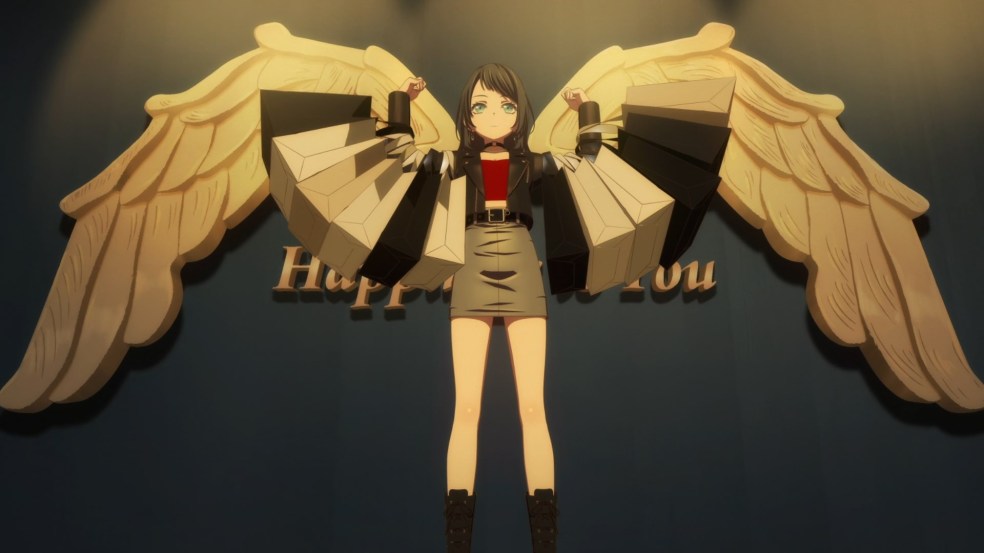
Episode 8, by the by, is not quite the event that episode seven was, but it’s nonetheless another excellent one. And, here’s a distinction I didn’t think I’d bother making for any episode of this show: it’s probably the funniest Ave Mujica has ever been. This matters, since most of that comedy comes from Umiri, finally getting some proper focus here that really peels back the layer of her cool-girl façade. Watching the CRYCHIC temp reunion in episode seven evidently really got to her, as she spends most of this episode coping with her jealousy in comically bad ways. Being given this much time to follow her also puts the lie to any notion of her being “the normal one” of Ave Mujica, given that we here learn that she almost exclusively drinks protein shakes for her meals and is Soulja Boy levels of terrible with her money. (I really cannot believe that this show features someone buying out an entire jewelry case. Retail therapy isn’t the answer, Umiri!)

She also tries to sets out on her personal goal of reforming Ave Mujica, starting with Nyamu of all people, to whom she relays her “tragic backstory” after struggling to down a single ginger ale.

Said backstory scans as more of a parody of this kind of flashback sequence than anything. All we get is that Umiri was in a band when she was a bit younger but was bossy enough that everyone was put off by it and left her stranded on stage during what was supposed to be an important concert. That’s why she’s like that: burned once for being too pushy, she went to the opposite extreme of far too hands-off, to the point of seeming untrustworthy (something Taki points out to her, early in her half of the episode). It tracks, but the droll undercutting of what’s rapidly become a trope in this relatively young genre is pretty funny, and shows that Ave Mujica isn’t all doom and gloom. (Nyamu is similarly unimpressed, and reacts to the story with a dry “wow, how sad” while inspecting her nails.)

All of this is relative, of course, because the “funniest” episode of this series does nonetheless open with a dramatic headspace sequence in which Mortis screams that she doesn’t want to die. The whole first half of the episode is actually pretty fucking dire, with all of Umiri’s stuff being in the latter half. Things start out decently enough, after the OP at least, but we’re reminded of the screaming Mortis pretty quickly when a nostalgic karaoke outing for Sakiko and Mutsumi turns into—well, it turns into something.

Intercut with that scene is one where Nyamu runs into Minami Mori, Mutsumi’s mother. Minami is, if it were not already obvious from prior episodes, a real piece of work. She describes her own child as a monster, “acting without realizing it,” but so talented she could outshine Minami herself if she put her mind to it. The Mutsumi-Mortis System’s expressiveness is not in question, but, just to put the tiger on the table here, it is pretty appalling for someone to be saying all of this about her own child. Worse, Mutsumi and co. have clearly internalized all of this, because the scene keeps cutting back to Mutsumi, Mortis, and Sakiko, arguing over whether CRYCHIC or Ave Mujica should reform. At some point, we’re locked out of seeing the objective events of the conflict entirely, Mortis’ desire to get Ave Mujica back together so she’ll have some reason to continue to exist is batted aside by Mutsumi’s unwillingness to let go of CRYCHIC. Sakiko just wants her friend to stop hurting, and she promises a lot to make that happen, but Mortis raises the idea that Sakiko doesn’t really even know who her friend actually is. She claims that the entire system has been a revolving cast of personalities who emerge and dissolve to fit the ongoing situation this entire time. Mortis and Mutsumi are exceptions to this rule, not the norm. We have some reason to be a bit skeptical of Mortis’ specific narration of events, but certainly, whatever good intentions might sit at the heart of that narration are discarded when Mutsumi seems to do to her what she did to Mutsumi back in episode three. There is a lot of internal strife here, and it’s hard not to feel for the both of them.

We do not see the results of the argument, the next time “Mortis” shows up, it’s toward the end of the episode, and the two halves thereof unite here. You may have noticed that, terrifyingly enough, Umiri and Mortis are actually aligned in goals at this point. After Nyamu half-heartedly promises to get back with AveMuji if and only if Umiri can get Mutsumi as well, Mortis is the first person to jump at the call. (Or is she? I’ve seen some theorizing that this last scene actually features Mutsumi pretending to be Mortis. Something to keep in mind as you read on.)

Mortis, you may recall, can’t actually play guitar. Thus, the episode ends with Umiri teaching her, delivering—in an episode where she’s otherwise a complete goofball and impossible to take seriously—probably her best line in the entire show so far, one that’s heavy with connotation and charge, given the whole doll motif this series has been almost obsessively fixated on since its opening minutes.

What is it with the girls in this show pulling out the exact kind of raw line that works as an armor-penetrating seduction bullet on other queer girls with mental problems?

She is, furthermore, rebuked by narration: from Uika, her first lines of any substantial length in three whole episodes. A doll, she says, will always be just that. Cue “Georgette Me, Georgette You.”

I’ve seen some concern about Ave Mujica potentially not having enough time to tie up all these loose ends, but even accounting for the fact that there are the live shows, band stories in the gacha game, and so on to look forward to, there are still five more episodes of this anime, two-ish hours of footage that could contain just about anything. Ironically, I think about the only danger the show is actually in is simply being misunderstood. Not many anime so much as approach the studied character dynamics at play here, especially those within the Mutsumi-Mortis system. As for the rest, the stage is open with possibility, and it is not over until the curtain drops. Episode 9 is called “If you leave, I shall not live.” Terrifying! I can’t wait.

Flower and Asura – Episode 6 – 7

Episode 6 sees Hana choose her selection for the NHK Cup. This is a bigger deal than it might sound, since doing so requires convincing her teacher of the passage she wants to read. Still, with everything considered, she finds one that she enjoys and which suits her. On her side of the story, everything is honestly going pretty well at the moment. Similarly, while Natsue is having more trouble than her, she’s still at least making progress on her script. It’s actually pretty incredible how much air the show can put into her script reading, given that her script is just a food ad. (It also gives us this, which, as a writer I must say I deeply relate to.)

The other end of the episode is the more interesting one here. For the first time we focus on following Matsuyuki [Yamashita Seiichirou], who we learn has a difficult home life with overbearing parents that expect him to follow in their footsteps as a doctor. He doesn’t actually seem terribly interested in doing that, and there is thus a clear central tension there, but from what we see here, he mostly acquiesces to their wishes at least face to face. Similarly, when Shuudai asks him to pen a drama script—not a small task!—he accepts with no apparent hesitation. It’s not wholly clear what Matsuyuki actually wants, although his appreciation for Hana’s readings to children and the possibly covert contact he keeps with his siblings in spite of his parents’ opinion that they’re “failures” provide some clues. There’s a clear good parent / bad parent contrast too, with Matsuyuki’s father caring for him mostly as a successor and nothing more, whereas Hana’s mother is openly proud that her daughter has made friends and found a passion.

Episode 7 spells Matsuyuki’s situation out more clearly. His older sister, a poet, left home and left him behind. This is something that clearly rests heavy on his mind, and it influences the script he’s agreed to write very heavily. It’s very interesting to me that within the drama, he writes three characters, one of whom is a girl whose parents expect her to become a doctor, but who wants to be a poet. He’s merged himself and his sister into one person. Any eggy questions this raises aside, it’s also a pretty solid bit of character building on the show’s part. He clearly admires his sister for walking away, and that admiration creeps out of him in a way that’s so unsubtle that even the other characters pick up on it by episode’s end. We also get to learn that Hana is a surprisingly fantastic actor when she plays the poet in the script. The show is cheating a little more than in the recitations here—a lot of the subtler visual characterization—that Hana has is replaced when she gets into character—but still, it’s great overall, and Hana’s performance in the climactic beach scene of the drama would be worth the price of admission for episode seven all on its own.

I like this show overall. Quite a lot, actually. But if it’s been missing one thing, it’s much in the way of stakes, aside from the looming promise of the NHK Cup. We get some of them here for the first time when it’s revealed that a meeting of Broadcast Clubs from across the country is on the horizon. Described as a “joint practice” session, this provides the show with an excuse to rejoin our main cast with Shura Saionji, the then-child actress whose recitation so inspired Hana as a child herself. The path we’re on here is obvious, in that Shura Saionji is being set up as essentially the villain of the piece. Any kvetching about the lack of stakes is admittedly partly a circumstantial complaint—anything would seem lacking in stakes airing in the same season as Ave Mujica, which manages to make its source material feel like genuine life or death—but I want Hana’s talent to be truly tested, and I want it to mean something if she’s to come out on top. To that end, the introduction of an antagonistic figure of some sort might just be exactly what the show needed. We’ll have to see.


A bit light on images this week, but hopefully that’s fine with everyone. Once again, I do ask that if you liked the article, consider dropping me a donation. Every penny helps.

To help compensate the lack of images in this article, go grab a drink from the oeosi machine as your Bonus Thought of the week.


Like what you’re reading? Consider following Magic Planet Anime to get notified when new articles go live. If you’d like to talk to other Magic Planet Anime readers, consider joining my Discord server! Also consider following me on AnilistBlueSky, or Tumblr and supporting me on Ko-Fi. If you want to read more of my work, consider heading over to the Directory to browse by category. If you’re looking for me to watch a specific show, watch this space. I am planning to reopen commissions in the near future.

All views expressed on Magic Planet Anime are solely my own opinions and conclusions and should not be taken to reflect the opinions of any other persons, groups, or organizations. All text is manually typed and edited, and no machine learning or other automatic tools are used in the creation of Magic Planet Anime articles, with the exception of a basic spellchecker. However, some articles may have additional tags placed by WordPress. All text, excepting direct quotations, is owned by Magic Planet Anime. Do not duplicate without permission. All images are owned by their original copyright holders.

Twenty Perfect Minutes: BanG Dream! It’s MyGO!!!!! Episode 13 – The Only One I Can Trust Is Myself

Twenty Perfect Minutes is an irregular column where I take a look at a single, specific anime episode that shaped my experience with the medium in some way, was personally important to me, or that I just really, really like. These columns contain spoilers.

This column contains additional spoilers for episodes 1-5 of BanG Dream! Ave Mujica.

This column is a companion piece to the 2/2/25 edition of The Weekly Orbit. They can be read independently, but make more sense together.


“Because….you seem like you’re about to break apart, Sakiko.”

No one ever would, but if someone were to ask me what the biggest whiff of my career was, it was far and away not covering BanG Dream! It’s MyGO!!!!! while it was still airing. I wrote a little about it, but not nearly enough. Hilariously, in that article, I call the series “fine,” and mostly gloss over Togawa Sakiko as a character except in how she relates to Tomori. Readers with long memories will recall it actually took me until last year to even finish the damn thing. I can’t defend my own lack of taste there, but I’ve certainly come around since then. (And to anyone who thinks I’m overrating the hell out of one or both seasons of this series, well, you’re not going to come away from this article with your mind changed.)

So, think of this as making up for lost time. As I’ve watched Ave Mujica, MyGO‘s direct sequel and a significantly darker take on (and inversion of) some of MyGO‘s same themes, I’ve felt compelled to revisit the origin story of that season’s eponymous band. With the benefit of hindsight, this feels like doing an autopsy. Anyone caught up on Ave Mujica as of the time of this writing knows that Ave Mujica themselves have broken up. If they get back together, it probably won’t be for a while, and it probably won’t be in the same way. So in hindsight, the first episode they appear in, MyGO‘s thirteenth (which is essentially just Ave Mujica episode zero), feels like the only real example of Ave Mujica as Sakiko, their founder, keyboardist, and composer, intended them to be. Sakiko’s unwillingness to compromise on her vision is one of a number of factors that led to the band’s eventual dissolution, but really, we should have seen this coming.

I mean, it’s kind of right there in the title, isn’t it?

The episode actually opens, at least after a brief and ominous prelude, by focusing on MyGO‘s own core cast. This only makes sense, It’s MyGO!!!!! the band are MyGO‘s main characters, and this is the immediate aftermath of their moment of triumph. Things are, for once, relatively clear, and the anime’s opening song is as clear and shining as the sapphire sky in its visuals. Of particular interest to us in this first half of the episode is a scene between Soyo and Tomori on the bridge near the latter’s home. Soyo says plainly that initially, when they were both members of their previous band CRYCHiC, the emotional rawness of Tomori’s lyrics was never something she was entirely comfortable with. But now, she says, she realizes the emotions expressed in those lyrics weren’t Tomori’s alone. They were hers, too.

Through Tomori’s music, she and Soyo are able to relate to each other. This of course is MyGO‘s last great expression of its thematic core, music as a tool of communication, openness, and honesty. In this, MyGO is overall not entirely dissimilar to the show that replaced it as the girl band anime of the moment the following year, Girls Band Cry. (A fact both franchises took notice and advantage of.) The two have one major difference though, Girls Band Cry wraps its story up around the time that main band Togenashi Togeari’s members begin to truly understand each other, and in this way it’s actually fairly straightforward. (Not even remotely a knock on it, I must stress.) MyGO does not do this. It knows it has to set the stage for its successor, and it knows that it has further work to do.

Thus, when Tomori attempts to reconcile with the last former CRYCHiC member she’s yet to reach out to, it doesn’t go nearly so well, and she finds Sakiko, her former bandmate, holed up in her school’s piano room banging out the sinister classical music like the Phantom of the damn Opera, a final indication, if anyone really needed one, that this is not going to all work out so neatly.

After Sakiko coldly brushes Tomori off, Anon, the somewhat airheaded guitarist of MyGO, attempts to cheer Tomori up by taking her out and about. At a planetarium, they run in to Uika, who Tomori has met before but doesn’t really know. The three have a nice chat, although after Uika leaves, Tomori notes that it’s odd that she calls her by her name, given that Tomori never told her it. All of this is significant because immediately after this conversation, Uika gets in a black cab, and is driven to the first night of her new job: the vocalist for Ave Mujica.

Again, hindsight makes two things really obvious: one, we almost immediately flip the “music is a tool of honesty and open communication” thing on its head. Sakiko’s plan for Ave Mujica requires deliberately obfuscating everything about its members, naturally including Sakiko’s own involvement. As far as she’s concerned, this is her show, and the rest of the band are actors within it. Which leads us to two: this band was never going to stay together. It’s at a fairly tame level here, but even this early on it is very obvious that Ave Mujica do not really “get” each other. Nyamu records behind-the-scenes footage on her phone, which Sakiko confiscates since if it ever got out it would destroy the band’s mystique.

There’s also this little exchange which….honestly, good question?

Nyamu also directly mentions rhythm guitarist Mutsumi’s famous parents, something she’s insecure about to put it very mildly, while Mutsumi ignores her and continues stone-facedly practicing her guitar. All of this was easy to dismiss as light bickering during the episode itself. Five episodes deep into Ave Mujica, where Mutsumi has retreated into herself, Nyamu has publicly unmasked the entire band, Uika’s obsession with Sakiko is starting to bubble to the surface, and Sakiko’s own self-loathing is at an all-time high, it reads as some truly spooky foreshadowing. This is also where the episode gets its title, upon presenting the girls with their masks, Sakiko says that on stage, the only person one can trust is themselves. A little under halfway into Ave Mujica, we can see how that attitude worked out.

And yet, for all that, the closing minutes of this episode are still such a trip. Ave Mujica are introduced to the world with a stage play about dolls discarded by humans who come to life under the light of a certain moon, and following that, a grandiose, fuming fire of a debut tune named after the band itself. Obviously, the idea of the discarded doll reflects back on Sakiko herself, but Ave Mujica’s audience have no way of knowing that. To them, and really, to us, while we’re under the anime’s spell, Ave Mujica’s purple and red gothic smoke is something enticingly dark and obscure.

This is the first and best argument for the exact opposite of MyGO‘s own point of view. Maybe “communicating your feelings” is secondary to putting on a good show, given that all of these characters are, you know, in a band. That’s certainly what Nyamu thinks, and it’s why, a third of the way into the Ave Mujica anime, she asks if the band even needs to be a band. She’s probably not entirely right to suggest that even in-context, and hell, Ave Mujica’s actual music is some of the absolute best that’s ever come out of girl band anime as a format, but there’s a grain of truth in there. We are all at least a little complicit, because we clearly love the drama, and the drama is why, both on a Watsonian and Doylistic level, the music even exists to begin with. This episode was our first hint of how truly toxic this story would get, and far from being taken aback—checking on this stuff is one of the few things reddit is useful for—people wanted things to get worse. And, fair play to Nyamu’s point of view, they did! And it’s really only seemed to raise the show’s esteem in the eyes of its audience. The series has given us exactly what we asked for. As a production, it’s realized it doesn’t actually need the music of the group itself to capture our imagination and attention.

I resurrected the Twenty Perfect Minutes name to talk about this episode because I do really think the seeds of Ave Mujica the series, probably the best thing airing right now, really start germinating here. But admittedly it’s an uneasy fit for what this column is about, to the extent that it ever had a specific, rigid format. Ideally, these episodes should stand out starkly from the anime they’re part of. This much is definitely true of “The Only One I Can Trust Is Myself,” but because it’s in large part a torch-passing to the Ave Mujica anime proper, it feels a bit like cheating. And since that series isn’t over yet, I have no definitive thesis or grand prediction to make. Some forecasts feel safer than others, especially with the sheer amount of ancillary text surrounding the series (the ARG for example), but anyone who says they know where Ave Mujica is going to go is lying to you.

And right now the “myself” I’m choosing to trust in is my theory that Uika is a lesbian, but we don’t need to worry about that for right now.

But, I did build in the caveat that sometimes this column is just about episodes that I really like, and I really fucking like this episode. I like its starry, clear opening half, where it feels like everything’s been resolved and anything is possible in the best way. And—this is bad of me—I love its second half, where it becomes clear that anything is possible in the worst way. I really like more than one episode of both of these seasons, in fact. (Off the top of my head I could probably do one of these on both the third and fourth episodes of Ave Mujica, if I wanted to. And as for MyGO, my first impressions column basically already is about its third episode. I’d be remiss to not mention that the very first hints of these themes are present even there. After all CRYCHiC is only founded because of a miscommunication, when Sakiko mistakes Tomori’s diary pages for song lyrics.) Will I do any of that? Who knows. It’s been three whole years since the last TPM column, so I’m clearly not exactly in a hurry to crank these out. But, like I said, I’m making up for lost time. To me, this episode is really special, and everything that’s happened since has only made it moreso.

This is Ave Mujica in the brief, shining moment when Sakiko was still in relative control. Before the inevitable clash of personalities tore it all apart. This is about as close as she ever gets to being genuinely cool, in fact, but even she seems to know that it can’t last. One of the very first things she does in this episode, when recruiting Uika to join the band, is declare that the weak version of herself is dead, a completely untrue statement that nonetheless sounds like irrefutable fact when she says it. Her very last action in the episode, in all of MyGO, in fact, is to icily suggest that she needs to come down from the stage high of Ave Mujica’s triumphant, cult-making first concert. She changes back into her everyday clothes and takes a public train back home, a dingy little place with a small forest of beer cans dotting the floor. She grimaces, she sneers a greeting to her “rotten” drunk of a father. If you didn’t understand before where her need to be in control, to portray herself as this theatrical, literal puppet-master came from, it hits you all at once. And then, just as you’re processing the thought, it ends.


Like what you’re reading? Consider following Magic Planet Anime to get notified when new articles go live. If you’d like to talk to other Magic Planet Anime readers, consider joining my Discord server! Also consider following me on AnilistBlueSky, or Tumblr and supporting me on Ko-Fi. If you want to read more of my work, consider heading over to the Directory to browse by category. If you’re looking for me to watch a specific show, watch this space. I am planning to reopen commissions in the near future.

All views expressed on Magic Planet Anime are solely my own opinions and conclusions and should not be taken to reflect the opinions of any other persons, groups, or organizations. All text is manually typed and edited, and no machine learning or other automatic tools are used in the creation of Magic Planet Anime articles, with the exception of a basic spellchecker. However, some articles may have additional tags placed by WordPress. All text, excepting direct quotations, is owned by Magic Planet Anime. Do not duplicate without permission. All images are owned by their original copyright holders.

The Weekly Orbit [8/5/24]

The Weekly Orbit is a weekly column collecting and refining my more casual anime- and manga-related thoughts from the previous week. Mostly, these are taken from my tumblr blog, and assume familiarity with the works covered. Be wary of spoilers!


Hello, anime fans! I don’t have much to say this week, so I won’t belabor the point. Let’s get into things.


Anime

Mayonaka Punch – Episode 4

In a development I definitely wouldn’t have predicted even a week ago, the title of “first anime to make me cry this season” goes to Mayonaka Punch.

This is very different in tone, structure, and even subject matter to every prior episode of this show and, judging by the previews, probably many of the later ones, too. Rather than focusing on the main group, this is a spotlight episode about Fu, probably the least-focused-on member of the group so far, and an old friend of hers named Aya. It’s much more poignant and heartbreaking than funny, and I think MayoPan, somewhat surprisingly, manages to make this massive shift in mood completely work.

Before now, the series hasn’t really grappled with what it means to be a vampire. It’s been an obstacle or inconvenience or a role that comes with a set of rules or even a prop for some of Masaki’s videos earlier in the series. With this episode though, MayoPan drills down on one of the oldest tropes in vampire fiction; the tragedy of immortality.

Fu met Aya when the latter was, going by her appearance, roughly a high schooler. She got Fu into western rock and pop music, and the two played music together, with Fu singing and Aya providing guitar. Aya eventually gets the idea that Fu is such a good singer that they could even go pro. Fu knows—and Yuki tells her this much—that this cannot possibly work. She can’t go out in the sunlight and doesn’t age, so people will start talking at some point. The entire thing is a foolish dream, and Fu knows this. But she can’t bring herself to tell Aya, and she ends up stringing Aya along right up until the very moment that they’re supposed to debut as a duo on an outdoor stage. The sun catches her outstretched hand, which briefly alights, and scared and confused, she runs away.

Back in the present, Masaki finds out about all this from the other vampires and gets it in her head that she should record Fu singing covers. Fu is initially very reluctant, but after a somewhat strained heart to heart she ends up seeking Aya out upon learning that she moved to New York some years ago. Then, upon meeting a friend of hers, the episode delivers its solemn last twist; Aya is dead. Fu will never see her friend again.

All of this loses something in the retelling, but in the moment it’s really, truly heartwrenching. (I love Masaki and Fu’s conversation, too. Fu goes back to this idea several times that she doesn’t deserve to sing, since she abandoned her friend, but Masaki contends that there’s nobody who doesn’t deserve to do the things that make them happy. There’s something really powerful in that, and I think it’s a theme the show will come back around to.) Fu makes a kind of peace with Aya’s passing, and the episode has a semi-happy postscript in that she does end up singing for the channel, pouring her passion into a new version of her dream in her friend’s memory, but it’s definitely bittersweet as opposed to just straight-up happy.

With this episode I think Mayonaka Punch has firmly placed itself in roughly the same category as Zombieland Saga, another show about undead entertainers that is fully willing to mine that status for both comedy and pathos. ZLS was, until now, a one-of-one, so I’m really happy to see something picking up its torch in this way. I don’t know if it’ll ever touch this territory again, but I’m glad that it did. Not only does this do an amazing job of making Fu immediately one of my favorite characters, it’s just also a frankly incredible piece of character work top to bottom, a story so self-contained that it’s almost a great anime all on its own.

Wistoria: Wand & Sword – Episode 4

Full credit: giving Will literally any other motivation beyond his vague crush on a character who’s barely on screen is probably a good move, and overall I liked the tavern showdown scene at the end of this episode, since it was the first time in this entire series that it has felt like there’s something riding on anything that’s happening. Also, hey, Wistoria recognizes that racism is bad! The subject is handled pretty poorly and with all of the inherent problems of the “fantasy racism” proxy, but at least it knows it’s bad. That’s something. That’s more than you get from some fantasy anime. Also we have our first actual arc set up now, which is good, too. Maybe I’ll end up liking this show by the time it ends after all! Who can say?

The Elusive Samurai – Episode 5

I was a little worried after last week but we fully bring it back here with a return to properly interesting visuals and a new character to round out the cast. The new guy, the master thief Genba [Yuki Aoi], I quite like him! It’s interesting that he’s something of a foil to Tokiyuki himself and how the series plays that up by having him actually morph into Tokiyuki with his magic mask in the last scene here.

Makeine: Too Many Losing Heroines! – Episode 4

A lovely and lightly meta episode this week. Let’s ask a question, does being a boy prevent Nukumizu, our lead, from being one of the “losing heroines” of the title? I would venture—even setting aside shenanigans from a few episodes back—that it does not. This episode sees him prematurely “dumped” by Anna as the two go through a fairly protracted series of misunderstandings as they more clearly work out what their feelings for each other actually are. Nu-kun clearly likes Anna, and I wouldn’t be that surprised if she liked him too on some level, but things are not lined up at the moment for our leads to get together. So they don’t! They’re just friends instead. At least for now.

In their final rooftop conversation—the second of the series—Anna mentions that as part of the lit club’s whole composition assignment she’s started writing, and that she also likes the books that Komari has recommended her. This is interesting to me because it’s a direct reference to Makeine’s own status a romance novel about romance novels, a romcom that is in part about how romcoms themselves tick. A lot of this episode is actually fairly somber because it’s in the midst of Anna and Nukumizu’s sort-of disassociation from each other after the latter overhears some popular girls talking about how Anna’s out of his league. The show represents this visually by repeating a key shot three times, once during an ordinary day, a second time, during all of these misunderstandings, in the middle of a downpour, and then a third time the day after the rain breaks as summer vacation lurks just around the corner. It’s a great visual trick in an episode full of them.

On that note. I read something earlier today which, to put it mildly, I did not agree with, about how considering an anime’s visuals and story separate is something only people who don’t consider the artform particularly seriously would do. A better and more true way to rephrase that sentiment, I think, would be to say that when the visuals and story work together this well, you tend to not be able to see the seams. I can only imagine how thorough the adapting process must’ve been for this series, it doesn’t seem like it’d be an easy thing to turn a light novel into an anime that’s this visually sumptuous, but Makeine keeps pulling it off.

I haven’t even talked about the whole Komari <-Tamaki-> Koto setup that is resolved in the first part of this episode and is, in some ways, a pre-reflection of what happens with Anna and Nukumizu (and their mutual friend, Anna’s crush Sousuke). It’s really quite astounding how a show that’s so simple at first blush has so many layers to it.

Bye Bye, Earth – Episode 4

As always, Bye Bye, Earth feels more like a highlight reel of its source material than a real adaptation, and as a result the story strains against awkward runs of internal narration and exposition. Nonetheless, because the setting of the series is just that odd, it’s still a compelling watch. This episode is an outpouring of odd, fascinating ideas; flower-cats that the solists test their swords on, question marks as symbols from “the age of the gods” that can render swords inert, a literal battle of the bands that sees our protagonist conscripted into a militarized marching band and sent to the slaughter.

It’s not nonsense; there’s an obvious extension of the theme of finding a place where one belongs, here, but it’s all a bit opaque. I can’t help but wish this had gotten more episodes or even just been adapted at a slower pace so it really had room to breathe. Nonetheless, it’s one of the season’s weirdest, most underrated anime, and I do think it’s worth keeping up with.

Oshi no Ko – Season 2, Episode 5

I don’t know how to explain it but watching this show is legitimately intoxicating. I need more anime where the entire cast are just complete maniacs, man. We don’t have enough of that.

Obviously, at this stage of this season’s plot, tensions are running really high as everyone has a ton of emotional investment in how the Demon’s Blade play does. The way this episode makes you feel that by plunging you into all of this huge spiderweb of entangled neuroses is just the absolute best. Half of the cast completely hate each other! Akane and Kana consider themselves rivals, obviously over Aqua, but arguably more importantly as actresses with wildly diverging styles and with a personal history that goes back to their respective childhoods. They spend so much of this episode openly taunting and seething at each other, it’s great. It is some Grade-A Toxin.

If you told me they were the eventual endgame couple I’d completely believe you. (I’d only even be skeptical because of Akasaka’s generally lacking queer representation in his works.) They genuinely look like they wanna kill each other by the end of the episode, it is the best.

This, too, is yuri.

Melt, who would be a complete nothing of a character in almost any other series, has an amazing scene here where he tries to tell off one of the other actors—who is acting like a complete scumbag, mind—only to be insulted by him because of his poor performance on Sweet Today last season, so he spends the whole episode, appropriately enough, melting under the pressure and angry with himself for lacking talent.

Aqua, of course, is trying to wring a good performance out of himself here because of his own ongoing goals. Aqua has spent a lot of these past two episodes wrestling with his demons (almost literally, given that his past life self is represented as a flickering mass of shadows) but somehow the most “ha ha, yes!” moment of the whole episode to me was him casually dropping to Akane that he plans on murdering someone and her just rolling with it. Does she think he’s just floating a thought experiment? Who knows! Akane is so fucked up that it’s hard to guess! Everyone in this show is so fucked up that it’s hard to guess!

Anime – Non-Seasonal

BanG Dream! It’s MyGO!!!! – Episodes 7 & 8

Speaking of messy, emotionally driven storytelling in a cast full of complete wrecks, hey, remember It’s MyGo!!!! ? One of my favorite anime premieres of last year? Yeah, it feels a little silly to whip out that whole subheader for a fairly short writeup but, hey, one of the anime I really liked from last year that I didn’t finish! I’m finally getting back to it! Honestly y’all, why did I ever stop? The drama, holy shit. I love every part of this show that feels like two ex-girlfriends arguing in the middle of a tumblr moodboard, which is, thankfully, much of the show.

I could write a whole article comparing Girls Band Cry‘s emotional realism to this show’s incredibly melodramatic, over the top theatricality. I don’t have that article in me today, but maybe someday.


Again, I’ll have to beg your patience with the lack of pictures again this week. Things will be hectic here at home for a while going forward, and I’m trying not to burn myself out by worrying too much over details like that. I’m also going to again gently plug my Ko-Fi, I have a doctor’s appointment in a few days and those can jumpscare a person with unexpected expenses sometimes, so it seemed like as appropriate a time as any.

I hope to see you next week. Until then, please enjoy this Bonus Thought, a shot of Komari from Makeine munching.


Like what you’re reading? Consider following Magic Planet Anime to get notified when new articles go live. If you’d like to talk to other Magic Planet Anime readers, consider joining my Discord server! Also consider following me on AnilistBlueSkyTumblr, or Twitter and supporting me on Ko-Fi or Patreon. If you want to read more of my work, consider heading over to the Directory to browse by category.

All views expressed on Magic Planet Anime are solely my own opinions and conclusions and should not be taken to reflect the opinions of any other persons, groups, or organizations. All text is manually typed and edited, and no machine learning or other automatic tools are used in the creation of Magic Planet Anime articles, with the exception of a basic spellchecker. However, some articles may have additional tags placed by WordPress. All text, excepting direct quotations, is owned by Magic Planet Anime. Do not duplicate without permission. All images are owned by their original copyright holders.

Anime Orbit: The Empathy of Invitation in Episode 3 of BANG DREAM! IT’S MYGO!!!!!

Anime Orbit is an irregular column where I summarize a stop along my journey through anime, manga, and the related spheres of popular culture over the past week.

Expect spoilers for covered material, where relevant.


Well, I did not expect to be covering this.

BanG Dream is foreign territory to me. I’m vaguely aware of the general contours of the series, both in terms of its anime adaptations and the mobile game that I believe (I’m not double-checking, so if I’m wrong you’ll have to forgive me) is the original spawning point for all this. Before two days ago, I’d never seen a single second of any of the BanG Dream anime. A friend* convinced me to give the most recent season a whirl, and I was assured it’s legible to newcomers. To be honest, I was a little resistant, mostly because It’s MyGO!!!!!, as it’s called, made the decision to drop its first three episodes as a single bundle, an increasingly-common practice that I remain undecided on where I stand in relation to.

The show, on the whole, is perfectly fine. Episodes 1 and 2 did not exactly knock my socks off, hence this being an Anime Orbit article and not a First Impressions article (although I might file it under both archives anyhow) but I thought they were pleasant enough, if maybe populated with a little too much melodrama that’s not quite to my taste. Anon [Rin Tateishi, in what appears to be her debut role], who serves as the lead for those episodes, is a fun character, being weirdly pushy and inconsiderate in a way that the show neither condemns nor glosses over but which propels the story forward in a nicely economical fashion.

More interesting than her though—at least to me—is another of the characters, who episode 3 focuses on, and in fact, takes place entirely from the perspective of. Yes, for 22 unbroken minutes, we inhabit the POV of Tomori [Hina Youmiya]. Some people will, I suspect, learn some things from this episode. Others, like myself, will already know deeply and intuitively the emotional territory explored here. The series doesn’t use the term, but Tomori is very obviously neurodivergent, and I feel comfortable going the extra step and calling her autistic. The episode inhabiting her viewpoint is, then, an exercise in empathy-as-invitation. It explains to us, without her ever saying all that much, what the show’s world and characters mean to her. She doesn’t need to say anything, we get to see it directly.

I wouldn’t go quite so far as to call the episode “important,” but it is a remarkably successful exercise. We start with her as a small child, where we see that she is more concerned with collecting rocks and “things that roll” than she is in directly socializing with other kids. (There’s a bit where she tries to give a would-be friend a bunch of pill bugs as a gift because she thinks they’re cute. This doesn’t work out as planned.)

As we see her go through life, she feels a distinct disjunct from other people. Sometimes we have to intuit that disconnection from the episode’s visual language—where Tomori often feels “crowded out” by other characters—and other times we see her diary, where she writes about this feeling in those words exactly. She’s on a different wavelength from most other people, and is keenly aware of it.

I should here pause the recap to disclose something. I myself am neurodivergent, but I will admit that I have ADHD rather than autism itself (the two are presently considered to be part of the same spectrum of alternate neurologies, and are often found together. As far as I know, I am not also autistic, although given my current material situation I’ll never be able to get tested, in any case), which might change how I read some of this.

Nonetheless, to me, this sequence of events comes across not as pitying Tomori, which would be condescending, but as simply trying to get as inside her head as possible. Even neurotypical teenagers often deal with feelings of loneliness and isolation, so when Tomori can’t connect to her peers, her loneliness feels immediate and real.

The good news is that she’s not alone for the whole episode. Tomori’s first real friend is Sakiko [Takao Kanon], who she develops a connection with after the latter sees her reaching out for a flower over a bridge and gets the mistaken notion that she’s trying to jump off. Sakiko is taken with Tomori, and her habit of collecting things (which as she grows expands to include a color-sorted crate of notebooks she uses as diaries, among other things), and after rather rudely riffling through one of her journals, finds what she assumes to be song lyrics. Tomori doesn’t correct her, and this misunderstanding is the predication on which the two eventually form a band, CRYCHIC. Tomori, naturally, as the “songwriter”, is also drafted as the vocalist.

Despite the obvious problems with this idea (and the notion that she’s kind of being yanked around, which, as a point of criticism, the episode never entirely gets past), she rolls with it, and eventually does start writing actual song lyrics. In a school performance that we see only glimpses of, Tomori floors her school’s student body.

This kind of thing, where a shy wallflower “comes out of her shell”, is a pretty typical story template for this genre of course, but MyGo!!!!! deserves full marks for making this all feel believable in such a short span of time. Indeed, the episode could itself be considered the same kind of plea for empathy that Tomori writes in her lyrics. It’s an interesting way of making you actually feel the journey of these five people, who initially have basically nothing in common aside from a vague desire to form a band, to a believably warm friend group.

But if it ended there, that would probably be too tidy. The other side to all this is that, in the aftermath of the concert, Sakiko suddenly loses interest in the band and stops coming to practice (possibly because of rude internet comments or something, it’s not entirely clear at this point). When she finally shows up again, Tomori makes an accidentally insensitive comment, and that’s that; CRYCHIC are no more. What the show really succeeds at getting across here is that sickly lightning bolt of shell-shock, where Tomori (who, again, is our POV character) can definitely tell that she said something that she shouldn’t have but can’t really think of any way to rectify the situation. And, well, ask anyone who’s been there; people are not nice to non-neurotypical people when they make fuck ups like that. Sakiko is angry, the band’s drummer, Taki [Coco Hayashi] eventually becomes very protective of Tomori. The rest of CRYCHIC mostly just seem hurt and confused.

This is all a very complicated situation, and the episode ends on that unresolved note, as the rest of the series takes place some time later (this episode is, in addition to everything else, essentially backstory for Tomori and the other ex-CRYCHIC girls). Tomori openly says that she feels incomplete somehow, an emotional beat that just absolutely punched yours truly dead in the gut. Her new school in general doesn’t seem kind to Tomori, and the show’s actual description notes that in-universe she’s given the not-very-nice nickname of “Honoeka’s Weirdo.” So the episode just ends there! With Tomori alone again. It’s a rough scene, one I’ve literally lived through, and it’s only the implicit promise that things will get better that makes this come off as realistically sad rather than a complete downer. That’s a hard thing to pull off.

It’s hard to say how, precisely, things will improve for Tomori and the other former CRYCHIC girls. But I’m confident that they will, simply because this episode is so intent on wholly inhabiting her as a character. Compassion this immediate doesn’t happen by accident, it has to be actively worked for.


*hi Josh


Like what you’re reading? Consider following Magic Planet Anime to get notified when new articles go live. If you’d like to talk to other Magic Planet Anime readers, consider joining my Discord server! Also consider following me on Twitter, Tumblr, or Anilist, and supporting me on Ko-Fi or Patreon. If you want to read more of my work, consider heading over to the Directory to browse by category. If you have any questions about this or any article, feel free to leave a comment, or pop on over to my RetroSpring and ask me there. It’s up to you!

All views expressed on Magic Planet Anime are my own opinions and conclusions and should not be taken to reflect the opinions of any other persons, groups, or organizations. All text, excepting direct quotations, is owned by Magic Planet Anime. Do not duplicate without permission. All images are owned by their original copyright holders.