AVE MUJICA at the Edge of the World

This article contains spoilers for the reviewed material, and assumes familiarity with it.


Few people nowadays know what man is. Many sense this ignorance and die the more easily because of it, the same way that I will die more easily once I have completed this story.

This is going to be a mess, so let’s start it with a question, so we at least have something to work off of.

Is a tragedy deferred a happy ending? Ave Mujica is at least willing to entertain the idea, but it’s never a clear-cut thing. Nothing about Ave Mujica is clear-cut, and the thinkpieces that will roll out over the coming weeks and months about this series might obscure how much of a rollercoaster ride it was, week to week, start to finish, in the moment. They might also obscure how wild it will keep being, as we now know—we’ll get back to this—that this isn’t the end.

To trot out the neatest and tidiest labels possible for a show that is the neither of those things, Ave Mujica is a series that deals with, among other topics; familial violence, how generational wealth drains the humanity from those that hold it, a number of different expressions of trauma and self-loathing, Dissociative Identity Disorder, and incest. All of this from a series that—despite some misguided English marketing trying to downplay this fact—is part of the BanG Dream! franchise. It, thus, is also still an anime about guitar music, at heart, a cousin of other recent genre entries like Girls Band Cry and Bocchi the Rock! (not to mention the other entries in its own series), in that it does still very much deal with a group of young girls using that music to process their traumas. The methodology is very different, and if Ave Mujica is the best of these (and I’d be willing to say that it is, even if the competition is very close), it’s not because its approach is inherently “just better”, or because more serious subject matter automatically leads to better content, but rather because it’s a logical outgrowth of what this genre was already doing. People will make their little jokes, of course: you can call it the dollposting anime, Perfect Blue for zoomers, etc. But none of these really capture Ave Mujica‘s fundamental observations and themes, and none of them can dent a show that’s this bulletproof.

All this to say, the walk from the earliest days of the BanG Dream! project to here is less extreme than it might appear at first glance. Poppin’ Party never went through most of this stuff, that’s true, but they’d absolutely be willing to throw horns at one of Ave Mujica’s concerts. The music, even when it’s not actively being heard—and it’s not heard for long stretches of this series—is both a connective tissue and a useful metaphor. If you can’t say something, maybe you can sing it.

That was the main thesis, too, of Ave Mujica‘s immediate predecessor and sister series, It’s MyGO!!!!!, effectively the first season of what becomes a two-parter here. AveMuji puts that theory to the toughest stress tests it can think of, and for a while, it seems like it might break under them. Consider that this is a band anime, and then recall that there is a gap from episode 2 to episode 7—almost half the season!—where there are absolutely zero in-show performances. Consider that this seemed at the time, given everything else going on in the narrative, more like a disband anime, an argument that Ave Mujica the group were not a good thing for anyone involved and maybe they’d all be better off apart.

It’s tempting to run through the absolute basics one more time. High school girl and neurodivergent icon Takamatsu Tomori [Youmiya Hina], and her first real friend Togawa Sakiko [Takao Kanon] form a band. This band, CRYCHIC, collapses not long after their first concert for a plethora of interpersonal reasons that are not really anyone’s fault in particular. It’s MyGO!!!!!, the first season of this show, focused on Tomori healing from this fallout with the help of both some of her old CRYCHIC bandmates and new friends alike. That group formed MyGO, title band of that season, pledging to build the rest of their lives, moment by moment, together as a band and as friends. So far, so girl band.

Ave Mujica—both the band and the show—run in the opposite direction, Sakiko attempts to put on a cold, merciless persona, and gathers a band based not on shared experiences or even particularly liking each other, but by a cynical rundown of what each member can add to the group. Sakiko’s childhood friend Mutsumi [Watase Yuzuki], another former CRYCHIC member, is added because of her guitar skills and her famous parents. Nyamu [Yonezawa Akane], the band’s drummer, is recruited as much for her looks and the flashiness of her ambidexterity as her actual chops, etc. If you’re reading this, you know all this already, so I won’t get too much farther into the nitty-gritty.

The result of all this? Probably the most seismic anime event of the 2020s thusfar. If not that, at least one that has exerted a deep and powerful pull on a certain kind of person. If you’re active on certain corners of tumblr or BlueSky you already know who I’m talking about. If not, we’ll just say: queer, gender-nonconformant, neurodivergent sorts. Which is a more formal and less fun way to say: the girlies. Ave Mujica takes the already intense emotional palette of MyGO and freezes it solid, erecting gothic cathedrals around the sharp, jagged pieces of pain and trauma that inform who we are, with a particular focus on the inherent violence of the family unit. Do you have bad parents? Mutsumi has the worst parent, a controlling, cruel stage mom who sees her daughter as competition instead of family. Furthermore, she’s plural, hosting, among others, a rambunctious protector alter who adopts the name Mortis from her stage name. From what we see, her mother treats this as a frightening burden, a sadly true-to-life read on how many singlet parents treat their plural children.

Uika [Sasaki Rico], the band’s singer, might be even worse off, the daughter of an illicit relationship between Sakiko’s grandfather and a house servant who has lived much of her life isolated from society. If this all seems rather melodramatic, I can only reiterate that that’s exactly the point, and anyone who writes the show—and honestly, much of this genre—off on those grounds is missing the most interesting artistic movement in the medium to happen this decade. More specifically, that heightened, arch theatricality has been present in the Ave Mujica project since we first knew it existed. This is a group of girls who were introduced to us as masked dolls, and who here leave us again as knights of a forgotten god. It feels a little ridiculous to criticize the series for a lack of “realism,” whether we’re referring to its literal events or its emotional palette. (And anyone who calls Nyamu and Umiri’s problems minor, even by comparison, is missing the very fact that by show’s end they’ve still willingly thrown their lot in with everyone else in the band.)

That tense, coiled sense of façade is also why it hits so hard when, in its very last episode, Ave Mujica finally lets all of that tension out. No one would walk away from this series thinking everything is neatly solved, but the finale is more concert than anime episode: 5 songs, two from MyGO, three from AveMuji themselves, all fantastic, and importantly, both bands are clearly having a blast. MyGO have the simpler story, but their sound has genuinely developed in some interesting directions, and centering a new song around Tomori’s jumbled, Jenga Tower-block poetry is never going to be a bad call.

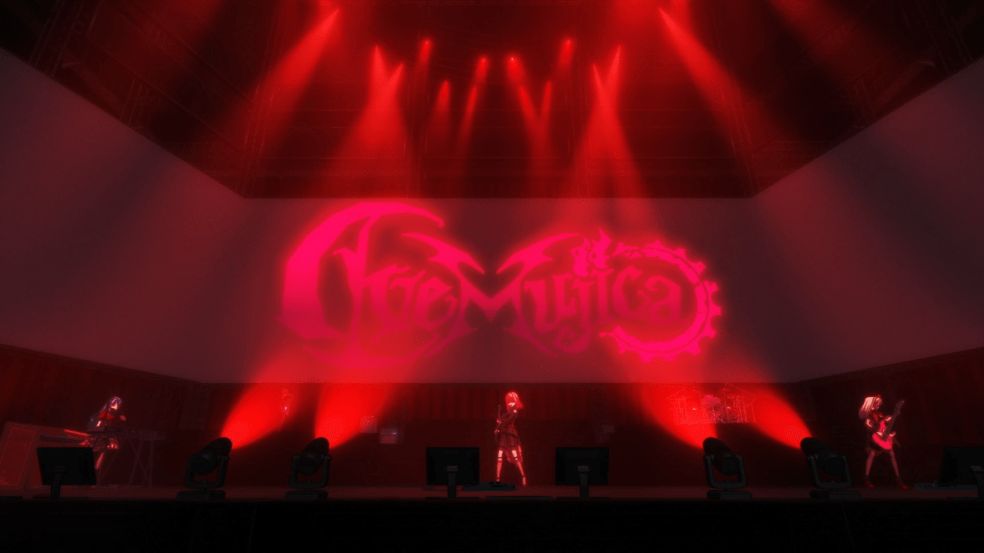
Ave Mujica, meanwhile, have somehow gone stadium-level yet again (the episode’s lack of a traditional narrative leaves us in the dark about how that happened. Season three material, most likely). Their doll motifs replaced with a warped Round Table-style knightly mythos, Uika-Doloris as an amnesiac who finds herself returning to the embrace of Oblivionis, god of forgetfulness, over and over. Sakiko literally portraying herself as a deity within the world of the scripts is sure to have ramifications going forward as a plot point, but, consider that outside of the series itself, it also easily cements her as one of the most interesting and iconic characters of her generation. It has been way, way too long since we had someone to add to the Anime Girl Pantheon, and if Sakiko needs to actively force herself up alongside older legends like Lain, Haruhi, and Madoka, that’s all the better. It fits.

(Also, let’s just be honest here. Sakiko’s god complex is probably not great for her, mental health-wise, but if it’s making her write stuff like this, well, at some point you can’t argue with the music.)

As for the literalities of the last story arc, episodes eleven, twelve, and so on, it seems impossible that this won’t all fall down around them someday, possibly even someday soon.

So again, to ask the question, can tragedy deferred really be considered a happy ending? Even a bittersweet one?

Maybe we should reframe that, and turn it back on ourselves; can you be happy, knowing you will one day die? If Ave Mujica are a fleeting dream, that’s at least partly because everything is a fleeting dream. Any comparison between MyGO‘s “a series of moments adds up to a lifetime” and Ave Mujica‘s embrace of an illusory eternity needs to understand that, despite the obvious differences between these groups of people, these are fundamentally two ways to say the same thing. Something lasts forever until it doesn’t. You take things day by day, and one day is eventually the last one. (I don’t have much to say about this series, as I’ve made clear from how I’m framing this article, but I am a little surprised how rarely I’ve seen discussion of death in relation with Ave Mujica; Sakiko’s late mother is a shadow who looms over much of the series, and there is a broad implication that Uika’s sister, the actual Uika, is no longer with us either.)

I have spoken before in my work about hating the term “messy” and how it’s often used to paper over the flaws in works that a certain stripe of critic, myself very much included, like. Something is messy if it induces strong emotion but has some kind of missed shot or some kind of frustrating loose end. To that, I refuse to apply the term to Ave Mujica, even though I’m sure many other people will. Every time I had a doubt about this show, it proved me wrong. Mortis disappearing for much of the show’s final act? She shows up in the finale to wink at the mirror and reassure us she’s fine. Umiri “not getting” a proper character arc? Her tragic backstory is presented in a funny way, sure, but it’s as legitimate a reason for trauma as anything else, this stuff isn’t a competition. Not enough songs? The last episode has fucking five of them. The fact that Hatsune is down awful for her niece? That makes their relationship more interesting, and sure, more troubling. I won’t entertain any suggestion otherwise. You can’t catch Ave Mujica off guard.

Even if you could, the curious thing about something as arresting as Ave Mujica is that after a while one’s emotional attachment stops being to the work itself so much and more the general orbit of it. The characters make such an impression on screen that they will live in our hearts forever. There is also the actual band, of course, who are fantastic, and a small spiderweb of ancillary media that enhances and sharpens the show in a number of interesting ways. None of this softens the point that the show itself is excellent, of course, one of the best I’ve ever seen, but it is worth keeping in mind.

And if you don’t agree….well honestly that’s fine? Why is talking about anime expected to be didactic like this anyway?

Isn’t all of this sort of silly? Another thing Ave Mujica has made me realize is that, despite the fact that I enjoy writing about anime, I also kind of hate doing it. (A love-hate relationship that I am all too aware is ironically somewhat reflective of what I’m reviewing.) Not because I’ve lost any love of prose or any love of analyzing fiction, but because there is this constant unending pressure to be correct about everything. (Or at least, I feel that there is. Maybe this feeling says more about me than it does anything else.) I had an inkling of this back when I reviewed Wonder Egg Priority years ago, which is why the two are somewhat connected in my mind even though the reception to AveMuji has been much more positive overall. Most of my really fulfilling engagement with Ave Mujica has not stemmed from my collective efforts of reviewing it. (Longtime readers will probably remember that we are a system ourselves, and if you didn’t know, well, surprise.) I—Ediva—have gotten much more out of talking about it with others, making of it a living discourse as opposed to a series of endlessly prolix pages where I try to prove that my opinion is the right one, man!, than almost anything else I’ve ever seen. I, Opal, have written fucking fanfiction for this series, weird and outlandish fanfiction—fanfiction I would never in a million years link here, mind you!—that has made me feel so much more connected to its world and its characters than laying them down on a table to cut them open ever could. And I, Ollie, have simply reveled in the fact that I got to feel seen. It’s very rare for popular fiction to touch on systems. I am not going to quit writing about anime—this is not my version of Brent DiCrescenzo’s To the 5 Boroughs review—but Ave Mujica has once again made me reevaluate how I really think about this stuff. How I feel about this stuff. In a way, that’s a higher compliment than anything I could actually say about it could ever be. Here’s something that sounds like a joke but isn’t: in the previews for one of the later episodes, 10 I want to say, Sakiko was shown reading Hermann Hesse’s Demian. We decided to read it too—why not, right?—and loved it. Some shows are bigger than just what’s on the screen.

None of me are saying that any of this makes analysis of the series wrong. But it does, increasingly, feel wrong for us. This is a world to be lived in, an atmosphere to be breathed, and a dream to set drift upon. I can’t pin the butterfly to the board like that. If you can, I’m not going to tell you you’re doing something wrong, but it’s not the right fit for how we feel about this show. Hence this instead of a “proper” review. Hence leaving it all up in the air.

That’s a temporary solution, but this, too, is the beautiful paradox of Ave Mujica: we can stay asleep in this dream forever—Until we wake up.


Like what you’re reading? Consider following Magic Planet Anime to get notified when new articles go live. If you’d like to talk to other Magic Planet Anime readers, consider joining my Discord server! Also consider following me on AnilistBlueSky, or Tumblr and supporting me on Ko-Fi. If you want to read more of my work, consider heading over to the Directory to browse by category.

All views expressed on Magic Planet Anime are solely my own opinions and conclusions and should not be taken to reflect the opinions of any other persons, groups, or organizations. All text is manually typed and edited, and no machine learning or other automatic tools are used in the creation of Magic Planet Anime articles, with the exception of a basic spellchecker. However, some articles may have additional tags placed by WordPress. All text, excepting direct quotations, is owned by Magic Planet Anime. Do not duplicate without permission. All images are owned by their original copyright holders.

The Weekly Orbit [3/4/25]

The Weekly Orbit is a weekly(-ish) column collecting and refining my more casual anime- and manga-related thoughts from the previous week. Mostly, these are taken from my tumblr blog, and assume familiarity with the works covered. Be wary of spoilers!


So, just to be very honest dear readers, this one was a struggle to get finished. I think I’m in the middle of a depressive period again and, without getting too into it, getting this together at all was pretty tough. I hope you can forgive the relative lack of images once again this week. (I couldn’t even do a banner image this time, as something is wrong with WordPress’s image processor at the moment, seemingly? Sigh.) I’m not sure if I’ll be back to do this again next week or not.

Ave Mujica – Episode 9

In this past week’s episode of everyone’s favorite fun time girl’s band party, Uika thinks about murdering her former coworker. Ain’t it nice?

At this point, I’ve sort of run out of things to say about individual episodes of Ave Mujica beyond doubling back on praise I’ve already given it. The only issue with a show like this is that saying the same things about it over and over can get a bit dry: nonetheless, I will say that the psychodrama is on point as ever this week. Uika returns, gaining some actual focus for the first time in quite a while. This pays off magnificently since, well, yeah, she does in fact get a pointed intrusive thought about throwing Mutsumi down the stairs when the two meet for the first time since Ave Mujica’s breakup. If you’re worried about Mutsumi’s safety though, you should really be keeping more of an eye on Mortis, who accidentally “kills” her in headspace this episode. (She’s probably fine. Probably. Ignore that Mortis spends the rest of the episode pretending to be Mutsumi.)

The real highlight for me is actually the final scene of the episode, where, for the first time, every single member of MyGO and AveMuji have gathered in the same place: Livehouse RiNG, naturally. This feels like an absolute tempest waiting to happen, and Nyamu gets the final word of the episode in with a visceral reaction of disgust. Not an inappropriate response to “Mutsumi” (actually Mortis) bending to Umiri’s plan to get Ave Mujica back together. When part of your show’s central narrative has been compared by its director to a “double suicide,” you have to account for these things. Next episode looks like it will be even worse. (And thus even better.) What can I possibly say at this point? It’s simply great.

Mobile Suit Gundam GQuuuuuuXEpisodes 1-3*

The ridiculously-titled GQuuuuuuX is set to celebrate Gundam’s 45th anniversary when it premieres in April, but, as is common these days, the first three episodes have been stitched together and released as a theatrical film ahead of time to build hype for the series’ premiere. I happened to have the opportunity to go see this movie—a subtitled release, no less—in theaters here in Chicago. (I went with my girlfriend and we had a lovely time. Hi, CC!)

There are obvious disadvantages to the three-episodes-as-a-movie structure, but for the most part they’re not really a huge problem with the GQuuuuuuX film. But it is notable that the first third thereof is pretty different from the rest. The opening act is a broad-strokes, impressionist what-if of the original Mobile Suit Gundam, in which behelmeted antagonist Char Aznable [Shin Yuuki] steals (this continuity’s version of) the original Gundam before Amuro ever so much as shows up. From there, the entire One Year War that makes up the original series’ plot goes wildly differently, and this culminates with Char’s mysterious disappearance at the end of the first act. Evidently flung through time, Samurai Jack-style, after a plan goes awry and he’s confronted with Some Newtype Bullshit.

I’ll admit, as someone who’s very much a Gundam neophyte, the first act here was a little bit of a tough sell. It’s excellently-directed, and the faux-retro look works shockingly well, but from what comparatively little I’ve seen of 0079 I was not super attached to Char, so him being the viewpoint character for most of the film’s buildup did not immediately excite me even if I can recognize that it was well done. Instead, it is the remainder of the film that most interests me. GQuuuuuuX here pulls off the impressive trick of drawing a direct line through the original Gundam, through the “Daicon Spirit” school of anime—that’s the zeitgeist of Gainax and her stylistic descendants, if you need a refresher—up to the present day. The most surprising thing about this is that it’s not more common: a full-color illustration that “real robot” and “super robot” are just points on a graph, it’s what you draw between them that matters.

Once we leave the original 0079 setting behind, we set off for something that is decidedly this show’s own thing, and the obvious ambition on display here clicks into place. Izuna is a burned-out space colony patrolled by Zaku in police deco, and there’s a theme of class warfare run through the whole thing. Our main characters are a schoolgirl, Yuzuriha “Machu” Amate [Kurosawa Tomoyo], driven and curious, who is eventually drawn into a world of underground mecha fighting and hijacks a Zeon test unit, the titular GQuuuuuuX. a “courier” (read: smuggler) she falls in with, Nyaan [Ishikawa Yui], her tie to that world. Joining them for the movie’s final act is Itou Shuji [Tsuchiya Shinba], a graffiti artist who’s somehow come into possession of what used to be Char’s Gundam. The movie only just came out, so I don’t want to spoil too much beyond what I already have, so instead, I’ll just say that the presentation and atmosphere here is absolutely fantastic. Especially with regard to the action, you can really tell that the Diebuster guy [Tsurumaki Kazuya] is directing this.

Manga

Destroy It All & Love Me in Hell – Chapters 1-19

The girl band golden age has coincided with toxic yuri as a subgenre—or strain, or whatever you want to call it—of girls’ love media gaining about as much attention as it ever has. This, I feel, cannot possibly be a coincidence. While the girl band characters use their medium to entangle themselves in each others’ neuroses and, hopefully at least, eventually come to some kind of resolution, the toxic yuri manga needs no such pretense and no such happy ending.

A year and a half ago, I talked about the then-seven chapters of Destroy It All & Love Me in Hell, explaining the general idea and appeal of toxic romance as I did so. My opinion has more or less not changed now that I’ve caught back up with it quite some time later. I am really just in awe of how compelling this series makes two girls ruining each others’ lives. Since that initial post, Kokoro has gone off the deep end as well, becoming obsessive to the point of forcing herself on Kurumi at one point. We’ve also met a new character, a hanger-on of Naoi’s who is enough of a masochist that she resorts to trying to bribe the girl into treating her badly. All this to say, it’s as toxic as it’s ever been. This is really more of a PSA than anything else: yes, if you want to read the girlies despairing, it has remained very good at delivering that. There’s also something to be said, though, about Kurumi’s quest to live free of expectations, and how every step she’s taken, seemingly toward that goal, has ended her right back where she started. I may review this manga when it finally finishes, whenever that will be, since I’m very interested in how this story ends.


That’s about all for this week. As always, I ask that you make a contribution if you enjoyed this column and are able to do so.

In lieu of the usual Bonus Image, have two, taken from this unofficial translation of an event from the BanG Dream! game, where Tomori says that Taki reminds her of a coffee bean. It is cute enough that I may die.


Like what you’re reading? Consider following Magic Planet Anime to get notified when new articles go live. If you’d like to talk to other Magic Planet Anime readers, consider joining my Discord server! Also consider following me on AnilistBlueSky, or Tumblr and supporting me on Ko-Fi. If you want to read more of my work, consider heading over to the Directory to browse by category. If you’re looking for me to watch a specific show, watch this space. I am planning to reopen commissions in the near future.

All views expressed on Magic Planet Anime are solely my own opinions and conclusions and should not be taken to reflect the opinions of any other persons, groups, or organizations. All text is manually typed and edited, and no machine learning or other automatic tools are used in the creation of Magic Planet Anime articles, with the exception of a basic spellchecker. However, some articles may have additional tags placed by WordPress. All text, excepting direct quotations, is owned by Magic Planet Anime. Do not duplicate without permission. All images are owned by their original copyright holders.

The Weekly Orbit [2/24/25]

The Weekly Orbit is a weekly(-ish) column collecting and refining my more casual anime- and manga-related thoughts from the previous week. Mostly, these are taken from my tumblr blog, and assume familiarity with the works covered. Be wary of spoilers!


Hello folks. It’s been two weeks, and if that makes you think “wow, you must have a ton of Girlies Being Dramatic stuff to catch up on”, you’d be absolutely correct.

Ave Mujica – Episode 7 – 8

Two weeks ago, in my long catch-up of the series, I pointed out that a number of people have asked the question: is Ave Mujica even actually a music anime? Generally speaking, that term implies some amount of actual musical performance within the body of the show itself, whatever form that may take. Ave Mujica has been very short on that up to this point, and now that we’re halfway through the series, some viewers have begun to lose their patience with AveMuji’s lack of adherence to those genre norms.

I am not one of those viewers. Nor am I particularly surprised or upset by the fact that we do get a performance in this episode. It just isn’t from Ave Mujica. Nor even from MyGO!!!!!, their counterparts and protagonists of the series’ first season. The band that sing a song—two songs, actually—in this episode are CRYCHIC. This isn’t some kind of formal reunion and it’s certainly not a flashback episode. It’s a very brief, fleeting moment shared on a stage with almost no one at all watching. It’s more group therapy than the traditional music video-esque band anime insert song.

Very, very few people ever get to eulogize the passing of their own adolescence as it occurs. Teenagers, real teenagers anyway, do not usually have the presence of mind to capture those moments in amber before they disappear forever. Sometimes, though, both in reality and fiction, it does happen, even if the people involved don’t necessarily know that they’re doing that. Here, in the seventh episode of Ave Mujica, CRYCHIC’s story comes to its conclusion. CRYCHIC are able to, for a fleeting moment, recognize that even over just the relatively short amount of time since their breakup, their lives have changed permanently. They mattered to each other, and maybe still can, in different ways, but there is no returning to that brief time together. You can, they all seem to understand, revisit that moment as many times as you want in your own head, but you can’t ever return to it. CRYCHIC is thus, in a way, actually torn down as the romantic ideal it’s spent most of the past two seasons being: it was, per the show’s own words, an ordinary band like any other. In reckoning with that, its former members can finally take the first steps to truly moving on.

How we get to that point is a long and winding road that involves Sakiko being tackled to the ground, spending long periods just sort of standing outside of Mutsumi’s house after Mortis refuses to see her, and a non-zero amount of various characters performing the MyGO Special (roughly shoving their way into someone’s current goings-on, and sometimes literally their home, to resolve an emotional conflict). In terms of overall plotting this is honestly one of the messier episodes in this subseries, but that’s not really a problem when every individual scene is this compelling. In addition to the aforementioned reunion performance there’s a lot of great tension between Mortis, Mutsumi, Sakiko, and Soyo, in various combinations throughout the episode.

The insert songs themselves are the highlight of course. To such an extent that, in a bold bit of fanservice-in-the-old-sense-of-the-term, an actual, real version of CRYCHIC, recorded a performance for The First Take, being sandwiched in between legendary art-rockers Shinsei Kamattechan and “You Broke Me First” singer/songwriter Tate McRae, a truly insane three-artist stretch that is emblematic of The First Take’s eclectic nature.

This makes any complaint about a relative (and it would be relative) lack of technical precision in the episode’s performance twice as absurd, of course. Not only do we hear MyGO practicing near the start of the episode where they sound as tight as ever, but CRYCHIC are playing for nobody but themselves. Aside from a tiny group of bystanders; Anon, Raana, and Umiri, who sneaks in midway, there’s no audience that they’re aware of, this is a purely cathartic exercise between them, and we are witness to it purely as viewers of a television program. No one is being performed for, and as if to emphasize the point, Tomori spends most of both songs singing not out from the stage but toward the rest of the band. “Scenes From An Alternate Universe Where CRYCHIC Never Broke Up” this is not.

In any case, while this is pretty clearly the brightest episode of Ave Mujica so far, and perhaps a true turnaround point where healing can begin, it’s probably going to get worse before it gets better. Umiri’s sneaking in to the performance is not a mistake, and the jealous snarl of a grimace she makes while watching CRYCHIC work their baggage with each other out must truly be seen to be believed. That’s not to even mention Uika, following there in the footsteps of the show itself, which she has spent two weeks conspicuously absent from, and very nearly makes it a third in episode eight.

Episode 8, by the by, is not quite the event that episode seven was, but it’s nonetheless another excellent one. And, here’s a distinction I didn’t think I’d bother making for any episode of this show: it’s probably the funniest Ave Mujica has ever been. This matters, since most of that comedy comes from Umiri, finally getting some proper focus here that really peels back the layer of her cool-girl façade. Watching the CRYCHIC temp reunion in episode seven evidently really got to her, as she spends most of this episode coping with her jealousy in comically bad ways. Being given this much time to follow her also puts the lie to any notion of her being “the normal one” of Ave Mujica, given that we here learn that she almost exclusively drinks protein shakes for her meals and is Soulja Boy levels of terrible with her money. (I really cannot believe that this show features someone buying out an entire jewelry case. Retail therapy isn’t the answer, Umiri!)

She also tries to sets out on her personal goal of reforming Ave Mujica, starting with Nyamu of all people, to whom she relays her “tragic backstory” after struggling to down a single ginger ale.

Said backstory scans as more of a parody of this kind of flashback sequence than anything. All we get is that Umiri was in a band when she was a bit younger but was bossy enough that everyone was put off by it and left her stranded on stage during what was supposed to be an important concert. That’s why she’s like that: burned once for being too pushy, she went to the opposite extreme of far too hands-off, to the point of seeming untrustworthy (something Taki points out to her, early in her half of the episode). It tracks, but the droll undercutting of what’s rapidly become a trope in this relatively young genre is pretty funny, and shows that Ave Mujica isn’t all doom and gloom. (Nyamu is similarly unimpressed, and reacts to the story with a dry “wow, how sad” while inspecting her nails.)

All of this is relative, of course, because the “funniest” episode of this series does nonetheless open with a dramatic headspace sequence in which Mortis screams that she doesn’t want to die. The whole first half of the episode is actually pretty fucking dire, with all of Umiri’s stuff being in the latter half. Things start out decently enough, after the OP at least, but we’re reminded of the screaming Mortis pretty quickly when a nostalgic karaoke outing for Sakiko and Mutsumi turns into—well, it turns into something.

Intercut with that scene is one where Nyamu runs into Minami Mori, Mutsumi’s mother. Minami is, if it were not already obvious from prior episodes, a real piece of work. She describes her own child as a monster, “acting without realizing it,” but so talented she could outshine Minami herself if she put her mind to it. The Mutsumi-Mortis System’s expressiveness is not in question, but, just to put the tiger on the table here, it is pretty appalling for someone to be saying all of this about her own child. Worse, Mutsumi and co. have clearly internalized all of this, because the scene keeps cutting back to Mutsumi, Mortis, and Sakiko, arguing over whether CRYCHIC or Ave Mujica should reform. At some point, we’re locked out of seeing the objective events of the conflict entirely, Mortis’ desire to get Ave Mujica back together so she’ll have some reason to continue to exist is batted aside by Mutsumi’s unwillingness to let go of CRYCHIC. Sakiko just wants her friend to stop hurting, and she promises a lot to make that happen, but Mortis raises the idea that Sakiko doesn’t really even know who her friend actually is. She claims that the entire system has been a revolving cast of personalities who emerge and dissolve to fit the ongoing situation this entire time. Mortis and Mutsumi are exceptions to this rule, not the norm. We have some reason to be a bit skeptical of Mortis’ specific narration of events, but certainly, whatever good intentions might sit at the heart of that narration are discarded when Mutsumi seems to do to her what she did to Mutsumi back in episode three. There is a lot of internal strife here, and it’s hard not to feel for the both of them.

We do not see the results of the argument, the next time “Mortis” shows up, it’s toward the end of the episode, and the two halves thereof unite here. You may have noticed that, terrifyingly enough, Umiri and Mortis are actually aligned in goals at this point. After Nyamu half-heartedly promises to get back with AveMuji if and only if Umiri can get Mutsumi as well, Mortis is the first person to jump at the call. (Or is she? I’ve seen some theorizing that this last scene actually features Mutsumi pretending to be Mortis. Something to keep in mind as you read on.)

Mortis, you may recall, can’t actually play guitar. Thus, the episode ends with Umiri teaching her, delivering—in an episode where she’s otherwise a complete goofball and impossible to take seriously—probably her best line in the entire show so far, one that’s heavy with connotation and charge, given the whole doll motif this series has been almost obsessively fixated on since its opening minutes.

What is it with the girls in this show pulling out the exact kind of raw line that works as an armor-penetrating seduction bullet on other queer girls with mental problems?

She is, furthermore, rebuked by narration: from Uika, her first lines of any substantial length in three whole episodes. A doll, she says, will always be just that. Cue “Georgette Me, Georgette You.”

I’ve seen some concern about Ave Mujica potentially not having enough time to tie up all these loose ends, but even accounting for the fact that there are the live shows, band stories in the gacha game, and so on to look forward to, there are still five more episodes of this anime, two-ish hours of footage that could contain just about anything. Ironically, I think about the only danger the show is actually in is simply being misunderstood. Not many anime so much as approach the studied character dynamics at play here, especially those within the Mutsumi-Mortis system. As for the rest, the stage is open with possibility, and it is not over until the curtain drops. Episode 9 is called “If you leave, I shall not live.” Terrifying! I can’t wait.

Flower and Asura – Episode 6 – 7

Episode 6 sees Hana choose her selection for the NHK Cup. This is a bigger deal than it might sound, since doing so requires convincing her teacher of the passage she wants to read. Still, with everything considered, she finds one that she enjoys and which suits her. On her side of the story, everything is honestly going pretty well at the moment. Similarly, while Natsue is having more trouble than her, she’s still at least making progress on her script. It’s actually pretty incredible how much air the show can put into her script reading, given that her script is just a food ad. (It also gives us this, which, as a writer I must say I deeply relate to.)

The other end of the episode is the more interesting one here. For the first time we focus on following Matsuyuki [Yamashita Seiichirou], who we learn has a difficult home life with overbearing parents that expect him to follow in their footsteps as a doctor. He doesn’t actually seem terribly interested in doing that, and there is thus a clear central tension there, but from what we see here, he mostly acquiesces to their wishes at least face to face. Similarly, when Shuudai asks him to pen a drama script—not a small task!—he accepts with no apparent hesitation. It’s not wholly clear what Matsuyuki actually wants, although his appreciation for Hana’s readings to children and the possibly covert contact he keeps with his siblings in spite of his parents’ opinion that they’re “failures” provide some clues. There’s a clear good parent / bad parent contrast too, with Matsuyuki’s father caring for him mostly as a successor and nothing more, whereas Hana’s mother is openly proud that her daughter has made friends and found a passion.

Episode 7 spells Matsuyuki’s situation out more clearly. His older sister, a poet, left home and left him behind. This is something that clearly rests heavy on his mind, and it influences the script he’s agreed to write very heavily. It’s very interesting to me that within the drama, he writes three characters, one of whom is a girl whose parents expect her to become a doctor, but who wants to be a poet. He’s merged himself and his sister into one person. Any eggy questions this raises aside, it’s also a pretty solid bit of character building on the show’s part. He clearly admires his sister for walking away, and that admiration creeps out of him in a way that’s so unsubtle that even the other characters pick up on it by episode’s end. We also get to learn that Hana is a surprisingly fantastic actor when she plays the poet in the script. The show is cheating a little more than in the recitations here—a lot of the subtler visual characterization—that Hana has is replaced when she gets into character—but still, it’s great overall, and Hana’s performance in the climactic beach scene of the drama would be worth the price of admission for episode seven all on its own.

I like this show overall. Quite a lot, actually. But if it’s been missing one thing, it’s much in the way of stakes, aside from the looming promise of the NHK Cup. We get some of them here for the first time when it’s revealed that a meeting of Broadcast Clubs from across the country is on the horizon. Described as a “joint practice” session, this provides the show with an excuse to rejoin our main cast with Shura Saionji, the then-child actress whose recitation so inspired Hana as a child herself. The path we’re on here is obvious, in that Shura Saionji is being set up as essentially the villain of the piece. Any kvetching about the lack of stakes is admittedly partly a circumstantial complaint—anything would seem lacking in stakes airing in the same season as Ave Mujica, which manages to make its source material feel like genuine life or death—but I want Hana’s talent to be truly tested, and I want it to mean something if she’s to come out on top. To that end, the introduction of an antagonistic figure of some sort might just be exactly what the show needed. We’ll have to see.


A bit light on images this week, but hopefully that’s fine with everyone. Once again, I do ask that if you liked the article, consider dropping me a donation. Every penny helps.

To help compensate the lack of images in this article, go grab a drink from the oeosi machine as your Bonus Thought of the week.


Like what you’re reading? Consider following Magic Planet Anime to get notified when new articles go live. If you’d like to talk to other Magic Planet Anime readers, consider joining my Discord server! Also consider following me on AnilistBlueSky, or Tumblr and supporting me on Ko-Fi. If you want to read more of my work, consider heading over to the Directory to browse by category. If you’re looking for me to watch a specific show, watch this space. I am planning to reopen commissions in the near future.

All views expressed on Magic Planet Anime are solely my own opinions and conclusions and should not be taken to reflect the opinions of any other persons, groups, or organizations. All text is manually typed and edited, and no machine learning or other automatic tools are used in the creation of Magic Planet Anime articles, with the exception of a basic spellchecker. However, some articles may have additional tags placed by WordPress. All text, excepting direct quotations, is owned by Magic Planet Anime. Do not duplicate without permission. All images are owned by their original copyright holders.

The Weekly Orbit [2/11/25]

The Weekly Orbit is a weekly(-ish) column collecting and refining my more casual anime- and manga-related thoughts from the previous week. Mostly, these are taken from my tumblr blog, and assume familiarity with the works covered. Be wary of spoilers!


Another week, another batch of girlies being absolutely dramatic. I’ll be honest, between the seasonals and the manga I read for this column, this might have the highest “girlies being dramatic” ratio of anything I’ve written in a long long while. I’d say in this respect at least, I’m living my best life. I hope you are too.


Anime – Seasonal

Ave Mujica – Episode 6

Every week I walk in to the torment nexus and walk out with my heart broken in three places. What a show.

Some interesting play with structure and framing this episode. At last week’s conclusion Soyo was shown discovering Mortis, and the whole scene was framed in slasher movie tones. Here, now that she has a better idea of Mortis’ whole, you know, thing, Mortis is instead framed as the angry, lost girl that she really is. I really enjoyed (and did not at all expect) Soyo actually playing along with Mortis’ whole ‘calling the doctor’ bit, it shows a pretty deep empathy that I don’t really know if we’ve seen the character express before? (It’s been a while since I watched MyGO, so I may be forgetting something.) Also, she apparently spends 3 whole days sleeping over there trying to patch things up, which, while there’s definitely a selfish aspect to her motive (she misses CRYCHiC too, after all), I still think deserves serious real one points. I don’t think I’d have the emotional stamina to spend 3 whole days consoling anyone about anything.

Full credit to Rana also, who can just intuit what’s going on with Mortis and Mutsumi without even actually being told. (She doesn’t actually go out of her way to help, though, and spends a decent amount of time this episode playing with cats. Rana remains this subseries’ most mysterious character.) Mortis actually seems to develop a bit of a crush on her, and is that a twinge of jealousy I detect from Soyo about that fact? In the tumblr version of this post I made a joke about the relationship chart this series must have, and then they just actually published one. Way to undercut my quips, Bushiroad.

I like Umiri’s brief scene in this episode. Forever the eternal mercenary, she describes the breakup of Ave Mujica as though it happened around her and not to her. And yet when Ricky Taki calls her on this, she gets annoyed. Truly the “fake ass IDGF’er” meme in human form.

The first half of this episode, I must stress, is actually pretty light by this show’s standards. So of course, there needs to be a breaking point somewhere. Here, that breaking point is between Mortis and Mutsumi, who stirs for the first time in a solid month only to find how awry things have gone in her absence. This isn’t what she wanted, and Mortis is appalled to learn so. The two have an argument in headspace, which of course to anyone outside of the Mutsumi-Mortis system’s own head just looks like an argument with herself, and she actually carries on so bad that she ends up tripping and falling in front of Live House Ring and making a huge scene, which of course a throng of anonymous busybodies are nearby to witness. It’s SO much that it would come off as contrived if the show weren’t so set on showing us how badly this is fucking over Mutsumi and Mortis. It’s hard to watch.

There is something admirable about the show’s complete lack of handholding with this kind of thing. This episode alone depicts multiple conflicts within a fully-realized mental space, a tug-of-war between Mortis and Mutsumi for their collective fate that is just profoundly sad to witness. I do wonder how legible this is to audiences who aren’t plural. Part of me is worried this series might actually be too ahead of its time for most audiences to properly appreciate.

(I’ve barely talked about Sakiko here and she is absolutely going through it up and down this entire episode. From the horrible, obviously untrue claims she makes about not caring about either band or even about Mutsumi, to the folder of sticky notes she’s gotten from Tomori over the years, to the fact that she sadly looks for another one despite telling Tomori off for them last week. To. This fucking expression, just, god.)

There’s a mostly-lighthearted interlude with Nyamu (it remains really funny that her dark secret, compared to everyone else’s, seems to just be that she’s from the sticks), but even that is twinged with her finding out about Mortis and Mutsumi’s public breakdown. The episode then ends with MyGO finding out about Sakiko’s whole extremely fucking complicated family situation. Episode 7 is entitled “Post nubila Phoebus,” “after the clouds, the Sun.” In most other contexts that would be a shining beam of hope, and maybe it is here too, but I’m fairly sure things will get worse before they get better. (Recall, we still have no idea what’s going on with Uika, just as one example, and she’s the only character from either band who doesn’t put in even a cursory appearance in this episode. Where is she!)

Flower and Asura – Episodes 2-5

I don’t usually try to predict how an anime will end before it gets there. But, by the same token, I tend to usually have at least a broad idea of what something “is doing” for most of its run. A first episode or so might need some room to establish itself, but by the halfway point of a series, one can usually figure out its whole deal with relative ease, especially if you’ve been watching anime for a while. All this is the long way around to say; I don’t get caught out by an anime very often. When I’m surprised it’s usually the addition of some new element, as opposed to something I had just outright been misunderstanding. Flower and Asura thus gets to join a pretty exclusive club with its fifth episode, and I am left to consider if I’ve maybe been underrating the show a little. (And by the time you’re reading this another episode will have aired, sigh! The unrelenting march of time.)

The gist is this: so far, Flower and Asura has largely been presented through the eyes of its main character, Hana. Hana’s insecurities and need to find a way to express herself defined the first episode or two of the series, and—perhaps this is the show’s fault, but I’m more inclined to blame myself—because of that, I had not really given terribly much consideration to the interiority of the show’s other characters. Natsue An, the snippy girl with the twin-tails, is a direct challenge to this, in her interactions with Hana she essentially addresses the viewer directly. This is the case with the rest of the cast, but the other two members’ inner lives we’ve explored to any extent are those of Mizuki, the free-spirited upperclassman that recruited Hana in the first place, and Ryouko, who, while not exactly a one-note character, has a deep interest in classic literature that aligns her nicely with Hana and Mizuki’s philosophy that recitation is primarily an art. The NHK Cup, the tournament looming in the show’s background, is to them secondary to reading what they want to be reading, and Ryouko says as much directly. Winning is not hugely important to either of them. (Certainly not to Ryouko, whose gleeful joy at the ancient drama frozen in glass by the Japanese Classics is outright described in-show as fetishistic. I feel very strongly I would get along with this character.)

Natsue is an irregularity here. She actually wants to win the Cup. As such, she’s not performing literary recitations like the characters we’ve discussed so far but rather a technical program, an altogether different thing that relies on a different skillset. Despite their different paths, Natsue is clearly at least appreciative of Hana’s talent, and, in her particularly brusque way, urges her to choose Kafka’s The Metamorphosis from among the available works to read a selection from. This is in contrast to Hana’s own desire to read from a contemporary work. (A work which in fact appears to be about a romance between two girls. Subtle.) If we’re just judging on taste, Natsue is clearly completely right; Hana’s particular timbre, especially the lower and more menacing end of her arsenal, which we know of from episode one, would lend itself very well to something as dark as The Metamorphosis. But this just isn’t what Hana wants to do, and it’s easy to read Natsue’s insistence that she do it as jealousy. It makes almost too much sense, right? Natsue, clearly someone who has very strong opinions on literature from her insistence on Hana’s selection and her denigration of the book Hana actually wants to read as shallow, would rather be doing recitation, right? I certainly read things that way. But we should stop ourselves here, because what that assumption actually is, I am a little embarrassed to say, is probably just projection.

Natsue, after an entire episode of Hana bugging her about it (including a magnetic—and also kind of embarrassing!—scene where Hana actually recites from the book she is planning to read from. In public, where the whole student body can see it), eventually explains that no, the real reason she’s so set on winning the tournament is nothing this complicated. She relates an anecdote from middle school where, in that school’s broadcasting club, an enthusiastic friend was selected to go to the nationals over her. Despite that friend’s insistence that Natsue was actually better at recitation than she was, the condescension—intentional or not—stung more than the actual failure. It has nothing to do with her specific talents and everything to do with just wanting to win in the first place.

Hana is left with the figurative egg on her face, although it’s not so bad, given that this causes the two to actually roughly get along for the first time in the entire show. Still, there’s an important point in there about not just assuming motives for this sort of thing. A point well made to both high school girls and, it turns out, anime critics more than a decade removed from high school.

All this and I’ve barely mentioned how utterly gay Mizuki and Hana’s entire relationship is. How embarrassing!

You and Idol Precure – Episodes 1 & 2

Idol anime are dead, long live idol anime.

Really interesting stuff with this show these past two episodes. Very clearly this is trying to be an “old school” Precure season in that it’s very physical and has a certain kind of comedy that’s been absent for the past couple years. Some people have been a little down on this but to be honest I’m really enjoying it, especially the return of the fisticuffs after an absence in Wonderful. (Not that that show needed them, but it’s always good to have some punching.) Our lead, Uta, alias Cure Idol [Matsuoka Misato], is probably the goofiest main Cure we’ve had in a while. I’m here for it. (That said, it seems like the blue Cure is going to have A Somewhat Sad Backstory and if I know myself I’m going to probably like her most, but who knows.)

Manga

Black and White: Tough Love at the Office

In the best possible way: this is wretched.

What we have here is a yuri manga where the “girls love” is two women, Shirakawa Junko and Kuroda Kayo, attempting to just completely destroy each others’ professional and personal lives over the course of several months after they begin working together in the same department of a bank. There’s a lot of talk about “toxic yuri” in the air right now, moreso than ever before I think, but this is a pretty potent strain of the stuff. These two are bad for each other, they don’t like each other, they become psychologically obsessed with each other, and their “intimacy” consists of violent, questionably-consensual sexual encounters where they alternate between actually fucking and throwing punches and the like at each other. It’s violent! Very violent!

None of this is a complaint of course, the primal and twisted nature of these scenes—which there are really only a couple throughout the whole manga, and they’re all pretty brief—is a big part of the point. There’s an idea floated here that while these two women are both trapped within the financial system that employs them, they’re at each others’ throats. Junko is BY FAR the more vicious of the two, and once Kayo starts seeing another woman, she gets that woman, a fund manager, fired for financial fraud. And yet, when the manga ends, Junko finds herself a pawn of the shadiest parts of the company she works for, possibly for the rest of her life, despite being “successful” in the business sense (and having picked up a new partner along the way). It’s Kayo who gets off with the comparatively happy ending; she quits the company entirely, and leaves to pursue love and happiness, things more important than success and failure. It’s honestly a surprisingly romantic ending for something that’s otherwise so vicious. Of course, not for Junko, who in the final page of the manga literally vanishes into darkness to join the other behind-the-scenes power brokers who run the company and Japan’s finances in general. I guess who really “won” is a matter of perspective, but I know who I’d rather be. (And not just because I’d rather have Junko making all of those twisted, sadistic grimaces at me, but you didn’t hear me say that.)


And that’ll do us for the second week of February. As with last week, I’m going to directly request that you drop a donation if you like reading these columns. They’re my only source of income, and every penny really does help a lot.

See you next week, but before I go, allow me to leave you with this week’s Bonus Thought, a sacred legend from the old days.


Like what you’re reading? Consider following Magic Planet Anime to get notified when new articles go live. If you’d like to talk to other Magic Planet Anime readers, consider joining my Discord server! Also consider following me on AnilistBlueSky, or Tumblr and supporting me on Ko-Fi. If you want to read more of my work, consider heading over to the Directory to browse by category. If you’re looking for me to watch a specific show, watch this space. I am planning to reopen commissions in the near future.

All views expressed on Magic Planet Anime are solely my own opinions and conclusions and should not be taken to reflect the opinions of any other persons, groups, or organizations. All text is manually typed and edited, and no machine learning or other automatic tools are used in the creation of Magic Planet Anime articles, with the exception of a basic spellchecker. However, some articles may have additional tags placed by WordPress. All text, excepting direct quotations, is owned by Magic Planet Anime. Do not duplicate without permission. All images are owned by their original copyright holders.

Twenty Perfect Minutes: BanG Dream! It’s MyGO!!!!! Episode 13 – The Only One I Can Trust Is Myself

Twenty Perfect Minutes is an irregular column where I take a look at a single, specific anime episode that shaped my experience with the medium in some way, was personally important to me, or that I just really, really like. These columns contain spoilers.

This column contains additional spoilers for episodes 1-5 of BanG Dream! Ave Mujica.

This column is a companion piece to the 2/2/25 edition of The Weekly Orbit. They can be read independently, but make more sense together.


“Because….you seem like you’re about to break apart, Sakiko.”

No one ever would, but if someone were to ask me what the biggest whiff of my career was, it was far and away not covering BanG Dream! It’s MyGO!!!!! while it was still airing. I wrote a little about it, but not nearly enough. Hilariously, in that article, I call the series “fine,” and mostly gloss over Togawa Sakiko as a character except in how she relates to Tomori. Readers with long memories will recall it actually took me until last year to even finish the damn thing. I can’t defend my own lack of taste there, but I’ve certainly come around since then. (And to anyone who thinks I’m overrating the hell out of one or both seasons of this series, well, you’re not going to come away from this article with your mind changed.)

So, think of this as making up for lost time. As I’ve watched Ave Mujica, MyGO‘s direct sequel and a significantly darker take on (and inversion of) some of MyGO‘s same themes, I’ve felt compelled to revisit the origin story of that season’s eponymous band. With the benefit of hindsight, this feels like doing an autopsy. Anyone caught up on Ave Mujica as of the time of this writing knows that Ave Mujica themselves have broken up. If they get back together, it probably won’t be for a while, and it probably won’t be in the same way. So in hindsight, the first episode they appear in, MyGO‘s thirteenth (which is essentially just Ave Mujica episode zero), feels like the only real example of Ave Mujica as Sakiko, their founder, keyboardist, and composer, intended them to be. Sakiko’s unwillingness to compromise on her vision is one of a number of factors that led to the band’s eventual dissolution, but really, we should have seen this coming.

I mean, it’s kind of right there in the title, isn’t it?

The episode actually opens, at least after a brief and ominous prelude, by focusing on MyGO‘s own core cast. This only makes sense, It’s MyGO!!!!! the band are MyGO‘s main characters, and this is the immediate aftermath of their moment of triumph. Things are, for once, relatively clear, and the anime’s opening song is as clear and shining as the sapphire sky in its visuals. Of particular interest to us in this first half of the episode is a scene between Soyo and Tomori on the bridge near the latter’s home. Soyo says plainly that initially, when they were both members of their previous band CRYCHiC, the emotional rawness of Tomori’s lyrics was never something she was entirely comfortable with. But now, she says, she realizes the emotions expressed in those lyrics weren’t Tomori’s alone. They were hers, too.

Through Tomori’s music, she and Soyo are able to relate to each other. This of course is MyGO‘s last great expression of its thematic core, music as a tool of communication, openness, and honesty. In this, MyGO is overall not entirely dissimilar to the show that replaced it as the girl band anime of the moment the following year, Girls Band Cry. (A fact both franchises took notice and advantage of.) The two have one major difference though, Girls Band Cry wraps its story up around the time that main band Togenashi Togeari’s members begin to truly understand each other, and in this way it’s actually fairly straightforward. (Not even remotely a knock on it, I must stress.) MyGO does not do this. It knows it has to set the stage for its successor, and it knows that it has further work to do.

Thus, when Tomori attempts to reconcile with the last former CRYCHiC member she’s yet to reach out to, it doesn’t go nearly so well, and she finds Sakiko, her former bandmate, holed up in her school’s piano room banging out the sinister classical music like the Phantom of the damn Opera, a final indication, if anyone really needed one, that this is not going to all work out so neatly.

After Sakiko coldly brushes Tomori off, Anon, the somewhat airheaded guitarist of MyGO, attempts to cheer Tomori up by taking her out and about. At a planetarium, they run in to Uika, who Tomori has met before but doesn’t really know. The three have a nice chat, although after Uika leaves, Tomori notes that it’s odd that she calls her by her name, given that Tomori never told her it. All of this is significant because immediately after this conversation, Uika gets in a black cab, and is driven to the first night of her new job: the vocalist for Ave Mujica.

Again, hindsight makes two things really obvious: one, we almost immediately flip the “music is a tool of honesty and open communication” thing on its head. Sakiko’s plan for Ave Mujica requires deliberately obfuscating everything about its members, naturally including Sakiko’s own involvement. As far as she’s concerned, this is her show, and the rest of the band are actors within it. Which leads us to two: this band was never going to stay together. It’s at a fairly tame level here, but even this early on it is very obvious that Ave Mujica do not really “get” each other. Nyamu records behind-the-scenes footage on her phone, which Sakiko confiscates since if it ever got out it would destroy the band’s mystique.

There’s also this little exchange which….honestly, good question?

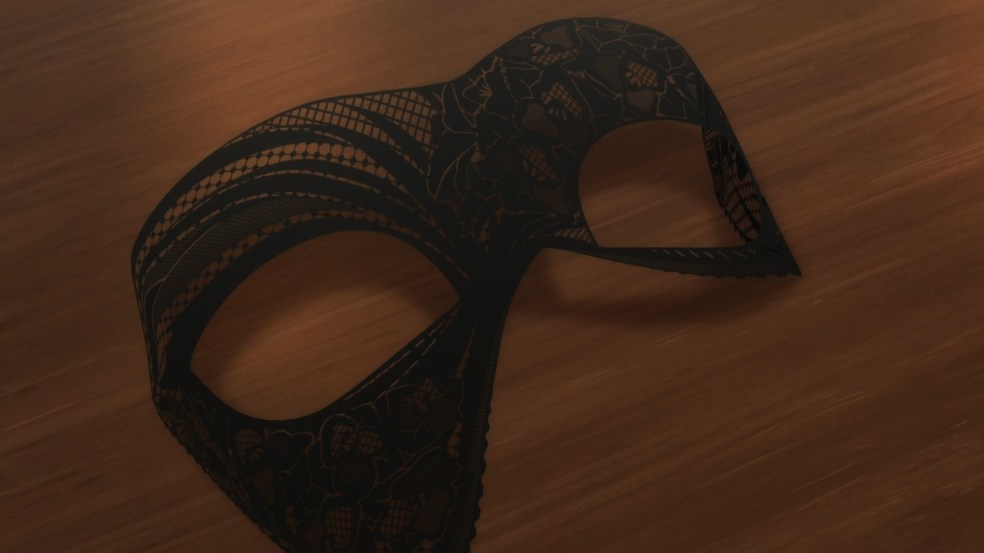
Nyamu also directly mentions rhythm guitarist Mutsumi’s famous parents, something she’s insecure about to put it very mildly, while Mutsumi ignores her and continues stone-facedly practicing her guitar. All of this was easy to dismiss as light bickering during the episode itself. Five episodes deep into Ave Mujica, where Mutsumi has retreated into herself, Nyamu has publicly unmasked the entire band, Uika’s obsession with Sakiko is starting to bubble to the surface, and Sakiko’s own self-loathing is at an all-time high, it reads as some truly spooky foreshadowing. This is also where the episode gets its title, upon presenting the girls with their masks, Sakiko says that on stage, the only person one can trust is themselves. A little under halfway into Ave Mujica, we can see how that attitude worked out.

And yet, for all that, the closing minutes of this episode are still such a trip. Ave Mujica are introduced to the world with a stage play about dolls discarded by humans who come to life under the light of a certain moon, and following that, a grandiose, fuming fire of a debut tune named after the band itself. Obviously, the idea of the discarded doll reflects back on Sakiko herself, but Ave Mujica’s audience have no way of knowing that. To them, and really, to us, while we’re under the anime’s spell, Ave Mujica’s purple and red gothic smoke is something enticingly dark and obscure.

This is the first and best argument for the exact opposite of MyGO‘s own point of view. Maybe “communicating your feelings” is secondary to putting on a good show, given that all of these characters are, you know, in a band. That’s certainly what Nyamu thinks, and it’s why, a third of the way into the Ave Mujica anime, she asks if the band even needs to be a band. She’s probably not entirely right to suggest that even in-context, and hell, Ave Mujica’s actual music is some of the absolute best that’s ever come out of girl band anime as a format, but there’s a grain of truth in there. We are all at least a little complicit, because we clearly love the drama, and the drama is why, both on a Watsonian and Doylistic level, the music even exists to begin with. This episode was our first hint of how truly toxic this story would get, and far from being taken aback—checking on this stuff is one of the few things reddit is useful for—people wanted things to get worse. And, fair play to Nyamu’s point of view, they did! And it’s really only seemed to raise the show’s esteem in the eyes of its audience. The series has given us exactly what we asked for. As a production, it’s realized it doesn’t actually need the music of the group itself to capture our imagination and attention.

I resurrected the Twenty Perfect Minutes name to talk about this episode because I do really think the seeds of Ave Mujica the series, probably the best thing airing right now, really start germinating here. But admittedly it’s an uneasy fit for what this column is about, to the extent that it ever had a specific, rigid format. Ideally, these episodes should stand out starkly from the anime they’re part of. This much is definitely true of “The Only One I Can Trust Is Myself,” but because it’s in large part a torch-passing to the Ave Mujica anime proper, it feels a bit like cheating. And since that series isn’t over yet, I have no definitive thesis or grand prediction to make. Some forecasts feel safer than others, especially with the sheer amount of ancillary text surrounding the series (the ARG for example), but anyone who says they know where Ave Mujica is going to go is lying to you.

And right now the “myself” I’m choosing to trust in is my theory that Uika is a lesbian, but we don’t need to worry about that for right now.

But, I did build in the caveat that sometimes this column is just about episodes that I really like, and I really fucking like this episode. I like its starry, clear opening half, where it feels like everything’s been resolved and anything is possible in the best way. And—this is bad of me—I love its second half, where it becomes clear that anything is possible in the worst way. I really like more than one episode of both of these seasons, in fact. (Off the top of my head I could probably do one of these on both the third and fourth episodes of Ave Mujica, if I wanted to. And as for MyGO, my first impressions column basically already is about its third episode. I’d be remiss to not mention that the very first hints of these themes are present even there. After all CRYCHiC is only founded because of a miscommunication, when Sakiko mistakes Tomori’s diary pages for song lyrics.) Will I do any of that? Who knows. It’s been three whole years since the last TPM column, so I’m clearly not exactly in a hurry to crank these out. But, like I said, I’m making up for lost time. To me, this episode is really special, and everything that’s happened since has only made it moreso.

This is Ave Mujica in the brief, shining moment when Sakiko was still in relative control. Before the inevitable clash of personalities tore it all apart. This is about as close as she ever gets to being genuinely cool, in fact, but even she seems to know that it can’t last. One of the very first things she does in this episode, when recruiting Uika to join the band, is declare that the weak version of herself is dead, a completely untrue statement that nonetheless sounds like irrefutable fact when she says it. Her very last action in the episode, in all of MyGO, in fact, is to icily suggest that she needs to come down from the stage high of Ave Mujica’s triumphant, cult-making first concert. She changes back into her everyday clothes and takes a public train back home, a dingy little place with a small forest of beer cans dotting the floor. She grimaces, she sneers a greeting to her “rotten” drunk of a father. If you didn’t understand before where her need to be in control, to portray herself as this theatrical, literal puppet-master came from, it hits you all at once. And then, just as you’re processing the thought, it ends.


Like what you’re reading? Consider following Magic Planet Anime to get notified when new articles go live. If you’d like to talk to other Magic Planet Anime readers, consider joining my Discord server! Also consider following me on AnilistBlueSky, or Tumblr and supporting me on Ko-Fi. If you want to read more of my work, consider heading over to the Directory to browse by category. If you’re looking for me to watch a specific show, watch this space. I am planning to reopen commissions in the near future.

All views expressed on Magic Planet Anime are solely my own opinions and conclusions and should not be taken to reflect the opinions of any other persons, groups, or organizations. All text is manually typed and edited, and no machine learning or other automatic tools are used in the creation of Magic Planet Anime articles, with the exception of a basic spellchecker. However, some articles may have additional tags placed by WordPress. All text, excepting direct quotations, is owned by Magic Planet Anime. Do not duplicate without permission. All images are owned by their original copyright holders.
The Weekly Orbit [2/2/2025]

The Weekly Orbit is a weekly(-ish) column collecting and refining my more casual anime- and manga-related thoughts from the previous week. Mostly, these are taken from my tumblr blog, and assume familiarity with the works covered. Be wary of spoilers!


We persist, we survive, and we thrive. A lot has happened since the last Weekly Orbit column, and I could spend this opening bit bloviating about how or why I’ve chosen to bring the column back now. The actual answer is much less romantic: for the first time in a while, I not only had something I wanted to talk about, but I had the mental bandwidth to do it. A lot’s happened over the past few months even in the specific realm of my relationship with anime (I got really into Uma Musume, for example), but the honest truth is just that I found the time and energy to get around to it. Thus, Weekly Orbit is back. At least for now. You can probably assume it will be a similarly on and off affair going forward.

That said, if you wanted to be dramatic—and who doesn’t love being dramatic?—you could point out that the last thing I wrote about in the last column before this series went on a months-long hiatus was BanG Dream! It’s MyGO!!!!! No prizes for guessing how that relates to this week’s column. Between this and the other column that will be going up later today, this is basically Ave Mujica Day on Magic Planet Anime. I cannot pretend I’m sorry about that.


Anime – Seasonal

BanG Dream! Ave Mujica

Where to even start?

What follows is a collation of two separate tumblr posts I’ve written over the past few days. A funny fact about anime—art in general, really—is that it’s always constrained by the circumstances around its production. Ave Mujica, as anyone who’s read my first impressions article or, honestly, just taken a gander at them knows, is cursed with very bad official subtitles right now. The practical effect of this is that I’ve had to wait for some brave souls (a group going by LoftMoon and a lone warrior calling themselves Nyamuchi after the in-show character, respectively) to pick up Crunchyroll’s slack before I could bring myself to actually catch up with the series.

All that is to say, I watched episodes two, three, four, and five of Ave Mujica over the past couple of days rather than the past couple of weeks. I would describe the overall effect as bulldozer-esque. It’s some of the most fun I’ve had with an anime in ages, but it’s also genuinely emotionally exhausting. At one point, I attempted to just write a literal list of the show’s ongoing events, but that in of itself got a bit out of control, so I pared it down to just these. Episodes two through four are defined by an arc in which Wakaba Mutsumi, the band’s rhythm guitarist and thus the core of their sound, does the following:

  • Flubs an interview by voicing what appears to be an intrusive thought, thus sparking rumors that the band is going to break up.
  • Freezes up on stage, sitting stone-still before the audience. Or, to invoke the metaphor we’re actually intended to see, sitting like a puppet with her strings cut.
  • Experiences a psychotic break, at which point a dissociative alter naming herself Mortis, after Mutsumi’s stage pseudonym, takes over as the primary personality, placing herself at front in what we are now aware is a system.
  • Mortis proceeds to hog the spotlight in interviews, leading to a bunch of tension with the other members, especially Nyamu. Mortis in general is flighty and theatrical. More importantly, she can’t actually play guitar. (At the very least, she claims to not be able to, and we’re not given a reason to disbelieve her on this subject.)
  • All of this, as well as Mortis’ generally confrontational nature towards Sakiko, who she claims to hate, culminates in the band breaking up. We are, at this point, four episodes in, and the band our show is named after is gone. “The dolls no longer exist.”

What is all this?

Usually, when you’re asking that question about an anime, it’s rhetorical. With Ave Mujica I’ve genuinely found myself with very little idea of where exactly it’s going to go. It’s fair to ask the question, and people have asked the question, is this even really a music anime anymore? We haven’t really gotten anything in the way of new songs, and Ave Mujica as a group, at least in the show’s narrative, are less defined by their music and more defined by what interrupts it and what grows around it.

An acquaintance has been watching the show ahead of me, and in doing so described it to me as going in more of a horror direction. My initial assumption was that they were exaggerating. Ave Mujica are a goth metal band, sure, but even considering the rich vein of drama mined by this show’s own immediate predecessor, MyGO, “horror” just seemed like a step beyond believability. And yet, here we are. To be sure, these horrors are largely in the mind, but that doesn’t really make them any less arresting. (See also Perfect Blue, clearly at least an indirect influence on this series.) Episode three, with its haunted, surreal visuals as we go directly inside Mutsumi’s mind, is the big turning point for the series. Yes, this is all “in Mutsumi’s head” and what is depicted in this scene is not literally happening. The lack of material reality does not change the fact that Mortis’ usurpation of the system is portrayed by her cute little doll form morphing into a shadow monster and eating Mutsumi. Yeah, sure, it doesn’t “actually happen,” but someone gets eaten alive in a fucking BanG Dream anime! What the hell!

This does raise the question, boring but admittedly necessary, as to whether or not Mortis’ depiction is problematic. When I wrote the tumblr version of this post I was on the fence, but having had the time to think it over I don’t really think so. Despite clearly being some kind of protector alter, Mortis is also naïve and rather kiddish. Most of the “horror” elements are framing of her own experiences or those of others reacting to her, especially Sakiko who is clearly just very unequipped to deal with this entire situation. It gives us some deliciously spooky shots, but Mortis is very clearly not actually a monster, all of this is part of the theater of the anime itself. (Still though! Episode 3! What the fuck!)

And then there’s episode five. The most recent, as of the time of this writing.

In the immediate aftermath of Ave Mujica’s dissolution, its members largely go their separate ways. Here, for the first time in a while, Sakiko gets to be the main character in her own show. Unfortunately, since that show is Ave Mujica, this does not necessarily mean she has a particularly good time.

Despite Uika’s—that’s Doloris, Ave Mujica’s vocalist, in case you’ve forgotten—pleas, Sakiko does not stay with her, where she’d been crashing for the past couple of episodes. Instead, she returns to her soul-crushing call center 9-to-5, and the abuse of her drunken father. Until, that is, her grandfather shows up, tells her he’s paid off the—I must imagine, significant—debts incurred from the cancellation of Ave Mujica’s arena tour. This is a pretty classic rich older asshole relative move, they take care of some financial problem for you so you’ll owe them. An episode one Sakiko would probably not have caved to this, but at this point in the series she’s been beaten down by the fallout from both her own bad decisions and the bad decisions of others, and so, she surrenders her agency to her grandfather. We don’t get to hear any explicit promises made, but it feels safe to say that the path forward for Sakiko, if things do not change, is a life as a physically comfortable but emotionally miserable pawn in the interminable power-play games of the wealthy.

Seeing Sakiko like this is, of course, a huge fucking bummer. At the core of it all, Sakiko is only human, but it must be remembered that she was introduced to us as an antagonistic, somewhat cryptic presence throughout the second half of MyGO. Seen through the eyes of others, Sakiko is massively charismatic—Char Aznable with a girl band, recall—but here she’s stripped of everything that makes her so. Seeing her cowed, beaten, rendered painfully clearly as just the teenage girl she actually is, is heartbreaking, a painting so sad the colors run off the canvas. She’s been reduced to a rich girl playing pretend. It hurts to watch.

All the more so because the second half of episode five reintroduces some of the MyGO cast. We get to see some of Sakiko’s past through Tomori’s memories. This person, a happy, fulfilled Sakiko in the early days of CRYCHiC’s activities, is someone that we the audience barely know. It’s difficult to even reconcile that this is the same girl who had a catastrophic falling out with the rest of that group and then spent the remainder of MyGO lurking around in the background. This is the girl who would be Oblivionis? And yet, it’s obviously so. What we are seeing—and have been seeing, this whole time—is someone who’s badly lost her way. The show’s oppressive atmosphere lets up for the first time in the parts of this episode dominated by the MyGO cast. They absolutely have their own shit going on, but compared to simply everything else the series has been so far, it’s small potatoes.

MyGO definitely paved the way for this to exist in both a sense of literal continuity and also in its particular approach to storytelling, but a lot is still up in the air, and episode five’s twin endings raise many, many more questions than they answer. Not to mention I have barely talked at all about what Uika and Nyamu have going on, those two are clearly powderkegs all their own. (One of the very few things I can say with confidence about the future direction of this show is that it will not end without them exploding.) Not that I’m complaining, mind you, the show’s intense, pulsating goth-drama is far and away its best quality. Things are almost placid when we’re within Tomori’s flashbacks, but the last parts of the episode bring us crashing back down to the depths pretty hard. I won’t say more, except that I think MyGO‘s central theme of music as a tool of honesty and communication is about to be very thoroughly tested.

One final thing: a fun aspect of being on the forever-dying tumblr is that most “active” fandoms, at least in the anime space, consist of a few dozen people batting ideas around. The result of this? There are a lot of other good posts on Ave Mujica too. So if you are not satisfied with the frankly way too long post you just read, or the even longer one that I intend to post later today, you can check out Iampiche’s analysis of parallels between characters, ouroborosorder’s analysis of parallels between this show and the series it’s a sequel to, this humorous but very much true assessment of the “girl band anime meta” by our-lady-of-haymakers, and a second post by that same person where they are just truly on some other shit that I don’t fully understand. Ave Mujica truly brings out the critic, and the chuuni, in everybody.

Sakamoto Days – Episode 4

Purely in terms of how much they can be mined for discourse in the old sense of the term, Sakamoto Days might be the least complex thing airing this season. There are zero hidden layers here, every episode is an excuse to get Sakamoto and a group of other assassins in a room, where they will fight, and Sakamoto will win. It is consistently entertaining and just as consistently absolutely nothing else. This episode’s got a fun one-off character in the form of Hard Boiled, whose whole thing is calling stuff “hard-boiled.” Also he has exploding ping pong balls. Pure popcorn TV, and I can’t fault it for that.


Anime – Non-Seasonal

Umamusume: Pretty Derby Season 2

The thing is this: everything anyone has ever told you about Uma Musume is true.

It is a ridiculous, meticulous setting where girls with horse ears compete in very serious, deadly serious races against each other for glory and the thrill of victory. Season 2 is not my favorite Uma Musume thing, that’s still the brain-scrambling New Era film, which I hope to write about someday in the not-too-distant future, but it’s very good, and it’s a really good take on the inspirational sports story formula, a vast improvement over the already pretty solid first season.

Tokai Teio [Machico]! I could kiss her. She’s the greatest prodigal runner ever. She’s our heroine. She suffers more than Jesus. The show repeats the basic plot beat of “Teio injures herself severely and might never run again” three times and somehow it actually hits harder each time. I don’t understand it, it flies in the face of conventional narrative logic, but here we are. It slaps end to end. By the end of the show I was cheering in my seat when she ran her final race.

Also of note: the story of Rice Shower [Iwami Manaka], the Assassin in Black, which is maybe the dark horse (haha) actual best story arc in this season, presented as a shy would-be contender and then revealed as a deadly spoiler who snatches a victory from, most crucially, co-protagonist Mejiro McQueen [Oonishi Saori]. All in all just really solid stuff throughout. The pacing problems inherent to having to write these stories loosely around real-life events are still here, but all told this is just an absolute blast and a huge improvement over season one. This is where I start to understand how we got to New Era.

As an aside, if you don’t follow me there you may not know that I actually livetweeted my experiences with much of Uma Musume on bluesky. I started with the Road To The Top OVA, and then the New Era movie, (although that one stalls out about halfway through for reasons that will be obvious if you read it), before going back and watching season one and season two. I won’t be doing this for the third season for reasons that will be apparent if you just scroll a bit further, but I figure I should mention this here where it’s relevant.

Umamusume: Pretty Derby Season 3 – Episodes 1 & 2

Interesting stuff.

These are just loose thoughts as opposed to more organized ones, and given that I’m only two episodes into this series I’m disinclined to re-edit them to the extent I did with some of the other stuff in this column. But the main thing that’s sticking out to me is this: a recurring fixture of this series is that you can’t compete against an idea, only the actual people on the field. Previously we see this with Teio’s fear that she’ll never be able to catch up to McQueen when she’s recovering in that show’s last arc, later on we’ll see it with Jungle Pocket and Agnes Tachyon in New Era. Here it takes something of a different form, in that our new protagonist Kitasan Black [Yano Hinaki]’s admiration of Teio is clearly constraining her in some way (probably most directly obvious during her flashback wherein she imagines Duramente, the horse who actually beat her, as Teio in full racing silks). Once Duramente is injured in the second part of the episode, this fixation almost immediately leaps to her instead.

All told this seems to be building up a somewhat more pronounced underdog story than is usual for this franchise. Also, one scene here has what I think is probably the most emotionally raw use of the vent stump (a recurring fixture of the series) that we’ve ever seen, in that Kitasan, fresh off a loss, doesn’t really say anything, she just fuckin’ hollers into it.

What all of this says about Kitasan is pretty interesting. A lot of what she does in these opening episodes is genuinely kind of offputting, which, ironically, kind of makes her more likable than she might’ve been as a more traditional protagonist for this series. I’m interested to see where the rest of this goes!


Manga

False Marigold

Interesting Taisho-period yuri with a nuanced, fraught central relationship, in which our protagonist is a young girl pretending to be her own dead brother in order to make his girlfriend, a blind girl, happy. This does not go smoothly, as you might expect, and I really like the story’s exploration of both Hana’s (the boymoder) and Lily’s (the girlfriend) internality. Both of them feel like very fully-realized people which makes it hurt all the more when they’re suffering and makes it all the nicer when things are going well for them.

Also there is a ton of hand and eye symbolism on the volume covers. Hana covering Lily’s eyes because yeah she’s literally blind but also she’s symbolically blind to the deception. (Or is she? As the series goes on it becomes apparent that Lily is sharper than Hana initially assumes. Still, it’s a nice bit of symbolism.)

I don’t have as much to say about this as I’d like to, so I might reread it at some point and take notes this time. All told though I do highly recommend it especially if you’re looking for a “toxic yuri” pickup. (True misery connoisseurs might be disappointed by a few aspects? I’m not sure.) Also if I ever see someone say that this “doesn’t count as yuri” I’m gonna slap them.


And that’s all for the big comeback piece. Hopefully you found something enlightening or just interesting somewhere in there. I’m going to make a rare direct request that, if you like my work in general and this article in particular, you drop a donation if you can spare it. It’s my only source of income, so every bit helps.

Now then, I leave you with this rare Anon W as your Bonus Thought of the week.


Like what you’re reading? Consider following Magic Planet Anime to get notified when new articles go live. If you’d like to talk to other Magic Planet Anime readers, consider joining my Discord server! Also consider following me on AnilistBlueSky, or Tumblr and supporting me on Ko-Fi. If you want to read more of my work, consider heading over to the Directory to browse by category. If you’re looking for me to watch a specific show, watch this space. I am planning to reopen commissions in the near future.

All views expressed on Magic Planet Anime are solely my own opinions and conclusions and should not be taken to reflect the opinions of any other persons, groups, or organizations. All text is manually typed and edited, and no machine learning or other automatic tools are used in the creation of Magic Planet Anime articles, with the exception of a basic spellchecker. However, some articles may have additional tags placed by WordPress. All text, excepting direct quotations, is owned by Magic Planet Anime. Do not duplicate without permission. All images are owned by their original copyright holders.

Seasonal First Impressions: Enter Oblivion with BANG DREAM! AVE MUJICA

Seasonal First Impressions is a column where I detail my thoughts, however brief or long, about a currently-airing anime’s first episode or so.


“Will you give me the rest of your life?”

God help us all, a short girl with blue hair is here to make her trauma everyone’s problem.

At the end of the final episode of BanG Dream! It’sMyGO!!!!!, the show was essentially hijacked. That series’ finale doesn’t really have anything to do with MyGO directly. Instead, it follows Togawa Sakiko [Takao Kanon], a cryptic, antagonistic presence for of much of that season and a former member of pre-MyGO band CRYCHIC, whose extremely messy dissolution still haunts that show’s cast. MyGO‘s finale made the argument that Sakiko, actually, was more haunted than any of them. Recruiting a supergroup of musicians from across BanG Dream‘s talent-overstuffed universe, she made them wear black lace face masks and gave them goth metal code names; Doloris for lead singer, guitarist, and childhood friend Misumi Uika [Sasaki Rico], Mortis for rhythm guitarist and also childhood friend Wakaba Mutsumi [Watase Yuzuki], Timoris for bassist Yahata Umiri [Okada Mei]—she of the famous “I’m in roughly 30 bands” screenshot—Amoris for capricious drummer Yuutenji Nyamu [Yonezawa Akane], and, finally, Oblivionis for herself, Sakiko, composing and on keyboard. It is their story, we’ve been promised, that BanG Dream! Ave Mujica will tell us.
Thus so established, Sakiko joined a long lineage of real and fictional masked musicians. From Slipknot to Daft Punk, from MF DOOM to KISS. Her reason for adopting a mask is, at its heart, the same as many real musicians who do so: a rejection of her “real” face allows her to become lost in persona, the old self subsumed into a dramatic, shadow-casting new self. A puppetmaster in a near-literal sense, given how her stage shows involve so much doll imagery. Welcome to her beautiful dark twisted fantasy, right?

Wrong. A driving theme here is that Sakiko is not nearly as in control of any of this—not her band, not her life—as she’d like to be. Most of this first episode, aside from Ave Mujica’s killer performance of opening theme “KILLxKISS” at the start, an interview immediately after where there is some tension between Sakiko and Nyamu, and a sequence at the end, is flashback.

Here, we learn a little about Sakiko’s life. The usage of traditional animation for some of these flashbacks is interesting. Readers may recall that Girls Band Cry used a similar technique to similar ends; to emphasize an idealization of these moments, to underscore that we’re not necessarily seeing them as they really were but rather how they felt. Ave Mujica, befitting its goth theater kid vibe, hammers the point home further by also drowning the earliest, still mostly happy memories in an amber sepia filter. More memories follow, and these get no filter and no flat animation; we learn how Sakiko’s mother died suddenly, tragically young. We see her inspired to found a band for the first time after seeing BanG Dream! veterans Morfonica in a small concert. We briefly retrace the rise and fall of CRYCHIC, Sakiko’s father losing his high-paying job at his own father-in-law’s company, and his collapsing into a broken drunk. Sakiko’s struggles to find some kind of job—any kind of job—to make ends meet for herself and her father. We relitigate CRYCHIC’s breakup, this time from Sakiko’s perspective and with a whole lot more crying in the rain, making it clear that leaving the band was just as painful for Sakiko as it was for anyone else. At one point, later in the episode and back in the present day, her father chucks a beer can at her face, giving her a noticeable bruise, and tells her to leave the house. Sakiko can’t take any of this. Thus, the mask.

All of this theater, mind you, lasts for less than a single full episode. On the stage before Ave Mujica are set to give a performance to their largest audience yet, Amoris promptly torches the entire thing, tossing her mask off and unmasking the rest of the band’s members in short order, underscoring both her status as the cast’s wildcard and her general lack of patience for Sakiko’s theatrics. There is something genuinely bold about undoing your characters’ central gimmick right at the end of the first episode, but it only matters so much. It’s true that the audience now knows of Ave Mujica’s civilian identities, but the real masks are something much less material than the flimsy lace that Amoris chucks on the ground.

The command of drama throughout this first episode is superb, but it’s fair to say that where any of this will go is still very much up in the air. Ave Mujica is a theater kid at heart, it lives and breathes drama, and drama, as we’ve seen in anime like MyGO, or, to name an even darker example something like Oshi no Ko, can keep the fire burning for a long, long time. But not forever! This upturning of a core component of the band’s—and thus the show’s—mythos is a promising start, but I do hope we get some actual character growth here, in one way or another. Sakiko’s awful home life is another factor that I do hope the show explores. It’d definitely be a lot more interesting than another rehash of the usual commercialism vs. authenticity stuff, which some of Nyamu’s antics can’t help but bring to mind, given that she’s an influencer off-stage. (Any commentary along those lines is doomed to fail anyway. Ave Mujica are a lot of things, and they make great music, but they’re not any kind of “authentic,” in-universe or out.)

That’s all hypotheticals though. The real nitpick as of now is in the subtitling. What would a girl band anime release be without bitching about the subtitles? I’m only going to touch on this, since other people have already pointed out the obvious, but Crunchyroll’s subtitles for this first episode are notably subpar, stilted in places and lacking song translations. Hopefully this will be fixed at some point, to say the least. Regardless of this glaring issue, which isn’t really even the show’s own fault, I’ve left the first episode confident that we’re in for a hell of a ride, episode 2’s title, Exitus acta probat, “the outcome justifies the deed”, is hugely promising. 11 more weeks of this! Strap in.


Like what you’re reading? Consider following Magic Planet Anime to get notified when new articles go live. If you’d like to talk to other Magic Planet Anime readers, consider joining my Discord server! Also consider following me on AnilistBlueSky, or Tumblr and supporting me on Ko-Fi. If you want to read more of my work, consider heading over to the Directory to browse by category. If you’re looking for me to watch a specific show, watch this space. I am planning to reopen commissions in the near future.

All views expressed on Magic Planet Anime are solely my own opinions and conclusions and should not be taken to reflect the opinions of any other persons, groups, or organizations. All text is manually typed and edited, and no machine learning or other automatic tools are used in the creation of Magic Planet Anime articles, with the exception of a basic spellchecker. However, some articles may have additional tags placed by WordPress. All text, excepting direct quotations, is owned by Magic Planet Anime. Do not duplicate without permission. All images are owned by their original copyright holders.