Let’s Watch UMA MUSUME – CINDERELLA GRAY Episode 10 – “The Peak”

Let’s Watch is a weekly recap column where I follow an anime for the course of its entire runtime.

For the Cinderella Gray column, new installments will be posted either on the Sunday each episode airs, or as soon as possible over the succeeding week. Expect spoilers!


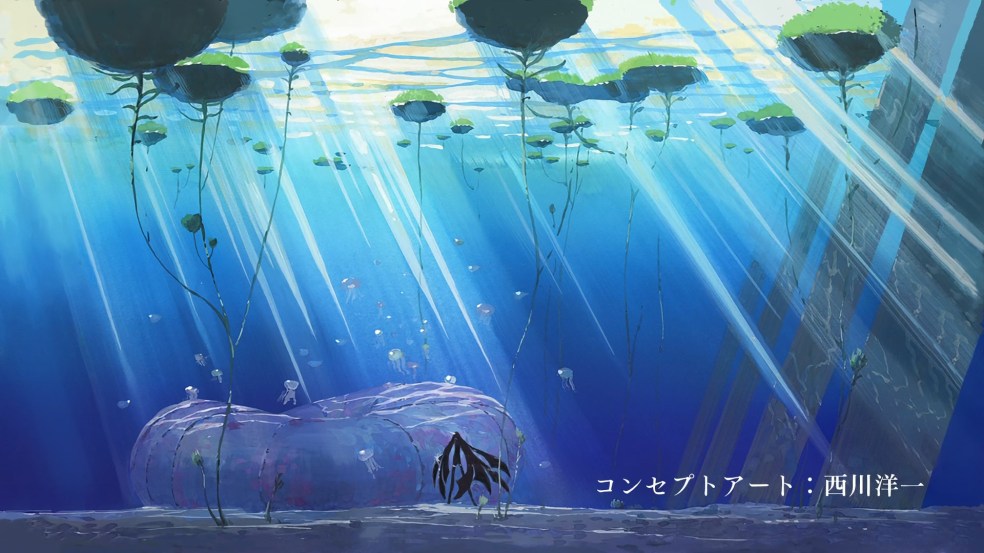
Following last week’s big fakeout, we have a more transitional and low-key turn for Cinderella Gray this week. Honestly, this is a good thing. If we were to have another big important race here, it would risk making the show repetitive (a trap its predecessor, the third season of no-subtitle Uma Musume, sometimes fell into). When we open, we find Oguri Cap in a funk, saddened that she was disqualified from what she was directly told were the “best” and most important races, she feels aimless and demotivated despite sticking religiously to her training.

There are a few factors that get her out of that malaise. One is the relatively brief race that is in this episode, and Oguri’s not actually in this one, not even in anyone’s mind. Instead, Roppei takes her to watch the Takarazuka Kinen. A plot point in some prior seasons, the Takarazuka’s lineup is determined by fan vote. The favorite is a one-off character, one Akitsu Teio. But the one who actually wins is Tamamo Cross.

Cross, the streak of blue lightning first introduced to us way, way back near the start of the season, has nonetheless been largely a background presence up until this point. She and Oguri still have not directly spoken, and seeing Cross win in person is the first time Oguri Cap seems truly aware of just what she’s up against. Despite its brevity, her from-behind win here is truly spectacular, and very much reminiscent of Oguri’s own victories.

This isn’t the only thing that puts some zip back in Oguri’s step. She also gets a phone call from her former rival Fujimasa March, making her first appearance of any real length in the series since her departure from it in episode six. Unsurprisingly, March has kept racing. What’s maybe a little moreso is that March is actually the one calling Oguri for reassurance. March is lost and without motivation too. We learn here that her dream of winning the Tokai Derby didn’t come true; she failed to even make the podium, coming in fourth, and as she calls Cap she’s on the verge of quitting entirely.

Of course, our protagonist, with her head of silver and heart of gold, is not having that from her first rival, someone who clearly still means a lot to her. In convincing March to continue racing, Oguri does the same to herself. The specific situations are fairly different of course—Oguri, if anything, is having too much success, whereas March’s anxiety is caused by her finally hitting a wall—but the emotional connection between the two makes it all make sense. Both will continue racing, even with their first dreams out of reach, March whips up a cute metaphor about moving on to the next mountain, and for a show—a whole series, really—that’s in part about staying determined in the face of whatever life throws at you, it absolutely works. (There’s also a cute sequence of cameos by Norn Ace and friends, and it’s good to know that they’re all still getting on well.)

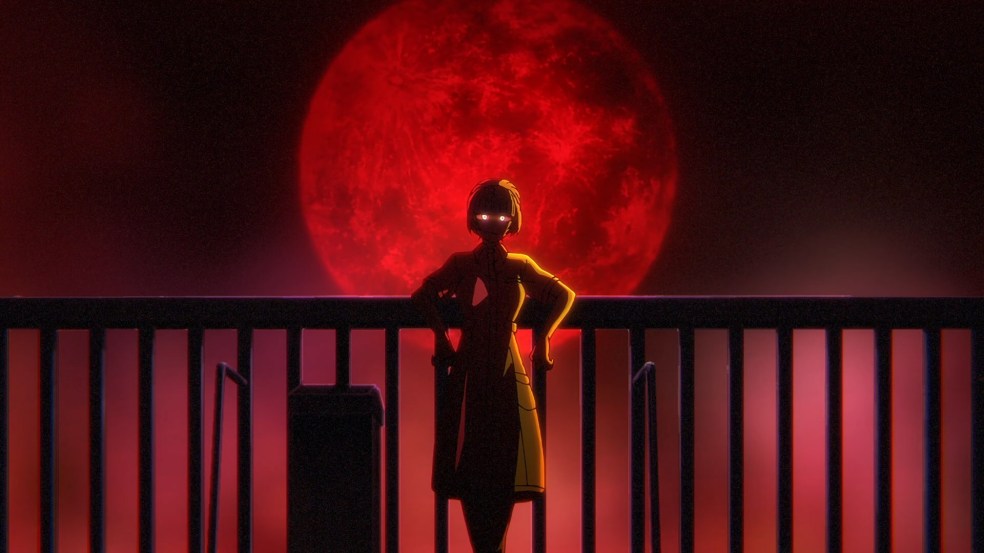
We also get a rare sequence from Tamamo Cross’s camp. Her trainer thinks Tamamo will probably be competing with Oguri for the first time in the coming Fall Tenno Sho, a G1 race (reinforced when, later in the episode, we learn Oguri is going to be running an important qualifying race for the fall G1s). Just as important to the scene, though, arguably, is that somebody clearly really wanted to draw Tamamo Cross working out. Live your truth, buddy.

My understanding is that this workout sequence is in the manga, but is not nearly as involved. I can only reiterate what I’ve already said.

The remainder of the episode is fairly lighthearted. Roppei puts Oguri and Belno on “summer vacation,” giving them a break after Oguri’s constant racing and training since arriving at Tracen. Oguri being Oguri, when given free reign to explore Tokyo, she mostly does so as a foodie, spending much of the episode’s second half on a date with Belno, in a blissful heaven of hamburgers, tornado fries, crepes, rolled ice cream, and so on. She’s in disguise during this whole outing, though her modest disguise of “a hat and some glasses” doesn’t really work, perhaps given the relative scarcity of silver-haired horse girls in Tokyo, and Oguri and Belno attract a decently-sized crowd regardless, to which Oguri Cap reacts this way.

I didn’t edit that. That’s really what she says, or at least it’s really how the subs translate it.

The crowd alerts Sensuke that Oguri is nearby, and the two have their first face to face conversation here, where he lets slip who all Oguri is going to be facing in her upcoming qualifying race. (It’s loosely implied by the framing that he shouldn’t really be sharing this information, but Sensuke is nothing if not unscrupulous.) The episode ends with that race just about to start, and as usual, we won’t know the results until next week. Still, with Oguri’s inner competitive fire newly set alight, it’s hard to imagine her losing. We’ll see how things go, won’t we?


Like what you’re reading? Consider following Magic Planet Anime to get notified when new articles go live. If you’d like to talk to other Magic Planet Anime readers, consider joining my Discord server! Also consider following me on AnilistBlueSky, or Tumblr and supporting me on Ko-Fi. If you want to read more of my work, consider heading over to the Directory to browse by category.

All views expressed on Magic Planet Anime are solely my own opinions and conclusions and should not be taken to reflect the opinions of any other persons, groups, or organizations. All text is manually typed and edited, and no machine learning or other automatic tools are used in the creation of Magic Planet Anime articles, with the exception of a basic spellchecker. However, some articles may have additional tags placed by WordPress. All text, excepting direct quotations, is owned by Magic Planet Anime. Do not duplicate without permission. All images are owned by their original copyright holders.
Let’s Watch: UMA MUSUME – CINDERELLA GRAY Episode 9 – “The Japanese Derby”

Let’s Watch is a weekly recap column where I follow an anime for the course of its entire runtime.

For the Cinderella Gray column, new installments will be posted either on the Sunday each episode airs, or as soon as possible over the succeeding week. Expect spoilers!


In real life, I can only imagine that whatever led to the actual Oguri Cap being allowed to compete in G1 races was some mixture of backroom politicking, the very real fan support behind the horse (as reflected in this show’s petition, based on a real one), and money changing hands. On its own, that’s not terribly compelling stuff, and similar bending of the rules is common throughout the entirety of sport, across the globe, up and down all levels of competition.

What makes Cinderella Gray interesting is its ability to translate minutiae of that nature into compelling art. You don’t need to know a damn thing about the actual horse to root for Oguri Cap as she appears in the show, you just need to be fired up, incensed that they won’t let her compete at the highest level possible because of irritating technicalities, rendered in the sharp and sickly-relatable language of stupid paperwork. Cindy Gray needs you to sympathize with three characters, in fact. One of whom is of course Oguri Cap herself. The other two, the sports tabloid reporter Sensuke and Symboli Rudolf’s right hand horse girl Maruzensky, are the kind of characters who’d have minor, barely-touched-upon roles in an anime that cared less about getting this stuff right. Their roles are arguably still minor in scope, but certainly not in impact. The former’s petition, and the latters personal connection to Oguri’s story—she too, we learn in the opening minutes of this episode, was disbarred from the Classics for the exact same reason—is enough to nudge the Emperor’s position.

On its own, that’s pretty remarkable. Symboli Rudolf sticks her neck out for Oguri Cap to quite an extent over the course of this episode, which is a huge 180 from her initial opinion on this whole situation. (Remember that back in episode 7, Rudolf was actively angry that Oguri just assumed the rules would be changed for her sake. Yet here she is, only two episodes later, actively advocating that same exact change of rules. It’s quite amazing what some perspective can accomplish.) Unfortunately, Symboli Rudolf, despite her prestigious position, does not actually make these rules. I think what Cinderella Gray has cottoned onto is that what it really needed to cap off this arc was a villain, even if only a short-term one, someone to sell that this big change is a big change.

Of course, the obvious thing about this sport is that if there’s ever a “bad guy,” it’s never going to be any of the horses.

Thus, Rudolf’s main obstacle in her change of heart is the URA Chairman, a blonde, bespectacled woman who puts in her one and if I had to guess, only appearance in this episode, Gendo Posing all the while. Taken in absolute terms, the scene isn’t much. Rudolf simply explains her position, the board takes it under advisement, and, in suitably dramatic fashion, it is eventually revealed that they acquiesced. Rudolf’s little speech is the real centerpiece of this scene; she actively denies that any of the obvious qualities is what makes a racer a star. It’s not strength, pedigree, or even race record, it’s how the crowd can pin their hopes and dreams on her. This is what Oguri Cap means to people, and implicitly, Rudolf sees herself in Oguri for this reason.

Fittingly, when Oguri Cap is introduced at the Japanese Derby, finally revealing that yes, she was allowed entry, to run alongside the storied competition we’ve gotten to know over the past few episodes (Yaeno Muteki, Dicta Striker, Mejiro Arden….), she’s introduced as “The Cinderella of Kasamatsu.” She’s there to carry her hometown’s dreams on her back, win or lose.

And she does win. Stomping past Sakura Chiyono O, who’s given a lovingly-rendered “power up” sequence in the fashion of many previous champions, past Dicta Striker who unfortunately hurts herself on the track, and so on. Oguri Cap storms the finish line, conquering all in her path and winning the Japan Derby by an astounding seven lengths. Insane, right? A shocking but—given her previous record—unsurprising capstone on an illustrious career.

Unfortunately, I’m lying to you. None of this ever happened.

No, you read that right. And if you’ve already seen the episode and were reading up to this point quite confused, well, now you know why. That did not happen. Neither Oguri Cap the character nor her real life counterpart were allowed to run in the Japanese Derby. The winner of that race was the aforementioned Sakura Chiyono O. This is a happy and straightforward triumph. For her, anyway.

It’s a testament to how well Cinderella Gray, and Uma Musume in general, is put together that I could easily imagine this being a genuinely triumphant moment if Chiyono O was our main character. In fact, she pulls double duty as a supporting character in both this series and the Star Blossom manga, so maybe we will see something like that someday.

In what I can only describe as one of the meanest gut punches of its type I’ve seen in years, the entire second two-thirds of this episode are revealed to be the daydream of Symboli Rudolf. There’s some subtle foreshadowing of this; note that Oguri Cap does not have G1-style racing silks unlike the competition. Note also that while lost deep in thought, Symboli Rudolf repeats the series-favorite chestnut that the Japanese Derby victory tends to go not to the strongest or fastest racer but to the luckiest. Oguri Cap is many things, but I’m not sure I’d say ‘lucky’ is one of them.

The irony of course is that to anyone who knows their real-life horse racing, or indeed anyone who’s just read the manga, this wasn’t a twist at all. But, well, as an anime-only it definitely caught me off guard. What I did not lie about is that part of what makes Cinderella Gray so interesting is its ability to transmute this kind of thing into compelling art. In a less ambitious narrative, there’d be no story at this point. Oguri didn’t win The Biggest Thing Possible, so what story is there left to tell? (Never mind that by its very nature Uma Musume largely avoids the spectre of international horse racing; the few times Uma Musume characters have gone abroad in past seasons they’ve mostly been completely stomped, and it makes for some pretty depressing character exits.)

Cinderella Gray‘s answer can be found both before and after this episode’s credits, bookending the OP and ED. Tamamo Cross, who we were introduced to quite a while ago at this point, reappears for the first time since Oguri’s transfer to Tracen, also effortlessly laying flat her opponents in a race before the opening credits, crackling with blue lightning like an equine Sonic the Hedgehog. This, the series tells us, is Oguri Cap’s real challenge. It does so directly, placing Oguri Cap’s hypothetical win in a dream-version of the Japanese Derby in context as the end of the “National Debut Arc,” and promising a “White Lightning Arc” beginning from episode 10. The named arcs, I must assume, are just in case anyone needs further proof that Cinderella Gray is essentially a battle shonen anime.

As for Oguri’s disbarment from the classics, I can imagine a certain kind of person being bummed. Oguri herself seems pretty let down, as the race she actually does win—the G2 New Zealand Trophy—she conquers so easily that she seems like she’s dissociating the entire time.

She picks herself back up again shortly thereafter, and it seems like Tamamo Cross will once again give her a much-needed peak to summit. But even setting that aside, there is a silver lining. Fitting, given Oguri’s ashen hair.

Symboli Rudolf was not able to convince the URA to change their policies on such short notice, but they do take her concerns under advisement, and it’s implied that this, combined with the public outcry paves the way for other racers in the future. Making a vanishingly brief cameo here is fan favorite—honestly, to just lay my biases on the table, my own personal favorite Uma Musume character, period—T. M. Opera O, The Overlord at Century’s End [normally voiced by Tokui Sora, though she doesn’t speak in her appearance here]. If we assume that the Uma Musume universe at least vaguely maps in some fashion to real-world timelines, Opera’s career won’t begin for quite a while, so this is clearly a flash-forward to sometime around the Road to the Top OVAs. Said largely without words here is that Oguri Cap’s career, and the outcry over her not being able to compete in G1s, eventually led to the changes that would allow Opera, and other racers like her, to be such an explosive presence years down the line.

It’s a consolation prize at best, and I imagine it’s a bit lost on anyone who’s not already tapped in to Uma Musume‘s broader lore. What saves it for me at least is that it ties neatly into the idea of Oguri Cap being someone people can pin their hopes and dreams on. Not being able to run at all is Oguri Cap’s first big defeat, but by setting the gears in motion to change the URA’s rules, she elevates a whole generation of racers well beyond her own career. The episode points this out directly; Rudolf’s final musing this week is that in spite of everything, Oguri Cap did trample all the existing rules and regulations, exactly like she said she would. That’s Oguri Cap for you, even when she’s down, she’s still an inspiration.


Like what you’re reading? Consider following Magic Planet Anime to get notified when new articles go live. If you’d like to talk to other Magic Planet Anime readers, consider joining my Discord server! Also consider following me on AnilistBlueSky, or Tumblr and supporting me on Ko-Fi. If you want to read more of my work, consider heading over to the Directory to browse by category.

All views expressed on Magic Planet Anime are solely my own opinions and conclusions and should not be taken to reflect the opinions of any other persons, groups, or organizations. All text is manually typed and edited, and no machine learning or other automatic tools are used in the creation of Magic Planet Anime articles, with the exception of a basic spellchecker. However, some articles may have additional tags placed by WordPress. All text, excepting direct quotations, is owned by Magic Planet Anime. Do not duplicate without permission. All images are owned by their original copyright holders.

Let’s Watch: UMA MUSUME – CINDERELLA GRAY Episode 8 – “The Right Stuff”

Let’s Watch is a weekly recap column where I follow an anime for the course of its entire runtime.

For the Cinderella Gray column, new installments will be posted either on the Sunday each episode airs, or as soon as possible over the succeeding week. Expect spoilers!


We begin this week’s episode with a blowout. Last week’s episode went out of its way to at least suggest that Black Ale was a credible threat to Oguri Cap. But true as that might be in theory, in practice, Ale runs in this race how she’d run in any other, and she ends up paying for it. Oguri Cap finds an opening in the pack of runners in the middle placements and shoots through them like a silver bullet. Or perhaps we should say around them, since her big play here is to take advantage of the sheer width of the track to come from the outside, seizing the front position from Black Ale relatively late but without much trouble.

All that happens before the OP drops, mind you. And it’s enough to get the attention of the blonde journalist we met very briefly last week. That guy, Fuji Sensuke [Takahashi Daisuke], turns out to be a surprisingly important part of this week’s plot. But before we talk about what he’s up to, we should talk about the two other races that happen in this episode. Both are important, and while we only really see one of them in any detail, they’re both important as setup pieces for where this story appears to be going overall. In general, I would actually say this is one of the series’ weaker episodes so far, given the somewhat muddled pacing. But it’s to the show’s immense credit that even with that in mind, it’s still wildly entertaining.

The episode’s second and most elaborated-upon race pits Oguri Cap against Yaeno Muteki [Hinohara Ayumi]. I have to admit to feeling a little bad for Yaeno, who carries herself with a seriousness that would not be out of place in a much older martial arts series or the like (and this is a comparison Cinderella Gray draws directly, when we meet her trainer late in the episode, he’s an old-school martial arts anime sensei type, looks like a retired samurai, and carries a wooden sword around with him). She attempts to directly challenge Oguri in the Tracen Academy cafeteria, only to get ignored because Cap is too busy being awed at the variety (and sheer quantity) of food available.

On the racetrack, Muteki is a more credible threat, deliberately hemming Oguri Cap in so she can’t pass the other racers on the inside of the track. What she doesn’t see coming is Oguri’s willingness to simply run much farther by taking the outside of the track, and while Cap is evidently impressed enough to actually remember who Yaeno Muteki is after this, she does still win, putting her at an impressive 2-0 within a single episode.

In spite of all this, I would say the episode’s actual main drama comes from somewhere else. In between all the racetrack action, we sometimes cut over to Symboli Rudolf and Maruzensky (voiced by mononymous seiyuu Lynn, she’s Rudolf’s assistant, and a horse girl from the same generation of racers). It’s worth honing in on this particular tidbit here.

Much effort has been put into reinforcing the idea that Symboli Rudolf was really something special. This makes sense given her obvious strength as an athlete, but what Maruzensky means is a bit more specific than that. What she really seems to find lacking in the modern Twinkle Series is the way that Rudolf lit up a crowd. That nebulous “superstar” quality is what Maruzensky thinks the game’s been missing. (And given the equally nebulous time scale of Uma Musume in general, we don’t have a great idea of how long ago that was, but it certainly seems like it’s been a while.) The obvious blank we’re supposed to fill in—made nearly-explicit when Maruzensky actually directly brings her up later in this scene—is that Oguri Cap is or at least could be that superstar. Were it not for the red tape getting in her way, of course.

Which brings us back to Fuji Sensuke. A reporter with the eye for sensational headlines, Sensuke gets wind of Oguri’s disbarment from the classics and runs with the story, publishing incendiary headlines and, by episode’s end, even getting a massive petition with tons of signatures in front of Symboli Rudolf. Sensuke is an evidently somewhat amoral figure, and Roppei expresses annoyance that he’s trying to make this happen when he sees the aforementioned headlines. (Does he think Oguri’s not ready? It’s hard to say.) The episode closes with a standoff between Sensuke and Rudolf—and I do have to give the guy credit for having the stones to demand she pull strings about this in person—but there’s one last foible we should touch on.

Yaeno Muteki’s loss to Oguri Cap seemed to disqualify her from the Satsuki Sho. However, one of the other racers—Dicta Striker [Hanamori Yumiri], who given her distinctive design seems like she’ll be important eventually—had to drop out, giving her an opportunity to enter in a replacement spot. The Satsuki Sho is a G1 race, and Yaeno Muteki actually wins it, although not without some serious competition. This, combined with Sensuke’s petition, certainly seems to be setting Oguri Cap and Yaeno Muteki up for a rematch. And this time, Oguri knows who she’s up against.


Like what you’re reading? Consider following Magic Planet Anime to get notified when new articles go live. If you’d like to talk to other Magic Planet Anime readers, consider joining my Discord server! Also consider following me on AnilistBlueSky, or Tumblr and supporting me on Ko-Fi. If you want to read more of my work, consider heading over to the Directory to browse by category.

All views expressed on Magic Planet Anime are solely my own opinions and conclusions and should not be taken to reflect the opinions of any other persons, groups, or organizations. All text is manually typed and edited, and no machine learning or other automatic tools are used in the creation of Magic Planet Anime articles, with the exception of a basic spellchecker. However, some articles may have additional tags placed by WordPress. All text, excepting direct quotations, is owned by Magic Planet Anime. Do not duplicate without permission. All images are owned by their original copyright holders.

Let’s Watch: UMA MUSUME – CINDERELLA GRAY Episode 7 – “Tracen Academy”

Let’s Watch is a weekly recap column where I follow an anime for the course of its entire runtime.

For the Cinderella Gray column, new installments will be posted either on the Sunday each episode airs, or as soon as possible over the succeeding week. Expect spoilers!


“Eclipse first, the rest nowhere.”

Tracen Academy is, to any Uma Musume fan who got onboard before Cinderella Gray, synonymous with the series itself. Tracen is the main setting for seasons 1-3, as well as Road To The Top and the New Era film. It is Uma Musume. So it’s unsurprising that, just past the halfway point of its first cour, Cinderella Gray is also shifting setting to the storied racing academy. I admit I only barely fall into the category of “Uma Musume fan who got into it before Cinderella Gray” myself, having started with the aforementioned Road To The Top OVA near the top of the year. Still, Tracen is an already immensely nostalgic setting for me, and it’s lovely to see it again. Also worth looking at are the contrasts between this episode and episode 1, instructive and fascinating as they are. We began this story in what is, comparatively speaking, a backwater for Uma Musume racing. (The “boonies,” as one character puts it.) We begin this second part of it here, in Japan’s racing capitol. Make sure to keep up, things don’t seem like they’re going to slow down any time soon.

It’s worth also briefly touching on the contrast between Tracen as depicted here and its own past appearances in Uma Musume anime. While always portrayed as a prestigious and sprawling school, here it somehow feels even more enormous, as though it’s been blown up to truly massive proportions. This feeling of massiveness serves to amplify the fish-out-of-water effect; Oguri Cap takes the sights and sounds of Tracen in stride (although Belno super doesn’t), but the point remains; they’re not in Kasamatsu anymore.

Their first few days also don’t go smoothly, why would they? In fact, quite a lot happens in this episode. Basically everything short of an actual race.

Firstly, there’s the school itself. As mentioned, sprawling, enormous, not what either Oguri nor Belno are used to. Helping them get adjusted is Roppei (it’s Musaka), subbing in as Oguri’s trainer while Kitahara gets his national license. The pair briefly meet, ad hoc, with Symboli Rudolf, who takes the time to explain the ostensible meaning behind their school’s motto.

We’ve already talked about “Eclipse first, the rest nowhere,” since it came up in episode four. Here, the phrase is framed as a command to aim for the ace, to never be content with second best, to stand alone at the top of the mountain. Interestingly, what I did not know at the time—and what you already know, if you clicked that link I put in the header—is that that’s not what it means. It actually refers to the dominance of a single, specific historical horse; that’s who Eclipse is, or rather was. This isn’t a criticism of course, Uma Musume has a long-standing habit of attempting to imbue artifacts of real horseracing with some additional meaning, (the example that comes to mind is Satono Diamond explicitly comparing her unbreakability to her namesake in season three) and the transmutation of “Eclipse” referring to a specific individual to meaning the verb “eclipse” is just another instance of that, and a pretty slick one. It’s also relevant to the episode on the whole. Oguri Cap being such a goofball can obscure the fact that she’s very, very good at what she does, and is about as strong-willed. She does not, and will not, settle for second place, literal or figurative, in anything.

This brings us to the topic of Oguri’s actual classroom. When Oguri attends her new homeroom for the first time, we meet an absolute smorgasbord of new faces. I assume each will be relevant in their turn as this arc goes on, but worth immediately mentioning are Yaeno Muteki [Hinohara Ayumi], who meets her as a new comrade and challenger with respect, and Black Ale [Mori Nanako], who absolutely does not do either of those things.

Black Ale is incredibly arrogant and is vocally unimpressed by Oguri. She has the race record to back that arrogance up, so one can kind of see where she’s coming from in not necessarily thinking Oguri is all that based on her wins back home. Still, she doesn’t actually have a good measure of who she’s messing with. And indeed this doesn’t really faze Oguri Cap at all, at first, and she responds to that little “sandboxes” insult with the kind of dry remark where you can tell she doesn’t even realize she’s just punked Ale in front of their entire class.

Much later, toward the end of the episode. Ale confronts Oguri Cap again, this time directly insulting Kasamatsu, its racers, and Oguri herself, and that Oguri does not stand for. As is tradition with this kind of thing, the two make a bet. When they meet in the upcoming Pegasus Stakes, if Black Ale wins, Oguri Cap will return home. If Cap wins, Ale has to watch her language. It’s true that Black Ale has probably the mouthiest lines of any Uma Musume in the anime so far, but implicitly what Oguri Cap is really saying is more along the lines of telling her to watch her mouth, a subtly different thing. Cap is a hometown hero in the making now, something she’s clearly aware of.

We need to back up, though. Because Black Ale is not the only horse girl Oguri tells off in this episode, and she is by far not the most prominent one.

To rewind a bit, it’s mentioned, not long after the classroom scene, that in order to enter the G1 classics and attempt to obtain the Triple Crown—that’s the Satsuki Sho, the Japanese Derby, and the Kikuka Sho—you have to, you know, register to do that. Kitahara seemingly never considered that Oguri Cap would want to do this immediately (or just didn’t know about all this paperwork in the first place), and as such Oguri has none of the relevant forms. If it’s possible, seeing Oguri Cap live one of my recurring nightmares that’s haunted me since middle school has made me love the character even more.

Still, it’s hard not to feel for her, here, and it says a lot about Cinderella Gray‘s range that it can capture both this extremely relatable exasperation and confusion and the fiery feelings of a competition stoked in the same episode. In fact, it draws a connection between the two. Because Oguri Cap, who really wants to win the Japanese Derby for Kitahara (since she can’t win the Tokai Derby now, but since they’re both called the Something Derby they must be basically the same, right?), gets it in her head that surely, there’s at least one person she can talk to to work out some kind of exception.

She’s wrong about this, or at least, wrong for the time being (it seems odd to me that the Triple Crown would be brought up at all if Oguri isn’t going to somehow at least attempt it eventually), but you really have to give her credit for trying, because the person she has in mind is Symboli Rudolf.

Symboli Rudolf is a fascinating character in the history of Uma Musume. Throughout the previous episodes of Cinderella Gray and, indeed, throughout most of the history of the franchise, she’s been largely a background presence. Season 2’s protagonist, Tokai Teoi, admired her deeply, and Rudolf has been present, usually as a somewhat remote voice of reason, throughout all three of the Uma Musume TV seasons. She’s a franchise-wide bedrock, and her immaculate race record backs up the often-made claim that she’s the strongest Uma Musume ever, but we know surprisingly little about her as a character.

What this episode suggests is that Symboli Rudolf’s air of authority is derived not only from her strength—although certainly that, too—but also the deadly seriousness with which she takes the sport. Oguri Cap explains her predicament, and for what is to my recollection the first time ever, we see Symboli Rudolf get angry about something.

The show is clearly very proud of this shot, because there’s a flash back to it not long later.

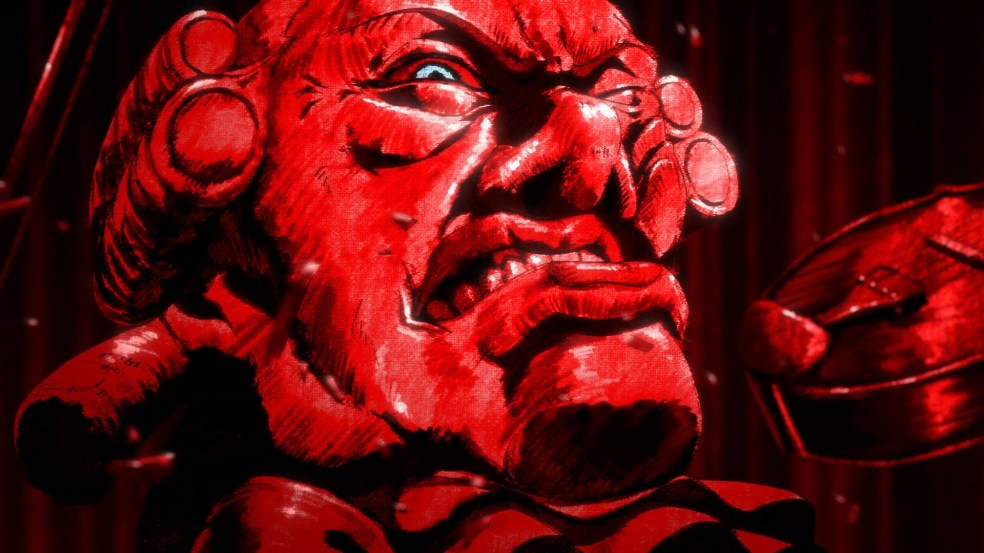
If anything, Rudolf is offended that Oguri Cap thinks she can waltz in and simply upend the proper order of things because she wants to. I really can only give it up for the character visuals here once again, that is a mean-looking horse right up there. In fact, her anger is overwhelming enough that Belno, also there while Oguri is asking about all this, actually falls to her knees in fear. I do get it! It’s not just Rudolf herself, it’s the gravity with which she treats this subject. There is no better illustration than this, the visual of a nameless Triple Crown winner standing atop a mountain of broken bodies, which fades into view with a grim grandiosity.

But of course, Oguri Cap is Oguri Cap. This is where we come back to that competitive mindset, typified by the motto which, remember, Rudolf herself expounded on earlier in this same episode. Oguri Cap will take these rules and traditions, and she will break them with her legs; her words, not mine. Arrogant! Arrogant, but really fucking cool! How does that even work? Is she going to just win so much that they’ll have no choice but to bump her up? I don’t know! I’m excited to find out!

One gets the sense from this single exchange that Rudolf is so used to most other people buckling in her presence that someone actively defying her is a bit of a shock. Am I reading too much into it? Maybe. But I’ve never met an anime I couldn’t over-analyze.

This article has already gotten super long, so I won’t go over every other little detail of the episode. But Oguri does meet her teammates, the other girls in Roppei’s stable; the preppy Meikun Tsukasa [Kazama Mayuko], the somber and shy Kraft Univer [Tanaka Takako], and–

[Kaiden Michiko]

It’s hard to say if these characters will be super relevant going forward or if they’ll mostly serve to help Oguri out with her training. Still, God Hannibal. What a name. I’m speechless.

In any case, the last scene of the episode cuts to the Pegasus Stakes, Oguri’s race against Black Ale. The race itself is territory for next episode, but one of the last scenes here is Oguri standing beneath the huge, open sky, drinking in the roar of the crowd, and being absolutely stoked out of her mind. It’s maybe the best possible way to tee up this particular cliffhanger; a reminder of why we love this absolute freak in the first place.


….Oh, and there’s a really cute post-credits scene where we check back in on Fujimasa March and company while they’re at what’s essentially a Denny’s. Norn gets called down bad, which I’m taking as validation of my ship, and Fujimarch ponders cutting her hair. It’s brief, but I’m very glad to see those characters even in passing.


Like what you’re reading? Consider following Magic Planet Anime to get notified when new articles go live. If you’d like to talk to other Magic Planet Anime readers, consider joining my Discord server! Also consider following me on AnilistBlueSky, or Tumblr. If you want to read more of my work, consider heading over to the Directory to browse by category.

All views expressed on Magic Planet Anime are solely my own opinions and conclusions and should not be taken to reflect the opinions of any other persons, groups, or organizations. All text is manually typed and edited, and no machine learning or other automatic tools are used in the creation of Magic Planet Anime articles, with the exception of a basic spellchecker. However, some articles may have additional tags placed by WordPress. All text, excepting direct quotations, is owned by Magic Planet Anime. Do not duplicate without permission. All images are owned by their original copyright holders.

Let’s Watch: UMA MUSUME – CINDERELLA GRAY Episode 6 – “The Beast”

Let’s Watch is a weekly recap column where I follow an anime for the course of its entire runtime.

For the Cinderella Gray column, new installments will be posted either on the Sunday each episode airs, or as soon as possible over the succeeding week. Expect spoilers!


Oguri Cap enters this episode devastated and conflicted. She leaves it a hometown hero. That’s how legends are born.

The previous episode of Cinderella Gray was a masterfully-crafted, coiling mechanism of tension. This episode is where that tension is released, and in that process we get to see some sides to our favorite characters that we haven’t seen before. But the true crux of the episode is the Gold Junior, an epic, psychological struggle on the racetrack. It ends with a huge, overwhelming moment of pure catharsis, one of the best of its kind in recent years. Remember; “Cap” meaning “peak.”

Getting there is another story. The episode opens with Oguri Cap furious, angrier than we’ve ever seen her, at Kitahara’s decision to transfer her to the nationals and stay behind. (Not to once again devote space on this site to my own thirsting, but there is a frightful beauty to Oguri’s angry faces, they’re very well-drawn and the fact that they’re such a stark contrast to how she normally acts really enhances the effect.) Her fury is easy to understand; she and Kitahara promised to take on the Tokai Derby together, and from her point of view he’s now breaking that promise. This is a recurring theme across the episode, the letters and spirit of these promises, and what breaking them means.

For Oguri, it makes it difficult for her to concentrate on the race, both in the training leading up to it and, eventually, for the race itself. For Kitahara, it’s the apex of his plague of self-doubt. No less a figure than once again, Symboli Rudolf, calls him out for his foolishness. Making either choice would’ve been better than trying to make none of them, and hinging the transfer on Oguri’s race results puts the horse girl in a truly unenviable situation.

The morning of the race is filled with contrast. Merch stalls sell adorable plushies of the rising local hero, and excitement is in the air from the audience at least, who clearly understand that they’re about to see Oguri build her legend up with another victory. But the track itself is bogged-down with mud after thudding, pounding rain from the previous night. Kitahara is in low spirits, and Oguri, now conflicted that her running is making others sad and without the confident support of her trainer, is in even lower ones.

Complicating things even further is the presence of Oguri’s rival up to this point, Fujimasa March. March, of course, is also furious. Word has by now spread that Oguri is going to be transferring to the nationals if she wins. Fujimasa demands to know why. They promised to race in the Tokai Derby together, and that promise is now falling apart before March’s eyes. Again, it’s easy to see why she’s upset, and moreover, why she’s hurt.

But she gets no sympathy from Cap herself. Deadened by having lost her reason to run, Oguri reminds her that all March has to do to keep her from transferring is to win. The presentation is immaculate here, with sweeping, low, buried-in-the-floor camera angles and easily the meanest face we’ve ever gotten from Oguri. The tension is palpable, and it says a lot that the slap across the face that Fujimarch opens the conversation with is not the highlight of this scene.

Nonetheless, the race waits for no one.

And indeed, the race itself is a struggle less between Oguri Cap and Fujimasa March, and more between Oguri Cap and herself. She’s out of form for much of the race, and imagines her legs bound by heavy iron chains dragging her down. For a while, it really does seem like Cap might actually lose, and it’s to the show’s credit that it keeps anyone who doesn’t have the real Oguri Cap’s racing history memorized guessing.

She’s so out of sorts that she doesn’t even make use of her trademark burst of speed, something which Fujimasa March notes with some incredulity, offended that her rival isn’t even trying. As it often does in these sorts of situations, it takes an external force to jostle Oguri Cap back into proper form.

That force is Kitahara, who, like Oguri, spends most of the race struggling with himself. His own doubts are quieter and get less direct attention (since he isn’t the protagonist, naturally), but he spends most of the Gold Junior sulking and not even actually looking at the race track. It takes Roppei, also in attendance, to snap him out of it, physically forcing him to look at Oguri Cap’s performance. Seeing his trainee obviously out of form and distraught is enough to spur Kitahara back to action, and he begins running too, fumbling through the crowd, bloodying his nose—that seems to happen to him a lot—and finally reaching a spot where he can cheer loud enough for Oguri to hear him. Just as Roppei shook Kitahara out of his stupor, Kitahara shakes Oguri out of hers by doing this.

For Oguri, his cheers, and the cheers from the others watching—Belno, the bully trio who have remained an important part of the supporting cast up to this point—are a reminder of why she’s running; to make herself happy, to make others happy.1 Regaining her confidence is enough: Oguri Cap takes the day.

In a beautiful touch, her hair comes undone as she crosses the finish line, leaving her final mark on the locals a wave of flowing, cloudy gray as she streaks into first place. The victory is immensely cathartic. The series makes a point here that Oguri Cap inspires her supporters; it’s obviously talking about Kitahara, Belno, Norn Ace, and so on, but it’s also talking about the people in the crowd, and thus, implicitly, us as well. The swell of joy is very real with this one, it’s perhaps one of the best-orchestrated victories in the whole franchise.

In the aftermath, Oguri’s stage show—which she rocks, by the way, and just generally looks great doing—becomes a platform for Kitahara to tell the crowd that, yes, the rumors are true. She’s moving on and up. The crowd is initially disappointed, but he reminds them—and anyone watching at home who might be sad to see this part of the story end—that there are higher dreams to aim for. This story isn’t over yet, and there are more mountains to climb.

The reason all of this works so well is that big dreams and stories of triumph are why we’re here in the first place. As Kitahara notes, it’s a Cinderella story! It’s right in the title! It’s also a testament to how ungodly well Cinderella Gray has been written so far that I’m genuinely going to miss every single character Oguri has to leave behind now that she’s transferring to Tracen! Norn Ace’s idea to take a commemorative picture (somehow framed as a polaroid photo despite her taking it on a smartphone, just one more drop of that trademark Uma Musume time weirdness) had me full-on crying.

I am aware I keep comparing Uma Musume to some kind of long-running battle shonen anime, which is, of course, not actually what it is. But I do have to bring that comparison out again, because this episode really does feel like the end of a long, long first season where there’s a notable changing of the guard and it’s all very bittersweet. I can only really again credit the writing for evoking that feeling over a scant six episodes (of a confirmed thirteen and a rumored 23). Perhaps the toughest departure is that of Fujimasa March, who vows to continue running despite her initial plan to quit if she lost to Oguri again. It doesn’t seem like they’ll meet again, at least not as competitors, as Oguri is going somewhere that March can’t reach. Nonetheless, their mutual respect for each other is genuinely touching, an excellent last note to their rivalry.

But we can’t dwell on who’s leaving, because two very important characters actually aren’t. Firstly, Kitahara vows to get a national trainer license—we aren’t explicitly told why he didn’t try to do this in the first place, but given some of the allusions to Kitahara’s still-murky past, we can make some educated guesses—and Belno Light, who is not just Oguri’s close friend but also her personal outfitter at this point, has quietly gotten acceptance into Tracen via its sports science program. This all ends the episode on a warm glow, bittersweet but with emphasis on the sweet. The main trio are going to Tracen, and the real race has yet to be run.


1: In this way, she isn’t actually terribly dissimilar to the protagonist of Uma Musume‘s third season, Kitasan Black. For a plethora of reasons, I think the approach works much better here.


Like what you’re reading? Consider following Magic Planet Anime to get notified when new articles go live. If you’d like to talk to other Magic Planet Anime readers, consider joining my Discord server! Also consider following me on AnilistBlueSky, or Tumblr and supporting me on Ko-Fi. If you want to read more of my work, consider heading over to the Directory to browse by category.

All views expressed on Magic Planet Anime are solely my own opinions and conclusions and should not be taken to reflect the opinions of any other persons, groups, or organizations. All text is manually typed and edited, and no machine learning or other automatic tools are used in the creation of Magic Planet Anime articles, with the exception of a basic spellchecker. However, some articles may have additional tags placed by WordPress. All text, excepting direct quotations, is owned by Magic Planet Anime. Do not duplicate without permission. All images are owned by their original copyright holders.

Let’s Watch: UMA MUSUME – CINDERELLA GRAY Episode 5 – “What’s Best For Her”

Let’s Watch is a weekly recap column where I follow an anime for the course of its entire runtime.

For the Cinderella Gray column, new installments will be posted either on the Sunday each episode airs, or as soon as possible over the succeeding week. Expect spoilers!


Cinderella Gray was never going to be all victory forever. No series is that, certainly not any sports anime and definitely not Uma Musume. (Even Season 2, which is the cleanest path-charting superstar story in the franchise, is defined perhaps even more by its dramatic, tragic moments as its triumphant ones.)

That said, the kind of dramatic conflict that emerges here is a bit surprising. Not unwelcome, but at the very least it isn’t something I saw coming.

First, a bit of racetrack politic: horse races in Japan (at least, in the Uma Musume universe, but I have little reason to assume this isn’t also true in real life) are separated into national and regional races. So far, Oguri Cap’s story has been at the regional level. The Tokai Derby she aims to run in against Fujimasa March, the race both she and her trainer Kitahara Jou dream of winning, is a regional race. To that end, the episode opens on Oguri competing in the Chukyo Hai, another regional race and a stop along the path to the Derby. She wins by a complete blowout, in fact. To the point that the race itself is basically an afterthought. This is all well and good, but as we learned last week, it’s not just the usual crowd of horsegirl enthusiasts watching the race, also present is Symboli Rudolf, president of Tracen Academy. Rudolf is extremely impressed by what she sees on the track, and sets about recruiting her to compete in the nationals. She talks to Kitahara first, and he is both starstruck and extremely intimidated that she wants to talk to him. Moreso when he finds out what she actually wants.

Cinderella Gray uses a fun structural trick in this episode, wherein after Kitahara’s talk with Rudolf, we actually cut to a flashback wherein a young Kitahara is first drafted into being a horsegirl trainer by his uncle Roppei. After we return to the present, Oguri is running training laps at her usual spot, and something has clearly happened to badly affect Kitahara’s mood, but we don’t yet know what.

The plain and pragmatic truth of the matter is this; Kitahara isn’t licensed to train on a national level. If Oguri Cap is recruited to compete in national races, she will have to leave Kitahara behind.

There is quite a lot of dancing around this through much of the episode’s middle third. Kitahara’s entire vibe is very off, and Oguri even picks up on it. (Not that it’s hard to tell that someone is out of sorts when they, say, forget to press the “start” button on a stopwatch when timing you. But still.) The drama here is pretty compelling, and through the earlier flashback, the series implies some prior failure on Kitahara’s part that has led to him being so hard on himself in the present day, although we don’t yet know what that might have been. Still, it takes a weeping Belno Light—the heart of the group, here—to get some sense through to him. What he wants or what Belno herself might want aren’t the important things, they have to ask Oguri what she wants directly.

Which, itself, Kitahara can’t seem to do in a straightforward way. He delivers the news firstly in a cloying, faux-bombastic tone, and then when Oguri asks if she’d be able to keep him as her trainer, starts viciously self-deprecating under a thin veneer of taking it instride. I love this entire scene, and it makes the whole episode. It really puts both Kitahara and Oguri’s personalities fully on display and shows what happens when they clash. Jou is, by this point, very much convinced that he has to take the loss and let Oguri go, and outright says at several points across the episode that he feels that he’s holding her back. His self-defeating mentality has already made this a given for him, and he doesn’t see any way out of it. Oguri, for her part, is upset, even offended that Kitahara would assume that she’d want to race anywhere where he wasn’t her trainer. Oguri is a very straightforward and direct person, and it’s clear that she’s been taking this talk of a shared dream of winning the Tokai Derby very seriously. She doesn’t say so outright, but it’s easy to imagine that even just being asked to race under a different trainer might feel like a betrayal.

And so, she storms off. Reminding Kitahara that the Tokai Derby is “our dream.” Were it that things ended there, this might seem like something of an anticlimax, but Kitahara doesn’t have the luxury of any kind of relief. He gets a phone call. Symboli Rudolf is on the other end of the line, and while she’s polite, she makes her position on the matter clear.

Thus, we come to the episode’s end, where Kitahara gives Oguri an ultimatum. In her next race, if she wins, she will be transferred to the nationals. If she loses, the two of them will aim for the Tokai Derby together.

That’s a rough hand to deal someone, and I am extremely interested in how Oguri is going to play it, especially with hints elsewhere in the episode that the national racing press are starting to catch on to the phenomenon brewing in Kasamatsu. The Gray Monster is waking up, and everyone but Oguri herself seems to be looking toward her eventual national rise to fame with great interest. Tamamo Cross, in a post-victory interview after one of her own races, makes note of her, while elsewhere mention is made that the two of them are defying a long-standing stereotype that ashen-coat horse girls can’t run. (A detail so bizarrely specific I can only imagine it’s a translation of some weird foible of actual horse racing culture.)

So ends an absolutely fantastic episode. There are tons of little details I haven’t had the space to cleanly fit in, and it’s hard to not just cram them all in here at the end. Belno blacksmithing new cleats for Oguri? The whole weird push and pull between Kitahara and his uncle Roppei, who seemed to know this entire thing with Oguri transferring to the nationals would play out how it did? Symboli Rudolf herself, who is fantastic here and whose nickname of “The Emperor” is treated almost literally given how everyone reacts to her? All told, this episode, its smaller, less-serious moments but especially its coiling tension, is the exact kind of stake-raising this show needed, and I am riveted to see where it all goes. The world is watching, Oguri Cap! What will you do?


Like what you’re reading? Consider following Magic Planet Anime to get notified when new articles go live. If you’d like to talk to other Magic Planet Anime readers, consider joining my Discord server! Also consider following me on AnilistBlueSky, or Tumblr and supporting me on Ko-Fi. If you want to read more of my work, consider heading over to the Directory to browse by category.

All views expressed on Magic Planet Anime are solely my own opinions and conclusions and should not be taken to reflect the opinions of any other persons, groups, or organizations. All text is manually typed and edited, and no machine learning or other automatic tools are used in the creation of Magic Planet Anime articles, with the exception of a basic spellchecker. However, some articles may have additional tags placed by WordPress. All text, excepting direct quotations, is owned by Magic Planet Anime. Do not duplicate without permission. All images are owned by their original copyright holders.

The Shambolic Anime Podcast Presents: Discussing ALIEN NINE

Today on the rarely-seen, once-in-a-while when we feel up to it Shambolic Anime podcast, my co-host Julian M. and I discuss seminal 2000s miniseries Alien Nine, and the manga it’s based on. Mind the content warning at the start of the episode, and enjoy!


If you want to read more of my work, consider heading over to the Directory to browse by category.

All views expressed on Magic Planet Anime are solely my own opinions and conclusions and should not be taken to reflect the opinions of any other persons, groups, or organizations. All text, excepting direct quotations, is owned by Magic Planet Anime. Do not duplicate without permission. All images are owned by their original copyright holders.

Let’s Watch: UMA MUSUME – CINDERELLA GRAY Episode 4 – “The Junior Crown”

Let’s Watch is a weekly(?) recap column where I follow an anime for the course of its entire(?) runtime. Expect spoilers!


I have not written a recap article for a currently-airing anime in nearly two years. It’s a surprisingly tough thing to nail down, at least if you want to write a good one. One has to capture the literal events of the episode, sure, but also nail its essence. What does the episode mean? Where is the show going from here? How does it fit into the contemporary landscape? What trends does it point to, present and future?

It’s a lot to consider, and that, combined with the inherent time pressure, is why I’ve largely dropped them from Magic Planet Anime. We’re making an exception today, because Cinderella Gray is, very plainly, the best thing airing right now. Despite—or perhaps because— of the fact that it’s “just” a very, very good sports series. There is a lot of great stuff airing right now (none of which I’m trying to knock), so that’s a big claim, but I stand by it. I haven’t really been beating the drum about the show as hard as I feel like I could be, and not everyone who reads these articles necessarily follows me on social media. Thus; this article. Hopefully the first of many, we’ll see.

It’s been a few weeks since I first wrote about Cinderella Gray, so let’s get up to speed real quick. After the first episode’s blowout, the second saw Oguri Cap take on Fujimasa March, the other extremely gifted, ash-haired horse girl at their school. That episode ends on a cliffhanger, and the third revealed that March narrowly edged Oguri Cap out of the victory in their first race together. The win wasn’t so definitive that she couldn’t attribute the victory to outside factors and, indeed, she becomes a little obsessed with trying to prove that she can beat Oguri fair and square. (This isn’t even an unreasonable thing to think; we also learned that Oguri’s old racing shoes were in absolutely terrible condition.) Episode three also saw Cap win a different race, absolutely demolishing the other racers and winning both the race itself and—I’m just gonna assume anyone reading this recap on my site is as yuri-brained as I am—the heart of gyaru horse girl / bully Norn Ace. Later, some more training led her to have a long, extremely shonen rival-y conversation with March, who directly challenged her to the Junior Crown.

This little conversation sets something inside Oguri alight. And that’s more or less where we begin this week. There’s a short sequence at the very top of the episode where Belno Light, Oguri’s gal pal and teammate, enters her own first race and loses quite badly. But I imagine we’ll be circling back around to her own story at a later date, as the vast majority of this episode is about Oguri, March, and this rivalry that’s grown between them.

It’s worth zeroing in on March’s line from the third episode; Without a peak to aim for there’s no point in climbing the mountain. We can make our little jokes, obviously—“peak” has taken on an adjectival meaning in English anime fandom over the past half decade, and it’s one that suits this series quite well—but it is really important that we don’t lose sight of this central metaphor.

When first asked about it, Oguri Cap is just grateful she can run at all. We already know from past episodes that when she was younger she could barely walk at all and it took active intervention on her mother’s part to turn her into the athlete she is today. This is great on its own of course, and it’s genuinely touching how truly grateful she seems to be that she can exert herself in the way she can, but this is a sports series. Oguri feels she has something to prove now.

There is an immense amount of appeal, in fact, just in watching Oguri do her thing, whether training or actually running. Aside from being a massively-endearing protagonist in the “strong but a bit of a doofus” mold (like dozens of classic shonen characters), there is a real joy to seeing her determination harden and sharpen now that she has a rival. At one point in this episode, she reveals that she’s been training with extremely heavy cleats on, a modern update on the whole “weighted clothing” trope from countless battle manga (which is promptly called attention to).

When the actual Junior Crown begins, Oguri’s trainer Jou takes note of her newfound motivation, self-deprecatingly quipping that he sometimes wonders why he’s there at all. This promptly gets him an earful from the episode’s new character; Jou’s uncle Musaka “Roppei” Ginjirou [Ootsuka Houchuu], also a horsegirl trainer, unexpectedly in town from Tokyo on vacation and scoping out the Junior Crown apparently on a whim.

Oguri Cap isn’t the only one training, of course. We get a look at March doing some “image training” (a minor obsession for this series, it played a fairly big role in Season 2), trying to imagine every possible scenario on the racetrack and conceiving of how to beat Oguri every single time. She claims to have thought up 100 different possibilities by the end of this scene, and given the fun visual of her dreaming up the blue and red colored ghosts of Cap and herself in the void of her own imagination, it’s easy to believe her.

There’s also an interesting contrast drawn between the relationships Oguri and March have to their trainers. Despite Jou’s self-effacing remark, it’s clear that Oguri likes and trusts him, and he has in fact contributed somewhat to developing her strengths. March’s trainer, meanwhile, gives her a presentation on the race, which she completely ignores in favor of her “concentration,” even going so far as to tell him to shut up. Whether this is something the series will continue to focus on as it goes forward is for those reading the original manga to know, but the difference is interesting, perhaps remarking on trust between trainer and athlete as just as important a component in a well-rounded competitor as anything else.

All of this leads up to the race, of course, and the Junior Crown is probably the show’s high point thus far. The race takes up a decent chunk of the episode, and we can basically break it down into two main parts, structurally-speaking. Firstly, there’s the race itself, which visually focuses on the actual motions of the racers as well as their mentalities while on the field, including a few full-on flashbacks to provide motivation, context, and color. (And toward the end we get some of the truly spectacular “auras” literally coloring the racers, a favorite technique of this series.) Secondly, there is the commentary, mostly coming from Jou and Belno who are watching in the stands, but also occasionally from Ginjirou and from an observing Tamamo Cross [Oozora Naomi], an uma musume visiting from Tokyo, who attends Tracen Academy, the prestigious racing school that is also the main setting of the three mainline Uma Musume seasons.

The race is spectacular. There’s a really great exchange between Cap and March just before the race begins, where Oguri interrupts March’s image training (which she’s still doing even as she prepares to run the actual race!), to say this.

I could write an entire separate article about the absolutely incredible character work the show has done with Oguri Cap so far. She’s goofy and silly often enough, and for just long enough, that as the audience we get sort of tricked into forgetting that she’s also basically Goku. This single line, probably the closest thing Oguri has offered so far in the series to a taunt, has more character in it than some anime’s entire casts. March, for the record, offers a shocked expression, but then a grin. This is largely a battle between the two of them, and they both know it.

Following on from the first three episodes, the racing in Cinderella Gray is a little less overtly fantastical than the approach taken in some more recent material from the series (certainly it’s quite a bit more grounded than the fantastical imagery in, say, New Era). But this isn’t a criticism, the grittier approach works really well for Cinderella Gray, and this race is probably the best demonstration of it yet. Particular attention is paid to Oguri Cap’s unique, low-to-the-ground stride, pointed out as a distinctive feature of her racing style as early as episode one.

Throughout, the race is a tug-of-war between Oguri Cap and Fujimasa March. (Spare a thought for Okan Maker, an extra who’s in the lead for a decent bit of the race but ends up left in the dust by both of them.) Accordingly we hear a lot from Fujimasa March. We even get a flashback showing how she’s been dedicated to winning her entire life, starting from when she was a child. In fact, much of the tone during the latter half of the race seems to sell the idea that March is going to inch out a win. She’s ahead of Oguri—admittedly just barely—starting after they both launch into a burst of speed at the same time. But what every single thing and person in the episode raising the flag that this is March’s race doesn’t understand is that Oguri Cap is….I mean, there’s no way to put it politely. She’s a monster.

The very last stretch of the race is spectacular, and here Cinderella Gray does lean into the more overt, battle shonen-esque stylings of some of its predecessors. That it’s only in such a short burst actually heightens its impact; just as March thinks she’s cinched the win, Oguri pulls a second burst of speed out of nowhere, treated with all the suddenness and gravitas of a warrior revealing a secret technique, and just like that, March is simply done.

Oguri Cap storms to victory, and the first arc of the series comes to a close.

After the race, March, initially in complete disbelief (and quite understandably pissed off) demands to know how she did that. Oguri speculates—as though she herself cannot entirely account for the power within her—that it was, in some way, March’s own doing. By directly challenging Oguri, she gave her something she didn’t have before. Oguri, of course, is quite grateful for all this, and we must imagine that the two will meet on the racetrack again in the future. Oguri directly offers such.

In doing this, Oguri seals the two’s relationship as rivals spurring each other to greater heights. I doubt March will be the last of these she picks up on her journey.

The episode’s denounement is fun, including the post-race concert, an oddity of the series that’s always felt a little tacked on—and at worst, reminiscent of the bottom of the barrel of the “idols but also other stuff” genre—here, in a relative rarity, it actually feels meaningful. Oguri has improved vastly as a performer since the previous episode where she listlessly danced to enka music and inspired Norn Ace to give her some dance lessons. (You know you’re living the sports yuri dream when all three of your former bullies show up to cheer you on at your race and one of them went out of her way to teach you how to dance. If we include Belno—and why not include Belno?—by my count Oguri has three different girls with their eyes on her. Four if we count Tamamo’s intrigued parting remark in this episode.)

The next decision to be made in Oguri’s journey is where she will race next. Jou wants to take her to the Chukyo Hai. Ginjirou advises him to skip it—he doesn’t directly say why—but Jou seems pretty determined, seeing it as an important stepping stone to Jou and Oguri’s mutual goal of winning the Tokai Derby. It might turn out to be a good thing that he’s so insistent, since an interesting post-credits scene reveals that another horsegirl attending that race—to observe, mind you—is Symboli Rudolf [Tadokoro Azusa], the Triple Crown winner that Uma Musume treats as the unofficial ur-horsegirl, president of Tracen Academy’s student council and looked up to by just about everyone. One of the final moments of the episode is a meaningful shot of the placard displaying Tracen’s motto, an artifact originally introduced way back in Uma Musume‘s first season. The motto itself is cryptic (and grammatically shaky) as always, but the shot imbues it with a certain power. Oguri Cap has much higher to climb. Both she, and her show, are just getting started.


Like what you’re reading? Consider following Magic Planet Anime to get notified when new articles go live. If you’d like to talk to other Magic Planet Anime readers, consider joining my Discord server! Also consider following me on AnilistBlueSky, or Tumblr and supporting me on Ko-Fi. If you want to read more of my work, consider heading over to the Directory to browse by category.

All views expressed on Magic Planet Anime are solely my own opinions and conclusions and should not be taken to reflect the opinions of any other persons, groups, or organizations. All text is manually typed and edited, and no machine learning or other automatic tools are used in the creation of Magic Planet Anime articles, with the exception of a basic spellchecker. However, some articles may have additional tags placed by WordPress. All text, excepting direct quotations, is owned by Magic Planet Anime. Do not duplicate without permission. All images are owned by their original copyright holders.

Seasonal First Impressions: Be Aware of MONO

Seasonal First Impressions is a column where I detail my thoughts, however brief or long, about a currently-airing anime’s first episode or so.


In 2017’s extremely metafictional club comedy anime Anime-Gataris, there is a scene where the main characters, all members of their school’s anime club, debate what makes a “classic anime.” The gag here being that they all just list off certain tropes or canned setups and scenarios rather than anything particularly deep (at one point someone ventures that if a main character vomits on screen? Well, that’s a classic anime). If I could put forward a candidate for that list, it would be this: any slice of life / comedy anime in which an older character is shown to be an absolutely terrible driver is an instant classic. Call it the Azumanga Daioh Principle.

mono, stylized in no-caps, is the latest member of that particular club, and it’s fairly meta in of itself. Consider that this is a slice of life comedy about two girls who take pictures, but one of the other characters is a mangaka who, by the end of this first episode, is writing a yonkoma about two girls who take pictures.

Her first idea for a manga, from earlier in the episode, isn’t bad either. She’s right that everyone likes comics about cats.

Unlike Anime-Gataris, that metafictionality (much lighter here than in that series) is not the point in of itself, but rather an underline that this is a show that understands its genre, and why people like and connect to that genre, very well. mono isn’t the first series like this we’ve had in a while, but it’s definitely the best in a while. To find something with a comparably great first episode you have to reach at least as far back as 2022’s Do It Yourself!!, maybe farther.

The actual plot, such as it is, is nothing terribly complicated. (Such stories rarely are.) Amamiya Satsuki [Mikawa Haruna] joins a photography club at her high school in her first year, implicitly because of a crush on her upperclassman who’s the head of the club. (That’s Satsuki at the top of this article in the banner image, looking like she’s offering you something.) Fast forward a year later, and said upperclassman has graduated, leaving Satsuki and her friend Kiriyama An [Koga Aoi] as its sole members, and Satsuki herself listless and lacking in motivation. An, who herself feels such a way about Satsuki that she describes “sitting together with her in the garden in [their] elder years” as a “dream,” is worried that the club might dissolve with just the two of them, and that Satsuki might remain a proverbial lump on a log forever.

After a motivating speech, Satsuki regains some amount of motivation, deciding to finally get a proper camera after a full year of exclusively taking photographs on her phone (most of which were of her sempai, and most of which were taken pictures of, in turn, by An). She buys a wide-angle camera off of an online auction, but oops! It doesn’t actually arrive. Thankfully, the seller actually lives in their city, making it relatively easy for Satsuki and An to track them down.

Which, if I’m the one being asked, is where the episode really takes off. I have a passing interest in photography (and a mostly-defunct phone photography blog over on tumblr), but it’s not a deep-seated passion, so it alone is not enough to sell me on a series. What puts me onto mono is its sheer joie de vivre. Every inch of it is stuffed with expressive animation and vibrant color, and it’s also just really damn funny. This is all crucial, since even if you, like me, are not super “into photography,” mono needs to convey its love of the world as a subject of art.

The camera seller turns out to be aforementioned mangaka Akiyama Haruno [Toono Hikaru]. She, and a gaggle of young kids who stop by her grandmother’s shop, where she also lives, completes the character dynamic of the series, being an older character who is decidedly not really a mentor in any way. Her spacey demeanor provides a nice contrast to the more high-energy dynamics between An and Satsuki. More importantly, she’s also a good (and literal) driver of plot, in as much as a series like this has plots. It’s she who provides Satsuki and An with that wide-angle camera, and, later, she drives them to a nearby landmark to take nightscape photos. For my money, she’s the best character, and her lackadaiscal and laid-back attitude instantly endeared her to me. That she coincidentally looks kind of like my VTuber rig certainly doesn’t hurt either. I am not biased in any way, I promise.

In any case, those nightscape photos cap off the first episode, otherwise quite zany and comedic, with a more contemplative tone. I don’t know if the “mono” in mono is “mono” as in the term mono no aware, as this would on the surface contradict the show’s comedic incliniations. But if it is, that’s a pretty solid allusion. The idea of photographs as permanent, fixed records of memories that are themselves inherently transient isn’t a new one, but I would love to see the show explore it regardless, and it provides a nice counterweight to the fast pace and upbeat tone of the rest of the series.

Brilliantly, one of the last scenes in the episode is a timelapse the girls took. The sequence lasts only a few seconds, but as the sun sets and the city lights glitter to life, the impression it leaves is forever.


Like what you’re reading? Consider following Magic Planet Anime to get notified when new articles go live. If you’d like to talk to other Magic Planet Anime readers, consider joining my Discord server! Also consider following me on AnilistBlueSky, or Tumblr and supporting me on Ko-Fi. If you want to read more of my work, consider heading over to the Directory to browse by category.

All views expressed on Magic Planet Anime are solely my own opinions and conclusions and should not be taken to reflect the opinions of any other persons, groups, or organizations. All text is manually typed and edited, and no machine learning or other automatic tools are used in the creation of Magic Planet Anime articles, with the exception of a basic spellchecker. However, some articles may have additional tags placed by WordPress. All text, excepting direct quotations, is owned by Magic Planet Anime. Do not duplicate without permission. All images are owned by their original copyright holders.

Seasonal First Impressions: Checking in to the APOCALYPSE HOTEL

Seasonal First Impressions is a column where I detail my thoughts, however brief or long, about a currently-airing anime’s first episode or so.


It has been entirely too long since I got weirdly, uncomfortably personal on this blog (a few months, at least), so let’s fix that.

I have been thinking about my own mortality a lot lately. I won’t go into why, but suffice to say this dwelling is neither wholly rational nor entirely unfounded. I mention my own recent fixation here to give some context for why I’m checking out Apocalypse Hotel, and why I was initially reluctant to check it out. Stories like this, stories of mankind’s extinction or departure and what we may leave behind in our wake, stories that inherently deal with loss and finality as themes, are incredibly aggravating when done poorly. I won’t name names, but there have been some unimpressive examples in recent years, and I have somewhat burned out on this genre of post-apocalyptic iyashikei as a result. (The less said about its mutant cousin, the isekai slow life genre, the better.) All this in mind, I planned to pass on Apocalypse Hotel. Surely it would not become one of the most instantly-beloved premieres of the season, right?

If that’s overselling it, it’s only just so. Within my circles at least, Apocalypse Hotel has become something of a surprise standout among the season’s premieres. Enough of one to cover it over GQuuuuuuX? I’m not sure about that, but the praise eventually got to me and I was inspired to give it a whirl. I’m glad I did, because this is a series that not only understands the fundamentals of its parent genre very well, it’s also a bit of casual leg-stretching for Cygames Pictures, who have established themselves as one of the more reliable studios around in recent years. (For reference, Apocalypse Hotel is a follow-on from last year’s Uma Musume film and Brave Bang Bravern. This year, they’re doing Cinderella Gray, also from this season, and an adaptation of acclaimed manga The Summer Hikaru Died in just a few months. Going back a bit farther, you might also know them from Princess Connect Re:Dive.)

As for the actual plot here, there honestly isn’t terribly much. We begin with a truly spine-chilling opening, in which an advertisement for the titular Ginza Hotel, then brand-new, is intercut with news reports of a deadly, plantborne virus that is rapidly rendering the Earth’s atmosphere hostile to human life. Just five years out from the COVID pandemic, this sort of imagery is still very pointed, and the uncomfortable contrast between the luxury of the hotel and the violence we see as the world becomes less and less habitable, culminating with a lucky few escaping to the stars in an “ark” (supposedly for just a few years while Earth’s ecosystem sorts itself out), is of course very intentional. It is equally so that most of the rest of the episode doesn’t directly deal with that discomfort. Instead, the series dances around it in a deliberate, careful way, only drawing attention to it directly at key moments.

Most of the episode is fairly comedic, in fact. We meet our cast of characters, a group of robots maintaining the Ginza Hotel. The most prominent of these, and the only one in the group that could conceivably pass as a human, is Yachiyo [Shirasu Saho], the “acting acting” head of reception and thus the one in charge of the hotel in a general sense. Yachiyo spends her days keeping her crew on-task as they make sure the hotel is kept clean and orderly, in preparation for humanity’s eventual return.

A return that, at this point, they have waited on for a hundred years and counting.

I don’t want to make Apocalypse Hotel seem darker than it actually is, because most of this episode genuinely is pretty upbeat. Gags like Yachiyo absolutely losing her cool because a single shampoo hat goes missing from one of the hotel’s bathrooms, or the bulky, extremely serious Doorman Robot [Touchi Hiroki] and his sheer dedication to his simple job of opening the front doors for any prospective guests, are a genuine delight.

Get Door Robo

Even the music is pretty upbeat while the crew go about their daily routine of keeping things clean and sparkling. But the undertone of massive loss is always there. Firstly from the simple fact that the thing they’re keeping so pristine is a giant hotel with nobody in it, and secondly from the more general post-apocalyptic trappings. A century is more than enough time for plants to have grown over much of the world outside the hotel, and these gorgeous wide shots instill a solid sense of longing and emptiness.

In other words, this show is quite clearly picking up the thread left by seminal works such as Yokohama Shopping Log. Being that good would be, frankly, too much to ask—Yokohama is arguably the definitive work of its genre—but that the two can even be in the same conversation is a good sign. There is one point in the episode in particular in which this influence is extremely evident, and that is when one “Driller Robot” does not report to the morning roll call at the hotel. Yachiyo goes out to find him, only to see that he’s been killed; massive metal spikes have been driven through him, and he’s completely motionless. Clearly saddened in a way she either can’t or won’t entirely express, Yachiyo solemnly places him on “indefinite leave,” and consigns him to a storeroom full of other similarly broken-down robots. An earlier gag draws attention to the fact that the Doorman no longer has any coolant in his systems, and one has to wonder how long it’ll be before he, too, joins that pile. We have already seen, via flashbacks, that Yachiyo’s crew used to be much larger.

Yachiyo’s behavior, as well, seems to indicate that she’s not as together as she’d like to put on. It’s mostly played as a joke here, but she has an angry outburst near the end of the episode, and she’s also been keeping detailed logs of operations every day since the hotel’s owner left. She tells herself that new guests will be coming soon, but it doesn’t really seem like she believes it.

Which makes the end of the episode all the more surprising. I can’t bring myself to spoil what, exactly, happens there, but I do think it points Apocalypse Hotel in an interesting direction going forward. Does all of this relate, that much, at the end of the day, to the fears I discussed opening this article? Eh, yes and no. Apocalypse Hotel is clearly a part of this cozy apocalypse genre—it’s right there in the name, after all—but it’s much more lighthearted, even whimsical, than I first assumed. Yet, that sense of loss and transience still very much does color everything about the series, and it’s difficult to say what it will end up leaning more into as it goes on. In other words, it’s hard make many long-term predictions. But, regardless of what happens on this particular after-the-end vacation, I’m planning on at least a short-term stay. Hopefully you are, too.


Like what you’re reading? Consider following Magic Planet Anime to get notified when new articles go live. If you’d like to talk to other Magic Planet Anime readers, consider joining my Discord server! Also consider following me on AnilistBlueSky, or Tumblr and supporting me on Ko-Fi. If you want to read more of my work, consider heading over to the Directory to browse by category.

All views expressed on Magic Planet Anime are solely my own opinions and conclusions and should not be taken to reflect the opinions of any other persons, groups, or organizations. All text is manually typed and edited, and no machine learning or other automatic tools are used in the creation of Magic Planet Anime articles, with the exception of a basic spellchecker. However, some articles may have additional tags placed by WordPress. All text, excepting direct quotations, is owned by Magic Planet Anime. Do not duplicate without permission. All images are owned by their original copyright holders.