
Seasonal First Impressions is a column where I detail my thoughts, however brief or long, about a currently-airing anime’s first episode or so.
You don’t get a nice piece of serendipity like this too often. The first anime to premiere in this anime season is also about the changing of the literal seasons. That’s pure poetry, right there, and it helps that Agents of The Four Seasons: Dance of Spring leads with an absolutely excellent premiere. It’s big, bold, and deals in broad emotions. None of these are bad things, and they mark the series as supremely self-confident.
It is worth noting, though, that the first thing we see and hear isn’t anything like that at all. Instead, it’s a barrage of smoke and gunfire, screamed names and something, somewhere, going wrong. This first impression colors the rest of the story. It does not paint a happy picture, but the first episode doesn’t return to it directly.
We open on the sight of two girls on a train. Going somewhere that, we eventually learn, will be the site of a ritual to break an unnaturally long Winter season. One of these girls is a warrior, the other is a season. There is an immediate, obvious, and directly-highlighted conflict between the apparent divine inner nature of the “agents” of the title and their obvious, human exteriors. When our heroines arrive at their destination, they are greeted by a crowd of curious faces. “They say she’s the Goddess of Spring” says one. “But she’s just a person”, replies another.
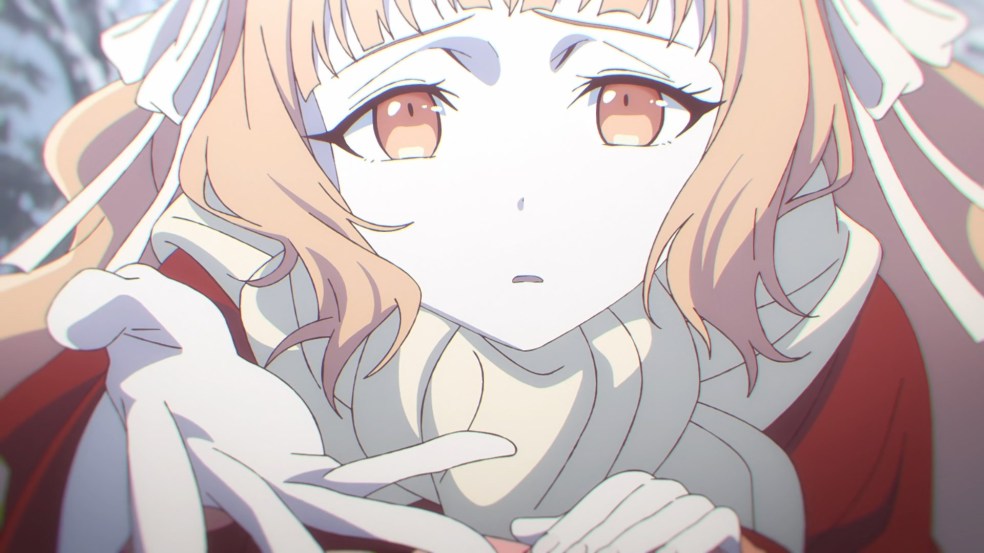
The official-sounding Agency of The Seasons, the group that meets our protagonists at their destination and clears the tourists from a nearby mountain for them, makes this all seem like an organized and formal affair. The lack of a Spring in a solid decade, mentioned here offhandedly, makes it seem very much otherwise. There is clearly something wrong with Hinagiku [Nukui Yuka], Spring’s agent, and her retainer Sakura [Aoyama Yoshino] seems to be doing a lot to keep her mind off of it. The Spring Goddess, if indeed that’s what she is, speaks in clipped, halting sentences, and is unsure of herself. As the show begins in earnest she and Sakura make their way to the mountaintop to perform the sacred rite to usher in Spring.


On the otherwise-abandoned mountain, they find Nazuna [Touyama Nao], a little girl shoveling snow, who has heard of only three seasons and has to be prompted at great length to remember that this “Spring” thing exists at all. This raises questions: with only three seasons remaining, do Winter and Summer simply crash into each other unceremoniously? Does the fact that describing it that way makes it sound like I’m describing global warming give this show an environmentalist undertone? We don’t know the answers to these questions just yet, but Hinagiku does answer a different one.
Referred to as Spring’s goddess, Hinagiku is keen to offer a correction. Demonstrating the divine power she’s been given by pulling a seed from her robe and growing it into a rose in an instant, Hinagiku explains that this power is not hers, only borrowed. Can we trust the self-deprecating Spring shaman’s own words on the matter? I’m unsure, although details at the end of the episode suggest so. In practical terms though, it means that like so many superhumans in fiction, the agents of the seasons are neither wholly divine nor wholly human. They are, at least narratively, both. The demigods of our modern age.
There is here a stunning display of mutual childish insensitivity, as Nazuna lashes out about the effects the long winter has had on her father’s tourism job and presses Hinagiku for an explanation of where precisely she—and Spring—have been. Sakura shoots back, and Nazuna crumples, crying that all adults are bullies who do nothing but yell. Hinagiku asks if she is yelled at by adults often. She does not answer. But, when the trio reach the mountaintop, she begins shoveling her snow again.
No mere character tic, Nazuna’s goal is to clear the snow from her mother’s grave. As a child who’s lived for ten long years never knowing the melting warmth of Spring, she is one of the people that Hinagiku and Sakura need to help most. This understood, the rite begins, and the episode reaches its climax.
People, we are told, are not really supposed to see this. Or at least not people who aren’t agents of the seasons themselves. Nazuna gets to, though, and so do we, as Hinagiku takes pity on her and on the snow that’s piled upon her mother’s grave, she calls the Spring right then and there. It is a sight.


She begins to sing, and as she sings, she dances. Her foot taps the ground and an explosion of clovers erupts from the Earth. As she spins, singing a song of forlorn love, grass races to the surface from under the soil, bubbles of water fill the air, Spring showers suspended in the dance. Flowers bloom as the sky drizzles, and then, the centerpiece: the world bursts into a carpet of Cherry blossoms and running water. Tearfully, Sakura exsplains to Nazuna that it is for the sake of people like her that Hinagiku has been pushing herself so hard. What goes unspoken directly is that here, in this moment, it is worth it. Here is what is spoken: Spring is here, and you are happy.

The episode ends with narration. A creation myth: how Winter came first, alone in the world, and then created Spring. The two were happy together, and Winter then created Summer and Autumn. No longer able to spend so much time with beloved Spring, Winter bestows the power of itself and its fellow seasons on humans of the land. Our story, on the whole, is about them. We do not know yet the full breadth of this story, but the narration gives us some hints: love, murder, the lives people carve for themselves. All of that is in the future, and as this is another recent anime to have a rather unusual episode count (fourteen as opposed to the usual twelve), we have even longer with Agents of The Four Seasons than usual. We will have plenty of time to learn all the ins and outs of the story being told here. For now, all we know is one very important thing: Spring has arrived, safe and sound.

Due to the ongoing urgent health matters I posted about earlier today. I am not sure if I will be able to cover any more premieres this season. But, if this is the only one I get to write about, I’m glad it was such a lovely thing.
This is replacing my usual footer on the site until my GoFundMe is paid for. If you liked what you just read, please consider reading my story and offering a donation, if you can’t, sharing the page around helps a lot as well.
Thank you for reading.
 The Magic Planet