
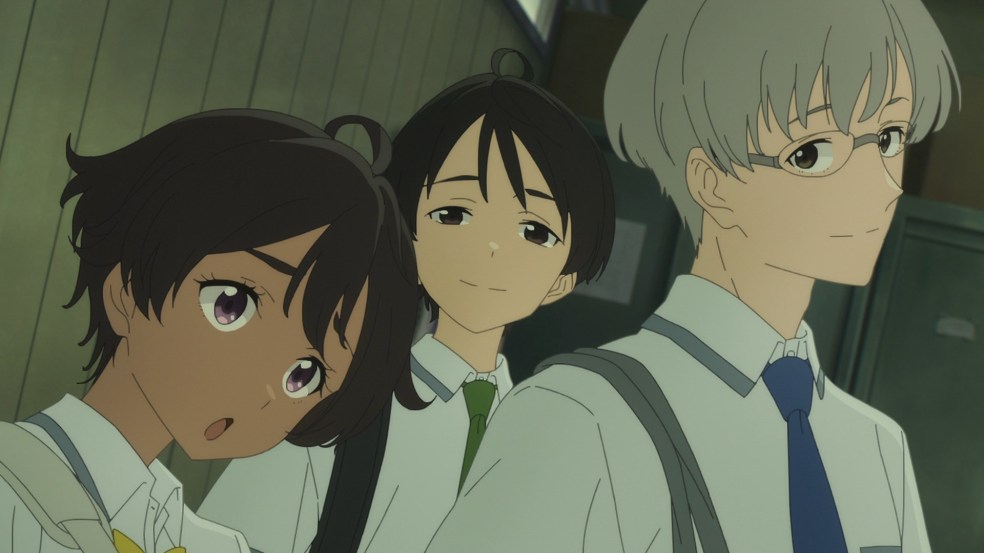
The Weekly Orbit is a weekly column collecting and refining my more casual anime- and manga-related thoughts from the previous week. Mostly, these are taken from my tumblr blog, and assume familiarity with the works covered. Be wary of spoilers!
Hello anime fans. I’m going to keep things brief and without too many pictures this week. I’ve been under the weather, so I didn’t have as much time to put this together as I’d have liked. Hopefully I’ll be feeling better when next Monday rolls around.
Anime
Mayonaka Punch – Episode 2
Mayonaka Punch‘s second episode gives us a pretty good notion of the show’s strengths and weaknesses. On the plus side, it’s still very funny, there are a lot of good gags here (mayo-garlic turning out to be a hallucinogen for vampires is probably my favorite of these), and the character dynamics work well when the show isn’t trying to overexplain itself. The art and animation are also top notch, which is good, because it’s always difficult to forecast ahead of time whether or not there will be a fall-off after the first episode.
On a lesser note, though, what the show isn’t as good at is the broad-strokes plot points. This entire episode sort of feels like a weird detour; Masaki, Live, Ichiko, and Fu start a channel called the Chu Chu Girls, find some surprisingly early success, but are then forced to delete it via the intervention of a red-haired vampire named Yuki [Kayano Ai], who Live has some prior history with, and who threatens to rat them out to a figure identified only as “Mother.” This is all well and good, but our girls end up making a second channel—this time without using their vampire abilities—at the end of the episode, so this episode essentially ends in the same place as the last. It feels a bit like we’re skipping ahead and resetting to avoid having to depict these characters getting to actually know each other. There’s a lack of specifics here that I find frustrating, especially when Masaki flashes back to meeting the other two Hyped-Up Girls, and they bond over liking the same kinds of Youtube videos. What those videos are and how they brought them together is left unstated (although I suppose this tracks with the show’s general depiction of Youtube as a thicket of content-for-content’s sake. Not an inaccurate depiction, but certainly not a complete one.)
Still, I’m optimistic. There are strong character moments here, too, like when Masaki returns to her now-empty house after the Hyped-Up Girls have moved out and spends yet another night egosurfing negative comments about her. Additionally, the next episode looks much more gag-focused, and I think if the series sticks to its guns in that way, it will serve it well.
Alya Sometimes Hides Her Feelings in Russian – Episode 3
Less comedic episode this time around. Mostly a flashback so we can learn how Alya and Kuze met. Pretty cute! I like that all Alya really wants is someone to recognize her hard work, that’s cute, and I think it works for the character. Again, this show is firmly still on my “just pretty good” list, but there are worse things to be.
Wistoria: Wand & Sword
Every minute I watch of this I have a nagging thought in the back of my head. Something like “this is fine, but I kind of wish this production team were working on something more innovative.” That’s unfair, because it’s not like if this show didn’t exist all of this polish would be magically going to Tower of God or something else airing right now, but it feels a bit hollow. You could probably get most of what’s genuinely worthwhile out of this show by watching gifs from it on sakugabooru.
I’m going to make a strange extended metaphor, please follow me down this path. Todd in the Shadows, noted Youtube Music Guy, once put forward the theory that there are two categories of pop stars, there are those who get the public interested in their personas and points of view and who will probably be at least somewhat famous forever, and there are those who will only remain in the public eye until their hits run out, and not a day longer.
Oomori Fujino, author of both the manga this is based on and more notably of the Danmachi series is, if we’re comparing creatives in this industry to pop stars—an admittedly dubious comparison, but bear with me here—the second one. His work has craft and fluidity and skill, and those are not by any means worthless things to have, but I am always at least a little cognizant of the fact that I’m seeing the sausage be made as he’s making it. More than just the fact that this series is a pretty direct riff on two other more popular IPs (Harry Potter and Black Clover), I just sort of can’t imagine someone caring all that much about this story on its own terms unless they have severe light novel poisoning. Even then, it mostly sticks out because it uses a number of basic storytelling techniques that actual narou-kei light novels tend to try to shortcut their way through. In other words, he is a consummate professional in a section of the industry presently dominated by amateurs.
This might seem like a weird turnaround because I think my first post on Wistoria came off as much more positive, but this is kind of just a different (arguably more cynical) way to frame what I thought upon finishing the first episode. Whether I phrase it as “wow, this is way better than the other narou-kei fantasy stuff going around right now. The main character has an actual motivation, clearly laid-out obstacles to overcome, and there’s not a pop-up stat screen in sight” or “It’s pretty grim that this is so much better than the other narou-kei fantasy stuff going around right now just because the main character has an actual motivation, clearly laid-out obstacles to overcome, and there aren’t any pop-up stat screens in sight” is kind of a matter of semantics. We will see if I manage to actually develop a strong opinion on this show by the time it ends, assuming I finish it.
Code Geass: Rozé of The Recapture
I don’t have a ton to say here. I appreciated the further ties back to the original series and the ever-more-absurd mecha action.
I think there’s an interesting discussion to be had about the contrast drawn between Toumi’s [Chiba Shouya] successful sacrifice, framed as heroic and worthwhile and even met with a salute, vs. the (failed) sacrifice performed by the bigoted Britannian commander whose name I’ve already forgotten. Obviously, within the literal text of the narrative Toumi is completely in the right while the commander is completely in the wrong, but it does draw attention to Code Geass‘ nationalist overtones, which are as much a part of the work as the things I actually like about it (most other parts of it, honestly. I’ve gone on at length before how weak I am to campy bullshit) are.
Bye, Bye Earth – Episode 2
Two episodes in, in what I suspect is probably the more indicative of the two we’ve had so far. My main takeaway from this episode was how much it reminded me of, surprisingly enough, Kino’s Journey.
Here, Belle journeys to Park City on the first step of her quest to become a Nomad and find her people. The Kino comparison sprang to mind because there’s an odd morality play sort of setup here. The City is divided in two, the good Topdogs and evil Underdogs, who live in different sections of it, but something about the specific use of “good and evil” here is….funny. Especially since the Priestess-King Rawhide [Tsuda Kenjirou & Satou Setsuji], who Belle eventually meets and forms a contract with, seems to embody both of them, there’s a sort of duality thing going on here.
My overall impression is honestly just that this is a very particular series going for a very particular thing. This is probably down to the age of the work—the Kino’s Journey analogue is less ridiculous than it may seem given the vintage of the original novels—and where this genre, the traveler story, has gone since. I am interested to see what the next step in Belle’s journey looks like, since it seems she will have to duel a centaur next week.
SHOSHIMIN: How to Become Ordinary
If I could identify any coherent thesis behind SHOSHIMIN Series, it’s how the world is often unfair and cruel to those who don’t fit in. Implicitly, then, it is also about how the world is often unfair and cruel to neurodivergent people. In fact, if I can identify a commonality among the conversations here, it’s that none of these people are “normal,” and they are continuously striving for a normalcy that they don’t have. Often by trying to impose it on others. Such a thing is common among friend groups with a lot of neurodivergent people in them, unless care is taken to avoid it.
The extremely mundane “detective work” provides something of a hook (and while I haven’t seen it, I believe it also calls back to the author’s previous series), but these are only indirectly, I think, related to the show’s actual point. Who can say, though? It might have some other cards to play, SHOSHIMIN remains an intriguingly circumspect work, the kind to make you resort to two-word chestnuts like “intriguingly circumspect.”
My Deer Friend Nokotan – Episode 2
How do you raise the stakes when your character dynamic already consists of a complete weirdo and the comparative straight-man forced to bounce off of her? Why, you add another weirdo of course. Thus, we meet Koshi-tan’s little sister Anko [Tanabe Rui] here. Anko is a bit less fundamentally unknowable than Nokotan (who accordingly has her implicit eldritch-ness toned down a little here, since it doesn’t work with the structure of this episode so much), but she’s about as much a force of nature.
I like Anko. Siscon characters are way overdone by now, but having one fits with the show’s ’00s comedy vibe and Anko is significantly scarier than is the norm for her archetype. She spends the (weaker) first half of the episode swearing revenge on Nokotan because she has it in her head that the deer has somehow stolen her sister’s virginity, a misconception that Nokotan herself of course does nothing to dispel. I am sad to report that whatever else may be said about me, if you have an anime character accuse her sister of making a “love nest” for herself and a deer, I will still find it pretty funny.
The second half of the episode is the real highlight here, though, as Anko and Nokotan compete in an absurd quiz show wherein Nokotan will have to be “deported” to a wildlife park if she loses. The subject of the show is, of course, Koshi-tan, and thus the episode once again gets most of its charge from humiliating its main character. Eventually, Anko, on the brink of losing, unleashes a flurry of kunai (where did she get those from? Who knows) on Nokotan, and while she dodges most of them with ease, she takes a bullet for Koshitan, and is promptly mourned by Koshi-tan and the rest of the cast with all the fanfare of Elmer Fudd weeping over Bugs Bunny. Meanwhile, she’s up in Deer Heaven, meeting with Deer God (not the subtitle group) and getting kicked back to Earth for unknowable reasons.
All told, a solid episode in a solid series, and I like the twist that Anko and Nokotan become friends at the end. My assumption is that life is not about to get any easier for Koshi-tan.
Makeine: Too Many Losing Heroines! – Episode 2
This was fantastic! Much more of a straightforward harem comedy than the first episode (except for that scene near the end), but a very good one, so I can hardly complain. Lemon [Wakayama Shion] is a wonderful character and I think she might be my favorite of the main 3 girls, I suppose we’ll have to see how things shake out with Chika, the short girl from the literature club. Some people will be put off by the comparatively horny nature of the first half of this episode. I can’t really pretend I care, much, personally. I thought it was pretty damn funny. (“But Nukumizu, it’s just us girls here!” can only be the result of truly intense heat stroke. Or maybe it’s foreshadowing and this will somehow turn into the first harem anime to star a trans girl. Anything is possible!)

Also, the nurse! Casually mentions having fucked in what is now her own office back when she was a student (possibly with the other woman who’s now her coworker?)! Wiretaps her office! Has a shipping chart! Most of the meta stuff from this episode came from her and she seems like she’ll be a great supporting character going forward.

The scene at the end of the episode where Lemon deals with her heartbreak by running laps after sunset is phenomenal, and I think if the show can continue hitting those sorts of emotional beats it’ll easily make my personal Top 5 by the end of the year.
2.5 Dimensional Seduction – Episode 3
I thought this was….fine, I suppose. I remain undecided on if the few things this show does well are worth putting up with the parts where it’s obviously lacking.

In this episode Mikari [Kitou Akari], the obligate normie girl in the harem who we met last week, does a cospaly shoot with Masamune and Ririsa. There is a little kernel of real feeling in how Mikari relates to Miriella, the character she’s cosplaying, because the character could never tell Ashford how she felt, and Mikari herself can’t be straightforward with Masamune, so she relates to her in that way. That said, sitting with it for a minute made me just think about how the various in-universe anime in Dress-Up Darling aren’t a contrived bespoke metaphor for part of the main plot in that series, and how they thus feel much more like real anime that could exist in some alternate timeline than the fairly thin picture of Ashword Wars that the show’s given us so far. I can also imagine the target audience actually finding the stuff in Dress-Up Darling hot, which, just to be super blunt, is not the case here. The visual chops just aren’t there, so the show is failing even in its intended basic goals.
A small point in the show’s favor is that I think this whole mana infusion thing is a crack about Fate/stay Night, which, hey, that’s something. Even then, that’s also kind of a weirdly dated reference point for a show in 2024, even keeping in mind that the manga is 5 years old.

There remains something broadly structurally impressive about most of the show being set in a single room with only a few characters, but it also makes the series feel kind of claustrophobic. This is a cousin of the same problem the Giji Harem anime is having right now. It’s not as severe here, but one does get the distinct sense that this probably works better in print where there’s not as much of a sense of place as in an anime. It’s also extremely languid in pace, and compared to how well-structured the other romcoms airing this season are that’s a very notable weakness. Although at the end of the episode, our leads stay overnight at school to get work on a cosROM done, which is a nice interruption from what has quickly become this series’ norm.
All this said, I think I am fairly close to dropping this. It doesn’t hold a candle to Makeine obviously, but it’s also not nearly as good as Roshidere, an equally low-stakes romcom with a horny streak that, despite its vastly different premise, is just handling itself with much more confidence and style than this has so far.
Wonderful Precure – Episode 25

This is a very fun and antics-heavy episode. I particularly like Mayu’s ongoing quest to play matchmaker with Satoru and Iroha (up to “narrating his inner thoughts” at one, hilarious point).
Mayu helping Yuki into the water is really cute until Komugi (intentionally) ruins the moment. I also quite liked their fight against the sea turtle garugaru and the nice “wonder of nature” moment with the normal sea turtle afterward toward the end of the episode.
Wonderful Precure has just kind of been quietly tossing off great episodes for a while now, and I’m a little sad that I haven’t always had the presence of mind to talk about them. This is not as hands-down excellent as the episode from a few weeks back where we finally get some hint as to who our main villain might be, but it was still very good, and next week’s episode promises to be so as well.
And that’s about all I’ve got for you, today. As today’s Bonus Thought, I’ll ask you to ponder this screencap, also from Wonderful Precure. I don’t know what it is, maybe lingering affection for that one OG Transformers episode? But something makes protagonists surfing inherently very funny to me. Maybe you agree.

“She will never be surfing.”
Spits out cereal.
With the bustle of premiere week firmly behind us, I’d like to again ask for you to consider making a small donation if you enjoy what I do here on the site. I don’t have a traditional job, so every penny helps.
Like what you’re reading? Consider following Magic Planet Anime to get notified when new articles go live. If you’d like to talk to other Magic Planet Anime readers, consider joining my Discord server! Also consider following me on Anilist, BlueSky, Tumblr, or Twitter and supporting me on Ko-Fi or Patreon. If you want to read more of my work, consider heading over to the Directory to browse by category.
All views expressed on Magic Planet Anime are solely my own opinions and conclusions and should not be taken to reflect the opinions of any other persons, groups, or organizations. All text is manually typed and edited, and no machine learning or other automatic tools are used in the creation of Magic Planet Anime articles, with the exception of a basic spellchecker. However, some articles may have additional tags placed by WordPress. All text, excepting direct quotations, is owned by Magic Planet Anime. Do not duplicate without permission. All images are owned by their original copyright holders.


 The Magic Planet