Let’s Watch is a weekly recap column where I follow an anime for the course of its entire runtime.
For the Cinderella Gray column, new installments will be posted either on the Sunday each episode airs, or as soon as possible over the succeeding week. Expect spoilers!
We begin this week’s episode with a blowout. Last week’s episode went out of its way to at least suggest that Black Ale was a credible threat to Oguri Cap. But true as that might be in theory, in practice, Ale runs in this race how she’d run in any other, and she ends up paying for it. Oguri Cap finds an opening in the pack of runners in the middle placements and shoots through them like a silver bullet. Or perhaps we should say around them, since her big play here is to take advantage of the sheer width of the track to come from the outside, seizing the front position from Black Ale relatively late but without much trouble.
All that happens before the OP drops, mind you. And it’s enough to get the attention of the blonde journalist we met very briefly last week. That guy, Fuji Sensuke [Takahashi Daisuke], turns out to be a surprisingly important part of this week’s plot. But before we talk about what he’s up to, we should talk about the two other races that happen in this episode. Both are important, and while we only really see one of them in any detail, they’re both important as setup pieces for where this story appears to be going overall. In general, I would actually say this is one of the series’ weaker episodes so far, given the somewhat muddled pacing. But it’s to the show’s immense credit that even with that in mind, it’s still wildly entertaining.
The episode’s second and most elaborated-upon race pits Oguri Cap against Yaeno Muteki [Hinohara Ayumi]. I have to admit to feeling a little bad for Yaeno, who carries herself with a seriousness that would not be out of place in a much older martial arts series or the like (and this is a comparison Cinderella Gray draws directly, when we meet her trainer late in the episode, he’s an old-school martial arts anime sensei type, looks like a retired samurai, and carries a wooden sword around with him). She attempts to directly challenge Oguri in the Tracen Academy cafeteria, only to get ignored because Cap is too busy being awed at the variety (and sheer quantity) of food available.
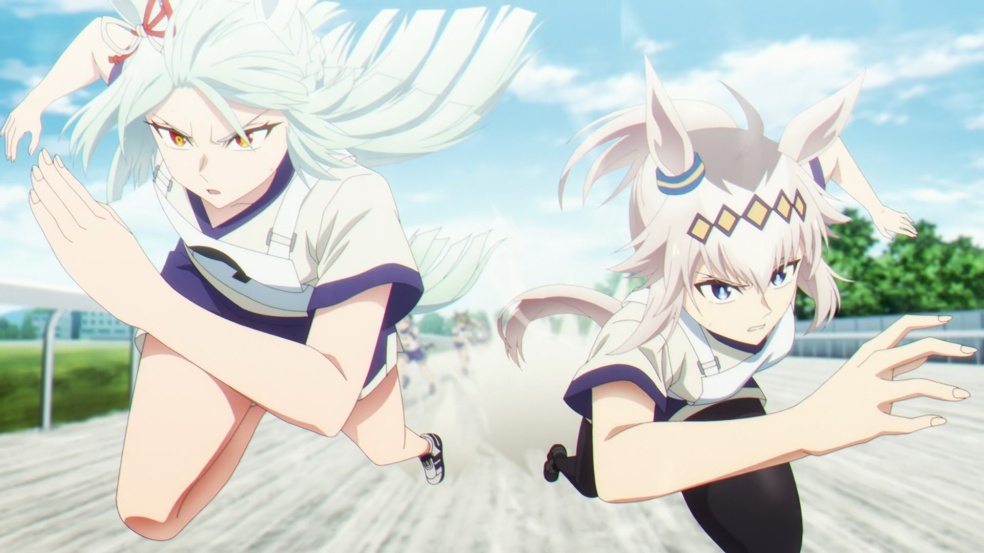
On the racetrack, Muteki is a more credible threat, deliberately hemming Oguri Cap in so she can’t pass the other racers on the inside of the track. What she doesn’t see coming is Oguri’s willingness to simply run much farther by taking the outside of the track, and while Cap is evidently impressed enough to actually remember who Yaeno Muteki is after this, she does still win, putting her at an impressive 2-0 within a single episode.
In spite of all this, I would say the episode’s actual main drama comes from somewhere else. In between all the racetrack action, we sometimes cut over to Symboli Rudolf and Maruzensky (voiced by mononymous seiyuu Lynn, she’s Rudolf’s assistant, and a horse girl from the same generation of racers). It’s worth honing in on this particular tidbit here.
Much effort has been put into reinforcing the idea that Symboli Rudolf was really something special. This makes sense given her obvious strength as an athlete, but what Maruzensky means is a bit more specific than that. What she really seems to find lacking in the modern Twinkle Series is the way that Rudolf lit up a crowd. That nebulous “superstar” quality is what Maruzensky thinks the game’s been missing. (And given the equally nebulous time scale of Uma Musume in general, we don’t have a great idea of how long ago that was, but it certainly seems like it’s been a while.) The obvious blank we’re supposed to fill in—made nearly-explicit when Maruzensky actually directly brings her up later in this scene—is that Oguri Cap is or at least could be that superstar. Were it not for the red tape getting in her way, of course.
Which brings us back to Fuji Sensuke. A reporter with the eye for sensational headlines, Sensuke gets wind of Oguri’s disbarment from the classics and runs with the story, publishing incendiary headlines and, by episode’s end, even getting a massive petition with tons of signatures in front of Symboli Rudolf. Sensuke is an evidently somewhat amoral figure, and Roppei expresses annoyance that he’s trying to make this happen when he sees the aforementioned headlines. (Does he think Oguri’s not ready? It’s hard to say.) The episode closes with a standoff between Sensuke and Rudolf—and I do have to give the guy credit for having the stones to demand she pull strings about this in person—but there’s one last foible we should touch on.
Yaeno Muteki’s loss to Oguri Cap seemed to disqualify her from the Satsuki Sho. However, one of the other racers—Dicta Striker [Hanamori Yumiri], who given her distinctive design seems like she’ll be important eventually—had to drop out, giving her an opportunity to enter in a replacement spot. The Satsuki Sho is a G1 race, and Yaeno Muteki actually wins it, although not without some serious competition. This, combined with Sensuke’s petition, certainly seems to be setting Oguri Cap and Yaeno Muteki up for a rematch. And this time, Oguri knows who she’s up against.
Like what you’re reading? Consider following Magic Planet Anime to get notified when new articles go live.If you’d like to talk to other Magic Planet Anime readers, consider joining my Discord server! Also consider following me on Anilist, BlueSky, or Tumblrand supporting me on Ko-Fi. If you want to read more of my work, consider heading over to the Directoryto browse by category.
All views expressed on Magic Planet Anime are solely my own opinions and conclusions and should not be taken to reflect the opinions of any other persons, groups, or organizations. All text is manually typed and edited, and no machine learning or other automatic tools are used in the creation of Magic Planet Anime articles, with the exception of a basic spellchecker. However, some articles may have additional tags placed by WordPress. All text, excepting direct quotations, is owned by Magic Planet Anime. Do not duplicate without permission. All images are owned by their original copyright holders.
Let’s Watch is a weekly recap column where I follow an anime for the course of its entire runtime.
For the Cinderella Gray column, new installments will be posted either on the Sunday each episode airs, or as soon as possible over the succeeding week. Expect spoilers!
Tracen Academy is, to any Uma Musume fan who got onboard before Cinderella Gray, synonymous with the series itself. Tracen is the main setting for seasons 1-3, as well as Road To The Top and the New Era film. It is Uma Musume. So it’s unsurprising that, just past the halfway point of its first cour, Cinderella Gray is also shifting setting to the storied racing academy. I admit I only barely fall into the category of “Uma Musume fan who got into it before Cinderella Gray” myself, having started with the aforementioned Road To The Top OVA near the top of the year. Still, Tracen is an already immensely nostalgic setting for me, and it’s lovely to see it again. Also worth looking at are the contrasts between this episode and episode 1, instructive and fascinating as they are. We began this story in what is, comparatively speaking, a backwater for Uma Musume racing. (The “boonies,” as one character puts it.) We begin this second part of it here, in Japan’s racing capitol. Make sure to keep up, things don’t seem like they’re going to slow down any time soon.
It’s worth also briefly touching on the contrast between Tracen as depicted here and its own past appearances in Uma Musume anime. While always portrayed as a prestigious and sprawling school, here it somehow feels even more enormous, as though it’s been blown up to truly massive proportions. This feeling of massiveness serves to amplify the fish-out-of-water effect; Oguri Cap takes the sights and sounds of Tracen in stride (although Belno super doesn’t), but the point remains; they’re not in Kasamatsu anymore.
Their first few days also don’t go smoothly, why would they? In fact, quite a lot happens in this episode. Basically everything short of an actual race.
Firstly, there’s the school itself. As mentioned, sprawling, enormous, not what either Oguri nor Belno are used to. Helping them get adjusted is Roppei (it’s Musaka), subbing in as Oguri’s trainer while Kitahara gets his national license. The pair briefly meet, ad hoc, with Symboli Rudolf, who takes the time to explain the ostensible meaning behind their school’s motto.
We’ve already talked about “Eclipse first, the rest nowhere,” since it came up in episode four. Here, the phrase is framed as a command to aim for the ace, to never be content with second best, to stand alone at the top of the mountain. Interestingly, what I did not know at the time—and what you already know, if you clicked that link I put in the header—is that that’s not what it means. It actually refers to the dominance of a single, specific historical horse; that’s who Eclipse is, or rather was. This isn’t a criticism of course, Uma Musume has a long-standing habit of attempting to imbue artifacts of real horseracing with some additional meaning, (the example that comes to mind is Satono Diamond explicitly comparing her unbreakability to her namesake in season three) and the transmutation of “Eclipse” referring to a specific individual to meaning the verb “eclipse” is just another instance of that, and a pretty slick one. It’s also relevant to the episode on the whole. Oguri Cap being such a goofball can obscure the fact that she’s very, very good at what she does, and is about as strong-willed. She does not, and will not, settle for second place, literal or figurative, in anything.
This brings us to the topic of Oguri’s actual classroom. When Oguri attends her new homeroom for the first time, we meet an absolute smorgasbord of new faces. I assume each will be relevant in their turn as this arc goes on, but worth immediately mentioning are Yaeno Muteki [Hinohara Ayumi], who meets her as a new comrade and challenger with respect, and Black Ale [Mori Nanako], who absolutely does not do either of those things.
Black Ale is incredibly arrogant and is vocally unimpressed by Oguri. She has the race record to back that arrogance up, so one can kind of see where she’s coming from in not necessarily thinking Oguri is all that based on her wins back home. Still, she doesn’t actually have a good measure of who she’s messing with. And indeed this doesn’t really faze Oguri Cap at all, at first, and she responds to that little “sandboxes” insult with the kind of dry remark where you can tell she doesn’t even realize she’s just punked Ale in front of their entire class.
Much later, toward the end of the episode. Ale confronts Oguri Cap again, this time directly insulting Kasamatsu, its racers, and Oguri herself, and that Oguri does not stand for. As is tradition with this kind of thing, the two make a bet. When they meet in the upcoming Pegasus Stakes, if Black Ale wins, Oguri Cap will return home. If Cap wins, Ale has to watch her language. It’s true that Black Ale has probably the mouthiest lines of any Uma Musume in the anime so far, but implicitly what Oguri Cap is really saying is more along the lines of telling her to watch her mouth, a subtly different thing. Cap is a hometown hero in the making now, something she’s clearly aware of.
We need to back up, though. Because Black Ale is not the only horse girl Oguri tells off in this episode, and she is by far not the most prominent one.
To rewind a bit, it’s mentioned, not long after the classroom scene, that in order to enter the G1 classics and attempt to obtain the Triple Crown—that’s the Satsuki Sho, the Japanese Derby, and the Kikuka Sho—you have to, you know, register to do that. Kitahara seemingly never considered that Oguri Cap would want to do this immediately (or just didn’t know about all this paperwork in the first place), and as such Oguri has none of the relevant forms. If it’s possible, seeing Oguri Cap live one of my recurring nightmares that’s haunted me since middle school has made me love the character even more.
Still, it’s hard not to feel for her, here, and it says a lot about Cinderella Gray‘s range that it can capture both this extremely relatable exasperation and confusion and the fiery feelings of a competition stoked in the same episode. In fact, it draws a connection between the two. Because Oguri Cap, who really wants to win the Japanese Derby for Kitahara (since she can’t win the Tokai Derby now, but since they’re both called the Something Derby they must be basically the same, right?), gets it in her head that surely, there’s at least one person she can talk to to work out some kind of exception.
She’s wrong about this, or at least, wrong for the time being (it seems odd to me that the Triple Crown would be brought up at all if Oguri isn’t going to somehow at least attempt it eventually), but you really have to give her credit for trying, because the person she has in mind is Symboli Rudolf.
Symboli Rudolf is a fascinating character in the history of Uma Musume. Throughout the previous episodes of Cinderella Gray and, indeed, throughout most of the history of the franchise, she’s been largely a background presence. Season 2’s protagonist, Tokai Teoi, admired her deeply, and Rudolf has been present, usually as a somewhat remote voice of reason, throughout all three of the Uma Musume TV seasons. She’s a franchise-wide bedrock, and her immaculate race record backs up the often-made claim that she’s the strongest Uma Musume ever, but we know surprisingly little about her as a character.
What this episode suggests is that Symboli Rudolf’s air of authority is derived not only from her strength—although certainly that, too—but also the deadly seriousness with which she takes the sport. Oguri Cap explains her predicament, and for what is to my recollection the first time ever, we see Symboli Rudolf get angry about something.
The show is clearly very proud of this shot, because there’s a flash back to it not long later.
If anything, Rudolf is offended that Oguri Cap thinks she can waltz in and simply upend the proper order of things because she wants to. I really can only give it up for the character visuals here once again, that is a mean-looking horse right up there. In fact, her anger is overwhelming enough that Belno, also there while Oguri is asking about all this, actually falls to her knees in fear. I do get it! It’s not just Rudolf herself, it’s the gravity with which she treats this subject. There is no better illustration than this, the visual of a nameless Triple Crown winner standing atop a mountain of broken bodies, which fades into view with a grim grandiosity.
But of course, Oguri Cap is Oguri Cap. This is where we come back to that competitive mindset, typified by the motto which, remember, Rudolf herself expounded on earlier in this same episode. Oguri Cap will take these rules and traditions, and she will break them with her legs; her words, not mine. Arrogant! Arrogant, but really fucking cool! How does that even work? Is she going to just win so much that they’ll have no choice but to bump her up? I don’t know! I’m excited to find out!
One gets the sense from this single exchange that Rudolf is so used to most other people buckling in her presence that someone actively defying her is a bit of a shock. Am I reading too much into it? Maybe. But I’ve never met an anime I couldn’t over-analyze.
This article has already gotten super long, so I won’t go over every other little detail of the episode. But Oguri does meet her teammates, the other girls in Roppei’s stable; the preppy Meikun Tsukasa [Kazama Mayuko], the somber and shy Kraft Univer [Tanaka Takako], and–
[Kaiden Michiko]
It’s hard to say if these characters will be super relevant going forward or if they’ll mostly serve to help Oguri out with her training. Still, God Hannibal. What a name. I’m speechless.
In any case, the last scene of the episode cuts to the Pegasus Stakes, Oguri’s race against Black Ale. The race itself is territory for next episode, but one of the last scenes here is Oguri standing beneath the huge, open sky, drinking in the roar of the crowd, and being absolutely stoked out of her mind. It’s maybe the best possible way to tee up this particular cliffhanger; a reminder of why we love this absolute freak in the first place.
….Oh, and there’s a really cute post-credits scene where we check back in on Fujimasa March and company while they’re at what’s essentially a Denny’s. Norn gets called down bad, which I’m taking as validation of my ship, and Fujimarch ponders cutting her hair. It’s brief, but I’m very glad to see those characters even in passing.
Like what you’re reading? Consider following Magic Planet Anime to get notified when new articles go live.If you’d like to talk to other Magic Planet Anime readers, consider joining my Discord server! Also consider following me on Anilist, BlueSky, or Tumblr. If you want to read more of my work, consider heading over to the Directoryto browse by category.
All views expressed on Magic Planet Anime are solely my own opinions and conclusions and should not be taken to reflect the opinions of any other persons, groups, or organizations. All text is manually typed and edited, and no machine learning or other automatic tools are used in the creation of Magic Planet Anime articles, with the exception of a basic spellchecker. However, some articles may have additional tags placed by WordPress. All text, excepting direct quotations, is owned by Magic Planet Anime. Do not duplicate without permission. All images are owned by their original copyright holders.
Let’s Watch is a weekly recap column where I follow an anime for the course of its entire runtime.
For the Cinderella Gray column, new installments will be posted either on the Sunday each episode airs, or as soon as possible over the succeeding week. Expect spoilers!
Oguri Cap enters this episode devastated and conflicted. She leaves it a hometown hero. That’s how legends are born.
The previous episode of Cinderella Gray was a masterfully-crafted, coiling mechanism of tension. This episode is where that tension is released, and in that process we get to see some sides to our favorite characters that we haven’t seen before. But the true crux of the episode is the Gold Junior, an epic, psychological struggle on the racetrack. It ends with a huge, overwhelming moment of pure catharsis, one of the best of its kind in recent years. Remember; “Cap” meaning “peak.”
Getting there is another story. The episode opens with Oguri Cap furious, angrier than we’ve ever seen her, at Kitahara’s decision to transfer her to the nationals and stay behind. (Not to once again devote space on this site to my own thirsting, but there is a frightful beauty to Oguri’s angry faces, they’re very well-drawn and the fact that they’re such a stark contrast to how she normally acts really enhances the effect.) Her fury is easy to understand; she and Kitahara promised to take on the Tokai Derby together, and from her point of view he’s now breaking that promise. This is a recurring theme across the episode, the letters and spirit of these promises, and what breaking them means.
For Oguri, it makes it difficult for her to concentrate on the race, both in the training leading up to it and, eventually, for the race itself. For Kitahara, it’s the apex of his plague of self-doubt. No less a figure than once again, Symboli Rudolf, calls him out for his foolishness. Making either choice would’ve been better than trying to make none of them, and hinging the transfer on Oguri’s race results puts the horse girl in a truly unenviable situation.
The morning of the race is filled with contrast. Merch stalls sell adorable plushies of the rising local hero, and excitement is in the air from the audience at least, who clearly understand that they’re about to see Oguri build her legend up with another victory. But the track itself is bogged-down with mud after thudding, pounding rain from the previous night. Kitahara is in low spirits, and Oguri, now conflicted that her running is making others sad and without the confident support of her trainer, is in even lower ones.
Complicating things even further is the presence of Oguri’s rival up to this point, Fujimasa March. March, of course, is also furious. Word has by now spread that Oguri is going to be transferring to the nationals if she wins. Fujimasa demands to know why. They promised to race in the Tokai Derby together, and that promise is now falling apart before March’s eyes. Again, it’s easy to see why she’s upset, and moreover, why she’s hurt.
But she gets no sympathy from Cap herself. Deadened by having lost her reason to run, Oguri reminds her that all March has to do to keep her from transferring is to win. The presentation is immaculate here, with sweeping, low, buried-in-the-floor camera angles and easily the meanest face we’ve ever gotten from Oguri. The tension is palpable, and it says a lot that the slap across the face that Fujimarch opens the conversation with is not the highlight of this scene.
Nonetheless, the race waits for no one.
And indeed, the race itself is a struggle less between Oguri Cap and Fujimasa March, and more between Oguri Cap and herself. She’s out of form for much of the race, and imagines her legs bound by heavy iron chains dragging her down. For a while, it really does seem like Cap might actually lose, and it’s to the show’s credit that it keeps anyone who doesn’t have the real Oguri Cap’s racing history memorized guessing.
She’s so out of sorts that she doesn’t even make use of her trademark burst of speed, something which Fujimasa March notes with some incredulity, offended that her rival isn’t even trying. As it often does in these sorts of situations, it takes an external force to jostle Oguri Cap back into proper form.
That force is Kitahara, who, like Oguri, spends most of the race struggling with himself. His own doubts are quieter and get less direct attention (since he isn’t the protagonist, naturally), but he spends most of the Gold Junior sulking and not even actually looking at the race track. It takes Roppei, also in attendance, to snap him out of it, physically forcing him to look at Oguri Cap’s performance. Seeing his trainee obviously out of form and distraught is enough to spur Kitahara back to action, and he begins running too, fumbling through the crowd, bloodying his nose—that seems to happen to him a lot—and finally reaching a spot where he can cheer loud enough for Oguri to hear him. Just as Roppei shook Kitahara out of his stupor, Kitahara shakes Oguri out of hers by doing this.
For Oguri, his cheers, and the cheers from the others watching—Belno, the bully trio who have remained an important part of the supporting cast up to this point—are a reminder of why she’s running; to make herself happy, to make others happy.1 Regaining her confidence is enough: Oguri Cap takes the day.
In a beautiful touch, her hair comes undone as she crosses the finish line, leaving her final mark on the locals a wave of flowing, cloudy gray as she streaks into first place. The victory is immensely cathartic. The series makes a point here that Oguri Cap inspires her supporters; it’s obviously talking about Kitahara, Belno, Norn Ace, and so on, but it’s also talking about the people in the crowd, and thus, implicitly, us as well. The swell of joy is very real with this one, it’s perhaps one of the best-orchestrated victories in the whole franchise.
In the aftermath, Oguri’s stage show—which she rocks, by the way, and just generally looks great doing—becomes a platform for Kitahara to tell the crowd that, yes, the rumors are true. She’s moving on and up. The crowd is initially disappointed, but he reminds them—and anyone watching at home who might be sad to see this part of the story end—that there are higher dreams to aim for. This story isn’t over yet, and there are more mountains to climb.
The reason all of this works so well is that big dreams and stories of triumph are why we’re here in the first place. As Kitahara notes, it’s a Cinderella story! It’s right in the title! It’s also a testament to how ungodly well Cinderella Gray has been written so far that I’m genuinely going to miss every single character Oguri has to leave behind now that she’s transferring to Tracen! Norn Ace’s idea to take a commemorative picture (somehow framed as a polaroid photo despite her taking it on a smartphone, just one more drop of that trademark Uma Musume time weirdness) had me full-on crying.
I am aware I keep comparing Uma Musume to some kind of long-running battle shonen anime, which is, of course, not actually what it is. But I do have to bring that comparison out again, because this episode really does feel like the end of a long, long first season where there’s a notable changing of the guard and it’s all very bittersweet. I can only really again credit the writing for evoking that feeling over a scant six episodes (of a confirmed thirteen and a rumored 23). Perhaps the toughest departure is that of Fujimasa March, who vows to continue running despite her initial plan to quit if she lost to Oguri again. It doesn’t seem like they’ll meet again, at least not as competitors, as Oguri is going somewhere that March can’t reach. Nonetheless, their mutual respect for each other is genuinely touching, an excellent last note to their rivalry.
But we can’t dwell on who’s leaving, because two very important characters actually aren’t. Firstly, Kitahara vows to get a national trainer license—we aren’t explicitly told why he didn’t try to do this in the first place, but given some of the allusions to Kitahara’s still-murky past, we can make some educated guesses—and Belno Light, who is not just Oguri’s close friend but also her personal outfitter at this point, has quietly gotten acceptance into Tracen via its sports science program. This all ends the episode on a warm glow, bittersweet but with emphasis on the sweet. The main trio are going to Tracen, and the real race has yet to be run.
1: In this way, she isn’t actually terribly dissimilar to the protagonist of Uma Musume‘s third season, Kitasan Black. For a plethora of reasons, I think the approach works much better here.
Like what you’re reading? Consider following Magic Planet Anime to get notified when new articles go live.If you’d like to talk to other Magic Planet Anime readers, consider joining my Discord server! Also consider following me on Anilist, BlueSky, or Tumblrand supporting me on Ko-Fi. If you want to read more of my work, consider heading over to the Directoryto browse by category.
All views expressed on Magic Planet Anime are solely my own opinions and conclusions and should not be taken to reflect the opinions of any other persons, groups, or organizations. All text is manually typed and edited, and no machine learning or other automatic tools are used in the creation of Magic Planet Anime articles, with the exception of a basic spellchecker. However, some articles may have additional tags placed by WordPress. All text, excepting direct quotations, is owned by Magic Planet Anime. Do not duplicate without permission. All images are owned by their original copyright holders.
Let’s Watch is a weekly recap column where I follow an anime for the course of its entire runtime.
For the Cinderella Gray column, new installments will be posted either on the Sunday each episode airs, or as soon as possible over the succeeding week. Expect spoilers!
Cinderella Gray was never going to be all victory forever. No series is that, certainly not any sports anime and definitely not Uma Musume. (Even Season 2, which is the cleanest path-charting superstar story in the franchise, is defined perhaps even more by its dramatic, tragic moments as its triumphant ones.)
That said, the kind of dramatic conflict that emerges here is a bit surprising. Not unwelcome, but at the very least it isn’t something I saw coming.
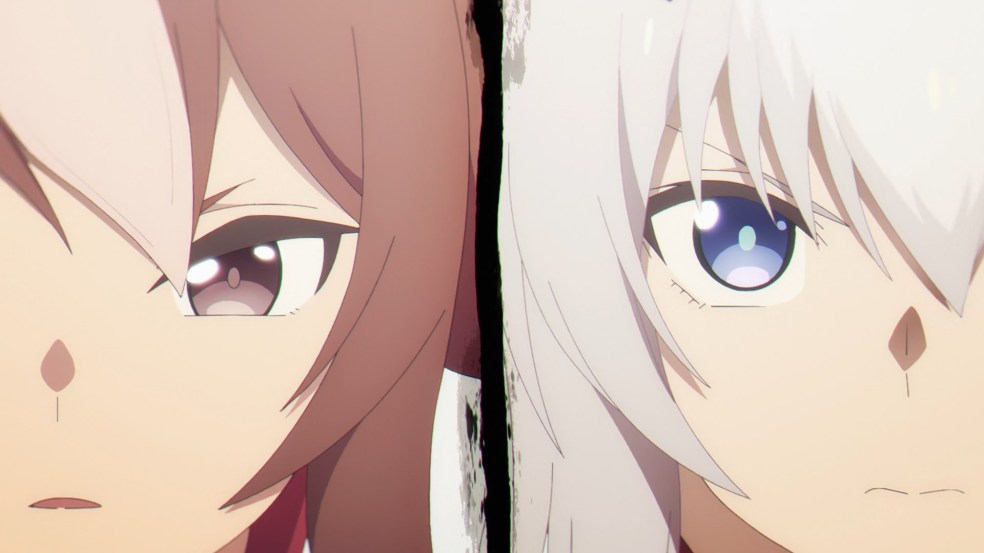
First, a bit of racetrack politic: horse races in Japan (at least, in the Uma Musume universe, but I have little reason to assume this isn’t also true in real life) are separated into national and regional races. So far, Oguri Cap’s story has been at the regional level. The Tokai Derby she aims to run in against Fujimasa March, the race both she and her trainer Kitahara Jou dream of winning, is a regional race. To that end, the episode opens on Oguri competing in the Chukyo Hai, another regional race and a stop along the path to the Derby. She wins by a complete blowout, in fact. To the point that the race itself is basically an afterthought. This is all well and good, but as we learned last week, it’s not just the usual crowd of horsegirl enthusiasts watching the race, also present is Symboli Rudolf, president of Tracen Academy. Rudolf is extremely impressed by what she sees on the track, and sets about recruiting her to compete in the nationals. She talks to Kitahara first, and he is both starstruck and extremely intimidated that she wants to talk to him. Moreso when he finds out what she actually wants.
Cinderella Gray uses a fun structural trick in this episode, wherein after Kitahara’s talk with Rudolf, we actually cut to a flashback wherein a young Kitahara is first drafted into being a horsegirl trainer by his uncle Roppei. After we return to the present, Oguri is running training laps at her usual spot, and something has clearly happened to badly affect Kitahara’s mood, but we don’t yet know what.
The plain and pragmatic truth of the matter is this; Kitahara isn’t licensed to train on a national level. If Oguri Cap is recruited to compete in national races, she will have to leave Kitahara behind.
There is quite a lot of dancing around this through much of the episode’s middle third. Kitahara’s entire vibe is very off, and Oguri even picks up on it. (Not that it’s hard to tell that someone is out of sorts when they, say, forget to press the “start” button on a stopwatch when timing you. But still.) The drama here is pretty compelling, and through the earlier flashback, the series implies some prior failure on Kitahara’s part that has led to him being so hard on himself in the present day, although we don’t yet know what that might have been. Still, it takes a weeping Belno Light—the heart of the group, here—to get some sense through to him. What he wants or what Belno herself might want aren’t the important things, they have to ask Oguri what she wants directly.
Which, itself, Kitahara can’t seem to do in a straightforward way. He delivers the news firstly in a cloying, faux-bombastic tone, and then when Oguri asks if she’d be able to keep him as her trainer, starts viciously self-deprecating under a thin veneer of taking it instride. I love this entire scene, and it makes the whole episode. It really puts both Kitahara and Oguri’s personalities fully on display and shows what happens when they clash. Jou is, by this point, very much convinced that he has to take the loss and let Oguri go, and outright says at several points across the episode that he feels that he’s holding her back. His self-defeating mentality has already made this a given for him, and he doesn’t see any way out of it. Oguri, for her part, is upset, even offended that Kitahara would assume that she’d want to race anywhere where he wasn’t her trainer. Oguri is a very straightforward and direct person, and it’s clear that she’s been taking this talk of a shared dream of winning the Tokai Derby very seriously. She doesn’t say so outright, but it’s easy to imagine that even just being asked to race under a different trainer might feel like a betrayal.
And so, she storms off. Reminding Kitahara that the Tokai Derby is “our dream.” Were it that things ended there, this might seem like something of an anticlimax, but Kitahara doesn’t have the luxury of any kind of relief. He gets a phone call. Symboli Rudolf is on the other end of the line, and while she’s polite, she makes her position on the matter clear.
Thus, we come to the episode’s end, where Kitahara gives Oguri an ultimatum. In her next race, if she wins, she will be transferred to the nationals. If she loses, the two of them will aim for the Tokai Derby together.
That’s a rough hand to deal someone, and I am extremely interested in how Oguri is going to play it, especially with hints elsewhere in the episode that the national racing press are starting to catch on to the phenomenon brewing in Kasamatsu. The Gray Monster is waking up, and everyone but Oguri herself seems to be looking toward her eventual national rise to fame with great interest. Tamamo Cross, in a post-victory interview after one of her own races, makes note of her, while elsewhere mention is made that the two of them are defying a long-standing stereotype that ashen-coat horse girls can’t run. (A detail so bizarrely specific I can only imagine it’s a translation of some weird foible of actual horse racing culture.)
So ends an absolutely fantastic episode. There are tons of little details I haven’t had the space to cleanly fit in, and it’s hard to not just cram them all in here at the end. Belno blacksmithing new cleats for Oguri? The whole weird push and pull between Kitahara and his uncle Roppei, who seemed to know this entire thing with Oguri transferring to the nationals would play out how it did? Symboli Rudolf herself, who is fantastic here and whose nickname of “The Emperor” is treated almost literally given how everyone reacts to her? All told, this episode, its smaller, less-serious moments but especially its coiling tension, is the exact kind of stake-raising this show needed, and I am riveted to see where it all goes. The world is watching, Oguri Cap! What will you do?
Like what you’re reading? Consider following Magic Planet Anime to get notified when new articles go live.If you’d like to talk to other Magic Planet Anime readers, consider joining my Discord server! Also consider following me on Anilist, BlueSky, or Tumblrand supporting me on Ko-Fi. If you want to read more of my work, consider heading over to the Directoryto browse by category.
All views expressed on Magic Planet Anime are solely my own opinions and conclusions and should not be taken to reflect the opinions of any other persons, groups, or organizations. All text is manually typed and edited, and no machine learning or other automatic tools are used in the creation of Magic Planet Anime articles, with the exception of a basic spellchecker. However, some articles may have additional tags placed by WordPress. All text, excepting direct quotations, is owned by Magic Planet Anime. Do not duplicate without permission. All images are owned by their original copyright holders.
Let’s Watch is a weekly(?) recap column where I follow an anime for the course of its entire(?) runtime. Expect spoilers!
I have not written a recap article for a currently-airing anime in nearly two years. It’s a surprisingly tough thing to nail down, at least if you want to write a good one. One has to capture the literal events of the episode, sure, but also nail its essence. What does the episode mean? Where is the show going from here? How does it fit into the contemporary landscape? What trends does it point to, present and future?
It’s a lot to consider, and that, combined with the inherent time pressure, is why I’ve largely dropped them from Magic Planet Anime. We’re making an exception today, because Cinderella Gray is, very plainly, the best thing airing right now. Despite—or perhaps because— of the fact that it’s “just” a very, very good sports series. There is a lot of great stuff airing right now (none of which I’m trying to knock), so that’s a big claim, but I stand by it. I haven’t really been beating the drum about the show as hard as I feel like I could be, and not everyone who reads these articles necessarily follows me on social media. Thus; this article. Hopefully the first of many, we’ll see.
It’s been a few weeks since I first wrote about Cinderella Gray, so let’s get up to speed real quick. After the first episode’s blowout, the second saw Oguri Cap take on Fujimasa March, the other extremely gifted, ash-haired horse girl at their school. That episode ends on a cliffhanger, and the third revealed that March narrowly edged Oguri Cap out of the victory in their first race together. The win wasn’t so definitive that she couldn’t attribute the victory to outside factors and, indeed, she becomes a little obsessed with trying to prove that she can beat Oguri fair and square. (This isn’t even an unreasonable thing to think; we also learned that Oguri’s old racing shoes were in absolutely terrible condition.) Episode three also saw Cap win a different race, absolutely demolishing the other racers and winning both the race itself and—I’m just gonna assume anyone reading this recap on my site is as yuri-brained as I am—the heart of gyaru horse girl / bully Norn Ace. Later, some more training led her to have a long, extremely shonen rival-y conversation with March, who directly challenged her to the Junior Crown.
This little conversation sets something inside Oguri alight. And that’s more or less where we begin this week. There’s a short sequence at the very top of the episode where Belno Light, Oguri’s gal pal and teammate, enters her own first race and loses quite badly. But I imagine we’ll be circling back around to her own story at a later date, as the vast majority of this episode is about Oguri, March, and this rivalry that’s grown between them.
It’s worth zeroing in on March’s line from the third episode; Without a peak to aim for there’s no point in climbing the mountain. We can make our little jokes, obviously—“peak” has taken on an adjectival meaning in English anime fandom over the past half decade, and it’s one that suits this series quite well—but it is really important that we don’t lose sight of this central metaphor.
When first asked about it, Oguri Cap is just grateful she can run at all. We already know from past episodes that when she was younger she could barely walk at all and it took active intervention on her mother’s part to turn her into the athlete she is today. This is great on its own of course, and it’s genuinely touching how truly grateful she seems to be that she can exert herself in the way she can, but this is a sports series. Oguri feels she has something to prove now.
There is an immense amount of appeal, in fact, just in watching Oguri do her thing, whether training or actually running. Aside from being a massively-endearing protagonist in the “strong but a bit of a doofus” mold (like dozens of classic shonen characters), there is a real joy to seeing her determination harden and sharpen now that she has a rival. At one point in this episode, she reveals that she’s been training with extremely heavy cleats on, a modern update on the whole “weighted clothing” trope from countless battle manga (which is promptly called attention to).
When the actual Junior Crown begins, Oguri’s trainer Jou takes note of her newfound motivation, self-deprecatingly quipping that he sometimes wonders why he’s there at all. This promptly gets him an earful from the episode’s new character; Jou’s uncle Musaka “Roppei” Ginjirou [Ootsuka Houchuu], also a horsegirl trainer, unexpectedly in town from Tokyo on vacation and scoping out the Junior Crown apparently on a whim.
Oguri Cap isn’t the only one training, of course. We get a look at March doing some “image training” (a minor obsession for this series, it played a fairly big role in Season 2), trying to imagine every possible scenario on the racetrack and conceiving of how to beat Oguri every single time. She claims to have thought up 100 different possibilities by the end of this scene, and given the fun visual of her dreaming up the blue and red colored ghosts of Cap and herself in the void of her own imagination, it’s easy to believe her.
There’s also an interesting contrast drawn between the relationships Oguri and March have to their trainers. Despite Jou’s self-effacing remark, it’s clear that Oguri likes and trusts him, and he has in fact contributed somewhat to developing her strengths. March’s trainer, meanwhile, gives her a presentation on the race, which she completely ignores in favor of her “concentration,” even going so far as to tell him to shut up. Whether this is something the series will continue to focus on as it goes forward is for those reading the original manga to know, but the difference is interesting, perhaps remarking on trust between trainer and athlete as just as important a component in a well-rounded competitor as anything else.
All of this leads up to the race, of course, and the Junior Crown is probably the show’s high point thus far. The race takes up a decent chunk of the episode, and we can basically break it down into two main parts, structurally-speaking. Firstly, there’s the race itself, which visually focuses on the actual motions of the racers as well as their mentalities while on the field, including a few full-on flashbacks to provide motivation, context, and color. (And toward the end we get some of the truly spectacular “auras” literally coloring the racers, a favorite technique of this series.) Secondly, there is the commentary, mostly coming from Jou and Belno who are watching in the stands, but also occasionally from Ginjirou and from an observing Tamamo Cross [Oozora Naomi], an uma musume visiting from Tokyo, who attends Tracen Academy, the prestigious racing school that is also the main setting of the three mainline Uma Musume seasons.
The race is spectacular. There’s a really great exchange between Cap and March just before the race begins, where Oguri interrupts March’s image training (which she’s still doing even as she prepares to run the actual race!), to say this.
I could write an entire separate article about the absolutely incredible character work the show has done with Oguri Cap so far. She’s goofy and silly often enough, and for just long enough, that as the audience we get sort of tricked into forgetting that she’s also basically Goku. This single line, probably the closest thing Oguri has offered so far in the series to a taunt, has more character in it than some anime’s entire casts. March, for the record, offers a shocked expression, but then a grin. This is largely a battle between the two of them, and they both know it.
Following on from the first three episodes, the racing in Cinderella Gray is a little less overtly fantastical than the approach taken in some more recent material from the series (certainly it’s quite a bit more grounded than the fantastical imagery in, say, New Era). But this isn’t a criticism, the grittier approach works really well for Cinderella Gray, and this race is probably the best demonstration of it yet. Particular attention is paid to Oguri Cap’s unique, low-to-the-ground stride, pointed out as a distinctive feature of her racing style as early as episode one.
Throughout, the race is a tug-of-war between Oguri Cap and Fujimasa March. (Spare a thought for Okan Maker, an extra who’s in the lead for a decent bit of the race but ends up left in the dust by both of them.) Accordingly we hear a lot from Fujimasa March. We even get a flashback showing how she’s been dedicated to winning her entire life, starting from when she was a child. In fact, much of the tone during the latter half of the race seems to sell the idea that March is going to inch out a win. She’s ahead of Oguri—admittedly just barely—starting after they both launch into a burst of speed at the same time. But what every single thing and person in the episode raising the flag that this is March’s race doesn’t understand is that Oguri Cap is….I mean, there’s no way to put it politely. She’s a monster.
The very last stretch of the race is spectacular, and here Cinderella Gray does lean into the more overt, battle shonen-esque stylings of some of its predecessors. That it’s only in such a short burst actually heightens its impact; just as March thinks she’s cinched the win, Oguri pulls a second burst of speed out of nowhere, treated with all the suddenness and gravitas of a warrior revealing a secret technique, and just like that, March is simply done.
Oguri Cap storms to victory, and the first arc of the series comes to a close.
After the race, March, initially in complete disbelief (and quite understandably pissed off) demands to know how she did that. Oguri speculates—as though she herself cannot entirely account for the power within her—that it was, in some way, March’s own doing. By directly challenging Oguri, she gave her something she didn’t have before. Oguri, of course, is quite grateful for all this, and we must imagine that the two will meet on the racetrack again in the future. Oguri directly offers such.
In doing this, Oguri seals the two’s relationship as rivals spurring each other to greater heights. I doubt March will be the last of these she picks up on her journey.
The episode’s denounement is fun, including the post-race concert, an oddity of the series that’s always felt a little tacked on—and at worst, reminiscent of the bottom of the barrel of the “idols but also other stuff” genre—here, in a relative rarity, it actually feels meaningful. Oguri has improved vastly as a performer since the previous episode where she listlessly danced to enka music and inspired Norn Ace to give her some dance lessons. (You know you’re living the sports yuri dream when all three of your former bullies show up to cheer you on at your race and one of them went out of her way to teach you how to dance. If we include Belno—and why not include Belno?—by my count Oguri has three different girls with their eyes on her. Four if we count Tamamo’s intrigued parting remark in this episode.)
The next decision to be made in Oguri’s journey is where she will race next. Jou wants to take her to the Chukyo Hai. Ginjirou advises him to skip it—he doesn’t directly say why—but Jou seems pretty determined, seeing it as an important stepping stone to Jou and Oguri’s mutual goal of winning the Tokai Derby. It might turn out to be a good thing that he’s so insistent, since an interesting post-credits scene reveals that another horsegirl attending that race—to observe, mind you—is Symboli Rudolf [Tadokoro Azusa], the Triple Crown winner that Uma Musume treats as the unofficial ur-horsegirl, president of Tracen Academy’s student council and looked up to by just about everyone. One of the final moments of the episode is a meaningful shot of the placard displaying Tracen’s motto, an artifact originally introduced way back in Uma Musume‘s first season. The motto itself is cryptic (and grammatically shaky) as always, but the shot imbues it with a certain power. Oguri Cap has much higher to climb. Both she, and her show, are just getting started.
Like what you’re reading? Consider following Magic Planet Anime to get notified when new articles go live.If you’d like to talk to other Magic Planet Anime readers, consider joining my Discord server! Also consider following me on Anilist, BlueSky, or Tumblrand supporting me on Ko-Fi. If you want to read more of my work, consider heading over to the Directoryto browse by category.
All views expressed on Magic Planet Anime are solely my own opinions and conclusions and should not be taken to reflect the opinions of any other persons, groups, or organizations. All text is manually typed and edited, and no machine learning or other automatic tools are used in the creation of Magic Planet Anime articles, with the exception of a basic spellchecker. However, some articles may have additional tags placed by WordPress. All text, excepting direct quotations, is owned by Magic Planet Anime. Do not duplicate without permission. All images are owned by their original copyright holders.
Let’s Watch used to be my most consistent regular column; but it’s been nearly a year since I last wrote one, and the facts of the anime industry, and my own tendency to randomly burn out toward the end of an anime season, make doing them consistently a fraught prospect. But I couldn’t help myself today, this week’s Dungeon Meshi episode was just too freakin’ pretty. So even if this doesn’t mark the return of the column in general, I hope you’ll enjoy me puffing the series up a bit, here.
This week’s episode, its third, was just an absolute visual treat. It’s one of the best-looking episodes of the year so far in general, actually. TRIGGER continue to deliver absolutely great-looking stuff a decade into their existence as a contemporary studio of note. I suspect it has a different episode director than the prior two; the character animation is noticeably looser and the storyboards seem more willing to deviate from the manga. This was one of my few complaints about the anime so far, that it was sticking maybe a little too close to the source material, so I’m happy to see some extra expression this time around.
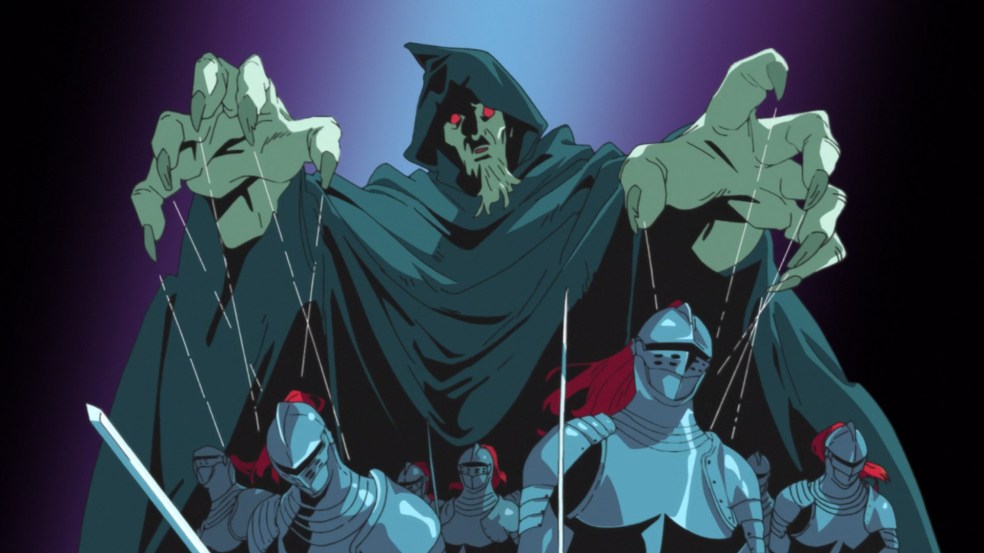
The obstacles / menu items for our heroes this time around are suits of living armor. As Senshi so wisely points out in the episode’s opening minutes—and to Laios’ immense disappointment—armor itself is, you know, metal. It’s not food. You literally cannot eat it.
Look at him, he’s so sad about this.
This does little to keep Laios from wondering, though, and since the party inevitably crosses paths with a swarm of suits of living armor guarding the path they’re trying to take further into the dungeon, it’s a somewhat relevant concern. (Actually, what is the term for a group of these things? An armory? A war chest? Who knows.) It’s especially so since they’re acting different from usual; rather than just springing to life when passed by, and returning to wherever they previously stood when the threat passes, these suits of armor seem to be deliberately trying to prevent our heroes from getting through the area. This is especially weird since, as Marcille points out, living armor aren’t alive, they’re magical constructs.
As our party struggles to deal with all this, we get some really nice fight scenes here. Action is not a main focus of Dungeon Meshi, but it is definitely a feature of the series, and it’s nice to see it fleshed out here with some of TRIGGER’s usual flash. There’s a lot of fluidity and style to the main fight scene here, with Marcille specifically often getting in a lot of goofy expressions (even moreso than the norm for this series) contrasted by some genuinely cool moments as she’s fighting the armors. The armors themselves are actually animated in a way that subtly hints as to what’s really going on here by having them move in a jerky, imperfect fashion. Needless to say, this is an absolutely lovely touch.
Particular attention is also paid to Laios’ imagination, which we get to see a little more of than usual here, and is expanded upon slightly from this part of the manga. Laios eventually finds and confronts the apparent ‘queen of the hive’ here, so to speak, which is wearing an ornate, rather Ornstein-ian design as opposed to the regular knights seen up to this point.
Laios happens to spot something on the inside of its tower shield, and we’re treated to a delightfully weird and loopy-looking segment where he flashes back to his childhood.
Doing so helps him put 2 and 2 together; the thing on its shield is an egg sac. A little more work, and he discerns the true identity of these creatures; they’re not the suits of armor themselves, they’re mollusks—things that look a bit like a cross between a sea slug and a scallop, specifically—hiding inside of them and mimicking muscle movements.
This, of course, leads Laios to an important revelation; he totally can eat them.
And so, the episode ends with the usual cooking portion. These creatures are new to Senshi, so only some of their dishes turn out well (an attempt to steam the creatures in the armor’s helmet ends poorly). This also makes Marcille’s usual food skepticism a little more understandable—honestly, as someone with an eating disorder who cannot eat a lot of foods, I always have wished the series was a little nicer to her about this. Maybe it is later on? I am still in the process of reading the manga—and even Chilchuck and Senshi make Laios eat the food first. But everything basically turns out alright, and Laios even picks up a passenger, which he keeps secret from the rest of his party, when he salvages a new sword from the defeated armor mollusks.
Surely, this is not a decision that will have no consequences whatsoever, right?
In any case, anime fans. I don’t necessarily want to sign off with ‘see you next week.’ My schedule remains very much in flux and 2024 promises to be a very busy year for me, but I do have some more articles in the pipeline (including one that should be out tomorrow or so), so I will definitely be seeing you in some capacity, somewhere soon. Ciao!
Like what you’re reading? Consider following Magic Planet Anime to get notified when new articles go live.If you’d like to talk to other Magic Planet Anime readers, consider joining my Discord server! Also consider following me on Anilist, BlueSky, or Tumblrand supporting me on Ko-Fi or Patreon. If you want to read more of my work, consider heading over to the Directoryto browse by category.
All views expressed on Magic Planet Anime are solely my own opinions and conclusions and should not be taken to reflect the opinions of any other persons, groups, or organizations. All text is manually typed and edited, and no machine learning or other automatic tools are used in the creation of Magic Planet Anime articles, with the exception of a basic spellchecker. However, some articles may have additional tags placed by WordPress. All text, excepting direct quotations, is owned by Magic Planet Anime. Do not duplicate without permission. All images are owned by their original copyright holders.
Let’s Watch is a weekly recap column where I follow an anime for the course of its entire runtime. Expect spoilers!
Last week, Oshi no Ko dealt with some extremely heavy subject matter; how reality shows manipulate the images of those starring in them, online harassment, attempted suicide. All very stark and very real problems, depicted in a harrowing light that cuts close to the bone.
This week, the series continues addressing some of these issues, but takes a different, more pragmatic approach, one informed by the character of Aqua himself. If you have to play this awful game—and if you’re in the industry and want to stay in the industry, you really do—how can you win? Akane wants to keep acting in spite of everything, and won’t quit Love Now despite her own mental health being in the gutter. In that situation, what can be done to shift the public opinion? How do you take control of a narrative that’s spun out that far?
Well, if there’s one thing Oshi no Ko is good at, it’s getting us to understand (if not necessarily sympathize with, that’s going to be a person to person thing) Aqua’s big plans. He takes this entire thing exactly as seriously as it deserves to be taken, and considers Akane’s actions a cry for help. So, he’s going to help her, even if that means he and his Love Now co-stars have to get their hands dirty to basically rewrite their own show. His plan is simple; they’re going to use a combination of filming and editing to present a version of Love Now from their own point of view; the “real reality show,” as Aqua puts it, in the form of an online video. While the ethical mores of this particular plan might be questionable, its ability to get the public at large back on Akane’s side is less so. Even more because Aqua has Love Now’s whole cast on his side; the guy knows what he’s doing. When time comes to acquire a key piece of raw footage, he even guilt-trips the show’s director in expert fashion. It’s captivating stuff, a performance of a different kind. (It’s also honestly a little scary, but hey, he’s an antihero.)
Sleepless nights of editing follow, ended by a Monster energy-riddled Aqua needing MEM’s help to finally upload the video. But the ploy works, and things end in more or less a settled fashion, as the internet firestorm finally subsides. Even if, as Aqua himself points out, the incident will probably still trail Akane from time to time for the rest of her career.
Love Now’s cast openly suggest that Akane might feel a little safer if she puts on more of a performance during the show’s tapings. Somebody offhandedly asks Aqua what kind of girls he likes, to take a suggestion, and the predictable happens.
(Interestingly, he doesn’t actually name Ai directly. Instead, he describes someone in generalities, and MEM, in a true brain-to-brain moment, tosses her out as an example of the kind of person Aqua’s thinking of.)
Akane, thinking that this Aqua guy is really nice, and maybe playing the part of his ideal girl might get him to notice her, does some character study.
By which, it must be clarified, I mean she does a lot of character study. We learn something pretty interesting about Akane here; she is the sort who needs to really get into the head of any role she’s going to play. Since Ai is now just another one of those roles, she spends some amount of time (it’s not entirely clear how long, but it seems like at least a few days) learning literally everything about her that she possibly can. Not just her public persona, but pulling tiny social tells out of random photographs and videos, making notes and taping them to her wall. It’s genuinely a little freaky, and of Akane herself, it speaks to the kind of person who feels a deep need to get lost in a performance and to fully inhabit it. And, if I can turn her lens back on her a bit, seems to suggest that she’s not really happy with who she is.
Nonetheless, in an aside, we learn that Akane is famous in the theatrical world as a true force to be reckoned with, and in the episode’s closing scene, we see why. By the time Akane returns to the Love Now cast, she’s dived so deep into Ai as a character that, when the camera starts rolling and she has to start acting, a pair of hauntingly familiar star designs appear in her eyes. Her voice actress imitates Ai’s manner of speech, the animators draw her with Ai’s rhythm of motion. She basically becomes Hoshino Ai. Aqua definitely notices; his shocked reaction is the last thing we see in the episode. (Complete with a killer cut to the ED, which unlike last week’s, absolutely fits here.)
Despite everything she’s been through, Akane is an absolute monster talent, and it’s heartening to see her given a chance to shine here after the awful mess she went through last week.
Like what you’re reading? Consider following Magic Planet Anime to get notified when new articles go live.If you’d like to talk to other Magic Planet Anime readers, consider joining my Discord server! Also consider following me on Twitter, Mastodon, or Anilist, and supporting me on Ko-Fi or Patreon. If you want to read more of my work, consider heading over to the Directoryto browse by category. If you have any questions about this or any article, feel free to leave a comment, or pop on over to my RetroSpring and ask me there. It’s up to you!
All views expressed on Magic Planet Anime are my own opinions and conclusions and should not be taken to reflect the opinions of any other persons, groups, or organizations. All text, excepting direct quotations, is owned by Magic Planet Anime. Do not duplicate without permission. All images are owned by their original copyright holders.
Let’s Watch is a weekly recap column where I follow an anime for the course of its entire runtime. Expect spoilers!
Content Warning: The below article discusses self-harm and attempted suicide.
We didn’t cover last week’s episode of Oshi no Ko here on the site. (I’d like to pretend that’s for some grand reason, but to be honest it’s just a combination of the fact that I’ve been sick and also reading way, way, way too much Umineko: When They Cry.) So to give a quick recap; last week, Aqua was able to convince Kana to join Ruby’s fledgling idol group, the rebooted B Komachi. It was a fun, straightforward episode that has something in common with, say, last year’s Shine Post, even if Oshi no Ko on the whole is very different from that. Tragically skipping last week also means we won’t get to discuss Kana and Ruby’s “mentor” in the realm of online marketing, masked fitness Youtuber Pieyon, in detail. He’s a pretty great minor character, all told, even if Kana certainly doesn’t see it that way.
On the other side of the coin, we got Aqua finally joining the reality show, a dating / daily life program called Love Now, he promised to take part in a few weeks back. Love Now’s cast show is of decent size, but we’re mostly going to be focusing on three characters; the fashion model Sumi Yuki [Saori Oonishi], the livestreamer MEM-cho [Rumi Ookubo], and the actress Kurokawa Akane [Manaka Iwami]. Other than Yuki coyly flirting with Aqua, this part of the episode was mostly scene-setting. (It’s to OnK’s credit that it’s willing to walk around in the less obviously-glamorous parts of the entertainment industry. Few people dream of getting famous off of gimmick fitness videos or reality TV. It’s a stepping stone thing.)
The focus is again on Yuki as this week’s episode opens up; a theatrical outburst where she cries and talks about quitting the show is, of course, just her playing up her actual feelings for the camera. Aqua observes this—and seems to have observed a lot about his castmates—and places them into three distinct categories; Yuki and MEM-cho both get “skillful”, whereas Akane is relegated, in his view, to someone who doesn’t come across well and so gets little screentime. Indeed, Yuki remains the center of attention for the first part of this episode. Within Love Now itself, she sits at the center of a love triangle, and thus most of the show’s audience interest is funneled toward her. It’s easy to get the sense that while Yuki may or may not be manipulative, exactly, she definitely at least knows how to play to her own strengths. Through all this, Aqua and MEM mostly stay out of the way, and at one point MEM actually accuses Aqua of being rather unambitious.
One person that definitely isn’t true of, though, is Akane. Throughout the episode we see her taking notes on her fellow cast members, from the camera crew, and practicing various things; stretching, fencing, line-reading. Akane is a capital-A Actor, not unlike Kana. But that’s ill-suited to a reality TV series where the main draw is everyone acting more or less how they actually do, any playing up for the camera aside, and she happens to nearly walk in on her own manager being yelled at by one of the show’s producers. She needs to leave some kind of mark on the show, or she’ll be left behind.
Oshi no Ko does something interesting here; there’s a cut-aside to Ruby and Kana, where the former has to stop the latter from tweeting negatively about a lousy soft drink she bought. Kana’s point is solid, and she says it verbatim; in the social media era, the entertainers themselves are the product. This borderline-paranoiac attitude is normal in the industry, and it makes sense, in a way, too. The Internet is a big place, and the digital abyss loves nothing more than to gaze back.
For a while, it seems like Akane’s story might be one about what happens when you don’t keep that in mind. Determined to make some kind of strong impression on Love Now’s viewers after god knows how many sleepless nights of searching her own name on Twitter and finding very little at all, she tries playing the part of the bad girl, and makes a go at snatching Yuki’s not-quite-bfs away from her. This, to put it mildly, goes badly. In the middle of a (mostly-staged) argument, she makes a dramatic hand gesture and accidentally smacks Yuki across the face, scratching her cheek. What Akane and Yuki themselves think of this whole incident doesn’t really matter; the fact that it was caught on camera means that the audience is judge, jury, and executioner here. And if you’ve ever followed reality TV even a little bit, you know how nasty this kind of thing can get.
I don’t like to screenshot fake tweets, but it’s pretty necessary to discuss what happens here. There are a lot of them.
As we see this, the show dissolves into a swarm of voices; buzzing like flies around Akane’s head as she slowly withdraws from her own life, and encounters scathing rebukes of not just the inciting incident but everything she’s ever done and even her personality itself everywhere she goes, online and off. It’s pretty goddamn depressing, and it’s impressive that Oshi no Ko can manage to convey just how hard this stuff, which can seem trivial to an outsider, hammers on you.
It’s bad enough that in the episode’s final scene, Akane leaves her apartment in a half-awake daze. She tells herself (and the group chat that seemingly all the Love Now actors are in) that she’s just going to the store to pick up some food, this in spite of the fact that a typhoon is blowing through and wind and rain are pounding down outside. It eventually becomes heartbreakingly clear that no matter what she might’ve said, Akane left the house to die. It takes the absolutely miraculous intervention of Aqua—just passing through by chance, or did he have some idea of what was about to happen?—to literally pull her back from the ledge mid-jump. (The harrowing moment is spoiled only very slightly by the rather inappropriate choice to fade the show’s ED song in. I think total silence might’ve been a better call this time around.) The real visual jewel here is a match cut between how Akane feels—tragically free—and how she actually looks standing in the pouring rain.
There’s no such thing as a pretty suicide. Thankfully, good fortune saw Akane saved in the nick of time, but it’s worth thinking about the context that Oshi no Ko was originally written in. The entertainment industry is no stranger to performers being pushed to the brink by an uncaring public, and the arc happened to originally serialize not long after the tragic Terrace House incident. [Just as an additional content warning, that article discusses a real-world suicide in detail, please exercise caution before deciding to read it.] The parallels are not subtle.
To some, there will never be a sufficiently tactful way to depict this kind of thing, but the horrors gestured to here are very real, and turning away when a light is shined on them doesn’t make them vanish. Not for nothing, “Egosurfing” is the only anime episode I can recall ever seeing that ends with a card showing the National Suicide Hotline’s information. Oshi no Ko is a work of fiction, so Akane was always going to be okay here. Real people, obviously, do not have that luxury, so the hotline card seems like a good inclusion.
There is no real suitable way to transition from discussing that kind of subject to my usual outros for these articles. Nonetheless, I will see you all again next week.
Like what you’re reading? Consider following Magic Planet Anime to get notified when new articles go live.If you’d like to talk to other Magic Planet Anime readers, consider joining my Discord server! Also consider following me on Twitter, Mastodon, or Anilist, and supporting me on Ko-Fi or Patreon. If you want to read more of my work, consider heading over to the Directoryto browse by category. If you have any questions about this or any article, feel free to leave a comment, or pop on over to my RetroSpring and ask me there. It’s up to you!
All views expressed on Magic Planet Anime are my own opinions and conclusions and should not be taken to reflect the opinions of any other persons, groups, or organizations. All text, excepting direct quotations, is owned by Magic Planet Anime. Do not duplicate without permission. All images are owned by their original copyright holders.
Let’s Watch is a weekly recap column where I follow an anime for the course of its entire runtime. Expect spoilers!
In with an out with a bang. If you’ll remember the closing minutes of last week’s episode, Aqua promised to make his performance in the final episode of Sweet Today count. And, implicitly, that was the show also promising to dazzle us. So, the question of how exactly it goes is what’s on our minds as we enter this week’s episode, and rain drips in to the leaky, abandoned warehouse that serves as the site of the shoot.
As we open, we actually lead with Kana’s side of things. A quick recap of her whole situation; former child prodigy-actor, now the subject of waning public interest, is given the lead role in a crappy live action miniseries adaptation of a beloved shoujo manga. She’s desperately trying to make her co-stars look decent in spite of their own lack of acting chops and nearly everything else about the series. This is something she cares about, she wants to be back in the spotlight and she wants to make a good show from this manga that, we learn, she loves too. It is just not happening; in particular her co-lead, played by the character Melt [Seiji Maeda], is an absolute cardboard cutout. She is getting nothing off of him, so she can’t give anything back.
This is when Aqua steps in. Improvising basically anything in a scripted performance—be it film, TV, whatever—is usually quite a bad idea. But Aqua does it anyway, in an admirable show of sheer audacity. He really leans into his role as the villain within Sweet Today, here, playing his character with an appropriate amount of sleazy grime and even deliberately antagonizing Melt just out of earshot of the camera.
Right or wrong, Melt’s sudden burst of emotion in response gives Kana something to actually play off of, and suddenly the child prodigy who can cry on command is back. Some of the show’s staff are a little annoyed (honestly, they’re not wrong to be, this isn’t the sort of thing one should try at home), but the series’ director isn’t, so it stays in, despite the alterations to the program it ends up necessitating. The staff aren’t the only people who’re charmed; this is the last shot of Kana while she’s being filmed that we get. Look at that blush!
Another group of people are grateful for the step up in Sweet Today‘s finale; the actual manga staff themselves. Not the least of which is the series’ actual mangaka. There is some palpable irony in the discussion she has with her assistants—about how manga artists often tell each other to keep their expectations in check when it comes to adaptations—being had in an adaptation of a manga. And indeed, the necessities of the format curtail a bit of the emotional punch. Still, it’s an effective scene, and we learn that the Sweet Today miniseries develops a small cult following on the internet off the basis of its strong final episode. (Previously mediocre shows suddenly and inexplicably becoming a lot better happens in anime, too, although it’s rare.) The mangaka ends up actually thanking Kana specifically during the show’s wrap party.
That party is also where we get our next plot thread. Kaburagi, who you’ll remember is the show’s producer and one of the many people on Aqua’s suspect list, ends up talking to him about Ai after casually remarking that they look rather similar. Aqua, who’s already crossed Kaburagi off the suspects list, presses him about how he knew Ai in the first place. Assuming Aqua to be more of a simple stan than anything else, he offers to trade a piece of little-known gossip for something; an appearance on a reality TV show that he’s the producer on.
We don’t get to see that just yet. The episode’s final third actually revolves around Aqua and Ruby’s new high school, a performing arts academy where Kana is their senior. Here we split off and mostly follow Ruby for a while. This is good, because it lets us get, say, her impressively bisexual reaction to entering her class for the first time.
She also makes a friend in the form of effusively pink gravure model with a fake Kansai accent Kotobuki Minami [Hina Youmiya]. In general, Ruby’s side of Oshi no Ko will tend toward the light and comedic for a good bit yet. She is very much the secondary protagonist after her brother, although this does mean we get to see more of her silly wild takes when something funny happens.
We also meet Shiranui Frill [Asami Seto] here. Regarded in-universe as a top entertainer even in high school, Frill mostly serves as the indirect conduit for the other upcoming plot line. (And as fanservice for Kaguya-sama:Love is War! fans. She’s the younger sister of minor character Shiranui Koromo.)
Ruby, a huge fan of Frill’s, feels insecure about not having a job in the industry yet. This leads to her pressuring Miyako to get her idol group together more quickly, but just as Miyako retorts that unaffiliated showbiz-grade cute girls are in short supply in Japan—precisely because of things like idol auditions—Aqua pipes up that he might know somebody who’s looking for an opportunity.
Namely, Kana.
Once again, though, that’s a development for next week, as the episode cuts there.
Until then, anime fans!
Like what you’re reading? Consider following Magic Planet Anime to get notified when new articles go live.If you’d like to talk to other Magic Planet Anime readers, consider joining my Discord server! Also consider following me on Twitter, Mastodon, or Anilist, and supporting me on Ko-Fi or Patreon. If you want to read more of my work, consider heading over to the Directoryto browse by category. If you have any questions about this or any article, feel free to leave a comment, or pop on over to my RetroSpring and ask me there. It’s up to you!
All views expressed on Magic Planet Anime are my own opinions and conclusions and should not be taken to reflect the opinions of any other persons, groups, or organizations. All text, excepting direct quotations, is owned by Magic Planet Anime. Do not duplicate without permission. All images are owned by their original copyright holders.
Let’s Watch is a weekly recap column where I follow an anime for the course of its entire runtime. Expect spoilers!
We open last week’s episode of Oshi no Ko on a smiling face and some cold, hard numbers. Ruby is applying to join an existing idol group as an add-on member. Her chances are literally one in hundreds of thousands, but nonetheless she swings into the episode’s opening moments in a whirl of joy and determination. Ruby is easily the more upbeat of our two leads (which is probably why, sadly, she’s the one who tends to get less screentime), and these first couple minutes are a cheerful pastiche of the past decade and change of idol anime. Juxtaposed, of course, with a reminder of the grim fate of Ruby’s mother / oshi in a past life / it’s complicated, Ai. A few of her friends at school razz her over the fact that she can’t sing, as though that’s ever been an obstacle to being a star anywhere in the world.
More pertinent are her brother Aqua’s objections. Idols, he points out as though Ruby doesn’t already know, make relatively little money, live under constant scrutiny, and are mostly pushed out of their line of work by their early 30s. Ruby does know all this, of course. But in a little exchange that cuts to the heart of why people do this stuff in the first place, she asks Aqua what his point even is. People do not chase the kind of dream Ruby’s chasing because they want to be rich or because they want job security. The dream is, itself, the point, for better or worse. This is something Oshi no Ko comes back to, underscoring and undercutting it in equal measure, throughout its whole story as part of its larger themes.
Something else that recurs not just throughout Oshi no Ko but throughout Aka Akasaka’s work in general is that simply wanting something badly enough does not make it happen. Ruby eventually gets the phone call responding to her audition, and is flatly rejected. She’s comforted by Miyako [Lynn], who is now serving as the twins’ mother figure as she runs the revamped Strawberry Productions by herself (they manage net talent these days, we’re told), but the comfort is a cold one. And as it turns out, Ruby hasn’t really been rejected on the basis of her own abilities in the first place. The person on the other end of the phone was actually Aquamarine, who, we learn, has been going through incredible lengths to keep his sister out of the industry. Being so deceptive about it is pretty shitty (to the point where the phone call “from the idol agency” was actually Aquamarine himself, he’s got quite the vocal range), but one does, in an abstract sense, understand his trepidations. You’d be paranoid about the whole thing too if your mother was stabbed to death by a stalker. Still, he’s clearly going about this entirely the wrong way, and this is absolutely going to come back to bite him somehow.
None of it ends up mattering; Ruby is promptly scouted for a different group—this one an indie—just days later.
Miyako and Aqua are rightly concerned that this might be a sketchy situation (which would not be a first for an underground idol group), and Aqua handles it in a rather unscrupulous way yet again, pretending to scout one of their idols and, with a little effort and a false promise of possibly hiring her himself, manages to squeeze all kinds of reasons to not let Ruby join out of her. (Incidentally, this character, Lala, is pretty cute, but I don’t think we ever see her again, unless I’m forgetting something.)
In the end, Ruby does sign with an agency; Strawberry themselves, who, under Miyako’s guidance, are putting together a new group for the first time in a decade. Both she and Aqua reason that if Ruby is really going to insist on this, it’s better for her to be managed close to home. In a different sort of show, this would be where things pivot back into a heart-pounding underdogs-race-to-the-top narrative, akin to something like The Idolmaster or last year’s surprisingly great Shine Post. But that is not what Oshi no Ko is, and that’s not where our story (or even the episode) ends.
Aqua has been helping the Director out as an editor and general assistant since his mother passed away, but when the Director approaches him (not for the first time) about becoming an actor as well, Aqua brushes him off, saying that he doesn’t have any true talent and doesn’t have what his mother did. This leads into the only real miss of episode 2, a gag where the Director keeps trying to give an inspirational monologue but is interrupted by his mom barging into his room. This is decently funny, almost Simpsons-y, the first time it happens, but it happens several times before the scene is over, and by the end it just feels vaguely meanspirited. (Which is also pretty Simpsons-y, now that I think of it.) It’s easy to miss that despite being interrupted, the Director’s speech is actually a pretty good one. He touches on how Aqua, who’s only a teenager, is way too young to be giving up on his dreams and clearly wants to be an actor. Aqua is so focused on finding his mother’s killer that he may be blind to his own love of the craft, which is pretty tragic in its own way and explains no small amount about his character.
Episode 2 ends with a fun little diversion. Aqua and Ruby enter the integrated middle / high school where Ruby will be getting her performing arts education. Here, we’re reintroduced to Kana, who Aqua doesn’t initially recognize. She gets the last line of the episode; initially relieved that Aqua’s returned to acting (crush much?), she flips out when Aqua tells her that he’s actually taking the general education track. Cut to credits!
All told, despite a few minor missteps, episode 2 is an essential bit of scaffolding, establishing both Ruby and Aqua’s respective personalities and motivations and their (rather lopsided) relationship with each other. I imagine Aqua’s serious, manipulative characterization might lose some people, and I’ll admit that the already-great series might be even better if we perhaps swapped the personalities around here, but really, these are petty complaints at best. And we’re not even done! Since my life has been in a bit of a shamble lately, I didn’t get to cover episode 2 last week, which means we’ve got two to talk about this week. Cut to (opening) credits!
We pick up right where we left off, with Aqua and Ruby meeting Kana again for the first time. Initially, they essentially lightly bully her, which gives us a feast of Good Kana Faces to kick off the episode with.
This quickly take a somewhat more serious turn, though, and it becomes clear that while the previous episode focused mostly on Ruby with an Aqua segment in its last third, this one is going to be Aqua’s show. (Ironic, given how much of the episode he spends still denying that he wants to act.)
We should talk about Kana first, though. This is our first real look at her post-her child actress era, and while her star has dimmed, it hasn’t gone out. She’s happy to leverage the fact that she’s the lead role in the fictional shoujo manga drama web-miniseries adaptation Sweet Today to attempt to get Aqua back in the game. (If Sweet Today sounds familiar, that’s because it also shows up in Kaguya-sama: Love is War. This and a few other connections make it clear that the two series take place in the same universe. Is this relevant to anything at all in either of them? Not to my knowledge, but it’s a fun fact.) Kana herself spends much of this early part of the episode bouncing around the screen and just generally being lively and engaging. I realize I’ve really hammered this point home over the last two columns, but this kind of charisma is deadly important if you’re trying to sell a character as a performer, and Kana is yet another Oshi no Ko cast member who has it in spades. (For that matter, Aqua does too, although his is more of a cold and dark kind of compelling. If he were a real person, I imagine he’d have quite the fandom over on tumblr.)
Aqua’s not interested until he hears the name of the drama’s producer, Masaya Kaburagi. As for why, we here swerve over to the show’s darker side once again. We learn that in his search for Ai’s killer, Aqua’s compiled a list of candidates. How? Well, he found his late mother’s secret personal phone, and spent four entire years trying to guess the correct passcode. (He’s lucky it only used numbers, frankly.) That gave him a list with a good dozen industry people on it. Masaya Kaburagi was one of them.
This in mind, he accepts Kana’s offer. Although because Kana happened to have just mentioned that the male lead in the production was attractive, she suddenly gets the wrong idea. (To be honest, the fact that she cares, even in a girlish “ohmigosh” sort of way, slightly bugs me. It’s not like Aqua would be the first gay actor in the world, and Kana’s been in the industry since she was a child.)
We actually get to see a minute or two of Sweet Today, and it is truly dire, with canned, wooden acting from not only Kana herself but also her co-lead. On Kana’s part, she’s deliberately acting well below her level, since most of her co-stars are male models, not actors, and without someone with equivalent chops to play off of, she risks barreling over the rest of the cast if they can’t keep up. Thus, she tries to act the same way they are, and hopes to at least present the series as “watchable”, if not great. She points out that acting well and making a good show are different things, and we get the point again here of acting being primarily about communication. This is a lesson she had to learn the hard way; the reason her roles dried up as she got older was that she was initially so difficult to work with. Things are different now, and she makes a point of being a good coworker.
All this said, Sweet Today‘s production is still a disaster. The main reason Kana wanted Aqua for the job, any personal feelings aside, is that Aqua genuinely is a great actor. All of the off-camera stuff—initial script run through, full rehearsal, etc.—is being blended into a single practice take, and that’s all the practice anyone gets. With Aqua onboard, Kana finally has someone at her level that she can play off of. If acting is communication, these are two people who speak the same language.
As for Aqua’s actual role, he is, irony of ironies, playing a stalker villain who appears in the show’s finale. (Aqua in fact mentions this directly, which I’d qualify as a minor weakness. Rarely do you need to actually point irony out!) During the rehearsal, he does fine, and Kana compliments him afterward. Her little speech here is actually quite nice overall, and conveys the strong sense of kinship that she feels with Aqua, someone else who was also a child actor, left the field for a while, and is now trying to come back (Aqua has his own reasons for doing so, but she doesn’t know that). The animation—in fact, the kind of animation often known as character acting—bumps up here, and Kana’s broad smile and her huge, wide hand gestures are really something lovely.
They are contrasted quite a bit by a something Aqua overhears. The producer, Mr. Kaburagi, says to the director that Kana is great to throw into “any random role” because she’s so easy to work with, and says it’s great how they can leverage her remaining name recognition for such little money. In fact, his only complaint is that she’s so focused on acting in the first place, dismissing the entire show—his own production!—as little more than pure promo material. This seems to get under Aqua’s skin in a major way, and as he collects one of Kaburagi’s discarded cigs (remember, he’s trying to catch his mom’s killer at the end of the day, and the cigarette serves as a possible source of material for a DNA test), he decides that even if he’s already done what he came here for, he might as well make a strong impression on the way out the door. “Out with a bang” as he puts it.
On that note, the episode closes, so we’ll have to wait until next week for Aqua’s actual performance. It’s great to be back, and since I haven’t gotten to say it in a while, I’ll relish saying it here; see you next week, anime fans.
Like what you’re reading? Consider following Magic Planet Anime to get notified when new articles go live.If you’d like to talk to other Magic Planet Anime readers, consider joining my Discord server! Also consider following me on Twitter, Mastodon, or Anilist, and supporting me on Ko-Fi or Patreon. If you want to read more of my work, consider heading over to the Directoryto browse by category. If you have any questions about this or any article, feel free to leave a comment, or pop on over to my RetroSpring and ask me there. It’s up to you!
All views expressed on Magic Planet Anime are my own opinions and conclusions and should not be taken to reflect the opinions of any other persons, groups, or organizations. All text, excepting direct quotations, is owned by Magic Planet Anime. Do not duplicate without permission. All images are owned by their original copyright holders.