Let’s Watch is a weekly recap column where I follow an anime for the course of its entire runtime. Expect spoilers!
Or: The one where things start getting kinda nuts.
Remember Shindler? The weird wannabe authoritarian we were introduced to a few weeks ago? takt op.Destiny certainly does, because he and his Musicart Hell return here, and in spectacularly awful fashion. But getting to the heart of why his return here is impactful requires us to talk about the rest of the episode first. “Truth -Noise-” is in fact, aside from its sharp turn in its final few minutes, otherwise another fairly sedate and character-driven episode.
The focus here, as it often is, is on our leads and their relationship to each other, which takes on a few new dimensions here as the trio roll into a town somewhere in the Appalachians that has been recently beset by D2s.
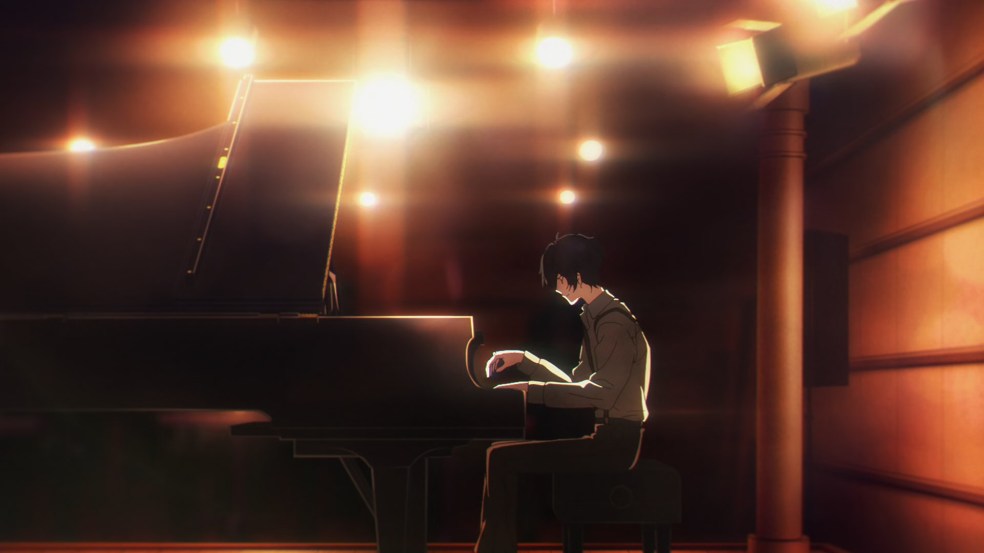
A few things happen here. Takt is wrapped up in attempts to compose a song since last week’s episode, and relentless mental improvisation (combined with his habit of tapping out the notes he’s “playing” in his head) have left him exhausted.
Takt, seen here looking like every college student I’ve ever known.
Destiny and Anna’s relationship has been somewhat strained by the latter being unwilling to let go of the idea that Destiny somehow still “is” Cosette (and in her defense it’s possible she’s right. We don’t really know enough about the mechanics of how Musicarts awaken. Either way, it’s clear Destiny doesn’t like it.)
Destiny and Takt’s relationship, meanwhile, feels like it’s opening up. When Takt gets ahold of an instrument this episode (a melodica, of all things, rather than the pianos he’s used to), it turns out to be because Destiny borrowed it from someone. It’s clear the two care about each other even if they’re not very good at showing it, which really gives their interactions some depth. Much of Destiny’s other character work this episode involves her helping some of the town’s residents–in particular, the mother of a young baby–out with procuring some basic supplies like food and such. It’s really lovely to see, and she remains a great character. (One of the very few ways this show could realistically greatly disappoint me is if they were to simply make Destiny disappear in a proverbial puff of smoke if Cosette were to come back.)
And about those D2s. We learn that, surprise: Shindler has been able to lead them around by the nose this entire time.
One of Hell’s abilities as it turns out, is to “wake up” sleeping D2s with her tuning fork. Cleverly, we actually saw this in action way back in episode three, but it was there devoid of any context, so we didn’t know what was happening. Shindler rants and raves about how the world is “impoverished” and how there’s no room for the poor and unproductive in it, and how he’s the real hero here and blah blah blah. He stops just short of saying something like “history will vindicate me.” As a portrait of a pretentious blowhard who’s convinced himself that his petty narcissistic impulses are for the greater good, it’s spot-on.
Some will decry the revelation that Shindler also awoke the D2s that lead to Takt’s hometown being ransacked in the first place (and to Cosette being killed and turned into Destiny) as overly convenient. What I think should not go unmentioned here is that in the episode’s opener we see Shindler told to avoid Takt by his superior, who praises the boy as “rare.” There is clearly something going on farther up in the hierarchy of the Symphonica as well, it’s just a question of what form it will take when it finally bubbles to the surface.
Takt naturally wants to kill Shindler. It’s hard to fault him–the man murdered a town of innocent people for basically no reason at all–and the episode ends on a cliffhanger as the two are about to face off. Thus, unlucky number 7 comes to an end. And wow quite a lot happens in this episode, doesn’t it? I haven’t even gotten the chance to mention that Leonard and Titan return for a brief cameo, presumably setting up a role in next week’s episode.
I’m here to look grim and chew bubblegum, and I’m all outta bubblegum.
Until then, anime fans.
Wanna talk to other Magic Planet Anime readers? Consider joining my Discord server! Also consider following me on Twitter and supporting me on Ko-Fi or Patreon. If you want to read more of my work, consider heading over to the Directoryto browse by category.
All views expressed on Magic Planet Anime are solely my own opinions and conclusions and should not be taken to reflect the opinions of any other persons, groups, or organizations. All text, excepting direct quotations, is owned by Magic Planet Anime. Do not duplicate without permission. All images are owned by their original copyright holders.
The Frontline Report is a weekly column where I summarize my journey through anime, manga, and the related spheres of popular culture over the past week. Expect spoilers for covered material.
Hello folks. Quick programming note before we get started here: Frontline Report is going to be a Mondays column from now on, since it fits a bit better with my schedule. This week’s column is, we’ll say, medium length? And primarily about Rumble Garanndoll. Listen; some weeks you don’t choose the anime, the anime chooses you.
Hope you’re all doing well out there, anime fans.
Rumble Garanndoll
Most anime that suffer from the problems that Rumble Garanndoll did a few weeks back are not helped by introducing more characters. Especially not if they’re also girls with some amount of tease-y maybe-chemistry with the male lead. Yet, doing just that has put the series back on track, and its past two episodes are probably the most interesting the show has ever been. If nothing else, Rumble Garanndoll thus continues to defy expectations.
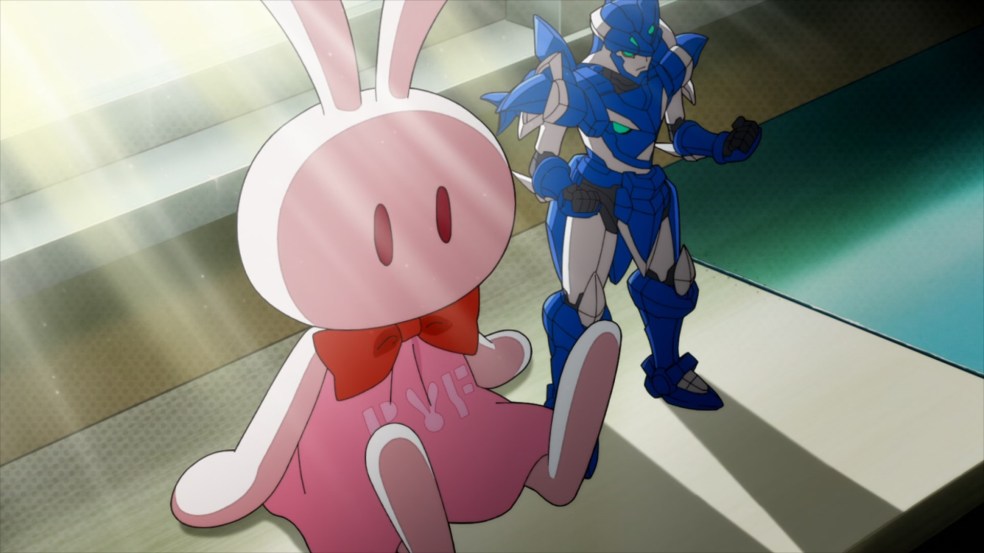
Last week’s episode, its fifth, concluded the miniature story arc of Yuki Aoba. Second-introduced battery girl, and quite possibly Japan’s last surviving idol singer. The natural self-doubt that comes with being an entertainer is compounded by the wildly difficult circumstances of Garanndoll’s setting, and so Hosomichi’s task is to get her back on track when she briefly gives the idol life up. It would be easy to do this by appealing to her imagined responsibility to her fans, or to simple nostalgia for better times, and Hosomichi does in fact try both. What eventually wins her over though is the fact that Yuki as an idol is how she’s happiest with herself, anyone else be damned. Her fans love her because she is a flawed, human person, not because of the artifice. This being Garanndoll, all of this climaxes with Yuki’s own version of the reconfigurable titular mecha–the Rabbit Two–blasting a True Army general to the ground with a rabbit-shaped beam made out of pure Idol Energy. As always, Rumble Garanndoll is at its best when it’s being least subtle.
And speaking of that, the show’s sixth episode is….well, it certainly is something.
I’ve previously commended Garanndoll for its general worldview as one of the show’s strengths. But if one ever thought that it was holding back, today’s episode tosses all subtlety to the window. This is very much a “backstory” episode, and an interlude between the series’ more bombastic moments. But in between usual interstitial fare like fun character interactions (and here, a harem series dynamic that only just manages to stay on the right side of the endearingly cheesy / annoyingly irritating divide), we get Rumble Garanndoll’s take on Japanese Nationalism.
Yes, you read that right.
It will shock no one who’s been following the series that it’s not a worldview the show holds in high regard. But even I was rather surprised at how blunt this sequence is. The conceit here is that one of the resistance’s members has smuggled in a propaganda film from the so-called True Country. There’s been some indication that they were from another world / another timeline / something like that. What’s made clear here, as the black-and-white war reel opens with a declaration that it was made in Year 90 of the “Eternal Showa Era,” is that this other world is one where Japan (and by implication, their allies as well) won World War II. Quite literally, the Japan of Rumble Garanndoll has been invaded by its own fascistic past. If that’s not quite condemnatory enough, here is what resistance commander Balzac says, word for word from the English sub track.
And coming in for the final blow is this interjection from Hosomichi’s “boss,” probably the most morally questionable character on the protagonists’ side of the show.
He perhaps has a talent for understatement.
The propaganda video itself is all monochrome authoritarian bluster. Captain Akatsuki Shinonome, our running background antagonist, decries the people of Garanndoll’s Japan–the declared “Illusory Country,” a heavy-handed erasure of the worth of millions of people–as failures with a “loser mentality.” If the show’s drawn lines from otaku culture to antifascist resistance have ever seemed silly (and I wouldn’t blame anyone for thinking they were), it’s worth noting that the rhetoric here is rooted in real examples. Moral panics about pop media permeate conservative regimes on both sides of the Pacific.
The propaganda film itself is eerily well-done, too. All monochrome except, of course, for the politically-charged imagery of blazing pink sakura blossoms.
Lest you think I’m giving the show too much credit for the “obvious” stance of being pro-democracy and freedom and anti-authoritarianist and censorship, I would point out that it is vanishingly rare for any country’s popular media to engage in such an openly condemnatory way with the dark parts of its own past. Nor does being “obvious” detract from its relevance and importance in a period of time where fascist talking points are increasingly resurfacing worldwide.
All this in the same episode that has a rather silly and drawn-out bath scene. What can I say? The show contains multitudes.
Mieruko-chan
In its more comedic moments, Mieruko-chan can struggle somewhat to justify its own existence as an adaption. At most things that make the series what it is; the creeping tension cut with enough comedy to keep it from being overwhelming, the manga is simply the better option. What Mieruko-chan the anime does offer though, if episode six is any indication, is a real treat on the rare occasions when the supernatural is helping Miko, in as much as it ever does.
The “Shrine Gods” chapter is adapted here, and it’s easily the standout sequence of the series so far. Miko bears witness to a pair–and then a trio–of shrine deities exorcising one of the most frightening phantoms she’s yet encountered. All while Hana remains naïve to the entire affair; fiddling with her phone camera and talking about Instagram while what’s essentially a horror’d up version of a shonen fight scene happens mere feet away. It’s funny, sure, but in moments like this Mieruko-chan feels like it’s exploring something a bit more worthwhile than the more disposable episodes of the anime adaption so far. Let’s hope it keeps that up.
Manga
Spy X Family
Wow, I know! A manga entry in a week where I’m not doing an actual manga shelf column. There’s a reason for that, though. I don’t have a ton to say about Spy x Family. I think it’s cute, charming, and funny. I picked it up again (after something of a false start a year or two ago) because I was interested in checking out the upcoming anime adaption. I can definitely see where enhancements and changes might be made, in particular with regard to Anya’s very good habit of looking incredibly smug. (And of course, I am very eager to see the beautiful Lor in animated form. 😊) Other than that? Everything you’ve heard about this one is true, I recommend checking it out if you have a chance.
Wanna talk to other Magic Planet Anime readers? Consider joining my Discord server! Also consider following me on Twitter and supporting me on Ko-Fi or Patreon. If you want to read more of my work, consider heading over to the Directoryto browse by category.
All views expressed on Magic Planet Anime are solely my own opinions and conclusions and should not be taken to reflect the opinions of any other persons, groups, or organizations. All text, excepting direct quotations, is owned by Magic Planet Anime. Do not duplicate without permission. All images are owned by their original copyright holders.
Let’s Watch is a weekly recap column where I follow an anime for the course of its entire runtime. Expect spoilers!
Before we begin, an administrative note. I somehow managed to hurt my hand a few days ago, and on top of that am presently sick. This is why there was no Frontline Report this week. I ask your patience if I seem a little less sharp than usual, and if my articles are accordingly a bit shorter for a while.
In any case, takt op.Destiny‘s sixth episode, “Sunrise -Rooster-“, for the most part, focused on minor bits of character building and some small dollops of backstory both for Takt specifically and the show’s setting in general. Most of it is building on old ideas, rather than introducing new ones. But that shouldn’t be taken to mean it’s minor. The emotional beats hit here are arguably more important than the actual narrative developments seen in episodes like last week’s. (Something I have come to realize about takt op is that I prefer its more low-key, traveler story-like episodes to its more “plot-important” ones.)
Following on from what we saw of Vegas a few episodes back, New Orleans, which our heroes reach here, is fairly desolate. Quite unlike Vegas though, there are remnants of the city’s past scattered about in a way that feels lived-in rather than superficial. Takt notes New Orleans as the birthplace of jazz, a fact that perhaps unsurprisingly, becomes relevant in the episode’s midsection. I should also quickly note here that, while we don’t meet a huge quantity of characters here, the episode does fairly well capture the racial diversity of an American city. That’s something that a lot of American media doesn’t do, so it’s worth praising here.
We follow two different paths through New Orleans over the course of the episode. Anna and Destiny leave Takt in the car while they go to pick up groceries, and their side of things unwinds into a chain of them helping out the various elderly residents of the city. Most of this is more cute than anything, but the third person they run into–an old woman with what appears to be dementia who mistakes Anna for her daughter–Destiny is eventually able to emotionally open up for one of the first times in the series. She has no shortage of praise for Anna, calling her strong, saying she protects her and that she knows many useful things. But it’s what she says about Takt himself that’s most revealing.
It’s been easy to get the impression that Takt and Destiny don’t really like each other very much, but that idea is put to rest here. Speaking honestly about her “Maestro”, Destiny praises the passion he puts into his piano-playing, and how it translates into her own experience on the battlefield. As she puts it, she is the music. It’s so poetic that it’s easy to forget that it’s almost literal. Without a doubt, this is one of takt op’s best pieces of character work so far.
Takt himself meanwhile ends up in what’s essentially a speakeasy. A small bar with shelves stocked higher with records and CDs than they are with liquor. The episode’s other two standout characters make their debut here as well. One is an enthusiastic bartender, who happily raves about a performance he once saw from Takt’s father once the Maestro lets slip that he’s Ken Asahina’s son. The other is the contemplative Joe, a former horn player who once played alongside Ken. He is, perhaps more than most, hit hard by the music ban.
Takt connects to both in his own way (although he’s rather cold to the former). When he’s given the opportunity to play a piano he, of course, takes it, and the resulting concert is one of the few times in takt op.Destiny where we’ve seen its first title character seem genuinely happy. Perhaps unsurprisingly, that joy spreads to his audience, and Joe especially is moved by his performance. (You may note that on another level, the performance of the entire cast spreads joy to us, the audience of the entire anime. Popular media is more cleverly meta than it’s often given credit for.) As thanks, the bartender offers him some music composition paper, something sure to come up again later.
It’d be easy to write this off as a “minor” or “filler” episode, but, as I mentioned in the first paragraph, I think these emotional moments are ultimately what give the visual showmanship the series is known for its meaning. Music, animation, and so on. We’ve all got art in our bones.
The episode closes with a rather ominous aside. We sneak a peek at the offices of the Grand Symphonica, where its leader learns that the only son of Ken “The Rooster” Asahina–which is to say, Takt–is still alive. Mention is made of “proper countermeasures,” it all feels very heavy and foreboding. Yet the episode itself is the very opposite of that; just for today, Takt, Destiny, and Anna all seem genuinely happy. It may or may not last, but it’s wise to appreciate the calm before the storm hits.
Wanna talk to other Magic Planet Anime readers? Consider joining my Discord server! Also consider following me on Twitter and supporting me on Ko-Fi or Patreon. If you want to read more of my work, consider heading over to the Directoryto browse by category.
All views expressed on Magic Planet Anime are solely my own opinions and conclusions and should not be taken to reflect the opinions of any other persons, groups, or organizations. All text, excepting direct quotations, is owned by Magic Planet Anime. Do not duplicate without permission. All images are owned by their original copyright holders.
The Manga Shelf is a column where I go over whatever I’ve been reading recently in the world of manga. Ongoing or complete, good or bad.These articles contain spoilers.
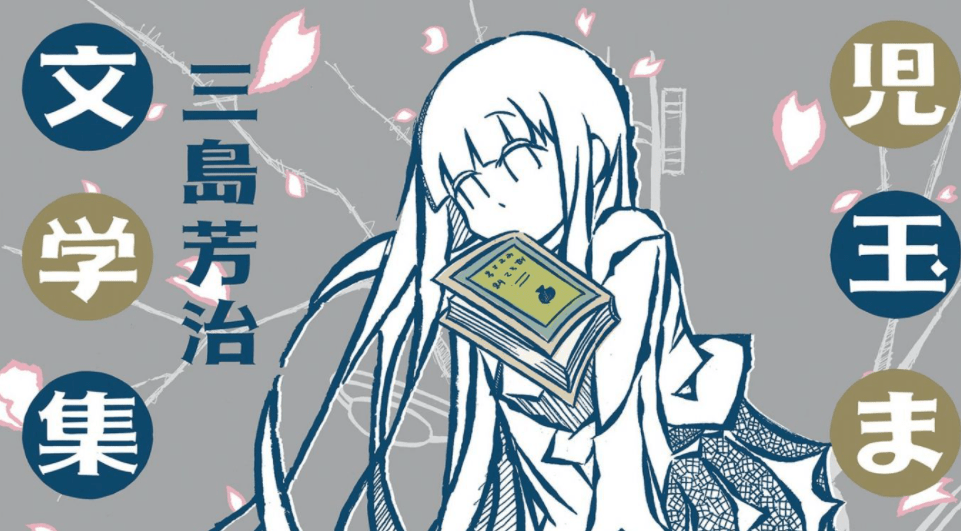
There are numerous ways to start a work of fiction. You have your classics; “once upon a time”, “it was a dark and stormy night” and such that are true arch-clichés. Then, far, far on the other end of the spectrum, you have real head-scratchers. Unique opening lines that make you spit out a mental “huh?” before you even know what kind of thing you’re reading. The Maria Kodama Literary Corpus starts with one of those.
“These leaves are like Jupiter, aren’t they?” Asks the title character. Before you go flipping this particular simile over in your mind, trying to untangle it, know that that’s not really the sort of story Kodama Literary Corpus is. Corpus revolves around both Kodama herself and her male companion, our ostensible main character, Fueda. Together they make up the sole members of the school’s Literary Club, and their conversations comprise the bulk of the series. Fueda is something of a dazed everyman (although it eventually becomes clear that he’s stranger than might first be obvious), awestruck by the evident brilliance (and perhaps more obvious to us than him, the mercuriality) of Kodama. They have a fun dynamic that shines through even their more convoluted interactions. It’s cute, which is a good beating heart for any romantic comedy to have.
Of course descriptors like “romantic comedy” and “school life comedy” only loosely apply to Kodama Literary Corpus. It is perhaps more accurate to say that it uses their structure to examine topics that ordinary entries in those genres would not. In this way, it is somewhat reminiscent of Imitation Crystal’s work in the school life genre, though it’s far less emotionally dire than something like Game Club. (More distantly, it has a cousin in the more downtempo, conversational parts of Bakemonogatari.) Much of those topics consist of the structure of literature and storytelling itself, something that Kodama is keenly interested in, and is what gives the manga its name. She’s fond of blithely quipping “it’s literature.” when laying another lesson in the subject on Fueda. This is the core “storytelling loop” of Corpus, although there are other aspects to the manga as well.
The series’ somewhat flippant attitude towards fairly serious subjects (such as teenage drinking, here) in the non-Kodama/Fueda sections also pushes it further toward the IC camp of subversive pseudo-school life manga which use the format to accomplish non-traditional things.
Corpus even comes with its own dedicated “recommended reading” list, in the form of the books namechecked underneath each after-chapter doodle. This is perhaps the rare school life manga it is possible to be under-read for. (And lest it sound like I’m trying to make myself seem smart; I may well fall in that category myself. I have read just one of the books the manga mentions, and some of them I’ve never even heard of.)
The series sometimes likes to poke at its own format’s tropes as well. For example; at one point Fueda’s sister is introduced, and he takes a thoughtful lean against the fourth wall to ponder whether or not he even had a sister until a few days prior. There are also occasional shorter segments that offer looser, more surreal ideas. These are fun, although not the norm for the manga. It also picks at its romantic comedy side on occasion. One chapter establishes that Fueda can’t see very well and probably should be wearing glasses. It’s his perspective that the manga is filtered through, so the person we see as “Maria Kodama”, the long-haired school beauty, is in part his own wishful thinking, and isn’t how she actually looks in reality. Despite this, Kodama claims at one point that Fueda’s delusions “protect her”, giving away that she cares for him more than she might outwardly admit. To really nail home the point that Fueda is not purely in love with his idea of Kodama rather than the girl herself, we eventually learn that he does know what she actually looks like, and even has a picture of her reading at her desk.
Of what currently exists in English of Kodama Literary Corpus, the eleventh chapter is perhaps both its best and most representative. This chapter features a storyline wherein Fueda is asked to improve his schoolday diary. Kodama suggests he do this by thinking of the many mundane tasks he and his classmates do through a mythological, literary lens. In other words; Literary Corpus takes a chapter to analyze itself, taking a critical scalpel to its own worldbuilding and by extension those aforementioned genres. (You may notice this also means it’s basically doing my job for me, but hey, I’ve never been above an easy mark.) Fueda’s writing is greatly improved by doing this, but more importantly Kodama brings the entire thing back around to her and his relationship. She ends the chapter with another quip of “that’s literature”, and in a very real way, she’s right.
All but explicitly stated here is the idea that stories are how we connect to each other; Kodama understands that more than most, so it’s not unreasonable (or even uncharitable) to read this entire endeavor she sets upon Fueda as simply a way to bring them closer together. After all, these are the final two pages of the chapter.
The after-chapter doodle also (half-jokingly?) claims a kinship with James Joyce’s Ulysses, drawing a line between two wildly different literary traditions in a way that only an oddball underground manga could. Given the presence of both a fixation on the goings-on of daily life, and a tendency to subvert or reanalyze those expectations present in both works, it’s not really an inaccurate comparison, either. (Whether Literary Corpus is anywhere near as good as Ulysses, or indeed, vice versa, is up to you, of course.)
Not that Kodama’s intentions are all good. A few chapters after this, she slyly destroys a burgeoning poet’s interest in the form, simultaneously using Fueda as a mouthpiece to do so and doing so specifically so he doesn’t take an interest in her. It’s hard to say, the work still incomplete, whether this mildly darker undertone will be explored in detail. One could also quite easily argue given what we see that Kodama is–by intention or by side effect–saving the girl from a fairly lonely life. After all, Kodama doesn’t entirely seem to think that her own being a “literature girl” is an admirable thing, as previously established in several chapters. (And either point of view assumes this will even stick. It’s hard to say if Inoue, as the girl’s named, will return as a character in any major capacity.)
Maria Kodama Literary Corpus, all told, is a unique little thing. And really, I have no reason for writing about it here beyond that fact. Strange little underground manga like this are perhaps my favorite thing in the medium, and if I can share them with my readerbase, all the better.
Wanna talk to other Magic Planet Anime readers? Consider joining my Discord server! Also consider following me on Twitter and supporting me on Ko-Fi or Patreon. If you want to read more of my work, consider heading over to the Directoryto browse by category.
All views expressed on Magic Planet Anime are solely my own opinions and conclusions and should not be taken to reflect the opinions of any other persons, groups, or organizations. All text, excepting direct quotations, is owned by Magic Planet Anime. Do not duplicate without permission. All images are owned by their original copyright holders.
Let’s Watch is a weekly recap column where I follow an anime for the course of its entire runtime. Expect spoilers!
There is an inherent push and pull at the heart of takt op.Destiny. The show is at its best when it’s giving us pure style. It’s much less remarkable as an actual story, where what we’ve seen so far has been solid but rarely amazing. That continues here in episode 5, “-Equitation -Valkyrie-“. takt op clearly wants it both ways, but the fact of the matter is that it’s a lot better at the former than the latter, so any dose of Plot has to be backed up by at least as much of its visual pyrotechnics. Episode 5 does stay on the right side of that line, and much of what I’m about to say can be chalked up to this being an episode that establishes new elements rather than fleshing them out. But its less inspired moments are a good reminder of why the show has to maintain that balance in the first place.
When takt op ends and people need to refer to this specific episode, they’ll call it “the one where they’re on a train.” Early on, Destiny fights off some D2s, and ends up standing on some train tracks after finishing them all off. Being how she is, she doesn’t move out of the way when a Symphonica train running important cargo (Black Night Siderite, as we soon learn) chugs toward her, so it has to stop. This rather astounding coincidence is how the show deigns to introduce three new characters, all of whom I suspect will be rather important in the weeks to come.
The first of these is Walkure. We learn several things about Musicarts in general through the lens of other characters talking about her; she’s a “conductor-less” Musicart, meaning that while she seems to take orders from another character and perhaps Symphonica-certified Conductors in general, she’s not actually “bonded” with any. Walkure is very straight-laced and by-the-book. She only ever refers to Takt as a disrespectful form of the word “You”* and is generally annoyed when he and Destiny act without official authorization. Later in the episode Takt and Destiny earn her respect after repelling another wave of D2s, and she melts like an ice cream cone in July after a very mild compliment from Takt himself, classic tsundere-style. It’s a little much, but she’s a likable enough character.
Offering that authorization is the conductor Felix Shindler. Shindler is obviously, cartoonishly shady, basically forcing Takt and Co. to “tag along” on his train as it hauls its cargo into Houston. (Our leads are New Orleans-bound, so he argues it’s only logical, given that Texas is on the way to Louisiana.) We don’t get much of a sense as to what he wants here. It’s clear from his monologues and his discussions with first one of his subordinates in the pre-opening, and later with his own Musicart, that he is concerned about Takt because he’s an “unauthorized” conductor.
It’s not totally clear whether that’s actually some kind of problem in the sense that the Symphonica itself would consider it one too, or if Shindler is just a petty wannabe authoritarian. The former would square with the general running implication that there’s something sinister about the Symphonica in general, and the latter would with his characterization here. It’s possible both are true.
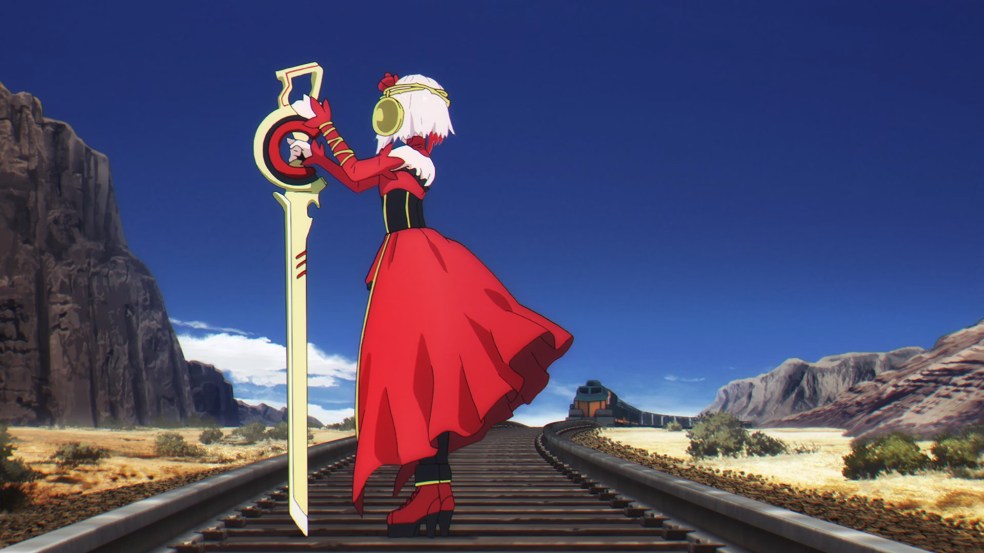
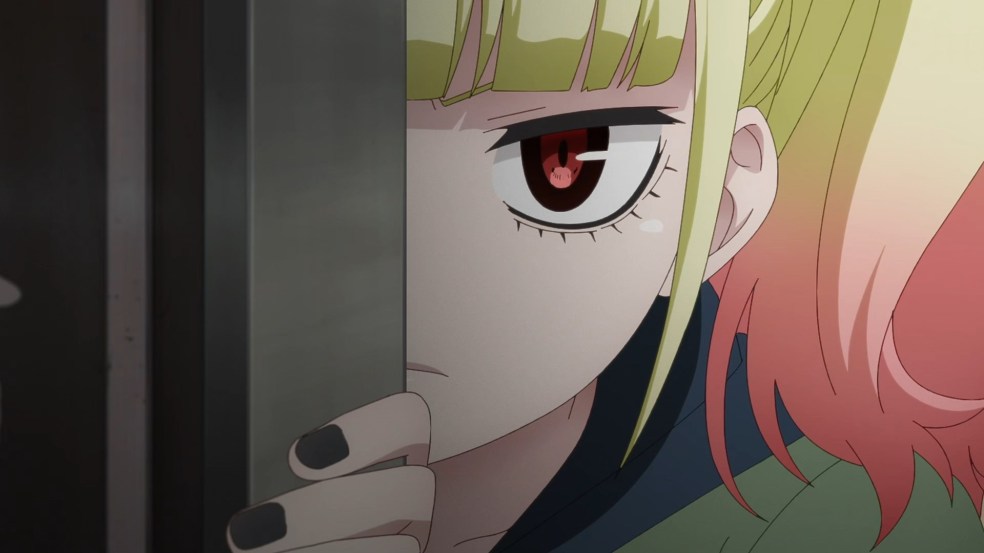
As mentioned, the third character here is Shindler’s own Musicart. Her name is Hell. Yes, really. The “vaguely ‘psycho’ berserker” archetype is one that many action anime make use of, and I’ve never been terribly fond of it. We briefly saw Hell for a few minutes back in episode 3, but this is the first time we get any sense of what her deal is. While Shindler is certainly her Conductor she appears to have an agenda of her own, something the show rather hilariously telegraphs by having her play solitaire at one point and flip up a Joker card. I suspect she may end up being more important to the series overall than Shindler is, but if that’ll be the case, only the very seeds of such a development are planted here.
She also gets a genuinely very creepy line where she suggests to Takt that he should bond with Walkure “by force.” Thankfully he’s not interested, but still, it’s kind of out-of-nowhere. Far more arresting than her limited characterization is the fact that her heels turn into….what I will tentatively term “combat rollerblades.”
I don’t think this is what ZZ Top had in mind when writing “Legs”, but perhaps it should’ve been.
Which brings me to my general thoughts on this episode. Most of what we learn was already fairly obvious by implication, and the few new pieces of explicit information we learn aren’t real gamechangers. Takt may or may not be “rogue” in some sense from the Symphonica, but we kinda already knew that. Shindler seems like he’ll be a decent antagonist, but he’s certainly not a terribly deep character, at least not yet. What remains untouchable in takt op.Destiny are the visuals. And true to form, the climactic fight scene of this episode, where Takt, Destiny, and Walkure defend the train from a swarm of flying D2s, is one of the show’s best so far. There are only so many ways to say that a show looks really great, but takt op still does. I suspect it will continue to.
Other than this there are some fun or interesting moments with our main cast scattered throughout. I’d be doing the episode a disservice if I did not at least briefly mention Destiny’s moment of pure euphoria upon eating a new kind of sweet for the first time.
Her and Takt’s relationship continues to soomewhat fluctuate between “bickering siblings” and “a pair of hurt people who take that out on each other because they’re not really on the same page, emotionally.” The whiplash is a little odd, but not so much as to detract from their general chemistry. They work in both modes.
The episode ends with Walkure being coldly dismissed from her post by Shindler and left, I suppose, essentially unemployed?
In the meantime, our main trio get back on the road, still bound for New Orleans. I suspect we’ll be seeing more of all these characters in future episodes. As such, it’s no insult to say that aside from its fight scenes “-Equitation -Valkyrie-” feels a lot like a chunk of setup that has not yet paid off. This is just something that happens when watching a seasonal week-by-week, and it is not really a criticism, merely a fact of the format. Thankfully, the series has enough eye candy to make even an episode like this still feel like a treat.
Until next week, anime fans.
*I don’t speak Japanese, but I believe what she’s saying is “kisama”, a very disrespectful second-person pronoun that, when it shows up in anime, is harsh enough to sometimes be translated as “you bastard” or the like.
Wanna talk to other Magic Planet Anime readers? Consider joining my Discord server! Also consider following me on Twitter and supporting me on Ko-Fi or Patreon. If you want to read more of my work, consider heading over to the Directoryto browse by category.
All views expressed on Magic Planet Anime are solely my own opinions and conclusions and should not be taken to reflect the opinions of any other persons, groups, or organizations. All text, excepting direct quotations, is owned by Magic Planet Anime. Do not duplicate without permission. All images are owned by their original copyright holders.
The Frontline Report is a weekly column where I summarize my journey through anime, manga, and the related spheres of popular culture over the past week. Expect spoilers for covered material.
We’ve got quite a trio of writeups here. In this week’s FLR we’ve got me thinking myself into a tizzy about one anime, being arguably too harsh with another, and then there’s Heike Monogatari, which remains basically unimpeachable.
I have to admit that any time I pen something like the latter two writeups here I worry I’ll acquire a reputation as an “issue critic”, or worse, a simple whiner. Hopefully, you’ll all take me on my word that I write what I write because to me, it is the truth, even if sometimes I can only arrive at it through a minor crucible of self-doubt. Honesty is the profession’s one requirement, and there’s nothing more honest than that.
Seasonals
The Heike Story
Of every anime I have ever covered on this blog, The Heike Story is, if not the most difficult to write about, certainly at least up there. On some level, what is there to say? Each and every episode advances the slow tragedy of the Heike Clan’s downfall. Their legacy melts away in real-time like snow in Spring. You can’t capture this kind of poeticism in plain language, not really.
Nonetheless, this episode stands out. One of Kiyomori’s plans to strike at the Clan’s enemies again goes awry; literally up in smoke, as one of Shigemori’s sons accidentally sets a whole temple complex alight. For his sins, his wife dreams of Gozu and Mezu foretelling his impending doom, threatening to drag him to Hell.
In the real world he burns alive as he’s set by a fever so intense that water literally evaporates upon contact with his skin. It kills him, eventually, his only regret being unvisited vengeance upon his enemies.
This pushes the household to a breaking point, and Biwa is kicked out by Sukemori as winter sets in. Where will she go? It’s impossible to say.
I have wondered more than once while watching Heike Monogatari if some of its characters, in their bottomless arrogance and self-assured righteousness, might resonate in a truly dark way with the current leaders of our world. Just something to chew on.
Komi Can’t Communicate
Administrative note: I am following NovaWorks’ absolutely gorgeous fansub for this series rather than the official subtitles. If you’re wondering why I seem to be several episodes behind, that is why.
The issue I always had with Komi‘s source material is that I could never quite understand what tone it was going for. On the one hand, Komi is something of a cringe comedy. A decent amount of the humor comes from Komi’s own ability to fail to perform basic human interactions, and most characters other than Komi herself (and Tadano) are, well, often pretty rude, even when accounting for their generally wacky, cartoonish personalities. On the other, the series projects an obvious, deep empathy for its title character, and is clearly sympathetic to her struggles even as it pokes fun at the mundanity of them. The long and short of all this is that the series has a pretty weird sense of humor, and it’s sometimes hard to tell if a given joke is being made at a character’s expense (and thus, intentionally or not, the expense of the sort of person they represent) or is being made with the idea that both the character themselves and any similar persons in the audience are “in on it.” And like it or not, that does matter. It’s the difference between gentle ribbing and punching down, and it’s what separates the good examples of this sort of comedy from the bad. All this is difficult enough to square with Komi herself, but it becomes even moreso with some of the other characters, one of whom we meet in episode 2.
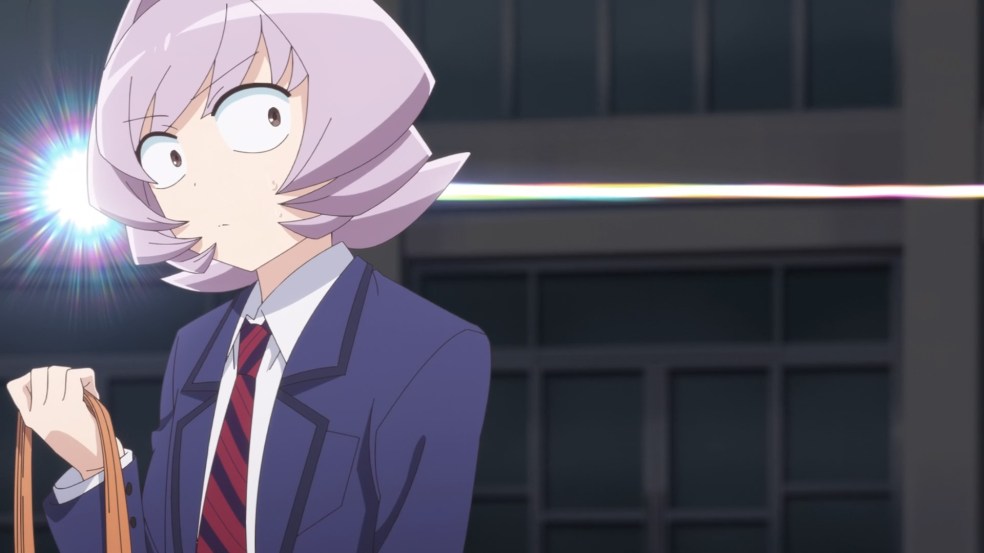
This is Najimi Osana. They are a gender bean.
I don’t know what line was translated this way, but to whoever chose this phrasing: bless you.
Before I say anything else; I actually like Najimi. They’re great. I just don’t really know how to feel about the fact that I like them.
Najimi is, well, some sort of gender-nonconforming. I don’t recall the source material ever getting particularly specific and this episode follows that lead. But whether they are genderfluid, nonbinary, MTF, simply a crossdresser, or some combination of the above, they are, for better or worse, the representative for how Komi Can’t Communicate “feels about” genderqueer people. In personality, they are hypersocial, flirty, a bit manipulative, and we’re told, a chronic liar. They’re very entertaining, but this depiction forces us to wade into thorny questions of representation.
I really hate having to ever address the question of whether a character is “good rep” or not. It makes me feel, frankly, like a cranky and vaguely pathetic stereotype of a critic. Look at me, being the big bad feminist werewolf ruining everyone’s fun little romcom by interrogating its assumptions about gender. It’s a genuinely sucky feeling, because every word I write in criticism of the series I feel like I must couch with repeated assurances that no, I do like it, I just don’t know about how it handles this. And on the other hand, no one’s art exists in a vacuum, so I feel like I am to some extent obligated to at least ask the question. Is Najimi’s central “joke” that they’re all of those things I listed, and happen to be, separately from that, genderqueer, or is it that they are those things because they’re genderqueer? That’s a huge distinction. The former is a personality, the latter is a stereotype. And the sexualized otokonoko is, certainly, a trope that exists in Japanese pop media, so my gut reaction drags me toward the latter interpretation, not helped by a pretty unpleasant sequence here where Najimi is nearly assaulted by a delinquent they used to know. (Thankfully, he’s scared off before anything can happen. This isn’t really that kind of show. Still, it’s the idea.)
But of course, as a critic (and really just as a literate viewer) you should never let your first reaction be the whole of your thoughts. The other side of this is that I want to absolve Komi Can’t Communicate of responsibility here, because as I said, I like Najimi. They’re a weird little gremlin who manages to be immensely popular anyway, we’re given the comical figure that they have five millionfriends, and honestly I do get it. I even think the scene where they casually insist that they’re “actually” a guy to turn someone down is kinda funny, because using your gender as a weapon to duck out of awkward social situations genuinely is amusing, it’s the sort of thing that certain genderqueer people (and I’m including myself here) absolutely would pull if they could. It’s almost Bugs Bunny-ish.
So I don’t want them to be bad. I want to live in a world where original mangaka Tomohito Oda came up with this character because he thought they’d be funny on their own merits. I want a genderqueer character to just be able to exist in an anime and be a funny little Starbucks goblin and have it not be a big deal. Maybe that’s why I am willing to take Najimi’s presence in the series (and their general characterization) on good faith. For me at least, and for now, it’s enough that they’re entertaining and funny and endearing. But it may not be for everybody, and I think both stances are okay as long as they’re arrived at properly. Such things are rarely cut and dry, and if you take away nothing else from all this rambling, let it be that. I have said all I said (and worried greatly about coming across as though I’m trying to shame people, which I’m absolutely not), but I must again reiterate that I genuinely really like the character.
And gosh, look at all this. I’ve written all I’ve written and barely touched on the actual plot of the episode itself. It’s a good one, despite any impression to the contrary I may have made here. Komi Can’t Communicate continues its impressive visual run here, and there’s a really fun bit where we see the same scene twice from two different perspectives back to back. The extended riff on Starbucks near the end of the episode where Komi is tasked with memorizing a monstrously long order (Najimi’s naturally. Yes, the “Starbucks goblin” descriptor was relevant. I’m such a good writer) is one of the funniest things I’ve seen in an anime this year. Shout out to this guy; “wearer of the black apron” indeed.
So yes, all my thinking in circles aside, it’s a largely good episode. Komi Can’t Communicate remains one to watch.
But now we have to get to the show that I actually am kind of disappointed with. Although here too things are….complicated.
Rumble Garanndoll
There is a thin line between being self-aware and being self-impressed. Has Rumble Garanndoll crossed it? I wouldn’t say so, but it’s getting awfully close. Followup question: do you remember Darling in the FranXX? Because somebody on Rumble Garanndoll‘s production team definitely does.
That’s probably a bad first impression to make for an episode that I did enjoy parts of, but it is very easy to see where Garanndoll might fall apart, and on several occasions over the course of its third episode I felt like I was watching Garanndoll get dangerously close to shattering in real time. As such, this writeup is going to mostly be about what I did not like about the episode, with apologies to the animators who continue to make Garanndoll a visual treat.
Let’s go over what Garanndoll has gotten right so far, first. Fair is fair, after all. It does correctly identify that otakudom–like any counterculture–is fundamentally incompatible with authoritarian ideologies. As close as the two can get to being bedfellows is proponents of the latter treating members of the former like useful idiots (that’s more or less what by-now recurring antagonist Hayate’s role is, and it’s something that happens in the contemporary cultural landscape all the time). Inevitably, the fascistic drive to purge “degeneracy” will take hold, and all art and culture will be subsumed beneath a nationalistic monolith. Garanndoll knows that, as demonstrated here where it contrasts how the Shark One works with how the villains’ mecha work. (The Shark is powered by passion and strength of feeling. The various mecha that the bad guys are playing with? “Patriotism.” That’s not terribly subtle commentary.) Inside Rin’s own mind, the only thing that’s able to defeat her fantasy flights of transforming heroes and giant robots are the memories of the villains themselves.
Again, not subtle. (And fittingly; one of the best parts of the episode.) Countercultures and authoritarianism are natural enemies; that’s a good and true thing for the show to grok. It resonates, even if it’s not exactly a novel observation.
What I worry Garanndoll may not understand is that passion for art–or more specifically what I will generally term “geek shit” here–cannot actually defeat authoritarianism by itself. I mentioned DarliFra in the opening paragraph, and while that show had numerous issues, it did also understand that you couldn’t kill the monster of fascism with hot blood alone. You need empathy, you need love, and you need thoughtfulness and planning. It was very bad at actually implementing those ideas but it at least knew that it had to try. I’m not sure Garanndoll does, which is a pretty serious problem for a show whose whole core idea pits a group of nerds-turned-rebel-alliance against the marching army of a culture-hostile dictatorship.
And there is another comparison to be made to DarliFra, and it’s the one you were probably expecting. I’ll level with you folks; I am far less anti-Guys In My Anime than many other lesbians I know who watch the stuff. I am not opposed to dudes. I’m not opposed to dudes in the lead role, even. But they have to be at least a bit interesting, and–here is another place where Rumble is starting to stumble–it cannot push heteronormative nonsense. Initially I thought male lead Hosomichi’s career as a host would be a vehicle for, something interesting. Perhaps a gentle once-over about how nerdy men tend to look at women. So far it’s mostly been a plot device, and here he gets roped into eyeroll-inducing platitudes about “a man and a woman” and about every time one was on screen I glared at my monitor so hard I thought I might melt it. To me, that is far more obnoxious than someone’s cheeky cut-swipe of a bad mecha anime from a few years ago.
Directors, writers, you must be aware that there are plenty of women who watch your work, or else you would not have written the female lead as an otaku girl. Honestly this kills me; Rin is not some two-bit wish fulfillment fantasy, I have known plenty of people who would wear a Mega Man outfit to their job if they thought they could get away with it, and I have known women–and am a woman–who love their giant robots. No one in 2021 wants this “and he gets the girl” shit. It has to be more earned than this. And to Garanndoll‘s credit maybe it will eventually earn it, maybe even in the episode airing tomorrow. It just really has not done so yet. But I’m skeptical now–more than I want to be–especially because the teased introduction of another girl at the end of this episode has all the hallmarks of a lazy harem setup. You can do better than this, can’t you? To use the show’s own symbolic language; watching Garanndoll should make me feel like my passion battery is charged up, not like it’s running on empty. I know this may seem hard to believe given all I’ve said, but I like this show, and the last thing I want to see it do is trip over the Sexism Bar and fall flat on its own face. It deserves better than that.
Elsewhere on MPA
First Impressions: High Guardian Spice – This show seems like decent fun. I haven’t watched more of it since I wrote this and I don’t really intend to. So if you’re looking for an “authoritative” opinion on it I’d suggest turning to other critics–probably those with more experience and more interest in writing about contemporary American cartoons–but if you just want my two cents, here it is.
Let’s Watch takt op.Destiny: Episode 4 – This is my favorite episode of takt op since its premiere. I think that really says all you need to know, doesn’t it?
And with ALL OF THAT said, I hope you all have a Happy Halloween and a good rest of your week.
Wanna talk to other Magic Planet Anime readers? Consider joining my Discord server! Also consider following me on Twitter and supporting me on Ko-Fi or Patreon. If you want to read more of my work, consider heading over to the Directoryto browse by category.
All views expressed on Magic Planet Anime are solely my own opinions and conclusions and should not be taken to reflect the opinions of any other persons, groups, or organizations. All text, excepting direct quotations, is owned by Magic Planet Anime. Do not duplicate without permission. All images are owned by their original copyright holders.
Seasonal First Impressions is a column where I detail my thoughts, however brief or long, about a currently-airing cartoon’s first episode or so.
Back in 2018, when “Crunchyroll Originals” had not yet become a deeply toxic pair of words, the streaming service announced its first slate of original programming. On that slate was High Guardian Spice. This article is only slightly even aboutHigh Guardian Spice, because to talk about HGS is to talk about its bizarre circumstances of creation and how Crunchyroll has handled it, a horrible boondoggle that I would wish on nobody. As for the show itself, full disclosure, I am basing all that I am about to say off of High Guardian Spice‘s first episode, to give it parity with, you know, every other show I’ve done a writeup on this season. I feel it’s only fair.1
So about that initial 2018 announcement. We didn’t know much about HGS; the show had a soft, rounded art style, early press materials boasted of it being written by “100% female writers”, and….honestly that was sort of it. Cultural currents conspired against the series; the Gamergate-derived reactionary movement within anime fandom descended on it like vultures to fresh carrion. It was decried as an assault by whatever word-scramble the alt-righters had managed to smash together that particular week. An assault not on anime alone but on you too, specifically, dear otaku, who were being replaced by legions of evil feminist SJWs with dyed hair. It was all very awful, hateful, melodramatic, and pointless.
Even at the time, this all seemed astonishingly ridiculous to anyone with two braincells to rub together. Crunchyroll had no qualms about airing things that demonstrably aren’t anime before, and it would have no qualms after. The idea that this show specifically was somehow going to be the straw that broke the camel’s back is absurd, even as someone who really does think that the ongoing pan-corporate attempt to rebrand any non-comedy cartoon not aimed at children as “anime” is somewhere between stupid and insidious. But, companies listen to internet outrage, no matter how contrived it is and no matter how much they might like to pretend they don’t. Spice was, thus, shelved for a time. Despite being finished sometime in 2019, it’s only “premiered”–read: was unceremoniously kerplunked down in a single, twelve-episode data dump–today. Its promotion amounting to a banner across the site’s top that will, I imagine, mostly serve to rekindle that tedious, performative, reactionary flareup, until it is eventually replaced by a banner advertising a new episode of a mediocre isekai.
And all that for this.
Even with just 20 minutes of footage to judge on, this is not a series that merits all that guff. High Guardian Spice is a very simple show, and its only real problem is not even a problem with the show itself; it’s where it is. It’s an issue so astoundingly unfair to the series itself that I feel bad bringing it up. But, that’s the fact of the matter. The show is a Crunchyroll exclusive, sitefellows with Attack on Titan and Demon Slayer and The Great Jahy Will Not Be Defeated. It is probably, as a result, totally doomed. I can imagine a smidgen of demographic crossover with the same section of Crunchyroll’s audience that leads to things like ancient newspaper comic strip Rex Morgan, M.D. namechecking Kira Kira Precure A La Mode. Beyond that? I really don’t see it.
It’s a shame, too, because the show is pretty good! As an anime critic (in as much as any person is one), I consider myself used to the tropes, structures, and rhythms of Japanese animation moreso than other sorts. And yeah, as everyone correctly predicted from day one, High Guardian Spice is a very American show, which makes it a bit of an odd watch if you’re expecting something built like an anime, but that’s not a bad thing in of itself.
Our premise here is very simple; village girls (and I am pretty sure, girlfriends) Rosemary and Sage are off to join a magical school, where they will be trained as Guardians. What’s a Guardian? Presumably they protect the world from evil of various sorts. It’s not gone into too deeply in the first episode. We mostly learn that Rosemary (she’s the rowdy pink one) wants to be a warrior, Sage (she’s the quiet blue one) wants to be a healer, and that Rosemary’s also-pink mom was also a Guardian. (She seems to be somehow missing rather than outright dead, lest anyone accuse HGS of riffing on Steven Universe too directly.) Rose and Sage do not actually attend the magical school–High Guardian Academy–in this first episode. Instead, they move to the city of Lyngarth and in with Sage’s cousins (also a very obvious lesbian couple), and get the lay of the land.
This gives the first episode a rather slice of life-y feel. The memorable stuff here is the character details; bits like Rosemary excitedly postulating that a striped, ferret-like creature “might have rabies”, a pair of interactions with an aloof elf, even simple things like her habit of loudly “AHH!”-ing when startled, these are all good, solid character-building. It’s cute, and it’s charming. Rosemary and Sage’s relationship deserves special mention here, as it’s clear even this early on that they care for each other a lot. This, perhaps, is the main thing from that silly “100% women” quote that actually shines through, here. They do have a genuinely very sweet relationship and I’d be interested to see how it develops over the course of the show.
As for the more serious, plot-heavy stuff? It’s there, but if it ever does develop into something more compelling, it must take some time. It’s very barebones this early on, mostly consisting of “Rosemary’s mom is missing” and something very vague about “old magic” and “new magic” being two things that don’t necessarily mix. To be fair; leading with something lighter and only building up to the actual meat of things later on is pretty standard for this kind of thing, so it’s hard to hold this against the series.
And honestly? That’s High Guardian Spice‘s premiere in a nutshell. It’s solid, if perhaps not entirely my thing. (I think being involved in the Steven Universe fandom during the show’s height of popularity may, sadly, have killed my interest in this genre, whatever you’d call it, for good.) I think that given a better home HGS could find the audience it truly deserves. It’s hard to argue it’s not a victim of Crunchyroll’s ramshackle, neglectful IP handling. I committed myself to checking out the series because I wanted to see what the actual cartoon was like. What was hidden behind all those layers of corporate brandspeak and performative reactionary rage. What I’ve found? A perfectly good little cartoon that didn’t get a fair shot. I can only hope that I’m wrong and actually does attract an audience that truly appreciates it, despite all odds. It deserves better than this, we all do.
Grade: B The Takeaway: If you’re a fan of latter-day Cartoon Network and Disney’s TV fare, or of Little Witch Academia, you should give this a look.
1: I will note that the show opens with a hilariously incongruous warning that the program contains “strong language, violence, and sexual content.” I am pretty sure this is an error of some sort, although if the show does have some kind of weird mid-season shift into being edgy as hell, that would be….interesting, to say the least.
Wanna talk to other Magic Planet Anime readers? Consider joining my Discord server! Also consider following me on Twitter and supporting me on Ko-Fi or Patreon. If you want to read more of my work, consider heading over to the Directoryto browse by category.
All views expressed on Magic Planet Anime are solely my own opinions and conclusions and should not be taken to reflect the opinions of any other persons, groups, or organizations. All text, excepting direct quotations, is owned by Magic Planet Anime. Do not duplicate without permission. All images are owned by their original copyright holders.
Let’s Watch is a weekly recap column where I follow an anime for the course of its entire runtime. Expect spoilers!
It starts out so simply! “Let the Performance Begin -Showtime-“, takt op.Destiny‘s fourth episode, opens with Takt and Destiny engaging in a little bit of training under Lenny’s guidance. It’s a great little demonstration of the kind of thrilling combat animation that takt op seems to be able to just summon with a casual flick of the wrist. Laser fire bounces off of scenery like rubber, a D2 is whacked to pieces like a busted action figure.
The usual. Eventually, this builds into what is probably takt op‘s most natural episode since its premiere. Perhaps “natural” is a funny word to use to describe an anime, but the focus here, at least with regard to Takt and Destiny, is the pair learning to fight like duet partners. And, on a less literal level, learning to find meaning in their new calling as protectors of the weak.
But first; we were promised a trip to Vegas last week. When our heroes roll into the town itself, it initially seems like we’ve been misled. Most of Las Vegas as we know it today is, here, abandoned, and a majority of the population survives by farming in fields outside the ruins. Our brief tour around the Vegas fields here is charming, but it quickly becomes clear that not everything is above-board. Most viewers will start to get the impression that something’s amiss with the introduction of Mr. Lang, a man wearing a decidedly not-farmer-ish suit and escorted at all times by a pair of armed bodyguards. When he’s introduced as the land’s “owner”, one need to connect only a few dots to intuit that the man is, at best, an exploitative landlord.
Before that particular thread can be tied up, though, we should also touch on Leonard’s interactions with Takt, here. We’ve only known Leonard for a little while, but he fills the role of the somewhat-cryptic (but seemingly, largely good-natured) mentor well. He and Takt discuss the meaning of music itself in one of “-Showtime-“‘s quieter scenes. Leonard espouses that music is a bringer of joy and a figurative guiding light. He argues that this is true even if the music itself can only come into existence through pain or loss, a fair enough idea. Less scrupulously, he also uses this concept to defend the Symphonica’s policy of not necessarily telling endangered populations that D2s may be nearby. The reasoning is sound, if cynical; fear saps peoples’ motivation, and that isn’t something that can be afforded when the world is just starting to get back on its feet. That, and they can’t really do anything to defend themselves without a Conductor around anyway. (Perhaps tellingly, Leonard doesn’t say that last part himself. It’s Takt who picks up the ball there.)
Leonard is an interesting and somewhat ambiguous figure, and his driving the episode’s plot doesn’t end here. It’s he and Titan who take the initiative into investigating Mr. Lang, uncovering a secret casino–a remnant of old Las Vegas in both physical form and spirit–without much effort. And while Takt, Destiny, and Anna eventually make their way to this place, too, it’s Leonard who gets in without a fight. When Destiny eventually drags Takt and Anna there, it’s because she’s following “vibrations” under the ground, and she’s more than happy to kick the living daylights out of Lang’s security guards to get in.
Of course, the inevitable eventually happens and Mr. Lang’s underground gambling den is promptly invaded by freaky spiked beetle-gorilla D2s, who bust in through the floor and bounce around the place like Sonic The Hedgehog in a casino level’s pinball table. Leonard gives Takt a sort of live-fire exercise here, and it’s over the course of this sequence where he and Destiny finally learn to “play” together like a proper pair of musicians should. Because this is takt op, that entails kicking a lot of monster ass. And indeed, much of it is kicked over the course of these few minutes. It’s the kind of scene that makes you want to break out old-timey adjectives like “rollicking” and “rip-roaring.” The show’s just fun to watch, OK?
After all this, we bid goodbye to Lenny here, with him shaking Takt’s hand Conductor to Conductor as he wishes our protagonist well. Their own business in Vegas taken care of, Leonard and Titan ride off into the sunset. I suspect we’ll be seeing them again. Oh, and if you’re worried about Mr. Lang, don’t be. Titan rounds him up in the episode’s closing minutes. What exactly happens to him is left to our imagination, but aside from confirming that yes, he was stealing money from the farmers to fund his bougie casinoland fantasies. This sequence also proves that Titan can be quite scary when she puts her mind to it! I really do hope we see more of her.
“This shot is mostly just to remind you that I’m not human and also carry a firearm.”
This episode lays some groundwork for future ones, certainly, but more importantly than that it’s the kind of engaging fun that you (or at least, I) look for in a series like this. It’s a nice reprieve after the rather serious nature of the last two episodes without being so lightweight that it feels inconsequential. This is what you want out of a traveler story series, and I hope many more episodes like this are to come.
Until next week, anime fans.
Wanna talk to other Magic Planet Anime readers? Consider joining my Discord server! Also consider following me on Twitter and supporting me on Ko-Fi or Patreon. If you want to read more of my work, consider heading over to the Directoryto browse by category.
All views expressed on Magic Planet Anime are solely my own opinions and conclusions and should not be taken to reflect the opinions of any other persons, groups, or organizations. All text, excepting direct quotations, is owned by Magic Planet Anime. Do not duplicate without permission. All images are owned by their original copyright holders.
The Frontline Report is a weekly column where I summarize my journey through anime, manga, and the related spheres of popular culture over the past week. Expect spoilers for covered material.
Just going to keep it honest with you folks. I have been enduring some pretty awful insomnia and some related mental health issues over the past several days. I have a little bit written about Mieruko-chan down below and that’s ALL I’m writing for this weekend other than the very brief “around MPA” stuff. Sometimes life is just like that. Hopefully you enjoy what I have written, and hopefully I’ll be in a bit better shape this time next week.
Seasonals
Mieruko-chan
An interesting thing about Mieruko-chan is that it can insert Miko, its lead, into ordinary ghost stories, where she serves as an observer and occasionally as a wry commentator. The most recent episode, for example, sees her accidentally lock eyes with a prettyboy at a Starbucks, to the great displeasure of the grotesque phantom of his presumable-departed following him around. She has to bluff her way out by convincing the ghost that he’s not her type while simultaneously not actually acknowledging its presence. But in a case of classic ghost tale morality, when his living date eventually shows up, she’s unknowingly escorted by a throng of her own departed lovers. The obvious implication being that they’re both murderers.
Beyond these interesting little situations, the show’s actual underlying narrative is pushed along a bit here, too. Poor Miko tries getting her hands on some juzu beads only for them to repeatedly pop apart in the presence of the stronger spirits she attracts. There’s even a pretty funny sequence near the end of the episode when a con-woman / actual practicing medium of some kind busts out her proverbial big guns; a shining, sparkling, glowing bracelet. She hands it over to Miko and it, too, promptly flies apart in the face of one of the ghosts following her around.
While the series is not exactly an earth-shatterer, I’ve always said (and I maintain) that the best solid seasonals tend to be good executions on genres that don’t get a ton of play, and Mieruko-chan proves itself a pretty good little horror-comedy here.
Wanna talk to other Magic Planet Anime readers? Consider joining my Discord server! Also consider following me on Twitter and supporting me on Ko-Fi or Patreon. If you want to read more of my work, consider heading over to the Directoryto browse by category.
All views expressed on Magic Planet Anime are solely my own opinions and conclusions and should not be taken to reflect the opinions of any other persons, groups, or organizations. All text, excepting direct quotations, is owned by Magic Planet Anime. Do not duplicate without permission. All images are owned by their original copyright holders.
This review contains spoilers for the reviewed material. This is your only warning.
When people talk about bonds, this is what they mean, isn’t it?
At just 40 minutes long, Alice in Deadly School only barely qualifies for this column, but I’m bending the rules for a reason here. Not a single thing about this OVA makes a lick of sense. In origin alone, it stands as a notable example of how odd the margins of the mainstream anime industry can get, stemming as it does from post-apoc idol show also-ran Gekidol (which, full disclosure, I haven’t seen). A friend called it the best anime of the year. Another absolutely hates it. It takes a truly special kind of anime to inspire strong feelings on both ends of the whatever-number-out-of-ten spectrum like that. And whatever else one may say about it, “special” is a word that describes Alice in Deadly School to a tee.
It tiptoes over the course of three or so different genres during its brief runtime, has a nowhereman visual style that, if you didn’t know, you could conceivably place anywhere from the past 20 years of mainstream anime, and is utterly fucking heartbreaking. I’ve tried to avoid using this phrase much over the course of the past year writing for this blog, as I was guilty of trotting it out too often in 2020, but the fact of the matter is that there just isn’t much like this.
Premisewise, at least, it has some ancestors. “Zombie outbreak at a high school” is not new ground for anime and manga; a cursory glance at anything from the infamous High School of the Dead to Dowman Sayman’s black comedy one shot “Girls’ Night Out of The Living Dead” will tell you that much. It’s hard to even argue that Alice in Deadly School brings much new to the table from this angle. Crossbreeding that particular premise with the girls’ club school-life genre has been done before too (see 2015’s SCHOOL-LIVE!). What Alice offers is lightning-electric resonance. Do you feel doomed every single day because of the relentless onslaught of soul-crushingly miserable news that permeates our lives, from the outrageously petty to the globally catastrophic? I have a pretty strong feeling that the people who made Alice do too.
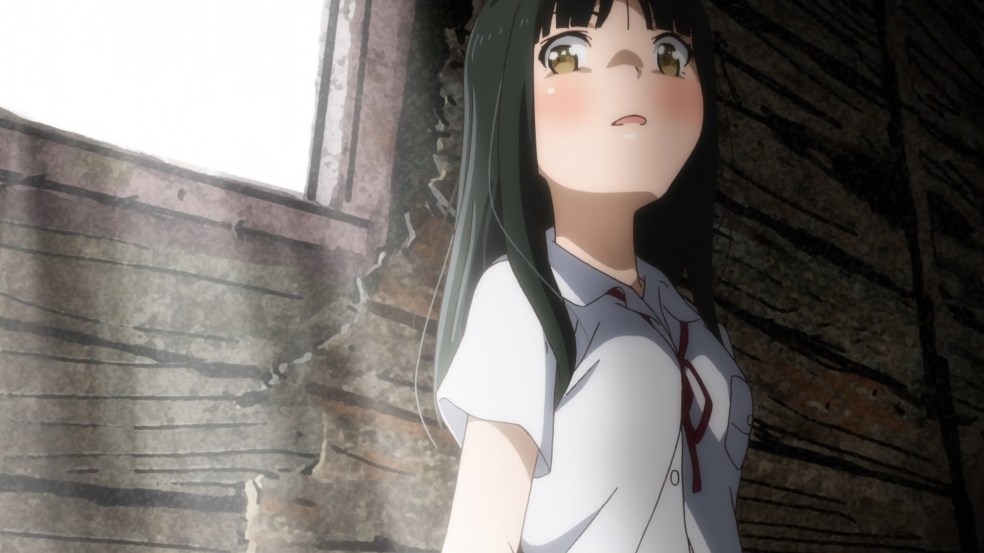
The term “zombie” itself is never used–standard for the genre these days–but it’s pretty clear what the creepy undead Things taking over the high school Alice takes place in are. Our cast then, naturally, are the outbreak’s few survivors. The main focus is on the “manzai club”, in truth just a pair of girls–Yuu and Nobuko–who aspire to be a manzai duo.
They’re hardly the only characters (and I’m doing the film a disservice by only briefly mentioning the Softball Club duo here), but they’re the two most important. Through their eyes, we see the broken-down remnants of the high school’s world, and their character interactions are great too. Some of this is funny; the OVA opens with the two riffing about why melonbread doesn’t actually have any melons in it. (Because a melon is too large, of course.) Some if it is melancholy; the two ruminate on their pasts more than once, and we find out that Yuu lost her mother some time ago. Some of it is just upsetting; the pair also witness the zombie of a former classmate being shot through the head, and the OVA’s whole color palette goes black, white, and blood-splatter red in the aftermath.
About that; Alice has a tendency to warp its visual style toward whatever emotion the story is trying to convey in the moment. This is not at all rare in anime (or in film in general). In 2021 alone, works as diverse as Super Cub and Sonny Boyhave done it to lesser or great degrees. But a case this extreme in an OVA whose visual style is otherwise pretty grounded is notable, especially with regard to the backgrounds, which often take on a hand-painted look when the film needs to move away from “reality” to convey a particularly strong emotion; nostalgia, sadness, disquiet, etc.
As Alice ticks on, its cast hatch a plan to escape the titular deadly school. This part of the OVA particularly is rather straightforward, but it works.
Who says kids don’t need to know Chemistry?
And as Alice in Deadly School nears its end, I face a particular challenge.
You see, conveying why something hits you emotionally is hard. It’s arguably my entire job, but that doesn’t make it easier in cases like this. There are a lot of anime that end with a character death. It’s not rare, and most of the time it does little for me. I tend to consider it a little cheap; something of a writer’s shortcut. An easy way to tug on your audience’s heartstrings and also ditch a character you’ve run out of ideas for at the same time. It’s only rarely actually objectionable, but it’s one of the immortal tools of literature that does the least for me.
So when I actually am hit by one, I have to really sit and think about why.
Nobuko dies near Alice in Deadly School‘s very, very end. We don’t even see it on screen, but it’s clear that she’s contracted the virus and is starting to slip. Her and Yuu’s final conversation–in a strange, green dreamspace that is mostly in Yuu’s own mind–is devastating. One of the film’s key themes is that dreams, even if we don’t achieve them, can keep us going through even the worst times in our lives. Nobuko’s is her shared dream with Yuu, to be a comedy duo, and it tangibly, provably, does not happen.
But Yuu can carry on–though not without heartache–because Nobuko’s spirit, her own aspirations, live on inside her. Alice seems to offer the minor salve that perhaps no one is truly dead if they’re remembered. The final piece falls into place here, in one of the year’s single most….I don’t even really know. Brilliant? Audacious? Just plain weird? Artistic decisions; an apparent riff on the Love Live! series’ famous “Kotori photobomb”, here reappropriated as a symbol that no matter when those close to us may leave our lives, we will always carry a piece of them with us. It’s contrasted with a final cut to the reality of the situation; Yuu posing by herself in front of an empty swing set.
This theme of carrying your torch as long as it’ll stay lit bears out in a few other ways near the OVA’s conclusion, too. A character whose lifelong goal was to become an idol finds herself trapped in the school’s announcement room, and sings her heart out over the school broadcast system even as she’s actively succumbing to the virus. She imagines herself in a pastel pink music video even as she’s literally bleeding from the neck. For a single moment, she is who she’s always wanted to be. And then she’s gone, and her song ends like the flip of a lightswitch.
So is Alice in Deadly School ultimately a hopeful work? It’s a bit hard to say, but I’d like to think so, although maybe “cautiously optimistic” is a better way to think of it. The girls who escape only do so after they give up on any hope of outside help and basically rescue themselves. If we take Alice as an allegory for our fears about the future of the world–and goodness could it apply to a lot of them, as is a long-standing tradition in zombie fiction–maybe the message is that action is our only option. Then again, the girls flee to a nearby mall, apparently being maintained as a shelter by some other group of people. So perhaps the takeaway is that we can only survive with the help of others, but that we need to take the effort to actually reach out into our own hands.
The real brilliance of course is that you can take all that and more from Alice in Deadly School. It’s a truly fascinating little film. Not unlike a certain other short-form anime project that I covered not quite yet a year ago, it reads as a eulogy to those who are gone from the ones who are still alive, although its scope is broader. It offers a small hope; maybe some of us can make it out of all this alive. And for those who’ll die either way? Perhaps we can at least go out on our own terms. The same, really, could be said of Alice itself.
It seems doubtful that the film (or its parent series) will ever pick up much of a following. Weird little OVA projects like this almost never do, at least not over here in the Anglosphere. But for 40 minutes, it’s one of the strangest, most resonant, and yeah, one of the best anime of 2021. That counts for something. Hold it in your hearts.
Wanna talk to other Magic Planet Anime readers? Consider joining my Discord server! Also consider following me on Twitter and supporting me on Ko-Fi or Patreon. If you want to read more of my work, consider heading over to the Directoryto browse by category.
All views expressed on Magic Planet Anime are solely my own opinions and conclusions and should not be taken to reflect the opinions of any other persons, groups, or organizations. All text, excepting direct quotations, is owned by Magic Planet Anime. Do not duplicate without permission. All images are owned by their original copyright holders.