
This review contains spoilers for the reviewed material. This is your only warning.
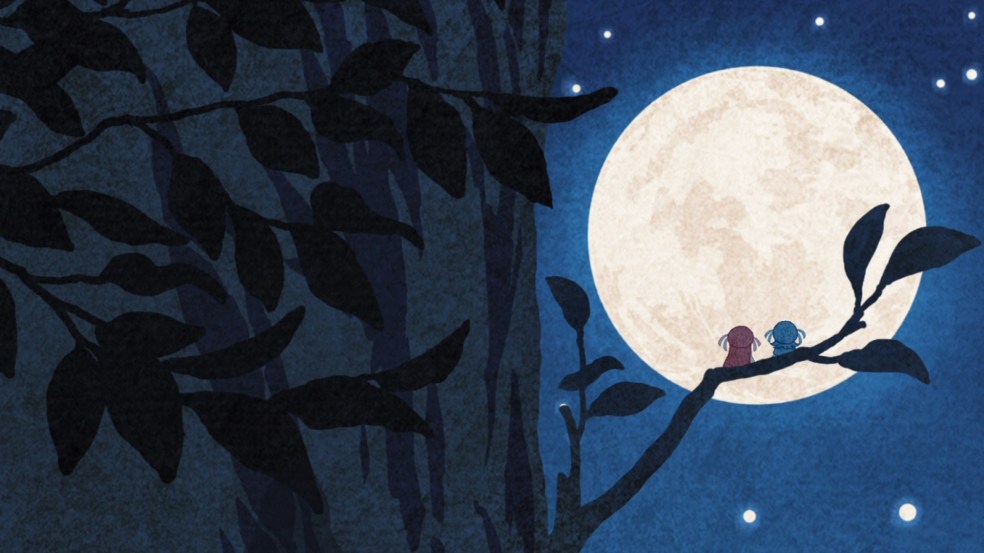
“We could even catch the moon in our tiny hands.”
I’ve missed this.
I refer here to two things. One is the very act of writing about an anime itself. It has been, at this point, more than a year since my last actual anime review—of Noir back in late 2024, you may remember—everything since then has been much more thrown together. If you’re not a regular reader of this site, that probably means exceptionally little to you, but I promise that to me it is important (and wonderful), to be properly writing a review again. If you don’t care about that, though, you might have some affection for the other thing that I’ve missed. I refer, of course, to the sprawling woodland of Hakumei and Mikochi, today’s object of appreciation.
I grew up in the Lehigh Valley region of Pennsylvania. I don’t miss much about PA, but one thing I do is its beautiful green mountains, wooded and teeming with life. The Poconos may seem like small potatoes to some, but they are where I lived and walked in my youth, and they remain in my heart. A distinction little else in the state can really claim.
When I made that nebulous transition from “person who sometimes watches anime” to “anime enthusiast”, one of the first genres I gravitated toward was iyashikei. Sometimes nicknamed “healing TV”, iyashikei is a kind of wading, immersive visual experience focused less on plot and strong conflict than characterization and immaculate worldbuilding, with a strong emphasis on lived-in environmental design. It’s all in the service of that vibe: immaculately pastoral in its best examples. Done right, you can practically feel the wind blowing through your hair and see the shimmer of the sparkling sunlight on the lake. One such iyashikei, Kamichu!, was among my first favorite anime, and when they pop up today (increasingly a rare occurrence, although last year’s mono is an example, if you want one that’s recent) I tend to at least check them out. The mountain greenery of such shows reminds me of that of my first home, and I love them for that.
Hakumei & Mikochi is maybe not quite recent enough to be called a product of “today.” It dates back from the tail end of the last decade, 2018. I was broadly aware of its pastoral reputation at the time, but my head was in a different place back then, and I was occupied with other things. I was perhaps too busy writing some of my first anime articles, singing the praises of the likes of SSSS.GRIDMAN, for example, to notice something this slow and cozy. I had perhaps fallen out of touch with this sort of thing.
And it wasn’t and isn’t just me! “Cozy”, “slow”, and “pastoral” are words that have fallen out of fashion as positive descriptors of art in recent years, at least in my circles. This is for good reason, as a lot of this aesthetic has been laid claim to by unpleasant sorts who seek to parley these ideas of pastoral peace into significantly less savory ones. But in our rush to push these people out—necessary work, make no mistake—we have perhaps been too quick to hand them this space wholesale. This I take issue with. An injection of the rustic life can, in fact, be a good remedy for the stresses of the soul. And I refuse to concede this genre to the bigoted. They do not deserve it.
In any case, Hakumei & Mikochi, while perhaps not entirely immune to such appropriation, is at least less likely to be a victim of it owing to part of its premise. Our leads here are a pair of tiny forestfolk who live and work among the trees, one of which is their home, forming a small part of a woodland society that absolutely oozes folksy charm. This place is called Makinata, and is the primary setting for our tale. These women, the titular Hakumei [Matsuda Risae] and Mikochi [Shimoji Shino], have a decidedly wife-and-wife dynamic. It’s beyond adorable, and makes Hakumei & Mikochi nicely amenable to a queer audience.

(Note however, before we get ahead of ourselves, that this does not extend quite so far as being an explicitly queer work. Somewhat frustratingly, our leads are only ever defined as “roommates” despite the obvious married-life framing. When Hakumei’s boss refers to Mikochi as her wife, the former is actually quite puzzled! Even odder is that a later episode sees someone make a similar joke to Mikochi, who accepts the framing without any protest. This kind of playing coy is not uncommon in this genre, but this is a fairly surprising place to find it. At least the “—and they were roommates!” jokes write themselves. And none of this will, in any case, stop me or anyone else from referring to Hakumei & Mikochi in shorthand as “that show about the tiny lesbians.”)
This is, perhaps, what’s found on the other end of the spectrum from that toxic yuri I’m always crowing about liking. I’ve always maintained you really want a little of both, anyway. Bitter flavors enhance sweet ones, after all. This desire, for something sweet, is what led to me deciding to watching Hakumei & Mikochi in the long term after stumbling on it during an anime roulette with some friends. (A fun activity, I recommend it.) Often, once I was committed to watching it on my own, I’d put an episode on before bed each night. On some occasions, pleasantly nuzzled between waking consciousness and the intoxicating pull of the dreamworld, I had to lazily slap the pause button on my computer, halting an episode in its tracks. Too soothed, in these moments, by the lullaby of the series to continue, and needing respite in the form of proper sleep. Asked what I think of Hakumei & Mikochi on the whole, “it put me to sleep, in a good way! :)” wouldn’t be a bad answer.
It would be an overly simple one, however.
From the beginning, Hakumei & Mikochi makes no secret of the fact that life in the woodland is not strictly snacks of giant peanuts* and drinks of beer. The series is in fact best understood as not being solely about the title characters, but rather the entire society of Makinata. We explore this in a few ways, but primarily through the show’s decently large cast. In addition to the liliputian forestfolk like Hakumei and Mikochi themselves, there are a number of talking animal characters as well. Everything from the weasel Iwashi [Matsukaze Masaya], who serves as Hakumei’s mentor and immediate superior at her job, to various one-off characters like a tiny beetle aesthete who longs for the glamorous life, a rabbit cameraman, a helpful baboon who operates a gondola, and so on, the forest of Makinata and its surrounding environs are stuffed to the gills with animal characters. This is a contributing factor to one of the show’s greatest strengths: its sheer sense of whimsy. Even outside its animal cast, this folksy anything-goes energy is quite prevalent. In episode six we meet a hairdresser, Jada [Shintani Mayumi!], one of H&M’s fellow forest-people. She lives, and runs her business out of, a giant egg. It’s absolutely delightful! And why not, right? If you’re going to establish something as inherently fairy tale-esque as tiny people who live in the woods, there’s no reason to not go all the way with it.


You will get your hair cut at Big Egg and you will get a mohawk and you will say “thank you Jada for my mohawk” when she’s done giving it to you.
This is just one part of what serves to make the show extremely watchable. Its visual styling is a big factor as well. While discussions of anime visuals these days often boil down to talk of sakuga, Hakumei & Mikochi has a fairly restrained animation style. It more than makes up for that (if indeed we can call it a shortcoming at all) with its other visual elements, such as its color choices—uniformly vibrant—and overall mood-setting. One trick it leans on fairly heavily in the directorial department is the use of cordoned-off panels of animation to emphasize particular moments. In a lesser anime this would come off as tacky, and I’m sure it’s drawing from the manga quite heavily, but given Hakumei & Mikochi‘s general energy, it works quite nicely, contributing something of a pop-up storybook feel. Beyond the visual realm, the voice acting and music are uniformly excellent. The former collecting a strong pool of talent, largely veterans, and the latter consistently setting a rustic and homemade feel. This applies as well to the vocal music. Such as that contributed by the character Konju [Yuuki Aoi], an initially rather arrogant singer who Hakumei and Mikochi befriend over the course of a few episodes, and also to the ending theme, an absolutely excellent piece of music that I looked forward to every time, even when I was sad to see a great episode end.
These of course are evaluations of the show’s (excellent across the board) craft. We should also pay attention however to what Hakumei & Mikochi is trying to say, or at least what aspects of it are part of the slow-life fantasy it offers and why they might be so. A consistent theme, perhaps surprisingly so, is the nature of labor! Something the series is actually supremely concerned with. No simple utopia, the world of Hakumei & Mikochi is one where work is exchanged for money just as in our own. And in fact, it demonstrates that this is no mere show economy, either. It’s shown to us via a few flashbacks that, at one point, Hakumei was even a homeless wanderer. This is a depiction of genuine poverty that’s quite rare in this sort of thing. One such flashback even sees her preyed upon by thieves and nearly left for dead! Of course, in the show’s present, she is very much fine, but it’s still quite a departure, even as the sad story that must have led to that condition in the first place is left merely implied instead of told to us in full. That she lives with Mikochi now and is gainfully employed as a carpenter, mason, and general handyman is treated as unequivocally a good thing, and from Hakumei’s own perspective it’s easy to see how that’d be so. (Mikochi, for her part, is a prepared foods wholesaler, which does strike me as a very specific profession for an anime character to have.)
About Hakumei’s many job titles, a uniting thread here is that Hakumei & Mikochi treats all types of labor similarly. This firstly means that, thankfully, there’s none of the odd job chauvinism you sometimes see in this sort of thing. But more interestingly it also means that, whether that work is what we’d consider mundane; catching fish, grinding coffee, bartending, construction, singing, etc., or what we’d consider fantastical, the series treats it with equal respect. Take for example Sen [Anzai Chika], the necromancer-of-sorts the lead pair meet in episode two. Her day to day life is defined by her research into her art. This involves tying magic lamps to cleaned skeletons, which reanimates them with a semblance of life by replicating the heartbeat of a living thing.

Science.
This is all treated as unusual, for certain, but not remotely sinister, being just another occupation that powers the woodland that Hakumei and Mikochi call home. When Sen reappears later in the series, she is again treated the same way as any other character. For another example, there is Ayune [Nabatame Hitomi], the last character of note introduced in the series proper. Mikochi’s elder sister, she’s a playwright in town due to a slump, and melancholic that she hasn’t seen Mikochi in so long. (Although she denies this at first.) A lesser series would come off as moralizing in writing a character like this, a writer with a fairly inconsiderate personality and no real life skills to speak of beyond her pen—a combination of traits that thankfully describes no one your reviewer here has ever met—but Hakumei & Mikochi is pretty amenable to her, warts and all. She’s a layabout, and when she does try to help Mikochi (with chopping an enormous daikon that she herself bought), she messes it up, but ultimately this is all played as eccentric as opposed to downright harmful. Maybe that’s cheating in its own way, but it makes the character endearing, and when we get to see a snippet of her work in the ending credits of that episode, it’s lovely. Hakumei & Mikochi respects the arts—mundane and fantastical—and physical labor equally.
In fact, I would say the main “fantasy” element of Hakumei & Mikochi in this regard is not an absence of work itself, as it is in some similar media, but the lack of alienation from that work. Hakumei, Mikochi, and their friends are able to make a living doing what they love, and there is a more or less direct correlation between the effort they put in and the rewards they reap. The fantasy here is not one of not having to work at all, it is one of working well out of passion rather than strict necessity, and of that passion being rewarded. This is not to say that Hakumei & Mikochi is remotely some sort of socialist parable, merely that it is able to imagine a world in which one’s aptitudes and passions are rewarded, rather than downplayed or deliberately worked out of them. It’s a nice idea, and it’s to the show’s immense credit that when we get a few episodes focusing on Hakumei’s work as a member of the Borestone Guild, a group of masons. In what is probably its most important articulation of this theme, it makes the whole process look about as rewarding as it must feel to Hakumei herself when all is said and done. A lovely thing to do for a character who is often defined by her desire to feel useful. Her formerly-dismissive boss, another forest-person named Narai [Tsuda Kenjirou], is even proud of her. Imagine that!
This fascination with labor extends into what work can be done for each other, as well, extending this idea into that of intra-community support. Sen, for instance, helps Hakumei and Mikochi when a lens fire destroys part of their house in episode three. Hakumei’s work with the Guild falls under this umbrella too, as the main project we see Hakumei help them with is restoring a causeway. While most such examples that dot the show are well-done, this community theme is also, unfortunately, where the show makes some of its relatively few missteps.
Despite this genre’s reputation for being laid-back, many iyashikei have a handful of zanier, more frantic episodes. Hakumei & Mikochi is no exception here, with episode eight in particular of interest to us here. In it, our girls have to help the denizens of a part of the nearby city called Honey House—a block inhabited by outcasts where “anything goes”—deal with a group of troublemakers. This is a more serious conflict than most Hakumei & Mikochi takes a look at, and in attempting to edge into this territory it does end up hitting a weird note. I think the disputes that arise between the old and new populations of a city and the like are a bit beyond H&M’s pay grade. Although the rather goofy tone keep it from feeling like too serious of a mistake. (Most notably, Konju is part of this storyline and serves as a damsel in distress when the troublemakers make off with her. Her extremely blasé attitude about being kidnapped does a lot to save the episode. She treats it more like a guided tour of the city, than anything.) The central idea of disputes rising in this sort of loose, almost anarchist space is neat, but the resolution feels off and just a bit too simplistic. Higaki [Takeuchi Ryouta]—Honey House’s nominal leader—makes up with the head of the troublemakers over a drink, and they bond over the memory of a departed friend. It’s a nice idea, but it also feels a bit like a hasty way to put the cork back on the bottle, so to speak.
In the series proper’s final episode, we touch on these ideas again. There we learn more about Hakumei’s backstory, how she once traveled with a caravan led by a great wolf named Emerald Tail [Sakakibara Yoshiko]. Hakumei herself describes Emerald’s caravan as both a trading group and a mutual protection force (the sub track in fact actually calls them “police”). Hakumei is quite open about thinking of them in positive terms. But interestingly, Emerald Tail herself doesn’t seem to entirely agree. It’s her who urges Hakumei to stay in Makinata, when the caravan arrives there. Stopped at the gate by—introduced to us suddenly here for the first time—the fact that Makinata actually excludes those over a certain size. When the caravan and Hakumei reunite, it’s extremely brief, limited to an exchange of greetings across a ravine. Hakumei, whomever she may have spent time with in the past, has found her home, and it’s with Mikochi. As with the Honey House story, this feels like a warm but perhaps rushed conclusion to a story that opens a lot of questions about the world of the series that it isn’t really equipped to answer.

For better or worse, Hakumei and Mikochi isn’t actually interested in these questions at all. These toe-dips into the wider geographical situation around Makinata are not a primary concern of the series, which is a bit bothersome to me! Since this definitely brushes closest to all of that hay I alluded to toward the beginning of this article. I would like to dismiss it out of hand, but cannot really do that. So while it doesn’t ruin the series for me, or even anything really at all close, it does remain as a qualm. I hate qualms, but to not acknowledge them is to render any praise of a series meaningless (and I hope I’ve made clear that I have quite a lot of praise to give), so acknowledged they must be. I have no simple explanation for these aspects of the show, but if I can offer one theory, it is perhaps an acknowledgement that, like our own, the world of Hakumei & Mikochi is vast and complex. That Hakumei has found her place within it does not necessarily make it less so.
It is, in any case, better at exploring the feeling of belonging so central to its characterization of Hakumei. This is typified by the show’s third and final major thematic concern, a uniting artistic impulse behind iyashikei in general; the wonder of the natural world. This is where Hakumei and Mikochi not only shines but sparkles. Every single episode breathes a wonderful, picture-book landscape naturality, and it is absolutely lovely stuff. Everything from the lake that Sen sets out to venture into in her submarine to the mountains outside Makinata itself, to the bamboo forests near Hakumei and Mikochi’s own home. Even when, in a late episode, Hakumei and Mikochi are caught in a rainstorm on a fishing trip, even something as mundane as a downpour is treated as a little miracle.

These too will be important memories, whether you like it or not!
This translates to to how the show treats even the most distant and fantastical aspect of the natural world, the night sky itself. When, in episode four, Hakumei and Mikochi’s house is damaged by a freak lens fire, the time they spend camping while it’s repaired is largely comedic, with Mikochi suffering a bit due to her indoorsy nature meshing poorly with the open wild. Crucially though, the segment is capped with Hakumei showing her the beauty of the stars at night. “This—” Hakumei says, “—is our roof. All of it.” Hakumei & Mikochi understands an old maxim very well: home is where the heart is, and if the heart is under the sky, well, so be it.

Not that nature is inherently kind, of course! In that same episode, our heroines are respectively rattled and injured by a great horned owl by the name of Oroshi. Hakumei is only able to get it to leave by offering it a bounty of dried meats. There’s an implicit respect for the natural here, one that contrasts with the claiming it as domain elsewhere. There are still wild things in the world, and not all of them play nicely with the tiny folk of the wood. Of course, at the end of the episode Oroshi reveals that it, too, is more or less benevolent. Still, the uncertainty is striking, and it remains as strong an image as the reached-for Moon.
That duality, I think, is a good synecdoche for the heart of this series. Outdoors or indoors, working hard or the lazy life, it’s the little things that Hakumei & Mikochi truly excels at, the subtle warmth of home. That has been enough for the anime to amass something of a cult following in the years since its release—as I mention near the top of this piece, it’s still well-liked in yuri fan circles—and it’s clearly appealed to enough people such that the manga has continued on to this very day. I haven’t actually read the manga, myself! But having enjoyed my time with the anime so thoroughly, I may very well do so. Not right away though, I don’t think. Hakumei & Mikochi is best saved for when you’re missing the slow life. There is truly no rush, it’ll wait for you, as familiar as your own front door.
*: Strictly speaking, they are regular-sized peanuts, and it is our protagonists who are small. Still, the effect is the same.
Like what you’re reading? Consider following Magic Planet Anime to get notified when new articles go live. If you’d like to talk to other Magic Planet Anime readers, consider joining my Discord server! Also consider following me on Anilist, BlueSky, or Tumblr and supporting me on Ko-Fi. If you want to read more of my work, consider heading over to the Directory to browse by category.
All views expressed on Magic Planet Anime are solely my own opinions and conclusions and should not be taken to reflect the opinions of any other persons, groups, or organizations. All text is manually typed and edited, and no machine learning or other automatic tools are used in the creation of Magic Planet Anime articles, with the exception of a basic spellchecker. However, some articles may have additional tags placed by WordPress. All text, excepting direct quotations, is owned by Magic Planet Anime. Do not duplicate without permission. All images are owned by their original copyright holders.
 The Magic Planet
okay I will download and watch Hakumei and Mikochi
LikeLike