
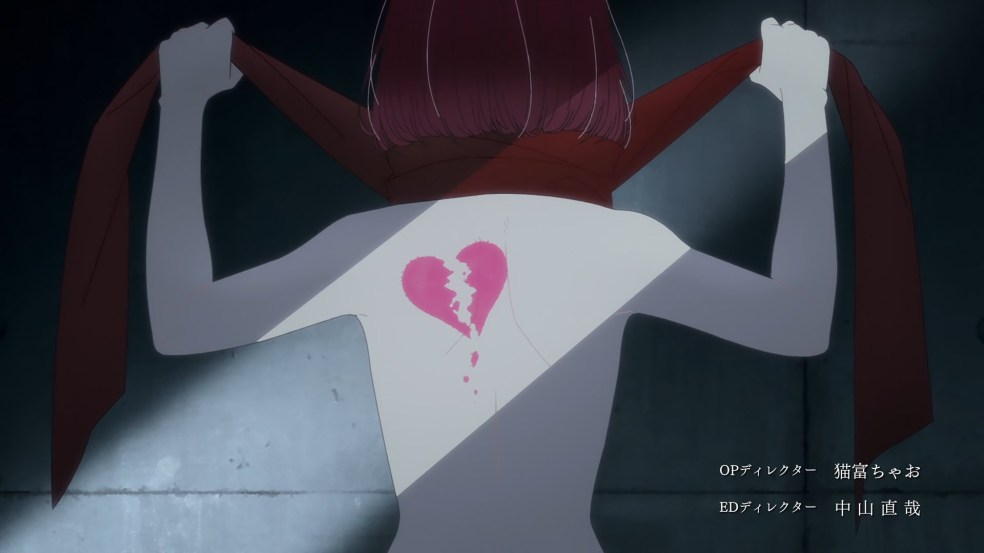
There are a variety of ways to interpret any story. This is something that’s obviously true, but I think is more often deployed as a cliché than really understood. For example, I have spoken a few different ways about Oshi no Ko over the past few years, I’ve praised it for its strong cast and bold storytelling, and I’ve criticized it for its relatively shallow understanding of the systems it seeks to critique and its reliance on elbow-jabbing shock value. Those aren’t contradictory opinions, my frustrations with the story stem from thinking it’s otherwise very good.
Out of habit, I’ve kept a lot of my more negative opinions on the series off-site to my tumblr or the like (with a few exceptions), while posting the more positive ones here. This has served to perhaps obscure that I think so far that season three is a pretty noticeable downgrade from season two. Not in terms of visuals—Hiramaki Daisuke’s team at Doga Kobo know what the fuck they’re doing if nothing else—but in terms of its actual story. I like this show best when it succeeds, but just as often, it lapses into Akasaka Aka bothsidesing some issue he clearly doesn’t understand very well, or gets caught in the muck of his addiction to wallowing in drama. (Often both at once.) Not to say “called it”, but I essentially knew this would happen, purely from Oshi no Ko‘s reputation as a manga that has a strong beginning and middle but a weak ending. Nothing gets a reputation that specific and that widespread without there being some kernel of truth to it. “No higher to climb” is specifically how I put it.
But, if I’m honest with myself, there are two things that make me want to be wrong about that assessment. One is simple contrarianism—you did remember that I’m the Wonder Egg Priority Defender, right? I love liking things that other people don’t. I never assume the role without a reason, but it’s one I like playing. Two is that when Oshi no Ko is good, it’s still very good. I think this episode is probably Oshi no Ko at its very best. It’s mostly about its best character, and it allows the show to actually explore its central ideas in an interesting way.

Last week’s episode saw Kana trying to schmooze with a director, Masanori Shima [Seiichiro Yamashita], to potentially be cast in one of his films. Shima, a young upstart who’s apparently responsible for some really good flicks, seemed nice enough at first, but once arriving at Shima’s home office, Kana found all of his staff gone for the evening. What followed was an awkward and uncomfortable scene of her being pretty ruthlessly hit on. Nothing Shima did crossed a clear line into violating consent, but this was one of those sickly situations where it’s clear that the power dynamics at play were influencing things in a way they really shouldn’t be. In finding a way out of this, Kana thought of Aqua, and tearfully explained that she has someone she already has feelings for.
This whole scene was, in of itself, a display of one of the obvious downsides of being an actress. The whole “casting couch” thing is a supremely gross mindset. Seeing someone in a position of power over an actress actually act on it is even more so. To his very limited credit, Shima backs off after Kana explicitly rejects his advances. But it’s still just all-around slimy, and despite the two parting on relatively okay terms, given everything, one can’t help but feel that Kana dodged a bullet. And however Kana herself may feel about it doesn’t end up mattering, because she happens to be spotted by a tabloid photographer while leaving Shima’s house. He snaps a few burst-shots of the two of them together and knows he has a scandal story in the making.
To be a little critical here, it feels like the show goes out of its way to exonerate Shima himself from any direct blame. A worse show would do this explicitly. Instead, he simply largely goes unmentioned while the episode places the blame on Mako Azami [Haruka Shiraishi], the girl who introduced Kana and Shima in the first place.

Now, it is true to life that scandals are often leaked from within a celebrity’s inner circle—this is even explicitly mentioned in this episode itself, albeit in a different context, because Oshi no Ko cares not for your subtlety—but a better show would just cut this entirely. It feels like a symptom of Akasaka Aka’s general tendency to try to complicate things for the sake of it, even when doing so doesn’t actually serve the narrative. It hardens into an overly-eager “no, you guys aren’t getting it, it’s not just the systems that are the problem! It’s the people in them!” that feels at times downright defensive. This trait is probably Oshi no Ko‘s biggest flaw in general, the kink in the armor that keeps holding it back. In its first season, Oshi no Ko really seemed like it wanted to turn the entertainment industry over and examine it rather than simply condemning it. That this tendency is present here—albeit only just so—in the show’s best episode in a season is thus a bit worrying. (And of course, if we circle back around to examining Shima’s role in all this at a later date, I’ll happily eat my words here, but I don’t think I’ll have to.)
Nonetheless, while this is all worth talking about, what I loved about this episode, and what makes it so great in spite of this flaw, was its study of Kana herself. Kana’s reaction to the specter of a probable scandal is one of profound panic. Confronted by the tabloid reporter, she freezes up in the face of his questions and eventually dashes off into the night in a fearful blur. Because episode director Uchinomiya Koki is a fucking pro, the show’s entire color palette changes moods along with her, trading in its usual bright and bold colors for a frozen world of grays, dark reds, and coffee-stain sepia browns.

When Kana’s panic is at its worst, she imagines the people she passes in the city crowd saying terrible things about her, the imagined slander clawing its way into her field of vision, like a blown-up, massive version of the tweet that ruined one of Ai’s days back in the very first episode of this series. It’s one of the best visual moments in a season that has hardly been short on those, and for that alone, this would be a great episode.

What’s really interesting, though, is how she eventually breaks herself out of this panic. Huddling by herself in the dark, Kana thinks that she should just quit. She thinks she wasn’t built to handle all this pressure. She cries about the mask she’s had to put on for the public her entire life, and somewhere in here she says something pretty heartbreaking: “Nobody wants the real Arima Kana.” Alone and frustrated, she cries for Aqua, who just so happens to be searching for her nearby. As a soft insert song kicks in, it briefly looks like Aqua might go to comfort her, which, just to lay it on the table, would’ve been super lame. The tension between Kana’s ambitions as an artist and her feelings for Aqua has been a central part of the character since the beginning, but it only works as a tension because Kana is so strong-willed. Having Aqua swoop in like an angel here would’ve robbed her of some of her agency and made her look weak.
Thankfully, this does not happen.
Crying out for Aqua causes her to pause, she’s shocked at her own neediness for someone who, at least from her point of view, isn’t actually interested in her like that. (Remember, Kana is not privy to Aqua’s inner thoughts like we are.) She chastises herself for playing the damsel in distress, and abruptly screams to the fucking sky that she’s not going to back down. She’s going to take the scandal, no matter how it breaks, on the chin, and she’s going to survive in the industry as she is. She—rightly!—reassures herself that she’s put up with this kind of thing since she was a preschooler. Something like this is not enough to stop her.
It’s absolutely fascinating that Kana seems to realize in real time that these things she’s always thought of as flaws about herself, her bitchy personality, her competitive streak, her lack of tolerance for the facades and handshaking of showbiz, her distance from the classical “pure and sweet-hearted” idol archetype, are actually why people like her. That’s definitely true out of universe, and in spite of her being a total professional, it’s hard to imagine that all this isn’t at least a little visible to her in-universe fans as well. You can’t really completely hide who you are, not wholly and not forever. It’s that old self-explaining magic trick maneuver Oshi no Ko really perfected last season, telling you exactly why you like this character right as it’s using that fondness to tug at your heartstrings. It’s brilliant stuff.
So, for the first time in a long time, Kana chooses herself. She’s will not bend or break, not for this. If I can be real here, I think this was also something I needed to hear as someone who’s long connected with the character. It’s really easy at times to dissociate from your own role in your life, to turn yourself into a damsel in distress or a completely helpless victim of circumstance. Sometimes people are victims, of course, but just as often, you really do have to rely on your own grit to get back out there, no matter what stands in your way. This is the kind of situation where Akasaka’s penchant for old school “just build up your confidence and do the damn thing”-type writing really shines. It helps that she handles things with a sense of humor, dryly realizing that this is going to lead to throngs of angry Twitter comments accusing her of being a slut who sleeps her way to the top and maybe worse. That’d be a hard thing for anyone to deal with, but Kana? Well, she puts it best.

The Doja Cat approach.
Taking the broader view, it’s interesting to contrast this development, how Kana frames it as something she’s doing to be true to herself, with the fate of Suzuhiro Mana. We briefly met her for the first and only time way, way back when Oshi no Ko was still a relatively new phenomenon, before it even had an anime. Back then, it seemed like Oshi no Ko would treat leaving the business, one way or another, as the only real possible “happy ending” for a life in the entertainment industry. That’s what Mana did, and that is what that little aside, buried next to the debut of the new B*Komachi, seemed to imply. This episode raises the possibility that just maybe, that isn’t the case. Maybe for a lucky and strong-willed few, the white hot light of fame doesn’t have to actually burn you to cinders. Of course, fire still hurts whether it kills you or not, but that’s just the cost of playing with it.
Then again, maybe even that much is just wishful thinking. Oshi no Ko is hardly the sort of story that would shy away from setting all this up only to pull it out from under the audience. It is totally possible that despite her confidence here, this scandal will destroy Kana’s career. I certainly hope it doesn’t, but it’s not off the table! If that happens, we’ll talk about it when the time comes. No matter how her story ends, I will be watching—and probably writing about—the saga of Arima Kana until it reaches its conclusion. She’s simply the best.

Like what you’re reading? Consider following Magic Planet Anime to get notified when new articles go live. If you’d like to talk to other Magic Planet Anime readers, consider joining my Discord server! Also consider following me on Anilist, BlueSky, or Tumblr and supporting me on Ko-Fi. If you want to read more of my work, consider heading over to the Directory to browse by category.
All views expressed on Magic Planet Anime are solely my own opinions and conclusions and should not be taken to reflect the opinions of any other persons, groups, or organizations. All text is manually typed and edited, and no machine learning or other automatic tools are used in the creation of Magic Planet Anime articles, with the exception of a basic spellchecker. However, some articles may have additional tags placed by WordPress. All text, excepting direct quotations, is owned by Magic Planet Anime. Do not duplicate without permission. All images are owned by their original copyright holders.


 The Magic Planet