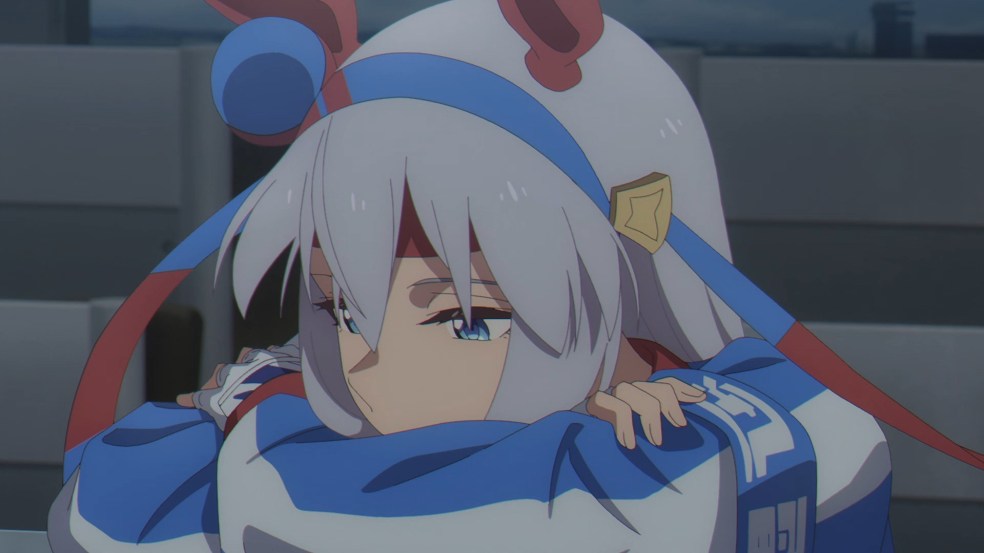
Let’s Watch UMAMUSUME: CINDERELLA GRAY – Episode 23 – “A New Era”

Let’s Watch is a weekly recap column where I follow an anime for the course of its entire runtime.

For the Cinderella Gray column, new installments will be posted either on the Sunday each episode airs, or as soon as possible over the succeeding week. Expect spoilers!

Cinderella Gray can be watched, legally and for free, on It’s Anime By REMOW on Youtube. A link is provided below for your convenience.


One of Umamusume‘s recurring fixations is on the changing of the guard. This is part of its larger ideas about the nature of the competition and, as we discussed last week, transience. New racers debut, greenhorns become veterans, veterans become legends, and those old contenders go out in a blaze of glory or otherwise retire. Rinse, repeat, the cycle never ends. In a meta way, this is even true of this episode’s title, which is a phrase that echoes up and down all across Umamusume, most notably appearing in the title of its movie from last year. That’s a tale for another time, though, perhaps.

This episode, the Cinderella Gray anime’s finale (at least for now), is a very direct demonstration of this concept. We tie up the few remaining threads of Tamamo Cross’ story, but perhaps more importantly, we are reassured that Oguri’s is still in progress. She’s at the top of the mountain now, everyone knows her and everyone loves her. Not for nothing is one of the episode’s opening shots of a young girl standing next to not the real Oguri Cap, but a cardboard cutout. This is cute, but also just the slightest bit dehumanizing perhaps, showing us that Oguri is already being flattened into an icon as opposed to a person.

Stronger than anyone, loved by everyone.

Of course, all this means that Oguri is no novice anymore, and she’s been at it for long enough that others are chasing after the comet trail she’s carved on her way from Kasamatsu to the Nationals.

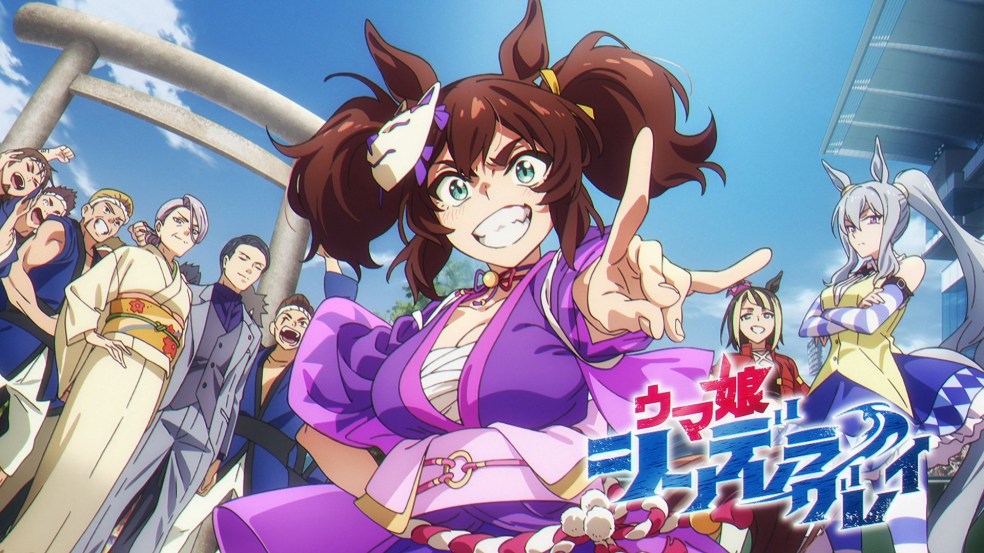
Enter Inari One [Inoue Haruno].

In the many (maybe too many) times I’ve compared Cinderella Gray to a battle shonen anime, I’ve largely avoided making too many specific attempts to slot characters into specific archetypes. There are a few examples where you can do this, but largely it doesn’t work, so I’ve held off until now. I say until now because Inari One is a pretty straight example of the whole hothead rival trope. She’s a good one, don’t get me wrong, but they did not break the mold when casting girlie. She calls herself “Inari-sama” when sufficiently riled up. She sometimes lets her own emotional outbursts get in the way of her success. Her temper is enough of a difference to be notably offputting at times, especially to her fellow racers, a strong contrast to Oguri who is mostly pretty affable. She’s literally associated with fire. Because she’s hot-blooded. (And also she has a vague fox motif and “foxfire” is a whole thing. That too.)

A character this broad would maybe be an uneasy fit for Cinderella Gray were it not for a few things. For one, as with every other character we’ve had to get to know quickly in this series, her debut episode is populated with brief flashbacks and asides that color her in and give her some depth. For another, when we meet her, she is very much in the midst of a “letting her emotions get in her own way” slump, which, to skip ahead a bit, makes her victory at the end of the episode feel earned in a way it wouldn’t if we hadn’t started here. For a third, she is very directly zeroing in on Oguri Cap herself. She says as much, and it makes sense for a couple of reasons.

Having won the Arima Kinen, Oguri Cap is pretty indisputably the strongest umamusume in Japan at the moment. Like Oguri, Inari One is from a relatively minor area in the context of racing, and also like Oguri, she’s aiming to challenge the nationals. Inari One is perhaps not the first person to explicitly aim for her head, she’s the first we’ve followed at any length, and certainly the first whose own rise mirrors Oguri’s so closely.

Of course, she has to actually rise first. Which at the top of the episode seems like it’s far from a sure thing. She looks like she’s about to win the race that opens her part of the episode, but at the last minute, one-off character and owner of a truly ridiculous hairstyle Face No More* passes her by. Inari throws a pretty hilarious temper tantrum about this in the locker rooms after the race, getting in some really great expressions while she does so, as No More insults her by pretending to not remember her name.

Some time after the race, she blows off steam while tearing up a practice track. But in doing so she risks wearing herself out, and it’s down to her trainer to remind her that, hey, that’s not really a great thing to be doing the day after a major race. As with a lot of the girls we’ve met over the course of this series, Inari and her trainer seem to be pretty close. A flashback sequence confirms this, showing us that they met when Inari was lost at a festival when she was very young.

It’s cute and it provides some evidence of a nice dynamic between them, Inari as a loose cannon who can only be reminded to keep herself under control by her firm, but even-handed trainer. In any case, Inari has a shot at truly proving herself; her trainer has entered her into the Tokyo Daishoten.

The Daishoten is the final race of the season. I have to admit, as someone who’s now current on the manga, I was never quite as in love with Inari One as I have been with some of its other characters, but I think giving us a full episode to get to know her was a good pacing decision. She’s fantastic here, and despite the nominally lower stakes of this race as compared to the Arima Kinen of the last two weeks, the presentation is action-packed and stylish enough for that to not really matter. Doubly so when Inari starts losing her cool and we get some outright scary visuals to illustrate that.

(This is a tangent, but it’s also fun that in the half dozen or so lines they swap between them, Inari’s two main competitors here, one-off characters Romance Bubbly and Fuyuno Nakasumi, seem to have a rivals yuri thing of their own going on. That’s called good worldbuilding, folks.)

Like Oguri, Inari is also being observed during her last important regional race by a veteran of umamusume racing. Not Symboli Rudolf, but one of her contemporaries, Japan’s third triple crown winner, Mr. C.B. [Amami Yurina]

Being a horse girl named Mr. C.B. is an admirable amount of gender. I have said this any time I’ve ever spoken about C.B. anywhere, and I will continue to say it, because it’s true.

Despite the pressure, Inari keeps her head on straight until the last spurt, where flames wreathe and nearly consume her, clearly signaling, along with the signature cracked glass effect which also pops up here, that she’s about to hit her Zone. Yet, just as she reaches out to grab ahold of that fire, she crosses the finish line, overtaking Fuyuno to win the day, and it disappears. A tease, sure, but the message is clear, this is absolutely someone who can go toe to toe with the Gray Monster.

Our last scene with Inari One here is during her victory concert where, in a move mirroring episode six (tellingly, where the show started associating Oguri with her “Ashen Beast” nickname), she explains that she’s moving on up to the nationals. Like Oguri’s fans, Inari’s are initially a bit reluctant to let their star go. But when she bids them farewell, cheers go up, and one gets the sense of what the “new era” promised by the episode title might entail. Oguri Cap will not stand at the top of the mountain alone for very long.

Inari’s story is just starting, but Tamamo Cross’s also comes to an end this episode. She’s present in just two brief scenes, where she departs on a plane and arrives at the hospital room of that old man she cares for so. He’s sitting up in his bed, and this sign of wellness alone is enough to make her break into tears. It’s a simple, sweet, and understated end to the White Lightning Arc. This is Tamamo’s exit, but the path she burned through the sport, and our hearts, isn’t going to be forgotten so easily.

It’s not all bittersweet moving on and flaming-hot new blood, though. Spliced in between all of that, there are a few short scenes of a Christmas party at Tracen organized a few days after the holiday. Oguri actually misses most of it, and she spends a good chunk of the season’s last episode sporting some truly impressive bedhead.

The party itself is cute. There’s a small aside of Dicta Striker attempting to cheer up Super Creek after her disqualification (she mostly succeeds), and also what is, to my recollection, one of the very few examples of straight-up fanservice in the whole series, wherein Black Ale has been tricked into wearing a slightly revealing Santa outfit by….someone. No names are given, so in the absence of evidence I’m going to assume it was Dicta Striker. It seems like something she’d do.

I’ve literally read the manga and even I am surprised at how many times Black Ale has managed to appear in this column after her single episode of any actual story relevance.

If there’s a note to end all this on, it’s probably what Musaka says to Oguri after she wakes up. Leaning on the fourth wall more than a little, he reminds her that, while she’s reached the peak of the proverbial mountain for now, her story is far from over. Challengers new and old are already coming for the crown.

“For the road was the rim of the Wheel, which encircled infinity.”


* I am 99% sure this is supposed to be “Faith No More”, as in the metal band, but F-a-c-e is how it’s rendered in REMOW’s subtitles, so it’s how I’ve written it here.


Like what you’re reading? Consider following Magic Planet Anime to get notified when new articles go live. If you’d like to talk to other Magic Planet Anime readers, consider joining my Discord server! Also consider following me on AnilistBlueSky, or Tumblr and supporting me on Ko-Fi. If you want to read more of my work, consider heading over to the Directory to browse by category.

All views expressed on Magic Planet Anime are solely my own opinions and conclusions and should not be taken to reflect the opinions of any other persons, groups, or organizations. All text is manually typed and edited, and no machine learning or other automatic tools are used in the creation of Magic Planet Anime articles, with the exception of a basic spellchecker. However, some articles may have additional tags placed by WordPress. All text, excepting direct quotations, is owned by Magic Planet Anime. Do not duplicate without permission. All images are owned by their original copyright holders.
Let’s Watch UMAMUSUME: CINDERELLA GRAY – Episode 22 – “Gray Phantom”

Let’s Watch is a weekly recap column where I follow an anime for the course of its entire runtime.

For the Cinderella Gray column, new installments will be posted either on the Sunday each episode airs, or as soon as possible over the succeeding week. Expect spoilers!

Cinderella Gray can be watched, legally and for free, on It’s Anime By REMOW on Youtube. A link is provided below for your convenience.


Native Dancer was an American thoroughbred racehorse. Without getting so into the nitty-gritty that this turns into a column on actual horseracing, the very short version is that he was one of the best. It’s hard to beat 21 victories in a 22-race career (although some have done so). To list just one accolade, the AP’s list of the best racehorses of the 20th century places him at third, behind only Man O’ War and Secretariat. For our purposes, though, his actual career is less important than two other things you need to keep in mind about Dancer. The first is that he had a nickname, the Gray Ghost. The second is that one of his children was Dancing Cap, a horse who, himself, we are primarily interested in here because of one of his children. You’re reading a column about him right now: Oguri Cap.

There is little reason to suspect that any version of Native Dancer ever existed in Umamusume. In general, lineage plays far less of a role in Umamusume than it does in actual horse racing, and the closest Umamusume has ever come to acknowledging any of the legendary racers who fill in the strange, fuzzy area outside of its immediate characters of focus is the vague insinuation that Manhattan Cafe’s mysterious “friend” might be the metaphorical or literal ghost of Sunday Silence. (As always, I recommend IronicLark’s blog if you want Umamusume analysis from someone who really knows their horseracing as opposed to someone with a mere passing interest in it like myself.) Nonetheless, watching this episode today, I thought about Native Dancer and his nickname. I have absolutely no way of proving this, but I think one of the most important aspects of this episode, and indeed the episode itself, takes its name from that epithet. In doing so, Cinderella Gray asks broader questions about what Umamusume actually is. Not as a franchise but as a story.

First, though, let’s pick up where we left off last week. The back half of the Arima Kinen is, to put it as simply as possible, nuts. After entering her Zone and blitzing past most of the playing field, Tamamo Cross duels it out with Oguri Cap for first place in the final leg. I repeat myself, but it’s worth repeating, it’s not merely that there are impressive action scenes here—though there definitely are—it’s that the raw emotion on display here is a very rare thing.

In literal terms, what happens here is the race’s four strongest competitors angling for the lead. Super Creek puts up a surprisingly strong performance, banking on pure stamina as opposed to anything flashier. Dicta Striker’s shotgun final spurt is a spectacle to behold as well, earning her probably the single most impressive cut of animation in the entire episode and deservedly putting her name in the conversation with the other greats here. Between the fierce showdown between rivals and the fireworks animation, I fall back on my old standby comparison: this is essentially a battle shonen anime, and the earlier half of this episode comes complete with plenty of “oh my god, the ultimate technique!”-style commentary from characters like Symboli Rudolf and Sensuke Fujii. This stuff is fantastic on even its worst day, and if that were all the episode was, it would still be great.

But, let’s be serious here. One of two umamusume are going to win this race. It’s either going to be Tamamo Cross or Oguri Cap. One of Cinderella Gray‘s favorite storytelling techniques is to dot an important race episode with little dollops of backstory or reflection from the runners. Previously, this has been used to characterize Oguri’s rivals. In the penultimate episode of the first cour, Tamamo Cross got that treatment, where the show strongly suggested that despite a thwarted crossing of the paths when they were both children, Tama and Oguri were, in some sense, always meant to run together. This episode reinforces that connection, but also reminds us of something else.

We see flashbacks to Oguri Cap’s childhood, a tiny gray puffball of a kidlin enraptured with the lightning-fast running she sees on TV. Her own legs, though, are weak, and her mother1 bandages them as she tries to stand and move around. The young Oguri asks her mother if she’ll ever run like the girls on TV, and her mother hugs her tight.

Of course she will.

And as Oguri’s mind turns to her gratitude toward her mother, it flows to everyone who’s helped get her where she is. The Kasamatsu gang, Fujimasa March, Belno, Jo, Musaka, every one of her rivals, all of whom have asked her, why do you run? Who are you aiming for?

And the answer, of course, is that Oguri isn’t trying to surpass anyone but herself. To whom running at all is a miracle, something fought for rather than given. She’s doing it because she loves it.

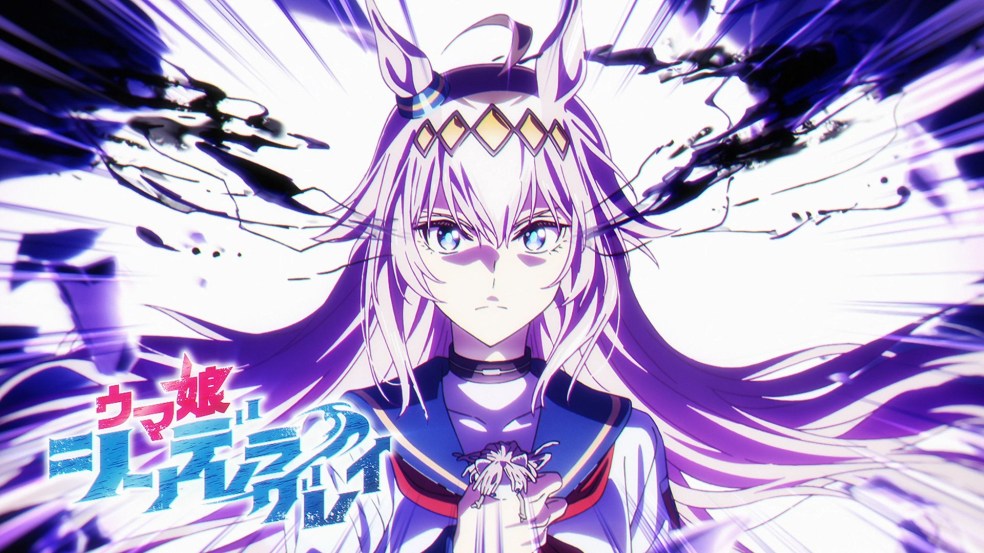
As soon as she realizes this, it all clicks into place, and we get to the episode’s namesake. The payoff, the gleefully cool-as-hell ultimate technique, Oguri Cap’s very own Zone.

A ghost, one might say.

Oguri and Tama continue running the final stretch neck to neck. But we actually see only relatively little of the literal events of the race from here on out. Instead, we’re transported to an emotion-driven image space, where the two talk. They reminisce, Tamamo Cross speaks of races come and gone and races that will never come, wistfully talking about how she owes Obey Your Master a beating at the next Japan Cup. But, she knows this won’t ever happen. Together, still in the shared mind space, Oguri and Tama begin running again. Tamamo Cross complains about how short the race is, even here, the finish line is in sight.

Nothing, not in sports, not in life, lasts forever. Every story has an end. There are no perpetual dawns, and any time the Sun rotates around our humble planet, it’s one day closer to going out forever. Here, in what they both know is their last dance together, Tamamo Cross and Oguri Cap bond for one final time over what keeps them going in spite of that, their love of life. Running more specifically, sure, but it is worth seriously understanding that finity and transience are two of Cinderella Gray‘s main thematic ideas.2 This, which is also what I was alluding to at the top of this column, is the first time we see those themes really underscored in a major way. It will not be the last.

Tamamo Cross’s story ends in defeat. Oguri Cap, reborn within the Gray Phantom, manages to edge over the finish line by just the slightest bit. This is not a sad ending, the victory and defeat are less important, perhaps, than who they are experienced alongside.

After the race, they have a talk that is heart-achingly sweet, and they embrace each other. To paraphrase the great Miko Iino, I am someone who enjoys hugs probably 50-70% more than the average person, this one here is one of the best anime hugs ever. I’m honestly jealous. Put it on the accolade board.

The end of the Arima Kinen is not a happy story for everybody. Dicta Striker gets properly fired up when she notices Oguri entering her Zone, but, the combined blood loss from her injury last episode and perhaps just general fatigue mean her body betrays her, and her legs give out as she attempts another shotgun surge. She still takes third, with Super Creek behind her taking fourth. Or at least, she would have taken fourth were she not ruled to be obstructing another racer’s movements after the fact, disqualifying her. It’s sneaky as hell to slip in the start of Creek’s upcoming arc here. But the nature of how Umamusume is written means it’s also a necessity, and it’s handled pretty well, juxtaposing as it does Creek’s embarrassment and loss with the overwhelming warmth of the rest of the episode’s final third.

(There are some other, smaller good bits as well, such as Symboli Rudolf heaping praise on Oguri, a really nice followup from that conversation she and Maruzensky had back in the first cour.)

That warmth truly is the dominant feeling. In what is by now a relative rarity for the series, we get an actual winning concert performance in place of the episode’s usual credits. Oguri Cap, Tamamo Cross, and Dicta Striker—patched up after her injuries, including breaking a tooth! which is perhaps why the concert seems to take place that night instead of immediately after the race—perform “Next Frontier”, one of Umamusume‘s standards, and a swelling, triumphant note to close out the episode.

Except there’s actually one more thing. After the concert, Oguri Cap takes the time to thank everyone who’s inspired her, who made her the racer she is today. She thanks her trainers, her rivals, and the crowd. That includes us.

Overall, “Gray Phantom” probably surpasses “Wild Joker” as Cinderella Gray’s best episode, and it’s one of the best in Umamusume on the whole. It also got me thinking, though, about the series’ overall nature. For a while now, I’ve been workshopping an as-yet unpublished article about a different piece of the Umamusume franchise. In that article, as I am about to here, I propose that despite its ostensibly “silly” or “very anime” premise, Umamusume is actually part of a very long lineage of work that seeks to anthropomorphize the minds and lives of non-human animals. I don’t have an answer as to whether that instinct is selfish, a bad habit of seeing all things as reflections of ourselves, or selfless, a genuine desire to connect with minds very different from our own.

Regardless of which side you fall on, it is fascinating to me that Oguri Cap, in some form or another, continues to inspire people 33 years after the end of his career and 15 after his death. (To float another conspiracy theory, I have wondered if the real Oguri’s epithet of “The Idol Horse” is how the premise of Umamusume was come up with in the first place.) If I can show my hand a little, I do think there’s something beautiful about the ideas that Cinderella Gray puts forward here, even the sad ones. Ultimately, though, these questions are a bit beyond the scope of this column, and I’ll save any harder arguments for another day. Tamamo Cross’s story is over, and while Oguri Cap’s will not last forever either, we still have a good, long time with her, assuming the anime gets renewed for another proper season (here’s hoping).

This isn’t the end of this season just yet, however. See you next week, umadacchi.

Now where have I heard that before?


1: It’s interesting that what little we know about Oguri Cap’s mother in Cinderella Gray doesn’t really fit the profile of either of the real Oguri Cap’s parents. Nonetheless, I usually refer to her as Narubi in my notes on the rare occasion she shows up, since it’s shorter than writing “Oguri Cap’s mom” every time.

2: There is a reason that, despite being “just” the last time we will see these two specific characters compete, this whole scene feels an awful lot like a depiction of some kind of afterlife. Tamamo Cross thus joins the storied ranks of sports anime characters who are being treated vaguely as though they’ve died when they’ve actually just retired or graduated or what have you. Sempai will be furthering her education, no doubt.


Like what you’re reading? Consider following Magic Planet Anime to get notified when new articles go live. If you’d like to talk to other Magic Planet Anime readers, consider joining my Discord server! Also consider following me on AnilistBlueSky, or Tumblr and supporting me on Ko-Fi. If you want to read more of my work, consider heading over to the Directory to browse by category.

All views expressed on Magic Planet Anime are solely my own opinions and conclusions and should not be taken to reflect the opinions of any other persons, groups, or organizations. All text is manually typed and edited, and no machine learning or other automatic tools are used in the creation of Magic Planet Anime articles, with the exception of a basic spellchecker. However, some articles may have additional tags placed by WordPress. All text, excepting direct quotations, is owned by Magic Planet Anime. Do not duplicate without permission. All images are owned by their original copyright holders.

Let’s Watch UMAMUSUME: CINDERELLA GRAY – Episode 21 – “The Arima Kinen”

Let’s Watch is a weekly recap column where I follow an anime for the course of its entire runtime.

For the Cinderella Gray column, new installments will be posted either on the Sunday each episode airs, or as soon as possible over the succeeding week. Expect spoilers!

Cinderella Gray can be watched, legally and for free, on It’s Anime By REMOW on Youtube. A link is provided below for your convenience. The descriptive blurbs for these articles are taken from those of REMOW’s Youtube uploads.


In a way, the episodes of Cinderella Gray that feature an actual race are usually the easiest to write about. This is where the series’ theory turns into practice, where the character work that it winds into a tight coil finally springs. This is where the excitement and the action are. Everything else in the show leads up to this.

It is perhaps a little surprising then that the first half of the episode is devoted to reinforcing all of those stakes. Even so, it’s actually quite effective. The Kasamatsu squad show up in person to witness the most important race of Oguri’s career, leading March to marvel at her first rival and reflect on how her growth has spurred on her own (something we saw in action back in episode fourteen). Kitahara Jo, as Oguri’s first trainer, is immensely proud that she’s here at all. There is a sense here that Oguri runs not just for herself, but for everyone who believes in her. This has always been true, but it’s meaningful that the show seeks to restate it now, right before the big race.

It’s not true of just Oguri, either. The three other major contenders in the race, Tamamo Cross, Super Creek, and Dicta Striker, all get at least a little screen time with their trainers before hitting the field. Tama’s fails to hold back her tears. Super Creek’s reminds her that this is not a clash of three titans, but four, and to not discount herself. Dicta’s, silent hulk of a man that he is, merely offers her an approving nod as she makes her way to the starting gate.

It’s Dicta Striker herself who notes that it’s not just the big four, everyone at the Arima Kinen is a monster in their own right. (Including characters who are essentially background faces to us, like say Lord Royal, also here to avenge her loss at the Fall Tenno Sho.) If it seems like I’m talking in circles about this a little bit, I’ll admit that I am, but I do just think the way Cinderella Gray is so intent on making sure we understand exactly what these races mean to the girls who run them is one of its strengths. (Sometimes this extends even to girls who aren’t presently running. A brief aside tells us that Japanese Derby champion Sakura Chiyono O is currently tending to a foot injury. She, Mejiro Ardan, and Yaeno Muteki get a brief, but sweet scene together in the stands.)

This is reinforced even further with our protagonist’s pre-race activities. She runs into Symboli Rudolf, who congratulates her on how far she’s come and the two more or less make amends from that whole spat way back in episode seven. Oguri Cap’s most important conversation before the race though is, of course, with Tamamo Cross.

Initially, Oguri’s attitude seems almost apologetic, and she’s clearly still kind of stunned that this will be Tamamo Cross’s final race. She talks about how Tamamo Cross, faster and stronger than even her, was once the goal she sought to surpass, but, as Tama’s own sepia-toned flashbacks play across the scene, Oguri hits a nerve when she says that she can tell that Tamamo Cross loves running as much as she does. As Tamamo’s thoughts flash back to the sickly old man who has been on her mind this entire time, she flips.

The brief back-and-forth here is certainly the angriest we’ve ever seen either of these characters. But, in a twisted way, it’s also them at some of their most charismatic. There’s a very raw vein of bitter anger running in both directions here, and this brief scene is one of my favorites in the entire series for managing to say so much with so little, I’m glad the anime was able to capture it this well. Even Tamamo Cross’s parting remark is captured perfectly, owing as much to Oozora Naomi’s performance as anything visual.

The Arima Kinen, both the race and the episode, is thus set up as the most important of the series thus far. Here, on a bright, cold Christmas day, Oguri has to settle her score with Tamamo Cross. She won’t get another chance.

Oguri shudders and shakes as she enters the gate. There are trumpets, and then, there’s a long, lead-heavy moment of dead silence and raw tension.

And then, they’re off.

As front-runner Lord Royal takes first place in the earliest part of the race, we follow our four “titans” one at a time. We focus, first, on Oguri Cap herself. Belno Light’s study of running form, a major component of last week’s episode, is here revealed to be the sole actual stratagem that Oguri is bringing to the Arima Kinen. The idea is simple: by leaning even lower than she normally does, Oguri offsets some of the difficulty of the track’s inclines. Other than that, she is, at Roppei’s encouragement, running mostly on instinct here. (In an amusing bit of prodding at the fourth-wall, he even dismisses the whole pace chaser / late surger dichotomy as a simplification for the sake of “the viewers.” He means the viewers of the races, in a Watsonian sense, but it’s funny nonetheless.)

Super Creek gets only a little focus as the race begins, although we can see how her large, bounding strides might help her with a track this tough even without the show directly calling attention to such. It’s really Dicta Striker who gets the lion’s share of the focus in the latter half of the episode as the race really gets started.

We haven’t known Dicta for nearly as long as Oguri or Tamamo Cross, and it’s fair to say she hasn’t been characterized quite as much as Super Creek either. What we do know is that, all else aside, she seems like a bit of an adrenaline freak. She actually bashes her head against the starting gate as the race starts, and it takes her a bit to realize just how badly she’s hurt herself. To my recollection, this is the first-ever depiction of blood in an Umamusume anime, which is not exactly shy when showing other kinds of injuries.

There is a lot of it, enough to be genuinely pretty worrying! But Dicta soldiers on, her rapid, kicking gait not letting up as she tries to ignore the amount of blood she’s losing and keep herself in the race.

While she does, at least for now, valiantly keep herself up and running, her thoughts of strategy, where to time her last spurt, and so on, turn out to be for unintentional provocation to another racer in the back. Our fourth titan, so to speak, gets annoyed at how slow and conservative the race has been so far. She didn’t come here to coast to an easy victory. She came here to win.

In one of the wickedest cliffhangers Umamusume has made use of to date, a streak of white lightning strikes the racecourse for the third and final time. Tamamo Cross will not go quiet.


Next Week: The Lightning Legend vs. The Gray Goliath, for the last time!


Like what you’re reading? Consider following Magic Planet Anime to get notified when new articles go live. If you’d like to talk to other Magic Planet Anime readers, consider joining my Discord server! Also consider following me on AnilistBlueSky, or Tumblr and supporting me on Ko-Fi. If you want to read more of my work, consider heading over to the Directory to browse by category.

All views expressed on Magic Planet Anime are solely my own opinions and conclusions and should not be taken to reflect the opinions of any other persons, groups, or organizations. All text is manually typed and edited, and no machine learning or other automatic tools are used in the creation of Magic Planet Anime articles, with the exception of a basic spellchecker. However, some articles may have additional tags placed by WordPress. All text, excepting direct quotations, is owned by Magic Planet Anime. Do not duplicate without permission. All images are owned by their original copyright holders.