
The Weekly Orbit is a (sometimes) weekly column collecting and refining my more casual anime- and manga-related thoughts from the previous week. Mostly, these are taken from my tumblr blog, and assume familiarity with the works covered. Be wary of spoilers!
Hi folks! It’s probably late at night for most of you as I post this, but I wanted to get one out this week, so I was willing to put it up outside my usual posting hours. Weirdly, the late hour sorta works, here. We’ve got a buffet of somewhat darker episodes this week, with only a few exceptions. Do enjoy.
Takopi’s Original Sin – Episodes 4 & 5
I haven’t written about Takopi’s Original Sin basically at all since it started airing, and I think part of that is a desire to not pass any judgment on something like this until I fully understand where it’s going. But it’s worth breaking that silence to say; this might be the best-animated episode of any show this year. There is some steep competition in that regard, but the way the visuals wobble out to convey Naoki’s dissociative state throughout much of episode four is really something else.

Narratively, I’m slightly less sure of what we’re doing, but the series has been good enough so far that everything I’m about to say should be taken as, at absolute most, a minor qualm. I think you can put the three kids that star in this story on a scale as to how obvious it is that the show wants you to sympathize with them: Marina was the least sympathetic, an incredibly vicious bully whose outbursts were explained by the revelation that she was physically abused at home. Her being perhaps the “worst” (I use the term very loosely) of these kids made her death all the more shocking. It’s not punishment vested on a bad person, it’s an absolutely tragic end to a very unhappy child whose life was defined by abuse, which she was the victim of but also the further perpetrator of. Naoki is the most overtly sympathetic, being subject to harsh psychological abuse by his own mother for much of his life and having few of the more “unpleasant” qualities of the other two. Shizuka, our protagonist, is somewhere between these two poles, and that’s where I’m scratching my head slightly because the specific way she’s between those extremes feels like something I’m not entirely clicking with. (Saying all this, I must again clarify that I am referring to ‘sympathetic’ as in the way that the narrative presents these characters to us. Personally speaking, I sympathize with all of them, because they’re young kids trapped in absolutely awful situations. But I digress….)

Naoki is talked into being an accomplice to covering up Marina’s murder because Shizuka basically charms him. Now, in of itself I think the beat of Naoki falling for Shizuka and this informing his actions is fine. But the degree to which Shizuka leans into it and actively leads him on just strikes me as kind of odd. To be clear, I don’t think this is “problematic” or whatever, I think what the series is trying to do is make a point about how people tend to take after their parents (in particular, bad mothers, respectively neglectful, psychologically abusive, and physically abusive, are a shared commonality between Shizuka, Naoki, and Marina respectively. Naoki’s brother even compares him to his mom explicitly). The framing is what feels a little odd to me, which I imagine is a problem unique to the anime, with the cartoon gunshot sounds accompanying Naoki’s gaga heart eyes probably being the most over the top example. (Although to be honest, now that I’ve laid it out here, I think I’ve actually talked myself out of having a problem with it. But it does still feel like the anime is trying a little too hard to shock us with how “bad” Shizuka is, maybe that’s just in my own imagination.)
On another note, Naoki’s brother is handled in a really interesting way throughout this episode. The bit where he comfortingly pats Naoki’s head and it’s portrayed as this bright, cheerful bit of magic is another example of the show’s visuals being over the top, but in a way I really appreciate.
Episode five, meanwhile, is another swerve and once again takes things in a somewhat different direction. I’m using this space to both jot down some thoughts on episode five itself—which, this is the rare thing that’s exclusive to this column, I’m not pulling from my tumblr here—but also to bounce off of this reblog addition to what I wrote above on the previous episode by tumblr user angyo. Angyo puts forward that the reason behind the way the show treats Shizuka is that we are to understand Shizuka and Marina as being two sides of the same coin. People in what are, at the end of the day, actually quite similar situations, being driven to life-or-death extremes by respectively Shizuka’s need to see Chappy again (even though he is probably dead) and Marina’s need for approval from her mother. (“Cornered raccoon rules”, as angyo put it, a turn of phrase good enough that I’m stealing it.) And I do think this is directly relevant to episode five, because what the gradual darkening of Shizuka’s character—what I took for an attempt to shock the audience just two paragraphs back—is actually an attempt to underscore how easily these characters could switch places. It is very easy to imagine, for example, a situation where Takopi encountered Naoki or Marina first upon arriving to Earth and this entire narrative is framed differently, with Marina as the most overtly sympathetic of the cast and Shizuka as the “bad guy.”
In fact, you don’t have to imagine this at all, because that’s exactly what episode five is. Shizuka and Takopi make it to Tokyo only to find that Shizuka’s father has since started a new life with some other woman and now has two other kids. Any hope that her father might entertain the idea of helping Shizuka is dashed when one of his other children asks him who this strange girl is, and he shuts the door on her. Backed into a corner yet again, she takes it out on Takopi, bashing him with a rock hard enough to induce forgotten memories to rise to the surface. He remembers something—wait a second, he actually has been to Earth before.

In a previous timeline, Takopi met Marina first. Thus, the anime’s fifth episode is a rough perspective flip of its first. Takopi—not yet known by that name—befriends Marina, more or less, and helps her navigate life from ages ten to sixteen or so. Shizuka is actually barely present in this version of events. Instead, we focus on how here as in the timelines we’ve already seen, Marina’s youth is defined by the abuse of her mother, and there’s a heartbreaking bit where Takopi, again totally innocent, observes that Marina must smack him around so often because her mother does the same to her. It’s these moments where Takopi’s Original Sin is most devestated, not where things reach an elevated fever pitch, but when Takopi makes a simple observation that any child could.

As things seem like they might finally be getting a bit better for Marina, Shizuka reenters the picture at a crucial moment. She (inadvertently? I’d like to think so) steals Naoki, here Marina’s boyfriend, from her. This leads to a terribly sad series of events that culminates in Marina finally snapping under her mother’s abuse, killing her and, it seems clear, eventually herself. Takopi knows what he must do to prevent this; he has to kill Shizuka, and he’ll use the time machine on his home planet to do it.
Forcing his way to the machine, he is reverted to mental childhood himself by the mysterious mother figure of his home planet, and by the time he returns to Earth we’re back at the start of episode one, and he’s forgotten about Shizuka and Marina entirely.
The strongest parallel here is thus that despite Takopi’s best intentions, he has demonstrably led both of this show’s protagonists to bad places, and eventually their deaths. The show’s present timeline, which we return to at the end of the episode, gives him a chance to potentially fix all of that, but it’s difficult to imagine him succeeding for the same reason that Takopi is, despite everything, still ultimately sympathetic. He’s basically a child himself in his current state, he has a simplistic understanding of the world, which is why his most sophisticated attempts at problem solving in the entire show so far boiled down to “kill Shizuka” and “try to help Shizuka cover up that she killed Marina.” Episode five ends with the unexpected return of Naoki to the main timeline, and between him coming back and Takopi’s memories resurfacing it’s hard to say where all of this will eventually end, but any show that makes its viewership turn over character dynamics this thoroughly is doing something right. Just one week out from its finale, it remains one of the season’s most compelling.
There’s No Freaking Way I’ll Be Your Lover! Unless…. – Episode 3
I like to give a show credit when it manages to completely throw me off. I do see how we got here Watanare‘s first episode, but it’s definitely still not a direction I expected the show to take when I watched its premiere.
There’s a lot of things I could talk about here but I’m a little uninterested in attempting to make some grand proclamation about what this narrative development “means.” Because I’m sure tons of people are already doing that and, to be honest, I do not really need my fiction to be a morality fable, so I don’t have strong opinions on where they’re going to take this. I’m fine with anything as long as it’s interesting.
I actually wanna talk about the backgrounds, mostly.
I’m hitting the limits of my artistic vocabulary here, because I don’t know what about them makes them look this way, but a good amount of the backgrounds in this series have a very flat and fake look to them. These are spaces meant to emphasize their own artificiality, and it hits a height in this episode that I was worried we wouldn’t see again after the premiere.
This isn’t a bad thing, It’s clearly deliberate and is meant to convey a sense of alienation. It’s also a very subtle inflection, and it’s one of my favorite things about the show. It’s most obvious with Mai’s room in Paris-

-and the suburb Renako lives in.

But notably, Renako’s room itself takes on this quality during the night after the incident at the end of this episode, which I think is a great way of quickly and subtly conveying her anxiety and confusion.

I’m unwilling to contribute to the discourse (in both the literal and euphemistic sense of that term) around the show beyond this, at least so far, but it’s definitely established itself as quietly being one of the season’s more interesting anime. I salute that.
Necronomico & The Cosmic Horror Show – Episode 4

I need an anti-favorite characters list on Anilist so I can put Eita on it. I get characters like this are supposed to be annoying and hateable so they can die late in the show for catharsis, but the dude is seriously just aggravating as shit. Also, I feel like there’s a version of this same character in every show like this so he’s not even particularly interesting or novel. Maybe my perception is skewed since I haven’t actually seen that many of these, but yeah.
Anyway, other than his being generally grating as fuck and the weird “on-screen chat commentary” gimmick, this is actually probably the best episode of the show so far. It’s also the best-looking since the premiere, a good sign for a show that would be lost without some visual oomph. I was a little worried we were already running out of ideas for death game setups with the second one, but the escape-room-with-the-directions premise the Old Gods field here is pretty solid. More importantly, the actual environment of Hotel Reversal, as it’s called, is really good, I love all the oranges and greens and the generally very zany vibe of the hotel itself. It makes it feel like a real escape room game despite the high stakes. We lose a few people this episode too, and it’s no big loss because they’re among the less interesting characters. My bet is that the teacher is the next person to die, but we’ll see.

Ruri Rocks / Introduction to Mineralogy – Episode 3
I’m really delighted by the decision to expand the show’s world a bit here. The anime’s first two episodes were nearly devoid of anything but Ruri and Nagi’s mineral expeditions. Here we meet one of Ruri’s colleagues, Imari Youko [Miyamoto Yume], and since we’ve roped a third person into this setup, the scope of the show expands too.
The entire iron mine trip is lovely, but obviously the bit at the end with the Flourite vein is the episode’s apex. We have an actual cliffhanger of sorts at the end and I really cannot wait to see what else this show has in store. The next episode of this show will likely have aired already by the time you read this, I’m sure that one will be lovely too.
It is also worth restating that Nagi remains just devastatingly hot. Anime woman of the year, I won’t apologize.
Call of the Night – Season 2, Episode 4
Well, this episode hit me like a ton of bricks.
Overall, Call of the Night has been improving steadily since it came back. (In fact, I’m starting to think the premiere was the weak link.) As such, there’s a lot to like in this episode; visually it’s an array of achingly lonesome liminal spaces, hospital rooms so dreary you can practically smell them, and dramatic, frightful closeups. The same borrowed horror language that the show used in its first episodes.

There’s all the show’s usual strengths writing-wise, including some great banter between Ko and Nazuna. But what really takes this episode to another level is its second half, where we learn the backstory of the character Honda Kabura [Itou Shizuka], a long-time supporting member of the cast and one of Nazuna’s fellow vampires. I don’t want to relitigate all the specifics, but the gist is that Kabura was, as a human, sickly, frequently in and out of hospitals. What we see of her friend group paints them as pretty unsupportive and shitty people, and in fact, her nurse tells her this outright.
Her nurse is, or at least appears to have been, Nazuna. But she’s not called Nazuna, as this person refers to herself as Haru. So either Nazuna went by a different name back then—it would track, given her almost total amnesia as to her earlier life established in last week’s episode—or there’s something else going on here and this is a relative or somesuch. Either way, Haru seems to be just about the only person Kabura really had in her life, so when things reach a breaking point, Haru is the person there for her. This all has an extremely strong gay overtone—more than that, really, since when Haru is running down a list of things that she hates and which have been imposed upon her, she includes men—and when it inevitably comes time for Haru to turn Kabura into a vampire, Call of the Night actually brings back its season one opening theme, drawing a direct line from what happened to Kabura in her own past and what happened to Ko at the beginning of this story.
Their specific situations are different. Ko’s problems seem to be mostly mental and social. Kabura’s to at least some extent are physical. But the effect is the same; these two are societal outcasts. When one of Kabura’s shitty friends visits her in the hospital, she ends up snapping at her. She hits the nail on the head though—these people really do look down on the sick and the unwell, those of us who walk slow or don’t socialize. When Haru offers to turn Kabura, she phrases it not as inviting her to vampirism but as inviting her to the opportunity to live a full life with actual meaning. “Do you want to be able to run?” asks the vampire. The girl who can only walk slow does not need to even speak her answer, for the vampire already knows it.


Anime – Non-Seasonal
The Epic of Zektbach
Well, this was quite a goofy thing.
Essentially, what we have here is a highly compressed attempt at a heroic epic about a character named Shamshir. Shamshir saves her country from an invasion, but her fellow soldiers are entranced by her “dance”—her fighting style—and eventually start committing murders, which Shamshir herself is blamed for.
This doesn’t really go anywhere despite a small handful of interesting ideas—we see things from Shamshir’s and also the murderers’ perspective a few times and they seem to see their targets as masses of binary code and chemical formulas—and the OVA unceremoniously peters out after Shamshir gives in to her bloodlust and murders her entire city, seemingly including her childhood friends.
Apparently, this is one facet of a larger franchise connected to a bunch of concept music, some small booklets, and a now-defunct website, so maybe this makes more sense in context (the series’ somehow still online Fandom wiki boldly claims the series has “gnostic themes”) but as an OVA it’s pretty bad. Not helping is the fact that it looks like absolute mud; almost everything is a shade of brown or red with occasional grays. The resulting visual effect is a bit like if a show had a sub-Attack on Titan color palette on Arifureta‘s visual budget. Still, there’s a charm to the specific kind of bad on display here, not so much so that this is worth seeking out, but I at least had a good time poking fun at it with my friend Josh, who I have now promoted to main-body-of-the-article status, I suppose. (Hi Josh.)
Josh and I started watching old OVAs together recently after having the brilliant decision to knock out famously bad anticlassic Garzey’s Wing together—if you see more OVAs here in the future you can thank them—and they in fact found one of the music videos that comprises the bulk of the remainder of the Zektbach franchise. It is way, way better than the OVA, and also has a much nicer art style. It lacks much of a narrative given that it’s, you know, a 2-minute music video, but it’s much more worth watching than the OVA, I think. I’ve embedded it below.
Puppet Princess
This, on the other hand, was just an absolute slap from start to finish.

These OVA centered around some kind of odd conceit from back in the day aren’t always as great as the general concept makes them sound. But this one and its puppet fighting gimmick really are just as much fun as the idea promises. Obviously, there are a lot of really excellent action sequences here, mostly revolving around our protagonist Rangiku’s [Uechi Aki] array of fighting puppets and the large box she keeps them in. But it really can’t be overstated how absolutely great this thing looks in general, the direction is razor-sharp and in particular the more horror-leaning scenes really pop. (As a side note, basically everyone suddenly gains individually-drawn teeth and bulging eyeballs when they’re going through terrible things. The former in particular means this probably has the most teeth-per-minute of any anime I’ve ever seen. Just something to think about!)
Also present is a master ninja / illusionist named Manajiri [Wakamoto Norio. Yes, really!] who serves as a sort of secondary dynamic. They have a solid dynamic. Although sullying it somewhat is that there’s a decidedly uncomfortable and unfortunately very of its time bit where he tries to grope Rangiku while she’s cleaning herself in a waterfall, although he does at least back off, which is more than can be said about many characters who’ve been placed in similar situations. It’s a little unfortunate since Manajiri is otherwise a pretty great character in his own right.
Rangiku’s puppets are easily my favorite thing about the OVA overall, though, she cycles through a couple of them over its 40-odd minute runtime and while the best is probably the large red samurai she uses for the first and last battle, they’re all great. Naturally, they become the tools of vengeance used to kill the man who murdered her father. Between the beats of the vengeance plot, there’s also some interesting (and harrowing!) stuff in here about how badly her father treated her in favor of the puppets. You can thus extract an interesting thematic line about a man in power favoring literal dolls over the human women in his life, but the OVA only has so much time to explore this. My only real complaint, in fact, other than the waterfall scene, is that I actually wouldn’t have minded watching a lot more of this. I think you could pretty easily extend this to a full series.
And interestingly, it almost sort of did? Puppet Princess itself never got a TV anime, but one of the mangaka’s other projects, Karakuri Circus, did, nearly twenty years later. It features a similar overall premise, which may be enough to finally get me to check Karakuri Circus out after having had it on my plan to watch….since it was new, I believe. There’s a lot of interesting anime out there! For better or worse.
That’s all for this week!
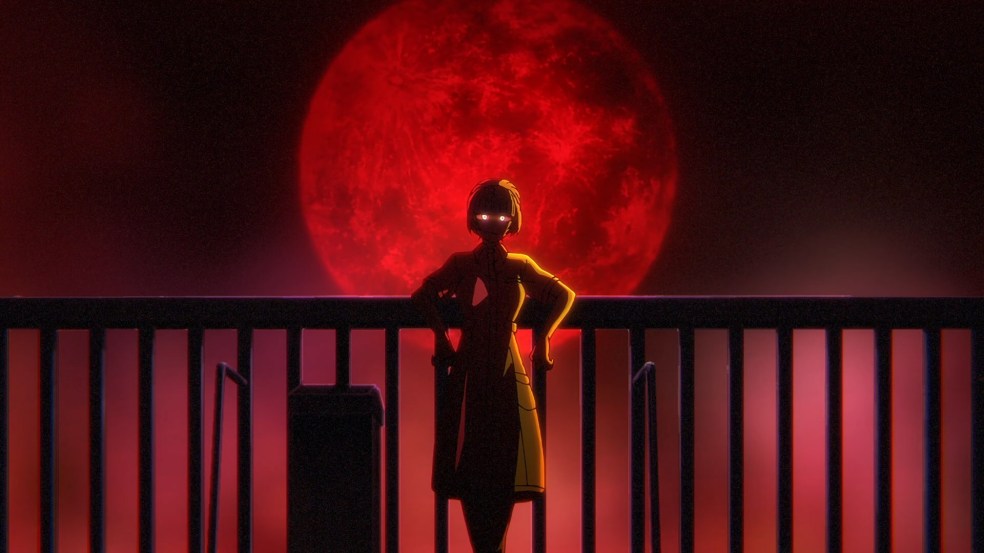
It’s been a long time since I did one of these, but on your way out the door why don’t you take a Bonus Screencap along with you? This time of Nazuna in her nurse getup from the Call of the Night midcard for this week.

Like what you’re reading? Consider following Magic Planet Anime to get notified when new articles go live. If you’d like to talk to other Magic Planet Anime readers, consider joining my Discord server! Also consider following me on Anilist, BlueSky, or Tumblr and supporting me on Ko-Fi. If you want to read more of my work, consider heading over to the Directory to browse by category.
All views expressed on Magic Planet Anime are solely my own opinions and conclusions and should not be taken to reflect the opinions of any other persons, groups, or organizations. All text is manually typed and edited, and no machine learning or other automatic tools are used in the creation of Magic Planet Anime articles, with the exception of a basic spellchecker. However, some articles may have additional tags placed by WordPress. All text, excepting direct quotations, is owned by Magic Planet Anime. Do not duplicate without permission. All images are owned by their original copyright holders.
 The Magic Planet
Pingback: Ranking Every 2025 Anime (That I Actually Finished) From Worst to Best – The Magic Planet
Pingback: Anime, Manga, and Light Novel Blog Posts That Caught My Eye This Week (August 1, 2025) – Lesley's Anime and Manga Corner
Thank you very much 🙂
LikeLike
Wonderful thoughts and great episode for Call of the Night.
LikeLike