Let’s Watch is a weekly recap column where I follow an anime for the course of its entire runtime.
For the Cinderella Gray column, new installments will be posted either on the Sunday each episode airs, or as soon as possible over the succeeding week. Expect spoilers!
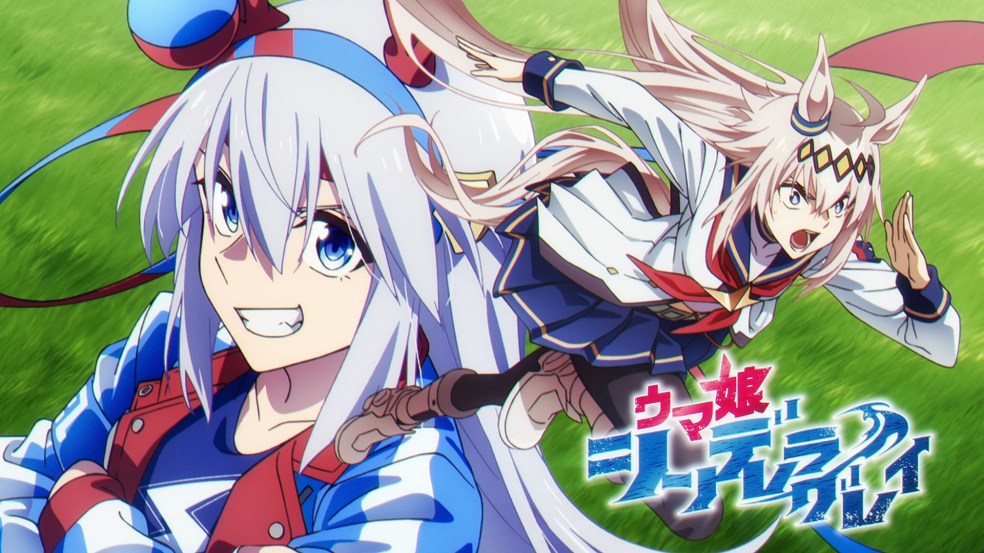
Back at the very beginning of this series, when we had only just met her, Oguri Cap was presented to us as “someone we could root for from the bottom of [our] hearts.” Those were the words of Kitahara Jou, her original trainer, who saw something in her. A spark, a fire. That rare, ineffable, and hard-to-qualify thing known as star power. There is just something about Oguri that makes people like her. This isn’t even restricted to Oguri Cap the anime character. Even the real, historical horse was so popular that cheering crowds chanting his name were known to pop up when he made an appearance. Regardless of the time, place, or even the medium, people love Oguri Cap. We want to see them succeed.
Essentially, this is us. (I’m Norn Ace.)
And succeed she has! When the only major defeat you’ve suffered so far was not at the hands of a fellow racer but bureaucracy, you know your career’s in a good place. Cinderella Gray has spent this entire season building that goodwill, contrasting her thunderous victories with her good-natured and straightforward personality, making us cheer for Oguri no matter where she runs or whom she runs against. That is still true here, in the final episode of what is already becoming retroactively known as Cinderella Gray Part 1. Make no mistake, her main rival in this race, Tamamo Cross, is also a great character. Enough so that she basically carried last week’s episode on her own, as Oguri was largely kept out of the spotlight there. But this is Oguri’s show. Oguri is who we’re here for. And this finale boils the series down to its barest essentials; a stable of powerful rivals, a race, a mountain to be conquered. There is nothing remotely complicated about the narrative here, all Oguri has to do is run.
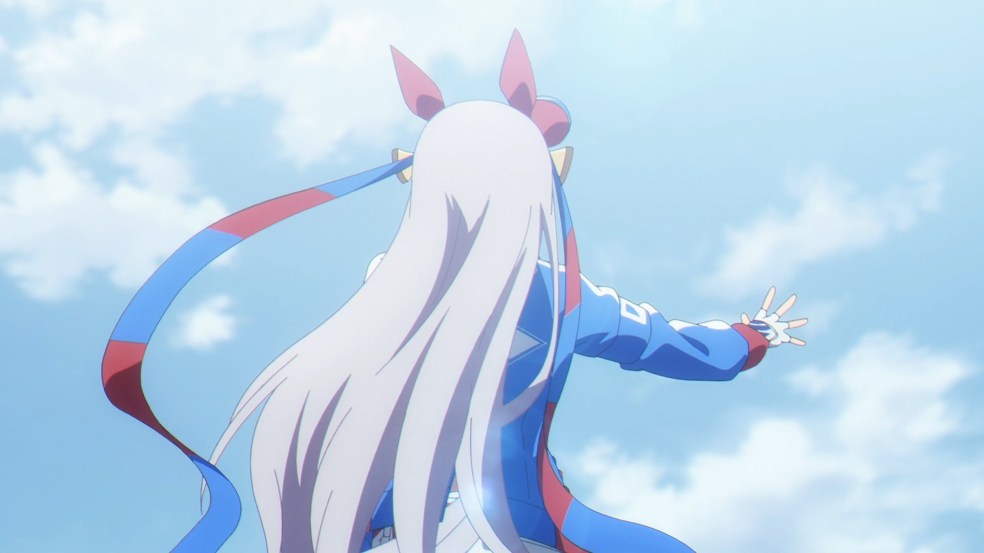
And yet, even running is not really a simple thing. The episode opens with some recapping of last week, this time from Oguri’s perspective—the way she waxes poetic about how Tamamo is so obviously different from the rest is really something, the girl has it bad—before getting into the real meat of the race, the final stretch of the course. This, both the show and Oguri herself make note of, is basically where the real race begins. The Tokyo racecourse that hosts the Tenno Sho ends with an absolutely brutal incline, making all of the “climbing the peak” metaphors deployed throughout this season stunningly literal as it speeds to a close. (I would not be surprised if the incline was, from a writing perspective, where all those metaphors came from.) As Tamamo passes front-runner Lord Royal, the race boils down to Tamamo herself and Oguri, two ash-haired racetrack demons who are, by all evidence, equally matched.
And then Tamamo gets a leg cramp. For a minute, it seems like Oguri’s last race of the season will play out as a victory with an asterisk; outside conditions throwing her dominance into question. What actually happens is much more stark, a much cleaner break, than something that cheap.
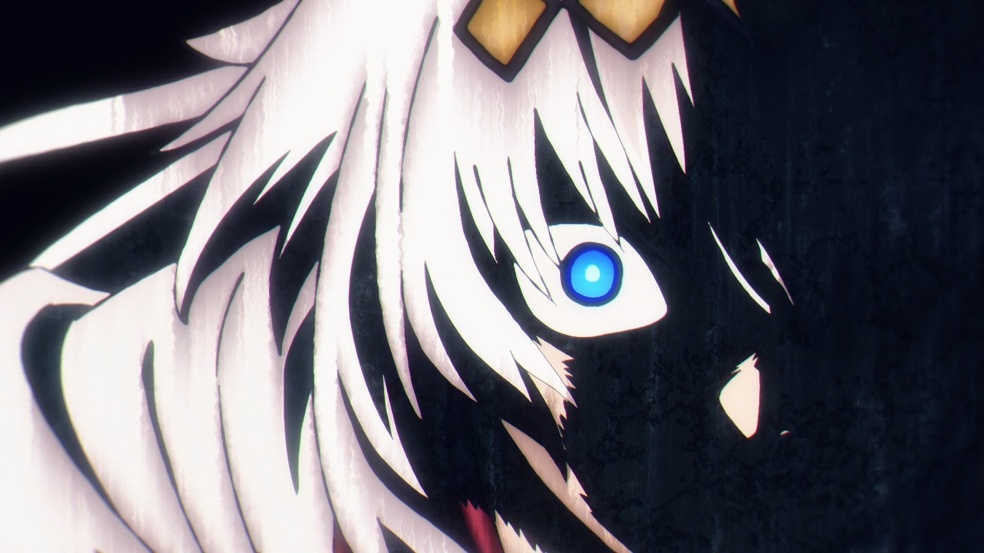
Tamamo Cross grits her teeth. She remembers her childhood; an old man with a strong accent teaching her the fundamentals of running as the sun sets next to a river. That old man, the same we met a few episodes ago as he lay in a hospital bed, clearly doing very badly, is who she thinks of as she steels herself. Suddenly, she is somewhere else. All sound fades away, and she is a streak of lightning across the racecourse.
Rarified, transformative states of this nature are a rare thing. Depicting them in fiction is really, really hard. Symboli Rudolf, who’d know a thing or two about this subject, just refers to it as “the Zone.” I can think of no better term myself, so I’ll defer to her, here. This is not the first time such a thing has been depicted in Uma Musume—a good chunk of the visual spectacle of the New Era movie, for example, comes from scenes like this—but it’s the first time Oguri Cap has stared down its barrel. For the first time in the series, she is on the receiving end of the same kind of buzzer-beater blowout performance she’s dealt to so many other racers. Tamamo Cross takes the gold in Part 1’s final race. Oguri Cap has lost.
Musaka, who can spot Oguri hitting her limit the second it happens, remarks that no matter how many times one endures it, defeat never feels less bitter. Norn Ace, watching back in Kasamatsu and probably Oguri Cap’s biggest fan, tries to talk herself out of feeling disappointed but is clearly crushed. Belno echoes many fan sentiments with saying that Oguri’s victory seemed predetermined. Nonetheless, the fact of the matter is that no one truly knows how a race like this—any competition like this—is going to go until it happens. (And remember, while Oguri Cap is who we’ve been following, for Tamamo Cross this is a major victory. Not only does she become the first racer to ever win both Tenno Sho races consecutively, the victory clearly means a lot to her trainer, who’s shown weeping with joy from his hospital bed.)
Perhaps the person with the most perspective on the whole issue, though, is Oguri Cap herself. Is she disappointed? Absolutely. We see her tear up after Tamamo crosses the finish line, and she attempts to reckon just why she lost. But she recovers almost instantly, brimming with motivation now that she’s found someone who can actually match her. Tamamo and Oguri talk after the race, swearing to run against each other again, officially declaring each other as their rivals with a whole lot of blushing that gives the scene as much gay subtext as anything from this franchise has ever had. It’s a wonderful bow on the episode.
So Oguri’s defeat here is not really a sad thing. For the first time, she has a rival who is not just at but above her level, and the episode ends with her as her same old cheerful self getting ready to train. There’s a new mountain to climb, and while we’ll have to wait ’til Fall to see just how Oguri plans to summit that particular peak, it seems inconceivable that she won’t. Cry if you must, but don’t dig a grave. To paraphrase Uma Musume‘s resident trickster Gold Ship, a loss is not the same as dying. Oguri Cap will be back.
Like what you’re reading? Consider following Magic Planet Anime to get notified when new articles go live.If you’d like to talk to other Magic Planet Anime readers, consider joining my Discord server! Also consider following me on Anilist, BlueSky, or Tumblrand supporting me on Ko-Fi. If you want to read more of my work, consider heading over to the Directoryto browse by category.
All views expressed on Magic Planet Anime are solely my own opinions and conclusions and should not be taken to reflect the opinions of any other persons, groups, or organizations. All text is manually typed and edited, and no machine learning or other automatic tools are used in the creation of Magic Planet Anime articles, with the exception of a basic spellchecker. However, some articles may have additional tags placed by WordPress. All text, excepting direct quotations, is owned by Magic Planet Anime. Do not duplicate without permission. All images are owned by their original copyright holders.
Seasonal First Impressions is a column where I detail my thoughts, however brief or long, about a currently-airing anime’s first episode or so.
Content Warning: This article contains discussion of suicide, child abuse, bullying, and other heavy topics. Please use your discretion before reading.
I’m open to the idea that this is a real “these three points make a line” sort of statement, but in my experience, it seems to me that when a show premieres before the bulk of its season, it’s usually lightweight and lighthearted. Something like Fluffy Paradise, or what have you. Why that is, I couldn’t tell you, but maybe there’s a sentiment that if you’re going to put yourself out there ahead of the pack, it doesn’t make sense to demand too much from viewers. That’s a guess, but it’s the best one I’ve got.
In any case, Takopi’s Original Sin—an ONA adaptation, slated for six episodes, of Taizen 5‘s Jump+ manga—does not follow this pattern. At all. In fact, before I say anything else, let me hit you with the same exact warnings that the show itself does.
Those two content warnings, one from the anime’s production committee and the other, as far as I can tell, inserted by distributors, are not a joke. Takopi is in the running for the heaviest anime I’ve ever covered on this site, and I’m saying that as a statement of fact, not some kind of tasteless “you won’t believe how dark this show is!” clickbait sort of thing. So please, if reading about anything described abvove is distressing to you, or if watching it is distressing, please exercise your judgment. Take care of yourself, alright?
Beyond that, it’s actually the visual element of this show I’d like to discuss first. (Coming to us from director Iino Shinya, previously best known for the Dr. Stone adaptation, and his team at Studio ENISHIYA. As far as I can tell, this is their first work that’s not a music video or something of that nature.) Despite this being an anime blog, I usually save notes on production polish and such for the last few paragraphs, mostly because the ins and outs of how an anime actually gets made are not my specialty, and there are only so many ways for a comparative layman to say something looks good. Takopi is different: its human character designs have a distinctive feel, I’d almost say a weathered appearance, that sets them apart from the norm. They’re not “realistic” per se, but they’re expressive and feel like stories unto themselves, most notably with Kuze Shizuka [Ueda Reina], a fourth-grader and one of our leads; rail-thin, with a stringy mop of black hair, dressed in a battered white t-shirt, and a face that conveys an exhaustion beyond her years. Deliberately cutting against all of that is our non-human lead, Takopi himself [Mamiya Kurumi]. Takopi is a round alien, essentially a pink sphere with some stumpy legs, a mouth, eyes, and two tentacles. He looks like something out of a children’s storybook, and he thinks like one too, most scenes that depict something he imagines do so in this painted, storybook style, and it adds an incredible amount of depth to the show.
As for the alien himself, Takopi comes from The Happy Planet. His mission? To spread joy far and wide across the galaxy.
To that end, he has a bag full of gadgets—Happy Gadgets—that can do just about anything; a wrist band that lets you fly, an instant camera / time machine, a talking moai-like head that gives advice, an infinitely-long ribbon that can make any two people who are fighting resolve their differences. You know, the basic stuff. Takopi is, textually speaking, a literal extraterrestrial. But from the moment he’s introduced to Shizuka’s life, it’s clear that he’s also meant to come off as rather childlike. He’s immensely naïve about how the world works, and his gizmos do little to solve Shizuka’s problems. Still, Shizuka, at least initially, seems to be grateful to have someone to talk to at the very least. Over the course of a few days, she feeds Takopi bread and the little alien offers her various widgets to improve her life. It should be pointed out that she declines to use any of them, other than allowing Takopi to take a picture with the aforementioned camera, for the stated reason that even something like being able to fly through the sky “wouldn’t change anything.”
One gets a sense of what she means when we’re first introduced to Kirarazaka Marina [Kohara Konomi]. Marina, a classmate of Shizuka’s and, it quickly becomes clear to us if not Takopi, her bully. From the very moment she’s introduced, Marina is so awful to Shizuka that it’s almost impressive. One of her first lines is her and an underling talking about how they’ve broken Shizuka’s writing board, about which Marina sneers that she can use her “welfare money” to buy another. Further details like insults scribbled on Shizuka’s bookbag and simply how insistent she is about hiding from Marina paint Shizuka’s school life as a living hell even before we get to actually see it in the episode’s second half.
There’s a sense of suffocation here, and the environment reflects it; a relatively small town where everyone knows everyone else but doesn’t necessarily like them. Shizuka’s home life paints an equally-bleak picture; her only real companion is her dog Chappy, a giant ball of fur and affection that truly seems to be the one light in her life. Her mother, an “escort”, doesn’t really seem to ever be home, and an innocent question about Takopi regarding where her father is is met with “I don’t have a dad.”
Even so. All of this is contrasted with Shizuka’s moments with Takopi, which she does seem to genuinely appreciate. After seeing Shizuka’s home for the first time, Takopi tries to cheer her up by offering to take her to his home planet. He’s rebuffed, but Shizuka, Takopi, and Chappy end that night by walking together under the star-woven night sky. Shizuka smiles, Takopi is overjoyed.
If Takopi’s Original Sin is ever “misleading” in any way—and I really don’t think it is, this is not a show that’s coy about what kind of story it’s trying to tell, but for the sake of argument—it’s probably here. For a few seconds, it seems like things are looking up.
And then tomorrow comes.
Shizuka, badly beaten and clutching an empty dog leash—did Chappy run away? What happened? We aren’t told—meets up with Takopi again. For neither the first nor the last time, Takopi tragically doesn’t really understand what he’s looking at, interpreting her bloody mouth and black eye as “decoration.” Shizuka can only mumble out that she had a “fight” with her “friend,” at which point Takopi likens the way Shizuka’s face has changed to how he blushes when he gets embarrassed. (Moments of this nature, where Takopi just fundamentally misunderstands something about how humanity works, are excellent in how thoroughly they can sink your heart in just a few lines of his cheery delivery, and they’re scattered all up and down the episode.)
He latches on to the “fight with a friend” description, though. Offering Shizuka a “Reconciliation Ribbon” that can make any two people reconcile so long as they each tie it around their fingers. For me at least, this is around where the feelings of unease cultivated by the opening minutes of the episode blossomed into full-blown dread.
Takopi somewhat reluctantly lets Shizuka borrow the ribbon, despite the rules of his mission (as dictated in a flashback by a large, white specimen of his species) saying that the gadgets should never be used without direct supervision. Time passes, and Takopi gets worried.
He eventually makes his way back to Shizuka’s home, only to find it empty. Empty except for the Ribbon, fashioned into a makeshift noose, and except for Shizuka, having hung herself. The scene is harrowing, an explosion of pure, black dread. (I think one can make the case that Takopi’s lending the Ribbon to Shizuka is the titular “original sin,” though given that we’re only one-sixth of the way through this story, I’m sure other interpretations will make themselves known.)
Understandably, the little pink alien panics. He wonders how this happened, blaming himself and lamenting that death is the one constant across the vast universe. He can’t bring back the dead, but there is one thing he can do with his extraordinary gadgetry. The camera’s hidden function as a time machine is revealed here, allowing Takopi to travel back to the moment the photo was taken. (This seems to require him to have the photo on-hand, and it’s said outright that the camera can only store one picture at a time. Both of these facts seem like they’ll eventually be relevant.)
Thus, the second part of this episode revolves around Takopi trying his damnedest to avert Shizuka’s tragic fate, to find a world where she lives. To do this, he feels the need to learn more about her. Traveling back to the past, he accompanies her to school, trying to solve various minor problems he incorrectly pegs as the source of her pain (forgetting her homework, being unable to finish her school lunch, etc.), and one of the episode’s most visually interesting moments consists of a montage juxtaposing these problems and Takopi’s stopgap solutions to them, splitting the video down the middle and showing both at the same time.
But what Takopi still doesn’t entirely get until the episode’s final act is that all of these things are symptoms of a bigger problem that Shizuka is dealing with. Namely, Marina. Everything else that happens to her in school is a direct result of Marina’s bullying; she didn’t forget her homework, Marina stole it. She might be able to actually finish her lunch were it not for Marina and her fellow bullies mocking Shizuka to her face while she’s trying to eat. And so on and so forth.
Takopi, heartbreakingly, doesn’t really understand this either. He assumes that Marina and Shizuka are former friends who’ve had some kind of falling out, and that if he can just get them to talk, things will be fine. The problems with this approach are left unsaid, but are obvious. What if someone just fucking hates you for no obvious reason? What if someone is abusing you because they themselves are abused and you’re just an outlet for their anger? What if someone is mad at some other specific person and you’re just a proxy for their rage? Takopi can’t consider these angles, and when he naively tries to use another of his gizmos (a palette that lets him take the appearance of anyone he wants) to take Shizuka’s place when Marina wants to “talk to her,” it predictably goes very poorly.
I have to confess, as awful and stomach-churning as Shizuka’s suicide was, this was actually the scene that made me pause the episode and necessitated me taking some time to collect myself before resuming. Marina just absolutely beats Takopi-as-Shizuka black and blue, ranting at him about how “she” is the daughter of a “parasite” who’s preying on her father, and concludes her assault by jamming a mechanical pencil in Takopi-Shizuka’s eye. The narrative revelation—that Shizuka’s mother is sleeping with Marina’s father, and this is one of the sources of Marina’s anger—is crammed into the margins by the visceral pummeling she’s giving Takopi-Shizuka, a clouding of cause-and-effect that is all too reflective of how these things can play out in real life. Marina, a child herself, is of course wholly unable to strike back against a grown woman who she thinks is ruining her family. Shizuka, comparatively defenseless, is an easy target.
Takopi simply has no frame of reference for any of this; nothing of this nature happens on his planet, and this single beating is enough to traumatize him. The next time loop around, he can’t make himself move to go help Shizuka, even as he knows exactly what’s happening to her. The best he can eventually think to do is to run and grab a teacher while still disguised as Shizuka. Even this doesn’t really work long term, it just gets Marina off of her for the time being.
The episode’s closing minutes see Takopi pledge to stay with Shizuka, even though he feels like a failure for not being able to truly protect her. They also follow Marina, further contextualizing her anger as the result of her mother, who is sitting at their dining room table and seething over her husband spending so much time with another woman. The episode ends on two distinct epilogues. Shizuka goes home and falls asleep in her living room with Takopi and Chappy, the closest to being happy we’ve yet seen her. Marina, on the other hand, exits the episode as her mother creepily puts her hand on her face, all about the scene implying that Marina is about to be the target of abuse herself, for nowhere near the first time. She begins crying, headlight-yellow eyes darting away from her mother and, full of fear and resentment, burning holes in the camera.
This show is….a difficult one to discuss productively, for lack of a better term. To be honest, I have felt a touch out of my depth writing this, most anime—including most anime I deeply love—has some escapist element that can make even quite dark storylines go down more easily. There’s a little of that here, and Takopi’s presence provides a dose of pitch-black humor when he’s not just making things worse with his childlike naiveite, but, like I said at the top, this is one of the bleakest things I’ve ever written about on this site. Still, I do hope I’ve made it clear that none of this is a problem. The series is outstanding at what it’s setting out to do, and I think if you can weather the storm Takopi’s Original Sin is putting down, you’ll find easily one of the year’s best premieres. I would not at all be surprised, if it keeps up the quality—and I imagine it will—to find Takopi making a lot of year-end best-of lists come December or so. This story may be dark, but it’s one worth telling.
Like what you’re reading? Consider following Magic Planet Anime to get notified when new articles go live.If you’d like to talk to other Magic Planet Anime readers, consider joining my Discord server! Also consider following me on Anilist, BlueSky, or Tumblrand supporting me on Ko-Fi. If you want to read more of my work, consider heading over to the Directoryto browse by category.
All views expressed on Magic Planet Anime are solely my own opinions and conclusions and should not be taken to reflect the opinions of any other persons, groups, or organizations. All text is manually typed and edited, and no machine learning or other automatic tools are used in the creation of Magic Planet Anime articles, with the exception of a basic spellchecker. However, some articles may have additional tags placed by WordPress. All text, excepting direct quotations, is owned by Magic Planet Anime. Do not duplicate without permission. All images are owned by their original copyright holders.
Let’s Watch is a weekly recap column where I follow an anime for the course of its entire runtime.
For the Cinderella Gray column, new installments will be posted either on the Sunday each episode airs, or as soon as possible over the succeeding week. Expect spoilers!
I’ve largely been pretty happy with how Cinderella Gray has presented its storytelling so far, but there’s an obvious disadvantage to the particular way this series, and really Uma Musume in general, is constructed. Because these stories are loosely built around real events, you don’t have the luxury of really picking and choosing what characters play what role in a given circumstance. Because of this, the Fall Tenno Sho is the first time Oguri Cap and Tamamo Cross have actually competed against each other in any way. And as a direct consequence of that, Tamamo has not gotten a ton of screentime.
That began to change last episode, and the trend continues here. If there’s a single thing this episode absolutely nails, it’s giving You The Viewer, should you perhaps have been skeptical, reason to care about Tamamo Cross. A pretty impressive amount of character work is crammed into these 20-odd minutes, and it’s probably the episode’s biggest accomplishment. In addition to, you know, all of the usual high points that Uma Musume hits.
There are two main techniques at play here. First, the episode opens with a straight-up flashback, depicting a very young Tamamo and her mother as, somewhat surprisingly, vagrants of some sort. To my recollection, this is the first real indicator that poverty as such exists in Uma Musume at all, and it’s a bit shocking to see them break that particular seal so casually. [A rare after the fact edit from me here: This was my initial read, but a friend has since pointed out that it’s possible they were just trying to find a home near a racetrack, and this would explain the more casual nature of the scene while still leaving the stakes roughly intact and honestly makes a bit more sense. This is what I get for writing late at night!] Still, the scene is effective, showing the two attempting to find housing in Kasamatsu and failing. Oguri’s mother even makes a brief cameo, pretty heavily implying that if things had worked out just slightly differently, Oguri Cap and Tamamo Cross would’ve known each other as children.
In addition to being excellent fuel for fanwork, that kind of what-if is meant to tie Oguri and Tamamo even more strongly together, the idea that these two were in some sense always “meant” to meet is a powerful one, and it bleeds over into their interactions in the present day.
Before we get into that, though, spare a thought for Lord Royal [Yamamura Hibiku], who has her first and, if I had to guess, probably last moment of any real relevance in this episode.
Royal, a frontrunner introduced in last week’s episode, is the only one of the other contestants given much attention aside from some jokes. She clearly thinks very highly of herself, and she actually has an impressive, commanding lead for much of the race. Arrogance is a hell of a thing though, and as soon as she starts imagining herself in true royal attire as the race’s obvious winner, she is interrupted by a streak of white lightning to her right.
Most Uma Musume racers, if their style is brought up, are defined by a single approach. As once again laid out by journalist and commentary character Sensuke, you have your frontrunners, pace chasers, late surgers, and end closers. Four different approaches that roughly demarcate how a particular horse girl runs; frontrunners attempt to get to the front of the pack early and stay there the entire race, pacers match the pace of the leading runner from not far behind her and attempt to overtake her at the end, surgers do much the same but from farther back, and end closers attempt last-second bullet zooms as the race comes to a close.
These categories aren’t absolute, but they are the boxes that most race styles fit into. Tamamo Cross, it’s noted, is an end closer. Adopting this approach after an incident during her debut where she collided with another horse girl mid-race. Her reputation as such seems to bother her a bit, as she runs here, she notes being unsatisfied with a style defined by her fear of the pack. (This makes her come off as both brimming with a charismatic, earned confidence, and as a bit of a trickster. The cool factor cannot be overstated.) And accordingly—and unusually—she completely switches her approach for this race, surprising even her own trainer. She keeps pace with Lord Royal for most of the track, and Royal is ahead of her for most of that time, but while Royal has a strategy of her own—deliberately making it seem like she’s tired out, when she in fact still has gas in the tank—she does not have the winds of destiny at her back. Thus, in the final leg of the race, Tamamo Cross passes her with ease. Better luck next time, Royal.
That’s not to say that Tamamo Cross’s victory is a sure thing, because the entire time she’s running, she feels something from behind her. Not the pack itself, but some singular, immense pressure. Like a force of nature bearing down on her. Something….monstrous.
This is, at the end of the day, Oguri Cap’s show. She is the titular Cinderella gray. In this arc people have started calling her “The Ashen Beast”, a title more fit for a Dark Souls boss than a racehorse. We don’t actually see who wins, here, as the episode ends on a truly wicked cliffhanger, but the show is doing an incredible job of making it seem plausible that it could be either her or Tamamo. Roppei points out that all of Oguri Cap’s victories have taught her to trust her raw power; unlike Tamamo, who is performing a dramatic switchup of her style here, Oguri is doing what she’s been doing this entire season, running low to the ground, tearing through the track like a monster, and leaving no survivors.
So who takes it? The White Lightning or the Gray Monster? The Ashen Beast or the trickster with the supersonic feet? Goku or Vegeta? We don’t know! But that kind of edge-of-your-seat tension, simplicity itself in description but impossibly difficult to actually nail, is what makes this series so great. Here, it accomplishes this with a clever perspective flip that effectively makes Tamamo our protagonist for the first part of the final race. It’s enough to leave the results up in the air. The finale, and the finish line, await.
Like what you’re reading? Consider following Magic Planet Anime to get notified when new articles go live.If you’d like to talk to other Magic Planet Anime readers, consider joining my Discord server! Also consider following me on Anilist, BlueSky, or Tumblrand supporting me on Ko-Fi. If you want to read more of my work, consider heading over to the Directoryto browse by category.
All views expressed on Magic Planet Anime are solely my own opinions and conclusions and should not be taken to reflect the opinions of any other persons, groups, or organizations. All text is manually typed and edited, and no machine learning or other automatic tools are used in the creation of Magic Planet Anime articles, with the exception of a basic spellchecker. However, some articles may have additional tags placed by WordPress. All text, excepting direct quotations, is owned by Magic Planet Anime. Do not duplicate without permission. All images are owned by their original copyright holders.
Let’s Watch is a weekly recap column where I follow an anime for the course of its entire runtime.
For the Cinderella Gray column, new installments will be posted either on the Sunday each episode airs, or as soon as possible over the succeeding week. Expect spoilers!
I took last week off, because of some stuff going on in my private life. So let’s get up to speed real quick. To keep the administrative note as brief as possible, I’m putting up both this recap for episode 11—last week’s episode—and episode 12’s recap tonight. When the recap for episode 12 goes up, I’ll edit a link in here. Eventually, I’ll go back and edit this note out entirely. Probably. Hopefully. If I remember to.
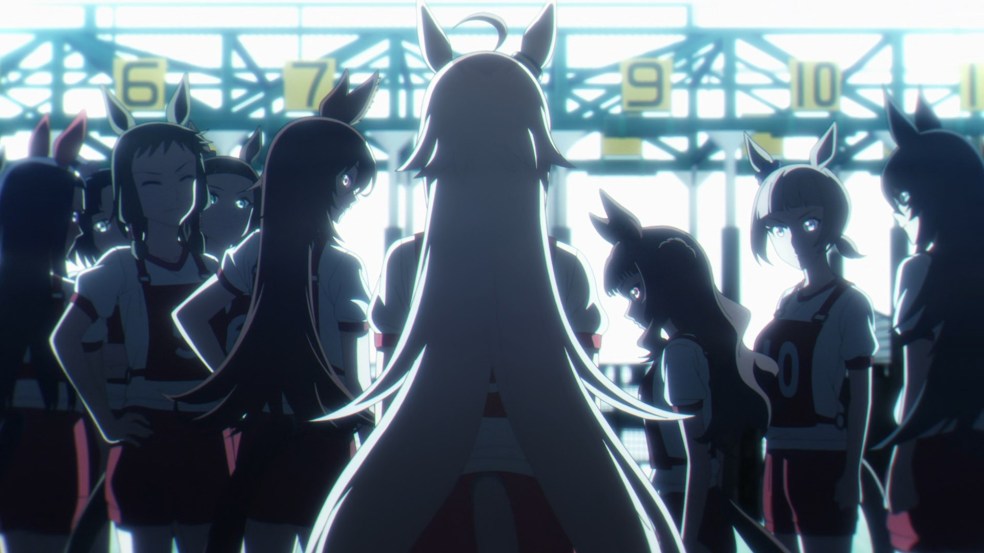
When we last left off two Sundays ago, Oguri Cap was at the starting gate for a qualifying race, the Mainichi Okan. This race gates Oguri Cap’s access to the Tenno Sho, so it is very important that Oguri wins it, and thus, it takes up the first half of episode 11. As is often the case, Cap is set against some of her generation’s best talent as an obstacle, the main standout here being European racetrack vet Sirius Symboli [Fairouz Ai?1]. (Sirius also does a funny little dance for the crowd and accidentally smacks one of her opponents in the face in the process. It’s so out of left field that I imagine it has to be based on something that actually happened.) But really, the fact of the matter is that the whole track wants her dead. This, Cinderella Gray is keen to point out, is the consequence of standing out so much. If you’re a big gray monster, people will want to slay you.
This race also gets somewhat into the “aura” phenomenon so commonly seen throughout the franchise. Yaeno Muteki, who plays a supporting role in this episode from the stands, notes that Oguri Cap’s talent is not just exceptional but abnormal. That “abnormality” is directly linked to two other horsegirls Yaeno is familiar with; Tamamo Cross and Dicta Striker, both of whom get extremely cool cutaways to show off the auras. (Cross gets her blue lightning, which we’ve seen a few times before, and Striker gets a yellow, hazy flame.) In the context of the show’s world, these visual effects don’t “really exist”, but as stylistic flourishes, they’re second to none, and it’s interesting for the series to directly draw attention to them in this manner, spelling out what’s been implied for the longest time; that they’re visual markers of those whose talent borders on the preternatural.
It is of course important to note that despite the not-insignificant skill of the competition here, neither Tamamo Cross nor Dicta Striker are running in the Mainichi Okan. Despite the other horse girls actively attempting to box her out of every conceivable path forward, Oguri manages a from-behind slingshot victory on the far outside of the track, not just lapping everyone handily but also running farther than any of them. Doing this marks her sixth graded win in a row, a tie for the all-time record.
About Tamamo Cross. It’s easy to forget, given how the series has steadily been getting she and Oguri Cap in position to be proper rivals basically since her introduction, that the two horse girls have not actually met yet. Or at least, they don’t meet until episode 11.
The second half of episode 11 is all setup, slowly driving these two girls together as we build up to the climax of this first season; the Fall Tenno Sho, a proper G1 race. Finally, Oguri Cap can run in the big leagues. Fittingly, the occasion is marked with another check-in with the Kasamatsu half of the cast. Kitahara makes his first appearance in quite a while, traveling to Tokyo to bring Cap presents from her friends back home. These are mostly the sort of amusing kitsch you’d expect to get from friends you haven’t seen in a while. Dig the collectable coin that Fujimasa March gives Oguri, stamped with the image of the mountain that they spoke on which lit Cap’s competitive fire in the first place, take note also of Norn Ace’s hilariously over the top gift of a custom dance workout DVD, and of Jo’s little good luck doll thing, which is supposed to look like Oguri Cap but resembles her so little that the good-natured horse girl initially mistook it for a caterpillar. (Oguri Cap being Oguri Cap, she is over the moon to have gifts from her friends either way.)
Tamamo Cross, on the other hand, is going through her own trials and tribulations. Before episode 10, we never really got any kind of prolonged look at Cross’s side of things, so this is relatively new territory for the series. We still don’t get a ton in terms of simple volume; we learn that Tamamo, apparently normally a light eater, has been eating a lot more than usual lately, perhaps implying that she’s really pouring things on for the Fall Tenno Sho. Much more important is that we learn that someone important to her, an older guy she simply calls “old man,” is laid up in the hospital, on life support, and evidently not doing well. This particular kind of medical drama isn’t anything new to Uma Musume as a series, but it’s a little unusual to see the sick one being a human (presumably a trainer? A former trainer? We don’t yet know). It adds an interesting wrinkle to Cross’s characterization. Whatever her relation to this man, it’s clear that he is at least some part of her motivation for running.
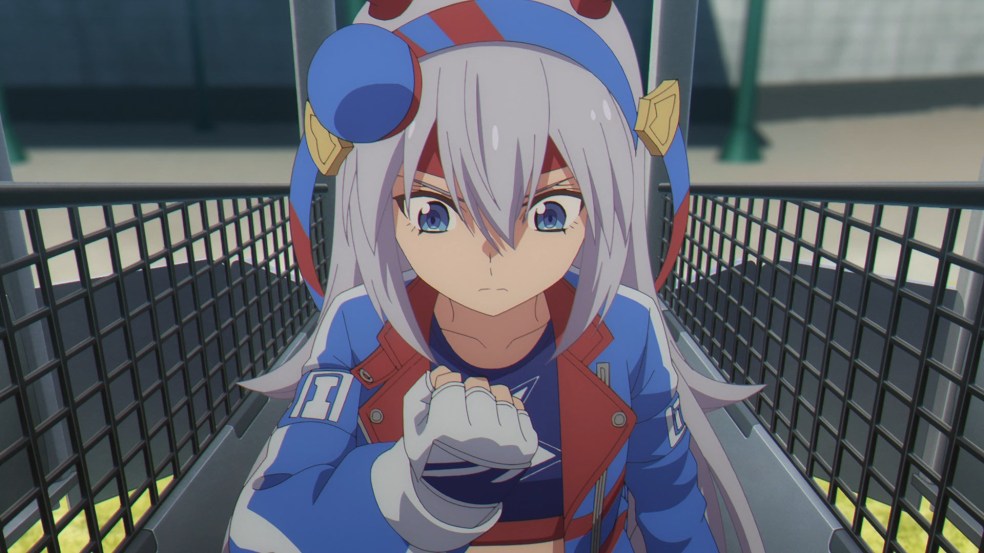
Thus, Oguri, with the support of her friends, and Tamamo, for the sake of this man, finally meet. A G1 race necessitates a press conference, something we’ve commonly seen in other Uma Musume seasons but not yet this one, and it also signals a temporary change in character design. This is the episode where Oguri receives her racing silks2 for the first time, and it’s given appropriate gravitas. The press conference sees her introduced to the flashing camera lights of the G1 world. This is Oguri Cap finally entering the level she should be competing in. She seizes the moment with a short but motivated comment about how she’s aiming to be not just the best in Japan, but in the world. The peak, as we hear once again.
This, of course, prompts someone in the crowd to dryly remark that this is an especially ambitious thing to say, given that “the peak” is standing right next to her.
Even without Cinderella Gray directly drawing attention to it beforehand, even if it were completely silent (Cap is not unaware of Tamamo Cross’s presence here, and as you can probably tell from that third screenshot, is in fact excited), the intent is clear. Oguri Cap may have finally met her match.
1: None of my usual sources were helpful in tracking down her voice actress, but MyAnimeList at least claims it’s Fairouz Ai, and Symboli certainly sounds like Fairouz Ai, doing one of her classic “tough girl” voices. Without any evidence to the contrary, I’m taking their word for it.
2: The sub track just renders this as “racewear,” which I find a little underwhelming
Like what you’re reading? Consider following Magic Planet Anime to get notified when new articles go live.If you’d like to talk to other Magic Planet Anime readers, consider joining my Discord server! Also consider following me on Anilist, BlueSky, or Tumblrand supporting me on Ko-Fi. If you want to read more of my work, consider heading over to the Directoryto browse by category.
All views expressed on Magic Planet Anime are solely my own opinions and conclusions and should not be taken to reflect the opinions of any other persons, groups, or organizations. All text is manually typed and edited, and no machine learning or other automatic tools are used in the creation of Magic Planet Anime articles, with the exception of a basic spellchecker. However, some articles may have additional tags placed by WordPress. All text, excepting direct quotations, is owned by Magic Planet Anime. Do not duplicate without permission. All images are owned by their original copyright holders.
Let’s Watch is a weekly recap column where I follow an anime for the course of its entire runtime.
For the Cinderella Gray column, new installments will be posted either on the Sunday each episode airs, or as soon as possible over the succeeding week. Expect spoilers!
Following last week’s big fakeout, we have a more transitional and low-key turn for Cinderella Gray this week. Honestly, this is a good thing. If we were to have another big important race here, it would risk making the show repetitive (a trap its predecessor, the third season of no-subtitle Uma Musume, sometimes fell into). When we open, we find Oguri Cap in a funk, saddened that she was disqualified from what she was directly told were the “best” and most important races, she feels aimless and demotivated despite sticking religiously to her training.
There are a few factors that get her out of that malaise. One is the relatively brief race that is in this episode, and Oguri’s not actually in this one, not even in anyone’s mind. Instead, Roppei takes her to watch the Takarazuka Kinen. A plot point in some prior seasons, the Takarazuka’s lineup is determined by fan vote. The favorite is a one-off character, one Akitsu Teio. But the one who actually wins is Tamamo Cross.
Cross, the streak of blue lightning first introduced to us way, way back near the start of the season, has nonetheless been largely a background presence up until this point. She and Oguri still have not directly spoken, and seeing Cross win in person is the first time Oguri Cap seems truly aware of just what she’s up against. Despite its brevity, her from-behind win here is truly spectacular, and very much reminiscent of Oguri’s own victories.
This isn’t the only thing that puts some zip back in Oguri’s step. She also gets a phone call from her former rival Fujimasa March, making her first appearance of any real length in the series since her departure from it in episode six. Unsurprisingly, March has kept racing. What’s maybe a little moreso is that March is actually the one calling Oguri for reassurance. March is lost and without motivation too. We learn here that her dream of winning the Tokai Derby didn’t come true; she failed to even make the podium, coming in fourth, and as she calls Cap she’s on the verge of quitting entirely.
Of course, our protagonist, with her head of silver and heart of gold, is not having that from her first rival, someone who clearly still means a lot to her. In convincing March to continue racing, Oguri does the same to herself. The specific situations are fairly different of course—Oguri, if anything, is having too much success, whereas March’s anxiety is caused by her finally hitting a wall—but the emotional connection between the two makes it all make sense. Both will continue racing, even with their first dreams out of reach, March whips up a cute metaphor about moving on to the next mountain, and for a show—a whole series, really—that’s in part about staying determined in the face of whatever life throws at you, it absolutely works. (There’s also a cute sequence of cameos by Norn Ace and friends, and it’s good to know that they’re all still getting on well.)
We also get a rare sequence from Tamamo Cross’s camp. Her trainer thinks Tamamo will probably be competing with Oguri for the first time in the coming Fall Tenno Sho, a G1 race (reinforced when, later in the episode, we learn Oguri is going to be running an important qualifying race for the fall G1s). Just as important to the scene, though, arguably, is that somebody clearly really wanted to draw Tamamo Cross working out. Live your truth, buddy.
My understanding is that this workout sequence is in the manga, but is not nearly as involved. I can only reiterate what I’ve already said.
The remainder of the episode is fairly lighthearted. Roppei puts Oguri and Belno on “summer vacation,” giving them a break after Oguri’s constant racing and training since arriving at Tracen. Oguri being Oguri, when given free reign to explore Tokyo, she mostly does so as a foodie, spending much of the episode’s second half on a date with Belno, in a blissful heaven of hamburgers, tornado fries, crepes, rolled ice cream, and so on. She’s in disguise during this whole outing, though her modest disguise of “a hat and some glasses” doesn’t really work, perhaps given the relative scarcity of silver-haired horse girls in Tokyo, and Oguri and Belno attract a decently-sized crowd regardless, to which Oguri Cap reacts this way.
I didn’t edit that. That’s really what she says, or at least it’s really how the subs translate it.
The crowd alerts Sensuke that Oguri is nearby, and the two have their first face to face conversation here, where he lets slip who all Oguri is going to be facing in her upcoming qualifying race. (It’s loosely implied by the framing that he shouldn’t really be sharing this information, but Sensuke is nothing if not unscrupulous.) The episode ends with that race just about to start, and as usual, we won’t know the results until next week. Still, with Oguri’s inner competitive fire newly set alight, it’s hard to imagine her losing. We’ll see how things go, won’t we?
Like what you’re reading? Consider following Magic Planet Anime to get notified when new articles go live.If you’d like to talk to other Magic Planet Anime readers, consider joining my Discord server! Also consider following me on Anilist, BlueSky, or Tumblrand supporting me on Ko-Fi. If you want to read more of my work, consider heading over to the Directoryto browse by category.
All views expressed on Magic Planet Anime are solely my own opinions and conclusions and should not be taken to reflect the opinions of any other persons, groups, or organizations. All text is manually typed and edited, and no machine learning or other automatic tools are used in the creation of Magic Planet Anime articles, with the exception of a basic spellchecker. However, some articles may have additional tags placed by WordPress. All text, excepting direct quotations, is owned by Magic Planet Anime. Do not duplicate without permission. All images are owned by their original copyright holders.
Let’s Watch is a weekly recap column where I follow an anime for the course of its entire runtime.
For the Cinderella Gray column, new installments will be posted either on the Sunday each episode airs, or as soon as possible over the succeeding week. Expect spoilers!
In real life, I can only imagine that whatever led to the actual Oguri Cap being allowed to compete in G1 races was some mixture of backroom politicking, the very real fan support behind the horse (as reflected in this show’s petition, based on a real one), and money changing hands. On its own, that’s not terribly compelling stuff, and similar bending of the rules is common throughout the entirety of sport, across the globe, up and down all levels of competition.
What makes Cinderella Gray interesting is its ability to translate minutiae of that nature into compelling art. You don’t need to know a damn thing about the actual horse to root for Oguri Cap as she appears in the show, you just need to be fired up, incensed that they won’t let her compete at the highest level possible because of irritating technicalities, rendered in the sharp and sickly-relatable language of stupid paperwork. Cindy Gray needs you to sympathize with three characters, in fact. One of whom is of course Oguri Cap herself. The other two, the sports tabloid reporter Sensuke and Symboli Rudolf’s right hand horse girl Maruzensky, are the kind of characters who’d have minor, barely-touched-upon roles in an anime that cared less about getting this stuff right. Their roles are arguably still minor in scope, but certainly not in impact. The former’s petition, and the latters personal connection to Oguri’s story—she too, we learn in the opening minutes of this episode, was disbarred from the Classics for the exact same reason—is enough to nudge the Emperor’s position.
On its own, that’s pretty remarkable. Symboli Rudolf sticks her neck out for Oguri Cap to quite an extent over the course of this episode, which is a huge 180 from her initial opinion on this whole situation. (Remember that back in episode 7, Rudolf was actively angry that Oguri just assumed the rules would be changed for her sake. Yet here she is, only two episodes later, actively advocating that same exact change of rules. It’s quite amazing what some perspective can accomplish.) Unfortunately, Symboli Rudolf, despite her prestigious position, does not actually make these rules. I think what Cinderella Gray has cottoned onto is that what it really needed to cap off this arc was a villain, even if only a short-term one, someone to sell that this big change is a big change.
Of course, the obvious thing about this sport is that if there’s ever a “bad guy,” it’s never going to be any of the horses.
Thus, Rudolf’s main obstacle in her change of heart is the URA Chairman, a blonde, bespectacled woman who puts in her one and if I had to guess, only appearance in this episode, Gendo Posing all the while. Taken in absolute terms, the scene isn’t much. Rudolf simply explains her position, the board takes it under advisement, and, in suitably dramatic fashion, it is eventually revealed that they acquiesced. Rudolf’s little speech is the real centerpiece of this scene; she actively denies that any of the obvious qualities is what makes a racer a star. It’s not strength, pedigree, or even race record, it’s how the crowd can pin their hopes and dreams on her. This is what Oguri Cap means to people, and implicitly, Rudolf sees herself in Oguri for this reason.
Fittingly, when Oguri Cap is introduced at the Japanese Derby, finally revealing that yes, she was allowed entry, to run alongside the storied competition we’ve gotten to know over the past few episodes (Yaeno Muteki, Dicta Striker, Mejiro Arden….), she’s introduced as “The Cinderella of Kasamatsu.” She’s there to carry her hometown’s dreams on her back, win or lose.
And she does win. Stomping past Sakura Chiyono O, who’s given a lovingly-rendered “power up” sequence in the fashion of many previous champions, past Dicta Striker who unfortunately hurts herself on the track, and so on. Oguri Cap storms the finish line, conquering all in her path and winning the Japan Derby by an astounding seven lengths. Insane, right? A shocking but—given her previous record—unsurprising capstone on an illustrious career.
Unfortunately, I’m lying to you. None of this ever happened.
No, you read that right. And if you’ve already seen the episode and were reading up to this point quite confused, well, now you know why. That did not happen. Neither Oguri Cap the character nor her real life counterpart were allowed to run in the Japanese Derby. The winner of that race was the aforementioned Sakura Chiyono O. This is a happy and straightforward triumph. For her, anyway.
It’s a testament to how well Cinderella Gray, and Uma Musume in general, is put together that I could easily imagine this being a genuinely triumphant moment if Chiyono O was our main character. In fact, she pulls double duty as a supporting character in both this series and the Star Blossom manga, so maybe we will see something like that someday.
In what I can only describe as one of the meanest gut punches of its type I’ve seen in years, the entire second two-thirds of this episode are revealed to be the daydream of Symboli Rudolf. There’s some subtle foreshadowing of this; note that Oguri Cap does not have G1-style racing silks unlike the competition. Note also that while lost deep in thought, Symboli Rudolf repeats the series-favorite chestnut that the Japanese Derby victory tends to go not to the strongest or fastest racer but to the luckiest. Oguri Cap is many things, but I’m not sure I’d say ‘lucky’ is one of them.
The irony of course is that to anyone who knows their real-life horse racing, or indeed anyone who’s just read the manga, this wasn’t a twist at all. But, well, as an anime-only it definitely caught me off guard. What I did not lie about is that part of what makes Cinderella Gray so interesting is its ability to transmute this kind of thing into compelling art. In a less ambitious narrative, there’d be no story at this point. Oguri didn’t win The Biggest Thing Possible, so what story is there left to tell? (Never mind that by its very nature Uma Musume largely avoids the spectre of international horse racing; the few times Uma Musume characters have gone abroad in past seasons they’ve mostly been completely stomped, and it makes for some pretty depressing character exits.)
Cinderella Gray‘s answer can be found both before and after this episode’s credits, bookending the OP and ED. Tamamo Cross, who we were introduced to quite a while ago at this point, reappears for the first time since Oguri’s transfer to Tracen, also effortlessly laying flat her opponents in a race before the opening credits, crackling with blue lightning like an equine Sonic the Hedgehog. This, the series tells us, is Oguri Cap’s real challenge. It does so directly, placing Oguri Cap’s hypothetical win in a dream-version of the Japanese Derby in context as the end of the “National Debut Arc,” and promising a “White Lightning Arc” beginning from episode 10. The named arcs, I must assume, are just in case anyone needs further proof that Cinderella Gray is essentially a battle shonen anime.
As for Oguri’s disbarment from the classics, I can imagine a certain kind of person being bummed. Oguri herself seems pretty let down, as the race she actually does win—the G2 New Zealand Trophy—she conquers so easily that she seems like she’s dissociating the entire time.
She picks herself back up again shortly thereafter, and it seems like Tamamo Cross will once again give her a much-needed peak to summit. But even setting that aside, there is a silver lining. Fitting, given Oguri’s ashen hair.
Symboli Rudolf was not able to convince the URA to change their policies on such short notice, but they do take her concerns under advisement, and it’s implied that this, combined with the public outcry paves the way for other racers in the future. Making a vanishingly brief cameo here is fan favorite—honestly, to just lay my biases on the table, my own personal favorite Uma Musume character, period—T. M. Opera O, The Overlord at Century’s End [normally voiced by Tokui Sora, though she doesn’t speak in her appearance here]. If we assume that the Uma Musume universe at least vaguely maps in some fashion to real-world timelines, Opera’s career won’t begin for quite a while, so this is clearly a flash-forward to sometime around the Road to the Top OVAs. Said largely without words here is that Oguri Cap’s career, and the outcry over her not being able to compete in G1s, eventually led to the changes that would allow Opera, and other racers like her, to be such an explosive presence years down the line.
It’s a consolation prize at best, and I imagine it’s a bit lost on anyone who’s not already tapped in to Uma Musume‘s broader lore. What saves it for me at least is that it ties neatly into the idea of Oguri Cap being someone people can pin their hopes and dreams on. Not being able to run at all is Oguri Cap’s first big defeat, but by setting the gears in motion to change the URA’s rules, she elevates a whole generation of racers well beyond her own career. The episode points this out directly; Rudolf’s final musing this week is that in spite of everything, Oguri Cap did trample all the existing rules and regulations, exactly like she said she would. That’s Oguri Cap for you, even when she’s down, she’s still an inspiration.
Like what you’re reading? Consider following Magic Planet Anime to get notified when new articles go live.If you’d like to talk to other Magic Planet Anime readers, consider joining my Discord server! Also consider following me on Anilist, BlueSky, or Tumblrand supporting me on Ko-Fi. If you want to read more of my work, consider heading over to the Directoryto browse by category.
All views expressed on Magic Planet Anime are solely my own opinions and conclusions and should not be taken to reflect the opinions of any other persons, groups, or organizations. All text is manually typed and edited, and no machine learning or other automatic tools are used in the creation of Magic Planet Anime articles, with the exception of a basic spellchecker. However, some articles may have additional tags placed by WordPress. All text, excepting direct quotations, is owned by Magic Planet Anime. Do not duplicate without permission. All images are owned by their original copyright holders.













 The Magic Planet