
This article contains spoilers for the reviewed material, and assumes familiarity with it.
Few people nowadays know what man is. Many sense this ignorance and die the more easily because of it, the same way that I will die more easily once I have completed this story.
This is going to be a mess, so let’s start it with a question, so we at least have something to work off of.
Is a tragedy deferred a happy ending? Ave Mujica is at least willing to entertain the idea, but it’s never a clear-cut thing. Nothing about Ave Mujica is clear-cut, and the thinkpieces that will roll out over the coming weeks and months about this series might obscure how much of a rollercoaster ride it was, week to week, start to finish, in the moment. They might also obscure how wild it will keep being, as we now know—we’ll get back to this—that this isn’t the end.

To trot out the neatest and tidiest labels possible for a show that is the neither of those things, Ave Mujica is a series that deals with, among other topics; familial violence, how generational wealth drains the humanity from those that hold it, a number of different expressions of trauma and self-loathing, Dissociative Identity Disorder, and incest. All of this from a series that—despite some misguided English marketing trying to downplay this fact—is part of the BanG Dream! franchise. It, thus, is also still an anime about guitar music, at heart, a cousin of other recent genre entries like Girls Band Cry and Bocchi the Rock! (not to mention the other entries in its own series), in that it does still very much deal with a group of young girls using that music to process their traumas. The methodology is very different, and if Ave Mujica is the best of these (and I’d be willing to say that it is, even if the competition is very close), it’s not because its approach is inherently “just better”, or because more serious subject matter automatically leads to better content, but rather because it’s a logical outgrowth of what this genre was already doing. People will make their little jokes, of course: you can call it the dollposting anime, Perfect Blue for zoomers, etc. But none of these really capture Ave Mujica‘s fundamental observations and themes, and none of them can dent a show that’s this bulletproof.
All this to say, the walk from the earliest days of the BanG Dream! project to here is less extreme than it might appear at first glance. Poppin’ Party never went through most of this stuff, that’s true, but they’d absolutely be willing to throw horns at one of Ave Mujica’s concerts. The music, even when it’s not actively being heard—and it’s not heard for long stretches of this series—is both a connective tissue and a useful metaphor. If you can’t say something, maybe you can sing it.
That was the main thesis, too, of Ave Mujica‘s immediate predecessor and sister series, It’s MyGO!!!!!, effectively the first season of what becomes a two-parter here. AveMuji puts that theory to the toughest stress tests it can think of, and for a while, it seems like it might break under them. Consider that this is a band anime, and then recall that there is a gap from episode 2 to episode 7—almost half the season!—where there are absolutely zero in-show performances. Consider that this seemed at the time, given everything else going on in the narrative, more like a disband anime, an argument that Ave Mujica the group were not a good thing for anyone involved and maybe they’d all be better off apart.
It’s tempting to run through the absolute basics one more time. High school girl and neurodivergent icon Takamatsu Tomori [Youmiya Hina], and her first real friend Togawa Sakiko [Takao Kanon] form a band. This band, CRYCHIC, collapses not long after their first concert for a plethora of interpersonal reasons that are not really anyone’s fault in particular. It’s MyGO!!!!!, the first season of this show, focused on Tomori healing from this fallout with the help of both some of her old CRYCHIC bandmates and new friends alike. That group formed MyGO, title band of that season, pledging to build the rest of their lives, moment by moment, together as a band and as friends. So far, so girl band.
Ave Mujica—both the band and the show—run in the opposite direction, Sakiko attempts to put on a cold, merciless persona, and gathers a band based not on shared experiences or even particularly liking each other, but by a cynical rundown of what each member can add to the group. Sakiko’s childhood friend Mutsumi [Watase Yuzuki], another former CRYCHIC member, is added because of her guitar skills and her famous parents. Nyamu [Yonezawa Akane], the band’s drummer, is recruited as much for her looks and the flashiness of her ambidexterity as her actual chops, etc. If you’re reading this, you know all this already, so I won’t get too much farther into the nitty-gritty.
The result of all this? Probably the most seismic anime event of the 2020s thusfar. If not that, at least one that has exerted a deep and powerful pull on a certain kind of person. If you’re active on certain corners of tumblr or BlueSky you already know who I’m talking about. If not, we’ll just say: queer, gender-nonconformant, neurodivergent sorts. Which is a more formal and less fun way to say: the girlies. Ave Mujica takes the already intense emotional palette of MyGO and freezes it solid, erecting gothic cathedrals around the sharp, jagged pieces of pain and trauma that inform who we are, with a particular focus on the inherent violence of the family unit. Do you have bad parents? Mutsumi has the worst parent, a controlling, cruel stage mom who sees her daughter as competition instead of family. Furthermore, she’s plural, hosting, among others, a rambunctious protector alter who adopts the name Mortis from her stage name. From what we see, her mother treats this as a frightening burden, a sadly true-to-life read on how many singlet parents treat their plural children.
Uika [Sasaki Rico], the band’s singer, might be even worse off, the daughter of an illicit relationship between Sakiko’s grandfather and a house servant who has lived much of her life isolated from society. If this all seems rather melodramatic, I can only reiterate that that’s exactly the point, and anyone who writes the show—and honestly, much of this genre—off on those grounds is missing the most interesting artistic movement in the medium to happen this decade. More specifically, that heightened, arch theatricality has been present in the Ave Mujica project since we first knew it existed. This is a group of girls who were introduced to us as masked dolls, and who here leave us again as knights of a forgotten god. It feels a little ridiculous to criticize the series for a lack of “realism,” whether we’re referring to its literal events or its emotional palette. (And anyone who calls Nyamu and Umiri’s problems minor, even by comparison, is missing the very fact that by show’s end they’ve still willingly thrown their lot in with everyone else in the band.)
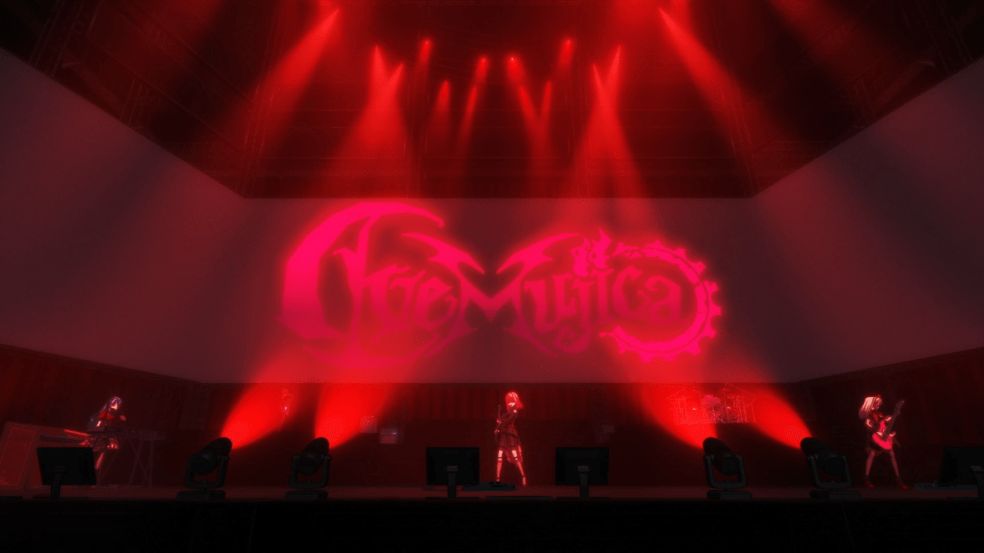
That tense, coiled sense of façade is also why it hits so hard when, in its very last episode, Ave Mujica finally lets all of that tension out. No one would walk away from this series thinking everything is neatly solved, but the finale is more concert than anime episode: 5 songs, two from MyGO, three from AveMuji themselves, all fantastic, and importantly, both bands are clearly having a blast. MyGO have the simpler story, but their sound has genuinely developed in some interesting directions, and centering a new song around Tomori’s jumbled, Jenga Tower-block poetry is never going to be a bad call.

Ave Mujica, meanwhile, have somehow gone stadium-level yet again (the episode’s lack of a traditional narrative leaves us in the dark about how that happened. Season three material, most likely). Their doll motifs replaced with a warped Round Table-style knightly mythos, Uika-Doloris as an amnesiac who finds herself returning to the embrace of Oblivionis, god of forgetfulness, over and over. Sakiko literally portraying herself as a deity within the world of the scripts is sure to have ramifications going forward as a plot point, but, consider that outside of the series itself, it also easily cements her as one of the most interesting and iconic characters of her generation. It has been way, way too long since we had someone to add to the Anime Girl Pantheon, and if Sakiko needs to actively force herself up alongside older legends like Lain, Haruhi, and Madoka, that’s all the better. It fits.

(Also, let’s just be honest here. Sakiko’s god complex is probably not great for her, mental health-wise, but if it’s making her write stuff like this, well, at some point you can’t argue with the music.)
As for the literalities of the last story arc, episodes eleven, twelve, and so on, it seems impossible that this won’t all fall down around them someday, possibly even someday soon.
So again, to ask the question, can tragedy deferred really be considered a happy ending? Even a bittersweet one?
Maybe we should reframe that, and turn it back on ourselves; can you be happy, knowing you will one day die? If Ave Mujica are a fleeting dream, that’s at least partly because everything is a fleeting dream. Any comparison between MyGO‘s “a series of moments adds up to a lifetime” and Ave Mujica‘s embrace of an illusory eternity needs to understand that, despite the obvious differences between these groups of people, these are fundamentally two ways to say the same thing. Something lasts forever until it doesn’t. You take things day by day, and one day is eventually the last one. (I don’t have much to say about this series, as I’ve made clear from how I’m framing this article, but I am a little surprised how rarely I’ve seen discussion of death in relation with Ave Mujica; Sakiko’s late mother is a shadow who looms over much of the series, and there is a broad implication that Uika’s sister, the actual Uika, is no longer with us either.)
I have spoken before in my work about hating the term “messy” and how it’s often used to paper over the flaws in works that a certain stripe of critic, myself very much included, like. Something is messy if it induces strong emotion but has some kind of missed shot or some kind of frustrating loose end. To that, I refuse to apply the term to Ave Mujica, even though I’m sure many other people will. Every time I had a doubt about this show, it proved me wrong. Mortis disappearing for much of the show’s final act? She shows up in the finale to wink at the mirror and reassure us she’s fine. Umiri “not getting” a proper character arc? Her tragic backstory is presented in a funny way, sure, but it’s as legitimate a reason for trauma as anything else, this stuff isn’t a competition. Not enough songs? The last episode has fucking five of them. The fact that Hatsune is down awful for her niece? That makes their relationship more interesting, and sure, more troubling. I won’t entertain any suggestion otherwise. You can’t catch Ave Mujica off guard.
Even if you could, the curious thing about something as arresting as Ave Mujica is that after a while one’s emotional attachment stops being to the work itself so much and more the general orbit of it. The characters make such an impression on screen that they will live in our hearts forever. There is also the actual band, of course, who are fantastic, and a small spiderweb of ancillary media that enhances and sharpens the show in a number of interesting ways. None of this softens the point that the show itself is excellent, of course, one of the best I’ve ever seen, but it is worth keeping in mind.
And if you don’t agree….well honestly that’s fine? Why is talking about anime expected to be didactic like this anyway?
Isn’t all of this sort of silly? Another thing Ave Mujica has made me realize is that, despite the fact that I enjoy writing about anime, I also kind of hate doing it. (A love-hate relationship that I am all too aware is ironically somewhat reflective of what I’m reviewing.) Not because I’ve lost any love of prose or any love of analyzing fiction, but because there is this constant unending pressure to be correct about everything. (Or at least, I feel that there is. Maybe this feeling says more about me than it does anything else.) I had an inkling of this back when I reviewed Wonder Egg Priority years ago, which is why the two are somewhat connected in my mind even though the reception to AveMuji has been much more positive overall. Most of my really fulfilling engagement with Ave Mujica has not stemmed from my collective efforts of reviewing it. (Longtime readers will probably remember that we are a system ourselves, and if you didn’t know, well, surprise.) I—Ediva—have gotten much more out of talking about it with others, making of it a living discourse as opposed to a series of endlessly prolix pages where I try to prove that my opinion is the right one, man!, than almost anything else I’ve ever seen. I, Opal, have written fucking fanfiction for this series, weird and outlandish fanfiction—fanfiction I would never in a million years link here, mind you!—that has made me feel so much more connected to its world and its characters than laying them down on a table to cut them open ever could. And I, Ollie, have simply reveled in the fact that I got to feel seen. It’s very rare for popular fiction to touch on systems. I am not going to quit writing about anime—this is not my version of Brent DiCrescenzo’s To the 5 Boroughs review—but Ave Mujica has once again made me reevaluate how I really think about this stuff. How I feel about this stuff. In a way, that’s a higher compliment than anything I could actually say about it could ever be. Here’s something that sounds like a joke but isn’t: in the previews for one of the later episodes, 10 I want to say, Sakiko was shown reading Hermann Hesse’s Demian. We decided to read it too—why not, right?—and loved it. Some shows are bigger than just what’s on the screen.
None of me are saying that any of this makes analysis of the series wrong. But it does, increasingly, feel wrong for us. This is a world to be lived in, an atmosphere to be breathed, and a dream to set drift upon. I can’t pin the butterfly to the board like that. If you can, I’m not going to tell you you’re doing something wrong, but it’s not the right fit for how we feel about this show. Hence this instead of a “proper” review. Hence leaving it all up in the air.
That’s a temporary solution, but this, too, is the beautiful paradox of Ave Mujica: we can stay asleep in this dream forever—Until we wake up.

Like what you’re reading? Consider following Magic Planet Anime to get notified when new articles go live. If you’d like to talk to other Magic Planet Anime readers, consider joining my Discord server! Also consider following me on Anilist, BlueSky, or Tumblr and supporting me on Ko-Fi. If you want to read more of my work, consider heading over to the Directory to browse by category.
All views expressed on Magic Planet Anime are solely my own opinions and conclusions and should not be taken to reflect the opinions of any other persons, groups, or organizations. All text is manually typed and edited, and no machine learning or other automatic tools are used in the creation of Magic Planet Anime articles, with the exception of a basic spellchecker. However, some articles may have additional tags placed by WordPress. All text, excepting direct quotations, is owned by Magic Planet Anime. Do not duplicate without permission. All images are owned by their original copyright holders.


 The Magic Planet