The Weekly Orbit [7/29/24]

The Weekly Orbit is a weekly column collecting and refining my more casual anime- and manga-related thoughts from the previous week. Mostly, these are taken from my tumblr blog, and assume familiarity with the works covered. Be wary of spoilers!


Hello, anime fans! I’m quite behind on basically everything this week, but hopefully you’ll enjoy reading about what I did manage to cover, regardless. Also, here’s an odd thing, in two of the below entries I end up talking at length about the shows’ ED themes. That wasn’t on purpose! But hey, serendipity and all that.


Anime

Wistoria: Wand and Sword – Episode 3

Another week, another pretty OK Wistoria episode.

Will meets an underclassman here with the fairly incredible name Iris Churchill [Ookubo Rumi]. Initially, she seems like any other bumbling student, and Will spends the majority of this episode helping her defeat a giant ice monster. However, because Wistoria knows every trick in the fantasy book, Iris is actually a double agent for the Magia Vander and is scouting for promising students for what seems to be some kind of upcoming confrontation between the wizards and the angels that were mentioned back in episode 1, the ones that live “beyond the sky.”

This whole plot is the most interesting thing Wistoria has going for it so far. It’s still hardly original, and when we meet the Magia Vander here they too all fall into classic archetypes (most obvious with the haughty elf sorceress Alf Ellenor Ljos [Amamiya Sora]), but it’s at least decently compelling.

Iris herself seems to have some kind of Thing™ going on with Elfie, and I wouldn’t be surprised if there’s more to the both of them than is obvious here, even taking the little twists we’ve been shown so far into account.

Oh, one other thing I did appreciate. When Will gears up to head to the dungeon (and we briefly meet his artificer friend Rosty), they draw him ripped as hell while he’s changing his shirt. I applaud the lack of cowardice, it would’ve been really easy to just make him look nondescript there.

Narenare -Cheer for you!- – Episode 3

The only way out is trusting the process.

Okay, no, let’s stop for a second. What is this show? I thought I knew. In fact, as of the end of this episode, I thought I might have some idea again, but I’m now sitting with it and thinking and….seriously, what is going on here?

In theory, Narenare could not be simpler. It’s a show about cheerleading. That’s a little unusual in the context of the “girls do stuff” supergenre of anime, but it’s nowhere near the weirdest of these things in premise. But that hides how strange the execution of this all is. In this episode alone, we see several scenes from the last two weeks involving the character Suzuha. Except this time, they’re from her perspective, and we see that far from being the cool, aloof near-cryptid we’ve been presented with so far, she’s actually just extremely shy.

The show lets us in on her inner monologue by way of a chibi version of herself that hangs out in thought bubbles and occasionally just rides around on her head. It’s hardly the strangest thing I’ve seen in an anime this season (Nokotan is airing, after all), but it’s a notably weird way to present this information given the show’s genre. This is a general trend that’s true of everything in this episode; Kanata suddenly getting “the yips” about cheerleading (treated with grave seriousness by those around her), Shion’s singer-songwriter aspirations, and so on. The show seems allergic to anything that would make its several running plot lines any easier to follow. Things are mostly followed up on by having them plonked onto the existing storyline in a decidedly odd way.

A friend1 compared this to Pride of Orange, another Girls Do X show that clearly had no idea what it was doing. But to be honest, I don’t really see it. Pride of Orange‘s main flaws were an overwhelming lack of interest in its own premise and cast, and just a general deep cynicism toward the entire idea of the hobby/club anime as a genre. I don’t get that off of Narenare at all. It is clearly sincerely trying to present an inspiring and straightforward sports girls narrative, but it seems either unable or unwilling to understand why those shows usually present things in the way that they do. The result is a strange, alienating effect, in a way that feels uncannily GoHands-y in vibe if not looks. (Despite a shared affinity for weird color filter bullshit, Narenare looks much nicer than anything GoHands have ever done.)

Anyway, I plan to keep watching, because I am interested in if this effect is intentional or not. My guess is that it isn’t, this thing has three different people on script and you could absolutely get something like this just by having too many cooks in the kitchen, but still, I’m curious to see if it manages to pull something out of this regardless or if it just completely crashes.

OTP, by the way.

Quality Assurance in Another World – Episodes 3 & 4

This show has a lot of issues, and I want to appreciate what it’s going for regardless, but it doesn’t make it easy.

The issues first; over the past two episodes it’s been saddled with a light-novely writing style that just actively saps the series’ momentum. I actually thought this was adapted from a light novel, and having since learned that this was a manga first, I’m baffled that this is how this is all being delivered. There’s tons of exposition just rattled off in a very flat way and the sheer incuriosity Nikola has about her own world is kind of weird (this, to be fair, might be on purpose). Some of the exposition is fine because it’s spiced up with flashbacks or some similar other visual trick, but when it’s literally just two characters talking it gets old quick. I’m hoping we’re moving past this part of the story.

What I appreciate though is just how utterly fucking weird this show is. There’s a bit here with our leads in a dungeon, and Nikola gets carted off to be sacrificed by…monsters that are giant coins with human faces? And the thing they’re sacrificing her to is a huge hand with a mouth that acts like a sea serpent?

These legitimately feel like monsters out of a buggy shovelware RPG, and I appreciate that about the show. Similarly, the fate of Haga’s two companions that we meet here are legitimately pretty eerie. One is stuck in the floor and the other is trapped in a kill loop, buggily hovering over a death trap that she can’t properly trigger because she has invincibility mode turned on. (All this is used to explain Haga’s disdain for the debug mode feature, fair enough.)

We also meet a gamemaster AI called Tesla here who introduces herself by abruptly possessing Nikola so she can give Haga orders. All rather bizarre!

And then the episode ends with our leads running into an NPC who’s T-posing. Which brings us to episode 4, which I did not particularly care for.

The comedic side of the series is still strong here. It’s hard to mess up something as inherently goofy as “a whole village is stuck T-posing because their model animations are fucked up.” But we also meet a pair of new characters here, a furry bug-tester named Amano who aspires to be a mangaka back in the real world, and Ru, an NPC he’s fallen for, who he ends up drawing manga within the game for. Ru is a pretty compelling, if simple, character; a disabled girl who loves hearing stories. But then, oops, she dies at the end of the episode, by having a literal building dropped on her head when some of the baddies from episode 2 return to stomp through town while riding a dragon. It just feels kind of hacky and I’ve rarely seen such a straightforward example of a female character being killed to give another Man Pain to motivate him. I’m not a fan, suffice to say.

So who knows where Quality Assurance is going to end up by the time it’s over. This is one of several anime that have had the broadcasts of their next episode delayed because of Olympics coverage, and depending on what my schedule looks like in nine days when it returns, I may just drop this entirely, if that’s how it’s going to handle things going forward. I don’t know, my opinion on this series soured fairly quickly.

The Elusive Samurai – Episode 4

Our first two parter and unfortunately I don’t think it entirely works. Still a good episode, but it doesn’t feel quite as essential as the last three.

Lots of eye imagery here, which makes sense given that Tokiyuki’s adversary this time around is an archer known for his preternatural eyesight. The whole dog-hunting competition is kind of where the episode falls apart a little bit because while I applaud experimenting around, the CGI just doesn’t look as good as the other weird shit the show has done. Even elsewhere in this episode, that stuff looks better.

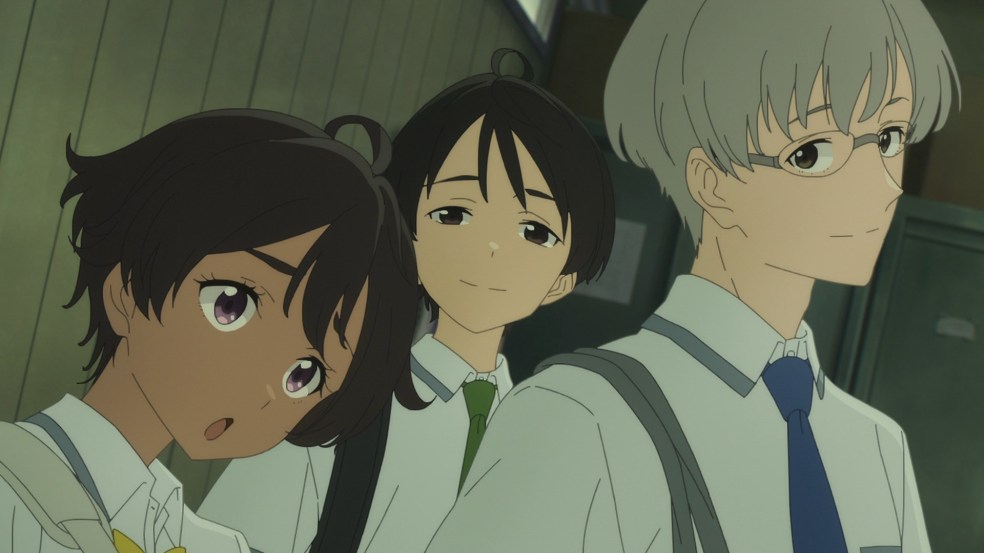
Alya Sometimes Hides Her Feelings in Russian – Episode 4

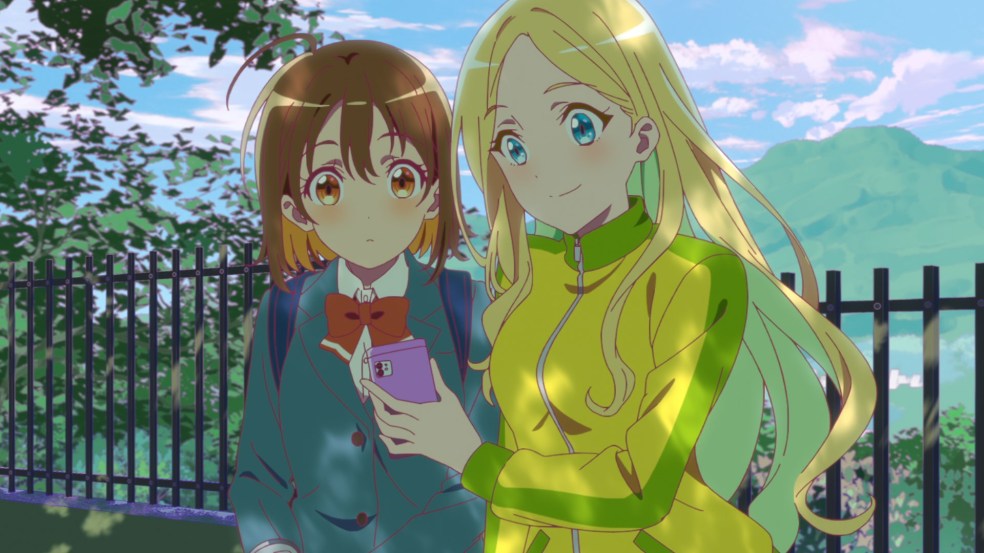
Honestly most of this episode is pretty dull. School drama is almost never compelling to me and that’s what the whole episode is built around. Worse, Alya and Kuze spend most of it apart so we don’t get any of their banter. (Also he basically solves the problem Alya’s caught up in for her which is not great from like an optics perspective, eh. This is minor compared to my other issues with the episode, but it still feels worth mentioning.)

The shorter second part of the episode is better since they’re back together and we get more of their repartee, which is the show’s main strength, and also a bit of relationship development (punctuated with a very powerful slap, since this is a pretty straightforward romcom anime at heart).

All of this is beside the real point of the episode, though; the song covered in the ED this week is fucking “Hare Hare Yukai”!

This is less of a weird pull than it might seem, given that Alya’s voice actress is a millennial and presumably grew up on the series, and there is a line to be drawn from Haruhi to this series, even if Roshidere‘s self-awareness is itself a pretty standard and accepted thing by now. (Somewhere in here Kuze thinks to himself that something doesn’t befit the main character in a romcom. Slow down, buddy, the fourth wall can only take so many hits.) I was delighted by this, and it redeemed an otherwise iffy episode in my eyes, so I’m happy it was done.

ATRI -My Dear Moments- – Episodes 2 & 3

I have realized that I like this show quite a bit.

On the face of it, ATRI depicts a fairly difficult situation. Its two main characters, Atri herself and her human caretaker Natsuki, aren’t exactly the most likeable of people. (Although Atri, who is merely clumsy and loud, is so more than Natsuki, who is sometimes outright nasty to her.) But something about these characters, and their world, compels me. I think it’s a fairly common thing to feel (even if you don’t necessarily think it rationally) that we are living in the end times of some sort, so post-apocalyptic fiction like this takes on a specific resonance in the modern day. But it’s more than just “the show is good because it depicts people getting by after a climate collapse,” which I think would be oversimplifying it.

I think I was closer on the mark with the AIR comparison I made last week than I initially realized. In addition to the obvious similarities—both take place in a coastal town, both have a heavily summer-drenched aesthetic that is a key part of the show’s visual and aural appeal—the general setup is fairly similar too, both in depicting a young (or at least young-seeming) girl and her male caretaker and their strange relationship that doesn’t neatly fall into any single category.

I’ve seen a lot of people deride the show as a rote male fantasy (in the vein of the many girl-with-a-quirk romcoms I’ve discussed this season) and while I’m not going to deny that there’s definitely at least a little of that, I don’t think it’s remotely the entire picture and seeing people write this off entirely because the main character is kind of a dick annoys me. Especially since I think his being a dick is part of the point of the series. (Hell, we get a very straightforward motivation for that here; when the ocean started rising, his dream of becoming an astronaut and helping with a climateering project fell apart and he hasn’t had any motivation to do much of anything since. It’s pretty understandable that this would turn someone crabby.)

I also like Minamo, one of the island town’s few remaining schoolgirls, very much an endangered species after the climate collapse that took place in this series’ backstory. There’s a very pronounced melancholy to almost everything she does, and she and Atri have a nice conversational scene together in her house—also half reclaimed by nature—in this episode where we learn her father evacuated to the mainland, and she chose to stay behind despite his wishes. That’s interesting! And when Atri visits her school at the end of the episode she seems to have some kind of weird flashback thing, which is also interesting.

The series has a lot going for it. In addition to everything I’ve just said, and also its deeper themes which are only just starting to take shape (persisting in the face of loss, even massive loss, is definitely going to be one), it’s also pretty funny! I can technically imagine how Atri’s antics might grate on someone but I find them endearing, and it’s hard not to when the character animation is so expressive.

Episode 3 isn’t quite as strong as Episode 2, but it’s still pretty good. Here we’re introduced to an entire secondary cast, the three young children that Minamo teaches about whatever she can at the high school, plus their older brother figure Ryuuji [Hosoya Yoshimasa]. The kids, especially their ringleader Ririka, seem fond of Natsuki, arbitrarily deciding that he’s secretly an assassin sent from the mainland and playing pretend with him based on that premise. Ryuuji is a lot colder to him, and seems to think his showing up at the school at all is an act of condescension. The episode deals in a lot of exposition about the situation on the mainland and the main thing to take away here is that the people of this island have essentially been abandoned. The kids, we’re told, actually did try to evacuate to the mainland and attend school there, but they were treated poorly and through circumstances we’re not given a super clear picture of, they eventually ended back on the island. They actually live at the school, with Ririka in particular spending a lot of late nights essentially camping out on the rooftop as she reads about electricity generation, hoping she might fix the island’s lack of electricity. By episode’s end, Natsuki has some idea of how that might be done, and his radical plan involves salvaging parts from the flooded-over disused windmills (a lovely shot of which serves as the episode’s visual center) and the fact that the school’s second floor floods at high tide.

All told, while this might be the weakest episode so far, the general buildup saves it, as does Atri’s continuing antics. I particularly like the bit here where she insists that she’s a “combat android” and we get a detailed, completely fake, flashback to her last days in “the war.”

Unrelated to the show itself, I want to briefly talk about the OP and ED and specifically the songs used for them. The OP, with a theme by mega-idol group Nogizaka46, is just an absolutely gorgeous thing and I really recommend watching it for yourself even if you have no interest in the show. The part where Atri dances and whips the ball (which later turns into the Moon!) around has such lovely, fluid motion that it’d make the entire project a worthwhile endeavor on its own even if the show itself were a complete throwaway.

But the ED, more specifically its theme, is actually even more interesting to me despite the fact that I like it less. Because it’s by 22/7. Yes, that 22/7, the idol group tied to the multimedia project of the same name, including its profoundly disappointing anime from a few years ago. That anime also had a great OP with some incredible visuals and a fantastic theme song, but the show itself was meandering and mediocre, and I don’t think it’s really stayed in the public consciousness over the past four years. (You’re more likely to find defenders of the earlier slice of life shorts.) Nonetheless, the group itself has stuck around. The ED is significantly cheerier than most of their songs, or at least the ones that I’m familiar with. But it’s pretty good! To be honest I’m just sort of shocked that they’re still active, although I think a good chunk of the original members have since departed (not that odd with idol groups, and I can’t imagine there’s much incentive to stay in 22/7 specifically).

It will be very odd if they end up soundtracking one of my favorite anime of the summer, but they well might! ATRI has tons of potential and I’m eager to see if it lives up to it, each individual episode has had its ups and downs so far, but it’s going to be the aggregate that really makes or breaks the show. I’m hardly the only person to have compared this to the KEY visual novel adaptations of old, and I’ve gotten the feeling that people really want that style back in some capacity. As such, I think there is a real chance for the series to leave a big impression on people. Here’s hoping.

Manga

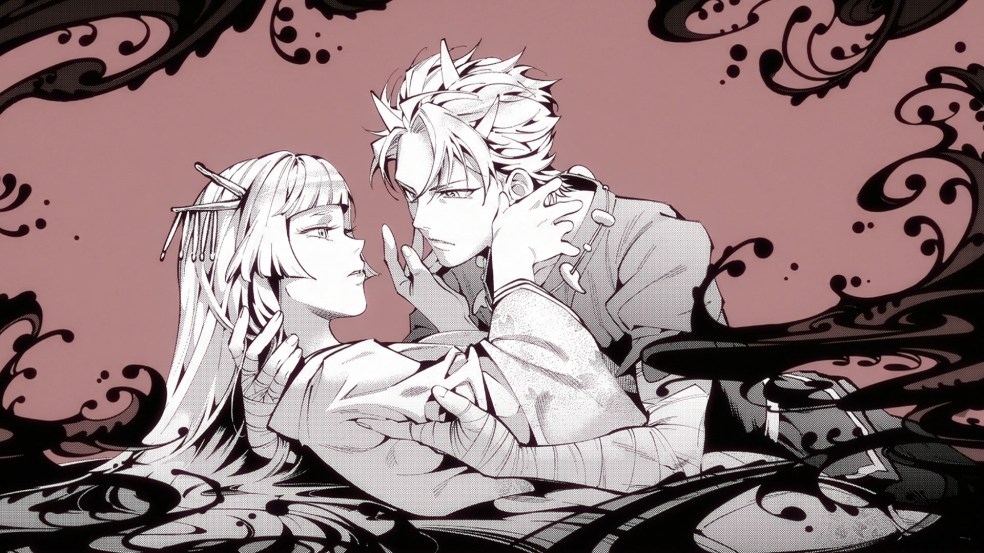
“Hitokiri” Shoujo, Koushaku Reijou no Goei ni Naru

This manga feels like someone read all of those “I wish somebody would just make a shonen manga with a lesbian as the main character” posts and took it as a challenge, to an almost comical degree.

To wit; the plot is basically a string of excuses for our lead to get into fights. Our lead girl was raised to be the bodyguard of a noble in fantasy-Japan, but before she could actually do that, her would-be master was murdered. The opening pages of the story are thus her getting revenge on this other person’s killer and then fleeing the country to go to fantasy-Europe, where she remains for what exists of the story so far. There, she meets a noblewoman on a train in the midst of said noblewoman getting attacked by assassins and offers her services. The noblewoman agrees to this, and from there forward the manga has, so far, solely been these characters moving from place to place and situation to situation, with bodyguard defending noblewoman (and her maid, a character in her own right) from attack.

All of this is handled in an almost childish fashion. Half of the dialogue consists of people threatening to kill each other. Of the half that remains, half of that half is the main girl explaining to her present opponent how she plans to kill them. This probably sounds like a complaint, but it’s honestly pretty funny. The end result is that our protagonist has such a matter-of-fact approach to murder that the whole manga feels like dry humor. Like, look at all this.

Interestingly, though. The manga implies that all this violence is something that weighs on her mind a lot. There are really only three kinds of scenes where she shows any real emotion, and two of them have to do with murder. For one, during battle, whether she’s being particularly sadistic or enjoying the high of fighting someone who’s an actual match for her.

For another, the one time her charge tries to exonerate her behavior by claiming that she’s not a murderer, our girl actually rather strongly insists that she is, even if what she does isn’t illegal. She seems surprised that anyone would even suggest otherwise.

The only non-violent strong reaction she has to anything is when she meets her future employer, who gets attacked shortly thereafter. We don’t have an inner monologue for her here, so we can’t know for sure what she’s thinking, but this thing is being marketed as a yuri series, so I don’t think I’m off in calling this gay.

All this together, I don’t really know if I’d call “Hitokiri” Shoujo, Koushaku Reijou no Goei ni Naru good exactly, but it’s definitely at least compelling. I’m not sure how much of that is intentional, these apparent character quirks could just as easily be the side effects of the shortcut-heavy nature of the narou-kei scene (and this does appear to have been adapted from a light novel). But with only four chapters out I’m at least willing to give it some time to see where it goes.


That’s all for this week, anime fans! Enjoy this book, as your Bonus Thought.


1: Hi Josh.


Like what you’re reading? Consider following Magic Planet Anime to get notified when new articles go live. If you’d like to talk to other Magic Planet Anime readers, consider joining my Discord server! Also consider following me on AnilistBlueSkyTumblr, or Twitter and supporting me on Ko-Fi or Patreon. If you want to read more of my work, consider heading over to the Directory to browse by category.

All views expressed on Magic Planet Anime are solely my own opinions and conclusions and should not be taken to reflect the opinions of any other persons, groups, or organizations. All text is manually typed and edited, and no machine learning or other automatic tools are used in the creation of Magic Planet Anime articles, with the exception of a basic spellchecker. However, some articles may have additional tags placed by WordPress. All text, excepting direct quotations, is owned by Magic Planet Anime. Do not duplicate without permission. All images are owned by their original copyright holders.
The Weekly Orbit [7/22/24]

The Weekly Orbit is a weekly column collecting and refining my more casual anime- and manga-related thoughts from the previous week. Mostly, these are taken from my tumblr blog, and assume familiarity with the works covered. Be wary of spoilers!


Hello anime fans. I’m going to keep things brief and without too many pictures this week. I’ve been under the weather, so I didn’t have as much time to put this together as I’d have liked. Hopefully I’ll be feeling better when next Monday rolls around.

Anime

Mayonaka Punch – Episode 2

Mayonaka Punch‘s second episode gives us a pretty good notion of the show’s strengths and weaknesses. On the plus side, it’s still very funny, there are a lot of good gags here (mayo-garlic turning out to be a hallucinogen for vampires is probably my favorite of these), and the character dynamics work well when the show isn’t trying to overexplain itself. The art and animation are also top notch, which is good, because it’s always difficult to forecast ahead of time whether or not there will be a fall-off after the first episode.

On a lesser note, though, what the show isn’t as good at is the broad-strokes plot points. This entire episode sort of feels like a weird detour; Masaki, Live, Ichiko, and Fu start a channel called the Chu Chu Girls, find some surprisingly early success, but are then forced to delete it via the intervention of a red-haired vampire named Yuki [Kayano Ai], who Live has some prior history with, and who threatens to rat them out to a figure identified only as “Mother.” This is all well and good, but our girls end up making a second channel—this time without using their vampire abilities—at the end of the episode, so this episode essentially ends in the same place as the last. It feels a bit like we’re skipping ahead and resetting to avoid having to depict these characters getting to actually know each other. There’s a lack of specifics here that I find frustrating, especially when Masaki flashes back to meeting the other two Hyped-Up Girls, and they bond over liking the same kinds of Youtube videos. What those videos are and how they brought them together is left unstated (although I suppose this tracks with the show’s general depiction of Youtube as a thicket of content-for-content’s sake. Not an inaccurate depiction, but certainly not a complete one.)

Still, I’m optimistic. There are strong character moments here, too, like when Masaki returns to her now-empty house after the Hyped-Up Girls have moved out and spends yet another night egosurfing negative comments about her. Additionally, the next episode looks much more gag-focused, and I think if the series sticks to its guns in that way, it will serve it well.

Alya Sometimes Hides Her Feelings in Russian – Episode 3

Less comedic episode this time around. Mostly a flashback so we can learn how Alya and Kuze met. Pretty cute! I like that all Alya really wants is someone to recognize her hard work, that’s cute, and I think it works for the character. Again, this show is firmly still on my “just pretty good” list, but there are worse things to be.

Wistoria: Wand & Sword

Every minute I watch of this I have a nagging thought in the back of my head. Something like “this is fine, but I kind of wish this production team were working on something more innovative.” That’s unfair, because it’s not like if this show didn’t exist all of this polish would be magically going to Tower of God or something else airing right now, but it feels a bit hollow. You could probably get most of what’s genuinely worthwhile out of this show by watching gifs from it on sakugabooru.

I’m going to make a strange extended metaphor, please follow me down this path. Todd in the Shadows, noted Youtube Music Guy, once put forward the theory that there are two categories of pop stars, there are those who get the public interested in their personas and points of view and who will probably be at least somewhat famous forever, and there are those who will only remain in the public eye until their hits run out, and not a day longer.

Oomori Fujino, author of both the manga this is based on and more notably of the Danmachi series is, if we’re comparing creatives in this industry to pop stars—an admittedly dubious comparison, but bear with me here—the second one. His work has craft and fluidity and skill, and those are not by any means worthless things to have, but I am always at least a little cognizant of the fact that I’m seeing the sausage be made as he’s making it. More than just the fact that this series is a pretty direct riff on two other more popular IPs (Harry Potter and Black Clover), I just sort of can’t imagine someone caring all that much about this story on its own terms unless they have severe light novel poisoning. Even then, it mostly sticks out because it uses a number of basic storytelling techniques that actual narou-kei light novels tend to try to shortcut their way through. In other words, he is a consummate professional in a section of the industry presently dominated by amateurs.

This might seem like a weird turnaround because I think my first post on Wistoria came off as much more positive, but this is kind of just a different (arguably more cynical) way to frame what I thought upon finishing the first episode. Whether I phrase it as “wow, this is way better than the other narou-kei fantasy stuff going around right now. The main character has an actual motivation, clearly laid-out obstacles to overcome, and there’s not a pop-up stat screen in sight” or “It’s pretty grim that this is so much better than the other narou-kei fantasy stuff going around right now just because the main character has an actual motivation, clearly laid-out obstacles to overcome, and there aren’t any pop-up stat screens in sight” is kind of a matter of semantics. We will see if I manage to actually develop a strong opinion on this show by the time it ends, assuming I finish it.

Code Geass: Rozé of The Recapture

I don’t have a ton to say here. I appreciated the further ties back to the original series and the ever-more-absurd mecha action.

I think there’s an interesting discussion to be had about the contrast drawn between Toumi’s [Chiba Shouya] successful sacrifice, framed as heroic and worthwhile and even met with a salute, vs. the (failed) sacrifice performed by the bigoted Britannian commander whose name I’ve already forgotten. Obviously, within the literal text of the narrative Toumi is completely in the right while the commander is completely in the wrong, but it does draw attention to Code Geass‘ nationalist overtones, which are as much a part of the work as the things I actually like about it (most other parts of it, honestly. I’ve gone on at length before how weak I am to campy bullshit) are.

Bye, Bye Earth – Episode 2

Two episodes in, in what I suspect is probably the more indicative of the two we’ve had so far. My main takeaway from this episode was how much it reminded me of, surprisingly enough, Kino’s Journey.

Here, Belle journeys to Park City on the first step of her quest to become a Nomad and find her people. The Kino comparison sprang to mind because there’s an odd morality play sort of setup here. The City is divided in two, the good Topdogs and evil Underdogs, who live in different sections of it, but something about the specific use of “good and evil” here is….funny. Especially since the Priestess-King Rawhide [Tsuda Kenjirou & Satou Setsuji], who Belle eventually meets and forms a contract with, seems to embody both of them, there’s a sort of duality thing going on here.

My overall impression is honestly just that this is a very particular series going for a very particular thing. This is probably down to the age of the work—the Kino’s Journey analogue is less ridiculous than it may seem given the vintage of the original novels—and where this genre, the traveler story, has gone since. I am interested to see what the next step in Belle’s journey looks like, since it seems she will have to duel a centaur next week.

SHOSHIMIN: How to Become Ordinary

If I could identify any coherent thesis behind SHOSHIMIN Series, it’s how the world is often unfair and cruel to those who don’t fit in. Implicitly, then, it is also about how the world is often unfair and cruel to neurodivergent people. In fact, if I can identify a commonality among the conversations here, it’s that none of these people are “normal,” and they are continuously striving for a normalcy that they don’t have. Often by trying to impose it on others. Such a thing is common among friend groups with a lot of neurodivergent people in them, unless care is taken to avoid it.

The extremely mundane “detective work” provides something of a hook (and while I haven’t seen it, I believe it also calls back to the author’s previous series), but these are only indirectly, I think, related to the show’s actual point. Who can say, though? It might have some other cards to play, SHOSHIMIN remains an intriguingly circumspect work, the kind to make you resort to two-word chestnuts like “intriguingly circumspect.”

My Deer Friend Nokotan – Episode 2

How do you raise the stakes when your character dynamic already consists of a complete weirdo and the comparative straight-man forced to bounce off of her? Why, you add another weirdo of course. Thus, we meet Koshi-tan’s little sister Anko [Tanabe Rui] here. Anko is a bit less fundamentally unknowable than Nokotan (who accordingly has her implicit eldritch-ness toned down a little here, since it doesn’t work with the structure of this episode so much), but she’s about as much a force of nature.

I like Anko. Siscon characters are way overdone by now, but having one fits with the show’s ’00s comedy vibe and Anko is significantly scarier than is the norm for her archetype. She spends the (weaker) first half of the episode swearing revenge on Nokotan because she has it in her head that the deer has somehow stolen her sister’s virginity, a misconception that Nokotan herself of course does nothing to dispel. I am sad to report that whatever else may be said about me, if you have an anime character accuse her sister of making a “love nest” for herself and a deer, I will still find it pretty funny.

The second half of the episode is the real highlight here, though, as Anko and Nokotan compete in an absurd quiz show wherein Nokotan will have to be “deported” to a wildlife park if she loses. The subject of the show is, of course, Koshi-tan, and thus the episode once again gets most of its charge from humiliating its main character. Eventually, Anko, on the brink of losing, unleashes a flurry of kunai (where did she get those from? Who knows) on Nokotan, and while she dodges most of them with ease, she takes a bullet for Koshitan, and is promptly mourned by Koshi-tan and the rest of the cast with all the fanfare of Elmer Fudd weeping over Bugs Bunny. Meanwhile, she’s up in Deer Heaven, meeting with Deer God (not the subtitle group) and getting kicked back to Earth for unknowable reasons.

All told, a solid episode in a solid series, and I like the twist that Anko and Nokotan become friends at the end. My assumption is that life is not about to get any easier for Koshi-tan.

Makeine: Too Many Losing Heroines! – Episode 2

This was fantastic! Much more of a straightforward harem comedy than the first episode (except for that scene near the end), but a very good one, so I can hardly complain. Lemon [Wakayama Shion] is a wonderful character and I think she might be my favorite of the main 3 girls, I suppose we’ll have to see how things shake out with Chika, the short girl from the literature club. Some people will be put off by the comparatively horny nature of the first half of this episode. I can’t really pretend I care, much, personally. I thought it was pretty damn funny. (“But Nukumizu, it’s just us girls here!” can only be the result of truly intense heat stroke. Or maybe it’s foreshadowing and this will somehow turn into the first harem anime to star a trans girl. Anything is possible!)

Also, the nurse! Casually mentions having fucked in what is now her own office back when she was a student (possibly with the other woman who’s now her coworker?)! Wiretaps her office! Has a shipping chart! Most of the meta stuff from this episode came from her and she seems like she’ll be a great supporting character going forward.

The scene at the end of the episode where Lemon deals with her heartbreak by running laps after sunset is phenomenal, and I think if the show can continue hitting those sorts of emotional beats it’ll easily make my personal Top 5 by the end of the year.

2.5 Dimensional Seduction – Episode 3

I thought this was….fine, I suppose. I remain undecided on if the few things this show does well are worth putting up with the parts where it’s obviously lacking.

In this episode Mikari [Kitou Akari], the obligate normie girl in the harem who we met last week, does a cospaly shoot with Masamune and Ririsa. There is a little kernel of real feeling in how Mikari relates to Miriella, the character she’s cosplaying, because the character could never tell Ashford how she felt, and Mikari herself can’t be straightforward with Masamune, so she relates to her in that way. That said, sitting with it for a minute made me just think about how the various in-universe anime in Dress-Up Darling aren’t a contrived bespoke metaphor for part of the main plot in that series, and how they thus feel much more like real anime that could exist in some alternate timeline than the fairly thin picture of Ashword Wars that the show’s given us so far. I can also imagine the target audience actually finding the stuff in Dress-Up Darling hot, which, just to be super blunt, is not the case here. The visual chops just aren’t there, so the show is failing even in its intended basic goals.

A small point in the show’s favor is that I think this whole mana infusion thing is a crack about Fate/stay Night, which, hey, that’s something. Even then, that’s also kind of a weirdly dated reference point for a show in 2024, even keeping in mind that the manga is 5 years old.

There remains something broadly structurally impressive about most of the show being set in a single room with only a few characters, but it also makes the series feel kind of claustrophobic. This is a cousin of the same problem the Giji Harem anime is having right now. It’s not as severe here, but one does get the distinct sense that this probably works better in print where there’s not as much of a sense of place as in an anime. It’s also extremely languid in pace, and compared to how well-structured the other romcoms airing this season are that’s a very notable weakness. Although at the end of the episode, our leads stay overnight at school to get work on a cosROM done, which is a nice interruption from what has quickly become this series’ norm.

All this said, I think I am fairly close to dropping this. It doesn’t hold a candle to Makeine obviously, but it’s also not nearly as good as Roshidere, an equally low-stakes romcom with a horny streak that, despite its vastly different premise, is just handling itself with much more confidence and style than this has so far.

Wonderful Precure – Episode 25

This is a very fun and antics-heavy episode. I particularly like Mayu’s ongoing quest to play matchmaker with Satoru and Iroha (up to “narrating his inner thoughts” at one, hilarious point).

Mayu helping Yuki into the water is really cute until Komugi (intentionally) ruins the moment. I also quite liked their fight against the sea turtle garugaru and the nice “wonder of nature” moment with the normal sea turtle afterward toward the end of the episode.

Wonderful Precure has just kind of been quietly tossing off great episodes for a while now, and I’m a little sad that I haven’t always had the presence of mind to talk about them. This is not as hands-down excellent as the episode from a few weeks back where we finally get some hint as to who our main villain might be, but it was still very good, and next week’s episode promises to be so as well.


And that’s about all I’ve got for you, today. As today’s Bonus Thought, I’ll ask you to ponder this screencap, also from Wonderful Precure. I don’t know what it is, maybe lingering affection for that one OG Transformers episode? But something makes protagonists surfing inherently very funny to me. Maybe you agree.

“She will never be surfing.”
Spits out cereal.

With the bustle of premiere week firmly behind us, I’d like to again ask for you to consider making a small donation if you enjoy what I do here on the site. I don’t have a traditional job, so every penny helps.


Like what you’re reading? Consider following Magic Planet Anime to get notified when new articles go live. If you’d like to talk to other Magic Planet Anime readers, consider joining my Discord server! Also consider following me on AnilistBlueSkyTumblr, or Twitter and supporting me on Ko-Fi or Patreon. If you want to read more of my work, consider heading over to the Directory to browse by category.

All views expressed on Magic Planet Anime are solely my own opinions and conclusions and should not be taken to reflect the opinions of any other persons, groups, or organizations. All text is manually typed and edited, and no machine learning or other automatic tools are used in the creation of Magic Planet Anime articles, with the exception of a basic spellchecker. However, some articles may have additional tags placed by WordPress. All text, excepting direct quotations, is owned by Magic Planet Anime. Do not duplicate without permission. All images are owned by their original copyright holders.

Seasonal First Impressions: Out of Luck, Out of Love in MAKEINE: TOO MANY LOSING HEROINES!

Seasonal First Impressions is a column where I detail my thoughts, however brief or long, about a currently-airing anime’s first episode or so.


Like so many of this season’s premieres—the good, the bad, and the strange—the real meat of Makeine‘s first episode is in its closing few minutes. Unlike with some of those shows, though, we’re going to start from the beginning. Makeine: Too Many Losing Heroines, deserves to be taken on its own terms.

Nukumizu Kazuhiko [Umeda Shuichirou] is a cynical sort. Not in a bad way—this is not the sort of show that tries to pass off an asshole male protagonist as having depth by making him a snarky jerk—but he’s pretty sure he’s got some things figured out. Nukumizu is a big light novel reader, fitting considering that that’s his own home medium, and he loves romance LNs. These are stories he clearly deeply appreciates, despite or maybe even because of their generally cliché- and trope-ridden nature, and as we’re introduced to him, he’s sitting in a café finishing one up by himself. Now, Nukumizu isn’t delusional, he’s aware that romance novels aren’t reality, and in fact, he has a little opening monologue here about how most high school couples break up. “Nearly all,” in fact, if you count people who break up after graduation, according to him. ([citation needed] But it’s the kind of thing you can’t blame a single teenager for believing.) Still, he wonders, and maybe even wishes—and who hasn’t wished for things, every now and again?—that he could know what it’s like. He’s never had a girlfriend, and he doesn’t know how it feels to have your life upended by fleeting and sudden feelings. You can’t really blame him for being curious.

Some of that feeling might vanish though, by his meeting (or really, getting to know) our other main character, Yanami Anna [Toono Hikaru]. Anna and her friend Sousuke [Oosaka Ryouta] are having what at first seems to be some kind of lovers’ quarrel, but as Nukumizu eavesdrops, it becomes clear that Anna is actually encouraging Sousuke to make his feelings for someone else known. Somewhere in the conversation, it slips out that Anna, a friend of his since childhood, loves him too.

This is all quite awkward. Moreso when Sousuke has little hesitation in making his choice, despite Anna’s own hurt feelings, she encourages Sousuke to tell his crush how he feels before she transfers to England in the coming months. Thus encouraged, Sousuke runs off, his own romance story beginning off-screen and somewhere else. Meanwhile, left behind, Anna pathetically nips at the bitten-down straw of the soda he’s left behind, an act that Nukumizu happens to catch her in. Unfortunately for him, Anna notices and pulls up to his table.

Thus begins a full-on unwelcome venting session. A torrent of TMI traumadumping that makes Nukumizu feel equally awkward and unable to really wriggle out of the situation. Worse, Anna orders a bunch of food and stress-eats all of it (relatable) while getting over what she charitably describes as her “breakup.” Anna, as you may notice, is not the most considerate person in the world, but as a noted fan of anime girls with bad personalities, I enjoy her antics. Especially when she complains further about how they’re too lovey-dovey later in the episode when they invite her to karaoke and she has to hear them sing duets.

This is, in fact, the central comedic conceit of this series. Nukumizu acts relatively normal, everyone around him is a font of romcom light novel clichés and bad coping strategies post-getting rejected. This applies to Anna throughout the episode, who runs Nukumizu’s charge up at the cafe ordering first a big plate of fries and then, we later learn, several other things as well. (This sprouts a whole side-plot where the reason that Anna and Nukumizu keep interacting after this point at all is because Nukumizu wants Anna to pay him back. When she eventually reveals that she can’t, she starts making lunches for him, giving them further reason to talk to each other.) It also seems like it’s going to be true of the other main girls. Lemon [Wakayama Shion], for example, laments that her boycrush only likes smart girls. I am interested to see what bad decisions she ends up making as a result of this.

Mind you, I’d also be fine with it if Lemon just got to be uncomplicatedly happy. She’s like a sad puppy here, it really got to me.

The joke is thus Nukumizu’s constant pinballing off of everyone’s antics and drama, essentially making this a harem comedy where the girls more want the main guy as a shoulder to cry on than a love interest. However, if this were to just be a harem series where the protagonist is also secondarily the girls’ therapist, it might get a little formulaic. Thankfully, more than that, there’s a slightly deeper world being built here. Since Anna and, eventually, all of the main girls, seem to have unrequited crushes on other people, there is an entire cast of minor supporting characters who are off living happy romcom stories of their own. Our main characters are, thus, “the losers,” hence the title of the show. Admittedly, it is also true that the “winning and losing” nature of romcom media discussion can feel tedious and childish, but that is perhaps more a consequence of their being read largely by teens and teens-at-heart than anything else. Even so, this seems like something that Makeine wants to seriously engage with rather than simply inverting.

This creates an interesting effect whereby Makeine feels like the B-Side of a “normal” romcom anime that doesn’t actually exist. Our characters are the weirdos, the outcasts, or simply the awkward. People too shy or too strange to properly make their feelings known to others. Makeine‘s protagonist being somewhat genre-aware of all the clichés the other characters speak and do is not terribly original in of itself. Indeed, you could argue that “protagonist somewhat aware of the clichés of the genre he’s in” has become a cliché itself over the years. But this broader, wide-net arrangement of characters where the entire cast feel like the background characters of another anime certainly is. This is Makeine‘s subtle innovation, and it’s why, of the 3 (to 4, it depends on how you count) romcom premieres I’ve covered on the site this season, this is easily the best. It extends to the character designs to a certain extent, even. While our own hero and heroines have nice designs of their own, the supporting characters meant to come off as the “real protagonists” of their own stories often have similarly striking ones. This is particularly true for Karen [Waki Azumi], Sousuke’s love interest, a pink-haired sweetheart who seems for all the world like a born romcom lead and is even the rare contemporary anime girl with hair vents1, but who is nonetheless a minor character in the actual story of Makeine.

She even talks like the lead in a “normal” romcom.

This might even explain the otherwise-puzzling decision to give the girls’ uniform a vertical array of four bowties for each character, as it draws some attention to the lightly heightened nature of the setting. That it looks funny (and provides an opportunity to color-code each character’s ties to their general appearance) is a nice bonus.

I want to pause there, because these claims of subversion are the kind of proclamations that get anime saddled with heavy, meaningless terms like “genre deconstruction” or its equally-meaningless cousin “reconstruction.”2 Makeine is neither of these things. By all indications, it is not going to sit you down and lecture you about why Romcom Light Novels Are Bad, nor is it going to gently reassure you that Romcom Light Novels Are Good. Makeine is taking it as a given that you understand the value of its own genre. The B-Side feeling is a structural trick—a very impressive one, no doubt, but a structural trick nonetheless—a way of delivering this story in an intriguing and engaging way.

As Nukumizu finds out, a romantic comedy that takes place on the B-Side, underneath some other story, is still a romance story. Despite his own cynicism, his own awareness of how these things usually play out both in reality and in fiction, the final scene of the episode sees him shot through the heart. He sees Anna on the school’s rooftop—a shamelessly stereotypical occurrence, completely unrealistic, lifted from a hundred other anime, other manga, other light novels—her sky-azure hair against the backdrop of a billowing white cumulus cloud, and the wind catches it just so. Just like that, it is completely fucking over for our boy.

Anna doesn’t clock his smitten stare. The two talk for a while, and after spotting Lemon running track in the field below, she suddenly begins crying. This, she says, is her heart catching up to her head that she won’t ever be with Sousuke, which threatens to leave the episode on a bitter and sad note.

Instead, after she lets it out, she and Nukumizu talk for a bit about how “getting dumped” feels. There’s something very subtle and sweet about the complexity of feeling captured here. How the utter hole left by a love lost can hijack your thoughts in strange, unintuitive ways. Anna says it herself; thinking about Lemon running track down below her suddenly crashes into the feeling of rejection. Makeine is very observant here; rejection is not a “logical” feeling. Anna describing this whole thing as “getting dumped” in the first place is frankly a little generous, as she admits in an earlier scene she and Sousuke were never dating in the first place. But the human heart is not driven by what does and doesn’t make sense, and so here she is, crying on a rooftop, she and Nukumizu looking absolutely miniscule beneath the massive sky.

They talk, eventually Anna stops crying, and after collecting herself—admitting in the process that it doesn’t even “feel like a fresh start”—she takes a massive, hearty chomp out of a chikuwa. All the while, Nukumizu is thinking. Thinking about himself, about Anna, about boys and girls, and about the romance novels he loves.

He repeats the episode’s opening monologue to himself. Perhaps in denial, perhaps in realization that he is not immune to a good yarn, even if he’s the one living it. The episode ends here, on a soaring, hopeful note. It’s an open question as to how long it will take Nukumizu to realize what’s happened to him here, but I’m sure he eventually will. Because this, after all, is a love story.


1: A kind of hair style that was popular in anime character designs in the ’00s. Sadly, it seems to have fallen out of favor somewhere near the turn of the last decade. Perhaps it’s starting to come back? We can only hope.

2: I am here referring to both of these terms in their latter day TVTropes-y usage. I would actually argue that both are wholly artificial concepts and neither really applies to almost any piece of media, but even if we take the framework that these terms create to be a real thing, Makeine doesn’t fall into it.


Like what you’re reading? Consider following Magic Planet Anime to get notified when new articles go live. If you’d like to talk to other Magic Planet Anime readers, consider joining my Discord server! Also consider following me on AnilistBlueSkyTumblr, or Twitter and supporting me on Ko-Fi or Patreon. If you want to read more of my work, consider heading over to the Directory to browse by category.

All views expressed on Magic Planet Anime are solely my own opinions and conclusions and should not be taken to reflect the opinions of any other persons, groups, or organizations. All text is manually typed and edited, and no machine learning or other automatic tools are used in the creation of Magic Planet Anime articles, with the exception of a basic spellchecker. However, some articles may have additional tags placed by WordPress. All text, excepting direct quotations, is owned by Magic Planet Anime. Do not duplicate without permission. All images are owned by their original copyright holders.

The Weekly Orbit [7/15/24]

Hello, anime fans! Premiere season is finally over here at Magic Planet Anime, which means I can finally get back into the regular groove of things after mostly covering premieres for the last two weeks. There’s still one more article in the pipe—you guys should be seeing it tomorrow, unless something’s gone wrong—but for the most part we’re back in our regular schedule.


Code Geass: Rozé of the Recapture – Episode 3

This was a pretty good episode, although Rozé is visibly straining against the limits of the 12-episode format at this point, cramming in tons of major twists and more lighthearted subplots into the 24 minute space of a single episode that can make the series feel a little claustrophobic.

The end result is that this episode feels very diced-up and fragmented, like a dozen little shards of stories are being laid all in a row.

That said, the effect works surprisingly well! Not having the original Code Geass‘ space to laze about and really revel in its contradictions is definitely hurting the show a bit, but I don’t think it’s to the point where it’s a major problem, at least not yet. Also, there were rare amounts of Gender in this episode; Sakuya lounging about in bed, dressing up as a maid, using her real voice while boymoding, etc. All very good. I’m also interested about the new knights we’re very briefly introduced to in the episode’s start.

As for the main thing; the child-emperor of Britannia is dead, and it seems like Sakura is going to be placed on the throne as a puppet for our local Char knockoff, Lord Noland [Yasumoto Hiroki]. This implies to me that he probably knows she’s not the real Sakuya, which makes things interesting. It’s fun to see how Rozé tries to skirt around the limitations of its runtime with regard to this kind of thing specifically. Norland’s plan to kill Callis and replace him with Sakuya would’ve been given several episodes of buildup in the original Code Geass. Here it’s all left to implication, making the entire thing feel all the more sudden.

All of this pales to the real revelation in this episode: LELOUCH IS HERE AND THEY GAVE HIM LINES AND EVERYTHING AND IT WAS JUST A FLASHBACK BUT I DON’T CARE AAAAAAAAAAAAAAAAAAAAAAAAA MY FUCKIN BOY!

That is the least formal writing you will ever read on this blog. Please revel in it.

Alya Sometimes Hides Her Feelings in Russian – Episode 2

This episode clarifies for us that Suou, who we met last week, is actually Kuze’s sister, and is also significantly less prim and proper than we might’ve been initially led to believe.

She’s an incorrigible faux-(or is it even faux?)-brocon and arguably even more of an otaku than her brother. I am Not Really Into This, suffice to say, but on the flip side, any texture is good for a romcom that’s working this tightly within a formula. Suou does not seem to be a particularly complex character (maybe that will change as the show goes on) but her sheer meanness is funny enough. She really delights in teasing Alya over her closeness to Kuze. Alya has no idea of course, that the source of this closeness is that they’re siblings, and she in fact assumes that they’re dating. (This is less unbelievable than it might seem given that the two use different surnames and don’t seem to be living together. My guess is that their parents are separated.)

This flows nicely into the main setting of the episode, a mall, where Alya runs into the siblings while they’re out shopping and gets roped into visiting a novelty spicy ramen restaurant. An admirable amount of visual polish goes into conveying how unpalatably hot the ramen is, but I will admit that this whole scene was a bit of a shrug for me.

I can’t help but notice that Alya’s Russian has already been relegated to a plot device. Alya mutters in Russian about wanting him to be her running mate in the student council election, and it really seems like he eventually will. Other than this it’s mostly relegated to a couple basic jokes during the ramen scene.

Alya herself remains a delight, though. At one point she and Kuze spend time clothes shopping and she gets hooked on him praising her outfits, only to collapse into an anxious ball when Suou shows up again.

Her walleyed expressions throughout this episode are also pretty endearing, and she’s the main character whose interiority here doesn’t come off as slightly forced. Contrast the siblings, who are here given an out of place melancholic flashback that I don’t think this show really has the weight to handle.

Roshidere still isn’t amazing or anything (and I could really do without the Single Egregious Ecchi Scene in each episode, they throw the whole vibe off) but I’m having fun with it, mostly off the strength of its cast, and I’m interested to see where this all goes.

This week’s ED theme is a sugary sweet cover of “Kawaii-te Gomen” (something like “Sorry I’m So Cute~”, apparently) by The HoneyWorks. I actually quite like this song, and Uesaka Sumire‘s cover of it here is a nice if straightforward take on the original.

Quality Assurance in Another World – Episode 2

This was not nearly as interesting as the first episode, but it was alright! Once it became clear that this is just a variant on Sword Art Online‘s setup I will admit that I lost some interest, but I’m going to stick with it a bit longer to see if it can gain that interest back. I liked this episode’s villain being a guy dressed up like Black-Iron Tarkus from Dark Souls, and he and his skinny friend do a bit to establish that most of Haga’s fellow QA people are pretty twisted this far into their being abandoned / purposely left in the game / whatever is going on.

I will say I think Haga’s insistence that if he just keeps doing his job he’ll eventually get home is the one thing that I’m hanging onto, here, because it’s a good metaphor for how being stuck in a dead-end job can feel and I think that’s on purpose. So hopefully the series has more tricks up its sleeve to come.

Oshi No Ko Season 2 – Episode 2

One of the central ideas of Oshi no Ko is that being in a creative field can absolutely suck. Perhaps that it even does usually suck, as a rule. So it is with “Game of Telephone”, the second episode of the show’s second season. As revealed at the end of the last episode, Abiko [Sakura Ayane], the mangaka for Demon’s Blade, hates the play’s script.

There’s a fun duality to the comedic and tragic sides of this episode. On the one hand, the fact that Abiko, a very weird little woman who brushes her teeth with double toothbrushes when she needs to do it quickly and dresses in decidedly dated attire, has everyone running scared is pretty funny. On the other hand, Abiko, as the original creator of a very successful work, wields a lot of power over the play, which she uses to eventually dislodge the pseudonymous scriptwriter GOA [Ono Daisuke] from his position, threatening to pull the right to make the play in the first place if she’s not allowed to simply do the script all over again herself.

GOA is, of course, devastated, and he can’t even get his name taken off the play so he’s not being falsely credited. One of Oshi no Ko‘s simplest shots to date is just him, sitting in his dimly lit apartment by himself, clearly doing fine financially but creatively deeply unfulfilled. It’s sad stuff.

And yet, Abiko isn’t entirely unsympathetic here either despite how she absolutely lays into GOA. Her passion that her work be translated accurately to other media is clearly genuine, and there is, of course, the little fact that Oshi no Ko itself was originally a manga. So there is some amount of sympathy for her point of view built into the series just inherently. (I’ve seen it suggested that Abiko is supposed to be a skewering of a certain kind of entitled mangaka or even some mangaka in particular, but I just don’t see it, especially considering that Akasaka Aka is pretty opinionated about his work in his own right.)

All told, this is a compelling episode in its own right and a solid twist to what was set up last episode. We end on Akane taking Aquamarine—who has professed to be disinterested in theater—out to see a 2.5D play of the type they’ll be putting on. I cannot wait to see what that looks like.

Anime – Non-Seasonal

This was fun! Despite the way Magic Knight Rayearth is often described as a mix of magical girl, mecha, and isekai genres, it most strongly comes off as a fairly straightforward heroic fantasy thing, at least so far. It’s such an old-school fantasy thing that Acquiring Legendary Weapons and Getting Out of The Monster Forest are whole-episode quests in of themselves.

The pacing of these early episodes is surprisingly hyperactive for the vintage of the show, which I find interesting. Also, the character animation is really bouncy and I like the amount of chibi cuts.

I also must confess to loving the evil sorceress Alcyone [Amano Yuri]. Her design is like 50% purple spheres by volume, it’s fantastic.

All three main girls are a lot of fun. So far Fuu [Kasahara Hiroko] has gotten the most focus and I like her fairly analytical personality, although it’s funny that even 30 years ago isekai protagonists were comparing the world they end up in against video games they’ve played. (There are a lot of differences obviously, but this similarity struck me and a friend1 who I was watching with as funny.) Episode 3 is a focus episode for her, wherein our main group meets the chronic liar / wandering swordsman Ferio [Yamazaki Takumi]. Despite initial skepticism she ends up falling for him, it’s cute, and believable! It also involves Fuu shooting one of her magic arrows into a big rock that turns things into monsters, so that’s pretty great too.

Going back a bit, episode 2 features a pretty involved scene where our girls take down a mud golem. I really liked it, as the way they lead it into a small pond where it dissolves. I think a lesser show would just take it for granted that our girls could defeat these things and not really bother showing us any details.

I was decidedly not a fan of the racial humor in the second episode, though, which caught me very off-guard. (It consists of the smith character fantasizing about capturing her enemies and doing so with some stereotypical Native American / boiling pot imagery, admittedly iconography nicked from old, racist American cartoons most likely, but still. Eugh.) and I’m hoping that’s the end of that.

Anyway, it’s a solid show overall! Excited to watch more whenever the aforementioned friend and I end up having the time.


That’s all for this week. I leave you with the following Bonus Thought. I’ve been forgetting to do these lately, shame on me!


1: Hi Josh


Like what you’re reading? Consider following Magic Planet Anime to get notified when new articles go live. If you’d like to talk to other Magic Planet Anime readers, consider joining my Discord server! Also consider following me on AnilistBlueSkyTumblr, or Twitter and supporting me on Ko-Fi or Patreon. If you want to read more of my work, consider heading over to the Directory to browse by category.

All views expressed on Magic Planet Anime are solely my own opinions and conclusions and should not be taken to reflect the opinions of any other persons, groups, or organizations. All text is manually typed and edited, and no machine learning or other automatic tools are used in the creation of Magic Planet Anime articles, with the exception of a basic spellchecker. However, some articles may have additional tags placed by WordPress. All text, excepting direct quotations, is owned by Magic Planet Anime. Do not duplicate without permission. All images are owned by their original copyright holders.

Seasonal First Impressions: Summer 2024 Stragglers, Part II

Seasonal First Impressions is a column where I detail my thoughts, however brief or long, about a currently-airing anime’s first episode or so.


The Magical Girl and the Evil Lieutenant Used to be Archenemies: Bit of an unusual story with this one, as it’s an adaptation of a manga, the author of whom, Fujiwara Cocoa, passed away a good nine years ago. My initial understanding is that they signed off on the project before then, so there’s nothing scummy going on here, but having since looked around I can’t actually find a source for that, so I have no idea! I like to think she’d be happy about this but it’s hard to know. It’s always a complex thing when a work is an adaptation by a creator who’s no longer with us.

Anyway, this is an entry in two separate but related anime genres. Firstly, it’s a romcom with a heavy speculative fiction element—this time, as you’d probably guess, derived from magical girl anime—and secondly, related to that conceit, it’s also a show purporting to show the “behind the scenes” workings of a Saturday morning kids’ action cartoon genre. If you think of it as Demon Girl Next Door meets Miss Kuroitsu From The Monster Development Department you’re not ridiculously far off.

I quite liked this! The jokes are very simple, mostly they consist of the Evil Lieutenant [Ono Yuuki] seeing the Magical Girl [Nakahara Mai] (neither character is actually named in this first episode) be cute, and then having a crisis of conscience when he finds this endearing or attractive instead of wanting to blast her off the face of the Earth. But I think this works for the show’s half-length episode format, any longer and it’d be a slog, any shorter and we’d be left wanting. 12 minutes is just about exactly enough to get the point across without it feeling like it’s overextending itself.

Visually the series is very pastel in a way I like (there’s an argument to be made that this is the better-looking between the two Bones shows I’ve seen this year. It might end up being the stronger one overall as well), and while the Magical Girl’s design is a little cheesecakey for my tastes it’s still pretty cute overall, and I love her hair. The Lieutenant has to settle for merely being passably handsome, so it goes! We also get lots of nice aesthetic touches indebted to the show’s latter parent genre; the Magical Girl has a henshin sequence (a very nice one, in fact), and the Lieutenant has faceless monster-person goons akin to the little ninja guys from Heartcatch Precure.

All around this is pretty fun and I enjoyed it a lot, it’s definitely filling that ‘Tis Time For Torture Princess niche of a character comedy with a nice warmth to it that I’ve been missing since that series ended a few months back.

Plus-Sized Elf: This is a fetish show for a fetish I don’t have, so, you know, I don’t really know what I expected here. I only watched this because a friend (who I will leave unnamed)1 roped me into it.

Some people might try to reach and say oh well it’s good to have any representation of different body types in anime, but that would require this to be representation and not a fetishizing joke, so I’m not really inclined to take that claim seriously. (Never has an anime made me so self-conscious about the thing I was going to drink while watching it.)

Also it looks bad and is paced like shit. This just makes me think of when Eiken got a TV anime back in the day. Even if you’re into this, what does it being on TV accomplish for you or anyone? I don’t get it.

SHOSHIMIN: How to Become Ordinary: This is….interesting. Specifically because it isn’t interesting.

The story, such that it is, is a pileup of artfully-arranged images. Images of normal, everyday things. Strawberry tarts, cakes, hallways, lost purses, street signs, bikes, grain, rivers.

Such that when things explode at the end, it’s by something as simple as someone stealing one of those images. (The bike.) There’s a strange elliptical quality to the whole thing, as though none of this really matters in any major sense, but of course, the case is always that if nothing in a situation matters, then everything does. This, I suspect, is some part of the point of SHOSHIMIN. Compelling stuff, in its own quiet way. I feel like I only half understand it at the moment, though.

Oshi no Ko – Season 2: I kind of wish I had never pledged to stop writing about this show on my site. It’s true that I have a lot of issues with the worst parts of the fanbase but the series itself is fucking brilliant and the anime is a compelling elevation of already-fantastic source material. Copying this entry over from my tumblr is a kind of half-compromise, since I’m still not giving it its own article. You can all feel free to tell me if you think this counts or not.

In any case, this Doga Kobo team should never be making anything but adaptations of excellent psychological dramas, I swear to god. If you had told me four years ago that Hiramaki Daisuke would be an easy A-List director, I would’ve laughed at you. (Which to be VERY clear, is an indictment of me, not him.) I have no idea how this guy went from directing the anime adaptation of fucking Koisuru Asteroid to this in just four years. (I have a friend2 who really likes that anime, maybe they saw something in his work back then that I did not. Who knows.)

The stunning trick they introduce here, okay. This arc revolves around Aqua, Kanna, and Akane participating in a 2.5D stage play for a popular manga. Whether or not a character is invested in their acting, whether or not they’ve actively got stage presence, is telegraphed by splattering paint around the environment, except instead of being a single color, the paint changes their entire character design, changing them from their mundane selves—the actors—to their transformed selves—their characters—it’s beautiful. I have no idea how hard this must’ve been to board and animate but it was completely worth it.

Sakuna: of Rice and Ruin: I was surprised that I did not like this that much? It doesn’t seem bad by any means, visually it’s very strong and there’s tons of atmosphere, but it’s also extremely exposition-heavy and the subtitles are very stilted, which hurts both my understanding of what’s going on and my ability to immerse myself in the world of the show. I’ll give it another episode or two, but unless the subtitles improve (or I can find a better translation) I’m not optimistic.

Wistoria: Wand and Sword: Another not-quite-isekai thing, yay.

This one is notable in that a lot of it is very clearly riffing on Harry Potter, down to character archetypes and even designs. Will [Amasaki Kouhei], our hero, is Harry (he even kind of looks like Harry) and other characters include a rude Draco-ish noble named Sion [Mizunaka Masaaki], a pretty clear Hermione stand-in, and an even clearer Professor Snape stand-in. Although the general premise, that our main character is the lone, magic-less swordsman in a world of sorcerors, actually borrows a fair bit more from Black Clover. No “boy who lived” stuff here, thankfully.

Most of this is fairly standard, but there’s a whole Wizard / Angel war in the backstory that comes up which is notionally interesting, as is the fact that the setting is basically a magic habitat dome. Will’s core motivation thus is to eventually become a Mage (I’m not using the show’s over-wrought titles) so he can see his childhood friend / love interest Elfaria [Sekine Akira] again. There’s some interesting visual symbolism in the flashback with Will’s arm literally dissolving to sand as he ponders that he’s “talentless” and can’t use magic.

The school he’s attending uses a numerical credits system. Which is of course solely a convenient plot device to get the ball rolling so we can get to our under-school dungeon and have a big ol’ fight break out. The fight in question is quite the spectacle. In content, it’s very basic, simply Will saving Sion, who’d stuck his nose at him earlier (and bullied him a long time before that) from a vicious, minotaur-looking thing, but the style is important here, there’s a lot of impressive action animation. It doesn’t have the most cohesiveness in the world, but conversely that means the individual cuts are compellingly expressive and if you’re a real sakuga-head type you’ll probably have a lot of fun with this one.

From that, you might think I was basically describing a shonen anime, and that’s because that’s actually exactly what this is. Unlike most examples of this genre-space which originate as amateur webfiction, Wistoria here started life as a manga, and the slightly higher barrier to entry of that format really does make all the difference here. Every single piece of this story has been done a hundred times before, from its xeroxed walled city setting, to the tsundere-ish girl who’s clearly crushing on Will, to Will himself, clearly based on the “has some innocuous skill that allows him to out-power his ostensible betters” sort of isekai protagonist, but the simple presence of flash and professionalism on the visual side, and basic storytelling competence on the other (Will has an actual motive beyond a vague desire for power, for example) make all the difference. I actually had a fair amount of fun with this overall, and I might keep up with it.

Bye Bye, Earth: This was an interesting one, it really grew on me over the course of the premiere and sitting with it after the fact, I think I kind of love it?

The decision to have the show’s very first scene of any length be our hero, Belle [Fairouz Ai], fighting and killing a majestic but destructive sea creature / plant animal called a fish flower is certainly something. If I could criticize it for anything here, the animation looks very nice and the show is solidly boarded and all, but backgrounds are a bit of an up and down thing. The first area we see is fairly nonspecific, but the forest we see later on is nice, and the interior of our protagonist’s house, where she lives with her mentor / surrogate father Sian [Suwabe Junichi] is cozy and meaningfully cluttered with esoterica.

At one point Sian and Belle talk about Belle’s “condition.” ie. she’s the only normal human in a world filled with anthros and kemonomimi. Somewhere in there, Sian drops the extremely Earth Maiden Arjuna-ass quote “Everything in this world tries to intermingle with everything else”, and this turns out to be basically the key to the whole episode. There’s a real running theme of interconnection (and our protagonist’s corresponding solitude) here. Sian describes Belle’s isolation as “homesickness”—for wherever she belongs, something she’s never really known—and advises her to go wandering in search of people like herself to cure it. She takes him up on that offer at the end of the episode.

I really like Belle, something about a powerful warrior who’s very philosophically-inclined and thoughtful is an automatic +1 from me in terms of protagonists. I had the thought in the middle of writing this that, oh my god, this is why they went with making everyone but the main girl an anthro, they all have ears, tails, something that marks them as being part of one animal tribe or another. very literally, they all have something she lacks. I’m an easy mark for obvious visual symbolism, what can I say?

She was also born from a stone, and in general her flashback to her strange childhood feels very esoteric and mythological. As a child, she attempts to steal Runding, now her sword in the present day, from the palace it’s locked up in, and this all happens under the glow of a massive, blue moon, a piece of visual iconography that feels intentional considering the series’ title. Runding talks, incidentally, and Belle seems to be able to communicate with it, which makes me wonder what it exactly is. Erewhon is written on it, which Sian claims means ‘utopia.’

At the end of the episode, Belle begins the trial she needs to undertake to become a wanderer, and in doing so, Sian erases himself from her memories as the two of them spar and he bestows her with a “curse” that she will carry with her for the rest of her life. There’s something deeply sad about the idea that Belle doesn’t even get to keep her one genuine connection with the man who’s basically her father.

And the episode just….ends, on that note! I’m actually very invested in this. I suppose you could criticize its narrative and symbolism for being obvious, but I like the journey Belle’s being set up to take, and I like how the world feels thought-out to some degree as opposed to being Generic ISO Fantasy Setting #7 (still got the ringed cities, though). All told I really liked this, I would rank it fairly highly among seasonal premieres.

ATRI -My Dear Memories- This, too, is an interesting one. I kept going back and forth on it while watching the premiere but I think I’d say my overall impressions are positive? It’s complicated.

What we have here is a future setting where massive flooding has sunk a good chunk of humanity. The state of things is telegraphed via the small-seeming islands that our protagonists live on; lots of overgrown buildings, using oil lamps for light and heat, that kind of thing. In the midst of all this we’re introduced to our lead, Natsuki [Ono Kenshou], who’s being lent a submersible by his “friend”, the generally scummy Catherine [Hikasa Youko]. While diving for salvage into what used to be the city he grew up in, he finds an android sealed in a capsule. This is the titular Atri [Akao Hikaru], and the rest of the episode is about Natsuki, Catherine, and innocent schoolgirl(?) Minamo [Takahashi Minami] interacting with her.

Their interactions are a bit fraught and this is where I started getting a bit skeptical. Catherine’s first instinct is to sell Atri despite the fact that the robo-girl is clearly human in all but biology, and the idea is taken seriously throughout the episode. Our characters go so far as to head to an appraiser. My immediate first reaction to this was very negative, and it’s definitely still possible that Atri (the show) will faceplant here, but I think what we’re actually doing is drawing a parallel between Atri herself and Natsuki with regard to the commodification of bodies. Natsuki, you see, is disabled, and only gets around with a prosthetic leg (which is noted to be old and finnicky; it locks up on him a few times throughout the episode and he has to break out an extendable cane). Natsuki needs money for a replacement prosthetic, something that will just allow him to live a comparably normal life, and Atri is considered a faulty machine—the appraiser outright calls her a collector’s item. There’s a difference in what kind of struggles they’re facing, but the connection is there, or at least the show seems to think it is. At the episode’s conclusion, Atri offers “I’ll be your leg!” to Natsuki. It’s definitely meant to read as heartwarming, but it’s a touchy subject to be sure, and I’m not sure how well the show handles it.

In general this seems like it could be a recurring problem. The series is definitely treating Atri’s status as a trade good as a bad thing, but there’s still something weirdly patronizing about the way she’s immediately super grateful to Natsuki for, say, buying her shoes. (I would argue that if you’re responsible for another human being, keeping them clothed is a pretty basic thing.) I think I’ll want to give this a few more episodes, seeing how it handles this whole setup, before I come down firmly on one side of liking its writing or not.

The visuals are a much less complicated thing to enjoy, though. They’re honestly just pretty great! I’ve seen a few people say that they’re bad which really puzzled me, the character animation is excellent throughout this first episode and the environments are fantastic. It may just be the title and the fact that I’ve watched it recently, but some of the shoreside scenes actually reminded me a little bit of AIR, another A-title anime based on a visual novel, just in how well they convey the feeling of summer, even if the overall goals of these anime are clearly quite different. The CGI isn’t the best, but it’s kept to a minimum and restricted to places where it logically makes sense, such as the submersible itself, so I wasn’t bothered. Also there’s a visual trick early on where some of Natsuki’s memories of living on the surface play out through the port windows of the sub, and that’s just really a lovely thing.

Enjoyed this overall I’d say, looking forward to seeing how Natsuki deals with the legacy of his late marine geologist mean butch grandma over the next few episodes.


1: You know who you are.

2: Hi Josh.


Like what you’re reading? Consider following Magic Planet Anime to get notified when new articles go live. If you’d like to talk to other Magic Planet Anime readers, consider joining my Discord server! Also consider following me on AnilistBlueSky, Tumblr, or Twitter and supporting me on Ko-Fi or Patreon. If you want to read more of my work, consider heading over to the Directory to browse by category.

All views expressed on Magic Planet Anime are solely my own opinions and conclusions and should not be taken to reflect the opinions of any other persons, groups, or organizations. All text is manually typed and edited, and no machine learning or other automatic tools are used in the creation of Magic Planet Anime articles, with the exception of a basic spellchecker. However, some articles may have additional tags placed by WordPress. All text, excepting direct quotations, is owned by Magic Planet Anime. Do not duplicate without permission. All images are owned by their original copyright holders.

Seasonal First Impressions: Succumb To The Power of MY DEER FRIEND NOKOTAN

Seasonal First Impressions is a column where I detail my thoughts, however brief or long, about a currently-airing anime’s first episode or so.


It will inevitably sound like hyperbole, but I’m serious. I don’t think I’ve ever seen anything quite like this before. Normally, when an anime picks up a pre-release hype train, it’s a dramatic work. Something with action, something that will make you hyped up or make you cry or maybe both. My Deer Friend Nokotan, a blisteringly absurd comedy series, is a rare exception to this rule. Its own hype seems to have come from its gleefully demented trailers. Not one, but two complete masterworks of the form whose onslaught of relentless shitposting and brutally catchy sloganeering seem to have more or less just beaten the entire English-speaking anime fandom into submission. The year of the deer is here. The rest of us are just living in it.

If I seem like I’m harping on about this, please understand that this is legitimately pretty weird. People were already doing things as zany as remixing the show’s theme song weeks before it even premiered, that kind of pre-release hype just doesn’t really happen for comedy anime. The only obvious point of comparison is Pop Team Epic, a similar example of a violently goofy show picking up a big following before it actually started airing.

So, obviously, this thing is a huge hit, right? Everyone’s watching it, everyone’s talking about it? Surely the only way it would be anything less than a consensus anime-of-the-season candidate is if a distributor did something very stupid, like, say, forcing every official English-language release to use subtitles so bad that there’s an ongoing debate about whether or not they were machine translated. In such a terrifying hypothetical, you might not even be able to watch the English dub, because the dub would be based on those unreadable subtitles.

Of course, that would never happen, right?

Right?

That you’re reading this at all is due to a person, group of people, or herd of deer in human guise going by DeerGod, who have seen fit to fansub the series. Their subs are lucid, carry the jokes well, and have a nice bit of flair to them. If there were any sense in the world, they’d be getting paid for it. Don’t blame me, OK? I, and most people who were excited for this series, tried going through official channels, and they did not have a version of this series that conveyed any amount of its original artistic intent.1 I will paraphrase DeerGod’s release post; if you want to support this project, buy the official English translation of the manga, done by Seven Seas. That translation clearly had actual work and care put into it, unlike the anime’s subtitles. Suffice to say I’m a bit annoyed about feeling the need to preface this whole thing with a rant about bad subtitles before we can even talk about the actual goddamn show.

Which is a shame, because My Deer Friend Nokotan is pretty fucking funny. As the trailers suggest, it’s a baldly silly, perfectly-engineered, 20-car pileup of a cartoon. This is a rare breed in the contemporary anime landscape, the most recent I can think of is TEPPEN!!!!!!!!!!!!!!!, and that show had the manzai routine framing device to tame its nonsense into a semi-logical shape. Nokotan is a bit like a manzai routine too, at least in that there’s a clear fool and straight-man. Respectively the titular Noko-tan [Han Megumi], and her blonde classmate, the overachieving former delinquent Torako [Fujita Saki]. But unlike Teppen, and indeed unlike most comedy anime (but like Pop Team Epic and some similar anime, such as Teekyuu! and Ai Mai Mi), there is no “behind the curtain” here where we can be relatively sure we’re seeing these characters act in a sincere way that’s “outside” of their respective bits. Nokotan is all bit, all the time, and that’s part of what makes it work.

Torako, we’re told, has spent a great deal of effort into trying to put her past behind her. It seems to have worked, because every character she encounters treats her like a perfect girl-about-town, up to and including the Narrator [Toriumi Kousuke]. This all changes when she meets Noko suspended between on a power line on her way to school. Torako freaks out, eventually helping her down when Noko guilts her into it, and this, in some cosmic sense, seems to be Torako falling into a trap. Because from that moment on, Noko is a constant presence in her life, and the show leaves any remote semblance of common sense behind.

For example; at one point, when Noko transfers into Torako’s class, she finds that her antlers don’t fit through the doorway. Undeterred, she simply marches right in anyway, destroying the wall and peppering a bunch of her fellow students in the face with random debris in glorious slow motion.

Meanwhile, the soundtrack switches over to the menacing “shika shika shika” theme music that it returns to, time and again, for whenever This Shit happens. The situation is clear; Torako lives in Noko’s world now, and there’s nothing she or her incredulous reactions (which serve as more of a break between comedic beats than comedic beats unto themselves) can do about it. This sets the tone for the rest of the episode; Noko will do something bizarre, Torako will be taken aback, and every other character present will act as though it’s the most normal thing in the world. We are basically watching Torako being gaslit, it’s great.

This continues for the rest of the episode. Noko does bizarre things like attempting to “thank” Torako for her help with a massive pile of deer crackers that the honor student obviously doesn’t want. She refuses to call her anything but “Delinquent-san” and “Virgin”, since her antlers (which appear to house some kind of sensors) and “animal instincts” tell her that Torako is both of those things. When she complains about a different nickname later on, Noko reverts to calling her those two things in order to get the new nickname to stick. In the episode’s last few minutes, Noko founds a “Deer Club”, an absurdist parody of the kind of do-nothing hobby clubs so common to the kind of school-based, lightly yuri-inflected light comedy that often gets filed under the “cute girls doing cute things” banner (see this frighteningly exhaustive reddit post, for a list). The club’s sole purpose is to “take care of deer, mostly”, and she manages to trick Torako into being its president with the enthusiastic help of her teacher. Played even a little bit differently, all of this would amount to a horror anime, and frankly with the bizarre visual touch of copy-and-pasted 3D CGI deer wandering around and spying on everyone to their apparent ignorance, it’s halfway there already.

I realize my choice of verbs is making Noko sound like a malevolent figure. To be honest, she’s actually mostly a cipher, we are given very little sense of her inner life—if she even has one—because the show is primarily, at least so far, from Torako’s perspective. Seven Seas’ manga listing asks the question, again from Torako’s point of view, “Is Noko[-]tan a deer, a girl, or something in-between?”, this seems a limited set of options only because it doesn’t include “terrifying deer-god from beyond the realms of time”, but it goes some way to conveying her utter confusion at this strange scenario she’s found herself in. Noko could be malevolent, she could simply be stupid, she could be a force of nature with no interiority at all and this entire show is basically the equivalent of being struck down by the gods for hubris. It flummoxes Torako all the same. Torako’s confusion, despite being the expected behavior for a straight-man character, is interesting, because she actually breaks the fourth wall a few times over the course of this episode. If she has the awareness of medium to know that she’s in an anime, then surely there’s nothing truly inexplicable about this situation, right? And yet, the thought never occurs to her, which just makes it all the funnier.

That Torako seems aware of the artificial nature of her world is telling, however, as it reveals Nokotan‘s structure as a deliberately depthless un-reality. These characters don’t exist beyond the jokes they were created to tell. This is true to some extent, with assorted minor variations, of any work of fiction, but it’s rare for a TV anime to draw this much attention to it. It extends even to the visual aspect of the series, which has a flatness to it that seems intentional or at least serendipitous. All of that is a fairly heady, maybe even pretentious, way of saying “the Deer Show is pretty funny.” But I can hardly help that I find the way in which it’s funny interesting. And besides, it’s not like this somehow puts the series above criticism, I could certainly make my nitpicks. In fact, I will!

  • Nitpick 1. Two scene slowing down = funny bits in one episode is hilarious, but definitely pushing it. Three is entirely too many and gives the episode a weird herky-jerky energy.
  • Nitpick 2. Compared to everything else, the jokes about Torako being a virgin just aren’t that funny, although how much it hurts her feelings kind of is.
  • Nitpick 3. There’s more bodily humor than I’d like: which is to say, any. I don’t really like thinking about spit or snot basically ever. I will admit this is a preference thing.

But nitpicks these remain. Nokotan is an oddity, but I hope it does well despite the obvious obstacles in its path relating to its distribution and such. It’s a legitimately brilliant little show, if this first episode is any indication, and the promise of more freaks characters being added to the mix only makes me more excited for what’s to come.


1. That this would happen the season immediately after the Girls Band Cry fiasco, wherein that series simply wasn’t licensed in English at all, is instructive. After all, simply not entering a market in the first place is to some extent a declaration that you don’t care what happens in that market. There just wasn’t an official product in the case of that series. This situation, where a disastrously low-quality one has been provided instead, is significantly more insulting, because it signals that you care enough to enter the market at all in an attempt to get peoples’ money, but not enough to actually provide a quality product.


Like what you’re reading? Consider following Magic Planet Anime to get notified when new articles go live. If you’d like to talk to other Magic Planet Anime readers, consider joining my Discord server! Also consider following me on AnilistBlueSky, or Tumblr and supporting me on Ko-Fi or Patreon. If you want to read more of my work, consider heading over to the Directory to browse by category.

All views expressed on Magic Planet Anime are solely my own opinions and conclusions and should not be taken to reflect the opinions of any other persons, groups, or organizations. All text is manually typed and edited, and no machine learning or other automatic tools are used in the creation of Magic Planet Anime articles, with the exception of a basic spellchecker. However, some articles may have additional tags placed by WordPress. All text, excepting direct quotations, is owned by Magic Planet Anime. Do not duplicate without permission. All images are owned by their original copyright holders.

Seasonal First Impressions: MAYONAKA PUNCH is a Total Knockout

Seasonal First Impressions is a column where I detail my thoughts, however brief or long, about a currently-airing anime’s first episode or so.


There have been anime about the Internet before, from Serial Experiments Lain all the way up to VTuber Legend also airing this very season. Mayonaka Punch is distinct from all of these in a single, very specific way; it feels terminally online. I have never seen anything so expertly convey the feeling of just being way, way, way too plugged in to social media and its various microdramas. Every Youtuber scandal, every shitposting Twitter account, every celebrity faux pas, feels equally important, even though it really isn’t. MayoPunch has the good sense to center this feeling, because it puts us in the head of our main character, Masaki [Hasegawa Ikumi].

Masaki is the rare anime girl who just completely sucks as a human being. To a degree that it’s actually a little surprising. Sure, she has a cute design, but short of actual villains it’s rare for a girl in the medium to be so toxic. It’s not that she has no redeeming qualities, but over the course of the first episode a portrait is painted where she comes off as self-absorbed and angry to a ridiculous degree. That anger might have a real motive, but if it does, we aren’t really privy to it here, and regardless of whether or not MayoPunch might decide to hedge its bets later on, it’s legitimately pretty bold to lead with such a thoroughly unlikeable main character. She’s a Youtuber, the recently-fired third member of a trio (now a duo) called the Hyped-Up Sisters, let go after complaining about the other two members endlessly on social media, bitching about the actual content of their videos, and finally, slugging one of the other girls live on-camera1. Not helping her case is that during the livestream where she’s fired, she actually goes to their house and tries to attack them again. That’s wild! That’s an insane thing to lead your show with!

And yet, her sheer toxicity makes her strangely compelling. Partly because there’s something clearly very wrong with her. This isn’t (or at least, isn’t yet) an Iseri Nina situation where her stubbornness seems to stem from some kind of earnest moral code. We don’t really have a good grip on what Masaki’s motivations actually are—she claims late in the episode that she started making Youtube videos because she just wanted to make things that are fun to watch, but this is a bit dubious given everything else here—so she comes off as more of a chronic self-sabotager than anything. She tries to kickstart a new Youtube channel but can’t pry herself away from a flood of negative comments long enough to really make anything good. Later in the episode, she ends up absolutely blitzed off her ass at some random hole-in-the-wall restaurant, drunkenly rambling about how she was the heart of Hype-Sis, damn it. When she’s kicked out (by an employee who knows who she is no less, how mortifying) she wanders into an abandoned hospital where Hype-Sis shot their first major video some years prior.

She wanders around, wallows in self-pity, and smacks her face into a rebar. It’s all compellingly pathetic, and the sight of her wandering in a daze, lazily recording everything with her cellphone in a desperate bid to recapture past glories, does an amazing job of capturing total emotional burnout. There’s a scene later on where she falls off a roof, and her initial reaction is relief. She’s tired; of this, of everything.

The event with the most immediate tangible consequence, though, turns out to be hitting her face on that support beam. This gives her a nosebleed. Why does that matter?

Because there’s a vampire in the hospital, too, of course.

Live [Fairouz Ai, absolutely fucking killing it as usual], is our other protagonist. She’s a counterpart to Masaki in some ways, and in some other ways, they’re oddly similar people. For instance, they’re both very selfish. Live, when she runs into Masaki, could not care less about her emotional state. She just wants to suck Masaki’s blood. Why? Because she saw her on the Internet for the first time earlier in the day, and Masaki happens to resemble a girl from the 20-year-long slumber that Live has just woken up from. Masaki is, literally, Live’s dream girl.

Yes, the show is gay, too. Albeit only in a way that’s equally as unhinged as everything else. Live wants Masaki’s blood. Live needs Masaki’s blood; those are her words, not mine. It’s fairly horny, and honestly the show is a fair bit more hot-blooded than some of the actual ecchi airing right now.

We don’t learn many specifics of Live’s situation before she goes girl-hunting in a local abandoned hospital. What we do learn is that her two-decade slumber was apparently unusually long even for a vampire, and in the meantime her henchwoman (who has a crush on her, no less) has been playing the stock market. Ichiko [Itou Yuina], the character in question, is a tiny little thing with huge pigtails, meaning that she’s another entry in the proud anime tradition of “childlike character does something mundane and adult, because that’s funny.” To be fair to the show; it is pretty funny. After being brought up to speed on new innovations like “the Internet” and “smartphones,” Live spots Masaki in a news story and, noting the resemblance to the girl from her dream, sets out to find her, thus uniting the two halves of this story. (They’re actually inter-cut in the show itself, you’ll have to forgive me for not reproducing that effect here.)

Live and Masaki’s relationship has a rocky start, to say the least. Masaki has no idea who Live is, so when she spots the vampire casually hanging out on the hospital’s ceiling, she’s understandably freaked out. She’s even more understandably freaked out when Live knows who she is. And even more freaked out when she expresses a desire to suck her blood.2 You can understand where Masaki’s coming from, here! (She’s a coward for that, though. I would’ve turned over my neck without a second thought.) There’s what one might describe as a chase scene, and the last major locale of the episode is the hospital rooftop, where Masaki accidentally falls, and almost bites it. Naturally, Live can sprout pink energy wings from her back, and is thus able to save Masaki without much trouble.

There’s the obvious comparison to be made to Call of the Night, and there’s some of the nocturnal romance that that series conjures here in the flight scene, even if it’s interrupted for a gag at the end when Masaki gets airsick. (MayoPunch seems to like cutting itself off to say “sike!”) The shared joy of the air seems to be what brings Masaki back to her senses, and by the time she’s on the ground she’s regained enough composure to make a proposal to Live. Help her new channel get a million subscribers3, and she’ll let Live have all the blood she wants. The vampire, of course, is all too happy to accept, and this first episode closes on the beautiful beginnings of what I imagine is going to be a weird relationship. It’s a lot! The show is a whirlwind of emotions and gags, and to capture some of that feeling I challenged myself to finish a first impressions article about it as quickly as possible.4 I don’t know if I succeeded, but I do know that I’m all too happy to like and subscribe for more of whatever’s going to happen here. I heartily recommend giving the show a try for yourself, to see if you’d like to do the same.


1: Making this the second season in a row to feature an anime where a main character was let go from a group after punching one of its other members on camera. Is this a reference to something that actually happened? If not, what a weird coincidence.

2: At one point she yells at Live for “phrasing it like she’s bumming a cig.” Not for nothing is Mayonaka Punch a good argument for having real translators in the season of My Deer Friend Nokotan‘s utter scuttling via machine translation. Misaki comes off as having an incredibly foul mouth despite not actually swearing that much, and it adds a lot to her characterization.

3: Normally I roll my eyes at things like this in anime, but the number-based goal actually makes sense here, given that we’re literally talking about a group of Youtubers who make variety content. The king of this approach is Mr. Beast, but there are tons of these guys all over the Internet, making content in dozens of languages that defies any simpler categorization.

4: It took about 40 minutes from having seen the show to final tagging and posting, if you’re wondering. This footnote was one of the last things I did.


Like what you’re reading? Consider following Magic Planet Anime to get notified when new articles go live. If you’d like to talk to other Magic Planet Anime readers, consider joining my Discord server! Also consider following me on AnilistBlueSky, or Tumblr and supporting me on Ko-Fi or Patreon. If you want to read more of my work, consider heading over to the Directory to browse by category.

All views expressed on Magic Planet Anime are solely my own opinions and conclusions and should not be taken to reflect the opinions of any other persons, groups, or organizations. All text is manually typed and edited, and no machine learning or other automatic tools are used in the creation of Magic Planet Anime articles, with the exception of a basic spellchecker. However, some articles may have additional tags placed by WordPress. All text, excepting direct quotations, is owned by Magic Planet Anime. Do not duplicate without permission. All images are owned by their original copyright holders.
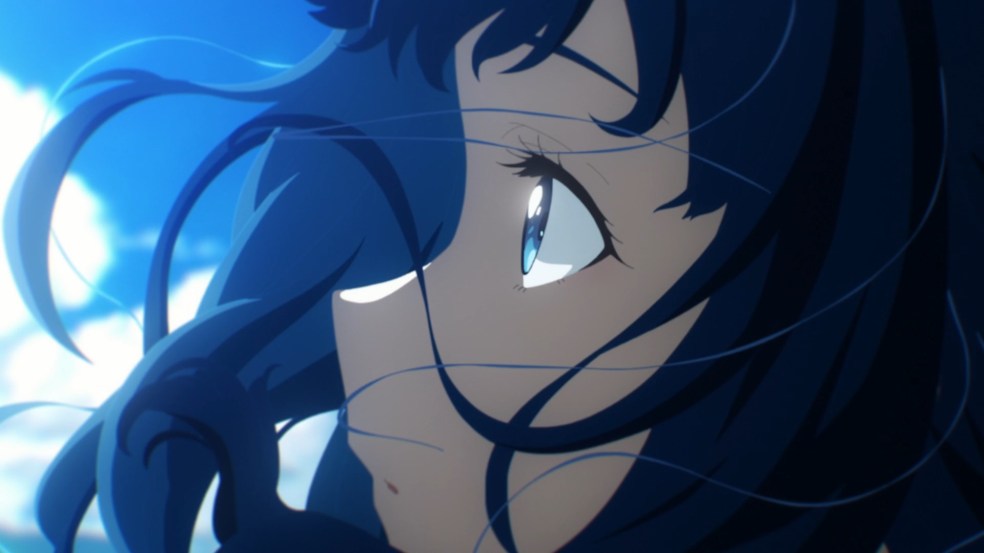
Seasonal First Impressions: Summer 2024 Stragglers

Seasonal First Impressions is a column where I detail my thoughts, however brief or long, about a currently-airing anime’s first episode or so.


I’ve done one of these once before, so you know the drill, let’s get into things.

Tasuketsu -Fate of the Majority-: We start out with something that was just really quite bad! The manga is ongoing and began a solid 11 years ago, so I can only imagine the incredibly fast pacing (and thus lack of any impact) for everything here is the result of running through a ridiculous number of chapters to set up a contrived death game scenario in 1 episode. This was an obvious, huge mistake on the part of whoever was in charge of adapting this and I can’t recommend it at all except maybe to gawk at how poorly it works.

The Ossan Newbie Adventurer, Trained To Death By the Most Powerful Party, Became Invincible: We’ve got a nominal comedy here, and there’s some tiny charge in the premise of our protagonist, Rick, only beginning his fantasy adventuring story at the age of 32. Unfortunately, the humor reveals itself pretty quickly to boil down to a couple stock gags. Rick being ridiculously strong because of his secluded mountain training with the party mentioned in the show’s title, Rick staring at some girl or another’s boobs, or various isekai clichés “hilariously” turned on their head to illustrate that some character or another is a loser. (Sometimes that’s also Rick, sometimes it’s someone else.)

The one joke here that isn’t plagiarized from countless other works of this nature is that of Rick’s age. This too mostly boils down to comments about how He Shouldn’t Adventure Because He’s Like 30 Or Something, or people calling him 40ish and it making him mad. It’s basically the “I’m 30 or 40 years old and I don’t need this right now” meme stretched to a whole 23 minutes. Despite being less openly rancid than the worst of its genre, there’s really not a lot to like here. Although there’s a certain rubberneck value to the almost GoHandsian way the character designs have been translated to screen. Sadly, that’s not matched by the animation, which is unremarkable aside from a nice cut when a lady-knight goes tumbling head over heels over and over near the end of the episode.

There’s a certain tedious, self-impressed nature to the humor, too. Analogous to the tedious, self-impressed melodrama of more serious narou-kei fare. Both are pretty unlikable, and Ossan Hero here is not any more likeable than its genre-fellows for its lighthearted tone. Even its misogyny feels rote and obligatory; female characters are introduced chest- or skirt-first, but the designs are too unappealing to even have any charge from that, and in any case the show’s lunkheaded nature just makes it feel lame. “Lame” is a good descriptor for this, overall.

Senpai is an Otokonoko: Do you know that meme that’s like, “am I a boy? Am I a girl? Nobody knows, and that makes everyone gay!” That’s basically the general thrust of My Senpai is an Otokonoko.

Frequent wild swings in art style are accompanied by similar swings in tone and mood. I would say that this seems like a remnant of however the manga’s written, serious moments intercut with comedic interludes. Neither really wins out as the “dominant” tone of the show, though, which, combined with its cobbled-together visuals, can make it feel somewhat incoherent. I wanted to like this, and it’s definitely not bad, but I’m not sure if I’m going to keep up with it or not. Watch this space, I guess?

Giji Harem: This is unfortunately just a flatly bad adaptation of a pretty good manga. Giji Harem was never a series with a particularly strong sense of place, so grounding the interactions in a more fully-drawn classroom (or wherever) doesn’t usually improve things and actively detracts from the original manga’s sketchy appeal. I could imagine someone liking the backgrounds, regardless, though, because they kind of have an accidental vaporwave quality to them. The bigger issue is that the half hour format completely sabotages the pacing. This just gives everything a kind of breathless clip as we move from one situation to another with no sense of rhythm and no time to really sit with any of these little bits that the main girl likes to do. I wouldn’t even say the voice acting is particularly great, which is a real issue because the female lead should ideally have a ton of range for something like this.

All told this just kind of sucks. I’m not a fan and would advise anyone who thinks the general premise is interesting to check out the manga instead.

Failure Frame: So first of all, to get what is obviously the most important thing out of the way, this show opens on a scene taking place in a bus. And I swear this is the same fucking bus as the one from Instant Death Skill back in Winter. If it’s not, I must truly be losing my mind.

Anyway, my overall impression of this is extremely negative; artless, self-pitying, relentlessly unpleasant drivel. The entire episode’s convoluted, contrived, cookie-cutter setup is an excuse to pen what is essentially shameless trauma venting. Rendered in thin metaphor via the stock isekai plot, sure, but trauma venting nonetheless. The one bright spot is Koshimizu Ami, voice actress for the disdainful goddess who summons our hero (and his entire class) to this other world. She absolutely kills the performance and one gets the sense that she just enjoyed having an excuse to turn in something this hammy.

That’s obviously not enough to sabotage something with writing this rancid, though. My main takeaway was just a strong feeling that I shouldn’t be watching this. Since first viewing the episode I’ve talked to some people who did like it and understand that there’s a sort of camp-edge value that some find in this sort of thing, but I couldn’t see it, personally. Very strongly not for me, thank you.

Dungeon People: This was okay! I do not think I will watch more of it, but it was okay.

Most of this first episode is just setup for the show’s general premise: a typical fantasy rogue is exploring a Wizardry-style dungeon, and accidentally breaks into the “back side” of the dungeon, and meets its manager, a little girl with vast magic powers. All of this amounts to, basically, a workplace comedy taking place in a JRPG dungeon, because our main character gets drafted into helping to keep the place running. It’s a decently fun premise, and the comedy is solid. I particularly like the bits that call back to this genre’s origins as a series of riffs on Wizardry, such as the wireframe-like effect when the MC senses some monsters through a wall. Also, it’s nice to see something that’s minimalist on purpose in an era where many shows can kind of feel accidentally so because they just aren’t done at air time. (See Giji Harem above, for example.)

My main issue is just that the show is so languid that it feels a bit boring. I compare this to other fantasy anime from this year with comedy leanings, like Dungeon Meshi or ‘Tis Time For Torture, Princess, both shows with a much livelier cast and just more going on in general, and it just doesn’t really measure up. That’s reductive and unfair, but it’s a competitive season in a competitive year, and I only have so much time on my hands. So I think this goes, somewhat reluctantly, into the drop pile. It’s just not quite good enough.

Narenare -Cheer For You!-: We end on a high note, because wow is this thing weird. There is a strange, perpendicular disconnect between what Nanare Hananare seems to want to be and what it actually is.

What it wants to be: an inspirational / lightly funny girls-get-it-done story about the joy and female camaraderie found in cheerleading. The obvious point of comparison here is Anima Yell!, a fun but mostly-forgotten anime with exactly that premise from about five years back.

What it actually is: A series of Sonic the Hedgehog speedrunning videos. A completely ridiculous tossed salad of diced gay vibes, a unique, soft visual look which makes the series seem to take place in a perpetual sunset, bizarre comedy, incredible feats of parkour and general People Flipping Over sorts of stuff, and a main story buried in there somewhere about a girl who’s undergoing physical therapy because of an illness and feels inspired when the main character, her best friend, cheerleads. Jokes include the fact that every character is dumb as a brick, a nonspecifically blonde foreigner named Anna [Tago Takeda Larissa] who they attempt to pass off as Brazilian and who smooches everyone she meets, the antics of a powerfully stoic freerunner / parkour ninja girl Suzuha [Nakashima Yuki], a Catholic school called “Ojou Girls High”, and on, and on. It feels near-Birdiewingian, but quite unlike Birdie Wing, this somehow feels entirely unintentional.

What a bizarre thing! What an absolute delight! I’m glad I took the time to check this out and I heartily recommend it.


Premiere season is, impressively, not over. So I will quite possibly see you again very soon, anime fans.


Like what you’re reading? Consider following Magic Planet Anime to get notified when new articles go live. If you’d like to talk to other Magic Planet Anime readers, consider joining my Discord server! Also consider following me on AnilistBlueSky, or Tumblr and supporting me on Ko-Fi or Patreon. If you want to read more of my work, consider heading over to the Directory to browse by category.

All views expressed on Magic Planet Anime are solely my own opinions and conclusions and should not be taken to reflect the opinions of any other persons, groups, or organizations. All text is manually typed and edited, and no machine learning or other automatic tools are used in the creation of Magic Planet Anime articles, with the exception of a basic spellchecker. However, some articles may have additional tags placed by WordPress. All text, excepting direct quotations, is owned by Magic Planet Anime. Do not duplicate without permission. All images are owned by their original copyright holders.

Seasonal First Impressions: Back to the Bottom in TOWER OF GOD SEASON 2

Seasonal First Impressions is a column where I detail my thoughts, however brief or long, about a currently-airing anime’s first episode or so.


“He who climbs upon the highest mountains laughs at all tragedies, real or imaginary.”
-Friedrich Nietzche quote, decontextualized and used as the blurb for my original review of Tower of God‘s first season.

Rachel pushed Bam. That’s what everyone remembers, that was the defining twist of this section of Tower of God’s story back when it was originally written and when it was adapted for anime. Bam was yanked from his quest to climb to the top of the mystical tower by a woman with complex motivations that we were only half-privy to. Naturally, the dark depths of Shonen Twitter crucified her, and she’s become one character in a long lineage to be declared A Total Irredeemable Bitch by a certain genre of anime fan. Tower of God Season 2 picks up several years later, with an older Bam [Ichikawa Taichi] alongside a new co-protagonist. Rachel was my favorite character, and still is, but we don’t learn what happened to her after her betrayal of Bam here. Not yet.

The intervening years have been unkind to this IP. Slave.in.utero, the author of the original webtoon, had a health scare, and the comic was put on hiatus for a while as a result. Rumors persist that the anime was jammed up in production issues, changing studios and directors in the process. The Tower of God that arrives to us in 2024 is a very different animal than the one we first met in 2020, when I called it a “contender for the Shonen Crown” in my in hindsight just slightly hyperbolic praise of the show’s first episode. Tower of God‘s history is tied up, in a minor way, with my own as an anime critic. It’s a truism that if you write criticism for long enough, you’ll eventually start talking about yourself, so why fight it? Let’s talk about my brief personal history with TOG.

Tower of God was the first series I was ever paid to cover, and I reveled in the opportunity to energetically break its episodes down week-by-week for GeekGirlAuthority, who I worked for at the time. I even, at one point, got to do a brief email interview with some of the voice actors for the English dub, including Johnny Young Bosch, a hero to my teenage self for voicing Lelouch Lamperouge. I remember this period of my life pretty fondly, but the intervening years have been unkind to this writer, too. I left GGA amicably, refocusing my efforts over here to Magic Planet Anime. Things have been tough, I started my own Let’s Watch series, ended it, caught COVID, which I am still dealing with the aftereffects of, spent a lot of time cooped up by myself, and on. And on.

None of this is Tower of God‘s fault. There’s a lot to be said for persistence, and watching the first episode gave me an odd feeling of camaraderie. “Yeah man, it’s been a tough four years for me, too.” Maybe that’s why new main character Ja Wangnan [Uchida Yuuma] gives himself a little pep talk about not giving up when we meet him. Maybe that’s why I was endeared to the guy even though he’s kind of a dick. Here’s a short list of things he accomplishes over the course of this first episode:

  1. Promises a little kid that when he becomes king, he’ll give him a super awesome ramen stand. This promise is made because the kid gave him a ramen coupon.
  2. Signs his organs away to a mob boss.
  3. Says multiple conflicting things to multiple people in the survival exam room (more on that in a second), while they’re all within earshot of each other.
  4. Makes a little girl cry.
  5. Tries and utterly fails to act tough in front of the older, edgier, much prettier 25th Bam.

All this to say, he’s a dick, but an entertaining and charismatic dick. I like him and had fun following him here, and he seems to have good intentions underneath it all. I’m sure the Tower will test them mightily, as it is wont to do, but it puts him on the right side of the “jerk in an annoying way”/”jerk in a funny way” divide.

His goal is graduating the survival exam, which you might remember from an early episode of the original series. Visually speaking, the action on display here is what saves the first episode from just being a straight visual downgrade of season one. Whatever you thought of Tower of God‘s first anime season, it had a distinct visual identity that really attempted to convey the look of the comic in motion. That’s a lot less obvious here, especially with the environments, which have what a friend described in a recent post of their own as a “seasonal-style” look. That is to say; they’re definitely drawn by professionals, but lack much in the way of personality. This is clearest with Wangnan’s apartment, which looks dreadfully generic.

“Are you sure we should just be using the same woody gradient for every interior wall?” “Yeah, it’ll be fine.”

So the action scenes (or scene, really) having as much focus and direction as it does is good. That, combined with the strong character writing, makes me want to keep watching, which is an achievement all its own in a season as strong as this one. Tower of God may not be the same show it was 4 years ago, but it’s still here, and that does legitimately count for something. Score one for surviving.


Like what you’re reading? Consider following Magic Planet Anime to get notified when new articles go live. If you’d like to talk to other Magic Planet Anime readers, consider joining my Discord server! Also consider following me on AnilistBlueSky, or Tumblr and supporting me on Ko-Fi or Patreon. If you want to read more of my work, consider heading over to the Directory to browse by category.

All views expressed on Magic Planet Anime are solely my own opinions and conclusions and should not be taken to reflect the opinions of any other persons, groups, or organizations. All text is manually typed and edited, and no machine learning or other automatic tools are used in the creation of Magic Planet Anime articles, with the exception of a basic spellchecker. However, some articles may have additional tags placed by WordPress. All text, excepting direct quotations, is owned by Magic Planet Anime. Do not duplicate without permission. All images are owned by their original copyright holders.

Seasonal First Impressions: Dead or Alive 1333 – In Search of THE ELUSIVE SAMURAI

Seasonal First Impressions is a column where I detail my thoughts, however brief or long, about a currently-airing anime’s first episode or so.


The opening few minutes of The Elusive Samurai are mostly setup, to establish our feudal Japanese setting, and some basic character humor. I must stress, not very good character humor. These are all cracks at the expense of one-note stereotypes; an ableist caricature that serves as a puppet ruler, a greedy, homely girl who hounds our main character because she has Mon signs in her eyes over the idea of marrying him someday, etc. I bring this up first not to criticize a Jump adaptation for having Jump manga humor (it’s an unfortunate reality of most things that run in the magazine, honestly), but to point out that Elusive Samurai pulls off a pretty nasty little trick with it, one that I can only respect. By the end of the episode, no matter what you thought of these characters and their flat interjections of comedy the first time around, you’re going to miss them, and appreciate the stabs of comedy that remain, no matter how out of place they’d otherwise seem.

The Elusive Samurai is interesting as an adaptation, essentially holding the manga open and bleeding it. The resulting effect is a series of incredibly strong tones, moods, and single scenes that work excellently in of themselves but only cohere if you take a step back. This isn’t a major departure from the manga, to be clear. Both feature a wild tonal seesaw. But the manga’s visual experimentation in the first chapter is constrained. Panels align to grids, pages are more or less orderly. Ambitious, but typical. The anime, meanwhile, is a shattered, slivered kind of chaos. Everything clashes with everything. All abrupt jolts. A procession of staccato jumps. It’s abrupt. Percussive. An analogy: Elusive Samurai is a song. Its plot beats, the rhythm. Tokiyuki, our lead, is the melody. When the action follows him, it sings and soars. He’s like a rabbit; nimble, ferociously committed to his own survival, and so cute you can’t help but be on his side. Yuikawa Asaki gives him an endearingly boyish voice, which goes a long way to elevating his already strong characterization from the manga.

I’m not trying to downplay that manga; it still does quite a lot with the 50ish pages of its opening chapter. But one gets the clear sense that it’s straining against the format a little1, which simply isn’t true of the anime. Every hook and jab designed to throw you off kilter feels intentional. Around the episode’s halfway point, Tokiyuki and his older brother—the child of a concubine—are playing with a kickball. It ends up on a roof, and it never comes back down. Instead, an ice-cold match cut turns it into a severed head, and from then on, Tokiyuki’s idyllic life is over.

Let’s rewind a little. Hojo Tokiyuki was a real person, a member of the Hojo, a house in 14th century Japan who were, in loose terms, nominal rulers of the country but several steps removed from any actual power. (The Hojo were, and Tokiyuki is the heir of at the start of the story, something absurd like the regents for the shogun for the Emperor. In turn, they, via Tokiyuki’s father, who is here the ableist caricature mentioned up at the top of this article.) The Elusive Samurai is thus, very loosely, historical fiction. Its events comprise the leadup to, and depending on the time period this series spans, possibly the actual events of, the Nanboku-chō Wars.

This friendly-looking tale of straightforward heroism is presented to us at the start of the series as an example of what we will not be seeing here.

This setting contextualizes all of these tone shifts somewhat. On the one hand, Tokiyuki is a child. He’s a boy of scarcely 8 whose tutors, throughout the episode’s bright forehalf, chastise him for being lazy, for running away when he doesn’t want to do something, and just generally being too carefree. But he is also a noble, and while his father’s position is that of a puppet, it is still a position. These expectations must weigh on him, and we get some sense of how when we’re introduced to our other main character.

Suwa Yorishige [Nakamura Yuuichi], a priest, is introduced to us, to Tokiyuki, literally beaming. The boy-prince finds himself in a tree and Yorishige appears suddenly behind him, offering portents of glory and doom in an extremely overbearing, forceful fashion.

A divinity dwells within him and seems to spill out of the screen; when he’s “on,” he emits radiant lights, dimmed somewhat only by his snarky assistant Shizuku [Yano Hinaki], who explains he’s a sham of a priest, but a real oracle. When Yorishige proclaims that Tokiyuki will, in a few years time, be a war hero beloved and feared in alteration, the prince is skeptical, and he promptly darts off once again.

Returning to his castle, we return to the scene of he and his brother playing. We return to the ball, and to the severed head.

When the violence intrudes in the episode’s second half, it is immediate, overwhelming, and oppressive. Like the smoke from a fire, but not like the smoke from a fire, as the city burns in very literal flames. The betrayal of Takauji [Konishi Katsuyuki], a vassal of Tokiyuki’s, marks a massive and irreversible turning point in the individual lives of not just Tokiyuki and every other character, but history itself. The two are juxtaposed; big, white text pops up like news headlines, proclaiming mass death, including of characters we met in the lighthearted first half of the episode. Tokiyuki’s archery teachers? Dead. His father? Committed suicide alongside his retainers. Kiyoko [Matsuda Satsumi], the girl who teases him in the very first main scene of the episode? “Violated and brutally killed,” per the sub track. These things aren’t dwelled on, exactly. They’re just presented as cold facts as the city of Kamakura burns to cinders. (Although it doesn’t feel like a coincidence that many of these characters are the very same who offhandedly called him cowardly in the episode’s first half.) The pounding drums of what’s become a war song.

One can hardly blame Tokiyuki for being completely devastated. When Yorishige appears to rescue him, he initially rejects the offer. He wants to die alongside his father. What’s more surprising is that the sham shaman obliges, pushing the displaced prince off of a cliff and alerting a group of samurai to his presence. In this hopeless situation, does the rabbit lay down and die?

Of course not. The running, ducking, bobbing, hiding, and dodging of the first half of the show comes flooding back. This time, with consequence. The samurai hack and cleave at him, but only hit each other. They go from an indistinct, merged smear of viciousness to cutting each other’s limbs off; both senses of the phrase “bleeding together” bleeding together. Improbably, Tokiyuki escapes. He, Yorishige, and Shizuku retreat into the night. The composition of the show has flipped around; now, Tokiyuki is the percussion, and the melody are the smoldering flames reaching into the night sky as he flees.
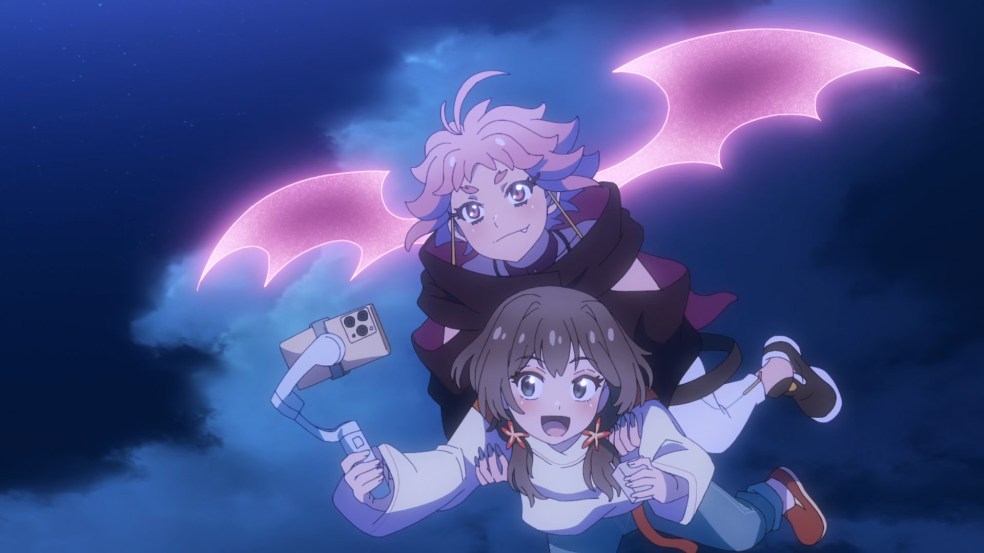
Yorishige lays out a plan. Tokiyuki can’t defeat Takauji alone, he must hide, he must flee, he must court allies and deceive his enemies. Tokiyuki must become El-ahrairah; cunning, full of tricks, listener and runner. That’s just how it goes for a prince with a thousand enemies. If it feels hard to read any glory into such a tale, that’s probably the point. A story where the hero is a coward and the villain sends armies to rape and murder townsfolk isn’t the cheeriest thing, no matter how much cheesing for the camera Yorishige might do. Then again, brutal violence is hardly a foreign element to this kind of historical fiction. That’s probably part of the point, too. The show spells it out directly; Tokiyuki is a hero of life. Takauji, his nemesis, one of death.

The series asks us to take on faith that this will be worth it, in the end, that it will tell a satisfying story. It’s a fair point to raise! All of these visual tricks are great and lovely and engaging, but does this story come together? If you take a very big picture view, you can read its dizzying fractiousness as intentional, as I’ve chosen to do here, but we’re in for 11 more episodes of this stuff, so it’s fair to ask what it will all add up to. And there is always the temptation to try to be definitive. If you forecast that a show will do this or that, and then it does, you look like a prophet. (Or, at least, someone who knows their Japanese history, in this case.) The honest answer though is that we won’t know if it feels “worth it” until we get there, and I think looking to divine the future is, in the case of something so freewheeling, probably doomed to frustration. The Elusive Samurai‘s visual element alone gives me more than enough to chew on to want to come back next week, but combined with the plight of Tokiyuki, fleeing into the night with his whole world in smoldering splinters behind him, it becomes magnetic. I have to know more.


1: Although it does experiment in its own way, eg. a raised sword jutting through one panel to pierce another on the opposite page.


Like what you’re reading? Consider following Magic Planet Anime to get notified when new articles go live. If you’d like to talk to other Magic Planet Anime readers, consider joining my Discord server! Also consider following me on AnilistBlueSky, or Tumblr and supporting me on Ko-Fi or Patreon. If you want to read more of my work, consider heading over to the Directory to browse by category.

All views expressed on Magic Planet Anime are solely my own opinions and conclusions and should not be taken to reflect the opinions of any other persons, groups, or organizations. All text is manually typed and edited, and no machine learning or other automatic tools are used in the creation of Magic Planet Anime articles, with the exception of a basic spellchecker. However, some articles may have additional tags placed by WordPress. All text, excepting direct quotations, is owned by Magic Planet Anime. Do not duplicate without permission. All images are owned by their original copyright holders.