
Magic Planet Arcade is a once-in-a-great-while column where I take a break from writing about cartoons to write about video games instead.
The flashing text of a bootup sequence gives way to a run-and-jump through an ominous, empty structure. Thoughts flash on-screen, whether they’re ours or someone else’s is not immediately clear.

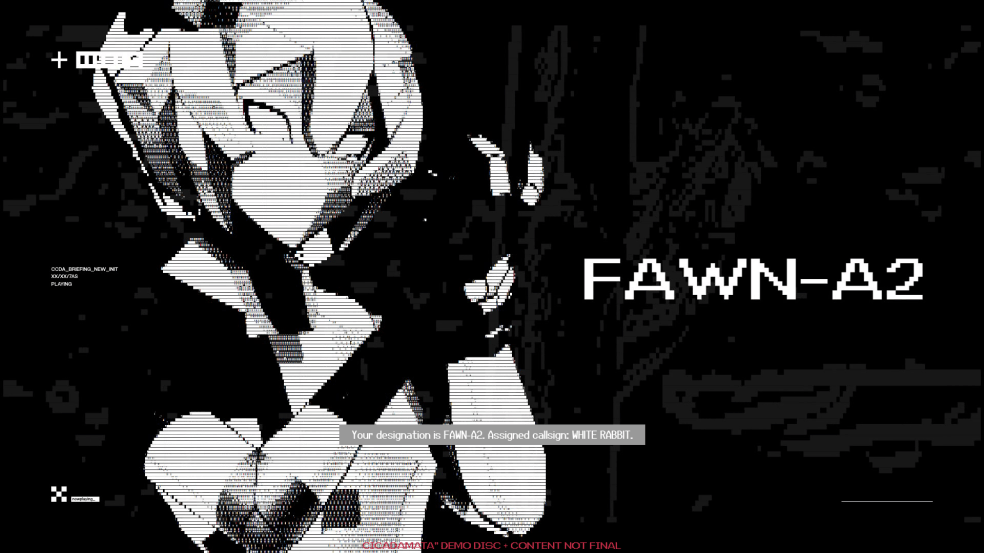
As the portentous omens come to a climax, we are reunited with our right hand, the [?handheld_assistant/;bestfriend/;gun] JOYEUSE, the first of many allcaps nouns we’re going to meet here. An AI named AEGIS, in a friendly, feminine voice, informs us that due to circumstances in our previous life, we have been drafted as a “Cicada”, broadly outlined as a sort of immortal robotic (or perhaps cyborg?) supersoldier. Our name is FAWN-A2, callsign The White Rabbit. Without more than a moment to get our bearings, AEGIS informs us that we are to be dropped into environs called SPHERES, somewhere in the CASCADE—the very nature of what the CASCADE even is is not explained to us—where we will retrieve sets of objects labeled CORES. Standing in our way is a variety of THREATS, named in broad terms that gesture at their form or function; SHOOTER, BOUNCER, CRAB, ESPER, etc., and rendered in a Superhot-esque red. Our instructions are very simple; get the CORES, get out, and if anything gets in our way, rip and tear.
If you’d think this sounds like the noun-heavy setup for a pretty simple FPS game, you’re half-right. Mechanically speaking, Cicadamata is part of the “go fast and beat ass” lineage of ‘movement shooters’ typified by something like Ultrakill. It’s an imperfect comparison, as Cicadamata‘s level layouts are generally a bit less enemy-focused and the visual aesthetic is very different (a future-retro “vectorheart” art style vs. Ultrakill‘s neo-Playstationy look), but they’re in the same ballpark. Cicadamata‘s weapon selection is very stripped-down compared to most FPSes. There is no “selection” at all, in fact. You have just one gun, Joyeuse itself, who functions as a cross between a shotgun, and, when the aim button is held, a sniper rifle. Joyeuse at your side, you can jump up to three consecutive times and dash once (thus really earning the “rabbit” part of your name) to hop about the levels, obliterate THREATS, and get to the exit. You also have a “stomp”, a diving downward drop that lets you step on enemies Mushroom Kingdom-style, should that be your preference.

Describing it in text does not really do justice to the kinetic feeling of actually playing Cicadamata. I’ve played a number of other games in this genre, and, to reveal my hand a bit, I tend to only get so much out of them. I’m simply not a competitive, top-of-the-leaderboards kind of player, it’s not in my nature. But Cicadamata‘s relatively stripped-down visual style—not a lot of complex textures here, for instance—lets it throw a lot of individual elements at you at once, which, combined with the twitchy movement and disassembled, surreal level geometry, makes the whole thing feel overstimulating in a good way. It’s properly buzzy, in fact, and AEGIS’ robotically gentle voice telling you that she’s proud of you when clear a level gives the entire thing a decidedly praise kink-y undertone. (Not the lone example of horniness. More overt, for instance, is the fact that one sees White Rabbit’s ass on the level results screen. But if you are expecting me to list that as a negative, I have bad news for you.) I am not normally the sort of person who’s inclined to try for S-rank clear times or the like, but Cicadamata tracks that, and I found myself aiming for Diamond (its highest rank) more than once, playing levels over and over despite the Demo Disc only having five of them. “Addicting” as an adjective in a video game context is beaten to death, and has a bit of a sinister cast to it. So I’ll just say I really, really enjoyed the 3 1/2 hours I managed to squeeze out of the demo, and plan to pick the game up when it releases.
Even more compelling to me than the gameplay however is the impressive amount of intrigue Cicadamata manages to build about its world in the demo’s short runtime (my first complete playthrough took perhaps 30 minutes) and lack of anything akin to cutscenes, normal dialogue, etc. If you linger around the dropship that starts each level, you’ll sometimes hear AEGIS deliver a bit of exposition about the SPHERE you’re in. (She’ll also encourage you to use the affirmation phrase “I am okay, the air is just heavy today” if you get scared or nervous. There is absolutely no sinister undertone to this whatsoever, I am assured.) There are also text terminals one can find in a few levels, something that greatly excited me in general.
Earlier, I compared this game to Ultrakill, perhaps the most successful of the movement-shooters that Cicadamata positions itself alongside. I love Ultrakill, don’t get me wrong—I’m transgender, it’s in the signup forms—but Ultrakill‘s religious saga about blood-fueled robots in an eschatological post-armageddon is a fairly different vibe than what’s going on here. To me, the text terminals seal the less immediately obvious, but perhaps more instructive, comparison. Despite having less in common with Cicadamata on a gamefeel level, the spectre of the original Marathon trilogy looms large over this game. (And the art direction brings to mind some trace of the Marathon reboot, as well.) Not just the first game, Marathon itself, but also Durandal, and Infinity. Cicadamta‘s story, if the Demo Disc is any indication, will be told in sputtering, half-remembered fragments, sometimes from the text terminals, and sometimes from stranger sources, be they hidden or randomly triggered. This very appropriate for themes of trauma, transformation, and the inherent fallibility of perception, all of which are present in the five terminals scattered across the demo. Each of these is brief, but they’re incredibly evocative, making use of cryptic phrasing, unknowable imaginary technical jargon crammed into crucial reports we have only some of the context for, diary-esque framing, and a [?bracketed word/synonym/evocative_third_word] writing trick that I’ve seen in a few places before but which never fails to delight me.

That you have to actually keep an eye out for the terminals might seem to scuttle the Marathon comparison a bit. After all, those games had plenty of hidden terminals, but most were right out in the open. But it brings most to mind a specific stretch of the series in particular, the so-called “Dream” levels in Marathon Infinity; the transitional “Electric Sheep” levels, “Where Are Monsters in Dreams“, “Eat The Path“, some of the most striking and surreal spaces in the entire trilogy, where the games’ otherwise linear storytelling begins to break down and it is made obvious to us, via heaps of surreal textual scenes, that our own player character is not necessarily an objective witness to events. Cicadamata even seems to be cognizant of this similarity, the first hidden terminal you can find makes mention of “Onaeire”, a name used vaguely but seemingly in reference to the location of the SPHERES or perhaps the entire setting in general. “Onaeire” is a fictional place-name, whatever its significance, but it seems to deliberately call to mind the adjective oneiric. Dream-like.

The Marathon comparison exists on an even more obvious level as well. Our [?shotgun/;handheld_assistant/;bestfriend] Joyeuse is named after one of Charlamagne’s swords. This is a naming convention directly borrowed from Bungie, who named the main AI companion in their first sci fi FPS trilogy Durandal and the same in the second Cortana. (Now, the one actually talking to us in our mission briefings and such is AEGIS, but given the tutorial, and some other factors, such as the talk that Joyeuse gives you little one-liner pep talks any time you zoom in with it, I do think the homage is intentional.) So this is clearly a reference Cicadamata is deliberately invoking, something being reached for.

Note Joyeuse talking to us in the bottom right. They have dozens of these quotes, some of which are just cute references and some of which seem to actively develop the relationship between Joyeuse and FAWN-A2. It’s very easy to completely gloss over this if you’re not looking for it, but I hope it remains and is expanded upon in the full game.
This would be meaningless if it weren’t a great game in its own right, of course. I do hope I made the fact that I think it very much is clear farther up this page. In addition to all that can be said about how the game looks and feels, what themes its story might eventually unpack, the main thing that impresses me is just how fresh it feels. The familiar toolbox of the movement shooter is there, to be certain, but gameplay, art, story, even audio intersecting in such a specifically compelling package makes for a game that is just absolute catnip to me and people like me. Not for nothing has the demo alone attracted a fair bit of attention (I’m not the first person to write about it, and I certainly won’t be the last). If I can peg all of its success on one thing, it is that sense of newness. Aspects of Cicadamata may be familiar, but it’s hard to name anything that’s put them together in this way before. There’s something new brewing here, and that’s genuinely exciting.
The only bad thing about all this is that, as of the time of this writing, you can’t actually play the demo anymore! I’m not really a games journalist, as the existence of just two other articles on this site about video games attests to. And by the time I’d heard about Cicadamata, played the demo, and had the thought to write about it, the timelocked demo was already just a half-day out from expiring, and by the time you read this, it will have run out entirely. (If I can levy any real criticism here it’s that I find that entire practice frustrating, though even there, I’m not sure if it’s a choice of the developers’ or some kind of requirement for being involved in Steam NextFest.) So if any of this sounds interesting to you, you will have to wait until the release of the game proper. Waiting can be frustrating, for sure, especially for something that doesn’t have a concrete release date yet. But you won’t wait alone; something else also waits in the heavens, and that, precisely, is why Cicadamata is so interesting.

Like what you’re reading? Consider following Magic Planet Anime to get notified when new articles go live. If you’d like to talk to other Magic Planet Anime readers, consider joining my Discord server! Also consider following me on Anilist, BlueSky, or Tumblr and supporting me on Ko-Fi. If you want to read more of my work, consider heading over to the Directory to browse by category.
All views expressed on Magic Planet Anime are solely my own opinions and conclusions and should not be taken to reflect the opinions of any other persons, groups, or organizations. All text is manually typed and edited, and no machine learning or other automatic tools are used in the creation of Magic Planet Anime articles, with the exception of a basic spellchecker. However, some articles may have additional tags placed by WordPress. All text, excepting direct quotations, is owned by Magic Planet Anime. Do not duplicate without permission. All images are owned by their original copyright holders.
 The Magic Planet